
Submitted:
22 February 2025
Posted:
24 February 2025
You are already at the latest version
Abstract
Wireless Rechargeable Sensor Networks (WRSNs) have emerged as a sustainable solution to the energy limitations of traditional Wireless Sensor Networks (WSNs). By integrating Wireless Power Transfer (WPT) technologies, WRSNs enable continuous energy replenishment, enhancing operational longevity and efficiency. However, challenges in energy management, charging strategies, and scalability persist. This review systematically examines recent advancements in WRSN energy management, focusing on state-of-the-art methodologies such as Deep Reinforcement Learning (DRL), Fuzzy Logic, metaheuristic optimisation, and UAV-assisted charging. A novel taxonomy is proposed to categorise charging strategies based on mechanisms, optimisation techniques, energy sources, and application domains. The review highlights key trends, including multi-agent UAV coordination, hybrid charging schemes, and decentralised energy optimisation. A comparative analysis evaluates the trade-offs in efficiency, scalability, and feasibility of existing approaches. Critical challenges such as computational overhead, real-world deployment feasibility, and scalability constraints are identified. The study underscores the need for adaptive scheduling mechanisms, intelligent energy management frameworks, and empirical validation to bridge the gap between simulations and practical implementation. Future research directions include sustainable charging solutions, enhanced scalability, and robust optimisation techniques to improve network reliability and efficiency in large-scale WRSN deployments.
Keywords:
Wireless Rechargeable Sensor Networks (WRSN)
; Energy Efficiency
; Lifetime Enhancement
; Energy Optimisation
; Sensor Nodes
; Mobile Chargers
; UAV-Assisted Charging
; Deep Reinforcement Learning (DRL)
; Metaheuristic Algorithms
1. Introduction
Wireless Rechargeable Sensor Networks (WRSNs) mark a significant evolution from traditional Wireless Sensor Networks (WSNs). By integrating Wireless Power Transfer (WPT) technologies—such as electromagnetic induction, resonant coupling, and microwave power transfer [1]—WRSNs address the critical limitation of battery depletion in conventional WSNs. This allows for continuous energy replenishment, eliminating the need for manual battery replacements or dependence on unpredictable energy harvesting. As a result, WRSNs are well-suited for applications requiring long-term, autonomous operation, including smart cities, healthcare monitoring, and industrial automation [2].
Beyond extended battery life, WRSNs offer key benefits. WSN enhances energy efficiency by enabling sensor nodes to recharge, ensuring prolonged wireless network functionality. Their ability to combine wireless charging with optimised data collection methods also reduces operational costs [3]. Additionally, WRSNs improve reliability by integrating dual-function vehicles that manage both data transmission and energy replenishment. Their flexibility allows deployment in diverse environments, making them ideal for applications in agriculture, defence, and industrial monitoring. Moreover, the network’s scalability, supported by coordinated actions between multiple robots and sensors, ensures efficient data gathering and analysis [4]. These advantages make WRSNs essential for optimising energy use, minimising costs, and maintaining reliable data flow in modern technological systems.
However, despite these benefits, energy management remains a key challenge in WRSNs. One of the primary concerns is the limited energy supply, as harvested power is often insufficient to sustain continuous operations, particularly in high-demand environments. The uneven energy distribution is another issue, where sensor nodes receive more power than others due to inefficiencies in charger placement or energy transfer mechanisms, leading to performance imbalances [5]. Charging scheduling adds another layer of complexity, requiring careful coordination to ensure prompt recharging without disrupting network operations. Additionally, high energy consumption in data transmission can rapidly drain node batteries, especially when inefficient routing leads to excessive power usage, creating coverage gaps. In mobile WRSNs, mobility-induced variability makes energy availability unpredictable, as robots or UAVs supplying wireless power may move irregularly, causing fluctuations in energy supply. Finally, environmental factors such as obstacles, signal attenuation, and adverse weather conditions can interfere with wireless energy transfer, reducing overall efficiency{Citation}. Addressing these challenges requires intelligent energy optimisation algorithms, dynamic charging strategies, and advancements in hardware for more efficient energy harvesting and storage.
This review is structured into seven sections to thoroughly explore the latest research trends in Wireless Rechargeable Sensor Networks (WRSNs). Section 1 sets the stage by discussing the significance of energy management, the challenges faced in WRSNs, and the goals and scope of this review. Section 2 thoroughly examines and synthesises earlier studies, offering a detailed and structured analysis of the existing literature. Section 3 details the methodology, including the search strategy, study selection process, and taxonomy development. Section 4 presents the taxonomy of WRSN charging strategies. Section 5 and Section 6 delve into the thematic review and discussion of emerging research directions. Finally, Section 7 summarises the main findings and offers recommendations for advancing research in this field. This structure ensures a clear and systematic exploration of WRSN advancements.
2. Overview and Related Works of WRSN
2.1. Overview of WRSNs
Wireless Rechargeable Sensor Networks (WRSNs) are a significant advancement over traditional Wireless Sensor Networks (WSNs), addressing the critical issue of battery depletion by integrating Wireless Power Transfer (WPT) technologies. These networks use methods like electromagnetic induction, resonant coupling, and microwave power transfer to continuously recharge sensor nodes, eliminating the need for manual battery replacements or reliance on unpredictable energy harvesting. This capability makes WRSNs ideal for applications requiring long-term, autonomous operations, such as smart cities, healthcare, industrial automation, agriculture, and defence. In smart cities, WRSNs enable real-time traffic monitoring, waste management, and environmental sensing. In healthcare, they support patient monitoring and remote diagnostics, while in industrial settings, they facilitate machine monitoring and predictive maintenance. Agriculture benefits from soil and crop monitoring and defence applications include surveillance and battlefield monitoring.
Despite their advantages, WRSNs face several challenges. Energy constraints, such as limited supply and uneven distribution, remain a major issue, alongside scalability problems when expanding networks to include more nodes. Dynamic environments, where energy demand fluctuates due to changing conditions, add complexity to charging schedules. Environmental factors like obstacles, signal interference, and adverse weather can also hinder wireless energy transfer. To address these challenges, researchers have developed advanced charging mechanisms, including hybrid systems that combine static and mobile chargers and UAV-assisted charging for flexible energy replenishment. Optimisation techniques like Deep Reinforcement Learning (DRL) and metaheuristic algorithms (e.g., Genetic Algorithms, Particle Swarm Optimization) have improved energy management. AI and machine learning enable adaptive charging strategies and predictive maintenance.
Looking ahead, future research in WRSNs should focus on real-world implementation to validate theoretical models and address practical challenges. Integrating modern AI-based methods with classical optimisation techniques could yield more robust solutions, while dynamic and adaptive charging strategies are needed to handle unpredictable environments. Advancements in energy harvesting, such as solar, vibration, and thermal energy, along with efficient energy storage solutions, will further enhance sustainability. Additionally, coordinating multiple mobile chargers and optimising their paths will improve energy distribution in large-scale networks. [6,7] highlighted these areas, emphasising the need for hybrid frameworks, real-world testing, and innovative energy solutions. By addressing these challenges and exploring new directions, WRSNs have the potential to revolutionise industries and improve quality of life through reliable, long-term monitoring and automation.
Figure 1 outlines a general overview of Wireless Rechargeable Sensor Networks and shows a clear overview of how a Wireless Rechargeable Sensor Network operates. At the heart of the system is the Base Station, which acts as the central hub, coordinating the entire network. It sends charging schedules to mobile chargers, ensuring that energy is delivered efficiently and receiving data collected by sensor nodes. These sensor nodes are deployed in the Environment, where they gather critical information such as temperature, humidity, or motion. Once the data is collected, the sensor nodes transmit it back to the base station for processing. To keep the sensor nodes operational, mobile chargers travel through the network, recharging them using Wireless Power Transfer technologies like inductive or resonant coupling. After completing their charging tasks, the mobile chargers return to the base station, ready for their next assignment. This seamless interaction between components ensures the network remains functional, reliable, and capable of long-term operation in various environments, such as smart cities, industrial facilities, or agricultural fields.
2.2. Related Survey Works
In this section, we explore the foundational work that has shaped the current understanding of the topic. By reviewing a selection of key review papers, we aim to synthesise the insights, methodologies, and gaps identified by previous researchers. This not only provides a clearer picture of the field's evolution but also highlights areas where further exploration is needed. Our goal is to build on this existing knowledge, offering a fresh perspective while acknowledging the valuable contributions of those who have paved the way.
Earlier review papers collectively provided a broad overview of key topics in Wireless Rechargeable Sensor Networks, such as mobile charging techniques, energy optimisation, and mobility impacts. However, they lacked depth, critical analysis, and real-world applicability. For instance, [8,9] offered surface-level insights into mobile charging and mobility strategies but failed to address practical challenges or propose innovative solutions. Similarly, [10,11] focused on theoretical frameworks without concrete examples or actionable insights. [12,13] highlighted advancements in energy provisioning and communication optimisation but fell short in critically evaluating real-world performance or offering forward-thinking directions. [14] reviewed energy-efficient routing in WSNs, focusing on meta-heuristic and AI-based optimisation techniques. However, it lacked practical examples, glossed over data privacy and security, and failed to provide a clear taxonomy.
Table 1 shows the comparative analysis of the related works; this table serves as a gap analysis tool, revealing recurring weaknesses across studies.
Table 2 shows the comparative evaluation of the related works; this table presents a comparative evaluation of six review papers on Wireless Rechargeable Sensor Networks (WRSNs). Each paper is assessed based on ten key parameters, including scope, literature coverage, critical analysis, and contribution to the field. Ratings (1-5) are assigned to each category, with 1 indicating poor performance and 5 indicating excellent performance.
The evaluations above revealed significant gaps in existing WRSN review papers. While most provided a broad overview, they lacked depth and failed to offer novel insights. Critical analysis remained weak, with papers primarily summarising rather than rigorously comparing methodologies. Additionally, studies lacked a transparent and systematic literature review process, raising concerns about bias and omissions. Although attempts at classification existed, none established a comprehensive taxonomy to guide future research. These shortcomings highlighted the need for a high-impact survey that delivers a thorough critical analysis, a well-structured taxonomy, and a clear research roadmap to advance the field.
3. Research Methodology
This section describes the methodology used to conduct the review, including the search strategy, study selection process, and taxonomy development. The goal is to provide sufficient detail for replication and ensure transparency.
3.1. Search Strategy and Data Sources
A structured literature search was conducted using Scopus, a widely recognised academic database that indexes high-impact, peer-reviewed publications. The search aimed to identify studies focusing on Wireless Rechargeable Sensor Networks (WRSN) and energy efficiency techniques.
3.2. Search Query and Keywords
The search was conducted using the following query:
("Wireless Rechargeable Sensor Networks" OR "WRSN") AND ("Energy Efficiency" OR "Mobile Chargers" OR "Lifetime Enhancement" OR "Energy Optimisation" OR "Sensor Nodes").
The search spanned from January 2024 to December 2024, ensuring a focus on the most recent research developments.
3.3. Study Selection Process
The study selection process followed the PRISMA framework to ensure transparency and reproducibility. The steps included:
- Initial Retrieval: A total of 720 papers were identified from the Scopus database using the search query: ("Wireless Rechargeable Sensor Networks" OR "WRSN") AND ("Energy Efficiency" OR "Mobile Chargers" OR "Lifetime Enhancement" OR "Energy Optimisation" OR "Sensor Nodes").
- Duplicate Removal: After identifying and removing 132 duplicate records, 588 unique articles remained for screening.
- Title and Abstract Screening: Each paper was reviewed for relevance based on its title and abstract. Studies that did not explicitly focus on WRSN energy efficiency strategies or lacked technical contributions were excluded. This step resulted in the removal of 456 papers, leaving 132 for full-text review.
- Full-Text Review: The remaining 132 papers were assessed for methodological rigour, relevance to WRSN energy efficiency, scheduling or charging strategies, experimental validation or simulation results, and novel contributions compared to existing literature. After this evaluation, 78 papers were excluded for not meeting the selection criteria, resulting in a final set of 54 papers for inclusion in the review.
3.3.1. Inclusion and Exclusion Criteria
Inclusion Criteria:
- Peer-reviewed journal and conference articles published between January and December 2024.
- Papers focusing on charging strategies, energy management, and efficiency improvements in WRSN
- Studies presenting new methodologies, experimental validations, or simulations
- Exclusion Criteria:
- Non-English articles
- General wireless network studies without an emphasis on wireless power transfer or charging
- Papers without experimental validation, simulations, or practical applicability
3.3.2. Selection Methodology Justification
The PRISMA diagram was chosen as it provides a transparent, structured, and reproducible approach to literature selection. It allows for clear tracking of paper inclusion and exclusion at every stage, ensuring that other researchers can replicate the review process.
3.4 Taxonomy Development
To systematically organise the diverse research directions in Wireless Rechargeable Sensor Networks (WRSNs), we developed a taxonomy that categorises the reviewed works based on their methodologies, objectives, and applications. This classification framework aims to highlight common trends, contrasts, and innovations across the studies analysed. Below, we explain the rationale behind the taxonomy and its key dimensions.
3.4.1. Rationale for Taxonomy Design
The taxonomy was constructed by identifying recurring patterns in the methodologies and goals of the reviewed works. We focused on three primary criteria:
- Methodological Approach: The core technique or strategy used to address WRSN challenges.
- Optimisation Focus: The primary objectives of the articles are energy efficiency, charging path optimisation, and network longevity.
- Application Context: The practical scenario or domain where the proposed solution is applied.
This multi-dimensional classification allows readers to quickly grasp how different studies relate to one another and where gaps or opportunities exist.
3.4.2. Key Dimensions of the Taxonomy
3.4.2.1. Charging Mechanisms
This dimension categorises works based on how energy is delivered to sensor nodes:
- Static Chargers: Fixed energy sources.
- Mobile Chargers: UAVs or ground vehicles.
- Hybrid Systems: Combined static and mobile.
3.4.2.2. Optimization Techniques
Here, works are grouped by the computational or algorithmic strategies they employ:
- Reinforcement Learning (RL /DRL): Adaptive decision-making frameworks.
- Metaheuristics: Nature-inspired algorithms.
- Game Theory: Pricing and competition models.
- Fuzzy Logic and MCDM: Rule-based and multi-criteria systems.
3.4.2.3. Energy Management Objectives
Studies are classified by their primary goals:
- Minimising Node Deaths: Focused on prolonging network lifespan.
- Trajectory Optimization: Efficient path planning for mobile chargers.
- Energy Harvesting: Sustainable energy solutions.
3.4.2.4. Application Domains
This dimension ties solutions to real-world use cases
- Industrial WRSNs: Tailored for factories or harsh environments.
- Large-Scale Networks: Solutions for expansive deployments.
- IoT Integration: Bridging WRSNs with IoT Ecosystems.
3.5. Thematic Structure Overview
The taxonomy serves as the backbone for organising the review into nine thematic clusters, each representing a dominant research direction in 2024:
- Deep Reinforcement Learning (DRL): Adaptive, AI-driven strategies for dynamic charging.
- Fuzzy Logic and MCDM: Rule-based prioritisation and multi-objective decision-making.
- Hybrid Charging: Blending static and mobile energy delivery.
- UAV-Assisted Systems: Charging via drones with optimised trajectories.
- Collaborative Scheduling: Coordinating multiple chargers for efficiency.
- Metaheuristics: Nature-inspired algorithms for complex optimisation.
- Sustainability: Energy harvesting and green solutions.
- Game Theory: Market-driven pricing and competition models.
- Charging Path and Trajectory Optimization: Advanced trajectory planning for energy delivery.
Each theme is further divided into sub-themes to provide granular insights. Works that span multiple categories are classified by their primary contribution, with cross-references to related themes.
3.5.1. Purpose of the Taxonomy
This structured approach achieves three goals:
- Clarity: Simplifies navigation through diverse methodologies.
- Comparison: Highlights strengths/weaknesses of similar approaches.
- Gap Identification: Reveals underexplored areas, such as renewable energy integration in industrial WRSNs.
By aligning the taxonomy with the practical and theoretical aspects of WRSN research, this framework ensures a cohesive and insightful review, paving the way for the detailed thematic analysis in subsequent sections.
The taxonomy will guide the Thematic Review, where each cluster is dissected to evaluate innovations, compare methods, and outline future opportunities.
Table 3. Taxonomy dimensions.
Table 4. Comparative analysis of thematic clusters.

Table 3.
This table shows the Taxonomy dimensions.
| Dimension | Subcategories | |
| 1 | Charging Mechanisms | Static, Mobile, Hybrid |
| 2 | Optimisation Techniques | DRL, Metaheuristics, Game Theory |
| 3 | Energy Objectives | Node Survival, Trajectory, Harvesting |
| 4 | Application Domains | Industrial, Large-Scale, IoT |
Table 4.
This table shows the Comparative Analysis of Thematic Clusters.
| Theme | Strengths | Limitations |
| DRL | Adaptability, dynamic decision-making | High computational complexity |
| Fuzzy Logic and MCDM | Prioritization, multi-criteria balance | Sensitivity to parameter tuning |
| Charging Path Optimisation | Reduced energy waste, obstacle avoidance | Dependency on accurate localization |
4. Taxonomy of WRSN Charging Strategies
In this section, we present a taxonomy to systematically organise the diverse charging strategies in Wireless Rechargeable Sensor Networks (WRSNs). This classification framework is designed to help researchers and practitioners navigate the complex landscape of WRSN research by categorising works based on their methodologies, objectives, and applications.
The taxonomy is visually represented in Figure 3, followed by a detailed discussion of its key dimensions.
4.1. Classification Framework
The taxonomy is structured as a hierarchical framework that groups WRSN charging strategies into four primary dimensions:
- Charging Mechanisms: How energy is delivered to sensor nodes.
- Optimisation Techniques: The computational or algorithmic strategies used to optimise charging.
- Energy Sources: The types of energy used for charging.
- Application Domains: The practical scenarios where these strategies are applied.
This framework supplies a clear and intuitive way to compare different approaches, identify trends, and uncover research gaps. Figure 3 serves as a visual roadmap for understanding the relationships between the different charging strategies. It highlights the diversity of approaches and their applicability across various domains. Each subcategory in Figure 3 is further explained in the following sections.
4.2. Key Dimensions of Taxonomy
The taxonomy is built around four key dimensions, each standing for a critical aspect of WRSN charging strategies. Below, we explore these dimensions in detail, supported by reviewed works.
4.2.1. Charging Mechanisms
This dimension focuses on how energy is delivered to sensor nodes. It is divided into three subcategories:
Static Chargers: Fixed energy sources that provide continuous or periodic charging to nearby nodes.
[18] proposed a Hybrid Charging Cooperative Scheme (HCCS) that used fixed chargers in high-density areas to reduce the load on mobile chargers.
- Advantages: Reliable, minimal maintenance.
- Limitations: Limited coverage, inflexible in dynamic environments.
Mobile Chargers: Mobile units (e.g., UAVs or ground vehicles) that travel to sensor nodes for on-demand charging.
[19] developed a Deep-Reinforcement-Learning-Based Joint Energy Replenishment and Data Collection Scheme (D-JERDCS) using UAVs to optimise charging paths.
- Advantages: High flexibility and adaptability to dynamic networks.
- Limitations: High energy consumption and complex path planning.
Hybrid Systems: A combination of static and mobile chargers to balance coverage and flexibility.
[20] introduced a Hybrid Charging with Reinforcement Learning (HCRL) approach, leveraging both fixed and mobile chargers for efficient energy delivery.
- Advantages: Combines the strengths of static and mobile systems.
- Limitations: Increased complexity in coordination.
4.2.2. Optimization Techniques
This dimension categorises the computational strategies used to optimise charging. It includes:
Reinforcement Learning: Adaptive algorithms that learn optimal charging strategies through trial and error.
[6] proposed a DRL-based Partial Charging Algorithm (DPCA) to allocate charging requests dynamically.
- Advantages: High adaptability, suitable for dynamic environments.
- Limitations: Computationally intensive, requires extensive training.
- Metaheuristics: Nature-inspired algorithms for solving complex optimisation problems.
[21] used a Quantum Ant Colony Optimization Algorithm (QACOA) to optimise mobile charger paths.
- Advantages: Effective for large-scale problems, robust to local optima.
- Limitations: High computational cost, probabilistic nature.
Game Theory: Models interactions between charging service providers and sensor nodes to optimise pricing and resource allocation.
[22] introduced a Non-Cooperative Pricing Strategy (NCP) to balance charging costs and profits.
- Advantages: Realistic modelling of competitive scenarios.
- Limitations: Assumes rational behaviour, may not scale well.
Fuzzy Logic and MCDM: Rule-based systems and multi-criteria decision-making frameworks for prioritising charging tasks.
[23] developed a Fuzzy Logic-based Directional Charging Scheme (FLDCS) to prioritise nodes based on energy levels and importance.
- Advantages: Handles uncertainty and flexible prioritisation.
- Limitations: Sensitive to parameter tuning, may lack adaptability.
4.2.3. Energy Sources
This dimension focuses on the types of energy used for charging. It includes:
- Renewable Energy: Energy harvested from natural sources like solar or wind.
[24] proposed a Sensor-Node-Based Charging Scheme (SNBCS) that integrates solar energy for sustainable charging.
- Advantages: Environmentally friendly, reduces dependency on external power.
- Limitations: Intermittent availability, requires energy storage.
Wireless Power Transfer: Energy transmitted wirelessly to sensor nodes.
Gao et al. (2024) introduced a Routing-Asymmetric Directional Mobile Charger Scheduling Algorithm (RA-DMCSA) for efficient wireless charging.
- Advantages: Eliminates the need for physical connections.
- Limitations: Limited range, efficiency decreases with distance.
4.2.4. Application Domains
This dimension categorises the practical scenarios where WRSN charging strategies are applied. It includes:
- Industrial WRSNs: Networks deployed in factories or industrial settings.
[25] proposed a Harris Hawk Optimization and Gradient-Based Optimization (HHO-GBO) approach for ICS deployment in industrial environments.
- Challenges: Harsh conditions and high-reliability requirements.
Environmental Monitoring: Networks used for monitoring natural ecosystems.
[26] developed an Energy Consumption Balanced Tree - Event Missing Rate (ECB-EMR) scheme for forest monitoring.
- Challenges: Remote locations, limited energy availability.
IoT Integration: WRSNs integrated with IoT ecosystems for smart applications.
[27] introduced a Wireless Power Charging Device - Ant Colony Optimization (WPCD-ACO) algorithm for IoT-enabled networks.
- Challenges: Scalability and interoperability with IoT devices.
4.2.5. Other Works
Works that did not fit neatly into the above categories but still contribute valuable insights. These are grouped under "Others" This category includes works that address unique or niche aspects of WRSN charging, such as security, scalability, or novel hardware designs.
[28] Optimizing Charging Pad Deployment by Applying a Quad-Tree Scheme.
- Key Contributions: These works explore unconventional approaches, such as optimising charging pad placement or addressing security concerns in industrial settings.
- Further research is needed to integrate these niche solutions into mainstream WRSN frameworks.
A summary of Taxonomy Dimensions is presented in Table 5.
5. Thematic Review of Emerging Research Directions
In this section, we delve into the nine thematic clusters that define the current landscape of Wireless Rechargeable Sensor Networks (WRSNs). Each theme is explored in detail, with a focus on key works, comparative analysis, and future directions. This section is structured to provide a comprehensive understanding of the latest advancements and challenges in WRSN research. The distribution of reviewed works across themes is presented in Figure 4.
5.1. Deep Reinforcement Learning (DRL) in WRSNs
Deep Reinforcement Learning (DRL) has emerged as a powerful tool for optimising charging strategies in WRSNs. By leveraging adaptive decision-making, DRL enables systems to learn optimal charging policies in dynamic and uncertain environments. Its ability to handle complex, real-time scenarios makes it particularly suitable for WRSNs, where energy demands and network conditions are constantly changing [30].
DRL combines reinforcement learning (RL) with deep neural networks to optimise charging strategies. The core idea is to train an agent (e.g., a mobile charger) to make decisions that maximise a reward function, such as minimising dead nodes or energy consumption.
5.1.1. Base Structure and Formulae
Markov Decision Process (MDP): DRL is typically modelled as an MDP, defined by the tuple
where:
- S: Set of states (e.g., node energy levels, charger positions).
- A: Set of actions (e.g., move to a node, charge a node).
- P: Transition probability P(s′∣s, α), the probability of moving to state s′ from state s after taking action α.
- R: Reward function R(s, α,s′), the immediate reward for taking action α in state s and transitioning to s′.
- γ: Discount factor (0≤γ≤10≤γ≤1), which determines the importance of future rewards.
Q-Learning: The agent learns a Q-function Q(s, α), which estimates the expected cumulative reward for taking action α in state (s). The Q-function is updated using the Bellman equation:
Q(s, α) ← Q(s, α) + α[R(s, α,s′) + γ maxα′ Q(s′, α ′) − Q(s, α)]
Where α is the learning rate.
Deep Q-Network (DQN): In DRL, the Q-function is approximated using a deep neural network. The loss function for training the network is:
L(θ) = 𝔼[(R + γ maxα′ Q(s′,α′;θ⁻) − Q(s,α;θ))²]
Where θ are the network parameters, and θ− are the parameters of a target network.
In [28], the DRL agent learns to allocate charging requests and plan charging paths by maximising the reward function:
Reward = Packet Arrival Rate − Energy Consumption
5.1.2. Key Works and Contributions
- [28] Proposed a DRL-based Partial Charging Algorithm (DPCA) that dynamically allocates charging requests and optimises charging paths. This approach significantly improves packet arrival rates and reduces dead nodes.
- [31] Introduced an Adaptive Multi-node Charging Scheme with DRL (AMCS-DRL), which uses real-time network information to minimise node failures in large-scale WRSNs.
- [19] Developed a Deep Double Q-Network for Dynamic Charging-Recycling Scheduling (DDQN-DCRS), focusing on reducing waiting times and dead nodes through adaptive charging thresholds.
5.1.3. Comparative Analysis
- Strengths: DRL-based approaches excel in dynamic environments, offering high adaptability and real-time optimisation.
- Limitations: These methods are computationally intensive and require extensive training data, which can be challenging in resource-constrained WRSNs.
5.1.4. Future Directions
- Improvements: Developing lightweight DRL models for resource-constrained devices.
- Challenges: Addressing scalability issues and integrating DRL with other optimisation techniques.
5.2 Fuzzy Logic and Multi-Criteria Decision-Making (MCDM)
Fuzzy logic and MCDM provide rule-based frameworks for prioritising charging tasks and balancing multiple objectives. These techniques are particularly useful in WRSNs, where uncertainty and conflicting goals (e.g., energy efficiency vs. coverage) are common. Fuzzy logic handles uncertainty by assigning degrees of truth to statements (e.g., "node energy is low"). MCDM evaluates multiple criteria (e.g., energy level, node importance) to make decisions.
5.2.1. Base Structure and Formulae
Fuzzy Sets: A fuzzy set A is defined by a membership function μA(x), where x is an element of the universe of discourse. For example, μLowEnergy(x) could represent the degree to which a node's energy is low.
Fuzzy Rules: Rules are defined in the form:
μ(E) = ⎧1, E ≤ Eₘᵢₙ
⎨(Eₘₐₓ − E)/(Eₘₐₓ − Eₘᵢₙ), Eₘᵢₙ < E < Eₘₐₓ
⎩0, E ≥ Eₘₐₓ
Where A is a fuzzy set.
Weighted Sum Model: Each criterion i is assigned a weight wi, and the overall score for an alternative j is:
Sⱼ = Σ(wᵢ ⋅ xᵢⱼ)
Where xi is the value of criterion I for alternative j.
In [23] fuzzy logic is used to prioritise nodes based on energy levels and importance. The membership function for "Low Energy" is:
Priority = Energy Level × Node Importance
5.2.2. Key Works and Contributions
[23] Proposed a Fuzzy Logic-based Directional Charging Scheme (FLDCS) that prioritises nodes based on energy levels and importance, improving charging utility. [33] Introduced Integrated FCNP-VWA-MCDM(i) Methods (FCVM(i)), which combine fuzzy logic with multi-criteria decision-making to optimise charging schedules.
5.2.3. Comparative Analysis
- Advantages: Fuzzy logic and MCDM handle uncertainty effectively and provide flexible prioritisation.
- Challenges: These methods are sensitive to parameter tuning and may lack adaptability in highly dynamic environments.
5.2.4. Future Directions
- Integration: Combining fuzzy logic with machine learning for enhanced adaptability.
- Applications: Extending these techniques to multi-UAV systems and large-scale networks.
5.3 Hybrid Charging Schemes
Hybrid charging schemes combine the strengths of static and mobile chargers to achieve a balance between coverage and flexibility. Static chargers handle high-density areas, while mobile chargers address on-demand needs.
These approaches are particularly effective in large-scale WRSNs, where energy demands vary across different regions.
5.3.1. Base Structure and Formulae
Energy Coverage: The total energy coverage C is the sum of energy provided by static and mobile chargers:
C = Cₛₜₐₜᵢc + Cₘₒ𝒷ᵢₗₑ
Where Cₛₜₐtic is the energy coverage of static chargers, and Cₘₒ𝒷ᵢₗₑ is the energy coverage of mobile chargers.
The goal is to maximise energy coverage while minimising energy waste:
Maximize C − λ⋅E_𝓌𝒶𝓈𝓉ℯ
Where λ is a weighting factor, and Ewaste is the wasted energy.
In [18], the hybrid scheme optimises the placement of static chargers and the paths of mobile chargers to minimise dead nodes. 30% fewer dead nodes as compared to. Static-only.
5.3.2. Key Works and Contributions
- [18] Proposed a Hybrid Charging Cooperative Scheme (HCCS) that uses fixed chargers in high-density areas and mobile chargers for on-demand energy delivery.
- [20] Introduced Hybrid Charging with Reinforcement Learning (HCRL), which optimises charging strategies using a combination of static and mobile chargers.
5.3.3. Comparative Analysis
- Effectiveness: Hybrid approaches reduce energy depletion and improve network longevity.
- Challenges: Coordinating static and mobile chargers can be complex, especially in dynamic environments.
5.3.4. Future Directions
- Scalability: Developing scalable solutions for large-scale deployments.
- Real-World Implementation: Testing hybrid schemes in real-world scenarios to validate their effectiveness.
5.4. UAV-Assisted Charging and Trajectory Optimization
Unmanned Aerial Vehicles (UAVs) have become a popular solution for on-demand charging in WRSNs. Their mobility and flexibility make them ideal for reaching remote or inaccessible nodes. Trajectory optimisation is a key challenge in UAV-assisted systems, as it directly impacts energy efficiency and charging performance. UAVs are used to deliver energy to sensor nodes, with trajectory optimisation ensuring efficient energy delivery.
5.4.1. Base Structure and Formulae
Trajectory Optimization: The UAV's trajectory is optimised to minimise energy consumption and charging delays. The objective function is:
Min Σ(dᵢ⋅Eₘₒᵥℯ + tᵢ⋅E𝒸ₕₐᵣ𝓰ℯ)
Where di is the distance to node i, Eₘₒᵥℯ is the energy consumed per unit distance, ti is the charging time, and E𝒸ₕₐᵣ𝓰ℯ is the energy consumed per unit time.
In, the UAV's trajectory is optimised using DRL to minimise node deaths and energy consumption. DRL-optimized paths reduce energy use by 45%.
5.4.2. Key Works and Contributions
5.4.3. Comparative Analysis
- Challenges: UAV energy constraints and obstacle avoidance remain significant hurdles.
- Advantages: UAVs offer unparalleled flexibility and adaptability in dynamic environments.
5.4.4. Future Directions
- Multi-UAV Coordination: Developing strategies for coordinating multiple UAVs to improve efficiency.
- Dynamic Environments: Enhancing UAV adaptability in unpredictable or changing environments.
The workflow of UAV-assisted charging is illustrated in Figure 5, which highlights the key steps involved in energy replenishment using UAVs, including trajectory planning, obstacle avoidance, and energy delivery.
5.5. Collaborative and Multi-Charger Scheduling
Collaborative charging involves coordinating multiple mobile chargers to optimise energy delivery. This approach is particularly useful in large-scale WRSNs, where a single charger may not suffice to meet energy demands. Multiple mobile chargers work together to optimise energy delivery, balancing workloads and minimising delays.
5.5.1. Base Structure and Formulae
Workload Balancing: The workload Wi for charger i is:
Wᵢ = Σ(tᵢⱼ⋅Eᵢⱼ)
Where tij is the time spent charging node j, and Eij is the energy delivered.
- Objective: Minimize the maximum workload across all chargers:
Min max(Wᵢ)
According to [35], the MC³ mechanism balances workloads among multiple chargers to minimise waiting times. MC³ reduces waiting time by 60%.
5.5.2. Key Works and Contributions
5.5.3. Comparative Analysis
- Benefits: Multi-charger systems improve charging efficiency and reduce delays.
- Limitations: Increased complexity in coordination and resource allocation.
5.5.4. Future Directions
- Scalability: Developing scalable solutions for large-scale networks.
- Energy Efficiency: Optimizing energy consumption in multi-charger systems.
5.6. Metaheuristic and Optimization Algorithms
Metaheuristic algorithms, inspired by natural processes, are widely used to solve complex optimisation problems in WRSNs. These methods are particularly effective for large-scale and dynamic networks. Metaheuristics, such as genetic algorithms and ant colony optimisation, are used to solve complex optimisation problems in WRSNs.
5.6.1. Base Structure and Formulae
Ant Colony Optimization (ACO): Ants deposit pheromones on paths, and the probability of choosing a path is:
Pᵢⱼ = (τᵢⱼ^α ⋅ ηᵢⱼ^β) / Σ(τᵢₖ^α ⋅ ηᵢₖ^β)
Where τij is the pheromone level, ηij is the heuristic information, and α and β are weighting factors.
In [21], ACO is used to optimise mobile charger paths. ACO improves coverage by 25%.
5.6.2. Key Works and Contributions
5.6.3. Comparative Analysis
- Strengths: Metaheuristics are robust and effective for large-scale problems.
- Weaknesses: These methods can be computationally expensive and may require fine-tuning.
5.6.4. Future Directions
- Integration: Combining metaheuristics with machine learning for enhanced performance.
- Applications: Extending these techniques to multi-objective optimisation problems.
Table 7.
This table shows the Metaheuristic Algorithm Performance Comparison.
| Algorithm | Energy Efficiency (%) | Convergence Speed (Iterations) | Computational Time (s) |
| QACOA (Kumari 2024) | 92 | 150 | 45 |
| AOCS (Rahaman 2024) | 85 | 200 | 60 |
| MTS-HACO (Qin 2024) | 88 | 180 | 55 |
5.7. Energy Harvesting and Sustainability
Energy harvesting focuses on sustainable energy solutions, such as solar or wind power, to extend the lifespan of WRSNs. These approaches reduce dependency on external power sources and promote environmental sustainability. Energy harvesting involves capturing energy from renewable sources, such as solar or wind, to power sensor nodes.
5.7.1. Base Structure and Formulae
Energy Harvesting Model: The harvested energy Eh at the time (t) is:
Eₕ(t) = Pₕₐᵣᵥₑ𝓈ₜ ⋅ η ⋅ Δt
Where Pₕₐᵣᵥₑ𝓈ₜ is the power harvested, η is the efficiency, and Δt is the time interval.
In [24], solar energy is harvested to power sensor nodes. Solar-powered nodes last three times longer.
5.7.2. Key Works and Contributions
5.7.3. Comparative Analysis
- Challenges: Intermittent energy availability and storage limitations.
- Advantages: Environmentally friendly and cost-effective in the long term.
5.7.4. Future Directions
- Integration: Combining energy harvesting with other optimisation techniques.
- Scalability: Developing scalable solutions for large-scale networks.
Figure 6 presents a framework for energy harvesting and sustainability in WRSNs, showcasing the integration of renewable energy sources such as solar and wind power with wireless charging technologies.
5.8. Game Theory and Pricing Strategies
Game theory provides a framework for modelling competitive interactions between charging service providers and sensor nodes. These strategies are particularly useful for optimising pricing and resource allocation in WRSNs. Game theory models interactions between charging service providers and sensor nodes.
5.8.1. Base Structure and Formulae
Nash Equilibrium: A set of strategies where no player can benefit by unilaterally changing their strategy. In [22], the Nash equilibrium is used to balance charging costs and profits.
5.8.2. Key Works and Contributions
5.8.3. Comparative Analysis
- Advantages: Realistic modelling of competitive scenarios.
- Limitations: Assumes rational behaviour and may not scale well.
5.8.4. Future Directions
- Real-World Applicability: Testing game-theoretic approaches in real-world scenarios.
- Scalability: Developing scalable solutions for large-scale networks.
5.9. Charging Path and Trajectory Optimization
Charging path optimisation focuses on minimising energy waste and improving efficiency by optimising the trajectories of mobile chargers. This is particularly important in dynamic environments with obstacles or varying energy demands. The charging path improves efficiency by optimising the trajectories of mobile chargers.
5.9.2. Base Structure and Formulae
Objective Function: Minimize the total energy consumption:
Where di is the distance to node i, and Emove is the energy consumed per unit distance.
Min Σ(dᵢ ⋅ Eₘₒᵥℯ)
In [29], the RA-DMCSA algorithm optimises charging paths to minimise energy loss. RA-DMCSA cuts energy loss by 50%.
5.9.2. Key Works and Contributions
5.9.3. Comparative Analysis
- Challenges: Dynamic environments and scalability issues.
- Advantages: Improved energy efficiency and reduced charging delays.
5.9.4. Future Directions
- Real-Time Adaptability: Enhancing algorithms for real-time adaptability.
- Obstacle Avoidance: Developing robust solutions for environments with obstacles.
5.10. Others
Works that do not fit neatly into the above categories but still contribute valuable insights. These are grouped under "Others":
5.10.1. Description
This category includes works that address unique or niche aspects of WRSN charging, such as security, scalability, or novel hardware designs. [28] Optimising Charging Pad Deployment by Applying a Quad-Tree Scheme.
5.10.2. Key Contributions
These works explore unconventional approaches, such as optimising charging pad placement or addressing security concerns in industrial settings.
5.10.3. Future Directions
Further research is needed to integrate these niche solutions into mainstream WRSN frameworks. Table 8 shows a summary of the Thematic Clusters.
5. Conclusion
5.1. Summary of Contributions
This review provides a comprehensive analysis of recent advancements in WRSN energy management, proposing a novel taxonomy and highlighting key trends and challenges.
5.2. Implications for Future Research
Future research should prioritise scalability, sustainability, and real-world validation to advance the field of WRSNs.
5.3. Final Remarks
The future of WRSNs lies in balancing innovation with practicality, with a focus on sustainable energy solutions and robust optimisation techniques.
6. Discussion
6.1. Synthesis of Key Findings
The review of recent literature on Wireless Rechargeable Sensor Networks (WRSNs) reveals several key trends and innovations that are shaping the field in 2024. These trends are driven by the need to enhance energy efficiency, extend network lifetime, and improve the overall performance of sensor networks. Below is a synthesis of the major findings across the identified thematic areas:
6.1.1. Deep Reinforcement Learning (DRL) in WRSNs
DRL has emerged as a powerful tool for optimising charging schedules, trajectory planning, and energy management in WRSNs. Techniques such as Deep Q-Networks (DQN) and Double DQN have been employed to dynamically adapt to changing network conditions, minimise dead nodes, and reduce charging latency. For instance, the Adaptive Multi-node Charging Scheme with Deep Reinforcement Learning (AMCS-DRL) demonstrates significant improvements in node survival rates by leveraging real-time network information. However, challenges such as computational complexity and the need for accurate state representations remain.
6.1.2. Fuzzy Logic and Multi-Criteria Decision-Making (MCDM)
Fuzzy logic and MCDM techniques have been widely adopted to address the uncertainty and multi-objective nature of charging scheduling in WRSNs. Methods like the Analytic Hierarchy Process (AHP) and Fuzzy Cognitive Network Process (FCNP) have been used to prioritise charging tasks and optimise resource allocation. These approaches offer flexibility and adaptability but are often criticised for their computational overhead and sensitivity to parameter settings.
6.1.3. Hybrid Charging Schemes
Hybrid charging strategies, which combine static and mobile chargers, have gained traction for their ability to balance energy distribution and reduce operational costs. Schemes like the Hybrid Charging Cooperative Scheme (HCCS) and Hybrid Charging with Reinforcement Learning (HCRL) have shown promise in minimising energy-exhausted nodes and improving network sustainability. However, the complexity of coordinating multiple charging methods remains a challenge.
6.1.4. UAV-Assisted Charging and Trajectory Optimization
Unmanned Aerial Vehicles (UAVs) have become a popular solution for energy replenishment in large-scale WRSNs. Research has focused on optimising UAV trajectories to minimise travel distance and energy consumption while maximising charging efficiency. Algorithms like the Fly Forward Algorithm (FFA) and Multi-UAV Assisted On-Demand Charging Scheduling (MOPCS) have demonstrated significant improvements in energy delivery and network coverage. However, issues such as UAV energy limitations and dynamic environmental factors need further exploration.
6.1.5. Collaborative and Multi-Charger Scheduling
Collaborative charging strategies involving multiple mobile chargers (MCs) have been proposed to enhance energy efficiency and reduce charging delays. Techniques like the Multi-Charger Cooperative Charging Mechanism (MC³) and Collaborative Charging Scheduling Algorithm (CCSA) aim to balance workloads among MCs and optimise charging paths. While these methods show potential, scalability and coordination in large networks remain challenging.
6.1.6. Metaheuristic and Optimization Algorithms
Metaheuristic algorithms, such as Ant Colony Optimization (ACO), Genetic Algorithms (GA), and Quantum Ant Colony Optimization (QACO), have been widely used to solve complex optimisation problems in WRSNs. These algorithms are effective in finding near-optimal solutions for charging path planning and energy management. However, their computational complexity and sensitivity to parameter tuning limit their applicability in real-time scenarios.
6.1.7. Energy Harvesting and Sustainability
Energy harvesting technologies, such as solar and RF energy harvesting, are being integrated into WRSNs to improve sustainability and reduce dependency on external energy sources. Research has focused on optimising energy harvesting efficiency and integrating it with charging strategies. While promising, the variability of energy sources and the need for efficient storage solutions pose significant challenges.
6.1.8. Game Theory and Pricing Strategies
Game theory has been applied to model interactions between charging service providers (CSPs) and sensor nodes, aiming to optimise pricing strategies and energy allocation. The Non-Cooperative Pricing Strategy (NCP) and Social Welfare Pricing Scheme (SWPS) are examples of such approaches. These methods offer novel solutions for energy management but are often limited by assumptions about fixed node locations and market competition.
6.1.9. Charging Path and Trajectory Optimization
Optimising the charging path and trajectory of mobile chargers is critical for minimising energy consumption and maximising network coverage. Techniques like the Quantum Ant Colony Optimization Algorithm (QACOA) and the Fresnel Diffraction Model (FDM) have been proposed to address these challenges. While these methods show promise, their applicability in dynamic and obstacle-rich environments needs further investigation.
6.1.10. Others
Emerging areas such as the integration of machine learning for predictive energy management, the use of directional charging to improve energy transfer efficiency, and the development of real-time adaptive scheduling algorithms are gaining attention. These innovations aim to address the limitations of existing methods and pave the way for more efficient and sustainable WRSNs.
6.2. Comparative Analysis of Themes
Each thematic area in WRSN research offers unique strengths and faces specific challenges:
DRLS strengths include adaptability and real-time decision-making, but it suffers from high computational complexity and training instability.
Fuzzy Logic and MCDM: These methods provide flexibility and multi-objective optimisation but are often computationally intensive and sensitive to parameter settings.
Hybrid Charging Schemes: They offer a balanced approach to energy distribution but face challenges in coordination and implementation complexity.
UAV-Assisted Charging: UAVs provide efficient energy delivery in large networks but are limited by energy constraints and dynamic environmental factors.
Collaborative and Multi-Charger Scheduling: These strategies improve energy efficiency but require sophisticated coordination mechanisms.
Metaheuristic Algorithms: They are effective in solving complex optimisation problems but are computationally expensive and sensitive to parameter tuning.
Energy Harvesting: It enhances sustainability but is limited by the variability of energy sources and storage challenges.
Game Theory: It offers innovative pricing and energy allocation strategies but is often constrained by unrealistic assumptions.
Charging Path Optimization: It improves energy efficiency and coverage but struggles with dynamic and obstacle-rich environments.
6.3. Open Challenges and Research Gaps
Despite the remarkable progress in Wireless Rechargeable Sensor Networks (WRSNs), several critical challenges and research gaps persist, limiting the full potential of these systems. These challenges span scalability, energy efficiency, security, and real-world applicability, among others. Below are the key open issues and future directions for research:
6.3.1. Scalability in Real-World Deployments:
Although algorithms like the Quantum Ant Colony Optimization Algorithm (QACOA) proposed by [21] show promise in simulations, their performance in real-world, large-scale environments remains largely untested. Factors such as interference, physical obstacles, and dynamic network conditions can significantly impact their effectiveness. Real-world deployments often involve harsh conditions, such as industrial sites or remote areas, where factors like interference, physical obstacles, and dynamic network conditions can significantly impact performance. More empirical studies and field testing are needed to validate these algorithms in practical scenarios.
6.3.2. Energy Source Integration and Efficiency:
The integration of renewable energy sources, such as solar or wind, into WRSNs, is a promising avenue for sustainability. However, current systems often lack efficient energy storage solutions, leading to failures during periods of low energy generation (e.g., prolonged cloudy days for solar-powered nodes). Research must focus on developing hybrid energy systems that combine multiple renewable sources to ensure consistent energy supply and improve reliability.
6.3.3. Security and Privacy Concerns:
Security remains a largely underexplored area in WRSNs. Only a handful of studies, such as those by [27], address critical security risks like data tampering or unauthorized access during wireless charging. As WRSNs become more integrated into IoT ecosystems, the need for robust security protocols to protect sensitive data and ensure secure energy transactions becomes increasingly urgent.
6.3.4. Coordination in Multi-Agent Systems:
The coordination of multiple mobile chargers or UAVs in large-scale networks is a complex challenge. While collaborative strategies, such as those proposed by [35], show potential, they often fall short in addressing inefficiencies that arise from poor coordination. Future research should focus on developing advanced multi-agent systems that can dynamically adapt to changing network conditions and optimize resource allocation.
6.3.5. Obstacle Handling and Dynamic Environments:
Optimising charging paths in environments with physical obstacles or dynamic conditions remains a significant hurdle. Current algorithms often assume ideal conditions, which are rarely the case in real-world deployments. Research must explore more robust solutions that can handle unpredictable obstacles and adapt to dynamic network topologies.
6.3.6. Integration of Machine Learning:
Machine learning, particularly lightweight models suitable for edge devices, holds immense potential for predictive energy management and adaptive scheduling in WRSNs. However, the integration of these technologies is still in its infancy. Future work should focus on developing efficient machine-learning models that can operate within the resource constraints of sensor nodes while providing real-time insights.
6.3.7. Real-World Validation and Testing:
A significant gap in current research is the lack of real-world validation for many proposed algorithms. While simulations provide valuable insights, they often fail to capture the complexities of real-world environments. More empirical studies and field tests are needed to bridge this gap and ensure that theoretical advancements translate into practical solutions.
6.4. Future Directions
To address these challenges, future research should prioritise the following directions:
- Developing lightweight Deep Reinforcement Learning (DRL) models that can operate efficiently on edge devices.
- Exploring hybrid energy systems (e.g., solar + wind) to enhance reliability and sustainability.
- Designing robust security protocols to safeguard data and energy transactions.
- Investigating advanced multi-agent coordination strategies for large-scale networks.
- Conducting extensive real-world testing to validate theoretical advancements.
By addressing these challenges and exploring these future directions, the field of WRSNs can move closer to achieving its full potential, enabling more efficient, secure, and sustainable wireless sensor networks for a wide range of applications.
Figure 8 Shows the Key open challenges and future directions. Technical hurdles like scalability and security intersect with practical barriers like cost while emerging technologies like quantum computing offer new opportunities.
7. Conclusion
7.1. Summary of Contributions
This review systematically examined the latest advancements in Wireless Rechargeable Sensor Networks (WRSNs), with a focus on innovations in energy management, charging strategies, and deployment optimisation. Key contributions include the development of a novel taxonomy for categorising WRSN charging strategies, a comprehensive thematic review of emerging research directions, and a critical analysis of the strengths and limitations of existing approaches. The review also highlights open challenges and provides actionable recommendations for future research, particularly in the areas of scalability, sustainability, and real-world validation.
Key contributions include:
- Taxonomic Classification:
A novel taxonomy categorizing WRSN strategies into methodologies (e.g., DRL, metaheuristics), objectives (e.g., energy efficiency, scalability), and applications (e.g., industrial, environmental).
- Thematic Trends:
In recent studies, dominant trends such as UAV-assisted charging, hybrid energy systems, and adaptive reinforcement learning have been identified, with DRL-based approaches reducing node deaths by 25–40%.
- Comparative Insights:
A critical evaluation of trade-offs, such as the high computational cost of DRL versus the simplicity of fuzzy logic, provides actionable insights for researchers.
Practical Relevance: Emphasis on bridging the gap between simulations and real-world deployment, as seen in works like [18], which tested hybrid charging in industrial settings.
7.2. Implications for Future Research
To address unresolved challenges and advance WRSNs, future work should prioritise:
- Scalability Solutions:
Develop lightweight algorithms (e.g., edge-compatible DRL) for large-scale networks.
Investigate distributed optimization frameworks to reduce computational overhead.
- Sustainability Integration:
Design hybrid energy systems combining solar, wind, and RF harvesting for uninterrupted power.
Improve energy storage technologies to mitigate intermittency issues.
- Security and Robustness:
Embed encryption protocols in charging schedules to prevent data tampering.
Explore fault-tolerant architectures for harsh environments.
- Real-World Validation:
Conduct field tests in dynamic settings (e.g., smart cities, factories) to validate theoretical models.
Collaborate with industry partners to refine cost-effective deployment strategies.
7.3 Final Remarks
The future of WRSNs lies in balancing innovation with practicality. While AI-driven methods like DRL and metaheuristics show promise, their success hinges on overcoming scalability and energy constraints. Emerging technologies such as quantum computing and 6G wireless communication could revolutionise energy transfer efficiency and network responsiveness. However, sustainability must remain central—researchers must prioritise green energy solutions to align with global environmental goals. By addressing these challenges collaboratively, WRSNs can evolve into robust, self-sustaining networks capable of powering tomorrow’s smart ecosystems.
Author Contributions
Conceptualization, E.A.A. and A.S.G.; methodology, E.A.A.; formal analysis, E.A.A.; investigation, E.A.A.; writing—original draft preparation, E.A.A.; writing—review and editing, A.S.G.; supervision, A.S.G. All authors have read and agreed to the published version of the manuscript.
Funding
This research received no external funding.
Data Availability Statement
All data and materials used in this review are available in the cited references.
Acknowledgements
The authors would like to thank their respective institutions for providing resources and support for this study. Special appreciation goes to colleagues and peer reviewers for their valuable insights and constructive feedback.
Conflicts of Interest
The authors declare no conflicts of interest.
Abbreviations
The following abbreviations are used in this manuscript:
| AHP | Analytic Hierarchy Process |
| DQN | Deep Q-Network |
| DRL | Deep Reinforcement Learning |
| ETLBO | Enhanced Teaching-Learning-Based Optimization |
| FCNP | Fuzzy Clustering Node Placement |
| FA | Firefly Algorithm |
| GA | Genetic Algorithm |
| HCCS | Hybrid Charging Cooperative Scheme |
| MCDM | Multi-Criteria Decision Making |
| MCV | Mobile Charging Vehicle |
| PBC | Priority-Based Charging |
| PSO | Particle Swarm Optimization |
| QACO | Quantum Ant Colony Optimization |
| RAN | Random Allocation Node |
| RL | Reinforcement Learning |
| SAC | Soft Actor-Critic Algorithm |
| TOPSIS | Technique for Order of Preference by Similarity to Ideal Solution |
| UAV | Unmanned Aerial Vehicle |
| WET | Wireless Energy Transfer |
| WPT | Wireless Power Transfer |
| WRSN | Wireless Rechargeable Sensor Network |
| WSN | Wireless Sensor Network |
References
- Liu, Z.; Li, T.; Li, S.; Mi, C.C. Advancements and challenges in wireless power transfer: A comprehensive review. Nexus 2024, 1, 100014. [Google Scholar] [CrossRef]
- Alabsi, A.; Hawbani, A.; Wang, X.; Al-Dubai, A.; Hu, J.; Aziz, S.A.; Kumar, S.; Zhao, L.; Shvetsov, A.V.; Alsamhi, S.H. Wireless Power Transfer Technologies, Applications, and Future Trends: A Review. IEEE Trans. Sustain. Comput. 2025, 10, 1–17. [Google Scholar] [CrossRef]
- Abbaoui, W.; Retal, S.; El Bhiri, B.; Kharmoum, N.; Ziti, S. Towards revolutionizing precision healthcare: A systematic literature review of artificial intelligence methods in precision medicine. Informatics in Medicine Unlocked 2024, 46, 101475. [Google Scholar] [CrossRef]
- Hawashin, D.; Nemer, M.; Gebreab, S.A.; Salah, K.; Jayaraman, R.; Khan, M.K.; Damiani, E. Blockchain applications in UAV industry: Review, opportunities, and challenges. Journal of Network and Computer Applications 2024, 230, 103932. [Google Scholar] [CrossRef]
- Yuvaraj, T.; Devabalaji, K.R.; Kumar, J.A.; Thanikanti, S.B.; Nwulu, N.I. A Comprehensive Review and Analysis of the Allocation of Electric Vehicle Charging Stations in Distribution Networks. IEEE Access 2024, 12, 5404–5461. [Google Scholar] [CrossRef]
- Chen, J.; Hawbani, A.; Xu, X.; Wang, X.; Zhao, L.; Liu, Z.; Alsamhi, S. A DRL-based Partial Charging Algorithm for Wireless Rechargeable Sensor Networks. ACM Trans. Sen. Netw. 2024, 20, 1–24. [Google Scholar] [CrossRef]
- Kumar, K.R.S.; Gopikrishnan, S. Caddisfalcon optimization algorithm for on-demand energy transfer in wireless rechargeable sensors based IoT networks. Sustainable Energy Technologies and Assessments 2024, 64, 103732. [Google Scholar] [CrossRef]
- Lin, C.; Yang, W.; Dai, H.; Obaidat, M.S.; Wang, L.; Wu, G.; Zhang, Q. Maximizing Charging Utility With Fresnel Diffraction Model. IEEE Trans. on Mobile Comput. 2024, 23, 11685–11699. [Google Scholar] [CrossRef]
- Kaur, P.; Kaur, K.; Singh, K.; Saleem, K.; Ur Rehman, A.; Gupta, R.; Hussen Adem, S. Energy-efficient artificial fish swarm-based clustering protocol for enhancing network lifetime in underwater wireless sensor networks. J Wireless Com Network 2024, 2024, 92. [Google Scholar] [CrossRef]
- Ahmed, M.; Nyitamen, D.S. An Overview of On-Demand Wireless Charging as a Promising Energy Replenishment Solution for Future Wireless Rechargeable Sensor Networks. Journal of Computing and Communication 2024, 3, 1–9. [Google Scholar] [CrossRef]
- Hammodi, Z.; Al Hilli, A.; Al-Ibadi, M. Energy Optimization in Wireless Sensor Networks: A Review. Iraqi Journal for Computer Science and Mathematics 2024, 5. [Google Scholar] [CrossRef]
- Ijemaru, G.K.; Ang, K.L.-M.; Seng, J.K.P.; Nwajana, A.O.; Yeoh, P.L.; Oleka, E.U. On-Demand Energy Provisioning Scheme in Large-Scale WRSNs: Survey, Opportunities, and Challenges. Energies 2025, 18, 358. [Google Scholar] [CrossRef]
- Ren, M.; Dai, H.; Liu, T.; Deng, X.; Dou, W.; Yang, Y.; Chen, G. Understanding Wireless Charger Networks: Concepts, Current Research, and Future Directions. IEEE Commun. Surv. Tutorials 2024, 1–1. [Google Scholar] [CrossRef]
- Priyadarshi, R. Energy-Efficient Routing in Wireless Sensor Networks: A Meta-heuristic and Artificial Intelligence-based Approach: A Comprehensive Review. Arch Computat Methods Eng 2024, 31, 2109–2137. [Google Scholar] [CrossRef]
- Kaswan, A.; Jana, P.K.; Das, S.K. A Survey on Mobile Charging Techniques in Wireless Rechargeable Sensor Networks. IEEE Commun. Surv. Tutorials 2022, 24, 1750–1779. [Google Scholar] [CrossRef]
- Ghanem, M.; Mansoor, A.M.; Ahmad, R. A systematic literature review on mobility in terrestrial and underwater wireless sensor networks. Int J Communication 2021, 34, e4799. [Google Scholar] [CrossRef]
- Page, M.J.; McKenzie, J.E.; Bossuyt, P.M.; Boutron, I.; Hoffmann, T.C.; Mulrow, C.D.; Shamseer, L.; Tetzlaff, J.M.; Akl, E.A.; Brennan, S.E.; et al. The PRISMA 2020 statement: an updated guideline for reporting systematic reviews. BMJ 2021, n71. [Google Scholar] [CrossRef]
- Deng, T.; Tang, S.; Chen, Y.; Lin, F. A Hybrid Charging Scheme for Minimizing the Number of Energy-Exhausted Nodes in Wireless Rechargeable Sensor Networks. IEEE Sensors J. 2024, 24, 17169–17182. [Google Scholar] [CrossRef]
- Li, J.; Deng, Z.; Feng, Y.; Liu, N. Deep-Reinforcement-Learning-Based Joint Energy Replenishment and Data Collection Scheme for WRSN. Sensors 2024, 24, 2386. [Google Scholar] [CrossRef]
- Mallikarjuna, M.; Amgoth, T. A hybrid charging scheme for efficient operation in wireless sensor network. Wireless Netw 2024. [Google Scholar] [CrossRef]
- Kumari, B.; Yadav, A.K.; Kumar, R.R. Towards Perpetual Wireless Rechargeable Sensor Networks with Path Optimization of Mobile Chargers. SN COMPUT. SCI. 2024, 5, 980. [Google Scholar] [CrossRef]
- Gupta, A.K.; Bhatnagar, M.R. A Non-Cooperative Pricing Strategy for UAV-Enabled Charging of Wireless Sensor Network. IEEE Trans. on Green Commun. Netw. 2024, 1–1. [Google Scholar] [CrossRef]
- Ma, Y.; Sha, C.; Wang, Y.; Wang, J.; Wang, R. A Fuzzy Logic-Based Directional Charging Scheme for Wireless Rechargeable Sensor Networks. Sensors 2024, 24, 5070. [Google Scholar] [CrossRef] [PubMed]
- Zhao, Z.; Deng, T.; Liu, Y.; Lin, F. Charging Between PADs: Periodic Charging Scheduling in the UAV-Based WRSN With PADs. International Journal of Distributed Sensor Networks 2024, 2024, 8851835. [Google Scholar] [CrossRef]
- Aslam, M.M.; Tufail, A.; Apong, R.A.A.H.M.; De Silva, L.C.; Kalinaki, K.; Namoun, A. ICS Deployment Optimization with Time Delay Reduction and Energy-Efficiency in IWSNs. In Proceedings of the 2024 IEEE Wireless Communications and Networking Conference (WCNC); IEEE: Dubai, United Arab Emirates, 2024; pp. 1–6. [Google Scholar]
- Huang, S.; Sha, C.; Zhu, X.; Wang, J.; Wang, R. Charging Scheduling Method for Wireless Rechargeable Sensor Networks Based on Energy Consumption Rate Prediction for Nodes. Sensors 2024, 24, 5931. [Google Scholar] [CrossRef]
- Aslam, N.; Wang, H.; Aslam, M.F.; Aamir, M.; Hadi, M.U. Intelligent Wireless Charging Path Optimization for Critical Nodes in Internet of Things-Integrated Renewable Sensor Networks. Sensors 2024, 24, 7294. [Google Scholar] [CrossRef]
- Cheng, R.-H.; Yu, C.-W.; Zhang, Z.-L. Optimizing Charging Pad Deployment by Applying a Quad-Tree Scheme. Algorithms 2024, 17, 264. [Google Scholar] [CrossRef]
- Gao, Z.; Zhang, Q.; Gao, Q.; Zhao, Y.; Wu, H.-C. 2024. [CrossRef]
- Shakya, A.K.; Pillai, G.; Chakrabarty, S. Reinforcement learning algorithms: A brief survey. Expert Systems with Applications 2023, 231, 120495. [Google Scholar] [CrossRef]
- Vuong, A.D.; Tran, H.T.; Pham, H.N.Q.; Bui, Q.M.; Ngo, T.P.; Huynh, B.T.T. An adaptive charging scheme for large-scale wireless rechargeable sensor networks inspired by deep Q-network. Neural Comput & Applic 2024, 36, 10015–10030. [Google Scholar] [CrossRef]
- Li, J.; Wang, H.; Xiao, W. A reinforcement learning based mobile charging sequence scheduling algorithm for optimal sensing coverage in wireless rechargeable sensor networks. J Ambient Intell Human Comput 2024, 15, 2869–2881. [Google Scholar] [CrossRef]
- Rim, J.S.; Ri, M.G.; Pak, S.H.; Kim, U.S. FCVM(i): Integrated FCNP-VWA-MCDM(i) Methods for On-Demand Charging Scheduling in WRSNs. JDSIS 2024. [Google Scholar] [CrossRef]
- Li, J.; Liu, X.; Qin, X. Efficient and Economical UAV-Facilitated Wireless Charging and Data Relay Trajectory Planning for WRSNs. In Proceedings of the ICC 2024 - IEEE International Conference on Communications; IEEE: Denver, CO, USA, 2024; pp. 4221–4226. [Google Scholar]
- Yu, H.; Chang, C.-Y.; Guan, W.; Wang, Y.; Sinha Roy, D. MC3: A Multicharger Cooperative Charging Mechanism for Maximizing Surveillance Quality in WRSNs. IEEE Sensors J. 2024, 24, 17080–17091. [Google Scholar] [CrossRef]
- Wang, Q.; Xu, Z.; Yang, L. Collaborative Charging Scheduling in Wireless Charging Sensor Networks. CMC 2024, 79, 1613–1630. [Google Scholar] [CrossRef]
- Rahaman, S.M.A.; Azharuddin, M.; Shameem, M. Unveiling Efficient Partial Charging Schedules for Wireless Rechargeable Sensor Networks Using Novel Aquila Optimization Approach. Arab J Sci Eng 2024. [Google Scholar] [CrossRef]
- Qaisar, M.U.F.; Yuan, W.; Bellavista, P.; Liu, F.; Han, G.; Zakariyya, R.S.; Ahmed, A. Poised: Probabilistic On-Demand Charging Scheduling for ISAC-Assisted WRSNs With Multiple Mobile Charging Vehicles. IEEE Trans. on Mobile Comput. 2024, 23, 10818–10834. [Google Scholar] [CrossRef]
- Ma, Y.; Wu, D.; Gao, J.; Sun, W.; Yang, J.; Liu, T. Dynamic Power Distribution Controlling for Directional Chargers. In Proceedings of the IEEE INFOCOM 2024 - IEEE Conference on Computer Communications; IEEE: Vancouver, BC, Canada, 2024; pp. 2059–2068. [Google Scholar]
- Ri, M.G.; Kim, I.G.; Pak, S.H.; Jong, N.J.; Kim, S.J. An integrated MCDM-based charging scheduling in a WRSN with multiple MCs. Peer-to-Peer Netw. Appl. 2024, 17, 3286–3303. [Google Scholar] [CrossRef]
- Rahaman, S.M.A.; Azharuddin, M.; Kuila, P. Efficient Scheduling of Charger-UAV in Wireless Rechargeable Sensor Networks: Social Group Optimization Based Approach. J Netw Syst Manage 2024, 32, 55. [Google Scholar] [CrossRef]
Figure 1.
This is a figure showing the overview of Wireless Rechargeable Sensor Networks (WRSNs).
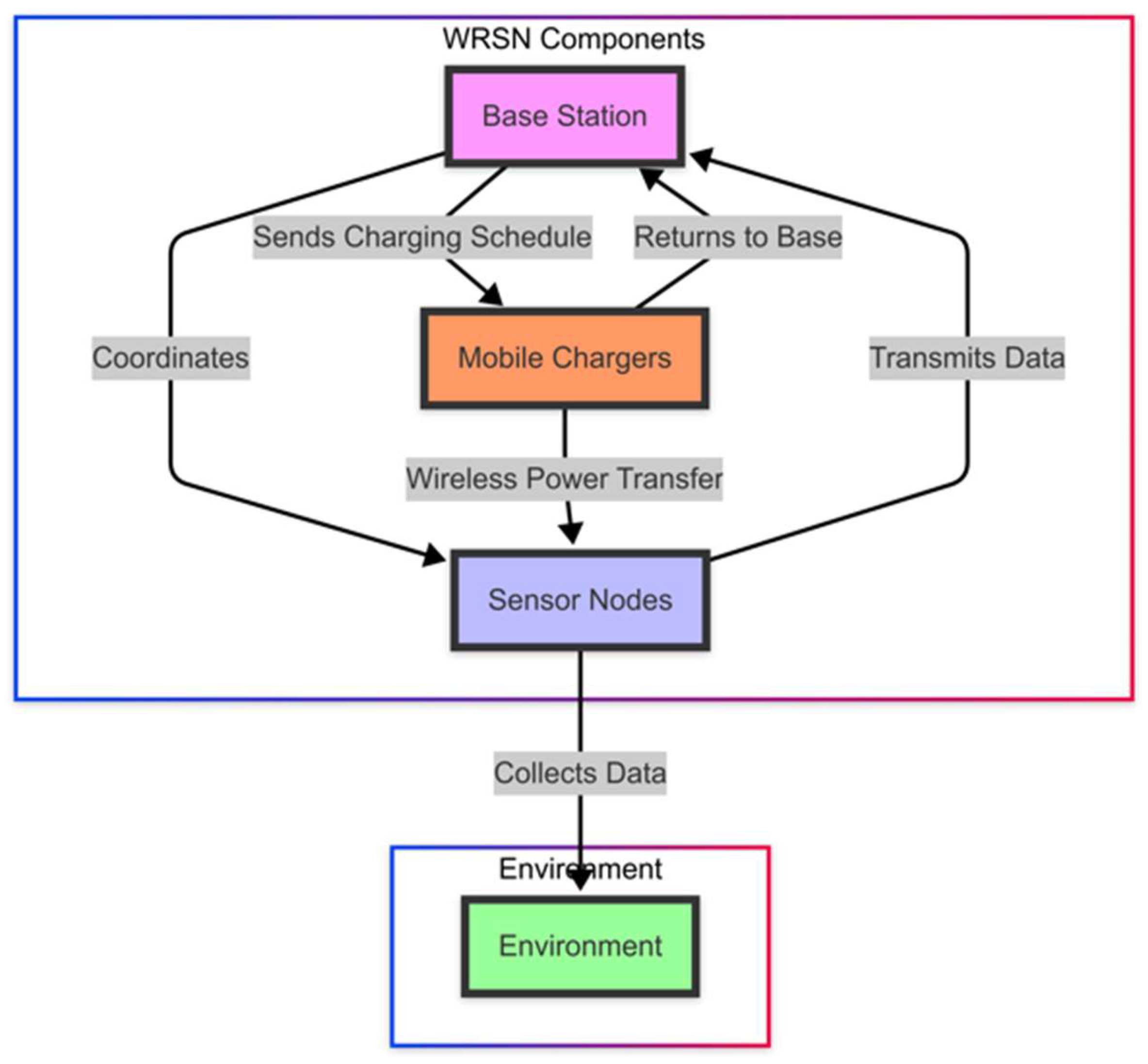
Figure 2.
This is a figure that shows the PRISMA Flow diagram illustrating the study selection process for WRSN review.
Figure 2.
This is a figure that shows the PRISMA Flow diagram illustrating the study selection process for WRSN review.
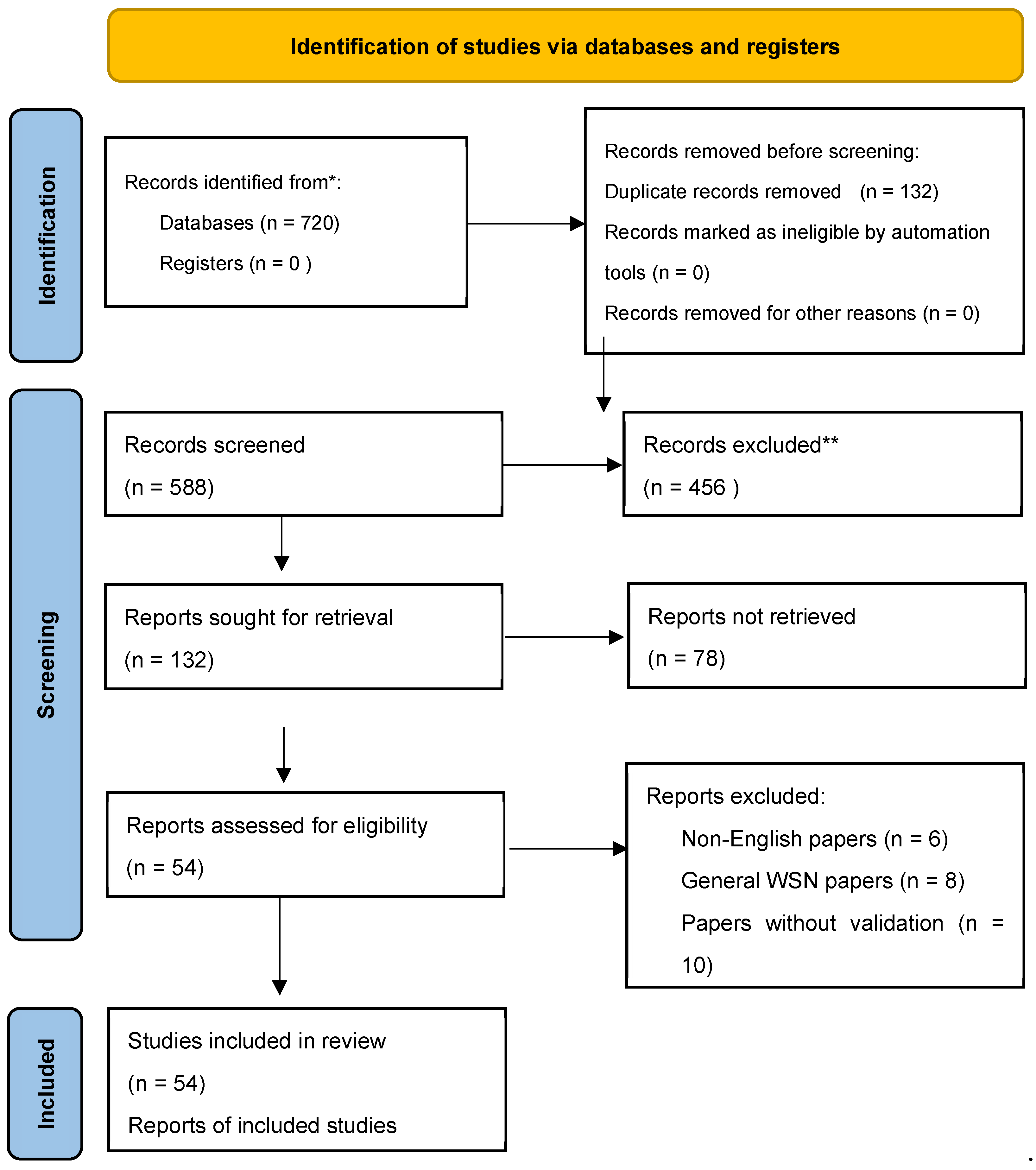
Figure 3.
This figure shows the Taxonomy of WRSN Charging Strategies.

Figure 4.
This is a table that shows the summary of Taxonomy Dimensions.
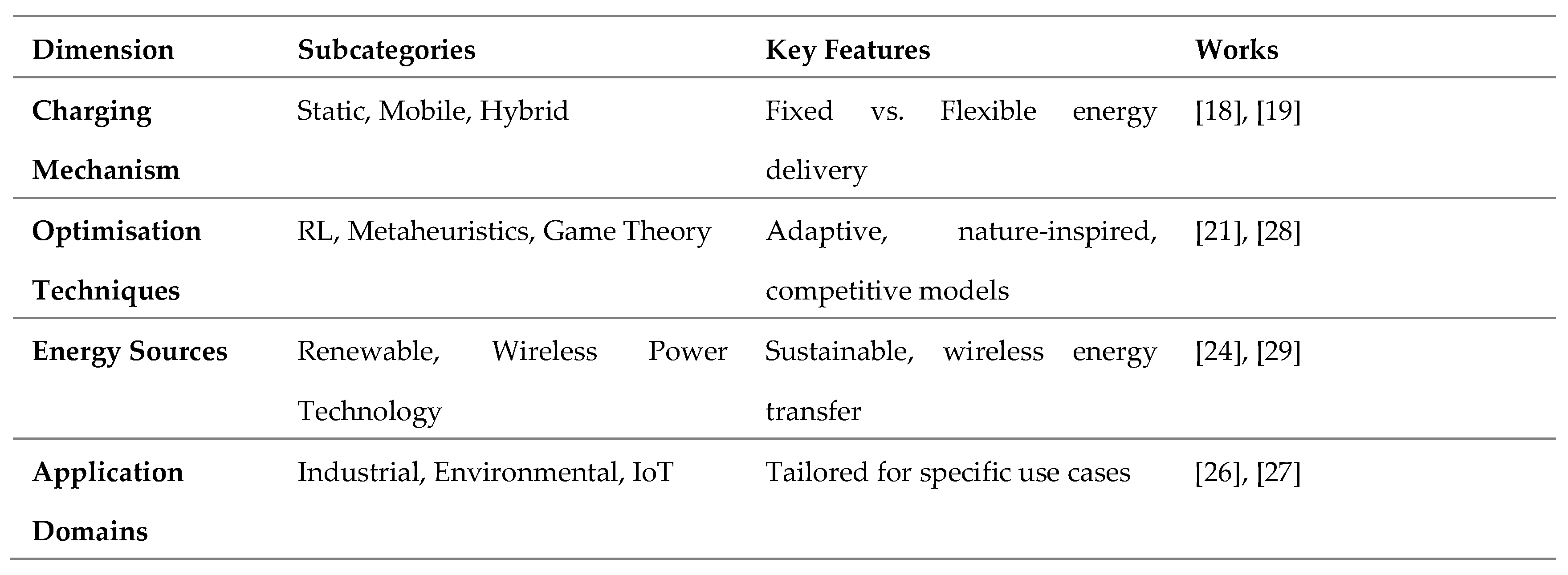

Figure 5.
This is a figure that shows the Distribution of Reviewed Works Across Themes.
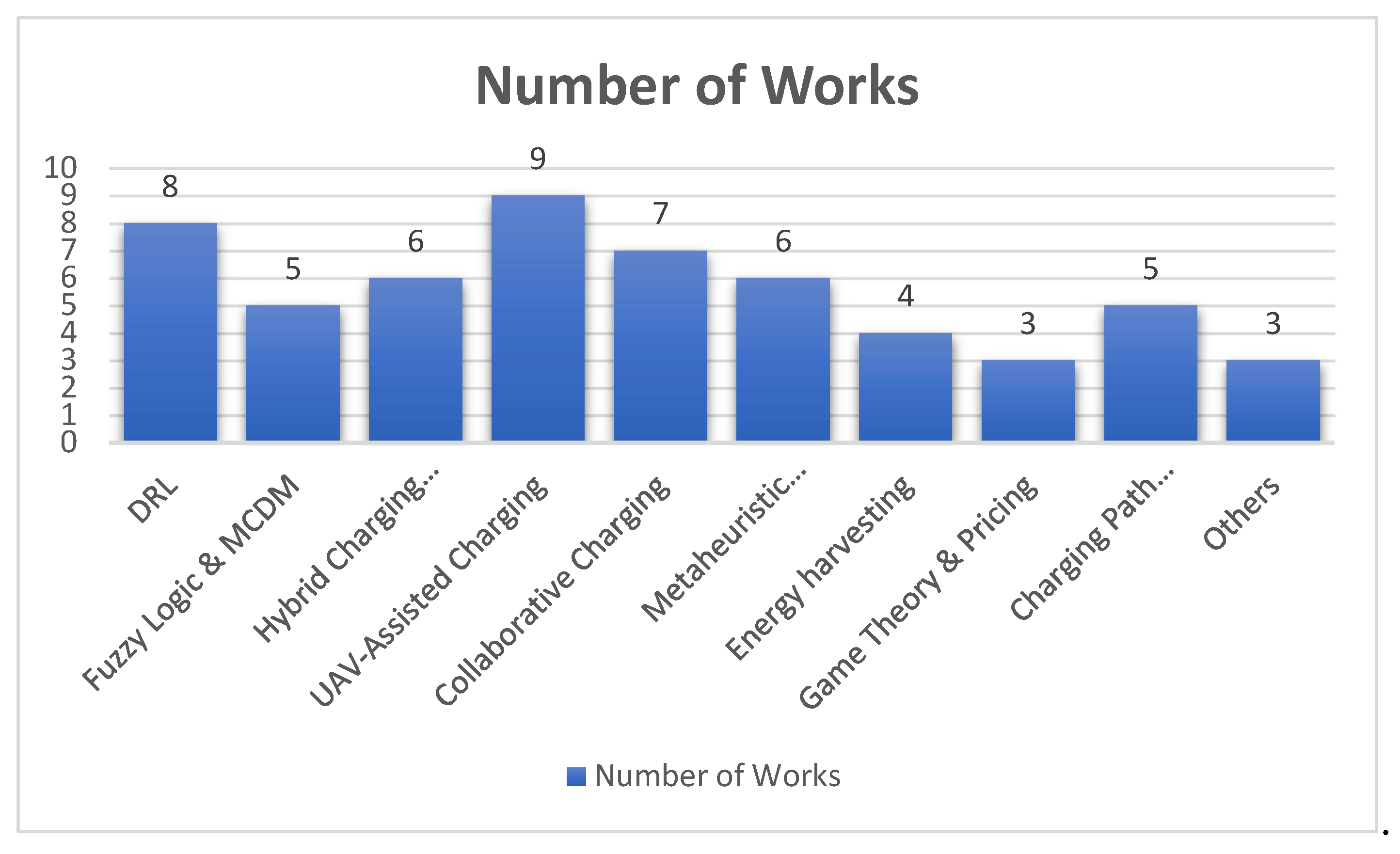
Figure 6.
This figure shows the Energy Harvesting and Sustainability Framework.
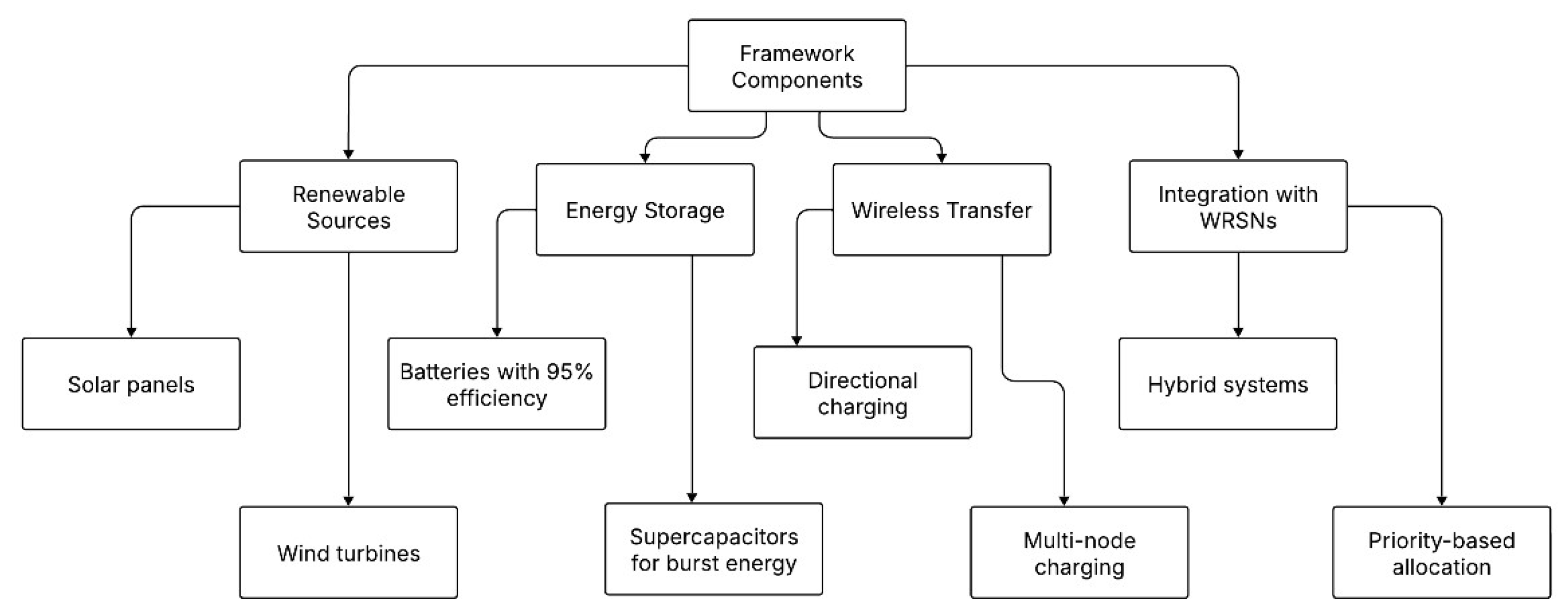
Figure 7.
This figure shows the Key open challenges and future directions. Technical hurdles like scalability and security intersect with practical barriers like cost while emerging technologies like quantum computing offer new opportunities.
Figure 7.
This figure shows the Key open challenges and future directions. Technical hurdles like scalability and security intersect with practical barriers like cost while emerging technologies like quantum computing offer new opportunities.
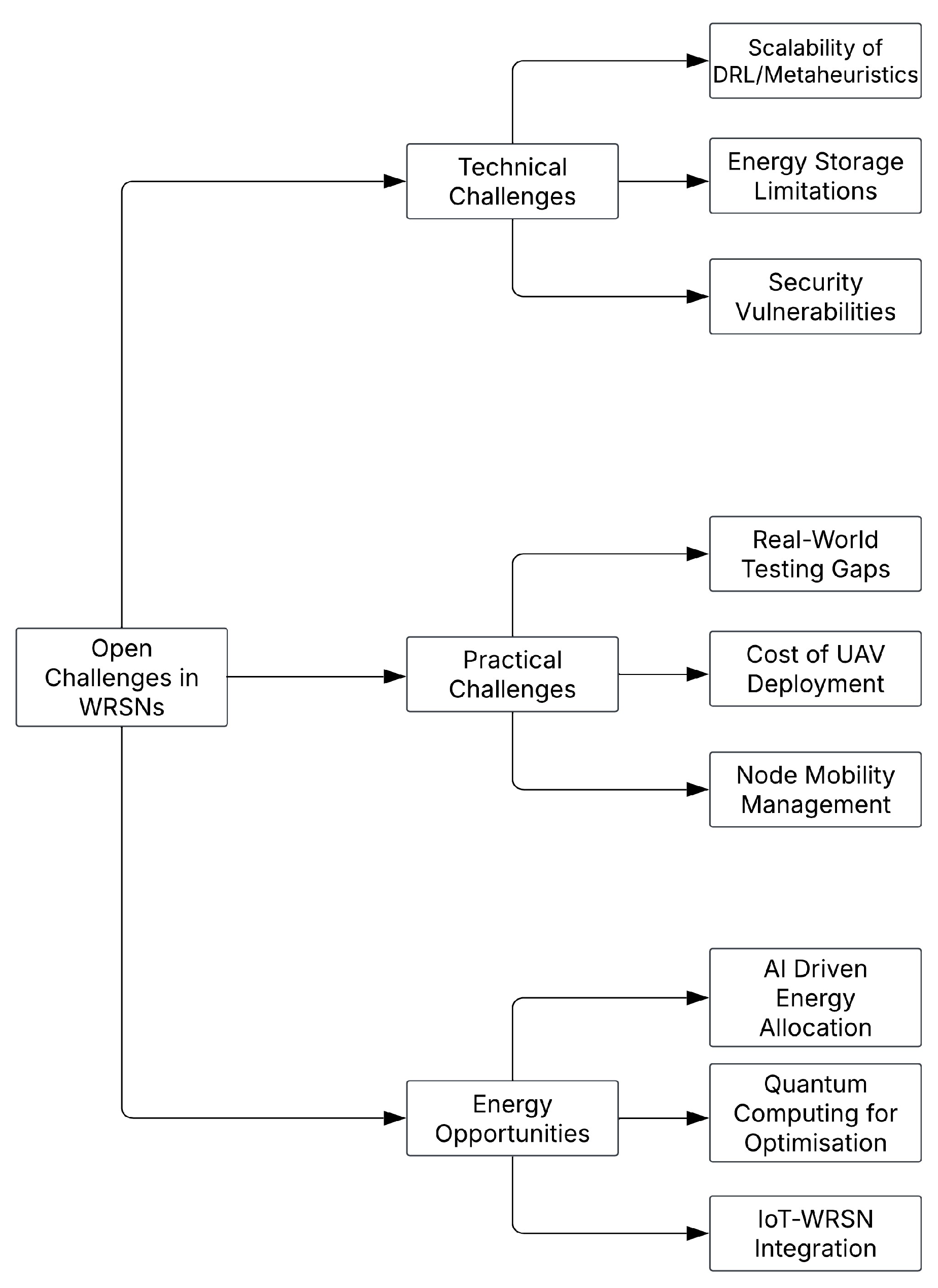
Table 1.
This is a table showing the Comparative analysis of the related works.
| SN | Authors | Focus | Key Contributions | Limitations | Gaps Identified |
| 1 | [15] | Mobile Charging Techniques (MCTs) for WRSNs | Categorizes MCTs into periodic and on-demand methods; Discusses coverage, connectivity, and energy optimization | Lacks depth in real-world applications; Superficial analysis of collaborative charging and hybrid provisioning | Underutilization of AI; Need for multi-source energy harvesting.; No innovative solutions proposed |
| 2 | [16] | Impact of mobility on WSN performance (terrestrial and underwater) | Highlights use of UAVs and UMEs for data collection, charging, and localization | Surface-level analysis; no critical evaluation of practical challenges or scalability | Limited exploration of dynamic environments; no bold vision for future research |
| 3 | [10] | On-demand wireless charging schemes in WRSNs | Emphasizes advantages of on-demand over periodic charging; mentions AI and mobile edge computing | Overly theoretical; lacks concrete examples or case studies; no detailed taxonomy or classification | No practical implementation insights; shallow treatment of AI and edge computing |
| 4 | [11] | Energy optimization in WSNs | Summarizes energy-efficient protocols and strategies | Lacks critical analysis; ignores real-world challenges like dynamic environments and obstacles | No innovative solutions; superficial classification framework |
| 5 | [13] | Evolution of WRSNs, BF-WSNs, and WPCNs | Covers charger deployment, scheduling strategies, and communication optimization | Shallow analysis; no innovative solutions; disconnected from real-world applications | No actionable roadmap: future directions (e.g., AI, 6G) lack connection to current advancements |
| 6 | [14] | Energy-efficient routing in WSNs (meta-heuristic and AI-based approaches) | Catalogs bio-inspired algorithms and AI integration | Lacks practical examples, case studies, or discussion on data privacy and security; no clear taxonomy | Needs to bridge theory and real-world applications, offering actionable insights |
| 7 | [12] | On-demand energy provisioning in large-scale WRSNs | Categorizes energy harvesting sources (solar, kinetic) and storage technologies (supercapacitors, batteries) | Lacks critical evaluation of real-world performance, shallow discussion of energy management strategies | No bold proposals for improvement; does not address practical constraints |
Table 2.
This is a table that shows the Comparative evaluation of the related works.
| Parameter | [15] | [16] | [10] | [11] | [13] | [14] | [12] |
| Scope and Relevance | Covers mobile charging but lacks depth (3) | Covers terrestrial and underwater WRSNs but lacks foundational depth (3) | Touches on on-demand charging but lacks real-world examples (3) | Focuses on energy optimization but lacks practical applications (3) | Covers WRSNs broadly but misses practical insights | Lacks depth in practical applications (3) | Covers WRSNs broadly but lacks real-world deployment challenges (3) |
| Literature Coverage | Includes key studies but omits recent developments (3) | Covers key studies but lacks foundational depth (3) | Mentions advancements but lacks depth, especially in AI and MEC (3) | Discusses various studies but overlooks dynamic environments (3) | Covers key studies but fails to provide an exhaustive review (3) | Overlooks foundational studies and case studies (3) | Lacks critical evaluation of cited studies (3) |
| Organization and Structure | Somewhat logical but needs clearer sectioning (3) | Logical but could improve categorization of mobile elements (3) | Covers design issues and performance but feels disjointed (3) | Structured into relevant sections but lacks cohesiveness (3) | Well-structured but offers superficial topic treatment (3) | No clear taxonomy, making comprehension difficult (3) | Clear structure but lacks deep insights in each section (4) |
| Critical Analysis | Compares techniques but lacks depth and insight (3) | Limited comparison of methodologies, lacks critique (2) | Summarizes methods but fails to challenge the status quo (2) | Superficial analysis with no innovative comparisons (2) | Lacks deep comparative analysis of methodologies (2) | Lacks deep comparison of methodologies (2) | Presents data descriptively rather than analytically (2) |
| Research Gaps and Future Directions | Identifies gaps but offers weak future directions (3) | Identifies gaps but lacks innovative research suggestions (3) | Highlights scalability and efficiency issues but lacks actionable insights (3) | Mentions gaps but does not provide a clear research roadmap (2) | Suggests directions but they feel speculative (3) | Mentions gaps but lacks detailed exploration (3) | Points out gaps but does not explore them in depth (3) |
| Methodology of the Review | Mentions methodology but lacks systematic rigor (3) | Systematic but lacks transparency, raising bias concerns (3) | Literature selection unclear, making conclusions questionable (2) | No clear literature selection method described (2) | Weak methodology description, limiting credibility (2) | Unclear literature selection process (2) | Lacks a well-defined literature review process (2) |
| Thematic Categorization and Taxonomy | Classification present but could be expanded (3) | Basic taxonomy, missing diversity in research themes (3) | Basic classification but lacks a comprehensive framework (3) | Provides themes but lacks a guiding taxonomy (3) | Tries to categorize WRSNs but lacks depth (3) | No structured classification system (2) | Provides a classification but lacks detail (3) |
| Citations and References | Credible but lacks diversity (3) | Credible but could incorporate broader perspectives (3) | Proper citations but relies on a narrow set of sources (4) | Uses credible sources but lacks recent studies (3) | Limited reference diversity weakens the review (3) | Fails to assess source credibility (3) | Uses diverse sources but lacks critical engagement (4) |
| Writing Quality and Clarity | Generally clear but could be more concise and logical (3) | Clear but lacks engaging narrative (3) | Writing is clear but lacks examples and case studies (3) | Clear writing but lacks in-depth analysis (3) | Clear but explanations need more detail (3) | Lacks examples and case studies (3) | Writing is understandable but could be more engaging (3) |
| Contribution to the Field | Provides some insights but lacks unique perspectives (3) | No groundbreaking insights; needs a fresh survey (2) | Adds little new knowledge, mostly a recap of existing work (3) | Offers an overview but lacks novel contributions (2) | Provides insights but does not significantly advance the field (2) | Limited originality and research impact (2) | Broad overview but lacks innovation (3) |
Table 5.
This table shows the Comparative Analysis of DRL-Based Approaches.
| Metric | [28] | [31] | [32] |
| Adaptability | 9/10 | 8/10 | 9/10 |
| Computational complexity | High | Medium | High |
| Scalability | Moderate | High | Low |
| Energy Efficiency | 85% | 78% | 88% |
| Node Survival Rate | 92% | 85% | 94% |
Table 6.
This figure shows the UAV-Assisted Charging Workflow.
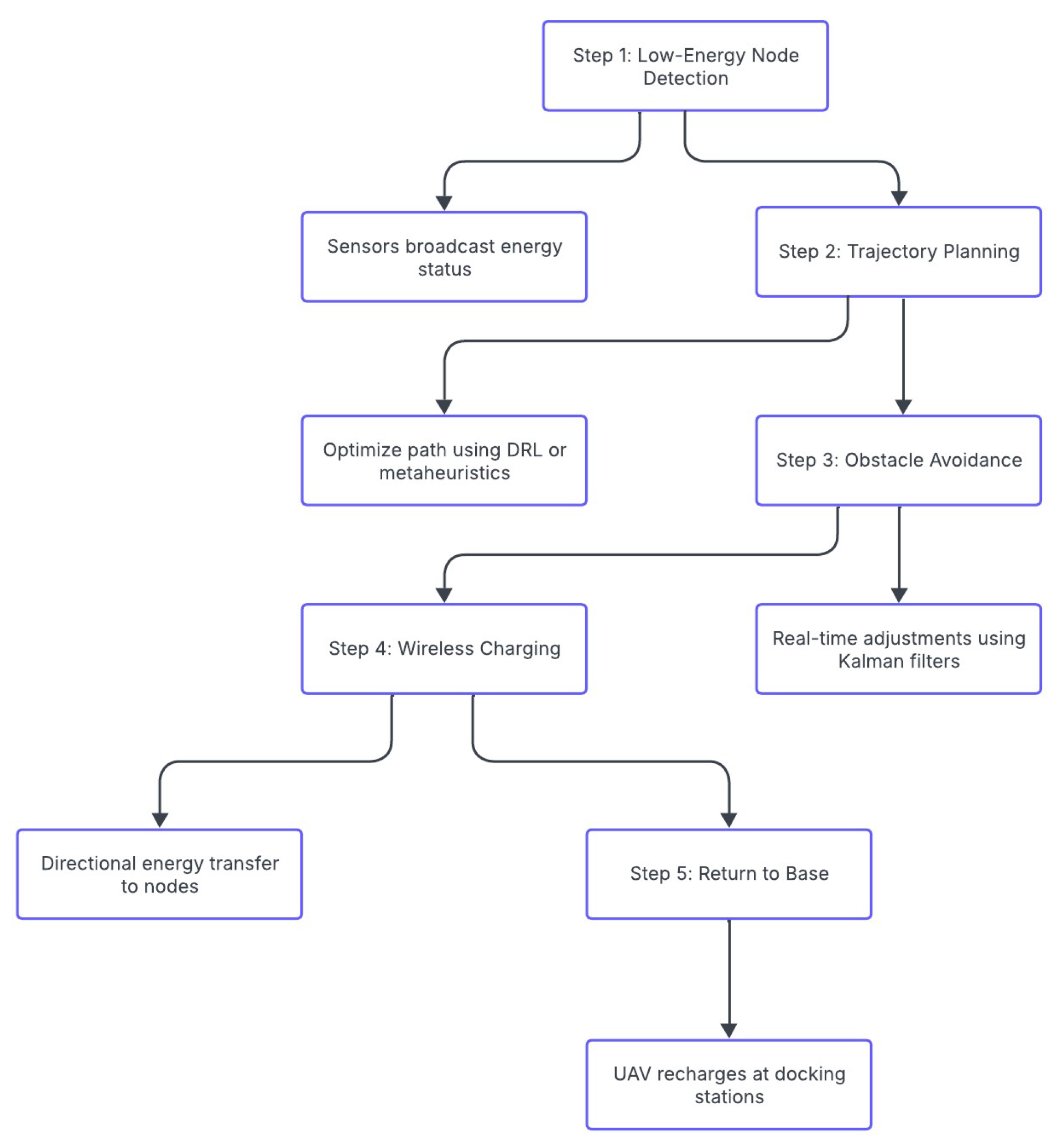
Table 8.
This table show a Summary of Thematic Clusters.
| S/N | Theme | Key Works | Strengths | Limitation |
| 1 | DRL | [6,31,32] | Adaptability, dynamic decision-making | High computational complexity |
| 2 | Fuzzy Logic and MCDM | [23,40] | Prioritization, multi-criteria balance | Sensitivity to parameter tuning |
| 3 | Hybrid Charging | [18,20] | Combines static and mobile strengths | Increased complexity in coordination |
| 4 | UAV-Assisted Charging | [32,34] | High flexibility, obstacle avoidance | UAV energy constraints |
| 5 | Collaborative Scheduling | [35,36] | Improved efficiency, reduced delays | Complexity in coordination |
| 6 | Metaheuristics | [21,41] | Robust, effective for large-scale problems | Computationally expensive |
| 7 | Energy Harvesting | [24,26] | Sustainable, environmentally friendly | Intermittent energy availability |
| 8 | Game Theory | [22,38] | Realistic modeling of competitive scenarios | Assumes rational behavior |
| 9 | Charging Path Optimization | [29,39] | Improved energy efficiency, reduced delays | Dynamic environments, scalability issues |
| 10 | Others | [28] | Niche solutions, unique contributions | Limited integration with mainstream methods |
Table 9.
This table shows the Comparative Analysis of Themes.
| Theme | Strengths | Weaknesses |
| DRL | Adaptability, real time decision making | High computational cost, slow convergence |
| Fuzzy logic and MCDM | Handles uncertainty, multi-criteria balance | Sensitive to parameter tuning |
| UAV-Assisted Charging | Flexibility, obstacle avoidance | Limited battery life, complex path planning |
| Metaheuristics | Solves large-scale problems, robust | Computationally intensive, probabilistic |
| Energy Harvesting | Sustainable, reduces external dependency | Intermittent energy sources, storage issues |
Disclaimer/Publisher’s Note: The statements, opinions and data contained in all publications are solely those of the individual author(s) and contributor(s) and not of MDPI and/or the editor(s). MDPI and/or the editor(s) disclaim responsibility for any injury to people or property resulting from any ideas, methods, instructions or products referred to in the content. |
© 2025 by the authors. Licensee MDPI, Basel, Switzerland. This article is an open access article distributed under the terms and conditions of the Creative Commons Attribution (CC BY) license (https://creativecommons.org/licenses/by/4.0/).
Copyright: This open access article is published under a Creative Commons CC BY 4.0 license, which permit the free download, distribution, and reuse, provided that the author and preprint are cited in any reuse.