

Submitted:
18 February 2025
Posted:
20 February 2025
You are already at the latest version
Abstract
The ability to substitute peat use in horticulture to potentially more sustainable alternatives hinges on the local availability of suitable biomass resources and whether these resources can be easily processed to achieve similar agronomic effectiveness to peat. This review estimates potential bio-mass availability in Ireland by reviewing production statistics and industry reports and identifying current uses and hypothetical processed biomass quantities. Annual estimates of the major biomass resources available in Ireland are 488 935 m3 of woody residues (mainly Sitka spruce pine) and 789 926 m3 of arable straws (from oats, wheat, barley, oil seed rape). The potential major processing pathways for the available biomass are mechanical (extruded, thinscrew, hammer milled, disc re-fined), carbonization (pyrolysis and hydrothermal carbonization) and composting. This review of the literature indicates that the major challenges to pyrolyzed alternatives in growth media include high alkalinity, high salinity and low water holding capacity. When biomass is processed into fibers, it requires additional processing to address nutrient immobilization (nitrogen and calcium) and the presence of phytotoxic compounds. We discuss possible solutions to these challenges in terms of agronomic management (altering fertigation, irrigation rates etc.), biomass conversion process op-timization (changing conditions of processes and applying additives) and novel growth media formulations with various material inputs that complement each other. We conclude that while national alternative biomass resources are available in sufficient volumes to potentially meet growing media requirements, significant further research and demonstration is required to convert these materials to growth media acceptable to both commercial and retail sectors. Research needs to focus on transforming these materials into growth media, and how they will impact agronomic management of crops. Furthermore, the optimization of biomass conversion processes and novel formulations incorporating multiple types of biomass needs to be the focus as we transition from peat products in professional horticulture.
Keywords:
peat-alternative
; biomass processing
; wood fiber
; compost
; biochar
; green wastes
1. Introduction
There is increasing global focus on sustainable agricultural practices to achieve and maintain food security while safeguarding the environment and human health [1]. Under the European Green deal, policies and action plans such as the Common Agricultural Policy (CAP), Farm to Fork Strategy (FFS), Biodiversity Strategy for 2030 (BS), Circular Economy Action Plan (CEAP) and Organic action Plan (OAP) are expected to have either climate neutral and/or positive environmental outcomes [2]. Greater attention is being paid to alternative agricultural production solutions that could replace current processes/practices considered harmful to the natural environment. Among these current processes, peat extraction for horticulture is identified as having a negative impact on carbon sequestration and biodiversity [3].
Peat has been the principal component in soilless horticultural growing media for decades. In the context of Ireland, it was a locally available and an affordable resource, however it is now widely recognized that continued extraction and use of peat is environmentally damaging. Transitioning away from peat use, towards more sustainable alternatives will require the use of indigenous bio-based resources, for which there are numerous outstanding challenges that need to be addressed [4,5]. The first challenge is to identify material(s) available in sufficient quantities to replace or dilute peat, then investigate how physical and chemical properties may be modified to be an agronomically effective substitute for peat. While studies in Europe have investigated the agronomic effectiveness of alternatives comprised of wood, plant matter, and green waste, these alternatives are not always ubiquitous (in all countries) [6,7,8]. The properties of alternative media materials and their agronomic effectiveness also vary greatly with type of modification, type of wood and plant species, and ratio of components.
A recent working paper by the Thünen Institute in Germany, provides a starting point for estimating available biomass quantities in Europe [9]. However, production data used is less refined at the national level for Ireland and contains some inconsistencies as noted by the authors [9]. Reports appended within the working paper show no current demand for wood fibers, chips, bark products in growth media production/supply, while data for green waste in Ireland is lacking. There is therefore great need to further refine estimations of biomass availability in the Irish context.
Local annual peat demand in the Irish professional horticultural sector is around 250 000 – 286 000 m3 [3,10]. About 112 632 – 155 000 m3 is used in Irish mushroom production [3,11] which contributes 27% (~ €117 million) of horticultural farm gate output value and approximately 131 000 m3 is used in the amenity, soft fruit and vegetable production sectors (valued at ~ €122 million) [10,12]. Including the retail and exports market, the demand for Irish peat for agriculture has been previously estimated to be 846 000 m3 [3] or 862 920 t (assuming a bulk density of 1020 kg/m3 at natural moisture content [13]). Annual peat production in Ireland has historically been estimated to be around 2 500 000 m3 with 90% of this production exported to Belgium, Netherlands, Luxembourg, Britain, France and Italy [14]. Peat demand (local and for export) is satisfied by extraction from local peatlands; however, recent extraction has been halted and subject to restrictions in identified special areas of conservation (SACs). As a result, peat exports have rapidly declined and are estimated to have reduced to about 393 000 t (382 353 m3) annually in 2022 [15]. The peat supply landscape is therefore in transition and the Irish Peatland Conservation Council is calling for an end to the sale of peat moss compost by the end of 2024 [16].
While new peat reduced and peat free products are becoming more available, especially for the market gardening sector, the impact of these new products on all the horticultural subsectors is largely unknown and statistics are still forthcoming of how much (if at all) are currently being used as peat replacements. According to a government report, growth media in the mushroom, high wire crop and soft fruit horticultural subsectors has been assessed as the most important input [17]. The physical and chemical characteristics of growth media required for each subsector of Irish production varies and thus finding alternatives which replicate the versatility of peat poses a significant challenge. As a result, more than one feedstock may be needed, and various transformative processes could be required along with late stage blending to ensure versatility of a peat replacement.
A flow analysis is presented herein which more accurately estimates the availability of Irish biomass resources that could be used as peat alternatives. It encompasses not only supply potential but also considers potential processing pathways in generating viable end-products for use as growth media components. Such a flow analysis requires a discussion of how certain biomass streams and processes may be more suited for a specific subsector.
The objectives of this paper were therefore to (1) identify major biomass resources produced in Ireland by estimating annual quantities produced, (2) to identify competing uses of this biomass, (3) to trace current and future flow pathways of each major resource quantifying losses in volume or mass at various stages and finally (4) to discuss the challenges and opportunities of each major resource.
2. Materials and Methods
2.1. Quantification of Potential Available Forest Resources
Data on Irish land dedicated to forestry, roundwood production and estimated future production were compiled from reports by the COFORD wood mobilisation and forecasting group and the forestry and timber yearbooks [18,19,20,21,22,23,24,25,26,27,28,29]. Conversion factors provided by the FAO ITTO and United Nations [30] were used to calculate quantities of bark, solid wood, sawdust and chips/slabs produced at different stages of the flow of forest resources.
2.2. Quantification of Potentially Available Agro-Wastes
Data on annual cropping of major field crops (wheat, barley, oilseed rape, oats and bean) was compiled from Teagasc annual harvest reports [31,32,33,34]. Field crop statistics were averaged over a period of five years (2019 to 2023) to obtain representative figures that account for yearly and seasonal fluctuations. The quantities of straw residues produced by each crop were estimated from cropping data using conversion factors in Table 1:
The estimated quantities in tonnes were then converted to volumetric quantities using formula (1):
Where 1.78 m3 is the volume of a 5 x 4 round bale of straw and 0.24 t is the mass of a bale of straw [35]. For miscanthus (Miscanthus sinensis) and willow (Salix alba L.), production values were for the year 2020 only from Robb [37]. Estimated volumes of miscanthus were calculated using formula (2):
Where 2.59 m3 is the volume of a 0.9 x 1.2 x 2.4m bale and 0.48 t is the mass of a bale. The volume of willow was calculated by dividing the yield (t) with the average bulk density value of harvested willow chips (0.15 t/m3) obtained from Caslin, et al. [38]
Annual production of municipal green wastes was compiled from [39].
2.3. Review of Agronomic Performance of Alternative Growth Media
A literature search was conducted on 20 October 2023 on the Web of Science database using the Boolean phrase for ALL FIELDS: ("growth media" OR "soilless media" AND "peat free" OR "peat reduced" OR "peat alternative" OR “alternative”) restricted to the past five years. Accessible files were analysed and selected if they reported on growth experiments and contained characterisation data of the growth media. This literature reported data were then compiled, elucidating agronomic performance as it relates to growing media types. Other early pioneering studies were also included to add to the discussion.
3. Availability of Local Raw Bio-Resources Excluding Imports
3.1. Availability of Wood and Forest Residues
Currently approximately 808 848 hectares in Ireland is afforested and about 61.2% is coniferous (mainly Sitka spruce), while broadleaves constitute the remainder (Oak, Beech, Ash) [40]. From 2016 to 2020, annual harvest of roundwood from Irish forests has been steadily increasing from 3 million m3 to about 4 million m3. Around 80% of that volume increase is Sitka spruce [41,42]. Annual roundwood production in Ireland is projected to keep rising up to about 8 million m3 by 2035 [18]. However, not all wood and bark are available for the horticultural sector, as can be seen through a flow diagram constructed using forecasted production and historical demand values (Figure 1). We estimate that about 488 935 m3 of forest residues could be available in Ireland as wood chips (55%), sawdust (18%) and bark (27%) that can be used for growth media.
During the years 2015 - 2018, the annual percentage of total roundwood channeled towards sawmill, pulpwood and stakewood processing in Ireland averaged 64, 31 and 5% respectively [25,26,27]. The sawmill processing conversion factors from [30] were used in constructing the flow diagram. All the wood residues produced by the panel product mills is used for on-site energy production (biomass boilers) and the panel product mills also rely on the sawmills for additional wood residues which are used to make fiberboard and strand boards [43].
3.2. Availability of Straw from Field Crops
As of 2022, wheat, barley and oats were the major field crops grown in Ireland by annual cropped land. While these 3 crops produce about 7.9 million m3 annually in straw residues, only about 634 674 m3 could be available annually for growth media (Table 2). This is because more recent estimates by Wallace [45] who cites industry sources, report that about 93% of cereal straws are baled for onward sale, and 99% of these bales are used for mushroom compost (wheat), animal bedding and animal feed (wheat, barley, oats). The estimates of cereal straws that could be available (Table 2) therefore include the 1% that remains from what is baled and the 7% that is usually not baled. Estimated local wheat annual straw demand for mushroom production is around 100 000 t (741 667 m3) [45] which alongside other input components (water, manure, gypsum, spawn) produces around 199 732 t of compost for use in this sector [46]. While the available straw figures are a good guide, the actual figures for straw availability are likely less than our estimations because of the straw incorporation measure scheme [47] where Irish farmers are reported to have incorporated residues to over 70 000 ha of farm land in 2023 [32].
Current production of industrial fiber crops such as hemp are at levels too low to be considered as potential peat replacement alternatives. For example a recent government report stated that total land sown for industrial hemp in Ireland in 2022 was only 72 ha [48].
3.3. Availability of Distillery/Brewers Spent Grain
Both brewers’ spent grain (BSG) and distillers’ spent grain (DSG) are separated from the liquid wort prior to fermentation during beer and spirit production respectively. The proportions and grain types used differ, resultantly BSG and DSG are compositionally distinct, however barley is the principal constituent and common to both processes. 250 000 t of barley are used by the brewing and distilling industry in Ireland annually, some of which is imported, and this figure is projected to increase in future [50].
For every 100L of beer brewed, between 21-22 kg of BSG is produced[51], while for the same volume of spirit, between 25-30 kg of DSG results [52]. An estimated 160 000 t of BSG are produced annually in Ireland [53], while a best estimate of between 54 000 – 64 800 t of DSG generation per annum is calculated from Irish spirit alcohol yearly output [50] using the conversion rates outlined above.
Both DSG and BSG, as co-products share similar valorisation pathways [54], however DSG onward use in Ireland is not widely reported in the literature. Approximately 70% BSG is used for animal feed and 10% for biogas production [55] and recently, part of the remaining 20% has also found use as a food ingredient [53]. Potential availability of BSG for use as media will therefore be less than 32 000 t (wet mass, appr. 80% water), approximately 202 532 m3 (assuming a wet bulk density of 158 kg/m3[56]).
Spent grains are microbiologically sterile at the point of production because they are separated from liquid wort at pasteurisation temperature, however they are susceptible to spoiling quickly unless properly stored, due to their high polysaccharide, protein and moisture content that makes them susceptible to colonisation by environmental microorganisms [51]. The high moisture content of spent grains also adds to the cost of transport. Transforming spent grains into an organically stable end-product (e.g. compost or char) would be necessary therefore for onward use as growth media. The estimated mineral content of BSG is 3600 mg Ca/kg, 1900 mg Mg/kg, 6000 mg P/kg and 137 mg Na/kg [57]. Because of its nutritional content, recently BSG has been shown to have good potential as a bio-fertiliser when composted or pyrolyzed and added to peat at low ratios (<5%) [58]. Once again, similar pathways for onward use are outlined for DSG (e.g.[54]).
3.4. Availability of Paper and Cardboard Waste, Municipal Composted Green Wastes, Digestates and Spent Mushroom Compost.
As of 2021, biomass that underwent composting/anaerobic digestion was generated from municipal waste (56%), agro-wastes (27%), waste treatment plants (12%) and other sources (5%), [39]. Five year average data from [39] for the years 2017 to 2021 reveal that about 513 498 t of biomass is available for either composting or anaerobic digestion in Ireland. Of this figure, currently about 49 and 51% of the biomass are composted (251 614 t) and anaerobically digested (261 884 t) respectively. The composted greenwaste (201 291 m3, assuming 40% yield and bulk density 500 kg/m3) is currently used in horticulture, landscaping and agriculture. Data from [39] for the year 2021 reveals that total annual paper and cardboard waste from packaging materials was at 509 339 t and 91% of that was reused (for energy recovery 18% and sent for recycling to other EU and non-EU countries 73%). Hypothetically, from this current demand, about 46 264 t of paper and cardboard could be available. However, these materials depending on previous use, may result in phytotoxicity [59] mainly due to high Ca and Na nutrient profiles making them less suitable as a peat growth media replacement.
Annually, 350 000 t of fresh spent mushroom compost (SMC) result from the production of 70 000 t of mushrooms [60]. This translates to 1 097 180 m3 of fresh SMC (average bulk density 319 kg/m3) which contains between 65 – 70% of water [61]. This SMC is steam sterilised in the mushrooms houses and is supplied to the horticulture and the agriculture sectors as an organic matter, or nutrient source [62]. Easily available data of SMC use and demand in Ireland is 30 years old, and is a result of a survey of one of the biggest mushroom producers which revealed that 35% of SMC was applied to land on farm and 40% was removed by a contractor and re-composted for onward sale [60]. Therefore about 25% (274 295 m3) could be immediately available for use in growth media.
4. Biomass Processing Pathways for Production of Growth Media and Minimum Irish Estimates.
Better estimates on the ability of current Irish resources to meet national demand for growth media needs to consider the various biomass processing pathways as reductions in usable biomass are processing pathway specific. This section explores volume reductions that may be expected from mechanical alteration, thermal carbonisation and composting pathways as a necessary step towards estimation of potential quantities of alternative growth media.
4.1. Mechanical Alteration (Chipping, Milling, Extruding Fibers)
Some materials such as sawdust and fresh bark (after mechanical chipping) may be used in their raw state. However, this may result in phyto-toxicity challenges that limit seed germination and growth. The hypothetical volumetric yields of chipped/milled fibres that could be produced from wood, and field crop residues are shown in (Table 3).
4.2. Pyrolysis and Hydrothermal Carbonisation to Produce Biochars and Hydrochars
Pyrolysis and hydrothermal carbonisation are when biomass is heated in a low or no oxygen environment to produce a charcoal-like product. Pyrolysis employs a dry environment and dry feedstocks, while hydrothermal carbonation employs a wet environment and undried feedstocks. Variables such as temperature, residence time and type of feedstock are known to affect char yields [65,66]. When materials are converted to char by dry pyrolysis at a temperature >350 oC, they usually yield about 30% of their initial mass (Table 4). Generally, higher wet or dry pyrolysis temperatures reduce char yields [67] and result in biochars with high ash content and pH (> 6) [68]. Low temperature wet or dry pyrolysis with short residence times liberates a high amount of char which can be as high as 84% of the initial mass.
4.3. General Composting
4.4. Estimates of Potential Volumes That Could Be Produced from Available Resources in Ireland.
The major resources available in Ireland consist of mainly wood/forest residues, field crop residues and green wastes which are estimated to add to 1.5 million m3 in their raw state (Table 6). Estimates of volumes of alternative growth media that could hypothetically be produced from such materials are reported in Table 6. Considering that the annual demand of peat is around 250 000 - 286 000 m3 in the professional horticultural sector and 846 000 m3 when including retail/hobby sector demand [3,10], biochar products or composted products from wood chips/slabs, bark and BSG may not be enough to meet the professional demand as single source 100% peat replacement resources (Table 6). However, carbonised or composted products from straw as single source type of feedstock may offset the annual demand in the Irish professional horticultural sector. Potential volumes that could be produced as fibres or biochar or hydrochar or compost from all the raw bio-resources available suggest that local resources may offset the commercial demand.
5. Recent Agronomic Effectiveness Results from Alternative Material Use in Horticultural Growth Media.
A literature search was conducted, selecting recent peer-reviewed journal articles reporting comparative agronomic performance of alternative growing media with peat, coir or any other commercially prominent growth media. The mark of performance varies between sub-sectors of horticulture; however, for food crops (i.e. vegetables and fruits) consistent crop quality and high yielding performance is a required positive result. While in ornamental and nursery stock production, qualitative results are more often reported citing the visual appeal, health and vigour of plants. It is however not always the case that bigger / more is better as parameters such compactness may be desirable in garden ornamentals [82]. This section summarises agronomic results from peat substitution/replacement experiments reported in recent literature.
5.1. Raw and Mechanically Altered Materials as Growth Media (Milled, Shavings, Dust, Chopped, Extruded Fibers).
Some early studies in New Zealand in the eighties showed great potential of using 100% fine uncomposted pine bark for a range of ornamental species (Adiantum cuneatum, Ficus elastica decora, Kalanchoe blossfeldiana and Aralia sieboldii), with plants grown in the fine bark producing plants with similar biomass to Irish peat [83]. However, mixed results on the effects of milled wood, extruded wood fibres and milled Miscanthus are reported in literature (Table 7). A reason for this could be that most papers reporting on these materials do not use a standard peat control for comparison. However, at volume proportions of 30% and less with peat, positive shoot results are reported compared to the controls used. Generally, wood fibres and milled wood/miscanthus reported in literature have relatively low bulk densities (<150g/L) and are slightly acidic.
5.2. Thermally Carbonised Products (Bio- and Hydro- Chars) as Growth Media.
The majority of papers reporting biochar use for horticultural media focus on biochar made from woody materials. It is generally not recommended nor realistic to use high rates of carbonised products as shown in numerous papers that report a reduction of shoot yields compared to peat controls (Table 8). Higher blending rates of biochars from forest residues are reported to result in a more severe shoot yield reduction. At lower proportional addition rates, positive yield results are reported for some crops. Generally, the wood-based biochar mixes reported in most papers have relatively high bulk densities (~500 g/L) and are alkaline (7 > pH).
5.3. Composted Materials as Growth Media.
Generally, composted green wastes from fruit and vegetable wastes as growth media result in an increase in shoot biomass of many crops, possibly due to the additional nutrient availability from the composts. Prasad and Maher [94] showed that Irish composted green wastes at a 50% mix with peat supported ornamental (escallonia and hypericum) biomass production as well as 100% peat. However, at rates above 25% of green waste, the resultant aesthetic index of escallonia was lower compared to peat. Other research shows that when composted woody materials are used, a reduction in shoot yields is usually observed [95,96,97]. Most recent research using composted woody materials employ the use of multiple mixes and report increased shoot biomass compared to peat [82,98]. In these multi-mixes animal or fowl manure is usually employed. Most composted green wastes have a bulk density of not more than 400g / L and are neutral to alkaline (Table 9). Compost production from green and wood wastes has high potential for scalability due to already existing collection and processing infrastructure in the European Union [99]. Composted SMS has potential to be used as growth media as reported in some studies where it was pasteurized and mixed with vermiculite or perlite and shown produce similar biomass to peat for the seedling production of tomatoes and cucumbers [100].
6. Identified Physico-Chemical Challenges of Alternative Growth Media and Opportunities.
6.1. Challenges with Wood and Plant Fibre
Microbial decomposition of organic matter can cause nitrogen (N) immobilisation reducing the availability of N for plant uptake. N immobilisation is increasingly likely in organic materials which have a carbon-to-nitrogen (C:N) ratio exceeding 30:1 [103]. Milled pine and other wood-based components can have C:N ratios in excess of 300:1 and potentially reduce available N from the applied fertilizer [103]. Research has shown that when wood and grass fibres are used in growth media, they usually exhibit low N and Ca availability (Table 10) which is usually a result of immobilisation [6,7]. Wood fibre’s susceptibility to N immobilisation can be counteracted successfully with optimal adjustment of N fertiliser input[104].
In addition to N immobilization, certain wood materials can leach plant inhibitory compounds into the root zone, particularly if the wood has not been sufficiently aged or processed [103]. These compounds vary in type and concentration depending on the tree species, age and/or part of the tree (e.g. bark, heartwood, roots) from which the wood-product is derived. The pre-conditioning (i.e. aging and/or pressure soaking) of feedstock materials in addition to frictional heat and pressure associated with some methods of fiberisation can effectively reduce both soluble and volatile compounds to acceptable levels for immediate use in growing media [105].
Wood fibres typically retain less water by volume compared with sphagnum peat and greater proportions of wood fibre may reduce WHC and require a higher frequency of irrigation during crop production [64],[103]. For this reason, some studies show that growth media containing pine wood fibre may supress damping off diseases [84]. The major benefit afforded by wood fibres inclusion in growth media however, is in their ability to improve wettability and water dispersion due to their hydrophilic nature[106].
6.2. Challenges with Biochars/Hydrochars
A trend of reduced biomass with wood-based biochars as growth media is evident in literature (Table 8). A study by Fascella, Mammano, D’Angiolillo, Pannico and Rouphael [89] recommended a maximum peat substitution of 25% using conifer wood biochar (5mm sieved) because higher rates of biochar reduced growth of lavender as a result of increases in EC, pH and reduced availability of P, Ca and Mg and reduced water holding capacity. Similar results for roses were reported where 25% peat substitution with biochar was recommended as well [86]. Biochar was also noted to result in Mg deficiency in cabbage leaves by Chrysargyris, Prasad, Kavanagh and Tzortzakis [88]. Biochars with high pH values usually have high ash content, mainly due to pyrolysis conditions (high temperatures and longer residence times) which result in greater availability of basic cations such as K+ [65].
Different results in terms of the effect of biochars on seedling germination are reported in literature [87,88,90,109] and this is explainable in terms of differences in biochars (feedstock, pyrolysis conditions, particle size), differences in ratios and test crops used and varying agronomic management. For example, in experiments by Chrysargyris, Prasad, Kavanagh and Tzortzakis [91], the same mixing ratio and biochar type resulted in varying responses (compared to peat) in different test plant species. Common challenges of biochars such as high pH, high EC and low availabilities of selected nutrients could be solved through various ways as suggested in Table 11.
6.3. Challenges with Composted Materials
Composts have varying nutrient profiles as a result of type of feedstock and composting conditions and can also be blended for specific market demands. It is therefore very difficult to give general recommendations that cover all the types of composts that could be available. Normally, composted woody materials usually have low N content while composts from food wastes usually have high available N (Table 12). Low N availability in wood derived composts may however be an advantage for ornamental plant production in small containers where low N availability results in small and more compact ornamentals which have more decorative value [82]. Fresh spent mushroom compost has limited use as growth media due to its high salt content needing to be leached or long-term weathering/composting [110].
6.4. Are Multi-Mix Growth Media the Answer?
All bio-resources are heterogenous either in their raw form and after transformation and consistency in production is critical to achieve product uniformity. Multiple mixes present the ability to carefully select materials that complement each other and adjust mixing ratios to create growth media with near to ideal properties. For example, high nutrient containing substances may be paired with low nutrient containing materials (e.g. composted greenwaste and wood fibre. Constant batch testing of raw and processed bio-resources will allow temporal mixing ratio adjustments to achieve batch uniformity. Agronomic benefits from substituting peat growth media with multiple mixes containing composted green wastes are usually from high availability of plant nutrients [8]. While this is a benefit, it can also cause challenges in professional settings, where a lack of consistency could affect plant uniformity and growth rates; nutrient imbalances if macro-nutrient availability becomes excessive through lack of proper fertigation management. Wood and composted green waste media may also exhibit high pH which can be solved with acidifying irrigation water as recommended by other researchers [8,101], which is a common approach in most fertigation systems.
Stratified blends are also an option where different types of media are put in layers in a container. While this may help with water distribution and water availability under low water input [113], it may be unhelpful for the purposes of dilution where alterations in pH and or EC and or nutrient levels composition are required.
7. Conclusions and Future Directions
Within this study it is demonstrated that the major biomass resources available in Ireland besides peat are from forestry (488 935 m3), straw from agricultural fields (838 912 m3), composted green wastes (201 291 m3), brewery spent grains (202 532 m3) and spent mushroom compost (274 295 m3). These resources in their raw state and individually are unsuited as a total peat replacement, and processing either mechanically (chipping, milling) or through composting and thermal carbonization significantly reduces the resources in volume (approximate yield of 40% w/w). The significant reduction in volume means that potential composted or thermally carbonized biomass may not be sufficient as total peat replacement in Ireland considering a total peat demand of 846 000 m3 (professional and hobby market).
Assuming a hypothetical general peat reduced mix of 30% wood fiber, 30% composted bark, 30% peat and 10% composted greenwaste, about 253 800 m3 of wood fiber, 253 800 m3 of composted bark and 84 600 m3 composted greenwaste would be needed to make up a mix meeting the 846 000 m3 peat demand. The wood fiber would come from 46 229 m3 of raw chips/slabs, and the composted bark will be produced from 478 869 m3 of raw bark. It is clear from this hypothetical mix that bark is limited, and careful ratios must be devised depending on estimated biomass availability. The current potential of composted bark (74 337 m3) could be augmented with diverting bark from other uses such as in boilers on wood processing sites (232 333 m3 of bark (Composted conversion: 130 106 m3)) and utilizing the remaining 221 464 m3 of woodchips (compost conversion 94 442 m3)) which are not required for wood fibre, which would indicate a total potential of 298 885 in composted wood materials, 17.8% in excess of current requirements. This indicates that there may be sufficient supplies in Ireland for existing hypothetical requirements, but there is little room for expansion and the impact of higher value competing uses could be severely detrimental to the security of growth media supply. Additionally, a requirement for 30% peat volume is also still required. Therefore, in order to provide sufficient growth media for critical functions, such as food and plant production and the future potential expansion of the Irish horticultural sector, access to raw materials to develop peat free growth material would need to be secured in order to avoid increases in the cost of production and prevent access to sufficient growth media volumes becoming a limiting factor in horticultural production.
It is not practical to use one processed product as a peat replacement (either composted, extruded or carbonized) because these products have some physical and chemical properties not suited for plant growth. Currently published research reports of less agronomic efficiency of alternative growth media at 100% peat replacement compared to peat use corroborate this. Major challenges of using alternative biomass in growth media include high alkalinity, high salinity and low water holding capacity when pyrolyzed products are used and immobilization of N and Ca and presence of pytotoxic compounds when the biomass is used as fibers. Research into novel growth media formulations with various materials that complement each other are therefore essential.
Though essential, economic considerations were not within the scope of this review and future research should analyze economic viability of biomass processing pathways for growth media, and the impact of increased utilization because of enhanced circular bio-economy activities that will decrease the supply of growth media. Current processing capacity (for composting, pyrolysis etc.) should be mapped out and an assessment of the ease of scalability performed. Life cycle assessments are recommended to ascertain environmental footprints of potential pathways.
Author Contributions
A. Tumbure: Conceptualization, methodology, data compilation, writing—original draft preparation, writing—review and editing, visualization M. Gaffney: validation, data curation, supervision, funding acquisition and writing—review and editing E. Corbertt: methodology, data compilation, writing—review and editing Lael Walsh: Funding acquisition, validation, data curation, writing—review and editing C. Pulver: validation, data curation, writing—review and editing L. Black: validation, data curation, writing—review and editing M. Prasad: validation, data curation, writing—review and editing J.J. Leahy: validation, data curation, writing—review and editing All authors have read and agreed to the published version of the manuscript.”
Funding
This review is a product of the Beyond Peat project which is funded by the Irish Department of Agriculture, Food and Marine (DAFM), grant number 2021R499.
Institutional Review Board Statement
Not applicable.
Data Availability Statement
This review uses data derived from public domain resources.
Acknowledgments
none
Conflicts of Interest
The authors declare no conflicts of interest. The funders had no role in the design of the study; in the collection, analyses, or interpretation of data; in the writing of the manuscript; or in the decision to publish the results.
References
- Barrett, G.E.; Alexander, P.D.; Robinson, J.S.; Bragg, N.C. Achieving environmentally sustainable growing media for soilless plant cultivation systems – A review. Scientia Horticulturae 2016, 212, 220–234. [Google Scholar] [CrossRef]
- European Commission. The European green deal. 2019.
- Prasad, M. Review of the use of peat moss in horticulture; 2021.
- Mulholland, B.J.; Waldron, K.; Watson, A.; Moates, G.; Whiteside, C.; Davies, J.; Newman, S.; Hickinbotham, R. Developing a methodology to replace peat in UK horticulture with responsibly sourced alternative raw materials. Acta Horticulturae 2019, 109–120. [Google Scholar] [CrossRef]
- Bragg, N.; Alexander, P. A review of the challenges facing horticultural researchers as they move toward sustainable growing media. Acta Horticulturae 2019, 7–14. [Google Scholar] [CrossRef]
- Nguyen, V.T.H.; Kraska, T.; Winkler, W.; Aydinlik, S.; Jackson, B.E.; Pude, R. Primary Mechanical Modification to Improve Performance of Miscanthus as Stand-Alone Growing Substrates. Agronomy 2022, 12. [Google Scholar] [CrossRef]
- Aurdal, S.M.; Woznicki, T.L.; Haraldsen, T.K.; Kusnierek, K.; Sønsteby, A.; Remberg, S.F. Wood Fiber-Based Growing Media for Strawberry Cultivation: Effects of Incorporation of Peat and Compost. Horticulturae 2022, 9. [Google Scholar] [CrossRef]
- Di Lonardo, S.; Cacini, S.; Becucci, L.; Lenzi, A.; Orsenigo, S.; Zubani, L.; Rossi, G.; Zaccheo, P.; Massa, D. Testing new peat-free substrate mixtures for the cultivation of perennial herbaceous species: A case study on Leucanthemum vulgare Lam. Scientia Horticulturae 2021, 289. [Google Scholar] [CrossRef]
- Hirschler, O.; Osterburg, B.; Weimar, H.; Glasenapp, S.; Ohmes, M.-F. Peat replacement in horticultural growing media: Availability of bio-based alternative materials; Thünen Institute: Braunschweig and Hamburg/Germany, 2022. [Google Scholar]
- DAFM. Working paper to address challenges related to peat supply in the horticulture sector. 2022.
- Séamus Boland, I.R.L.I. Final report on the assessment of the Levels and suitability of current indigenous peat stocks and identification of sub-thirty hectare sites and other recommendations to support domestic horticulture industry as it transitions to peat alternatives; Séamus Boland, Irish Rural Link (IRL): 2022.
- Growing Media Ireland. Irish Horticultural Peat Industry 2021, Opening Statement. 2021.
- Galvin, L.F. Physical properties of Irish peats. Irish Journal of Agricultural Research 1976, 15, 207–221. [Google Scholar]
- IPCC. Ireland’s peatland conservation action plan 2020: halting the loss of peatland biodiversity, 2: Peatland Conservation Council, 2009.
- O’Brien, A. Over 390,000t of peat exported in 2022 – minister. Agriland 2023. [Google Scholar]
- IPCC. End the sale of peat moss compost in the retail sector. 2024.
- DAFM. Horticulture. 2020.
- COFORD. All Ireland Roundwood Production Forecast 2021-2040; Department of Agriculture, Food and the Marine: Dublin, Ireland, 2022. [Google Scholar]
- COFORD. All Ireland roundwood production forecast 2021-2040 - methodology; Department of Agriculture, Food and the Marine: Dublin 2, Ireland, 2021. [Google Scholar]
- COFORD. Forests and wood products, and their importance in climate change mitigation: A series of COFORD statements, 2022; 2.
- COFORD. Wood supply and demand on the island of Ireland to 2030; Department of Agriculture, Food and the Marine: Dublin 2, Ireland, 2022. [Google Scholar]
- COFORD. Wood supply and demand on the island of Ireland to 2025, 2018; 2.
- COFORD. All Ireland roundwood production forecast 2021-2040, 2021; 2.
- Whelan, D. ITGA submission on the Department of Agriculture, Food and the Marine’s Statement of Strategy 2020 - 2023. In Forestry and timber yearbook (2020); Irish timber growers association: Dublin, ireland, 2020. [Google Scholar]
- O’driscoll, E. An overview of wood fibre use in ireland (2016). In Forestry and timber yearbook (2018); Irish timber growers association: Dublin, Ireland, 2018. [Google Scholar]
- O’Driscoll, E. An overview of wood fibre use in Ireland (2017). In Forestry and timber yearbook (2019); Irish timber growers association: Dublin, Ireland, 2019. [Google Scholar]
- O’Driscoll, E. An overview of wood fibre use in Ireland (2018). In Forestry and timber yearbook 2020; Irish timber growers association: Dublin, Ireland, 2020. [Google Scholar]
- Magner, D. Roundwood forecast supply to increase to 7.9 million m3 by 2035. In Forestry and timber yearbook (2021); Irish timber growers association: Dublin, Ireland, 2021. [Google Scholar]
- Magner, D. Timber production from private forests increased by 63% from 2015 to 2021. In Forestry and timber yearbook (2023); Irish timber growers association: Dublin, ireland, 2023. [Google Scholar]
- FAO ITTO and United Nations. Forest product conversion factors, 2020.
- Teagasc. Harvest report 2022; Teagasc: Carlow, Ireland, 17/10/2023 2022. [Google Scholar]
- Teagasc. Harvest report 2023; Teagasc: Carlow, Ireland, 2023. [Google Scholar]
- Teagasc. Harvest Report 2020; Crops Knowledge Transfer Department, Teagasc: Carlow, Ireland, 2020. [Google Scholar]
- Teagasc. Harvest report 2021; Teagasc: Carlow, Ireland, 2021. [Google Scholar]
- Teagasc. Fact sheet energy -13: Straw for energy. 2020.
- Nolan, A.; Mc Donnell, K.; Devlin, G.J.; Carroll, J.P.; Finnan, J. Potential availability of non-woody biomass feedstock for pellet production within the Republic of Ireland. Int J Agric & Biol Eng. [CrossRef]
- Robb, S. Where to next for willow and miscanthus. Available online: https://www.farmersjournal.ie/where-to-next-for-willow-and-miscanthus-684693 (accessed on 23/07/2024).
- Caslin, B.; Finnan, J.; Johnston, C.; McCracken, A.; Walsh, L. Short rotation coppice willow; best practice guidelines; Teagasc and AFBI: 2015.
- EPA. National Waste Statistics. 2023.
- DAFM. Forest Statistics Ireland 2023. 2023.
- Sosa, A.; Klvac, R.; Coates, E.; Kent, T.; Devlin, G. Improving Log Loading Efficiency for Improved Sustainable Transport within the Irish Forest and Biomass Sectors. Sustainability 2015, 7, 3017–3030. [Google Scholar] [CrossRef]
- O’Tuama, P.; Purser, P.; Wilson, F.; Dhubháin, Á.N. Challenges and opportunities – Sitka spruce in Ireland. In Introduced tree species in European forests: opportunities and challenges, Krumm, F., Vítková, L., Eds.; European Forest Institute: 2016; pp. 344-351.
- Magner, D. Weak home market driving increased pulpwood exports. Farmers journal 2023. [Google Scholar]
- Knaggs, G.; O’Driscoll, E. Woodflow and forest-based biomass energy use on the island of Ireland (2018). 2019.
- Wallace, M. Economic impact assessment of the tillage sector in Ireland; 2020.
- Teagasc. Mushroom Sector Development Plan to 2020; Teagasc Mushroom Stakeholder Consultative Group: Carlow, Ireland, 2013. [Google Scholar]
- SIM. The Straw Incorporation Measure (SIM) 2022; Article 28 of Regulation (EU) No 1305/2013 of the European Parliament and of the Council of (Agri-environment-climate). 2022. 17 December.
- DAFM. Report on consultation on the potential for growing fibre crops and whether these crops have a viable market. 2022.
- Styles, D.; Thorne, F.; Jones, M.B. Energy crops in Ireland: An economic comparison of willow and Miscanthus production with conventional farming systems. Biomass and Bioenergy 2008, 32, 407–421. [Google Scholar] [CrossRef]
- Barry-Ryan, E.C.U.a.C. Overview of the Irish brewing and distilling. Brewing Science 2022, 75, 9–16. [Google Scholar]
- Kieran, M. Lynch, E.J.S., Elke K. Arendt. Brewers’ spent grain: a review with an emphasison food and health. Journal of the Institute of Brewing Volume 122, Issue 4.
- Abolore, R.S. , Pradhan, D., Jaiswal, S., Jaiswal, A.K. Characterization of Spent Grain from Irish Whiskey Distilleries for Biorefinery Feedstock Potential to Produce High-Value Chemicals and Biopolymers. Applied Sciences 2024, 14, 11577. [Google Scholar] [CrossRef]
- Fitzgerald, R.J. Incorporation of novel brewers’ spent grain (BSG)-derived protein hydrolysates and blended ingredient in functional foods for older adults and assessment of health benefits in vivo; 2022.
- J. C. Akunna, G.M.W. J. C. Akunna, G.M.W. Co-products from malt whisky production and their utilisation. In The alcohol textbook: a reference for the beverage, fuel and industrial alcohol industries, G. M. Walker, C.A., W. M. Ingledew, C. Pilgrim, Ed.; Lallemand Biofuels & Distilled Spirits: 2017; pp. 529-537.
- Umego, E.C.; Barry-Ryan, C. "Review of the valorization initiatives of brewing and distilling byproducts. Critical Reviews in Food Science and Nutrition 2023. [Google Scholar] [CrossRef]
- Naibaho, J.a.K., M. The variability of physico-chemical properties of brewery spent grain from 8 different breweries. Heliyon 2021, 7, 2405–8440. [Google Scholar] [CrossRef] [PubMed]
- Ikram, S.; Huang, L.; Zhang, H.; Wang, J.; Yin, M. Composition and Nutrient Value Proposition of Brewers Spent Grain. J Food Sci 2017, 82, 2232–2242. [Google Scholar] [CrossRef] [PubMed]
- Bianco, A.; Melito, S.; Garau, M.; Giannini, V.; Zara, G.; Assandri, D.; Oufensou, S.; Coronas, R.; Pampuro, N.; Budroni, M. The potential use of brewers’ spent grain-based substrates as horticultural bio-fertilizers. Frontiers in Sustainable Food Systems 2024, 8. [Google Scholar] [CrossRef]
- Chrysargyris, A.; Stavrinides, M.; Moustakas, K.; Tzortzakis, N. Utilization of paper waste as growing media for potted ornamental plants. Clean Technologies and Environmental Policy 2018, 21, 1937–1948. [Google Scholar] [CrossRef]
- Jordan, S.N.; Holland, L.B.; Linnane, S.U. Spent mushroom compost management and options for use. 2012.
- Maher, M.J.; Magette, W.L.; Smyth, S.; Duggan, J.; Dodd, V.A.; Hennerty, M.J.; McCabe, T. Managing spent mushroom compost; 84170 113 0; Teagasc: Dublin, ireland, 2000; ISBN 1. [Google Scholar]
- Northway Mushrooms. Submission 32 Northway Mushrooms public consultation. 2020.
- Lee, J.S.; Rezaei, H.; Gholami Banadkoki, O.; Yazdan Panah, F.; Sokhansanj, S. Variability in Physical Properties of Logging and Sawmill Residues for Making Wood Pellets. Processes 2024, 12. [Google Scholar] [CrossRef]
- Dittrich, C.; Pecenka, R.; Løes, A.-K.; Cáceres, R.; Conroy, J.; Rayns, F.; Schmutz, U.; Kir, A.; Kruggel-Emden, H. Extrusion of Different Plants into Fibre for Peat Replacement in Growing Media: Adjustment of Parameters to Achieve Satisfactory Physical Fibre-Properties. Agronomy 2021, 11. [Google Scholar] [CrossRef]
- Tumbure, A.; Bishop, P.; Bretherton, M.; Hedley, M. Co-Pyrolysis of Maize Stover and Igneous Phosphate Rock to Produce Potential Biochar-Based Phosphate Fertilizer with Improved Carbon Retention and Liming Value. ACS Sustainable Chemistry and Engineering 2020, 8, 4178–4184. [Google Scholar] [CrossRef]
- Lakshman, V.; Brassard, P.; Hamelin, L.; Raghavan, V.; Godbout, S. Pyrolysis of Miscanthus: Developing the mass balance of a biorefinery through experimental tests in an auger reactor. Bioresource Technology Reports 2021, 14. [Google Scholar] [CrossRef]
- Gokhale, J.S.; Hude, M.P.; Yadav, G.D.; Thomas, M.; Kozinski, J.; Dalai, A.K. Hydrothermal processing of waste pine wood into industrially useful products. Journal of the Indian Chemical Society 2022, 99. [Google Scholar] [CrossRef]
- Domingues, R.R.; Trugilho, P.F.; Silva, C.A.; Melo, I.; Melo, L.C.A.; Magriotis, Z.M.; Sanchez-Monedero, M.A. Properties of biochar derived from wood and high-nutrient biomasses with the aim of agronomic and environmental benefits. PLoS One 2017, 12, 1–19. [Google Scholar] [CrossRef] [PubMed]
- Sedmihradská, A.; Pohořelý, M.; Jevič, P.; Skoblia, S.; Beňo, Z.; Farták, J.; Čech, B.; Hartman, M. Pyrolysis of wheat and barley straw. Research in Agricultural Engineering 2020, 66, 8–17. [Google Scholar] [CrossRef]
- Yu, Y.; Lau, A.; Sokhansanj, S. Hydrothermal carbonization and pelletization of moistened wheat straw. Renewable Energy 2022, 190, 1018–1028. [Google Scholar] [CrossRef]
- Zhang, D.; Peng, Q.; Yang, R.; Lin, W.; Wang, H.; Zhou, W.; Qi, Z.; Ouyang, L. Slight carbonization as a new approach to obtain peat alternative. Industrial Crops and Products 2023, 202. [Google Scholar] [CrossRef]
- Maaoui, A.; Ben Hassen Trabelsi, A.; Ben Abdallah, A.; Chagtmi, R.; Lopez, G.; Cortazar, M.; Olazar, M. Assessment of pine wood biomass wastes valorization by pyrolysis with focus on fast pyrolysis biochar production. Journal of the Energy Institute 2023, 108. [Google Scholar] [CrossRef]
- Boutaieb, M.; Guiza, M.; Román, S.; Ledesma Cano, B.; Nogales, S.; Ouederni, A. Hydrothermal carbonization as a preliminary step to pine cone pyrolysis for bioenergy production. Comptes Rendus. Chimie 2021, 23, 607–621. [Google Scholar] [CrossRef]
- Rada Arias, E.; Bertero, M.; Jozami, E.; Feldman, S.R.; Falco, M.; Sedran, U. Pyrolytic conversion of perennial grasses and woody shrubs to energy and chemicals. SN Applied Sciences 2019, 2. [Google Scholar] [CrossRef]
- Bhakta, A.K.; Snoussi, Y.; Garah, M.E.; Ammar, S.; Chehimi, M.M. Brewer’s Spent Grain Biochar: Grinding Method Matters. C Journal of carbon research 2022, 8. [Google Scholar] [CrossRef]
- da Silva Araújo, F.P.; de Souza Cupertino, G.; de Cássia Superbi de Sousa, R.; de Castro Santana, R.; Pereira, A.F. Use of biochar produced from brewer’s spent grains as an adsorbent. Biomass Conversion and Biorefinery 2024. [Google Scholar] [CrossRef]
- Atallah, E.; Zeaiter, J.; Ahmad, M.N.; Leahy, J.J.; Kwapinski, W. Hydrothermal carbonization of spent mushroom compost waste compared against torrefaction and pyrolysis. Fuel Processing Technology 2021, 216. [Google Scholar] [CrossRef]
- Gaffney, M.; Lee, A.; Prasad, M.; Cassidy, J. Municipal organic wastes in crop production. TRESEARCH 2017.
- Czekała, W.; Janczak, D.; Pochwatka, P.; Nowak, M.; Dach, J. Gases Emissions during Composting Process of Agri-Food Industry Waste. Applied Sciences 2022, 12. [Google Scholar] [CrossRef]
- Chavez-Rico, V.S.; Bodelier, P.L.E.; van Eekert, M.; Sechi, V.; Veeken, A.; Buisman, C. Producing organic amendments: Physicochemical changes in biowaste used in anaerobic digestion, composting, and fermentation. Waste Manag 2022, 149, 177–185. [Google Scholar] [CrossRef]
- Breitenbeck, G.A.; Schellinger, D. Calculating the Reduction in Material Mass And Volume during Composting. Compost Science & Utilization 2004, 12, 365–371. [Google Scholar] [CrossRef]
- Schroeter-Zakrzewska, A.; Komorowicz, M. The Use of Compost from Post-Consumer Wood Waste Containing Microbiological Inoculums on Growth and Flowering of Chrysanthemum (Chrysanthemum × grandiflorum Ramat./Kitam.). Agronomy 2022, 12. [Google Scholar] [CrossRef]
- Prasad, M. Evaluation of woodwastes as a substrate for ornamental crops watered by capillary and drip irrigation. Acta Horticulturae 1980, 99, 93–104. [Google Scholar] [CrossRef]
- Poleatewich, A.; Michaud, I.; Jackson, B.; Krause, M.; DeGenring, L. The Effect of Peat Moss Amended with Three Engineered Wood Substrate Components on Suppression of Damping-Off Caused by Rhizoctonia solani. Agriculture 2022, 12. [Google Scholar] [CrossRef]
- González-Orozco, M.; Prieto-Ruíz, J.; Aldrete, A.; Hernández-Díaz, J.; Chávez-Simental, J.; Rodríguez-Laguna, R. Nursery Production of Pinus engelmannii Carr. with Substrates Based on Fresh Sawdust. Forests 2018, 9. [Google Scholar] [CrossRef]
- Fascella, G.; Mammano, M.M.; D’Angiolillo, F.; Rouphael, Y. Effects of conifer wood biochar as a substrate component on ornamental performance, photosynthetic activity, and mineral composition of pottedRosa rugosa. The Journal of Horticultural Science and Biotechnology 2017, 93, 519–528. [Google Scholar] [CrossRef]
- Rathnayake, D.; Creber, H.; Van Poucke, R.; Sohi, S.; Meers, E.; Mašek, O.; Ronsse, F. Biochar from sawmill residues: characterization and evaluation for its potential use in the horticultural growing media. Biochar 2021, 3, 201–212. [Google Scholar] [CrossRef]
- Chrysargyris; Prasad; Kavanagh; Tzortzakis. Biochar Type and Ratio as a Peat Additive/Partial Peat Replacement in Growing Media for Cabbage Seedling Production. Agronomy 2019, 9. [Google Scholar] [CrossRef]
- Fascella, G.; Mammano, M.M.; D’Angiolillo, F.; Pannico, A.; Rouphael, Y. Coniferous wood biochar as substrate component of two containerized Lavender species: Effects on morpho-physiological traits and nutrients partitioning. Scientia Horticulturae 2020, 267. [Google Scholar] [CrossRef]
- Prasad, M.; Tzortzakis, N.; McDaniel, N. Chemical characterization of biochar and assessment of the nutrient dynamics by means of preliminary plant growth tests. J Environ Manage 2018, 216, 89–95. [Google Scholar] [CrossRef]
- Chrysargyris, A.; Prasad, M.; Kavanagh, A.; Tzortzakis, N. Biochar Type, Ratio, and Nutrient Levels in Growing Media Affects Seedling Production and Plant Performance. Agronomy 2020, 10. [Google Scholar] [CrossRef]
- Guo, Y.; Niu, G.; Starman, T.; Gu, M. Growth and development of Easter lily in response to container substrate with biochar. The Journal of Horticultural Science and Biotechnology 2018, 94, 80–86. [Google Scholar] [CrossRef]
- Vaughn, S.F.; Kenar, J.A.; Thompson, A.R.; Peterson, S.C. Comparison of biochars derived from wood pellets and pelletized wheat straw as replacements for peat in potting substrates. Industrial Crops and Products 2013, 51, 437–443. [Google Scholar] [CrossRef]
- Prasad, M.; Maher, M.J. Evaluation of composted botanic materials as components of a reduced-peat growing media for nursery stock. European Compost Network ECN 2006, 9. [Google Scholar]
- Mininni, C.; Grassi, F.; Traversa, A.; Cocozza, C.; Parente, A.; Miano, T.; Santamaria, P. Posidonia oceanica (L.) based compost as substrate for potted basil production. J Sci Food Agric 2015, 95, 2041–2046. [Google Scholar] [CrossRef]
- Adamczewska-Sowińska, K.; Sowiński, J.; Jamroz, E.; Bekier, J. Combining Willow Compost and Peat as Media for Juvenile Tomato Transplant Production. Agronomy 2021, 11. [Google Scholar] [CrossRef]
- Adamczewska-Sowinska, K.; Sowinski, J.; Jamroz, E.; Bekier, J. Compost from willow biomass (Salix viminalis L.) as a horticultural substrate alternative to peat in the production of vegetable transplants. Sci Rep 2022, 12, 17617. [Google Scholar] [CrossRef] [PubMed]
- Marutani, M.; Clemente, S. Compost-Based Growing Media Improved Yield of Leafy Lettuce in Pot Culture. Agronomy 2021, 11. [Google Scholar] [CrossRef]
- Gilbert, J.; Siebert, S. Overview of bio-waste collection, treatment & markets across Europe; European Compost Network ECN: Bochum, Germany, 06 January 2025. [Google Scholar]
- Zhang, R.-H.; Duan, Z.-Q.; Li, Z.-G. Use of Spent Mushroom Substrate as Growing Media for Tomato and Cucumber Seedlings. Pedosphere 2012, 22, 333–342. [Google Scholar] [CrossRef]
- Massa, D.; Malorgio, F.; Lazzereschi, S.; Carmassi, G.; Prisa, D.; Burchi, G. Evaluation of two green composts for peat substitution in geranium (Pelargonium zonale L.) cultivation: Effect on plant growth, quality, nutrition, and photosynthesis. Scientia Horticulturae 2018, 228, 213–221. [Google Scholar] [CrossRef]
- Zawadzińska, A.; Salachna, P.; Nowak, J.S.; Kowalczyk, W.; Piechocki, R.; Łopusiewicz, Ł.; Pietrak, A. Compost Based on Pulp and Paper Mill Sludge, Fruit-Vegetable Waste, Mushroom Spent Substrate and Rye Straw Improves Yield and Nutritional Value of Tomato. Agronomy 2021, 12. [Google Scholar] [CrossRef]
- Dickson, R.W. , Helms, K. M., Jackson, B. E., Machesney, L. M., and Lee, J. A. Evaluation of Peat Blended with Pine Wood Components for Effects on Substrate Physical Properties, Nitrogen Immobilization, and Growth of Petunia (Petunia ×hybrida Vilm.-Andr.). HortScience 2022, 57, 304–311. [Google Scholar] [CrossRef]
- Woznicki, T.; Jackson, B.E.; Sønsteby, A.; Kusnierek, K. Wood Fiber from Norway Spruce—A Stand-Alone Growing Medium for Hydroponic Strawberry Production. Horticulturae 2023, 9, 815. [Google Scholar] [CrossRef]
- Jackson, B.E. Methods for mitigating toxicity in fresh wood substrates. Greenhouse Management 2020. [Google Scholar]
- Michel, J.-C. , Durand, S., Jackson, B.E. and Fonteno, W.C. Analyzing rehydration efficiency of hydrophilic (wood fiber) vs potentially hydrophobic (peat) substrates using different irrigation methods. Acta Horticulturae 2021, 1317, 343–350. [Google Scholar] [CrossRef]
- Chrysargyris, A.; Antoniou, O.; Tzionis, A.; Prasad, M.; Tzortzakis, N. Alternative soilless media using olive-mill and paper waste for growing ornamental plants. Environ Sci Pollut Res Int 2018, 25, 35915–35927. [Google Scholar] [CrossRef]
- Zhou, W.; Liao, J.; Zhou, B.; Yang, R.; Lin, W.; Zhang, D.; Wang, H.; Qi, Z. Rapidly reducing phytotoxicity of green waste for growing media by incubation with ammonium. Environmental Technology & Innovation 2023, 31. [Google Scholar] [CrossRef]
- Escuer, O.; Karp, K.; Escuer-Gatius, J.; Raave, H.; Teppand, T.; Shanskiy, M. Hardwood biochar as an alternative to reduce peat use for seed germination and growth of Tagetes patula. Acta Agriculturae Scandinavica, Section B — Soil & Plant Science 2021, 71, 408–421. [Google Scholar] [CrossRef]
- Mwangi, R.W.; Mustafa, M.; Kappel, N.; Csambalik, L.; Szabó, A. Practical applications of spent mushroom compost in cultivation and disease control of selected vegetables species. Journal of Material Cycles and Waste Management 2024, 26, 1918–1933. [Google Scholar] [CrossRef]
- López-Fabal, A.; López-López, N. Using gorse compost as a peat-free growing substrate for organic strawberry production. Biological Agriculture & Horticulture 2022, 39, 19–35. [Google Scholar] [CrossRef]
- Vandecasteele, B.; Debode, J.; Willekens, K.; Van Delm, T. Recycling of P and K in circular horticulture through compost application in sustainable growing media for fertigated strawberry cultivation. European Journal of Agronomy 2018, 96, 131–145. [Google Scholar] [CrossRef]
- Criscione, K.S.; Fields, J.S.; Owen, J.S.; Fultz, L.; Bush, E. Evaluating Stratified Substrates Effect on Containerized Crop Growth under Varied Irrigation Strategies. HortScience 2022, 57, 400–413. [Google Scholar] [CrossRef]
Figure 1.
Local Irish forest biomass resources (overbark) and annual flow estimates, excluding imports. Forecasting data for 1-3 compiled from [29], historical apportionment data (3a – c) and residue production and demand from [25,26,27,30,44].
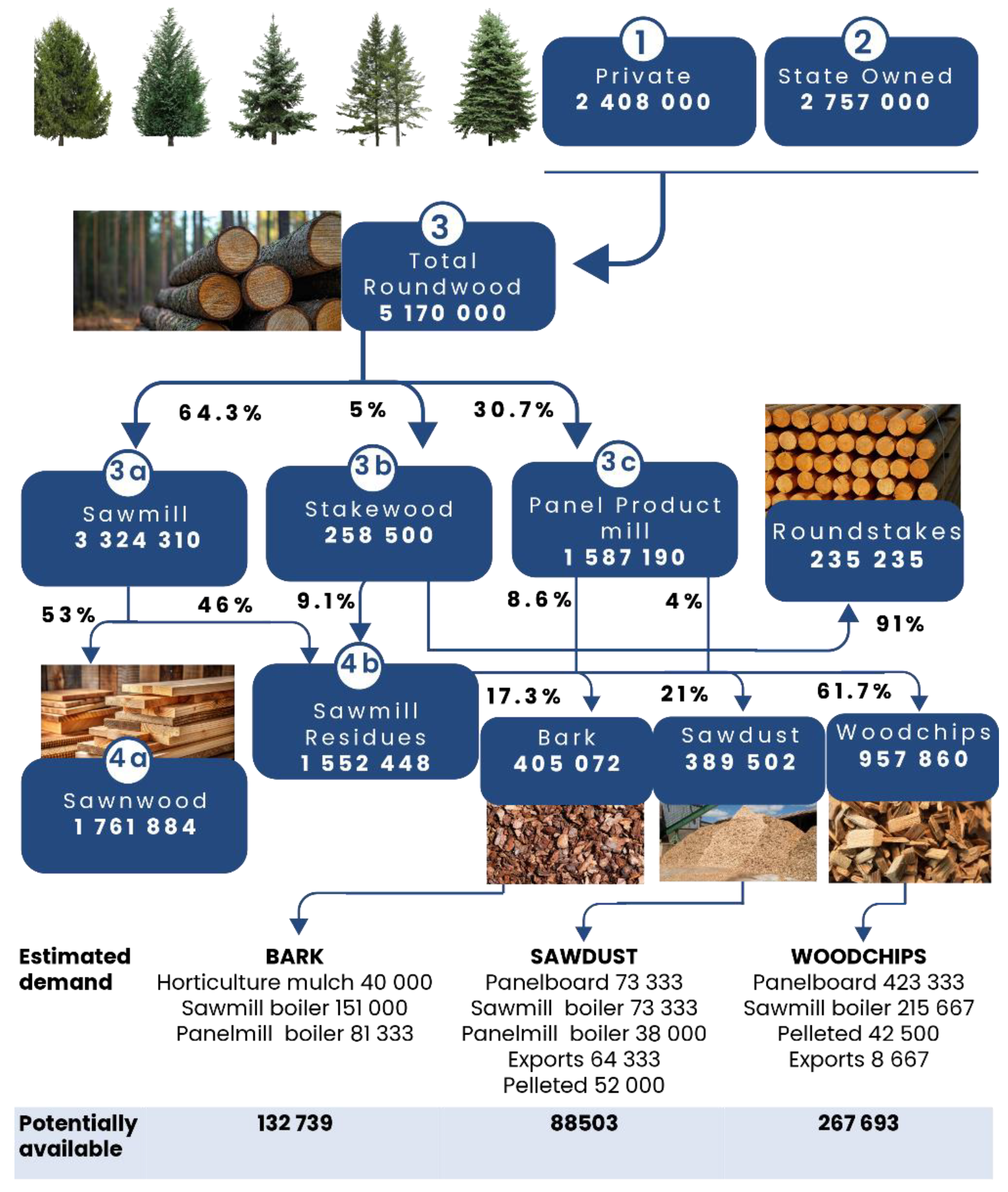

Table 1.
Conversion factors employed to estimate straw residue production from.
| Crop | Estimated straw yields (t/ha) | Reference |
|---|---|---|
| Winter wheat | 4.2 | [35] |
| Summer wheat | 3 | [35] |
| Winter barley | 4.2 | [35] |
| Summer barley | 3.6 | [35] |
| Winter Oats | 4.7 | [35] |
| Summer Oats | 3.9 | [35] |
| Oil seed rape | 2.2 | [36] |
| Beans | 3.7 | [36] |
| Willow and miscanthus | 10 | [37] |
Table 2.
Field crop residues and grass fiber annual production in Ireland.
| Type | 5-year Average annual cropping (ha) | Quantity produced (t)1 | Total Volume produced (m3) | Competing Uses | Reference | Potentially available for growth media (m3)2 |
|---|---|---|---|---|---|---|
| Wheat straw | 60 440 | 246 000 | 1 824 500 | c.93% of total combined cereals straw baled (wheat, barley, oats) [45], of which 60%-90% is used for bedding and feed [35,45], and 8.5 – 8.9% is used for mushroom compost (excluding oat straw) [35,45] | [31,32,33,34,45] | 145 960 |
| Barley straw | 186 280 | 710 052 | 5 266 219 | see above | [31,32,33,34,45] | 421 298 |
| Oats straw | 26 500 | 113 622 | 842 697 | see above | [31,32,33,34,45] | 67 416 |
| Oilseed rape straw | 12 460 | 27 910 | 207 002 | c.25% baled [45] | [31,32,33,34,45] | 155 252 |
| Bean Straw | 27340 | 38 796 | 287 737 | Amount used as animal feed and animal bedding unknown – est 90% | [31,32,33,34] | 28 774 |
| Miscanthus | 5933 | 5 930 | 31 997 | The amount used in energy production and animal bedding figures unknown. – est 60% | [49] | 12 799 |
| Willow | 2783 | 2 780 | 18 5334 | First harvest in 3- 4 years [37] Amount used in energy production unknown. – est 60% | [37] | 7 413 |
Table 3.
Hypothetical product yields from mechanical processing of various feedstocks.
| Material | Mechanical Process | Final bulk density of product (kg/m3) | Estimated product yield (% mass to volume change) | Reference |
|---|---|---|---|---|
| Soft wood | Sawdust | 232 | 431 | [63] |
| Willow | Chipped | 150 | 667 | [38] |
| Miscanthus | Hammer milled | 160 | 625 | [6] |
| Forest residues | Twin screw extrusion | 182 | 549 | [64] |
| Paper Waste | Shredded | 107 | 935 | [59] |
Table 4.
Thermal carbonisation conditions and expected yields of char products from various feedstocks.
Table 4.
Thermal carbonisation conditions and expected yields of char products from various feedstocks.
| Type of feedstocks | Thermal carbonisation conditions | Expected yield (% w/w) | Reference |
|---|---|---|---|
| Agro-wastes e.g. wheat, barley, oats | 300 - 600 oC, dry | 24 - 60% | [69] |
| Agro-wastes e.g. wheat, barley, oats | 100 - 220 oC, wet | 63 – 71% | [70] |
| Woody shrub clippings, forest residues, pine bark | 350 - 750, dry | 32 – 60% | [71] [68] |
| Pinecones | 500 – 700 oC, wet | 18 – 84% | [72,73] |
| Grass clippings – Miscanthus, pasture grass | 425 - 575 oC, dry | 20 – 33% | [66,74] |
| Brewers spent grains | 500 - 850 oC, dry | 15 – 63% | [75,76] |
| Spent mushroom compost | 225 - 250 oC, wet | 34 – 73% | [77] |
Table 5.
Composting conditions and expected yields of composted products from various feedstocks.
| Type of feedstocks | Composting conditions / details | Expected product yield (% w/w) | Reference |
|---|---|---|---|
| Green wastes – vegetable, household waste | 2 -4 m3/min airflow, covered with insulation, 50 days | 38 – 40% | [79] |
| Green wastes | Forced aeration, heated (30-50 oC), 60 days | 37% | [80] |
| Woody chips, forest residues | uncovered windrows, 100 days | 87% (63% of initial volume) | [81] |
| Bark | uncovered windrows, 100 days | 73% (56% of initial volume) | [81] |
Table 6.
Hypothetical estimates of annual volumes of growth media materials that could be produced in Ireland.
Table 6.
Hypothetical estimates of annual volumes of growth media materials that could be produced in Ireland.
| Hypothetical volumes that can be produced (m3) | |||||
|---|---|---|---|---|---|
| Material | Raw | Extruded Fibera |
Biocharb | Hydrocharc | Compostd |
| Wood chips/Slabs | 267 693 | 1 469 635 | 160 616 | 214 154 | 168 647 |
| Sawdust | 88 503 | - | - | - | 55 757 |
| Bark | 132 739 | 728 737 | 79 643 | 106 191 | 74 334 |
| Straw (wheat, barley, oats, oil seed rape, bean, miscanthus, willow) | 838 912 | 4 605 627 | 251 674 | 587 238 | 335 565 |
| Brewers Spent Grain | 202 532 | - | 60 760 | 141 772 | 81 013 |
| Green-wastes – household, municipal and agroc | - | - | - | - | 201 291 |
| Spent mushroom compost | 274 295 | - | 82 289 | 192 007 | 164 577 |
| Total | 1 804 674 | 6 803 999 | 634 982 | 1 241 362 | 1 081 184 |
aCalculated using a x5.49 increase in volume (see table 3), b30% biochar yield (straw, brewers spent grain, spent mushroom compost) and 60% biochar yield (wood) (see Table 4). c 70% hydrochar yield (straw, brewers spent grain, spent mushroom compost) and 80% hydrochar yield (wood) (see Table 4), d 56% compost yield (bark), 40% (straw, brewers spent grain) and 63% (wood chips, spent mushroom compost) (see Table 5).
Table 7.
Agronomic results and selected properties of growth media incorporating raw and mechanically altered biomass materials as growth media.
Table 7.
Agronomic results and selected properties of growth media incorporating raw and mechanically altered biomass materials as growth media.
| Feedstock | Ratio with peat (v/v) | Growth media characteristics | Crops grown | Yield result as compared to control | Reference | ||
|---|---|---|---|---|---|---|---|
| BD g/L | pH | EC dS/m | |||||
| Scots pine (hammer milled) | 10 – 30% | 95 – 138 | 5.7 – 6.1 | 0.39 – 0.42 |
Radish (Raphanus sativus) | Increased yields by 14 to 24% (compared to 70% peat + 30% perlite control) | [84] |
| Miscanthus (milled and screened) |
100% | 120 – 160 | 6.2 – 6.3 | 0.4 – 0.7 | Chinese cabbage (Brassica rapa subsp. Pekinensis) | Reduced yields by -44 to -56% (compared to coir control) | [6] |
| Miscanthus (chopped) |
100% | 100 | 6.3 | 0.3 | Chinese cabbage (Brassica rapa subsp. Pekinensis) | Reduced yields by -61% (compared to coir control) | [6] |
| Fresh pine sawdust mixed with composted pine bark | 20 – 70% | nr | 4.5 – 4.8 | 0.07 – 0.09 | Apache pine (Pinus engelmannii) | Mixed results: increased shoot yields by 7 to 17% for 20, 30 & 50% blends but reduced yields by -2 to -12% for 40, 60 and 70% blends (compared to 50% peat + 50% composted bark control) |
[85] |
| Scots pine (disc refined fiber) | 10 – 30% | 70 - 91g | 5.4 - 6 | 0.35 – 0.36 | Radish (Raphanus sativus) | Increased yields by 5 to 15% (compared to 70% peat + 30% perlite control) |
[84] |
| Scots pine (screw extruded fiber) | 10 – 30% | 75 - 130 | 5.2 – 5.7 | 0.3 | Radish (Raphanus sativus) | Reduced shoot yields by -6 to -14% (compared to 70% peat + 30% perlite control) |
[84] |
| wood (disc refined fiber) + sewage sludge | 25 – 100% | 370 | 4.5 | nr | Strawberry (Fragaria × ananassa) | All reduced yields by about 6% except for the 75% blend | [7] |
Table 8.
Agronomic results and selected properties of growth media incorporating thermally carbonised biomass as growth media. n.r. – not reported.
Table 8.
Agronomic results and selected properties of growth media incorporating thermally carbonised biomass as growth media. n.r. – not reported.
| Feedstock & pyrolysis conditions | Ratio with peat (v/v) | Growth media characteristics | Crops grown | Yield result as compared to control | Reference | ||
|---|---|---|---|---|---|---|---|
| BD g/L | pH | EC dS/m | |||||
| Woody materials biochar | |||||||
| Pine forest residues (450 oC, 48hr) | 25 – 75% | 375 – 505 | 6.6 – 7.8 | 5.5 – 14.6 |
Beach rose (Rosa rugosa Thunb) | All reduced shoot yields by -8 to -57% | [86] |
| Sitka spruce sawmill residues (550 oC, 4mins) | 25 – 100% | 180 – 280 | 5.9 – 9.9 | 0.2 – 0.4 | Tomato (Solanum lycopersicum) | 25 and 50% blends improved shoot yields up to 40% while 75 & 100% blends reduced yields by up to -86% |
[87] |
| Beech spruce & pine mix (400 -700 oC, 15 - 30mins) | 5 – 20% | nr | 5.01 – 5.89 | 0.038 – 0.047 |
Cabbage (Brassica oleracea var. capitata) | All reduced shoot yields from -30 to 44% | [88] |
| Conifer wood (conditions n.r.) | 25 – 75% | 375 – 505 | 6.5 – 7.8 | 5.5 – 14.6 |
Lavender (Lavandula angustifolia) | All reduced shoot yields from -35 to -70% | [89] |
| Beech, spruce and ash mix (450 -600oC, mins n.r.) |
10 – 50% | nr | 5 – 8.3 | 0.21-0.39 | Tomato (Solanum lycopersicum) | All reduced shoot yields from -10 to -53% | [90] |
| Beech, spruce & pine (500 -600oC, mins n.r.) | 7.5 & 15% | nr | 5.1 and 5.4 | 330 and 210 | Lettuce (Lactuca sativa) | Yield reduction of -49 and -6% | [91] |
| Pine wood (450oC) | 20 – 80% | 100 - 160 | nr | nr | Easter Lily (Lilium longiflorum Thunb.) | No significant differences in plant height between all ratios mixes and peat. | [92] |
| Field crop residues biochar | |||||||
| Wheat straw (temperature n.r., 3hrs) | 5 – 15% | 141 - 148 | 5.4 - 5.6 | 1.72 – 1.9 | Marigold (Tagetes patula L.) | Improved shoot yields by 6.5 – 15% | [93] |
n.r. not reported, EC electrical conductivity.
Table 9.
Agronomic results and selected properties of growth media incorporating composted biomass as growth media.
Table 9.
Agronomic results and selected properties of growth media incorporating composted biomass as growth media.
| Compost type | Ratio with peat (v/v) | Growth media characteristics | Crops grown | Yield result as compared to control | Reference | ||
|---|---|---|---|---|---|---|---|
| BD g/L | pH | EC dS/m | |||||
| Green waste | 45% with coir | 210 | 7.8 | 0.77 | Oxeye daisy (Leucanthemum vulgare) | Yield increased by 48% | [8] |
| Green waste (mixed green refuse including urban prunings) | 30 - 50% | 180 – 280 | 6.7 – 7.5 | 0.24 – 0.45 |
Geranium (Pelargonium zonale L.) | Increased yields by up to 6.7% except for a 50% blend treatment | [101] |
| Green waste (40% fruit-vegetable waste) |
25 – 30% | 220 – 310 | 5.6 – 6.1 | 1.5 – 1.6 | Tomato (Solanum lycopersicum) | Increased shoot yields by range 21 - 62% | [102] |
| Green waste (urban pruning and trimmings) | 30 – 100% | 281 – 365 | 6.7 – 8.4 | 0.71 – 1.44 |
Basil (Ocimum basilicum) | Reduced shoot yields by -20 to –64% | [95] |
| Green waste (municipal + sewage sludge) |
100% | 600 | 7.6 | nr | Strawberry (Fragaria × ananassa) | Reduced shoot yields by -12% (compared to coir control) | [7] |
| Green waste (botanic wastes) | 25 – 100% | 137 - 176 | nr | nr | Escallonia laevis ‘Gold Brian’, Euonymus europaeus, Viburnum tinus, Euryops pectinatus and Olearia x haastii | Similar yields to peat | [94] |
| Forest residues (willow) | 100% | nr | 7 – 6.6 | 0.2 – 0.3 | Tomato (Solanum lycopersicum), cucumber (Cucumis sativus) | Reduced yields by -97% for tomato and -74% for cucumber | [97] |
| Composted Spent mushroom compost and pasturised | 20 – 50% (with vermiculite or perlite) | 277 - 396 | 6 – 6.9 | 1.28 – 1.58 | Cucumber (Cucumis sativus) and Tomato (Solanum lycopersi cum) |
Yielded similar biomass yields to peat | [100] |
nr – not reported, EC – electrical conductivity.
Table 10.
Identified challenges with peat replacement/ substitution using wood and grass fibres and paper waste.
Table 10.
Identified challenges with peat replacement/ substitution using wood and grass fibres and paper waste.
| Physico-chemical challenges of material | Type of fibre | Reference | Possible solution |
|---|---|---|---|
| Low N availability – inherent and N immobilisation | Wood: disc refined, grass: milled and paper waste |
[6,7,59] | Increase fertigation rates or initial nutrient application before potting. |
| Low water holding capacity | Wood Grass: milled (miscanthus) |
[64] [6] |
Mix with high water holding materials. Fine mill to < 3mm. |
| High EC - phytotoxic levels of Ca and Na |
Paper waste | [59,107] | Leach media initially. |
| Phytotoxic compounds |
Wood – milled prunnings | [105,108] | Volatile compounds - Change milling method applied (i.e. increase heat and pressure) Soluble compounds - feedstock pre-conditioning (i.e. soaking) Organic acids - incubate with ammonium carbonate |
| Low Ca exchange capacity | Grass (miscanthus) | [6] | Adjust fertigation rates or apply higher starter fertiliser rates. |
Table 11.
Identified challenges with peat replacement/ substitution using biochars.
| Physico-chemical challenges of material | Biochar feedstock | Reference | Possible solution |
|---|---|---|---|
| High pH | beech, pine, poplar, alder, larch, silver fir and spruce | [86,87,88,89,109] | Leach with water or dilute acid. Mix with other materials. Perform pre-pyrolysis additions (e.g. with phosphates) Adjust pyrolysis conditions to those that reduce ash content. Acidify irrigation water or add of S to growth media |
| High EC (mainly a result of increased available K) | beech, pine, poplar, alder, larch, silver fir and spruce | [86,87,88,89,109] | Leach with water or dilute acid. Sieve out finer particles. Adjust pyrolysis conditions to those that reduce ash content |
| Low available P, Ca, Mg and N | beech, pine, poplar, alder, larch, silver fir and spruce | [86,87,88,89,90,109] | Leach with water or dilute acid. Increase fertiliser rates (might not be feasible) or use slow-release fertilisers. Perform pre-pyrolysis additions (e.g. with phosphates) |
| Low water holding capacity | beech, pine, poplar, alder, larch, silver fir and spruce | [86,87,89,109] | Perform post pyrolysis sieving to < 2mm. Mix with other finer materials. |
Table 12.
Identified challenges with peat replacement/ substitution using composted materials.
| Physio-chemical challenges of material | Compost feedstock | Reference | Possible solution |
|---|---|---|---|
| Reduced availability of N | Gorse Ulex europaeus | [111] | Increase N fertiliser rates. Add nutrients pre-composting. |
| High N availability | Mixed green waste | [112] | Reduce N fertigation. |
| High EC; mainly due to high chloride concentration (high salinity) | Mixed green waste | [101] | Mix with inert materials. |
| Low pH | Post consumer wood | [82] | Apply lime. |
| Low water availability | Municipal garden waste and sewage digestate | [7] | Adjust irrigation rates. Mix with other materials. |
| High salinity (K, Na, Ca, Cl, sulphates, and nitrates) | Spent mushroom compost | [60,110] | Mix with other materials, Long-term weathering |
Disclaimer/Publisher’s Note: The statements, opinions and data contained in all publications are solely those of the individual author(s) and contributor(s) and not of MDPI and/or the editor(s). MDPI and/or the editor(s) disclaim responsibility for any injury to people or property resulting from any ideas, methods, instructions or products referred to in the content. |
© 2025 by the authors. Licensee MDPI, Basel, Switzerland. This article is an open access article distributed under the terms and conditions of the Creative Commons Attribution (CC BY) license (http://creativecommons.org/licenses/by/4.0/).
Copyright: This open access article is published under a Creative Commons CC BY 4.0 license, which permit the free download, distribution, and reuse, provided that the author and preprint are cited in any reuse.


