

Submitted:
17 February 2025
Posted:
19 February 2025
You are already at the latest version
Abstract
This paper presents an adaptation and application of the Risk-Informed Asset-Centric (RIACT) process to analyze the resilience of a portion of Hydro-Québec's electric power grid against extreme ice storm risks, when supplying the densely populated Greater Montreal area, one of the power system’s major load centers. The key aspect consists in avoiding widespread or major blackouts and maintaining the functional performance of the area’s critical and essential services. The study identifies critical risks and asset exposures, analyzes potential solutions. The evaluation is aimed at deploying, on an urban grid, measures based on the PERA resilience stages: i) Preparation; ii) Endurance (Absorption); iii) Recovery; and iv) Adaptation. The proposed PERA plan aims to provide insights in implementing effective preventive measures while emphasizing the importance of monitoring, communication, and reporting throughout the process. By integrating resilience and asset management practices, this approach provides a simplified framework for managing risks associated with extreme weather events, ensuring the continuity of essential services.
Keywords:
urban resilience
; electric power grid
; climate change
; asset management
; mitigation strategies
; cascading failures
1. Introduction
Extreme weather events, especially ice storms, constitute significant threats to electrical infrastructure, potentially leading to widespread power outages and disruptions across urban essential services. In Canada, Quebec has faced such challenges, most notably during the 1998 ice storm that left over 1.4 million customers without power for extended periods [1]. The official data is also available in the public report concerning this event and on Hydro-Québec’s official website [2]. These events highlight the need for robust resilience strategies within electrical utilities to ensure the continuity of essential services and the smooth operation of the city’s critical services and industries. This paper aims to adapt and apply the Risk-Informed Asset-Centric (RIACT) process for the analysis of the resilience of Hydro-Québec’s electric power grid against major ice storm risks at the city level using data from the 1998 extreme ice storm.
Hydro-Québec, as a major utility provider, plays a fundamental role in supporting Canada’s critical infrastructure [3]. The reliability and resilience of its electric power grid are vital not only for residential customers but also for interconnected sectors such as health-care services, communications, transportation, water management, banking, and emergency services. The interdependencies among these sectors mean that disruptions in the electric power grid can have far-reaching consequences, leading to systemic failures that affect the broader urban ecosystem. Therefore, ensuring that Hydro-Québec’s infrastructure and system are resilient is essential for maintaining societal stability and economic continuity during extreme weather events.
The RIACT process, originally designed to assess and manage risks in urban resilience frameworks, offers an approach to identify, analyze, and mitigate risks associated with critical assets. By adapting RIACT to the Hydro-Québec specific context and ice storms risks, this study seeks to adapt a tailored framework that addresses the unique challenges faced by electrical utilities. This adaptation involves: i) defining the scope at the city level; ii) contextualizing the risks related to ice storms and their impact on the electric power grid; iii) establishing criteria to avoid major blackouts; and iv) ensuring the functional performance of city services and industries. Despite the present study focused only on ice storms, the RIACT framework's systematic approach developed can be effectively extended to address other infrastructure threats such as floods, earthquakes, cybersecurity risks, and other extreme weather events, making it a versatile tool for comprehensive infrastructure resilience planning.
A key aspect of RIACT adaptation is the identification of risks and asset exposures. Ice storms primarily threaten the electric power grid through physical damage to infrastructure such as poles, towers, and transmission lines. Additionally, the cascading effects of grid failures extend to other critical infrastructure, increasing the overall vulnerability of the urban environment. By systematically identifying these risks and exposures, the RIACT process enables a thorough assessment of the dimensions, indicators, and parameters necessary to effectively measure and evaluate resilience.
Furthermore, the analysis phase within RIACT involves exploring potential solutions, to mitigate the identified risks by implementing preventive measures. This study will evaluate long-term and short-term strategies, such as grid reinforcement, adoption of smart grid technologies, and implementation of anti-cascading towers as an effective measure. By calculating metrics related to cost, risk, and performance, the study aims to prioritize solutions that offer the most significant improvements in resilience while remaining economically viable.
By evaluating these solutions, the study focus on the urban resilience stages of Preparation, Endurance, Recovery, and Adaptation (PERA), ensuring the selected measures not only address immediate vulnerabilities but also enhance the grid’s ability to withstand future disruptions and adapt to evolving climate conditions. The final treatment plan will outline actionable steps for implementing these measures, supported by robust monitoring, communication, and reporting mechanisms to ensure ongoing effectiveness and stakeholder engagement.
The objectives include defining the scope and context of the risks, identifying and assessing asset exposures, analyzing potential mitigation solutions, and evaluating these solutions based on urban resilience stages. Ultimately, the study aims to develop a well-structured treatment plan that ensures the continuity of essential services and improves the overall resilience of urban infrastructure in the face of extreme weather events. It is based on the data of the 1998 ice storm, and recommendations made by the Commission Nicolet [2] in 2004, that the Régie de l’énergie approved Hydro-Québec's request to implement a de-icer at the Lévis substation, aimed at enhancing the power grid's resilience following the 1998 ice storm, with an estimated project cost of $190.8 million [4]. While the Régie recognized concerns regarding the technology's untested nature and the absence of independent risk analysis, it ultimately deemed the project necessary for maintaining power supply security in the greater Quebec City area [4], another important load center of Hydro-Québec’s electrical system and prone to severe Ice storms.
This paper is organized into several sections. Following the introduction, the Literature Review examines existing risk management frameworks and relevant case studies on ice storm impacts. The Methodology section outlines the adapted RIACT process, detailing each stage from scope definition to recording and reporting. The Results section presents the findings from the risk and asset exposure assessments and the evaluation of potential solutions. The Discussion analysis and interprets the results, exploring their implications for Hydro-Québec and urban resilience. Finally, the Conclusion summarizes the key findings, acknowledges limitations, and suggests directions for future research.
2. Literature Review
The literature review structure employed a dual-search strategy to systematically analyze storm resilience in electric power grids. The first search used broad terms (“storm,” “resilience,” “electrical grid,” “cascad*”) to capture 411 studies on general resilience mechanisms and cascading failures. The second search narrowed the focus with terms like “ice storm” and “critical infrastructure,” yielding 227 studies specific to ice-related impacts. A VOS visualization analysis identified five research clusters: power systems resilience, extreme weather events, risk assessment, infrastructure interdependencies, and response-recovery strategies. Overlay visualizations revealed a temporal shift from foundational infrastructure studies to climate change adaptation and smart grid technologies. Annual publication trends showed a 104% increase in Search 1 outputs (2019–2024) and a 190% rise in Search 2, indicating growing emphasis on ice storm impacts. Geographically, 40% of publications originated from the United States and China, while Canada contributed 2.7%, highlighting regional research gaps. Subject area analysis demonstrated interdisciplinary engagement, with Engineering (31%) and Energy (22%) dominating, followed by Computer Science (15%) and Environmental Science (12%). The systematic approach combined quantitative bibliometric analysis with qualitative theme extraction, ensuring comprehensive coverage of technical, operational, and policy dimensions in electric grid resilience research.
2.1. Systematic Review
To comprehensively explore the existing literature on storm resilience, particularly focusing on electric power grids and cascading effects, two distinct search strategies were employed. The first search string was broad, aiming to capture a wide range of studies related to storms, resilience, electric power grids, and cascading failures. The second search string was narrower, incorporating additional keywords such as "ice storm," "critical infrastructure," and "cascading," to home in on specific aspects pertinent to ice storm impacts on electric power grids and associated infrastructures.
Search 1:
storm AND resilience AND electrical AND grid AND cascad* AND (LIMIT-TO (SRCTYPE, "j")) AND (LIMIT-TO (DOCTYPE, "ar") OR LIMIT-TO (DOCTYPE, "re")) AND (LIMIT-TO (LANGUAGE, "English"))
This search yielded 411 results. The terms "storm," "resilience," "electrical," "grid," and "cascad*" were chosen to ensure a broad capture of literature addressing general storm resilience in electric power grids, including studies on cascading failures. The use of wildcard "cascad*" allows for the inclusion of related terms such as "cascading" and "cascade."
Search 2:
ice AND storm AND resilience AND electrical AND grid AND critical AND infrastructure AND (LIMIT-TO (DOCTYPE, "ar") OR LIMIT-TO (DOCTYPE, "re")) AND (LIMIT-TO (LANGUAGE, "English")) AND (LIMIT-TO (SRCTYPE, "j"))
This search returned 227 results. By adding "ice" and "critical infrastructure," the search was narrowed to focus specifically on ice storms and their impact on electric power grids and other essential infrastructures. This refinement helps in obtaining more targeted studies relevant to the specific context of ice storms in Canadian cities.
The decision to employ both a broad and a narrow search strategy was intentional. The broad search ensures that main and diverse studies are captured, providing an understanding of the general resilience of electric power grids to storm events. Conversely, the narrow search targets literature that specifically addresses ice storms and their nuanced impacts, which is directly relevant to the study's focus on ice storm risks in Canada.
To further analyze the relationships and clusters within the retrieved literature, a VOS visualization RIS analysis was conducted, generating network (Figure 1) and overlay visualizations (Figure 2). These visualizations help in identifying prominent themes and their interconnections within the research domain.
The network visualization revealed several distinct clusters, each representing a core theme within the literature:
- Power Systems and Resilience: This cluster includes terms like "power system," "grid resilience," "distribution network," and "transmission line." It indicates a strong focus on the technical aspects of electric power grids and their ability to withstand and recover from storm-induced disruptions.
- Extreme Weather Events: Terms such as "extreme event," "hurricane," "typhoon," and "windstorm" fall under this cluster, emphasizing studies related to various types of severe weather phenomena and their impacts on infrastructure.
- Risk and Vulnerability Assessment: This cluster encompasses "risk," "vulnerability analysis," "hazard," and "probability," highlighting the importance of assessing and quantifying risks associated with storms to inform resilience strategies.
- Infrastructure and Interdependencies: Including terms like "critical infrastructure," "interdependency," and "infrastructure system," this cluster underscores the interconnected nature of urban infrastructures and how failures in one system can cascade to others.
- Response and Recovery: Terms such as "disaster," "response," "recovery," and "outage" are part of this cluster, focusing on the strategies and measures for responding to and recovering from storm-induced disruptions.
The overlay visualization provides insights into how research themes have evolved over time. For instance, earlier publications predominantly focused on "infrastructure" and "risk," while more recent studies have shifted towards "power system resilience" and "climate change." This temporal analysis indicates a growing emphasis on integrating climate change considerations into resilience planning and the adoption of advanced technologies to enhance grid resilience.
The clustering results from the VOS analysis highlight the multifaceted nature of storm resilience research. The prominence of power systems and resilience underscores the role of electric power grids in urban infrastructure and the necessity to secure them against extreme weather events. The emergence of climate change as a significant theme in recent years reflects the broader recognition of its impact on the frequency and intensity of storms, necessitating adaptive resilience strategies.
Moreover, the interconnectedness of infrastructures, as depicted in the clusters, emphasizes the complexity of urban resilience. It suggests that resilience planning cannot be solved but must consider the interdependence among various infrastructure systems. This holistic approach is essential for preventing cascading failures that can amplify the impacts of storms.
The shift towards more recent themes like smart grid technologies and climate adaptation in the overlay visualization indicates an evolving research landscape that embraces innovation and sustainability. These trends align with global resilience framework that advocate for forward-thinking and adaptive measures to address emerging challenges posed by climate change.
As shown Figure 3, analyzing the number of publications per year provides a temporal perspective on the research activity and emerging trends in storm resilience and electric power grid studies.
The publication trend shows a clear upward trajectory, especially in the last five years, indicating a growing academic and practical interest in storm resilience and electric power grid robustness. In 2024 (till October) alone, Search 1 yielded 98 publications, nearly double the 48 publications from 2021. Search 2, while narrower, also reflects significant growth, with 58 publications in 2024 compared to 20 in 2021.
The increasing number of publications over the years can be attributed to several factors. Firstly, the escalating frequency and severity of extreme weather events, exacerbated by climate change, have heightened the urgency for resilient infrastructure. As cities face more frequent ice storms and other severe weather events, the demand for research on mitigating these impacts has surged.
Secondly, advancements in technology and data analytics have enabled more sophisticated studies on electric power grid resilience. The integration of smart grid technologies, real-time monitoring systems, and predictive analytics has opened new avenues for research, contributing to the rise in publications.
Additionally, policy initiatives and funding allocations aimed at enhancing urban resilience have likely spurred academic interest and investment in this area. Governments and international bodies recognizing the importance of resilient infrastructure may have incentivized research through grants and collaborative projects, further fueling publication growth.
The disparity between Search 1 and Search 2 results highlights the broader versus specialized focus in literature. While the general topic of storm resilience is extensively studied, specific aspects like ice storms and their direct impact on critical infrastructure receive comparatively less attention. This gap underscores the need for more targeted research to address the unique challenges posed by ice storms, particularly in regions like Canada where such events are prevalent.
Understanding the geographical distribution of research provides insight into regional priorities and expertise in storm resilience and electric power grid studies.
Figure 4 and Figure 5 show the distribution of research publications by country for two different search strategies. Figure 4 provides a bar chart indicating the number of publications from each country, with the United States and China leading in research output. Figure 5 presents a world map that visually highlights the geographic spread of publications, with darker regions representing higher research activity in infrastructure resilience and storm-related studies. These figures illustrate global interest in the subject, with notable contributions from North America, Europe, and Asia.
The United States leads significantly with 166 publications from Search 1 and 97 from Search 2, followed by China with 126 and 64 publications, respectively. European countries such as the United Kingdom, Italy, and Germany also contribute notably, while Canada, the focal point of this study, has 11 publications in Search 1 and 7 in Search 2.
The dominance of the United States and China in publication counts reflects their substantial investments in research and development related to infrastructure resilience and smart grid technologies. These countries possess advanced technological capabilities and robust research institutions that drive extensive studies in storm resilience and electric power grid management.
European countries, particularly the United Kingdom and Italy, also show considerable research activity, likely influenced by their focus on sustainable energy and resilient infrastructure in response to climate change and urbanization pressures. Germany’s relatively lower count in Search 2 compared to Search 1 may indicate a broader focus on power systems rather than specific storm-related resilience.
Canada’s presence, though modest, is significant given the study’s focus on ice storms. The relatively lower number of publications may suggest an opportunity for further research tailored to Canada’s unique climatic challenges. Enhancing Canadian research efforts in this area could provide valuable insights and solutions applicable to similar regions globally.
Emerging research contributions from countries like Iran, India, and Australia highlight a growing global recognition of the importance of resilient electric power grids. However, the disparity in publication counts also points to potential regional gaps where certain countries may need to bolster their research initiatives to address specific vulnerabilities related to extreme weather events.
The international distribution of research underscores the universal relevance of storm resilience and the electric power grid’s critical role in modern urban infrastructure. Collaborative efforts and sharing knowledge across countries can enhance global resilience strategies, leveraging diverse experiences and innovations to tackle common challenges.
Analyzing the distribution of publications across different subject areas (Figure 6) provides a multidimensional view of the research landscape, highlighting interdisciplinary approaches and dominant fields of study.
The Engineering and Energy sectors dominate the publication landscape, accounting for 255 and 181 publications in Search 1, respectively. Computer Science and Environmental Science follow, with substantial contributions in both search categories. Social Sciences, Earth and Planetary Sciences, and Mathematics also feature prominently, indicating the interdisciplinary nature of storm resilience research.
The prominence of Engineering and Energy in the subject area distribution aligns with the technical focus of storm resilience studies, particularly concerning electric power grids and infrastructure systems. Engineering disciplines contribute significantly to understanding and improving the physical robustness of power systems, while Energy studies emphasize sustainable and resilient energy solutions in the face of extreme weather events.
The substantial representation of Computer Science highlights the growing importance of digital technologies, such as smart grids, real-time monitoring systems, and data analytics, in enhancing grid resilience. These technologies enable more efficient detection, response, and recovery from storm-induced disruptions, reflecting the integration of digital innovations in traditional engineering domains.
Environmental Science’s significant presence underscores the interplay between climatic factors and infrastructure resilience. Studies in this area often explore the environmental impacts of storms and the necessary adaptations to mitigate these effects, emphasizing the need for sustainable and eco-friendly resilience strategies.
The inclusion of Social Sciences and Business, Management, and Accounting indicates an acknowledgment of the socio-economic dimensions of storm resilience. These fields address aspects such as community preparedness, economic impacts, policy development, and stakeholder engagement, which are important for resilience planning.
Earth and Planetary Sciences, Mathematics, and Materials Science contribute to the foundational understanding of storm dynamics, risk modeling, and the development of resilient materials and structures. These disciplines provide the scientific and quantitative basis necessary for informed decision-making and effective resilience strategies.
The relatively lower representation of Medicine and Physics and Astronomy suggests that while these fields are relevant, they are less central to the core focus of electric power grid resilience in the context of storm impacts. However, their inclusion reflects the multidisciplinary approach required to address the complex challenges of urban resilience comprehensively.
Overall, the distribution across subject areas highlights the necessity of an interdisciplinary approach to storm resilience. Combining technical engineering solutions with insights from environmental sciences, computer technologies, and social sciences fosters a holistic understanding and more effective strategies for enhancing the resilience of electric power grids and urban infrastructures.
The systematic literature review employed a dual-search strategy to capture both broad and specific aspects of storm resilience in electric power grids. The VOS analysis identified key thematic clusters and revealed evolving research trends over time, emphasizing the increasing integration of climate change considerations and advanced technologies in resilience planning. Publication trends by year and country highlight the growing academic and practical interest in this field, with significant contributions from leading research nations like the United States and China.
The subject area distribution shows that storm resilience research includes work from many fields. Most work comes from engineering, energy, and computer science. Work from environmental science and social science is also present. This shows that strengthening electric power grid resilience against extreme weather requires work from different fields.
The review also found gaps. There are few studies on how ice storms affect electric power grids in regions such as Canada. Research that focuses on these gaps may offer insights and solutions that match local weather and infrastructure conditions.
2.2. RIACT Process in Urban Resilience
The Risk-Informed Asset-Centric (RIACT) process (Figure 7) is a framework designed to integrate risk management with asset management, particularly in the context of urban resilience [5]. RIACT is structured into various sequential stages: i) Scope Definition; ii) Context Definition; iii) Criteria Definition; iv) Identification (Risk & Asset Exposure); v) Analysis; vi) Evaluation; vii) Treatment; viii) Monitoring & Review; ix) Communication & Consultation; and x) Recording & Reporting [6,7]. Each stage builds upon the previous one, ensuring a systematic approach to identifying, analyzing, and mitigating risks associated with critical constructed assets [8,9,10].
The RIACT process follows a systematic approach to enhance urban resilience through eight interconnected steps. The process begins with establishing scope, context, and criteria, which sets the foundation for risk assessment at different administrative levels. This leads to risk identification and analysis phases, where potential hazards are evaluated based on their likelihood and impact on asset systems. The evaluation and treatment phases enable decision-makers to prioritize risks and implement appropriate mitigation strategies while considering cost-risk-performance balance. Throughout the process, continuous monitoring, stakeholder communication, and documentation are maintained to ensure effectiveness and accountability.
The Preparation, Endurance, Recovery, Adaptation (PERA) framework integrates with RIACT to provide a structured approach to urban resilience. The framework divides resilience-building into four stages: i) Preparation focuses on risk reduction and early warning systems; ii) Endurance addresses the capacity to maintain essential services during disruptions; iii) Recovery encompasses the restoration of systems to normal operation; and iv) Adaptation involves system improvements based on lessons learned. The PERA stages are incorporated into the RIACT evaluation phase to align risk assessment with resilience objectives, ensuring that risk treatment measures support long-term urban resilience development through these four distinct yet interconnected stages.
RIACT aligns international standards such as ISO 31000 for risk management [11], ISO 55000 for asset management [12], and ISO 37123:2019 for sustainable cities and communities [13]. By incorporating these standards, the RIACT process ensures that risk assessments are thorough, consistent, and based on best practices. The process emphasizes the importance of understanding the interdependencies between assets and the potential cascading effects of risks, which is important for critical infrastructure like electric power grids.
The RIACT framework is particularly relevant for urban environments where the complexity and interconnectivity of systems require a holistic approach to risk management [14,15,16,17]. By focusing on assets at the center of the risk assessment, the process allows for targeted strategies that enhance the resilience of critical infrastructure, ensuring continuity of services in the face of adverse events [18,19].
2.3. Enhancing Grid Resilience and Asset Management in the Face of Ice Storm Impacts
Ice storms, though infrequent, pose significant threats to electric power grids, leading to widespread power outages and cascading failures in urban infrastructure [20,21]. The 1998 Quebec ice storm is a prime example of the catastrophic effects such events can have on power systems, underscoring the need for improved asset management and resilience strategies.
Recent literature emphasizes the importance of integrating complexity science and risk-informed decision-making to enhance grid resilience against extreme weather events like ice storms. Komljenovic, Abdul-Nour, and Popovic (2015) argue that traditional asset management approaches are insufficient for addressing the complexities and uncertainties inherent in modern power systems [22]. They advocate for viewing these systems as complex adaptive systems (CAS), which allows for a better understanding of their dynamic behaviors and vulnerabilities under extreme conditions.
Building on this perspective, Komljenovic and al. (2016) introduced a Risk-Informed Decision-Making (RIDM) framework that incorporates the risks of extreme and rare events into asset management strategies [23]. This framework is important for utilities facing natural disasters such as ice storms, as it enables them to assess potential impacts and prioritize investments in grid reinforcement and maintenance. By considering the likelihood and consequences of such rare events, utilities can develop more robust contingency plans to mitigate large-scale failures.
Predictive maintenance and real-time monitoring are also critical components in enhancing grid resilience. Blancke and al. (2018) Proposed a holistic multi-failure mode prognosis approach for complex equipment, which can be instrumental in predicting failures caused by ice accumulation on infrastructure components [24]. Utilizing graph theory and stochastic models, this approach allows utilities to dynamically assess the health of their assets and implement timely interventions before failures occur.
Advancing this concept, Blancke and al. (2019) develop a predictive maintenance model based on failure mechanism propagation, enabling detailed tracking of how ice-induced stresses affect grid infrastructure [25]. This model supports decision-making by identifying critical components at risk and optimizing maintenance schedules to prevent cascading failures during ice storms. Implementing such predictive maintenance strategies can significantly reduce downtime and enhance the reliability of power supply during extreme weather events.
In the context of electric power utilities, Gaha and al. (2021) present a global methodology for maintenance assessment based on risk-informed decision-making [26,27]. Their framework integrates a power grid reliability simulator with asset management strategies, focusing on the Value of Lost Load (VoLL) to evaluate the economic impact of outages caused by extreme weather events. By simulating various ice storm scenarios, utilities can better understand potential vulnerabilities and develop strategies to enhance grid resilience, such as reinforcing critical infrastructure or diversifying energy sources.
Raymond and Komljenovic (2024) highlight the necessity of enhanced situational awareness as a roadmap to generation plant modernization and reliability [28]. With the increasing integration of distributed energy resources (DERs) like solar and wind power, and the challenges posed by extreme weather, real-time monitoring and adaptive control systems become essential. Implementing advanced monitoring technologies allows utilities to respond more effectively to ice storms by quickly isolating affected areas and rerouting power to minimize outages, as demonstrated in the response to the 1998 Quebec ice storm.
Collectively, these studies underscore the importance of adopting advanced asset management practices, predictive maintenance techniques, and risk-informed frameworks to bolster the resilience of electric power grids against ice storms. By leveraging holistic and adaptive approaches, utilities can better prepare for and mitigate the impacts of such extreme events, ensuring the continuity of critical services and the safety of urban infrastructure. Lessons learned from past ice storms highlight the need for preparedness, real-time monitoring, and system flexibility to absorb and recover from large-scale disruptions.
2.4. Overview of the 1998 Quebec Ice Storm and Its Impact on Power Infrastructure
In January 1998, Quebec experienced one of the most severe ice storms in its history, which had a profound impact on the region's electrical infrastructure. Beginning on January 5 and lasting until January 10, a total of three successive storms resulted in unprecedented ice accumulation, with some areas experiencing up to 110 millimeters of ice accumulation on structures and conductors [29]. The total cost of the storm amounted to approximately 1.65 billion Canadian dollars [29].
The ice storm not only disrupted daily life but also underscored the importance of preparing for extreme weather events and the need for resilient infrastructure. The widespread power outages and infrastructure damage highlighted the critical need for utilities to reassess their risk management and resilience strategies [31,32]. Recognizing the necessity for a more robust infrastructure, Hydro-Québec undertook a comprehensive review of its transmission grid design and operational philosophy [29] which resulted in a series of projects aimed at increasing the security of supply for the affected areas.
In response, Hydro-Québec invested heavily in improving the power system's reliability and resilience. Following the storm, an additional 1 billion Canadian dollars were earmarked for corrections to the power system, emphasizing a long-term commitment to infrastructure improvement [29]. One of the key lessons learned was the importance of preparation and situational awareness [27,33].
In the early 1990s, following several system blackouts, Hydro-Québec had undertaken an extensive program for enhancing its system reliability and resilience against extreme events [29]. This program prompted investments costing up to 1.3 billion Canadian dollars and was successfully implemented prior to the 1998 events. This program had a major positive impact on the system’s reliability and played a major role in safekeeping the supply of power to the unaffected regions, despite the extensive damage suffered during the 1998 storm, no system blackout occurred.
Hydro-Québec had been using weather stations since the early 1970s to establish ice accumulation conditions in remote areas where their extra-high voltage (EHV) transmission lines ventured to collect power from remote (1000 km) hydraulic power stations. These stations eventually evolved into a more sophisticated system called Sygivre and this system is now at its fourth generation, it provides the ability for the system operators to detect ice accumulation data and monitor in real time weather conditions [3,34]. Hydro-Québec has increased the number of weather stations to 50, enhancing the ability to collect ice accumulation data and monitor climatic conditions [3,34]. These stations, which have been in operation for over 40 years, provide valuable historical data to inform future planning and risk assessments [3,34].
The company also reassessed the recurrence rates used in designing its transmission infrastructure. Prior to the storm, line design was based on a less evolved deterministic approach which resulted in a uniform withstand design recurrence rate of approximately one in 50-years. Following the 1998 storm, the revised mechanical design criteria for new transmission lines were established such that lines considered strategic should withstand an icing load of a storm with 150-year recurrence rate and regular lines a 50-year rate [29]. Recognizing the 1998 storm as a 300-year event prompted Hydro-Québec to update these recurrence rates, leading to the implementation of higher design standards for new constructions [35]. Interventions on existing lines would also trigger the evaluation of the need for the addition of anti-cascading structures.
In the early 1990s, Hydro-Québec established new principles and criteria that took the form of a defense plan, with successive lines of defense aimed at enhancing grid resilience against similar events [29] to avoid system blackout and protect the integrity of strategic equipment during major events. By 2005, the company had published a paper detailing an integrated approach to designing a reliable power system, emphasizing lessons learned from the 1998 ice storm [29]. This approach incorporated risk analysis and resilience considerations into both system design and operation, setting a new trend in design approach in the industry [32].
The early 2000s also saw major system outages in Italy, the northeastern United States, and the Philippines, highlighting a global vulnerability of power systems to disruptive events [31,36]. These incidents reinforced the need for robust strategies to enhance power grid resilience worldwide. In 2015, studies provided critical insights into the economic valuation of power grid resilience, informing utilities on the importance of investing in reliable infrastructure [37].
By 2021, the focus on resilience had grown significantly. A global methodology for electrical utilities maintenance assessment based on risk-informed decision-making was published, underscoring the increasing importance of incorporating risk and resilience considerations into asset management practices [27,38]. In 2022, discussions emphasized the role of human psychology and decision-making in asset management during crises, indicating a multidisciplinary approach to resilience [23,39].
In 2023, as part of a global strategy aimed at evaluating the resilience of Hydro-Québec's transmission grid. An extensive study was recently conducted, the first of three foreseen study regions, and focused particularly on the Montreal area. This study aimed to identify remaining vulnerabilities and propose potential mitigating measures for future ice storms [40].
The 1998 Quebec ice storm served as a catalyst for significant changes in how Hydro-Québec and other utilities approach system design, resilience and risk management. The extensive damage and associated costs underscored the importance of robust infrastructure, comprehensive planning, and the integration of risk and resilience into all aspects of power system design and operation [32,42,43]. Through substantial investments and the adoption of new design practices, strategies and technologies, Hydro-Québec has significantly enhanced the resilience of its power grid, providing a model for utilities worldwide facing similar challenges [29,30]
Looking ahead, it is projected that by 2025, the IEEE's Distribution Resiliency Working Group will finalize industry-standard grid resilience metrics. This development is expected to further formalize the assessment and enhancement of power system resilience, providing utilities with standardized tools and benchmarks [41]
3. Methodology
This section outlines the process of adapting the RIACT framework to analyze Hydro-Québec’s resilience against ice storms, particularly focusing on the Greater Montreal area. Each step follows a structured approach to assess risks, analyze solutions, and implement measures to safeguard critical infrastructure, especially the electric power grid.
The methodology for adapting the RIACT framework follows a step-by-step process. As shown in Figure 8, the process begins with defining the scope and context of the study, establishing the relevant risks, and setting clear criteria for avoiding power outages and maintaining critical services.
3.1. Scope, Context, and Criteria Definition
The scope of this study focuses on the Greater Montreal area, a region with high population density and of critical importance to Quebec’s economy. Montreal’s vulnerability to ice storms, which can severely impact the electric power grid and other essential services considering cascading effect, makes it an ideal focus for studying urban resilience. By concentrating on this specific urban area, the study aims to provide detailed, actionable insights tailored to the city's unique infrastructure challenges, while still aligning with Hydro-Québec’s broader regional resilience goals.
In terms of context, the primary risk addressed in this study is ice storms, which have historically caused significant damage to Quebec’s electric grid. Ice accumulation can cause extended damages on transmission power lines, distribution poles and lead to widespread outages, threatening the stability of the electric grid—Montreal’s key exposed asset. Furthermore, the cascading effects of grid failures can disrupt other critical infrastructure, such as transportation systems, emergency services, and communication networks. This interconnectedness means that even localized electrical failures can have far-reaching consequences across the urban ecosystem, making grid resilience fundamental to the entire city.
To mitigate these risks, the main criterion for this study is to avoid major blackouts in Montreal and ensure the continuous operation of essential services during ice storms. Critical infrastructure, such as hospitals, public transportation, water supply, and emergency services, must remain functional. Performance standards will focus on minimizing outage times and ensuring a rapid response to any disruptions, ensuring that the city can recover quickly and maintain vital services throughout extreme weather events.
3.2. Identification and Analysis of Risks and Asset Exposure
The identification and analysis phases of the RIACT process focuses on two key elements in the context of Quebec's power infrastructure: risks and exposed assets and the likelihood and potential impact of the extreme event. This systematic approach enables a clear understanding of both the threat landscape and vulnerable infrastructure components that require protection.
Extreme ice storms represent the primary risk to Quebec's power infrastructure, as demonstrated by the catastrophic events of 1998 (see Figure 9 [1,29,44]). When ice accumulates on power infrastructure, it creates severe mechanical loads that can exceed design specifications. These loads develop when consecutive freezing rain events deposit layers of ice on transmission towers, conductors, and other grid components. The 1998 storm produced ice accumulations exceeding 75 millimeters, which led to widespread system failures.
The exposed assets in Quebec's power system include an extensive network of extra-high voltage (EHV) transmission lines spanning in harsh climate regions (see Figure 10). This infrastructure network consists of strategic rights-of-way that transmit power, over approximately 1000 km, from remote generation facilities to province’s most populated areas. The system includes thousands of steel transmission towers and towers, and specialized electrical equipment designed to operate in extreme weather conditions.
The electric power grid is not only the most exposed asset but also the most critical. It serves as the backbone for essential services and urban infrastructure [1,29,44]. The weight of ice accumulation during severe storms can lead to cascading effects that extend beyond the grid itself. When the electric power grid fails, it disrupts other critical infrastructure such as public transportation systems, emergency response services, water supply networks, and communication systems [1,29,44]. For example, during the 1998 storm, the loss of power compromised Montreal’s transportation networks, causing major service delays and leaving emergency responders reliant on backup generators.
The interconnectedness of these systems means that even a localized grid failure can ripple across the city, leading to widespread disruptions [1,29,44]. Hospitals rely on uninterrupted power for life-saving operations and water supply, water treatment plants need electricity to maintain safe water supplies, and emergency services depend on communication networks that are powered by the grid. Electric supply is at the core of concerns for many critical systems. A blackout of this scale can severely impede the city's ability to maintain essential services, leaving millions of residents without access to critical resources.
Given the scale of exposure—covering the entire Greater Montreal region, with its population of around 4 million residents—and the potential for cascading impacts on other vital infrastructures, it is necessary to strengthen the resilience of the electric power grid [1,29,44]. Ensuring the robustness of over 3,000 kilometers of transmission and distribution lines, as well as critical substations and poles, is not only essential for preventing mass outages but also for safeguarding the stability of Montreal’s entire urban infrastructure during future extreme ice storms or other major weather events.
These identification and steps provide a foundation for the subsequent evaluation phase using PERA framework within the adaptation of RIACT framework for Hydro-Québec's ice storm resilience.
3.3. Evaluation
In the evaluation phase of the RIACT process there is a need to research the priority and necessary actions. Based on the research on the documentation previously available for the 1998 ice storm event, the immediate priority during the storm focused on public safety and power restoration [1,2,29,45].
Infrastructure reinforcement emerged as a critical medium-term priority. Hydro-Québec invested $2 billion in rebuilding and strengthening the power grid. This included, among other criteria, the installation of anti-cascading towers approximately every 10 transmission towers and adding 295 km of new transmission lines. The utility also established a 1,250 MW interconnection with Ontario to enhance system redundancy [1,2,29,45].
Long-term priorities are centered on risk management and emergency preparedness. Hydro-Québec developed comprehensive response plans with clear communication protocols and resource allocation procedures. The utility implemented real-time ice monitoring systems and enhanced vegetation management practices. These measures included a $130 million budget for tree maintenance and the development of advanced weather monitoring capabilities. Regular updates to emergency procedures and public education initiatives continue to form part of Quebec's ongoing preparedness strategy [1,2,29,45].
Based on the RIACT, it is necessary to classify these actions into the PERA stages (Preparation, Endurance, Recovery, Adaptation). Figure 11 shows this classification.
One point to address first is that the PERA framework distinguishes two distinct temporal contexts in urban resilience management. Preparation and adaptation phases operate on extended timescales, typically spanning years to decades during normal, non-event periods. These phases allow for comprehensive planning, infrastructure development, and systematic improvements to the power system. In contrast, endurance and recovery phases are executed during the actual crisis event, with much shorter timeframes ranging from hours to months.
During the 1998 Quebec Ice Storm, for example, while the endurance phase lasted only days and recovery took approximately one month, Hydro-Québec's preparation investments began years before the event, and their adaptation measures - including the $1 billion infrastructure enhancement program - continued for decades afterward. This temporal distinction is important for understanding how resilience strategies must balance long-term systematic improvements with rapid crisis response capabilities.
To explore potential solutions for both short-term and long-term resilience improvements, one can draw insights into Hydro-Québec’s experiences with extreme weather events like the 1998 ice storm and align these with the company's operational (OPEX) and capital (CAPEX) strategies, based on the data from the documents provided [1,2,29,45].
In terms of OPEX, which focuses on the day-to-day operation and maintenance of the power grid, both short-term and long-term solutions are essential to maintain resilience during extreme weather events and other system disruptions.
Short-term OPEX should focus on measures that can be quickly implemented to reduce immediate risks and improve the system's operational efficiency. For instance, Hydro-Québec implemented immediate vegetation control measures to prevent tree-related outages that frequently exacerbate damage during storms. These measures, as noted in previous studies on resilience management, are important in the "preparation" phase of resilience [45]. Additionally, Hydro-Québec’s emergency response strategy, such as deploying 30 missions to affected areas during the 1998 storm, illustrates the importance of well-trained, readily deployable teams to manage outages and grid failures [45,46]
In the long term OPEX, operational resilience can be improved through ongoing maintenance programs, regular inspections, and staff training on new resilience technologies. The incorporation of smart grid features into operations is another long-term operational solution. By integrating these technologies, utilities can optimize their energy distribution in real-time and react dynamically to changing grid conditions [29,46]. This approach also supports recovery and adaptation phases by improving the system’s ability to absorb and recover from disruptions.
CAPEX investments focus on infrastructure improvements and technology upgrades that enhance the grid's robustness and resilience to future extreme events.
Short-term CAPEX involves immediate infrastructure repairs and upgrades to address vulnerabilities highlighted by events like the 1998 ice storm. For instance, Hydro-Québec made rapid investments in mobile de-icing vehicles and reserve transmission towers, which could be quickly deployed to restore power lines [29,46]. These efforts were aimed at minimizing downtime and preventing cascading failures that increase recovery times. Additionally, the installation of portable substations and transformers provided flexibility and redundancy in the system [29,46].
For the long-term CAPEX should focus on reinforcing the grid against future disasters. Hydro-Québec’s strategy post-1998 included the use of anti-cascading towers, which were specifically designed to prevent chain reactions of structural failures across the grid [29,47]. Another significant long-term investment was the rehabilitation of over 900 kilometers of lines to more robust design criteria, above CSA (Canadian Standard Association) national standard in effect at that time [45]. This reinforced infrastructure is essential in the adaptation phase, ensuring that lessons learned from past events are integrated into the grid’s design practices to enhance its future performance.
Moreover, Hydro-Québec’s transmission grid conception and exploitation philosophy have also been revised and improved at the system level during the 1990s [1], [29]. Four basic principles and successive lines of defense against extreme contingencies have been reviewed: i) Principle No. 1: Service continuity must be assured following events most likely to occur on the power system; ii)Principle No. 2: Hydro-Québec’s power system must include ways of avoiding system-wide power failures under extreme contingencies; iii) Principle No. 3: Strategic equipment must not sustain any damage in the event of a general outage to ensure that system restoration is always an option; iv) Principle No. 4: Hydro-Québec’s transmission system must be designed to allow the system to be restored within a reasonable period after a catastrophic event. This resulted in the implementation of fast acting automation systems that are the first line of action to ensure system performance and balance in case of major impacts to the transmission system.
Hydro-Québec also developed and implemented the Sygivre system, a real-time monitoring system that detects ice storms, tracks their development and keeps potential users informed as well as monitor ice accumulation and allows the grid operators to proactively respond [47,1], [45].
Finally, smart grid investments and digital twin technologies development will offer cutting-edge solutions for long-term CAPEX. These technologies allow the utility to simulate various disaster scenarios, evaluate their impact on the grid, and optimize the resilience of physical assets [1,46]. Both short-term and long-term resilience improvements in OPEX and CAPEX are critical to ensure that the power grid can withstand and quickly recover from extreme events like ice storms. While short-term solutions focus on immediate response and operational efficiency, long-term investments in infrastructure and technology aim to build a grid that is more robust, adaptive, and capable of handling future challenges. Hydro-Québec’s strategy of combining traditional asset management with resilience thinking serves as an exemplary approach to maintaining system reliability in the face of increasing climatic and operational uncertainties.
Based on available historical data, the following sections provide insights into how Hydro-Québec's system responded to the 1998 ice storm, using information from key sources such as [1], [2,29,45]. The evaluation focuses on the stages of preparation, endurance, recovery, and adaptation, each reflecting a phase in the event and response process [1,29,44].
In the preparation phase, prior to the ice storm of 1998, Hydro-Québec undertook substantial measures to enhance the reliability of its power system. In the early 1990s, the company invested 1.3 billion Canadian dollars in a program dedicated to improving overall system reliability. To monitor weather conditions and gather data on ice accumulation, Hydro-Québec operates a network of approximately 50 weather stations that had been in operation for 20 years prior to the 1998 events. Following the 1998 storm, design criteria for the electrical infrastructure were modified to consider ice storms recurrence rates when designing transmission lines. Mainly focused on securing the system backbone and aiming at insuring power transmission to the major load centers, transmission lines were categorized based on either a 50-year rate for “Regular” lines a 150-year recurrence rate for “Strategic” lines and a 500-year rate at river crossings.
In the most recent extreme weather study, the goal was to assess the degree of resilience when facing a storm scenario with conditions like 1998 but intentionally placed in the most severe location, with an ice accumulation of 75 millimeters [45]. The focus was also on the 65-millimeter ice thickness on distribution conductors. A reduced height factor of 1.15 was used in studies to assess ice thickness on distribution lines more accurately as per standard procedures [45]. This new study also allowed us to uncover new weather events that were not previously considered in the weather history data and revealed that major ice storms had occurred in 1921, 1929, 1942, 1961, 1972, 1983, 1997 and 1998, totaling eight significant events in the larger region over the last century.
Quebec was struck by three consecutive ice storms that spanned from January 5 to January 10. During this period, the region experienced unprecedented meteorological conditions, with maximum ice accumulations reaching up to 110 millimeters in some areas and average accumulations between 50 and 70 millimeters [1]. The storm impacted a vast area of 400,000 square kilometers, including 130,000 square kilometers located in the province of Quebec where ice accretion exceeded 20 millimeters.
The infrastructure damage was extensive: 24,000 poles and 900 steel towers were damaged, and 3,000 kilometers of power lines were affected [2]. The financial impact was significant, with the storm's total cost amounting to 1.656 billion Canadian dollars [1,2,29,45].
In the recovery phase, following the storm, concerted efforts were made to restore services and repair the damaged infrastructure. The total recovery phase spanned approximately one month [1,2,29,45]. Remarkably, 80% of customers were reconnected within the first week, and the remaining 20% regained power over the subsequent three weeks. Power was fully restored to the last customer by February 6, 1998.
Human resources played a key role in the recovery process. A total of 9,000 soldiers from the Canadian Armed Forces were deployed to assist with recovery efforts, working alongside Hydro-Québec personnel. The company organized 30 missions, each comprising about 120 people, including approximately 50 soldiers per mission. The cost of work required for high-risk substations during recovery was 18 million Canadian dollars [1,2,29,45].
In the adaptation phase, in the aftermath of the storm, long-term changes and investments were implemented to enhance the resilience of the power system. Hydro-Québec earmarked 1 billion Canadian dollars for directed to power system enhancements aimed at improving the security of the supply in the affected area. Infrastructure enhancements included adding 295 kilometers of new power lines and reinforcing 552 kilometers of existing lines. Key restoration criteria were adopted and aimed at making the electrical supply 50% restored within four days after the event and restoring most of the remaining electrical load within 21 days [1,2,29,45].
Revised design standards were adopted that included a focus on considering local historic weather conditions when design transmission lines and using different recurrence rates for ice storms, namely 50-years, 150-years and 500-years rate depending on the intended application category (e.g.: regular, strategic, river-crossings), emphasizing the importance of integrated resilience in infrastructure planning. As previously mentioned, changes have been made to the power grid system level, not only at the asset level [29].
Among the many projects developed and implemented where interties (or interconnections) with the neighboring utilities. One project provided 1,250 megawatts of capacity and helped secure emergency supply [1,2,29,45].
Another major system addition fueled by the 1998 events was the construction of the sturdiest 735 kilovolts transmission line on the transmission system to ensure the electrical supply to the most populated area and the largest load center of the province.
Hydro-Québec also invested into R&D projects, such as a new de-icing technology developed and implemented in the region of the second most populated area (second largest load center of the province) and prone to the formation of significant ice-storms [4], [45]. Approximately 10 years after the 1998 events, in 2007, these major projects were completed and commissioned. From then on, a project-based approach was adopted, transmission lines robust upgrades were integrated and limited to planned projects. After many years of using this approach, one recent observation is that this approach is insufficient to address weaknesses due to climate change [45]. In 2024, new projects are being gradually approved to address specific reinforcement/improvements identified considering energy system resilience assessment regarding extreme weather events [1,2,29,45]. [
Table 1 provides a summary of Hydro-Québec's actions and the resulting impacts across all four PERA phases of the 1998 ice storm, represent the sequential stages of Hydro-Québec's actions and responses.
Climate change considerations became essential to future planning, with impacts on ice storms estimated over a 100-year period [29,45]. Additionally, a socially acceptable tolerance level for catastrophic events was defined as 1 to 3 million customer-days of interruption [1,29,44]. Energy demand trends indicated growing consumption, with the electricity demand reaching an all-time high in Quebec on February 3, 2023.
3.4. Treatment
The treatment phase of the RIACT process, as applied to Hydro-Québec's resilience strategy for ice storms in the Greater Montreal area, involves a comprehensive set of actions designed to mitigate, transfer, accept, or avoid identified risks. This phase is critical for translating the insights gained from the risk identification, analysis, and evaluation stages into tangible improvements in the power system's resilience. The treatment strategies are carefully balanced against cost, risk, and performance (CRP) considerations to ensure that the selected measures are both effective and economically viable. The overarching goal is to minimize the likelihood and impact of power outages caused by ice storms while maintaining the overall performance and reliability of the electric grid.
Hydro-Québec's treatment approach integrates both operational (OPEX) and capital (CAPEX) strategies, reflecting a dual focus on immediate risk reduction and long-term system enhancement. This approach aligns with the RIACT framework's emphasis on balancing the CRP triad.
In the short term, OPEX measures are implemented to address immediate vulnerabilities and improve the system's operational efficiency. These actions are designed to mitigate risks by reducing the likelihood of outages and enhancing the system's ability to withstand disruptions. For example, expanding vegetation management programs help prevent tree-related outages, a common issue during ice storms. This mitigation strategy directly reduces the risk of infrastructure damage and service interruptions at a relatively low operational cost [1,2,29,45].
Emergency response capabilities, another OPEX component, are enhanced by maintaining well-trained on-call teams ready for rapid deployment during and after storm events. This strategy falls under the "mitigate" category of the RIACT treatment options, as it aims to minimize the impact of disruptions by ensuring a swift and effective response. Additionally, the implementation of real-time monitoring systems, such as Sygivre, enables the early detection of ice accumulation on critical infrastructure. This allows for proactive measures to be taken, such as deploying de-icing equipment or adjusting grid operations, effectively transferring some of the operational risks associated with ice buildup through informed, preventative actions [1,2,29,45].
In the long term, OPEX strategies focus on sustaining resilience through continuous improvement and adaptation. Regular infrastructure inspections, as part of a robust asset management program, help identify and address potential weaknesses before they lead to failures. Staff training programs ensure that personnel are equipped to handle evolving challenges and effectively operate new technologies. The integration of smart grid technologies further enhances long-term operational resilience by improving grid management capabilities and facilitating quicker, more informed responses during extreme weather events. These long-term OPEX measures contribute to both risk mitigation and acceptance by improving the system's overall ability to manage and recover from disruptions [1,2,29,45].
On the capital investment side, short-term CAPEX initiatives are directed toward immediate infrastructure reinforcements that address the vulnerabilities exposed by past events like the 1998 ice storm. These investments aim to mitigate risks by strengthening critical assets and enhancing system redundancy. Examples include acquiring mobile de-icing equipment, establishing reserves of transmission towers, and deploying portable substations to ensure swift recovery during and after storms. These measures directly reduce the likelihood and impact of outages by providing the necessary resources to quickly restore power and prevent cascading failures.
Long-term CAPEX strategies focus on transformative improvements that enhance the grid's structural robustness and resilience to future extreme events. One key initiative is the installation of anti-cascading towers on older generations of transmission lines, which is mandatory for new transmission lines, a measure designed to prevent the domino effect of tower failures observed during the 1998 storm. This represents a significant investment in risk mitigation, as it directly addresses a major vulnerability in the transmission system. Additionally, planning engineers are conducting province-wide assessments to identify and document both existing and potential future weaknesses in the transmission system, particularly those associated with climate change. These efforts reflect a proactive approach to risk avoidance and mitigation, ensuring that the grid is prepared for a wide range of potential threats [1,2,29,45].
The consideration of additional de-icing equipment in key locations on the grid exemplifies the balanced approach to risk management inherent in the RIACT framework. By strategically deploying these resources, Hydro-Québec can mitigate the impact of ice accumulation on critical infrastructure while optimizing the cost-effectiveness of the intervention. This approach recognizes that while it may not be feasible to eliminate all risks associated with ice storms, targeted investments can significantly reduce their impact on the power system. The development of a holistic approach that considers the interplay between various types of weather events further demonstrates the comprehensive nature of Hydro-Québec's treatment strategy, ensuring that resilience measures are effective against a wide range of potential disruptions [1,2,29,45].
Ultimately, the successful implementation of these treatment strategies requires a collaborative effort that extends beyond Hydro-Québec to encompass all stakeholders involved in the management of both public and private infrastructure in the Greater Montreal area. This collaborative approach recognizes that resilience is a shared responsibility and that the actions of one entity can have significant implications for the entire urban ecosystem. By ensuring that all systems meet established robustness and resilience standards, and by fostering cooperation and coordination among different infrastructure operators, the overall resilience of the city and its suburbs can be significantly enhanced. This collective effort ensures that the critical services and well-being of the community are safeguarded, enabling the infrastructure to withstand and recover from extreme ice storm events or other major disruptions effectively. Resilience, in this context, becomes a whole-society endeavor, reflecting the interconnected nature of modern urban environments.
3.5. Supportive Elements
To ensure the long-term resilience of its power system, Hydro-Québec emphasizes continuously improving robustness of monitoring, communication, and reporting systems. Real-time tracking of the grid’s performance by automation is essential to ensure transmission system stability and leveraging smart grid technologies to provide continuous assessments of low voltage and behind the meter generation for adequate operation response. These systems can detect issues before they escalate into large-scale failures, allowing for rapid responses during events like ice storms. For example, after the 1998 ice storm, Hydro-Québec improved its monitoring capabilities by integrating weather tracking systems like Sygivre, which monitors ice accumulation and provides valuable real-time data to remote operators [29,47].
Periodic reviews are critical in assessing the effectiveness of resilience measures. These reviews help identify areas of improvement and ensure that Hydro-Québec adapts to evolving/emergent risks, such as the increasing frequency of extreme weather events due to climate change [1,46]. Stakeholders, including local government agencies, public safety agencies both at the municipal and provincial levels, emergency services, and industry partners, are invited to participate in these reviews to provide diverse perspectives and ensure comprehensive and insures a common understanding of the risk at stakes. For example, after the 1998 storm, Hydro-Québec worked closely with emergency services and the government to review its recovery strategies and improve its emergency response protocols [45,47].
Effective communication with stakeholders is necessary for implementing these resilience strategies. Regular consultations with key groups—such as government agencies, industry partners, and public safety agencies and the public—will ensure alignment on resilience goals and track progress over time [47]. Open lines of communication during crises, such as during ice storms, are particularly important to coordinate response efforts and provide real-time updates. Hydro-Québec’s success in deploying 30 missions with coordinated teams of military and utility personnel during the 1998 storm highlighted the importance of such communication channels [45].
Finally, recording and reporting all actions within this resilience framework will ensure transparency and accountability. Detailed logs of interventions, monitoring data, and results from periodic reviews will be maintained. Regular reports will be issued to stakeholders, providing updates on the grid’s resilience status and any necessary adjustments to the action plan. This documentation ensures that all efforts are well-documented, much like Hydro-Québec’s detailed recovery efforts following the 1998 ice storm, where lessons learned were used to adapt the grid’s infrastructure and operational protocols [45,46].
4. Results and Discussion
4.1. RIACT Framework Implementation Effectiveness
The adaptation of RIACT framework to Hydro-Québec's ice storm resilience strategy demonstrated both strengths and limitations in addressing the complex challenges of power grid protection. The framework's systematic approach proved particularly effective in identifying and categorizing risks while facilitating the development of targeted solutions across different temporal scales.
A key finding was the framework's ability to successfully integrate both operational and capital investment strategies. The dual focus on OPEX and CAPEX considerations enabled Hydro-Québec to organize a more comprehensive approach to resilience, addressing both immediate vulnerability and long-term structural improvements. This was evidenced by the successful implementation of short-term solutions like vegetation management alongside major infrastructure investments such as the installation of anti-cascading towers.
However, the analysis revealed that the framework required significant adaptation to account for the unique characteristics of ice storm risks. While RIACT traditionally focuses on asset-centric approaches, the interconnected nature of power grid failures during ice storms necessitated a broader systems-thinking approach. This adaptation resulted in a more holistic treatment of risks, considering both direct infrastructure impacts and cascading effects on dependent systems.
4.2. PERA Framework Implementation Analysis
The implementation of PERA framework has shown several insights into effective resilience planning. The analysis of historical data, particularly from the 1998 ice storm, demonstrated that success in each PERA phase was highly dependent on the effectiveness of preceding phases.
In the Preparation phase, the pre-1998 investments of 1.3 billion CAD in system reliability showed both strengths and limitations. While these investments provided a foundation for basic system resilience, they proved insufficient against the extreme conditions of the 1998 storm. This finding led to the important realization that traditional reliability-focused approaches needed to be supplemented with specific resilience measures designed for extreme events.
The Endurance phase analysis revealed that system performance during extreme events was significantly influenced by the robustness of infrastructure and the effectiveness of real-time monitoring systems. The implementation of the Sygivre system proved particularly valuable, enabling more proactive responses to ice accumulation. However, the analysis also showed that endurance capabilities were constrained by the physical limitations of existing infrastructure, highlighting the need for structural improvements.
Recovery phase effectiveness was found to be highly dependent on pre-planned coordination and resource availability. The successful restoration of power to 80% of customers within one week during the 1998 storm demonstrated the importance of having well-defined recovery protocols and adequate resource mobilization plans. The deployment of 9,000 military personnel alongside utility workers illustrated the critical role of cross-organizational coordination in effective recovery.
The Adaptation phase findings proved the most substantial long-term improvements in system resilience. The post-1998 investment of 1 billion CAD in system enhancements, including 295 kilometers of new power lines and reinforcement of 552 kilometers of existing lines, demonstrated a significant shift toward proactive resilience planning. The revision of design standards to account for 150-year and 50-year recurrence rates for strategic and regular lines respectively represented a more risk-informed approach to infrastructure development.
4.3. Cost-Benefit Analysis, Technological Integration, and Stakeholder Coordination and Communication
The financial analysis of resilience investments revealed a complex relationship between initial costs and long-term benefits. The total cost of the 1998 ice storm (1.656 billion CAD) provided a baseline for evaluating the economic justification of subsequent investments in resilience measures. The analysis suggests that while initial investment costs were substantial, they were justified when compared to the potential costs of future catastrophic failures.
The implementation of specific resilience measures showed varying degrees of cost-effectiveness. For example, the investment in the Sygivre monitoring system demonstrated high value through its ability to provide early warnings and enable preemptive actions, potentially preventing costly infrastructure damage. Similarly, the strategic placement of anti-cascading towers proved cost-effective by limiting the extent of cascading failures during extreme events.
The analysis revealed that technological innovation played a key role in enhancing system resilience. The implementation of smart grid technologies and advanced monitoring systems significantly improved Hydro-Québec's ability to detect and respond to potential failures. The Sygivre system demonstrated the value of real-time monitoring in ice storm risk management.
However, the study also identified limitations in current technological solutions. While monitoring systems could effectively detect ice accumulation, the physical challenges of ice removal and infrastructure protection remained significant. This finding highlighted the need for continued innovation in de-icing technologies and infrastructure design.
The analysis of stakeholder engagement revealed that effective coordination among multiple organizations was important for successful resilience implementation. The integration of military personnel, utility workers, and emergency services during the 1998 recovery demonstrated the importance of pre-planned coordination protocols. However, the study also identified opportunities for improvement in communication systems and stakeholder engagement processes.
Perhaps the most significant finding was the need to adapt resilience strategies to account for climate change impacts. The analysis of historical ice storm patterns, combined with climate change projections, suggested that traditional design standards based on historical data alone may be insufficient for future challenges. This led to the development of more forward-looking resilience strategies that consider potential changes in weather patterns and storm intensity.
4.4. The Role of Statistical Distributions in Ice Storm Analysis
Statistical distributions help power utilities model and predict ice storm occurrences and their potential impact on infrastructure. The Generalized Extreme Value (GEV) distribution provides a framework for modeling extreme weather events, including maximum ice accumulation values and return periods. This distribution can account for both regular ice storms and rare events that occur once every several hundred years. The GEV distribution includes three parameters that allow it to model different types of tail behavior, making it suitable for analyzing various ice accumulation patterns.
The Gumbel distribution, which represents a special case of the GEV distribution, offers a simpler approach to modeling extreme weather events. Power utilities often use this distribution because it requires fewer parameters and provides straightforward calculations for engineering applications. The Gumbel distribution works well for modeling annual maximum values and can estimate return periods for infrastructure design standards. The Weibull distribution presents another option for analyzing ice storm data. This distribution can model both the frequency and severity of ice storms, and utilities use it to estimate the probability of equipment failures under different ice loading conditions. The Weibull distribution's flexibility allows it to fit various patterns of ice accumulation data.
Each distribution has specific limitations when applied to ice storm analysis. The GEV distribution needs large datasets for accurate parameter estimation. The Gumbel distribution may underestimate the probability of extreme events. The Weibull distribution can be sensitive to the choice of parameter estimation method.
The selection of an appropriate distribution depends on the available data and the specific analysis needs. For design standards, utilities might use the Gumbel distribution due to its established use in engineering practices. For risk assessment of extreme events, the GEV distribution could provide more conservative estimates. For equipment reliability analysis, the Weibull distribution might offer the most relevant insights.
The extraction of meaningful statistical distributions from the provided dataset faces several constraints. The Table 1 contains limited historical records, with only six documented ice storms over a century. The measurements of ice accumulation lack consistency across different time periods. The spatial distribution of weather stations has changed over time, affecting data collection methods.
Data confidentiality presents additional challenges for distribution fitting. Power utilities maintain detailed records of infrastructure damage, repair costs, and system performance during ice storms. However, these records often contain sensitive information about grid vulnerabilities and critical infrastructure locations. The public release of such data could pose security risks to the power system.
The combination of historical data gaps and confidentiality requirements prevents the development of complete statistical models. While the available data provides insights into ice storm patterns, it does not support robust distribution fitting. Future statistical analyses would benefit from standardized data collection methods and appropriate data sharing protocols that balance transparency with security considerations.
This limitation in distribution fitting affects how utilities approach risk assessment and infrastructure design. Without complete statistical models, engineers must rely on conservative design standards and multiple analysis methods to ensure system resilience. The development of improved data collection and sharing frameworks, while maintaining necessary confidentiality, would enhance the industry's ability to model and prepare for future ice storms.
The code provided below explains how we fitted two probability distributions, the Generalized Extreme Value (GEV) and Gumbel distributions, to ice storm accumulation data. The data set used in this analysis includes both historical records and synthetic data to estimate the probability of extreme ice accumulation events. By combining the data, we provide a comprehensive view of how rare and severe events are distributed over time.
The GEV distribution is defined using three parameters: shape , location , and scale . Its cumulative distribution function (CDF) is expressed as:
The Gumbel distribution, which is a special case of the GEV distribution with , simplifies to the following CDF:
Using the scipy.stats library, the code estimated these parameters by fitting both distributions to the combined dataset. The dataset included historical records when available, while synthetic data filled the gaps for missing years. For synthetic data, values for typical events were generated from a normal distribution with a mean of 30 mm and a standard deviation of 10 mm. Severe events, occurring with a probability, were drawn from a normal distribution with a mean of 60 mm and a standard deviation of 15 mm . All negative values were adjusted to zero to ensure realistic results.
The return levels for specific return periods ( ) were calculated by using the quantile function, which is the inverse of the CDF. For the GEV distribution, the return level is computed as:
For the Gumbel distribution, where , the return level simplifies to:
These return levels represent the maximum expected ice accumulation over return periods such as 2, 5, 10, or 100 years. By comparing the fitted distributions to the data, the results show how often extreme ice storm events might occur.
The final output included fitted parameters, return levels for different periods, and a visualization comparing the observed and fitted data. The histogram displayed the combined dataset alongside the probability density functions (PDFs) of both distributions. This analysis provides insights into the likelihood of future extreme ice storms and can guide planning and risk assessment.
The Result in CLI:
GEV Distribution Parameters:
Shape (ξ): 0.012
Location (μ): 29.323
Scale (σ): 13.603
Gumbel Distribution Parameters:
Location (μ): 29.235
Scale (σ): 13.570
Return Period Estimates:
Return Period (years) GEV Estimate (mm) Gumbel Estimate (mm)
| 2 | 34.3 | 34.2 |
| 5 | 49.5 | 49.6 |
| 10 | 59.5 | 59.8 |
| 25 | 72.0 | 72.6 |
| 50 | 81.2 | 82.2 |
| 100 | 90.2 | 91.7 |
| 150 | 95.4 | 97.2 |
| 350 | 106.2 | 108.7 |
| 500 | 110.8 | 113.6 |
Figure 12.
Ice Storm Accumulation Distribution Fitting.
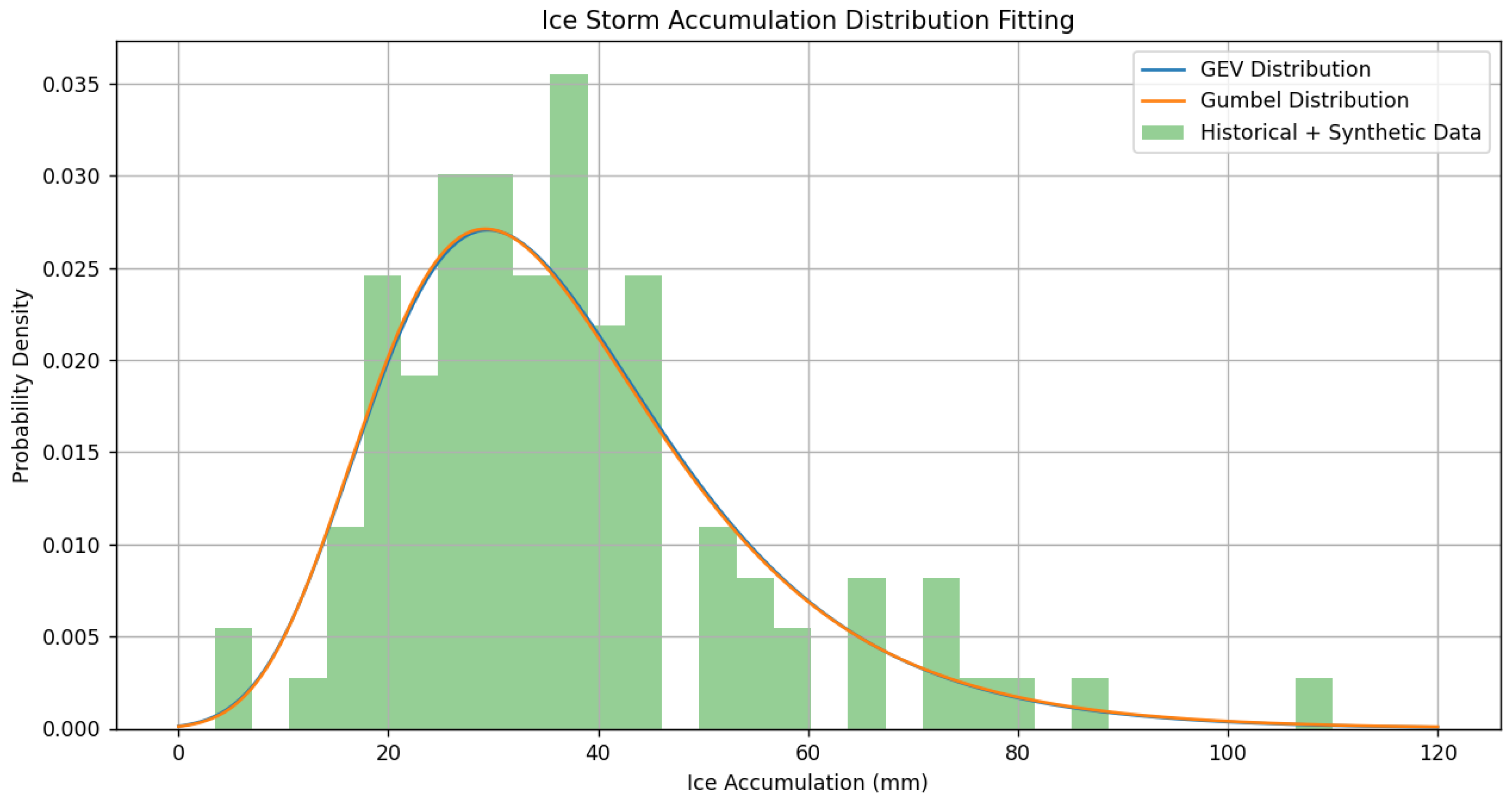
The GEV and Gumbel distributions present similar parameters in modeling ice accumulation patterns. Both distributions show location parameters near 29.3mm and scale parameters of 13.6mm. The GEV shape parameter equals 0.012, which explains the close alignment between the two distributions, as the Gumbel distribution represents a special case of GEV when the shape parameter approaches zero.
The distribution graph reveals patterns in ice accumulation events. The histogram displays most events between 20-50mm, with a right-skewed tail extending to 110mm. This matches the expected behavior of extreme weather events, where moderate accumulations happen often, and extreme accumulations happen less frequently. Both the GEV and Gumbel fitted curves follow the empirical data distribution, with peak probability density occurring at 35-40mm of ice accumulation.
The return period analysis provides insights at different time scales. Events with 2-year return periods show accumulations of 34mm, representing standard ice storms. The 5-year return period indicates 49mm accumulations, while 10-year events reach 60mm. These values align with observed historical patterns of ice accumulation in the region.
The medium range return periods connect with infrastructure design standards. The 25-year events predict 72mm accumulation, and 50-year events indicate 81-82mm. These values support Hydro-Québec's current design standards for regular transmission lines. The 150-year return period shows 95-97mm accumulations, matching the design requirements for strategic transmission lines.
The long-range return periods provide context for extreme events. The models predict 106-109mm accumulation for 350-year events, which aligns with the 1998 ice storm's 110mm accumulation. The 500-year return period indicates potential accumulations of 111-114mm, establishing an upper reference for infrastructure design considerations.
These results suggest three main points for infrastructure planning. First, the current two-tier design standard using 50-year and 150-year return periods aligns with the statistical predictions. Second, the gradual increase in ice accumulation across return periods allows for systematic infrastructure protection planning. Third, the consistency between GEV and Gumbel distributions provides reliability in the predictions.
The analysis supports specific actions for infrastructure management. The current design standards can continue, with regular lines designed for 50-year events and strategic lines for 150-year events. Infrastructure managers can use the 350-year return values for additional system protection measures. The models provide a framework for monitoring changes in extreme weather patterns over time.
This statistical understanding of ice accumulation patterns helps infrastructure planners prepare for different scenarios. The return period estimates give reference points for design decisions, while the distribution models provide tools for risk assessment. These findings can guide infrastructure investments and maintenance schedules based on predicted ice accumulation patterns.
5. Conclusions, Future Research and Limitations
The analysis of the resilience strategies developed by Hydro-Québec's has revealed several critical areas for future development and research. The enhancement of real-time monitoring capabilities emerges as a primary recommendation, with particular emphasis on improving predictive analytics for ice storm events. Current monitoring systems, while effective, could benefit from additional sensors, enhanced data processing capabilities, and improved integration with weather forecasting models. This would enable more accurate predictions of ice accumulation patterns and potential system vulnerabilities, allowing for more proactive response measures.
Infrastructure design standards require significant evolution to address the challenges posed by climate change. Traditional standards based on historical data may no longer be sufficient given the increasing frequency and intensity of extreme weather events. Future research should focus on developing adaptive design criteria that can accommodate changing climate patterns while maintaining cost-effectiveness. This includes investigating new materials and construction techniques that could enhance infrastructure resilience without prohibitive cost increases.
Stakeholder coordination represents another very important area for improvement. While existing protocols demonstrated effectiveness during past events, there is a clear need for more integrated communication systems and coordinated response frameworks. Future research should examine how to better integrate emergency services, military support, utility workers, and local government agencies during crisis events. This includes developing standardized protocols for resource sharing, decision-making hierarchies, and information dissemination across different organizational boundaries.
The development of innovative de-icing technologies presents a particularly promising area for future research. Current de-icing methods often rely on manual intervention or passive systems, which can be both time-consuming and resource intensive. Research into automated de-icing systems, smart materials that resist ice accumulation, and more efficient heating systems could significantly improve the grid's resilience during winter storms. These technological advances should be coupled with comprehensive protection measures that address both immediate ice accumulation challenges and long-term infrastructure degradation.
Risk assessment models require substantial refinement to better account for the complex nature of cascading failures in power systems. Future research should focus on developing more sophisticated modeling approaches that can capture the interconnected nature of modern power grids and their dependencies on other critical infrastructure systems. This includes incorporating artificial intelligence and machine learning techniques to better predict potential failure patterns and optimize resource allocation during crisis events.
Additionally, future research should examine the economic implications of various resilience measures, including both direct costs and indirect benefits such as avoided losses and improved system reliability. This economic analysis should consider multiple time horizons and various climate change scenarios to provide a more comprehensive understanding of investment priorities.
The implementation of these recommendations will require sustained commitment from both technical and organizational perspectives. Future research should also explore how to effectively balance these various improvements while maintaining operational efficiency and cost-effectiveness. This includes investigating potential funding mechanisms, regulatory frameworks, and implementation strategies that can support long-term resilience enhancement efforts.
Moreover, there is a need for increased international collaboration in sharing best practices and research findings related to ice storm resilience. While Hydro-Québec's experience provides valuable insights, comparative studies with other utilities facing similar challenges could yield additional strategies and solutions. This collaborative approach could accelerate the development of more effective resilience measures while avoiding duplicate research efforts across different regions.
Several limitations of the current analysis should be noted. First, the reliance on historical data, particularly from the 1998 ice storm, may not fully capture the range of potential future scenarios under changing climate conditions. Second, the economic analysis of resilience measures was constrained by the challenges of quantifying indirect benefits and long-term risk reduction. Finally, the implementation of some recommended measures may be limited by practical constraints such as budget limitations and technical feasibility.
This comprehensive analysis demonstrates that while significant progress has been made in enhancing power grid resilience against ice storms, continued adaptation and improvement will be necessary to address future challenges. The success of the RIACT framework implementation, combined with the insights gained from the PERA analysis, provides a strong foundation for future resilience planning efforts.
Author Contributions
Conceptualization, Seyed M. H. S. Rezvani and Dragan Komljenovic; data curation, Seyed M. H. S. Rezvani, Marc Morissette and Dragan Komljenovic; formal analysis, Seyed M. H. S. Rezvani, Marc Morissette and Dragan Komljenovic; methodology, Seyed M. H. S. Rezvani and Nuno Marques de Almeida; software, Seyed M. H. S. Rezvani; supervision, Maria João Falcão Silva and Nuno Marques de Almeida; validation, Marc Morissette, Dragan Komljenovic and Nuno Marques de Almeida; visualization, Seyed M. H. S. Rezvani; writing—original draft, Seyed M. H. S. Rezvani; writing—review and editing, Seyed M. H. S. Rezvani, Marc Morissette, Dragan Komljenovic, Maria João Falcão Silva and Nuno Marques de Almeida. All authors have read and agreed to the published version of the manuscript.
Funding
This work is part of the research being carried out at Civil Engineering Research and Innovation for Sustainability (CERIS) and was funded by Fundação para a Ciência e a Tecnologia (FCT) in the framework of project UIDB/04625/2020 and FCT grant number “2022.12886.BD” (carried out at the Instituto Superior Técnico (IST)).
Institutional Review Board Statement
Not applicable.
Informed Consent Statement
Not applicable.
Data Availability Statement
The data supporting the findings of this study will be made available on request. Some data may not be available due to their confidentiality.
Acknowledgments
We are grateful for the technical and administrative support provided by the staff at the Civil Engineering Research and Innovation for Sustainability (CERIS) of the Instituto Superior Técnico (IST). We would also like to thank the Fundação para a Ciência e Tecnologia (FCT) for their financial support, without which this study would not have been possible. Special thanks to Hydro-Québec (HQ) for their collaboration and for providing the required data and contributing to the methodology and analysis. The contributions from various stakeholders and practitioners in the construction and urban planning industry, who provided valuable feedback and insights, are also deeply appreciated.
Conflicts of Interest
The authors declare no conflicts of interest.
References
- Komljenovic, D. Engineering Asset Management at Times of Major, Large-Scale Instabilities and Disruptions. In Proceedings of the WCEAM 2019; 2021; p. 255270.
- Nicolet, C. Pour Affronter l’imprévisible; Les Enseignements Du Verglas de 98 (Rapport Principal); Gouvernement du Québec: Québec, Canada, 1999.
- Hydro-Québec Annual Report; 2024.
- QUÉBEC, R.D.E.L.D.U. Décision D-2004-175 R-3522-2003; 2004.
- Rezvani, S.M.H.S.; Falcão Silva, M.J.; de Almeida, N.M. The Risk-Informed Asset-Centric (RIACT) Urban Resilience Enhancement Process: An Outline and Pilot-Case Demonstrator for Earthquake Risk Mitigation in Portuguese Municipalities. Applied Sciences 2024, 14, 634. [Google Scholar] [CrossRef]
- Dam, N.; Program, S.; Seminar, T. Risk-Informed Decision-Making in Asset Management of Critical Infrastructures. 2021. [Google Scholar]
- Arnette, A.N.; Zobel, C.W. A Risk-Based Approach to Improving Disaster Relief Asset Pre-Positioning. Prod Oper Manag 2019, 28, 457–478. [Google Scholar] [CrossRef]
- Rezvani, S.M.; Falcão Silva, M.J.; de Almeida, N.M. Urban Resilience Index for Critical Infrastructure: A Scenario-Based Approach to Disaster Risk Reduction in Road Networks. Sustainability 2024, 16, 4143. [Google Scholar] [CrossRef]
- Rezvani, S.M.; Gonçalves, A.; Silva, M.J.F.; de Almeida, N.M. Smart Hotspot Detection Using Geospatial Artificial Intelligence: A Machine Learning Approach to Reduce Flood Risk. Sustain Cities Soc 2024, 115, 105873. [Google Scholar] [CrossRef]
- Rezvani, S.M.H.S.; João, M.; Silva, F.; Marques De Almeida, N. Mapping Geospatial AI Flood Risk in National Road Networks. ISPRS International Journal of Geo-Information 2024, Vol. 13, Page 323 2024, 13, 323. [Google Scholar] [CrossRef]
- ISO/IEC ISO/IEC 31000:2018 - Risk Management - Principles and Guidelines; 2018; ISBN 2831886376.
- ISO 55000 ISO/CD: 2012. Asset Management - Oveview Principles and Terminology; International Organization for Standardization, 2014.
- ISO 37123 ISO 37123:2019(En), Sustainable Cities and Communities — Indicators for Resilient Cities; 2019.
- Rezvani, S.M.H.S.; Almeida, N.; Silva, M.J.F. Multi-Disciplinary and Dynamic Urban Resilience Assessment Through Stochastic Analysis of a Virtual City; 2023; ISBN 9783031254475.
- Duarte, M.; Almeida, N.; Falcão, M.J.; Rezvani, S.M.H.S. Resilience Rating System for Buildings Against Natural Hazards; 2022; ISBN 9783030967932.
- Rezvani, S.M.H.S.; Almeida, N.; Silva, M.J.F.; Maletič, D. Resilience Exposure Assessment Using Multi-Layer Mapping of Portuguese 308 Cities and Communities; 2023; ISBN 9783031254475.
- Rezvani, S.M.H.S.; Falcão, M.J.; Komljenovic, D.; de Almeida, N.M. A Systematic Literature Review on Urban Resilience Enabled with Asset and Disaster Risk Management Approaches and GIS-Based Decision Support Tools. Applied Sciences (Switzerland) 2023, 13. [Google Scholar] [CrossRef]
- Almeida, N.M.; Silva, M.J.F.M.J.F.; Salvado, F.; Rodrigues, H.; Maletič, D.; de Almeida, N.M.N.M.; Silva, M.J.F.M.J.F.; Salvado, F.; Rodrigues, H.; Maletič, D. Risk-Informed Performance-Based Metrics for Evaluating the Structural Safety and Serviceability of Constructed Assets against Natural Disasters. Sustainability 2021, 13, 5925. [Google Scholar] [CrossRef]
- Koks, E.E.; Rozenberg, J.; Zorn, C.; Tariverdi, M.; Vousdoukas, M.; Fraser, S.A.; Hall, J.W.; Hallegatte, S. A Global Multi-Hazard Risk Analysis of Road and Railway Infrastructure Assets. Nat Commun 2019, 10, 1–11. [Google Scholar] [CrossRef]
- Panchalogaranjan, V.; Moses, P.; Shumaker, N. Case Study of a Severe Ice Storm Impacting Distribution Networks in Oklahoma. IEEE Trans Reliab 2023, 72, 1442–1452. [Google Scholar] [CrossRef]
- Zhao, Y.; Wan, C.; Wang, C.; Wang, N.; Deng, R.; Li, B. A Two-Stage Scheduling Model for Urban Distribution Network Resilience Enhancement in Ice Storms. IET Renewable Power Generation 2024, 18, 1149–1163. [Google Scholar] [CrossRef]
- Komljenovic, D.; Abdul-Nour, G.; Popovic, N. An Approach for Strategic Planning and Asset Management in the Mining Industry in the Context of Business and Operational Complexity. Int J Min Miner Eng 2015, 6, 338–360. [Google Scholar] [CrossRef]
- Komljenovic, D.; Gaha, M.; Abdul-Nour, G.; Langheit, C.; Bourgeois, M. Risks of Extreme and Rare Events in Asset Management. Saf Sci 2016, 88, 129–145. [Google Scholar] [CrossRef]
- Blancke, O.; Tahan, A.; Komljenovic, D.; Amyot, N.; Lévesque, M.; Hudon, C. A Holistic Multi-Failure Mode Prognosis Approach for Complex Equipment. Reliab Eng Syst Saf 2018, 180, 136–151. [Google Scholar] [CrossRef]
- Blancke, O.; Combette, A.; Amyot, N.; Komljenovic, D.; Lévesque, M.; Hudon, C.; Tahan, A.; Zerhouni, N. A Predictive Maintenance Approach for Complex Equipment Based on a Failure Mechanism Propagation Model. Int J Progn Health Manag 2019, 10. [Google Scholar] [CrossRef]
- Komljenovic, D.; Messaoudi, D.; Côté, A.; Gaha, M.; Vouligny, L.; Alarie, S.; Dems, A.; Blancke, O. Asset Management in Electrical Utilities in the Context of Business and Operational Complexity; 2021; ISBN 9783030642273.
- Gaha, M.; Chabane, B.; Komljenovic, D.; Côté, A.; Hébert, C.; Blancke, O.; Delavari, A.; Abdul-Nour, G. Global Methodology for Electrical Utilities Maintenance Assessment Based on Risk-Informed Decision Making. Sustainability (Switzerland) 2021, 13, 1–23. [Google Scholar] [CrossRef]
- Raymond, J.; Komljenovic, D. Situational Awareness: A Road Map to Generation Plant Modernization and Reliability. IEEE Power and Energy Magazine 2024, 22, 29–41. [Google Scholar] [CrossRef]
- Trudel, G.; Gingras, J.P.; Pierre, J.R. Designing a Reliable Power System: Hydro-Québec’s Integrated Approach. Proceedings of the IEEE 2005, 93, 907–917. [Google Scholar] [CrossRef]
- Brettschneider, S.; Fofana, I. Evolution of Countermeasures against Atmospheric Icing of Power Lines over the Past Four Decades and Their Applications into Field Operations. Energies (Basel) 2021, 14, 6291. [Google Scholar] [CrossRef]
- Helbing, D. Globally Networked Risks and How to Respond; Nature Publishing Group, 2013; Vol. 497, pp. 51–59.
- Aven, T. The Call for a Shift from Risk to Resilience: What Does It Mean? Risk Analysis 2018, 39, 1196–1203. [Google Scholar] [CrossRef]
- Endsley, M.R. Situation Awareness Misconceptions and Misunderstandings. J Cogn Eng Decis Mak 2015, 9, 4–32. [Google Scholar] [CrossRef]
- Abdul-Nour, G.; Gauthier, F.; Diallo, I.; Komljenovic, D.; Vaillancourt, R.; Côté, A. Development of a Resilience Management Framework Adapted to Complex Asset Systems: Hydro-Québec Research Chair on Asset Management; 2021; ISBN 9783030642273.
- Ghannoum, E. Evolution of IEC 60826 ``Loading and Strength of Overhead Lines’’. Electrical Transmission in a New Age 2002, 59–73. [Google Scholar] [CrossRef]
- Rosenheim, N.; Guidotti, R.; Gardoni, P.; Peacock, W.G. Integration of Detailed Household and Housing Unit Characteristic Data with Critical Infrastructure for Post-Hazard Resilience Modeling. Sustain Resilient Infrastruct 2019, 1–17. [Google Scholar] [CrossRef]
- Schröder, T.; Kuckshinrichs, W. Value of Lost Load: An Efficient Economic Indicator for Power Supply Security? A Literature Review. Front Energy Res 2015, 3. [Google Scholar] [CrossRef]
- Katina, P.F.; Pyne, J.C.; Keating, C.B.; Komljenovic, D. Complex System Governance as a Framework for Asset Management. Sustainability (Switzerland) 2021, 13. [Google Scholar] [CrossRef]
- Robert, B.; Morabito, L. Success Factors and Lessons Learned during the Implementation of a Cooperative Space for Critical Infrastructures. International Journal of Critical Infrastructures 2024, 20, 1. [Google Scholar] [CrossRef]
- Lachapelle, M.; Thériault, J.M. Characteristics of Precipitation Particles and Microphysical Processes during the 11–12 January 2020 Ice Pellet Storm in the Montréal Area, Québec, Canada. Mon Weather Rev 2022, 150, 1043–1059. [Google Scholar] [CrossRef]
- Stanković, A.M.; Tomsovic, K.L.; De Caro, F.; Braun, M.; Chow, J.H.; Čukalevski, N.; Dobson, I.; Eto, J.; Fink, B.; Hachmann, C.; and, al. Methods for Analysis and Quantification of Power System Resilience. IEEE Transactions on Power Systems 2023, 38, 4774–4787. [Google Scholar] [CrossRef]
- Zio, E. Challenges in the Vulnerability and Risk Analysis of Critical Infrastructures. Reliab Eng Syst Saf 2016, 152, 137–150. [Google Scholar] [CrossRef]
- Woods, D.D. Four Concepts for Resilience and the Implications for the Future of Resilience Engineering. Reliab Eng Syst Saf 2015, 141, 5–9. [Google Scholar] [CrossRef]
- Komljenovic, D. Engineering Asset Management at Times of Major, Large-Scale Instabilities and Disruptions. 14th WCEAM Proceedings 2020, 255–270. [Google Scholar] [CrossRef]
- Morissette, M.; Komljenovic, D.; Robert, B.; Gravel, J.-F.; Benoit, N.; Lebeau, S.; Fortin, W.; Yaacoub, S.-J.; Leduc, P.; Rioux, P.-J.; and, al. Combining Asset Integrity Management and Resilience in Coping with Extreme Climate Events in Electrical Power Grids. Asset Integrity Management of Critical Infrastructure 2024, 52–65. [Google Scholar] [CrossRef]
- EPRI Perspectives on Transforming Utility Business Models: Paper 11 – Business Models for Resilience. Available online: https://www.epri.com/research/products/000000003002030744 (accessed on 18 October 2024).
- Komljenovic, D.; Guner, I. Role and Importance of Resilience and Engineering Asset Management at Times of Major, Large-Scale Instabilities and Disruptions at Electrical Utilities “Value of Resilience Interest Group (EPRI)” (Slightly Modified). In Proceedings of the Value of Resilience Interest Group (EPRI); Department of Industrial Management, University of Seville, Seville, S., Márquez, A.C., Hydro-Quebec, Varennes, C., Komljenovic, D., Graduate School of Technology Management, University of Pretoria, Pretoria, S.A., Amadi-Echend, J., Eds.; Springer International Publishing: Singapore, 28th – 31st July. 2019., 2021; pp. 255–270.
Figure 1.
Network visualizations generated from the VOS search, highlighting various clusters based on co-occurring terms.
Figure 1.
Network visualizations generated from the VOS search, highlighting various clusters based on co-occurring terms.

Figure 2.
Overlay visualizations, showing the temporal evolution of research themes over the years.
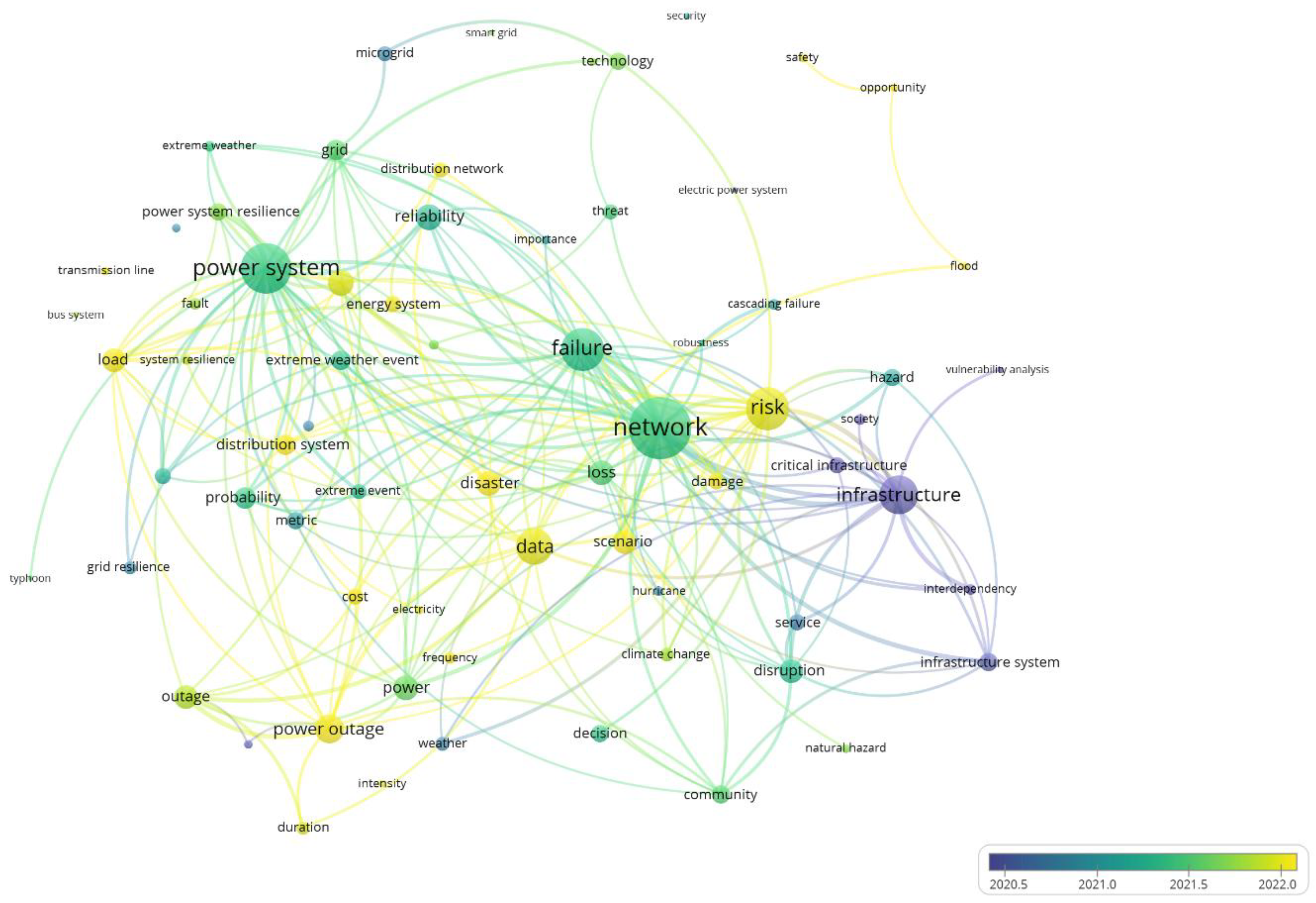
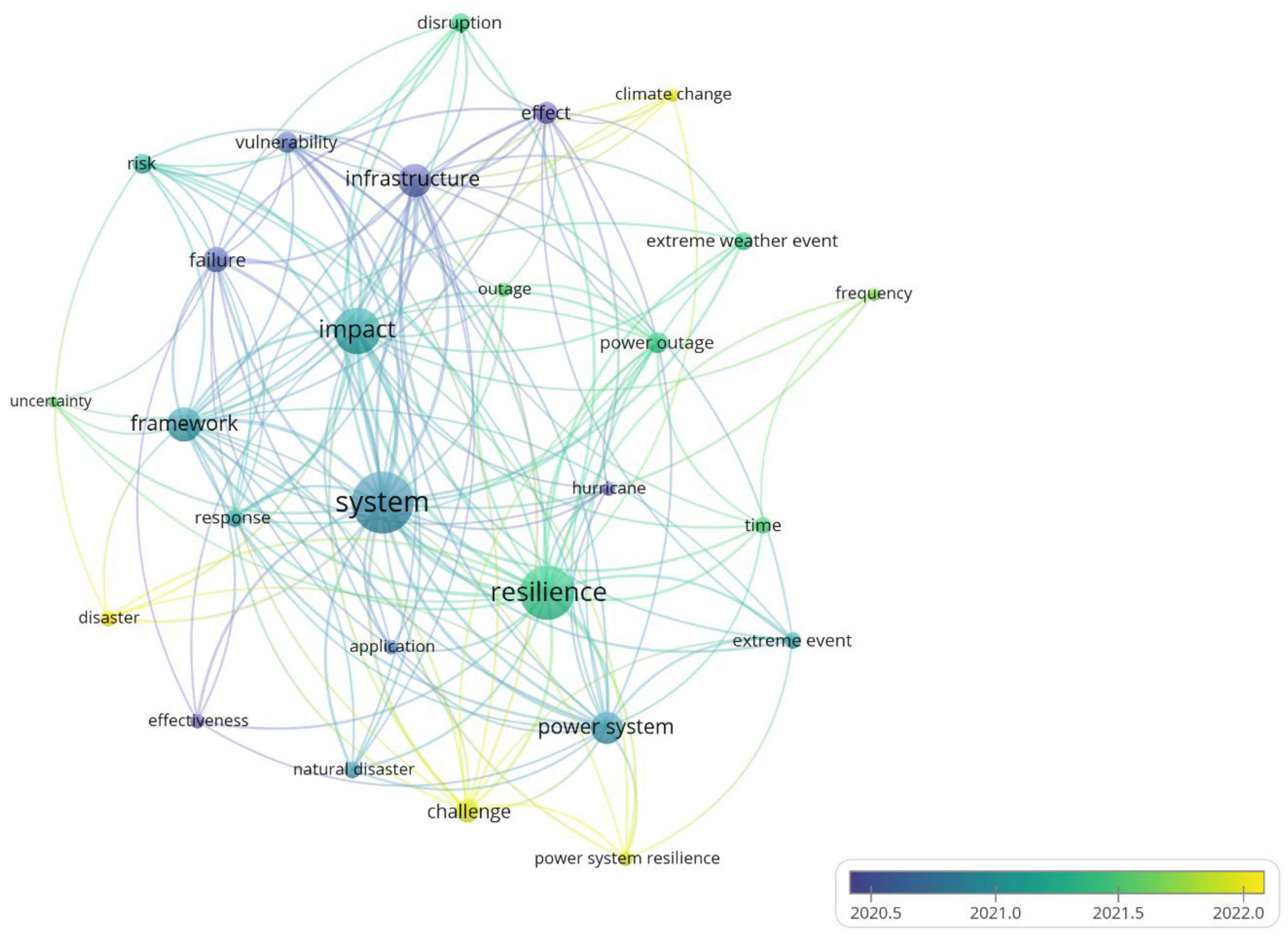
Figure 3.
Annual distribution of publications resulting from Search 1 and Search 2.
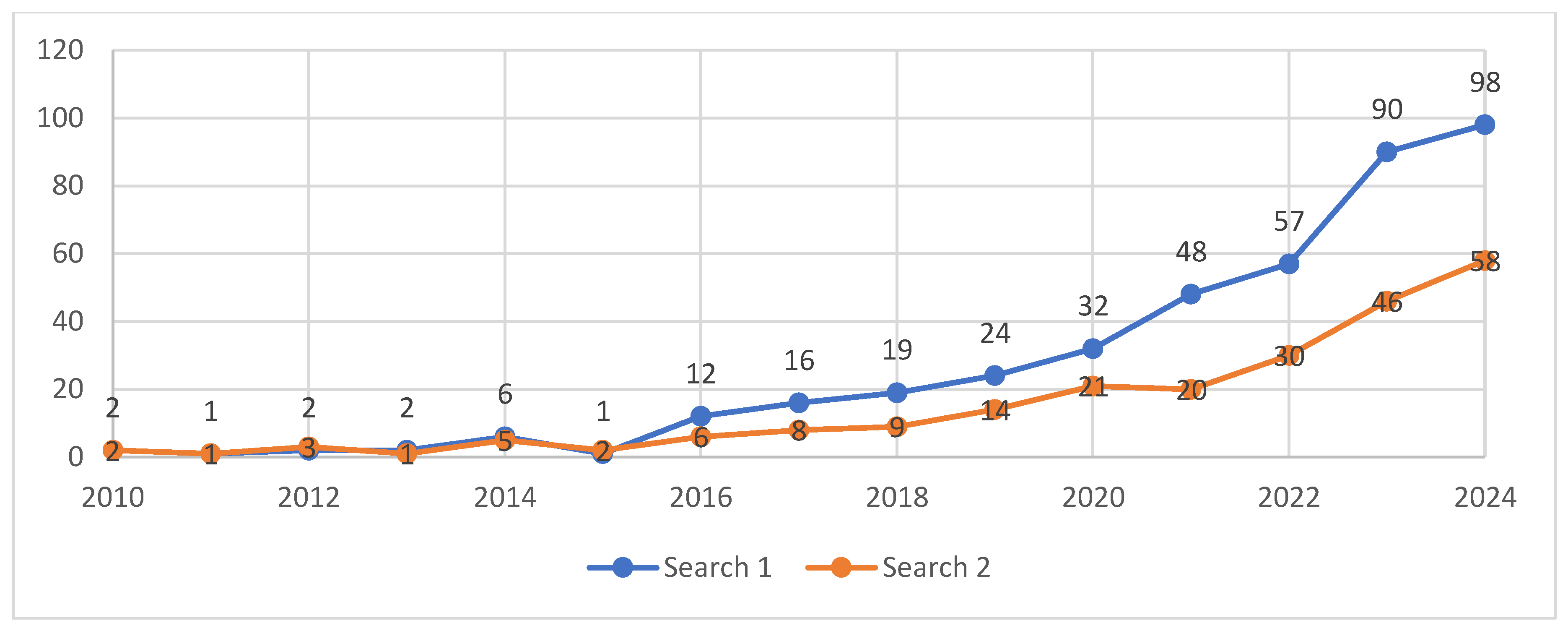
Figure 4.
Distribution of publications across different countries.
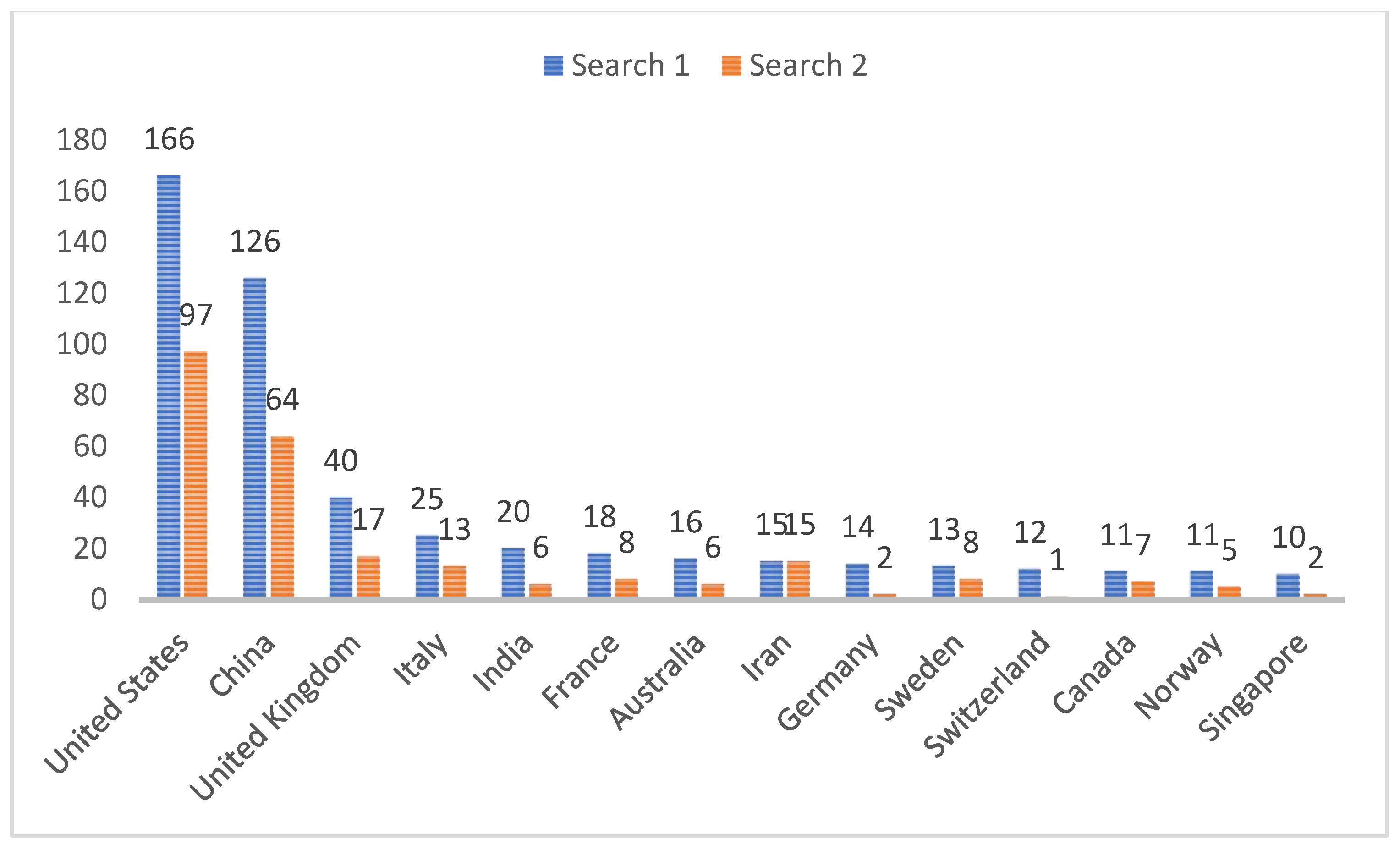
Figure 5.
World map of publications across different countries.
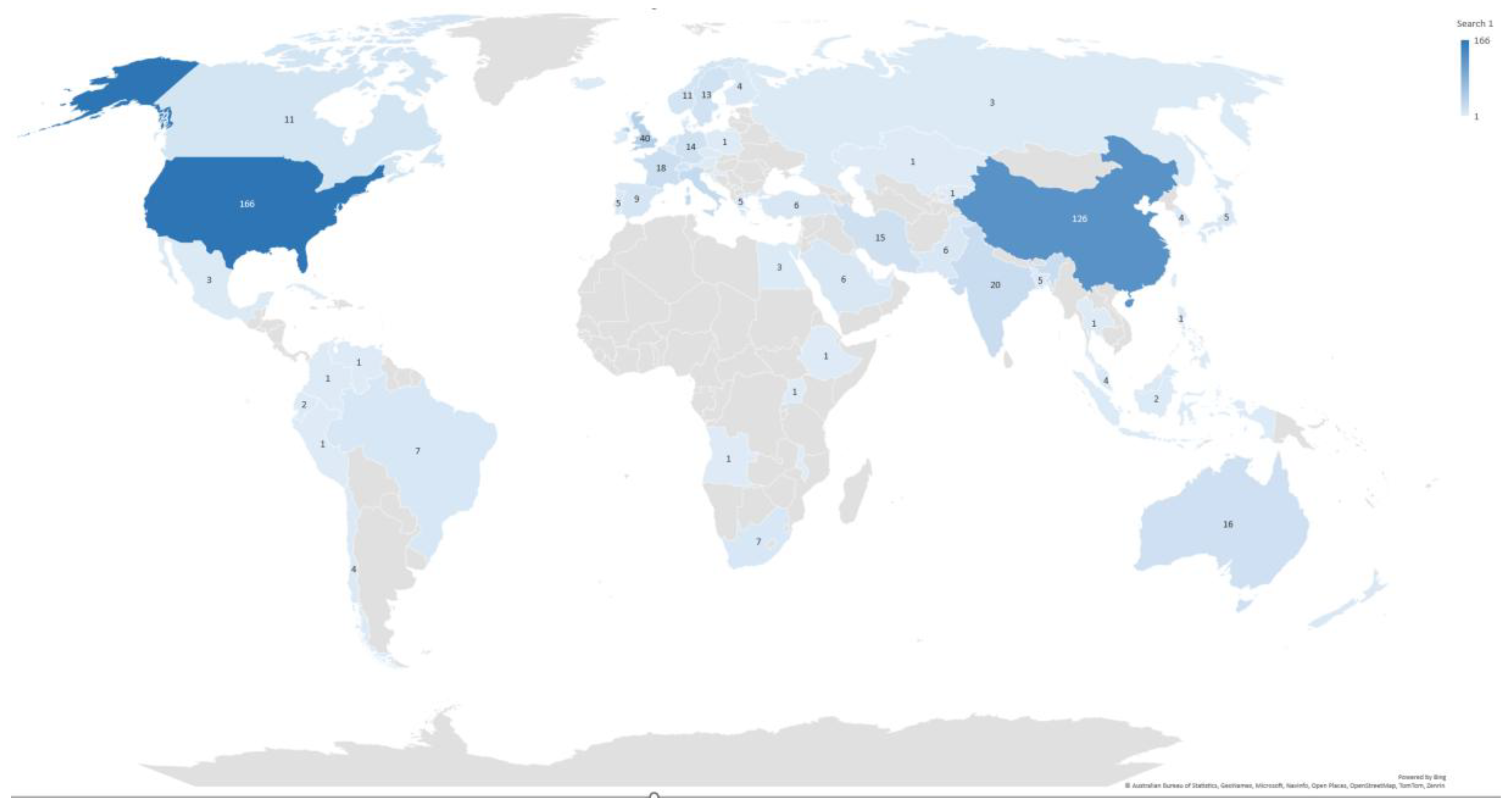
Figure 6.
Distribution of publications across various subject areas,: a) inner ring - Search 1; andii) outer ring - Search 2.
Figure 6.
Distribution of publications across various subject areas,: a) inner ring - Search 1; andii) outer ring - Search 2.
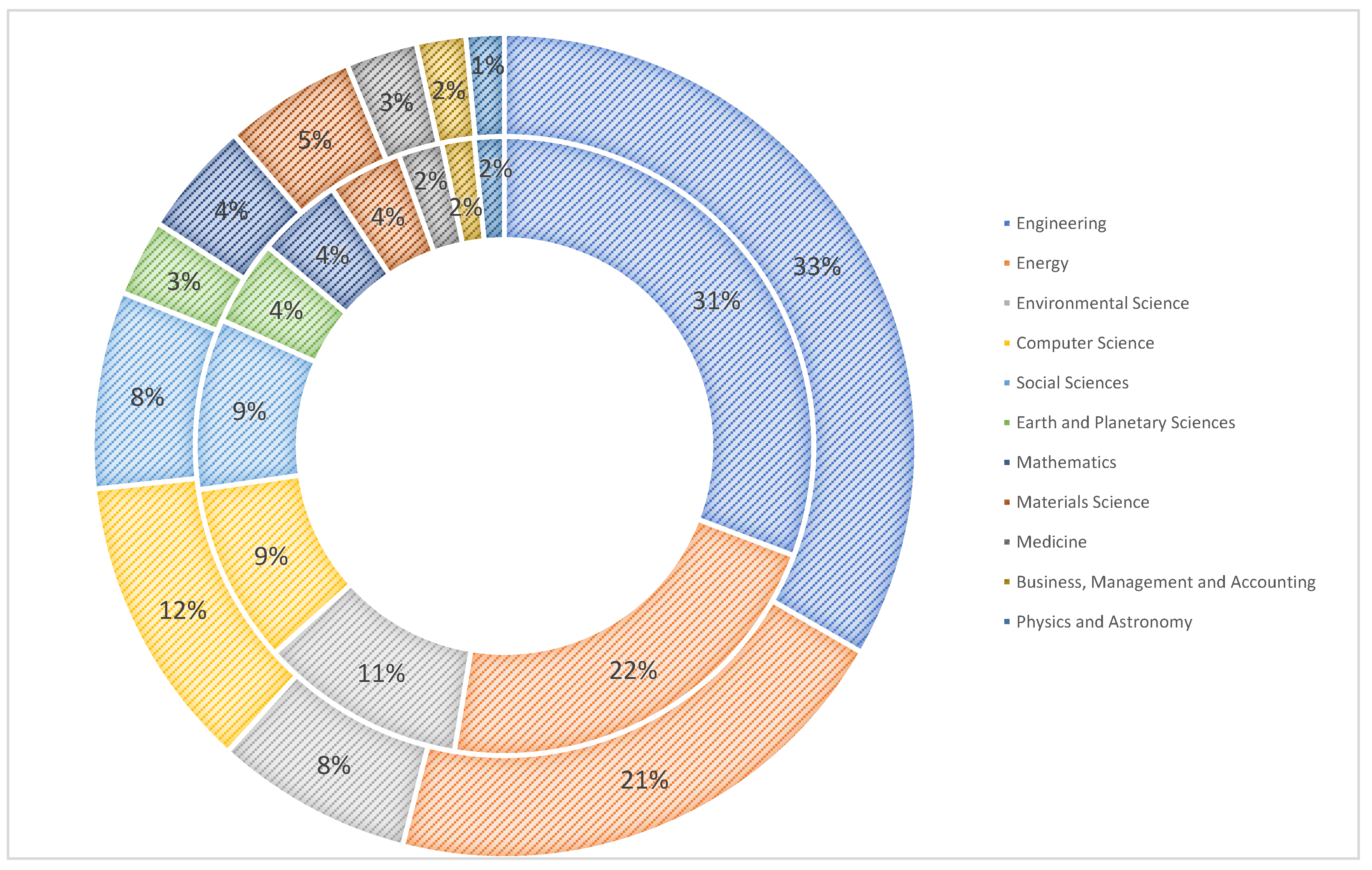
Figure 7.
RIACT process phasesincorporating Preparation, Endurance, Recovery, Adaptation (PERA) stages.
Figure 7.
RIACT process phasesincorporating Preparation, Endurance, Recovery, Adaptation (PERA) stages.
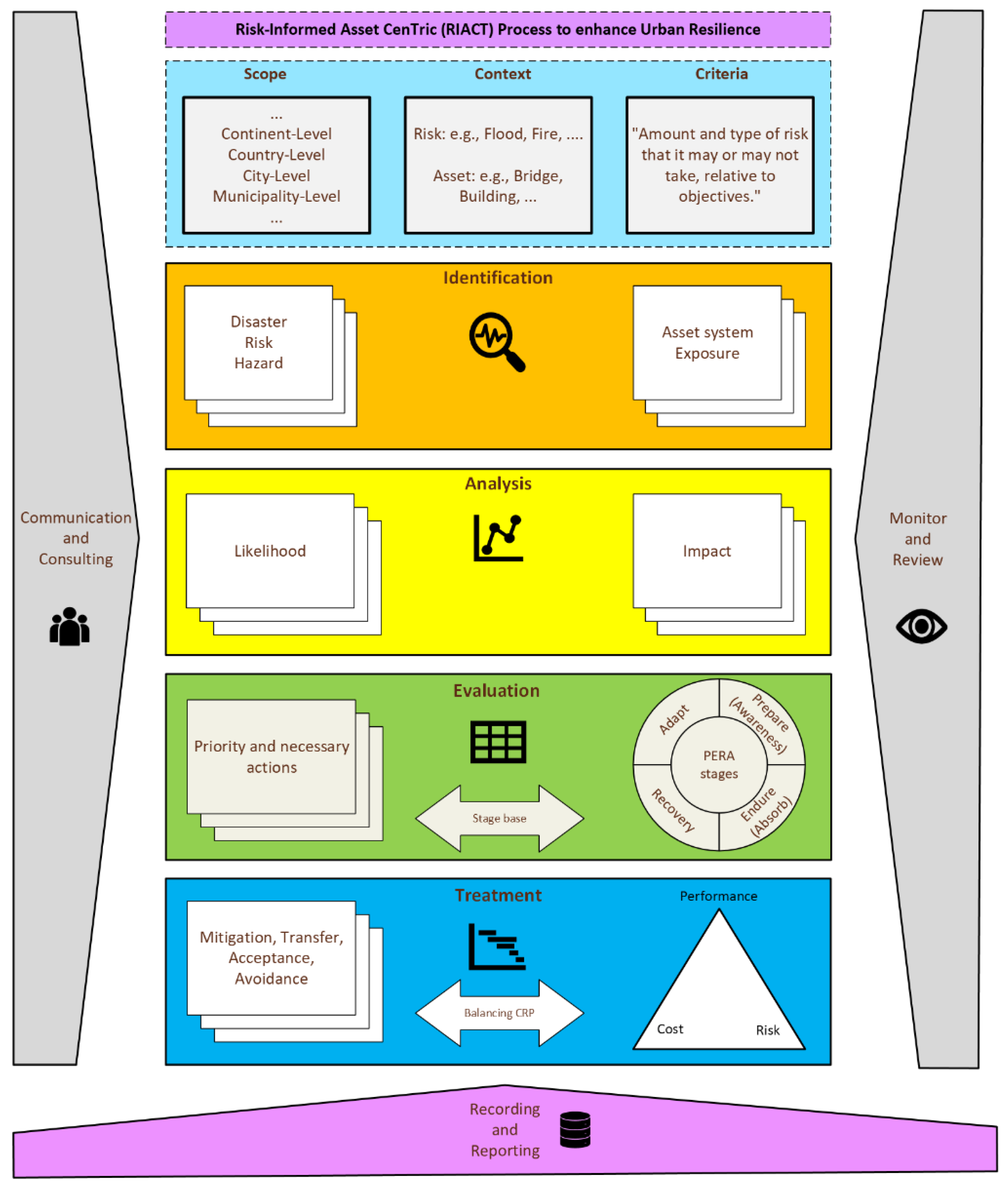
Figure 8.
Key Steps in the RIACT Framework for Ice Storm Resilience.
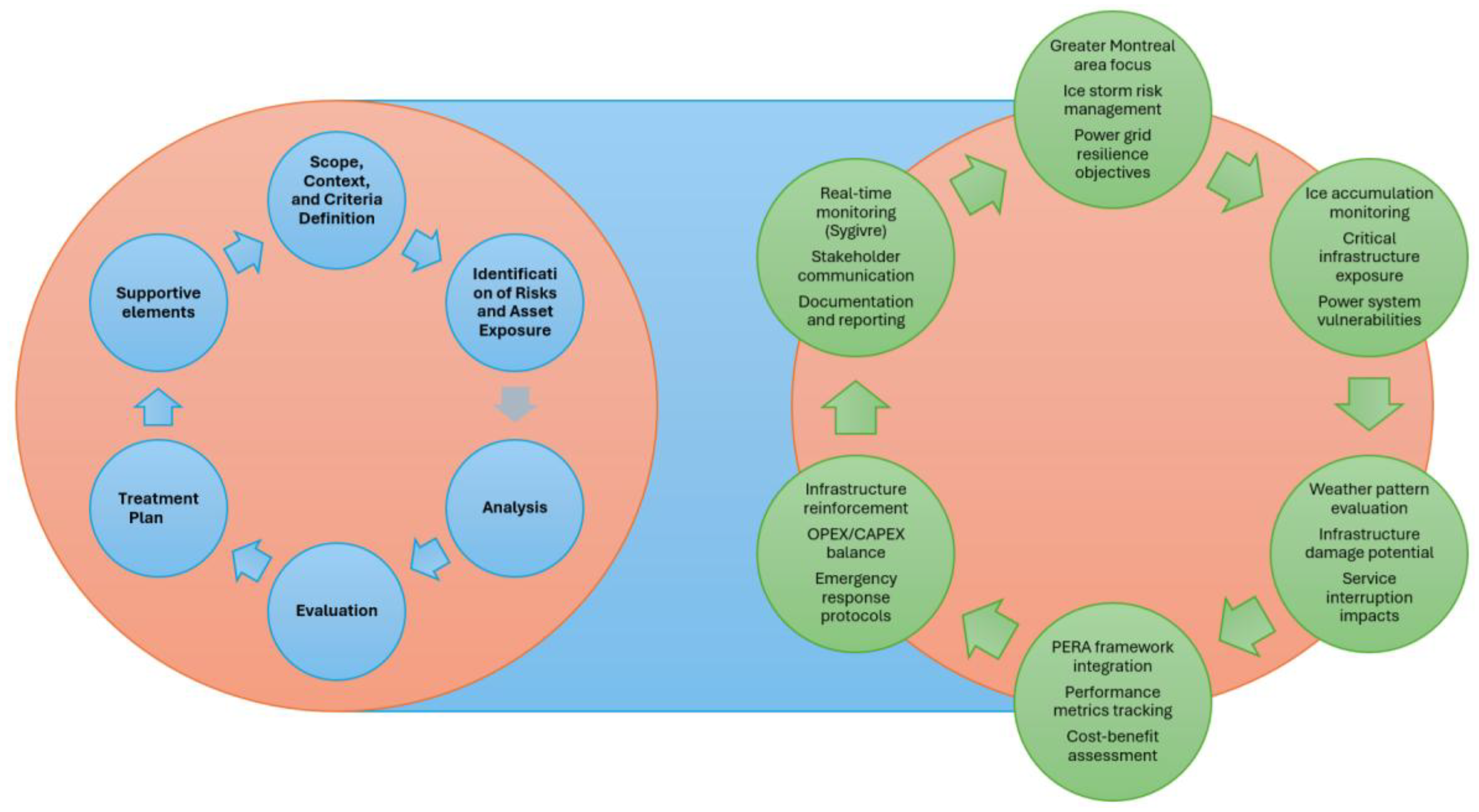
Figure 9.
Impact of the 1998 Ice Storm on Quebec's power infrastructure, showing collapsed transmission towers and emergency response efforts [1,29,44].

Figure 10.
Map of Hydro-Quebec's transmission network showing major power corridors and geographical distribution of infrastructure (https://www.hydroquebec.com/about/ and https://www.hydroquebec.com/about/financial-results/annual-report.html).
Figure 10.
Map of Hydro-Quebec's transmission network showing major power corridors and geographical distribution of infrastructure (https://www.hydroquebec.com/about/ and https://www.hydroquebec.com/about/financial-results/annual-report.html).
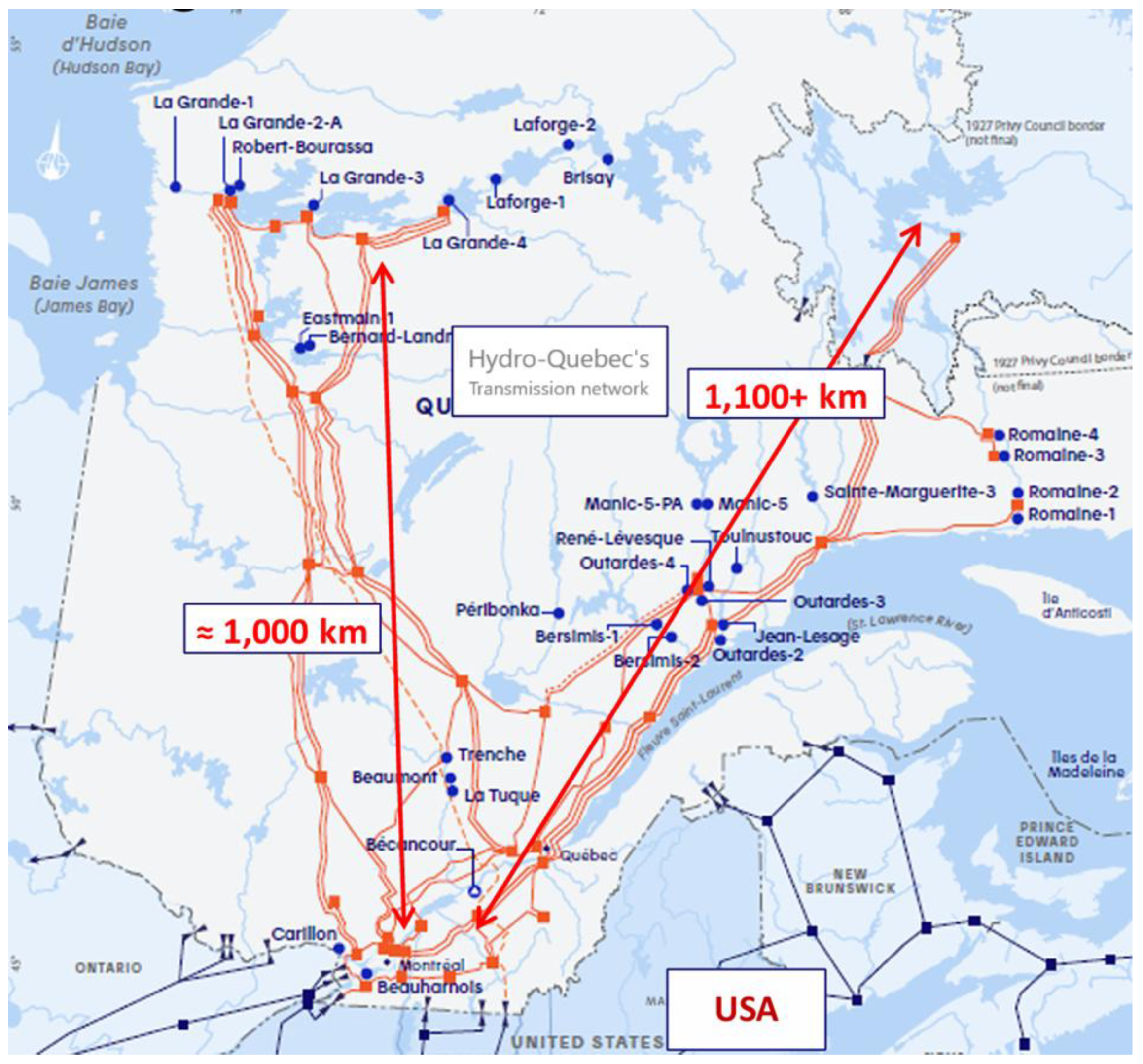
Figure 11.
RIACT evaluation - PERA Stages: Detailed Tasks.
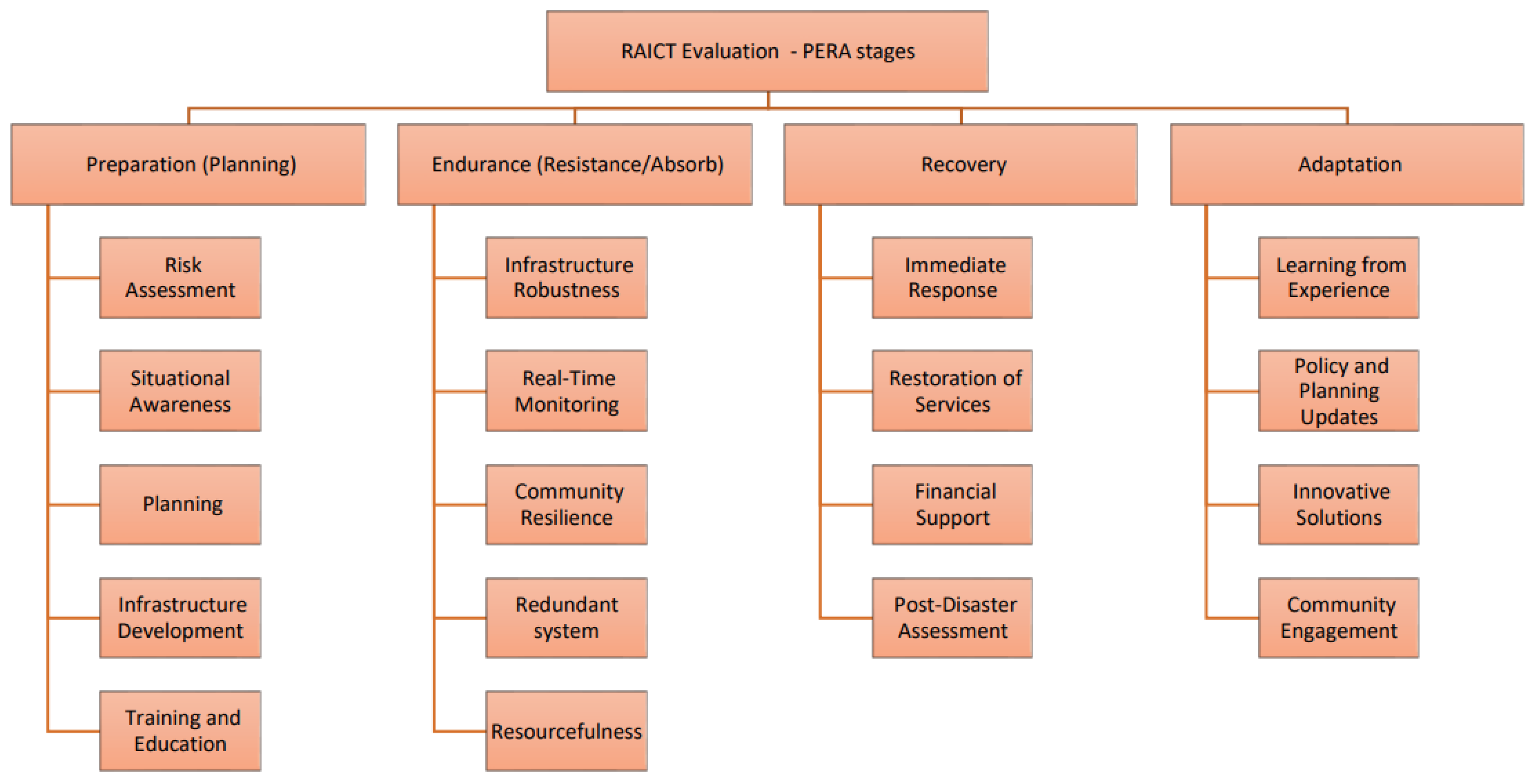

| Aspect | Details | Phase |
| Investment in System Reliability and Resilience | Invested 1.3 billion CAD in the early 1990s to improve system reliability/resilience. | Preparation |
| Weather Monitoring | 50 weather stations operated for 20 years to monitor weather conditions and ice accumulation. | |
| Transmission lines design | Revised transmission line design criteria to increase the mechanical capacity for radial ice accumulations | |
| Transmission lines Right-of-way | Established transmission line routes criteria limiting the number of lines to maximum two adjacent lines per right-of-way and a minimum distance of 15 km between right-of-way | |
| Duration of ice storm | Lasted from January 5 to January 10, 1998. | Endurance/Absorption |
| Storm magnitude | Considered as a 300-year recurrence event, highlighting its exceptional severity. Three successive storms over the duration | |
| Storm maximum ice accumulation | Reached up to 110 mm. | |
| Storm average ice accumulation | Between 50 and 70 mm. | |
| Impacted area | Affected 400,000 sq km total; 130,000 sq km in Quebec experienced ice accretion exceeding 20 mm. | |
| Infrastructure damage | - 24,000 poles damaged | |
| - 900 steel towers damaged | ||
| - 3,000 km of power lines affected | ||
| Financial impact | Total cost of 1.656 billion CAD; 1.028 billion CAD borne by the Quebec government and Hydro-Québec. | |
| Total Recovery Time | Spanned approximately one month. | Recovery |
| Customer Reconnection | - 80% reconnected within the first week | |
| - Remaining 20% regained power over the subsequent three weeks | ||
| Full Power Restoration | Achieved by February 6, 1998. | |
| Human Resources Deployed | - Hydro-Québec personnel | |
| - Personnel from neighboring utilities | ||
| - 9,000 soldiers assisted in recovery efforts | ||
| - Organized 30 missions, each with ~120 people, including ~50 soldiers per mission | ||
| Cost for High-Risk Substations | 18 million CAD required for work during recovery. | |
| Infrastructure Enhancements | - Added 295 km of new power lines | Adaptation |
| - Reinforced 552 km of existing lines | ||
| New Interconnection | Built a new interconnection to neighboring utility, providing an additional capacity of 1,250 MW. | |
| Transmission Line Design Standards | Reviewed internal transmission line design standard to more stringent criteria than national (CSA) and international standards (IEC). Creation of ice historic accumulation maps to account for climate zones when establishing line route. | |
| Transmission Line Design Standards | Instauration of ice storm recurrence rates: 50-years, 150-year and 500 years rate . | |
| Historical Ice Storms | Major storms occurred in 1921, 1929, 1942, 1961, and 1983—totaling six significant events over the last century. | |
| Transmission Line Extension | Construction of the sturdiest 735 kV transmission line to ensure the electrical supply of the most populated area of the province. | |
| Restoration objectives considered in planning | - Instauration of restauration criteria after a major event, 50% of electrical supply within four days and most of the electrical load within 21 days | |
| Financial Investment | More than 1 billion CAD invested in transmission system improvement projects after the storm. New transmission line upgrades investments have been recently approved and more projects using de-icing technologies are being analyzed. | |
| Transmission grid conception and exploitation philosophy revised and improved | Four basic principles and successive defense barriers have been reviewed at the power grid level. | |
| Ice Storm Scenario Planning | Considered the impact of 75 mm ice accumulation in most severe storm location. | |
| Height Factor Adjustment | Used a reduced height factor of 1,15 to more accurately assess ice thickness on distribution lines, resulting in 65 mm ice thickness on distribution conductors. |
Disclaimer/Publisher’s Note: The statements, opinions and data contained in all publications are solely those of the individual author(s) and contributor(s) and not of MDPI and/or the editor(s). MDPI and/or the editor(s) disclaim responsibility for any injury to people or property resulting from any ideas, methods, instructions or products referred to in the content. |
© 2025 by the authors. Licensee MDPI, Basel, Switzerland. This article is an open access article distributed under the terms and conditions of the Creative Commons Attribution (CC BY) license (http://creativecommons.org/licenses/by/4.0/).
Copyright: This open access article is published under a Creative Commons CC BY 4.0 license, which permit the free download, distribution, and reuse, provided that the author and preprint are cited in any reuse.