

Submitted:
18 February 2025
Posted:
18 February 2025
You are already at the latest version
Abstract
In recent years, deep eutectic solvents (DES) have attracted a lot of attention as a substitute for current toxic organic solvents and can be applied in many chemical processes such as extraction and synthesis. Development of new deep eutectic solvents for use in the isolation of valuable biologically active substances with significant benefits for the health, the environment, and others are being investigated with increasing scientific interest. Deep eutectic solvents were prepared using menthol as a hydrogen bond donor and different tertiary amines as hydrogen bond acceptors by varying the ratio of the two constituents. The DES obtained were analyzed using densitometry, viscosimetry, IR, TGA, and DSC. The potential of the DES for extraction and re - extraction was evaluated with a water solution of lactic acid. All the DESs obtained are suitable for the extraction of lactic acid. Deep eutectic solvents based on menthol and DOA (2:1), TOA (2:1), TDDA (1:2) and THA (2:1) show highest results.
Keywords:
lactic acid
; deep eutectic solvents
; extraction
; menthol
; tertiary amines
1. Introduction
In recent years the demand for lactic acid (LA) has increased considerably as a consequence of the increasing use of LA in the production of polylactic acid and green solvents. The major problem in fermentative LA production is in product separation from fermentation broth and its purification. The classical approach for LA separation is neutralization of the broth with an alkali reagent, usually Ca(OH)2 [1]. Precipitated calcium lactate undergoes additional treatment with sulphuric acid to obtain free LA, which is further subjected to purification. The process is complicated and doesn’t assure the necessary purity. Other recovery techniques like membrane separation [2,3], ion exchange [4], liquid-liquid extraction [5,6,7], and aqueous two-phase systems [8] also have been applied for LA separation and purification. Among them, liquid-liquid extraction seems to be the most attractive because it is simple, low energy consuming, easily scaled up, and gives the possibility of in-situ operation. Various tertiary amines or quaternary ammonium salts are preferred as extractants because of their selectivity and efficiency [9,10,11]. For increasing the solubility of the acid-amine complex and adjusting the physical properties of the extraction phase the extractant is usually mixed with diluent and/or modifier. The main drawback of using long-chain amine-based extractants is that they are harmful and toxic to the microorganisms usually used for fermentation. Deep eutectic solvents (DES) represent a relatively new group of chemicals with very promising properties to be used as a substitute for high molecular weight aliphatic amines or quaternary ammonium salts in the extraction of organic acids. DES offers many properties making them an excellent alternative to traditional extractants like low price, ease of preparation, low toxicity, biocompatibility and biodegradability, as well as possibility of tuning their properties by changing one or both components. The first publication describing the synthesis and properties of such compounds and their characteristic of having lower freezing points than their constituent compounds appeared in 2001 [12]. Later on, a huge number of papers described the synthesis and properties of various DES. The term DES was first introduced by Abbot et al. [13] describing the compounds formed between choline chloride and carboxylic acids. Now for the characterization of DES, the following definition is accepted - a mixture of Lewis and Brønsted acids and bases that significantly reduce the freezing point compared with those of the components [14]. DESs are composed of two or more substances – one acting as a hydrogen bond acceptor (HBA) and the other as a hydrogen bond donor (HBD). Various tertiary amines or quaternary ammonium salts are most widely used as HBA and different alcohols, glycols, sugars, or carboxylic acid as HBD. Some chemicals, like menthol, thymol, and some organic acids may serve as HBA or HBD, depending on the second component. DES has broad applications in various fields [15] – metal processing (electrodeposition, electropolishing, extraction), synthesis, extraction of valuable compounds, etc. In recent years, the number of papers devoted to the extraction of various compounds with DES constantly increased. Different DES were used for the extraction of natural bioactive compounds [16,17,18], phenolic compounds [19,20,21,22], carotenoids [23], essential oils [24], podophyllotoxins [25], antioxidants [26], etc. Recently, the interest in the application of DES as extractants, diluents, or modifiers for the extraction of low molecular weight organic acids considerably increased. Different DESs were used in the separation of formic [27], acetic [28], citric [29], phthalic [30], lactic [31,32], nicotinic [33], palmitic [34,35], and various carboxylic acids [36,37]. Xu et al. [38] proposed an original use of DES for the separation of lactic acid – in situ forming of DES, using different lactams as HBA and LA as HBD.
The present work aims to synthesize and characterize new deep eutectic solvents formed between some aliphatic amines and menthol and to study and determine their ability in extraction and stripping of lactic acid
2. Materials and Methods
DES Preparation
Deep eutectic solvents (DES) were prepared using menthol as a hydrogen bond donor and different secondary and tertiary amines as hydrogen bond acceptors by varying the ratio of the two constituents. All used chemicals are listed in Table 1. The solvents are prepared by stirring constantly with a magnetic stirrer and at a constant temperature of 75 °C for 4 hours. The DES obtained were analyzed using densitometry, viscosimetry, IR, TGA, DSC, and liquid chromatography.
Fourier Transform Infrared Spectroscopy (FTIR)
Measurements were carried out using a Bruker Vector 22 apparatus (Ettlingen, Germany) spectrometer at room temperature with a wavenumber resolution of 1 cm-1 in the frequency range of 4000–400 cm− 1. The silicon substrate coated with a liquid sample was made, which was then placed in the FTIR sample holder to be analyzed directly without dilution in KBr or a solvent. To obtain a good signal-to-noise ratio, 16 scans were run and averaged. A background spectrum was obtained for each experimental condition to eliminate the effect of the silicon surface.
Thermal Properties
Differential scanning calorimetry (DSC, TA Instrument Model DSC 120, New Castle, USA) and thermogravimetric analysis (TGA, Perkin Elmer TGA 4000 analyzer, Waltham, USA) were used to explore the thermal properties of the prepared eutectic mixtures. For TGA analyses 10-15 mg of samples were heated in a range of 30 – 600 o C with a heating rate of 10 o C.min-1.
The liquid-solid phase transitions investigated by DSC were determined in a temperature range of -100 °C – 60 °C with a heating and cooling rate of 10 °C.min-1. Dry argon as a purge gas with a flow rate of 50 mL.min-1 and 310 mL.min-1 was used for cell and cooler purge, resp., to prevent condensation in the furnace. Indium and sapphire were used as standards for the calibration of the apparatus. Samples (10-15 mg) were transferred into the aluminum pans and hermetically sealed to prevent vaporization.
For the TGA analyses, the samples (10-15 mg) were heated in a range of 30 – 600 °C with a heating rate of 10 °C min.
Density and Viscosity Measurements
Density of the each obtained DES samples were determined using Density Meter Excellence D4, Mettler-Toledo GmbH, Greifensee, Switzerland, and the viscosity was measured with rotational viscometer Reotest 2, VEB MLW Prüfgeräte-Werk Medingen, Sitz Freital, Dresden Germany.
Extraction and Stripping of LA
With the formed DES, experiments were performed for extraction with an aqueous solution of lactic acid and stripping with sodium hydroxide solutions. The working solutions of lactic acid (10 g/L) were prepared from 90% L (+) -lactic acid. Because of the presence of dimers of the acid in concentrated lactic acid solutions (about 25% of the total concentration), a tenfold diluted solution was boiled under reflux for 8–10 h for dimers hydrolysis. The resulting solution, containing 100–120 g/L lactic acid was used for the preparation of aqueous phases for the extraction studies. The experiments were carried out in 50 ml separatory funnels. Equal volumes (15 ml) of aqueous phase containing lactic acid and organic phase (DES) were shaken for 15 min at ambient temperature on the shaking machine IKA HS501 Digital (IKA Labortechnique). Before extraction experiments DES were contacted with distilled water (15 min) for equilibration and after phase separation were used in the extraction and stripping experiments. After stripping experiments DES were washed with 15 ml distilled water before further use.
Lactic Acid Analysis
The concentration of LA in water phases after extraction and re-extraction was analyzed with an HPLC system composed of pump Smartline S-100, Knauer, refractometric detector – Perkin-Elmer LC-25RI, the column used was Aminex HPX-87H, Biorad, 300x7,8 mm and specialized software EuroChom, Knauer. As mobile phase 0.1N H2SO4 was used at flow 0,6 ml/min. Crystalline LA was used for the preparation of the standard solution. The concentration of lactic acid in the organic phase ([CLA]org) was calculated by subtracting the LA concentration in the water phase after extraction ([CLA]aq) from the initial LA concentration (C0). For comparison of the extraction ability of various DES, distribution coefficient (K) and extraction efficiency (E%) were calculated as follows:
3. Results and Discussion
Various eutectic mixtures obtained in this study using menthol as a hydrogen bond acceptor and the set of secondary and tertiary amines of aliphatic hydrocarbon of different chain lengths as donors are listed in Table 2.
3.1. Fourier Transform Infrared Spectrophotometry (FTIR)
The formation of eutectic mixtures upon direct mixing of the components in the liquid state is often attributed to intermolecular interactions leading to the formation of hydrogen bonds [39,40,41]. In order to clarify the interaction of menthol with amine upon their mixing, we conducted a series of FTIR experiments with the starting reagents – menthol and each of the amines - and then with their mixtures at different molar ratios.
The overlapped FTIR spectra of pure menthol and the eutectic mixtures with TOA at various molar ratios are presented in Figure 1. The spectra of eutectic mixtures of menthol with other amines do not differ significantly in the areas of interest.
In the FTIR spectrum of the menthol the representative band corresponding to the hydroxyl group, at about 3250 cm-1, can be observed. In the spectra of all the menthol/amine eutectic mixtures this band is shifted significantly which can be attributed to the formation of a new compound, through the formation of hydrogen bonds between menthol and amine acts as hydrogen bond donor. In addition, there is a change in the width of this band depending on the molar ratio of the components, which also implies the formation of a new compound. The small but noticeable band shift at low wavenumber values responsible for C-H band stretching vibration from 1450 cm-1 to 1465 cm-1 observed in FTIR spectra of the eutectic mixtures also supports the assumption of the formation of complex compounds of menthol and amines due to the H-bonding of their functional groups.
FTIR spectra of M/TOA eutectic mixtures after extraction and subsequent re-extraction are shown in Figure 2. The observed overlapping of the spectra of the eutectic mixture, extract, and re-extract in the considered areas testifies to the stability of the newly formed complex compounds.
3.2. Thermogravimetric Analysis (TGA)
TGA is employed to study the primary reactions of the heated mixtures as well as to quantify their degradation. Traditionally, when TGA is performed the weight loss due to the formation of thermal products is plotted as a function of temperature. The typical decomposition profile is plotted in Figure 3.
Figure 3(a) depicts the temperature dependence curves of the decomposition of the starting components – menthol, corresponding amine (DOA a)), TOA b)) as well as of the eutectic mixtures before and after extraction and re-extraction.
The TGA curves of the thermal decomposition of menthol and amines differ significantly. As reported by other authors in the analysis of various eutectic mixtures, the latter show an increased resistance to thermal decomposition compared to that of the individual components [42]. The thermal durability is increased upon conversion to DES as both the inflection point as well as the endpoint of the thermograms are increased [29]. While the process of degradation of menthol starts as low as of about 100 oC and ends at about 170 oC the decomposition of amines starts over 200 oC and completes at least at 300 oC (DOA) or at much higher temperatures (TOA - 300 oC; THA and TDDA - 460 oC). Tdeg and degree of degradation of eutectic mixtures are shown in Table 3.
Analyzing thermal curves of menthol/amine eutectic mixtures it is obvious that the process of their degradation proceeds at much higher temperatures compared to menthol degradation but lower of the amine degradation. The mixtures of menthol and DOA or THA decompose gradually which supports the assumption of formation of menthol-amine complexes in their eutectic mixtures. The noticeable degradation in stages is observed during the process of thermal degradation of mixtures of menthol and TOA and TDDA (see Table 3 - first step decomposition degree). It should be emphasized, however, that the decomposition temperature of the products in this first stage is higher than that of pure menthol, which implies the absence of unreacted menthol in mixtures with amine. The formation of more than one type of complex with the specified amines is also plausible. The observed differences in the degrees of degradation depending on the type of amine support this assumption that the number and length of the hydrocarbon chains affect the accessibility to the donor center and the manner of implementation of the hydrogen bonds in the complexes.
Last, but not least it should be pointed out that degradation of extracted as well as re-extracted samples follow a similar course of thermal degradation, albeit at slightly lower temperatures as seen from data placed in Table 4.
Similar to the thermal behavior of starting mixtures, two-stage thermal decomposition of eutectic mixtures formed from menthol and TOA or TDDA is observed and therefore more than one type of menthol-amine complex is expected to be formed in extracted and re-extracted eutectic mixtures. The increased content of these products implies an occurrence of the process of partial disintegration of the complex resulting from the formation of hydrogen bonds between the donor (amine) and the acceptor (menthol) or the transformation of the type of complexes.
3.3. Differential Scanning Calorimetry (DSC)
In order to confirm the eutectic nature of the menthol/amine mixtures, the melting point of the formulated mixtures was performed by recording the DSC measurements. The solid−liquid phase transition was measured from −90°C to 50°C with a heating and cooling rate of 10 °C/min.
The selected DSC traces of the menthol: amine(s) (DOA, TDDA) eutectics are shown in Figure 4. The mass fraction of menthol in the mixture with DOA increases as the data are viewed from top to bottom. Menthol, DOA, and TDDA show clear endothermic peaks in the region of 35-42◦C [43,44], 11-12◦C [45], and 15-16◦C [46], respectively, as their melting temperatures. The thermograms of the various mixtures clearly indicate the formation of binary (or even triple) eutectic mixtures. Multiple thermal transition peaks are expected while heating a mixture of menthol and a suitable conformer to obtain a eutectic solvent. On the other hand, eutectic formation, irrespective of the stoichiometry, is a process accompanied by heat generation. In general, the thermal behavior of the systems studied is marked by transitions between crystalline and amorphous phases which in turn are dependent on the composition and reflect the complex molecular ordering that the systems can adopt [47]. In each of them, the melting points are significantly lower than that of menthol or amine used and hence qualify the definition of eutectic solvent. The transitions that occur at temperatures that are significantly lower than those observed for the pure menthol and amine compounds suggest the strong interactions that exist between the components. Upon heating, the pre-melting appears sequentially as a broad convolution of several endothermic peaks between about -25◦C to 5◦C, followed up by the final melting from about 8◦C to 22◦C depending on the type of amine and its quantity in the eutectic mixture.
During cooling from the liquid state at 50◦C down to -90◦C mixtures exhibit a sharp single crystallization (in case of M/DOA=2/1) at -15.73◦C in case of M/DOA=2/1 or more than one peak (M/DOA=1/1, 1/2 or M/TDDA= 1/1, respectively) occurring at a temperature range from 8.81◦C to -20.46◦C.
The suggested formation of eutectic mixtures as a result of the hydrogen bonding between the hydroxyl group in menthol and amino group in amine proposed in the discussion of FTIR results is also consistent with DSC results. It can also be noted the relatively smaller decrease in the value of the melting temperature of the mixture of menthol and TDDA, where the larger number and longer chain of hydrocarbon substituents in the amine obviously hinder the formation of hydrogen bonds thus reducing their strength due to spatially difficult access to the donor center.
The predicted in the TGA part of the discussion formation of more than one type of complex with the specified amines is also plausible. The observed differences in the DSC thermograms depending on the type of amine and its quantitative content in the eutectic mixture support the assumption that the number and length of the hydrocarbon chains affect the accessibility to the donor center and the manner of implementation and strength of the hydrogen bonds formed in the complexes.
3.4. Density and Viscosity Measurements
In general density of the DES decreased with increasing the temperature from 20 to 60 oC for all studied DES. The increase of the menthol quantity in the composition of DES led to an increase in the density, while an increase in the amine content led to a decrease in the density. Figure 5 shows changes in the density with temperature for M:DOA and M:TDDA as examples.
As can be seen in Figure 5(a) there is a small increase in the density values of the used DES (after extraction and stripping). This increase could be attributed to the presence of a small amount of LA after stripping and washing.
The results from experimental viscosity measurements of M:DOA DES are presented in Figure 6. Increasing menthol content led to an increase in the viscosity, while the increase in DOA content led to a decrease in the viscosity.
3.5. Extraction and Stripping of Lactic Acid
Tests with all synthesized DES were made to determine their ability to extract LA from an aqueous solution. 15 ml of DES were mixed with aqueous LA solution (10 g/L) in a ratio of 1:1. After phase separation, the concentration in the water phase was measured and this in the organic phase was calculated as a difference between the initial and final LA concentration in the aqueous phase. The values of the extraction efficiency and distribution coefficient were calculated for all 12 DES and the results obtained are presented in Figure 7.
As can be seen from the figure the extraction efficiency varied from 43 (for M:THA 1:2) to 86%( for M:DOA 1:2). In general, the best results were achieved with DES formed by DOA and Menthol – from 82 to 86% depending of the ratio. Other DES also showed efficiency over 80% - M:TOA 2:1 and M:THA 2:1. The values of the distribution coefficient varied from 0.8 to 6.2 depending on the amine and components ratio. Bes values (about 6) were achieved with M:DOA 2:1 and M:THA 2:1. Most values of K are between 1.5 and 4.5. These values are close to those reported by Kyuchoukov and Yankov [9] for LA extraction with different long-chain tertiary amines. Demmelmayer et al. [31] reported extraction efficiency of LA of about 30%, 70% for acetic acid, and 90% for oxalic acid when using thymol-menthol-based DES as a modifier for acid extraction from sweet sorghum silage press juice with TOA. Similar results were reported also for other extractants like Aliquat, TOPO, and TBP for the same system [32]. Şahin & Kurtulbaş [28], reported an increase of up to 4 times in the extraction of acetic acid with DES composed of glycerol and quaternary ammonium salt. An extraction efficiency of over 90% was achieved by Toprakçı et al. [48] in the extraction of 2,4-dichlorophenoxyacetic acid with DES menthol:formic acid as a solvent. Rivero and al. [37] investigated the extraction of adipic, levulinic, and succinic acids with DES based on TOPO. However, the extraction with pure TOPO was better. Xu et al. [38] applying a new approach for in situ formation of DES achieved 99% separation of LA from fermentation broth. Lalikoglu [27] used DES formed by menthol and nonanoic acid, decanoic acid, dodecanoic acid for formic acid extraction. When using DES the extraction efficiency is about 10-13%, but using DES as diluents for TOA the efficiency increased to 90%. Baş et al. [29] investigated the extraction of citric with DES formed of menthol and TBP. Physical extraction with studied DES lead to an extraction efficiency of about 38%, while E% increased to 90% when DES were used as a solvent for TOA. Liu et al. [36] studied the extraction of lactic, acetic, and succinic acids with DES formed by amides and geraniol. The values of the distribution coefficient varied from 0.38 to 2.85 depending on DES composition and extracted acid, while extraction efficiency changed between 40 and 80% for LA, 60 and 90% for AA, and 75 and 95% for SA. The DES can be recycled and used in about 15 cycles. A simulation of a continuous extractive column showed about 99 % of the LA extraction yield using amide-based hydrophobic DESs (volume ratio of 2.0 and 9 stages). In another paper [49] the authors reported similar results for the extraction of lactic malic and tartaric acids with the same DES. Van Osch et al. [50] investigated various DES formed by decanoic acid and quaternary ammonium slats for extraction of acetic, propionic and butyric acids. The extraction efficiencies of the acids that the studied hydrophobic DESs perform better than extraction with TOA. The values of E% varied between 25 and 38% for AA, 45 and 76% for PA, and 74 and 92% for BA. The extraction efficiencies increase with increasing chain length of the quaternary ammonium salt. Aşçı and Lalikoglu [51] investigated different DES composed of TOPO and menthol for the extraction of seven carboxylic acids. The distribution coefficient varied from 0.19 and 3.76 and extraction efficiency from about 16 to 79%. The best results (3.76 and 79%) were obtained for propionic acid. The values of lactic acid are 0.48 and 32.4 respectively. Gautam & Datta [33] used DES formed of menthol and tri octyl phosphine oxide for extraction of nicotinic acid. The highest distribution coefficient of 7.8 and extraction efficiency of 88.33% were observed with 0.01 M acid concentration. From the presented data it is clearly seen that the results obtained with DES menthol and DOA are among the best reported in the literature for the extraction of lactic acid with DES.
Stripping of loaded DES was made with NaOH. The efficiency of striping was between 70 and 95%. The second strip can separate additionally only about 1-2%. The best results for stripping are presented in Table 5. Liu et al. [36] reported stripping efficiency between 35 and 75% for lactic, acetic, and succinic acid with DES formed by amides and geraniol.
3.5. Consecutive Extraction of Lactic Acid with M:DOA 1:2 DES
In order to investigate the stability of the used DES, five consecutive cycles of extraction and stripping were performed with DES M:DOA 2:1. The same portion of DES was used for extraction after stripping and washing. The results are presented in Figure 8.
It is seen from the figure that the DES is stable, and the distribution coefficient increases from the first to the fourth cycle. It can be explained with additional sites for LA molecules attachment from already extracted acid. The possible mechanism should be like the formation of extractant-acid complexes with more than one acid molecule in the ordinary extraction with aliphatic amines. The decrease in the value of the distribution coefficient for the fifth cycle can be attributed to exhausting the possible sites for extraction, already occupied by the unextracted acid, remaining in the DES after stripping. The values of extraction efficiency are between 85 and 90%, almost identical to this obtained in the single extraction. Gautam & Datta [33] reported using DES for 5 successive cycles without regeneration and further regeneration with 1 N NaOH.
5. Conclusions
Twelve DES composed of menthol and secondary and tertiary amines were synthesized and characterized to be used for the lactic acid extraction from an aqueous solution. Best results were obtained with DES formed by menthol and DOA in a 2:1 ratio – distribution coefficient of 6.2 and extraction efficiency of 86%. The loaded with LA DES can be successfully stripped with NaOH. The obtained DESs are stable and can be used in at least five consecutive cycles of extraction and stripping without changes in efficacy. The results obtained are among the best reported for LA extraction employing different DES. These preliminary results are a good base for further investigation of using DES in the extraction of lactic acid from real fermentation broth.
Author Contributions
Conceptualization, D.Y. and Ch.N..; methodology, D.Y., Ch.N.; software, P.T..; validation, D.Y. and Ch.N.; formal analysis, D.I. A.A. and P.T.; investigation, D.I., A.A. and P.T.; resources, D.Y.; data curation, P.T.; writing—original draft preparation, D.Y. and Ch.N.; writing—review and editing, D.Y., Ch.N. and P.T..; visualization, D.I. and D.Y.; supervision, D.Y.; project administration, D.Y and Ch.N..; funding acquisition, D.Y. and Ch.N. All authors have read and agreed to the published version of the manuscript.
Funding
Research equipment of Distributed Research Infrastructures INFRAMAT, part of Bulgarian National Roadmap for Research Infrastructures, supported by Bulgarian Ministry of Education and Science under Grant Agreement DO1-322/30.11.2023 and of “Energy storage and hydrogen energetics (ESHER)”, approved by DCM No 354/29.08.2017 under Grant Agreement DO1-349/13.12.2023 was used in this investigation.
Institutional Review Board Statement
Not applicable.
Informed Consent Statement
Not applicable.
Data Availability Statement
Not applicable.
Conflicts of Interest
The authors declare no conflicts of interest.
References
- P. von Frieling, K. Schuegerl Recovery of Lactic Acid from Aqueous Model Solutions and Fermentation Broths. Process Biochemistry 34, 685–696. [CrossRef]
- Alexandri, M.; Schneider, R.; Venus, J. Membrane Technologies for Lactic Acid Separation from Fermentation Broths Derived from Renewable Resources. Membranes 2018, 8, 94. [CrossRef]
- Lee, H.D.; Lee, M.Y.; Hwang, Y.S.; Cho, Y.H.; Kim, H.W.; Park, H.B. Separation and Purification of Lactic Acid from Fermentation Broth Using Membrane-Integrated Separation Processes. Ind. Eng. Chem. Res. 2017, 56, 8301–8310. [CrossRef]
- Din, N.A.S.; Lim, S.J.; Maskat, M.Y.; Mutalib, S.A.; Zaini, N.A.M. Lactic Acid Separation and Recovery from Fermentation Broth by Ion-Exchange Resin: A Review. Bioresour. Bioprocess. 2021, 8, 31. [CrossRef]
- Tönjes, S.; Uitterhaegen, E.; De Winter, K.; Soetaert, W. Reactive Extraction Technologies for Organic Acids in Industrial Fermentation Processes – A Review. Separation and Purification Technology 2025, 356, 129881. [CrossRef]
- Beg, D.; Kumar, A.; Shende, D.; Wasewar, K. Liquid-Liquid Extraction of Lactic Acid Using Non-Toxic Solvents. Chemical Data Collections 2022, 38, 100823. [CrossRef]
- Teke, G.M.; Gakingo, G.K.; Pott, R.W.M. The Liquid-Liquid Extractive Fermentation of L–Lactic Acid in a Novel Semi-Partition Bioreactor (SPB). Journal of Biotechnology 2022, 360, 55–61. [CrossRef]
- Zinov’eva, I.V.; Zakhodyaeva, Yu.A.; Voshkin, A.A. Extraction of Lactic Acid Using the Polyethylene Glycol–Sodium Sulfate–Water System. Theor Found Chem Eng 2021, 55, 101–106. [CrossRef]
- Kyuchoukov, G.; Yankov, D. Lactic Acid Extraction by Means of Long Chain Tertiary Amines: A Comparative Theoretical and Experimental Study. Ind. Eng. Chem. Res. 2012, 51, 9117–9122. [CrossRef]
- Kumar, A.; Thakur, A. Reactive Extraction of Lactic Acid Using Environmentally Benign Green Solvents and Synergistic Mixture of Extractants. Scientia Iranica 2019, 0, 0–0. [CrossRef]
- Bayazit, Ş.S.; Uslu, H.; İnci, İ. Comparison of the Efficiencies of Amine Extractants on Lactic Acid with Different Organic Solvents. J. Chem. Eng. Data 2011, 56, 750–756. [CrossRef]
- Abbott, A.P.; Capper, G.; Davies, D.L.; Munro, H.L.; Rasheed, R.K.; Tambyrajah, V. Preparation of Novel, Moisture-Stable, Lewis-Acidic Ionic Liquids Containing Quaternary Ammonium Salts with Functional Side Chains. Chem. Commun. 2001, 2010–2011. [CrossRef]
- Abbott, A.P.; Capper, G.; Davies, D.L.; Rasheed, R.K.; Tambyrajah, V. Novel Solvent Properties of Choline Chloride/Urea mixturesElectronic Supplementary Information (ESI) Available: Spectroscopic Data. See Http://Www.Rsc.Org/Suppdata/Cc/B2/B210714g/. Chem. Commun. 2003, 70–71. [CrossRef]
- Martins, M.A.R.; Pinho, S.P.; Coutinho, J.A.P. Insights into the Nature of Eutectic and Deep Eutectic Mixtures. J Solution Chem 2019, 48, 962–982. [CrossRef]
- Smith, E.L.; Abbott, A.P.; Ryder, K.S. Deep Eutectic Solvents (DESs) and Their Applications. Chem. Rev. 2014, 114, 11060–11082. [CrossRef]
- Zainal-Abidin, M.H.; Hayyan, M.; Hayyan, A.; Jayakumar, N.S. New Horizons in the Extraction of Bioactive Compounds Using Deep Eutectic Solvents: A Review. Analytica Chimica Acta 2017, 979, 1–23. [CrossRef]
- Huang, J.; Guo, X.; Xu, T.; Fan, L.; Zhou, X.; Wu, S. Ionic Deep Eutectic Solvents for the Extraction and Separation of Natural Products. Journal of Chromatography A 2019, 1598, 1–19. [CrossRef]
- Kalyniukova, A.; Holuša, J.; Musiolek, D.; Sedlakova-Kadukova, J.; Płotka-Wasylka, J.; Andruch, V. Application of Deep Eutectic Solvents for Separation and Determination of Bioactive Compounds in Medicinal Plants. Industrial Crops and Products 2021, 172, 114047. [CrossRef]
- Ruesgas-Ramón, M.; Figueroa-Espinoza, M.C.; Durand, E. Application of Deep Eutectic Solvents (DES) for Phenolic Compounds Extraction: Overview, Challenges, and Opportunities. J. Agric. Food Chem. 2017, 65, 3591–3601. [CrossRef]
- Dai, Y.; Witkamp, G.-J.; Verpoorte, R.; Choi, Y.H. Natural Deep Eutectic Solvents as a New Extraction Media for Phenolic Metabolites in Carthamus Tinctorius L. Anal. Chem. 2013, 85, 6272–6278. [CrossRef]
- Fanali, C.; Gallo, V.; Della Posta, S.; Dugo, L.; Mazzeo, L.; Cocchi, M.; Piemonte, V.; De Gara, L. Choline Chloride–Lactic Acid-Based NADES As an Extraction Medium in a Response Surface Methodology-Optimized Method for the Extraction of Phenolic Compounds from Hazelnut Skin. Molecules 2021, 26, 2652. [CrossRef]
- Şen, F.B.; Nemli, E.; Bekdeşer, B.; Çelik, S.E.; Lalikoglu, M.; Aşçı, Y.S.; Capanoglu, E.; Bener, M.; Apak, R. Microwave-Assisted Extraction of Valuable Phenolics from Sunflower Pomace with Natural Deep Eutectic Solvents and Food Applications of the Extracts. Biomass Conv. Bioref. 2024. [CrossRef]
- Görüşük, E.M.; Lalikoglu, M.; Aşçı, Y.S.; Bener, M.; Bekdeşer, B.; Apak, R. Novel Tributyl Phosphate-Based Deep Eutectic Solvent: Application in Microwave Assisted Extraction of Carotenoids. Food Chemistry 2024, 459, 140418. [CrossRef]
- Qin, Z.; Cheng, H.; Song, Z.; Ji, L.; Chen, L.; Qi, Z. Selection of Deep Eutectic Solvents for Extractive Deterpenation of Lemon Essential Oil. Journal of Molecular Liquids 2022, 350, 118524. [CrossRef]
- Li, X.; Wang, D.; Wang, B.; Li, D. Ultrasound-Assisted Deep Eutectic Solvents Extraction of Podophyllotoxins from Juniperus Sabina L: Optimization, Enrichment, and Anti-Drug Resistant Bacteria Activity. Industrial Crops and Products 2024, 221, 119408. [CrossRef]
- Cañadas, R.; González-Miquel, M.; González, E.J.; Díaz, I.; Rodríguez, M. Hydrophobic Eutectic Solvents for Extraction of Natural Phenolic Antioxidants from Winery Wastewater. Separation and Purification Technology 2021, 254, 117590. [CrossRef]
- Lalikoglu, M. Intensification of Formic Acid from Dilute Aqueous Solutions Using Menthol Based Hydrophobic Deep Eutectic Solvents. Journal of the Indian Chemical Society 2022, 99, 100303. [CrossRef]
- Şahin, S.; Kurtulbaş, E. An Advanced Approach for the Recovery of Acetic Acid from Its Aqueous Media: Deep Eutectic Liquids versus Ionic Liquids. Biomass Conv. Bioref. 2022, 12, 341–349. [CrossRef]
- Baş, Y.; Lalikoglu, M.; Uthan, A.; Kordon, E.; Anur, A.; Aşçı, Y.S. Realization for Rapid Extraction of Citric Acid from Aqueous Solutions Using Deep Eutectic Solvents. Journal of Molecular Liquids 2024, 411, 125699. [CrossRef]
- Ortega-Zamora, C.; González-Sálamo, J.; Hernández-Sánchez, C.; Hernández-Borges, J. Menthol-Based Deep Eutectic Solvent Dispersive Liquid–Liquid Microextraction: A Simple and Quick Approach for the Analysis of Phthalic Acid Esters from Water and Beverage Samples. ACS Sustainable Chem. Eng. 2020, 8, 8783–8794. [CrossRef]
- Demmelmayer, P.; Steiner, L.; Weber, H.; Kienberger, M. Thymol-Menthol-Based Deep Eutectic Solvent as a Modifier in Reactive Liquid–Liquid Extraction of Carboxylic Acids from Pretreated Sweet Sorghum Silage Press Juice. Separation and Purification Technology 2023, 310, 123060. [CrossRef]
- Demmelmayer, P.; Foo, J.W.; Wiesler, D.; Rudelstorfer, G.; Kienberger, M. Reactive Liquid-Liquid Extraction of Lactic Acid from Microfiltered Sweet Sorghum Silage Press Juice in an Agitated Extraction Column Using a Hydrophobic Natural Deep Eutectic Solvent as Modifier. Journal of Cleaner Production 2024, 458, 142463. [CrossRef]
- Gautam, K.; Datta, D. Recovery of Nicotinic Acid (Niacin) Using Hydrophobic Deep Eutectic Solvent: Ultrasonication Facilitated Extraction. Chemical Data Collections 2022, 41, 100934. [CrossRef]
- Mulia, Ph.D, K.; Adam, D.; Zahrina, I.; Krisanti, Ph.D, E. Green Extraction of Palmitic Acid from Palm Oil Using Betaine-Based Natural Deep Eutectic Solvents. IJTech 2018, 9, 335. [CrossRef]
- Mulia, K.; Masanari, E.; Zahrina, I.; Susanto, B.; Krisanti, E.A. Optimization of Palmitic Acid Extraction from Palm Oil with Betaine-Based Natural Deep Eutectic Solvent Using Response Surface Methodology.; Tangerang, Indonesia, 2019; p. 020041.
- Liu, L.; Fang, H.; Wei, Q.; Ren, X. Extraction Performance Evaluation of Amide-Based Deep Eutectic Solvents for Carboxylic Acid: Molecular Dynamics Simulations and a Mini-Pilot Study. Separation and Purification Technology 2023, 304, 122360. [CrossRef]
- Riveiro, E.; González, B.; Domínguez, Á. Extraction of Adipic, Levulinic and Succinic Acids from Water Using TOPO-Based Deep Eutectic Solvents. Separation and Purification Technology 2020, 241, 116692. [CrossRef]
- Xu, S.; Ma, W.; Zhao, J.; Yu, J.; Wei, Q.; Ren, X. In-Situ Formation of Hydrophobic Deep Eutectic Solvents to Separate Lactic Acid: Lactam as Hydrogen Bond Acceptor and Lactic Acid as Hydrogen Bond Donor. Separation and Purification Technology 2025, 353, 128511. [CrossRef]
- Yu, Y.; Zhang, W.; Han, X.; Huang, X.; Zhao, J.; Ren, Q.; Luo, H. Menthol-Based Eutectic Mixtures: Novel Potential Temporary Consolidants for Archaeological Excavation Applications. Journal of Cultural Heritage 2019, 39, 103–109. [CrossRef]
- Ohno, K.; Shimoaka, T.; Akai, N.; Katsumoto, Y. Relationship between the Broad OH Stretching Band of Methanol and Hydrogen-Bonding Patterns in the Liquid Phase. J. Phys. Chem. A 2008, 112, 7342–7348. [CrossRef]
- Gu, Q.; Trindle, C.; Knee, J.L. Communication: Frequency Shifts of an Intramolecular Hydrogen Bond as a Measure of Intermolecular Hydrogen Bond Strengths. The Journal of Chemical Physics 2012, 137, 091101. [CrossRef]
- Ribeiro, B.D.; Florindo, C.; Iff, L.C.; Coelho, M.A.Z.; Marrucho, I.M. Menthol-Based Eutectic Mixtures: Hydrophobic Low Viscosity Solvents. ACS Sustainable Chem. Eng. 2015, 3, 2469–2477. [CrossRef]
- Aroso, I.M.; Craveiro, R.; Rocha, Â.; Dionísio, M.; Barreiros, S.; Reis, R.L.; Paiva, A.; Duarte, A.R.C. Design of Controlled Release Systems for THEDES—Therapeutic Deep Eutectic Solvents, Using Supercritical Fluid Technology. International Journal of Pharmaceutics 2015, 492, 73–79. [CrossRef]
- Verma, R.; Banerjee, T. Liquid–Liquid Extraction of Lower Alcohols Using Menthol-Based Hydrophobic Deep Eutectic Solvent: Experiments and COSMO-SAC Predictions. Ind. Eng. Chem. Res. 2018, 57, 3371–3381. [CrossRef]
- Chemical BooK, Dioctylamine (1120-48-5) Available online: https://www.chemicalbook.com/ProductMSDSDetailCB7389427_EN.htm (accessed on 13 February 2025).
- Chemical BooK, Tridodecylamine (102-87-4) Available online: https://www.chemicalbook.com/ChemicalProductProperty_US_CB5727311.aspx (accessed on 13 February 2025).
- Yamashita, H.; Hirakura, Y.; Yuda, M.; Terada, K. Coformer Screening Using Thermal Analysis Based on Binary Phase Diagrams. Pharm Res 2014, 31, 1946–1957. [CrossRef]
- Toprakçı, İ.; Pekel, A.G.; Kurtulbaş, E.; Şahin, S. Special Designed Menthol-Based Deep Eutectic Liquid for the Removal of Herbicide 2,4-Dichlorophenoxyacetic Acid through Reactive Liquid–Liquid Extraction. Chem. Pap. 2020, 74, 3995–4002. [CrossRef]
- Liu, L.; Su, B.; Wei, Q.; Ren, X. Selective Separation of Lactic, Malic, and Tartaric Acids Based on the Hydrophobic Deep Eutectic Solvents of Terpenes and Amides. Green Chem. 2021, 23, 5866–5874. [CrossRef]
- Van Osch, D.J.G.P.; Zubeir, L.F.; Van Den Bruinhorst, A.; Rocha, M.A.A.; Kroon, M.C. Hydrophobic Deep Eutectic Solvents as Water-Immiscible Extractants. Green Chem. 2015, 17, 4518–4521. [CrossRef]
- Aşçı, Y.S.; Lalikoglu, M. Development of New Hydrophobic Deep Eutectic Solvents Based on Trioctylphosphine Oxide for Reactive Extraction of Carboxylic Acids. Ind. Eng. Chem. Res. 2021, 60, 1356–1365. [CrossRef]
Figure 1.
A plot of the transmittance vs wave numbers of the menthol (blue) and M/DOA eutectic mixtures at 2/1 (black), 1/1 (pink), and 1/2 (grey) molar ratio.
Figure 1.
A plot of the transmittance vs wave numbers of the menthol (blue) and M/DOA eutectic mixtures at 2/1 (black), 1/1 (pink), and 1/2 (grey) molar ratio.
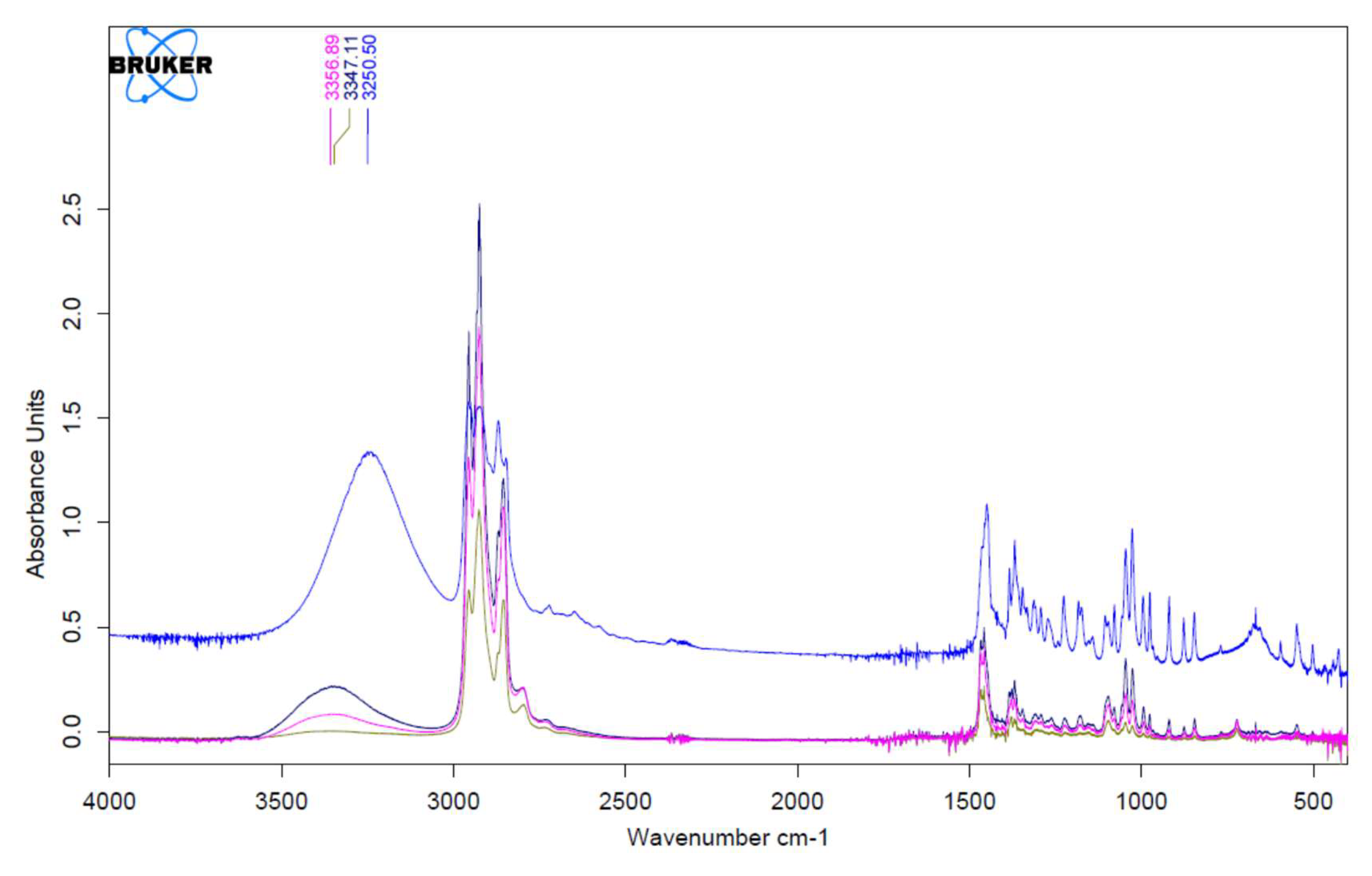
Figure 2.
FTIR spectra of the menthol (green), M:DOA eutectic mixtures (blue), after extraction (black) and re-extraction (red).
Figure 2.
FTIR spectra of the menthol (green), M:DOA eutectic mixtures (blue), after extraction (black) and re-extraction (red).
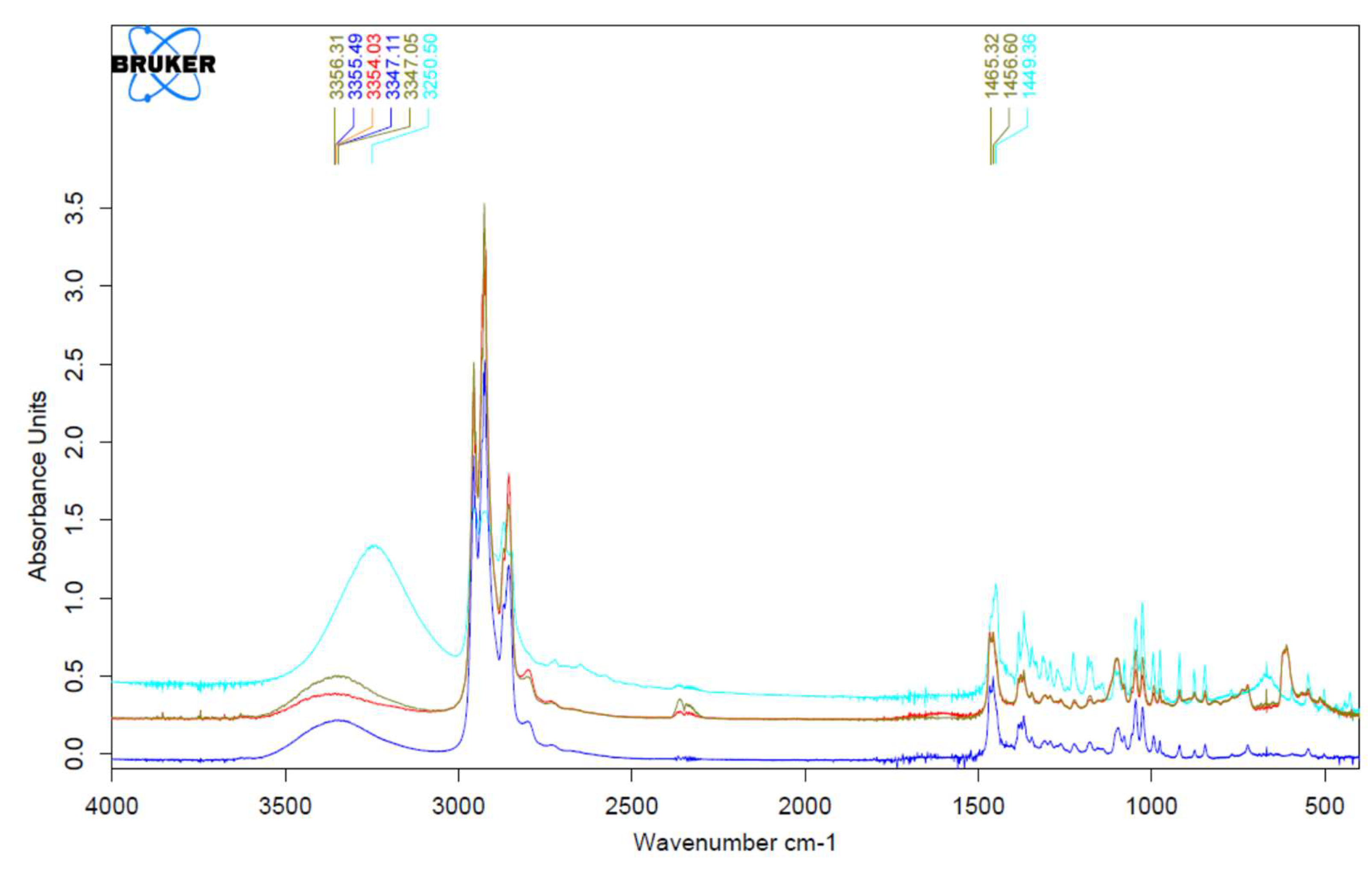
Figure 3.
TGA decomposition profile of compounds (gray – menthol, blue – amine (DOA a); TOA b)), eutectic mixture (red), after extraction (green) and after re-extraction (black).
Figure 3.
TGA decomposition profile of compounds (gray – menthol, blue – amine (DOA a); TOA b)), eutectic mixture (red), after extraction (green) and after re-extraction (black).
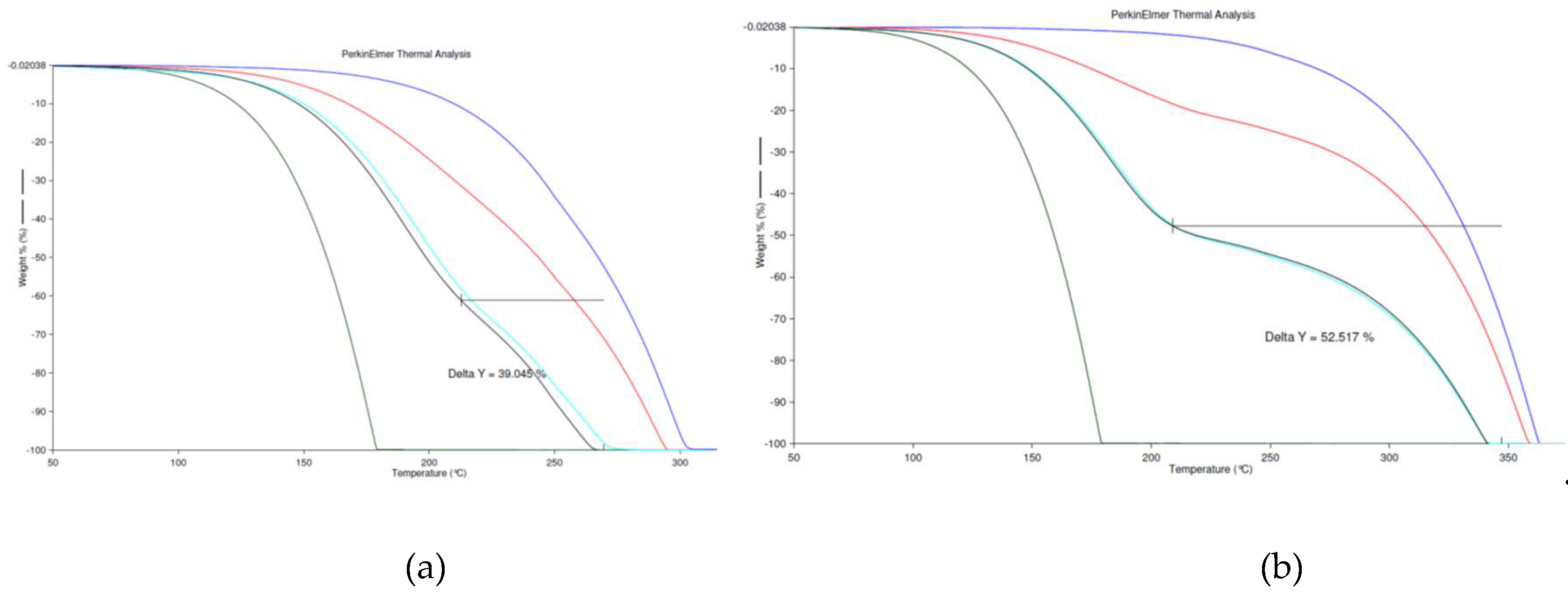
Figure 4.
DSC thermograms of menthol/amine: (a) - M/DOA 1:2, (b) - M/DOA 1:1, (c) - M/DOA 2:1, and (d) M/TDDA 1:1) mixtures.
Figure 4.
DSC thermograms of menthol/amine: (a) - M/DOA 1:2, (b) - M/DOA 1:1, (c) - M/DOA 2:1, and (d) M/TDDA 1:1) mixtures.
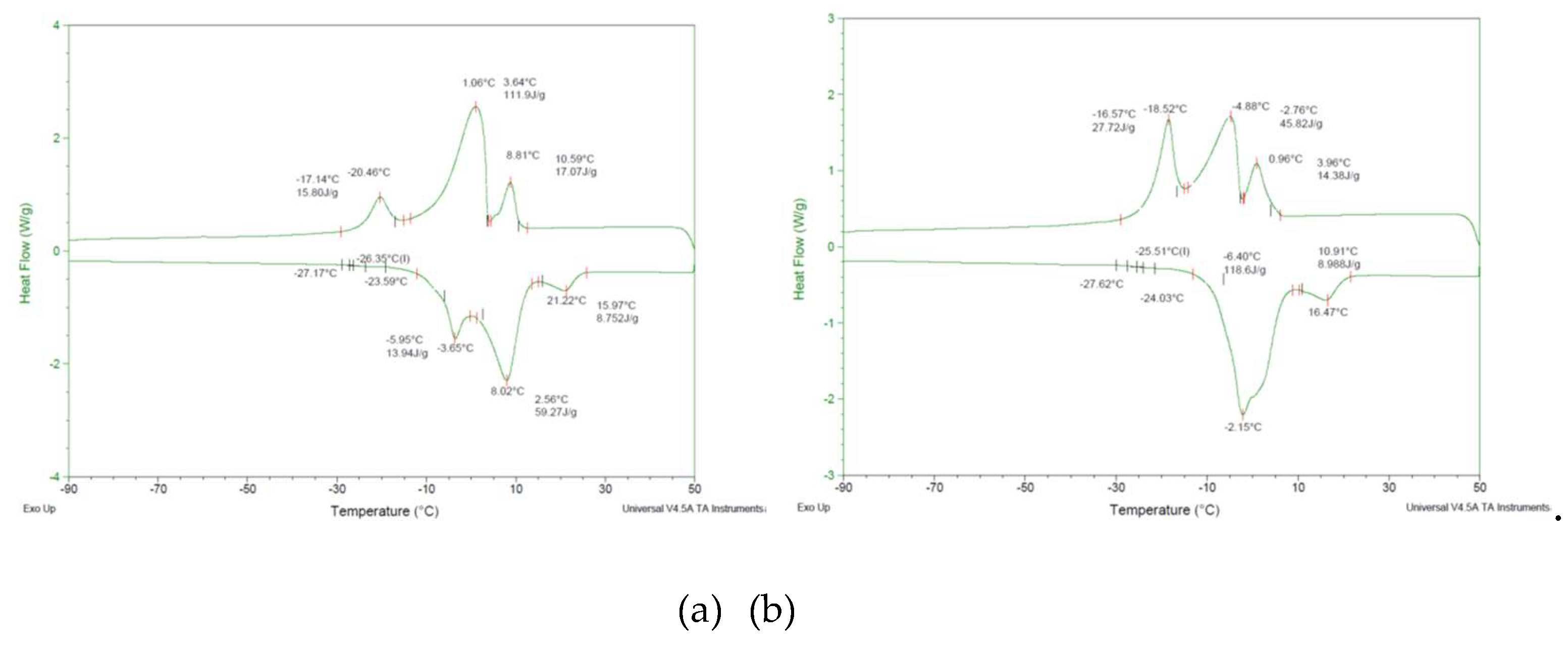
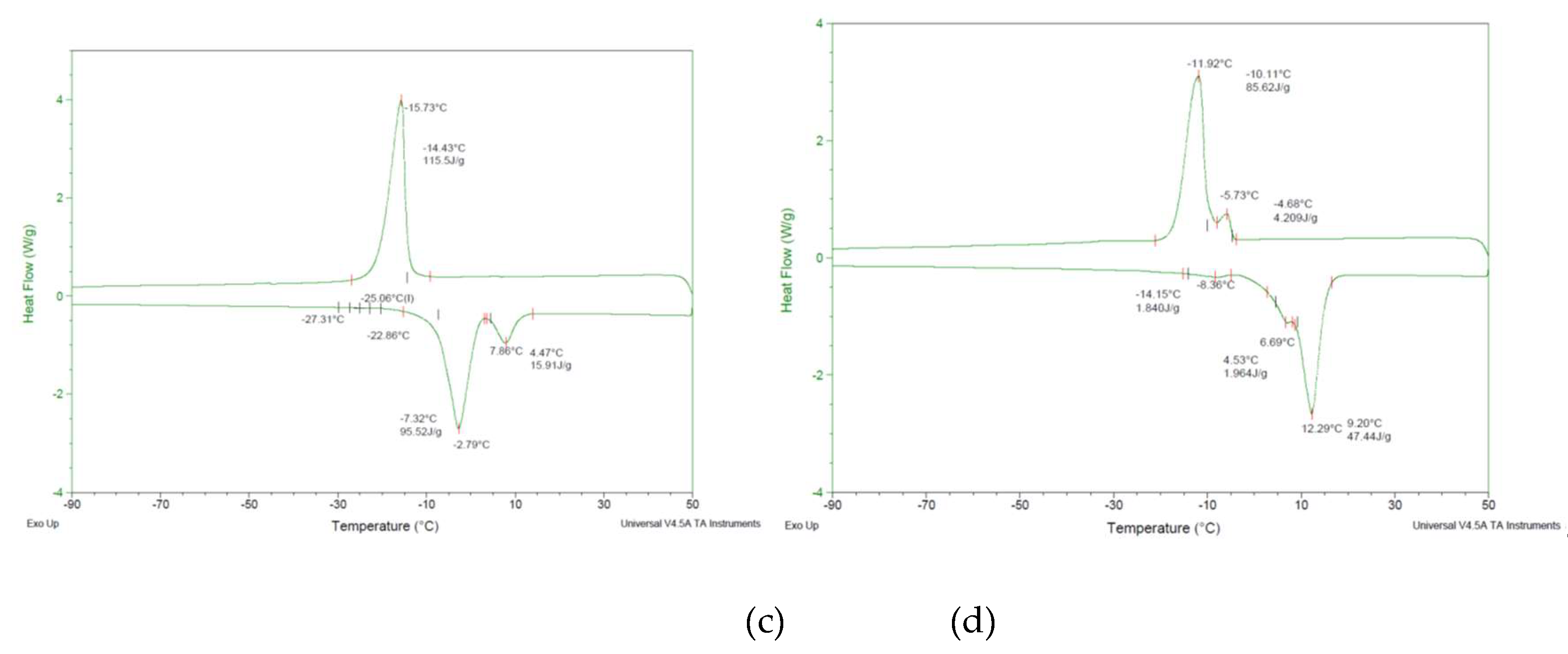
Figure 5.
Densities of M:DOA (a) and M:TDDA (b) DES as a function of temperature.

Figure 6.
Experimental viscosity measurements of M:DOA DES.

Figure 7.
LA extraction with DES: (a) extraction efficiency, (b) distribution coefficient.

Figure 8.
Distribution coefficient (a) and extraction efficiency (b) during consecutive extraction and stripping cycles.
Figure 8.
Distribution coefficient (a) and extraction efficiency (b) during consecutive extraction and stripping cycles.
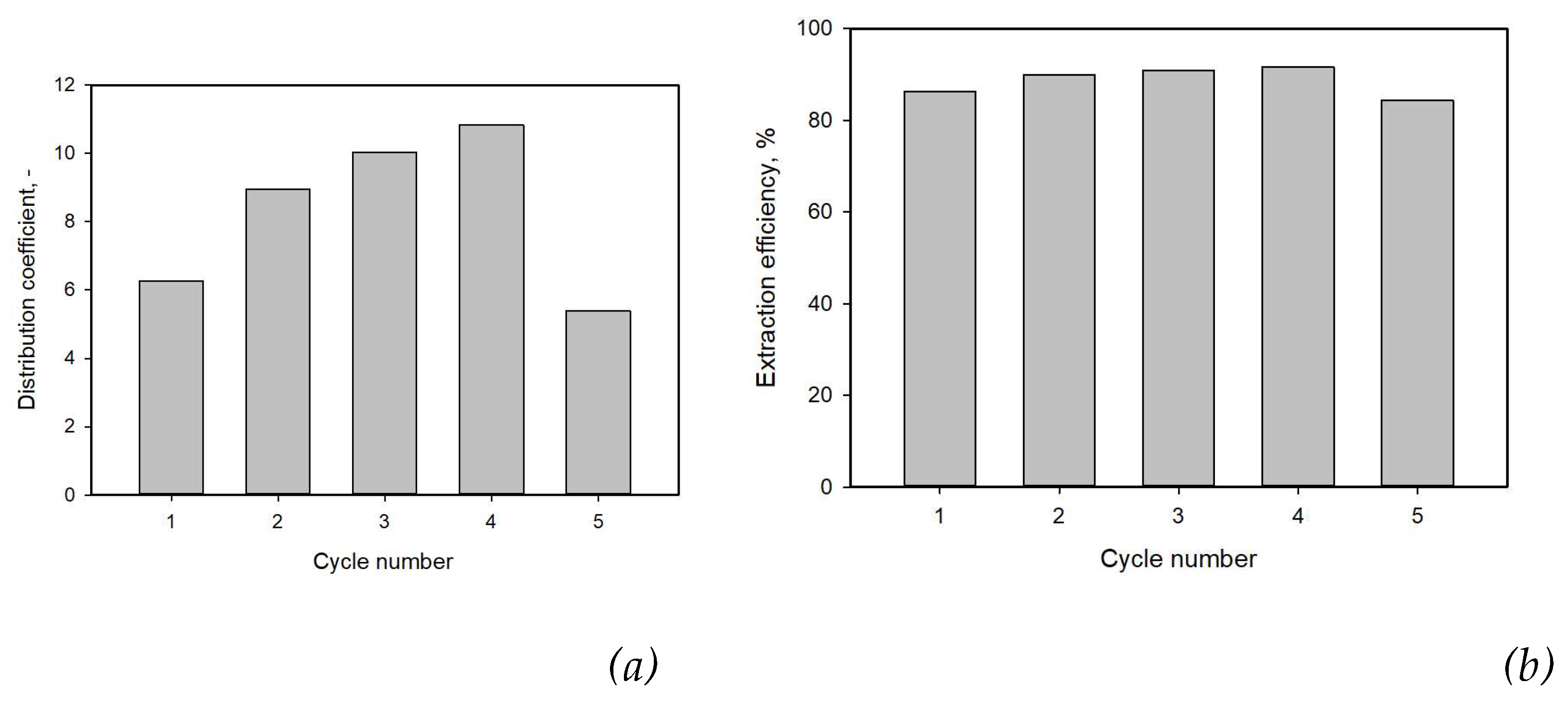

Table 1.
List of chemicals used in the experiments.
| Name | Abbreviation | Supplier | Purity |
|---|---|---|---|
| L (+) Lactic acid | LA | Acros Organics | ≥ 90% |
| Crystalline L- (+) Lactic acid | LA | Thermo Scientific | ≥ 98% |
| L- Menthol | M | Sigma-Aldrich | ≥ 99% |
| Dioctyl amine | DOA | Fluka | ≥ 97% |
| Trihexyl amine | THA | Jenssen Chemica | ≥ 95% |
| Trioctyl amine | TOA | Thermo Scientific | ≥ 95% |
| Tridodecyl amine | TDDA | Merck | ≥ 95% |
Table 2.
Eutectic mixtures and molar ratio of menthol and amines.
| Mixture components | Molar ratio |
|---|---|
| M/DOA | 1:1, 1:2, 2:1 |
| M/TOA | 1:1, 1:2, 2:1 |
| M/THA | 1:1, 1:2, 2:1 |
| M/TDDA | 1:1, 1:2, 2:1 |
Table 3.
Thermal properties of compounds and some eutectic mixtures.
| Pure compound | ToC | DES | Tdeg (oC) | First step decomposition degree (%) |
| L-Menthol | 175 | M/DOA 1:1 | 280 | - |
| DOA | 305 | M/DOA 1:2 | 290 | - |
| TOA | 365 | M/TOA 1:2 | 360 | 26,5 % |
| THA | 465 | M/THA 1/1 | 275 | - |
| TDDA | 470 | M/THA 1:2 | 290 | - |
| M/TDDA 1/1 | 460 | 30 % | ||
| M/TDDA 1:2 | 460 | 18 % |
Table 4.
Tdeg and decomposition degree after extraction and re-extraction.
| Eutectic mixtures (ratio) | First step Tdeg (oC) | Decomposition degree (%) | Second step Tdeg (oC) | Decomposition degree (%) |
| M/DOA 1:2 ex | - | - | 275 | 100 |
| M/DOA 1:2 re-ex | - | - | 275 | 100 |
| M/TOA 1/1 ex | 220 | 50 | 340 | 50 |
| M/TOA 1/1 re-ex | 220 | 50 | 340 | 50 |
| M/THA 1/1 ex | - | - | 275 | 100 |
| M/THA 1/1 re-ex | - | - | 275 | 100 |
| M/TDDA 1:2 ex | 230 | 41 | 450 | 59 |
Table 5.
Striping of DES loaded with LA.
| DES | Ratio | First stripping, % | First & Second stripping, % |
| M:DOA | 2:1 | 95 | 97 |
| M:THA | 1:2 | 86 | 86 |
| M:THA | 2:1 | 94 | 95 |
Disclaimer/Publisher’s Note: The statements, opinions and data contained in all publications are solely those of the individual author(s) and contributor(s) and not of MDPI and/or the editor(s). MDPI and/or the editor(s) disclaim responsibility for any injury to people or property resulting from any ideas, methods, instructions or products referred to in the content. |
© 2025 by the authors. Licensee MDPI, Basel, Switzerland. This article is an open access article distributed under the terms and conditions of the Creative Commons Attribution (CC BY) license (http://creativecommons.org/licenses/by/4.0/).
Copyright: This open access article is published under a Creative Commons CC BY 4.0 license, which permit the free download, distribution, and reuse, provided that the author and preprint are cited in any reuse.