

Submitted:
17 February 2025
Posted:
18 February 2025
You are already at the latest version
Abstract
Thermodynamics explanations by Geometric model were initiated by all precursors Carnot, Gibbs, Duhem, Reeb and Carathéodory. It is only recently that Symplectic Foliation Model introduced in the domain of Geometric statistical Mechanics has given a geometric definition of Entropy as invariant Casimir function on Symplectic leaves (coadjoint orbit of the Lie Group acting on the system, where orbits are interpreted as level sets of Entropy). We give a symplectic foliation interpretation of Thermodynamics based on Jean-Marie Souriau’s "Lie Groups Thermodynamics". This model gives a Lie algebra cohomological characterization of Entropy, as an invariant Casimir function in coadjoint representation. The dual space of the Lie algebra foliates into coadjoint orbits identified with the Entropy level sets. In the framework of Thermodynamics, a dynamics on symplectic leaves, described by Poisson bracket, is associated to non-dissipative phenomenon, and on transversal Riemannian foliation (level sets of energy), dynamics characterized by metric bracket induce entropy production from symplective leaf to leaf. Souriau’s model is interpreted by Libermann's foliations, clarified as dual to Poisson -structure of Haefliger.
Keywords:
Thermodynamics
; 2nd principle
; Symplectic Foliation
; Riemannian Foliation
; Lie Groups
; Lie Algebra Cohomology
; Entropy
; Casimir Function
; Pfaff forms
1. Preamble
In this article, we develop the ideas of the notions of foliations associated with the Pfaff equations of thermodynamics, to interpret the 2nd principle of Sadi Carnot to the recent work of the symplectic model of statistical mechanics of Jean -Marie Souriau, called “Lie groups Thermodynamics”.
Jean-Marie Souriau's model, known as "Lie groups Thermodynamics," is a symplectic model of statistical mechanics. This framework integrates geometric methods into statistical mechanics, where Gibbs states of a system are represented as points in a symplectic manifold, and Lie groups describe the symmetries of the system. We give an original interpretation of “Lie groups Thermodynamics” with a symplectic foliation generated by coadjoint orbit of the Lie group acting on the system, where the Entropy is characterized as an invariant Casimir Function. Transverse to this symplectic foliation, considered as level sets of Entropy, we can associate a Riemannian foliation as level set of Energy. These transverse foliations define a webs structure (Wolak 1989). We explain dynamics along both transverse leaves by a metriplectic flow mixing Poisson bracket on symplectic leaves (level sets of Entropy), describing non-dissipative phenomenon by preserving Entropy, and metric bracket on Riemannian leaves (level sets of Energy), characterizing non-dissipative phenomenon by Enropy production. In the framework of Information Geometry for statistical manifolds, we can associate to the symplectic foliation the Fisher metric, and to the Riemannian foliation the dual of the Fisher metric (hessian of Entropy).
Jean-Marie Souriau is a French mathematician who has had a significant impact on the development of symplectic geometry, notably by introducing innovative concepts and ideas that have enriched the understanding of geometric structures of dynamical systems, in particular the relationship between geometry, physics, and representations of symmetry groups. His most important contributions to symplectic geometry is his theory of Hamiltonian systems in a geometric framework, notably through the notion of Hamiltonian dynamical systems. Souriau formalized the idea that the dynamics of a physical system can be described geometrically by a symplectic manifold, by treating the trajectories of Hamiltonian systems as curves in a symplectic manifold. He formulated precisely how symmetry groups act on phase spaces, which are symplectic manifolds, and how this is related to the invariants of the system. Souriau showed how symplectic geometry is related to the coadjoint orbits of a Lie group acting on a manifold, particularly in the context of mechanical systems where symmetries are often described by Lie groups (e.g., the Galileo group). Souriau recognized that a contact structure, which is a generalization of the odd-dimensional symplectic structure, can be used to describe dissipative or non-reversible dynamics. This insight allowed contact geometry to be related to more general dynamical systems, and enriched the understanding of symplectic geometry, which is more often applied to reversible systems.
Jean-Marie Souriau has applied symplectic model for statistical mechanics and thermodynamics, entitled “Lie Groups Thermodynamics”. This approach allows statistical mechanics and thermodynamics to be understood as a natural extension of Hamiltonian mechanics. The idea is to treat a statistical ensemble as a family of Hamiltonian systems, taking into account probability distributions defined on the phase space. Souriau developed a formulation in which the dynamics of entropy and other thermodynamic variables follow naturally from symplectic geometry, thus highlighting the connection between statistical mechanics (and more generally thermodynamics) and geometry.
The structure of this paper is described in the following.
In chapter 1, we introduce the work of the French mathematician and physicist, Jean-Marie Souriau, who after introducing symplectic geometry into the framework of classical mechanics and the calculus of variations, generalized his symplectic model for statistical mechanics. We explain how this model, which he called “Lie groups Thermodynamics”, which is part of the theory of representations of Alexandre Kirillov, allows us to reconsider the 2nd principle of Sadi Carnot within the framework of the foliation theory introduced by Charles Erhresmann and Georges Reeb. We introduce a new, purely geometric definition of Entropy, as an invariant Casimir function on the symplectic foliations, generated by the coadjoint orbits of the group, acting on the thermodynamic system. We also establish links with Information Geometry associated with the Fisher metric.
In chapter 2, we develop this foliation model of thermodynamics, making the link with the notion of metriplectic flow, compatible with Onsager relations, describing the dynamics along each of the leaves. We show that to the symplectic foliation of Souriau, we can associate a transverse Riemannian foliation by the energy level sets, which describe the dissipative phenomena and the generation of Entropy of the 2nd principle of Sadi Carnot.
In chapter 3, we recall that the physicist Baptiste Coquinot has established the compatibilities of metriplectic flow with the Onsager relations that describe dissipative phenomena. We also recall that Günther Vojta had studied first Onsager relations within the framework of symplectic geometry.
In chapter 4, we give physicist Herbert B. Callen's insight into thermodynamics as the Science of symmetry. We recall avenues of study opened by Callen to explore more deeply the role of symmetry in thermodynamics.
In chapter 5, we conclude with last works of Jean-Marie Souriau on Thermodynamics in private unpublished documents.
[…] On a fort peu étudié jusqu’ici les changements de température survenus dans les corps par l’effet du mouvement; cette classe de phénomènes mériterait cependant l’attention des observateurs. Lorsque les corps sont en mouvement, lorsque surtout il se consomme ou qu’il se produit de la puissance motrice, il arrive des changements remarquables dans la distribution de la chaleur et peut-être dans sa quantité. Nous allons apporter un petit nombre de faits, où ce phénomène se développe avec le plus d’évidence. (Carnot 1824b, p. 195)
[…] La thermodynamique a habitué de longue date la physique mathématique [cf. DUHEM P.] à la considération de formes de Pfaff complètement intégrables : la chaleur élémentaire dQ [notation des thermodynamiciens] représentant la chaleur élémentaire cédée dans une modification infinitésimale réversible est une telle forme complètement intégrable. Ce point ne semble guère avoir été creusé depuis lors. (Reeb 1978, p. 8)
2. Jean-Marie Souriau’s Symplectic Model of Lie Groups Thermodynamics and Geometric Definition of Entropy as Casimir Function on Symplectic Foliation
As observed by Charles-Michel Marle (Marle 2016, 2018, 2019, 2020a & 2020b, 2021a, 2021b & 2021c), Josiah Willard Gibbs in chapter IV of his book “Elementary Principles in Statistical Mechanics, developed with Especial Reference to the Rational Foundation of Thermodynamics” published in 1902 (Gibbs 1902), considered generalization of Gibbs states built with the moment map of the product of the one-dimensional group of translations in time and the three-dimensional group of rotations in space for the study of systems contained in a rotating vessel, referring to a paper by Maxwell published in 1878. We can read in the book of Gibbs:
[…] The consideration of the above case of statistical equilibrium may be made the foundation of the theory of the thermodynamic equilibrium of rotating bodies, a subject which has been treated by Maxwell in his memoir On Boltzmann's theorem on the average distribution of energy in a system of material points (Gibbs 1902, p.44)
Jacques Hadamard made a review of this book in 1906 (Hadamard 1906) and wrote:
[…] This book is not one of those that one analyzes hastily; but, on the other hand, the questions it deals with have been greatly agitated in recent times; the ideas defended by Gibbs have been the subject of much controversy; the reasoning with which he supported them has also been criticized. It seems interesting to me to study his work in the light of these controversies and by discussing these criticisms (Hadamard 1906, p. 194)
We will develop in this chapter Jean-Marie Souriau’works who studied systematically thermodynamics in case of dynamical systems under the action of a Lie group in the framework of Symplectic Geometry applied for Statistical Mechanics (Souriau 1953, 1954, 1965, 1966, 1967, 1969, 1974, 1975, 1977, 1984, 1986, 1996, 1997, 2005 & 2007). We will also make the link with the mechanics of completely integrable Hamiltonian systems (the study of complete systems of first integrals) (Cartier 1994), that is in geometric language, Lagrangian foliations of symplectic manifolds (Lawson 1974), that was studied by Paulette Libermann under the supervision of Charles Ehresmann, as advised by Elie Cartan. Paulette Libermann observed that analysis and mechanics (and nowdays quantum physics) require examining the more general situation of symplectically complete foliations (Libermann 1954, 1959, 1983, 1986, 1989, 1991 & 2005, Libermann & Marle 1987, Pang 1990).
2.1. Souriau’s Seminal Idea of Symplectic Model of Statistical Mechanics in the Framework of Representation Theory
Jean-Marie Souriau PhD was supervised by André Lichnérowicz at Collège de France, who was also interested by the notion of symplectic foliation after its development by his PhD student and the work of Paulette Libermann. We can read in Lichnérowicz lecture at Collège de France:
[…] Tuesday's class was devoted to the systematic study of the relationships between foliation and Poisson manifolds. The notion of Poisson manifold was introduced by us in 1975 as a natural contravariant generalization of that of symplectic manifold. On such a manifold, the Poisson structure determines a symplectic foliation either in a generalized sense (non-regular Poisson manifold) or in the strict sense of the term (regular Poisson manifold). A simple natural example of the first case is provided by the orbits of the coadjoint representation of a Lie algebra. A simple example of the second case is given by the fibers cotangent to the foliations. Let (M, F) be a symplectic manifold equipped with a Lagrangian foliation £. It has been shown that there always exists on M a connection adapted to foliation which induces on each leaf a flat connection without torsion. If the manifold admits a fiber-type Riemannian metric for £, it admits a Riemannian metric which induces a flat metric on each leaf. We have thus clarified and generalized recent results of A. Weinstein and P. Dazord. The same results are valid if, instead of a Lagrangian foliation, we consider an isotropic foliation of (M, F) such that the field of symplectic orthogonal planes is a coisotropic foliation. (Lichnerowicz 1983d, p.2)
The statistical Physics community (Berezin 2007) ignored Souriau’s Symplectic Model of Thermodynamics until recently. We can only make reference to G. Vojta paper (Vojta 1990) “Symplectic Formalism for the Thermodynamics of Irreversible Processes”, making reference to Prof. Ingarden (Ingarden 1981 & 1988, Ingarden & Kossakowski & Ohya 1997), where Votja writes:
[…] A characteristic trend in mathematical physics is the growing use of the same abstract formalisms for the description of very different physical phenomena. A paradigm is the Hamiltonization of various fields of physics, i.e. the use of Hamiltonian structuresand symplectic geometry, based on the mathematical language of exterior differential forms, fibre bundles, Poisson bracket structures and generally Lie algebraic conceptions. Examples are widespread. With the dliscovery of the Lie-Poisson structure underlying the Euler equations of fluid flow by Arnol’d ... Another field where Hamiltonian structures and symplectic geometry play a growing role is quantum mechanics and quantum field theory including nuclear physics. In the foreground are problems of quantization (so-called geometric quantization) by means of the Wigner-Wel formalism and the physics of semi-classical systems. A further use for Hamiltonian structures and symplectic notions is given in the fields of differential equations, optimization and control theory. Characteristic of all these theoretical developments is that the systems considered are ideal systems (fluids, plasmas, quantum systems,…) without energy dissipation (without frictions, damping,…), i.e. without entropy production. There exists a larger literature on the damping of quantized systems or, in other words, on problems of the correct formulation of a quantum theory of systems with friction. A symplectic approach to nonconservative systems- which can be considered as a first step towards a correct quantization procedure-was treated only in few papers without explicitly considering, however, the thermodynamics and, in particular, the entropy balance. On the other hand a few papers have been published on the symplectic structure of equilibrium thermodynamics, but (to the best of our knowledge) not of irreversible thermodynamics, with one important exception, i.e. a set of papers by the Ingarden group on “information geometry” and irreversible thermodynamics where indeed the connection between information theory and differential geometry plays the main role”.(Vojta 1990, p. 251)
Lie Group Representation theory and Symplectic Geometry in Mechanics were in parallel studied in Russia by Alexandre Kirillov and Vladimir Arnold (Arnold 1966 & 1990), but without connexion with Souriau’s works on “Lie Groups Thermodynamics”.
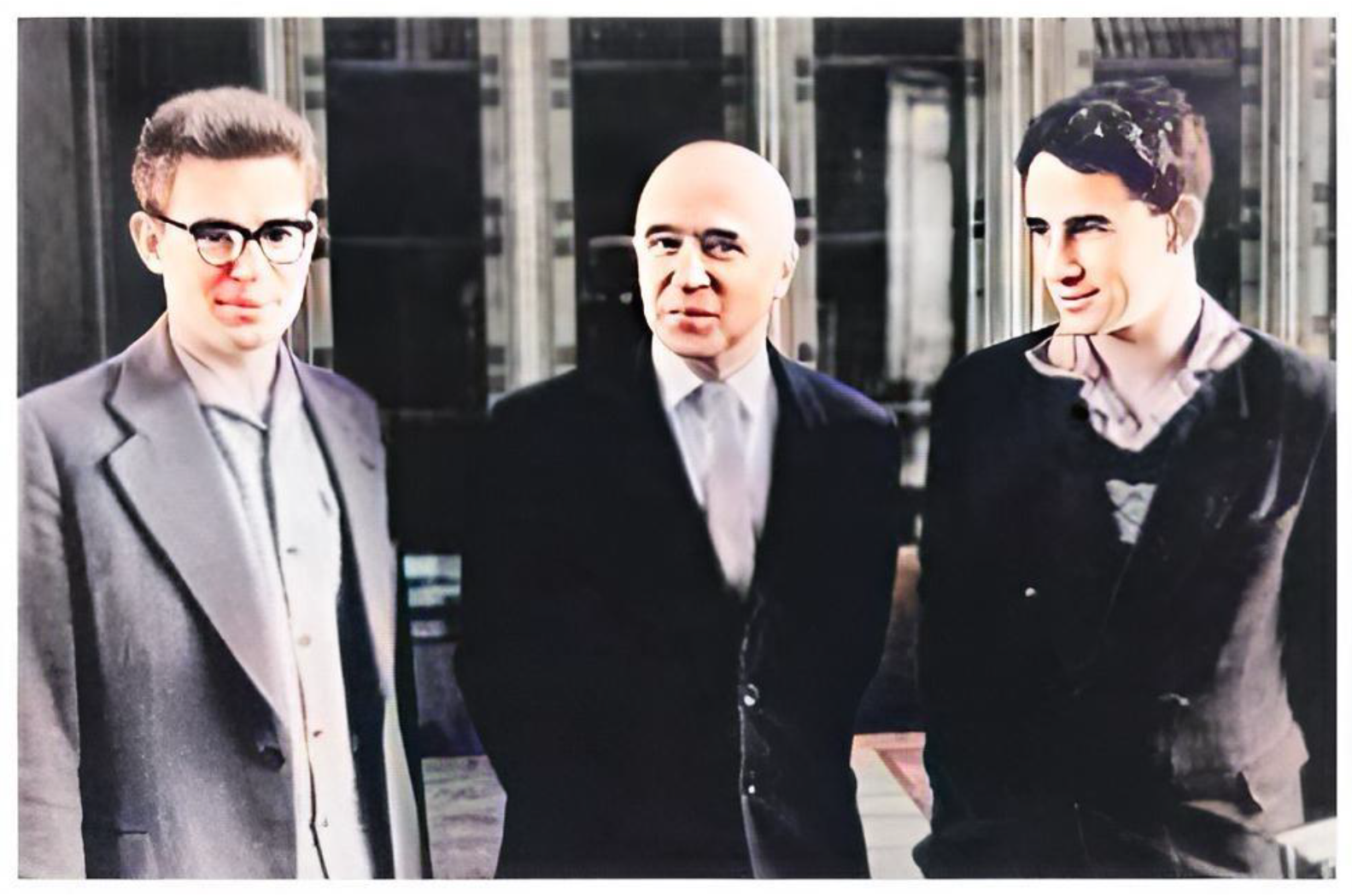
Figure 1.
Russian school of Lie Group Representation Theory and Symplectic Geometry, with Alexandre Kirillov (on the left) and Vladimir Arnold (on the right). Source (Khesin & Tabachnikov 2014, p. 94).
Figure 1.
Russian school of Lie Group Representation Theory and Symplectic Geometry, with Alexandre Kirillov (on the left) and Vladimir Arnold (on the right). Source (Khesin & Tabachnikov 2014, p. 94).
2.2. Jean-Marie Souriau Scientific Biography
At the end of the war, the physicist and mathematician Jean-Marie Souriau began his career as an engineer at ONERA. Influenced by presentations by American engineering researchers at ENS Paris, he was won over and made the conscious decision to do a thesis on the stability of aircraft. After his thesis supervised by André Lichnerowicz (Lichnerowicz 1976, 1982a & 1982b, 1983a, 1983b, 1983c & 1983d), he took a position at the Institute of Advanced Studies in Tunis. We will try to retrace his scientific quest for a new foundation of statistical physics, thermodynamics and quantum mechanics on the common base of the structures of symplectic geometry. The theory of representations of Lie groups, initiated by Alexandre Kirillov (Kirillov 1974 & 2004), plays a central role with the notion of moment map (Kapranov 2011), co-adjoint orbits and cohomology of Lie algebras (Nencka & Streater 1999, Pavlov & Sergeev 2008), to capture the structures generated by symmetries. This quest began for Jean-Marie Souriau in the romantic setting of the ruins of Carthage, where isolated he undertook an intimate reading of the works of Lagrange and discovered the symplectic structures which had until then been hidden from the view of mechanics. On the basis of this geometric mechanics, we will discover how he had the idea of extending it to statistical mechanics, and gave it the disconcerting name of “Lie Groups Thermodynamics ”. As he later admitted, all this scaffolding, which he built in his solitude in Carthage and the silence of his passions, had as its ultimate goal the “geometric quantification” of quantum mechanics. The seeds of this original thought were not born by chance but in the cradle of a line of philosophers from Ecole Normale Supérieure over several generations, who had shaped his spirit into the triptych “Aesthetics – Structure – Movement ” and whose family work he completed in attacking the “ structure of the movement ”; his uncle Etienne Souriau having transmitted to him the “ structure of aestheticism ” and his grandfather Paul Souriau “ the Aesthetics of movement ”. Reconnecting with Aristotle's physics where movement is both a change of place (mechanics) and a change of state (thermodynamics), Jean-Marie Souriau bequeathed us a new Thermodynamics based on symplectic geometry, in which through the miracles of the cohomology of Lie algebra, temperature, heat and entropy ontologically changed their nature and acquired a purely geometric definition. The (Planck) temperature appeared as an element of the Lie algebra of the symmetry group which acts on the dynamic system, heat as an element of the dual space of the Lie algebra, and entropy as a Casimir invariant function (Casimir 1931) on the co-adjoint orbits (orbits, themselves seen as a symplectic foliation). This last point is undoubtedly the most profound ontological rupture of the 20th century . Since Claude Shannon, entropy had only had an axiomatic definition without solid established foundations. With Souriau, entropy acquires a purely geometric archetypal definition. Consider the group which acts on the system and the associated symmetries, consider its co-adjoint orbits (action of the group on the moment map; the moment map playing the role of a geometrization of Noether's theorem), the entropy then appears clearly as the invariant Casimir function on the symplectic foliation thus created. By the same token, this symplectic foliation appears as the entropy level sets (a leaf corresponds to a constant entropy). From leaf to leaf, entropy increases as explained by the 2nd principle of thermodynamics. This 2nd principle thus changes its nature and is, therefore, closely linked to the structures of these symplectic foliations. Thus, a new equation allows us to characterize and “geometrically construct” the entropy starting from the symmetry group, and also allows us to rewrite the Fourier heat equation (Bachelard 1973) geometrically with a Poisson bracket (Cosserat 2023). This new vision of things also revolutionizes information theory and geometry. The Souriau model makes it possible to construct the probability density of maximum entropy for any homogeneous space on which a Lie group acts, or to calculate a density associated with a group. Souriau introduced a Riemannian metric on this symplectic manifold, from what is called the KKS 2 form (Kirillov, Kostant and Souriau) and a cocycle which bears his name. We recently made the link between this Riemannian metric and the Koszul-Fisher metric of information geometry (Jean-Louis Koszul had studied this metric, in parallel with Ernest Vinberg for sharp convex cones and its invariance with respect to automorphisms of these cones). By achieving the alliance of changes of places and changes of states, the thought of Jean-Marie Souriau rediscovered the concepts of Aristotle's physics and the epistemology of Blaise Pascal. Without doubt, Souriau's discovery is one of the greatest discoveries in physics of the 20th century , modifying the ontological nature of the elements of Fourier's and Carnot's theory of heat and giving a new status to entropy, as a fundamental archetype emerging from the cohomological structures of the symplectic foliations and the moment map associated with the dynamic group which acts on the system. Having understood that the foliation model of Souriau Thermodynamics was limited to non-dissipative phenomena, we disentangled the links with non-equilibrium thermodynamics by highlighting that Riemannien foliation ,transverse to symplectic foliations and the associated dynamics corresponded to dissipative phenomena ( production of entropy by passing from symplectic leaf to leaf of entropy level sets). The updated transverse structures have shown to be compatible with Onsager relations (Casimir 1945, Hubmer & Titulaer 1987) and the metriplectic flow (flow coupling a Poisson bracket and a metric bracket) as proven by Baptiste Coquinot (Coquinot & Morrison 2020). The metric bracket associated with these transverse structures happens to be linked to the inverse Koszul-Fisher metric of Information geometry, that is to say to the Hessian of entropy. This “Souriau-ian” revolution also shakes the edifice of Claude Shannon's information theory and Kolmogorov's probabilities by also recasting these disciplines on the basis of symplectic geometry. The structures of probabilities and information are thus reconstructed on the basis of the theory of symplectic foliations.
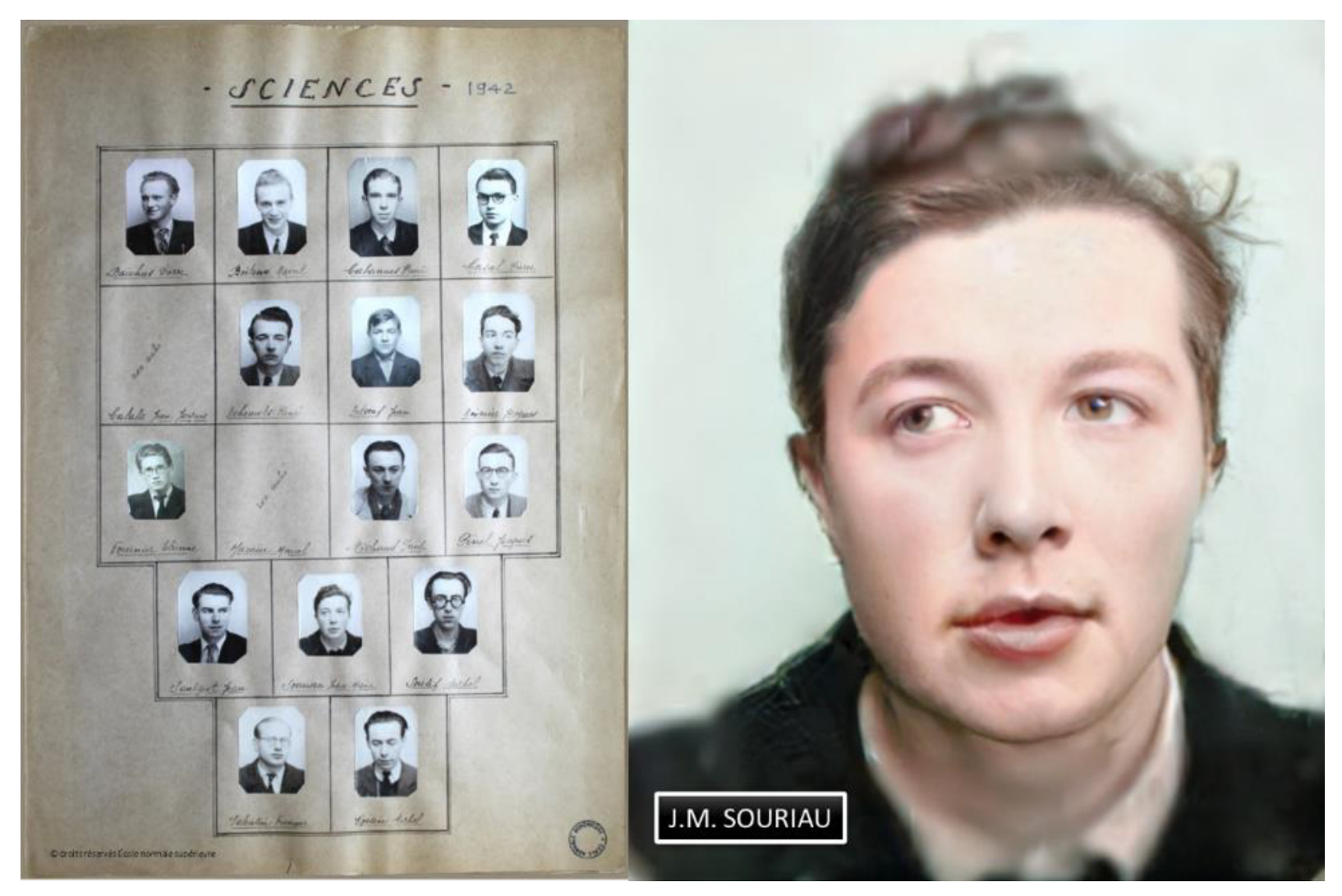
Jean-Marie Souriau from 1932 to 1942 did his secondary studies in Nancy, Nîmes, Grenoble and Versailles, undoubtedly following the various assignments of his teaching father. Jean-Marie Souriau married Christianne Hoebrechts, who died prematurely in 1985 and with whom he had five children Isabelle, Catherine, Yann, Jérôme and Magali. He entered ENS Paris in 1942, passing twice in the unoccupied zone in Lyon and a second time in Paris. Also admitted to the Ecole Polytechnique, he resigned to join ENS Paris. During his studies at the ENS, he took courses at the Sorbonne with the physicist Yves Rocard and the mathematician Elie Cartan . He joined as a volunteer for La France Libre in 1944. A volunteer, he returned to the ENS in 1945 and registered for a special session of the aggregation, organized for young people who had served under the flags to liberate our country. With his friend Gérard Debreu (Nobel Prize in economics several years later). Gérard Debreu first and Jean-Marie Souriau second are brilliantly received.
Figure 2.
Jean-Marie Souriau, student at the Ecole Normale Supérieure in Paris in 1942, with Jacques Dixmier and René Deheuvels among others. Source trombino Ecole Normale Supérieure Paris 1942.
Figure 2.
Jean-Marie Souriau, student at the Ecole Normale Supérieure in Paris in 1942, with Jacques Dixmier and René Deheuvels among others. Source trombino Ecole Normale Supérieure Paris 1942.
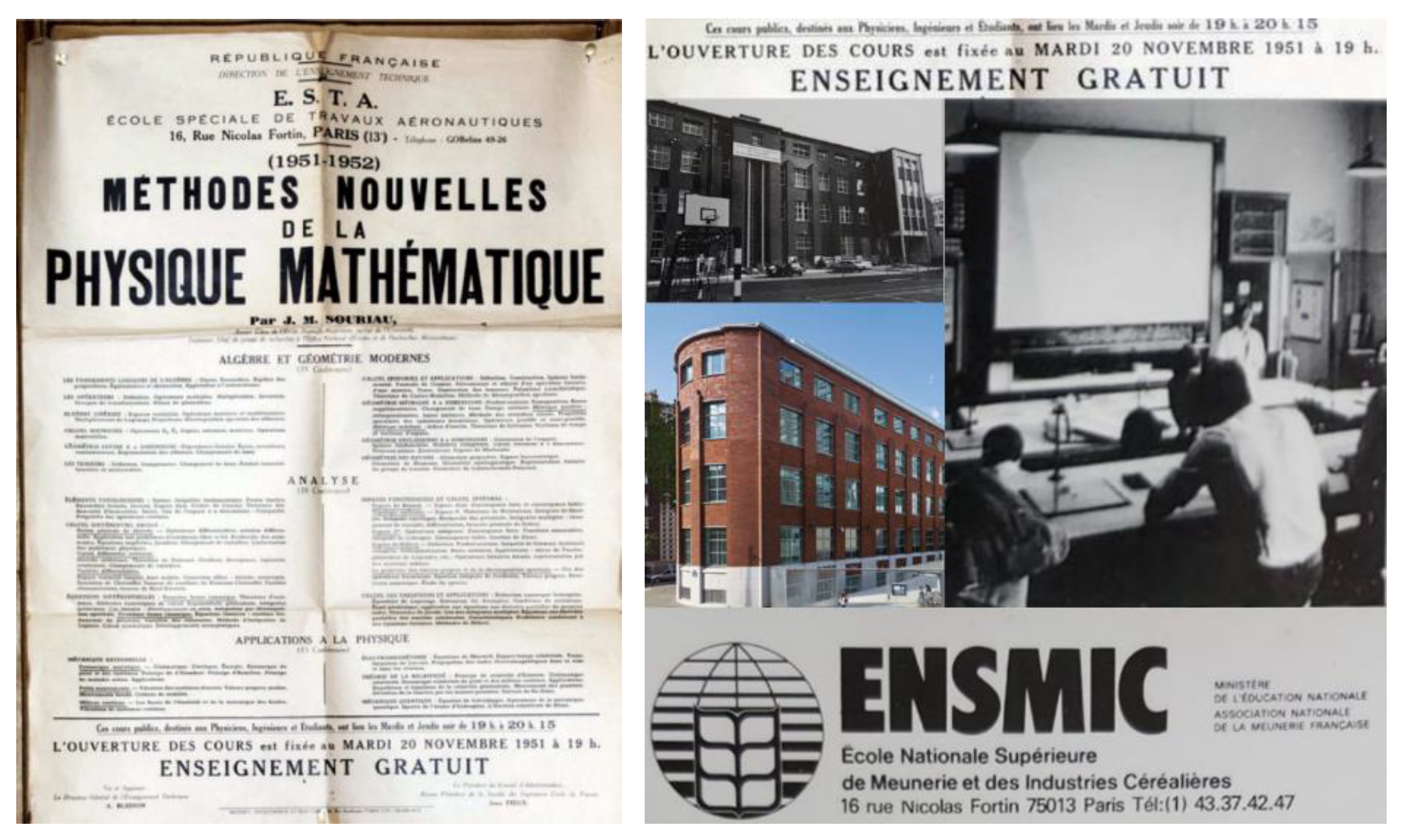
In 1946, the same year, he joined a laboratory working on the scanning electron microscope and then joined a CNRS “theoretical physics” session as a researcher. As early as 1948, he offered a free open course “ New Methods of Mathematical Physics ” for which he twice filled the 200-seat lecture halls. Classes take place at 16 rue Nicolas Fortin, at the Ecole de la Meunerie. Souriau certainly thought of his Souriau ancestors, master millers in Vendômois. As Claude Vallée testifies:
[…] I remember that he often told me about an evening course that he gave at the “Ecole des Meuniers” in collaboration with Jérôme Chastenet de Géry and Roger Valid (who wrote the exercises). Originally, the public courses of 1951-52 were a response to the lack of matrix calculation that Jean-Marie Souriau had felt among French aeronautical engineers, notably at the recently created ONERA. The simple addition of 2 matrices was respectfully considered a very abstract notion. These shortcomings prevented engineers from understanding the progress made by American aircraft manufacturers during the Second World War (progress that allowed them to win the air war while the English won the sea war). ... This is what motivated, in the 1950s, the need for a good understanding of matrix calculation to master "Structural Mechanics" and design prototypes of new aircraft...conferences on "Modern Algebra and Geometry" summarized on the poster .(Vallée, de Saxcé, G. & Marle 2012, p. 108)
Figure 3.
Jean-Marie Souriau's free course at the Ecole de la Meunerie, on “New methods of mathematical physics” . Source (Vallée, de Saxcé, G. & Marle 2012, p. 109).
Figure 3.
Jean-Marie Souriau's free course at the Ecole de la Meunerie, on “New methods of mathematical physics” . Source (Vallée, de Saxcé, G. & Marle 2012, p. 109).
Souriau made this course into a “Linear Calculation” book. There we can find a presentation of the calculation of the parameters of the characteristic polynomial of a matrix, improving the method of Urbain Jean Joseph Leverrier of 1840. As early as 1955, Souriau's algorithm was tested and compared by the National Bureau of Standards of Los Angeles, under the sponsorship of the Wright Air Development Center, the US Air Force and the Office of Naval Research, and was concluded at the University of California, by the Office of Naval Research.
He finally opted for a career as an aeronautical engineer at ONERA, becoming head of research teams and defending his thesis in June 1952 on the theme of “ aircraft stability ” under the direction of André Lichnerowicz (professor at Collège de France) and Joseph Pérès (collaborator of Vito Volterra); thesis which was used to design the “ Caravelle ” and “ Concorde ” aircraft (ONERA obtains royalties on the Souriau patents). In this thesis, he refers to the work of Yves Rocard on “ General dynamics of vibrations ”. In his thesis, he writes:
[…] I studied the problems of vibrations and stability which arise in aeronautics and in some other techniques; this work allowed me to develop stability criteria which are presented in the form of algorithms that can be easily calculated from theoretical or test data; they have since been regularly used in various fields (subsonic and supersonic aircraft, navigation instruments, etc.) . (Souriau 1952, p.12)
In an interview, Souriau speaks in these terms about the content of his thesis:
[…] We couple the elastic properties of the wings of an airplane with the dynamics of the atmosphere described by partial differential equations and a sheet of vortex discontinuities. With all this, we calculate a complex determinant and we count how many turns it makes around the origin when a pulsation varies. If it makes the right number of revolutions, the plane is stable; otherwise it will start to vibrate and explode. And it works ! It was used for planes like the Concorde. The result was that we could put the motors anywhere, and it made no difference to stability. As a result, we started to put the engines on the rear tail and for 25 years, all the planes that had engines at the rear paid royalties to France, but not to me. (Souriau 1952, p.13)
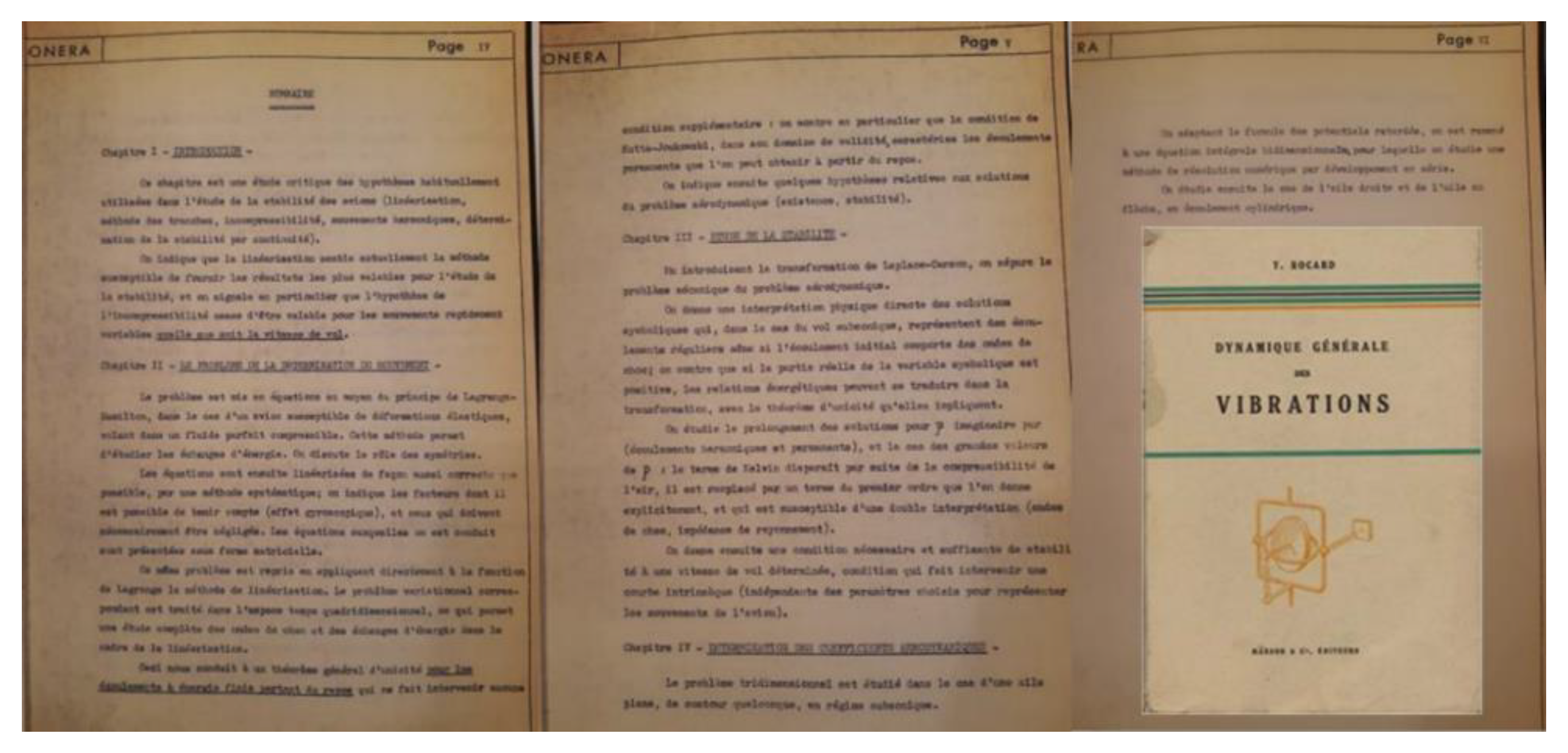
I obtained a copy of this thesis through colleagues at ONERA (Vincent Brion and Agnès Dolfi-Bouteyre), the cover and certain pages of which I reproduce below.
Figure 4.
Pages from Jean-Marie Souriau's thesis "On the stability of aircraft" defended on June 20, 1952, including the bibliographic page which refers to the work of Yves Rocard . Source personal photo of Souriau's thesis manuscript archived at the ONERA.
Figure 4.
Pages from Jean-Marie Souriau's thesis "On the stability of aircraft" defended on June 20, 1952, including the bibliographic page which refers to the work of Yves Rocard . Source personal photo of Souriau's thesis manuscript archived at the ONERA.
Professor Jean-Pierre François wrote in “ Dynamic Systems applied to Oscillations ” (Françoise 2013) about Jean-Marie Souriau's thesis:
[…] One of the most important contributions of the theory of dynamic systems to applications is the study of stability. It is not always very easy in a concrete situation to put this study into practice. The thesis of J.-M. Souriau is a beautiful illustration of this with a very delicate discussion of the possible hypotheses in the study of the stability of aircraft, the choice of a linearization method and the mathematical solution proposed in the form of calculation of a complex determinant for which we calculate the number of turns it makes around the origin. In the framework of the theory of systems on several time scales, new stability problems arise. For example, with the theory of dynamic bifurcations introduced by R. Thom, we can discuss delays at bifurcation. The orbits corresponding to the maximum delays (maximum canards) are now considered as “separators” beyond which we observe a very rapid transition towards new attractors. (Françoise 2013, p.5)
During this period, in 1948 he also invented an algorithm called the Leverrier-Souriau algorithm which allows the characteristic polynomial of a matrix to be calculated and which was used on the first IBM computers. From 1948 to 1952, he also provided continuing education at the Special School of Aeronautical Works (ESTA, Paris) under the general title “New methods of mathematical physics”. From 1951 to 1952, he created and ran the Mechanics course in the third year of the École Normale Supérieure de l'Enseignement Technique (ÉNSET, Paris). From 1952, he also had university training in the following disciplines: Mathematics, Mechanics, Relativity, Mathematical Methods of Physics and Computer Science.
After his thesis in 1952, he joined the Institut des Hautes Etudes, rue de Rome in Tunis, and settled with his wife exactly in Carthage. It was during this period that he reread and deepened the work of Lagrange in Analytical Mechanics and discovered the symplectic structures that he formalized in his work “ Structure of dynamic systems ”. It was while thinking about his exchanges with ONERA engineers that he invented his masterpiece, the “moment map”, a geometrization of Noether's theorem (Noether 1918) (the components of the moment map are the invariants of Noether). We can read in the interview by Patrick Iglesias:
[…] It was with the memory of discussions with engineers who asked the following question: what is essential in mechanics. I remember very well an engineer asking me: is mechanics simply the principle of conservation of energy? This is good for a one-parameter system, but once there are two, it's not enough. I had of course learned the Lagrange equations and all the analytical principles of mechanics, but it was all just a recipe book; we have not seen real principles .” He remained in Tunis from 1952 to 1958, as a lecturer, then as a full professor at the Institut des Hautes Études. In 1953, he participated in the CNRS conference on differential geometry in Strasbourg, and he published his first work there based on his work begun in Carthage, entitled “ Differential symplectic geometry. Applications ”. Charles Ehresmann and André Lichnerowicz, the organizers of this 1953 conference, stated in the introduction to the proceedings: “ We have especially endeavored to highlight some of the new paths in which our science is embarking. We also wanted young mathematicians to be able to highlight their thoughts and their results. (Souriau 1995, p.164)
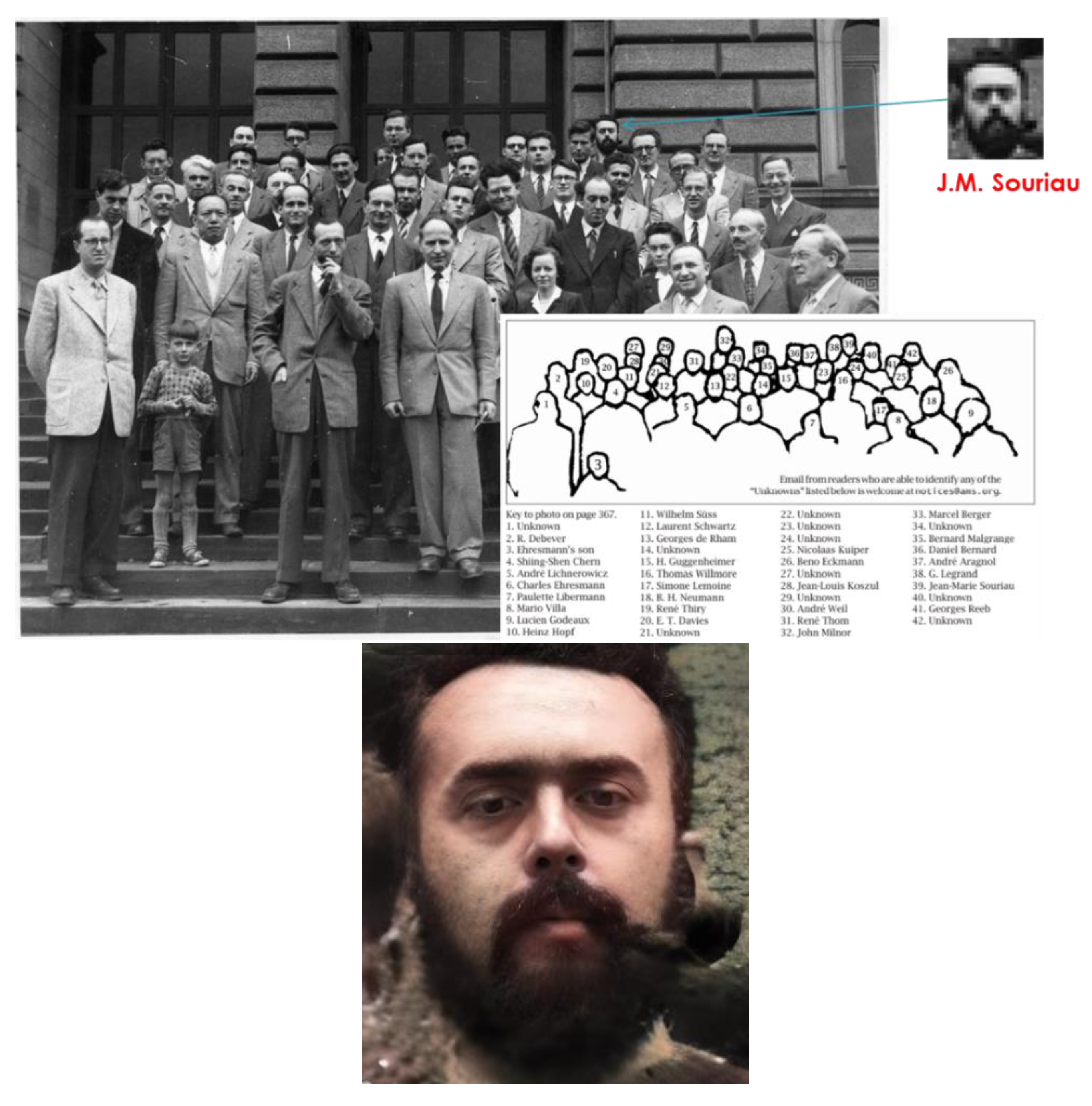
Figure 5.
Jean-Marie Souriau at the “Differential Geometry” Conference in Strasbourg in 1953. In the same photo, Jean-Louis Koszul, André Weil, Shiing-Shen Chern, Georges de Rham, Charles Ehresmann, Lucien Godeaux, Heinz Hopf, André Lichnerowicz (thesis director of Jean-Marie Souriau), Bernard Malgrange, John Milnor, Georges Reeb, Laurent Schwartz, René Thom, Paulette Libermann. Source (Audin 2008, p. 367 & 369).
Figure 5.
Jean-Marie Souriau at the “Differential Geometry” Conference in Strasbourg in 1953. In the same photo, Jean-Louis Koszul, André Weil, Shiing-Shen Chern, Georges de Rham, Charles Ehresmann, Lucien Godeaux, Heinz Hopf, André Lichnerowicz (thesis director of Jean-Marie Souriau), Bernard Malgrange, John Milnor, Georges Reeb, Laurent Schwartz, René Thom, Paulette Libermann. Source (Audin 2008, p. 367 & 369).
In 1956, he created the International Conference on Variational Theories (CITV) which is held every year for high-level research on the themes he initiated. This conference was renewed in 1996 with the help of Claude Vallée from the University of Montpellier and from 2012 by Gery de Saxcé from the University of Lille (de Saxcé &Vallée 2012 & 2016, de Saxcé 2016, 2019 & 2022). The last CITV'23 conference was organized in Porquerolles.
In 1958, he became a professor at the University of Aix-Marseille. He remained in Marseille throughout his career, and from 1978 to 1985 became director of the Marseille Center for Theoretical Physics (CNRS laboratory) in charge of the Theoretical Mechanics, Geometry and Quantification, Astronomy and Cosmology teams. He was also a professor of Mathematics at the University of Provence (Aix-Marseille I) and ended up as an exceptional second-level professor. For five years he was the director of the third inter-university cycle of pure mathematics in Marseille, and for five years of the third inter-university cycle of theoretical physics in Marseille-Nice.
In 1974, Souriau organized the international conference “ Symplectic Geometry and Mathematical Physics ” in Aix-en-Provence and he wrote the proceedings, in a new bound volume published under this title in 1975 by Editions du Center National de la Recherche Scientifique. Souriau's contribution to the proceedings is a 65-page article " Statistical mechanics, Lie groups and cosmology " which begins with the chapter "Symplectic formulation of statistical mechanics " which summarizes and extends chapter IV "Statistical mechanics" of his fundamental book “ Structure of dynamic systems ” (Souriau 1969) published in 1970 (copyright 1969, legal deposit October 1969). It is in this article that he develops what he called “Lie groups Thermodynamics ” which is a symplectic model of statistical mechanics, where the temperature (of Planck) is generalized to all invariants (not only the energy, but also the angular moments) and takes on a geometric meaning as an element of the Lie algebra of the group acting on the system. In the introduction to the volume of proceedings, Souriau writes that Symplectic geometry is not, strictly speaking, a new theory, but it comes from the work of Lagrange (1788) of which Souriau gave a modernized formulation . Souriau further wrote that applications of symplectic geometry had become numerous, touching "a very wide range of subjects ". Souriau developed the fact that Lagrange had been at the origin of these structures, he wrote an article in 1986 on this subject "The symplectic structure of mechanics described by Lagrange in 1811 " (Souriau 1986), published in issue n°94 of " Mathematics and Human Sciences ”.
He was also a member of the French Mathematical Society (SMF) and the French Society of Astronomy Specialists. For five years, he also taught courses in the third inter-university cycle of Pure Mathematics in Marseille and the third inter-university cycle of Theoretical Physics in Marseille-Nice. He was a member of the editorial board of the “ Journal of Geometry and Physics ” in Florence. He organized two international CNRS conferences in 1968 and 1981 and the Days of the Mathematical Society of France. He was one of the main actors in the creation of the Center for Theoretical Physics of Luminy, which he directed from 1978 to 1985. Honored with the Academic Palms and the National Order of Merit, he obtained the Prize on the theme " Vibrations " put in competition by the Association for Aeronautical Research in 1952, the Prize on the theme " Cosmology " put in competition by the Association for Aeronautical Research in 1952. Louis Jacot Foundation in 1978, Grand Prix Jaffe of the Academy of Sciences in 1981 and Grand Prix Scientifique de la Ville de Paris in 1986. Jean-Marie Souriau died in 2012 at the age of 90.
In 2019, a conference was organized at Paris-Cité University and the Henri Poincaré Institute, with the title “Souriau 2019”. We can note the keynote by Jean-Pierre Bourguignon (former director of IHES and the European ERC) “Jean-Marie Souriau and Symplectic Geometry” (Bourguignon 2019). Bourguignon recounts that as a young student at the Ecole Polytechnique, they had initiated a seminar between students to compensate for the low level of mechanics courses. It was at this time that they came across Souriau's book which fascinated them by the fact that Souriau refounded analytical mechanics on the solid foundations of symplectic geometry and the calculus of variations. Bourguignon had the opportunity several times to meet and speak to Souriau in the conferences he organized.
2.3. Jean-Marie Souriau elaboration of Symplectic model of Mechanics and Lie Group Thermodynamics
Souriau’s symplectic idea germinated on the ruins of Carthage and in the reading of the works of Lagrange. Souriau specifies in an interview:
[…] In 1952, I left everything and went to the University of Tunis… The way the administration understood research. You had to search for so many hours a day. There were little windows in the doors so the guards could see if we were doing math or not. I have a friend who was fired for political reasons... This period played a big role in my life, for personal reasons. From a research point of view I began to meditate on the practice of mechanics . When you invert a three x three matrix, you see a denominator common to all the terms appear, you have discovered the determinant. Having noticed that strange antisymmetric things appeared in the equations of mechanics, I said to myself: this is exactly like Euclidean spaces except that it is quite the opposite. I thus had the idea of doing differential symplectic geometry , the title of my first work published on this subject in 1953…. It was much later that I understood that it was implicit in Lagrange. The essential idea is that the solutions of the equations of motion of a dynamic system constitute a symplectic manifold . And I thought that there was an interest in studying this type of manifold, just as there is an interest in studying Riemannian manifolds... It was with the memory of discussions with engineers who asked the following question: what is what is essential in mechanics. I remember very well an engineer who asked me: is mechanics simply the principle of conservation of energy? This is fine for a one-parameter system, but as soon as there are two, it's not enough. I had of course learned the Lagrange equations and all the analytical principles of mechanics, but all that was a recipe book; we did not see any real principles there. (Souriau 1995, p.164)
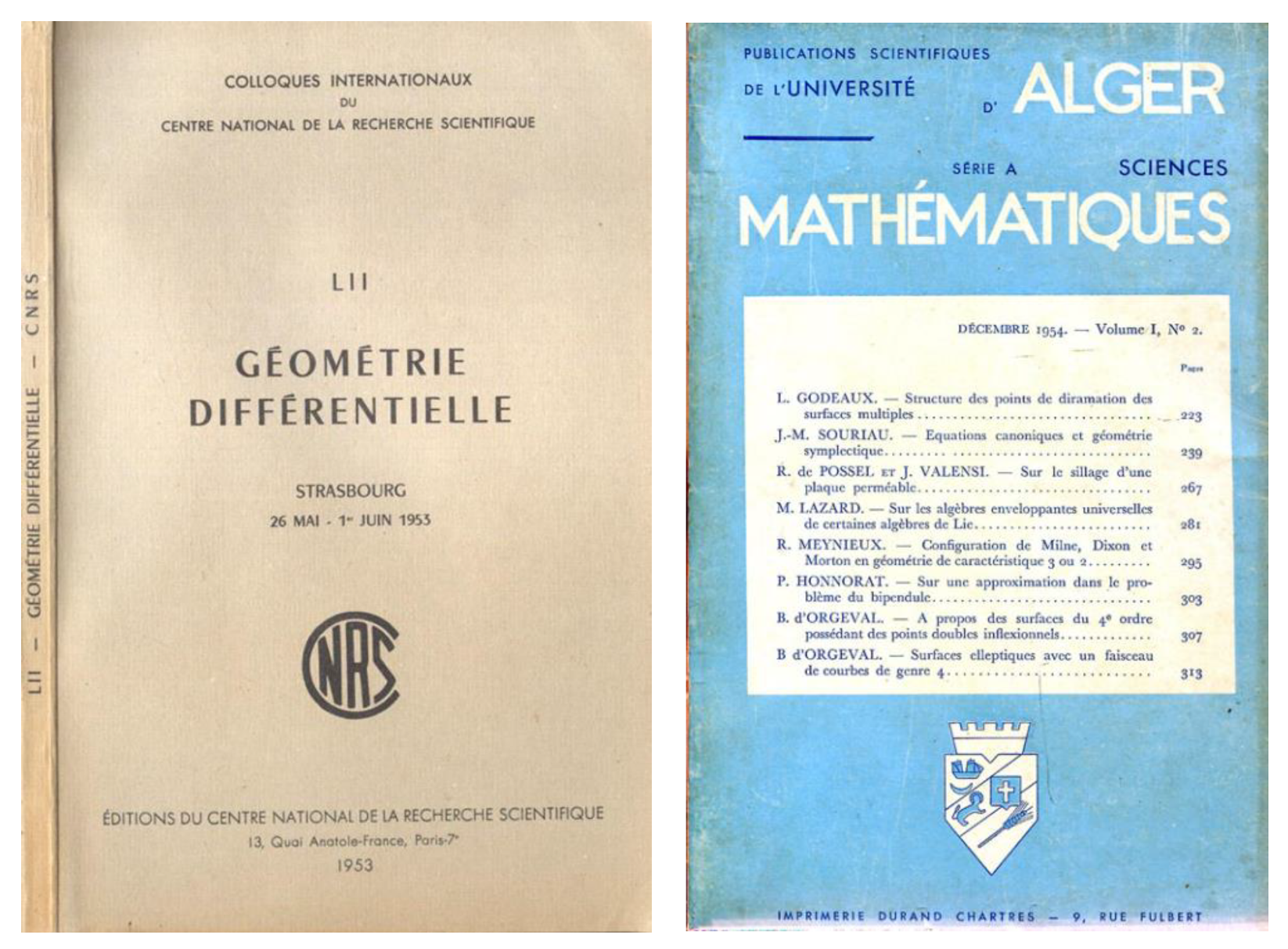
Figure 6.
The founding articles of Symplectic geometry by JM Souriau written in Carthage and published in 1953 “Differential symplectic geometry” in the proceedings of the Strasbourg conference and in 1954 “Canonical equations and symplectic geometry” in the scientific publications of the University of Algiers. Source GallicaSouriau explains in this same interview the genesis of this symplectic revolution:.
Figure 6.
The founding articles of Symplectic geometry by JM Souriau written in Carthage and published in 1953 “Differential symplectic geometry” in the proceedings of the Strasbourg conference and in 1954 “Canonical equations and symplectic geometry” in the scientific publications of the University of Algiers. Source GallicaSouriau explains in this same interview the genesis of this symplectic revolution:.
[…] In my first publication, there was also the word “application”. I applied this formalism to the calculation of disturbances, introducing saturated isotropic manifolds (which today we call Lagrangian manifolds) which make it possible to produce so many symplectomorphisms , while there are so few “riemannomorphisms”. Earlier I was talking about determinants which appear miraculously when we try to invert a matrix. For symplectic geometry it's a bit the same thing. You try to resolve the disturbances of a system and you see the coefficients of the symplectic structure appear . You want to solve a problem, you solve it by hand, you work, and when you have worked well, you see something appear that was hidden underneath. And what Lagrange saw, which Laplace did not see, was the symplectic structure. Finally, if you look closely at the progression of mathematics, you realize that it is very often like that. It's usage that tells you if it's important , and then you axiomatize things. But that comes after the fact. What makes symplectic geometry important is that it is self-imposed . I am not a Platonist, I am not saying that mathematical ideas are ready-made and that we only have to discover them. We discover physics. Symplectic geometry was discovered as a tool for celestial mechanics. Starting from a general theory of differential equations, we would probably never have found it. The particular model of the equations of celestial mechanics was richer than the model of “general” differential equations…. What makes the theory global, and therefore geometric, is the action of groups of symplectomorphisms. Think of the theorem of Noether, a mathematician at the origin of an important part of modern algebra, but who also discovered this theorem which teaches us that the symmetries of a system lead to conserved quantities. It hides (or reveals) the relationships between group and symplectic. I implemented something that I thought was new, but which had existed since Sophus Lie, a geometrization of Noether's theorem . I called it “moment map”. The initial variational formulation has exceptions which disappear with the symplectic formulation. (Souriau 1995, p. 164)
In fact, very quickly, Souriau, back in Marseille, realized that his symplectic model was more suited to quantum physics than to classical analytical mechanics. The final chapters of his book will be devoted to quantum mechanics. Until the end of the 1990s, he built his final edifice on “ geometric quantification ”. His statistical mechanics was also a step towards quantum mechanics. On this subject, Souriau specifies:
[…] In 1958, I returned to France, to Marseille. And there I found myself confronted with theoretical physicists and the problems of quantum mechanics which had disturbed me during my studies like all students, I think. I realized that symplectic geometry was an essential tool for quantum mechanics . And that in fact it was even more appropriate for quantum mechanics than it was for classical mechanics . When I wrote my book on the subject I wanted to write a book on quantum mechanics and I realized that I had to present all classical mechanics in detail, as well as statistical mechanics . These were not foreign theories since they were linked by symplectic structure and symmetries. You take two particles which revolve around each other following Newton's laws, and then you take a hydrogen atom of which you only see the spectrum. These are two objects which a priori have nothing to do with each other; but they have symplectic symmetries in common. A door is ajar . (Souriau 1995, p. 165)
Jean Marie Souriau introduced the terminology “ symplectic geometry ”. His first work on the subject, entitled “ Differential Symplectic Geometry. Applications ”, was presented at the CNRS conference in Strasbourg in 1953. In 1954, he summarized all the details of his presentation given in Strasbourg in the article “ Canonical equations and symplectic geometry ” in scientific publications of the University of Algiers.
We will start by recalling Souriau's approach to analytical mechanics by introducing symplectic structures, and then explain how he applied this symplectic model to statistical mechanics.
By exploring Lagrange in Carthage, Souriau discovered that behind the Lagrangian approach (Lagrange's brackets) was a symplectic structure, which he revealed in his book " Structure of dynamic systems " in 1969. To this end, he proposed a rewriting of the equations of mechanics classically given in phase space :
Souriau rediscovers that Lagrange considered the space of movements :
This system of equations describes all of the solutions of the dynamic system which is then represented by a foliation, which represents all of the solutions to these equations. Indeed, classical mechanics is interested in one solution, while foliation theory will consider all possible solutions whatever the initial conditions.
This foliation is given by an anti-symmetric 2nd order covariant tensor , called the Lagrange (-Souriau) form, a bilinear operator on the tangent vectors to V (space of movements)
In the Souriau-Lagrange model, is a 2-form on the evolution space V, and the differential equation of motion implies:
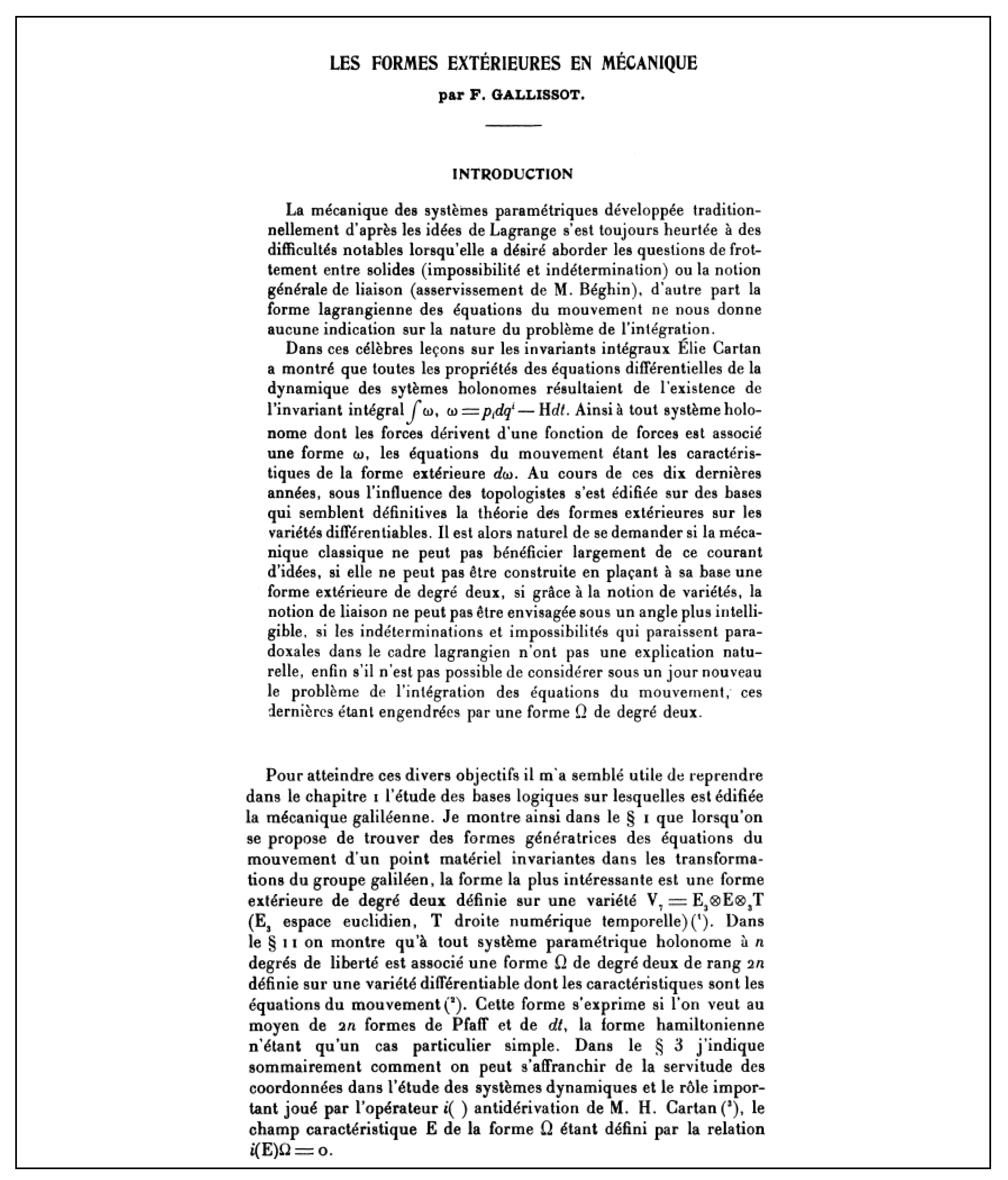
In his work, Souriau only refers to a single author to free himself from the coordinate system, the thesis of François Gallissot from 1954 (Gallisot 1952) and in particular to the following Gallissot theorem:
Gallissot's theorem : There are 3 types of differential forms generating the equations of motion of the material point, invariant under the action of the Galileo group:
constrains the Pfaff form to be closed and to be reduced to the differential of :
This proves that has an exterior differential generating the Poincaré-Cartan integral invariant:
Figure 1.
Thesis by François Gallissot defended in Chartres, as main inspiration of Jean-Marie Souriau. (Gallissot 1952). Source NUMDAM.
Figure 1.
Thesis by François Gallissot defended in Chartres, as main inspiration of Jean-Marie Souriau. (Gallissot 1952). Source NUMDAM.
2.4. Souriau’s Lie Group Thermodynamics as Symplectic Model of Statstical Mechanics
In chapter IV of his book “Structure of dynamic systems ”, Jean-Marie Souriau extends his symplectic model to statistical mechanics and introduces a “Lie Groups Thermodynamics”. Based on this model, we will show a geometric characterization of entropy as a Casimir invariant function in coadjoint representation, where the Souriau cocycle is a measure of the absence of equivariance of the moment map. The dual space of the Lie algebra realizes a foliation via the coadjoint orbits (Coleman 1994); symplectic leaves which are also the level sets of Entropy. In the context of thermodynamics, the dynamics along these foliations describes non-dissipative phenomena, while the dynamics transverse to these symplectic leaves is representative of dissipative phenomena. The model also establishes the 2nd principle of thermodynamics, linked to the definite positivity of the tensor associated with the generalization of the Koszul-Fisher metric of Information Geometry. We reveal a new geometric Fourier heat equation, which is written intrinsically as an Euler-Poincaré equation (Poincaré 1901). The Souriau entropy as a Casimir function is thus characterized by the Poisson cohomology introduced by Jean-Louis Koszul.
In this “Lie groups Thermodynamics ”, Souriau highlights the following facts:
[1] The geometric temperature (of Planck) is an element of the Lie algebra of the dynamic group (Galileo group for classical mechanics or Poincaré group for relativistic mechanics for example) acting on the system, and the geometric heat an element of the dual of the Lie algebra.
[2] Geometric Entropy is the Legendre transform of the opposite of the logarithm of the Laplace transform
[3] The Fisher metric of information geometry is associated with the KKS (Kostant-Kirillov-Souriau) 2-form; 2-form conferring a symplectic structure to the coadjoint orbits associated with the moment map
[4] The Fisher metric is identified with a geometric heat capacity (Hessian of the Massieu potential)
[5] Entropy is an invariant Casimir function along the symplectic leaves, which are themselves given by the coadjoint orbits (action of the group on the moment map):
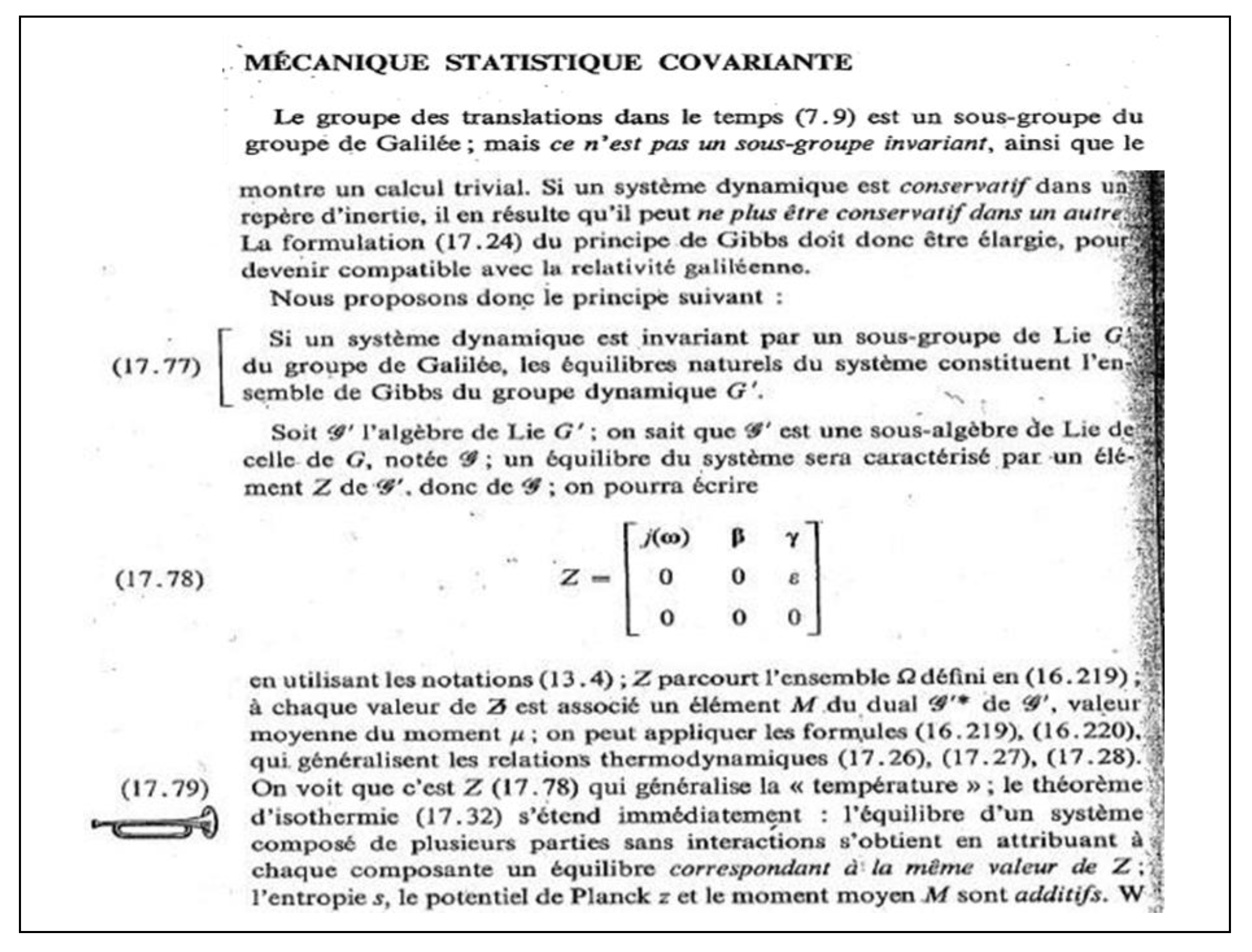
Figure 2.
Covariant statistical mechanics by Jean-Marie Souriau in his book. Source (Souriau 1969, p. 298).
Figure 2.
Covariant statistical mechanics by Jean-Marie Souriau in his book. Source (Souriau 1969, p. 298).
In the following, we will use these notations and definitions:
- Lie and dual Lie algebras:
Lie algebra :
Dual space of Lie algebra
- Coadjoint operator:
- Moment map:
- Souriau 1-cocycle:
- Souriau 2-cocycle:

- Affine coadjoint operator:
- Poisson Bracket given by KKS 2-form
- Affine Poisson bracket:
- Foliation : A foliation can be thought of as a structure where one "cuts" the manifold into a set of smooth leaves (submanifolds), and the overall structure of the foliation can be very different from simply cutting the manifold into disjoint pieces. The leaves can "bend" or "twist" across the manifold in a regular way. The concept of foliation is particularly used in geometric, topological, and analytical studies, and appears in many areas, including dynamics, geometry of manifolds, and physics (e.g., in models of dynamical systems or phase structures).
- Lie algebra cohomology: Lie algebra cohomology can be seen through a geometric interpretation. For example, in differential geometry, Lie algebra cohomology appears in the study of local symmetries of a manifold, connection structures on bundles, and complexes of differential forms associated with Lie algebras. Lie algebra cohomology is a way to measure the obstructions to the possibility of "deforming" a structure given by a Lie algebra. It allows to study properties of Lie algebras, such as representations and internal structure, in a very general and abstract way. We will use the default of cohomology, where a cocycle appears when coadjoint operator is not equivariant.
We introduce Entropy into Souriau's model of “Lie groups Thermodynamics”, a symplectic model of statical physics. The Entropy is defined on the coadjoint affine orbit of the Lie group which acts (where Q is a "geometric" heat, element of the dual space of the Lie algebra of the group). It has an invariance property if we note the affine coadjoint action where is called the Souriau cocycle, and is associated with the lack of equivariance of the moment map (Barbaresco 2018, Barbaresco 2019a, 2019b & 2019c, Barbaresco 2020, Barbaresco 2021a 2020b, 2020c, 2020d & 2020e, Barbaresco 2022a, 2022b, 2022c, 2022d, 2022e & 2022f, Barbaresco 2023). In the framework of Souriau’s Lie groups Thermodynamics, we then characterize the Entropy as a Casimir invariant function in coadjoint representation . When M is a Poisson manifold, a function on M is a Casimir function if and only if this function is constant on each symplectic leaf (the non-empty open subsets of the symplectic leaves are the smallest embedded manifolds of M which are submanifolds of Poisson). Classically, Entropy is defined axiomatically as Shannon or von Neumann Entropy without geometric considerations. In Souriau model, the entropy will be characterized as a solution to the Casimir equation given for the affine equivariance:
where by noting the moment map, and the symplectic Souriau cocycle, which appears in the case with non-zero cohomology (i.e. in the case of non-equivariance of the coadjoint operator on the moment map) .
The KKS (Kostant-Kirillov Souriau) 2-form which associates a homogeneous symplectic manifold structure with coadjoint orbits, will be linked to the extension of the Koszul-Fisher metric of Information Geometry. The symplectic leaves associated with these coadjoint orbits are the level sets of Entropy. In the context of thermodynamics, we interpret that the dynamics on these symplectic leaves describes non-dissipative phenomena, while the dynamics transverse to these leaves describes the dissipative phenomena. The dynamics is given by with the equilibrium when (the numerical scheme associated with this flow preserves the coadjoint orbits and the Casimirs functions of the Lie–Poisson equation). We will also observe that
, which founds the 2nd principle of thermodynamics by the defined positivity of the Souriau tensor linked to Fisher information or to the extension of the 2nd Koszul form of Information geometry.
In the context of Information geometry, the Riemannian metric of an exponential family is given by the Fisher information matrix defined by:
The Shannon Entropy is given by the Legendre transform:
is linked to the generating function of cumulants in statistics.
In the Souriau model, the structure of the information geometry is preserved and extended over the Symplectic manifold M associated with the coadjoint orbits:
In Souriau's thermodynamic model of Lie groups, β is a "geometric" (Planck) temperature, element of Lie algebra of the group, and Q is a “geometric” heat, element of the dual space of the Lie algebra of the group. Souriau proposed a Riemannian metric that we identified as a generalization of Koszul-Fisher's metric:
Souriau's fundamental theorem is that “ Any symplectic manifold on which a Lie group acts transitively by a Hamiltonian action is a space covering a coadjoint orbit ”. We can observe that the Fisher metric is this non-equivariant case 2-form extension

The additional Souriau term is generated by the non-equivariance of the coadjoint operator via the symplectic cocycle. The tensor used to define this extended Fisher metric is defined by the moment map J(x), map from M (homogeneous symplectic manifold) to the dual space of the Lie algebra, given by:

This tensor is also defined in the tangent space of the cocycle  (this cocycle appears due to the non-equivariance of the coadjoint operator
  action of the group on the dual space of the Lie algebra, which is modified with a cocycle).
(this cocycle appears due to the non-equivariance of the coadjoint operator action of the group on the dual space of the Lie algebra, which is modified with a cocycle).We speak of affine action:  . In the following we will use the notation with such as Koszul and Souriau use it.
  is called a Souriau cocycle, and it is a measure of the lack of equivariance.
. In the following we will use the notation with such as Koszul and Souriau use it. is called a Souriau cocycle, and it is a measure of the lack of equivariance.
We can then deduce that the tensor could also be written (with cocycle relation):
Figure 3.
Souriau cocycle: Non-equivariance of the coadjoint operator. Source Personal drawing.
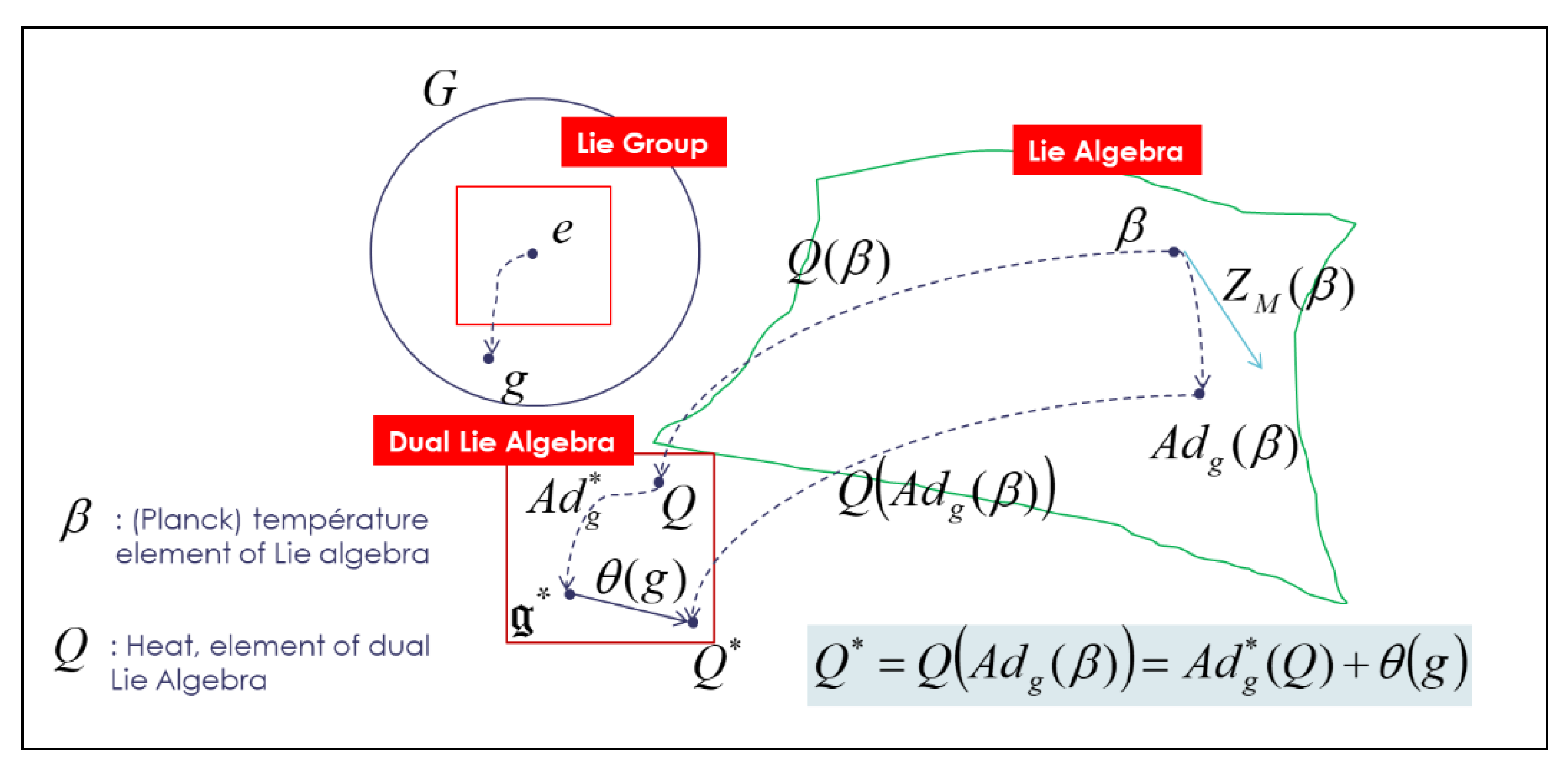
When an element of the group g acts on the element  of the Lie algebra, the operator is given by the adjoint operator
  . With respect to the group action
  , Entropy
  and Fisher's metric
  are invariant:

of the Lie algebra, the operator is given by the adjoint operator . With respect to the group action , Entropy and Fisher's metric are invariant:
Souriau completed his “ geometric theory of heat ” by introducing a 2-form into the Lie algebra, that is to say a metric Riemann tensor in the values of the adjoint orbit of , with an element of Lie algebra. This metric is given for  :
:
 where
where  is a cocycle of the Lie algebra, defined by
  with θ a cocycle of the Lie group defined by
  . We observe that the Riemannian Souriau metric, introduced with the symplectic cocycle, is a generalization of the Fisher metric, which we call the Souriau-Fisher metric, which retains the property of being defined as the Hessian of the logarithm of the function of partition
 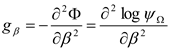 as in classical information geometry. We will establish the equality of two terms, between the definition of Souriau based on the cocycle of the Lie group and parameterized by the “geometric heat” Q (element of the dual space of the Lie algebra) and the “geometric temperature”
  (element of the Lie algebra) and the Hessian of the characteristic function with respect to the variable :

:
where is a cocycle of the Lie algebra, defined by with θ a cocycle of the Lie group defined by . We observe that the Riemannian Souriau metric, introduced with the symplectic cocycle, is a generalization of the Fisher metric, which we call the Souriau-Fisher metric, which retains the property of being defined as the Hessian of the logarithm of the function of partition as in classical information geometry. We will establish the equality of two terms, between the definition of Souriau based on the cocycle of the Lie group and parameterized by the “geometric heat” Q (element of the dual space of the Lie algebra) and the “geometric temperature” (element of the Lie algebra) and the Hessian of the characteristic function with respect to the variable :
Figure 4.
Fisher-Souriau metric and Souriau’s Lie Group Thermodynamics. Source Personal Picture.
To consider entropy invariance, we must use the property that:

For  , either gβ the Hessian form on
  with the potential
 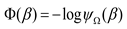 . For
. For  , we define:

, either gβ the Hessian form on with the potential . For , we define:
The positive definitive character is given by the Cauchy-Schwarz inequality:
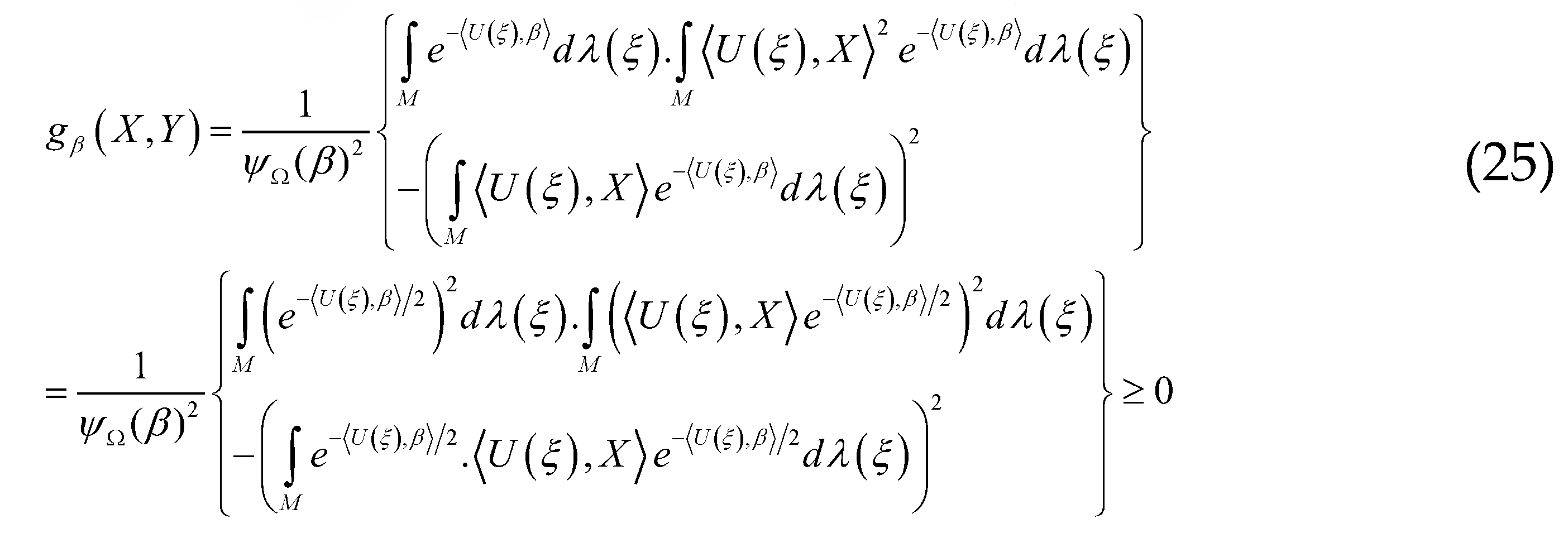
We observe that 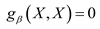 if and only if
  is independent of
  , which means that the set
 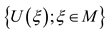 is contained in an affine hyperplane in
  perpendicular to the vector
  . We have seen that
  , which is a generalization of the classic Fisher metric from information geometry , and will give the relation the Riemannian metric introduced by Souriau:
 we have for everything :

if and only if is independent of , which means that the set is contained in an affine hyperplane in perpendicular to the vector . We have seen that , which is a generalization of the classic Fisher metric from information geometry , and will give the relation the Riemannian metric introduced by Souriau:
we have for everything :
Let us derive the above expression with respect to g . Namely, we substitute and differentiate at t = 0 . Then the left side of the equation becomes
 and the right-hand side of the other equation is calculated as follows:
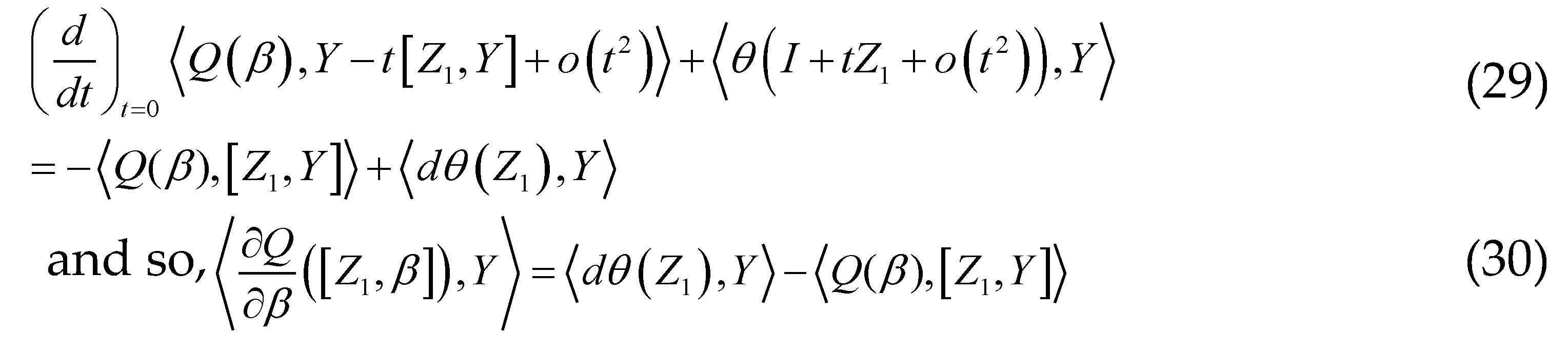
and the right-hand side of the other equation is calculated as follows:
By substituting  for the expression above:

for the expression above:
We then define the symplectic 2-cocycle and the tensor:

Considering  , it is an extension of the KKS (Kirillov-Kostant-Souriau) 2-form in the case of non-zero cohomology. Introduced by Souriau, we can define this metric extension of Fisher with the 2-form of Souriau:

, it is an extension of the KKS (Kirillov-Kostant-Souriau) 2-form in the case of non-zero cohomology. Introduced by Souriau, we can define this metric extension of Fisher with the 2-form of Souriau:
As the entropy is defined by the Legendre transform of the characteristic function, a dual metric of the Fisher metric is also given by the Hessian of the “ geometric entropy ” S(Q) with respect to the dual variable given by Q:  .
.
.Fisher's metric was considered by Souriau as a generalization of " heat capacity " . Souriau called it “ geometric capacity ” : 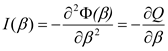 .
.
.In his 1974 article, Jean-Marie Souriau wrote  : To prove this equation, we need to consider the parameterized curve . The parameterized curve passes, for , through the point , since is the identical map of the Lie algebra . This curve is in the adjoint orbit of . So by taking its derivative with respect to , then for , we obtain a tangent vector in to the deputy orbit of this point. When takes all possible values in , the vectors thus obtained generate the entire tangent vector space at the orbit of this point:
: To prove this equation, we need to consider the parameterized curve . The parameterized curve passes, for , through the point , since is the identical map of the Lie algebra . This curve is in the adjoint orbit of . So by taking its derivative with respect to , then for , we obtain a tangent vector in to the deputy orbit of this point. When takes all possible values in , the vectors thus obtained generate the entire tangent vector space at the orbit of this point:
As . With , we have and by derivation with respect to at , we finally find the equation given by Souriau:
2.5. Hidden geometric definition of Entropy as Casimir function in Souriau’sequation
We propose to characterize this invariance more explicitly, by characterizing Entropy as an invariant Casimir function in coadjoint representation . From the last Souriau equation, if we use the identities  , then we can deduce that
 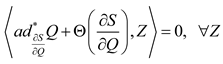 .
.
, then we can deduce that .So the entropy S(Q) must verify 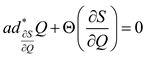 , that characterizes an invariant Casimir function in the case of non-zero cohomology , which we propose to write with Poisson brackets, where:

, that characterizes an invariant Casimir function in the case of non-zero cohomology , which we propose to write with Poisson brackets, where:
We find the extended Casimir equation in the case of non-zero cohomology verified by Entropy, 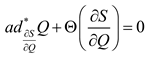 , then the generalized Casimir condition
 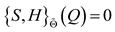 . This previous Lie-Poisson equation is equivalent to the modified Lie-Poisson variational principle :
, then the generalized Casimir condition . This previous Lie-Poisson equation is equivalent to the modified Lie-Poisson variational principle :From this Lie-Poisson equation, we can introduce a Geometric Fourier Heat Equation :
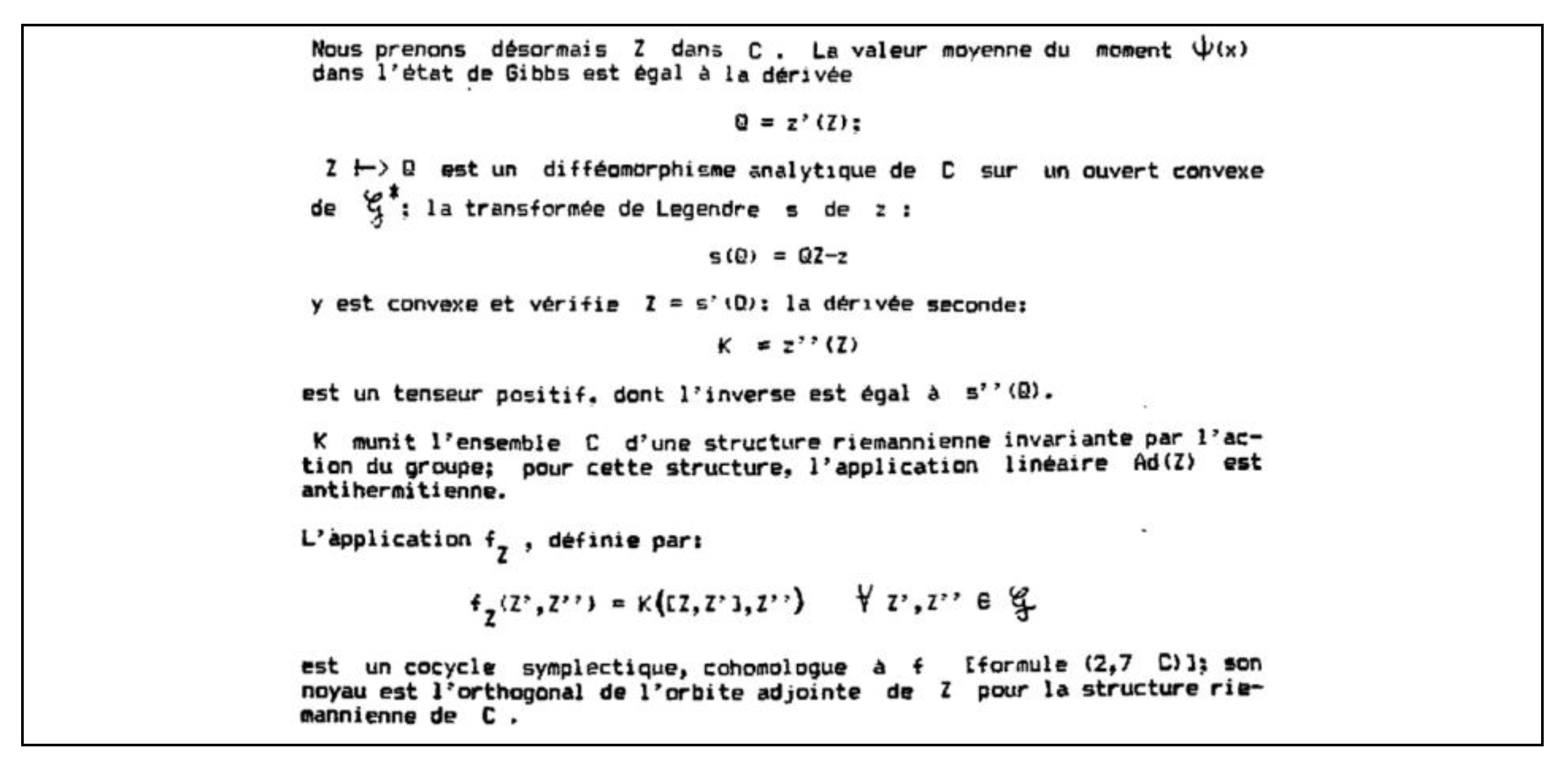
The link with the 2nd principle of Thermodynamics will be deduced from the positivity of the Souriau-Fisher metric:
The 2 equations characterizing Entropy as an invariant Casimir function are linked by:
This equation was observed by Souriau, where he wrote that β is a kernel of  , that is to say:
 which we can develop to find the Casimir equation:
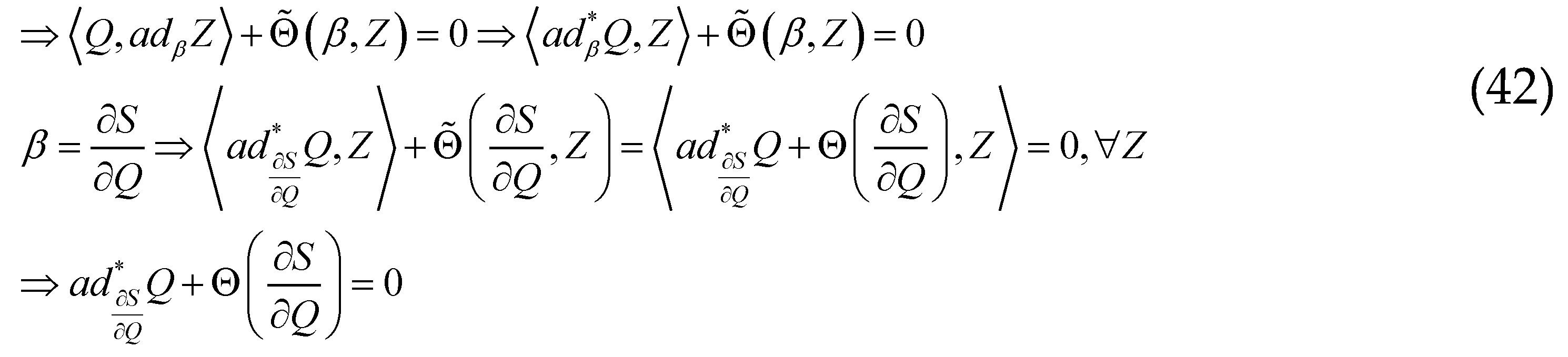
, that is to say:
which we can develop to find the Casimir equation:
is the set of Casimir functions on , linked to Rham cohomology and Poisson cohomology introduced by J.L. Koszul.
In the article “Quantum? So it’s geometric,” Souriau writes the Quinta Essentia (Quinte Essence) of his model:
[…] Let us first place ourselves within the framework of classical mechanics. Let us study an isolated, non-dissipative mechanical system—we will briefly call it a “thing.” The set of movements of this “thing” is a symplectic manifold. For what ? It is enough to refer to Lagrange's Analytical Mechanics (1811); the space of movements is treated as a differentiable manifold; the covariant and contravariant coordinates of the symplectic form are written there (these are the “parentheses” and “brackets” of Lagrange). Let's now talk about 20th century geometry. Let G be a diffeological group (for example a Lie group); μ a moment of G (a moment, it is a left-invariant 1-form on G); then the action of the group on μ canonically generates a symplectic space (these groups could have an infinite dimension). Epistemological presumption: behind each “thing” is hidden a group G (its “source”), and the movements of the “thing” are simply moments of G (mnemonic Latin doublet: momentum-movimentum). The isolation of the “thing” then indicates that the Poincaré group (respectively Galileo-Bargmann) is inserted in G; this is the origin of the conserved relativistic (respectively classical) quantities associated with a movement x: they simply constitute the moment induced on the spatio-temporal group by the moment-movement x. …There is a theorem that dates back to the 20th century. If we take a coadjoint orbit of a Lie group, it has a symplectic structure. Here is an algorithm for producing symplectic manifolds: take coadjoint orbits of a group. So this suggests that behind this Lagrange symplectic structure, there was a hidden group. Let's take the classic movement of a moment of the group, then this group is very "big" to have the whole solar system. But in this group is included the Galileo group, and every moment of a group generates moments of a subgroup. We will thus find the moments of the Galileo group, and if we want relativistic mechanics, it will be that of the Poincaré group. In fact with the Galileo group, there is a small problem, it is not the moments of the Galileo group that we use, it is the moments of a central extension of the Galileo group, which is called the Bargmann group, and which has dimension 11. It is because of this extension that there is this famous arbitrary constant appearing in energy. On the other hand, when we do special relativity, we take the Poincaré group and there are no more problems because among the moments there is the mass and the energy is mc2. So the group of dimension 11 is an artifact which disappears when we do special relativity. (Souriau 2003, video)
Figure 5.
Lie groups Thermodynamics equations in Souriau's papers. Source (Souriau 1978, p.104).
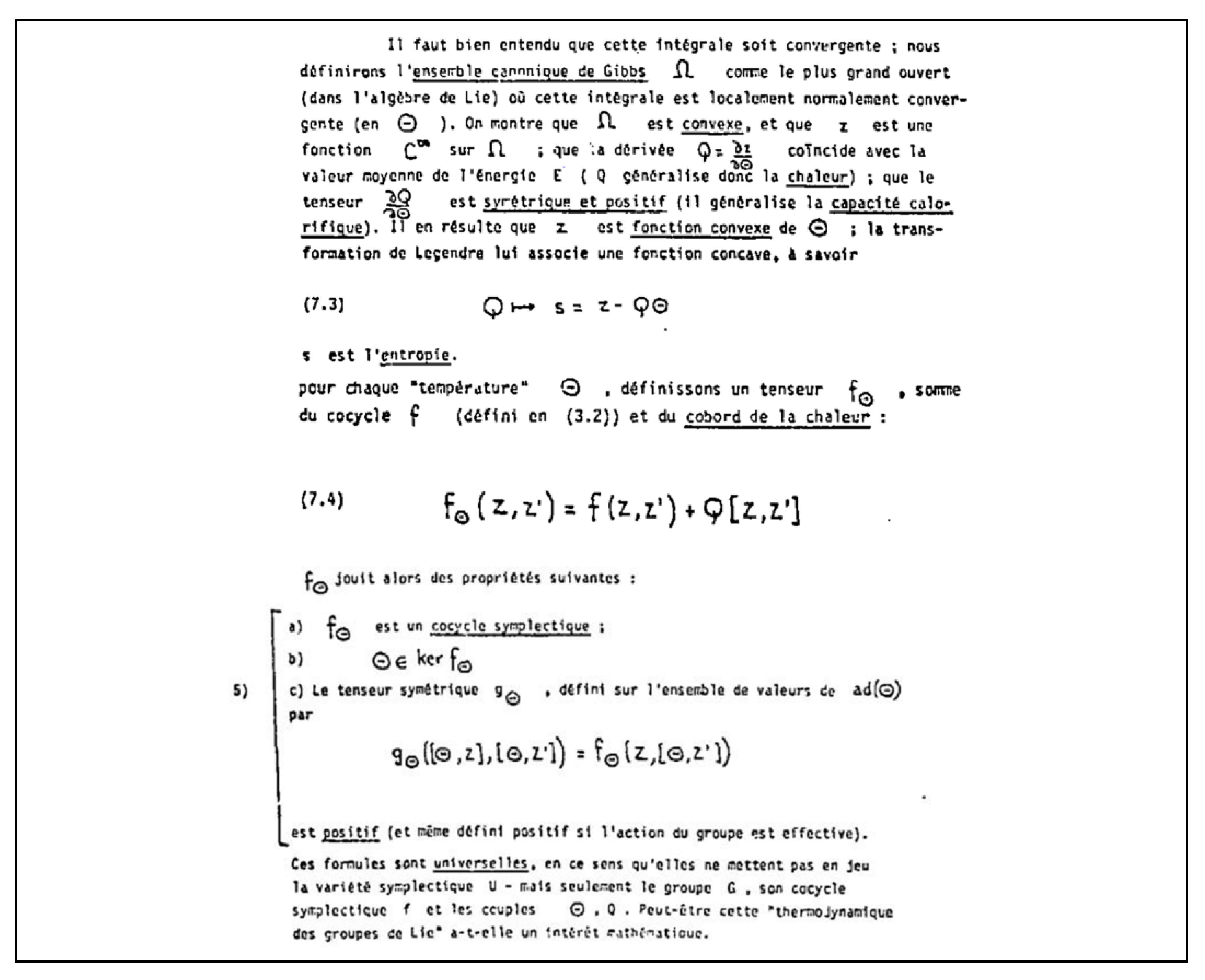
To illustrate his Lie groups Thermodynamics, Souriau will consider the Galileo group, which is composed of the following transformations (Rotation R, boost u, spatial translation w and temporal translation e):
Souriau noticed that in the global case, there is no Gibbs equilibrium (Gibbs 1875 & 1902), he therefore considers Gibbs states (Kozlov 2004) for Hamiltonian actions of subgroups with 1 parameter of the Galileo group. In particular, he obtains the following theorem:
Souriau's theorem: The action of the complete Galilean group on the space of movements of an isolated mechanical system is not linked to any state of Gibbs equilibrium (the open subset of the Lie algebra, associated with this state of Gibbs, is empty)
The 1-parameter subgroup of the Galileo group generated by element of the Lie algebra is given by the matrices:
Souriau illustrated the Gibbs equilibrium for the centrifuge, for which the group which acts is that of rotation around the axis:
By posing the following expressions:
Souriau finds with the equations of his model, the Gibbs equilibrium of the centrifuge via the moment map J :
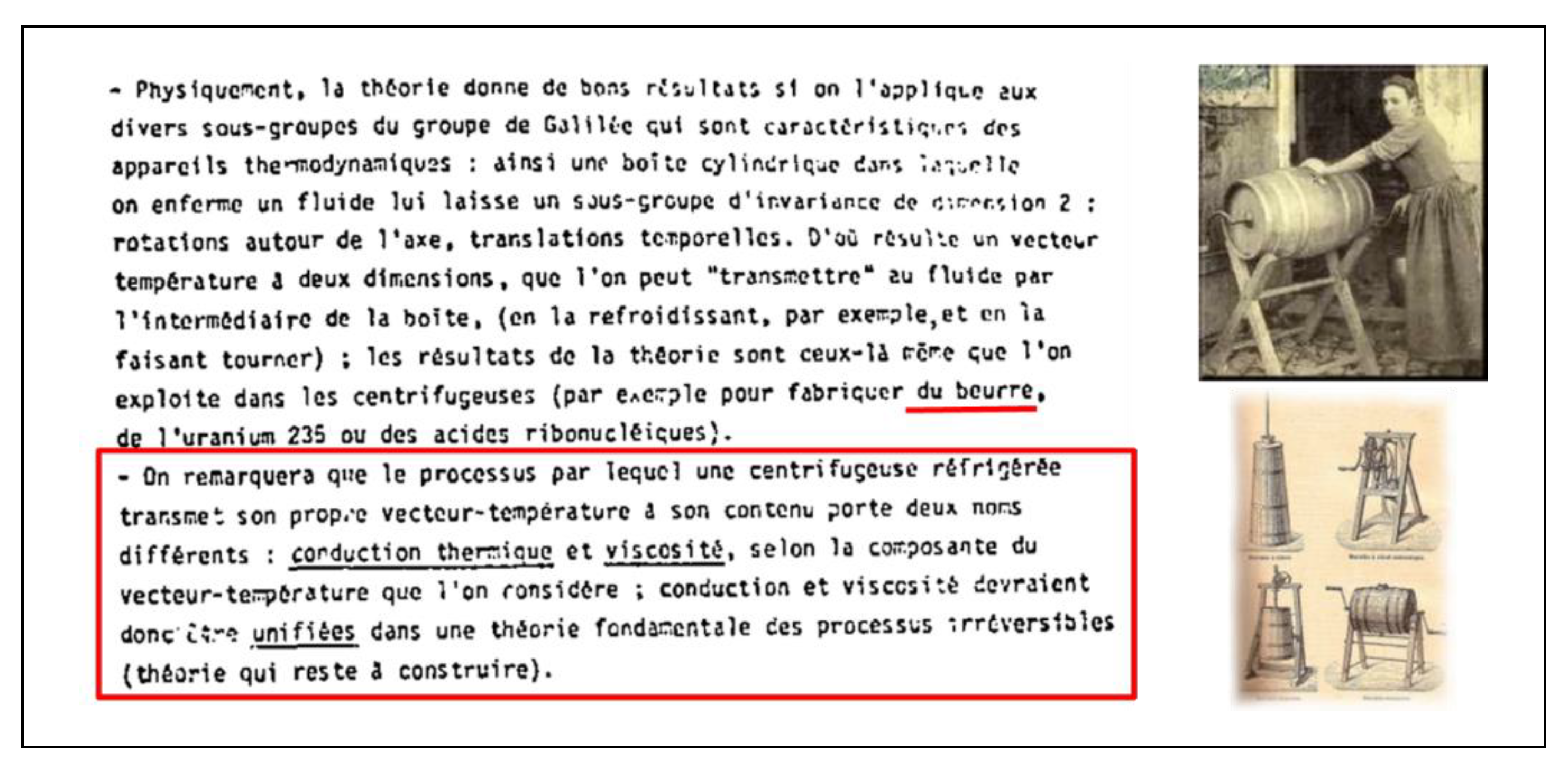
the behavior of a gas made up of point particles of various masses in a centrifuge rotating at constant angular speed (the heaviest particles concentrate further from the axis of rotation than the lighter ones). He specifies that the thermodynamics of the centrifuge can be used to make churned butter, enriched uranium or ribo-acids .
As Roger Balian (Balian 1991) explains in his book:
[…] Angular momentum is transmitted to the gas when the molecules collide with the rotating walls, which changes the Maxwell distribution at each point, moving its origin. The walls act as a reservoir of angular momentum. Their movement is characterized by a certain angular speed, and the angular speeds of the fluid and the walls become equal at equilibrium, exactly like the equalization of temperature by energy exchanges. (Balian 1991, p.339)
We do have two (Planck) temperatures, the classic Planck temperature ensuring the thermal balance of the centrifuge, but also a 2nd temperature, Lagrange hyper-parameter, which ensures the balance of the angular moments (the wall, reservoir of angular momentum transmits this angular momentum to the particles in contact with it which arrives at an equilibrium by viscosity).
Figure 6.
The Thermodynamics of Souriau, that of the creamer of churned butter and the reference to dissipation (Fourier conduction and Navier viscosity). Source (Souriau 1978, p. 105) & Gallica.
Figure 6.
The Thermodynamics of Souriau, that of the creamer of churned butter and the reference to dissipation (Fourier conduction and Navier viscosity). Source (Souriau 1978, p. 105) & Gallica.
3. Metriplectic Flow and Webs model of Dissipative Thermodynamics
3.1. Theory of Foliation from Ehresmann and Reeb to Libermann
The theory of foliations is a qualitative theory, generalizing differential equations, initiated by Henri Poincaré, and developed by Charles Ehresmann and Georges Reeb, (Martinet & Reeb 1973, Reeb 1952, 1959 & 1978, Reeb Ehresmann Thom & Libermann 1964) with the contribution of A. Haefliger (Haefliger 2016), P. Molino (Molino 1989, Condevaux Dazord & Molino 1988), B.L. Reinhart (Reinhart 1983). The specific foliations, called Riemannian, generated by metric functions were developed, for their part, by Ph. Tondeur. The notion of foliation in thermodynamics appeared in the 1900s in the seminal article by Constantin Carathéodory where the horizontal curves roughly correspond to adiabatic processes, carried out in the language of Carnot cycles. The couple properties of Poisson manifolds were also explored by C. Carathéodory in 1935, under the name "groups of polar functions", where he observed that two families of differentiable functions formed by the prime integrals of F (a sub -completely integrable vector set of TM) and its orthogonal orthF, respectively, called “function groups”, are “polar” of each other. This seminal work by C. Carathéodory led to the concept of Poisson structure which was first defined and treated in depth for the first time by André Lichnerowicz (Basart & Lichnerowicz 1982, Hamoui & Lichnerowicz 1982) and independently by Alexander Kirillov. André Haefliger observed that generally, for a field of planes of codimension 1 given by a Pfaff form ω, the integrability condition is equivalent to ω ∧ d ω = 0. In this case there exists locally a non-zero function λ , called integration factor, and a function φ, called first integral, such that ω = λdφ. The level manifolds of φ are the integral manifolds. Carathéodory gave in 1909 a local geometric characterization of the complete integrability of a Pfaff form ω, namely: ω is completely integrable if and only if, for every neighborhood U of every point x, there exists a point of U which cannot be linked to x by a U-shaped curve tangent to the kernel of ω. He uses this characterization to express remarkably concisely and conceptually the second law of thermodynamics. Georges Reeb and Charles Ehresmann, who founded the theory of foliations, organized numerous conferences on this theme
Figure 7.
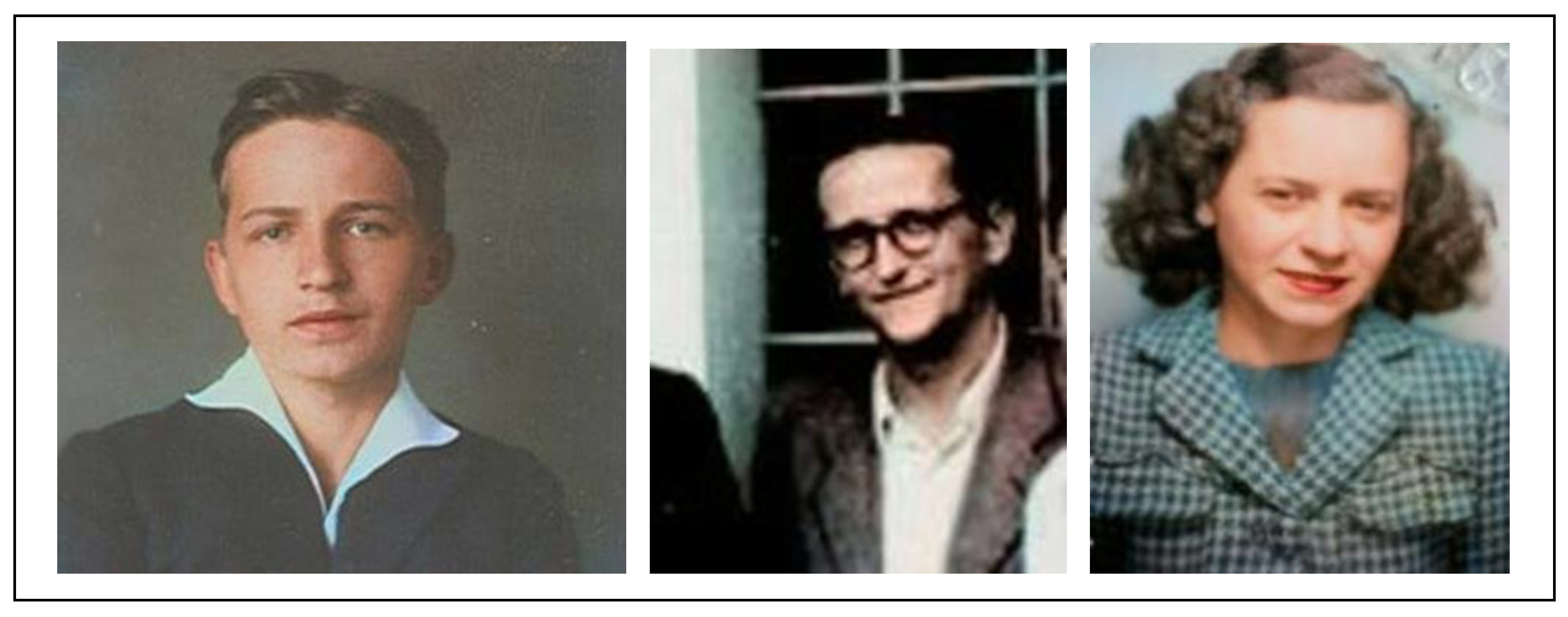
Charles Ehresmann, Georges Reeb and Paulette Libermann. Source Gallica.
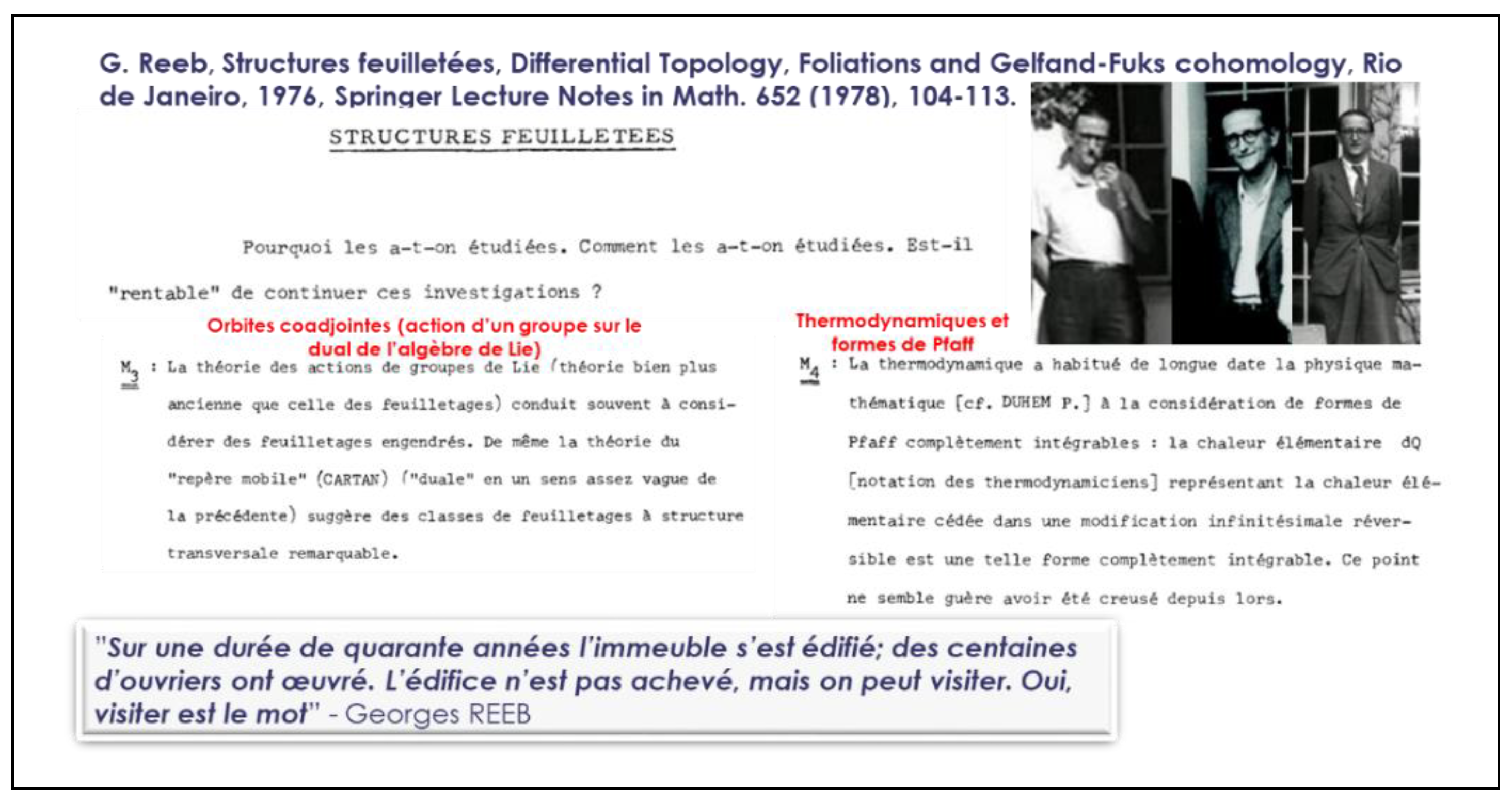
Symplectic geometry associated with analytical mechanics has developed considerably over the last decades; inspired by the work of Sophus Lie (Lie 1876, 1877 & 1890) and Elie Cartan, André Lichnerowicz, Georges Reeb, Jean-Marie Souriau, as well as François Gallissot, who were the initiators of this renaissance of Analytical Mechanics. Georges Reeb asked the following questions about foliage structures: “ Why were they studied? How were they studied? Is it “profitable” to continue these investigations? » and the motivations proposed for the study of these foliations. Among the motivations, Reeb identified two key use cases, the action of Lie groups and the Pfaff integrable forms of thermodynamics:
[…] The theory of the action of Lie groups (a much older theory than that of foliations) often leads to considering the generated foliations. Likewise , the theory of the “moving frame” (Cartan) (“dual” in a rather vague sense of the previous one) suggests classes of foliations with a remarkable transverse structure. (Reeb 1959, p. 110)
[…]Thermodynamics has long accustomed mathematical physics [cf. Duhem P.] to the consideration of completely integrable Pfaff forms : the elementary heat dQ [notation of thermodynamicists] representing the elementary heat given up in an infinitesimal reversible modification is such a completely integrable form. This point hardly seems to have been explored since then. (Reeb 1959, p. 110)
The 1st subject on Cartan's moving frame was developed by Edmond Fédida, doctoral student of Georges Reeb and the 2nd subject on the Pfaff forms of thermodynamics by Jean-Marie Souriau.
Figure 8.
Georges Reeb's reflections on the reasons which motivate the study of foliations. Source (Reeb 1959, p. 110) and Gallica.
Figure 8.
Georges Reeb's reflections on the reasons which motivate the study of foliations. Source (Reeb 1959, p. 110) and Gallica.
3.2. Transverse Symplectic foliation model of dissipative thermodynamics and the metriplectic flow
We introduce a webs structure model from information geometry and heat theory based on the thermodynamics of Lie groups of Jean-Marie Souriau to describe the transverse Poisson structure of the metriplectic flow for dissipative phenomena. . This model gives a Lie algebra cohomological characterization of Entropy, as an invariant Casimir function in coadjoint representation. The dual space of the Lie algebra unfolds in coadjoint orbits identified with the level sets of entropy. In the context of Thermodynamics, we associate a symplectic bi-foliation structure to describe the non-dissipative dynamics on the symplectic leaves (on level sets of Entropy, the entropy being seen as an invariant Casimir function on each leaf), and the transverse dissipative dynamics, given by the transverse Poisson structure (production of Entropy passing from leaf to leaf). The orbits of a Hamiltonian action and the level sets of the moment map are polar with respect to each other (Albert 1989). Souriau's model can be interpreted by the foliations studied by Miss Paulette Libermann, and the notion of -structure of Haefliger, which is the maximum extension of the notion of moment in the sense of Souriau, as introduced by P. Molino, M. Condevaux and P. Dazord in the articles of the “Séminaire Sud-Rhodanien de Géométrie”. Paulette Libermann proved that a Legendre foliation (Jayne, N. 1992) on a contact manifold is complete if and only if the pseudo-orthogonal distribution is completely integrable, and that the contact form is locally equivalent to the Poincaré-Cartan integral invariant. Paulette Libermann demonstrated a classic theorem relating to co-isotropic foliations, which notably provides a proof of Darboux's theorem. Finally, we will refer to the work of Edmond Fédida on the theory of foliation structures in the language of fully integrable Pfaff systems associated with the Cartan moving frame.
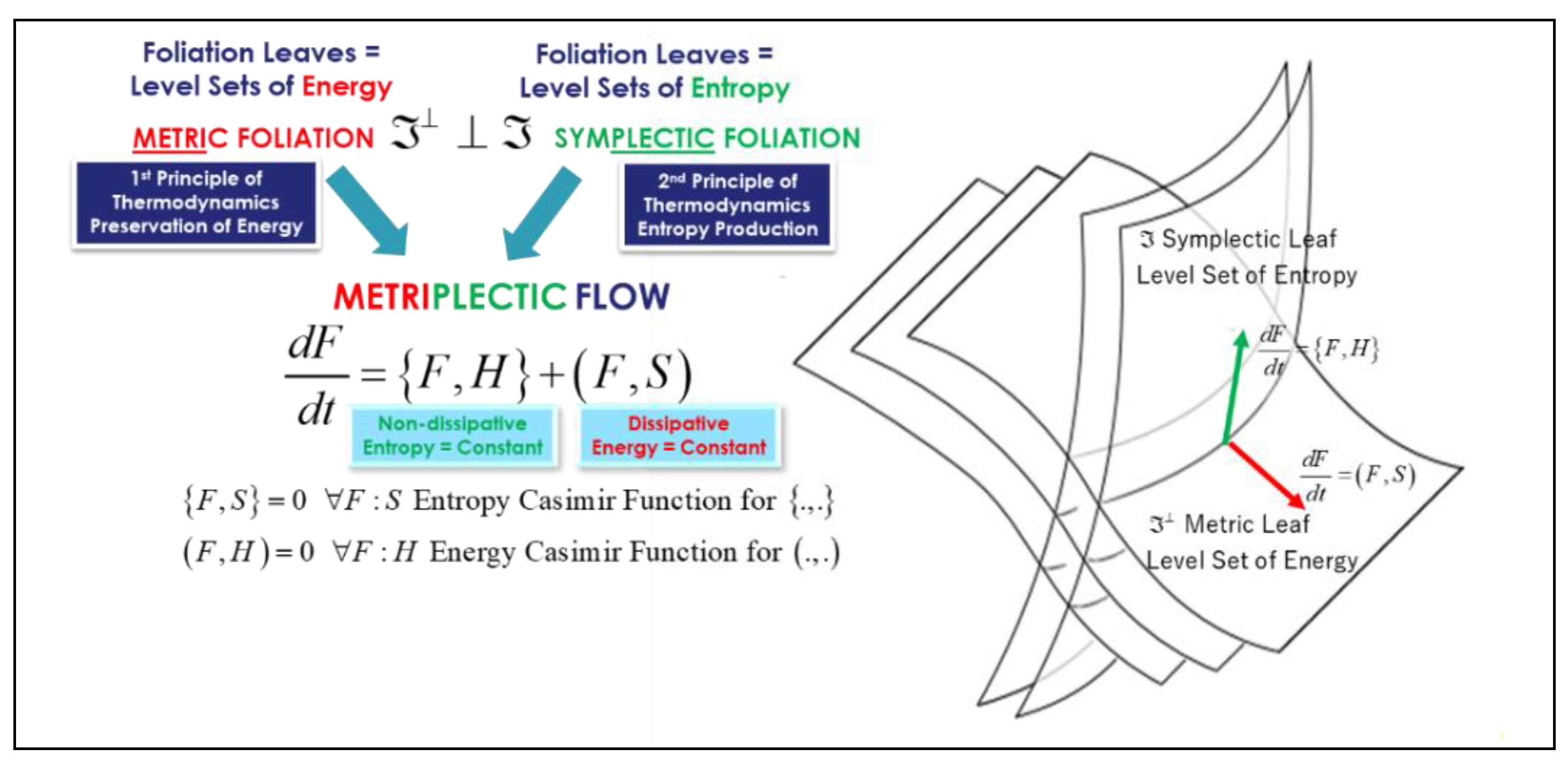
The metriplectic bracket was first introduced in 1983 by A.N. Kaufman and P.J. Morrison. This formalism ensures both energy conservation and a non-decrease in entropy, and it reduces to the traditional formalism of Poisson brackets in the limit of the absence of dissipation. The axiomatization of this model was carried out in parallel by Grmela and Öttinger. There are three main types of dissipation: thermal diffusion with energy conservation and entropy production by heat transfer; viscosity, which extracts energy from the system (e.g., Navier-Stokes equation); and transport equations with collision operators. These types of dissipative systems that satisfy both the 1st and 2nd principles of thermodynamics are included in metriplectic dynamics . A new bracket in the metriplectic formalism provides the evolution equation :
The 2nd bracket is a metric bracket checking the 2 constraints with the entropy S selected in the set of Casimir invariants of the non-canonical Poisson bracket. The metriplectic flow thus conforms to the 1st and 2nd principles of thermodynamics:y
1st principle of thermodynamics: conservation of energy
2nd principle of thermodynamics: the production of entropy
Finally, two compatible brackets, a Poisson bracket and a symmetric bracket, determine the geometry in metriplectic systems:
The energy H is a Casimir invariant of the dissipative bracket, and the entropy S is a Casimir invariant of the Poisson bracket:
The symmetry requirement generalizes Onsager symmetry from irreversible linear thermodynamics to nonlinear problems; however, in the traditional metriplectic model, the possibility of Casimir symmetry is not taken into account. The bracket proposed by Kaufman is more general than the metriplectic bracket.
Figure 9.
Metriplectic Flow on Symplectic Foliation (coadjoint orbits of moment map, level sets of entropy) & Transverse Metric Foliation (level sets of Energy). Source Personal Picture.
Figure 9.
Metriplectic Flow on Symplectic Foliation (coadjoint orbits of moment map, level sets of entropy) & Transverse Metric Foliation (level sets of Energy). Source Personal Picture.
The local structure of a completely integrable system is given explicitely by action–angle coordinates, whose existence is induced by the Liouville–Arnold‘s theorem. The Liouville–Arnold‘s theorem assure the existence of action–angle coordinates adapted to a fibration, with respect to the existence of a sufficiently high number of specific integrals. If we consider Action-Angle coordinates (Nehorosev 1972): . We also consider Moment Map where are coordinates on given by where is a base of vectors field of group action: . We can select angular coordinates such that . For Symplectic coordinates and complex structure, we onsider a complexe structure :
We can then deduce the metric:
We can make appear a symplectic potential:
and then recover the Guillemin metric :
Recently, new links have been established between Information Geometry, Toric Manifolds and Delzant Polytopes (Delzant 1986 & Delzant 1988), where the torification approach places information geometry at the very heart of information-theoretical principles (Molitor 2021, Fujita 2024).
To illustrate the metriplectic flow, we give in the following image the illustration of the coadjoint orbits (generated via the moment map in the dual of the Lie algebra) for the Lie group SU(1,1) acting transitively on the Poincaré complex unit disk. The symplectic foliation is given by the upper sheets of the 2-layer hyperboloid. J(z) is the moment map which goes from z belonging to the unit disk on the hyperboloid (in fact the 3 components of the moment map on the dual of the Lie algebra verify the equation of the hyperboloid) . The Poisson bracket describes the non-dissipative dynamics of Souriau which remains on the sheet of the symplectic foliation (the entropy is constant on the sheet, layer of the hyperboloid, because the entropy is an invariant Casimir function on this sheet).
Figure 10.
Metriplectic flow and Symplectic foliation for the SU(1,1) group acting transitively on the Poincaré unit disk: upper sheets of the 2-layer hyperboloid. Source Personal Picture.
Figure 10.
Metriplectic flow and Symplectic foliation for the SU(1,1) group acting transitively on the Poincaré unit disk: upper sheets of the 2-layer hyperboloid. Source Personal Picture.
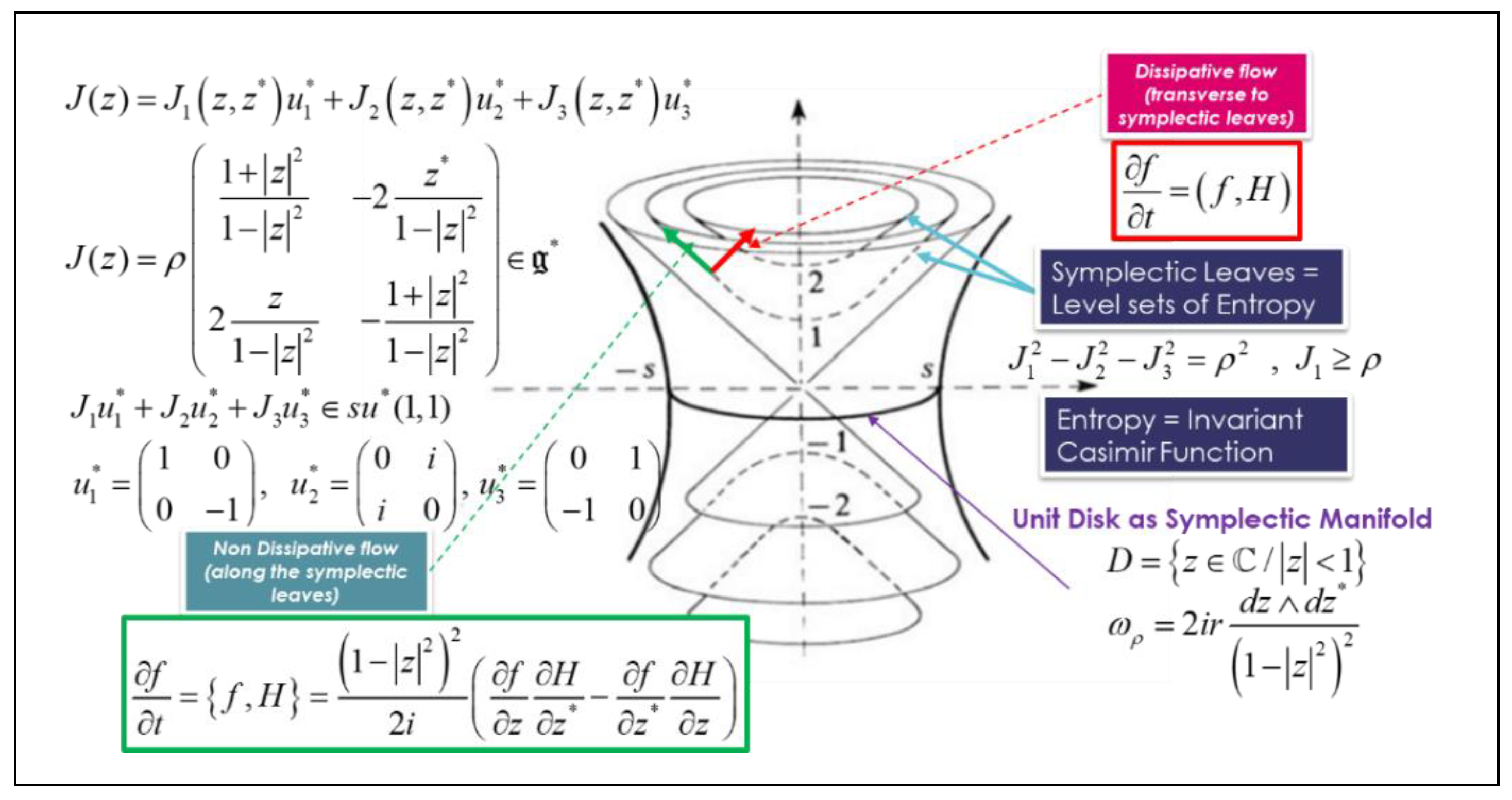
As the entropy is a Casimir function on the symplectic leaves, this also shows that these leaves are the level curves of the entropy. Transversely to the symplectic leaves, the dissipative dynamics is given by a metric bracket which remains on the leaves at constant energy. This transverse metric foliation corresponds to the level sets of Energy and the metric is given by the dual metric of the Fisher metric of information geometry, that is to say the Hessian of entropy.
The structure of dissipative thermodynamics is therefore described by two transverse foliations:
Symplectic foliation (entropy level sets) for non-dissipative dynamics, characterized by the Fisher metric and the KKS 2-form on symplectic leaves
Metric transverse foliation (energy level sets) for dissipative dynamics, characterized by the dual Fisher metric given by the Hessian of the entropy on the metric sheets.
Figure 11.
Relationship between the 3 models: Lie Groups Thermodynamics by Souriau, Metriplectic flow linked to the Onsager-Casimir relationships of Baptiste Coquinot and the foliation theory of Georges Reeb and Charles Ehresmann. Source Personal Picture and Photos from Gallica.
Figure 11.
Relationship between the 3 models: Lie Groups Thermodynamics by Souriau, Metriplectic flow linked to the Onsager-Casimir relationships of Baptiste Coquinot and the foliation theory of Georges Reeb and Charles Ehresmann. Source Personal Picture and Photos from Gallica.
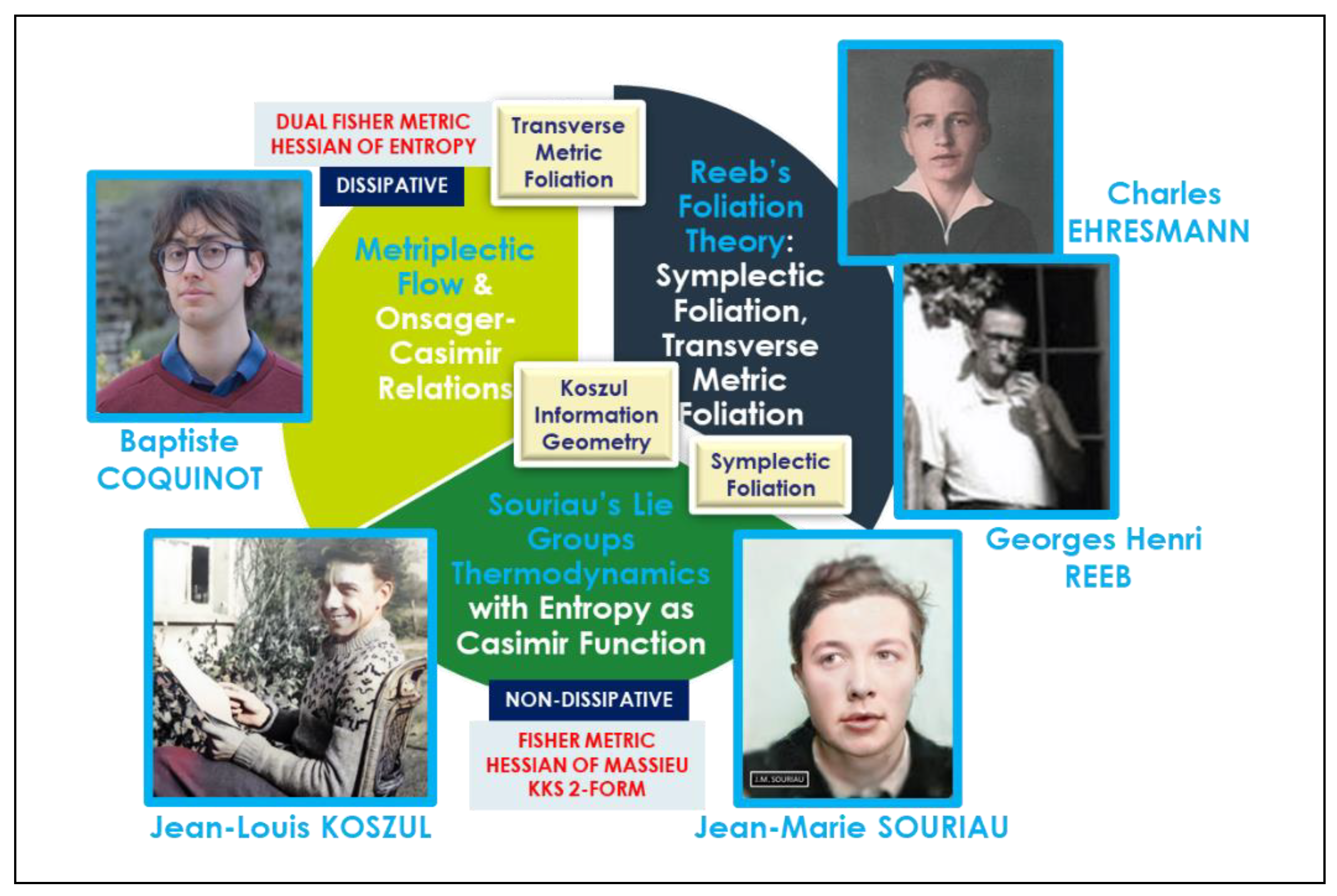
Finally, we can define Carnot’s cycle for Souriau’s Lie Groups Thermodynamics on the symplectic leaves (levels set of entropy) and transverse Riemannian leaves (level sets of energy). The Carnot cycle is a theoretical thermodynamic cycle for a dithermic engine, made up of four reversible processes: reversible isothermal expansion, reversible adiabatic expansion (therefore isentropic), reversible isothermal compression, and reversible adiabatic compression. But we can also represent Carnot cycle in a temperature-entropy diagram: AB isothermal expansion; BC adiabatic expansion (isentropic), CD isothermal compression, DA adiabatic compression (isentropic).
Figure 12.
top left) Carnot cycle in Temperature-Pression representation, (top right) Carnot Cycle in Temperature-Entropy Representation, (bottom) Souriau cycle on symplectic leaf (level set of entropy) and on transverse Riemannian leaf (level set of energy) Source wikimedia.
Figure 12.
top left) Carnot cycle in Temperature-Pression representation, (top right) Carnot Cycle in Temperature-Entropy Representation, (bottom) Souriau cycle on symplectic leaf (level set of entropy) and on transverse Riemannian leaf (level set of energy) Source wikimedia.
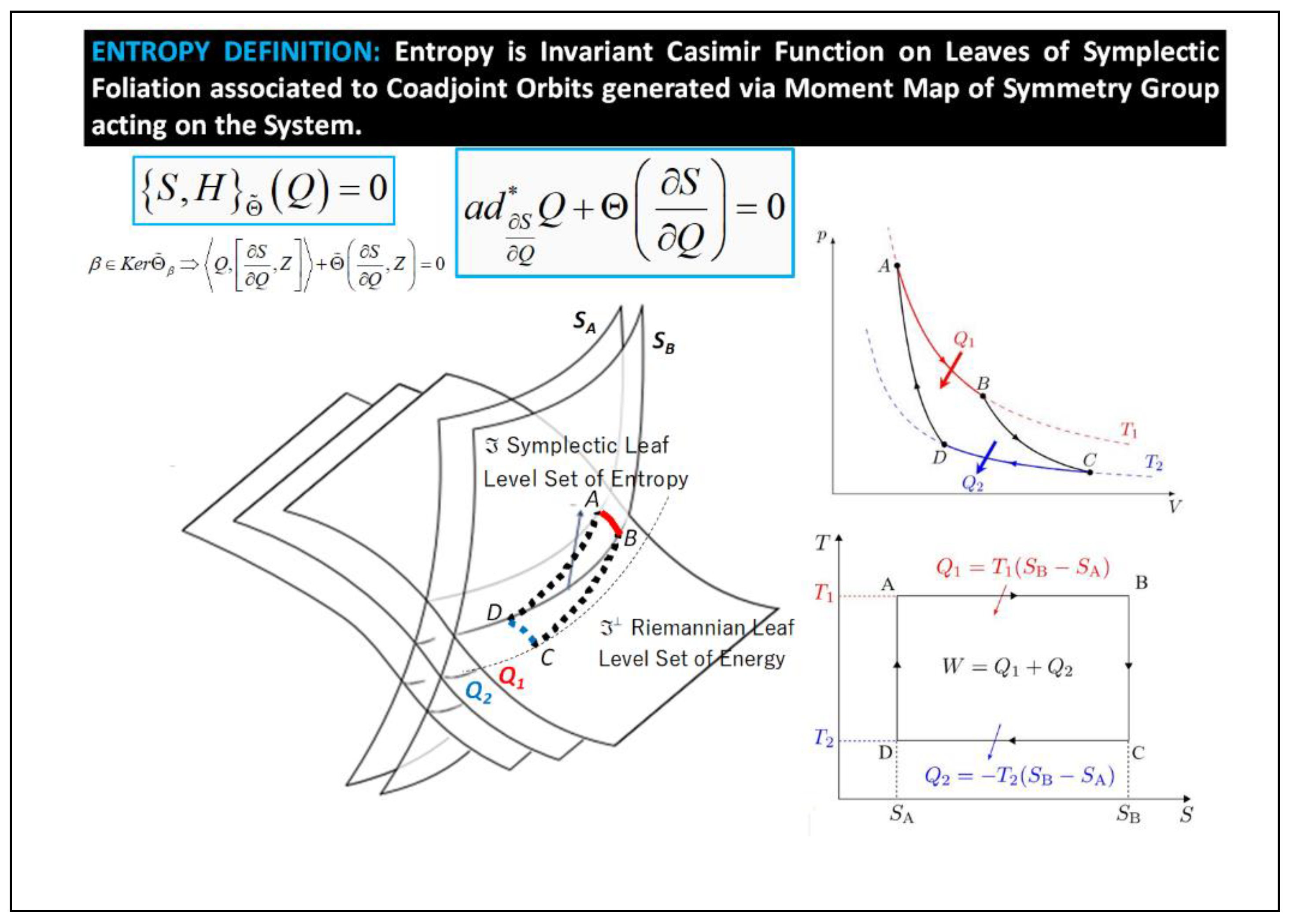
4. Thermodynamics as a Science of Symmetry by Herbert B. Callen
The physical phenomenon of symmetries and their physical–mathematical conceptualisation traverse the history of science as explained by Raffaele Pisano (Pisano 2024). Herbert Bernard Callen (Callen 1973, Callen 1974 & Callen 1985), one of the founders of the modern theory of irreversible thermodynamics,is the author of famous book “Thermodynamics and an Introduction to Thermostatistics” in 1960. In 1973 and 1974, he published a book chapter “A Symmetry Interpretation of Thermodynamics” and a paper on “Thermodynamics as a Science of Symmetry”, given a new interpretation of thermodynamics from the symmetry properties of physical laws, mediated through the statistics of large systems. The fundamental laws of physics possess various symmetry properties that impose constraints and regularities on the possible properties of matter in thermodynamics. Callen made reference to Noether's theorem
[…] every continuous symmetry of a system implies a conservation theorem, and vice versa … The most primitive class of symmetries is the class of continuous spacetime transformations. The (presumed) invariance of physical laws under time translation implies the conservation of energy. Symmetry under spatial translation implies conservation of momentum, and rotational symmetry implies conservation of angular momentum.(Callen, p.425)
and to dynamical symmetries as gauge transformation of the electromagnetic equations (action on the scalar and vector potentials with the invariance of the electric charge). Other symmetries (baryon/lepton number, strangeness/isospin conservations in strong interactions) d’ont occur in conventional thermodynamic systems. Last area of symmetry is linked to the concept of broken symmetry.
About Thermodynamics coordinates, unkwnowing Jean-Marie Souriau work, Herbert Bernard Callen wrote idea related preservation of Souriau’s moment map (geometrization of Noether Theorem”:
[…] The most immediately evident conserved coordinate is, of course, the energy (time-translation symmetry). Its relevance as a thermodynamic coordinate underlies the "first law" of thermodynamics. Time-translation, spatial translation, and spatial rotation symmetries are interrelated in a single class of continuous space-time symmetries. The symmetry interpretation of thermodynamics immediately suggests, then, that energy, linear momentum, and angular momentum should play fully analogous roles in thermodynamics. The equivalence of these roles is rarely evident in conventional treatments, which appear to grant the energy a misleadingly unique status. The momentum and the angular momentum are generally suppressed by restricting the theory to systems at rest, constrained by external "clamps." Nevertheless, it is evident that in principle the linear momentum does appear in the formalism in a form fully equivalent to the energy, for relativistic considerations imply that the energy in one frame appears partially as linear momentum in another frame. Similarly, the angular momentum is only occasionally introduced explicitly into thermodynamic formalisms (as in astrophysical applications to rotating galaxies); it appears, for instance, in the "Boltzmann factor," , additively and symmetrically with the energy. To stress these facts we might well amend the first law to read that "the extended first law of thermodynamics is the symmetry of the laws of physics under space and time translations and under spatial rotation.".(Callen 1974 p.427)
As Callen showed that the thermodynamic coordinates symmetry has led to an extension of the first law of thermodynamics (not reduced to energy preservation but also extended to angular momentum preservation), he then considered more deeply into the second and third laws of thermodynamics in relation with the emerging theory of second-order phase transitions, and the Onsager extension to irreversible processes. Callen observed that equal a priori probability of states is in the form of a symmetry principle. where the entropy depends symmetrically on all permissible states.
Given unitarity symmetry of quantum mechanics among the microstates, it follows that a uniform probability density in phase space remains uniform under the intrinsic dynamics of the system. This principle determines the functional form of the entropy. The conservation of the phase space volume under an internal unitary transformation is the Boltzmann H-theorem. the interchangeability of the unitarity condition and time-reversal symmetry demonstrates that unitarity is viewed as a symmetry condition. He concluded that the central basis of the Onsager theory is the time-reversal symmetry of physical laws.
Figure 13.
Herbert B. Callen. Source Wikimedia.
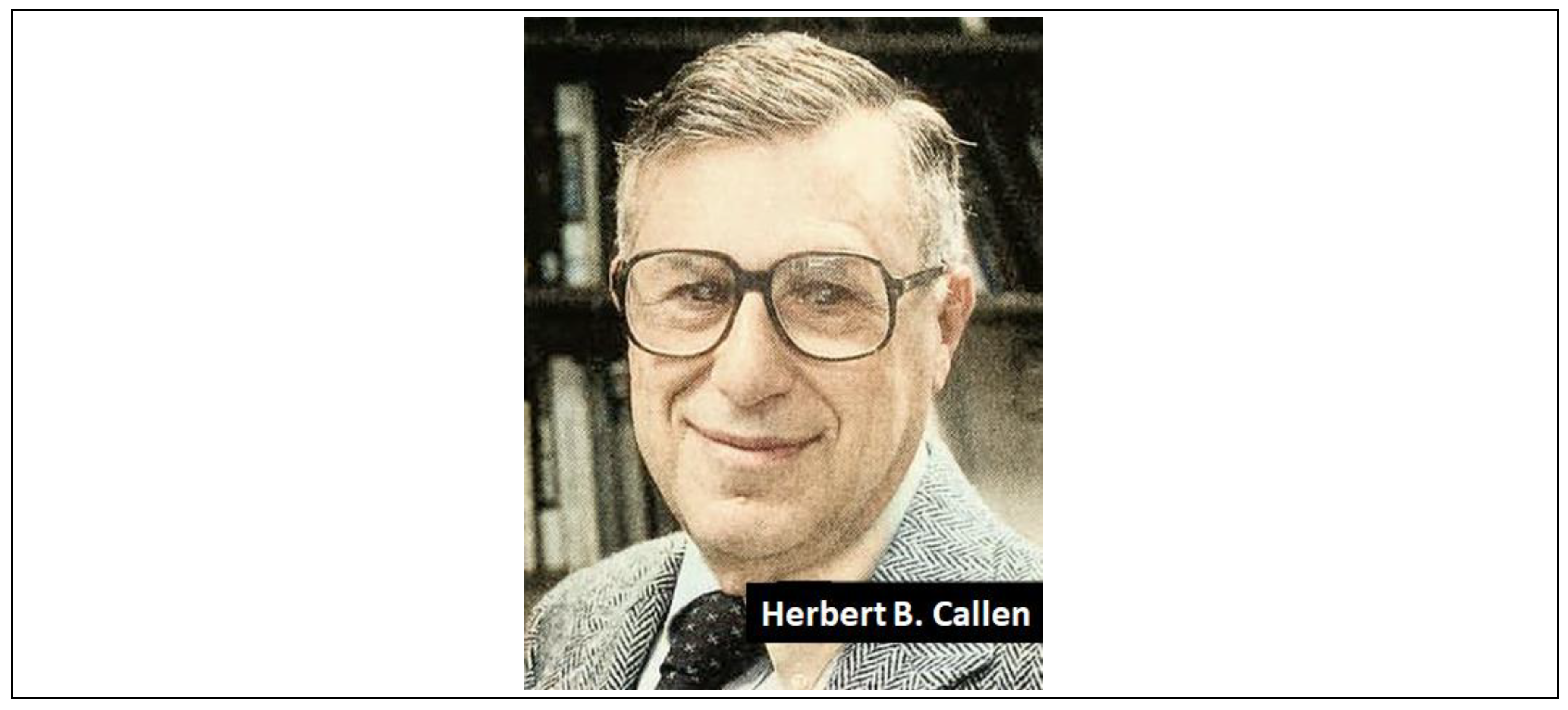
5. Last works of Jean-Marie Souriau on Thermodynamics
Jean-Marie had started working on a second edition of his book “Structure of Dynamic Systems ”. He had planned to add four additional chapters:
[a] chapter 16 “Convexity”
[b] chapter 17 “Measurements”
[c] chapter 18 “Statistical States”
[d] chapter 19 “Thermodynamics”
Unfortunately, this work was not completed, but it would be interesting to consider a 2nd edition of the book by appending these draft chapters which were already well advanced. There we find a generalization of the Laplace transformation and a generalized definition of the notion of entropy.
Figure 14.
Chapter proofs for a 2nd edition of the book “Structure of dynamic systems”. Source Souriau website.
Figure 14.
Chapter proofs for a 2nd edition of the book “Structure of dynamic systems”. Source Souriau website.
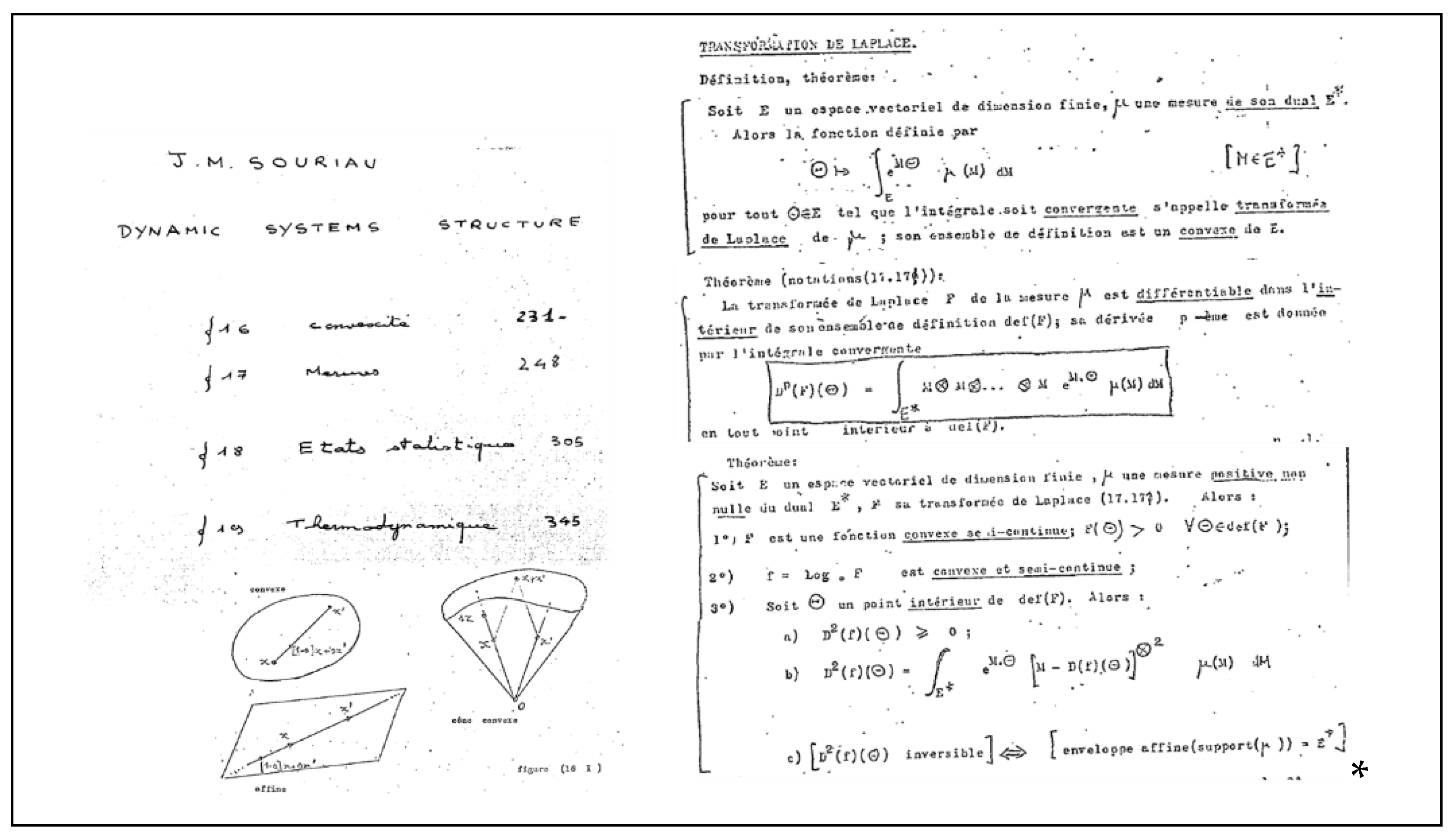
Acknowledgments
I would like to thank the people with whom I have had many fruitful and inspiring exchanges. I would like to quote Roger Balian on the notion of Massieu's potentials, Charles-Michel Marle on the symplectic model of Souriau's thermodynamics, and finally Baptiste Coquinot on the metriplectic flow and the Onsager relations for dissipative thermodynamics. I would also like to thank the participants of the “Nord Bassin Parisien” seminar on the “Geometric Structures of Dissipation” that I launched in 2023.
References
- Albert C (1989) Le théorème de réduction de Marsden-Weinstein en géométrie cosymplectique et de contact. Journal of Geometry and Physics 6(4):627–649.
- Arnold VI (1966) Sur la géométrie différentielle des groupes de Lie de dimension infinie et ses applications à l'hydrodynamique des fluides parfaits. Annales de l'institut Fourier 19(1):319-361.
- Arnold VI, Givental AB (1990) Symplectic Geometry. In: Arnol'd VI and Novikov SP (eds). Dynamical Systems IV Symplectic Geometry and its Applications, Encyclopaedia of Mathematical Sciences, Springer-Verlag, Berlin, pp. 1-136.
- Audin M (2008) Differential Geometry, Strasbourg, 1953. Notices from the AMS 55(3):366-370.
- Bachelard G (1973) Étude sur l’évolution d’un problème de physique: La propagation thermique dans les solides. Vrin, Paris.
- Balian R, Alhassid Y, Reinhardt H (1986) Dissipation in many-body systems: a geometric approach based on information theory. Physical Reports 131:1-146.
- Balian R, Valentin P (2001) Hamiltonian structure of thermodynamics with gauge. The European Physical Journal B, Condensed Matter and Complex Systems 21:269-282.
- Balian R (2015) François Massieu et les potentiels thermodynamiques. Évolution des disciplines et histoire des découvertes, n° Avril, Académie des Sciences, Paris.
- Barbaresco F (2018) Higher Order Geometric Theory of Information and Heat Based on Poly-Symplectic Geometry of Souriau Lie Groups Thermodynamics and Their Contextures: The Bedrock for Lie Group Machine Learning. Entropy 20(11):840-900.
- Barbaresco F (2019a) Jean–Louis Koszul and the elementary structures of information geometry. In: Nielsen F (eds). Geometric Structures of Information, Springer, Switzerland, pp. 333–392.
- Barbaresco F (2019b) Lie Groups Thermodynamics & Souriau-Fisher Metric. In: Lachieze-Rey M (eds). Souriau 2019 Conference Proceedings, Institut Henri Poincaré, Paris.
- Barbaresco F (2019c) Souriau Exponential Map Algorithm for Machine Learning on Matrix Lie Groups. In: Nielsen F and Barbaresco F (eds), Geometric Science of Information GSI’19, Lecture Notes in Computer Science 11712, Springer, Berlin, pp. 85–95.
- Barbaresco F (2020) Lie Group Statistics and Lie Group Machine Learning Based on Souriau Lie Groups Thermodynamics & Koszul-Souriau-Fisher Metric: New Entropy Definition as Generalized Casimir Invariant Function in Coadjoint Representation. Entropy (22,):642-700.
- Barbaresco F (2021a) Souriau-Casimir Lie Groups Thermodynamics and Machine Learning. In: Nielsen F and Barbaresco F (eds). Geometric Structures of Statistical Physics, Information Geometry, and Learning, Springer, Berlin, pp. 53–83.
- Barbaresco F (2021b) Koszul lecture related to geometric and analytic mechanics, Souriau’s Lie group thermodynamics and information geometry. Information Geometry Journal, Springer 4:245–262.
- Barbaresco F (2021c) Invariant Koszul Form of Homogeneous Bounded Domains and Information Geometry Structures. In: Nielsen F (eds). Progress in Information Geometry. Signals and Communication Technology, Springer, Berlin, Germany, pp. 89-126.
- Barbaresco F (2021d) Jean-Marie Souriau’s Symplectic Model of Statistical Physics: Seminal Papers on Lie Groups Thermodynamics - Quod Erat Demonstrandum. In: Nielsen F and Barbaresco F (eds). Geometric Structures of Statistical Physics, Information Geometry, and Learning, Springer, Berlin, pp. 12–50.
- Barbaresco F (2021e) Archetypal Model of Entropy by Poisson Cohomology as Invariant Casimir Function in Coadjoint Representation and Geometric Fourier Heat Equation. In: Nielsen F and Barbaresco F (eds). Geometric Science of Information GSI’21, Lecture Notes in Computer Science 12829. Springer, pp. 417–429.
- Barbaresco F (2022a) Symplectic theory of heat and information geometry. Handbook of Statistics, special issue Geometry and Statistics 46(4):107-143.
- Barbaresco F (2022b) Symplectic Foliation Structures of Non-Equilibrium Thermodynamics as Dissipation Model: Application to Metriplectic Nonlinear Lindblad Quantum Master Equation. Entropy 24 :1626-1662.
- Barbaresco F (2022c) Densité de probabilité gaussienne à maximum d’Entropie pour les groupes de Lie basée sur le modèle symplectique de Jean-Marie Souriau. Proceedings of the GRETSI’22 Conference, Nancy, France.
- Barbaresco F (2022d) Théorie symplectique de l’Information et de la chaleur: Thermodynamique des groupes de Lie et définition de l’Entropie comme fonction de Casimir. GRETSI’22, Nancy. Retrieved via: https://gretsi.fr/data/colloque/pdf/2022_barbaresco696.pdf [07/09/2022].
- Barbaresco F (2022e) Entropy Geometric Structure as Casimir Invariant Function in Coadjoint Representation: Geometric Theory of Heat & Information Geometry Based on Souriau Lie Groups Thermodynamics and Lie Algebra Cohomology. In: Freeden W and Zuhair Nashed M (eds). Frontiers in Entropy Across the Disciplines, World Scientific, Singapore, pp. 133–158.
- Barbaresco F (2022f) Souriau Entropy Based on Symplectic Model of Statistical Physics: Three Jean-Marie Souriau’s Seminal Papers on Lie Groups Thermodynamics. In: Freeden W and Zuhair Nashed M (eds). Frontiers in Entropy Across the Disciplines, World Scientific, Singapore, pp. 55–90.
- Barbaresco F (2023) Symplectic Foliation Transverse Structure and Libermann Foliation of Heat Theory and Information Geometry. In: Nielsen F and Barbaresco F (eds) Geometric Science of Information GSI’23. Lecture Notes in Computer Science 14072, Springer, Berlin, pp. 152–164.
- Basart H, Lichnerowicz A (1982) Variétés de poisson et star-produits tangentiels. Ibidem 1(295) :681-685.
- Benayoun L (1999) Méthodes géométriques pour l’étude des systèmes thermodynamiques et la génération d’équations d’état. PhD Thesis, Institut National Polytechnique de Grenoble, Grenoble.
- Benayoun L, Valentin P (2022) Evolution of equations of state through contact transformations. Fluid Phase Equilibria 194:439-449.
- Bourguignon JP (2019) Jean-Marie Souriau and Symplectic Geometry, Souriau’19 conference, 50th birthday of Jean-Marie Souriau’s Book, Paris, Retrieved via: https://www.youtube.com/watch?v=93hFolIBo0Q&t=3s [27/05/2019].
- Callen HB (1973) A Symmetry Interpretation of Thermodynamics. In: Domingos JDD (eds.). Foundations of Continuum Thermodynamics, Instituto de Alta Cultura-Núcleo de Estudos de Engenharia Mecanica, pp. 61–79.
- Callen, HB (1974) Thermodynamics as a Science of Symmetry, Foundations of Physics 4(4):423–443.
- Callen HB (1985) Thermodynamics and An Introduction to Thermostatistics, 2nd edition, Wiley, New York.
- Carnot S (1824a) Réflexions sur la Puissance Motrice du Feu et sur les Machines propres à développer cette Puissance, Bachelier, Paris.
- Carnot S (1824b) Extracts from unpublished notes by Sadi Carnot on mathematics, physics and other subjects. Gallica, Paris.
- Cartan E (1899) Sur certaines expressions différentielles et le problème de Pfaff. Annales de l’Ecole Normale Supérieure 16 :239-332.
- Cartan E (1958) Leçons sur les invariants intégraux, Hermann, Paris.
- Cartier P (1994) Some fundamental techniques in the theory of integrable systems. In: Babelon O, Cartier P, Kosmann-Schwarzbach Y (eds).Lectures on Integrable Systems, World Scientific Publishing, pp. 1-41.
- Casimir HGB (1931) Uber die konstruktion einer zu den irreduziblen darstellungen halbeinfacher kontinuierlicher gruppen gehörigen differentialleichung. Proceedings of Royal Society Amsterdam 34:844–846.
- Casimir HBG (1945) On onsager’s principle of microscopic reversibility. Reviews of Modern Physics 17:343-362.
- Coleman CP (1994) The Search for Stable Equilibria on Coadjoint Orbits and Applications to Dissipative Processes. University of California, Berkeley report. Retrieved via: https://www.cds.caltech.edu/~marsden/wiki/uploads/projects/geomech/Coleman1994.pdf.
- Condevaux M, Dazord P, Molino P (1988) Géométrie du moment. Publications du département de mathématiques de Lyon, fascicule 1B, Séminaire Sud-Rhodanien 1(5) :131-160.
- Coquinot B, Morrison PJ (2020) A General Metriplectic Framework with Application to Dissipative Extended Magnetohydrodynamics. Journal of Plasma Physics 86(3):835860302.
- Cosserat O (2023) Theory and Construction of Structure Preserving Integrators in Poisson Geometry. Differential Geometry. Université de La Rochelle, La Rochelle.
- Darboux G (1882a) Sur le problème de Pfaff. Bulletin des sciences mathématiques et astronomiques 2(6):14-36.
- Darboux G (1882b) Sur le problème de Pfaff, Bulletin des sciences mathématiques et astronomiques 2(6):49-62.
- Dazord P (1983) Feuilletages et mécanique hamiltonienne. Seminaire de geometrie, université de Lyon I 3(4) :1-49.
- Dazord P, Molino P (1988) Gamma-Structures poissonniennes et feuilletages de Libermann, Publications du département de mathématiques de Lyon, fascicule 1B, Séminaire Sud-Rhodanien 1(2):69-89.
- Dazord P, Delzant T (1987) Le problème général des variables actions-angles. Journal of Differential Geometry 26 :223-251.
- Delzant T (1986) Variables actions-angles non commutatives et exemples d'images convexes de l'application moment, Paris 6 University, Paris.
- Delzant T (1988) Hamiltoniens périodiques et images convexes de l’application moment. Bulletin de la Société Mathématique de France 116(3)315–339.
- de Saxcé G, Vallée C (2012) Bargmann group, momentum tensor and Galilean invariance of Clausius–Duhem inequality. International Journal of Engineering Science 50(1):216-232.
- de Saxcé G, Vallée C (2016) Galilean Mechanics and Thermodynamics of Continua. Wiley, Hoboken.
- de Saxcé G (2016) Link between Lie Group Statistical Mechanics and Thermodynamics of Continua. Entropy 18:254-269.
- de Saxcé G (2019) Euler-Poincaré equation for Lie groups with non null symplectic cohomology. Application to the mechanics. In: Nielsen F and Barbaresco F (eds), Geometric Science of Information GSI’19, Lecture Notes in Computer Science 11712, Springer, Berlin, pp. 66–74.
- de Saxcé G, Marle CM (2022) Structure des Systèmes Dynamiques Jean-Marie Souriau’s Book 50th Birthday. In: Barbaresco F and Nielsen F (eds), Geometric Structures of Statistical Physics, Information Geometry, and Learning, Springer Berlin, pp. 3-11.
- Ehresmann, C (1951) Sur la théorie des variétés feuilletées. Rendieonti di Matematiea 5(10):64-83.
- Fedida E (1973) Feuilletages du plan, feuilletages de Lie. PhD University of Strasbourg, Strasbourg.
- Fedida E (1974) Sur l’existence des feuilletages de Lie. Compte-Rendu de l’Académie des Sciences Paris 278:835–837.
- Fedida E (1978) Sur la théorie des feuilletages associée au repère mobile : cas des feuilletages de lie. In: Schweitzer PA (eds). Differential Topology, Foliations and Gelfand-Fuks Cohomology, Lecture Notes in Mathematics, Springer, Berlin, pp. 183–195.
- Françoise JP (2013) Systèmes Dynamiques appliqués aux Oscillations. 21ème Congrès Français de Mécanique, Bordeaux. Retrieved via: https://hal.science/hal-03441433/document [22/11/21].
- Gallisot F (1952) Les formes extérieures en mécanique. Annales de l’Institut Fourier 4 :145–297.
- Gibbs JW (1875) Equilibrium of Heterogeneous Substances. The transactions of the Connecticut Academy 3:108-248 and 3:343-524.
- Gibbs JW (1902) Elementary Principles in Statistical Mechanics, developed with Especial Reference to the Rational Foundation of Thermodynamics. Cambridge University Press, Cambridge.
- Goursat E (1922) Leçons sur les problèmes de Pfaff, Hermann, Paris.
- Hadamard J (1906) Review of Elementary Principles in Statistical Mechanics, Developed with Special Reference to the Rational Foundations of Thermodynamics by J. Willard Gibbs. Bulletin of American Mathematical Society 12(4):194–210.
- Haefliger A (2016) Naissance des feuilletages, d'Ehresmann-Reeb à Novikov. In : Kouneiher J, Flament D, Nabonnand P and Szczeciniarz JJ (eds). Géométrie au XXe Siècle, 1930-2000, Histoire et Horizons, Hermann, Paris, pp. 99–110.
- Hamoui A, Lichnerowicz A (1982) Sur la quantification d'un système dynamique à hamiltonien dépendant du temps. Comptes rendus Académie des Sciences Paris 294(1) :705-710.
- Hubmer GF, Titulaer UM (1987) The Onsager-Casimir relations revisited. Journal of Statistical Physics 49:331–346.
- Jayne N (1992) Legendre Foliations on Contact Metric Manifolds, Massey University PhD thesis, Massey.
- Jaynes ET (1957a) Information Theory and Statistical Mechanics. The Physical Review 106(4):620-630.
- Jaynes ET (1957b) Information Theory and Statistical Mechanics II. Physics Revue 108(2):171–190.
- Kapranov M (2011) Thermodynamics and the moment map, arXiv:1108.3472v1. Retrieved via: https://doi.org/10.48550/arXiv.1108.3472 [17/08/2011]. [CrossRef]
- Khesin BA, Tabachnikov SL (2014) Arnold Swimming Against the Tide, AMS Non-Series Monographs, Volume 86, Moscow, Retrieved via: https://doi.org/10.1090/mbk/086. [CrossRef]
- Kirillov AA (1974) Eléments de la théorie des représentations. Mir, Moscow.
- Kirillov AA (2004) Lectures on the orbit method. Volume 64 of Graduate Studies in Mathematics, American Mathematical Society, Providence.
- Kozlov VV (2004) Gibbs and Poincaré Statistical Equilibria in Systems with Slowly Varying Parameters. Doklady Mathematics 69(2):278–281.
- Lagrange JL (1855) Mécanique Analytique. Mallet-Bachelier, Paris.
- Lawson JrH (1974) Foliations. Bulletin of American Mathematics Society 80:369–418.
- Libermann P (1954) Sur Ie problème d'équivalence de certaines structures infinitésimales regulières. Annali di Matematica Pura ed Applicata 36:27-120.
- Libermann P (1959) Automorphismes infinitésimaux des structures symplectiques et de contact. Collection de Géométrie Différentielle Globale, Gauthier-Villars, Paris.
- Libermann P (1983) Problèmes d’équivalence et géométrie symplectique. Astérisque 107:43-68.
- Libermann P (1986) Sur quelques propriétés de géométrie homogène. In : Dufour JC (eds). Séminaire Sud-Rhodanien de Géométrie, Travaux en cours, Hermann, Paris, pp. 91-106.
- Libermann P, Marle CM (1987) Symplectic Geometry and analytical Mechanics. Reidel, Dordrecht.
- Libermann P (1989) Cartan-Darboux theorems for Pfaffian forms on foliated manifolds. Proceedings VIth International Colloquium Differential Geometry 125-144.
- Libermann P (1991) Legendre Foliations on Contact Manifolds, Differential Geometry and its Applications 1:57-76.
- Libermann P (2005) La géométrie différentielle d’Elie Cartan à Charles Ehresmann et André Lichnerowicz. In : Kouneiher J, Flament D, Nabonnand P, Szczeciniarz JJ (eds). Géométrie au XXe siècle, 1930-2000. Histoire et horizons, Hermann, Paris, pp. 191–208.
- Lichnerowicz A (1976) Variétés symplectiques, canoniques et systèmes dynamiques. In : Rund H and Forbes W (eds). Topics in Differential Geometry, volume in honour of ET Davies, Academic Press, New York, pp. 57-85.
- Lichnerowicz A (1982a) Géométrie différentielle des variétés de contact. Journal de Mathématiques pures et appliquées 4 :345-380.
- Lichnerowicz A (1982b) Variétés de Poisson et feuilletages. Annales de la Faculté des Sciences, Toulouse 4:195-262.
- Lichnerowicz A (1983a) Formes caractéristiques d'un feuilletage et classes de cohomologie de l'algèbre des vecteurs tangents à valeurs dans les formes normales. Comptes rendus Académie des Sciences Paris 296(1):67-71.
- Lichnerowicz A (1983b) Quantum Mechanics and déformations of Geometrical Dynamics. In: Barut AO (eds). Quantum Theory, Groups, Fields and Particles, Reidel, Dordrecht, pp. 3-82.
- Lichnerowicz A, Tran-Van-Tan (1983c) Feuilletages, géométrie riemannienne et géométrie symplectique. Ibidem 296(1):205-210.
- Lichnerowicz, A (1983d) Physique mathématique, Cours du Collège de France 1982-1983, Institut de France 1:111-115.
- Lie S (1876) Allgemeine Theorie der partiellen Differentialgleichungen erster Ordnung. Mathematische Annalen 9:245-296.
- Lie S (1877) Allgemeine Theorie der partiellen Differentialgleichungen erster Ordnung (Zweite Abhandlung). Mathematische Annalen 11:464-557.
- Lie S (1890) Transformationsgruppen, I, II, III. Teubner, Berlin. Reprinted by Chelsea Publishing Company, New York.
- Lindblad G (1893) Non-Equilibrium Entropy and Irreversibility, D. Reidel, Dordrecht.
- Marle CM (2016) From Tools in Symplectic and Poisson Geometry to, J.-M. Souriau’s Theories of Statistical Mechanics and Thermodynamics. Entropy 18(10):370-416.
- Marle CM (2018) Géométrie Symplectique et Géométrie de Poisson. Calvage & Mounet, Paris.
- Marle CM (2019) Projection Stéréographique et Moments, Hal-02157930, Version 1. Retrieved via: https://hal.science/hal-02157930/document [06/07/2019].
- Marle CM (2020a) On Gibbs states of mechanical systems with symmetries. Journal of Geometry and Symmetry in Physics 57:45–85.
- Marle CM (2020b) Examples of Gibbs States of Mechanical Systems with Symmetries. Journal of Geometry and Symmetry in Physics 58:55–79.
- Marle CM (2021a) On Generalized Gibbs States of Mechanical Systems with Symmetries. arXiv, arXiv:2012.00582v2. Retrieved via: https://arxiv.org/pdf/2012.00582 [13/01/2021].
- Marle CM (2021b) États de Gibbs construits au moyen d’un moment de l’action hamiltonienne d’un groupe de Lie: Signification physique et exemples. Diaporama Bilingue Français–Anglais, Colloque en L’honneur de Jean-Pierre Marco. Retrieved via: https://marle.perso.math.cnrs.fr/diaporamas/GibbsStatesMomentMap.pdf [07/06/2021].
- Marle CM (2021c) Gibbs States on Symplectic Manifolds with Symmetries. Geometric Science of Information. In: Nielsen F and Barbaresco F (eds), Geometric Science of Information GSI’21, Lecture Notes in Computer Science 12829, Springer, Berlin, pp 237–244.
- Martinet J, Reeb G (1973) Sur une généralisation des structures feuilletées de codimension 1. In : Maslov V (eds). Dynamical systems, Academic Press, New York, pp. 177-184.
- Maschke B, Goreac G, Kirchhoff J (2024) Generating functions for irreversible Hamiltonian systems. arXiv:2404.04092v2. Retreived via: https://arxiv.org/pdf/2404.04092 [08/04/2024].
- Massieu F (1869a) Sur les Fonctions caractéristiques des divers fluides. Comptes Rendus de l’Académie des Sciences Paris 69:858–862.
- Massieu F (1869b) Addition au précédent Mémoire sur les Fonctions caractéristiques. Comptes Rendus de l’Académie des Sciences Paris 69:1057–1061.
- Massieu F (1873) Exposé des principes fondamentaux de la théorie mécanique de la chaleur (note destinée à servir d'introduction au Mémoire de l'auteur sur les fonctions caractéristiques des divers fluides et la théorie des vapeurs), Gallica, Paris.
- Massieu F (1876) Thermodynamique: Mémoire sur les Fonctions Caractéristiques des Divers Fluides et sur la Théorie des Vapeurs, Académie des Sciences Paris 1:92-110.
- Molino P (1989) Dualité symplectique, feuilletage et géométrie du moment. Publicacions Matematiques 33:533-541.
- Molitor M (2021) Kähler toric manifolds from dually flat spaces. arXiv:2109.04839v1. Retreived via: https://arxiv.org/pdf/2109.04839 [10/09/2021].
- Morrison PJ, Updike MH (2023) An inclusive curvature-like framework for describing dissipation: metriplectic 4-bracket dynamics. Physical Review E109:045202.
- Mrugala R (1978) Geometrical formulation of equilibrium phenomenological thermodynamics. Reports on Mathematical Physics 14(3):419-427.
- Mrugala R (2000) On contact and metric structures on thermodynamic spaces. Mathematical Aspects of Quantum Information and Quantum Chaos 1142:167-181.
- Nencka H, Streater RF (1999) Information Geometry for some Lie algebras. Infinite Dimensional Analysis, Quantum Probability and Related Topics 2(3):441-460.
- Noether E (1918) Invariante variationsprobleme. Nachrichten von der Gesellschaft der Wissenschaften zu Gottingen, Abhandlungen der Mathematisch-Physikalischen Klasse 191:235-257.
- Nehorosev NN (1972) Action-angle variables and their generalizations. Translation Moscow Mathematical Society 26:180–198.
- Onsager L (1931) Reciprocal relations in irreversible processes I. Physical Review 37:405–426.
- Onsager L, Machlup S (1953a) Fluctuations and Irreversible Processes, Physical Review 91:1505-1510.
- Onsager L, Machlup S (1953b) Fluctuations and Irreversible Processes II. Systems with Kinetic Energy, Physical Review 91:1512–1515.
- Pang MY (1990) The Structure of Legendre Foliations. Transations of the American Mathematical Society 30(2):417-455.
- Pavlov VP, Sergeev VM (2008) Thermodynamics from the Differential Geometry Standpoint. Theoretical and Mathematical Physics 157(1):1484–1490.
- Pisano R (2024) Brief summaries on symmetries in the history of physics–mathematics: James Clerk Maxwell (1865–1873), Emmy Noether (1915–1918) and Albert Einstein (1905–1926). Journal of Physics: Conference Series IOP Oxford: 2877 012101.
- Poincaré H (1901) Sur une forme nouvelle des équations de la Mécanique. Compte-Rendus des Séances de l’Académie des Sciences Paris 18:48–51.
- Poincaré H (1908) Thermodynamique, cours de Sorbonne 2nd édition revue et corrigée, Gauthier-Villars, Paris.
- Reeb G (1952) Sur certaines propriétés topologiques des trajectoires des systèmes dynamiques. Académie royale de Belgique 27(9) :234-265.
- Reeb G (1956) Sur la théorie générale des systèmes dynamiques. Annales de l'institut Fourier 6:89-115.
- Reeb G (1959) Structures feuilletées. Bulletin de la Société Mathématique de France 87 :445–450.
- Reeb G (1978) Structures feuilletées. Differential Topology, Foliations and Gelfand-Fuks cohomology, Lecture Notes in Mathematics 652:104–113.
- Reeb G, Ehresmann C, Thom R, Libermann P (1964) Structures feuilletées, Colloques Internationaux Du Cnrs (CIDC), CNRS, Paris.
- Reech F (1858) Note sur un mémoire intitulé: Théorie des propriétés calorifiques et expansives des fluides élastiques. Comptes Rendus de l’Académie des Scinces Paris 46(2):84-89.
- Reech F (1869) Théorie des machines motrices et des effets mécaniques de la chaleur. Eugène Lacroix, Paris.
- Reinhart BL (1983) Differential Geometry of Foliations, vol. 99, Springer Verlag, Cham.
- Souriau JM (1952) Sur la stabilité des avions. PhD ONERA, Chatillon.
- Souriau JM (1953) Géométrie symplectique différentielle. Applications. In : Ehresmann C and Lichnerowicz A (eds). Colloque CNRS, Géométrie différentielle, Strasbourg, Editions du CNRS, Paris, pp. 53-59.
- Souriau JM (1954) Equations Canoniques et Géométrie Symplectique. Publications Scientifiques Universitaire d’Alger A(1):239–265.
- Souria JM (1965) Géométrie de l’Espace des Phases, Calcul des Variations et Mécanique Quantique. Tirage Ronéotypé, Faculté des Sciences, Marseille.
- Souriau JM (1966) Définition covariante des équilibres thermodynamiques. Supplement Il Nuovo Cimento 4:203–216.
- Souriau JM (1967) Réalisations d’algèbres de Lie au moyen de variables dynamiques. Il Nuovo Cimento A(49):197–198.
- Souriau JM (1969) Structure des systèmes dynamiques. Dunod, Paris.
- Souriau JM (1974) Mécanique statistique, groupes de Lie et cosmologie. In : Souriau JM (eds). Colloque International du CNRS Géométrie symplectique et physique Mathématique, CNRS, Marseille.
- Souriau JM (1975) Géométrie Symplectique et Physique Mathématique. Deux Conférences de Jean-Marie Souriau, Colloquium de la Société Mathématique de France, SMF, Paris.
- Souriau JM (1977) Thermodynamique et géométrie. In: Bleuler K and Reetz A (eds). Differential Geometry Methods in Mathematical Physics II, Springer, Berlin, pp. 369–397.
- Souriau JM (1978) Géométrie symplectique et physique mathématique, CNRS, Marseille.
- Souriau JM (1984) Mécanique Classique et Géométrie Symplectique. CNRS-CPT-84/PE.1695, CNRS, Marseille.
- Souriau JM (1986) La structure symplectique de la mécanique décrite par Lagrange en 1811. Mathématiques & Sciences Humaines 94:45–54.
- Souriau JM (1990) Titres & travaux : principaux thèmes de recherche, CNRS, Marseille.
- Souriau JM (1995) Itinéraire d’un mathématicien - Un entretien avec Jean-Marie Souriau. Propos recueillis par Patrick Iglesias, Le journal de maths des élèves 1(3):162-168.
- Souriau JM (1996) Grammaire de la Nature. Private publication. Retreived via: https://jmsouriau.klacto.net/Souriau.2007a.pdf [25/05/2007].
- Souriau JM (1997) Structure of dynamical systems, a symplectic view of physics. Progress in Mathematics. Birkhäuser, Boston.
- Souriau JM (2003) C’est quantique ? Donc c’est géométrique. Série Documents de travail (Équipe F2DS), Feuilletages-quantification géométrique : textes des journées d’étude. Retreived via : https://jmsouriau.klacto.net/JMS.html [10/05/2003].
- Souriau JM (2005) Les groupes comme universaux. In : Kouneiher J, Flament D., Nabonnand P., Szczeciniarz JJ (eds). Géométrie au XXe siècle, 1930-2000. Histoire et horizons, Hermann, Paris, pp.395-416.
- Souriau JM (2007) On Geometric Dynamics. Discrete and Continuous Dynamical Systems, 19:595–607.
- Streater RF (2007) Lost Causes in and beyond Physics, Springer, London.
- Thom R (1982) Logos et théorie des Catastrophes. René Thom talk at the Cerisy International Conference, Annales de la Fondation Louis de Broglie 27(4):575-596.
- Thomson W (1849) XXXVI.—An Account of Carnot’s Theory of the Motive Power of Heat;with Numerical Results deduced from Regnault’s Experiments on Steam. Transactions of the Royal Society of Edinburgh, 16(5):541-574.
- Trusdell C (1980) The Tragicomical History of Thermodynamics 1822-1854, Springer, Berlin.
- Vallée C, de Saxcé G, Marle CM (2012) Hommage à Jean-Marie Souriau, Gazette des Mathématiciens 133:97-102.
- Vojta G (1990) Symplectic Formalism for the Thermodynamics of Irreversible Processes, Annalen Der Physik 502(2):251-258.
- Wolak RA (1989) Foliated and associated geometric structures on foliated manifolds. Annales de la faculté des sciences de Toulouse 5e série 10(3):337-360.
Disclaimer/Publisher’s Note: The statements, opinions and data contained in all publications are solely those of the individual author(s) and contributor(s) and not of MDPI and/or the editor(s). MDPI and/or the editor(s) disclaim responsibility for any injury to people or property resulting from any ideas, methods, instructions or products referred to in the content. |
© 2025 by the authors. Licensee MDPI, Basel, Switzerland. This article is an open access article distributed under the terms and conditions of the Creative Commons Attribution (CC BY) license (http://creativecommons.org/licenses/by/4.0/).
Copyright: This open access article is published under a Creative Commons CC BY 4.0 license, which permit the free download, distribution, and reuse, provided that the author and preprint are cited in any reuse.


