

Submitted:
15 February 2025
Posted:
17 February 2025
You are already at the latest version
Abstract
Waste-to-energy (WtE) are clean technologies that support a circular economy by providing solutions to managing non-recyclable waste while generating alternative energy sources. Despite the promising benefits, technology adoption is challenged by financing constraints, technical maturity, environmental impacts, supporting policies, and public acceptance. A growing number of studies analyzed the acceptability of WtE and identified the factors affecting the adoption of WtE technologies. This study aims to analyze these research hotspots, technologies, and acceptability factors by combining bibliometric and systematic analyses. Initial search from Web of Science and Scopus databases identified 1328 unique documents, and the refinement resulted in 109 for data analysis. The results present a comprehensive overview of the state-of-the-art, providing researchers bases for future research directions. Among the WtE technologies in the reviewed literature are incineration, anaerobic digestion, gasification, and pyrolysis, with limited studies about refuse-derived fuel and landfilling with gas recovery. The identified common factors include perceived risks, trust, attitudes, perceived benefits, ‘Not-In-My-BackYard’ (NIMBY), awareness, and knowledge. Moreover, the findings present valuable insights for policymakers, practitioners, and WtE project planners to support WtE adoption while achieving sustainable, circular, and low-carbon economies.
Keywords:
bibliometric analysis
; circular economy
; social acceptability
; systematic review
; waste-to-energy
1. Introduction
Due to the increasing population and economic growth, sustainable management of municipal solid waste (MSW) remains one of the challenging issues for developing and even developed countries. According to the United Nations Environment Programme (UNEP) report, the global generation of municipal solid waste (MSW) is around 2.1 billion tonnes in 2023 and is projected to grow up to 3.8 billion tonnes by 2050 [1]. This contributes to approximately 5% of the global greenhouse gas (GHG) emissions [2]. If not properly managed, MSW poses adverse impacts on the health of humans and the environment [3]. This costs around USD 361 billion, including the social costs and externalities, and is expected to double to a staggering USD 640.3 billion in 2050 without drastic interventions [1].
To address these problems, different countries are implementing various strategies and technologies to decrease the environmental footprints of MSW. These include the 3Rs (reduce, reuse, recycle), segregation at source, composting, circular economy, and sanitary landfilling [4,5,6,7,8]. Another promising technology is waste-to-energy (WtE), which complements the previous strategies by closing the loop of a circular economy. It helps reduce the need for new landfills, processes unrecyclable wastes, supports recycling and the recovery of valuable materials, and contributes to energy security by converting wastes into usable fuel, heat, or electricity [9,10,11].
As shown in Figure 1, WtE encompasses a range of technologies from biological treatment, thermal treatment, and landfilling. Biological treatment pertains to anaerobic digestion (AD) of the organic fraction of MSW, which involves a biodegradation process carried out by microorganisms without oxygen to produce biogas [12]. Thermal conversion includes incineration (burning all types of MSW) and refuse-derived fuel (RDF), which produces heat and power; pyrolysis or thermal decomposition of organic wastes that produce biochar, bio-oil, and syngas; and gasification or organic wastes that also produces syngas [10,13,14]. On the other hand, landfilling can be converted into a WtE facility if it captures landfill gas, usually composed of methane, and generates electricity or heat through turbines [10]. Moreover, landfill leachates can be processed through AD to produce biogas and microbial fuel cells or biohydrogen [15].
In recent years, the increasing number of studies on WtE has brought scholars to review the literature from different perspectives, including technical, economic, environmental, and social perspectives. For instance, Kumar & Samadder [16] reviewed the global scenario of WtE technological options such as incineration, pyrolysis, gasification, AD, and landfilling with gas recovery. Hsu et al. [17] covered various perspectives, such as value chain analysis, thermal treatment, techno-economic analysis, life-cycle assessment, power generation, and energy/exergy analysis. Ramos & Rouboa [18] also covered socio-economic and environmental aspects by reviewing the WtE literature on the life cycle assessment (LCA), life cycle costing, and social impact assessment. Furthermore, several studies also employed multi-criteria decision analysis (MCDA). In one study, Vlachokostas et al. [19] applied MCDA, integrating economic, technological, environmental, social, and political factors in the decision-making process towards promoting WtE management strategies. Patil et al. [20] also applied MCDA using an analytical hierarchy process comparing WtE technologies with four aspects such as technical, sociocultural, economic, and environmental with fifteen sub-criteria.
Nonetheless, there is a limited review of literature specifically focusing on the social acceptability of WtE technologies. To name a few, Ramos [21] conducted a literature review on social and sustainability assessments related to the thermal conversion of wastes. The study found that there is a lack of consistent reporting practices for social-LCA of WtE implementation and identified social concerns on employment, human health, accessibility, safety, and odor-related issues. Balla [22] applied a systematic literature review and revealed the factors affecting the social acceptability of WtE technology projects, including public perceptions of fairness, trust, and climate change. In the case of Ghana, Williams et al. [23] identified the factors challenging the implementation of WtE projects, such as limited funding, inadequate logistics, expertise, and infrastructure, growing population, and negative attitudes toward the environment, among others. These reviews, albeit provided an overview of the factors affecting the implementation of WtE technologies, had limited samples of selected studies analyzed. A substantial number of WtE studies recently published were not included, yet worthy of investigation.
Hence, this study aims to provide a more comprehensive overview of current research hotspots in WtE as well as to present a more in-depth review of academic papers analyzing the acceptability of WtE technologies. Specifically, the study aims to (1) review the extant literature that analyzes the acceptability of WtE technologies; (2) identify the research hotspots in the field; (3) provide a comprehensive overview of WtE technologies; (4) enumerate the factors affecting the adoption of WtE technologies; and (5) identify the knowledge gaps that serve as a basis for research direction. This study employs a combination of bibliometric analysis and systematic literature review. The results summarize the reviewed WtE literature, provide several insights on the social acceptability of WtE that need further research, and present implications that might be useful for policymakers, practitioners, and project planners for the successful adoption and implementation of WtE projects.
2. Materials and Methods
To provide a comprehensive review of the literature on the social acceptability of WtE, this paper combines bibliometric and systematic analyses. Bibliometric analysis is a systematic study carried out on scientific literature for the identification of patterns, trends, and impacts within a certain field [24]. It is used to analyze emerging trends in article and journal performances, collaboration patterns, and research constituents, as well as to explore the intellectual structure of a specific domain in the extant literature [25]. The main steps for bibliometric analysis are defining research objectives, literature search and data collection, data cleaning and processing, selection of bibliometric techniques, data analysis, visualization, and interpretation and reporting [24].
On the other hand, a systematic literature review is a research methodology that is transparent and reproducible, aiming to synthesize scientific evidence to answer a particular research question seeking to include all published evidence on the topic, and evaluating the quality of the evidence [26]. It comprises eight steps divided into three phases: (A) Review Planning Phase – (1) formulating research issue and (2) devising and verifying the review protocol, (B) Conducting Review Phase – (3) examining and searching literature, (4) filtering for inclusion, (5) evaluating quality, (6) data extraction, and (7) data analysis and synthesis, and lastly (C) Establishing Reports based on Review Outcomes – (8) summarizing the results in the form of reports [27].
Following previous studies [28,29], this review combines the advantages of bibliometric analysis and systematic literature review to present a comprehensive overview of the literature, identify gaps, and recommend future directions for research and implementation of WtE projects. As shown in Figure 2, the sequence of steps includes (1) sample preparation and database selection, (2) adjustment and refinement of research criteria, (3) bibliometric information analysis, and (4) systematic review of WtE literature.
In the first step, the initial search was limited by the following inclusion criteria: (1) the acceptability of WtE is analyzed; (2) WtE processes MSW; (3) at least one of the WtE technologies is evaluated; and (4) factors affecting acceptability are presented. The following combination of keywords was used as a search criterion: “social acceptability” OR “social acceptance” OR “public acceptance” OR “public acceptability” AND “waste-to-energy.” Meanwhile, the database selection was delimited to Web of Science (WoS) and Scopus. The WoS Core Collection database, a product of Clarivate, is the world’s oldest, most widely used, and authoritative database of scientific and scholarly research publications and citations covering journals, proceedings, books, and data compilations [30]. To date, the WoS platform covers over 235 million records from over 34,865 journals, more than 157,000 books, over 314,000 conferences, more than 128 million patents, and over 15 million data sets. On the other hand, the Scopus database, a product of Elsevier, is one of the largest curated databases covering scientific journals, books, conference proceedings, etc., which are selected through a process of content selection followed by continuous re-evaluation [31]. Currently, Scopus covers 97.3+ million records from 368+ thousand books, 28.3+ thousand serials, and 2.33 million preprints. Google Scholar, albeit the most comprehensive database covering journals, books, conference papers, unpublished materials, and non-academic documents, has been greatly debated, and its low data quality raises questions about its suitability for research evaluation [28]. Hence, this review only covered the literature from WoS and Scopus.
The preliminary search resulted in 650 documents from WoS and 679 from Scopus. Upon removal of duplicates, there were 1328 unique documents left. Documents from conference papers and proceedings were excluded due to the limited discussion of acceptability, methods, and methodology, which were crucial in the systematic literature review. Documents analyzing the social acceptability of other types of wastes were also removed, such as nuclear or radioactive wastes [32], wastewater [33,34], and carbon capture and storage [35]. Furthermore, review articles [21,36] were also removed. In total, 109 research articles were reviewed for the bibliometric analysis and systematic literature review. The list of reviewed documents is presented in Appendix A Table A1.
In the third step, research hotspots from bibliometric information were analyzed, including the country and year of publication trends, authors and institutions, journals, and the number of citations as of 5 February 2025. Finally, a systematic literature review was conducted focusing on the types of WtE technology and the factors affecting the acceptability and implementation of WtE projects.
3. Bibliometric Analysis of Waste-to-Energy Literature
3.1. Country and Year Trends
A total of 109 documents were reviewed for the bibliometric analysis. These documents were published by authors from 38 countries. As presented in Figure 3, China has the highest number of documents published at 50 (46%), followed by Australia and the United Kingdom with 12 (11%), Germany, Greece, and the United States of America with 7 (6%), Italy with 6 (6%), Spain with 5 (5%), Indonesia with 4 (4%), and Czech Republic with four documents (3%). The top spot was expected as China has the highest number of WtE plants globally and the amount of MSW treated by WtE [1]. Among the top 10 countries, only two were from developing countries: China and Indonesia. This implies that developed countries play an important role in managing MSW with WtE technologies, while social acceptability research from developing countries is lagging relative to the trend in developed countries [37].
In terms of the year of publication, the review result, as shown in Figure 4, revealed an increasing trend in WtE literature on social acceptability. The post-pandemic period had the highest number of documents published, with 17 in 2022, 16 in 2023, and 13 in 2024. This trend is expected to be the increasing urban population densities and the associated consumption pattern result in a rapid increase in the volume of waste generation. With the limited land in urban areas and the scarcity of new sites for landfills, the demand for WtE technologies is also increasing [38]. This requires thorough studies not only on the technical and economic aspects but also on these technologies' environmental impacts and social acceptability. Moreover, the situation was exacerbated during the COVID-19 pandemic as the infectious and hazardous medical wastes required immediate treatment, and WtE technologies were significantly considered to address the problem [39].
Meanwhile, the first two documents were published in 2010 by Jamasb et al. [40] who looked at the institutional and policy issues of WtE and Scheffran [41] on criteria for sustainable bioenergy infrastructure and lifecycle. On the other hand, the most recent (in 2025) publication indexed in WoS was authored by Luna-delRisco et al. [42] who evaluated the socio-economic drivers of household adoption of biodigester systems for domestic energy in rural Colombia.
3.2. Journal Analysis
With the multidisciplinary and interdisciplinary natures of WtE projects, the acceptability of WtE technologies was positioned in various subjects of management, sustainability, technology, energy, environment, energy, and engineering. Out of 67 serials (journals and books), the top journals with the most number of publications were Waste Management (11), Journal of Cleaner Production (10), Energy (4), Environmental Impact Assessment Review (4), Technological Forecasting and Social Change (3), Sustainable Energy Technologies and Assessment (3), and Energies (3).

Table 1.
Journals with the most publications.
| Rank | Title | Total Publications | Percentage |
| 1 | Waste Management | 11 | 10% |
| 2 | Journal of Cleaner Production | 10 | 9% |
| 3-4 | Energy | 4 | 4% |
| 5-8 | Environmental Impact Assessment Review | 4 | 4% |
| 5-8 | Technological Forecasting and Social Change | 3 | 3% |
| 5-8 | Sustainable Energy Technologies and Assessment | 3 | 3% |
| 5-8 | Energies | 3 | 3% |
The top journals also received the highest number of citations, led by Waste Management with 558 and the Journal of Cleaner Production (289) as shown in Table 2. It can be observed that some journals with fewer publications received high citations including the International Journal of Energy and Environmental Engineering (141), Habitat International (100), and Sustainable Cities and Society (89). These journals have only 1 document, such as Amoo & Fagbenle [43] in the International Journal of Energy and Environmental Engineering, Huang et al. [44] in Habitat International, and Liu et al. [45] in Sustainable Cities and Society.
3.3. Institutional Analysis
The 108 documents were published by the authors from 189 institutions worldwide. As presented in Table 3, seven out of the top 11 most productive institutions came from China headed by Zhejiang Sci-Tech University with 13 documents. This was followed by North China Institute of Science and Technology at #3 with 8, East China Normal University, Xiamen University, and Tongji University at #6-10 with 4, and lastly, Nanjing University of Science & Technology and Hefei University of Technology at #11-12 with 3 documents. Among the most recent works from Zhejiang Sci-Tech University include Zhou et al. [46] assessing the impact of psychological distance on public acceptance of waste-to-energy combustion projects, He et al. [47] evaluating the social license to operate waste-to-energy incineration projects, and Chen et al. [48] analyzing the effects of perceived stress on public acceptance of waste incineration projects. Other institutions in the top 10 are (2) Queensland University of Technology with 10 documents, (#4) Aristotle University with 7, (#5) Bond University with 5, and (#6-10) Cranfield University and University of Technology Sydney with 4 documents.
Similarly, eight out of the top 10 most productive were included in the most cited institutions as presented in Table 4. The top 10 was headed by Zhejiang Sci-Tech University with 393 citations, followed by Queensland University of Technology, Aristotle University, North China Institute of Science and Technology, Cranfield University, Tongji University, East China Normal University, Nottingham Trent University, Xiamen University, and Hefei University of Technology.
It is interesting to note that Nottingham Trent University, which had only two documents, placed in the 8th spot. These publications were in collaboration with Cranfield University, such as Garnett & Cooper [49] analyzing the enhanced public engagement as a legitimizing tool for municipal waste management decision-making and Garnett et al. [50] presenting a conceptual framework for negotiating public involvement in municipal waste management decision-making.
3.4. Author Analysis
A total of 367 authors around the world studied the social acceptability of WtE technologies. The top 7 spots were dominated by five authors from China headed by (#1) Liu, Y. with 13 documents, followed by (#2-3) Cui, C. and Xia, B. with 10, and (#5-7) Ke, Y and Xu, M. with four documents. Other spots in the top are #4 Martin Skitmore from Australia with nine documents and #5-7 Christos Vlachokostas from Greece with four documents.
Likewise, Yong Liu from Zhejiang Sci-Tech University dominated the top 10 most-cited authors, as presented in Table 6. Among his most cited publications include “Impact of community engagement on public acceptance towards waste-to-energy incineration projects: Empirical evidence from China” [51] with 109 citations and “Enhancing public acceptance towards waste-to-energy incineration projects: Lessons learned from a case study in China” [45] with 89 citations.
Other most-cited authors were Xia B. with 357, Vlachokostas C. with 270, Moussiopoulos N.with 266, Skitmore M. with 248, Sun C.J.Y. with 168, Cooper T. with 138, Garnett K. with 138, Ge Y. with 131, and Jiang X. with 113 citations. It can be noticed that some of these authors were not included in the Top 7 most productive. For instance, Moussiopoulos N. ranked 4th with only 3 documents. His publications included Achillas et al. [52] analyzing the social acceptance of the development of a waste-to-energy plant in urban areas, Vlachocostas et al. [53] presenting a decision support system to implement units of alternative biowaste treatment for producing bioenergy and boosting local bioeconomy, and Vlachocostas et al. [54] evaluating the externalities of the operation of a municipal solid waste-to-energy incineration facility.
Another is example in the list is CJY Sun with only 3 documents such as Sun et al. [55] estimating the impact of residential risk perception on the willingness to pay (WTP) to avoid having WtE power plants in the neighborhood, Sun et al. [56] identifying the determinants of risk perception and how the risk perception influences WtE facility expansion, and Cui et al. [37] investigating the potential risk factors in public-private partnership WtE incineration projects. Moreover, K. Garnett and T. Cooper only had two papers [49,50], XY. Jiang had two [37,45], and Y. Ge had two [45,57]. On the other hand, M. Xu [47,57,58,59] and YJ. Ke [46,47,58,59], despite having 4 papers each, were not included due to a lower number of citations.
4. Social Acceptability of Waste-to-Energy Technologies
With the growing interest in the application of WtE in addressing MSW management challenges, the acceptability of various WtE has been analyzed. This review presents the analysis of these technologies, the methodologies used in evaluating the acceptability of these technologies, and the factors affecting them.
4.1. Waste-to-Energy Technologies
While Figure 1 outlined seven WtE technologies, the reviewed literature included only 6 of these (see Table 7). Incineration has been mostly studied with 72 documents (66%), followed by AD with 46 (42%), gasification with 7 (6%), pyrolysis with 6 (6%), and RDF and landfill with gas recovery with two documents (2%). Incineration stands out as a practical and sustainable solution for MSW, given the potential adverse environmental consequences of landfilling, incineration can reduce the volume of domestic waste by 50-80%, as other WtE technologies cannot process all types of waste [8,60,61]. Moreover, incineration is winning support among policymakers as it could reduce GHG emissions and enhance the transition toward a circular economy [60,62]. On the contrary, incineration is considered a ‘not in my backyard’ (NIMBY) technology due to the perceived negative externalities, lack of accurate information about the technology, and lack of effective risk communication [63].
Anaerobic digestion (AD) is another WtE technology that involves a biodegradation process of the organic portion of MSW, carried out by microorganisms in the absence of oxygen. It produces biogas, a methane-rich gas that can be used as fuel, and digestate, which is a source of nutrients that can be used as a fertilizer [64]. AD can be classified as a dry (60–75% water) with clear advantages in terms of digester volume, water consumption, and the production of wastewater, or a wet (85–90% water) process with higher methane productivity, lower mixing and pumping costs, and can dilute peak concentrations of substrate and inhibitors [12].
The third on the list is gasification, which is considered a suitable WtE method for the chemical co-processing of most sophisticated plastic wastes. It involves the thermal decomposition of solid carbonaceous materials in the presence of steam, oxygen, or carbon dioxide to produce a syngas comprising mainly of combustible gases (hydrogen, carbon monoxide, and methane), noncombustible gas (carbon dioxide, oxygen, and nitrogen), and trace amounts of other higher series of hydrocarbons [65]. The syngas produced from the gasification process can be used to produce other chemicals and generate heat, lighting, and electricity [18]. Compared to incineration, the gasification technique has a promising environmental and economic performance [65]. However, its utilization is limited to plastics and their derivatives as compared to ‘burn all’ waste using incineration [66].
Another WtE technology is pyrolysis, which involves the thermal decomposition of organic materials into simple molecules at elevated temperatures in the absence of oxygen [67]. Applying heat (300 and 8500C) indirectly to waste causes the thermal decomposition of the waste to produce biochar, bio-oil, and biogas [10,13]. In the thermal process, fractions of MSW with high moisture content are either removed from the MSW or pre-dried before pyrolysis to reduce the amount of heat that needs to be input into the facility [68]. Along with other thermal treatment technologies such as gasification and plasma gasification, pyrolysis was proven to have limited applicability due to the complexity of the processes, the inability to process a variety of waste streams that require pre-treatment, and lower net-energy recovery [67].
Refuse-derived fuel (RDF) is a type of fuel produced from the remaining organic and combustible non-recyclable components of MSW [69]. From RDF, a range of energy products can be derived, including heat, power, and biofuels, such as biomethane or biochar [70]. Its main advantages are the reduction of landfill waste and the generation of power from materials that would otherwise contribute to environmental issues. For instance, in the cement industry, using RDF instead of conventional fossil fuel demonstrated environmental benefits such as reduction in acidification, GHG emissions, eutrophication, summer smog, landfill costs, and carcinogenic risk potential [71]. However, combustion of these fuels could raise hazardous gas emissions such as NOx, SOx, CO2, and dioxins, which the cogeneration requires the treatment of flue gas [72]. Moreover, RDF to power technology is perceived to be greatly affected by completion risk, environment, health & safety, revenue risk, concessionaire risk, and planning risk [14].
Last on the list is landfilling with gas recovery, which refers to a sanitary landfill (SLF) that has a system that captures, manages, and often utilizes the gases from the decomposition of waste [73]. The process produces methane and carbon dioxide, which are naturally produced during the anaerobic breakdown of organic materials in the landfill. Among its advantages over traditional landfilling and open dumpsites include reduction of GHG emissions, production of renewable energy, improvement of air quality, and other societal benefits [16,74]. On the other hand, landfills have some disadvantages, like the generation of odors and leachate that can contaminate the water resources [75].
Yet, microbial cells, microbial fuel cells, and landfill leachate are technologies that have not been analyzed from a social perspective. They are capable of transforming organic materials into valuable products such as energy and chemical compounds [76]. The technology remains at a laboratory scale, albeit offering promising results, because of the lack of industrial-scale applications due to difficulties in achieving stable performance under real operating conditions [77]. To utilize these technologies for the production of bioenergy/energy, technologies such as fermentation, anaerobic digestion (AD), supercritical water gasification (SCWG), and bio-electrochemical systems seem to be prospective options [15].
Meanwhile, it can be observed in Table 7 that the total percentage is above 100%, as several studies analyzed and compared different WtE technologies. For instance, Mertzanakis et al. [78] compared incineration, AD, gasification, and pyrolysis using a holistic assessment of the scientific literature, a public survey, and an experts’ opinion survey. The study found AD as the most preferable choice due to its cost-effectiveness and lower environmental impact, while incineration became the most preferred choice if the social criterion is in high focus [78]. On the contrary, Neehaul et al. [68] found that AD ranked as the prioritized technology when the social acceptance indicator was identified as the critical criterion, while incineration emerged as the preferred technology when the social aspect was either attenuated or eliminated during the sensitivity analysis.
4.2. Factors Affecting the Acceptability of Waste-to-Energy
The social factors affecting the acceptability of a technology or intervention are crucial because they influence the project’s ability to be sustained, scaled up, or replicated [79,80]. This review analyzed the factors affecting the social acceptability of WtE technologies. The analysis identified 126 factors, as presented in a word cloud in Figure 5 and summarized in Table 8.
A total of 29 papers, or 27% of the documents, recognized the ‘perceived risks as a major factor that hinders WtE adoption. Construction of WtE facilities faces considerable and strong opposition from local communities due to the perceived potential risks [51]. The level of public acceptance is low if the perceived potential risks to the environment/health of the local communities are high [57,58]. Among the potential health risks include adverse birth and neonatal outcomes, congenital anomalies, post-neonatal and infant mortality, and cancer [81]. Environmental risks include pollution, decrease in environmental quality, and environmental degradation [82]. Excessive risk perception would significantly increase the probability of opposing the WtE facility expansion as risks would result in social costs, such as a reduction in net benefits for operating WtE facilities and market failure in the housing market due to negative externalities [56].
Second to the list is ‘trust,’ which includes the public trust in the institution, government, experts, developers, and private enterprises operating the WtE facility [60,66]. The trust serves as a foundation of cooperation and participation in the successful and effective implementation of MSW treatment policy, including WtE facilities [83]. Moreover, interpersonal trust and institutional trust have a significant impact on households’ perceived value of energy utilization, particularly from agricultural wastes [84].
The third factor identified in the reviewed literature is the ‘attitudes.’ Understanding the public attitudes towards WtE projects forms a good interaction between the government, the private sector, and the public by encouraging the development of WtE projects, helping local governments prevent risks, and forming policy suggestions [47]. Another factor affecting the acceptability of WtE is the ‘perceived benefits.’ Economic compensation effectively improves residents’ acceptance by being positively associated with their perceived economic benefit and trust in the local government [85]. The acceptance of WtE can be viewed at both individual and community levels, which can be attributed to the expectations of cost savings, improved health information, and gas and electricity produced from the WtE facility may, in return, bring financial benefits to the community as well as individual household [86]. Nonetheless, the government ought to offer attractive benefits and incentives for the rapid growth and development of WtE projects [87].
Meanwhile, if some projects may cause potential environmental or social risks, their construction will be protested and boycotted by the public [88]. This phenomenon is called “Not-In-My-BackYard” or NIMBY, which is demonstrated by residents in the surrounding area who adopt a protectionist attitude and take measures to resist and protest against the construction of an unwelcome facility near their homes [89]. On the other hand, if an established WtE plant with designs blending art and function serving the citizens for a long time has built up healthy relationships with the communities, the NIMBY syndrome is converted to the Beauty-In-My-BackYard (BIMBY) synergy [90].
Other major factors affecting the acceptability of WtE are awareness and knowledge. Public awareness pertains to familiarity with the concept of WtE technology, the national policies about WtE, and the technology’s environmental impacts [91,92]. The more residents are aware of the WtE project, the more they realize it provides more benefits and poses fewer risks [63]. Additionally, public awareness about various waste management issues can lower waste production and enhance management techniques [93]. Meanwhile, a higher level of knowledge would allow the public to have a better-founded evaluation of WtE-based products, and they could make an informed decision about whether these can become environmentally friendly alternatives contributing to policy goals for energy transition [94]. On the other hand, citizens with little to no knowledge are significantly less willing to pay compared to respondents with knowledge of WtE [95].
5. Conclusion and Recommendations
This study presented a literature review of the social acceptability of WtE technologies. The data refinement resulted in 109 documents from the WoS and Scopus databases. The year-trends revealed research progress from 2 papers published in 2010 to 48 in the last three years. China emerged as a significant contributor to the literature related to the social acceptability of WtE technologies in terms of the most number of publications as well as the most productive and most-cited authors and institutions. Over 20% of the papers were published in Waste Management and the Journal of Cleaner Production, which also received the most citations. Most of the papers analyzed the acceptability of incineration at 66%, followed by anaerobic digestion at 42%. Among the factors affecting the acceptability of WtE technologies were perceived risks, public trust, attitudes toward WtE, perceived benefits, and the NIMBY syndrome.
There were only a few studies analyzing the acceptability of pyrolysis and gasification due to their limited applicability, the complexity of the processes, and the inability to process a variety of MSW. With their huge potential to complement other MSW management strategies, future studies may consider analyzing the acceptability of pyrolysis and gasification, particularly those that are still in the planning and feasibility stages of project cycle development. Moreover, the acceptability of other WtE technologies, such as gas recovery and anaerobic digestion of leachate from landfills, can be considered for further social acceptability analysis.
The major factors supporting the implementation of WtE technologies were trust, attitudes, perceived benefits, awareness, and knowledge. On the other hand, perceived risk and NIMBY syndrome were the barriers to implementing WtE technologies. The findings provide valuable insights for policymakers, practitioners, and WtE project planners to support WtE adoption while achieving sustainable, circular, and low-carbon economies.
Information, Education, and Communication (IEC). The acceptability of WtE depends on how well information about the technology, the project implementation, and its impacts are communicated to the public. IEC strategies such as public forums, stakeholder consultations, educational campaigns, and distributing IEC materials in both print and online platforms can foster positive perceptions while reducing resistance towards WtE technologies.
Community Involvement. Communities are more likely to accept WtE projects if they are well-informed, engaged, and invested. They can be involved in the conceptualization, participatory planning, implementation, decision-making, and monitoring and evaluation of the project. These activities foster transparency, collaboration, ownership, and long-term commitment, creating a positive relationship between the project and the community.
Transparency. Openly communicating the project benefits, addressing potential risks, sharing the progress monitoring of the project, and involving the community in decision-making improve the social acceptability of WtE. This builds public trust, dispels misconceptions, and mitigates resistance while fostering co-management of MSW through WtE technologies.
Systems Approach. A systems approach to planning and implementation considers the interdependencies of social, environmental, economic, and technological aspects of WtE projects. This approach ensures that all stakeholders are considered, concerns are addressed, and the technology is integrated sustainably within the community. This comprehensive, participatory, inclusive, and long-term WtE planning ensures that WTE technologies contribute to sustainable MSW management and energy production while gaining the trust and support of local communities turning NIMBY into BIMBY.
Author Contributions
Conceptualization, C.B.A. and M.J.A.S.; methodology, C.B.A. and M.J.A.S.; validation, C.B.A.; formal analysis, M.J.A.S; investigation, C.B.A. and M.J.A.S.; resources, C.B.A.; data curation, M.J.A.S.; writing—original draft preparation, C.B.A. and M.J.A.S.; writing—review and editing, C.B.A.; visualization, M.J.A.S.; project administration, C.B.A. All authors have read and agreed to the published version of the manuscript.
Funding
This research received no external funding.
Data Availability Statement
The data in this study is summarized in the Appendix.
Acknowledgments
The authors acknowledge the support from the Department of Community and Environmental Resource Planning (DCERP) of the College of Human Ecology, University of the Philippines Los Baños, the DCERP CREST Planning Lab, and the DCERP Urban Lab.
Conflicts of Interest
The authors declare no conflicts of interest.
Abbreviations
The following abbreviations are used in this manuscript:
| AD | Anaerobic digestion |
| BIMBY | Beauty-In-My-BackYard |
| GHG | Greenhouse gas |
| IEC | Information, Education, and Communication |
| LCA | Life cycle assessment |
| MCDA | Multi-criteria decision analysis |
| MSW | Municipal solid waste |
| NIMBY | Not-In-My-BackYard |
| RDF | Refuse-derived fuel |
| SLF | Sanitary landfill |
| UNEP | United Nations Environment Programme |
| WOS | Web of Science |
| WtE | Waste-to-energy |
| WTP | Willingness to pay |
| 3Rs | Reduce, reuse, recycle |
Appendix A
Table A1.
List of the Reviewed Literature.
| Author | Year | Title |
| Achillas et al. [52] | 2011 | Social acceptance for the development of a waste-to-energy plant in an urban area |
| Ahmed et al. [87] | 2022 | Systematic analysis of factors affecting biogas technology acceptance: Insights from the diffusion of innovation |
| Ajieh et al. [96] | 2021 | Assessment of sociocultural acceptability of biogas from fecal waste as an alternative energy source in selected areas of Benin City, Edo State, Nigeria |
| Amir et al. [97] | 2015 | Socio-Economic Considerations of Converting Food Waste into Biogas on a Household Level in Indonesia: The Case of the City of Bandung |
| Amoo & Fagbenle [43] | 2013 | Renewable municipal solid waste pathways for energy generation and sustainable development in the Nigerian context |
| Asare et al. [95] | 2024 | Assessment of Knowledge, Attitudes and Practices Towards Waste Management in Ghana: Implications for Energy Production |
| Baxter et al. [98] | 2020 | How energy from waste (EFW) facilities impact waste diversion behavior: A case study of Ontario, Canada |
| Benassai [99] | 2023 | Environmental Conflict and Contingent Valuation Method: Setting Up a Pilot Study on Biogas Plants Acceptance in Emilia Romagna |
| Borges et al. [100] | 2023 | Scaling actors’ perspectives about innovation system functions: Diffusion of biogas in Brazil |
| Caferra et al. [101] | 2023 | Wasting energy or energizing waste? The public acceptance of waste-to-energy technology |
| Calle Mendoza et al. [102] | 2024 | Social acceptance, emissions analysis and potential applications of paper-waste briquettes in Andean areas |
| Chalhoub M.S. [103] | 2018 | Public policy and technology choices for municipal solid waste management a recent case in Lebanon |
| Chen et al. [48] | 2023 | Effects of perceived stress on public acceptance of waste incineration projects: evidence from three cities in China |
| Chen et al. [104] | 2022 | Demographic differences in public acceptance of waste-to-energy incinerators in China: High perceived stress group vs. low perceived stress group |
| Cong et al. [105] | 2021 | Exploring critical influencing factors for the site selection failure of waste-to-energy projects in China caused by the not in my back yard effect |
| Cudjoe & Wang [65] | 2024 | Public acceptance towards plastic waste-to-energy gasification projects: The role of social trust and health consciousness |
| Cui et al. [37] | 2020 | Determining critical risk factors affecting public-private partnership waste-to-energy incineration projects in China |
| Dolla & Laishram [14] | 2021 | Effect of energy from waste technologies on the risk profile of public-private partnership waste treatment projects of India |
| Ellacuriaga et al. [77] | 2022 | Is Decentralized Anaerobic Digestion a Solution? Analyzing Biogas Production and Residential Energy Demand |
| Emmanouil et al. [106] | 2022 | Pay-as-You-Throw (PAYT) for Municipal Solid Waste Management in Greece: On Public Opinion and Acceptance |
| Eom et al. [86] | 2021 | Social acceptance and willingness to pay for a smart Eco-toilet system producing a Community-based bioenergy in Korea |
| Falconer et al. [64] | 2020 | Anaerobic Digestion of food waste: Eliciting sustainable water-energy-food nexus practices with Agent Based Modelling and visual analytics |
| Fetanat et al. [13] | 2019 | Informing energy justice based decision-making framework for waste-to-energy technologies selection in sustainable waste management: A case of Iran |
| Fu et al. [107] | 2021 | Three-stage model based evaluation of local residents' acceptance towards waste-to-energy incineration project under construction: A Chinese perspective |
| Garnett & Cooper [49] | 2014 | Effective dialogue: Enhanced public engagement as a legitimising tool for municipal waste management decision-making |
| Garnett et al. [50] | 2017 | A conceptual framework for negotiating public involvement in municipal waste management decision-making in the UK |
| Ghimire et al. [108] | 2024 | Assessing stakeholders' risk perception in public-private partnerships for waste-to-energy projects: A case study of Nepal |
| He, K. et al. [84] | 2020 | Rural households’ perceived value of energy utilization of crop residues: A case study from China |
| He, X. et al. [47] | 2023 | Evaluating the social license to operate of waste-to-energy incineration projects: A case study from the Yangtze River Delta of China |
| He, K. et al. [109] | 2018 | Rural households' willingness to accept compensation for energy utilization of crop straw in China |
| Herbes et al. [94] | 2018 | Towards marketing biomethane in France-French consumers' perception of biomethane |
| Hobbs et al. [110] | 2017 | Sustainability approach: Food waste-to-energy solutions for small rural developing communities |
| Hou et al. [111] | 2019 | Improving social acceptance of waste-to-energy incinerators in China: Role of place attachment, trust, and fairness |
| Huang, YL et al. [44] | 2015 | Public acceptance of waste incineration power plants in China: Comparative case studies |
| Huang, YS et al. [60] | 2022 | Perceptional differences in the factors of local acceptance of waste incineration plant |
| Jamasb et al. [40] | 2010 | Waste to energy in the UK: Policy and institutional issues |
| Jin et al. [112] | 2022 | A signaling game approach of siting conflict mediation for the construction of waste incineration facilities under information asymmetry |
| Joneset al. [66] | 2022 | Understanding public perceptions of chemical recycling: A comparative study of public attitudes towards coal and waste gasification in Germany and the United Kingdom |
| Kanto et al. [74] | 2015 | From waste-to-energy (An awareness campaign in converting waste into energy in supit urang Landfill, Malang, Indonesia) |
| Kong et al. [113] | 2023 | How Does Differential Public Participation Influence Outcome Justice in Energy Transitions? Evidence from a Waste-to-Energy (WTE) Project in China |
| Lahl & Zeschmar-Lahl [114] | 2018 | Prerequisites for Public Acceptance of Waste-to-Energy Plants: Evidence from Germany and Indonesia |
| Lee et al. [115] | 2021 | Subjectivity Analysis of Underground Incinerators: Focus on Academic and Industry Experts |
| Liu et al. [45] | 2019 | Enhancing public acceptance towards waste-to-energy incineration projects: Lessons learned from a case study in China |
| Liu et al. [85] | 2021a | Effects of economic compensation on public acceptance of waste-to-energy incineration projects: an attribution theory perspective |
| Liu et al. [51] | 2018a | Impact of community engagement on public acceptance towards waste-to-energy incineration projects: Empirical evidence from China |
| Liu et al. [116] | 2018b | Identification of Risk Factors Affecting PPP Waste-to-Energy Incineration Projects in China: A Multiple Case Study |
| Liu et al. [57] | 2021b | Influences of environmental impact assessment on public acceptance of waste-to-energy incineration projects |
| Lu, J-W et al. [90] | 2019 | From NIMBY to BIMBY: An evaluation of aesthetic appearance and social sustainability of MSW incineration plants in China |
| Lu, JT et al. [117] | 2023 | Constraints affecting the promotion of waste incineration power generation project in China: A perspective of improved technology acceptance model |
| Luna-delRisco et al. [42] | 2025 | Evaluating the socio-economic drivers of household adoption of biodigester systems for domestic energy in rural Colombia |
| Martinat et al. [118] | 2017 | Interpreting regional and local diversities of the social acceptance of agricultural AD plants in the rural space of the Moravian-Silesian Region (Czech Republic) |
| Martinát et al. [119] | 2022 | Best Practice Forever? Dynamics behind the Perception of Farm-Fed Anaerobic Digestion Plants in Rural Peripheries |
| Martinát et al. [120] | 2020 | Rich or poor? Who actually lives in proximity to AD plants in Wales? |
| Mazzanti et al. [121] | 2021 | The biogas dilemma: An analysis on the social approval of large new plants |
| Mendoza et al. [102] | 2024 | Social acceptance, emissions analysis and potential applications of paper-waste briquettes in Andean areas |
| Mertzanakis et al. [78] | 2024 | Closing the Loop between Waste-to-Energy Technologies: A Holistic Assessment Based on Multiple Criteria |
| Neehaul et al. [68] | 2020 | Energy recovery from municipal solid waste in Mauritius: Opportunities and challenges |
| Niang et al. [122] | 2022 | How do local actors coordinate to implement a successful biogas project? |
| Nketiah et al. [123] | 2022 | Citizens? willingness to pay for local anaerobic digestion energy: The influence of altruistic value and knowledge |
| Pérez et al. [124] | 2020 | Polyhydroxyalkanoates (PHA) production from biogas in waste treatment facilities: Assessing the potential impacts on economy, environment and society |
| Phillips et al. [125] | 2014 | Assessing the perception and reality of arguments against thermal waste treatment plants in terms of property prices |
| Qiao & Wang [126] | 2023 | An intuitionistic fuzzy site selection decision framework for waste-to-energy projects from the perspective of ‘‘Not In My Backyard’’ risk |
| Quan & Zuo [127] | 2022 | An Empirical Study of Public Response to a Waste-to-Energy Plant in China: Effects of Knowledge, Risk, Benefit and Systematic Processing |
| Quan et al. [89] | 2022 | Risk Perception Thresholds and Their Impact on the Behavior of Nearby Residents in Waste to Energy Project Conflict: An Evolutionary Game Analysis |
| Ren et al. [82] | 2016 | Risk perception and public acceptance toward a highly protested Waste-to-Energy facility |
| Ribeiro & Quintanilla [128] | 2015 | Transitions in biofuel technologies: An appraisal of the social impacts of cellulosic ethanol using the Delphi method |
| Roach [129] | 2013 | Examining public understanding of the environmental effects of an energy-from-waste facility |
| Sarker et al. [93] | 2024 | Household solid waste management in a recently established municipality of Bangladesh: Prevailing practices, residents’ perceptions, attitude and awareness |
| Scheffran [41] | 2010 | Criteria for a sustainable bioenergy infrastructure and lifecycle |
| Schumacher & Schultmann [130] | 2017 | Local Acceptance of Biogas Plants: A Comparative Study in the Trinational Upper Rhine Region |
| Shan et al. [83] | 2021 | The impact of environmental benefits and institutional trust on residents' willingness to participate in municipal solid waste treatment: a case study in Beijing, China |
| Song et al. [131] | 2015 | Modeling the Concession Period and Subsidy for BOT Waste-to-Energy Incineration Projects |
| Strano et al. [62] | 2019 | Communication as a prevention tool: A key lever for general acceptance of the role of incineration (waste-to-energy) and transformation plants towards circular economy |
| Subiza-Pérez et al. [132] | 2023 | Waste-to-energy risk perception typology: health, politics and environmental impacts |
| Subiza-Pérez et al. [81] | 2020 | Explaining social acceptance of a municipal waste incineration plant through sociodemographic and psycho-environmental variables |
| Sun et al. [56] | 2023 | Social cost of waste-to-energy (WTE) incineration siting: From the perspective of risk perception |
| Sun et al. [55] | 2019 | Public acceptance towards waste-to-energy power plants: a new quantified assessment based on “willingness to pay” |
| Suryawan et al. [92] | 2023 | Acceptance of Waste to Energy Technology by Local Residents of Jakarta City, Indonesia to Achieve Sustainable Clean and Environmentally Friendly Energy |
| Tahiru et al. [91] | 2024 | Public perceptions of waste-to-energy technology in developing countries: A case study of Tamale, Ghana |
| Talang & Sirivithayapakorn [69] | 2022 | Comparative analysis of environmental costs, economic return and social impact of national-level municipal solid waste management schemes in Thailand |
| Tehupeiory et al. [133] | 2023 | Evaluating Community Preferences for Waste-to-Energy Development in Jakarta: An Analysis Using the Choice Experiment Method |
| Upham & Jones [134] | 2012 | Don't lock me in: Public opinion on the prospective use of waste process heat for district heating |
| van Dijk et al. [135] | 2024 | Public acceptance of biomass for bioenergy: The need for feedstock differentiation and communicating a waste utilization frame |
| Vlachokostas et al. [53] | 2020a | Decision support system to implement units of alternative biowaste treatment for producing bioenergy and boosting local bioeconomy |
| Vlachokostas et al. [54] | 2020b | Externalities of energy sources: The operation of a municipal solid waste-to-energy incineration facility in the greater Thessaloniki area, Greece |
| Wan et al. [136] | 2024 | Influence of Stakeholder Identities on Unfairness Perception of Local Residents toward Public Facilities: Neurocognition Evidence from the Case of Waste-to-Energy Projects in China |
| Wu et al. [137] | 2018 | Site Selection of Waste-to-Energy (WtE) Plant considering Public Satisfaction by an Extended VIKOR Method |
| Xexakis & Trutnevyte [138] | 2022 | Model-based scenarios of EU27 electricity supply are not aligned with the perspectives of French, German, and Polish citizens |
| Xu, M & Lin [88] | 2023 | Accessing people’s attitudes towards garbage incineration power plants: Evidence from models correcting sample selection bias |
| Xu, MM & Lin [61] | 2020 | Exploring the not in my backyard effect in the construction of waste incineration power plants - based on a survey in metropolises of China |
| Xu, MM et al. [59] | 2023 | Social acceptance of NIMBY facilities: A comparative study between public acceptance and the social license to operate analytical frameworks |
| Xu, XM et al. [139] | 2024 | Examining behavioral strategies of residents and enterprises in the context of subsidy phase-outs for waste incineration power plants |
| Xue et al. [140] | 2021 | Residents' intention to take collective action through participation in not-in-my-backyard protests in China |
| Yamane & Kaneko [141] | 2023 | Exploring the impact of awareness on public acceptance of emerging energy technologies: An analysis of the oil palm industry |
| Yang et al. [142] | 2019 | Bayesian-Based NIMBY Crisis Transformation Path Discovery for Municipal Solid Waste Incineration in China |
| Yu et al. [143] | 2022 | Unlocking key factors affecting utilization of biomass briquettes in Africa through SWOT and analytic hierarchy process: A case of Madagascar |
| Yuan et al. [144] | 2019 | Public perception towards waste-to-energy as a waste management strategy: A case from Shandong, China |
| Zabaniotou et al. [67] | 2014 | Analysis of good practices, barriers and drivers for ELTs pyrolysis industrial application |
| Zabaniotou et al. [145] | 2019 | Transition to bioenergy: Engineering and technology undergraduate students’ perceptions of and readiness for agricultural waste-based bioenergy in Greece |
| Zander et al. [146] | 2015 | Biogas production and society: Evidence from Germany |
| Zeng et al. [147] | 2024a | Seeking information about waste-to-energy incineration projects: The role of objective knowledge and benefit perceptions in an extended PRISM |
| Zeng et al. [63] | 2024b | Understanding residents' risk information seeking, processing and sharing regarding waste incineration power projects |
| Zeng et al. [63] | 2023 | Exploring the effects of information insufficiency on residents' intention to seek information about waste-to-energy incineration projects |
| Zhang et al. [148] | 2021 | Identifying the Predictors of Community Acceptance of Waste Incineration Plants in Urban China: A Qualitative Analysis from a Public Perspective |
| Zhao, H et al. [149] | 2022 | Evaluation on the implementation effect of public participation in the decision-making of NIMBY facilities |
| Zhao, R et al. [150] | 2019 | Public risk perception towards power generation by municipal waste incineration: Word-frequency-based decision making |
| Zheng et al. [151] | 2021 | Residents’ acceptance towards waste-to-energy facilities: formation, diffusion and policy implications |
| Zhou et al. [46] | 2024 | Impact of psychological distance on public acceptance of waste-to-energy combustion projects |
| Zhou et al. [58] | 2022 | Exploring the effects of spatial distance on public perception of waste-to-energy incineration projects |
References
- United Nations Environment Programme. Global Waste Management Outlook 2024; UN Environment Programme: Nairobi, Kenya, 2024. [Google Scholar]
- Gautam, M.; Agrawal, M. Greenhouse Gas Emissions from Municipal Solid Waste Management: A Review of Global Scenario. In Carbon Footprint Case Studies; Environmental Footprints and Eco-design of Products and Processes; 2021; pp. 123-160.
- Khan, S.; Anjum, R.; Raza, S.T.; Ahmed Bazai, N.; Ihtisham, M. Technologies for municipal solid waste management: Current status, challenges, and future perspectives. Chemosphere 2022, 288. [Google Scholar] [CrossRef] [PubMed]
- Velasco, K.F.D.; Visco, E.S.; Geges, D.B. Perceived Impacts of a Community-Based Solid Waste Management Initiative in Santa Cruz, Laguna, Philippines. Journal of Human Ecology and Sustainability 2024, 2, 2. [Google Scholar] [CrossRef]
- Konstantinidou, A.; Ioannou, K.; Tsantopoulos, G.; Arabatzis, G. Citizens’ Attitudes and Practices Towards Waste Reduction, Separation, and Recycling: A Systematic Review. Sustainability 2024, 16. [Google Scholar] [CrossRef]
- Hemidat, S.; Achouri, O.; El Fels, L.; Elagroudy, S.; Hafidi, M.; Chaouki, B.; Ahmed, M.; Hodgkinson, I.; Guo, J. Solid Waste Management in the Context of a Circular Economy in the MENA Region. Sustainability 2022, 14. [Google Scholar] [CrossRef]
- Sulewski, P.; Kais, K.; Gołaś, M.; Rawa, G.; Urbańska, K.; Wąs, A. Home Bio-Waste Composting for the Circular Economy. Energies 2021, 14. [Google Scholar] [CrossRef]
- Langit, E.R.A.; Parungao, C.A.S.; Gregorio, E.T.A.; Sabo-o, A.J.M.; Dulay, B.A.Y.; Loren, D.D.; Patria, K.A.M.; Quines, B.A.B.; Dacumos, M.V.F.; Catabay, J.A.C.; et al. Feasibility Study of an Integrated Waste Management Technology System for a Circular Economy in the Philippines. Journal of Human Ecology and Sustainability 2024, 2, 3. [Google Scholar] [CrossRef]
- Atstaja, D.; Cudecka-Purina, N.; Koval, V.; Kuzmina, J.; Butkevics, J.; Hrinchenko, H. Waste-to-Energy in the Circular Economy Transition and Development of Resource-Efficient Business Models. Energies 2024, 17. [Google Scholar] [CrossRef]
- Agaton, C.B.; Guno, C.S.; Villanueva, R.O.; Villanueva, R.O. Economic analysis of waste-to-energy investment in the Philippines: A real options approach. Applied Energy 2020, 275, 115265. [Google Scholar] [CrossRef]
- Hachemi, H.; Seladji, C.; Negadi, L.; Bhandari, R.; Aryal, S.; Sacko, B.d.D. Improving municipal solid waste management in Algeria and exploring energy recovery options. Renewable Energy 2024, 230. [Google Scholar] [CrossRef]
- Adami, L.; Schiavon, M.; Torretta, V.; Costa, L.; Rada, E.C. Evaluation of conventional and alternative anaerobic digestion technologies for applications to small and rural communities. Waste Management 2020, 118, 79–89. [Google Scholar] [CrossRef]
- Fetanat, A.; Mofid, H.; Mehrannia, M.; Shafipour, G. Informing energy justice based decision-making framework for waste-to-energy technologies selection in sustainable waste management: A case of Iran. Journal of Cleaner Production 2019, 228, 1377–1390. [Google Scholar] [CrossRef]
- Dolla, T.; Laishram, B. Effect of energy from waste technologies on the risk profile of public-private partnership waste treatment projects of India. Journal of Cleaner Production 2021, 284. [Google Scholar] [CrossRef]
- Kumar, S.S.; Kumar, A.; Malyan, S.K.; Ghosh, P.; Kumar, M.; Kapoor, R.; Agrawal, A.K.; Kumar, S.; Kumar, V.; Singh, L. Landfill leachate valorization: A potential alternative to burden off resources and support energy systems. Fuel 2023, 331. [Google Scholar] [CrossRef]
- Kumar, A.; Samadder, S.R. A review on technological options of waste to energy for effective management of municipal solid waste. Waste Management 2017, 69, 407–422. [Google Scholar] [CrossRef]
- Hsu, H.-W.; Binyet, E.; Nugroho, R.A.A.; Wang, W.-C.; Srinophakun, P.; Chein, R.-Y.; Demafelis, R.; Chiarasumran, N.; Saputro, H.; Alhikami, A.F.; et al. Toward sustainability of Waste-to-Energy: An overview. Energy Conversion and Management 2024, 321. [Google Scholar] [CrossRef]
- Ramos, A.; Rouboa, A. Life cycle thinking of plasma gasification as a waste-to-energy tool: Review on environmental, economic and social aspects. Renewable and Sustainable Energy Reviews 2022, 153. [Google Scholar] [CrossRef]
- Vlachokostas, C.; Michailidou, A.V.; Achillas, C. Multi-Criteria Decision Analysis towards promoting Waste-to-Energy Management Strategies: A critical review. Renewable and Sustainable Energy Reviews 2021, 138. [Google Scholar] [CrossRef]
- Patil, S.C.; Schulze-Netzer, C.; Korpås, M. Current and emerging waste-to-energy technologies: A comparative study with multi-criteria decision analysis. Smart Energy 2024, 16. [Google Scholar] [CrossRef]
- Ramos, A. Sustainability assessment in waste management: An exploratory study of the social perspective in waste-to-energy cases. Journal of Cleaner Production 2024, 475. [Google Scholar] [CrossRef]
- Balla, P. Capture those opinions! A synthesis analysis of the types of public attitudes measured in waste-to-energy and carbon capture and storage acceptance research. Uppsala University, Sweden, 2023.
- Williams, P.A.; Narra, S.; Antwi, E.; Quaye, W.; Hagan, E.; Asare, R.; Owusu-Arthur, J.; Ekanthalu, V.S. Review of Barriers to Effective Implementation of Waste and Energy Management Policies in Ghana: Implications for the Promotion of Waste-to-Energy Technologies. Waste 2023, 1, 313–332. [Google Scholar] [CrossRef]
- Passas, I. Bibliometric Analysis: The Main Steps. Encyclopedia 2024, 4, 1014–1025. [Google Scholar] [CrossRef]
- Donthu, N.; Kumar, S.; Mukherjee, D.; Pandey, N.; Lim, W.M. How to conduct a bibliometric analysis: An overview and guidelines. Journal of Business Research 2021, 133, 285–296. [Google Scholar] [CrossRef]
- Lame, G. Systematic Literature Reviews: An Introduction. Proceedings of the Design Society: International Conference on Engineering Design 2019, 1, 1633–1642. [Google Scholar] [CrossRef]
- Varsha, P.S.; Chakraborty, A.; Kar, A.K. How to Undertake an Impactful Literature Review: Understanding Review Approaches and Guidelines for High-impact Systematic Literature Reviews. South Asian Journal of Business and Management Cases 2024, 13, 18–35. [Google Scholar] [CrossRef]
- Agaton, C.B. Application of real options in carbon capture and storage literature: Valuation techniques and research hotspots. Science of The Total Environment 2021, 795. [Google Scholar] [CrossRef]
- Phulwani, P.R.; Kumar, D.; Goyal, P. A Systematic Literature Review and Bibliometric Analysis of Recycling Behavior. Journal of Global Marketing 2020, 33, 354–376. [Google Scholar] [CrossRef]
- Birkle, C.; Pendlebury, D.A.; Schnell, J.; Adams, J. Web of Science as a data source for research on scientific and scholarly activity. Quantitative Science Studies 2020, 1, 363–376. [Google Scholar] [CrossRef]
- Singh, V.K.; Singh, P.; Karmakar, M.; Leta, J.; Mayr, P. The journal coverage of Web of Science, Scopus and Dimensions: A comparative analysis. Scientometrics 2021, 126, 5113–5142. [Google Scholar] [CrossRef]
- Alfee, S.L.; Islam, M.S. Assessment of public perception towards the radioactive waste management of Bangladesh. Progress in Nuclear Energy 2021, 140. [Google Scholar] [CrossRef]
- Bressani-Ribeiro, T.; Mota Filho, C.R.; Melo, V.R.d.; Bianchetti, F.J.; Chernicharo, C.A.d.L. Planning for achieving low carbon and integrated resources recovery from sewage treatment plants in Minas Gerais, Brazil. Journal of Environmental Management 2019, 242, 465–473. [Google Scholar] [CrossRef]
- Guila, P.M.C.; Agaton, C.B.; Rivera, R.R.B.; Abucay, E.R. Household Willingness to Pay for Constructed Wetlands as Nature-Based Solutions for Wastewater Treatment in Bayawan City, Philippines. Journal of Human Ecology and Sustainability 2024, 2, 5. [Google Scholar] [CrossRef]
- Akerboom, S.; Waldmann, S.; Mukherjee, A.; Agaton, C.; Sanders, M.; Kramer, G.J. Different This Time? The Prospects of CCS in the Netherlands in the 2020s. Frontiers in Energy Research 2021, 9. [Google Scholar] [CrossRef]
- Mancini, E.; Raggi, A. Out of sight, out of mind? The importance of local context and trust in understanding the social acceptance of biogas projects: A global scale review. Energy Research & Social Science 2022, 91. [Google Scholar] [CrossRef]
- Cui, C.; Sun, C.; Liu, Y.; Jiang, X.; Chen, Q. Determining critical risk factors affecting public-private partnership waste-to-energy incineration projects in China. Energy Science & Engineering 2019, 8, 1181–1193. [Google Scholar] [CrossRef]
- Makarichi, L.; Jutidamrongphan, W.; Techato, K.-a. The evolution of waste-to-energy incineration: A review. Renewable and Sustainable Energy Reviews 2018, 91, 812–821. [Google Scholar] [CrossRef]
- Pitrez, P.; Monteiro, E.; Rouboa, A. Energy recovery from infectious hospital waste and its safe neutralization. International Journal of Hydrogen Energy 2025, 105, 1103–1113. [Google Scholar] [CrossRef]
- Jamasb, T.; Nepal, R.; Kiamil, H. Waste to energy in the UK: policy and institutional issues. Proceedings of the Institution of Civil Engineers - Energy 2010, 163, 79–86. [Google Scholar] [CrossRef]
- Scheffran, J. Criteria for a Sustainable Bioenergy Infrastructure and Lifecycle. In Plant Biotechnology for Sustainable Production of Energy and Co-products; Biotechnology in Agriculture and Forestry; 2010; pp. 409-447.
- Luna-delRisco, M.; Arrieta González, C.; Mendoza-Hernández, S.; Vanegas-Trujillo, E.; da Rocha Meneses, L.; Rio, J.S.-D.; Castillo-Meza, L.E.; Santos-Ballardo, D.U.; Gómez Montoya, J.P. Evaluating the socio-economic drivers of household adoption of biodigester systems for domestic energy in rural Colombia. Sustainable Energy Technologies and Assessments 2025, 73. [Google Scholar] [CrossRef]
- Amoo, O.M.; Fagbenle, R. Renewable municipal solid waste pathways for energy generation and sustainable development in the Nigerian context. International Journal of Energy and Environmental Engineering 2013, 4. [Google Scholar] [CrossRef]
- Huang, Y.; Ning, Y.; Zhang, T.; Fei, Y. Public acceptance of waste incineration power plants in China: Comparative case studies. Habitat International 2015, 47, 11–19. [Google Scholar] [CrossRef]
- Liu, Y.; Ge, Y.; Xia, B.; Cui, C.; Jiang, X.; Skitmore, M. Enhancing public acceptance towards waste-to-energy incineration projects: Lessons learned from a case study in China. Sustainable Cities and Society 2019, 48. [Google Scholar] [CrossRef]
- Zhou, Q.; Luo, X.; Gao, X.; Xia, B.; Ke, Y.; Skitmore, M.; Liu, Y. Impact of psychological distance on public acceptance of waste-to-energy combustion projects. Environmental Impact Assessment Review 2024, 109. [Google Scholar] [CrossRef]
- He, X.; Xu, M.; Cui, C.; Xia, B.; Ke, Y.; Skitmore, M.; Liu, Y. Evaluating the social license to operate of waste-to-energy incineration projects: A case study from the Yangtze River Delta of China. Journal of Cleaner Production 2023, 388. [Google Scholar] [CrossRef]
- Chen, J.; He, X.; Cui, C.; Xia, B.; Skitmore, M.; Liu, Y. Effects of perceived stress on public acceptance of waste incineration projects: evidence from three cities in China. Environmental Science and Pollution Research 2022, 30, 34952–34965. [Google Scholar] [CrossRef] [PubMed]
- Garnett, K.; Cooper, T. Effective dialogue: Enhanced public engagement as a legitimising tool for municipal waste management decision-making. Waste Management 2014, 34, 2709–2726. [Google Scholar] [CrossRef]
- Garnett, K.; Cooper, T.; Longhurst, P.; Jude, S.; Tyrrel, S. A conceptual framework for negotiating public involvement in municipal waste management decision-making in the UK. Waste Management 2017, 66, 210–221. [Google Scholar] [CrossRef]
- Liu, Y.; Sun, C.; Xia, B.; Cui, C.; Coffey, V. Impact of community engagement on public acceptance towards waste-to-energy incineration projects: Empirical evidence from China. Waste Management 2018, 76, 431–442. [Google Scholar] [CrossRef]
- Achillas, C.; Vlachokostas, C.; Moussiopoulos, N.; Banias, G.; Kafetzopoulos, G.; Karagiannidis, A. Social acceptance for the development of a waste-to-energy plant in an urban area. Resources, Conservation and Recycling 2011, 55, 857–863. [Google Scholar] [CrossRef]
- Vlachokostas, C.; Achillas, C.; Agnantiaris, I.; Michailidou, A.V.; Pallas, C.; Feleki, E.; Moussiopoulos, N. Decision Support System to Implement Units of Alternative Biowaste Treatment for Producing Bioenergy and Boosting Local Bioeconomy. Energies 2020, 13. [Google Scholar] [CrossRef]
- Vlachokostas, C.; Achillas, C.; Michailidou, A.V.; Tsegas, G.; Moussiopoulos, N. Externalities of energy sources: The operation of a municipal solid waste-to-energy incineration facility in the greater Thessaloniki area, Greece. Waste Management 2020, 113, 351–358. [Google Scholar] [CrossRef]
- Sun, C.; Ouyang, X.; Meng, X. Public acceptance towards waste-to-energy power plants: a new quantified assessment based on “willingness to pay”. Journal of Environmental Planning and Management 2019, 62, 2459–2477. [Google Scholar] [CrossRef]
- Sun, C.; Meng, X.; Ouyang, X.; Xu, M. Social cost of waste-to-energy (WTE) incineration siting: From the perspective of risk perception. Environmental Impact Assessment Review 2023, 102. [Google Scholar] [CrossRef]
- Liu, Y.; Xu, M.; Ge, Y.; Cui, C.; Xia, B.; Skitmore, M. Influences of environmental impact assessment on public acceptance of waste-to-energy incineration projects. Journal of Cleaner Production 2021, 304. [Google Scholar] [CrossRef]
- Zhou, Q.; Xu, M.; Liu, Y.; Cui, C.; Xia, B.; Ke, Y.; Skitmore, M. Exploring the effects of spatial distance on public perception of waste-to-energy incineration projects. Waste Management 2022, 143, 168–176. [Google Scholar] [CrossRef] [PubMed]
- Xu, M.; Liu, Y.; Cui, C.; Xia, B.; Ke, Y.; Skitmore, M. Social acceptance of NIMBY facilities: A comparative study between public acceptance and the social license to operate analytical frameworks. Land Use Policy 2023, 124. [Google Scholar] [CrossRef]
- Huang, Y.; Zhang, Z.; Zhang, Y.; Wang, Z. Perceptional differences in the factors of local acceptance of waste incineration plant. Frontiers in Psychology 2022, 13. [Google Scholar] [CrossRef]
- Xu, M.; Lin, B. Exploring the “not in my backyard” effect in the construction of waste incineration power plants - based on a survey in metropolises of China. Environmental Impact Assessment Review 2020, 82. [Google Scholar] [CrossRef]
- 62. Strano, L.; Pecoraro, D.V.; Pecoraro, N.; Gigli, C.; Amara, G. Communication as a prevention tool: A key lever for general acceptance of the role of incineration (waste-to-energy) and transformation plants towards circular economy. Procedia Environmental Science, Engineering and Management 2019, 6, 253–260. [Google Scholar]
- Zeng, J.; Duan, H.; Zhu, W.; Song, J. Understanding residents’ risk information seeking, processing and sharing regarding waste incineration power projects. Energy 2024, 304. [Google Scholar] [CrossRef]
- Falconer, R.E.; Haltas, I.; Varga, L.; Forbes, P.J.; Abdel-Aal, M.; Panayotov, N. Anaerobic Digestion of food waste: Eliciting sustainable water-energy-food nexus practices with Agent Based Modelling and visual analytics. Journal of Cleaner Production 2020, 255. [Google Scholar] [CrossRef]
- Cudjoe, D.; Wang, H. Public acceptance towards plastic waste-to-energy gasification projects: The role of social trust and health consciousness. Journal of Environmental Management 2024, 356. [Google Scholar] [CrossRef] [PubMed]
- Jones, C.R.; Lee, R.P.; Kaklamanou, D. Understanding public perceptions of chemical recycling: A comparative study of public attitudes towards coal and waste gasification in Germany and the United Kingdom. Sustainable Production and Consumption 2022, 32, 125–135. [Google Scholar] [CrossRef]
- Zabaniotou, A.; Antoniou, N.; Bruton, G. Analysis of good practices, barriers and drivers for ELTs pyrolysis industrial application. Waste Management 2014, 34, 2335–2346. [Google Scholar] [CrossRef] [PubMed]
- Neehaul, N.; Jeetah, P.; Deenapanray, P. Energy recovery from municipal solid waste in Mauritius: Opportunities and challenges. Environmental Development 2020, 33. [Google Scholar] [CrossRef]
- Prateep Na Talang, R.; Sirivithayapakorn, S. Comparative analysis of environmental costs, economic return and social impact of national-level municipal solid waste management schemes in Thailand. Journal of Cleaner Production 2022, 343. [Google Scholar] [CrossRef]
- Tahir, J.; Ahmad, R.; Martinez, P. A critical review of sustianable refuse-derived fuel production in waste processing facility. Energy Conversion and Management: X 2024, 24. [Google Scholar] [CrossRef]
- Shehata, N.; Obaideen, K.; Sayed, E.T.; Abdelkareem, M.A.; Mahmoud, M.S.; El-Salamony, A.-H.R.; Mahmoud, H.M.; Olabi, A.G. Role of refuse-derived fuel in circular economy and sustainable development goals. Process Safety and Environmental Protection 2022, 163, 558–573. [Google Scholar] [CrossRef]
- Gałko, G.; Mazur, I.; Rejdak, M.; Jagustyn, B.; Hrabak, J.; Ouadi, M.; Jahangiri, H.; Sajdak, M. Evaluation of alternative refuse-derived fuel use as a valuable resource in various valorised applications. Energy 2023, 263. [Google Scholar] [CrossRef]
- Saravanan, A.; Kumar, P.S.; Nhung, T.C.; Ramesh, B.; Srinivasan, S.; Rangasamy, G. A review on biological methodologies in municipal solid waste management and landfilling: Resource and energy recovery. Chemosphere 2022, 309. [Google Scholar] [CrossRef]
- Kanto, S.; Nirwana, M.D.; Utami, I.H.; Sandra. From waste-to-energy (An awareness campaign in converting waste into energy in supit urang Landfill, Malang, Indonesia). International Journal of Applied Business and Economic Research 2015, 13, 4777–4789. [Google Scholar]
- Al-Hazmi, H.E.; Hassan, G.K.; Kurniawan, T.A.; Śniatała, B.; Joseph, T.M.; Majtacz, J.; Piechota, G.; Li, X.; El-Gohary, F.A.; Saeb, M.R.; et al. Technological solutions to landfill management: Towards recovery of biomethane and carbon neutrality. Journal of Environmental Management 2024, 354. [Google Scholar] [CrossRef] [PubMed]
- Ghazali, A.W.; Sanusi, S.; Johari, Z.A.; Mohd Zaini Makhtar, M. Microbial Fuel Cells (MFC) as an Alternative Energy Source: The Perceptions and Attitudes Towards Sustainable and Renewable Energy in Malaysia. In Microbial Fuel Cell (MFC) Applications for Sludge Valorization; Green Energy and Technology; 2023; pp. 59-71.
- Ellacuriaga, M.; González, R.; Gómez, X. Is Decentralized Anaerobic Digestion a Solution? Analyzing Biogas Production and Residential Energy Demand. Eng 2022, 3, 662–676. [Google Scholar] [CrossRef]
- Mertzanakis, C.; Vlachokostas, C.; Toufexis, C.; Michailidou, A.V. Closing the Loop between Waste-to-Energy Technologies: A Holistic Assessment Based on Multiple Criteria. Energies 2024, 17. [Google Scholar] [CrossRef]
- Agaton, C.B.; Guila, P.M.C. Success Factors and Challenges: Implications of Real Options Valuation of Constructed Wetlands as Nature-Based Solutions for Wastewater Treatment. Resources 2024, 13. [Google Scholar] [CrossRef]
- Agaton, C.B. Real Options Analysis of Constructed Wetlands as Nature-Based Solutions to Wastewater Treatment Under Multiple Uncertainties: A Case Study in the Philippines. Sustainability 2024, 16. [Google Scholar] [CrossRef]
- Subiza-Pérez, M.; Marina, L.S.; Irizar, A.; Gallastegi, M.; Anabitarte, A.; Urbieta, N.; Babarro, I.; Molinuevo, A.; Vozmediano, L.; Ibarluzea, J. Explaining social acceptance of a municipal waste incineration plant through sociodemographic and psycho-environmental variables. Environmental Pollution 2020, 263. [Google Scholar] [CrossRef] [PubMed]
- Ren, X.; Che, Y.; Yang, K.; Tao, Y. Risk perception and public acceptance toward a highly protested Waste-to-Energy facility. Waste Management 2016, 48, 528–539. [Google Scholar] [CrossRef]
- Shan, S.-n.; Duan, X.; Zhang, T.-t.; Zhang, Y.; Wang, H. The impact of environmental benefits and institutional trust on residents’ willingness to participate in municipal solid waste treatment: a case study in Beijing, China. International Journal of Low-Carbon Technologies 2021, 16, 1170–1186. [Google Scholar] [CrossRef]
- He, K.; Zhang, J.; Wang, A.; Chang, H. Rural households’ perceived value of energy utilization of crop residues: A case study from China. Renewable Energy 2020, 155, 286–295. [Google Scholar] [CrossRef]
- Liu, Y.; Cui, C.; Zhang, C.; Xia, B.; Chen, Q.; Skitmore, M. Effects of economic compensation on public acceptance of waste-to-energy incineration projects: an attribution theory perspective. Journal of Environmental Planning and Management 2020, 64, 1515–1535. [Google Scholar] [CrossRef]
- Eom, Y.S.; Oh, H.; Cho, J.; Kim, J. Social acceptance and willingness to pay for a smart Eco-toilet system producing a Community-based bioenergy in Korea. Sustainable Energy Technologies and Assessments 2021, 47. [Google Scholar] [CrossRef]
- Ahmed, N.; Qamar, S.; Jabeen, G.; Yan, Q.; Ahmad, M. Systematic analysis of factors affecting biogas technology acceptance: Insights from the diffusion of innovation. Sustainable Energy Technologies and Assessments 2022, 52. [Google Scholar] [CrossRef]
- Xu, M.; Lin, B. Accessing people's attitudes towards garbage incineration power plants: Evidence from models correcting sample selection bias. Environmental Impact Assessment Review 2023, 99. [Google Scholar] [CrossRef]
- Quan, X.; Zuo, G.; Sun, H. Risk Perception Thresholds and Their Impact on the Behavior of Nearby Residents in Waste to Energy Project Conflict: An Evolutionary Game Analysis. Sustainability 2022, 14. [Google Scholar] [CrossRef]
- Lu, J.-W.; Xie, Y.; Xu, B.; Huang, Y.; Hai, J.; Zhang, J. From NIMBY to BIMBY: An evaluation of aesthetic appearance and social sustainability of MSW incineration plants in China. Waste Management 2019, 95, 325–333. [Google Scholar] [CrossRef]
- Tahiru, A.-W.; Cobbina, S.J.; Asare, W. Public perceptions of waste-to-energy technology in developing countries: A case study of tamale, Ghana. Cleaner Waste Systems 2024, 9. [Google Scholar] [CrossRef]
- Suryawan, I.W.K.; Septiariva, I.Y.; Sari, M.M.; Ramadan, B.S.; Suhardono, S.; Sianipar, I.M.J.; Tehupeiory, A.; Prayogo, W.; Lim, J.-W. Acceptance of Waste to Energy Technology by Local Residents of Jakarta City, Indonesia to Achieve Sustainable Clean and Environmentally Friendly Energy. Journal of Sustainable Development of Energy, Water and Environment Systems 2023, 11, 1–17. [Google Scholar] [CrossRef]
- Sarker, A.; Baul, T.K.; Nath, T.K.; Karmakar, S.; Paul, A. Household solid waste management in a recently established municipality of Bangladesh: Prevailing practices, residents’ perceptions, attitude and awareness. World Development Sustainability 2024, 4. [Google Scholar] [CrossRef]
- Herbes, C.; Chouvellon, S.; Lacombe, J. Towards marketing biomethane in France—French consumers’ perception of biomethane. Energy, Sustainability and Society 2018, 8. [Google Scholar] [CrossRef]
- Asare, R.; Mahama, A.; Williams, P.A.; Ahiekpor, J.; Aryee, A.; Asabo, R. Assessment of Knowledge, Attitudes and Practices Towards Waste Management in Ghana: Implications for Energy Production. In Innovations in Circular Economy and Renewable Energy in Africa; World Sustainability Series; 2024; pp. 67-85.
- Ajieh, M.U.; Isagba, E.S.; Ihoeghian, N.; Edosa, V.I.O.; Amenaghawon, A.; Oshoma, C.E.; Erhunmwunse, N.; Obuekwe, I.S.; Tongo, I.; Emokaro, C.; et al. Assessment of sociocultural acceptability of biogas from faecal waste as an alternative energy source in selected areas of Benin City, Edo State, Nigeria. Environment, Development and Sustainability 2021, 23, 13182–13199. [Google Scholar] [CrossRef]
- Amir, E.; Hophmayer-Tokich, S.; Kurnani, T. Socio-Economic Considerations of Converting Food Waste into Biogas on a Household Level in Indonesia: The Case of the City of Bandung. Recycling 2015, 1, 61–88. [Google Scholar] [CrossRef]
- Baxter, J.; Maclaren, V.; Bayne, J. How energy from waste (EFW) facilities impact waste diversion behavior: A case study of Ontario, Canada. Resources, Conservation and Recycling 2020, 158. [Google Scholar] [CrossRef]
- Benassai, D.E.M. Environmental Conflict and Contingent Valuation Method: Setting Up a Pilot Study on Biogas Plants Acceptance in Emilia Romagna. In Sustainability in Practice; World Sustainability Series; 2023; pp. 265-277.
- Borges, C.P.; Silberg, T.R.; Uriona-Maldonado, M.; Vaz, C.R. Scaling actors’ perspectives about innovation system functions: Diffusion of biogas in Brazil. Technological Forecasting and Social Change 2023, 190. [Google Scholar] [CrossRef]
- Caferra, R.; D'Adamo, I.; Morone, P. Wasting energy or energizing waste? The public acceptance of waste-to-energy technology. Energy 2023, 263. [Google Scholar] [CrossRef]
- Calle Mendoza, I.J.; Gorritty Portillo, M.A.; Ruiz Mayta, J.G.; Alanoca Limachi, J.L.; Torretta, V.; Ferronato, N. Social acceptance, emissions analysis and potential applications of paper-waste briquettes in Andean areas. Environmental Research 2024, 241. [Google Scholar] [CrossRef]
- Chalhoub, M.S.; Foo, K.Y. Public policy and technology choices for municipal solid waste management a recent case in Lebanon. Cogent Environmental Science 2018, 4. [Google Scholar] [CrossRef]
- Chen, J.; He, X.; Shen, Y.; Zhao, Y.; Cui, C.; Liu, Y. Demographic differences in public acceptance of waste-to-energy incinerators in China: High perceived stress group vs. low perceived stress group. Frontiers in Psychology 2022, 13. [Google Scholar] [CrossRef]
- Cong, X.; Wang, L.; Ma, L.; Skibnewski, M. Exploring critical influencing factors for the site selection failure of waste-to-energy projects in China caused by the “not in my back yard” effect. Engineering, Construction and Architectural Management 2020, 28, 1561–1592. [Google Scholar] [CrossRef]
- Emmanouil, C.; Papadopoulou, K.; Papamichael, I.; Zorpas, A.A. Pay-as-You-Throw (PAYT) for Municipal Solid Waste Management in Greece: On Public Opinion and Acceptance. Sustainability 2022, 14. [Google Scholar] [CrossRef]
- Fu, L.; Yang, Q.; Liu, X.; Wang, Z. Three-stage model based evaluation of local residents’ acceptance towards waste-to-energy incineration project under construction: A Chinese perspective. Waste Management 2021, 121, 105–116. [Google Scholar] [CrossRef]
- Ghimire, M.; Pandey, S.; Woo, J. Assessing stakeholders' risk perception in public-private partnerships for waste-to-energy projects: A case study of Nepal. Energy for Sustainable Development 2024, 79. [Google Scholar] [CrossRef]
- He, K.; Zhang, J.; Zeng, Y. Rural households' willingness to accept compensation for energy utilization of crop straw in China. Energy 2018, 165, 562–571. [Google Scholar] [CrossRef]
- Hobbs, S.; Morton, E.V.; Barclay, N.; Landis, A. Sustainability Approach: Food Waste-to-Energy Solutions for Small Rural Developing Communities. The International Journal of Environmental, Cultural, Economic, and Social Sustainability: Annual Review 2018, 13, 21–37. [Google Scholar] [CrossRef]
- Hou, G.; Chen, T.; Ma, K.; Liao, Z.; Xia, H.; Yao, T. Improving Social Acceptance of Waste-to-Energy Incinerators in China: Role of Place Attachment, Trust, and Fairness. Sustainability 2019, 11. [Google Scholar] [CrossRef]
- Jin, S.; Wang, Y.; Qian, X.; Zhou, J.; Nie, Y.; Qian, G. A signaling game approach of siting conflict mediation for the construction of waste incineration facilities under information asymmetry. Journal of Cleaner Production 2022, 335. [Google Scholar] [CrossRef]
- Kong, F.; Chen, S.; Gou, J. How Does Differential Public Participation Influence Outcome Justice in Energy Transitions? Evidence from a Waste-to-Energy (WTE) Project in China. Sustainability 2023, 15. [Google Scholar] [CrossRef]
- Lahl, U.; Zeschmar-Lahl, B. Prerequisites for Public Acceptance of Waste-to-Energy Plants: Evidence from Germany and Indonesia. Makara Journal of Technology 2018, 22. [Google Scholar] [CrossRef]
- Lee, J.-h.; Shin, K.-h.; Park, J.-m.; Kim, C.-g.; Cho, K.-j. Subjectivity Analysis of Underground Incinerators: Focus on Academic and Industry Experts. Land 2021, 10. [Google Scholar] [CrossRef]
- Liu, Y.; Sun, C.; Xia, B.; Liu, S.; Skitmore, M.; Yang, D. Identification of Risk Factors Affecting PPP Waste-to-Energy Incineration Projects in China: A Multiple Case Study. Advances in Civil Engineering 2018, 2018. [Google Scholar] [CrossRef]
- Lu, J.; Rong, D.; Lev, B.; Liang, M.; Zhang, C.; Gao, Y. Constraints affecting the promotion of waste incineration power generation project in China: A perspective of improved technology acceptance model. Technological Forecasting and Social Change 2023, 186. [Google Scholar] [CrossRef]
- Martinat, S.; Navratil, J.; Trojan, J.; Frantal, B.; Klusacek, P.; Pasqualetti, M.J. Interpreting regional and local diversities of the social acceptance of agricultural AD plants in the rural space of the Moravian-Silesian Region (Czech Republic). Rendiconti Lincei 2017, 28, 535–548. [Google Scholar] [CrossRef]
- Martinát, S.; Chodkowska-Miszczuk, J.; Kulla, M.; Navrátil, J.; Klusáček, P.; Dvořák, P.; Novotný, L.; Krejčí, T.; Pregi, L.; Trojan, J.; et al. Best Practice Forever? Dynamics behind the Perception of Farm-Fed Anaerobic Digestion Plants in Rural Peripheries. Energies 2022, 15. [Google Scholar] [CrossRef]
- Martinát, S.; Cowell, R.; Navrátil, J. Rich or poor? Who actually lives in proximity to AD plants in Wales? Biomass and Bioenergy 2020, 143. [Google Scholar] [CrossRef]
- Mazzanti, M.; Modica, M.; Rampa, A. The biogas dilemma: An analysis on the social approval of large new plants. Waste Management 2021, 133, 10–18. [Google Scholar] [CrossRef]
- Niang, A.; Torre, A.; Bourdin, S. How do local actors coordinate to implement a successful biogas project? Environmental Science & Policy 2022, 136, 337–347. [Google Scholar] [CrossRef]
- Nketiah, E.; Song, H.; Obuobi, B.; Adu-Gyamfi, G.; Adjei, M.; Cudjoe, D. Citizens' willingness to pay for local anaerobic digestion energy: The influence of altruistic value and knowledge. Energy 2022, 260. [Google Scholar] [CrossRef]
- Pérez, V.; Mota, C.R.; Muñoz, R.; Lebrero, R. Polyhydroxyalkanoates (PHA) production from biogas in waste treatment facilities: Assessing the potential impacts on economy, environment and society. Chemosphere 2020, 255. [Google Scholar] [CrossRef]
- Phillips, K.J.O.; Longhurst, P.J.; Wagland, S.T. Assessing the perception and reality of arguments against thermal waste treatment plants in terms of property prices. Waste Management 2014, 34, 219–225. [Google Scholar] [CrossRef]
- Qiao, Y.; Wang, J. An intuitionistic fuzzy site selection decision framework for waste-to-energy projects from the perspective of "Not In My Backyard" risk. AIMS Mathematics 2023, 8, 3676–3698. [Google Scholar] [CrossRef]
- Quan, X.; Quan, X.; Zuo, G.; Zuo, G. An Empirical Study of Public Response to a Waste-to-Energy Plant in China: Effects of Knowledge, Risk, Benefit and Systematic Processing. 系统科学与信息学报(英文) 2022, 10, 35–50. [Google Scholar] [CrossRef]
- Ribeiro, B.E.; Quintanilla, M.A. Transitions in biofuel technologies: An appraisal of the social impacts of cellulosic ethanol using the Delphi method. Technological Forecasting and Social Change 2015, 92, 53–68. [Google Scholar] [CrossRef]
- Roach, I. Examining public understanding of the environmental effects of an energy-from-waste facility. Impact Assessment and Project Appraisal 2013, 31, 220–225. [Google Scholar] [CrossRef]
- Schumacher, K.; Schultmann, F. Local Acceptance of Biogas Plants: A Comparative Study in the Trinational Upper Rhine Region. Waste and Biomass Valorization 2017, 8, 2393–2412. [Google Scholar] [CrossRef]
- Song, J.; Song, D.; Zhang, D. Modeling the Concession Period and Subsidy for BOT Waste-to-Energy Incineration Projects. Journal of Construction Engineering and Management 2015, 141. [Google Scholar] [CrossRef]
- Subiza-Pérez, M.; Zabala, A.; Groten, D.; Vozmediano, L.; Juan, C.S.; Ibarluzea, J. Waste-to-energy risk perception typology: health, politics and environmental impacts. Journal of Risk Research 2023, 26, 1101–1118. [Google Scholar] [CrossRef]
- Tehupeiory, A.; Septiariva, I.Y.; Suryawan, I.W.K. Evaluating Community Preferences for Waste-to-Energy Development in Jakarta: An Analysis Using the Choice Experiment Method. AIMS Environmental Science 2023, 10, 809–831. [Google Scholar] [CrossRef]
- Upham, P.; Jones, C. Don’t lock me in: Public opinion on the prospective use of waste process heat for district heating. Applied Energy 2012, 89, 21–29. [Google Scholar] [CrossRef]
- van Dijk, M.; Goedegebure, R.; Nap, J.-P. Public acceptance of biomass for bioenergy: The need for feedstock differentiation and communicating a waste utilization frame. Renewable and Sustainable Energy Reviews 2024, 202. [Google Scholar] [CrossRef]
- Wan, X.; Luo, X.; Su, P.; Zhang, Y.; Wang, R. Influence of Stakeholder Identities on Unfairness Perception of Local Residents toward Public Facilities: Neurocognition Evidence from the Case of Waste-to-Energy Projects in China. Journal of Management in Engineering 2024, 40. [Google Scholar] [CrossRef]
- Wu, Y.; Qin, L.; Xu, C.; Ji, S. Site Selection of Waste-to-Energy (WtE) Plant considering Public Satisfaction by an Extended VIKOR Method. Mathematical Problems in Engineering 2018, 2018, 1–17. [Google Scholar] [CrossRef]
- Xexakis, G.; Trutnevyte, E. Model-based scenarios of EU27 electricity supply are not aligned with the perspectives of French, German, and Polish citizens. Renewable and Sustainable Energy Transition 2022, 2. [Google Scholar] [CrossRef]
- Xu, X.; Wu, Q.; Huang, Y.; Dong, C.; Feng, C. Examining behavioral strategies of residents and enterprises in the context of subsidy phase-outs for waste incineration power plants. Journal of Cleaner Production 2024, 443. [Google Scholar] [CrossRef]
- Xue, M.; Zhao, J.; Hua, C.; Shen, H. Residents' intention to take collective action through participation in not-in-my-backyard protests in China. Social Behavior and Personality: an international journal 2021, 49, 1–16. [Google Scholar] [CrossRef]
- Yamane, T.; Kaneko, S. Exploring the impact of awareness on public acceptance of emerging energy technologies: An analysis of the oil palm industry. Journal of Cleaner Production 2023, 414. [Google Scholar] [CrossRef]
- Yang, Q.; Zhu, Y.; Liu, X.; Fu, L.; Guo, Q. Bayesian-Based NIMBY Crisis Transformation Path Discovery for Municipal Solid Waste Incineration in China. Sustainability 2019, 11. [Google Scholar] [CrossRef]
- Yu, S.; Lew, V.; Ma, W.; Bao, Z.; Hao, J.L. Unlocking key factors affecting utilization of biomass briquettes in Africa through SWOT and analytic hierarchy process: A case of Madagascar. Fuel 2022, 323. [Google Scholar] [CrossRef]
- Yuan, X.; Fan, X.; Liang, J.; Liu, M.; Teng, Y.; Ma, Q.; Wang, Q.; Mu, R.; Zuo, J. Public Perception towards Waste-to-Energy as a Waste Management Strategy: A Case from Shandong, China. International Journal of Environmental Research and Public Health 2019, 16. [Google Scholar] [CrossRef]
- Zabaniotou, A.; Fytili, D.; Lakioti, Ε.; Karayannis, V. Transition to bioenergy: Engineering and technology undergraduate students’ perceptions of and readiness for agricultural waste-based bioenergy in Greece. Global Transitions 2019, 1, 157–170. [Google Scholar] [CrossRef]
- Zander, K.; Christoph-Schulz, I.; Bürgelt, D. Biogas production and society: evidence from Germany. In Know your food; 2015; pp. 89-94.
- Zeng, J.; Duan, H.; Zhou, Z.; Song, J. Seeking information about waste-to-energy incineration projects: The role of objective knowledge and benefit perceptions in an extended PRISM. Risk Analysis 2024, 44, 1743–1758. [Google Scholar] [CrossRef]
- Zhang, Y.; Liu, Y.; Zhai, K. Identifying the Predictors of Community Acceptance of Waste Incineration Plants in Urban China: A Qualitative Analysis from a Public Perspective. International Journal of Environmental Research and Public Health 2021, 18. [Google Scholar] [CrossRef]
- Zhao, H.; Ge, Y.; Zhang, J. Evaluation on the implementation effect of public participation in the decision-making of NIMBY facilities. Plos One 2022, 17. [Google Scholar] [CrossRef] [PubMed]
- Zhao, R.; Huang, Y.; Zhou, Y.; Yang, M.; Liu, X. Public Risk Perception Towards Power Generation by Municipal Waste Incineration. In Advanced Integrated Approaches to Environmental Economics and Policy; Advances in Finance, Accounting, and Economics; 2020; pp. 87-104.
- Zheng, J.; Yu, L.; Ma, G.; Mi, H.; Jiao, Y. Residents’ acceptance towards waste-to-energy facilities: formation, diffusion and policy implications. Journal of Cleaner Production 2021, 287. [Google Scholar] [CrossRef]
Figure 1.
Waste-to-energy technologies and their products.

Figure 2.
Waste-to-energy literature review framework.
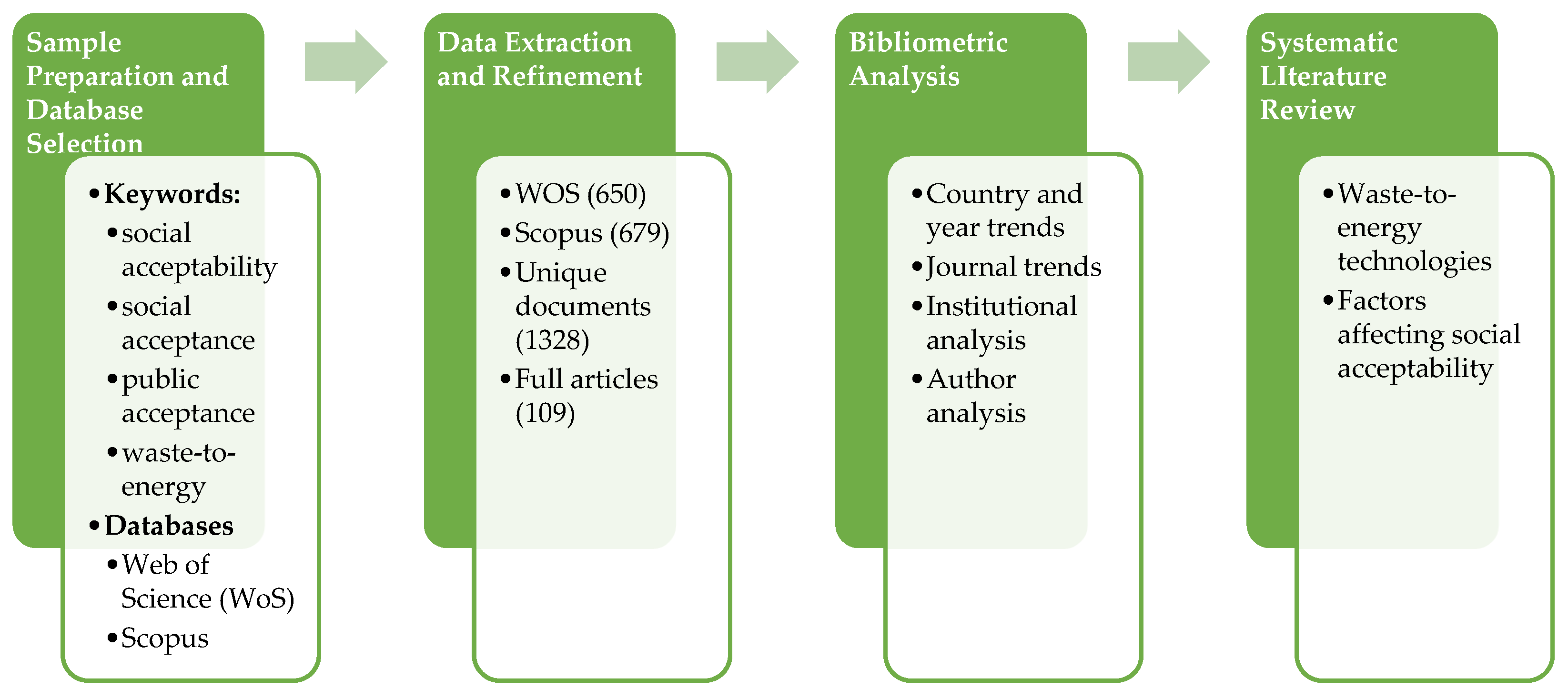
Figure 3.
Geographical distribution of WtE literature on social acceptability. (figure generated by authors using Microsoft Excel).
Figure 3.
Geographical distribution of WtE literature on social acceptability. (figure generated by authors using Microsoft Excel).
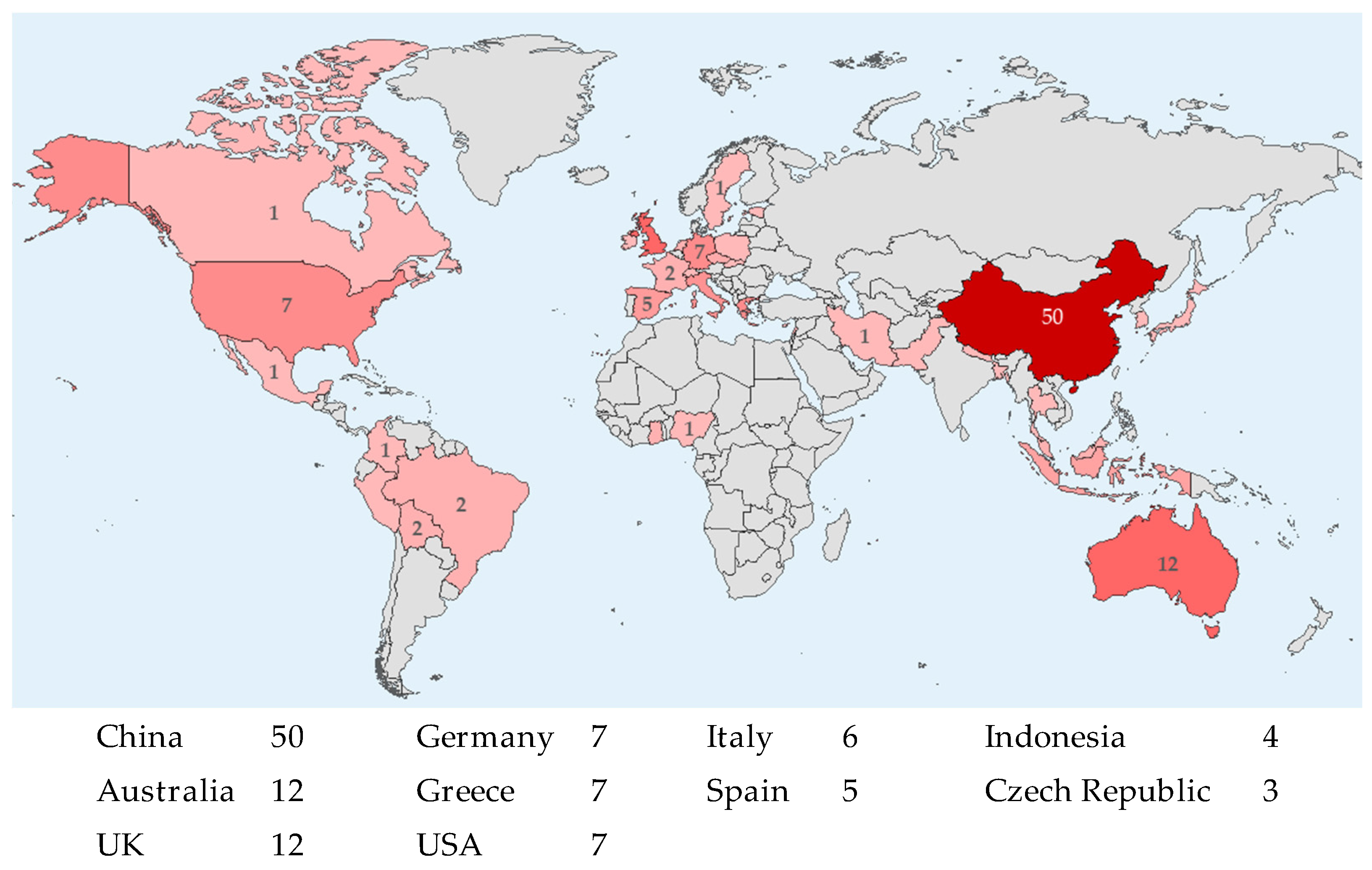
Figure 4.
Trends the year of publication.
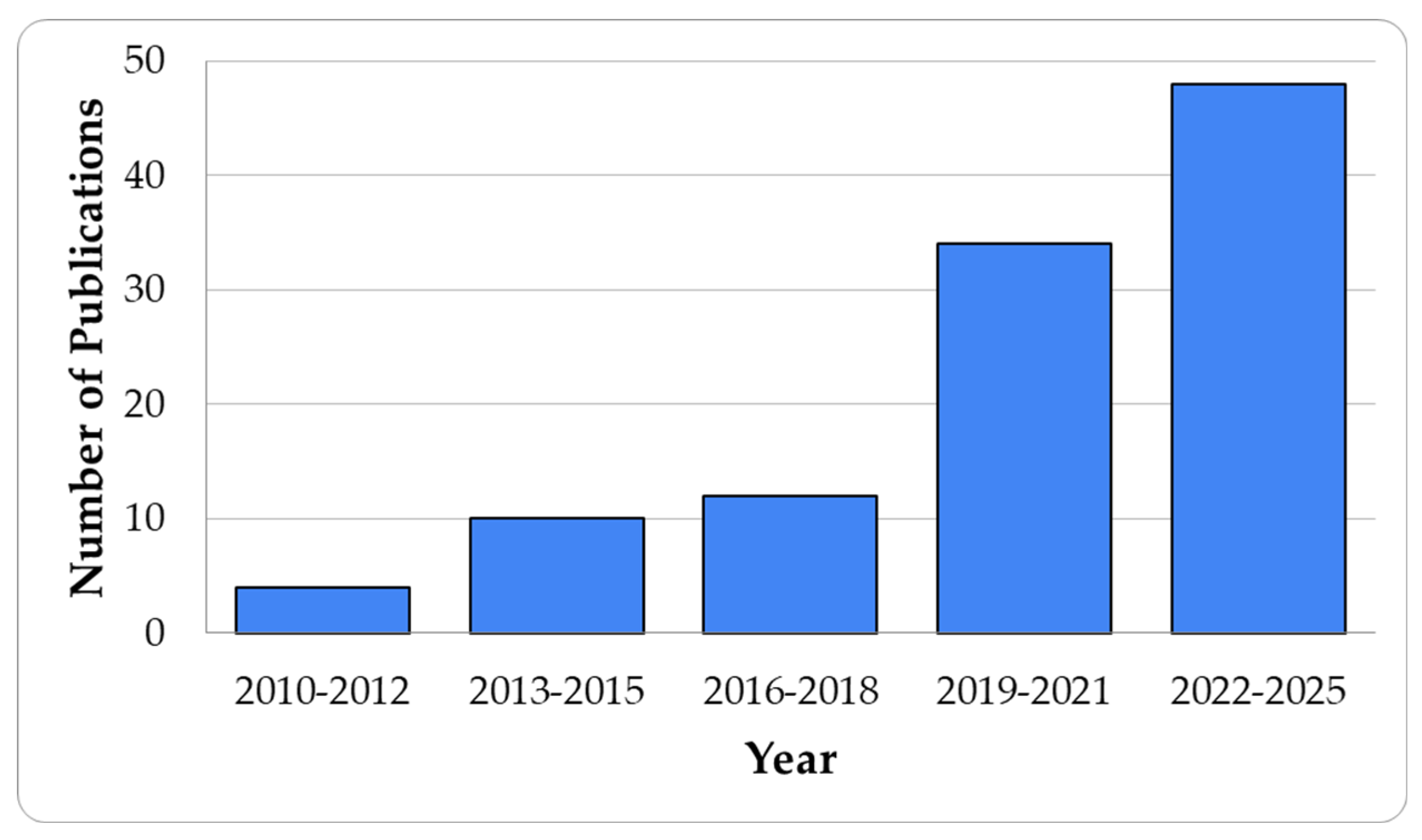
Figure 5.
Factors affecting the acceptability of waste-to-energy projects.
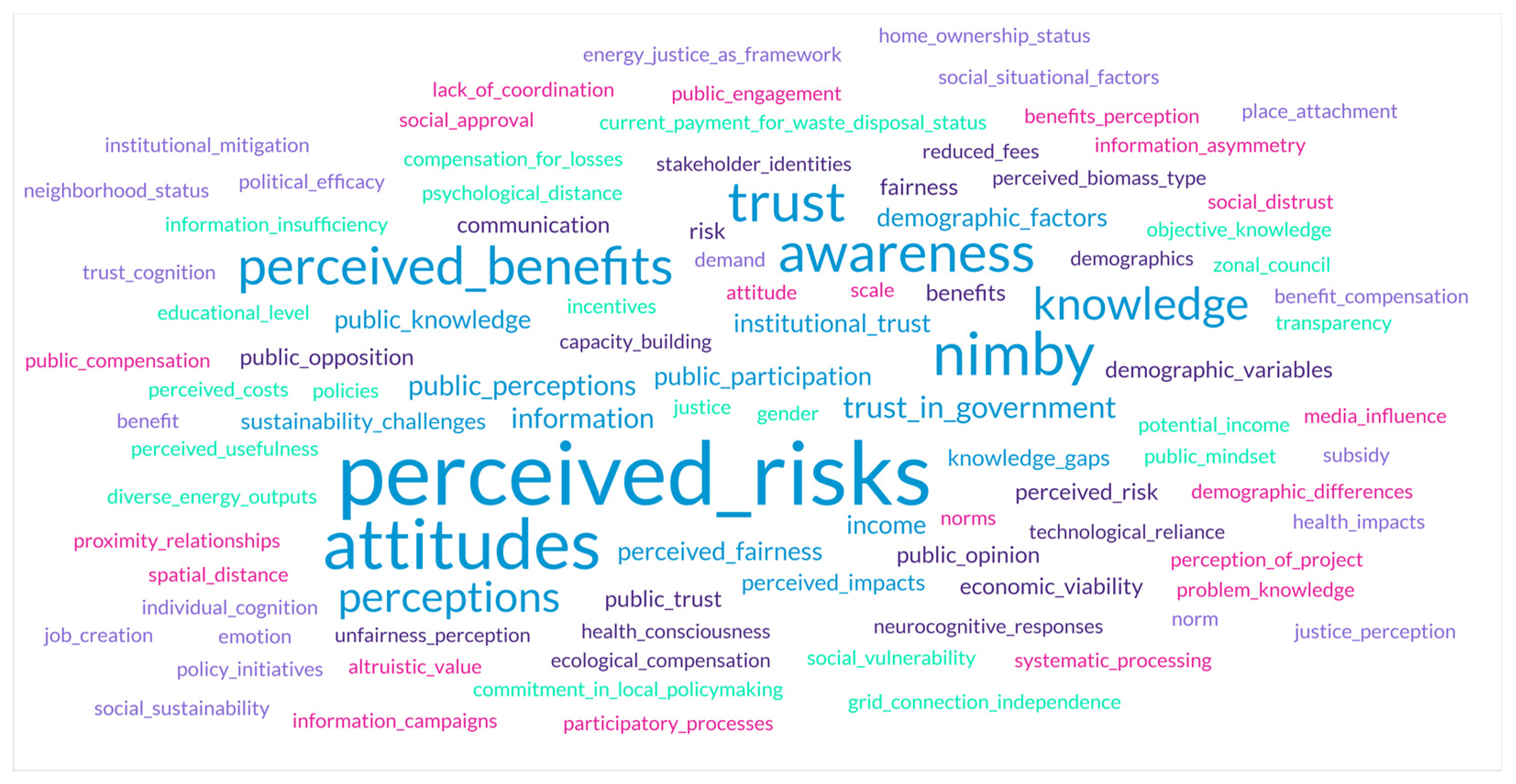
Table 2.
Top 10 most cited journals.
| Rank | Title | Total Citations |
| 1 | Waste Management | 558 |
| 2 | Journal of Cleaner Production | 289 |
| 3 | Resources, Conservation and Recycling | 190 |
| 4 | International Journal of Energy and Environmental Engineering | 141 |
| 5 | Energy | 108 |
| 6 | Habitat International | 100 |
| 7 | Environmental Impact Assessment Review | 92 |
| 8 | Sustainable Cities and Society | 89 |
| 9 | Technological Forecasting and Social Change | 88 |
| 10 | Sustainability | 85 |
Table 3.
Top 12 most productive institutions.
| Rank | Institution | Documents |
| 1 | Zhejiang Sci-Tech University | 13 |
| 2 | Queensland University of Technology | 10 |
| 3 | North China Institute of Science and Technology | 8 |
| 4 | Aristotle University | 7 |
| 5 | Bond University | 5 |
| 6-10 | Cranfield University | 4 |
| 6-10 | East China Normal University | 4 |
| 6-10 | Xiamen University | 4 |
| 6-10 | Tongji University | 4 |
| 6-10 | University of Technology Sydney | 4 |
| 11-12 | Nanjing University of Science & Technology | 3 |
| 11-12 | Hefei University of Technology | 3 |
Table 4.
Top 10 most cited institutions.
| Rank | Institution | Citations |
| 1 | Zhejiang Sci-Tech University | 393 |
| 2 | Queensland University of Technology | 357 |
| 3 | Aristotle University | 324 |
| 4 | North China Institute of Science and Technology | 321 |
| 5 | Cranfield University | 197 |
| 6 | Tongji University | 167 |
| 7 | East China Normal University | 154 |
| 8 | Nottingham Trent University | 138 |
| 9 | Xiamen University | 119 |
| 10 | Hefei University of Technology | 111 |
Table 5.
Top 7 most productive authors.
| Rank | Author | Documents |
| 1 | Liu Y. | 13 |
| 2-3 | Cui C. | 10 |
| 2-3 | Xia B. | 10 |
| 4 | Skitmore M. | 9 |
| 5-7 | Ke Y. | 4 |
| 5-7 | Vlachokostas C. | 4 |
| 5-7 | Xu M. | 4 |
Table 6.
Top 10 most-cited authors.
| Rank | Author | Citations |
| 1 | Liu Y. | 400 |
| 2 | Xia B. | 357 |
| 3 | Vlachokostas C. | 270 |
| 4 | Moussiopoulos N. | 266 |
| 5 | Skitmore M. | 248 |
| 6 | Sun CJY. | 168 |
| 7-8 | Garnett K. | 138 |
| 7-8 | Cooper T. | 138 |
| 9 | Ge YJ. | 131 |
| 10 | Jiang X | 113 |
Table 7.
Technologies analyzed the acceptability of waste-to-energy.
| Rank | Technology | Total Documents | Percentage |
| 1 | Incineration | 72 | 66% |
| 2 | Anaerobic digestion | 46 | 42% |
| 3 | Gasification | 7 | 6% |
| 4 | Pyrolysis | 6 | 6% |
| 5-6 | Refuse-derived fuel | 2 | 2% |
| 5-6 | Landfill with gas recovery | 2 | 2% |
Table 8.
The top 7 most common factors affecting the acceptability of waste-to-energy technologies.
| Rank | Technology | Total Documents | Percentage |
| 1 | Perceived risks | 29 | 27% |
| 2 | Trust | 23 | 21% |
| 3 | Attitudes | 21 | 19% |
| 4 | Perceived benefits | 18 | 17% |
| 5 | NIMBY | 17 | 15% |
| 6 | Awareness | 15 | 14% |
| 7 | Knowledge | 11 | 10% |
Disclaimer/Publisher’s Note: The statements, opinions and data contained in all publications are solely those of the individual author(s) and contributor(s) and not of MDPI and/or the editor(s). MDPI and/or the editor(s) disclaim responsibility for any injury to people or property resulting from any ideas, methods, instructions or products referred to in the content. |
© 2025 by the authors. Licensee MDPI, Basel, Switzerland. This article is an open access article distributed under the terms and conditions of the Creative Commons Attribution (CC BY) license (https://creativecommons.org/licenses/by/4.0/).
Copyright: This open access article is published under a Creative Commons CC BY 4.0 license, which permit the free download, distribution, and reuse, provided that the author and preprint are cited in any reuse.


