

Submitted:
13 February 2025
Posted:
16 February 2025
You are already at the latest version
Abstract
Blockchain technology has sparked significant interest and is currently being researched by academics and practitioners due to its potential to reduce transaction costs, improve the security of transactions, transparency, etc. However, there is still much doubt about its impacts, and the technology is still in its infancy, with varying degrees of adoption among different financial institutions. Structural Equation Modelling (SEM) analysis was utilized to test the impact of blockchain and dynamic capabilities on the Bankʹs Performance of top banks in Spain. The innovative approach seeks to understand how performance can be improved by deploying blockchain technology (BTE) in banks. Results showed a significant association between banks’ adoption of blockchain and the generation of dynamic capabilities and financial performance. Thus, we can confirm that a bank adopting blockchain will more likely create dynamic capabilities than those that do not. Hence, blockchain technology is an important tool for achieving dynamic capabilities and increasing performance in banks. Based on the findings, we suggest areas for additional research and highlight policy considerations related to the wider adoption of blockchain technology.
Keywords:
1. Introduction
2. Literature Review
2.1 Blockchain Technology (BC/BTE)
- Immutability: After a transaction is validated, it cannot be changed by nefarious parties.
- Traceability: The transaction history is fully and transparently audited.
- Consensus: To avoid conflicts, all participants agreed to a single dataset.
- Automation: Under specific circumstances, commands and transactions can be performed automatically.
2.2. Dynamic Capabilities (DC)
2.3. Development of the Conceptual Model and Hypotheses
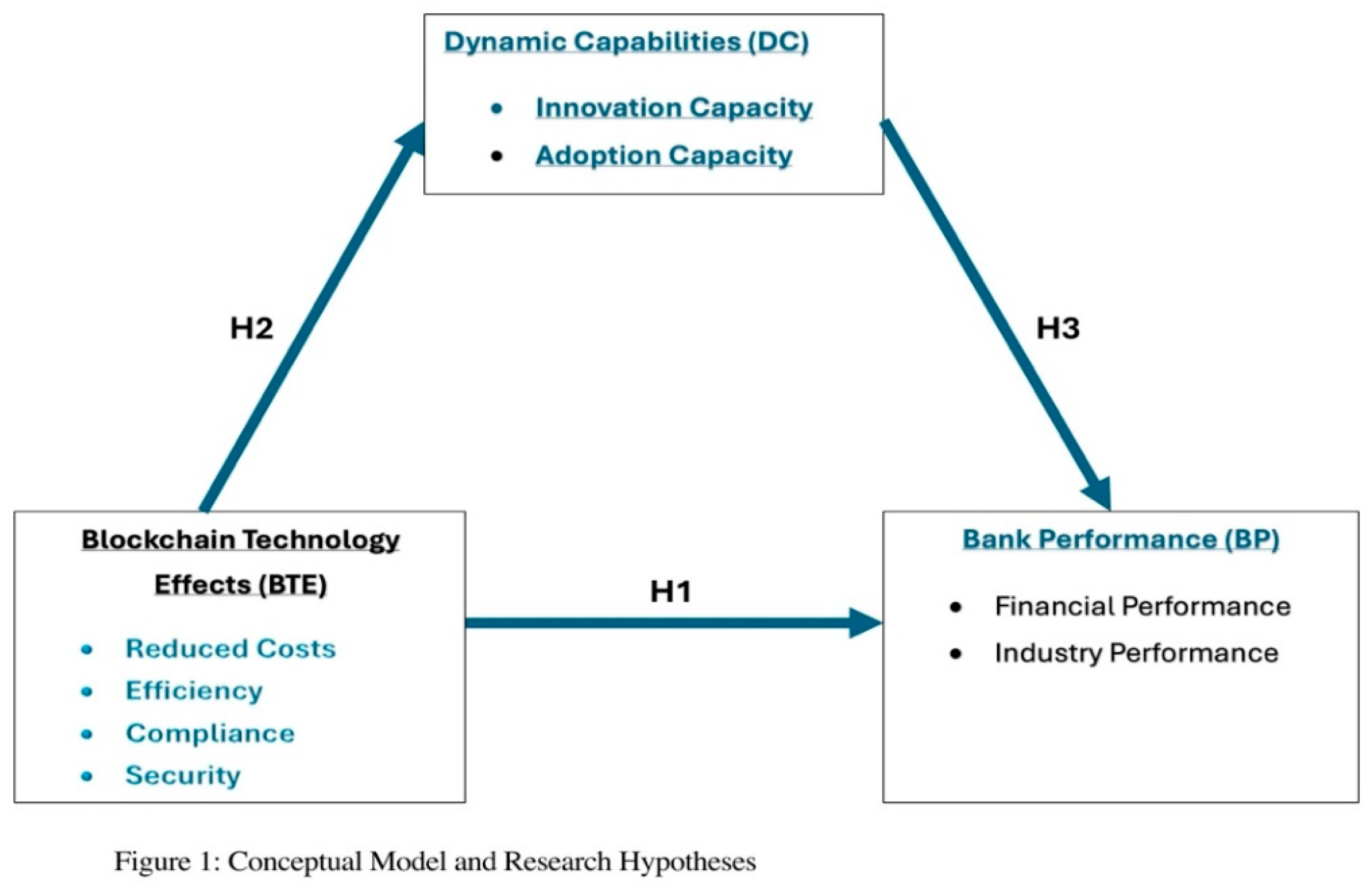
3. Methods
| Question | Brief explanation for including the question | Reference |
| Do you find it easy to use blockchain in your bank? | This question was to figure out banks that are using blockchain technology or not | [70] |
| If you were able to use blockchain, would this help you plan your activities better? | This question was to figure out banks that are using blockchain technology or not | [111] |
| How do you currently use blockchain technology? Select as many as you see possible | This question was to determine how blockchain is being use in banks | [27] |
| Do you find it hard to use blockchain that are appropriate for your products? | This question was to determine how blockchain is being use in banks | [27] |
| What information would you like to receive regarding blockchain efficiency? | This question was to determine how blockchain efficiency | [112] |
| How would you rate the following functions of blockchain? | This question was to determine blockchain functionality | [31] |
| How should the system work? Perhaps other features you would like to see? | This question was to determine blockchain features | [36] |
| What blockchain technology do you use most at your bank? | This question was to determine blockchain usage | [113] |
| Which of these blockchain technology do you use less often? | This question was to determine blockchain usage | [113] |
| What information should be included in a blockchain? | This question was to determine blockchain features | [36] |
| What are the potentials of blockchain technology? | This question was to determine blockchain features | [36] |
| What are the dangers of blockchain technology? | This question was to determine blockchain security and safety | [114] |
| How do you mitigate against these dangers of using blockchain technology? | This question was to determine blockchain security and safety | [114] |
| How should blockchain work? Perhaps other features you would like to see? | This question was to determine blockchain functionality | [31] |
| What stops your bank from using blockchain? | This question was to determine blockchain adoptability | [115] |
| Does BTE improves banks performance? | This question was to determine blockchain efficiency | [112] |
| Does BTE speed up your transactions? | This question was to determine blockchain efficiency | [112] |
| Does BTE provide more security for your transactions? | This question was to determine blockchain security and safety | [115] |
| Does BTE improves customers satisfaction? | This question was to determine blockchain efficiency | [112] |
| Does BTE Reduced operational costs? | This question was to determine blockchain efficiency | [112] |
| Does the usage of BTE comply with regulatory directives? | This question was to determine blockchain compliance with regulations | [116] |
| Does BTE improves your banks efficiency? | This question was to determine blockchain efficiency | [112] |
| Does BTE improve your bank financial performance? | This question was to determine blockchain efficiency | [112] |
| Does BTE increase your banks' market share? | This question was to determine blockchain performance | [117] |
| Does BTE increase your banks' ranking in the industry? | This question was to determine blockchain performance | [117] |
| Do you believe blockchain enhances your bank Absorption capacity? | This question was to determine banks blockchain capabilities | [118] |
| Do you believe blockchain improves your bank Adoption capacity? | This question was to determine banks blockchain capabilities | [118] |
| Do you believe blockchain boosts your bank detection capacity? | This question was to determine banks blockchain capabilities | [118] |
| Do you believe blockchain augments your bank Innovation capacity? | This question was to determine banks blockchain capabilities | [118] |
| Please state any other competitive advantages your bank enjoys from the use of blockchain technology? | This question was to determine banks competitive advantage using blockchain | [119] |
- (1)
- they reflect the target population for the final survey, and they are IT specialists in the banking industry with significant expertise in the deployment and implementation of blockchain technology.
- (2)
- In the academic sector, specialists whose research efforts are connected in some form to dynamic capabilities, banking performance, and/or economics were chosen.
4. Results
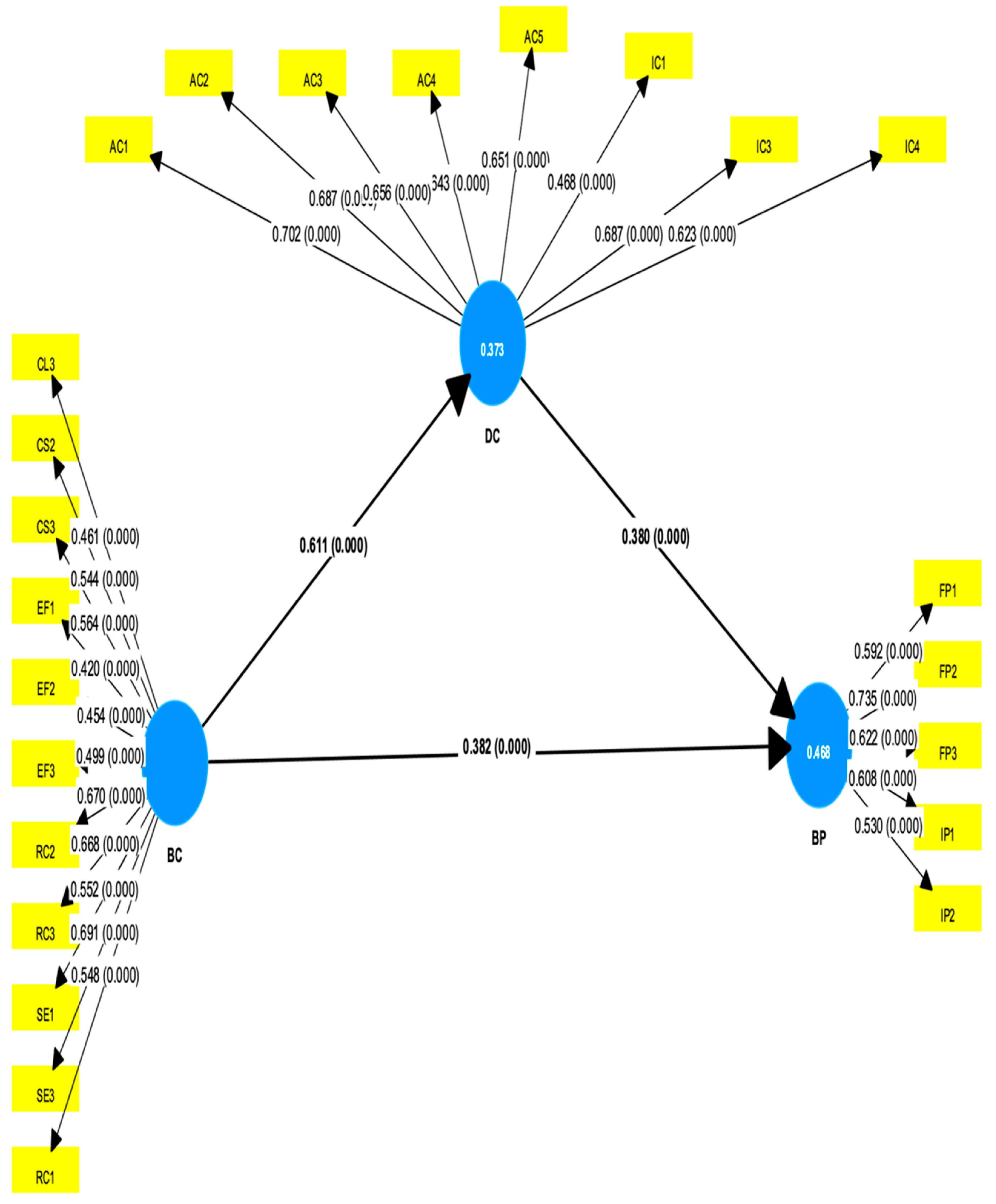

| R-square | |||||
| Original sample (o) | Sample mean (M) | Standard deviation (STDEV) | T-statistics ([O/STDEV]) | P values | |
| BP | 0,468 | 0,484 | 0,056 | 8,299 | 0,000 |
| DC | 0,373 | 0,387 | 0,057 | 6,494 | 0,000 |
| R-square adjusted | |||||
| Original sample (o) | Sample mean (M) | Standard deviation (STDEV) | T-statistics ([O/STDEV]) | P values | |
| BP | 0,461 | 0,477 | 0,057 | 8,089 | 0,000 |
| DC | 0,369 | 0,384 | 0,058 | 6,391 | 0,000 |
| f-square | |||||
| Original sample (o) | Sample mean (M) | Standard deviation (STDEV) | T-statistics ([O/STDEV]) | P values | |
| BTE-> BP | 0,172 | 0,188 | 0,077 | 2,232 | 0,026 |
| BTE-> DC | 0,595 | 0,647 | 0,157 | 3,783 | 0,000 |
| DC-> BP | 0,17 | 0,182 | 0,08 | 2,14 | 0,032 |
| average variance extracted (AVE) | |||||
| Original sample (o) | Sample mean (M) | Standard deviation (STDEV) | T-statistics ([O/STDEV]) | P values | |
| BTE | 0,312 | 0,314 | 0,026 | 11,855 | 0,000 |
| BP | 0,385 | 0,387 | 0,029 | 13,464 | 0,000 |
| DC | 0,414 | 0,416 | 0,027 | 15,432 | 0,000 |
| composite reliability (rho_c) | |||||
| Original sample (o) | Sample mean (M) | Standard deviation (STDEV) | T-statistics ([O/STDEV]) | P values | |
| BTE | 0,83 | 0,828 | 0,018 | 45,121 | 0,000 |
| BP | 0,756 | 0,754 | 0,024 | 31,791 | 0,000 |
| DC | 0,848 | 0,848 | 0,015 | 58,062 | 0,000 |
| composite reliability (rho_a) | |||||
| Original sample (o) | Sample mean (M) | Standard deviation (STDEV) | T-statistics ([O/STDEV]) | P values | |
| BTE | 0,787 | 0,787 | 0,028 | 28,566 | 0,000 |
| BP | 0,617 | 0,618 | 0,05 | 12,314 | 0,000 |
| DC | 0,803 | 0,805 | 0,022 | 36,464 | 0,000 |
| Cronbach's alpha | |||||
| Original sample (o) | Sample mean (M) | Standard deviation (STDEV) | T-statistics ([O/STDEV]) | P values | |
| BTE | 0,775 | 0,773 | 0,028 | 27,725 | 0,000 |
| BP | 0,607 | 0,604 | 0,047 | 13,011 | 0,000 |
| DC | 0,795 | 0,974 | 0,023 | 34,447 | 0,000 |
| Heterotrait-monotrait ratio (HTMT) | |||||
| Confidence intervals | |||||
| Original sample (o) | Sample mean (M) | 25% | 97.5% | ||
| BP <-> BTE | 0,868 | 0,87 | 0,725 | 1,012 | |
| DC <-> BTE | 0,761 | 0,763 | 0,654 | 0,863 | |
| DC <-> BP | 0,819 | 0,825 | 0,686 | 0,96 | |
| Fornell-Lacker Criterion | |||
| BTE | BP | DC | |
| BC | 0,559 | ||
| BP | 0,614 | 0,621 | |
| DC | 0,611 | 0,613 | 0,643 |
Indirect Effects
| Total Indirect effects | |||||
| Original sample (o) | Sample mean (M) | Standard deviation (STDEV) | T-statistics ([O/STDEV]) | P values | |
| BTE ->BP | 0,232 | 0,235 | 0,05 | 4,614 | 0,000 |
| Specific Indirect effects | |||||
| Original sample (o) | Sample mean (M) | Standard deviation (STDEV) | T-statistics ([O/STDEV]) | P values | |
| BTE->DC->BP | 0,232 | 0,235 | 0,05 | 4,614 | 0,000 |
| Total effects | |||||
| Original sample (o) | Sample mean (M) | Standard deviation (STDEV) | T-statistics ([O/STDEV]) | P values | |
| BTE-> BP | 0,614 | 0,624 | 0,049 | 12,512 | 0,000 |
| BTE-> DC | 0,611 | 0,621 | 0,047 | 13,055 | 0,000 |
| DC-> BP | 0,380 | 0,379 | 0,077 | 4,926 | 0,000 |
Validating Higher Order Construct
5. Discussions and Implications
6. Conclusion
- Sample limitations: The study sample focused on banks, many of which may still be in the early stages of blockchain adoption. Banks with limited blockchain experience may not yet be fully capitalizing on its potential, leading to less dramatic performance improvements.
- The novelty of the technology: Blockchain is still an emerging technology, and its widespread application across all banking operations remains limited.
- Many banks may still be in the pilot phase of blockchain projects, which limits observable performance improvements. The full benefits of blockchain adoption may only become apparent after further maturity and integration.
- Data processing tools: The tools used for data collection and analysis might not fully capture the complexity of the connections between Blockchain technology effects and performance. Future studies could benefit from more advanced data analytics tools to assess blockchain's impact more comprehensively.
Author Contributions
Funding
Data Availability Statement
Conflicts of Interest
Abbreviations
| MDPI | Multidisciplinary Digital Publishing Institute |
| BTE | Blockchain Technology Effects |
| BP | Banks’ Performance |
| BP | Dynamic Capabilities |
References
- J. Y. Lee, “A decentralized token economy: How blockchain and cryptocurrency can revolutionize business,” Business Horizons, vol. 62, no. 6, pp. 773–784, Nov. 2019. [CrossRef]
- M. Leal, F. Pisani, and M. Endler, “A Multilayer Distributed Ledger Technology Architecture for Immutable Registry of Mobility and Location Information,” 2022 IEEE 1st Global Emerging Technology Blockchain Forum: Blockchain & Beyond (iGETblockchain), vol. abs 1707 82, pp. 1–6, Nov. 2022. [CrossRef]
- A. Berentsen, “Aleksander Berentsen Recommends ‘Bitcoin: A Peer-to-Peer Electronic Cash System’ by Satoshi Nakamoto,” 21st Century Economics, pp. 7–8, 2019. [CrossRef]
- T. Ghossein and A. N. Rana, “Business Environment Reforms in Fragile and Conflict-Affected Situations,” Jan. 2022. [CrossRef]
- A. Ghosh, S. Gupta, A. Dua, and N. Kumar, “Security of Cryptocurrencies in blockchain technology: State-of-art, challenges and future prospects,” Journal of Network and Computer Applications, vol. 163, p. 102635, Aug. 2020. [CrossRef]
- N. O. Nawari and S. Ravindran, “Blockchain Technologies in BIM Workflow Environment,” Computing in Civil Engineering 2019, vol. 2016, pp. 343–352, Jun. 2019. [CrossRef]
- H. Juma, “Cross-Border Trade Through Blockchain,” Proceedings of the II International Triple Helix Summit, pp. 165–179, Dec. 2019. [CrossRef]
- N. Kshetri, “Blockchain Technology for Improving Transparency and Citizen’s Trust,” Advances in Information and Communication, pp. 716–735, 2021. [CrossRef]
- D. W. E. Allen, C. Berg, S. Davidson, M. Novak, and J. Potts, “International policy coordination for blockchain supply chains,” Asia & the Pacific Policy Studies, vol. 6, no. 3, pp. 367–380, May 2019. [CrossRef]
- K. S. Hald and A. Kinra, “How the blockchain enables and constrains supply chain performance,” International Journal of Physical Distribution & Logistics Management, vol. 49, no. 4, pp. 376–397, Jun. 2019. [CrossRef]
- P. Centobelli, R. Cerchione, P. D. Vecchio, E. Oropallo, and G. Secundo, “Blockchain technology for bridging trust, traceability, and transparency in the circular supply chain,” Information & Management, vol. 59, no. 7, p. 103508, Nov. 2022. [CrossRef]
- N. K. -, S. H. -, U. K. -, and S. S. -, “Blockchain in Supply Chain Management: Enhancing Transparency, Efficiency, and Trust,” Advanced International Journal of Multidisciplinary Research, vol. 2, no. 5, Oct. 2024. [CrossRef]
- J. Taskinsoy, “The Great Silent Crash of the 21st Century,” SSRN Electronic Journal, 2022. [CrossRef]
- B. Sakız and E. A. H. Gencer, “Cryptocurrencies, Blockchain Technology, and Sustainability,” International Conference on Eurasian Economies 2020, pp. 200–206, Sep. 2020. [CrossRef]
- N. M. Brennan, N. Subramaniam, and C. J. van Staden, “Corporate governance implications of disruptive technology: An overview,” The British Accounting Review, vol. 51, no. 6, p. 100860, Nov. 2019. [CrossRef]
- D. Tapscott and A. Tapscott, “How Blockchain Will Change Organizations,” What the Digital Future Holds, pp. 43–56, Jan. 2018. [CrossRef]
- N. Kshetri, “Will blockchain emerge as a tool to break the poverty chain in the Global South?” Third World Quarterly, vol. 38, no. 8, pp. 1710–1732, Apr. 2017. [CrossRef]
- Carter, C., & Koh, L., "Blockchain disruption in transport: are you decentralized yet? " 2018.
- B. Carson, G. Romanelli, P. Walsh, and A. Zhumaev, "Blockchain beyond the hype: What is the strategic business value," McKinsey & Company, vol. 1, pp. 1-13, 2018.
- S. Saberi, M. Kouhizadeh, J. Sarkis, and L. Shen, “Blockchain technology and its relationships to sustainable supply chain management,” International Journal of Production Research, vol. 57, no. 7, pp. 2117–2135, Oct. 2018. [CrossRef]
- M. Swan, “Anticipating the Economic Benefits of Blockchain,” Technology Innovation Management Review, vol. 7, no. 10, pp. 6–13, Oct. 2017. [CrossRef]
- E. Karafiloski and A. Mishev, “Blockchain solutions for big data challenges: A literature review,” IEEE EUROCON 2017 -17th International Conference on Smart Technologies, Jul. 2017. [CrossRef]
- F. Glaser and L. Bezzenberger, "Beyond Cryptocurrencies-a Taxonomy of Decentralized Consensus Systems," in 23rd European Conference on Information Systems (ECIS), Münster, Germany, March 2015.
- S. Miau and J.-M. Yang, “Bibliometrics-based evaluation of the Blockchain research trend: 2008 – March 2017,” Technology Analysis & Strategic Management, vol. 30, no. 9, pp. 1029–1045, Jan. 2018. [CrossRef]
- A. Kumari and N. C. Devi, “The Impact of FinTech and Blockchain Technologies on Banking and Financial Services,” Technology Innovation Management Review, vol. 12, no. 1/2, May 2022. [CrossRef]
- E. Chowdhury, A. Stasi, and A. Pellegrino, "Blockchain technology in financial accounting: emerging regulatory issues," Review of Financial Economics, vol. 21, pp. 862-868, 2023.
- P. Garg, B. Gupta, A. K. Chauhan, U. Sivarajah, S. Gupta, and S. Modgil, “Measuring the perceived benefits of implementing blockchain technology in the banking sector,” Technological Forecasting and Social Change, vol. 163, p. 120407, Feb. 2021. [CrossRef]
- M. Javaid, A. Haleem, R. P. Singh, R. Suman, and S. Khan, “A review of Blockchain Technology applications for financial services,” Bench Council Transactions on Benchmarks, Standards and Evaluations, vol. 2, no. 3, p. 100073, Jul. 2022. [CrossRef]
- A. Gupta and S. Gupta, “Blockchain Technology Application in Indian Banking Sector,” Delhi Business Review, vol. 19, no. 2, pp. 75–84, Nov. 2018. [CrossRef]
- S. Underwood, “Blockchain beyond Bitcoin,” Communications of the ACM, vol. 59, no. 11, pp. 15–17, Oct. 2016. [CrossRef]
- F. Casino, T. K. Dasaklis, and C. Patsakis, “A systematic literature review of blockchain-based applications: Current status, classification and open issues,” Telematics and Informatics, vol. 36, pp. 55–81, Mar. 2019. [CrossRef]
- N. Kant, “Blockchain: a strategic resource to attain and sustain competitive advantage,” International Journal of Innovation Science, vol. 13, no. 4, pp. 520–538, Feb. 2021. [CrossRef]
- M. Pilkington, “Blockchain technology: principles and applications,” Research Handbook on Digital Transformations, Sep. 2016. [CrossRef]
- B. Libert, M. Beck, and J. Wind, "How blockchain technology will disrupt financial services firms," Knowledge@Wharton, 2016. Available online: http://knowledge.wharton.upenn.edu/article/blockchain-technology-will-disrupt-fnancial-services/firms.
- W. Mu, Y. Bian, and J. L. Zhao, “The role of online leadership in open collaborative innovation: Evidence from blockchain open-source projects,” Industrial Management & Data Systems, 2019.
- T. Beck, T. Chen, C. Lin, and F. M. Song, "Financial innovation: The bright and the dark sides," Journal of Banking & Finance, vol. 72, pp. 28-51, 2016.
- S. M. English and E. Nezhadian, “Conditions of Full Disclosure: The Blockchain Remuneration Model,” 2017 IEEE European Symposium on Security and Privacy Workshops (Eurocamp), pp. 64–67, Apr. 2017. [CrossRef]
- F. Gao, L. Zhu, M. Shen, K. Sharif, Z. Wan, and K. Ren, "A blockchain-based privacy-preserving payment mechanism for vehicle-to-grid networks," IEEE Network, vol. 32, no. 6, pp. 184-192, 2018.
- T. Lundqvist, A. De Blanche, and H. R. H. Andersson, “Thing-to-thing electricity micropayments using blockchain technology,” in 2017 Global Internet of Things Summit (GIoTS), pp. 1-6, 2017.
- G. Papadopoulos, "Blockchain and digital payments: an institutionalist analysis of Cryptocurrencies," in Handbook of Digital Currency, Academic Press, pp. 153-172, 2015.
- Y. Yamada, T. Nakajima, and M. Sakamoto, "Blockchain-LI: a study on implementing activity-based micro-pricing using cryptocurrency technologies," in Proc. 14th Int. Conf. Advances in Mobile Computing and Multi-Media, pp. 203–207, 2016.
- Y. Guo and C. Liang, "Blockchain application and outlook in the banking industry," Financial Innovation, vol. 2, no. 1, pp. 1-12, 2016.
- M. Isaksen, Blockchain: The Future of Cross Border Payments, master’s thesis, University of Stavanger, Norway, 2018.
- H. Hassani, X. Huang, and E. Silva, "Banking with blockchain-ed big data," Journal of Management Analytics, vol. 5, no. 4, pp. 256-275, 2018.
- M. A. Hitt, L. Bierman, K. Shimizu, and R. Kochhar, “Direct and Moderating Effects of Human Capital on Strategy and Performance in Professional Service Firms: A Resource-Based Perspective,” Academy of Management Journal, vol. 44, no. 1, pp. 13–28, Feb. 2001. [CrossRef]
- J. Barney, "Firm resources and sustained competitive advantage," Journal of Management Science, vol. 17, no. 1, pp. 99-120, 1991.
- A. Grech and A. F. Camilleri, “Blockchain in Education,” Luxembourg: Publications Office of the European Union, 2017.
- C. L. Wang, C. Senaratne, and M. Rafiq, “Success Traps, Dynamic Capabilities and Firm Performance,” British Journal of Management, vol. 26, no. 1, pp. 26–44, Aug. 2014. [CrossRef]
- J. B. Barney and A. M. Arikan, "The resource-based view: origins and implications," The Blackwell Handbook of Strategic Management, 2001. [CrossRef]
- D. J. Teece, "Explicating dynamic capabilities: The nature and micro-foundations of (sustainable) enterprise performance," Strategic Management Journal, vol. 28, no. 13, pp. 1319–1350, 2007.
- J. Weerawardena and F. T. Mavondo, “Capabilities, innovation and competitive advantage,” Industrial Marketing Management, vol. 40, no. 8, pp. 1220–1223, Nov. 2011. [CrossRef]
- D. Teece and G. Pisano, “The Dynamic Capabilities of Firms: an Introduction,” Industrial and Corporate Change, vol. 3, no. 3, pp. 537–556, 1994. [CrossRef]
- T. Gundu, "Learn, Unlearn and Relearn: Adaptive Cybersecurity Culture Model," International Conference on Cyber Warfare and Security, vol. 19, no. 1, pp. 95-102, 2024.
- C. Baden-Fuller and D. Teece, "Market sensing, dynamic capability, and competitive dynamics," Industrial Marketing Management, vol. 89, pp. 105-106, 2020. [CrossRef]
- N. Petit and D. J. Teece, “Innovating Big Tech firms and competition policy: favoring dynamic over static competition,” Industrial and Corporate Change, vol. 30, no. 5, pp. 1168–1198, Sep. 2021. [CrossRef]
- F. Pasquale, “The Black Box Society,” Jan. 2015. [CrossRef]
- N. Kant and N. Agrawal, “Developing a measure of climate strategy proactivity displayed to attain competitive advantage,” Competitiveness Review: An International Business Journal, vol. 31, no. 5, pp. 832–862, Nov. 2020. [CrossRef]
- M. E. Porter, “Industry Structure and Competitive Strategy: Keys to Profitability,” Financial Analysts Journal, vol. 36, no. 4, pp. 30–41, Jul. 1980. [CrossRef]
- T. Cater and D. Pucko, "How competitive advantage influences firm performance: the case of Slovenian firms," Economic and Business Review, vol. 7, (2), pp. 119-135, 2005.
- Z. Arifin and Frmanzah, “The Effect of Dynamic Capability to Technology Adoption and its Determinant Factors for Improving Firm’s Performance; Toward a Conceptual Model,” Procedia - Social and Behavioral Sciences, vol. 207, pp. 786–796, Oct. 2015. [CrossRef]
- A. Ionescu and N. R. Dumitru, "The role of innovation in creating the company’s competitive advantage," Ecoforum Journal, vol. 4, no. 1, pp. 99-104, 2015.
- X. A. Koufteros, *Time-Based Competition: Developing a Nomological Network of Constructs and Instrument Development*, Unpublished Dissertation, 1995.
- J. Zhang, “The nature of external representations in problem-solving,” Cognitive Science, vol. 21, no. 2, pp. 179–217, Jun. 1997. [CrossRef]
- S. Li, B. Ragu-Nathan, T. S. Ragu-Nathan, and S. Subba Rao, “The impact of supply chain management practices on competitive advantage and organizational performance,” Omega, vol. 34, no. 2, pp. 107–124, Apr. 2006. [CrossRef]
- K. M. Eisenhardt and J. A. Martin, “Dynamic capabilities: what are they?” Strategic Management Journal, vol. 21, no. 10–11, pp. 1105–1121, 2000.
- C. E. Helfat and S. G. Winter, “Untangling Dynamic and Operational Capabilities: Strategy for the (N)ever-Changing World,” Strategic Management Journal, vol. 32, no. 11, pp. 1243–1250, Aug. 2011. [CrossRef]
- D. J. Teece, G. Pisano, and A. Shuen, “Dynamic Capabilities and Strategic Management,” Resources, Firms, And Strategies, pp. 268–285, Dec. 1997. [CrossRef]
- B. Blagoev, T. Hernes, S. Kunisch, and M. Schultz, “Time as a Research Lens: A Conceptual Review and Research Agenda,” Journal of Management, vol. 50, no. 6, pp. 2152–2196, Dec. 2023. [CrossRef]
- J. Wollersheim and K. H. Heimeriks, “Dynamic Capabilities and Their Characteristic Qualities: Insights from a Lab Experiment,” Organization Science, vol. 27, no. 2, pp. 233–248, Mar. 2016. [CrossRef]
- N. Dashkevich, S. Counsell, and G. Destefanis, “Blockchain Application for Central Banks: A Systematic Mapping Study,” IEEE Access, vol. 8, pp. 139918–139952, 2020. [CrossRef]
- C. E. Helfat and M. A. Peteraf, "Understanding dynamic capabilities: progress along a developmental path," Strategic Organization, vol. 7, no. 1, pp. 91-102, 2009. [CrossRef]
- S. A. Zahra and G. George, “Absorptive Capacity: A Review, Reconceptualization, and Extension,” Academy of Management Review, vol. 27, no. 2, pp. 185–203, Apr. 2002. [CrossRef]
- S. K. Cohen and T. Caner, “Converting inventions into breakthrough innovations: The role of exploitation and alliance network knowledge heterogeneity,” Journal of Engineering and Technology Management, vol. 40, pp. 29–44, Apr. 2016. [CrossRef]
- C. L. Wang and P. K. Ahmed, “Dynamic capabilities: A review and research agenda,” International Journal of Management Reviews, vol. 9, no. 1, pp. 31–51, Feb. 2007. [CrossRef]
- U. Lichtenthaler and E. Lichtenthaler, “A Capability-Based Framework for Open Innovation: Complementing Absorptive Capacity,” Journal of Management Studies, vol. 46, no. 8, pp. 1315–1338, Oct. 2009. [CrossRef]
- C. Gallego-Gomez and C. De-Pablos-Heredero, “Artificial Intelligence as an Enabling Tool for the Development of Dynamic Capabilities in the Banking Industry,” International Journal of Enterprise Information Systems, vol. 16, no. 3, pp. 20–33, Jul. 2020. [CrossRef]
- J. Fahy, “The resource-based view of the firm: some stumbling-blocks on the road to understanding sustainable competitive advantage,” Journal of European Industrial Training, vol. 24, no. 2/3/4, pp. 94–104, Mar. 2000. [CrossRef]
- M. T. Tsai and C. M. Shih, The impact of marketing knowledge among managers on marketing capabilities and business performance, International Journal of Management, vol. 21, no. 4, pp. 524-530, 2004.
- N. A. Morgan, D. W. Vorhies, and C. H. Mason, “Market orientation, marketing capabilities, and firm performance,” Strategic Management Journal, vol. 30, no. 8, pp. 909–920, Mar. 2009. [CrossRef]
- J. Guimaraes, E. Severo, and C. Vasconcelos, “Sustainable Competitive Advantage: A Survey of Companies in Southern Brazil,” Brazilian Business Review, vol. 14, no. 3, pp. 352–367, May 2017. [CrossRef]
- K. Harrington, “Distributed autonomous learning framework,” Disruptive Technologies in Information Sciences II, p. 21, Jul. 2019. [CrossRef]
- A. McCauley unblocked: How Blockchains Will Change Your Business (and What to Do About It). Sebastopol, CA: O'Reilly Media, Inc., 2019.
- A. Basul, "The future of competitive advantage in banking and payments," bobsguide.com, 2021. Available online: https://www.bobsguide.com/articles/the-future-of-competitive-advantage-in banking-and-payments/.
- C. K. Prahalad and G. Hamel, “The Core Competence of the Corporation,” Strategische Unternehmungsplanung — Strategische Unternehmungsführung, pp. 275–292. [CrossRef]
- T. L. Esper, C. Clifford Defee, and J. T. Mentzer, “A framework of supply chain orientation,” The International Journal of Logistics Management, vol. 21, no. 2, pp. 161–179, Aug. 2010. [CrossRef]
- W. T. Moran, "Research on discrete consumption markets can guide resource shifts, help increase profitability," Marketing News, vol. 14, no. 23, p. 4, 1981.
- F. Seyedjafarrangraz, C. De Fuentes, and M. Zhang, “Mapping the global regulatory terrain in digital banking: a longitudinal study across countries,” Digital Policy, Regulation and Governance, Nov. 2024. [CrossRef]
- E. Palmieri and E. F. Geretto, Adapting to Change. Palgrave Macmillan Studies in Banking and Financial Institutions, 2023.
- J. Ferreira, A. Coelho, and L. Moutinho, “Dynamic capabilities, creativity, and innovation capability and their impact on competitive advantage and firm performance: The moderating role of entrepreneurial orientation,” Technovation, vol. 92–93, p. 102061, Apr. 2020. [CrossRef]
- A. H. Trani and D. A. Tran, “CUSTOMER EXPERIENCE AND SATISFACTION WITH DIGITAL BANKING SERVICES,” Proceeding of International Conference on Business, Economics, Social Sciences, and Humanities, vol. 7, pp. 548–555, Jun. 2024. [CrossRef]
- T. Heubeck, “Managerial capabilities as facilitators of digital transformation? Dynamic managerial capabilities as antecedents to digital business model transformation and firm performance,” Digital Business, vol. 3, no. 1, p. 100053, Jun. 2023. [CrossRef]
- W. Probojakti, H. N. Utami, A. Prasetya, and M. F. Riza, “Building Sustainable Competitive Advantage in Banking through Organizational Agility,” Sustainability, vol. 16, no. 19, p. 8327, Sep. 2024. [CrossRef]
- G. A. Churchill, “A Paradigm for Developing Better Measures of Marketing Constructs,” Journal of Marketing Research, vol. 16, no. 1, pp. 64–73, Feb. 1979. [CrossRef]
- P. Garg, B. Gupta, K. N. Kapil, U. Sivarajah, and S. Gupta, “Examining the relationship between Blockchain technology effects and organizational performance in the Indian banking sector,” Annals of Operations Research, Mar. 2023. [CrossRef]
- H. W. Marsh, K.-T. Hau, J. R. Balla, and D. Grayson, “Is More Ever Too Much? The Number of Indicators per Factor in Confirmatory Factor Analysis,” Multivariate Behavioral Research, vol. 33, no. 2, pp. 181–220, Apr. 1998. [CrossRef]
- J. Hulland, “Use of partial least squares (PLS) in strategic management research: a review of four recent studies,” Strategic Management Journal, vol. 20, no. 2, pp. 195–204, Feb. 1999.
- J. F. Hair, G. T. M. Hult, C. M. Ringle, M. Sarstedt, N. P. Danks, and S. Ray, “An Introduction to Structural Equation Modeling,” Partial Least Squares Structural Equation Modeling (PLS-SEM) Using R, pp. 1–29, 2021. [CrossRef]
- J. F. Hair Jr, M. Sarstedt, L. Hopkins, and V. G. Kuppelwieser, “Partial least squares structural equation modeling (PLS-SEM),” European Business Review, vol. 26, no. 2, pp. 106–121, Mar. 2014. [CrossRef]
- J. Yli-Huumo, D. Ko, S. Choi, S. Park, and K. Smolander, “Where Is Current Research on Blockchain Technology? —A Systematic Review,” PLOS ONE, vol. 11, no. 10, p. e0163477, Oct. 2016. [CrossRef]
- S. Saberi, M. Kouhizadeh, J. Sarkis, and L. Shen, “Blockchain technology and its relationships to sustainable supply chain management,” International Journal of Production Research, vol. 57, no. 7, pp. 2117–2135, Oct. 2018. [CrossRef]
- M. Torrado Fonseca, M. Reguant Álvarez, and C. Quirós Domínguez, “DELPHI METHOD ON TRANSITIONS AND ACCESS PATHS TO MASTER'S DEGREES IN SOCIAL SCIENCES IN SPAIN,” Education: Theories, Methods, and Perspectives Vol I, pp. 248–258, Apr. 2021. [CrossRef]
- P. Nasa, R. Jain, and D. Juneja, “Delphi methodology in healthcare research: How to decide its appropriateness,” World Journal of Methodology, vol. 11, no. 4, pp. 116–129, Jul. 2021. [CrossRef]
- F. Krebs et al., “Transforming Health Care Delivery towards Value-Based Health Care in Germany: A Delphi Survey among Stakeholders,” Healthcare, vol. 11, no. 8, p. 1187, Apr. 2023. [CrossRef]
- Y. Y. Phoi, M. P. Bonham, M. Rogers, J. Dorrian, and A. M. Coates, “Content Validation of a Chrono nutrition Questionnaire for the General and Shift Work Populations: A Delphi Study,” Nutrients, vol. 13, no. 11, p. 4087, Nov. 2021. [CrossRef]
- C. Vélez Álvarez, J. A. Vidarte Claros, A. Arango Arenas, B. E. Patiño Palma, and Y. A. Rondón Villamil, “Adaptation and validation of content of the sedentary behavior questionnaire,” Hacia la Promoción de la Salud, vol. 26, no. 1, pp. 148–162, Jan. 2021. [CrossRef]
- M. Arribas, "Design and validation of questionnaires," Midwives profession, vol. 5, no. 17, pp. 23-29, 2004.
- M. de L. Bravo Estévez and J. J. Arrieta Gallastegui, “The Delphi method. Its implementation in a didactic strategy for teaching geometric demonstrations,” Ibero-American Journal of Education, vol. 36, no. 7, pp. 1–10, Sep. 2005. [CrossRef]
- A. Flostrand, L. Pitt, and S. Bridson, “The Delphi technique in forecasting– A 42-year bibliographic analysis (1975–2017),” Technological Forecasting and Social Change, vol. 150, p. 119773, Jan. 2020. [CrossRef]
- E. López-Gómez, “THE DELPHI METHOD IN CURRENT RESEARCH IN EDUCATION: A THEORETICAL AND METHODOLOGICAL REVIEW,” Education XX1, vol. 21, no. 1, Nov. 2017. [CrossRef]
- A. Meafa, A. C. Benabdellah, and K. Zekhnini, “Enhancing Supply Chain Resilience Through Dynamic Capabilities of Blockchain Technology: A Structural Model Analysis,” Procedia Computer Science, vol. 232, pp. 980–989, 2024. [CrossRef]
- R. Patel, M. Migliavacca, and M. E. Oriani, “Blockchain in banking and finance: A bibliometric review,” Research in International Business and Finance, vol. 62, p. 101718, Dec. 2022. [CrossRef]
- Z. Guan, Y. Zhang, L. Zhu, L. Wu, and S. Yu, “EFFECT: an efficient flexible privacy-preserving data aggregation scheme with authentication in smart grid,” Science China Information Sciences, vol. 62, no. 3, Jan. 2019. [CrossRef]
- G. Tripathi, M. A. Ahad, and G. Casalino, “A comprehensive review of blockchain technology: Underlying principles and historical background with future challenges,” Decision Analytics Journal, vol. 9, p. 100344, Dec. 2023. [CrossRef]
- G. Habib, S. Sharma, S. Ibrahim, I. Ahmad, S. Qureshi, and M. Ishfaq, “Blockchain Technology: Benefits, Challenges, Applications, and Integration of Blockchain Technology with Cloud Computing,” Future Internet, vol. 14, no. 11, p. 341, Nov. 2022. [CrossRef]
- P. Baudier, V. Chang, H. Zhang, Q. Xu, J. Zhang, and M. Arami, “How Blockchain can impact financial services – The overview, challenges, and recommendations from expert interviewees,” Technological Forecasting and Social Change, vol. 158, p. 120166, Sep. 2020. [CrossRef]
- M. Mannan, P. de Filippi, and W. Reijers, “The Emergence of Blockchain Constitutionalism,” The Oxford Handbook of Digital Constitutionalism, Oct. 2024. [CrossRef]
- S. Chava, A. Oettl, A. Subramanian, and K. Subramanian, “Bargaining Power, Banking Deregulation, and Innovation,” SSRN Electronic Journal, 2012. [CrossRef]
- A. Sharma, D. Sharma, and R. Bansal, “Emerging Role of Blockchain in Banking Operations: An Overview,” Contemporary Studies of Risks in Emerging Technology, Part A, pp. 1–12, May 2023. [CrossRef]
- M. Vinod Ramchandra, K. Kumar, A. Sarkar, S. Kr. Mukherjee, and K. Agarwal, “Assessment of the impact of blockchain technology in the banking industry,” Materials Today: Proceedings, vol. 56, pp. 2221–2226, 2022. [CrossRef]
| Variables | Categories | Frequency | Response rate ( %) |
| Gender | Female | 67 | 39.4% |
| Male | 103 | 60.6% | |
| Age | 25–35 | 79 | 46.65% |
| 35–50 | 75 | 43.83% | |
| Age | 51 and above | 16 | 9.25% |
Disclaimer/Publisher’s Note: The statements, opinions and data contained in all publications are solely those of the individual author(s) and contributor(s) and not of MDPI and/or the editor(s). MDPI and/or the editor(s) disclaim responsibility for any injury to people or property resulting from any ideas, methods, instructions or products referred to in the content. |
© 2025 by the authors. Licensee MDPI, Basel, Switzerland. This article is an open access article distributed under the terms and conditions of the Creative Commons Attribution (CC BY) license (http://creativecommons.org/licenses/by/4.0/).