

Submitted:
04 June 2026
Posted:
05 June 2026
You are already at the latest version
Abstract
This integrative review traces the evolution of journalism in Saudi Arabia from its origins in early state communication to a contemporary, digitally networked media ecosystem. Drawing on peer-reviewed scholarships, official documentation, and verifiable industry data, the study situates the Kingdom’s media transformation within the wider programme of socio-economic reform associated with Vision 2030 and interrogates the interaction among regulatory governance, cultural continuity, economic diversification, and technological innovation. Using Whittemore and Knafl’s (2005) integrative method and a comparative media-systems lens (Hallin & Mancini, 2004, 2012), the analysis synthesises historical milestones, current connectivity indicators, and market estimates, and it corrects several errors that recur in secondary accounts—most notably the dating of the first radio (1949) and television (1965) services and the institutional lineage of contemporary media regulation. By January 2025, internet and social-media penetration had reached approximately 99% of the population (Kemp, 2025), reshaping production, distribution, and consumption of news, while female labour-force participation rose from 23.2% in 2016 to roughly 35% by 2023, surpassing the Vision 2030 target ahead of schedule (World Bank, 2026). The findings describe a model of managed modernisation in which media reform is deliberately sequenced to align with national development while preserving social cohesion. The review contributes to scholarship on media development in non-Western contexts and offers evidence-based recommendations for policymakers, media organisations, educators, technology developers, and international partners.
Keywords:
journalism
; Saudi Arabia
; media transformation
; digital media
; Vision 2030
; media regulation
; press history
; public sphere
1. Introduction
Contemporary journalism in Saudi Arabia occupies the meeting point of an established cultural and religious tradition, exceptionally rapid technological adoption, and an ambitious national-development agenda. Since the launch of Vision 2030 in 2016, the Kingdom’s media landscape has been reshaped through policy reform, institutional reorganisation, and sustained investment in digital infrastructure (Saudi Vision 2030, 2024). To make sense of this trajectory, present-day developments must be situated within a longer institutional history that begins in the early twentieth century, alongside the consolidation of the modern Saudi state under King ʻAbd al-ʻAzīz Al Saʻud. Understood in this way, Saudi journalism is neither a simple replica of Western models nor a static instrument of state communication; it is a distinctive system whose form has been negotiated continuously between local imperatives and global pressures (Mellor, 2022).
The starting point of organised journalism in the Kingdom is the official gazette Umm al-Qurā, first issued in 1924—roughly eight years before the formal unification of the Kingdom (Ministry of Media, n.d.). The gazette published royal decrees, official statements, and religious guidance, and it established a durable template in which the press functioned as an instrument of governance, religious communication, and national cohesion. Subsequent decades saw the introduction of radio broadcasting in 1949 and television in 1965, extending public communication to non-literate audiences and to geographically dispersed populations (Boyd, 1999; Ministry of Media, n.d.). These foundational choices—state stewardship paired with incremental technological adoption—continue to inform the system’s contemporary logic.
The digital era has transformed that logic at every level of the value chain. The diffusion of high-speed connectivity, smartphones, and social platforms has produced a participatory information environment in which audiences are simultaneously consumers and producers of content. By the start of 2025, internet penetration stood at approximately 99% and social-media adoption was equivalent to 99.6% of the population (Kemp, 2025). These conditions have generated both opportunities—greater interactivity, new professional pathways, and expanded civic expression—and tensions concerning content governance, information integrity, and the balance between openness and social stability (Al-Ghamdi, 2021; Mellor, 2023).
This review pursues three objectives. First, it reconstructs the historical development of Saudi journalism using primary documentation, correcting several dates and institutional claims that have circulated inaccurately in secondary sources. Second, it synthesises the contemporary evidence on connectivity, regulation, economics, gender, and the public sphere to characterise the present-day Saudi media system. Third, it interprets these findings through comparative media-systems theory and distills implications for the principal stakeholders. The overarching aim is to provide scholars, practitioners, and policymakers with an accurate, evidence-based account of how Saudi journalism has evolved and where it is heading.
The significance of this analysis is threefold. Empirically, it consolidates dispersed and sometimes inconsistent evidence into a single, source-verified account, providing a reliable reference point for future research. Theoretically, it tests the explanatory reach of comparative media-systems theory in a Gulf context, contributing to the wider project of de-Westernising media studies by treating the Saudi system as a coherent configuration rather than a deviation from a liberal norm (Hallin & Mancini, 2012; Mellor, 2022). Practically, it converts synthesis into guidance, offering stakeholders a calibrated reading of opportunities and constraints. In combining these contributions, the review responds to a recurring weakness in the regional literature—reliance on unverified figures and misremembered dates—by foregrounding verification as a methodological commitment rather than an afterthought.
The article proceeds as follows. The literature review situates the study within comparative media-systems theory and seven thematic strands of scholarship. The methodology and analytical-framework sections set out the integrative design and the verification procedure. The historical section reconstructs the development of Saudi journalism across four periods, correcting the factual record. The findings sections then synthesise contemporary evidence on connectivity, the public sphere, gender, and culture, followed by an assessment of challenges and opportunities and a forward-looking analysis of emerging trends. The discussion interprets the findings through the lens of managed modernisation, and the recommendations translate the analysis into stakeholder-specific guidance.
2. Literature Review
Scholarship on Saudi and Arab media has expanded considerably over the past two decades, moving from a narrow focus on the state-controlled press toward multidimensional analyses of digitalisation, professional practice, gender, and the public sphere (Mellor, 2005, 2022). The present review organises this literature around seven themes that together frame the analysis: comparative media-systems theory; the historiography of Saudi media; digital transformation and audience behaviour; regulatory evolution; gender and professional participation; economic dimensions; and social media and the public sphere.
2.1. Comparative Media-Systems Theory
The comparative study of media systems provides the principal theoretical anchor for this review. Hallin and Mancini (2004) demonstrated that the structure of any national media system is shaped jointly by political context, market development, the strength of professional norms, and the degree of state intervention. Although their original three models were derived from Western democracies, the authors and subsequent scholars extended the framework to non-Western settings, cautioning against the uncritical export of Western categories (Hallin & Mancini, 2012). Applied to the Gulf, this body of work suggests that systems such as Saudi Arabia’s are best understood not as deficient approximations of liberal models but as coherent configurations in which state stewardship, commercial competition, and technological openness are combined in locally specific ways. Mellor’s (2022) comparative account of Arab media reinforces this point, emphasising the hybridity that results when global platforms, transnational ownership, and national regulation intersect.
A second theoretical current, the de-Westernising of media studies, complements this framework. Scholars working in this tradition argue that normative benchmarks derived from liberal-democratic contexts—adversarial watchdog journalism, formal editorial independence, an unregulated marketplace of ideas—cannot be applied mechanically to systems with different political histories and cultural commitments (Hallin & Mancini, 2012). For the Gulf, this implies analysing the press on its own terms: as an institution that has historically prioritised national cohesion, religious communication, and developmental goals alongside, rather than in opposition to, the provision of news. Mellor (2023) extends the critique to the digital sphere, observing that the global information order positions Arab media and audiences as recipients rather than producers of content, and that platform capitalism reproduces these asymmetries online. This review adopts that analytical posture, neither idealising nor dismissing the Saudi model, but seeking to describe and explain its distinctive logic with verifiable evidence.
2.2. The Historiography of Saudi Media
Historical scholarship locates the origins of Saudi journalism in the gazette Umm al-Qurā (1924) and traces the subsequent layering of radio, television, and the press onto a centralised institutional base (Boyd, 1999). This literature is valuable but uneven: secondary sources frequently misreport foundational dates, attributing radio to the early 1930s or television to the late 1950s. Primary documentation from the Ministry of Media (n.d.) and Boyd’s (1999) authoritative survey of Arab broadcasting establish the correct chronology—radio in 1949 and television in 1965—and the present review adopts these verified dates. Accurate periodisation matters not merely for the record but because analyses of media–society relations build directly upon it.
The historiography also documents a consistent throughline in the system’s purpose. From the gazette of 1924 onward, Saudi media institutions were conceived as instruments of integration—binding diverse regions and communities into a shared national project—rather than as adversaries of the state (Boyd, 1999; Mellor, 2005). This developmental orientation distinguishes the Saudi trajectory from the conflict-centred model that informs much Western press history, and it helps explain why later reforms have tended to expand professional capacity and commercial scope without abandoning the integrative function. Reading the contemporary system against this historical baseline, rather than against an external normative ideal, is essential to interpreting its present configuration accurately.
2.3. Digital Transformation and Audience Behaviour
A consistent finding across recent studies is the speed and depth of digital adoption in the Gulf. In Saudi Arabia, near-universal connectivity combines with a youthful population to make online and mobile channels the primary venues for news (Kemp, 2025). At the start of 2025 the median age was 29.6 years, and the 18–34 cohort accounted for roughly a third of the population, conditions that help explain why digital-first strategies have become central to news organisations’ reach and relevance. Scholarship on Arab digital journalism, however, cautions against technological optimism: Mellor (2023) argues that the digital sphere has often reproduced, rather than dissolved, offline hierarchies of political, economic, and cultural power, in part because the digital advertising market is dominated by global technology firms and because competition for engagement metrics can incentivise low-quality content. Computational approaches to Arabic-language media have matured in parallel; recent work applying machine learning to Arab media coverage of the Sustainable Development Goals illustrates both the analytical opportunities and the linguistic challenges of large-scale Arabic text analysis (Alsuhaibani et al., 2025).
Two features of the audience environment recur across this literature and warrant emphasis. The first is the dominance of mobile access: in a market where mobile connections substantially exceed the population, the smartphone is the primary point of contact with news, and this has pushed organisations toward vertical video, messaging-app distribution, and platform-native formats. The second is the compression of the news cycle and the blurring of producer and consumer roles, as audiences share, comment on, and originate content in real time. These shifts deliver reach and immediacy but also expose newsrooms to intensified competition for attention and to the reputational risks of unverified material. The scholarly consensus is therefore cautious rather than celebratory: digital transformation has expanded participation and efficiency while transferring significant gatekeeping power to global platforms whose commercial logics do not necessarily align with the public-interest functions of journalism (Mellor, 2023).
2.4. Regulatory Evolution
The regulatory architecture governing Saudi media has been reorganised in distinct stages. The Ministry of Information, established in the early 1960s, was renamed the Ministry of Culture and Information in 2003 and, in 2018, restructured into a dedicated Ministry of Media and a separate Ministry of Culture (Ministry of Media, n.d.). The principal sector regulator, founded in 2012 as the General Commission for Audiovisual Media, was reconstituted in September 2023 as the General Authority for Media Regulation, with an expanded mandate spanning broadcasting standards, digital content, advertising oversight, and investment promotion (General Authority for Media Regulation, 2023). This sequence reflects a deliberate shift from bureaucratic administration toward a regulator oriented to a converged, investment-friendly market—consistent with the comparative observation that Gulf media reform tends to be managed and incremental rather than abrupt (Hallin & Mancini, 2012; Mellor, 2022).
The contemporary regulatory mandate is notable for explicitly coupling oversight with development. The General Authority for Media Regulation is charged not only with monitoring content and enforcing standards across broadcast, print, and digital channels, but also with licensing, nurturing local talent, enhancing domestic production, and promoting investment (General Authority for Media Regulation, 2023). This dual orientation—regulating and growing the sector simultaneously—signals that media is treated as a strategic industry within the diversification agenda, not merely as a domain to be policed. It also implies a regulator that must balance competing objectives: encouraging a vibrant, commercially viable, and internationally competitive media sector while maintaining the content standards and cultural alignment that have long characterised the system.
2.5. Gender and Professional Participation
Women’s participation in Saudi media has attracted sustained scholarly attention. Early studies documented how female journalists built professional roles initially through women’s magazines and, later, satellite television, framing this development in terms of gradual empowerment within significant structural constraints (Le Renard, 2008; Mellor, 2010). The reform programme since 2017—including the 2018 lifting of restrictions on women driving and subsequent changes to guardianship and labour rules—has substantially altered this landscape. The most robust officially documented indicator is female labour-force participation, which rose from 23.2% in 2016 to roughly 35% by 2023, surpassing the Vision 2030 target of 30% ahead of schedule (World Bank, 2026). Within journalism specifically, women have increasingly assumed on-air, editorial, and managerial roles, and digital platforms have created additional pathways for audience-building and professional visibility (Mellor, 2023).
The scholarly debate on this trajectory has shifted in emphasis over time. Earlier work framed women’s entry into media through the lens of constrained empowerment, documenting how female journalists negotiated mobility restrictions, gender segregation, and limited access to certain beats while building expertise in women’s magazines and, subsequently, satellite television (Le Renard, 2008; Mellor, 2010). More recent scholarship situates these gains within the post-2017 reform programme and the broader expansion of women’s economic participation, while remaining attentive to persistent structural barriers such as sectoral segregation and wage differentials (World Bank, 2026). The balance of evidence suggests substantial, officially documented progress alongside an unfinished agenda nuanced picture that resists both triumphalist and dismissive readings and that this review seeks to represent accurately.
2.6. Economic Dimensions
The economic sustainability of Arab and Saudi media has become a central research concern as subsidy-dependent models give way to commercial competition. Mellor (2023) underscores that the shift to digital revenue is constrained by the dominance of global platforms in the advertising market, a structural feature that shapes the strategic choices available to regional outlets. Market analyses, while methodologically heterogeneous, consistently report rapid growth in Saudi digital advertising, with independent estimates placing the digital segment at roughly US$8.9 billion in 2024 and projecting expansion to about US$23.2 billion by 2030 (Grand View Research, 2025; IMARC Group, 2025). These figures should be read as indicative rather than definitive, given differences in scope and method across providers.
Beyond headline market size, the literature identifies a structural transition in revenue composition. The historical reliance on public funding and a controlled advertising environment is giving way to a digital-first market in which programmatic advertising, influencer partnerships, and platform-mediated distribution predominate. This transition creates opportunities—measurable performance, granular targeting, and access to younger audiences—but it also exposes regional outlets to the bargaining power of global platforms that intermediate between advertisers and audiences (Mellor, 2023). The strategic implication, widely noted in the literature, is that sustainable business models will depend on developing direct audience relationships, differentiated premium content, and diversified revenue streams rather than on advertising alone. Reliable, independent measurement of these dynamics remains limited, which is itself a research priority.
2.7. Social Media and the Public Sphere
A distinctive strand of scholarship examines how social media, especially Twitter (now X)—has reconfigured public communication in the Kingdom. Studies of hashtag campaigns demonstrate that these platforms created shared communicative spaces with several characteristics associated with a public sphere, enabling cross-gender deliberation and the articulation of demands that had limited offline outlets (Thorsen & Sreedharan, 2019). Analyses of the women’s right-to-drive movement similarly show how connective action mobilised participation and visibility around reform (Khalil & Storie, 2021). At the same time, this literature is attentive to the constraints and risks of online expression, including the challenges of verification and information integrity that accompany participatory media (Al-Ghamdi, 2021). Together, these studies frame the social impact of digital media as genuinely transformative yet bounded by cultural, regulatory, and structural conditions.
Taken as a whole, the literature reveals two gaps that this review addresses. First, although individual strands—history, regulation, gender, economics, and the public sphere—are well developed, they are rarely integrated into a single, source-verified synthesis that connects the historical record to the contemporary system. Second, regional literature is unusually vulnerable to the circulation of unverified statistics and misremembered milestones, which undermines cumulative knowledge-building. By triangulating peer-reviewed scholarships with primary documentation and verifiable indicators, and by correcting the factual record where necessary, the present review aims to provide an integrated and reliable account on which subsequent work can build.
3. Methodology
3.1. Research Design
The study employs an integrative review, a method that permits the systematic combination of empirical, theoretical, and documentary sources to develop a comprehensive understanding of a phenomenon (Whittemore & Knafl, 2005). The integrative approach is well suited to a subject, such as Saudi journalism, that spans a century of institutional change and requires the synthesis of historical, regulatory, economic, and social evidence. Consistent with mixed-methods principles (Creswell & Plano Clark, 2018), the design triangulates multiple evidentiary streams to enhance validity and to guard against over-reliance on any single source type.
Sources were included where they met three criteria: relevance to Saudi or comparable Gulf and Arab media; traceability to an identifiable author, institution, or dataset; and the availability of a verifiable locator (a digital object identifier, an institutional URL, or an established publisher). Claims that could not be corroborated against such a source, whether statistics or historical assertions—were excluded rather than reproduced. This conservative inclusion rule reduces the breadth of the evidence based relative to an undisciplined synthesis, but it materially increases reliability, which is the appropriate trade-off for a review intended to serve as a reference point.
3.2. Data Sources
Three categories of source were used. First, peer-reviewed scholarship was identified through Web of Science, Scopus, and supplementary database searches combining the terms “Saudi Arabia,” “journalism,” “media,” “digital,” “public sphere,” and “Vision 2030.” Second, official and regulatory documentation was drawn from the Ministry of Media and the General Authority for Media Regulation, providing authoritative evidence on institutional history and the contemporary regulatory mandate (General Authority for Media Regulation, 2023; Ministry of Media, n.d.). Third, connectivity and market indicators were obtained from primary data publishers, including Datar portal (Kemp, 2025), and from independent market-research firms. Where figures derive from third-party estimates produced with differing methodologies, this is stated explicitly so that readers can weigh the evidence accordingly.
3.3. Analytical Procedures
Analysis proceeded through four complementary procedures. Chronological reconstruction traced developmental milestones across distinct periods and resolved discrepancies in the secondary literature against primary documentation. Thematic synthesis identified recurring patterns—digitalisation, regulatory adaptation, professional development, gendered participation, and economic restructuring—across the evidence base. Comparative contextualisation situated Saudi developments within regional and global trends to distinguish locally specific features from broader regularities. Finally, quantitative description summarised connectivity and market indicators to anchor interpretation in measurable evidence.
Verification operated as a cross-cutting procedure rather than a discrete step. Each substantive claim—historical, institutional, or quantitative—was checked against at least one primary or authoritative source, and discrepancies between secondary accounts were adjudicated in favour of official documentation or established scholarship. Where sources disagreed on a figure, the review reports the range and its provenance rather than selecting a single value for rhetorical convenience. This procedure is especially consequential for market statistics, where commercial research firms employ different definitions and methods, and for historical dates, where secondary sources frequently propagate errors. By making verification explicit and traceable, the methodology supports the review’s aim of serving as a reliable reference point.
3.4. Rigour, Verification, and Limitations
A deliberate effort was made to verify factual claims against primary sources and to flag, rather than reproduce, assertions that could not be corroborated. This procedure led to the correction of several widely repeated errors and to the exclusion of unverifiable figures. Two limitations follow from this commitment. First, the review privileges verifiable indicators; where official sector-specific data are not publicly available—for example, the precise share of women within journalism—the analysis reports the closest robust proxy and signals the gap rather than filling it with estimates. Second, market figures drawn from commercial research firms vary by methodology and are therefore presented as indicative ranges. These constraints are appropriate to a review whose central purpose is an accurate, credible synthesis.
4. Analytical Framework
The analytical framework integrates four lenses that operate together rather than in sequence. The chronological lens traces institutional and technological milestones across developmental periods, establishing an accurate factual base. The thematic lens identifies recurring dynamics—digitalisation, regulatory adaptation, professional development, and economic restructuring—that cut across periods and source types. The comparative lens situates Saudi developments within regional and global trends, drawing on media-systems theory to distinguish locally specific features from broader regularities (Hallin & Mancini, 2004, 2012). The quantitative lens summarises connectivity and market indicators to ground interpretation in measurable evidence. Table 1 maps these lenses to the principal evidence sources and to the sections in which they are applied, providing a transparent account of how conclusions are derived.
The value of integrating the four lenses lies in their mutual correction. Quantitative indicators acquire meaning only when placed within an accurate chronology and a comparative context; historical reconstruction gains analytical purchase when connected to contemporary data and theory; and thematic synthesis guards against the tendency to over-interpret any single statistic. By applying the lenses concurrently, the review aims to produce conclusions that are simultaneously grounded in verifiable evidence, situated within the relevant scholarship, and sensitive to the distinctive features of the Saudi case. This integrated design is also what allows the review to identify and correct the factual inconsistencies that a single-lens approach might reproduce.
5. Historical Development of Saudi Journalism
The evolution of Saudi journalism mirrors the political, cultural, and economic transformation of the Kingdom. From the outset, media institutions served to disseminate official information, articulate national identity, and structure communication between the state and citizens. The following periodisation traces this development from foundation to the digital era, correcting several dates frequently misreported in secondary sources and summarised, with verified attribution, in Table 2. Figure 1 presents the same sequence as a visual timeline.
5.1. Foundational Period (1924–1960)
Organised journalism began with the gazette Umm al-Qurā in 1924, which published royal decrees, official statements, and religious guidance (Ministry of Media, n.d.). Radio followed a generation later: a royal decree of 1949 established the Saudi broadcasting service, and the first transmission was made from Jeddah during the Hajj season of that year (Boyd, 1999; Ministry of Media, n.d.). Contrary to accounts that place radio in the early 1930s, the documentary record of the Ministry of Media and Boyd’s authoritative survey both date the service to 1949. Early content centred on Qurʾanic recitation, news, and educational programming intended to foster national unity across the Kingdom’s diverse regions, and the introduction of broadcasting was itself the product of careful negotiation between modernising ambitions and conservative sensibilities (Boyd, 1999).
This foundational period established patterns that would prove remarkably durable. The pairing of new communication technology with religious and cultural reassurance—demonstrated when Qurʾanic recitation was used to legitimise the introduction of radio—became a recurring template for managing technological change (Boyd, 1999). So too did the close association between media development and state-building, in which each new medium was enlisted to extend the reach of official communication and to knit a dispersed population into a shared national community. Understanding these origins is essential to interpreting the contemporary system, because the integrative, culturally attuned, and state-stewarded character of present-day Saudi media is not a recent imposition, but the continuation of a logic established at the system’s inception.
5.2. Institutional Consolidation and Press Expansion (1960–1990)
The petroleum economy underwrote a substantial expansion of media infrastructure. Independent dailies emerged at the start of the 1960s—ʻUkāz and Al-Jazīrah were both founded in 1960—followed by Al-Riyāḑ in 1965. A pivotal regulatory development was the 1964 royal decree that ended individual ownership of newspapers and established the press-institution model, under which titles were operated by corporate boards (Ministry of Media, n.d.). The Ministry of Information, created in the early 1960s, centralised media policy, while television broadcasting commenced in 1965 with black-and-white services from Riyadh and Jeddah; colour transmission followed in 1974, and the Saudi Press Agency was established in 1971 (Boyd, 1999; Ministry of Media, n.d.). English-language journalism developed with the launch of Arab News in 1975. This period thus combined infrastructural growth with the institutionalisation of a corporate-but-supervised press model that would shape the sector for decades.
Two further developments distinguished this era. The first was the gradual professionalisation of journalism, as university programmes and training initiatives began to supply formally educated practitioners, raising standards and creating the basis for a distinct professional field (Mellor, 2005). The second was the consolidation of the press’s role in nation-building: newspapers and broadcasting carried official information, religious instruction, and cultural content to a rapidly urbanising population, reinforcing a shared national narrative across regions with distinct identities and dialects. The corporate press-institution model, supervised but commercially operated, allowed editorial capacity to grow while keeping the sector aligned with national priorities—an arrangement that prefigured the managed character of later digital-era reform.
Read together, these milestones reveal a measured cadence of adoption: each major medium was introduced once the institutional and cultural groundwork had been prepared, and each was absorbed into an expanding but consistently supervised system. The intervals between innovations—roughly a quarter-century from the founding gazette to radio, and a further generation to television—reflect deliberate sequencing rather than technological lag. This rhythm of paced, state-guided adoption prefigures the managed character of the contemporary digital transition. Figure 1 renders the same chronology visually, making the tempo of the Kingdom’s media development legible at a glance.
5.3. Satellite Era and Regional Integration (1990–2010)
The 1990s extended Saudi media beyond national borders. The Middle East Broadcasting Center, launched in 1991, established a significant pan-Arab presence, while the introduction of internet connectivity at the end of the decade laid the groundwork for later digital transformation (Boyd, 1999; Mellor, 2022). Heightened competition from international and regional broadcasters prompted Saudi organisations to invest in production quality and professional development, and it foreshadowed the audience fragmentation that digital platforms would later intensify.
The satellite era also recalibrated the relationship between national and pan-Arab audiences. Saudi-financed broadcasters operating from regional hubs reached viewers across the Arab world, extending the Kingdom’s cultural and informational presence while exposing domestic audiences to a wider range of perspectives and production styles. This transnational turn anticipated several features of the digital present: competition for attention across borders, the importance of high-quality content, and the strategic use of media for regional influence and public diplomacy (Mellor, 2022). It also marked the beginning of a sustained shift from a closed, predominantly domestic media space toward an open, competitive, and increasingly commercial environment—one in which the state’s role moved from direct provision toward stewardship, regulation, and investment.
5.4. Digital Era and Vision 2030 (2010–Present)
The diffusion of smartphones and social platforms after 2010 fundamentally altered news production and consumption. Vision 2030, launched in 2016, accelerated transformation through regulatory reform and investment. Institutionally, the 2018 restructuring created a dedicated Ministry of Media, and in September 2023 the sector regulator was reconstituted as the General Authority for Media Regulation, with a converged remit covering broadcasting, digital content, and advertising (General Authority for Media Regulation, 2023; Ministry of Media, n.d.). The state broadcaster operates under the Saudi Broadcasting Authority, while the publicly listed Saudi Research and Media Group and the broadcaster MBC anchor a commercial sector that has increasingly attracted private and institutional investment. The contemporary connectivity environment—analysed in detail in Section 6—provides the substrate on which these institutional changes now operate.
What distinguishes the current period is the simultaneity of change across multiple dimensions. Technological adoption, regulatory reorganisation, economic commercialisation, and social transformation are unfolding together rather than sequentially, producing a media system that is being reconfigured in real time. The dissolution of the older bureaucratic model and its replacement by a development-oriented regulator, the consolidation of commercial broadcasters and publishers, and the migration of audiences to mobile and social platforms are mutually reinforcing processes. This concurrency is precisely what makes the Saudi case analytically interesting: it offers a compressed, observable instance of a media system transitioning from a state-administered configuration toward a managed-market one, while retaining the integrative and culturally aligned functions inherited from its founding period.
6. Social Impact and Cultural Transformation
The expansion of digital media has reshaped public discourse, civic participation, gendered professional opportunity, and cultural expression in Saudi Arabia. This section synthesises the contemporary evidence—the empirical core of the review—beginning with the connectivity environment that conditions all subsequent dynamics.
6.1. The Connectivity Environment
Saudi Arabia entered 2025 with near-universal connectivity. There were 33.9 million internet users (99.0% penetration, capped at 99% by the source), 34.1 million social-media user identities (99.6% of the population), and 48.1 million cellular mobile connections, equivalent to 140% of the population because many users hold more than one connection (Kemp, 2025). These indicators, summarised in Table 3, place Saudi Arabia among the most digitally connected societies in the world. Combined with a median age of 29.6 years, they explain why mobile and social channels have become the default venues for news and why news organisations have prioritised mobile-first, platform-native strategies. The scale of adoption also raises the stakes of information integrity, since a highly connected, youthful audience is exposed to both the benefits of rapid information flow and the risks of misinformation (Al-Ghamdi, 2021).
For news organisations, the near-universal penetration documented above reframes strategy in several ways. Distribution becomes platform-mediated, so that visibility depends on the affordances and algorithms of services that organisations do not control; audience relationships become data-rich, enabling personalisation and analytics-driven editorial decisions; and revenue becomes contingent on a digital advertising market dominated by global firms (Mellor, 2023). The same conditions that maximise reach therefore concentrate strategic dependence on external platforms. This tension—expansive reach paired with structural dependence—recurs throughout the contemporary system and frames the economic and regulatory challenges examined in Section 7. It also clarifies why investment in proprietary platforms, Arabic-language tools, and first-party audience relationships has become a strategic priority for leading Saudi media organisations. Figure 2 presents these connectivity indicators graphically, underscoring the degree to which access now saturates the population.
6.2. Public Discourse, Civic Engagement, and the Public Sphere
Near-universal connectivity has widened the range of voices participating in public conversation, even as that conversation continues to operate within established cultural and regulatory parameters. A substantial body of research demonstrates that social platforms—particularly Twitter (now X)—created shared communicative spaces exhibiting several characteristics associated with a public sphere. Thorsen and Sreedharan (2019), analysing 2.7 million tweets in the #EndMaleGuardianship campaign, found that these spaces enabled cross-gender deliberation and the articulation of demands with limited offline outlets. Khalil and Storie (2021) similarly showed how connective action around the women’s right-to-drive movement mobilised participation and visibility in advance of reform. These findings should be read alongside Mellor’s (2023) caution that digital platforms can reproduce offline hierarchies, and alongside evidence that participatory media intensify the challenge of verification (Al-Ghamdi, 2021). The net assessment is that digital media have genuinely expanded civic expression in the Kingdom while remaining bounded by structural and regulatory conditions—an interpretation that fits the managed-modernisation model developed in this review.
The mechanism by which these platforms operate is instructive. Research on major reform campaigns suggests that social media enabled the public disclosure of preferences that had previously gone unvoiced, allowing latent support for change to become visible and to coordinate around shared demands (Khalil & Storie, 2021; Thorsen & Sreedharan, 2019). In this sense, the platforms functioned less as engines of confrontation than as instruments through which evolving social attitudes could be expressed and aggregated—a dynamic that aligned, in the case of women’s mobility and participation, with the direction of subsequent official reform. At the same time, the verification challenges documented in studies of Saudi online news indicate that the same openness that amplifies civic voice also amplifies rumour, underscoring why media-literacy and fact-checking capacities have become integral to the system’s functioning (Al-Ghamdi, 2021). The Saudi experience thus offers a clear illustration of how participatory media can broaden public discourse within a managed framework rather than outside it.
6.3. Gender Dynamics and Professional Participation
The reform programme since 2017 has markedly expanded women’s participation across professions, including media. The most robust officially documented indicator is female labour-force participation, which rose from 23.2% in 2016 to roughly 35% by 2023, surpassing the Vision 2030 target of 30% well ahead of schedule (World Bank, 2026). The trend is the product of legal and labour reforms—including the 2018 lifting of restrictions on women driving and changes to guardianship rules—combined with active labour-market programmes and the correction of misperceived social norms (World Bank, 2026). Within journalism specifically, the scholarly record traces a longer arc: women built professional roles first through women’s magazines and later through satellite television, a development long analysed in terms of gradual empowerment within structural constraints (Le Renard, 2008; Mellor, 2010). Digital platforms have since created additional pathways for audience-building and professional visibility (Mellor, 2023). Precise sector-specific figures for women within journalism should be drawn from official labour statistics or a dedicated survey rather than from undocumented estimates; as shown in Table 4, the verifiable economy-wide trend frames the sectoral picture.
The relationship between women’s media participation and broader social change has been bidirectional. On one side, expanding professional opportunity has increased the presence of women as producers of news and commentary, diversifying the perspectives represented in mainstream media. On the other, the public-sphere research reviewed above shows that women used digital platforms not only as consumers but as agents who articulated demands and shaped public conversation during landmark reform campaigns (Khalil & Storie, 2021; Thorsen & Sreedharan, 2019). Media participation and social reform have thus reinforced one another: greater visibility in professional roles has lent authority to women’s voices, while the platforms that amplified those voices have, in turn, normalised women’s presence in public communication. This dynamic exemplifies how the social impact of media operates not as a one-way effect but as a continuous interaction between the media system and the society it serves. Figure 3 charts the underlying labour-market progression, plotting participation against the 30% Vision 2030 benchmark and making visible the point at which the target was surpassed.
6.4. Cultural Preservation and Innovation
Saudi journalism has balanced cultural continuity with modernisation, using digital storytelling to document heritage, festivals, and historical sites for domestic and global audiences as part of wider cultural-diplomacy efforts (Saudi Vision 2030, 2024). Investment in Arabic-language digital tools—content-management systems, natural-language processing, and multimedia production—has supported both the preservation and the evolution of Arabic media, an area in which computational research is expanding rapidly (Alsuhaibani et al., 2025). This dual orientation, conserving cultural identity while embracing technological capability, is a defining feature of the contemporary system and a recurrent theme in comparative accounts of Arab media (Mellor, 2022).
Cultural production has also become an instrument of soft power. Documentary, heritage, and lifestyle content distributed through digital channels projects a contemporary national image to regional and global audiences, complementing the Kingdom’s broader cultural-diplomacy and tourism objectives under Vision 2030 (Saudi Vision 2030, 2024). The growth of Arabic-language digital media—podcasts, streaming, and short-form video—has created new venues for storytelling that are simultaneously locally rooted and internationally legible. This convergence of cultural preservation, commercial opportunity, and reputational strategy illustrates how, in the contemporary system, media functions across several registers at once: as a public-information service, an economic sector, and a vehicle of national representation.
7. Challenges and Opportunities
The sector’s transformation presents both constraints and prospects. Media organisations must reconcile international professional standards with cultural expectations, adapt regulation to fast-moving digital platforms, and build sustainable commercial models in a market historically accustomed to free or subsidised content. At the same time, near-universal connectivity, a youthful audience, and sustained investment create substantial opportunities for growth and regional leadership. Table 5 offers an analytical assessment of the principal domains, mapping the relative challenge, opportunity, and priority of each.
As Table 5 indicates, the most acute pressures cluster around economic sustainability and international competition, where a high level of challenge coincides with a high level of opportunity and yields a critical priority rating. Technological adaptation, by contrast, registers as a very high opportunity given the Kingdom’s connectivity and investment capacity, while cultural balance, though a lower-order challenge, remains a persistent consideration. The subsections that follow examine the most consequential of these domains in turn, beginning with the economics of the sector.
7.1. Economic Sustainability and the Advertising Market
The shift from subsidy toward diversified commercial revenue is reflected in a rapidly expanding advertising market, though estimates vary by methodology and should be read as indicative. Independent analyses place the Kingdom’s total advertising market at roughly US$6.3 billion in 2024 (IMARC Group, 2025), while estimates focused specifically on digital advertising are larger—approximately US$8.9 billion in 2024, with projected growth to about US$23.2 billion by 2030 at a compound annual growth rate of 17.1% (Grand View Research, 2025). Industry reporting indicates that digital channels accounted for the majority of advertising spend in the Saudi and Emirati markets by the mid-2020s, and that Saudi Arabia commands roughly a third of the Middle East advertising market (Market Data Forecast, 2026). These indicators are summarised in Table 6. Yet growth is not unconstrained: as Mellor (2023) argues, the dominance of global technology firms in the digital advertising market limits the revenue that regional outlets can capture, making subscription models, premium content, and diversified partnerships strategically important.
As Table 6 makes clear, the estimates differ by provider and scope: the figures for the total advertising market and for the digital segment rest on different definitions and are therefore not directly comparable. What they share is an unmistakable upward trajectory for digital spend. Figure 4 visualises this movement by juxtaposing the 2024 baseline with the 2030 projection; it is the trend, rather than any single point estimate, that constitutes the analytically meaningful signal.
The strategic response emerging across the sector combines several elements. Leading organisations are investing in first-party data and proprietary distribution to reduce dependence on third-party platforms; experimenting with subscription and membership models suited to a market historically accustomed to free access; and pursuing content licensing, events, and international partnerships to diversify revenue beyond advertising. The publicly listed Saudi Research and Media Group and the broadcaster MBC exemplify the commercialisation and consolidation of a sector that once relied predominantly on public funding. These moves are consistent with the broader logic of Vision 2030, which treats media not only as a public-information function but as an economic sector capable of contributing to diversification and employment. Whether subscription models can achieve scale in a free-access market remains an open empirical question, and one that future research should track with verifiable data rather than projection.
7.2. Regulatory Balance and Editorial Practice
Reforms have introduced greater operational flexibility, yet media organisations continue to operate within defined parameters regarding content and cultural representation. Regulators face the perennial challenge of adapting oversight to user-generated content, social platforms, and algorithmic distribution while supporting investment and innovation (General Authority for Media Regulation, 2023). Reconciling internationally competitive content with cultural authenticity remains an ongoing negotiation—one that comparative scholarship identifies as characteristic of managed, incremental liberalisation rather than abrupt deregulation (Hallin & Mancini, 2012; Mellor, 2022).
The core regulatory tension is one of pace and scope: how much openness to permit, how quickly, and through which mechanisms. Regulators must keep pace with platforms and formats that evolve faster than rule-making cycles, while preserving the predictability that investors and professionals require. Instruments such as graduated licensing, codes of practice for digital and AI-assisted content, and consultative rule-making offer ways to manage this tension, extending greater latitude to established organisations with strong compliance records while maintaining baseline standards across the sector. The development-oriented mandate of the contemporary regulator suggests an approach that treats regulation as an enabler of a credible, investable media market rather than solely as a constraint (General Authority for Media Regulation, 2023)—though the durability of this balance will depend on consistent, transparent implementation.
7.3. Professional Development and Skills
The contemporary newsroom requires data, multimedia, and platform competencies alongside traditional reporting skills, as well as literacy in artificial-intelligence tools and their ethical use. The maturation of Arabic-language computational methods (Alsuhaibani et al., 2025) signals both an opportunity—locally relevant tools for a vast Arabic-speaking audience—and a training imperative. Sustained investment in continuous learning, mentorship, and international exchange is therefore central to the sector’s competitiveness.
The skills transition is best understood as cumulative rather than substitutive: traditional competencies—accuracy, sourcing, editorial judgement, and ethical reasoning—remain foundational and become more, not less, important as automated tools proliferate. What changes is the surrounding toolkit, which now encompasses data analysis, multimedia production, search and social optimisation, audience analytics, and the critical evaluation of AI outputs. Meeting this challenge requires coordinated action across the system: universities updating curricula, professional bodies certifying new competencies, and organisations institutionalising on-the-job training. The maturation of Arabic-language computational research provides a domestic knowledge base on which such training can draw (Alsuhaibani et al., 2025), and structured mentorship pairing experienced journalists with emerging talent can help transfer tacit professional judgement alongside technical skills.
8. Future Trajectories and Emerging Trends
8.1. Artificial Intelligence and Automation
Artificial intelligence is being applied to translation, content optimisation, audience analytics, and Arabic-language natural-language processing, with both efficiency gains and ethical questions concerning authenticity, bias, and employment (Alsuhaibani et al., 2025). The development of Arabic-specific tools positions the Kingdom to serve a large regional audience, but it also requires careful governance to preserve editorial integrity and to prevent the amplification of misinformation.
Realising the opportunity while containing the risks will depend on governance choices. On the opportunity side, robust Arabic-language natural-language processing addresses a genuine market and research gap, since much computational tooling has been optimised for English; Saudi investment in this area could yield exportable expertise across the Arabic-speaking world (Alsuhaibani et al., 2025). On the risk side, automated content generation, recommendation, and translation raise familiar concerns about authenticity, bias, labour displacement, and the scalable production of misleading material. The appropriate response is not to forgo these technologies but to embed them within clear professional and regulatory standards—disclosure norms, human editorial oversight, and provenance verification—so that efficiency gains do not come at the expense of trust. This is precisely the kind of adaptive, standards-based governance that the reconstituted regulator is mandated to develop (General Authority for Media Regulation, 2023).
8.2. Sustainability and Responsible Operations
Environmental sustainability is gaining prominence as digital-first operations reduce material costs and as climate and conservation coverage aligns with national priorities (Saudi Vision 2030, 2024). Digital distribution lowers the resource intensity of news production while broadening reach, an alignment of commercial and environmental logics that is likely to deepen.
Beyond operational efficiency, sustainability is also emerging as a content agenda. Coverage of environmental issues, conservation, and the energy transition aligns with national policy priorities and with growing audience interest, positioning media organisations as contributors to public awareness and behavioural change. This convergence of editorial mission and national strategy mirrors the broader pattern observed throughout this review, in which media development is sequenced to support wider Vision 2030 objectives. As environmental, social, and governance expectations diffuse through the corporate sector, media organisations that integrate sustainable operations and responsible coverage are likely to strengthen both their public standing and their commercial resilience.
8.3. International Collaboration and Regional Leadership
International collaboration—through partnerships, exchanges, and multilingual content—offers a route to enhanced quality, diplomatic engagement, and regional leadership in Arabic-language media innovation (Mellor, 2022). The Kingdom’s scale, connectivity, and investment capacity position it to export expertise in Arabic digital media, even as comparative scholarship warns that genuine influence requires moving from being a recipient to a producer of globally circulating content (Mellor, 2023).
Three forms of collaboration appear especially promising. The first is technological: partnerships and open standards for Arabic-language tools could establish the Kingdom as a hub for media-technology development serving the wider Arabic-speaking world. The second is professional: exchange programmes, fellowships, and joint training initiatives can raise standards while building durable relationships with international institutions. The third is editorial and cultural: collaborative journalism and co-productions can improve content quality and diversify perspectives, while enabling Saudi voices to participate more fully in global conversations. Across all three, the comparative literature counsels a shift from passive reception toward active production, so that collaboration enhances rather than entrenches existing asymmetries in the global information order (Mellor, 2022, 2023). Pursued deliberately, these partnerships can advance both commercial competitiveness and the Kingdom’s public-diplomacy objectives.
9. Discussion
This review set out to reconstruct the history of Saudi journalism accurately, to synthesise the contemporary evidence, and to interpret both through comparative theory. The synthesis yields a coherent picture: a media system whose founding logic—state stewardship in the service of national integration—has persisted across a century of technological change, and which is now being reconfigured, at speed and on several fronts simultaneously, into a managed-market form. The following discussion draws out the principal findings, situates them theoretically, and reflects on their methodological and practical implications.
The evidence synthesised here describes a media sector in rapid, state-guided transition, and three findings stand out. First, digital adoption in Saudi Arabia is now near-universal: at the start of 2025, internet and social-media penetration both approached 99% of the population, and a youthful age structure has made mobile and social channels the default venues for news (Kemp, 2025). This connectivity is the substrate on which every other development rests. Second, the regulatory and institutional architecture has been deliberately reorganised—culminating in the 2018 ministerial restructuring and the 2023 creation of the General Authority for Media Regulation—to support a converged, investment-oriented market while retaining strategic oversight (General Authority for Media Regulation, 2023; Ministry of Media, n.d.). Third, the commercial base is expanding, with advertising-market estimates pointing to strong digital growth, even as methodological differences across sources and the structural dominance of global platforms counsel caution about how much of that growth regional outlets can capture (Grand View Research, 2025; Mellor, 2023).
These dynamics are best interpreted through comparative media-systems theory (Hallin & Mancini, 2004, 2012). The Saudi case illustrates a model in which liberalisation is sequenced and managed rather than abrupt, and in which technological openness coexists with cultural and regulatory constraint. The social-media literature sharpens this interpretation: platforms have demonstrably expanded civic expression and created public-sphere-like spaces—most visibly around women’s rights campaigns (Khalil & Storie, 2021; Thorsen & Sreedharan, 2019)—yet these spaces remain bounded, and the digital sphere has not simply dissolved offline hierarchies (Mellor, 2023). The expansion of women’s economy-wide participation, from 23.2% in 2016 to roughly 35% by 2023 (World Bank, 2026), provides a concrete, officially documented marker of the broader social transformation within which media change is unfolding.
This review also underscores a methodological point of wider relevance. Several widely circulated claims about Saudi media history—such as the dating of early radio and television, or the institutional lineage of the contemporary regulator—are inaccurate in secondary sources. Careful verification against primary documentation is therefore essential, both for historical accuracy and for the credibility of analyses that build upon it. For a literature on non-Western media that aspires to Q1/Q2 standards, disciplined sourcing is not a peripheral concern but a precondition of scholarly contribution.
The review’s principal theoretical contribution is to specify the Saudi case as an instance of managed modernisation: a configuration in which the state sequences and steers liberalisation—of content, ownership, and technology—to align with national development goals while preserving social cohesion. This characterisation extends comparative media-systems theory into a Gulf setting and supplies a vocabulary for analysing similar trajectories elsewhere in the region. It also clarifies what the model is not: it is neither a closed authoritarian system insulated from market and technological forces, nor a liberal-pluralist system in which the state withdraws from the media field. Instead, it is a hybrid in which openness and oversight are calibrated together. Recognising this logic helps explain otherwise puzzling combinations—near-total connectivity alongside active content regulation, vigorous commercial competition alongside strategic state stewardship—that appear contradictory only when measured against a single normative template.
Two boundaries on these conclusions should be acknowledged. First, the synthesis privileges verifiable indicators, so domains where public, sector-specific data are scarce—such as the precise composition of the journalistic workforce by gender—are described through the closest robust proxy rather than asserted with false precision. Second, although the managed-modernisation framework is analytically useful, its transferability to other states should be tested rather than assumed, since the Saudi configuration reflects particular historical, economic, and cultural conditions. These caveats define a clear agenda for future research: primary, sector-specific data collection on the media workforce and on subscription economics, and comparative studies that probe the limits of the framework across the Gulf and the wider Arab world.
The implications are stakeholder specific. For practitioners, the priorities are digital and data competencies and rigorous verification practices in a high-velocity information environment. For policymakers, the task is adaptive regulation that supports innovation while safeguarding information integrity. For educators, interdisciplinary curricula combining journalism with technology and Arabic-language computation are increasingly important. For international partners, opportunities lie in collaborative content, training, and knowledge exchange grounded in accurate, mutually respectful understanding.
10. Conclusion
This review has traced the journalism industry in Saudi Arabia across a full century, from the founding of the gazette Umm al-Qurā in 1924 to a contemporary, digitally networked media ecosystem in which internet and social-media penetration approach the entire population. Read as a whole, the evidence does not describe a series of disconnected episodes but a single, coherent trajectory. The state stewardship and integrative purpose established at the system’s inception have persisted through every subsequent transition—radio in 1949, television in 1965, the satellite era inaugurated in 1991, and the digital transformation accelerated by Vision 2030—even as the instruments, scale, and commercial character of the sector have changed beyond recognition. Accurately reconstructing this chronology and correcting the errors that have circulated in secondary accounts, has been a precondition for the interpretation that follows rather than an incidental by-product of it.
Connecting the strands of the analysis reveals their underlying coherence. The contemporary connectivity environment is not merely a backdrop but the substrate on which regulatory, economic, gendered, and cultural change jointly unfold: near-universal, mobile-first access reshapes how news is produced and distributed, concentrates strategic dependence on global platforms, and raises the stakes of information integrity, while simultaneously enabling the participatory dynamics documented in the public-sphere literature. The reorganisation of regulations in the development-oriented authority constituted in 2023—addresses the same forces from the institutional side, coupling oversight with the deliberate cultivation of an investable, internationally competitive sector. The expansion of women’s economy-wide participation, and the visibility women achieved through digital reform campaigns, exemplify the bidirectional relationship between the media system and the society it serves. Each finding, in other words, illuminates the others, and together they describe a system being reconfigured on several fronts at once.
The intellectual contribution of weaving these efforts together lies in the concept of managed modernisation, which this review advances as an analytic characterisation of the Saudi case and a contribution to the de-Westernising of media studies. The framework resolves what appear, against a single liberal template, to be contradictions—total connectivity alongside active content regulation, vigorous commercial competition alongside strategic state stewardship—by recognising them as the calibrated combination of openness and oversight that defines the system. Interpreted through comparative media-systems theory (Hallin & Mancini, 2004, 2012) and the critical scholarship on Arab digital journalism (Mellor, 2022, 2023), the Saudi experience emerges as neither a deficient approximation of Western models nor a closed authoritarian order, but a distinctive and intelligible configuration whose logic can be specified, tested, and compared. This reframing carries implications beyond the Kingdom: it offers a vocabulary for analysing similar trajectories across the Gulf and the wider Arab world, and it demonstrates that disciplined verification and theoretical clarity are mutually reinforcing rather than competing scholarly virtues.
The broader significance of the work is therefore both substantive and methodological. Substantively, it consolidates dispersed and sometimes inconsistent evidence into a verified, integrated account that links a century of institutional history to the present-day system and to its likely trajectories. Methodologically, it shows that literature prone to the circulation of unverified figures and misremembered milestones can be placed on firmer footing when verification is treated as a constitutive commitment. The recommendations that follow from the analysis—adaptive regulation, sustainable and platform-aware business models, interdisciplinary education, ethical adoption of artificial intelligence, and collaboration grounded in accurate understanding—are coherent precisely because they flow from a single, evidence-based reading of how the system works and where its tensions lie.
In closing, the study affirms that the journalism industry in Saudi Arabia repays serious scholarly attention not as a peripheral or anomalous case but as a revealing instance of how media systems evolve when rapid technological change, deliberate national reform, and enduring cultural commitments converge. Understood on its own terms and with verifiable evidence, the Saudi experience enriches the comparative study of media development, clarifies the conditions under which participatory media expand public discourse within managed frameworks, and underscores the enduring scholarly value of accuracy, coherence, and intellectual honesty. It is in advancing that understanding—faithful to the record, attentive to context, and open to comparison—that the academic significance of this work ultimately resides.
11. Recommendations
Building on the foregoing analysis, the following recommendations are directed to the principal stakeholders.
For government and regulatory authorities: develop adaptive, technology-responsive frameworks; consider regulatory sandboxes for controlled experimentation with new formats and business models; and issue clear guidelines for the ethical use of artificial intelligence in journalism (General Authority for Media Regulation, 2023). Graduated approaches that extend operational flexibility to established, credible organisations can incentivise excellence while maintaining accountability.
For media organisations: pursue mobile-first, multi-platform strategies appropriate to a near-fully connected audience (Kemp, 2025); pair AI-enabled tools with strong editorial oversight; and develop sustainable subscription and diversified-revenue models suited to local audiences, recognising the structural constraints of a platform-dominated advertising market (Mellor, 2023). Continuous professional development and structured mentorship should be institutionalised rather than treated as ad hoc.
For educational institutions: integrate digital, data, and AI literacy into core curricula; develop specialised programmes in Arabic-language digital content and media-technology management; and expand applied training partnerships with leading media organisations. For professional bodies: advance ethical standards and certification for digital and AI-assisted practice, and strengthen peer-review and accountability mechanisms.
For technology developers: prioritise Arabic-language tools, privacy-respecting analytics, and mobile-optimised platforms, building on the rapid maturation of Arabic computational research (Alsuhaibani et al., 2025). For international partners: support training, knowledge exchange, and collaborative journalism grounded in accurate understanding, and contribute to the documentation and preservation of Saudi media history. Finally, robust monitoring—tracking digital revenue, professional development, audience engagement, content diversity, and information literacy—should underpin continuous improvement and allow progress to be benchmarked against global standards.
Taken together, these recommendations describe a coordinated agenda rather than a set of isolated measures. Their common thread is the alignment of innovation with integrity: expanding the sector’s technological capability, commercial viability, and international reach while safeguarding the accuracy, accountability, and cultural alignment that have long defined Saudi media. A monitoring framework that combines economic, social, and innovation indicators—reviewed on a regular cycle and benchmarked internationally—would convert this agenda into measurable progress and provide an evidence base for future adjustment. In this way, the Kingdom can consolidate its gains, sustain a dynamic and credible media sector, and contribute meaningfully to national development, informed public discourse, and international understanding.
Funding
This work was supported and funded by the Deanship of Scientific Research at Imam Mohammad ibn Saud Islamic University (IMSIU) (grant number IMSIU-DDRSP2602).
Conflicts of Interest
The author declares no conflicts of interest.
Transparency
The author confirms that the manuscript is an honest, accurate, and transparent account of the study, that no vital features have been omitted, and that any deviations from the planned study have been explained. This study followed accepted ethical standards in research and publication.
Author Biography
Dr. Safran Safar Almakaty is a Professor of Communication and Media at Imam Mohammad ibn Saud Islamic University (IMSIU) in Riyadh, Saudi Arabia. He holds a Master of Arts from Michigan State University and a PhD from the University of Kentucky. His research examines media evolution in the Middle East, with particular attention to how new technologies, global trends, and socio-political reform reshape public discourse and information exchange. He has published widely in peer-reviewed venues and contributes to international scholarly forums on media and communication.
References
- Al-Ghamdi, N. A. Ideological representation of fear and hope in online newspaper reports on COVID-19 in Saudi Arabia. Heliyon 2021, 7(4), e06864. [Google Scholar] [CrossRef] [PubMed]
- Alojail, M. Critical success factors and challenges in adopting digital transformation at the Ministry of Education in Saudi Arabia. Sustainability 2023, 15(21), 15492. [Google Scholar] [CrossRef]
- Alsuhaibani, M.; Gaanoun, K.; Qamar, A. M. Artificial intelligence-driven insights into Arab media’s sustainable development goals coverage. PeerJ Computer Science 11 2025, Article e3071. [Google Scholar] [CrossRef] [PubMed]
- Boyd, D. A. Broadcasting in the Arab world: A survey of the electronic media in the Middle East, 3rd ed.; Iowa State University Press, 1999. [Google Scholar]
- Creswell, J. W.; Plano Clark, V. L. Designing and conducting mixed methods research, 3rd ed.; SAGE Publications, 2018. [Google Scholar]
- General Authority for Media Regulation. Regulation of the General Authority for Media Regulation (Resolution No. 174). Kingdom of Saudi Arabia. 2023. Available online: https://gmedia.gov.sa/en/overview.
- Grand View Research. Saudi Arabia digital advertising market size & outlook, 2030. 2025. Available online: https://www.grandviewresearch.com/horizon/outlook/digital-advertising-market/saudi-arabia.
- Hallin, D. C.; Mancini, P. Comparing media systems: Three models of media and politics; Cambridge University Press, 2004. [Google Scholar] [CrossRef]
- Hallin, D. C.; Mancini, P. (Eds.) Comparing media systems beyond the Western world; Cambridge University Press, 2012. [Google Scholar] [CrossRef]
- IMARC Group. Saudi Arabia advertising market report 2025–2033. 2025. Available online: https://www.imarcgroup.com/saudi-arabia-advertising-market.
- Kemp, S. Digital 2025: Saudi Arabia; DataReportal, 2025; Available online: https://datareportal.com/reports/digital-2025-saudi-arabia.
- Khalil, A.; Storie, L. K. Social media and connective action: The case of the Saudi women’s movement for the right to drive. New Media & Society 2021, 23(10), 3038–3061. [Google Scholar] [CrossRef]
- Le Renard, A. “Only for women”: Women, the state, and reform in Saudi Arabia. Middle East Journal 2008, 62(4), 610–629. [Google Scholar] [CrossRef]
- Market Data Forecast. Middle East advertising market size, share, and growth forecast, 2026–2034. 2026. Available online: https://www.marketdataforecast.com/market-reports/middle-east-advertising-market.
- Mellor, N. The making of Arab news. Rowman & Littlefield. 2005. [Google Scholar]
- Mellor, N. “More than a parrot”: The case of Saudi women journalists. Journal of Arab & Muslim Media Research 2010, 3(3), 207–222. [Google Scholar] [CrossRef]
- Mellor, N. Arab digital journalism; Routledge, 2022. [Google Scholar]
- Mellor, N. The digital divide in the journalism sector. Convergence: The International Journal of Research into New Media Technologies Advance online publication. 2023. [Google Scholar] [CrossRef]
- Ministry of Media. About Saudi media. Kingdom of Saudi Arabia. n.d. Available online: https://media.gov.sa/en/about-media.
- Saudi Vision 2030. Vision 2030 annual report. Kingdom of Saudi Arabia. 2024. Available online: https://www.vision2030.gov.sa/en/annual-reports.
- Thorsen, E.; Sreedharan, C. #EndMaleGuardianship: Women’s rights, social media and the Arab public sphere. New Media & Society 2019, 21(5), 1121–1140. [Google Scholar] [CrossRef]
- Whittemore, R.; Knafl, K. The integrative review: Updated methodology. Journal of Advanced Nursing 2005, 52(5), 546–553. [Google Scholar] [CrossRef] [PubMed]
- World Bank. Female labor force participation in the Middle East and North Africa; World Bank, 2026; Available online: https://documents.worldbank.org.
Figure 1.
Timeline of principal milestones in the development of Saudi media, 1924–2023. Note. Adapted from Ministry of Media (n.d.) and Boyd (1999).
Figure 1.
Timeline of principal milestones in the development of Saudi media, 1924–2023. Note. Adapted from Ministry of Media (n.d.) and Boyd (1999).
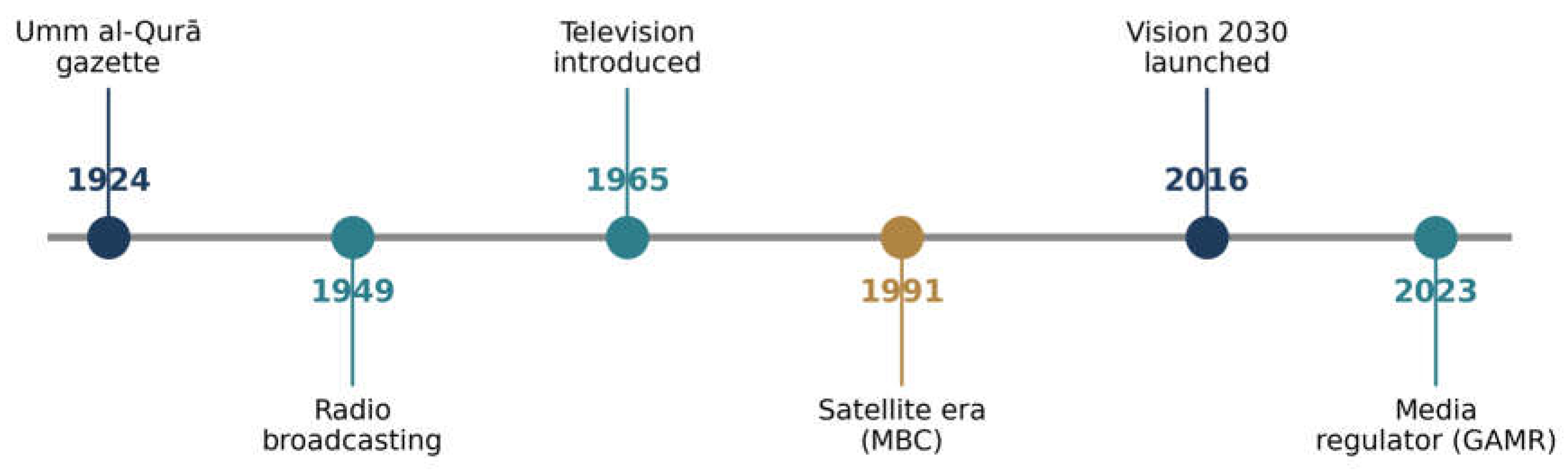
Figure 2.
Saudi Arabia digital connectivity indicators as a share of total population, January 2025. Note. Adapted from Kemp (2025). Mobile connections exceed 100% because many users hold more than one connection.
Figure 2.
Saudi Arabia digital connectivity indicators as a share of total population, January 2025. Note. Adapted from Kemp (2025). Mobile connections exceed 100% because many users hold more than one connection.
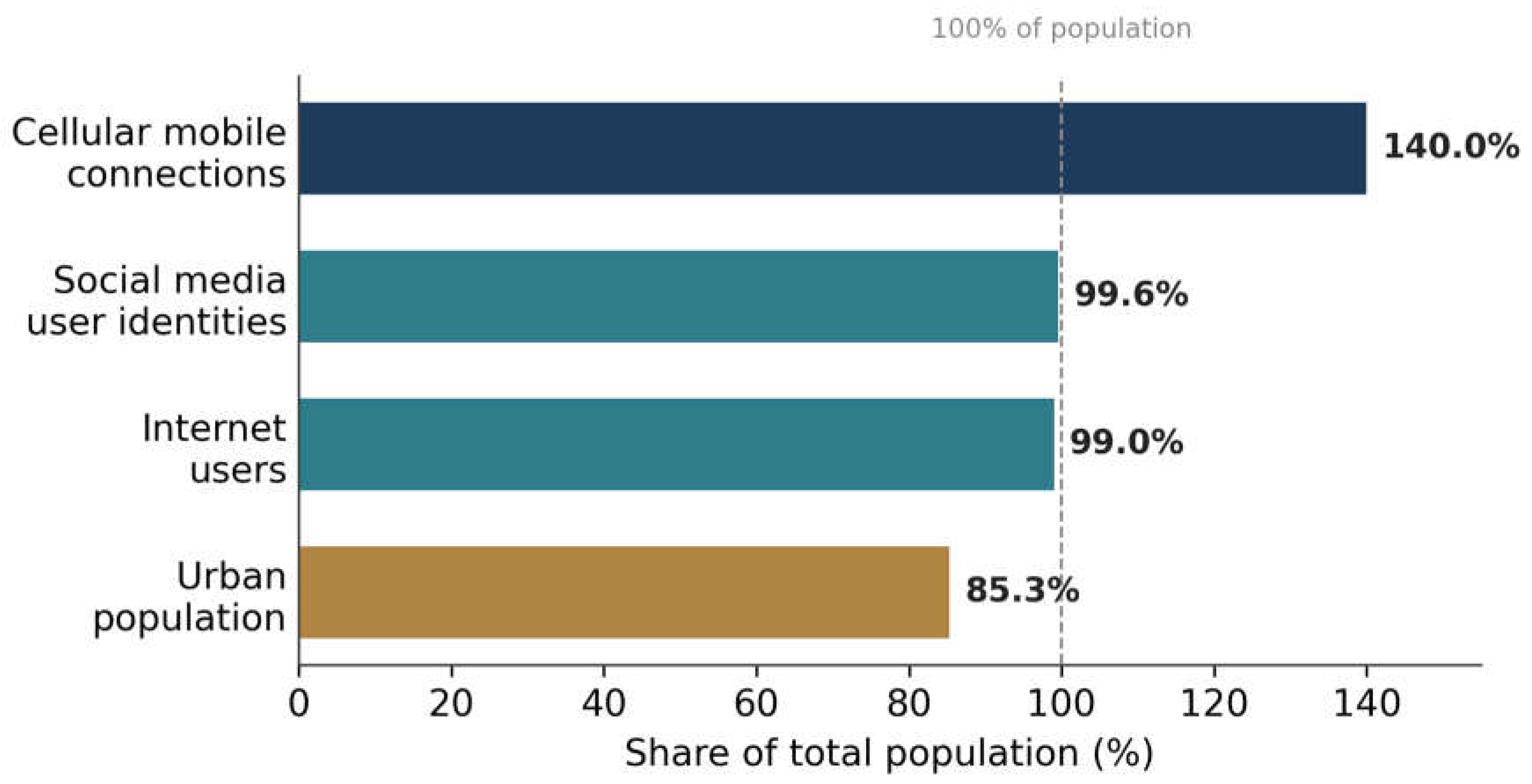
Figure 3.
Female labour-force participation in Saudi Arabia relative to the Vision 2030 target, 2016–2023. Note. Adapted from World Bank (2026). The dashed line marks the 30% Vision 2030 target.
Figure 3.
Female labour-force participation in Saudi Arabia relative to the Vision 2030 target, 2016–2023. Note. Adapted from World Bank (2026). The dashed line marks the 30% Vision 2030 target.
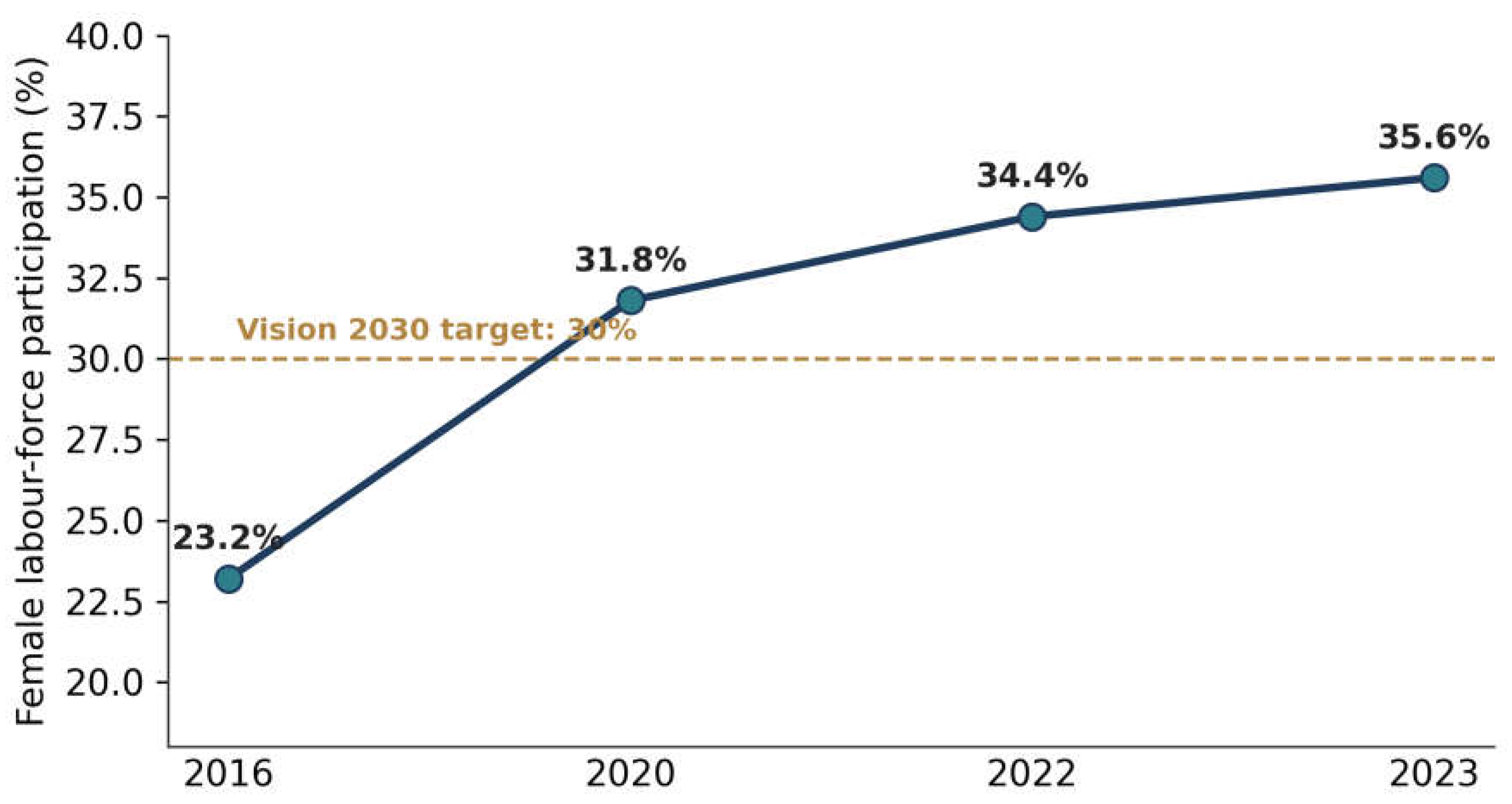
Figure 4.
Estimated Saudi digital advertising market, 2024 and 2030 projection (US$ billions). Note. Adapted from Grand View Research (2025). The 2030 figure is a projection at a 17.1% compound annual growth rate.
Figure 4.
Estimated Saudi digital advertising market, 2024 and 2030 projection (US$ billions). Note. Adapted from Grand View Research (2025). The 2030 figure is a projection at a 17.1% compound annual growth rate.
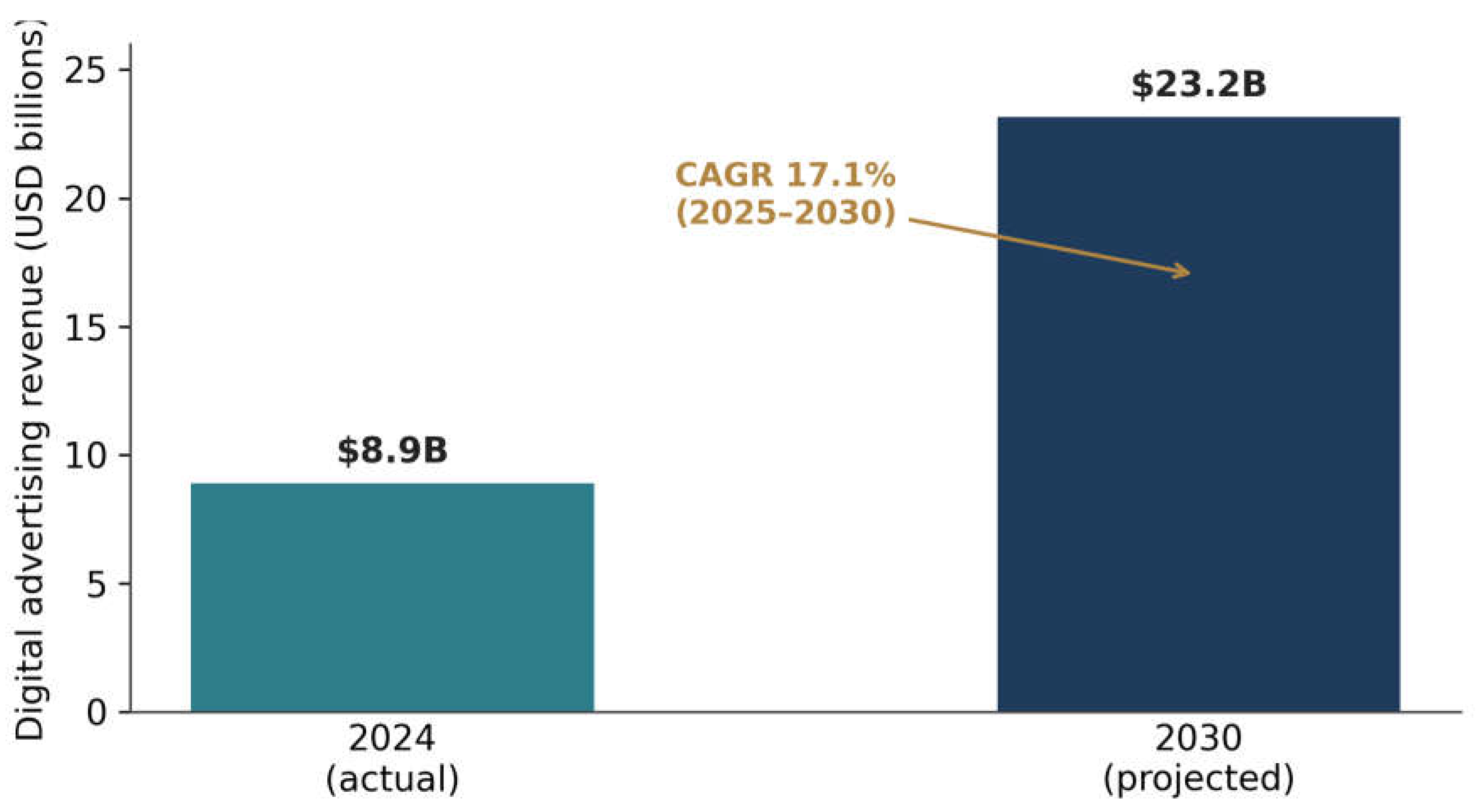

Table 1.
Analytical Framework: Lenses, Evidence, and Application.
| Analytical lens | Principal evidence | Application in this review |
|---|---|---|
| Chronological | Ministry of Media (n.d.); Boyd (1999) | Section 5 (historical reconstruction) |
| Thematic | Peer-reviewed scholarship; official documents | Section 6, Section 7 and Section 8 (synthesis of themes) |
| Comparative | Hallin & Mancini (2004, 2012); Mellor (2022) | Section 2 and Section 9 (theory and discussion) |
| Quantitative | Kemp (2025); market research; World Bank (2026) | Section 5, Section 6 and Section 7 (indicators and trends) |
Note. Author’s analytical synthesis. The framework integrates the four lenses concurrently rather than as discrete stages.
Table 2.
Verified Milestones in the Development of Saudi Media, 1924–1991.
| Year | Milestone | Significance |
|---|---|---|
| 1924 | Umm al-Qurā gazette established | First organised publication; official and religious communication |
| 1949 | Radio broadcasting established (Jeddah) | Royal decree; first broadcast during the Hajj season |
| 1960 | ʻUkāz and Al-Jazīrah founded | Emergence of the daily private press |
| 1964 | Press-institution decree | Ended individual ownership; corporate press model |
| 1965 | Television introduced; Al-Riyāḑ founded | Black-and-white TV from Riyadh and Jeddah |
| 1971 | Saudi Press Agency established | National wire service |
| 1974 | Colour television | Technical modernisation of broadcasting |
| 1975 | Arab News launched | English-language daily for international audiences |
| 1991 | Satellite broadcasting (MBC) | Regional reach beyond national borders |
Note. Adapted from official records of the Ministry of Media (n.d.) and Boyd (1999). Dates for radio (1949) and television (1965) correct figures frequently misreported in secondary accounts.
Table 3.
Saudi Arabia Digital Connectivity Snapshot, January 2025.
| Indicator | Value | Year-on-year change |
|---|---|---|
| Total population | 34.3 million | +1.8% |
| Cellular mobile connections | 48.1 million (140% of pop.) | +4.0% |
| Internet users | 33.9 million (99.0%) | +1.8% |
| Social-media user identities | 34.1 million (99.6%) | — |
| Median age of population | 29.6 years | — |
| Urban population share | 85.3% | — |
Note. Adapted from Kemp (2025), Digital 2025: Saudi Arabia (Datar portal), drawing on GSMA Intelligence and Kepios analysis. Internet adoption is capped at 99% by the source; social-media identities may not represent unique individuals.
Table 4.
Female Labour-Force Participation in Saudi Arabia, 2016–2023.
| Year | Participation (%) | Context |
|---|---|---|
| 2016 | 23.2 | Baseline at the launch of Vision 2030 |
| 2020 | 31.8 | Surpassed the 30% target ahead of schedule |
| 2022 | 34.4 | Continued expansion across sectors |
| 2023 | ≈35 | Stabilised in the 35–36% range (GASTAT) |
Note. Adapted from World Bank (2026). Figures refer to economy-wide female labour-force participation, not the journalism sector specifically. The Vision 2030 target was 30%.
Table 5.
Assessment of Sector Challenges and Opportunities.
| Domain | Challenge | Opportunity | Priority |
|---|---|---|---|
| Economic sustainability | High | High | Critical |
| Technological adaptation | Medium | Very high | High |
| Professional development | Medium | High | High |
| Regulatory adaptation | Medium | Medium | Medium |
| International competition | High | High | Critical |
| Cultural balance | Low | Medium | Medium |
Note. Author’s analytical synthesis based on the sources reviewed. The table represents a qualitative assessment rather than survey-derived measurement.
Table 6.
Estimates of the Saudi Advertising and Digital Media Market.
| Indicator | Value | Year | Source |
|---|---|---|---|
| Total advertising market | US$6.28 billion | 2024 | IMARC Group (2025) |
| Digital advertising market | US$8.90 billion | 2024 | Grand View Research (2025) |
| Digital advertising (projected) | US$23.17 billion | 2030 | Grand View Research (2025) |
| Digital ad CAGR | 17.1% | 2025–2030 | Grand View Research (2025) |
| Saudi share of MENA ad market | ≈34% | 2025 | Market Data Forecast (2026) |
Note. Figures are third-party market estimates produced with differing scopes and methodologies; values are not directly comparable and are presented for indicative purposes.
Disclaimer/Publisher’s Note: The statements, opinions and data contained in all publications are solely those of the individual author(s) and contributor(s) and not of MDPI and/or the editor(s). MDPI and/or the editor(s) disclaim responsibility for any injury to people or property resulting from any ideas, methods, instructions or products referred to in the content. |
© 2026 by the authors. Licensee MDPI, Basel, Switzerland. This article is an open access article distributed under the terms and conditions of the Creative Commons Attribution (CC BY) license (http://creativecommons.org/licenses/by/4.0/).
Copyright: This open access article is published under a Creative Commons CC BY 4.0 license, which permit the free download, distribution, and reuse, provided that the author and preprint are cited in any reuse.