Preprint
Article

This version is not peer-reviewed.

Impact of First Stage Moderated Mediation on Capital Structure, Firm Size, Firm Value and Financial Distress

Submitted:

10 February 2025

Posted:

11 February 2025

You are already at the latest version

Abstract

The paper seeks to find the direct and indirect association amongst capital structure and firm value among all the non financial firms listed in PSX from (2014-2019). Secondary panel data was used to conduct analysis. Structural equation modelling technique in Stata was used to estimate the direct effects. MedSEM, aspecial package for Stata, was used to estimate the indirect effects. Results showed that capital structure had nodirect effect on value of the firm, but financial distress mediated the association amongst capital structure and value of the firm. Substantial indirect effect clearly manifests the existence of indirect nature of association amongst capital structure and value of the firm.

Keywords: 
;  ;  ;  ;  

1. Introduction

The ultimate goal of any firm is to maximize the wealth of its shareholders by optimizing its firm value. Formulating an optimal capital structure is imperative for any firm to optimize its value and subsequently optimizing the wealth of its shareholders. Configuring a right mix amongst the amount of debt and equity to be used in the firm’s capital structure, still remains a mystery. Managerial decisions pertinent to financing capital structure hold a lot of significance, devising an optimal capital structure alleviates company’s cost of financing capital and consequently results in optimizing value of the firm.
Capital structure potentially has a profound effect on the value of a firm. Conclusions drawn from the research would help managers in taking substantial decisions pertinent to structuring their capital and its potential repercussions on firm’s value.
Despite several studies being conducted on the association amongst capital structure and value of the firm, there has still been no conclusive evidence to assert anything in this regard. (Sari & Sedana, 2020) in their study found a positive and substantial association amongst capital structure and firm value.
On the contrary, (Putri & Rahyuda, 2020) and (Saputra et al., 2019) found no substantial association amongst the variables in their respective studies. In conclusive nature of the results amongst the two variables may be manifesting a presence of some intervening variable, mediating the association amongst two afore-mentioned variables.
Several studies have been conducted to investigate the indirect effect of capital structure on firm value. (Putri & Rahyuda, 2020), (Ningsih & Paramitha, 2019) in their study found that profitability was able to mediate the association amongst capital structure and firm value. These studies clearly manifest the existence of indirect effect amongst capital structure and firm value.
(Fredrick & Osazemen, 2018), (Muigai & Muriithi, 2017) in their respective studies found that, firms with greater amount of debt in their capital structure were more prone to financial distress. Asserting a linear association amongst capital structure and financial distress.
The inconclusive nature of results conducted through empirical studies, clearly highlights a need for a further study. The indirect nature of association amongst capital structure and firm value has been studied by several intervening variables but no study has yet tested the role of financial distress in mediating the association amongst capital structure and firm value. This study would be testing both the direct and indirect effect of capital structure on firm value, using financial distress as an intervening variable.
The association under study has a strong theoretical backing. M&M (1958) theory of capital structure, the first recognized theory in the realm of capital structure in its original proposition, proposed that, value of any firm is independent of their capital structure mix. So, according to M&M theory, decisions pertinent to capital financing won’t have a conspicuous effect on the value of the firm.
Trade-off theory asserts that, every firm needs to identify their optimal capital structure. Debt being tax deductible has a conspicuous advantage over equity, on the other hand too much debt could result in the firm being financially distressed. Trading off the tax advantage with bankruptcy risk and identifying an optimal capital structure is crucial. Providing a theoretical support to the proposed association amongst capital structure and financial distress.
The study is structured as follows: Section 1 is followed by Section 2 which exhibits literature review and hypothesis development. Section 3 contains research methodology. Section 4 presents data analysis and results. Section 5, 6 and 7 present discussion, conclusion and future research direction.

1.1. Research Objectives

The research looks to meet several objectives. Which are:
  • To examine the effect of capital structure on firm value.
  • To examine the impact of capital structure on financial distress.
  • To examine the effect of financial distress on firm value.
  • To test the indirect effect of capital structure on firm value mediated by financial distress.

1.2. Research Questions

The research tries to answer the following questions:
  • Does capital structure have a direct effect on firm value?
  • Does capital structure have a direct effect on financial distress?
  • Does financial distress have a direct impact on firm value?
  • Is financial distress able to mediate the association amongst capital structure and firm value?

2. Literature Review and Hypothesis Development

2.1. Capital Structure

Capital structure has been defined by scholars in countless many ways. (Putri & Rahyuda, 2020), defined capital structure as the respective proportion of equity and debt a company uses to perform its operational activities. (Putro & Risman, 2021), defined capital structure as the correspondence amongst long term debt and equity.
(Gill et al., 2011), defined capital structure as the combination of debt and equity a firm deploys to carry out its operations.
Capital structure can be defined as the proportion of debt and equity a company employs in order to finance its assets. It is the mixture of debt and equity the management feels should be used to finance the assets of a company.
Solvency ratio is often used to calculate the capital structure of any organization. It measures the extent to which the assets of a company are being financed through debt. It is the ratio amongst total debt and total assets of a company, manifesting the proportion of company’s assets being financed by debt. The study uses the very ratio as a proxy to measure capital structure.

2.1.1. Capital Structure and Firm Value

Firm’s value is the extent to which the management has been able to effectively utilize firm’s resources as perceived by the investors. (Putri & Rahyuda, 2020). Firm’s value is manifested by the firm’s stock price, with higher stock price indicating greater firm value and plentiful shareholders’ wealth. (Sari & Sedana, 2020). According to the theory of firm, the over-arching objective of any company is to maximize the value of the company. Optimal firm value is accompanied by greater shareholder’s wealth.
Value of any firm is reflected in its stock prices, with higher prices manifesting alluring future prospects. Every company aspires to maximize the wealth of their shareholders by maximizing its share price.
This paper uses the proxy of price to book value (PBV) to measure the value of the firm. With higher price to book value indicating positive evaluation of a company’s performance as perceived by the investors, consequently, manifesting higher firm value. On the other hand, lower price to book value indicates unfavorable company’s performance as per the investor’s perception, and consequently, lower firm value.
(Putri & Rahyuda, 2020), (Sari & Sedana, 2020), used the same proxy of price to book value to measure the firm’s value.
Value of a firm is affected by a number of factors. Managerial decisions pertinent to financing capital structure potentially have a profound effect on the value of a firm.
Modigliani and Miller (1958), in their first proposition, presented a theory in which they asserted that, under perfect market conditions, the market value of any firm is independent of the proportion of debt or equity it possesses. It says that, whether the firm is financed completely by debt, or equity, or in any other proportion, will not affect the market value of the firm. M&M took two firms with varying capital structure, one with debt, other without debt, and proposed that the market value of the firms will not be affected by the financial decisions pertinent to the formation of capital structure, provided the perfect market conditions, and the fact that both have identical levels of cash flow.
In fact, according to M&M, it’s not the capital structure that affects the firm’s market value, but profitability and risk determine the market value of the firm.
It can be demonstrated through an equation:
VL = VU Where:
VL Shows the value of a firm with debt.
VU Shows the Value of a firm without debt.
According to them: Financial decisions pertinent to the capital structure of the firm would not affect its value, provided, all the other factors are controlled.
Modigliani & Miller (1963), in their subsequent proposition, incorporated the effects of tax in determining the value of the firm.
According to them, a firm which is financed through debt, carries a distinct advantage over the unlevered firm, this is due to the fact that, interest expense is tax deductible.
So, the more debt a firm has constituting its capital structure would mean that, it would be paying more interest on the debt, as the interest expense is tax deductible, more interest would mean lower tax, which in turn would increase the amount of money in the firm. This phenomenon is known as interest tax shield.
According to them: the market value of a firm having debt in their capital structure will be greater than the market value of a firm without debt, by the amount of tax shield it has, compared to the later firm.
It can be represented in an equation firm:
VL = VU + TC*D Where:
VU - Value of a firm without debt.
VL - Value of a firm with debt.
TC - Tax rate.
D - Amount of Debt.
Equation clearly shows that, the value of a levered firm is greater than the value of an unlevered firm, by the amount of interest tax-shield it holds.
Let’s look at the empirical evidence concerning the association amongst capital structure and firm value.
(Hirdinis, 2019), in his study found a positive and substantial association amongst capital structure and firm value. (Hasbi, 2015), tested the association amongst capital structure and firm value. He found that capital structure had a positive and substantial effect on firm value.
(Sari & Sedana, 2020) in his study found a positive and substantial association amongst capital structure and firm value.
(Osazuwa, 2016), reported a positive and substantial association amongst capital structure and firm value.
On the other hand, (Saputra et al., 2019), found no substantial association amongst capital structure and firm value in their respective studies.
Looking at the empirical evidence from the past, it is conspicuous that the results are contrasting. So there is a further need to study this association.
So, based upon the theories and empirical evidence we propose that:
H1. 
Capital structure has a substantial effect on firm value.

2.1.2. Capital Structure and Financial Distress

(Andrade & Kaplan, 1998), defined financial distress as a situation where the firm is unable to meet its financial obligations or is vulnerable to a potential risk of bankruptcy.
Financial distress can be defined as the situation where the company is unable to generate the requisite cash flows, in order to meet its financial obligations.
Empirical literature over the years have identified several factors as a potential predictor of a firm’s financial distress. Few of the major predictors as identified by the literature include: insufficient cash flows, volatile profitability, inefficient corporate governance and fragile capital structure.
(Altman, 2000), (Muigai & Muriithi, 2017), in their studies have all identified capital structure as a key predictor of a firm’s financial distress.
Association amongst capital structure and financial distress has intrigued researchers in the past. Trade off theory explicitly explains the association amongst capital structure of a firm and how it can lead to financial distress for that firm.

2.2. Trade-Off Theory

Trade off theory advocates that, each firm has its own optimal capital structure, this optimal capital structure is obtained by weighing up the merits against the demerits of using debt and equity.
Debt being tax deductible provides a tax shield, tax shield is a conspicuous advantage debt financing has over equity financing. But on the contrary, too much debt would put the firm under a financial distress, being a noticeable disadvantage.
So, the optimal capital structure for any firm would be a trade-off amongst tax deductible advantage of debt and financial distress caused by excessive issuance of debt.
Another factor that needs to be incorporated in the trade-off to reach at optimal capital structure is the agency cost. So, the optimal capital structure is obtained by trading off the tax deductible advantage of debt against the cost of financial distress resulting from over issuance of debt and the agency cost of debt against the agency cost of equity. So the theory asserts that, each firm has an optimal capital structure, and they are always adapting their financial disposition to achieve that optimal structure.
The theory also asserts that a firm with too much debt in its capital structure would be more vulnerable to financial distress and ultimately to the risk of being bankrupt. Increase in the amount of debt beyond an optimal level would increase the probability to default on its debts.
(Fredrick & Osazemen, 2018), studied the association amongst capital structure and financial firm for manufacturing companies listed in Nigeria. He found that capital structure had a negative association with the Altman z score (proxy for financial distress), meaning a positive association amongst capital structure and financial distress.
(Muigai & Muriithi, 2017), in their study of nonfinancial firms listed in Kenya, found a negative association amongst capital structure and the Altman z score (proxy to measure financial distress), meaning a positive association amongst capital structure and financial distress.
(Muigai & Muriithi, 2017), studied the effect of capital structure on financial distress for the nonfinancial companies listed in Nairobi stock exchange. He too found out a negative association amongst capital structure and z score, consequently, indicating a positive association amongst capital structure and financial distress.
All of the researches have culminated similar results. All of these results further advocate the propositions made by the trade-off theory. So based upon the empirical evidence and theoretical support, we hypothesize that
H2. 
Capital structure has a positive and substantial impact on financial distress.

2.2.2. Financial Distress and Firm Valu

Financial distress clearly manifests the firm’s inability to generateadequate cashflows, consequently, exposing the firm against bankruptcy risk. Firms experiencing situation of financial distress clearly shows the inefficiency on the part of the company’s management. Unfavourable financial position as manifested by the financial distress will clearly impart a negative signal to the investors and potential shareholders. The insolvent financial position of the firm would clearly manifest their ominous future potential. This would consequently have an adverse effect on the investor’s perception of the firm’s performance. All of this would translate into deteriorated stock performance, and consequently, poor firm value.
There has been a very scant literature studying the direct effect of financial distress on the value of the firm. Studies have been conducted establishing the association amongst capital structure and firm value. But very few studies havel inked financial distress with firm value.
(Ahmad et al., 2020), conducted a study on nonfinancial firms listed in PSX. They studied the association amongst financial distress and firm performance. The study found a positive association amongst Altman z score and firm performance. Asserting a positive association amongst financial stability and firm performance, consequently a negative association amongst financial distress and firm performance.
(Kariuki, 2013), studied the association amongst financial distress and financial performance of listed and non-listed commercial banks in Kenya. Results showed a
After reviewing the literature it is evident that financial distress clearly has an adverse effect on firm’s performance and consequently on firm value. So, we hypothesize that
H3. 
Financial distress has a negative and substantial effect on firm value.

2.2.3. Capital Structure and Firm Value with Mediating Effect of Financial Distress

The association amongst the capital structure and financial distress has been tested empirically by many scholars. (Eboiyehi & Ikpesu, 2017), (Muigai R., 2016), in their researches have all reported that capital structure has a substantial and positive effect on financial distress. Indicating the fact that firms with higher level of debt in their capital structure have a greater tendency to suffer financial distress.
Effectoffinancialdistressonfirmperformancehasalsobeenthesubjectofresearchers. (Ahmad et al., 2020), (Kariuki, 2013), all culminated their research with the findings of a negative association amongst financial distress and firm performance.
Severalstudieshavebeenthesubjectofaassociationamongstcapitalstructureandfirm value. (Sari & Sedana, 2020), (Hirdinis, 2019) found a substantial positive association amongst capital structure and firm value. On the other hand, (Saputra et al., 2019) found no substantial association amongst capital structure and firm value in their respective studies.
Empirical evidence shows that, firms with greater amount of debt in their capital structure have a tendency of being financially distressed. Results also show that financial distress has a negative and substantial effect on firm performance. Based upon the empirical findings from the previous studies, this study would be looking to develop a association amongst capital structure and firm value with financial distress as intervening variable.
The association amongst capital structure and firm value has been studied by the mediating role of several intervening variables. (Putri & Rahyuda, 2020) in their study found that profitability was able to mediate the association amongst capital structure and firm value.
No study has yet sought a association amongst capital structure and firm value with financial distress as intervening variable.
So, we hypothesize that:
H4. 
Financial distress mediates the association amongst capital structure and firm value.

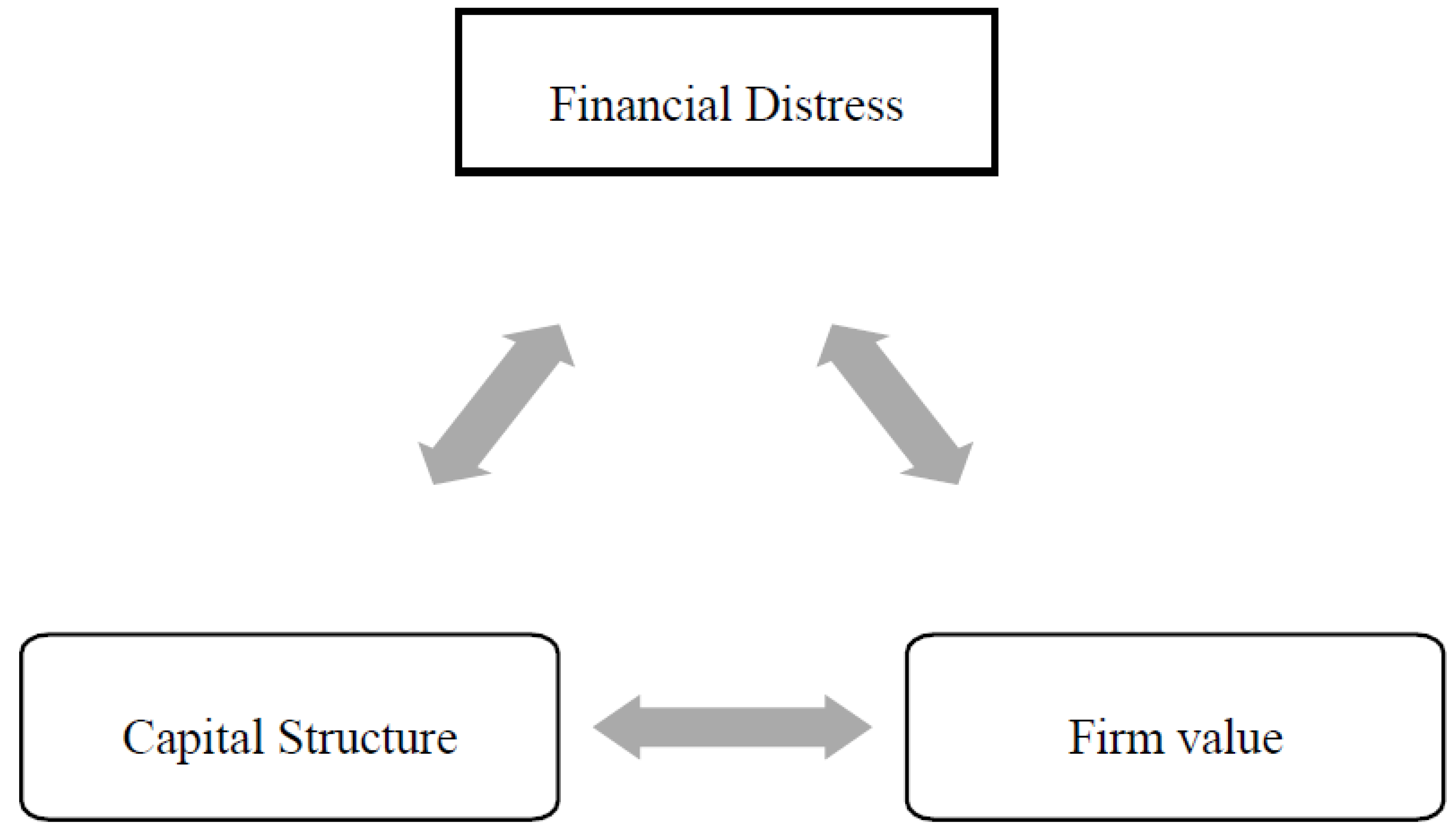
2.3. Theoretical Framework

Figure 1. Theoretical Framework.
Preprints 148857 g001

3. Research Methodology

3.1. Research Design

The study aims to find the association amongst capital structure and firm value: with mediating effect of financial distress. The study used panel data quantitative research design. As the type of data being used has the characteristics of both time series and cross sectional, a panel data research technique was employed.

3.1.1. Population and Sampling

The population of the study constituted of all 387 nonfinancial firms listed in Pakistan stock exchange during the six year period (2014–2019).
Due to several constraints related to data availability the research sample excluded 29 companies from the original population. The final sample constituted of 358 nonfinancial firms listed at PSX from the period of (2014–2019).

3.1.2. Data Collection

Secondary data over the six year period (2014–2019) was collected. Data was collected from the official website of state bank of Pakistan. Authenticity of data was confirmed by matching the collected data with the annual financial statements of firms. Research didn’t included data of year 2020 to avoid potential effect of covid-19 on the firm’s performance and potentially culminating in biased results.

3.1.3. Proxies for Variables Understudy

Table 1 shows the variables under study, the irnotation used in the study, the proxy used to measure each variable and references of the proxies being used in the study.

3.1.4. Structural Equation Modelling

The paper uses structural equation modelling technique to estimate the required coefficient. The first equation estimates the effect of capital structure our independent variable on financial distress which is our mediator. This equation would give us the first path coefficient needed to estimate the indirect effect. The equation is given by:
DTTA = α + βFD + ϵ (1)
The above equation would estimate the effect of our independent variable on our mediator. It represents the first stage coefficient of indirect effect. The coefficient yielded from the equation would be used to calculate the indirect effect.
The next equation would be used to determine the direct effect of capital structure on firm value in the presence of moderator, the equation also calculates the effect of financial distress our mediator on firm value our dependent variable, second stage path coefficient which along with first stage path coefficient is used to calculate the indirect effect. The equation is given by:
FV = α + βDTTA + βFD + ϵ₁ (2) Where:
α: Constant, represents slope of the equation.
β₁: Represent direct effect of capital structure on firm value.
β₂: Represents direct effect of financial distress on firm value.
ϵ₁: Represents error term
The above equation would be used to calculate direct effect of capital structure on firm value. Furthermore, the equation would be used to estimate the second stage path coefficient (β₂) which in turn would be used to calculate the indirect effect.

4. Data Analysis and Results

Table 2 exhibits the characteristics pertinent to the centrality and dispersion of the variables under study. Table 2 shows that on average the nonfinancial firms of Pakistan used about 70% of debt to finance their assets. This manifests that the financing disposition of nonfinancial firms in Pakistan is debt inclined. The dispersion from the mean was recorded to be 1.0855. FD exhibiting the Altman z score having a mean value of 31 indicates the financial soundness of the nonfinancial firms. Exhibiting a dispersion of 245 from the mean. FV has a mean of 2.73, which shows the investors optimistic perception about the firms in general. Dispersion of 14.38 from the mean show the range of overall value. Firm size of the nonfinancial firms on average was 15.19, having a standard deviation of 1.95.

4.1. Pearson Correlation

Table 3 exhibits Pearson correlation among the variables under study. The correlation matrix is used to test for any multicollinearity amongst the exogenous variables. Table 3 clearly shows no serious correlation among any of the variables under study. So there is no danger of any multi collinearity.

4.1.1. Unit Root Test

Unit root test were conducted to find out the feasibility of data. Test is conducted to identify any unit roots in the data. The null hypothesis is that data contains unit roots, while the alternative hypothesis says there are no unit roots and the data is stationary.
Table 4 clearly shows that there are no unit roots in any of the variables under study. So, were jectour null hypothesis and accept the alternative hypothesis. All the variables are stationary at a confidence interval of 99% as indicated by a p-value of less than 0.1 for all the variables. We can proceed with our panel data for analysis.

4.2. Structural Equation Results

Table 5 exhibits the results of structural equation model conducted in Stata. Results show that capital structure has a negative and substantial effect on financial distress. The p-value of (0.004<0.05), shows that the results are substantial at 99% confidence level. The value of coefficient (-13. 86198) represents the first stage path coefficient used to calculate the indirect effect.
Table 6 exhibits the direct effect of FD (mediator) on FV (dependent variable). The p value of (0.000<0.05), shows that the association is substantial at a confidence level of 99%. The value of coefficient (0.128593) indicates that for one unit increase in financial distress, Firm value will increase by 0.12 times.This coefficient represents the second stage path coefficient used to determine the indirect effect. Direct effect of capital structure on firm value is given by the coefficient (0.292). But this association is not substantial at 95% confidence level as manifested by a p-value of (0.292>0.05).

Direct Effects

Table 7 shows the result of all the direct effects carried out in the study. Results show that capital structure has a negative effect (-0.2947027) on fir value. But the p-value of (0.292>0.05), clearly manifests the insignificance of the results. So, we culminate that capital structure has no effect on firm value. Based upon the results our first hypothesis is rejected.
Table 7 also exhibit the effect of capital structure on financial distress. A coefficient of (-13.86198) and a p-value of (0.004<0.05), shows that capital structure has a negative and substantial effect on financial distress. Based on the results, our second hypothesis is accepted.
Results show that financial distress has a positive and substantial effect on firm value. This is manifested by a coefficient of (0.128593) and a p-value of (0.000). The results are substantial at 95% confidence level. So, our third hypothesis that financial distress an impact on firm value is accepted.

4.2.1. Indirect Effects

Table 8 exhibits the indirect effect of capital structure on firm value mediated by financial distress. A coefficient of (-0.178) and a p-value of (0.006 < 0.05), shows that financial distress was able to mediate the effect of capital structure on firm value. Negative coefficient shows that capital structure had a negative effect on firm value as mediated by financial distress. Results were substantial at a confidence level of 99%. So, as the indirect effect was substantial, our hypothes is that financial distress is able to mediate the effect of capital structure on firm value is accepted.
Furthermore, the direct effect of capital structure on firm value in the presence of mediator, reflected by Table 6, is insubstantial, while the indirect effect of capital structure on firm value through financial distress is substantial. This is a manifestation of complete mediation. So we say that the effect of capital structure on firm value is completely mediated by financial distress.
We add both direct effect and indirect effect to calculate our total effects. Total effects as given by Table 9 mounts to (-0.473).

5. Discussion

The research seeks to investigate the association amongst capital structure and firm value. In addition, the research also looks to find out the role of financial distress in mediating the effect of capital structure on firm value.
Results show that capital structure didn’t have a substantial effect on firm value of non-financial firms listed in PSX. The results negate our proposed hypothesis that capital structure has a substantial effect on firm value. The results are in line with several previous studies which identified no substantial association amongst capital structure and firm value (Putri & Rahyuda, 2020) (Saputra et al., 2019). The results are in line with the assertions made by Modigliani and Miller theory (1958), according to the theory, the value of any firm is independent of the proportion of debt or equity they have used to finance their capital structure.
Insubstantial association amongst capital structure and firm value could be because the investors in Pakistan don’t value the financing mix to evaluate a firm’s value. They have some other parameters to evaluate the value of a firm.
Results also show that capital structure had a substantial effect on financial distress. Negative coefficient amongst capital structure and Altman z score indicates that financially levered firms have a tendency to be financially distressed. This is in accordance with our proposed hypothesis.
The study results are supported by several previous studies, who also found a positive and substantial association amongst capital structure and financial distress (Muigai R., 2016), (Muigai & Muriithi, 2017).
The results complement the assertions made by trade-off theory. According to the theory: Too much debt being employed in the capital structure would increase the firm’s risk of being bankrupt, consequently, prone to financial distress.
High proportion of debt in the capital structure would increase the firm’s risk of getting bankrupt. Higher debt is often accompanied by higher cost of capital, which translates into financial distress.
Financial distress was found to have a substantial impact on capital structure. A positive coefficient amongst financial distress and z score shows that firms who were financially stable had a higher market value. Results also implied that financially distressed firms had a negative and substantial effect on the firm’s value. The results support our hypothesis that financial distress has a negative and substantial effect on capital structure.
Finally, in our last association, we found that the indirect effect of capital structure on firm value through financial distress was substantial. Results show that financial distress was able to completely mediate the association amongst capital structure and firm value. This is in accordance with our proposed hypothesis that financial distress is able to mediate the association amongst capital structure and firm value. The results are in accordance with previous studies of (Putri & Rahyuda, 2020) who found a substantial indirect effect of capital structure on firm value mediated by profitability. So, we conclude that the association amongst capital structure and firm value has got an indirect nature attached to it. Indirect effect indicates that the effect of capital structure on firm value is mediated by different variables.

5.1. Conclusion

The research seeks to find the direct and indirect effect of capital structure on firm value of all the non-financial firms listed in PSX during the period of (2014–2019). The results show that capital structure didn’t have a direct effect on the firm value. Results show that capital structure has a substantial indirect effect on firm value. Financial distress was able to completely mediate the association amongst capital structure and firm value.

5.1. Future Research Direction

The research uses the Altman Z score to evaluate the financial distress levels of the firms. Future researchers can uses other evaluation tools such as Ohlson O-score to predict the level of financial soundness and potential bankruptcy risk of the firms.
Value of the firms can be measured by using other variables which can possibly reflect a more accurate measure of firm value.
The study used financial distress as a mediator to test for the indirect effect, future researchers can use other mediators like corporate social responsibility or firms green behaviour to test for the indirect effects.

5.1. Policy Implication

The research has several policy implications for the firms and managers. Managers should be aware that the capital structure proportion has no substantial effect on the investor’s perception of the firm’s value. However, capital structure decisions have a substantial indirect effect on the firm’s value, transmitted through other variables. Firms should not be too concerned about their financing decisions, but the utilization of the capital being financed can effect several critical variables which in turn transmit the effect on firm value. Managers should avoid employing too much debt in their capital structure as it would lead to financial distress which in turn would lead to an adverse firm value.

References

  1. Ahmad, S., L. Zhang, A. Ahmad, and A. Ahmad. 2020. Effect of financial distress on firm’s performance of non-financial firms registered with Pakistan Stoke Exchange. International Journal of Business and Management Sciences 1, 1. [Google Scholar]
  2. Altman, E. 2000. Predictingfinancialdistressofcompanies:revisitingtheZ-scoreand ZETA models. Stern School of Business, New York University 9. [Google Scholar]
  3. Andrade, G., and S. N. Kaplan. 1998. How costly is financial (not economic) distress? Evidence from highly leveraged transactions that became distressed. The Journal of Finance 53, 5: 1443–1493. [Google Scholar] [CrossRef]
  4. Eboiyehi, O., and F. Ikpesu. 2017. An empirical investigation of capital structure and tax shield on business distress in Nigeria: An application of panel corrected standard error (PCSE) approach. Journal of Global Economics, Management and Business Research 8, 2: 67–65. [Google Scholar]
  5. Fredrick, I., and E. Osazemen. 2018. Capital structure and corporate financial distress of manufacturing firms in Nigeria. Journal of Accounting and Taxatio 10, 7: 78–84. [Google Scholar]
  6. Gill, A., N. Biger, and N. Mathur. 2011. Theeffectsofcapitalstructureonprofitability: Evidence from United States. International Journal of Management 28, 4. [Google Scholar]
  7. Hasbi, H. 2015. Islamic microfinance institution: the capital structure, growth, performance and value of firm in Indonesia. Procedia-Social and Behavioral Sciences. [Google Scholar] [CrossRef]
  8. Hirdinis, M. 2019. Capital Structure and Firm Size on Firm Value Moderated by Profitability. International Journal of Economics and Business Administration 7, 1: 174–191. [Google Scholar]
  9. Kariuki, H. N. 2013. The effect of financial distress on financial performance of commercial banks in Kenya. Unpublished MBA Project University of Nairobi. [Google Scholar]
  10. Muigai, R. 2016. Effect of capital structure on financial distress of nonfinancial companies listed in Nairobi securities exchange. (Doctoral dissertation, COHRED, Finance, JKUAT). [Google Scholar]
  11. Muigai, R., and J. Muriithi. 2017. Themoderatingeffectoffirmsizeontheassociation amongstcapitalstructureandfinancialdistressofnonfinancialcompanieslisted in Kenya. Journal of Finance and Accounting 5, 4: 151. [Google Scholar]
  12. Ningsih, N. L., and P. D. Paramitha. 2019. Do Capital Structure and Liquidity Increasing Value of The Firm? A Mediating Role of Profitability. Jurnal Ekonomi dan Bisnis Jagaditha 6, 2: 78–85. [Google Scholar]
  13. Osazuwa, N. P.-A. 2016. The moderating effect of profitability and leverage on the associationamongsteco-efficiencyandfirmvalueinpubliclytradedMalaysian firms. Social Responsibility Journal 12, 2: 295–306. [Google Scholar] [CrossRef]
  14. Putri, I. G., and H. Rahyuda. 2020. Effect of Capital Structure and Sales Growth on Firm Value with Profitability as Mediation. International Research Journal of Management, IT & Social Sciences 7, 1: 145–155. [Google Scholar]
  15. Putro, D. C., and A. Risman. 2021. The effect of capital structure and liquidity on firm value mediated by profitability. The EUrASEANs: Journal on global socio-economic dynamics 2, 27. [Google Scholar] [CrossRef]
  16. Saputra, L. A., Surati, and A. Saufi. 2019. Mediation role of job satisfaction towards effect of conflict roles on organizational commitment. International Journal of Social Sciences and Humanities 3, 2: 165–175. [Google Scholar] [CrossRef]
  17. Sari, I.A., and I.B. Sedana. 2020. ProfitabilityandLiquidityonFirmValueandCapital Structure as Intervening Variable. International Research Journal of Management, IT & Social Sciences 7, 1: 116–127. [Google Scholar]
Table 1. Variables measurement.
Variable Notation Proxy Source
Independent variable
capital structure DTTA Total debt/total assets (Pattiruhu & Paais, 2020)
Dependent variable
Firm value FV Market price per share/Book price per share (R P 3 2020),
Moderator
Firm Size FS Ln(Assets) (Tahir, et al., 2020)
Mediator
Financial distress FD Altman z score (Altman, 1968)
Table 2. Descriptive statistics.
Variable Mean Std. Dev. Max Min
DTTA O.704 1.0855 13.34 0.002
FV 2.73 14.389 259.96 -37.032
FD 31.298 245.5 4973.218 -3470.24
FS 15.199 1.953 20.45 8.00
Table 3. Pearson correlation.
DTTA FS FD FV
DTTA 1 FS -0.2958 1 FD -0.0613
-0.1716 1 FV -0.0357 0.0176 0.2210 1
Table 4. Unit root test.
Variables Statistic p-Value
DTTA -2.1e+03 0.000
FD -1.2e+02 0.000
FS -76.2787 0.000
FV 1817.1837 0.000
Table 5. SEM.
Table 5. SEM.
Variable (FD) Coefficient Std. Err Z p>z 95% Conf. Interval
DTTA -13.86198 4.875192 -2.84 0.004 -23.41718 -4.306
Table 6. SEM.
Table 6. SEM.
Variable (FV) Coefficient Std. Err Z p>z 95% Conf. Interval
FD 0.128593 0.0012353 10.41 0.000 0.0104379 0.0152
DTTA -0.2947027 2794094 -1.05 0.292 -0.842335 0.2529
Table 7. Direct Effects.
Hypothesis Variable DirectEffect Sig Hypothesis Description
1 DTTA∙>FV -0.2947027 0.292 Rejected
2 DTTA∙>FD-13.86198 0.004 Accepted
3 FD∙>FV 0.128593 0.000Accepted
Table 8. Indirect Effects.
Estimates Sobel Test
Indirect Effect -0.178
Std. Err. 0.065
z-value -2.743
p-value 0.006
Conf. Interval -0.306, -0.051
Table 9. Direct, Indirect and Total effect.
Direct effect Indirect Effect Total Effect
-0.294 -0.178 -0.473
Disclaimer/Publisher’s Note: The statements, opinions and data contained in all publications are solely those of the individual author(s) and contributor(s) and not of MDPI and/or the editor(s). MDPI and/or the editor(s) disclaim responsibility for any injury to people or property resulting from any ideas, methods, instructions or products referred to in the content.
Copyright: This open access article is published under a Creative Commons CC BY 4.0 license, which permit the free download, distribution, and reuse, provided that the author and preprint are cited in any reuse.
Prerpints.org logo

Preprints.org is a free preprint server supported by MDPI in Basel, Switzerland.

Subscribe

Disclaimer

Terms of Use

Privacy Policy

Privacy Settings

© 2025 MDPI (Basel, Switzerland) unless otherwise stated
