
Submitted:
02 February 2025
Posted:
03 February 2025
You are already at the latest version
Abstract
This study investigates the impact of rural tourism on rural transformation in China, using Liujiafan in Hefei as a case study. Based on system theory, it explores the mechanisms of rural transformation and restructuration driven by tourism under the dual influence of endogenous and exogenous systems. Key findings include: (1) The tourism-driven rural transformation process exhibits distinct phased and holistic characteristics. (2) The core of this transformation is the re-creation of rural value through the interaction of "human-land-industry," supported by three major rural communities. (3) The transformation is a dynamic and cyclical process. (4) Both tourism-driven restructuring and natural evolution begin with economic restructuration but differ in trajectory and speed. This study provides actionable insights for policymakers to leverage tourism in rural revitalization strategies, emphasizing infrastructure development and community engagement.
Keywords:
Rural transformation and restructuring
; Rural tourism
; Peri-urban regions
; Systems theory
; Rural community
1. Introduction
With the advancement of China's new urbanization and the deepening implementation of the rural revitalization strategy, peri-urban regions have become pivotal regions in the urbanization process due to their unique geographical location and resource conditions. These areas, serving as the forefront of intense urban-rural interactions [1], are undergoing unprecedented changes and thus warrant significant attention. Peri-urban regions are experiencing spatial restructuring due to urban expansion and the growing domestic leisure market, driven by a large population and an expanding middle-income group. These factors drive consumption upgrades and create significant market demand. The rural areas within these peri-urban zones, with their high historical, cultural, social, and economic value, have become important for new rural economic forms and key destinations for leisure and vacation activities [2]. These areas significantly impact the development of peri-urban rural regions, undergoing social refiguration due to rapid urbanization and the tourism economy (new consumerism), leading to continuous deconstruction of the traditional rural social structure. Therefore, revealing the process and characteristics of social-spatial restructuring in peri-urban regions during the interactive development of urban and rural areas, and exploring the mechanisms of this regional restructuring, holds significant importance for rural studies, tourism studies, and urban planning.
The restructuring of rural space is inevitably the result of multiple factors acting in concert, spanning the entire process of regional economic and social development. The reorganization of elements and functional reshaping of the rural human-land relationship regional system form the basis for understanding and recognizing rural spatial restructuring and transformational development [3,4]. Currently, the systemic circle theory provides a relatively systematic theoretical framework for rural space research, offering important insights into the understanding of rural space. Halfacree, building on Lefebvre's "production of space" theory, established a "triple model of rural space," which includes rural locality, representations of the rural, and everyday lives of the rural. Rural locality refers to the rural areas delineated through spatial practices such as production or consumption; representations of the rural pertain to the subjective spaces of people's perceptions and images of the countryside, as well as the ways in which the rural is integrated into (capitalist) production processes; everyday lives of the rural encompass personal and socio-cultural factors that understand and identify rural life. Compared to the binary definition of "locality/social representation," the "triple model of rural space" starts from the rural subject, emphasizing the importance of everyday life practices, introducing experiential and lived spaces, and compensating for the incompleteness of the rural space concept under the binary definition.
The restructuration of rural society is of great significance for the evolution of rural areas. As the ultimate goal of rural restructuration, the importance of rural social refiguration lies in its connotation, which reflects the deep-seated objectives of achieving comprehensive and harmonious rural development. Reviewing the current research on the rural social refiguration space, there is an increasing focus on social and cultural spaces. However, studies that explore the characteristics and influencing mechanisms of the multi-dimensional (social) space system of rural areas from an integrated perspective of "material-social-cultural" trinity are still in need of further development.
Therefore, this paper, based on systems theory and using the traditional overseas Chinese hometown of Liujiafan in the peri-urban region of Hefei as a typical case, investigates the process and mechanisms of rural deconstruction- restructuration driven by tourism-led endogenous and exogenous systems. This study aims to enrich the content and restructuration models of rural research, reveal the unique role of tourism in guiding the evolutionary process of rural restructuration, and explore optimization and reorganization methods. This research provides theoretical support and decision-making references for tourism-led rural transformation, promoting rural revitalization and sustainable development in China.
2. Literature
2.1. Theoretical Sources of Rural Transformation and Restructuration
The rural social refiguration and transformation is a significant issue in the process of urbanization in China and has become a focal point in contemporary rural geography research. Since the 1990s, the de-agrarianization of rural areas in developed countries has accelerated, with the rise of rural handicrafts, retail, tourism, and cultural industries. Rural areas have shifted from a productivist to a post-productivist model, from industrialization to post-industrialization, and from production spaces to consumption spaces, becoming increasingly multifunctional. This shift has transformed rural areas into multi-stakeholder, multifunctional, and multidimensional spaces [5,6,7]. In the 21st century, the development of rural tourism has become one of the most significant changes in rural regions, with tourism, leisure, and entertainment emerging as key factors in the environmental, economic, and social transformations of many rural areas [8,9,10]. Leisure and entertainment, as well as second homes, have even become dominant in some rural areas, leading to the formation of concepts such as "leisure rural" and "hedonistic periphery" [11,12]. These elements have driven the restructuration of rural areas, facilitating the transition from a primary production-based rural economy to a more service-oriented economy—towards post-productivism. Rural spaces have thus become landscapes dominated by consumption rather than primary production, representing post-productivism and consumer-oriented rural landscapes [13].
Under the implementation of China's rural revitalization strategy, the transformation of rural areas has attracted widespread academic attention. Wang Yanfei identified three mechanisms of rural transformation in China: exogenous, endogenous, and composite, and provided detailed explanations for these driving modes [14]. Endogenous development, also known as endogenous growth, explains the driving forces of economic growth from four dimensions: technological progress, human capital accumulation, knowledge accumulation, and institutional improvement [15,16]. Zhang, F., in his research on the driving mechanisms of regional rural development in China, emphasized that regional development policies, levels of industrialization, and urbanization constitute the external system of rural development. Yan, X., from the perspective of an urban-rural interdependent system, proposed that the external driving force of rural restructuration is market forces, while the internal driving force stems from the new functional demands of the urban-rural interdependent system on rural areas. The generation mechanism involves functional restructuration, structural changes, and the flow of elements between urban and rural areas, ultimately optimizing the overall function of the regional system. To address issues related to rural transformation and restructuration, the academic community has achieved fruitful results in the spatial aspects, driving mechanisms, and spatiotemporal pattern evolution of rural transformation and restructuration. For example, Long, H. defined the concept of rural restructuration, constructed a "elements-structure-function" theoretical analysis framework, and explored the implementation paths of rural restructuration [17].
Peri-urban rural regions are influenced by urban consumerism and rural post-productivism in China. The decline of agricultural economic status and adjustments in rural economies, the rise of rural service sectors and rationalization of local services, and the reorganization of urban-rural population flows and social development elements have interacted to reshape the socio-economic structure of rural areas [18]. Rural tourism is considered an important means and effective path to promote rural development and has thus become a significant driving force for rural restructuring [19]. The peri-urban rural tourism destinations in large cities represent a new type of rural form in the modern urban development process in China. These areas retain certain characteristics of rural natural and cultural landscapes while effectively achieving integration and convergence between urban and rural areas in terms of economy, space, and social structure [20].
2.2. Theoretical Framework of Rural Transformation and Restructuration Driven by Endogenous-Exogenous Systems
The rural territorial system is an open system within a defined rural area, constituted by the interaction of various elements such as natural endowments, locational conditions, economic foundations, human resources, and cultural customs, forming a structure and function [21,22]. Regional development policies, marketization levels, and urbanization levels together form the exogenous system of rural transformation and Restructuration [23]. Natural resources, locational conditions, and social, human, and technological resources corresponding to the dimensions of endogenous growth theory constitute the endogenous system [24,25]. From the perspective of an urban-rural interdependent system, the external driving force of rural restructuration is market forces, while the internal driving force stems from the new functional demands of the urban-rural interdependent system on rural areas. Under the influence of both internal and external system dynamics, functional restructuration, structural reorganization, and element flows collectively drive the transformation and restructuration of rural areas [26].
The living, production, ecological, and cultural functions of rural areas are also constantly evolving and transforming [27]. Rural tourism, as an important means to promote rural development, has evolved from being a pathway for farmers' economic income to guiding the rural industrial structure towards an upgrade to urban leisure consumption economy, establishing new socialist rural areas, and achieving urban-rural integration. Rural tourism is not only an economic approach but also creates a new development model for the transition from rural to urban areas through non-industrial paths.
The prosperity of rural tourism has brought significant changes to the economy, space, and social structure of rural areas, which is a prominent manifestation of rural development. The development of tourism has transformed rural communities from a single spatial entity (villagers) to a multi-entity (tourists, government, operators, etc.), changing the economic structure through industrial shifts. The production space in rural areas is gradually restructured towards non-agricultural production spaces such as industry and leisure services. The changes in economic relations lead to social relationship alterations, resulting in adjustments in social organization models, shifting from a traditional "villager self-governance" system to a "multi-entity co-governance" model. For example, Xi, J. et al. analyzed the social spatial refiguration process of Gougou Village in Hebei's Yanshanpo, finding that the village underwent drastic social refiguration and "spatial polarization" driven by tourism, evolving from a traditional "rural society" community bonded by kinship to a tourism service-oriented community bonded by economic interests.
Rural restructuration is a response to the dynamic changes in key elements such as labor, land, and capital within the rural territorial system. Tourism, as an important driving force, manifests in the multi-dimensional space of traditional villages, reshaping the social, economic, and spatial structures of rural areas during the process of resource reconfiguration. In terms of labor, rural tourism attracts urban tourists and immigrants, increasing population mobility and density, altering population structures, and promoting social diversification. It also provides residents with employment and entrepreneurship opportunities, alleviating the issue of population loss [28,29]. Regarding land, rural tourism promotes changes in land use, expands non-agricultural land areas, redevelops idle buildings, and drives intensive and scaled land management, enhancing land use efficiency and economic value [30,31]. In terms of capital, rural tourism attracts substantial government and social capital investment in tourism infrastructure and product development, stimulating the entrepreneurial enthusiasm and investment willingness of rural residents, forming diversified investment entities and business models, and promoting capital flow and agglomeration in related industries, facilitating industrial structure optimization, and upgrading [32]. During the process of rural transformation and restructuration, these elements interact, jointly promoting the development and change of rural areas.
Rural tourism also drives social refiguration in rural areas, mainly reflected in three aspects: social entities, social relationships, and social space. The development of tourism promotes the openness of rural society and pushes rural governance from traditional to modern transformation, optimizing and upgrading the governance system. As a key concept to explain the relationship between humans and land, "value co-creation," which focuses on resource integration and interactive cooperation, and aims at value creation through the participation of multiple entities, is a dynamic process [33]. Stakeholders are the main subjects of value co-creation, the integration of various resources is the material basis of value co-creation, multiple values are the desired outcomes, and win-win efficiency is the long-term pursuit of value [34].
In summary, this study analyzes the theoretical sources of rural transformation and restructuration driven by the endogenous-exogenous system of rural areas, based on relevant literature on the evolution and variation of "system-function-structure-elements-value" in the rural territorial system on the urban periphery in China. It combs through the contributions of tourism in promoting the upgrading of rural systems, optimizing functions, reorganizing structures, integrating elements, and co-creating values, providing a theoretical basis for systematic research on tourism and rural restructuration.
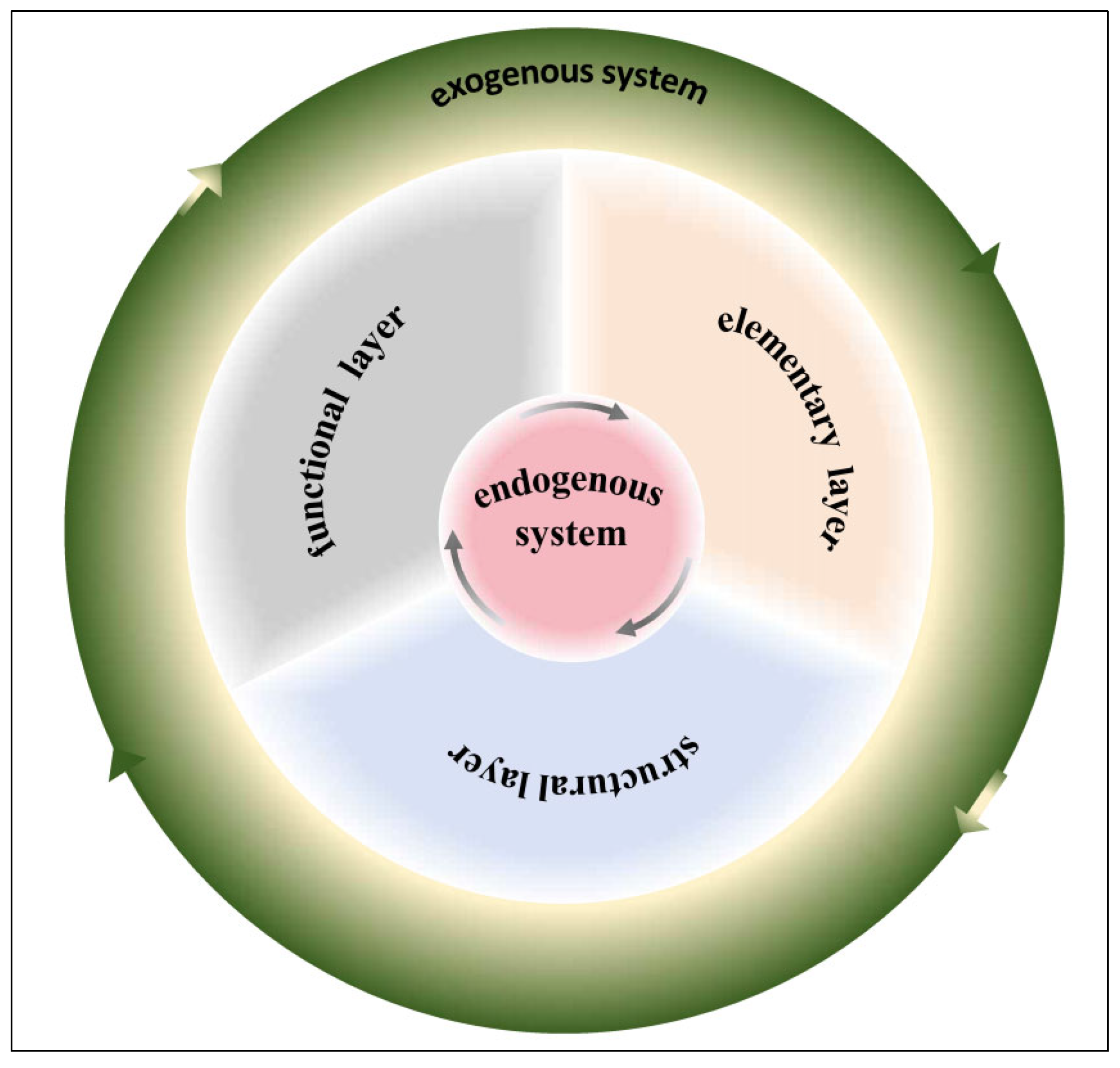
Figure 1.
Rural resetructuration driven by exo-endogenous system.
3. Study Design
3.1. Case Study Area Overview
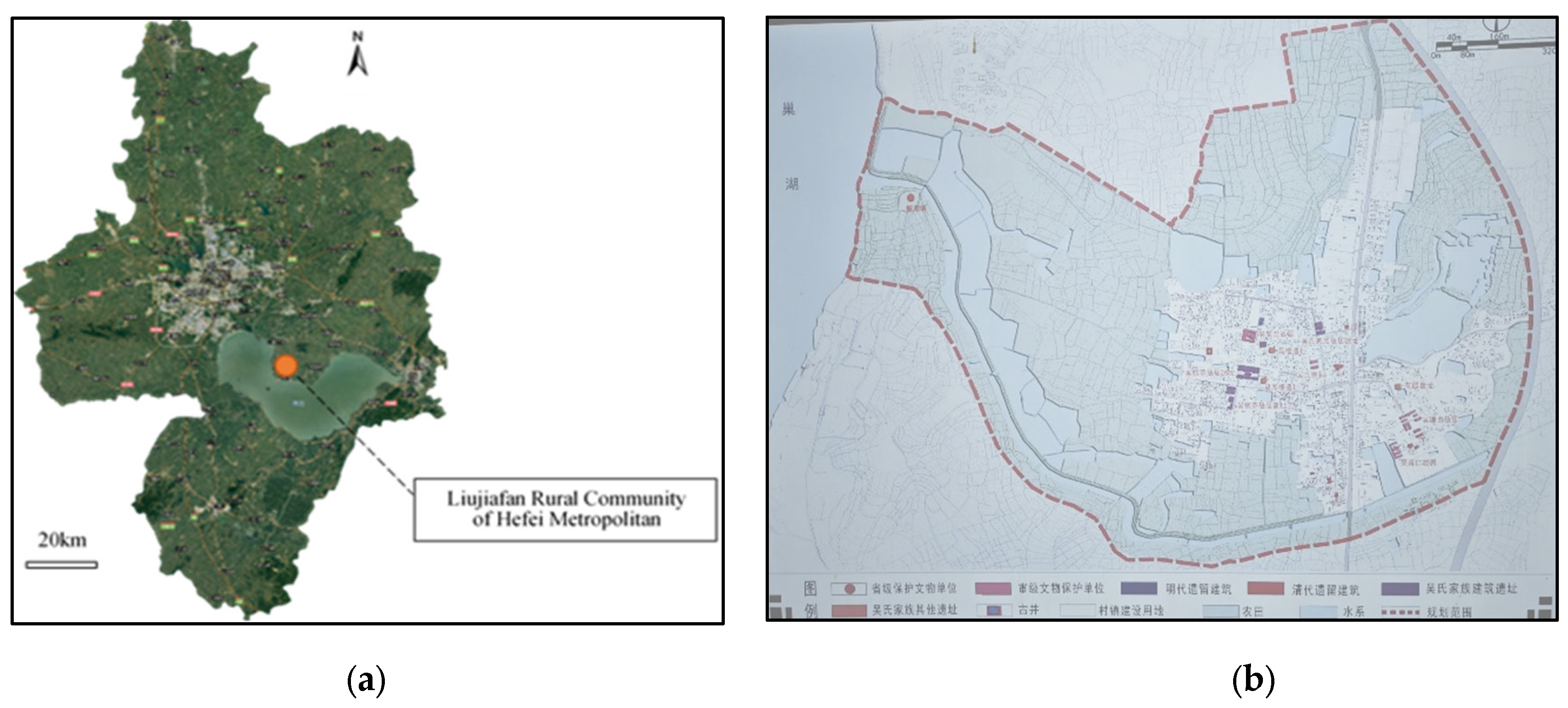
Liujiafan Community is located at the southern end of Feidong County, Hefei City, in the hilly region of the Jianghuai area. The terrain is characterized by a gradual slope from east to west, with undulating hills. Originally the site of the Binhu Township government, Liujiafan was formed by the merger of Hubin Community and Baotao Village in May 2020. The community covers an area of approximately 6.8 square kilometers and comprises thirteen natural villages, with a permanent population of 5,020 residents. Situated in a zone where urban and rural areas are in intense interaction, Liujiafan is adjacent to the north bank of Chaohu Lake and is surrounded by the peaks of Qingyang, Baima, Chahu, and Sidingshan to the southeast. The surrounding hills form a natural basin, making it a typical "city-lake" intersection area and a region known for its abundant agricultural resources. The area is renowned for its unique and rich natural and cultural landscapes. In 2006, it was jointly recognized by the Anhui Provincial Government and the Anhui Provincial Overseas Chinese Association as the "First Overseas Chinese Village in Anhui," with more than 4,000 overseas Chinese residents. There were originally over 800 ancient residential buildings, but due to various factors such as the passage of time and weathering, only about 100 buildings from the Ming and Qing dynasties remain.
Currently, several cultural and tourism projects have been launched, providing nearly 200 local employment opportunities, and stimulating employment for nearly 1,000 people. Liujiafan is gradually becoming a hub for agricultural, cultural, and tourism industries on the north bank of Chaohu Lake, a popular tourist check-in spot and the preferred destination for leisure and tourism in Hefei. Thanks to the development of the cultural and tourism industry cluster, a series of new business formats have been introduced and integrated with the tourism industry, leading to continuous restructuration of local characteristics and essential transformations in spatial structure and social relationships. The restructuration of Liujiafan Community involves a profound transformation of social relationships, representing complex interactions within the "city-lake" system and reshaping the evolutionary path of rural areas on the urban periphery.
Figure 2.
(a) Liujiafan Location of Hefei; (b) Liujiafan Rural Community. (Source: Compiled by the author, and provided by Liujiafan community government).
Figure 2.
(a) Liujiafan Location of Hefei; (b) Liujiafan Rural Community. (Source: Compiled by the author, and provided by Liujiafan community government).
3.2. Case Study Area Overview
This study primarily employs field investigation methods, utilizing semi-structured interviews and non-participant observation to collect first-hand data, complemented by textual analysis and case study methods for comprehensive analysis. The study was conducted in three phases to ensure comprehensive data collection and analysis, using semi-structured interviews and non-participant observation.
The first phase spanned from December 2023 to January 2024, during which online data collection was conducted to gather reports and documentary materials related to Liujiafan. Building on this foundation, the research team conducted two field surveys and semi-structured interviews in Liujiafan from January 13 to 15, 2024. The team collected materials from the Wu Clan Ancestral Hall Council and the Cultural History Research Association, which included records of the origins of Liujiafan, socio-economic and cultural changes, major events, and genealogies as cultural heritage carriers, all of which possess significant documentary value and high credibility. Additionally, through online search engines, using keywords such as "Liujiafan," "Liujiafan Resort Area," and "Liujiafan Tourism," web pages and news media reports were collected to understand the general development and research status of the Liujiafan Resort Area.
The second phase took place from March 1 to 5, 2024. Prior to this phase, the research team briefly learned the local dialect and prepared necessary investigation tools. A total of 21 in-depth interviews were conducted, focusing on the historical evolution of Liujiafan, changes in industrial structure, and the transformation of social networks and cultural life in the village since the development of tourism. The interviewees were selected from various representative groups who have a good understanding of the development process of Liujiafan (Table 1).
The third phase occurred from April 6 to 10, 2024. Based on the organization and analysis of existing data and interview information, the research team conducted three supplementary surveys to complete relevant information and correct information errors caused by interviewees' unclear subjective understanding. Using the form of semi-structured interviews, the investigation covered key information related to the restructuration of individuals, social relationships, and rural spaces.
4. Evolutionary Process and Internal Mechanisms of Rural Restructuration Driven by Tourism
4.1. Analysis of the Evolutionary Process of Rural Restructuration Driven by Tourism
Upon organizing existing data, it is evident that the process of rural restructuration driven by tourism exhibits distinct phases, consistent with previous research findings [35]. Through the organization of materials, it was identified that 2019 marked a pivotal year in the development of tourism in Liujiafan. In response to Hefei's "Great Lake City" and rural revitalization strategies, the local government collaborated with private enterprises to develop the Jianghuai Overseas Chinese Township·Liujiafan cultural and tourism project, transforming Liujiafan into a tourist destination on the urban periphery. Consequently, this study divides the evolutionary process into two phases: the initial phase and the rapid development phase.
- 1.
- Initial Phase (2013-2019): Economic and spatial restructuration tend towards stability. As stated by FT-21 (Table 3), due to the implementation of policies for the protection of fishery resources and the aquatic ecological environment of Chaohu Lake, fishermen along the lake shore transitioned from fishing to other occupations. In the early phases of local tourism development, tourism initially drove economic restructuration, but its fame was limited, primarily serving the development of surrounding holiday real estate. A few fishermen engaged in homestay operations, and the driving effect of tourism was not significant. In 2013, the ancient residential buildings of Liujiafan were listed as key municipal cultural relics protection units by Hefei City. The local government, adhering to the principle of respecting history and the approach of restoring the old as it was, renovated and explored the resources of the ancient residential buildings. By 2019, leveraging the opportunity of integrated cultural and tourism development, the local government increased support for the tourism development of Liujiafan, marking a new phase in its tourism development. Tourism drove the transformation of rural industries, shifting the dominant industry from agriculture and fisheries to tourism, promoting the integration of rural industries, and gradually changing the spatial layout of rural industries, aligning with the "thriving industries" aspect of rural revitalization. Consequently, tourism drove Liujiafan to transform from a traditional "production-living" space to a "production-living-ecological" composite space, making the rural area more livable and stabilizing the spatial structure, with tourism space resources achieving optimized allocation.
Tourism-driven spatial restructuring significantly changed the rural social structure and economic pattern, reshaping the interaction between people and land, as described by FT-6 (who previously worked away from home, but returned to his hometown due to the development of tourism...) and FT-7 (Previously, most people here were engaged in farming. After the development of tourism, the land was contracted out, and the local development of tourism also provided many jobs related to tourism, which paid more than farming. We all shifted to this line of work...). The increase in external operators and the return of some local young people for entrepreneurship led to a transformation of the rural community from a "familiar society" to a "semi-familiar society," from an "elderly society" to a "middle-aged and youth society," and from a "hollow village" to a "solid village," marking the initial restructuration of rural society driven by tourism. Concurrently, the local income structure gradually changed, shifting from a single agricultural income to a diversified income structure of "rent-dividends-wages-tourism income," making villagers' income more diversified. The rural economic system transitioned from a "dual economy" based on migrant work, traditional fisheries, and cultivation to a "diversified economy" integrating cultural and tourism industries, marking the secondary restructuration of the rural economy driven by tourism and tending towards stability. This outcome aligns with the "prosperous life" aspect of rural revitalization. During this phase, tourism initially drove the preliminary restructuration of the rural economy, which in turn guided the restructuration of land structure and functions, continuously leading spatial restructuration. The tourism-driven spatial restructuration of the countryside also changed the rural social structure and economic pattern, simultaneously driving the initial rural social refiguring and the secondary restructuration of the rural economy. This study posits that tourism-driven rural restructuration begins with economic restructuration, consistent with existing research views [36]; tourism-driven land restructuration is the direct pathway to rural restructuration, and changes in land use structure and functions are the foundation for spatial restructuration [37]; this study also suggests that tourism-driven secondary restructuration of the rural economy and society occurs concurrently, but while the rural economy undergoes secondary restructuration, social refiguration is only in its initial phase. The occurrence of the processes is inseparable from the regulation of the "visible hand" of the government, as proposed in Theoretical Expectation 1 and Theoretical Expectation 2. Theoretical Expectation 1: Government intervention is crucial in the initial phase of tourism-driven rural restructuration; Theoretical Expectation 2: The foundation of tourism-driven rural spatial restructuration is economic restructuration, and economic restructuration is the direct pathway to rural restructuration.
- 2.
- Rapid Development Phase (2020-Present): Social and cultural refiguration tend towards stability. As mentioned by FT-3 (…The development of local tourism has allowed me to find an ideal job right at my doorstep. It feels like this job was tailor-made for me. Two years ago (2022), I also asked my nephew to come back. Working outside was meaningless. At first, he was reluctant, and his girlfriend, who is from Henan, was unwilling to come. Last year (2023), he didn't earn much from working outside. Now, it's not bad here. After the New Year, he didn't leave and even brought his girlfriend. They are getting married this year (2024).…), during the rapid development phase of tourism, the population of the rural community has significantly increased. However, during this process, several operators have exited, which may be a result of the automatic process of natural selection in the rural tourism market; the increase in new external immigrants also contributes to the regularization of rural tourism management. At the same time, the return of more middle-aged and young people for entrepreneurship and local employment is conducive to harmonious family relationships and helps alleviate the "hollowing out" phenomenon. It can be seen that tourism drives continuous changes in the organizational structure and social relations of the countryside, gradually shifting from the initial "semi-familiar society" to a "familiar society," and from a "middle-aged and youth society" to an "elite society," with tourism driving the secondary refiguration of rural society and tending towards stability (Table 3). In the aforementioned process, new immigrants also bring different cultures. They transition from "leasing relationships" to "friendship relationships," with new immigrants continuously influencing local residents and local residents also changing new immigrants. To meet the needs of tourists, the ancient culture within the village is preserved, and cultural activities gradually increase. At the same time, with increased contact with tourists, villagers' lifestyles, consumption concepts, and ideas undergo changes. During the rapid development phase of tourism, external tourism operators and practitioners have developed a sense of belonging and identification with local culture, and tourism-driven cultural refiguration in the countryside tends towards stability. This research outcome is in line with the connotations of "civilized rural customs" and "effective governance" in rural revitalization.
During this phase, tourism drives significant changes in the internal social relations and organizational structure of the countryside, affecting the cultural attributes of the rural area. Tourism-driven secondary restructuration of rural society sees the transition from a "semi-familiar society" to a "familiar society" and from a "middle-aged and youth society" to an "elite society," constructing a community identity. Concurrently, the rural tourism market undergoes natural selection, with the remaining high-quality tourism enterprises emerging as "leaders" (such as the accommodations in Huatian Time Art Gallery, Fantang Shiwushe homestay, and the 1952·Granary Cultural and Creative Park), promoting the scaling of tourism operations. It is found that tourism-driven social refiguration of the countryside is the cornerstone for cultural refiguration, with external cultures continuously integrating into local cultures and villagers' concepts undergoing changes. At the same time, tourism drives the revival of excellent traditional cultures, forming a geo-cultural community of traditional, local, and external cultures. This process is generally slow [38], but it can rapidly mature under the joint action of capital and government, the "invisible hand" and the "visible hand," which is a new phenomenon emerging in the implementation of China's rural revitalization strategy. As stated in Theoretical Expectation 3, 4, and 5. Theoretical Expectation 3: Tourism-driven social refiguration of the countryside is a modern transformation process from a "familiar society" to a "semi-familiar society" and back to a "familiar society"; Theoretical Expectation 4: Tourism-driven cultural refiguration is generally a slow process of continuous "sedimentation," but it can rapidly mature under certain conditions; Theoretical Expectation 5: Tourism-driven rural restructuration is an evolving process and also a process of natural selection.
4.2. Mechanism Analysis of Rural Restructuration Driven by Tourism
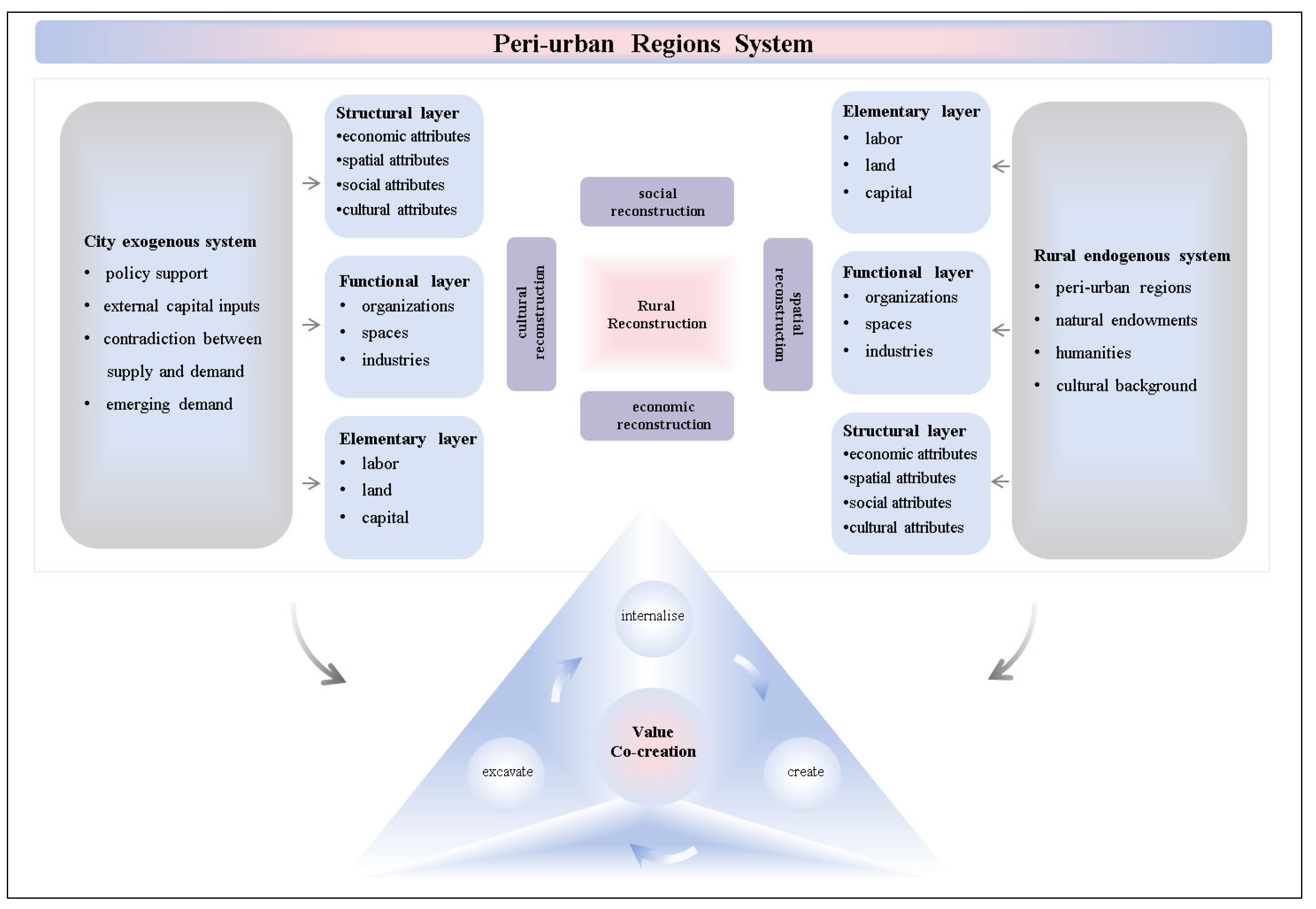
Based on the evolutionary process of rural restructuration driven by tourism and the attributes of rural tourism, this paper constructs a systematic interpretive framework based on the dual drive of "exogenous deconstruction-endogenous restructuration," to examine the driving mechanisms of rural restructuration driven by tourism. This approach facilitates a better abstraction of the essence of restructuration, forming the construction process of the theory of rural value re-creation/co-creation. The process and driving mechanisms of rural restructuration are analyzed based on the system circle layer theory, decomposing the peri-urban territorial system into three levels: the functional layer, the deconstruction layer, and the element layer. The functional layer is composed of four dimensions: "economic attribute function, spatial attribute function, social attribute function, and cultural attribute function." The structural layer is constituted by three types of structures: "organization-space-industry." The element layer is made up of three elements: "human-land-industry."
As shown in the figure, the rural restructuration driven by tourism is a dual-motivated process from outside to inside and from inside to outside. It reconstructs from the superficial layer to the essential layer and vice versa, ultimately constructing its complex intrinsic mechanism. Observing the entire deconstruction-restructuration process of the countryside from both the exogenous and endogenous systems, the exogenous system first deconstructs the evolution process of rural deconstruction. The local rural economic deconstruction is concentrated in the decline and disappearance of traditional agriculture and fisheries, and the rise of emerging rural tourism and leisure industries and their related industries. Obviously, relying solely on the local resource endowment of the countryside would be a slow process, which is also the situation of most ordinary villages far from the urban edge in China. However, peri-urban villages, due to their natural locational advantages and proximity to urban consumer service markets, attract external capital investment under the guidance of local government policies.
Secondly, the "tourism+" industry, as a key economic function attribute, plays the role of a "starter" in driving the restructuration of the rural economy from a typical "dual economy" of migrant work and traditional farming to a "diverse economy" of multi-industry integration. This shift has driven the transformation of spatial, social, and cultural functional attributes. The changes in functional attributes are transmitted to the intermediate structural layer of rural organizations, spaces, and industries, leading to the disintegration and restructuration of the existing structural layer. This is mainly manifested in the transformation of rural society and culture from an "elderly society" to a "middle-aged and youth society" under the influence of the exogenous system, which is also a deconstruction process from a "familiar society" to a "semi-familiar society"; it has experienced a deconstruction process from "local cultural continuation" to "external cultural embedding." The endogenous system intervenes in the deconstruction process, achieving a transformation from a "middle-aged and youth society" to an "elite society," and then completing the restructuration process from a "semi-familiar society" to a "familiar society" and from "external cultural embedding" to "diverse cultural coexistence." Under the drive of tourism, the deconstruction and restructuration of economy, space, society, and culture have formed three major rural communities of peri-urban economy, multiple spaces, and organizational culture.
Thirdly, the formation and integration of the three major rural communities driven by the "exogenous-endogenous system" with tourism as the main body have integrated the villagers' "production-living-ecological" space and interests, stimulated the vitality of rural development, and realized the underlying logic of local rural revitalization. As can be seen from FT-15 (part of it is rented out...) and FT-7 (the development of tourism projects here...), FT-13 (the change of living environment...), the formation and interaction of the three major rural communities driven by tourism have successfully activated rural resources, promoted the transformation of rural resources into assets, and further realized the common benefits of the countryside and villagers, laying the foundation for the interaction of "labor-land-capital" elements. The formation of the three major rural communities is an important support for the deconstruction- restructuration of the countryside driven by tourism and constitutes the carrier of the interaction of "labor-land-capital" elements.
By deeply analyzing the hierarchical relationship of rural deconstruction and restructuration driven by the exogenous-endogenous system with tourism as the main body, we further examine the interaction process of the core layer "labor-land-capital": The deconstruction and restructuration of the countryside guided by tourism are carried out under the joint action of the exogenous and endogenous systems of the countryside. Subsequently, the ecological landscape value and resource value attached to the land are excavated, and at the same time, the cultural value of the peri-urban region of the countryside is activated. While tourism promotes the deconstruction of the original rural economy, it also reconstructs the rural industrial structure and value, promotes the organic integration of multiple rural industries, and continuously extends the industrial value chain. On the basis of agricultural development, the added value of agriculture is increased with "tourism"; eventually, the tourism capital element value with "food, accommodation, transportation, tourism, shopping, and entertainment" as the main body is integrated, and the consumption value of the industry is highlighted. In the process of driving the interaction of "capital" and "land" by rural tourism, the participation of "labor" - the main body of the countryside - is indispensable, and it enhances and internalizes the value of the main body of the countryside. Tourism promotes the upgrading of rural value, activates the humanistic value of the countryside, and continuously identifies the value co-creation of multiple stakeholders. The countryside has developed from the original "local people" to a community of "local people, outsiders, and returnees," and the value of the countryside is continuously internalized, continuously promoting the deconstruction of the existing countryside and promoting the restructuration of the new countryside.
The interaction of the core layer "labor-land-capital" elements is the fundamental way of rural restructuration driven by the exogenous-endogenous system with tourism as the main body. Its essence is the value transformation brought about by the changes in the relationship of labor, land, and capital, and the multiple values of the countryside are re-recognized and excavated. Based on the value enhancement of "labor-land-capital" in rural restructuration driven by tourism, the study further abstracts the essence layer of rural deconstruction and restructuration - the re-creation of rural value. According to the data such as FT-19 (there used to be no other leisure activities, but it's different now...) and FT-13 (our local environment has improved, which will attract more and more tourists...), the driving mechanism of rural restructuration by the exogenous-endogenous system with tourism as the main body, the essence layer of rural restructuration accompanies the process of "value excavation - value internalization - value creation" within the countryside. The value of "labor-land-capital" in the countryside is constantly re-created, and its essence is the re-creation of the multiple values of the countryside. It is a process of "rediscovery," "reutilization," and "recreation" of rural value, and the re-creation of rural value further sublimates the multiple values of the countryside. Therefore, this paper believes that the essence of rural restructuration driven by tourism is to realize the re-creation of rural value, and its logical main line is "system-function-structure-elements-value."
Figure 3.
The exo-endogenous mechanism of tourism-driven rural reconfiguration.
The driving mechanism of rural restructuration driven by tourism proposed in this paper, which is guided by the exogenous-endogenous system, differs from the traditional mechanism research under the "elements-structure-function" perspective, mainly in the evolution process of rural deconstruction-restructuration, the source of driving force, and the extension of the logical main line. At present, the research on the process and mechanism of rural restructuration in the academic circle is mainly based on the macro perspective, on the basis of the theoretical framework of "elements-structure-function" evolution promoting rural restructuration proposed by scholars such as Long, H., and explores the process of rural restructuration driven by external forces from the logical main line of "element combination-structural reorganization-functional optimization."[39,40] Some scholars, based on the "endogenous growth" theory and the micro perspective, proposed that rural restructuration starts from "functional" restructuration[41], reshapes and optimizes the function of the rural territorial system, and explores the process and mechanism of rural restructuration. The current mechanism constructed by the academic circle focuses on a single-dimensional perspective, and the logical mechanism stays at the static restructuration analysis and characteristic analysis of the functional, deconstruction, and element levels, without further in-depth and full-process analysis and discussion. Therefore, this study innovates on the basis of previous research. In the interpretation of rural restructuration, it starts from the integrity of rural deconstruction and restructuration, dynamically observes, and analyzes the whole process, and deeply explores the source of power and essence in this whole process. The mechanism research is extended to the level of rural community value co-creation. The essence of rural restructuration is that under the joint action of the endogenous-exogenous system, the "labor-land-capital" elements in the original system are deconstructed, and its multiple values are continuously re-created under the drive of tourism, realizing the whole process of "rediscovery," "reutilization," and "recreation" of the value of peri-urban rural regions. In addition, the driving mechanism constructed in this paper is highly consistent with the systematic and holistic nature of peri-urban villages, and the biggest difference from the previous research is that the interaction between layers is integrated into one, which is highly consistent with the systematic.
5. Evolutionary Process and Internal Mechanisms of Rural Restructuration Driven by Tourism
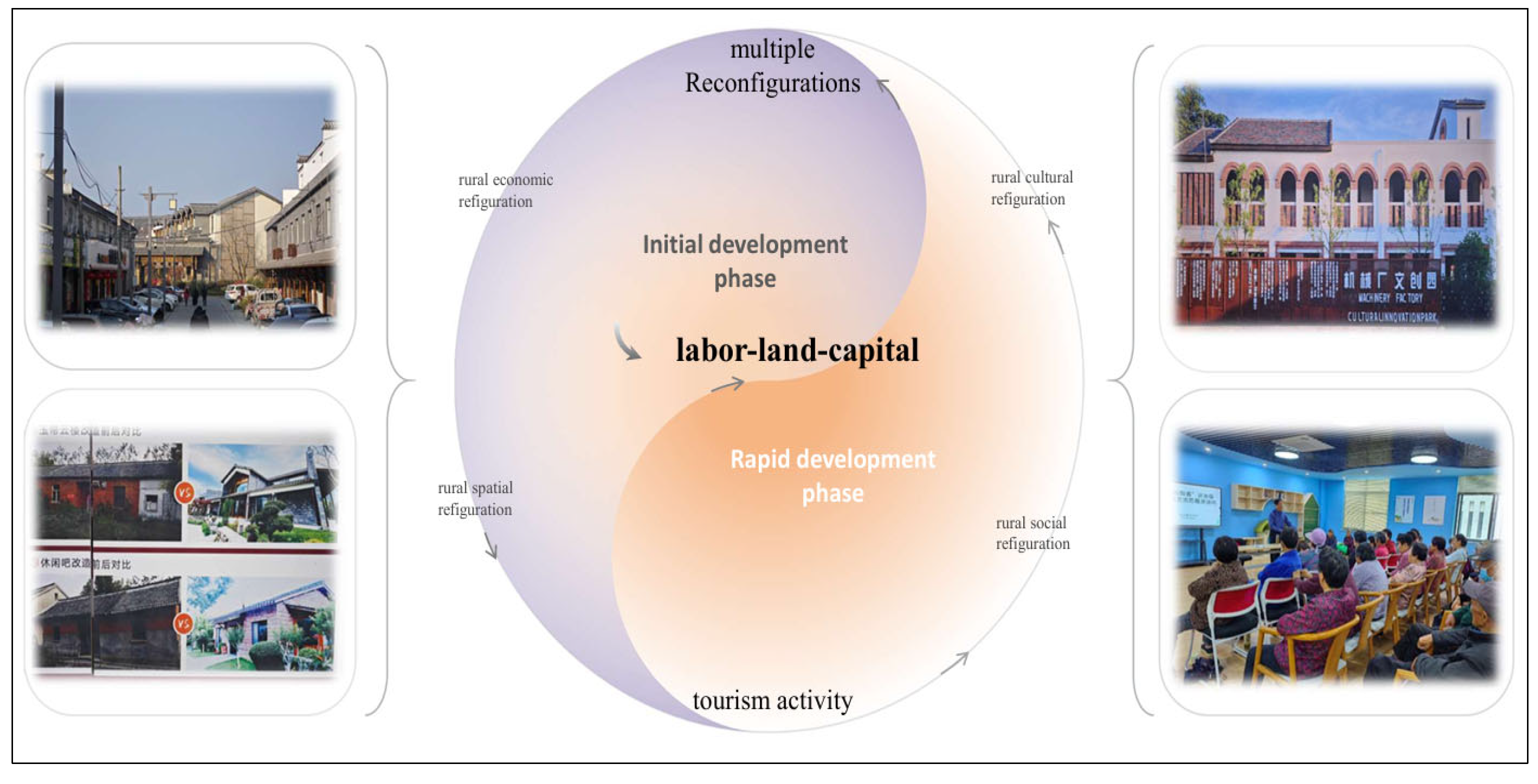
This paper constructs a dynamic model with temporal evolution, ultimately reaching a stable phase of multi-dimensional restructuration. It is posited that the process of rural restructuration driven by tourism comprises two phases: the initial development phase and the rapid development phase, encompassing four processes of economic, spatial, social, and cultural refiguration, thus constituting a complete process of rural restructuration driven by tourism. The initial development phase is characterized by the stabilization of economic and spatial restructuration, while the rapid development phase is marked by the stabilization of social and cultural refiguration. The core of the rural restructuration process driven by tourism is the interaction of the three elements: "labor-land-capital." In this process, tourism continuously promotes the interaction of these three elements within the rural territorial system. Subsequently, with the continuous development of rural tourism, interactions persist, new tourism business entities continuously enter, poorly performing entities are eliminated, or the countryside develops new tourism projects, and external environments continuously change, as well as the iterative upgrading of tourism products. Tourism drives the rural area to evolve cyclically according to the evolutionary model, and the four processes are continuously refined and optimized. The values generated by these interactions become the cornerstone for the next cycle. Through multiple cycles, the socio-economic form of the countryside tends to stabilize, the spatial pattern is continuously optimized, the allocation of rural resources becomes more rational, and the service system is perfected, thereby promoting the healthy development of the rural tourism industry and the rural territorial system. The countryside ultimately enters a stable phase of multi-dimensional restructuration where economic, spatial, social, and cultural refiguration are mutually integrated and interact; throughout the continuous cycles and up to the multi-dimensional restructuration stable phase, the core of the rural restructuration process driven by tourism remains unchanged—the interaction of the "labor-land-capital" elements.
This paper posits that rural restructuration is a dynamic, developmental, and cyclical process. Rural restructuration roughly experiences an initial phase dominated by the restructuration of economic and spatial dimensions led by "land, ecology, consumption, and service," a mature phase dominated by the refiguration of social and cultural dimensions led by "identity, others, revival, and culture," and ultimately reaches a stable phase of multi-dimensional restructuration led by "subject, value, network, and system." Additionally, in this evolutionary process, the unique attributes of rural restructuration driven by tourism are manifested as follows:
- 1. Restructuration of Rural Ecological and Consumption Spaces: This is a unique contribution of tourism-driven efforts. The rural space transitions from a traditional "production + life" space to a "production + life + ecology" composite space
- Significant Refiguration of Rural Social Organizational Relationships: The tourism-driven refiguration of rural social organizational relationships shows a significant increase, forming a deconstruction-refiguration logic from "familiar society-semi-familiar society-familiar society," highlighting the unique role of tourism.
- Core of Rural Restructuration under Tourism Leadership: The core of rural restructuration under the leadership of tourism is the revival of traditional culture, the better integration of external cultures into local cultures, and the enhancement of residents' spiritual levels.
This study builds upon the findings that the process of rural restructuration driven by tourism exhibits phased characteristics, with the initial phase being inseparable from the assistance of the government's "visible hand". The essence of rural restructuration driven by tourism is the re-creation of rural value, with the fundamental pathway being the interaction of the "human-land-industry" trilogy. Key supports include the "three major rural communities" — the rural organizational cultural community, the rural geo-economic community, and the rural multiple space community. The foundational conditions are the restructuration of the rural economy, space, society, and culture. The process of rural restructuration driven by tourism is dynamic, developmental, and cyclical.
Figure 4.
Dynamic evolutionary model of exo-endogenous system-driven rural reconfiguration.
6. Conclusions and Discussion
Based on the theory of endogenous-exogenous systems in rural areas, this paper conducts a case study of the first overseas Chinese village in Anhui Province—Liujiafan in Hefei. The study identifies that rural restructuration driven by tourism exhibits phased characteristics and is a dynamic, developmental, and cyclical process. The core of this process is the re-creation and enhancement of rural value, revealing the intrinsic mechanisms of rural restructuration driven by tourism: The process of rural restructuration driven by tourism is an interactive process from outside to inside and from inside to outside. It is based on four superficial subsystems of economic, spatial, social, and cultural refiguration, relying on three intermediate layers of rural organizational cultural community, rural geo-economic community, and rural multiple space community as logical starting points, and revolves around the interaction of three core elements: "labor-land-capital." Through three stages of value excavation, value internalization, and value creation, the essence of rural restructuration driven by tourism is deconstructed and reconstructed from the exogenous and endogenous systems, achieving the re-creation of rural value.
"Tourism-led rural restructuration" is a significant driving force within the endogenous-exogenous system. Following the logical thread of "system-function-structure-elements-value," it enables the re-recognition and excavation of the diverse values of the countryside. In the process of driving the interaction of the core elements of "labor-land-capital," it reconstructs the socio-economic and cultural forms and territorial spatial patterns of the countryside. The essence of this process is a change in value. In this process, the unique attributes of tourism are demonstrated, and it also shows essential differences from the natural evolution of the countryside (referring to the countryside without exogenous or endogenous driving forces):
- Differences in Deconstruction-Restructuration Processes: The restructuration of the countryside under natural evolution usually begins with economic restructuration, which plays a leading role in spatial and social refiguration [42]. However, the economic form has not changed significantly, and population outflow leads to an increased vacancy rate of living spaces, with the countryside remaining at a low level of development [43–45]. Even under the strong support of China's rural revitalization policy, the lack of internal development momentum results in relatively slow restructuration. In contrast, tourism-driven rural restructuration, although also starting with economic restructuration, has at its core the revival of traditional culture, the better integration of external cultures into local cultures, and the enhancement of residents' spiritual levels. In the natural evolution state, the cultural attributes of the countryside are not well protected and inherited, as indicated by FT-2(...prior to the initiation of tourism development, some courtyard walls, which had stood for over a century, appeared dilapidated and on the verge of collapse, with their structural integrity uncertain...), often leading to cultural decline or extinction. Tourism-driven rural restructuration has an important stage of cultural refiguration. Additionally, there are differences in spatial restructuration. Tourism-guided internal and external driving forces in rural spatial restructuration expand land and economic restructuration and emphasize the uniqueness of ecological restructuration, which is a unique aspect of tourism development in rural restructuration.
- Similarities and Differences in Core Elements: Both tourism-driven and naturally evolved rural restructuration have "labor-land-capital" as core elements, and the interaction of these core elements promotes rural restructuration. However, the essence of the interaction of the core elements "labor-land-capital" in tourism-driven rural restructuration is the transformation of element values, that is, expanding the boundaries of rural resource capabilities, improving resource utilization efficiency, and increasing product added value, allowing the diverse values of the countryside to be re-recognized and excavated. In the natural evolution state, the interaction process of the three core elements "labor-land-capital" in rural restructuration is inevitably affected by the "suction effect" of urban development, leading to the disintegration and extinction of local rural society. In contrast, tourism-driven rural restructuration reduces this one-way "suction" and brings about "elite return flow" and a two-way interactive process.
The refiguration of rural society is a complex and diverse process, influenced by a multitude of interwoven factors. These factors include: the re-construction of the rural economy, which provides a material foundation; the spatial layout of the rural areas serves as a platform for activities and development; the resource environment, which is an indispensable support system; the tourism market, which plays a leading role; and policy systems, which provide stable guarantees and regulatory management. The core driving force behind all these developments is the active participation of the main actors. These elements are interwoven and mutually influential, forming a dynamic collaborative relationship that collectively promotes the comprehensive reshaping of rural society.
Author Contributions
Conceptualization, H.Z. and Y.Z.; methodology, Y.Z.; software, J.L.; validation, X.Z., Y.Z. and H.Z.; formal analysis, H.Z.; investigation, J.L.; resources, H.Z.; data curation, X.Z.; writing—original draft preparation, Y.Z.; writing—review and editing, H.Z.; visualization, X.Z.; supervision, J.L.; project administration, H.Z.; funding acquisition, H.Z. and Y.Z. All authors have read and agreed to the published version of the manuscript.
Funding
This research is funded by research project on Social Science Innovation and Development of Anhui Province Federation of Social Sciences, grant number 2021CX048; Philosophy and Social Science Planning Project of Anhui Province, grant number AHSKQ2022D076; Talent Research Fund Project of Hefei University, grant number 21-22RC48,20RC71.
Data Availability Statement
The data presented in this study are available on request from the author. The data are not publicly available due to privacy restrictions.
Acknowledgments
The assistance provided by Wenyan Liu, Jingjing Shen, Yaqing Wang and all of those who contributed to the investigation and data collection is greatly appreciated.
Conflicts of Interest
The authors declare no conflict of interest.
References
- Friedmann J,Bloch. American Exceptionalism in Regional Planning. International Journal of Urban and Regional Research 1990, 14, 576–601. [Google Scholar] [CrossRef]
- Yang Ren; Lu Jingfeng; Li Wei. Evolution and Influential Mechanism of Multi-dimensional Space of Typical TraditionalVillages in the Metropolitan Fringe of Pearl River Delta. Economic Geography 2022, 42, 190–199. [Google Scholar] [CrossRef]
- Liu Yangsui; Zhou Yang; Li Yuheng. Rural regional system and rural revitalization strategy in China. Acta Geograpica Sinica 2019, 74, 2511–2528. [Google Scholar] [CrossRef]
- Yang Ren; Liu Yansui; Long Hualou; Zhang Yijun. Research progress and prospect of rural transformation and restructuration in China: paradigms and main content. Progress in Geography 2015, 34, 1019–1030. [Google Scholar] [CrossRef]
- Paquette S; Domon G. Changing ruralities, changing landscapes: Exploring social recomposition using a multi-scale approach. Journal of Rural Studies 2003, 19, 425–444. [Google Scholar] [CrossRef]
- Smith D P; Phillips D A. Socio- cultural representations of gentrified Pennie rurality. Journal of Rural Studies 2001, 17, 457-469. [CrossRef]
- Lv Zuyi; Lin Gen. Hybridity: Rethinking rurality. Geographical Research 2017, 36, 1873-1885. [CrossRef]
- Hall, D.; Mitchell, M.; Roberts, L. Tourism and the countryside: dynamic relationships; Ashgate Publishing Company: Burlington, USA, 2003. [Google Scholar] [CrossRef]
- Müller D, K.; Hall, M.; Keen, D. Second home tourism impact, planning and management; //Hall C, M, Müller D K. Tourism, Mobility and Second Homes: Between Elite Landscape and Common Ground, Eds.; Channel View Publication: Clevedon, UK, 2004; pp. 112–187. [Google Scholar] [CrossRef]
- Marjavaara, R. The displacement myth: Second home tourism in the Stockholm archipelago. Tourism Geographies 2007, 9, 296–317. [Google Scholar] [CrossRef]
- Halseth G; Hall C M; Müller D K. The "cottage" privilege: Increasingly elite landscapes of second homes in Canada; // Hall C, M, Müller D K. Tourism, Mobility and Second Homes: Between Elite Landscape and Common Ground, Eds.; Channel View Publication: Clevedon, UK, 2004; pp. 35–54. [Google Scholar] [CrossRef]
- Müller D, K. 9. second home tourism in the Swedish mountain range//Nature-Based Tourism in Peripheral Areas; Multilingual Matters: Bristol, UK, 2004; pp. 133–148. [Google Scholar] [CrossRef]
- Woods, M. Rural Geography: Processes, Responses and Experiences in Rural Restructuring; Sage: London, UK, 2005. [Google Scholar] [CrossRef]
- Wang Yan-fei; Liu Yan-sui; Li Yu-heng. The Spatial Disparity of Rural Transition Development and Regional Characteristics of Its Driving Forces. Economic Geography 2016, 36, 135–142. [Google Scholar] [CrossRef]
- Romer, P.M. Increasing returns and long-run growth. J. Polit. Econ 1986, 94, 1002–1037. [Google Scholar] [CrossRef]
- Lucas, R.E. On the mechanics of economic development. J. Monet. Econ 1988, 22, 3–42. [Google Scholar] [CrossRef]
- Long Hualou. Land consolidation and rural spatial restructuring. Acta Geographica Sinica 2013, 68, 1019-1028. https://www.geog.com.cn/CN/Y2013/V68/I8/1019#4. /: 1019-1028. https.
- Woods, M. Rural; Routledge: London and New York, UK and USA, 2011. [Google Scholar] [CrossRef]
- Lu Song; Liu Junmei; Rao Xiaofang; Zhang Hai. Research review on the rural restructuration influenced by tourism. Journal of Chinese Ecotourism 2021, 11, 315–331. [Google Scholar] [CrossRef]
- He, Y.; Wen, C.; Fang, X. Impacts of urban-rural integration on landscape patterns and their implications for landscape sustainability: The case of Changsha, China. Landsc Ecol 2024, 39, 129. [Google Scholar] [CrossRef]
- Long Hualou; Tu Shuangshuang; Ge Dazhuan, et al. The allocation and management of critical resources in rural China under restructuring: Problems and prospects. Journal of Rural Studies 2016, 47, 392-412. [CrossRef]
- Tu Shuangshuang; Long Hualou; Li Tingting, Ge Dazhuan. The mechanism and models of villages and towns construction and rural development in China. Economic Geography 2015, 35, 149–156. [Google Scholar] [CrossRef]
- Zhang Fugang; Liu Yansui. Dynamic mechanism and models of regional rural development in China. Acta Geographica Sinica 2008, 63, 115–122. [Google Scholar] [CrossRef]
- Wu Chuanjun. Problems of the Sustainable Development of Agriculture and Rural Economy in China: Case Studies of Agricultural Area of Different Types; China Environmental Science Press: Beijing, China, 2001. [Google Scholar]
- Romer, P.M. Endogenous technological change. J. Polit. Econ 1990, 98, S71–S102. [Google Scholar] [CrossRef]
- Yan Xuyang; Tang Lihua; Yang Yijie. Functional Restructuration of Hollow Village from the Perspective of Urban-Rural Relations: Dynamics and Mechanism-A Case Study of the “Rebirthof” Ganyugou Village. Management Review 2020, 32, 325–336. [Google Scholar] [CrossRef]
- Tu Shuangshuang; Long Hualou. Study on the mechanism and models of villages and towns construction and rural development in China. National Academic Symposium on Land Resource Development, Reorganization and New-type Urbanization, Anyang, China, 24/07/2015.
- Richter, R. Rural social enterprises as embedded intermediaries: The innovative power of connecting rural communities with supra-regional networks. Journal of Rural Studies 2019, 70, 179–187. [Google Scholar] [CrossRef]
- Phillips M; Smith D; Brooking H, et al. The gentrification of a post- industrial English rural village: Querying urban planetary perspectives. Journal of Rural Studies 2022, 91, 108-125. [CrossRef]
- Zhou, X.; Li, X.; Gu, X. How Does Urban-Rural Capital Flow Affect Rural Restructuration near Metropolitan Areas? Evidence from Shanghai, China. Land 2023, 12, 620. [Google Scholar] [CrossRef]
- Chen Kunqiu; Zhou Jingjing; Chen Yunya; Chen Jiao. Pattern and Mechanism of The Flow of Urban-rural Land Elements in China. Economic Geography 2024, 44, 183-192. [CrossRef]
- Ralph Richter. Rural social enterprises as embedded intermediaries: The innovative power of connecting rural communities with supra-regional networks. Journal of Rural Studies 2019, 70, 179-187. [CrossRef]
- Vargo S L; Lusch R F. Service Dominant Logic:Continuing the Evolution. Journal of the Academy of Marketing Science 2008, 36, 1–10. [Google Scholar] [CrossRef]
- Wu Lin; Wu Wenzhi; Feng Xuegang. Restructuration of Rural Tourism Value Chain Leaded by Value Co-Creation. Chinese Journal of Agricultural Resources and Regional Planning 2019, 40, 227-231. [CrossRef]
- Tu Shuangshuang; Zheng Yuban; Long Hualou; Wang Shimeng; Liang Xiaoli; Wang Wei. Spatio-temporal pattern of rural development and restructuring and regional path of rural vitalization in Guangxi, China. Acta Geographica Sinica 2020, 75, 365-381. [CrossRef]
- Liu Minkun; Ren Lili; Deng Xiaogui. Study on the Tourism Path Admittance Threshold and Differentiation Choice of Rural Revitalization Strategy. Business and Management Journal 2021, 43, 173–192. [Google Scholar] [CrossRef]
- Dai, M.; Fan, D.; Wang, R.; Ou, Y.; Ma, X. Does rural tourism revitalize the countryside? An exploration of rural spatial restructuration driven by tourism development. Journal of Destination Marketing & Management 2023, 29, 100801. [Google Scholar] [CrossRef]
- Ren Lili; Liu Minkun; Deng Xiaogui; Liang Lianjian; Zeng Xihao. From deconstruction to restructuration: The inner mechanism and evolutionary model of tourism-driven rural restructuration in the context of rural revitalization: Taking Zhongliang Village in Xixiangtang District, Nanning City as an example. Scientia Geographica Sinica 2024, 44, 1738-1746. [CrossRef]
- Long Hualou; Tu Shuangshuang. Rural restructuring: Theory, approach and research prospect. Scientia Geographica Sinica 2017, 72, 563–576. [Google Scholar] [CrossRef]
- Zhu Yuanyuan; Luo Yuan. Re-conceptualization and prospects of rural social space restructuration processes in China: Based on the perspective of counter-stream of rural-urban migration. Progress in Geography 2024, 43, 374–386. [CrossRef]
- Yu bin; Li Yingying; Zhu Yuanyuan; Zhuo Rong-rong; Zeng Ju-xin. Characteristics and regional model of rural restructuring in main agricultural production regions in Central China: A case study of Jianghan Plain. Journal of Natural Resources 2020, 35, 2063-2078. [CrossRef]
- Miao XueLing; Xie Jia. A Review and Reflection on the Application of Grounded Theory: Taking Studies of Tourist Experience as a Case. Tourism Tribune 2021, 36, 122–135. [Google Scholar] [CrossRef]
- Li Heping; He Yanqing; Fu Peng; Xiao Jing; Xie xin. A Research on the Dynamics of and the Spatial Responses to the Restructuring Agricultural Rural Settlements. Urban Planning Forum 2021, (01), 36–43. [Google Scholar] [CrossRef]
- Jana Spilková; Radim Perlín. Farmers' markets in Czechia: Risks and possibilities. Journal of Rural Studies 2013, 32, 220-229. [CrossRef]
- Gamito Teresa Maria; Madureira Lívia; Lima Santos José Manuel. Unveiling and typifying rural resources underpinned by innovation dynamics in rural areas. Regional Science Policy & Practice 2019, 13, 457–477. [Google Scholar] [CrossRef]

Table 1.
Attributes of Interviewees in Depth Interviews.
| ID | Gender | Age | Occupation | Time(min) |
| FT-1 | Male | 48 | Assistant General Manager of Liujiafan Scenic Area | 48’ |
| FT-2 | Female | 36 | Liujiaban Homestay Housekeeper | 50’ |
| FT-3 | Male | 45 | Liujiaban Homestay Housekeeper | 40’ |
| FT-4 | Female | 35 | Liujiaban Homestay Housekeeper | 38’ |
| FT-5 | Female | 33 | Restaurant Staff | 26’ |
| FT-6 | Female | 40 | Restaurant Staff | 30’ |
| FT-7 | Female | 38 | Restaurant Staff | 12’ |
| FT-8 | Female | 36 | Liujiaban Tourist Service Center Staff | 68’ |
| FT-9 | Female | 35 | Snack Shop Proprietress | 23’ |
| FT-10 | Male | 53 | Party Secretary of Liujiaban Community | 50’ |
| FT-11 | Female | 45 | Manager of Liujiaban Cultural and Tourism Project | 45’ |
| FT-12 | Male | 60 | Homestay Proprietress | 40’ |
| FT-13 | Female | 65 | Shop proprietress | 40’ |
| FT-14 | Male | 70 | Homestay Owner | 50’ |
| FT-15 | Female | 60 | Restaurant Proprietress | 42’ |
| FT-16 | Male | 58 | Homestay and Restaurant Owner | 48’ |
| FT-17 | Male | 46 | Travel Souvenir Shop Owner | 50’ |
| FT-18 | Female | 40 | non-tourist residents | 15’ |
| FT-19 | Male | 58 | non-tourist residents | 20’ |
| FT-20 | Male | 35 | non-tourist residents | 38’ |
| FT-21 | Female | 34 | Operator of the 1952 Granary Cultural and Creative Park | 23’ |
Table 2.
Example of representative coding data for the initial phase.
| original materials | Initial Coding | Focused Coding |
| FT-5:I previously worked away from home, which left the elderly and children at home without care. | Returning to the family fold | |
| FT-18:Previously, there were not many job opportunities here, and the income was low with little prospect for development. The children all went out to work, leaving just the two of us, the elderly, at home. | Rural return migration | Initial population restructuring |
| FT-1:In the past, I worked away from home for extended periods. Later, when a development project was initiated, I was fortunate enough to be appointed as the curator of the Liujiafan Toy Museum. Working here not only offers a generous salary and benefits package but, more importantly, it is close to my home. As a result, I actively recommend this opportunity to my friends and encourage them to seek employment closer to home. | Population Structure; Employment Opportunities | Economic Restructuring |
| FT-2:In the past, there were limited employment opportunities here, and the young often chose to leave their hometowns to work elsewhere. Previously, our community was characterized by left-behind children and the elderly, and the village was in a state of disrepair. However, as Hefei developed, those who had left gradually returned, bringing vitality back to their hometowns. Subsequently, with the implementation of poverty alleviation initiatives, various facilities were established, and the village’s appearance was transformed. The wild grass on the hills outside the village and along the Chaohu Lake was cleared. Previously, the Chaohu Lake suffered from severe blue-green algae blooms, which emitted an extremely unpleasant odor, but the situation has since improved. | Living space; Ecological space | Initial population restructuring |
| FT-10: The community underwent an early transformation, introducing a new group of occupational groups, including homestay managers, travel consultants, and illustrators for cultural and creative products. However, initially, we found these people quite strange; they stayed up late and spent their weekends running around the mountains and lakes. | External Industry; Semi-Acquaintances | Initial Social Restructuring |
| FT-7: Previously, most people here were engaged in farming. After the development of tourism, the land was contracted out, and the local development of tourism also provided many jobs related to tourism, which paid more than farming. We all shifted to this line of work. | Production Space: Land Transfer | Spatial Restructuring |
| FT-12: I used to run a bathhouse. Now that people's living conditions have improved and they no longer need to bathe outside, I took advantage of the local tourism development and converted my house into a homestay. Since Hefei developed well after 2010, villagers gradually returned from Jiangsu, Zhejiang, and Shanghai. They could work for employers or run their own farmhouses (restaurants). | Changes in Livelihood; Diversification of Income | Initial Economic Restructuring |
| FT-16: Originally, our family worked outside and farmed. With the development of local tourism and an increase in tourists, we decided to return home to start a business. We initially opened a guesthouse, but later, due to the pandemic and intense competition from external investors in the homestay business, we merged the guesthouse and restaurant into one establishment, with the guesthouse upstairs and the restaurant downstairs. | Industrial Structure Adjustment; Migrant Workers' Return; Competition from External Investment | Initial Economic Restructuring - Secondary Restructuring; Initial Spatial Restructuring - Secondary Restructuring |
| FT-6: I used to work outside, and my children were taken care of by their grandparents. Over time, the children became somewhat estranged from me. Now that I'm back, I have more time to spend with my children. | Kinship: Left-Behind Children and the Elderly | Initial Social Restructuring |
| FT-4: I have two children. I work as a homestay manager in Liujiafan. I can send my children to school first and then start my work at the homestay, which helps me better balance work and life. | Changes in Livelihood | Initial Economic Restructuring |
| FT-15: My house is too large. It would be idle anyway, and previously it was only used for my own residence. I might as well rent out a part of it. In this way, my income can also increase. | Diversification of Income; Changes in Livelihood | Initial Spatial Restructuring |
| FT-19: Now, if a light bulb breaks at home, the government will send someone to fix it. Life is more secure, and happiness has increased. | Life Happiness | |
| FT-13: Now that tourism has developed, the environment has been beautified, and hygiene is much better than before. It looks more comfortable, and the quality of life feels improved. | Ecological Environment; | Initial Spatial Restructuring; Initial Economic Restructuring |
| FT-13: Previously, there was no environmental awareness. Trees were cut down without a second thought. But now, we all realize that a better local environment in our countryside will definitely attract more tourists. | Environmental Protection Awareness | |
| FT-14: In the past, it was enough to have clothes to wear and food to eat. Now, it's different. We not only want to have but also want quality. We are beginning to pursue quality. | Life Philosophy |
Table 3.
Example of representative coding data for the rapid development phase.
| original materials | Initial Coding | Focused Coding |
| FT-3: The development of local tourism has allowed me to find an ideal job right at my doorstep. It feels like this job was tailor-made for me. Two years ago (2022), I also asked my nephew to come back. Working outside was meaningless. At first, he was reluctant, and his girlfriend, who is from Henan, was unwilling to come. Last year (2023), he didn't earn much from working outside. Now, it's not bad here. After the New Year, he didn't leave and even brought his girlfriend. They are getting married this year (2024). | External Kinship | Secondary Social Restructuring |
| FT-8: Previously working in Shanghai, I returned to my hometown for employment after the development of local tourism. Life in Shanghai was too fast-paced. Here, the pace is slower, life is more comfortable, and it's convenient to take care of the elderly and children. | Life Comfort; Returning to Family | |
| FT-19: Local restaurants recruit young people for jobs, providing positions. Some young people return to work here, while others, who are more enterprising, have started their own businesses. | Employment Opportunities; Youth Return Entrepreneurship | Secondary Economic Restructuring |
| FT-8: My husband and I used to work in Shanghai, also in the service industry, but the pace was particularly fast and the pressure was high. Now, the pace here is slower, suitable for retirement, and the lifestyle is more comfortable. It feels good to be back. My husband has also partnered with some old friends from Shanghai to start a small company. | Return of Local Elites; Life Pace | Social Restructuring; Economic Restructuring |
| FT-9: We moved here from Xi'an to open a store. Liujiafan has a large flow of people, and we mainly operate some handmade specialty goods. | Population Restructuring; Increase in External Operators | Secondary Economic Restructuring |
| FT-11: The ancient town of Liujiafan did not relocate all the villagers during its development and transformation. We maintained a very friendly relationship with the surrounding residents. After the completion, many residents found local employment and later started their own businesses, realizing their dreams of getting rich locally. | Acquaintance Society; Harmonious Neighborly Relations | Secondary Economic Restructuring |
| FT-10: With better hardware, increased passenger flow, and enriched lives of the people, the living environment has changed significantly compared to the past. Especially now that this block has been developed, it is much better than before. | Living Space; Increased Income | Secondary Spatial Restructuring |
| FT-14: We now pay more attention to healthy exercise. There are bike rentals nearby, and sometimes we go for a Chaohu Lake cycling or running. With more young people around, people from Hefei also come on weekends, and my shop stays open later. | Lifestyle; Integration of External Culture; Ideological Shift | Cultural Restructuring |
| FT-18: This main road used to have some of our neighbors, with whom we occasionally chatted. Later, the development of tourism occupied this land, and they moved to the other side. Now they live farther away and come less frequently. | Geographical Relationships; | Secondary Social Restructuring |
| FT-13: Now these young people come to our village. Initially, we were not used to it, but now we think it's quite good. They are also polite and take care of our business. | Host-Guest Relationship | Cultural Restructuring |
| FT-17: We came here two years ago and hired two young people who learn quickly. At first, we were in the store every day and on weekends and holidays, tourists would come to this street, so business was decent. But during weekdays, there were few customers. Later, they started live-streaming to sell goods online. Now, they mainly focus on this online business. | Employment Relationship; Live Streaming for Sales | Secondary Economic Restructuring |
| FT-14: Initially, it was a two-story building used for my own residence. Later, as the number of guests increased and the rooms were insufficient, we added another floor. Many people in our area have done the same. Those who run successful businesses have even expanded further. | Expansion; Commercialization | Secondary Spatial Restructuring |
| FT-19: In the past, after dinner, we would just go to our neighbors' houses or sit at the doorstep chatting. There were hardly any other leisure activities. Now, it's different. Especially during festivals like the Spring Festival and the Mid-Autumn Festival, the young people here organize many traditional activities. They package these old traditions in a new way, and even city dwellers come to participate. The homestays and farmhouses in our village are now better than before. | Integration of Culture and Tourism; Shift in Lifestyle and Thinking | Cultural Restructuring; Secondary Economic Restructuring |
| FT-20: After the development of tourism in our village, the number of leisure spaces has definitely increased. We now have parks and camping sites, and the surrounding greenery is much better. People can go for walks and entertainment. With the integration of culture and tourism, the community has also collected cultural elements related to the overseas Chinese history of Liujiafan from each household. | Leisure Space; Overseas Chinese Culture; Integration of Culture and Tourism | Cultural Restructuring |
| FT-21: We used to operate a teahouse by the Chaohu Lake shore (where fishermen, due to ecological protection, transitioned to tourism-related businesses such as teahouses and coffee shops, which became weekend gathering spots for urban residents). After the cultural and tourism integration project in Liujiafan in 2020, we moved here because we saw the potential of the whole space. | Cultural Space; Expansion and Concentration | Cultural Restructuring; Secondary Spatial Restructuring |
Disclaimer/Publisher’s Note: The statements, opinions and data contained in all publications are solely those of the individual author(s) and contributor(s) and not of MDPI and/or the editor(s). MDPI and/or the editor(s) disclaim responsibility for any injury to people or property resulting from any ideas, methods, instructions or products referred to in the content. |
© 2025 by the authors. Licensee MDPI, Basel, Switzerland. This article is an open access article distributed under the terms and conditions of the Creative Commons Attribution (CC BY) license (http://creativecommons.org/licenses/by/4.0/).
Copyright: This open access article is published under a Creative Commons CC BY 4.0 license, which permit the free download, distribution, and reuse, provided that the author and preprint are cited in any reuse.