4.1. Cai and Fen
The data of "cai" is listed in
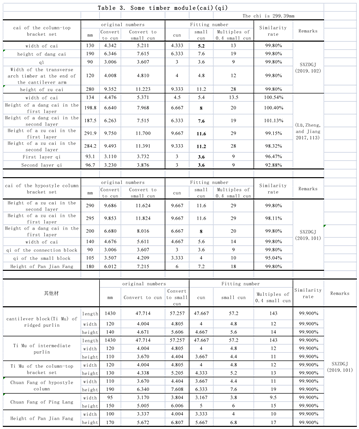
Table 3. The data from SXZDGJ (2019,101and102) is comprehensive, while the data from Lü, Zheng, and Jiang (2017) is more detailed. SXZDGJ (2019, 101) doesn't pay special attention to the differences in zucai (full-sized timbers) of each layer of the column - head bracket set, with the zucai of the first and second layers being the same. The surveying and mapping in Lü, Zheng, and Jiang (2017) takes the average value from multiple samples. The height of the dang cai (single - sized timbers) of the first-layer hua-gong and nidao-gong is 198.8 mm, which is significantly larger than that of others. Based on this, it is fitted to a dangcai of 8 small cun. Lü, Zheng, and Jiang (2017) recorded 23 data of the width of timbers. There are 16 data of the width of timbers at the end of the first jump, with an average value of 135.3 mm. There are 7 data of the width of shua-tou, with an average value of 130.85 mm.
As shown in
Table 3, the differences in the cai are not limited to the first and second floors. There are also variations in other positions. Generally speaking, the timbers can be classified into several types.
First, for the first layer of cai in the column-top bracket set, the dang cai component measures 8 small cun in height, 5.4 small cun in width, with a qi of 3.6 small cun, and the zu cai component is 11.6 small cun. This type of component includes the first-layer hua-gong (flower-shaped bracket arms) and nidao-gong (axial bracket arm).
Second, for the second to fourth layers of cai in the column-top bracket set, the zu cai timbers are 11.2 small cun, the qi is 3.6 small cun, the dang cai timbers are 7.6 small cun, and the width of the timbers is 5.2 small cun.
Third, for the transverse brackets at the end of the bracket-arms in the column-top bracket set, including the guazi-gong, guazi-man-gong, and ling-gong, all of which are moxie-gong. Their width is 4.8 small cun, equivalent to 4 cun. The dang cai timbers are 7.6 small cun, the qi is 3.6 small cun, and the zu cai timbers are 11.2 small cun.
Fourth, for the timbers used in the inner-column bracket sets, the dang cai are 8 small cun, and the width is 5.6 small cun. The qi measurements are surprisingly different. The qi of the jiaohu-dou (a type of block) at the end of the hua-gong bracket-arms is 3.6 small cun, and the zu cai timbers are 11.6 small cun. The qi of the sandou (a type of block) on the nidao-gong is 4 small cun, and the full-sized timbers are 12 small cun. Here, the heights of the zu cai timbers of the nidao-gong and the hua-gong are different.
Fifth, for other cai on the upper frame, the width ranges from a minimum of 3.8 small cun to a maximum of 4.4 small cun, and the height of the timbers also varies.
As shown in
Table 3, all the cross-sectional data of the timbers can be expressed as multiples of 0.4 small cun. The unit "fen" originated from the Yingzao Fashi. It is a measurement unit that was flexibly adjusted according to a unified proportion after the timbers were measured in cun. It is inappropriate to rigidly apply the rules in the Yingzao Fashi to this hall. However, using 0.4 small cun as a measurement unit is worth a try. Here, borrowing the concept of "cai-fen" from the Yingzao Fashi, we take 0.4 small cun as one "fen". This "fen" is the one restricted by the construction ruler, which is a sub-modulus in the architectural modular system, rather than the "fen" in the Yingzao Fashi.
Table 3.
Some timber module(cai)(qi).
Table 3.
Some timber module(cai)(qi).
4.2. Bearing Block(Dou)
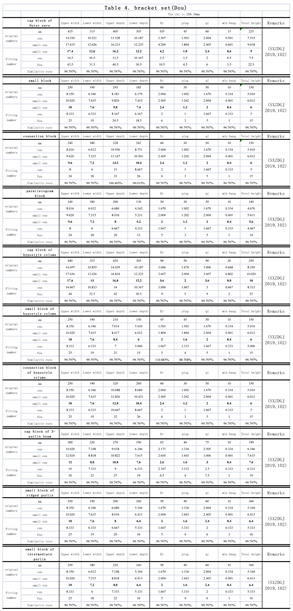
The data of the dou are listed in
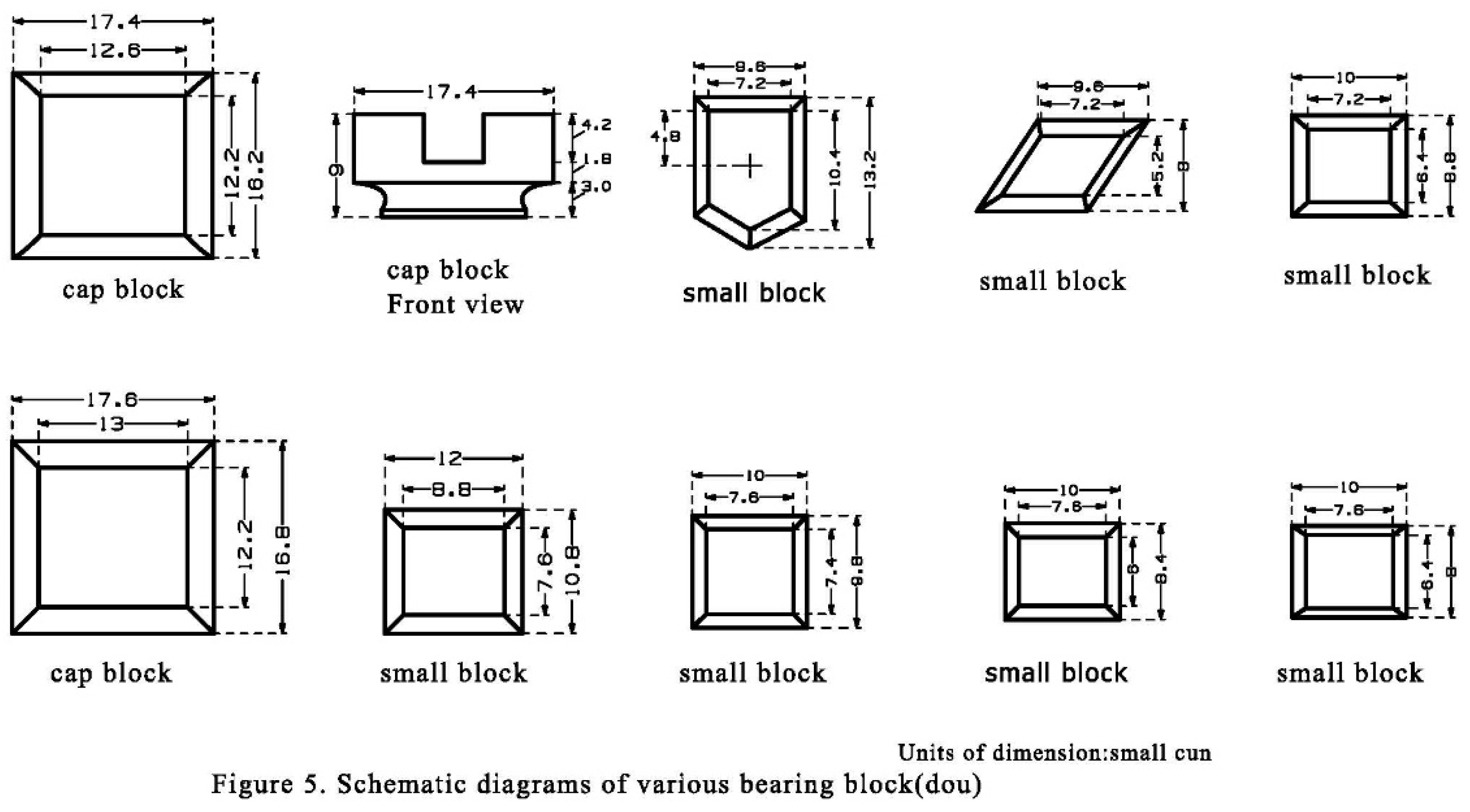
Table 4. By comparison, it can be seen that each part of the dou can also be measured in two ways: small cun and fen. The size of the dou also varies slightly according to its position. Macroscopically, it can be classified into two categories: large and small.As shown in
Figure 5.
Although there are differences between the cap block(ludou) on the outer eaves and those on the hypostyle columns,their dimensions are close and their shapes are relatively large, Fall into a large category.The widths at the upper part of the intersecting dou, diagonal dou, and scattered dou are quite close, about 25 fen. Since they are similar in size, they are classified into the same category.
Overall, the sizes of the dou are not uniform. This lack of uniformity may be due to precision errors, but the differences are clearly noticeable. The dou does not have fixed proportions and specifications; essentially, it varies according to the material and the requirements of the structure.
Figure 5.
Schematic diagrams of various bearing block(dou).
Figure 5.
Schematic diagrams of various bearing block(dou).
Table 4.
bracket set(Dou).
Table 4.
bracket set(Dou).
4.3. Length of the Out-Jump, Xin Chang (The Center - to - Center Distance of the Assembly Joints), and Length of Thebracketarm (Gong).
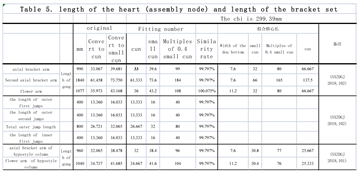
The length of the gong minus the bottom length of the small dou (bearing block) gives the length of the gong's center part(xin chang). The data are listed in
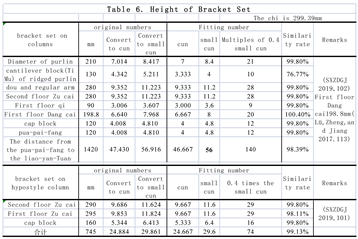
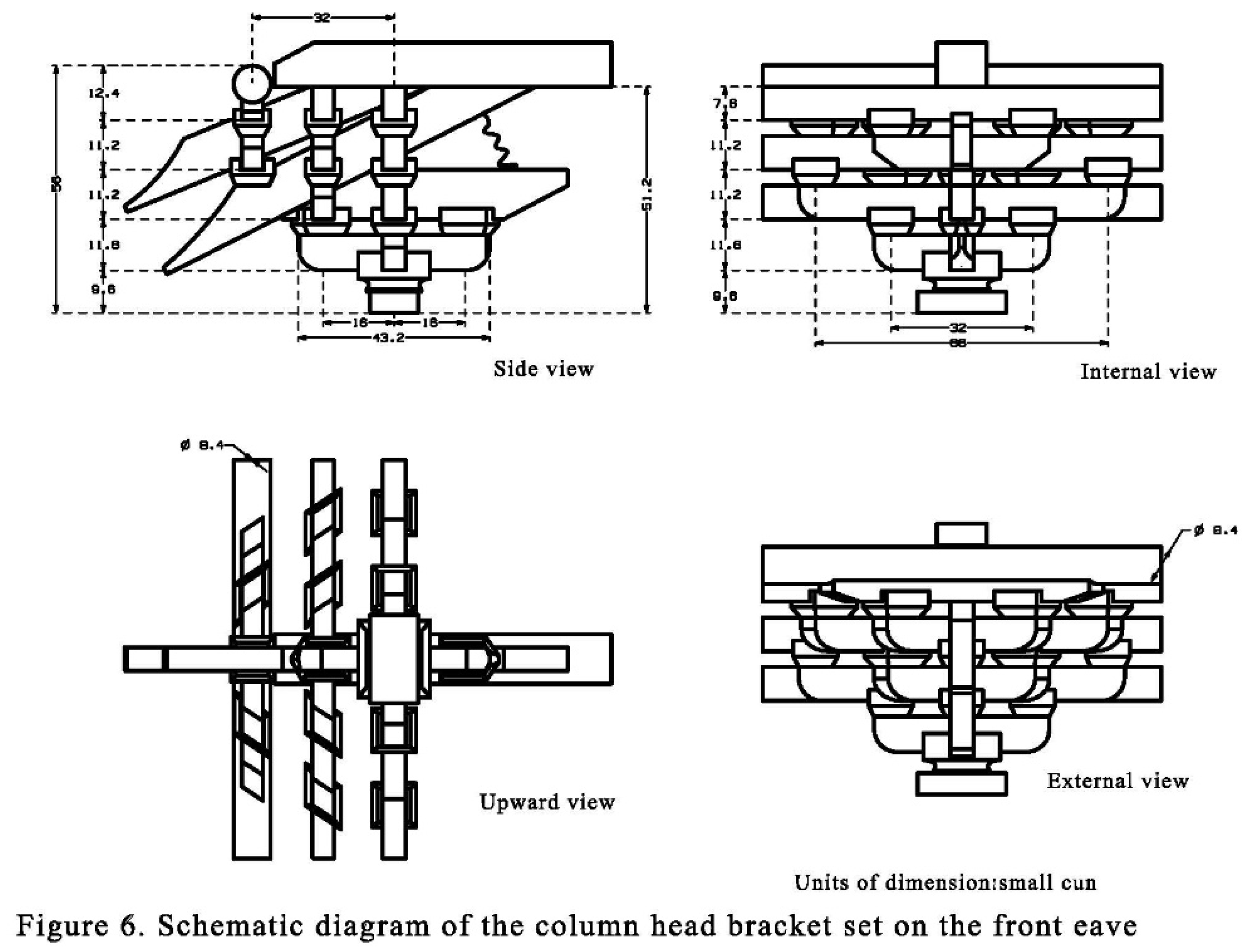
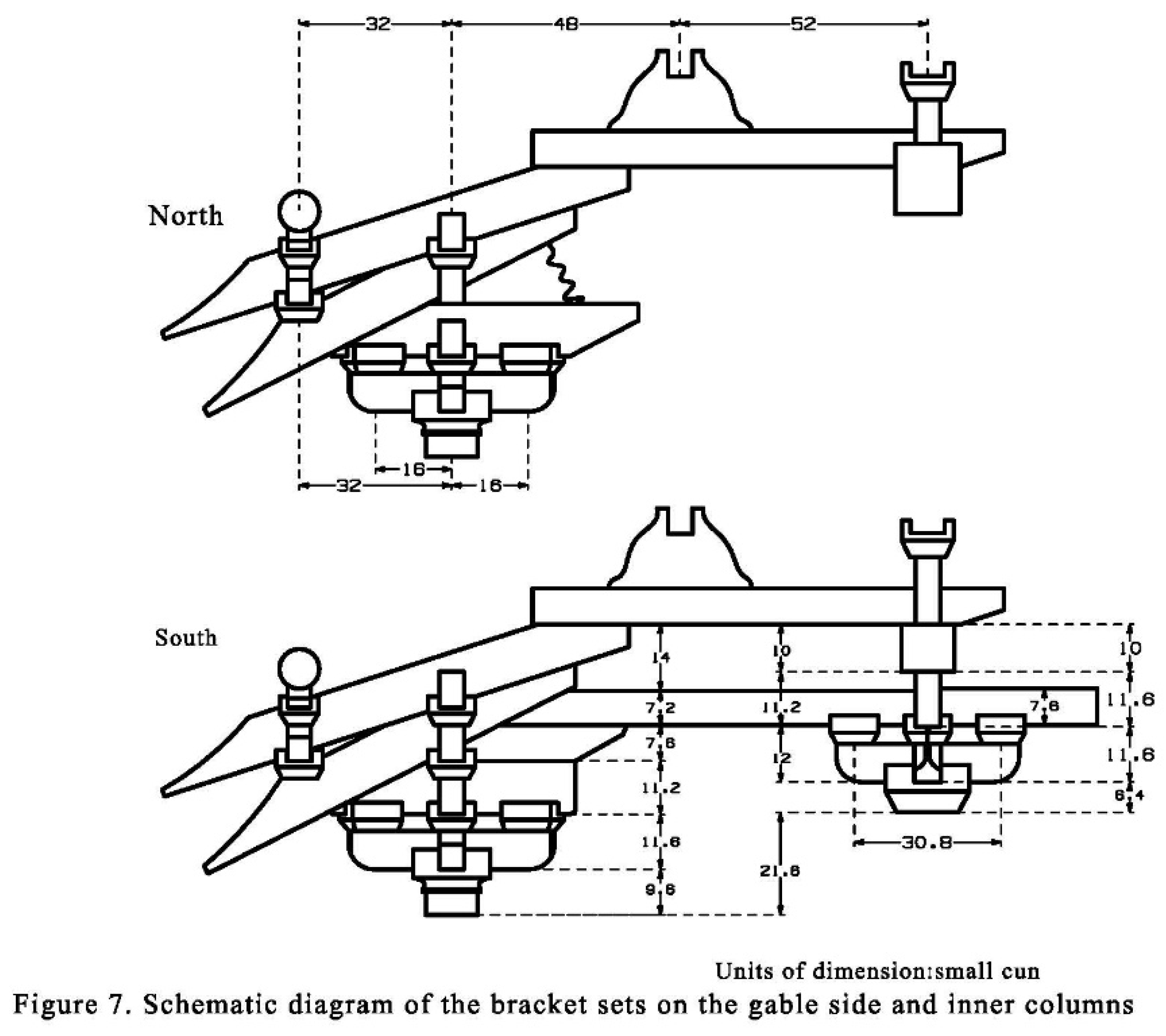
Table 5, measured in chi, and converted into small cun and fen, and then fitted as shown in
Figure 6 and
Figure 7.
For the bracket set on columns, the length of both the inner and outer first jumps is 16 small cun, and the length of the second jump is also 16 small cun. The total length of the outer jumps is 32 small cun, which is equivalent to 80 fen.
The length of the center part(xin chang) of the nidao-gong (axial bracket arm) in the exterior eave bracketing is 32 small cun, which is the same as the length of the center part of the first-layer hua gong.
The length of the xin chang of the nidaomang-gong(The second-layer axial bracket arm) in the exterior eave bracketed construction is 66 small cun, which is equivalent to 165 fen. This gong is the longest horizontally. Although it is incised(yin ke), it is related to the spacing between the bracket set (puzuo) and is a major parameter.
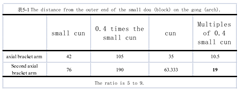
As shown in Tables 5-1 and 5, the width of the nidaomang-gong, which represents the width of the bracket set, is set according to the distance between the outer ends of the two small dou on it. The distance between the outer ends of the two dou of the nidaomang-gong is 76 small cun, which is exactly 19 times 4 small cun. This is set using the modular unit of 4 small cun. As for the other gongs in
Table 5, they are all multiples of 0.4 small cun but rarely multiples of 4 small cun. This is because the construction of the bracket sets needs to take into account structural relationships and proportional relationships, so it cannot be set as multiples of 4 small cun.
4.5. Arrangement of Bracket Set Parameters and Distances
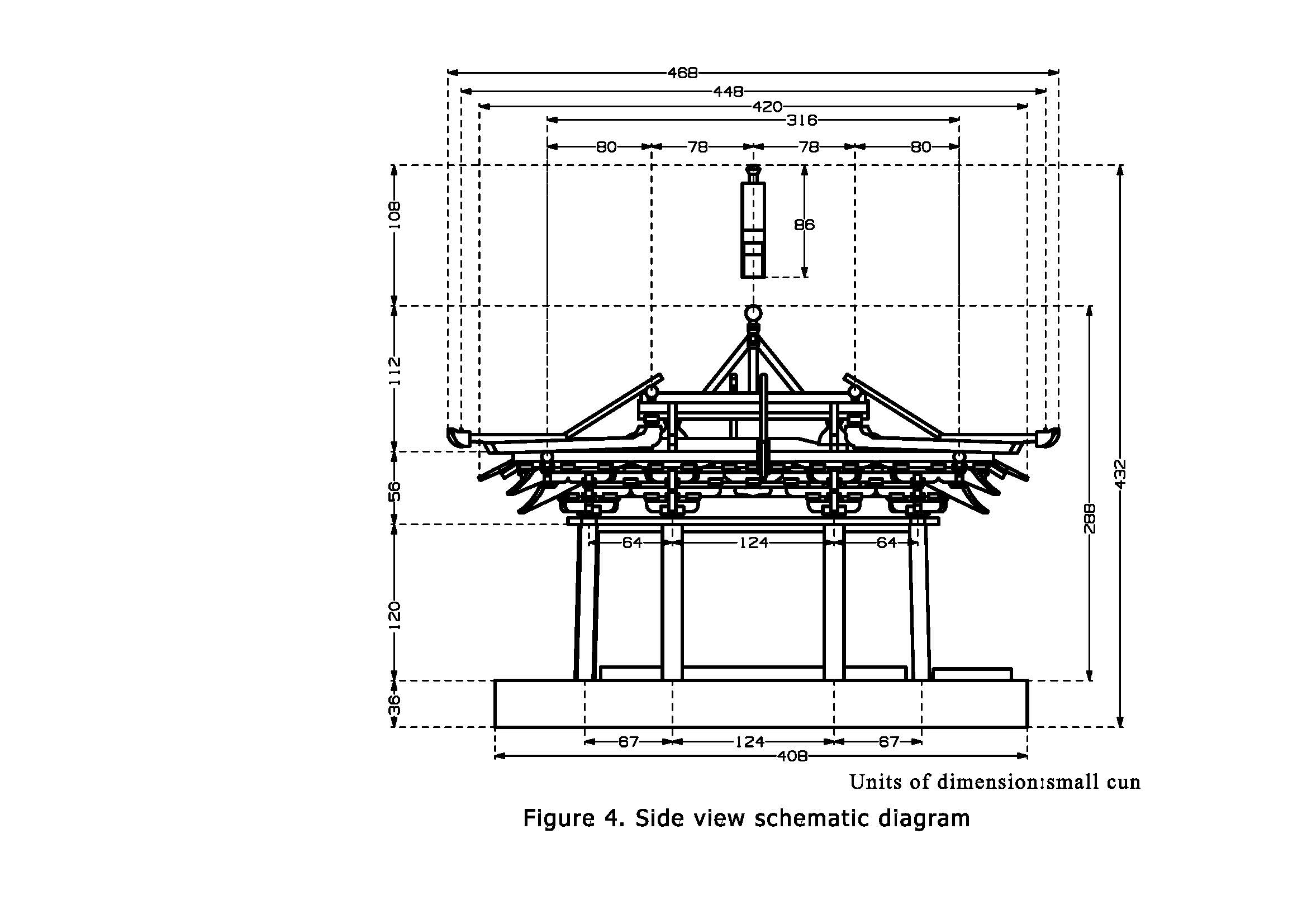
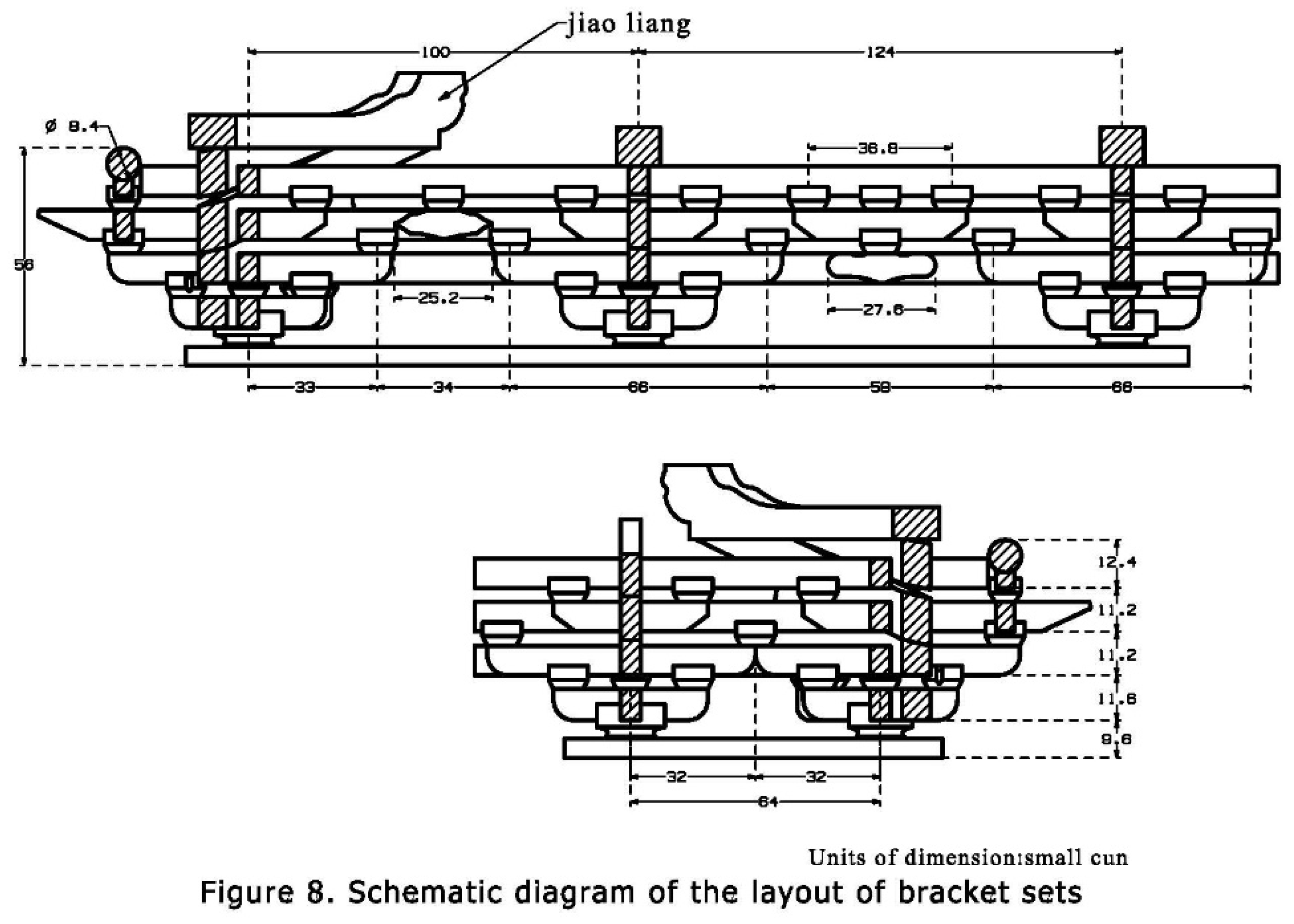
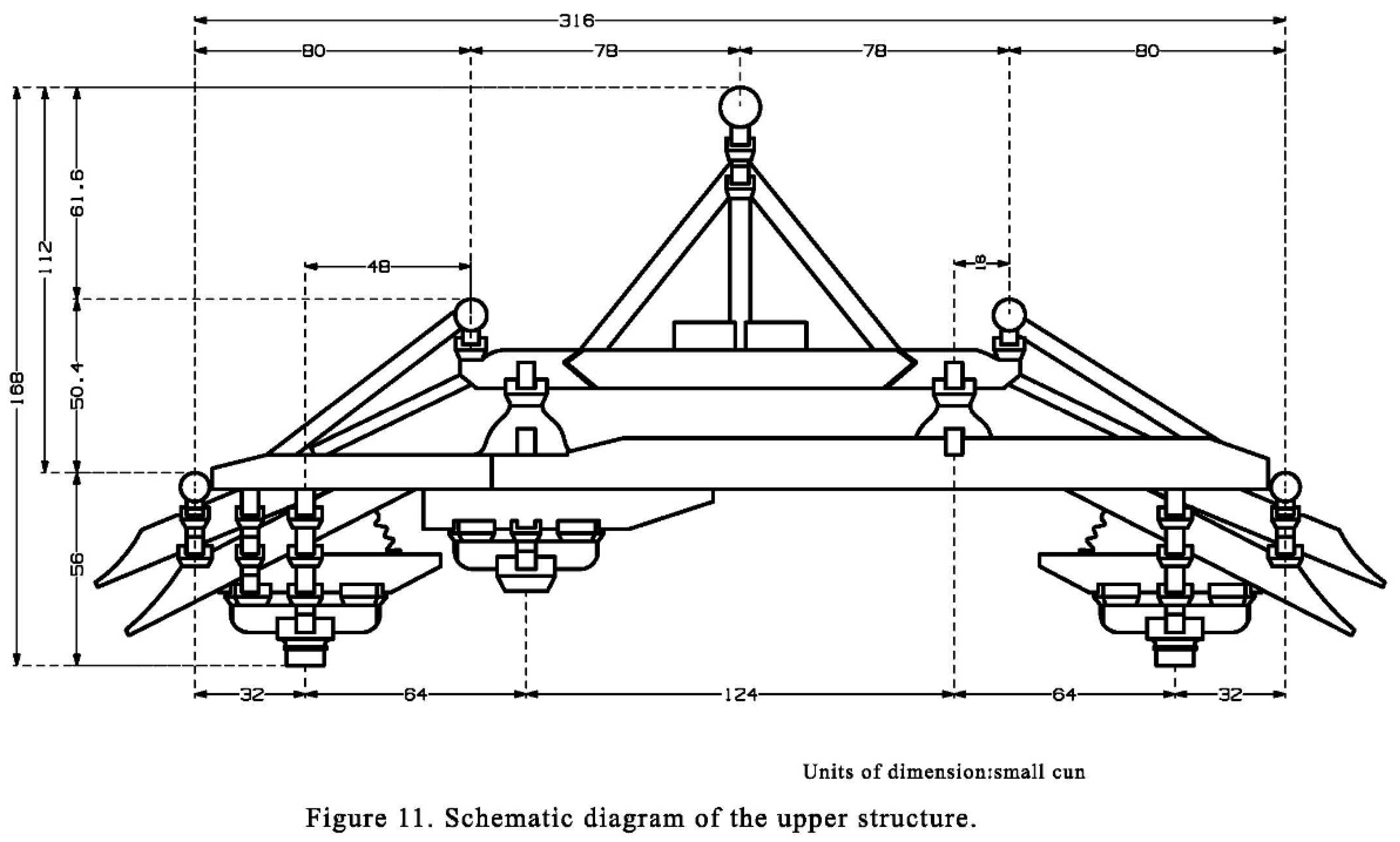
The main parameters of the bracket set are as follows: the Length of the out-jump is 32 small cun. the width, measured from the outer ends of the two small dou on the gong , is 76 small cun.The height of the bracket set is 56 small cun. For large-scale timber framing, the bracket set is a distinctive feature, and the bay width is the key to the structure. The bay width, the length of the xin chang of the nidaomang-gong(The second-layer axial bracket arm),and the length of the out-jump of the bracket set are a set of related data.
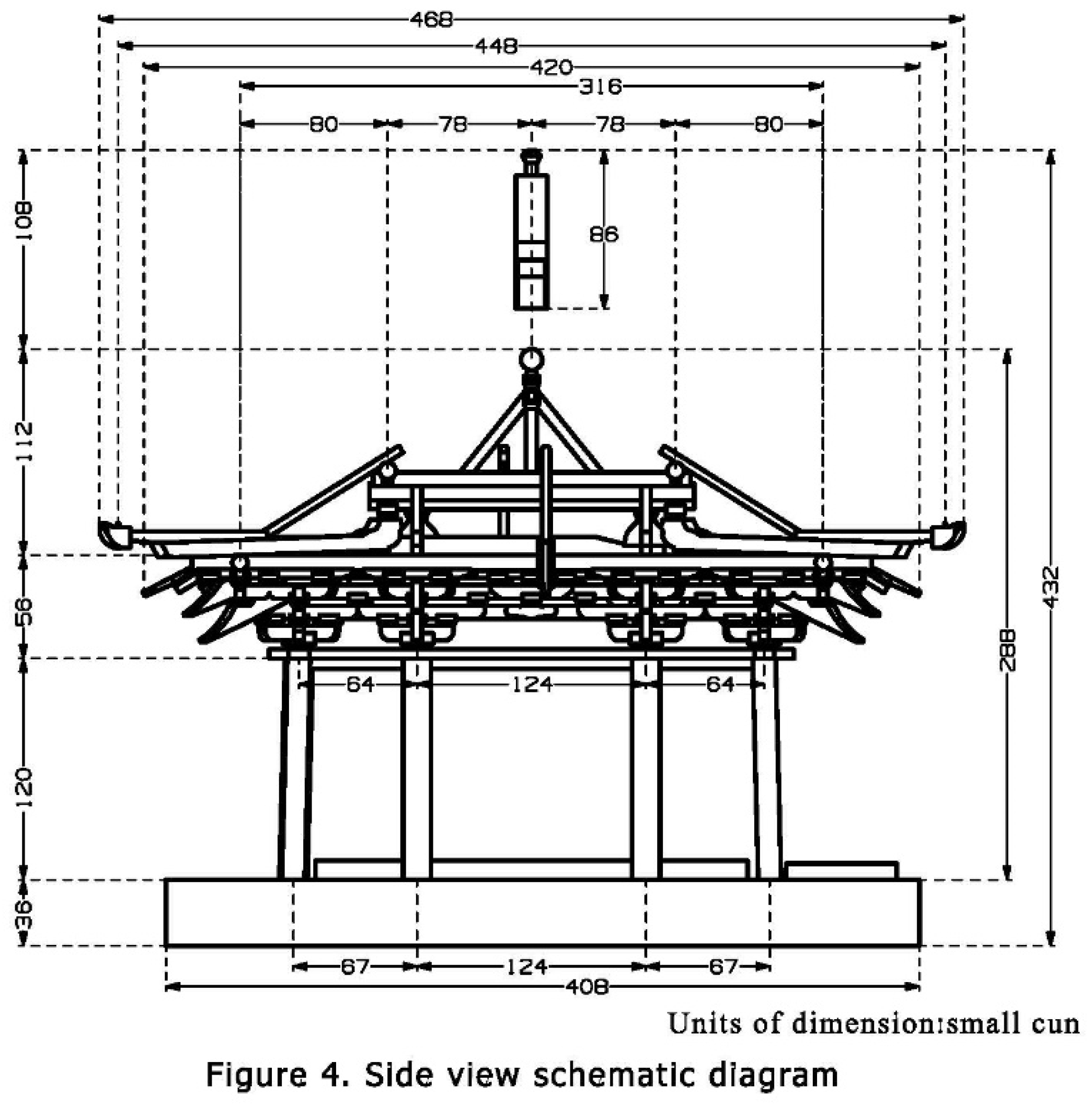
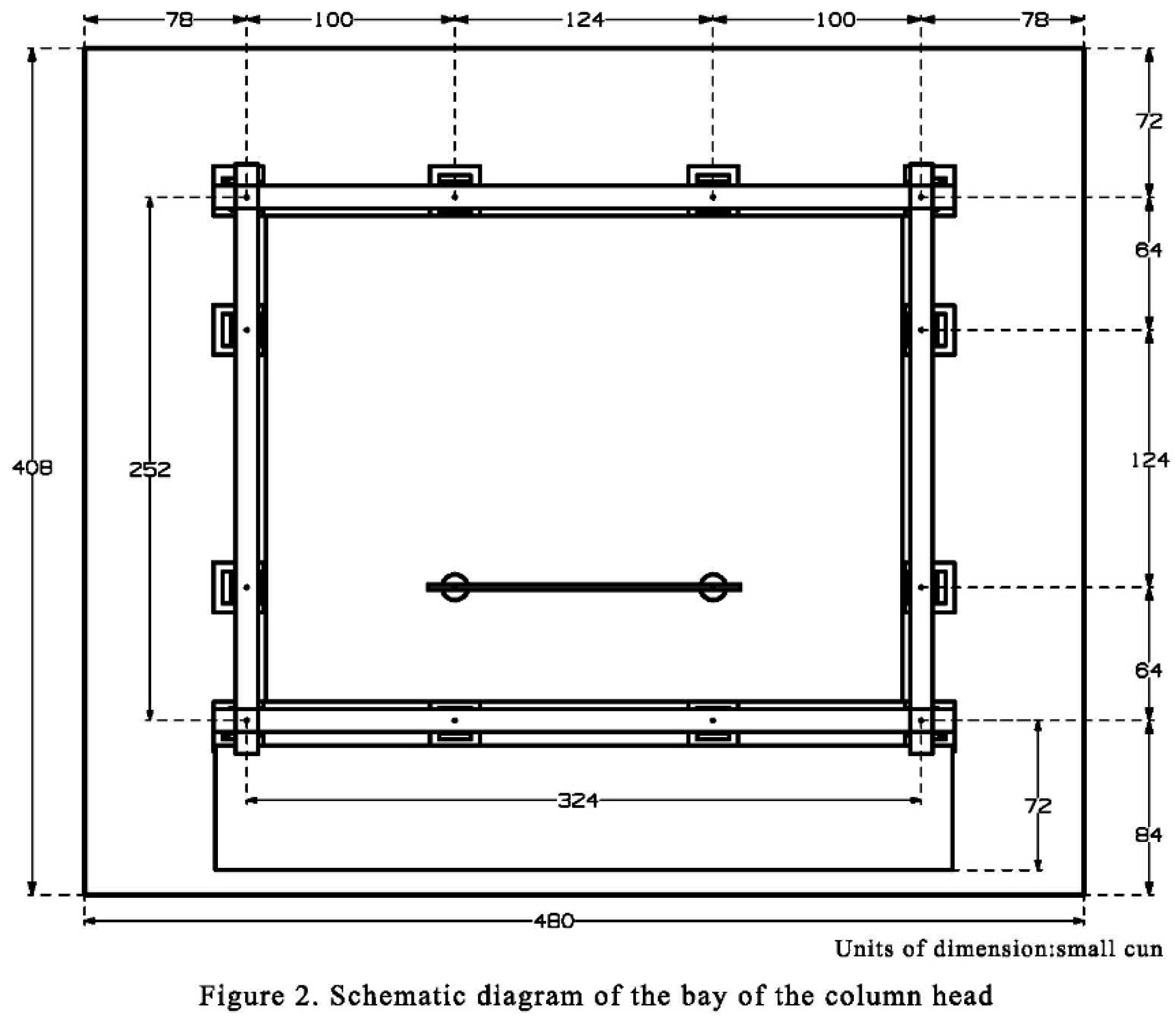
There are three types of bay widths in this hall: 124 small cun, 100 small cun, and 64 small cun. The lengths of the gongs are shown in
Table 5, and their arrangements are illustrated in
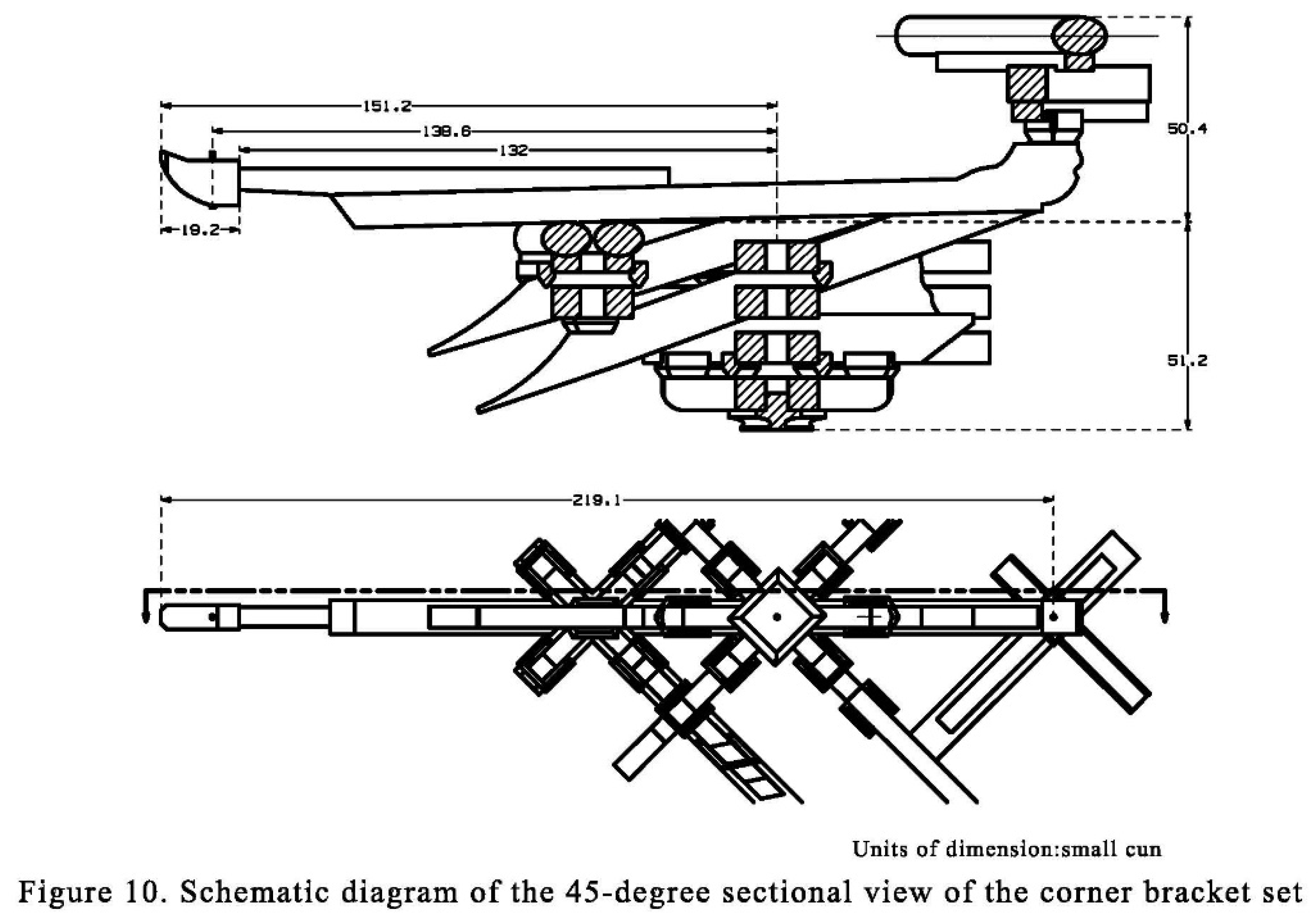
Figure 8,
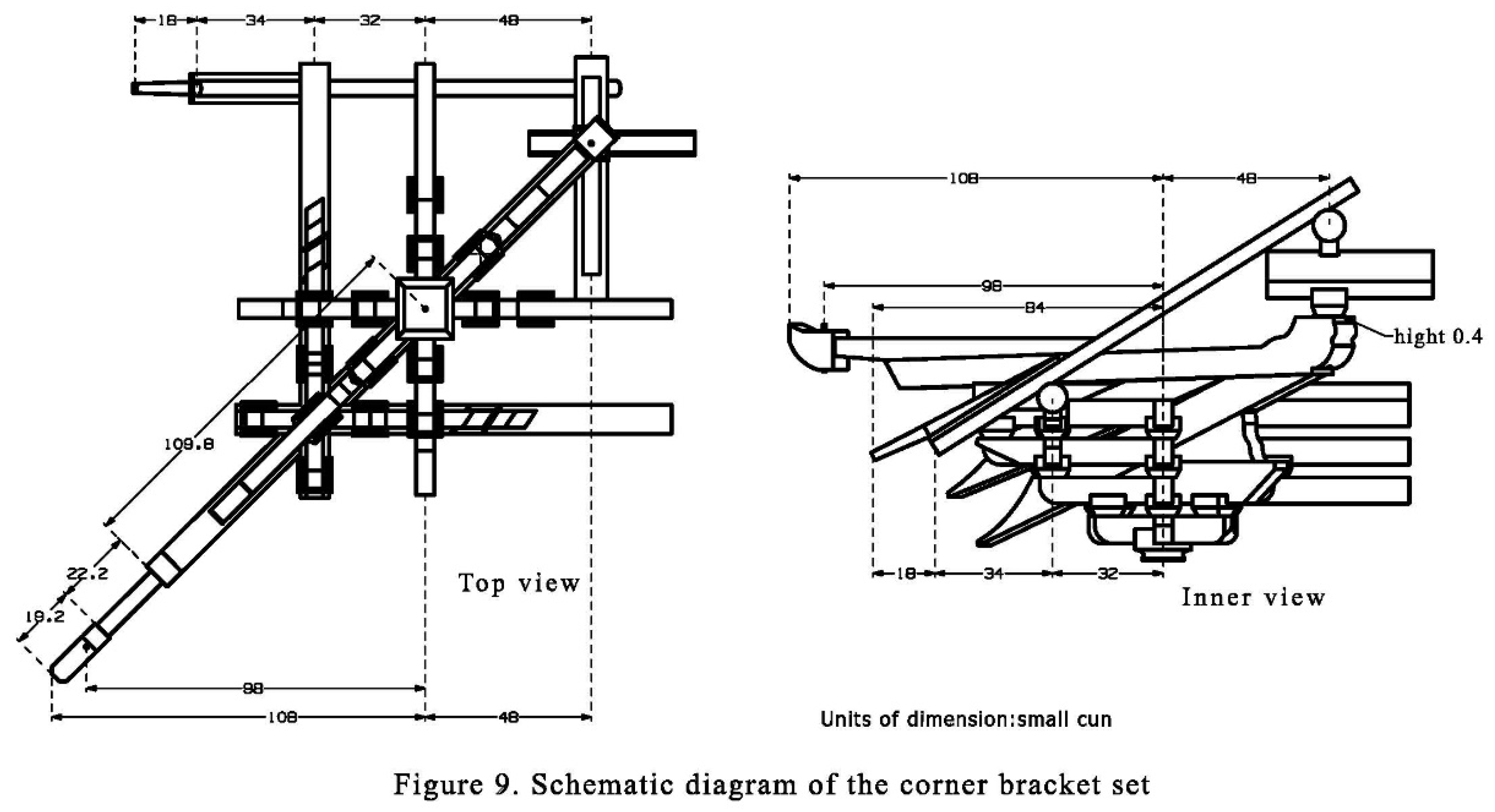
Figure 9 and
Figure 10. This layout is logical and practical. The underlying design concept is to prioritize ensuring the large framework and large dimensions, while small components are adjusted according to the structure and requirements. It is not the case that the width of the bracket set is specified first, and then the distance between the bracket sets and the bay width are coordinated.
Table 5.
length of the heart (assembly node) and length of the bracket set .
Table 5.
length of the heart (assembly node) and length of the bracket set .
Figure 8.
Schematic diagram of the layout of bracket sets.
Figure 8.
Schematic diagram of the layout of bracket sets.
Figure 9.
Schematic diagram of the corner bracket set.
Figure 9.
Schematic diagram of the corner bracket set.
Figure 10.
Schematic diagram of the 45-degree sectional view of the corner bracket set.
Figure 10.
Schematic diagram of the 45-degree sectional view of the corner bracket set.