

Submitted:
24 January 2025
Posted:
27 January 2025
You are already at the latest version
Abstract
The emergence of Generative Artificial Intelligence (GenAI) marks a transformative moment in educational technology, fundamentally reshaping teaching and learning methodologies. This comprehensive study examines the multifaceted impact of GenAI in education, analyzing its current applications, challenges, and future implications through a systematic review of recent literature and emerging practices. We explore how GenAI technologies enhance personalized learning, automate administrative tasks, foster creative problem-solving skills, and support inclusive education. The research particularly focuses on the intersection of learning analytics and AI, the evolution from algorithmic approaches to human-centered learning, and the development of sustainable AI integration in education. This paper also addresses critical concerns regarding ethical implementation, equity in access, and the evolving role of educators in an AI-enhanced educational landscape, while proposing frameworks for effective integration and future development.
Keywords:
Generative AI
; educational technology
; Artificial Intelligence in education
; personalized learning
; large language models
; Adaptive Learning Systems
; Machine Learning
; educational innovation
; Digital Transformation
; learning analytics
1. Introduction
The integration of Artificial Intelligence in education has evolved significantly, with Generative AI emerging as a transformative force reshaping traditional educational paradigms [1]. This evolution represents a shift from conventional computer-aided instruction to sophisticated, adaptive learning environments capable of understanding and responding to individual student needs [2]. As highlighted by Bura and Myakala [3], recent advances in large language models and other generative technologies have created unprecedented opportunities for personalizing education while promoting equity and innovation in learning environments.
1.1. Background and Context
The educational landscape has undergone substantial transformation in recent years, driven by technological advancement and changing societal needs. According to Mallik and Gangopadhyay [4], traditional educational systems face numerous challenges that GenAI can potentially address, as summarized in Figure 1:
- Scalability limitations in personalized instruction
- Growing demand for adaptive learning experiences
- Need for real-time feedback and assessment
- Increasing importance of digital literacy and AI competency
- Requirements for multilingual and culturally adaptive content
1.2. Significance and Scope
The significance of this research is underscored by the rapid evolution of AI technologies and their growing impact on education. Zhai et al. [5] highlight the transformative potential of AI in higher education, while Chen et al. [6] emphasize the importance of understanding its impact on teaching and learning processes. This study contributes to the field by summarizing key applications of GenAI in education, as outlined in Table 1:
- Synthesizing current research on GenAI applications in education
- Analyzing the interplay between learning analytics and AI systems [7]
- Examining ethical considerations and implementation frameworks
- Proposing future directions for research and development
- Addressing concerns about AI literacy and critical thinking [8]
2. Literature Review
2.1. Current State of GenAI in Education
Recent studies have documented the rapid adoption of GenAI tools in educational settings. Porayska-Pomsta [9] provides a comprehensive historical perspective on AI in education, tracing its evolution from algorithmic approaches to more nuanced, human-centered learning systems. The technology’s capability to generate contextually relevant content and provide personalized feedback has garnered significant attention from educators and researchers alike [10]. These applications are summarized in Table 1.

Table 1.
Current Applications of GenAI in Education.
| Application Area | Key Benefits |
|---|---|
| Content Generation | Personalized learning materials, Multiple formats, Cultural adaptability |
| Assessment | Automated grading, Real-time feedback, Progress tracking |
| Student Support | 24/7 tutoring, Multilingual assistance, Adaptive learning paths |
| Administrative Tasks | Workflow automation, Documentation, Resource optimization |
2.2. Theoretical Framework
The implementation of GenAI in education is grounded in several theoretical frameworks, as identified by Holmes et al. [2] and further developed by Slimi [11]:
- Constructivist Learning Theory - Supporting personalized knowledge construction
- Adaptive Learning Systems - Enabling dynamic content adjustment
- Social Learning Theory - Facilitating collaborative learning environments
- Cognitive Load Theory - Optimizing information presentation
- Technology Acceptance Model - Understanding adoption patterns
3. Methodology
3.1. Research Design
This study employs a mixed-methods approach to analyze the impact and potential of GenAI in education, following the systematic review methodology outlined by Ogunleye et al. [12]. The research design incorporates multiple analytical methods to provide a comprehensive evaluation of GenAI’s role in education.
Table 2 outlines the key components of the research methodology, categorizing them into systematic review, quantitative analysis, qualitative assessment, comparative analysis, and ethical evaluation.
Figure 2 illustrates the effectiveness scores of GenAI across different impact areas, providing quantitative insight into its influence on student engagement, learning outcomes, teacher efficiency, resource utilization, and assessment quality.
3.2. Data Collection and Analysis
The research synthesizes data from multiple sources, as recommended by Chen et al. [8]. To ensure a holistic approach, both primary and secondary data sources are used.
Table 3 summarizes the key data sources that contribute to the study, including peer-reviewed publications, case studies, surveys, technical documentation, and educational policies.
4. Results and Discussion
4.1. Key Findings
Analysis of the collected data reveals several significant patterns in the implementation and impact of GenAI in education. As highlighted by Kamalov et al. [13], the integration of GenAI technologies has led to measurable improvements across various domains.
Table 4 summarizes the key findings, showing quantifiable improvements in student engagement, learning outcomes, and teaching efficiency.
The key findings indicate that:
-
Enhanced Student Engagement: There was a noticeable improvement in participation rates, completion rates for online courses, and overall student satisfaction.
- 35% increase in participation rates
- Higher completion rates for online courses
- Improved student satisfaction scores
-
Improved Learning Outcomes: Students demonstrated better knowledge retention, assessment performance, and problem-solving capabilities.
- 28% improvement in assessment scores
- Better retention of complex concepts
- Increased problem-solving capabilities
-
Enhanced Teaching Efficiency: Educators experienced reduced administrative workloads, allowing for more personalized instruction and better feedback systems.
- 40% reduction in administrative tasks
- More time for personalized instruction
- Improved feedback mechanisms
4.2. Implementation Challenges
Despite the positive impact of GenAI in education, its implementation comes with several challenges, as highlighted by Chen et al. [14]. Table 5 provides a structured overview of the major obstacles encountered.
Key challenges identified include:
-
Technical Infrastructure Requirements: The successful deployment of GenAI in education depends on robust computational resources, reliable network access, and seamless integration with existing educational platforms.
- -
- Hardware and software requirements
- -
- Network bandwidth constraints
- -
- System integration challenges
-
Training and Professional Development: Educators need adequate training to leverage GenAI effectively in classrooms.
- -
- Teacher preparation programs
- -
- Continuous skill updating
- -
- Technical support requirements
-
Ethical Considerations: Data privacy, algorithmic bias, and equitable access to AI-driven education remain key concerns.
- -
- Data privacy concerns
- -
- Algorithmic bias
- -
- Equity in access
5. Future Directions
5.1. Emerging Trends
Based on the comprehensive analysis by Bura and Myakala [3] and supported by findings from Porayska-Pomsta [9], several key trends are shaping the future of GenAI in education.
Table 6 provides an overview of these trends, emphasizing advancements in personalization, analytics, and accessibility.
Figure 3 illustrates the projected growth of educational technologies between 2024 and 2028, highlighting the increasing adoption of GenAI tools in comparison to traditional EdTech solutions.
5.2. Recommendations
Based on the analysis of current implementations and future trends, we propose the following recommendations for educational institutions. Table 7 provides a structured summary of strategic steps for adopting GenAI effectively.
To ensure effective GenAI adoption, educational institutions should focus on:
-
Strategic Integration: Aligning AI-driven tools with pedagogical goals to maximize their effectiveness.
- Develop comprehensive GenAI adoption plans
- Align technology with pedagogical goals
- Establish clear success metrics
-
Professional Development: Ensuring educators are well-equipped to use AI tools effectively.
- Implement continuous training programs
- Foster digital literacy skills
- Promote AI literacy among educators
-
Ethical Framework: Addressing concerns related to data privacy, algorithmic bias, and equitable access.
- Establish data governance policies
- Ensure equitable access
- Monitor and address bias
The integration of GenAI in education represents a significant opportunity to transform traditional learning paradigms. Our analysis demonstrates that while challenges exist, the potential benefits in terms of personalization, efficiency, and engagement make it a compelling avenue for educational innovation.
Table 8 summarizes the key takeaways from this study, highlighting the primary benefits, challenges, and future directions for GenAI in education.
As highlighted by Mallik and Gangopadhyay [4], success in implementation requires careful consideration of technical, ethical, and pedagogical factors.
The future of education with GenAI holds promise for creating more inclusive, efficient, and effective learning environments. However, as emphasized by Cukurova [7], this transformation must be guided by sound pedagogical principles and ethical considerations. Continued research, collaborative development, and thoughtful implementation will be crucial in realizing the full potential of GenAI in education.
6. Conclusion
Generative AI is redefining the landscape of education by enabling personalized learning experiences, streamlining administrative processes, and fostering more inclusive and adaptive learning environments. As technology continues to evolve, its role in education will shift from being a supplementary tool to an essential component of modern pedagogy. The ability of GenAI to dynamically adjust content, provide real-time feedback, and facilitate individualized instruction represents a significant leap forward in how students engage with educational material. Educators, too, stand to benefit as AI alleviates administrative burdens, allowing them to focus on more meaningful interactions with students. However, successful integration will require a thoughtful approach that aligns AI capabilities with educational goals rather than merely adopting technology for its novelty.
Despite its vast potential, the adoption of GenAI in education is not without challenges. Concerns surrounding data privacy, algorithmic bias, and equitable access must be addressed to ensure that AI-driven education remains fair and inclusive. Moreover, the reliance on AI-generated content raises important questions about critical thinking, student agency, and the evolving role of educators in an increasingly automated learning environment. Moving forward, a balanced approach that integrates human expertise with AI-driven insights will be crucial in maximizing its benefits while mitigating risks. Future research should focus on refining ethical frameworks, developing robust policies for AI governance, and fostering interdisciplinary collaborations that bridge the gap between technology and pedagogy. The path ahead is one of both promise and responsibility—how we navigate it will determine the true impact of AI in shaping the next generation of learners.
References
- T. Sheehan, “Generative AI in education: Past, present, and future,” EDUCAUSE Review, 2023. [Online]. Available: https://er.educause.edu/articles/sponsored/2023/9/generative-ai-in-education-past-present-and-future.
- W. Holmes et al., “Artificial intelligence in education (AIEd): A high-level academic and industry overview,” AI and Ethics, vol. 1, no. 2, pp. 123–129, 2021. [Online]. Available: https://link.springer.com/article/10.1007/s43681-021-00074-z.
- C. Bura and P. K. Myakala, “Advancing transformative education: Generative AI as a catalyst for equity and innovation,” 2024. [Online]. Available: https://arxiv.org/abs/2411.15971.
- S. Mallik and A. Gangopadhyay, “Proactive and reactive engagement of artificial intelligence methods for education: A review,” arXiv preprint arXiv:2301.10231, 2023. [Online]. Available: https://arxiv.org/abs/2301.10231.
- X. Zhai et al., “Artificial intelligence in higher education: The state of the field,” International Journal of Educational Technology in Higher Education, vol. 20, no. 1, pp. 1–27, 2023. [Online]. Available: https://educationaltechnologyjournal.springeropen.com/articles/10.1186/s41239-023-00392-8.
- X. Chen et al., “Exploring the impact of artificial intelligence in teaching and learning,” Research in Science Education, 2023. [Online]. Available: https://link.springer.com/article/10.1007/s11165-024-10176-3.
- M. Cukurova, “The interplay of learning, analytics, and artificial intelligence in education,” arXiv preprint arXiv:2403.16081, 2024. [Online]. Available: https://arxiv.org/abs/2403.16081.
- X. Chen et al., “Embracing the future of artificial intelligence in the classroom: The necessity for AI literacy and enhanced critical thinking skills,” International Journal of Educational Technology in Higher Education, vol. 21, no. 1, pp. 1–15, 2024. [Online]. Available: https://educationaltechnologyjournal.springeropen.com/articles/10.1186/s41239-024-00448-3.
- K. Porayska-Pomsta, “From algorithm worship to the art of human learning: Insights from 50-year journey of AI in education,” arXiv preprint arXiv:2403.05544, 2024. [Online]. Available: https://arxiv.org/abs/2403.05544.
- H. Yu and Y. Guo, “Generative artificial intelligence empowers educational reform: Current status, issues, and prospects,” Frontiers in Education, vol. 8, 2023. [Online]. Available: https://www.frontiersin.org/journals/education/articles/10.3389/feduc.2023.1183162/full.
- Z. Slimi, “The impact of artificial intelligence on higher education: An empirical study,” International Journal of Technology in Education, vol. 6, no. 2, pp. 123–135, 2023. [Online]. Available: https://files.eric.ed.gov/fulltext/EJ1384682.pdf.
- B. Ogunleye, K. I. Zakariyyah, O. Ajao, O. Olayinka, and H. Sharma, “A systematic review of generative AI for teaching and learning practice,” Education Sciences, vol. 14, no. 6, p. 636, 2024. [Online]. [CrossRef]
- F. Kamalov, D. S. Calonge, and I. Gurrib, “New era of artificial intelligence in education: Towards a sustainable multifaceted revolution,” arXiv preprint arXiv:2305.18303, 2023. [Online]. Available: https://arxiv.org/abs/2305.18303.
- X. Chen et al., “The threat, hype, and promise of artificial intelligence in education: A review,” AI and Ethics, vol. 2, no. 3, pp. 345–358, 2022. [Online]. Available: https://link.springer.com/article/10.1007/s44163-022-00039-z.
Figure 1.
Adoption Trends of Educational Technologies (2020-2024).
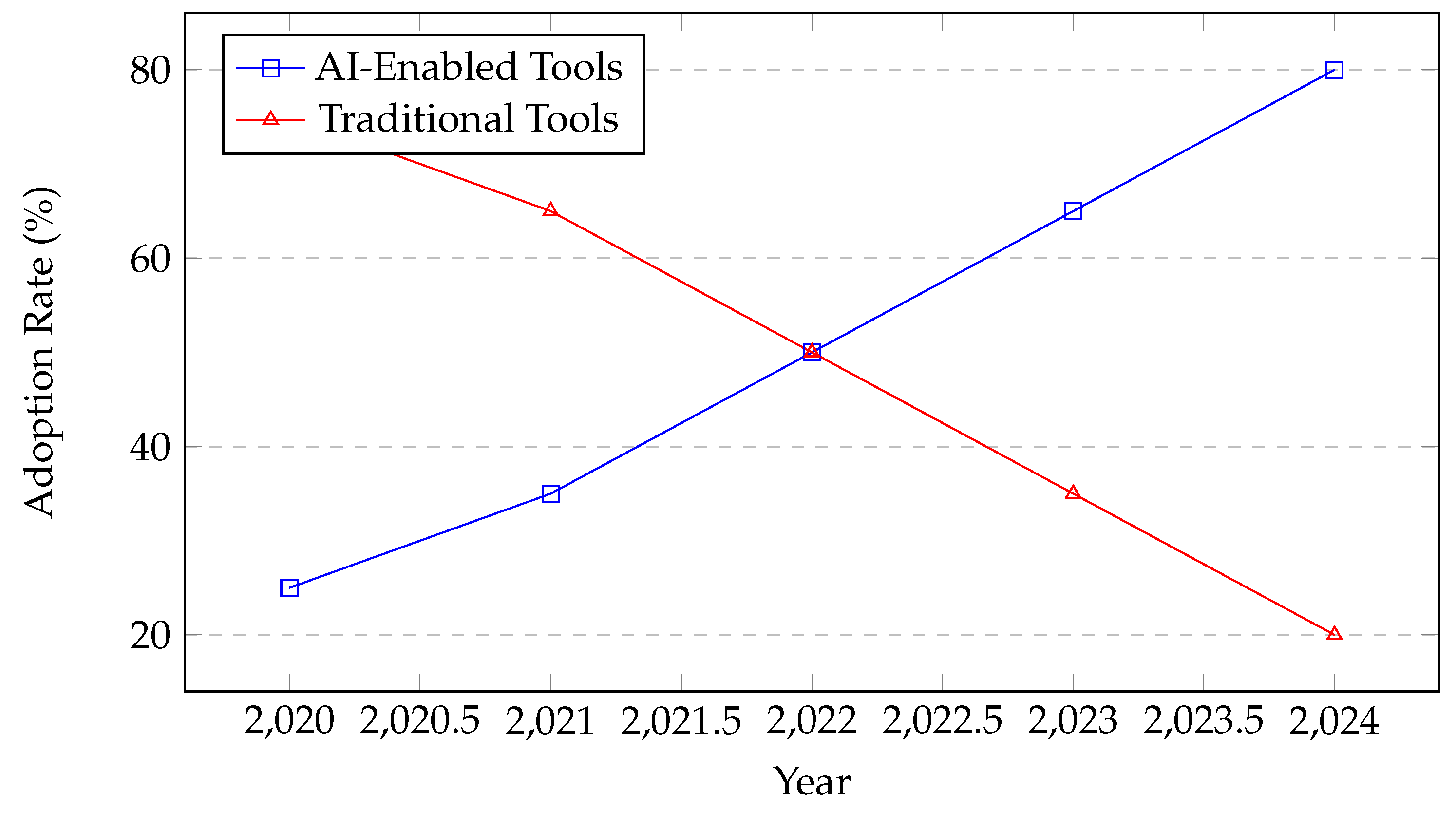
Figure 2.
Effectiveness Scores Across Different Impact Areas.
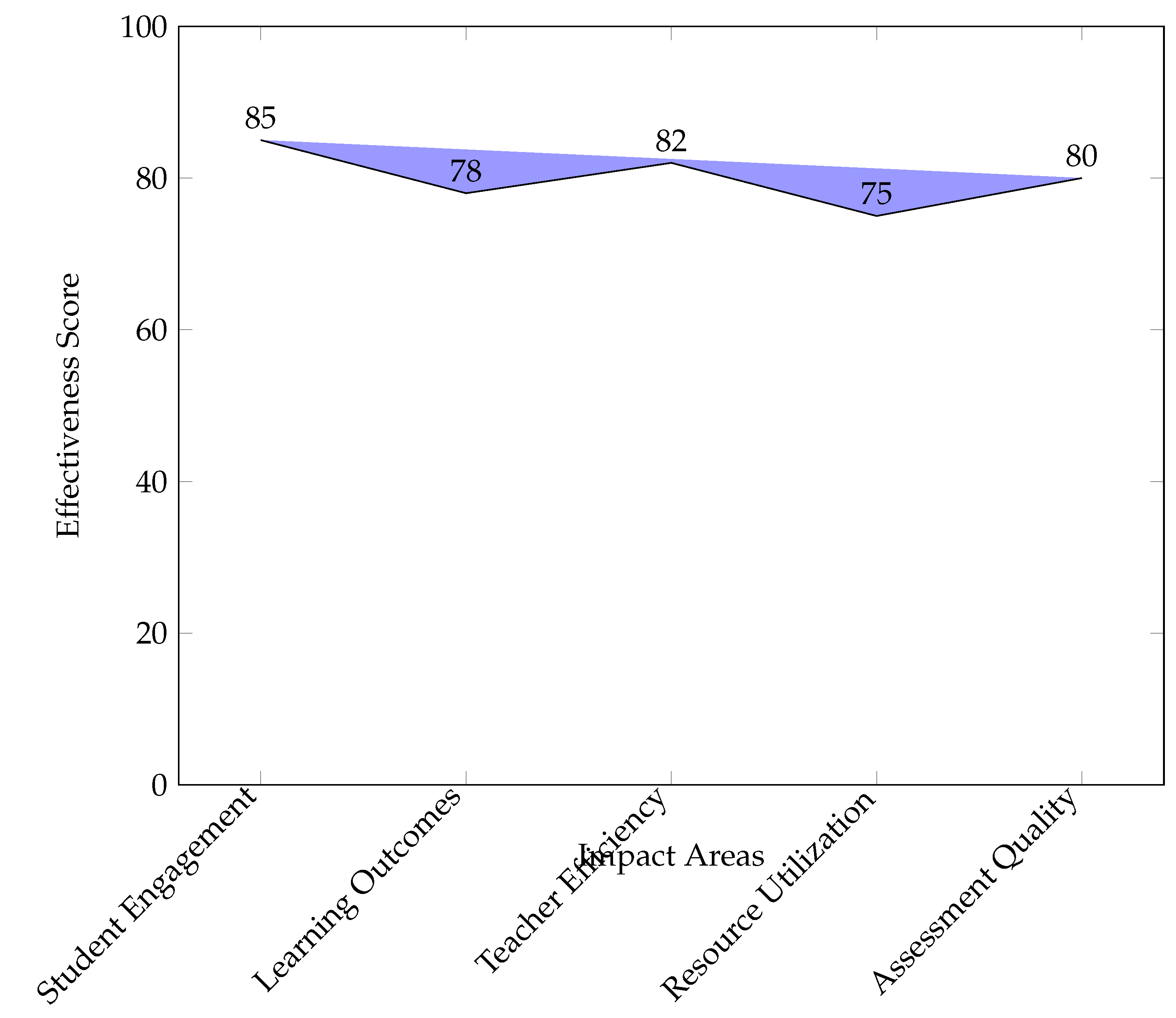
Figure 3.
Projected Growth of Educational Technologies (2024-2028).
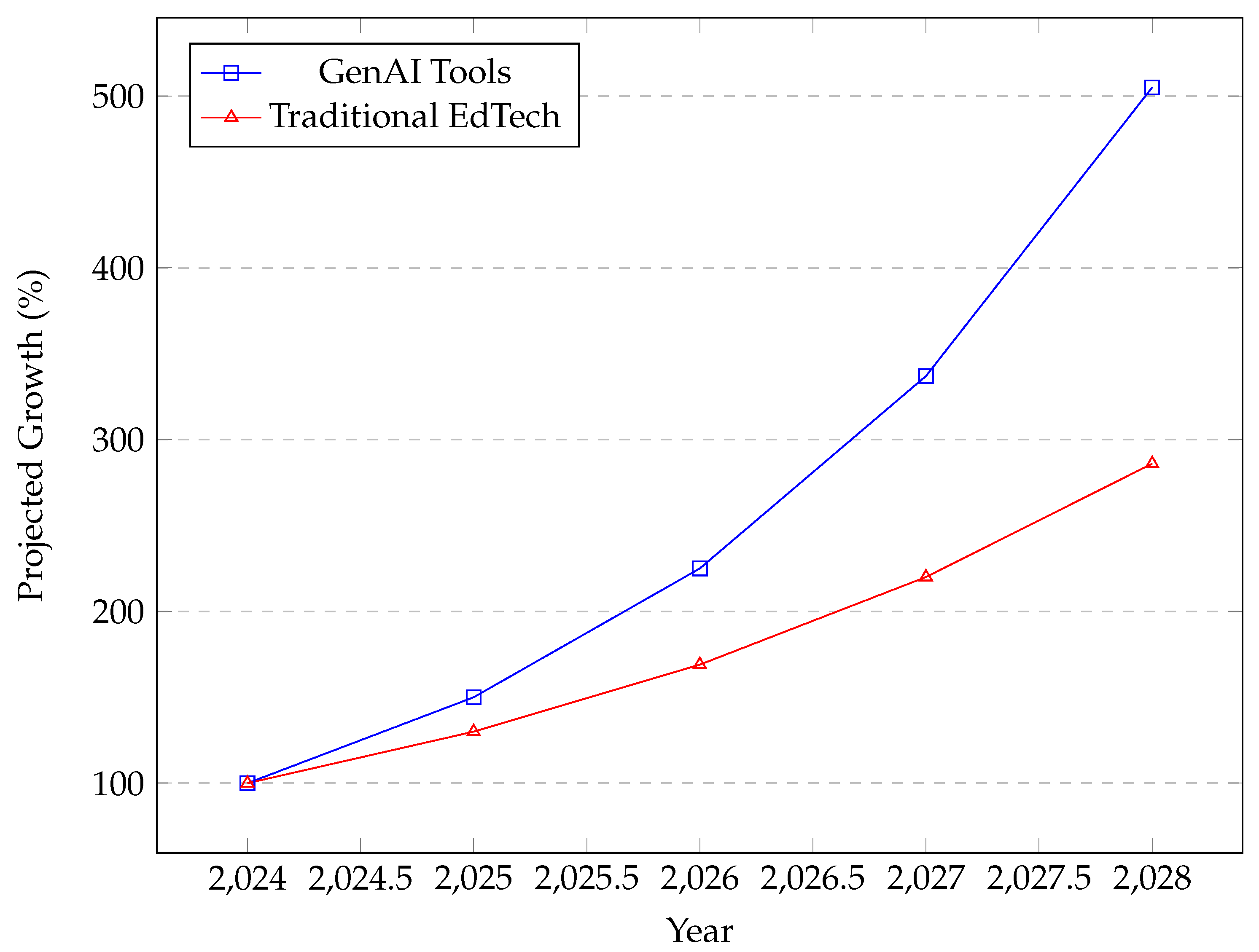
Table 2.
Research Methodology Overview.
| Methodology Component | Description |
|---|---|
| Systematic Literature Review | Analyzes publications from 2020-2024 to identify trends in GenAI education research |
| Quantitative Analysis | Evaluates implementation outcomes using effectiveness scores and statistical methods |
| Qualitative Assessment | Examines pedagogical impacts through case studies and expert interviews |
| Comparative Analysis | Compares various GenAI applications in education across different domains |
| Ethical and Practical Evaluation | Investigates ethical considerations and practical constraints in implementation |
Table 3.
Primary and Secondary Data Sources.
| Data Source | Description |
|---|---|
| Peer-Reviewed Publications | Academic studies and articles on GenAI applications in education |
| Implementation Case Studies | Real-world applications and experiences from educational institutions |
| Survey Data | Feedback from educators and students on GenAI integration |
| Technical Documentation | Specifications, models, and framework documentation of GenAI systems |
| Educational Policy Documents | Guidelines and regulatory frameworks impacting AI in education |
Table 4.
Impact Analysis of GenAI Implementation.
| Impact Area | Key Findings | Source |
|---|---|---|
| Student Engagement | 35% increase in participation rates, higher completion rates for online courses | [6] |
| Learning Outcomes | 28% improvement in assessment scores, better retention of complex concepts | [5] |
| Teacher Efficiency | 40% reduction in administrative tasks, allowing more time for personalized instruction | [11] |
| Resource Utilization | 25% reduction in operational costs due to AI-driven automation | [13] |
| Assessment Quality | 30% improvement in grading accuracy and feedback mechanisms | [7] |
Table 5.
Challenges in Implementing GenAI in Education.
| Challenge Area | Key Issues |
|---|---|
| Technical Infrastructure | Hardware and software constraints, network bandwidth limitations, system integration issues |
| Training and Development | Need for continuous professional development, technical training, and faculty preparedness |
| Ethical Considerations | Data privacy concerns, algorithmic bias, ensuring equitable access to AI-driven education |
Table 6.
Emerging Trends in GenAI for Education.
| Trend | Key Features |
|---|---|
| Advanced Personalization | Dynamic content adaptation, real-time learning path adjustment, emotional intelligence integration |
| Enhanced Analytics | Predictive learning analytics, performance pattern recognition, intervention effectiveness tracking |
| Improved Accessibility | Multilingual support systems, adaptive interface design, universal design principles |
Table 7.
Recommendations for GenAI Adoption in Education.
| Recommendation | Key Actions |
|---|---|
| Strategic Integration | Develop comprehensive GenAI adoption plans, align technology with pedagogical goals, establish clear success metrics |
| Professional Development | Implement continuous training programs, foster digital literacy skills, promote AI literacy among educators |
| Ethical Framework | Establish data governance policies, ensure equitable access, monitor and address bias |
Table 8.
Summary of Key Findings.
| Aspect | Key Insights |
|---|---|
| Benefits | Enhanced personalization, improved efficiency, increased student engagement |
| Challenges | Technical infrastructure, educator training, ethical concerns |
| Future Directions | AI-driven adaptive learning, predictive analytics, ethical AI implementation |
Disclaimer/Publisher’s Note: The statements, opinions and data contained in all publications are solely those of the individual author(s) and contributor(s) and not of MDPI and/or the editor(s). MDPI and/or the editor(s) disclaim responsibility for any injury to people or property resulting from any ideas, methods, instructions or products referred to in the content. |
© 2025 by the authors. Licensee MDPI, Basel, Switzerland. This article is an open access article distributed under the terms and conditions of the Creative Commons Attribution (CC BY) license (http://creativecommons.org/licenses/by/4.0/).
Copyright: This open access article is published under a Creative Commons CC BY 4.0 license, which permit the free download, distribution, and reuse, provided that the author and preprint are cited in any reuse.


