

Submitted:
26 January 2025
Posted:
27 January 2025
You are already at the latest version
Abstract
Fixational eye movements are important for holding the central visual field on a target for a certain period. In this study, we aimed to quantitatively assess fixational dispari-ties using binocular eye-tracking in strabismus children (before and after surgical alignment) and normal children. Fixational disparity of 117 children (4 – 18 years; 57 with strabismus and 60 age-similar normal controls) were recorded under binocular viewing with corrected refractive errors. Disparities in gaze positions relative to the target location were recorded from both eyes. Main outcome measures included fixa-tion disparities along horizontal and vertical axes in the fixation test. Children with strabismus exhibited significant (P<0.001) fixational disparities than normal children in both horizontal and vertical directions. Additionally, children with esotropia versus exotropia had poorer fixational function. Fixational disparities were significantly de-creased in the horizontal direction after strabismus surgery. A significant negative correlation was observed between binocular best-corrected visual acuity and fixation disparities in children with strabismus. Children with strabismus had significant fixa-tional disparities that were observably diminished in the horizontal direction after surgical alignment. Binocular assessment of fixational disparities can provide a more comprehensive evaluation of visual function in strabismus
Keywords:
1. Introduction
2. Materials and Methods
3. Results
4. Discussion
5. Conclusions
Author Contributions
Funding
Institutional Review Board Statement
Informed Consent Statement
Data Availability Statement
Conflicts of Interest
Abbreviations
| SD | Standard deviation |
| Sig. | Significant |
| Pre-OP | Preoperative |
| Post-OP | Postoperative |
| BCVA | Best corrected vision acuity |
| L | Left |
| R | Right |
References
- Duchesne, J.; Coubard, O.A. Measuring vergence and fixation disparity in 3D space. Eur J Neurosci 2021, 53, 1473–1486. [Google Scholar] [CrossRef] [PubMed]
- Rigas, I.; Friedman, L.; Komogortsev, O. Study of an Extensive Set of Eye Movement Features: Extraction Methods and Statistical Analysis. J Eye Mov Res 2018, 11. [Google Scholar] [CrossRef] [PubMed]
- Traxler, M.J.; Long, D.L.; Tooley, K.M.; Johns, C.L.; Zirnstein, M.; Jonathan, E. Individual Differences in Eye-Movements During Reading: Working Memory and Speed-of-Processing Effects. J Eye Mov Res 2012, 5. [Google Scholar] [CrossRef]
- Poffa, R.; Joos, R. The influence of vergence facility on binocular eye movements during reading. J Eye Mov Res 2019, 12. [Google Scholar] [CrossRef] [PubMed]
- Zhang, Y.; Wu, X.; Zheng, C.; Zhao, Y.; Gao, J.; Deng, Z.; Zhang, X.; Chen, J. Effects of Vergence Eye Movement Planning on Size Perception and Early Visual Processing. J Cogn Neurosci 2024, 1–14. [Google Scholar] [CrossRef] [PubMed]
- Jaschinski, W. Individual Objective and Subjective Fixation Disparity in Near Vision. PLoS One 2017, 12, e0170190. [Google Scholar] [CrossRef] [PubMed]
- Alvarez, T.L.; Kim, E.H.; Yaramothu, C.; Granger-Donetti, B. The influence of age on adaptation of disparity vergence and phoria. Vision Res 2017, 133, 1–11. [Google Scholar] [CrossRef] [PubMed]
- Canessa, A.; Gibaldi, A.; Chessa, M.; Fato, M.; Solari, F.; Sabatini, S.P. A dataset of stereoscopic images and ground-truth disparity mimicking human fixations in peripersonal space. Sci Data 2017, 4, 170034. [Google Scholar] [CrossRef] [PubMed]
- Aizenman, A.M.; Koulieris, G.A.; Gibaldi, A.; Sehgal, V.; Levi, D.M.; Banks, M.S. The Statistics of Eye Movements and Binocular Disparities during VR Gaming: Implications for Headset Design. ACM Trans Graph 2023, 42. [Google Scholar] [CrossRef] [PubMed]
- Balaban, C.D.; Nayak, N.S.; Williams, E.C.; Kiderman, A.; Hoffer, M.E. Frequency dependence of coordinated pupil and eye movements for binocular disparity tracking. Front Neurol 2023, 14, 1081084. [Google Scholar] [CrossRef] [PubMed]
- Schroth, V.; Joos, R.; Alshuth, E.; Jaschinski, W. Effects of aligning prisms on the objective and subjective fixation disparity in far distance. J Eye Mov Res 2019, 12. [Google Scholar] [CrossRef] [PubMed]
- Al-Haddad, C.; Hoyeck, S.; Torbey, J.; Houry, R.; Boustany, R.M.N. Eye Tracking Abnormalities in School-Aged Children With Strabismus and With and Without Amblyopia. J Pediat Ophth Strab 2019, 56, 297–304. [Google Scholar] [CrossRef]
- Mihara, M.; Hayashi, A.; Kakeue, K.; Tamura, R. Changes in saccadic eye movement and smooth pursuit gain in patients with acquired comitant esotropia after strabismus surgery. J Eye Mov Res 2023, 16. [Google Scholar] [CrossRef] [PubMed]
- Economides, J.R.; Adams, D.L.; Horton, J.C. Variability of Ocular Deviation in Strabismus. JAMA Ophthalmol 2016, 134, 63–69. [Google Scholar] [CrossRef] [PubMed]
- Chen, Z.H.; Fu, H.; Lo, W.L.; Chi, Z.; Xu, B. Eye-tracking-aided digital system for strabismus diagnosis. Healthc Technol Lett 2018, 5, 1–6. [Google Scholar] [CrossRef] [PubMed]
- Iwata, Y.; Handa, T.; Ishikawa, H. Objective measurement of nine gaze-directions using an eye-tracking device. J Eye Mov Res 2020, 13. [Google Scholar] [CrossRef] [PubMed]
- Kowler, E. Eye movements: the past 25 years. Vision Res 2011, 51, 1457–1483. [Google Scholar] [CrossRef] [PubMed]
- Putnam, N.M.; Hofer, H.J.; Doble, N.; Chen, L.; Carroll, J.; Williams, D.R. The locus of fixation and the foveal cone mosaic. J Vis 2005, 5, 632–639. [Google Scholar] [CrossRef] [PubMed]
- Jainta, S.; Hoormann, J.; Kloke, W.B.; Jaschinski, W. Binocularity during reading fixations: Properties of the minimum fixation disparity. Vision Res 2010, 50, 1775–1785. [Google Scholar] [CrossRef] [PubMed]
- Jainta, S.; Jaschinski, W.; Wilkins, A.J. Periodic letter strokes within a word affect fixation disparity during reading. J Vis 2010, 10, 2. [Google Scholar] [CrossRef]
- Svede, A.; Hoormann, J.; Jainta, S.; Jaschinski, W. Subjective fixation disparity affected by dynamic asymmetry, resting vergence, and nonius bias. Invest Ophthalmol Vis Sci 2011, 52, 4356–4361. [Google Scholar] [CrossRef]
- Otero-Millan, J.; Macknik, S.L.; Martinez-Conde, S. Fixational eye movements and binocular vision. Front Integr Neurosci 2014, 8, 52. [Google Scholar] [CrossRef] [PubMed]
- Walton, M.M.; Ono, S.; Mustari, M. Vertical and oblique saccade disconjugacy in strabismus. Invest Ophthalmol Vis Sci 2014, 55, 275–290. [Google Scholar] [CrossRef] [PubMed]
- Weiss, A.H.; Kelly, J.P.; Hopper, R.A.; Phillips, J.O. Crouzon Syndrome: Relationship of Eye Movements to Pattern Strabismus. Invest Ophthalmol Vis Sci 2015, 56, 4394–4402. [Google Scholar] [CrossRef] [PubMed]
- Moon, Y.; Lee, W.J.; Shin, S.H.; Lee, J.Y.; Lee, S.J.; Ko, B.W.; Lim, H.W. Quantitative Analysis of Translatory Movements in Patients With Horizontal Strabismus. Invest Ophthalmol Vis Sci 2021, 62, 24. [Google Scholar] [CrossRef] [PubMed]
- Yeh, P.H.; Liu, C.H.; Sun, M.H.; Chi, S.C.; Hwang, Y.S. To measure the amount of ocular deviation in strabismus patients with an eye-tracking virtual reality headset. BMC Ophthalmol 2021, 21, 246. [Google Scholar] [CrossRef] [PubMed]
- Zipori, A.B.; Colpa, L.; Wong, A.M.F.; Cushing, S.L.; Gordon, K.A. Postural stability and visual impairment: Assessing balance in children with strabismus and amblyopia. PLoS One 2018, 13, e0205857. [Google Scholar] [CrossRef] [PubMed]
- Denniss, J.; Scholes, C.; McGraw, P.V.; Nam, S.H.; Roach, N.W. Estimation of Contrast Sensitivity From Fixational Eye Movements. Invest Ophthalmol Vis Sci 2018, 59, 5408–5416. [Google Scholar] [CrossRef] [PubMed]
- Al-Haddad, C.; Hoyeck, S.; Torbey, J.; Houry, R.; Boustany, R.N. Eye Tracking Abnormalities in School-Aged Children With Strabismus and With and Without Amblyopia. J Pediatr Ophthalmol Strabismus 2019, 56, 297–304. [Google Scholar] [CrossRef] [PubMed]
- Zhou, Y.; Bian, H.; Yu, X.; Wen, W.; Zhao, C. Quantitative assessment of eye movements using a binocular paradigm: comparison among amblyopic, recovered amblyopic and normal children. BMC Ophthalmol 2022, 22, 365. [Google Scholar] [CrossRef] [PubMed]
- Ivanchenko, D.; Rifai, K.; Hafed, Z.M.; Schaeffel, F. A low-cost, high-performance video-based binocular eye tracker for psychophysical research. J Eye Mov Res 2021, 14. [Google Scholar] [CrossRef] [PubMed]
- Xin, L.; Bin, Z.; Xiaoqin, D.; Wenjing, H.; Yuandong, L.; Jinyu, Z.; Chen, Z.; Lin, W. Detecting Task Difficulty of Learners in Colonoscopy: Evidence from Eye-Tracking. J Eye Mov Res 2021, 14. [Google Scholar] [CrossRef]
- Leube, A.; Rifai, K.; Rifai, K. Sampling rate influences saccade detection in mobile eye tracking of a reading task. J Eye Mov Res 2017, 10. [Google Scholar] [CrossRef] [PubMed]
- Chen, Y.W.; Lin, S.A.; Lin, P.W.; Huang, H.M. The difference of surgical outcomes between manifest exotropia and esotropia. Int Ophthalmol 2019, 39, 1427–1436. [Google Scholar] [CrossRef]
- Brodsky, M.C.; Fray, K.J. Dissociated horizontal deviation after surgery for infantile esotropia: clinical characteristics and proposed pathophysiologic mechanisms. Arch Ophthalmol 2007, 125, 1683–1692. [Google Scholar] [CrossRef] [PubMed]
- Ellis, G.S., Jr.; Pritchard, C.H.; Baham, L.; Babiuch, A. Medial rectus surgery for convergence excess esotropia with an accommodative component: a comparison of augmented recession, slanted recession, and recession with posterior fixation. Am Orthopt J 2012, 62, 50–60. [Google Scholar] [CrossRef] [PubMed]
- Pullela, M.; Degler, B.A.; Coats, D.K.; Das, V.E. Longitudinal Evaluation of Eye Misalignment and Eye Movements Following Surgical Correction of Strabismus in Monkeys. Invest Ophthalmol Vis Sci 2016, 57, 6040–6047. [Google Scholar] [CrossRef]
- Maneschg, O.A.; Barboni, M.T.S.; Nagy, Z.Z.; Nemeth, J. Fixation stability after surgical treatment of strabismus and biofeedback fixation training in amblyopic eyes. Bmc Ophthalmol 2021, 21, 264. [Google Scholar] [CrossRef] [PubMed]
- Ding, J.; Levi, D.M. Recovery of stereopsis through perceptual learning in human adults with abnormal binocular vision. P Natl Acad Sci USA 2011, 108, E733–E741. [Google Scholar] [CrossRef]
- Wu, Y.; Xu, M.; Zhang, J.; Zhou, J.; Wan, M.; Dai, Z.; Peng, T.; Min, S.H.; Hou, F.; Zhou, J.; et al. Can Clinical Measures of Postoperative Binocular Function Predict the Long-Term Stability of Postoperative Alignment in Intermittent Exotropia? J Ophthalmol 2020, 2020, 7392165. [Google Scholar] [CrossRef]
- Ahn, Y.J.; Park, Y.Y.; Chung, Y.W.; Park, S.H.; Shin, S.Y. Surgical and sensory outcomes in patients with intermittent exotropia according to preoperative refractive error. Eye (Lond) 2019, 33, 1314–1320. [Google Scholar] [CrossRef] [PubMed]
- Kurup, S.P.; Barto, H.W.; Myung, G.; Mets, M.B. Stereoacuity outcomes following surgical correction of the nonaccommodative component in partially accommodative esotropia. J AAPOS 2018, 22, 92–96. [Google Scholar] [CrossRef] [PubMed]
- Leffler, C.T.; Vaziri, K.; Schwartz, S.G.; Cavuoto, K.M.; McKeown, C.A.; Kishor, K.S.; Janot, A.C. Rates of Reoperation and Abnormal Binocularity Following Strabismus Surgery in Children. Am J Ophthalmol 2016, 162, 159–166. [Google Scholar] [CrossRef] [PubMed]
- Yang, X.; Fan, Y.; Chu, H.; Yan, L.; Wiederhold, B.K.; Wiederhold, M.; Liao, Y. Preliminary Study of Short-Term Visual Perceptual Training Based on Virtual Reality and Augmented Reality in Postoperative Strabismic Patients. Cyberpsychol Behav Soc Netw 2022, 25, 465–470. [Google Scholar] [CrossRef] [PubMed]
- Kang, S.L.; Beylergil, S.B.; Otero-Millan, J.; Shaikh, A.G.; Ghasia, F.F. Fixational Eye Movement Waveforms in Amblyopia: Characteristics of Fast and Slow Eye Movements. J Eye Mov Res 2019, 12. [Google Scholar] [CrossRef] [PubMed]
- Raju, M.H.; Friedman, L.; Bouman, T.M.; Komogortsev, O.V. Filtering Eye-Tracking Data From an EyeLink 1000: Comparing Heuristic, Savitzky-Golay, IIR and FIR Digital Filters. J Eye Mov Res 2021, 14. [Google Scholar] [CrossRef] [PubMed]
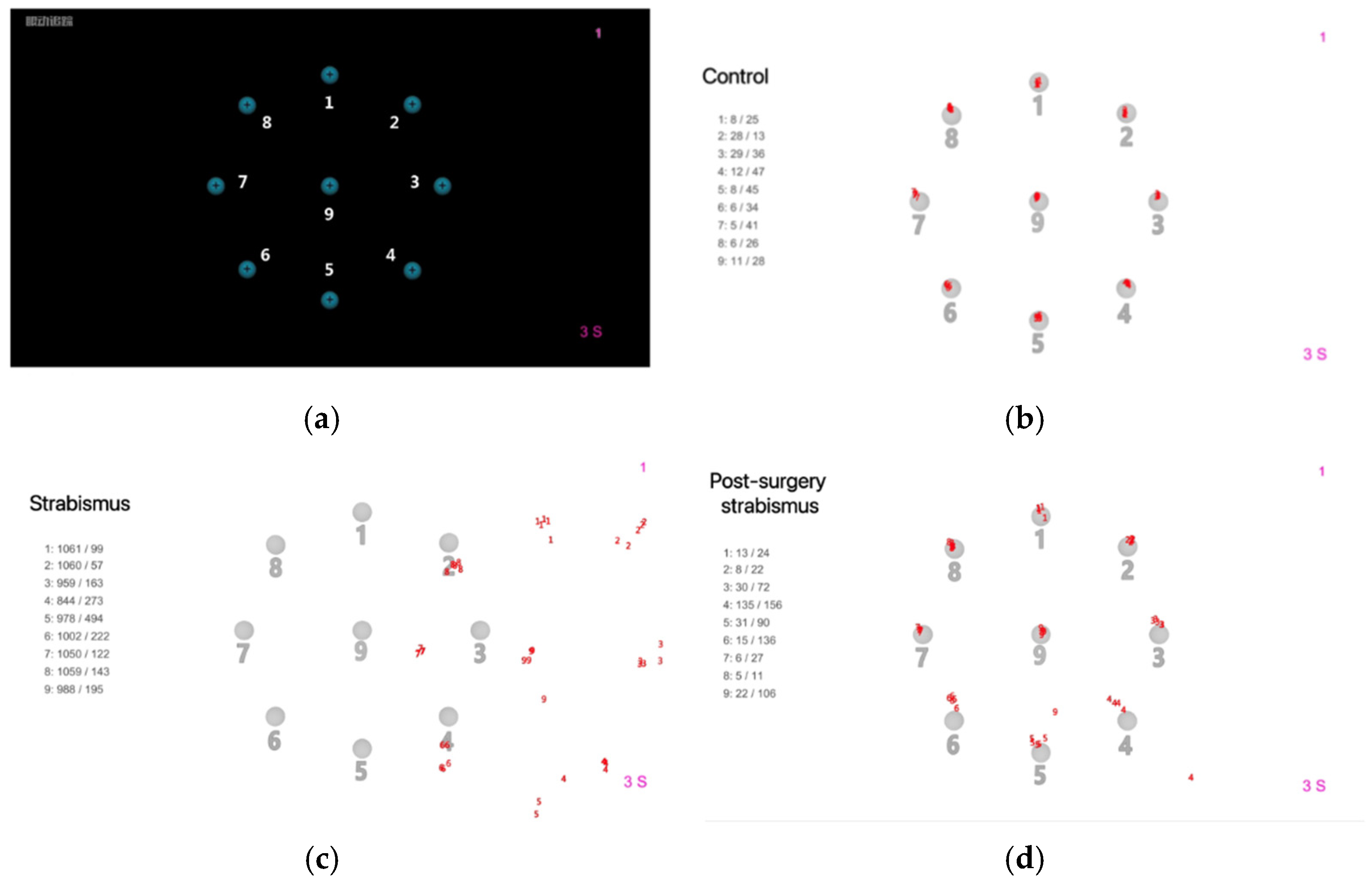
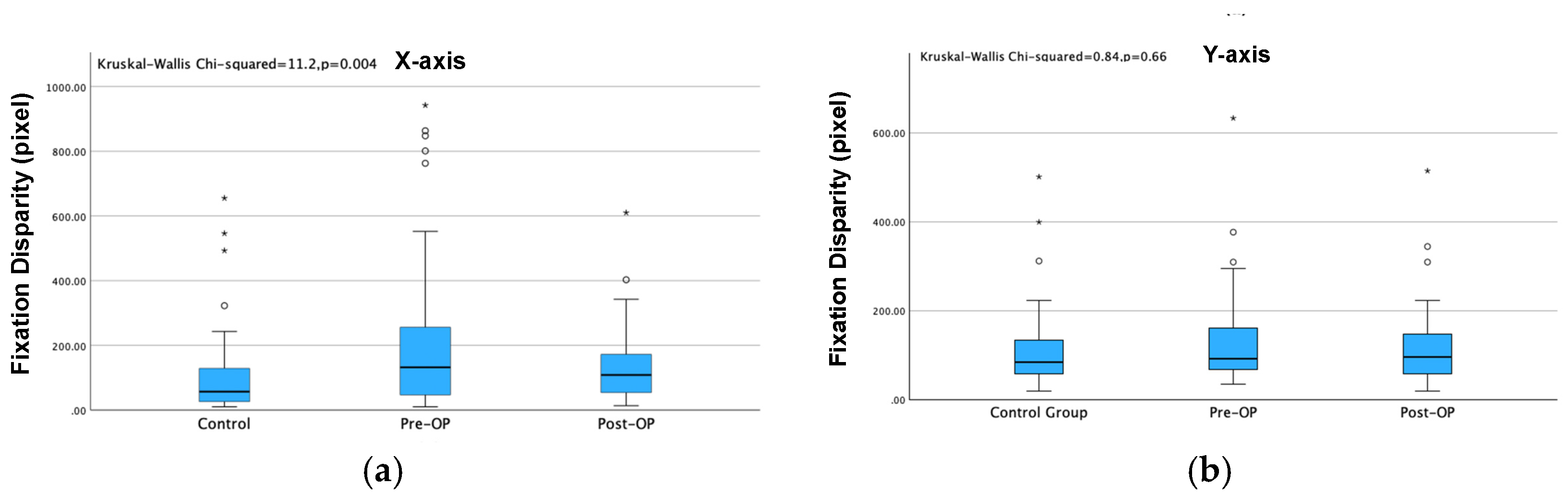
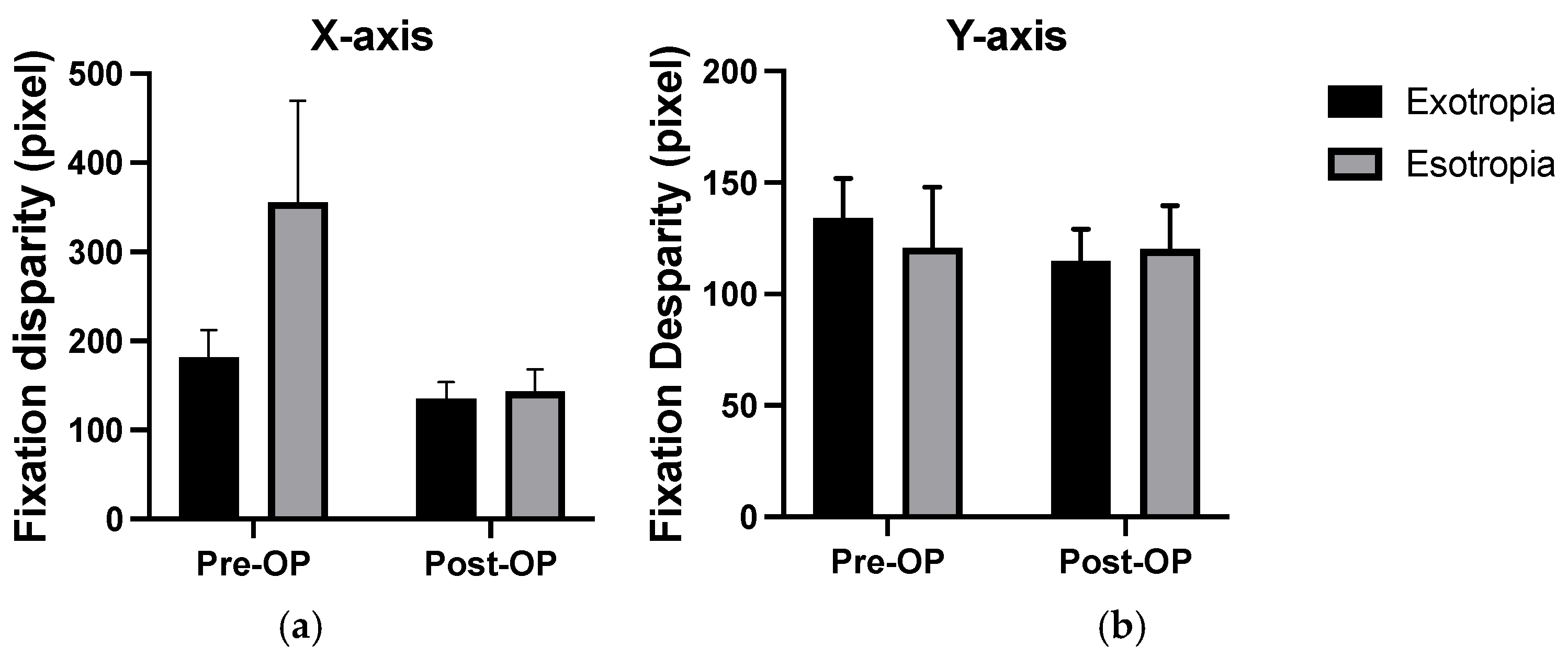
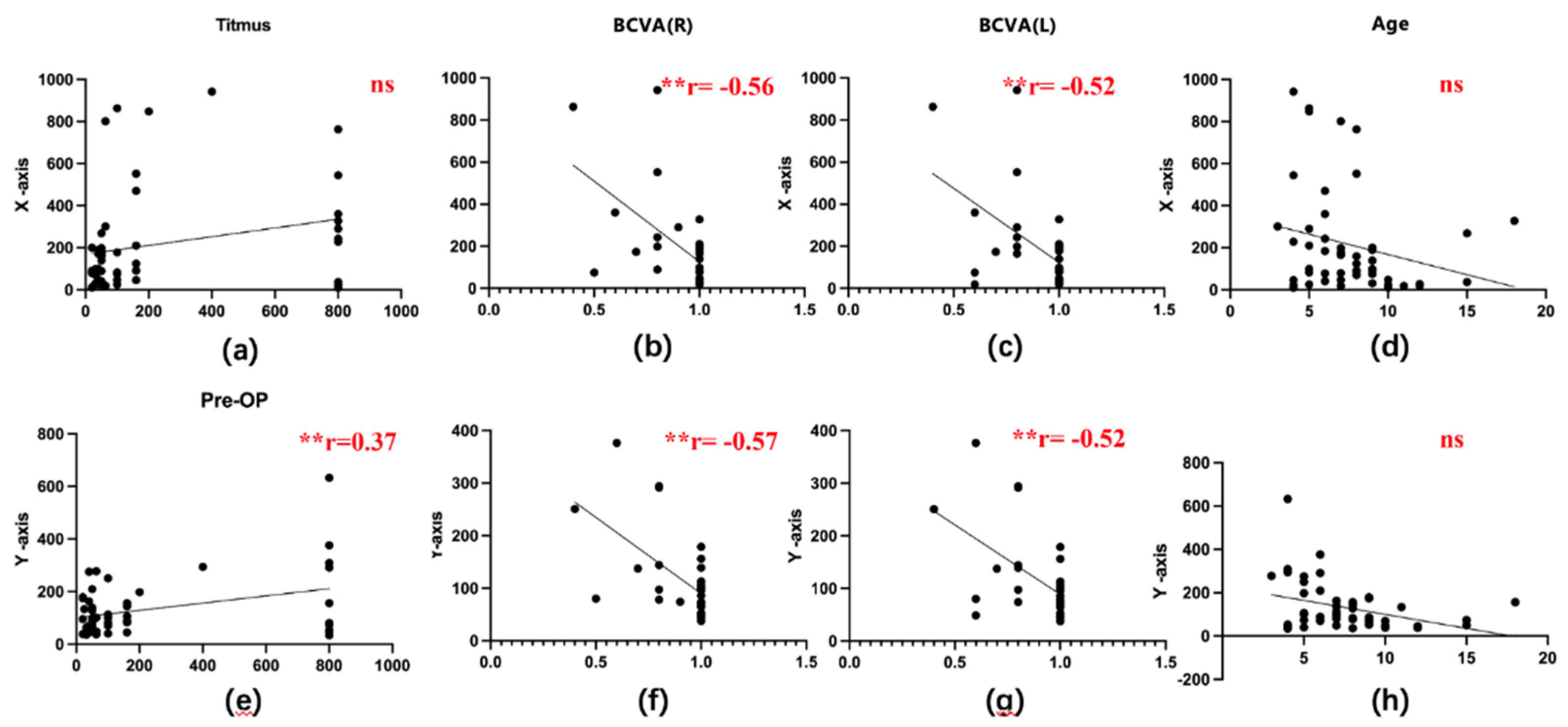

| Categories | Count | ||
| Control Group | Strabismus Group | Sig. | |
| Age range (years)Mean age [SD] | 4–12 | 4–18 | |
| 7.37 [0.20] | 7.76 [3.59] | 0.82 | |
| Sex | |||
| Male | 26 (43.3%) | 36 (63.2%) | |
| Female | 34 (56.7%) | 21 (36.8%) | |
| Total | 60 | 57 | 0.78 |
| Categories | Strabismus Group | Control Group | Sig. | |||||
|---|---|---|---|---|---|---|---|---|
| Mean | SD | Mean | SD | |||||
| Fixational disparities (pixel) | X-axis | Pre-OP | 214.61 | 32.14 | 103.78 | 16.43 | <0.001 | |
| Post-OP | 142.15 | 15.48 | ||||||
| Sig. | 0.03 | |||||||
| Y-axis | Pre-OP | 133.97 | 14.67 | 96.6 | 6.37 | <0.001 | ||
| Post-OP | 123.69 | 12.64 | ||||||
| Sig. | 0.42 | |||||||
| Stereoacuity (") | Pre-OP | 243.38 | 40.44 | 50.33 | 4.83 | 0.02 | ||
| Post-OP | 221.29 | 40.19 | ||||||
| Sig. | <0.001 | |||||||
| Categories | Pre-OP | Post-OP | Sig. | ||||||
|---|---|---|---|---|---|---|---|---|---|
| Mean | SD | Mean | SD | ||||||
| Exotropia | X-axis(pixel) | 181.52 | 30.87 | 135.14 | 18.84 | 0.18 | |||
| Esotropia | 356.02 | 113.63 | 143.18 | 24.94 | 0.04 | ||||
| Sig. | 0.04 | 0.84 | |||||||
| Exotropia | Y-axis(pixel) | 134.27 | 17.71 | 114.86 | 14.31 | 0.21 | |||
| Esotropia | 120.86 | 27.30 | 120.18 | 19.48 | 0.48 | ||||
| Sig. | 0.73 | 0.86 | |||||||
Disclaimer/Publisher’s Note: The statements, opinions and data contained in all publications are solely those of the individual author(s) and contributor(s) and not of MDPI and/or the editor(s). MDPI and/or the editor(s) disclaim responsibility for any injury to people or property resulting from any ideas, methods, instructions or products referred to in the content. |
© 2025 by the authors. Licensee MDPI, Basel, Switzerland. This article is an open access article distributed under the terms and conditions of the Creative Commons Attribution (CC BY) license (http://creativecommons.org/licenses/by/4.0/).