

Submitted:
26 January 2025
Posted:
27 January 2025
You are already at the latest version
Abstract
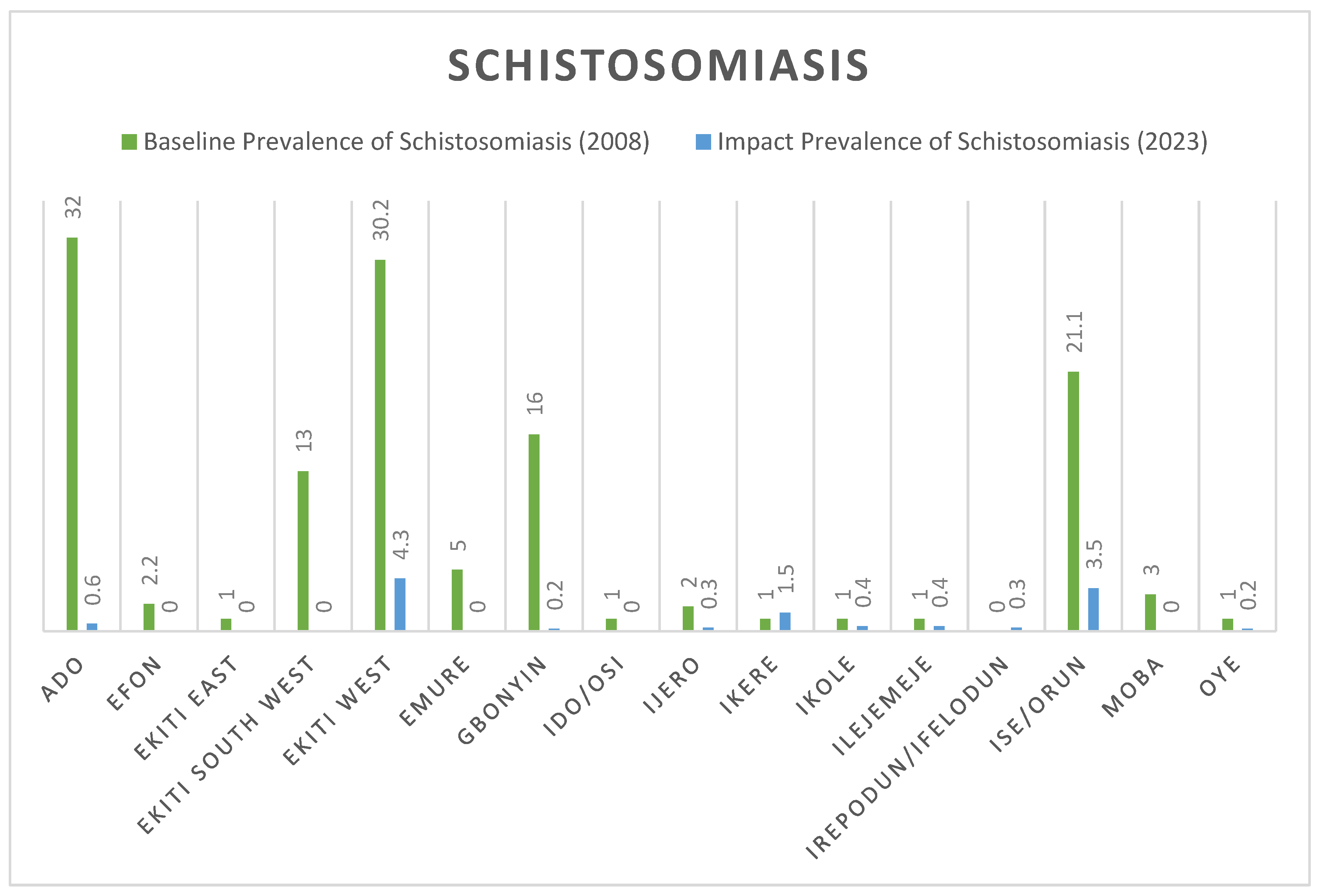
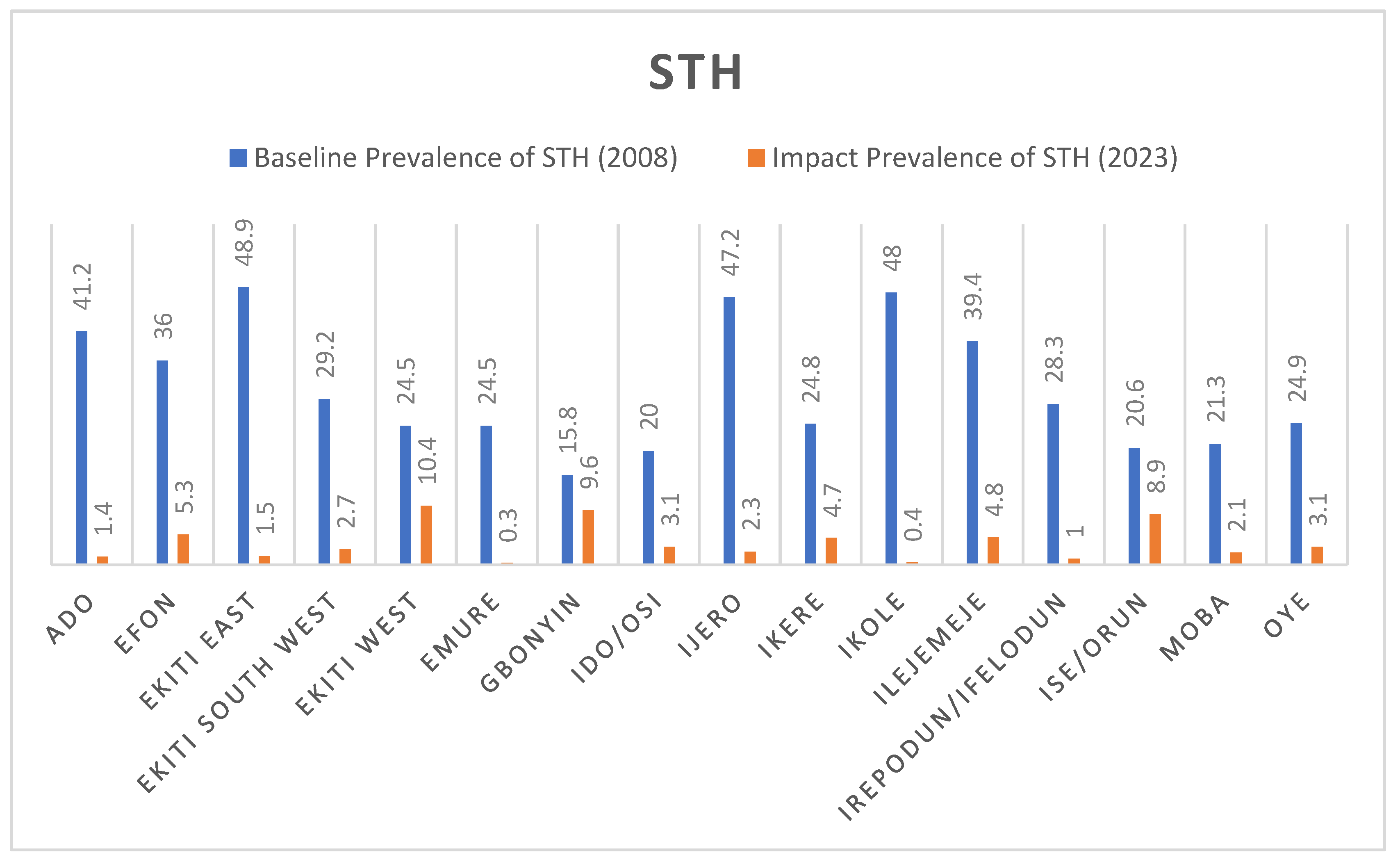
Background: Granular assessment of Schistosomiasis (SCH) and soil-transmitted helminthiasis (STHs) in a population with instituted treatment programs is a critical step in understanding the progress of control programs towards the 2030 elimination targets. Such scientific insight into the impact of recurrent rounds of mass treatment with Praziquantel and Albendazole/Mebendazole should facilitate improved planning and targeting of resources. Methodology: This schistosomiasis and STHs granular assessment was conducted in 16 Local Government Areas (LGAs) of Ekiti State between October and November 2023. Samples were collected from pupils in166 primary and junior secondary schools across 166 wards/communities. Urine and stool samples were collected from 7670 pupils between 5 and 14 years, comprising 3823 (49.8%) males and 3847 (50.1%) females. When aggregated at individual LGA, the highest number of participants (658 children) was recorded in Ado Ekiti LGA. Emure recorded the lowest number of participants with 320 children across 9 out of 10 wards in the LGA. The result of this granular assessment was compared to the 2008 and 2015 baseline prevalence of each LGA to assess the level of reduction in both prevalence and intensity. Results: Overall, 58 (0.76%) out of 7670 pupils were infected with Schistosomia haematobium. No Schistosoma mansoni infection was recorded in any of the 7670 analyzed samples. Two hundred and ninety-six (3.86%) of the examined samples were infected with STHs. In the 16 LGAs assessed, Ekiti West had the highest S. haematobium prevalence of 4.26%. Ise/Orun and Oye ranked 2nd and 3rd with a prevalence of 3.48% & 2.40% respectively. There were no reported infection of S. haematobium in Efon, Ekiti-East, Ekiti South-west, Ido/Osi & Moba, LGAs while a further 7 LGAs had <1% prevalence. The prevalence of STHs was highest in Ekiti-West with a prevalence of 10.45%. Gbonyin & Ise/Orun had the prevalence of 9.62% & 8.9% respectively, making them 2nd and 3rd in ranking accordingly. Emure, Ikole and Irepodun Local Governments had the lowest prevalence of 0.31%, 0.38% & 1.01% respectively. Conclusion: There was a sharp decline in the prevalence of S. haematobium & STHs in the State across the 16 LGAs as compared to the baseline prevalence obtained from the Federal Ministry of Health NTD program. Our assessment demonstrates that only 3 LGAs require continued MDA every 2/3 years based on the WHO guidelines, while 6 are now non-endemic and 7 require only surveillance. The prevalence of STHs has significantly reduced across the 16 LGAs. Comparative analysis of the computed and baseline prevalence shows that 6 LGAs are not endemic according to WHO guidelines. Two of the assessed LGAs require one round of MDA yearly and 8 LGAs need one round of MDA every two to three years.
Keywords:
Introduction
Problem Statement
Ethical Clearance
Methodology
Study Site and Population
Study Design: Site Selection and Sample Size
Stool and Urine Sample Collection at School
Data Collection
Data Processing and Analysis
Results
Demographic Data

| S/N | LGA | No of wards where samples were collected | No of wards where samples were NOT collected/returned | No of Participants per LGA | No of participants whose samples were returned |
| 1. | Ado | 13 | 0 | 658 | 0 |
| 2. | Efon | 9 | 1 | 416 | 0 |
| 3. | Ekiti East | 12 | 0 | 618 | 0 |
| 4. | Ekiti South West | 11 | 0 | 556 | 0 |
| 5. | Ekiti West | 9 | 2 | 469 | 0 |
| 6. | Emure | 9 | 0/1 | 320 | 9 |
| 7. | Gbonyin | 9 | 1 | 447 | 0 |
| 8. | Ido/Osi | 11 | 0 | 509 | 0 |
| 9. | Ijero | 10 | 2 | 303 | 0 |
| 10. | Ikere | 11 | 0 | 550 | 0 |
| 11. | Ikole | 12 | 0 | 527 | 0 |
| 12. | Ilejemeje | 10 | 0 | 546 | 0 |
| 13. | Irepodun/Ifelodun | 10 | 1 | 396 | 0 |
| 14. | Ise/Orun | 8 | 1/1 | 517 | 33 |
| 15. | Moba | 11 | 0 | 420 | 0 |
| 16. | Oye | 11 | 1 | 418 | 0 |
| Total | 166 | 9/2 | 7670 | 42 | |
Prevalence of Schistosomiasis
| S/N | LGA | No. of respondents | Number positive | Prevalence |
| 1 | Ado | 658 | 4 | 0.6 |
| 2 | Efon | 416 | 0 | 0.0 |
| 3 | Ekiti East | 618 | 0 | 0.0 |
| 4 | Ekiti South West | 556 | 0 | 0.0 |
| 5 | Ekiti West | 469 | 20 | 4.3 |
| 6 | Emure | 320 | 0 | 0.0 |
| 7 | Gbonyin | 447 | 1 | 0.2 |
| 8 | Ido/Osi | 509 | 0 | 0.0 |
| 9 | Ijero | 303 | 1 | 0.3 |
| 10 | Ikere | 550 | 8 | 1.5 |
| 11 | Ikole | 527 | 2 | 0.4 |
| 12 | Ilejemeje | 546 | 2 | 0.4 |
| 13 | Irepodun/Ifelodun | 396 | 1 | 0.3 |
| 14 | Ise/Orun | 517 | 18 | 3.5 |
| 15 | Moba | 420 | 0 | 0.0 |
| 16 | Oye | 418 | 1 | 0.2 |
| Total | 7670 | 58 | 0.8 |
Prevalence of Schistosomiasis by Sex
Prevalence of Soil-Transmitted Helminths (STH)
| S/N | LGA | No. of respondents | Number positive | Prevalence |
| 1 | Ado | 658 | 9 | 1.4 |
| 2 | Efon | 416 | 22 | 5.3 |
| 3 | Ekiti East | 618 | 9 | 1.5 |
| 4 | Ekiti South West | 556 | 15 | 2.7 |
| 5 | Ekiti West | 469 | 49 | 10.4 |
| 6 | Emure | 320 | 1 | 0.3 |
| 7 | Gbonyin | 447 | 43 | 9.6 |
| 8 | Ido/Osi | 509 | 16 | 3.1 |
| 9 | Ijero | 303 | 7 | 2.3 |
| 10 | Ikere | 550 | 26 | 4.7 |
| 11 | Ikole | 527 | 2 | 0.4 |
| 12 | Ilejemeje | 546 | 26 | 4.8 |
| 13 | Irepodun/Ifelodun | 396 | 4 | 1.0 |
| 14 | Ise/Orun | 517 | 46 | 8.9 |
| 15 | Moba | 420 | 8 | 1.9 |
| 16 | Oye | 418 | 13 | 3.1 |
| Total | 7670 | 296 | 3.9 |
Distribution of Parasites by Species Across the LGA
| Schistosomiasis | STH | ||||
| LGA | S. Hae | S. Man | Ascaris | TT | HW |
| Ado | 4 (0.61) | 0 (0.00) | 8 (1.22) | 0 (0.00) | 1 (0.15) |
| Efon | 0 (0.00) | 0 (0.00) | 22 (5.29) | 0 (0.00) | 0 (0.00) |
| Ekiti East | 0 (0.00) | 0 (0.00) | 9 (1.46) | 1 (0.16) | 0 (0.00) |
| Ekiti South West | 0 (0.00) | 0 (0.00) | 15 (2.70) | 0 (0.00) | 0 (0.00) |
| Ekiti West | 20 (4.24) | 0 (0.00) | 45 (9.59) | 1 (0.21) | 4 (0.85) |
| Emure | 0 (0.00) | 0 (0.00) | 1 (0.31) | 0 (0.00) | 0 (0.00) |
| Gbonyin | 1 (0.22) | 0 (0.00) | 29 (6.49) | 11 (2.46) | 6 (1.34) |
| Ido/Osi | 0 (0.00) | 0 (0.00) | 12 (2.36) | 0 (0.00) | 4 (0.79) |
| Ijero | 1 (0.33) | 0 (0.00) | 6 (1.98) | 0 (0.00) | 1 (0.33) |
| Ikere | 8 (1.45) | 0 (0.00) | 24 (4.36) | 0 (0.00) | 2 (0.36) |
| Ikole | 2 (0.38) | 0 (0.00) | 1 (0.19) | 1 (0.19) | 0 (0.00) |
| Ilejemeje | 2 (0.37) | 0 (0.00) | 23 (4.21) | 2 (0.37) | 1 (0.18) |
| Irepodun/Ifelodun | 1 (0.25) | 0 (0.00) | 4 (1.01) | 0 (0.00) | 0 (0.00) |
| Ise/Orun | 18 (3.48) | 0 (0.00) | 37 (7.16) | 0 (0.00) | 11 (2.13) |
| Moba | 0 (0.00) | 0 (0.00) | 8 (1.90) | 0 (0.00) | 0 (0.00) |
| Oye | 1 (0.24) | 0 (0.00) | 11 (2.63) | 1 (0.24) | 3 (0.72) |
| Total | 58 (0.76) | 0 (0.00) | 255 (3.32) | 17 (0.22) | 33 (0.43) |
| Total | 0.76 | 3.86 | |||
Infection Load Estimation
| LGA | Average Intensity of Infection Load | |||||||
| S. haematobium | Intensity | A. lumbricoides | Intensity | T. tricuira | Intensity | Hookworm | Intensity | |
| Ado | 78 | High | 213 | Light | 0 | None | 24 | Light |
| Efon | 0 | None | 862 | Light | 0 | None | 0 | None |
| Ekiti East | 0 | None | 187 | Light | 408 | Light | 0 | None |
| Ekiti South West | 0 | None | 294 | Light | 0 | None | 0 | None |
| Ekiti West | 14 | Low | 751 | Light | 336 | Light | 24 | Light |
| Emure | 0 | None | 4080 | Light | 0 | None | 0 | None |
| Gbonyin | 1 | Low | 778 | Light | 111 | Light | 56 | Light |
| Ido/Osi | 0 | None | 170 | Light | 0 | None | 30 | Light |
| Ijero | 16 | Low | 24 | Light | 0 | None | 24 | Light |
| Ikere | 24 | Low | 911 | Light | 0 | None | 36 | Light |
| Ikole | 2 | Low | 264 | Light | 264 | Light | 0 | None |
| Ilejemeje | 1 | Low | 279 | Light | 36 | Light | 24 | Light |
| Irepodun/Ifelodun | 119 | High | 5886 | Moderate | 0 | None | 0 | None |
| Ise/Orun | 39 | Low | 322 | Light | 0 | None | 244 | Light |
| Moba | 0 | None | 78 | Light | 0 | None | 0 | None |
| Oye | 1 | Low | 168 | Light | 24 | Light | 288 | Light |
| Total (State) | 28 | Low | 611 | Light | 137 | Light | 129 | Light |
| S/N | LGA | No. of Participants (Positive) | No. of Male (Positive) | No. of Female (Positive) | Prevalence of STH among Male | Prevalence of STH among Female | Prevalence of STH among the participants |
| 1. | Ado | 658 (9) | 324 (2) | 334 (7) | 0.62 | 2.10 | 1.37 |
| 2. | Efon | 416 (22) | 199 (11) | 217 (11) | 5.53 | 5.07 | 5.29 |
| 3. | Ekiti East | 618 (9) | 313 (6) | 305 (3) | 1.92 | 0.98 | 1.46 |
| 4. | Ekiti South West | 556 (15) | 250 (4) | 306 (11) | 1.60 | 3.59 | 2.70 |
| 5. | Ekiti West | 469 (49) | 220 (21) | 249 (28) | 9.55 | 11.24 | 10.45 |
| 6. | Emure | 320 (1) | 161 (0) | 159 (1) | 0.00 | 0.63 | 0.31 |
| 7. | Gbonyin | 447 (43) | 222 (24) | 225 (19) | 10.81 | 8.44 | 9.62 |
| 8. | Ido/Osi | 509 (16) | 260 (8) | 249 (8) | 3.08 | 3.21 | 3.14 |
| 9. | Ijero | 303 (7) | 169 (4) | 134 (3) | 2.37 | 2.24 | 2.31 |
| 10. | Ikere | 550 (26) | 265 (13) | 285 (13) | 4.91 | 4.56 | 4.73 |
| 11. | Ikole | 527 (2) | 261 (2) | 266 (0) | 0.77 | 0.00 | 0.38 |
| 12. | Ilejemeje | 546 (26) | 258 (13) | 288 (13) | 5.04 | 4.51 | 4.76 |
| 13. | Irepodun/Ifelodun | 396 (4) | 207 (1) | 189 (3]) | 0.48 | 1.59 | 1.01 |
| 14 | Ise/Orun | 517 (46) | 291 (26) | 226 (20) | 8.93 | 8.85 | 8.90 |
| 15. | Moba | 420 (8) | 213 (5) | 207 (3) | 2.35 | 1.45 | 1.90 |
| 16. | Oye | 418 (13) | 210 (11) | 208 (2) | 5.24 | 0.96 | 3.11 |
| Total | 7670 (296) | 3823 (151) | 3847 (145) | 3.95 | 3.77 | 3.86 | |
Measured Prevalence Compared with Baseline Prevalence
Discussion
Conclusion
Acknowledgements
- Ekiti State Ministry of Health
- Ekiti State University Teaching Hospital
- Ekiti State University, College of Medicine
- Federal Ministry of Health
- Delft Global Initiative - Delft University of Technology
- INSPiRED - Delft University of Technology/Leiden University Medical Centrum
- MITOSATH
- AiDx Medical BV
- THE END FUND
Supplementary Materials
Author Contributions
Institutional Review Board Statement
Conflicts of Interest
References
- Steinmann P, Keiser J, Bos R, Tanner M, Utzinger J, 2006. Schistosomiasis and water resources development: systematic review, meta-analysis, and estimates of people at risk. Lancet Infect Dis 6: 411–425.
- Hotez PJ, Yamey G, 2009. The evolving scope of PLoS Neglected Tropical Diseases. PLoS Negl Trop Dis 3: e379. [CrossRef]
- WHO, 2002. Prevention and control of schistosomiasis and soil-transmitted helminthiasis: Report of a WHO expert committee. WHO Technical Report Series No. 912. Geneva: World Health Organization, 1–57.
- Anderson RM, May RM. Infectious diseases of humans. 1991. Oxford: Oxford University Press.
- Kabatereine NB, Vennervald BJ, Ouma JH, Kemijumbi J, Butterworth AE, Dunne DW, et al. 1999. Adult resistance to schistosomiasis mansoni: age-dependence to reinfection remains constant in communities with diverse exposure patterns. Parasitology; 118:101–5. [CrossRef]
- WHO, 2006. World Health Organization. Preventive chemotherapy in human helminthiasis: coordinated use of anthelminthic drugs in control interventions: a manual for health professionals and programme managers. Geneva: World Health Organization Press.
- World Health Organization (WHO). PCT databank—Soil-Transmitted Helminthiases. World Health Organization, Geneva, Switzerland (2016a). Available online: http://www.who.int/neglected_diseases/preventive_chemotherapy/sth/en/ (accessed on 23 May 2023).
- Hotez, P. J. et al. The global burden of disease study 2010: Interpretation and implications for the neglected tropical diseases. PLoS Negl. Trop. Dis. 8, e2865 (2014). [CrossRef]
- World Health Organization (WHO). Soil-transmitted Helminth INFECTIONS—Fact sheet. World Health Organization, Geneva, Switzerland (2016b). Available online: http://www.who.int/mediacentre/factsheets/fs366/en/ (accessed on 23 May 2023).
- Tchuem Tchuente L-A, Stothard JR, Rollinson D, Reinhard-Rupp J. 2018. Precision mapping: An innovative tool and way forward to shrink the map, better target interventions, and accelerate toward the elimination of schistosomiasis. PLoS Negl Trop Dis 12(8): e0006563. [CrossRef]
- WHO-AFRO, 2014. Guide for Mapping Neglected Tropical Diseases Targeted by Preventive Chemotherapy in the African Region. World Health Organization-Regional Office for Africa.
- Makau-Barasa, L., Assefa, L., Aderogba, M., Bell, D., Solomon, J., Urude, R. O., Nebe, O. J., J, A. E., Damen, J. G., Popoola, S., Diehl, J. C., Vdovine, G. & Agbana, T. (2023). Performance evaluation of the AiDx multi-diagnostic automated microscope for the detection of schistosomiasis in Abuja, Nigeria. Sci Rep, 13, 14833. [CrossRef]
- Onasanya A, Bengtson M, Agbana T, Oladunni O, van Engelen J, Oladepo O, Diehl JC. Towards Inclusive Diagnostics for Neglected Tropical Diseases: User Experience of a New Digital Diagnostic Device in Low-Income Settings. Tropical Medicine and Infectious Disease. 2023; 8(3):176. [CrossRef]
- National Protocol for Integrated Epidemilogogical Mapping and Baseline Survey of Schistosomiasis and Soil Transmitted Helminths. Federal Ministry of Health, Nigeria (2013).
- Hailegebriel T, Nibret E, Munshea A. Efficacy of Praziquantel for the Treatment of Human Schistosomiasis in Ethiopia: A Systematic Review and Meta-Analysis. J Trop Med. 2021 Dec 20;2021:2625255. [CrossRef] [PubMed] [PubMed Central]
- Berhanu MS, Atnafie SA, Ali TE, Chekol AA, Kebede HB. Efficacy of Praziquantel Treatment and Schistosoma Mansoni Infection among Primary School Children in Kemisse Town, Northeast Ethiopia. Ethiop J Health Sci. 2022 May;32(3):631-640. [CrossRef] [PubMed] [PubMed Central]
- Report on Epidemiologibal Mapping of Schistosomiasis and Soil Transmitted Helminthiasisin 19 States and the FCT, Nigeria. May 2015.
Disclaimer/Publisher’s Note: The statements, opinions and data contained in all publications are solely those of the individual author(s) and contributor(s) and not of MDPI and/or the editor(s). MDPI and/or the editor(s) disclaim responsibility for any injury to people or property resulting from any ideas, methods, instructions or products referred to in the content. |
© 2025 by the authors. Licensee MDPI, Basel, Switzerland. This article is an open access article distributed under the terms and conditions of the Creative Commons Attribution (CC BY) license (http://creativecommons.org/licenses/by/4.0/).