

Submitted:
19 January 2025
Posted:
20 January 2025
You are already at the latest version
Abstract
Sustainable urban development increasingly aligns with the Sustainable Development Goals (SDGs), highlighting the importance of integrating local cultural landscapes into city planning. One compelling example is the concept of fengshui forests in China, which are deeply rooted in traditional beliefs associated with prosperity for local communities. This study explores how fengshui forests can inform urban landscape design, particularly in the context of biodiversity conservation. A comprehensive literature review was conducted, examining studies on the ecological functions and cultural significance of fengshui forests. This analysis included research articles, case studies, and ecological assessments, revealing that fengshui forests provide essential ecosystem services—such as preserving biodiversity, regulating microclimates, and sequestering carbon—while also offering unique cultural insights, economic resources, and tourism potential. Recognizing the critical role of plant selection and combination in urban landscape design, we compiled a database of 1,196 recorded plant species from fengshui forests, detailing their physiological traits, geographical distribution, and social values. By employing diverse plant pairing principles, urban landscape designers can select suitable species to create green spaces that support a well-functioning food web and ecosystem, ultimately fostering biodiversity conservation. By harnessing both the ecological functions and cultural values of fengshui forests, this research highlights their potential to enhance urban eco-landscape design, promote eco-tourism, and aid in the preservation of local species. These forests, with their traditional roots and ecological significance, hold promise for advancing ecological civilization through effective biodiversity conservation and sustainable urban planning.
Keywords:
Fengshui forests
; Ecological function
; Humanistic value
; Urban biodiversity
1. Introduction
Urban green ecological environments face significant challenges, including landscape and habitat fragmentation, human interference, and declining habitat quality [1,2]. In pursuit of the United Nations Sustainable Development Goals (SDGs) and the promotion of sustainable cities, it is essential to enhance urban green space ecosystems and biodiversity. A promising approach is to leverage local cultural landscapes in urban design [3,4,5]. One notable example is fengshui forests, which integrate traditional beliefs with ecological principles. Incorporating fengshui forests into urban green landscape design not only improves ecological functions but also enhances community well-being, ultimately supporting sustainable urban development [6,7].
Fengshui forests represent a unique aspect of human settlement landscapes in China, with various theories regarding their origins. The prevailing belief is that fengshui forests stem from classical fengshui ideas, reflecting a distinct cultural phenomenon that highlights the harmony between humans and nature [8,9,10]. This traditional concept emphasizes the selection or modification of natural environments to promote good fortune and mitigate disaster [9,10,11,12]. Ancient Chinese thought posited that a suitable environment should be surrounded by water, forests, hills, and mountains to harness beneficial "qi" or energy [10,12]. Thus, fengshui forests are integral to fengshui theory.
Another explanation for the genesis of fengshui forests is their development for the worship of gods and ancestors, particularly the earth deities [10,13,14]. Villagers believed that planting trees around settlements provided protection from these gods and that such forests came to symbolize regional worship and cultural identity [15].
Fengshui forests can be defined as natural or artificial plant communities with strict protection and significant historical value [10]. More specifically, they represent stable vegetation communities shaped by years of natural succession from human-initiated forestation [16]. These forests can be found in villages, gardens, parks, or natural reserves, where the layout and selection of flora balance aesthetic appeal with fengshui principles [8,10,17] (Figure 1). In China, fengshui forests are prevalent in southern and central regions, including Hong Kong, Guangdong, Guangxi, and Jiangxi [17,18,19].
Before the 1970s, only two books—Flora of Hong Kong by George Bentham (1861) and Flora of Kwangtung and Hong Kong by Stephan T. Dunn and William J. Tutcher (1912)—mentioned the concept of fengshui forests in Hong Kong [8,16]. This lack of scholarly attention highlights how fengshui forests were historically underappreciated despite their cultural significance. However, systematic research on fengshui forests began in the 1970s [8]. During this time, Stella L. Thrower studied the floristics and plant communities of fengshui forests in Hong Kong, proposing that these forests were the original remnant forests preserved by human settlement [8,20,21]. This foundational work sparked interest in the ecological and cultural dimensions of fengshui forests, paving the way for subsequent studies. Since the 1980s, research on fengshui forests as a folk culture began in Hong Kong [8], further contributing to the understanding of their role in local identity and ecology.
In mainland China, research on fengshui forests also started in the 1980s, primarily focusing on ecological and landscape aspects. Early studies concentrated on rural ecology, landscape design, and management, as well as the definition, development, and conservation of fengshui forests [22]. Chen et al. [23] conducted a meticulous study of the vegetation communities in the Pearl River Delta region's fengshui forests, documenting over 600 plant species and organizing various vegetation community structures suitable for ecological afforestation projects. Furthermore, Chen et al. [17] systematically investigated the geographical distribution of fengshui forests in the southern and central regions of China. Influenced by Chinese culture, fengshui forests have also been found in Japan, Korea, Thailand, and other East and Southeast Asian countries within the Han Culture Circle [24,25], often referred to as "cultural forests" or "cultural protection forests" according to local history and culture.
Given the rapid urban development leading to increased fragmentation of green spaces detrimental to urban biodiversity conservation efforts [2], there is an urgent need to explore new designs for urban landscapes that promote biodiversity protection. As a unique Chinese human settlement landscape concept utilizing forested areas to create harmonious living environments with nature while offering diverse ecological and cultural values, fengshui forests hold great potential for enhancing urban landscape construction practices. However, current research primarily focuses on internal landscapes and conservation aspects without adequately addressing urban ecology [10,26].
This study aims to review and discuss the application of fengshui forest configurations in the design of urban parks and landscapes, focusing on biodiversity conservation and economic development, particularly within the framework of sustainable urban ecological development as outlined by the Sustainable Development Goals (SDGs). By examining existing research and practical examples, this work seeks to highlight how integrating fengshui forest principles can create multifunctional green spaces that benefit both people and nature. To further enhance the integration of fengshui forest principles in urban biodiversity conservation, a plant species database specific to fengshui forests has been developed. This database aims to support effective urban landscape design, promote the conservation of urban biodiversity, and serve as a valuable resource for urban planners and ecologists working towards sustainable urban environments.
2. Ecological Functions and Values
Fengshui forests have demonstrated a variety of ecological functions and values, including biodiversity conservation, microclimate regulation, carbon fixation, air quality improvement, and soil and water conservation. These functions play a crucial role in supporting both local ecosystems and broader environmental health.
2.1. Biodiversity Conservation
Fengshui forests can be considered essential landscapes for biodiversity [27] (Table 1). They support a rich diversity of plant species [21,28,29] as well as various animal species, including ants [30], birds [31,32] and mammals [33]. The heterogeneous habitats within fengshui forests play a vital role in regional biodiversity conservation [28,34].
In terms of plant diversity, fengshui forests are particularly abundant. In Guangdong Province’s Pearl River Delta, 698 plant species were recorded in 30 fengshui forests [29]. Similarly, Hong Kong hosts 567 plant species across 118 fengshui forests [8]. A study in Wuyuan County, Jiangxi Province [32], further illustrated that fengshui forests contribute significantly to plant species diversity in their surrounding regions. Compared to artificial landscapes and secondary natural landscapes, fengshui forests exhibit higher plant species richness and biodiversity indices [28,35,36]. Several studies [35,36,39,40,41] have documented that fengshui forests show superior Shannon-Wiener Index (SWI) and Simpson Index (SI) values across three vertical structural levels: tree layer (SWI: 1.5 to 4.2, SI: 0.50 to 0.97), shrub layer (SWI: 3.0 to 4.7, SI: 0.60 to 0.90), and grass layer (SWI: 1.5 to 3.5, SI: 0.6 to 0.7). These findings indicate that fengshui forests possess a complex and stable structure of plant communities, suggesting their potential as vital habitats for diverse animal species [33].
Fengshui forests also support a wide range of wildlife. For instance, a bird survey in Zhongshan, Guangdong Province, revealed that 56.41% of the region’s bird species inhabit fengshui forests [31]. Another study in Zhuhai showed that fengshui forests had higher bird species richness compared to orchards (Jiang, Zhong and Tsim, personal communication). In terms of insects, over 200 butterfly species were found in the fengshui forest of Fung Yuen Village, accounting for approximately 90% of Hong Kong’s total butterfly species [42]. Additionally, Nooten et al. [30] found that native ant species richness was higher in fengshui forests than in secondary forests and shrublands in Hong Kong. However, the richness of tramp ant species was lower in fengshui forests, highlighting their significance as refuges for native species [30]. Overall, fengshui forests play a critical role in maintaining regional biodiversity.
With their abundant species resources, fengshui forests can also be considered important sources of seeds and genetic materials. Due to seed dispersal by frugivorous birds, fengshui forests serve as seed suppliers to surrounding areas, aiding the regeneration of rare plant species and forests [37]. As less human-influenced environments, fengshui forests maintain a more stable seedling density compared to artificial secondary forests, indicating a greater capacity for regeneration [34]. Furthermore, the relatively higher species diversity in fengshui forests provides a substantial primary pool for gene conservation, as these forests conserve genetic diversity with minimal human interference [38]. Most fengshui forests exhibit species heterogeneity higher than 2 [35,36,39,40,41,43], indicating that they not only harbor high species richness but also significant genetic diversity [43].
Fengshui forests contribute to the protection of rare animal and plant species. For example, the Blue-crowned Laughingthrush (Garrulax courtoisi), a critically endangered bird listed on the IUCN Red List [44] and an endemic species in China, is found exclusively in the fengshui forests of Wuyuan County, Jiangxi Province [32,45]. Additionally, the Pied Falconet (Microhierax melanoleucos), White-eared Night-heron (Gorsachius magnificus), and Japanese Night-heron (G. goisagi) are among other rare bird species identified in the fengshui forests of Wuyuan County [32]. Rare or nationally protected plant species such as Pseudolarix amabilis, Erythrophleum fordii, Aquilaria sinensis, and Ormosia henryi have also been documented in these forests [46]. Moreover, some trees over a hundred years old are well-protected in fengshui forests, thanks to both conscious protection efforts and the forests' long-standing history. Studies have indicated that the abundance of old tree resources in rural areas often exceeds that found in urban settings, attributed to local awareness regarding the conservation of fengshui forests [47,48].
The conscious protection and reduced human interference in fengshui forests lead to higher species richness and genetic diversity, as well as enhanced functions in biodiversity and rare species conservation. By safeguarding these unique ecosystems, we not only preserve biodiversity but also strengthen the resilience of the surrounding environment.
2.2. Microclimate Regulation
Fengshui forests play a crucial role in regulating local environmental conditions (Table 2). Research indicates that the canopy cover of fengshui forests can exceed 80%, providing substantial shade beneath the trees [49,50]. Due to the positive relationship between radiation and environmental temperature [51], this extensive canopy helps to attenuate sunlight, effectively cooling the surrounding area. For instance, a study in Zhuhai found that solar radiation levels beneath the fengshui trees were lower compared to both the surrounding open areas and the edges of the forests (Xie and Tsim, personal communication) Additionally, processes such as plant transpiration [8] and photosynthesis [10] further contribute to temperature reduction within these forests.
In addition to temperature control, fengshui forests also regulate wind patterns. Research conducted in Huitong Village demonstrated that these forests could reduce wind intensity by 28.8% to 33.4% (Xie and Tsim, personal communication). They effectively block dry and chilly northern winds and can mitigate the impact of typhoons [8]. Furthermore, a study in Nanchang City found that fengshui forests play a role in reducing dust storms [52], further highlighting their environmental benefits.
Through effective temperature and wind regulation, fengshui forests significantly improve the local microclimate, thereby creating a more favorable environment for wildlife.
2.3. Carbon Fixation
Fengshui forests play a crucial role as significant carbon sinks (Table 3), demonstrating greater carbon storage capacity compared to various other habitats, including barren hills, artificial forests, and evergreen broad-leaf forests found in nature reserves [53,54]. A study revealed that the carbon storage in fengshui forests in Guangzhou averaged 259.17 ± 69.67 t/hm², surpassing that of evergreen broad-leaf forests in the Dinghushan Nature Reserve (244.998 t/hm²) and exceeding the average carbon storage of forests in Guangzhou (178.03 t/hm²) and across China (163.70 t/hm²) [54]. Additionally, some of these fengshui forests have reported average carbon storage levels exceeding 300 t/hm² [54]. The primary contributors to the total carbon pool in these forests are the tree and soil layers [53,54,55]. Moreover, the carbon storage potential in each fengshui forest is influenced by factors such as patch size and edge effects [56,57,58,59,60]. Due to conscious conservation efforts and reduced human interference, the capacity for carbon storage in fengshui forests is on the rise [17,55,61]. Furthermore, the carbon storage capabilities of fengshui forests can yield substantial carbon assets, valued at up to RMB 186,400/hm² [55].
2.4. Other Functions
Fengshui forests play a significant role in enhancing air quality by effectively adsorbing dust, suspended particles, and toxic substances such as hydrogen fluoride and sulfur dioxide [10]. In addition to these benefits, certain plant species within these forests, especially traditional Chinese herbs, secrete aromatic hydrocarbons and other volatile compounds. These substances not only repel mosquitoes but also combat pathogens, contributing to air purification and improving the overall living environment [10,62,63].
Moreover, fengshui forests are vital for soil and water conservation, helping to prevent erosion. Due to minimal human interference, these forests maintain intact soil structures and demonstrate superior soil chemical properties, which enhance soil quality [64]. They also support a sustainable hydrological system, thereby benefiting local ecosystems [19]. Historically, rural communities in China have recognized the importance of fengshui forests for soil and water conservation, a belief that has persisted since ancient times [65,66]. The strategic placement of fengshui forests is crucial for protecting villages from erosion and ensuring a reliable supply of groundwater and surface water, as illustrated by the fengshui forests located behind Houlongshan village [26].
In addition to these primary functions, fengshui forests also provide various ecological services, including noise reduction, serving as natural fire barriers, and mitigating the impacts of natural disasters [67,68,69,70].
In summary, fengshui forests contribute a wide array of ecological functions that enhance air and soil quality, promote water conservation, and provide critical services that support the health and sustainability of local environments.
3. Humanistic Values of Fengshui Forests
With a long history and rich regional culture, fengshui forests in China generate a variety of humanistic values, encompassing social, economic, and cultural dimensions. The social values include historical and cultural research, while economic values focus on the cultivation of economic crops, medicinal plants, and tourism development.
3.1. Social Values
Fengshui forests hold significant social values, particularly in terms of historical and cultural significance. These forests are steeped in heritage, often featuring ancient structures accompanied by a wealth of poetry and historical accounts. Additionally, fengshui forests are intricately linked to human settlements, fostering diverse folk cultures.
3.1.1. Historical Research Values
Fengshui forests, with histories spanning hundreds of years, are invaluable for historical research. As a specific type of forest landscape, they are closely associated with human settlement buildings, reflecting the principles of fengshui theory. Notable examples include the Ming dynasty cypress forest in Beijing's Temple of Heaven and the fengshui forest in Confucius Forest, Shandong Province, both of which serve as crucial resources for studying heritage structures [10].
Moreover, many fengshui forests are connected to significant historical events, such as the Great Emigrations. For instance, the ancient pagoda forest in Guangji Temple, Shanxi Province, is considered the starting point of the Great Emigration in Northern China during the early Ming dynasty [10]. Similarly, fengshui forests in northern Guangxi Province were formed alongside the migration of Han people, integrating Han cultural elements during the Ming and Qing Dynasties [71]. In Southeast China, fengshui forests established by the Hakka people are vital to Hakka villages [72]. Furthermore, certain trees, such as Osmanthus fragrans in Lushan White Deer Academy, are believed to have been planted by renowned figures like Zhu Xi, a famous Neo-Confucian philosopher [10].
In addition to their historical significance, fengshui forests are rich in mythology, ancient texts, and poetry. For instance, folklore surrounding the Confucius Forest includes the belief that “crows would never stay in the Confucius Forest” [10]. Various poems from the Han and Tang dynasties and articles from the Qing dynasty and the Republic of China specifically mention the landscapes of fengshui forests, providing essential insights for historical research, particularly in ancient literature.
Overall, fengshui forests serve as vital historical resources that enhance our understanding of heritage structures and significant cultural events throughout Chinese history.
3.1.2. Cultural Values
Fengshui forests are deeply intertwined with human communities, giving rise to various folk and regional cultures, thus possessing considerable cultural value. A core belief surrounding fengshui forests is the harmony between humans and nature, aligning with fundamental Taoist thought [72,73]. This ecological model reflects a virtuous cycle in which villagers sustainably utilize and protect the fengshui forests, which in turn provide benefits to the community. Furthermore, Taoism posits that forests are connected to wonderlands inhabited by deities, making fengshui forests surrounding Taoist temples unique environments for spiritual practices [15]. Similarly, Buddhism emphasizes the planting of fengshui forests around temples to create tranquil spaces for meditation and spiritual activities [10,15].
Moreover, fengshui forests are closely linked to regional cultures. In Hakka areas, folk practices associated with fengshui have become integral to Hakka identity. The Hakka believe that planting and protecting fengshui forests fosters a beneficial environment for families and the community [72,74]. Specific trees within these forests may be revered as village deities or symbols of family lineage, prompting Hakka communities to organize worship activities [75]. Similar tree divinity worship practices also exist among ethnic minorities in Guangxi, Guizhou, and Yunnan Provinces, blending Han fengshui theory with local traditions [71,76].
In summary, fengshui forests embody cultural values that promote community harmony and spiritual connections, reflecting a deep-seated belief in the interrelationship between nature and human life.
3.2. Economic Values
Fengshui forests predominantly consist of protected woodlands where carefully selected economic crops and medicinal herbs are cultivated. Additionally, their unique historical and cultural significance, coupled with distinctive landscapes, provides a foundation for tourism development, contributing substantial economic value.
3.2.1. Economic Crops and Medicines
Fengshui forests are cultivated not only for village protection but also for economic development. During the planting process, villagers intentionally select economically valuable plant species, including crops, medicinal plants, and timber trees [10,19]. For example, the camphor tree (Cinnamomum camphora) is prevalent in fengshui forests, accounting for 24% to 44% of all surveyed trees in Hong Kong's fengshui forests [50]. This economically important species serves as both a traditional Chinese herb and timber for construction and shipbuilding. Moreover, it provides raw materials for producing camphor and camphor oil used in various industries and modern medicine [77].
In addition to timber, certain fruit trees, such as apricot, jujube, pear, plum, longan, and litchi, are commonly found in fengshui forests, serving as significant economic sources for local villagers [10,16,21,39]. Fengshui forests also contain traditional Chinese herbs like Aspidistra lurida, Polygonatum sibiricum, Capparis acutifolia, Psychotria asiatica, and Camellia drupifera, which are valuable for medicinal use and health food products [21,39,41,78,79].
Ultimately, fengshui forests represent a vital source of economic crops and medicinal plants, contributing significantly to local economies while supporting traditional practices.
3.2.2. Tourism
As distinctive landscapes, fengshui forests offer aesthetic values, encompassing color, form, sound, and fragrance, which create enchanting environments within villages [10]. Many fengshui forests, particularly in Southern China, have existed for over a century and are deeply rooted in local cultures, thereby promoting special tourism and related industries [80]. In Guizhou, minority villages have become essential tourist destinations, featuring unique village landscapes and the surrounding fengshui forests [81]. The distinct cultures and villages of these minorities have fueled the growth of rural tourism, making it a vital industry in Guizhou. In 2020, revenue from special rural tourism in Guizhou reached RMB 12.04 billion, benefiting 225,000 rural households [82].
In conclusion, fengshui forests play a crucial role in tourism development, enhancing local economies and preserving cultural heritage through their unique landscapes and historical significance.
4. Database of Plants in Fengshui Forests
As discussed in previous sections, fengshui forests have the potential to enhance urban biodiversity by fulfilling various ecological functions typical of forest ecosystems. With their unique historical, cultural, and economic value as distinctive landscapes in Chinese village settlements, fengshui forests are particularly suitable for urban ecological construction in cities across China. However, the primary challenge lies in effectively integrating the concept of fengshui forests into urban development and ecological initiatives to achieve the Sustainable Development Goals (SDGs). One direct application involves recreating fengshui forests, or wooded areas that embody some of their characteristics, in urban communities, or incorporating fengshui forest design concepts into urban park and landscape planning. A key aspect of this process is selecting and establishing appropriate plant combinations and community structures.
Numerous studies have analyzed the plant species and community structures within fengshui forests, which predominantly consist of native species alongside some that have been introduced over the centuries [46]. The observed community structure patterns typically feature economically valuable plants as dominant species, exhibiting complex hierarchical structures along with infiltration and mosaic distribution phenomena [36,83]. Notably, fruit trees and culturally significant trees dominate the tree layer, while Chinese herbal plants prevail in the shrub layer [29,83]. Therefore, when selecting and planting vegetation for urban landscapes, designers can draw directly from the characteristics of plant communities found in fengshui forests. However, current research lacks a comprehensive database documenting the plant species found in fengshui forests, which would aid urban landscape designers in their vegetation selection.
In preparation for this review paper, a total of 1,196 plant species recorded in Chinese fengshui forests were collected and summarized [21,23,29,36,46,83,84]. This has resulted in the creation of the Database of Plants in Fengshui Forests, which includes basic information, ecological values, and humanistic values associated with each plant species (Table 4).
4.1. Overview of the Database
The Database of Plants in Fengshui Forests serves as a comprehensive resource, detailing the diverse plant species that thrive within these unique ecosystems and highlighting their ecological and cultural significance.
Most species in the database are native to China, with only 4.8% being introduced species, some of which have been present for hundreds of years, such as Epiphyllum oxypetalum, Hylocereus undatus, and Opuntia dillenii [46,77]. According to the distribution of seed plants by genera in China as developed by Wu [85], the spermatophytes in fengshui forests mainly belong to Pantropic, Tropical Asia, and Old World Tropics [40,78,83,86,87,88,89,90,91,92,93]. Furthermore, based on the Flora of China [77] and Catalogue of Life China [94], most recorded plant species are distributed in Southern, Eastern, Central, and Southwestern China, with fewer species found in Northwestern and Northern regions, reflecting the geographic distribution patterns of fengshui forests in China.
The database indicates that 36.8% (440 species) of the recorded plant species are trees, 27.4% (328 species) are shrubs, 27.9% (334 species) are grasses, 6.1% (73 species) are lianas, and 1.8% (21 species) are bamboos. Additionally, it documents the presence of protected and endangered plant species, including 21 key protected species in China and 56 species classified above the Near Threatened (NT) level according to the IUCN Red List. Among the total of 534 host plant species recorded, 30.3% (162 species) support butterflies, 33.0% (176 species) support moths, 73.6% (393 species) support other arthropods, and 3.7% (20 species) support other animals, such as slugs and mice.
Moreover, the database organizes information about the flowering and fruiting seasons of the plants. Over 100 plant species exhibit blooming or fruit-bearing characteristics each month, with more than 300 flowering species from April to July and over 300 fruit-bearing species from July to November (Figure 2).
This database not only records basic botanical information and protection grades of plant species within fengshui forests, but also includes humanistic values such as economic, medicinal, landscape, tourism, and historical/cultural values (Table 5). Specifically, 704 plant species have economic value for industrial production related to building materials, commodity processing, food processing, and other agricultural and livestock industries, while 895 plant species possess medicinal value for traditional Chinese medicine processing, extracting medicinal ingredients, and producing healthcare products. Additionally, 528 species have commercial value for developing ornamental plants for landscaping, and 161 species are valuable for eco-tourism development. Furthermore, 152 species carry historical, religious, and folk cultural research value.
4.2. Specific Values and SDGs
The Database of Plants in Fengshui Forests not only catalogs the diverse plant species within fengshui forests but also highlights their specific ecological and humanistic values, linking these attributes to relevant United Nations Sustainable Development Goals (SDGs) (Table 5).
The database encompasses extensive information regarding the host plants and their flowering and fruiting periods. In the context of urban green landscape design, strategically combining and applying these plant species can enhance wildlife attraction, thereby enriching the urban food web and ecosystem. By arranging these plants to emulate the patterns found in fengshui forests, ecological functions such as microclimate improvement, noise reduction [67], and dust storm mitigation [52] can be realized within urban environments. These initiatives align with several objectives outlined in SDG 13, “Climate Action”, and SDG 15, “Life on Land”.
Additionally, the database catalogs a diverse range of rare plant species capable of adapting to human habitats, facilitating the ex-situ conservation of these plants in urban environments [95], which aligns with relevant objectives outlined in SDG 15.
By exploiting the economic, medicinal, landscape, and tourism values of the plants within the database, new green industries such as eco-tourism [65,96], Chinese herbal gardens [97], and native plant nurseries [98] can be established. This would create economic value and employment opportunities, facilitate local economic development, and drive sustainable consumption and production patterns, all of which are associated with the goals of SDG 12, “Responsible Consumption and Production”. Furthermore, promoting the medicinal worth of these plants can advance traditional Chinese medicine culture [97,99], fostering a more scientific and healthful lifestyle, which relates to certain goals of SDG 3, “Good Health and Well-being”. Additionally, by integrating the historical and cultural values of these plants, ancient tree parks, poetry and culture parks, and other theme parks [48,67] can be constructed, developing new historical and cultural outdoor education bases and providing high-quality educational resources relevant to some goals of SDG 4, “Quality Education”.
Ultimately, by leveraging the ecological functions of fengshui forests, these plants can improve urban ecosystems and enhance cultural values, promoting the construction of safer and more sustainable urban living environments, closely aligned with the goal of SDG 11, "Sustainable Cities and Communities".
In summary, the plants documented in the Database of Plants in Fengshui Forests contribute significantly to the realization of the UN's Sustainable Development Goals across multiple dimensions, encompassing ecological, economic, and social aspects.
5. Applications
5.1. Applications in Native Species Conservation and Eco-Tourism
Fengshui forests serve as vital reservoirs for native species, particularly native plant species. Research on plant communities in fengshui forests across Guangdong Province, Guangxi Province, Hong Kong, and other areas in Southern China has demonstrated their robustness, characterized by intricate structures and heightened biodiversity [21,29,79]. The flora in fengshui forests predominantly includes typical subtropical zonal plants, featuring a wealth of native species with territorial characteristics and cultural significance [21,29].
Fengshui forests harbor numerous native plant species and function as vital seed banks and gene pools for indigenous species, supporting the development and conservation of native ornamental plants. Compared to artificial secondary forests, fengshui forests possess more complex and stable community structures, which are favorable for protecting and facilitating the growth of local species [35]. Additionally, fengshui forests are significant venues for the conservation of rare native plants, which face challenges such as habitat fragmentation and small population sizes that lead to reduced fertility and vitality [100]. In-situ conservation, which involves establishing nature reserves to safeguard the native habitats of rare plants, should be prioritized [100,101]. However, due to habitat destruction, ex-situ conservation—preserving and maintaining living samples of rare plants outside nature reserves—becomes an efficient alternative [102,103]. As a source of rare native plants, fengshui forests can support both in-situ protection and provide seeds for cultivating rare plant seedlings [95], enabling effective ex-situ conservation in urban green spaces. The Database of Plants in Fengshui Forests includes several protected species, further demonstrating the role of fengshui forests in conservation efforts. By incorporating the design principles of fengshui forests into urban landscapes, we can create habitats that facilitate both in-situ and ex-situ conservation of endangered plant species, thereby contributing to SDG 15, which focuses on life on land and biodiversity conservation.
Fengshui forests with high species richness also play a crucial role in promoting ecotourism development. The International Ecotourism Society (TIES) defines ecotourism as “responsible travel to natural areas that conserves the environment, sustains the wellbeing of the local people, and involves interpretation and education” [104]. This trend is particularly important in developing countries [105]. Samal and Dash [105] also highlight the coexistence model of ecotourism and community-based ecotourism (CBET) as a way to maximize biodiversity conservation benefits. Biodiversity and the presence of rare wildlife contribute significantly to the growth of ecotourism and local economies. Since the introduction of ecotourism to China in the 1980s, many tourist destinations have been established in nature reserves [106]. Recently, birdwatching tourism has gained popularity in China, driven by the rich biodiversity in fengshui forests and old trees surrounding villages [107]. This has prompted local villagers to develop birdwatching-related businesses, such as guided tours and homestays, significantly benefiting their economies. For instance, a villager in Yunnan Province can earn between RMB 200 and 500 per day as a birdwatching guide, substantially more than the RMB 2,000 per year typically earned from farming [108]. In Mingxi, Fujian Province, birdwatching has led to an average income increase of RMB 60,000 for villagers [109]. In Guangxi Province, government investments of RMB 7 million have fostered the rural birding economy, benefiting over ten villages [110]. Moreover, the financial gains from birdwatching have shifted local attitudes from capturing birds to protecting them [108,110], raising awareness of nature conservation and benefiting local biodiversity. Therefore, protecting fengshui forests is vital not only for conserving native species but also for promoting ecotourism, which significantly contributes to local rural economies, aligning with SDG 8 on decent work and economic growth.
5.2. Improve on Urban Landscape Design
Over centuries, fengshui forests have developed into sophisticated systems, particularly in the interplay between natural surroundings and human habitation. Incorporating fengshui forests into urban landscape design is a viable option for ecological urban development, a growing trend in urban management. This development emphasizes environmental protection, economic growth, and social progress, while honoring the city’s cultural heritage, including fengshui forests [111]. By integrating urban park designs based on the landscapes and plant species of fengshui forests, we can establish eco-city systems that promote ecological conservation and sustainable economic development, thereby contributing to SDG 11, which aims to make cities inclusive, safe, resilient, and sustainable.
Urban green spaces are crucial for ecological urban development and urban biodiversity, serving multiple ecological functions and holding significant humanistic value [112,113]. The urban green coverage rate is a key indicator of urban ecological environment quality [112]. However, urbanization has led to encroachment and fragmentation of these spaces [112,114,115], resulting in decreased biodiversity and exacerbating urban ecological issues like the heat island effect [112]. Urban parks and green landscapes are essential resources in this context. Incorporating biological and sustainable designs into urban landscape planning is imperative to enhance urban biodiversity, mitigate heat island risks, address ecological challenges, and foster sustainable development. Fengshui forests, which provide various ecological functions such as improving microclimates, conserving soil and water, fixing carbon, enhancing air quality, and reducing noise, can be integrated into urban parks to create livable environments. Therefore, principles and concepts derived from fengshui forests can serve as valuable models for designing ecologically sensitive urban parks, ultimately supporting SDG 13 on climate action.
The conservation of urban biodiversity is a pivotal concern in urban ecological construction, with city parks and green landscapes being essential for fostering biodiversity. A common challenge in urban landscapes is the introduction of numerous ornamental plants, which can lead to biological invasions that negatively impact the stability and growth of indigenous plants [116,117]. Thus, utilizing native plants in landscape design is a crucial strategy for promoting urban biodiversity conservation, a practice supported by policy initiatives. The upcoming “Regulations on Urban Greening of Guangdong Province,” effective from 2024, will prioritize the use of endemic species for greening efforts while preventing the invasion of alien species [118]. Fengshui forests, as mature human-inhabited landscapes, comprise plant species well-suited for urban habitats. The Database of Plants in Fengshui Forests indicates that 95% of the recorded plants are native species, providing appropriate local choices for constructing urban green landscapes. This approach reduces the risk of biological invasions from exotic ornamental plants while promoting urban green ecosystems and biodiversity conservation, which directly supports SDG 15.
When designing urban green landscapes, it is essential not only to select native plants but also to consider how to combine and arrange them to create a balanced food web and ecosystem. This strategy supports urban ecological construction, the protection of biodiversity, and sustainable urban development, thereby contributing to the attainment of the Sustainable Development Goals (SDGs).
The Database of Plants in Fengshui Forests offers fundamental taxonomic information, life forms, and flowering and fruiting periods for 1,196 plant species recorded in fengshui forests. By integrating diverse matching principles, complex plant community structures can be configured to facilitate the establishment of comprehensive food webs and green space ecosystems.
The first matching principle is to integrate various life forms, constructing a complex, interpenetrating, and stable forest layer structure akin to that of a fengshui forest in urban landscapes. This approach enhances the robustness of urban green ecosystems and aids in the protection of urban biodiversity.
The second principle is to cultivate host plants that attract a diverse array of butterflies, moths, beetles, and other insects. This not only facilitates the establishment of urban parks with distinctive features, such as butterfly habitats, but also promotes urban ecotourism and enriches food webs, advancing conservation efforts for urban biodiversity.
The third principle is to combine plants with diverse flowering and fruiting periods to ensure a continuous supply of blooms and fruits throughout the year. This approach enhances landscape diversity and aesthetic appeal while providing essential food sources, such as nectar and fruits, for insects and wildlife, thus fostering a complete food web.
To achieve SDG 11, which aims to build sustainable cities, it is crucial to consider not only the green and sustainable development of urban areas but also the sustainable development of regional cultures. The database also provides various humanistic values associated with the plants. Thus, the fourth principle for plant selection in urban green spaces is to choose species with special values for designing thematic landscapes, facilitating cultural education and awareness, and promoting the protection and sustainable development of regional cultures, aligning with SDG 4 on quality education.
By harmonizing the principles of fengshui forests with urban landscape design, we can create resilient, biodiverse urban ecosystems that not only enhance the quality of life for residents but also contribute to the achievement of multiple Sustainable Development Goals, ensuring a sustainable future for both people and nature.
6. Conclusions
This study highlights the significance of fengshui forests as exemplars for designing urban green landscapes that contribute to the construction of sustainable cities and the realization of the Sustainable Development Goals (SDGs). Through an extensive review of literature, it is evident that fengshui forests provide unique ecological functions and humanistic values. As a distinctive type of secondary forest in China, these forests play vital roles in conserving biodiversity (SDG 15), improving microclimates, sequestering carbon, enhancing air quality, protecting soil and water resources, reducing noise and dust, and serving as natural fire barriers to mitigate disaster risks (SDG 13).
In addition to their ecological benefits, fengshui forests are rich in historical, cultural, and economic values, contributing to crop and medicinal material production as well as tourism development (SDG 8). By incorporating the design principles inherent to fengshui forests, urban planners can create green landscapes that promote sustainable urban development (SDG 11).
The key to effective urban green landscape design lies in the careful selection and combination of plant species. The Database of Plants in Fengshui Forests includes 1,196 plant species recorded in fengshui forests, detailing their classification, protection statuses, and significant economic and cultural values. By applying four strategic principles for plant selection and arrangement, urban landscapes can be designed to foster robust ecosystems and complete food webs, thus enhancing biodiversity conservation (SDG 15) and improving overall urban resilience.
Moreover, fengshui forests can play a crucial role in the protection of native plants and the promotion of eco-tourism (SDG 8), offering local communities’ economic opportunities while fostering cultural heritage (SDG 4). As cities increasingly prioritize ecological development, the integration of fengshui forest principles into urban landscape design emerges as a powerful approach to creating livable environments that align with the broader objectives of sustainability, health, and well-being (SDG 3, SDG 12).
In summary, the application of fengshui forests in urban design not only addresses pressing ecological challenges but also enhances the cultural and economic vitality of urban areas, making significant strides toward the achievement of multiple SDGs.
Author Contributions
Conceptualization, S.T. Tsim; methodology, L. Liang and X. Wang; software, X. Wang; formal analysis, L. Liang; data curation, L. Liang; writing—original draft preparation, L. Liang and X. Wang; writing—review and editing, J. Qiu and X. Li; visualization, L. Liang and X. Wang; supervision, S.T. Tsim; project administration, Q. Gong and S.T. Tsim; funding acquisition, S.T. Tsim. All authors have read and agreed to the published version of the manuscript.
Funding
This research was funded by the Zhuhai Municipal Science and Technology Program in the Field of Social Development for the project “Application of Fengshui Forest Principle in Urban Ecological Landscape Design” (No. ZH22036201210148PWC) and by the UIC internal matching fund (UICR0300005).
Institutional Review Board Statement
Not applicable.
Informed Consent Statement
Not applicable.
Data Availability Statement
The raw data supporting the conclusions of this article will be made available by the authors on request.
Acknowledgments
We would like to express our gratitude to all members of the Guangdong Provincial/Zhuhai Key Laboratory of Interdisciplinary Research and Application for Data Science, as well as the UIC Interdisciplinary Research Hub on Eco-Environmental Data of Zhuhai. Special thanks are also extended to our undergraduate student interns: Peiyan Zhou, Chenzhe Liang, Qingyu He, Qiting Ye, Yitong Chen, Jiayin Hou, Xinger Yang, Mingxuan Chen, and Wenbo Zhou, whose contributions were invaluable to this work.
References
- Goddard, M.A.; Dougill, A.J.; Benton, T.G. Scaling up from Gardens: Biodiversity Conservation in Urban Environments. Trends Ecol. Evol. 2010, 25, 90–98. [CrossRef]
- McKinney, M.L. Urbanization, Biodiversity, and Conservation: The Impacts of Urbanization on Native Species Are Poorly Studied, but Educating a Highly Urbanized Human Population about These Impacts Can Greatly Improve Species Conservation in All Ecosystems. BioScience 2002, 52, 883–890. [CrossRef]
- O’Brien, L.; De Vreese, R.; Kern, M.; Sievänen, T.; Stojanova, B.; Atmiş, E. Cultural Ecosystem Benefits of Urban and Peri-Urban Green Infrastructure across Different European Countries. Urban For. Urban Green. 2017, 24, 236–248. [CrossRef]
- Shabatura, L.; Bauer, N.; Iatsevich, O. Socio-Cultural Problems of Sustainable Urban Environment. IOP Conf. Ser. Mater. Sci. Eng. 2018, 463, 022009. [CrossRef]
- Vos, W.; Meekes, H. Trends in European Cultural Landscape Development: Perspectives for a Sustainable Future. Landsc. Urban Plan. 1999, 46, 3–14. [CrossRef]
- Huang, B.-X.; Chiou, S.-C.; Li, W.-Y. Landscape Pattern and Ecological Network Structure in Urban Green Space Planning: A Case Study of Fuzhou City. Land 2021, 10, 769. [CrossRef]
- Tzoulas, K.; Korpela, K.; Venn, S.; Yli-Pelkonen, V.; Kaźmierczak, A.; Niemela, J.; James, P. Promoting Ecosystem and Human Health in Urban Areas Using Green Infrastructure: A Literature Review. Landsc. Urban Plan. 2007, 81, 167–178. [CrossRef]
- Joseph K. L. Yip; Y. N. Ngar; Jackie Y. Yip; Eric K. Y. Liu; Patrick C. C. Lai Venturing Fung Shui Woods; 1st ed.; HKSAR Government & Cosmos Books Ltd.: Hong Kong, 2004; ISBN 988-201-641-3.
- Zhong, Z.; Ceranic, B. FengShui – A Systematic Research of Vernacular Sustainable Development In Ancient China and Its Lessons for Future. In Proceedings of the UK Chinese Association of Resources and Environment; Greenwich, 2007.
- Guan, C. Fengshui Landscapes: Understanding of Fengshui Forest Culture; 1st ed.; Southeast Unviersity Ltd.: China, 2012;
- Han, K.-T. Traditional Chinese Site Selection-Feng Shui: An Evolutionary/Ecological Perspective. Jourbal Cult. Geogr. FallWinter 2001, 19, 75–96. [CrossRef]
- Bruun, O. Fengshui in China: Geomantic Divination Between State Orthodoxy and Popular Religion; 1st ed.; NIAS Press: United Kingdom, 2003; ISBN 978-87-91114-57-1.
- Lin, Z.; Yao, J.; Bao, Z. Rural Fengshui Forest Research. In Proceedings of 2019 Annual Conference of Chinese Society of Landscape Architecture (Volume 1); China Achitecture Publishing & Media Co. Ltd.: China, 2019; pp. 241–245.
- Wu, Y. Origin of Fengshui Woods and Its Enlightenment to Modern Society. J. Anhui Agri Sci 2011, 39, 17984–17986. [CrossRef]
- Guan, C. An analysis of ancient Chinese fengshui forest. Agric. Archaeol. 2002, 3, 239–243.
- Dai, X. The Progress of the Geomantic Forests in China. Chin. Agric. Sci. Bull. 2011, 27, 1–4, doi:CNKI:SUN:ZNTB.0.2011-19-004.
- Chen, B.; Coggins, C.; Minor, J.; Zhang, Y. Fengshui Forests and Village Landscapes in China: Geographic Extent, Socioecological Significance, and Conservation Prospects. Urban For. Urban Green. 2018, 31, 79–92. [CrossRef]
- Chen, J.; Lin, W.; Zhang, Y.; Dai, Y.; Chen, B. Village Fengshui Forests as Forms of Cultural and Ecological Heritage: Interpretations and Conservation Policy Implications from Southern China. Forests 2020, 11, 1286. [CrossRef]
- Coggins, C.; Minor, J. Fengshui Forests as A Socio-Natural Reservoir in the Face of Climate Change and Environmental Transformation. Asia Pac. Perspect. 2018, 15, 4–29.
- Thrower, S.L. Floristics of the Fung Shui Wood. In The Vegetation of Hong Kong: Its Structure and Change; Royal Asiatic Society Hong Kong Branch: Hong Kong, 1975; pp. 21–43.
- Zhuang, X. Floristic Composition and Conservation of the Fungshui Woods in Guangdong’s Pearl River Delta and Hong Kong. For. Environ. Sci. 2012, 28, 72–76.
- Tang, H.; Song, X.; Liang, H. Analysis of the Research Progress of Fengshui Forest at Home and Abroad Based on CiteSpace Software. Guangdong Landsc. Archit. 2022, 44, 18–23.
- Feng Shui Woods Communities in the Pearl River Delta and Tree Species for the Establishment of Ecological Forests; Chen, H., Li, J., Liu, S., Zhuang, X., Fang, Z., Ye, Y., Eds.; 1st ed.; Xinjiang Science and Technology Press: XinJiang, China, 2008;
- Sacred Forests of Asia | Spiritual Ecology and the Politics of Nature Conservation; Coggins, C., Chen, B., Eds.; 1st ed.; Routledge: New York, 2022; ISBN 978-1-00-314368-0.
- Hong, S.-K.; Song, I.-J.; Wu, J. Fengshui Theory in Urban Landscape Planning. Urban Ecosyst. 2007, 10, 221–237. [CrossRef]
- Coggins, C.; Chevrier, J.; Dwyer, M.; Longway, L.; Xu, M.; Tiso, P.; Li, Z. Village Fengshui Forests of Southern China – Culture History and Conservation Status. ASIANetwork Exch. J. Asian Stud. Lib. Arts 2012, 19, 52.
- Zhang, J. Impacts of Rural Fengshui Forest Construction on Biodiversity. Study Ecol. Eng. Hum. Settl. 2020, 377–392. [CrossRef]
- Hu, L.; Li, Z.; Liao, W.; Fan, Q. Values of Village Fengshui Forest Patches in Biodiversity Conservation in the Pearl River Delta, China. Biol. Conserv. 2011, 144, 1553–1559. [CrossRef]
- Liao, Y.; Chen, H.; Wang, Z.; Chen, C.; Liu, L. Study on Community of Fengshui Woods and the Value of Application in the Construction of Ecological Public Welfare Forest. J. Subtrop. Resour. Environ. 2008, 3, 42–48. [CrossRef]
- Nooten, S.S.; Lee, R.H.; Guénard, B. Evaluating the Conservation Value of Sacred Forests for Ant Taxonomic, Functional and Phylogenetic Diversity in Highly Degraded Landscapes. Biol. Conserv. 2021, 261, 109286. [CrossRef]
- Ji, F.; Sun, H.; Yuan, Q.; Yang, X.; Zhou, J.; Hu, H. Ecological and conservational effects of Fengshui Woods on avian diversity in Zhongshan, China. Ecol. Environ. Sci. 2016, 25, 1871–1878. [CrossRef]
- Liao, W.; Hong, Y.; Yu, S.; Ouyang, X.; He, G. A Study on the Propagation Habitat of Garrulax Galbanus Courtoisi and the Relationship of the Birds with Village Forests in Wuyuan, Jiangxi Province. Acta Agric. Univ. Jiangxiensis 2007, 29, 837-841,850. [CrossRef]
- Coggins, C.R. Wildlife Conservation and Bamboo Management in China’s Southeast Uplands. Geogr. Rev. 2000, 90, 83. [CrossRef]
- Zhou, L.; Huang, L.; Jin, C.; Hu, S.; Long, Y.; Qian, S.; Shang, K.; Song, K.; Song, Y.-B.; Lin, D.; et al. Fengshui Forests as a Conservation Paradigm of the Golden Larch in China. For. Ecol. Manag. 2022, 520, 120358. [CrossRef]
- Guo, X.; Chen, H. Plant Diversity in the Golf Course on Palm Islands of Huizhou City. J. China West Norm. Univ. Nat. Sci. 2018, 39, 370–376. [CrossRef]
- Liao, Y.; Chen, C.; Chen, H.; Zhang, J.; Wu, Z.; Liu, L. The Community Characters and Plant Diversity of Fengshui Woods in Liantang Country, Guangzhou. Ecol. Environ. 2008, 17, 812–817. [CrossRef]
- Li, N.; An, S.-Q.; Fu, W.-Y.; Lu, C.-H. Ecological Rescue of Remnant Fengshui Trees in Farmlands by Avian Frugivores. Plant Ecol. Divers. 2014, 8, 401–405. [CrossRef]
- Ge, Y.J.; Liu, Y.J.; Shen, A.H.; Lin, X.C. Fengshui Forests Conserve Genetic Diversity: A Case Study of Phoebe Bournei (Hemsl.) Yang in Southern China. Genet. Mol. Res. 2015, 14, 1986–1993. [CrossRef]
- Li, L.; Li, X.; Ni, J.; Dai, S. Characteristics of Plant Community of Fengshui Forest in Nanping Village of Guangzhou City, Guangdong Province. South China For. Sci. 2019, 47, 51–54. [CrossRef]
- Shen, D.; Mo, L.; Liu, S.; Chen, K. The Characters of Fengshui Woods in Yangmeikeng of Qingxi Town, Dongguan. Trop. For. 2019, 47, 30–33. [CrossRef]
- Song, X.; Deng, Z.; Dong, H.; Guo, Y.; Wu, W.; Wang, D. Analysis of Fengshui Forest Community in Buling Village,Linchen Town,Huazhou City,Guangdong Province. J Anhui Agric Sci 2021, 49, 93–97. [CrossRef]
- Young, J.J.; Yiu, Y. Butterflies Watching in Hong Kong; 1st ed.; Wan Li Book Co. Ltd.: Hong Kong, 2002;
- Gong, Z.; Tang, Y. Impacts of Reforestation on Woody Species Composition, Species Diversity and Community Structure in Dry-Hot Valley of the Jinsha River, Southwestern China. J. Mt. Sci. 2016, 13, 2182–2191. [CrossRef]
- IUCN Garrulax Courtoisi Available online: https://dx.doi.org/10.2305/IUCN.UK.2018-2.RLTS.T22732350A131890764.en (accessed on 12 July 2023).
- He, F.; Lin, J.; Wang, Y.; Wang, G.; Hong, Y.; Zheng, P.; Wen, C.; Lin, Z.; Shi, Q. Bird Records from Wuyuan, NE Jiangxi of SE China. Chin. J. Zool. 2014, 49, 170–184. [CrossRef]
- Ye, H.; Xu, Z.; Wu, M.; Cao, H. Geomantic Woods in Guangzhou; 1st ed.; Huazhong University of Science & Technology Press: Wuhan, 2013;
- Chen, S.; Guo, H.; Guan, K.; Deng, Y.; Xie, T.; Tan, G. Resources Characteristics and Distribution Patterns of Ancient Tree Reserve Resources in Luhe County. Chin. J. Trop. Agric. 2022, 42, 49–55.
- Qian, W.; Zhao, Q.; Hu, R.; Wang, Y.; Huang, J.; Chen, Z.; Huang, Z.; Zeng, W. Analysis and Utilization Planning of Old Tree Resources in Nanhai District of Foshan City. For. Environ. Sci. 2021, 37, 67. [CrossRef]
- Coggins, C. When the Land Is Excellent: Village Feng Shui Forests and the Nature of Lineage, Polity and Vitality in Southern China. In Religion and Ecological Sustainability in China; Miller, J., Dan Smyer Yu, Peter van der Veer, Eds.; Routledge: New York, 2014; pp. 97–126.
- Li, S.Y. Community-Based Forestry and the Functions of Institutions: A Case Study of “Fung Shui” Forests in Hong Kong. Int. For. Rev. 2018, 20, 362–374. [CrossRef]
- Richter, R.; Ballasus, H.; Engelmann, R.A.; Zielhofer, C.; Sanaei, A.; Wirth, C. Tree Species Matter for Forest Microclimate Regulation during the Drought Year 2018: Disentangling Environmental Drivers and Biotic Drivers. Sci. Rep. 2022, 12, 17559. [CrossRef]
- Zhu, Z.; Xu, J.; Zhang, Y.; Mei, Y. Value of Fengshui Forests of Village in the New Rural Construction Planning. South China For. Sci. 2012, 61–64. [CrossRef]
- Tao, Y.; Bai, L. Carbon Storage of Ecosystems in Holly Hill and Barren Hill Karst Area. Guihaia 2018, 38, 1062–1069. [CrossRef]
- Ma, Z.; Zhou, Z.; Li, Y.; Chen, D.; Zhao, H.; Luo, T.; Xu, H.; Chen, J.; Wu, J.; Zhang, X. Carbon Density in Geomantic Forests in Guangzhou, China. Plant Secience J. 2020, 38, 506–516. [CrossRef]
- Zhang, R.; Zhou, Z.; Luo, T.; Li, X.; Li, Y.; Zhao, H. Carbon Storage Value Accounting of A Typical Feng-Shui Wood of Schima Superba in Guangzhou City. For. Environ. Sci. 2017, 33, 14–18.
- Lou, D.; Chen, Y.; Chen, Y.; Ma, L.; Yu, C.; Guan, D. Effects of Patch Size Variation on Biomass in Fengshui Forest in East Guangzhou. Acta Sci. Nat. Univ. 2019, 58, 12–21. [CrossRef]
- Ma, L.; Shen, C.; Lou, D.; Fu, S.; Guan, D. Ecosystem Carbon Storage in Forest Fragments of Differing Patch Size. Nat. Sci. Rep. 2017, 7, 1–8. [CrossRef]
- Ma, L.; Shen, C.; Lou, D.; Fu, S.; Guan, D. Patterns of Ecosystem Carbon Density in Edge-Affected Fengshui Forests. Ecol. Eng. 2017, 107, 216–223. [CrossRef]
- Shen, C.; Ma, L.; Hu, J.; Huang, L.; Chen, Y.; Guan, D. Soil Carbon Storage and Its Determinants in Forest Fragments of Differentiated Patch Size. Forests 2019, 10, 1044. [CrossRef]
- Shen, C.; Shi, N.; Fu, S.; Ye, W.; Ma, L.; Guan, D. Decline in Aboveground Biomass Due to Fragmentation in Subtropical Forests of China. Forests 2021, 12, 617. [CrossRef]
- Lu, Z. Diameter Class Distribution of Biomass and Carbon Storage in Fengshui Forests in Dongguan. For. -Prod. Spec. China 2017, 150, 43–45. [CrossRef]
- Hu, S.; Liang, W.; Huang, H.; Hou, C.; Chen, J.; Xu, C.; Luo, H.; Lian, H.; Chen, S.; Xu, P. Study on Chemical Composition and Antifungal Effect of Different Cheical Types of Cinnamoum Camphora Essential Oils. J. Anhui Agri Sci 2022, 50, 193–197.
- Xiao, X.; He, Y.; Li, Y.; Zhou, Y.; Yin, Z. Chemical Components and Antimicrobial Activity of Volatile Oil from Leaves and Fruits of Cinnamomum Camphora. Hunan Agric. Sci. 2022, 50–54. [CrossRef]
- Jim, C.Y. Conservation of Soils in Culturally Protected Woodlands in Rural Hong Kong. For. Ecol. Manag. 2003, 175, 339–353. [CrossRef]
- Gao, H.; Ouyang, Z.; Zheng, H.; Bluemling, B. Perception and Attitudes of Local People Concerning Ecosystem Services of Culturally Protected Forests. Acta Ecol. Sin. 2013, 33, 756–763.
- Guan, C. Study on Knowledge and Practice on Function of Conserving Water and Soil of Forests in Ancient China. Sci. Soil Water Conserv. 2004, 2, 105–110. [CrossRef]
- Jia, Y.; Tang, X.; Zhang, Z.; Jiang, C. Exploration for Geomantic Forests in Ancient Village on Dongshan and Xishan Taihu Lake. J. Shandong Agric. Univ. Nat. Sci. Ed. 2017, 48, 504–510. [CrossRef]
- Lenell, M. Decrease in Traditional Ecological Knowledge through Modernization : Perspectives on Culturally Protected Village Fengshui Forests in Southeast China. Master’s Thesis, Stockholm University, 2015.
- Li, J.; Fang, Z.; Chen, C.; Kang, M.; Chen, H. Investigation of Tree Species Composition of Fengshui Woods in Foshan City. For. Environ. Sci. 2006, 22, 39–43. [CrossRef]
- Xiu, X.; Sun, H.; Peng, B. Study on Main Constructive Species of Fengshui Woods in Zhongshan City. For. Environ. Sci. 2014, 30, 52–57. [CrossRef]
- Zhang, G.; Zhang, F. Inheritance and development of Fengshui forest culture in Yao villages in northern Guangxi. Arch. Shanxi 2018, 02, 136–138.
- Luo, J.; Zhang, Y. Analysis of settlement, housing and environmental culture. Chin. Cult. Forum 2018, 8, 136–141, doi:CNKI:SUN:ZHWL.0.2015-08-024.
- Zhang, Q. An analysis on the ecological landscape of Fengshui forest. Urban Public Art Res. 2019, 12, 91–94, doi:CNKI:SUN:MEIC.0.2019-12-042.
- Guo, Q.; Bai, H. Discussion on Hakka Fengshui Culture in Southern Jiangxi from the Perspective of Ecological History. Old Lib. Area Built 2015, 18–19.
- Guo, Q.; Zhong, X.; Song, K. Hakka Culture and Rural Landscape Forest. For. Humankind 2014, doi:CNKI:SUN:SLRL.0.2014-12-061.
- Zhang, G. Cultural Interpretation of Traditional Village Landscape Forest. Soc. Sci. Guangxi 2016, 201–204.
- Flora of China; Wu, Z., Raven, P.H., Hong, D., Eds.; 1st ed.; Science Press: China, 1982;
- Kong, B.; Cao, H.; Ma, L.; Wu, L.; Chen, C.; Huang, Z. Community Characteristics of the Fengshui-Wood of Erythrophleum Fordii in Guangzhou. Trop. Geogr. 2013, 33, 307–313. [CrossRef]
- Li, Y.; Sun, M.; Zhao, F. Study on the Plant Species Diversity and Management of the Sacred Nature Sites in the Mountain Area of Southwestern Zhejiang,China. J. Ecol. Rural Environ. 2021, 37, 1115–1121. [CrossRef]
- Wu, L. The Value and Optimization of Village Fengshui Forest in Rural Landscape Construction. Anhui AgriSciBull 2014, 20, 108–109. [CrossRef]
- Zheng, X.; Hu, B. A Study on The Tourist Space Development in The Dong Villages in Guizhou Province. Guangxi Ethn. Stud. 2015, 119–125. [CrossRef]
- Deng, Y. Guizhou Further Promoted the High-Quality Development of Rural Tourism Available online: https://www.guizhou.gov.cn/home/gzyw/202109/t20210913_70145669.html (accessed on 1 July 2023).
- Zhang, Y.; Chen, H.; Qin, X.; Zhang, R.; Xing, F. Characteristics and Species Dversity of Syzygium Odoratum Community in Dapeng Pninsula, Shenzhen. Guihaia 2007, 27, 596–603.
- Tang, G.; Chen, D.; Luo, S.; Zheng, M.; Hou, B.; Xu, Z. Plant Community Diversity of Geomantic Woods in Jiangpu, Conghua, Guangzhou, Guangdong. Guangdong For. Sci. Technol. 2012, 28, 1–6.
- Wu, Z. The Areal-Types of Chinese Genera of Seed Plants. Acta Bot. Yunnanica 1991, 4, 1–139.
- Chen, Z.; Gu, C.; Guan, K.; Chen, J.; Liu, Y.; Fan, Q.; Liao, W. Coenological Characteristics of Endospermum Chinense and Nauclea Officinalis at the Fengshui Woods of Qiniang Mountain, Shenzhen. Ecol. Sci. 2020, 39, 167–174. [CrossRef]
- Fan, Y.; Zhang, Q.; Zou, Z.; Liu, S.; Chu, G. The Community Structure and Its Rare and Endangered Plants Conservation Status of Geomantic Forest at Zhongling Village in Guangzhou. Ecol. Sci. 2019, 38, 162–167. [CrossRef]
- Kang, W.; Qiu, S.; Lin, Y.; Luo, X.; Mo, L. Analysis on the Geographical Elements of the Temple Fengshui Woods in the Northern Guangdong Province —— Take Nanhua Temple and Yunmen Temple as Examples. J. Shaoguan Univ. 2017, 38, 64–68. [CrossRef]
- Lu, A.; Zhu, D.; Yang, C.; Xiao, J.; Yang, L.; Pei, T.; Yang, D.; Yang, C. Investigation of Cyclobalanopsis Gilva Community in Fengshui Forest in Mengchong Village, Tongdao County, Hunan Province. J. Green Sci. Technol. 2014, 81–86.
- Tang, D.; Ma, J.; Li, H. Flora of Vascular Plant in Fengshui Woods on Karst Hills of Guilin. J. Guangxi Norm. Univ. Nat. Sci. Ed. 2017, 35, 126–132. [CrossRef]
- Yang, Q.; Pan, S.; Lai, W.; Yang, H.; Kuang, W. Investigation on the Community Characteristics and Species Diversity of Qiaoxi Geomantic Forest in Meizhou. Guihaia 2015, 35, 833–841. [CrossRef]
- Zhao, S.; Zeng, Q.; Xing, F. Characteristics and Species Diversity of Macaranga Tanarius Community on Ilhaverde Hill of Macau. J. Anhui Agri Sci 2010, 38, 3243–3248.
- Zhu, B.; Zhang, F.; Li, Z.; Wang, R.; Pan, W.; Wang, Y. The Community Characteristics and Conservation of Geomantic Forest Including Aquilaria Sinensis in Guangzhou. Guangdong For. Sci. Technol. 2011, 27, 15–21. [CrossRef]
- Liu, B.; Jia, Y.; He, S.; Yan, Y.; Zhou, X.; Zhang, X.; Sun, J.; Jin, X.; Yang, Y.; Chen, W. China Checklist of Higher Plants, In the Catalogue of Life China: 2023 Annual Checklist 2023.
- Guo, Y.; Wang, G.; Chen, B.; Huang, X.; Zhou, L.; Liang, D.; Zhang, Y.; Wang, R. Conservation on the Rare and Endangered Plants in Guangzhou. J. Trop. Subtrop. Bot. 2020, 28, 227–235. [CrossRef]
- Mo, H.; Zhuang, X.; Huang, C.; Xu, R.; Zhou, X.; Wei, Y.; Tang, X. Conservation and Utilization of the Floristic Diversity of Xijing Village Fengshui Wood in Zengcheng City. Guangdong Agric. Sci. 2011, 38, 144–148. [CrossRef]
- Lin, W.; Liu, Y.; Lan, L.; Ming, Y.; Wu, Y.; Tang, G.; Zheng, M. Medicinal Plant Resources in Geomantic Forest from Conghua District, Guangzhou. Sultrapical Plant Sci. 2016, 45, 146–149.
- Xia, D.; Dai, Y.; He, G.; Tang, J. Indigenous Plant Resources and Their Protection and Utilization in the Process of Urbanization in Shenzhen. J. Anhui Agri Sci 2017, 45, 176-178,196. [CrossRef]
- Sun, H.; Zhang, D.; Xiu, X. Medicinal Plant Resources in the Fengshui Woods in Zhongshan City. J. Trop. Biol. 2016, 7, 368–372. [CrossRef]
- Feng, C.; Jie, Z.; Huang, H. Parallel situ conservation: A new plant conservation strategy to integrate in situ and ex situ conservation of plants. Biodivers. Sci. 2023, 31, 23184. [CrossRef]
- Ma J.; Rong K. Research and practice on biodiversity in situ conservation in China: progress and prospect. Biodivers. Sci. 2012, 20, 551–558. [CrossRef]
- Sara Oldfield; Adrian C. Newton Integrated Conservation of Tree Species by Botanic Gardens: A Reference Manual; 1st ed.; Botanic Gardens Conservation International: Richmond, United Kingdom, 2012;
- Wen, X.; Chen, H. Botanical gardens and ex situ conservation of the wild plant species. Biodivers. Sci. 2022, 30, 22017. [CrossRef]
- TIES What Is Ecotourism Available online: https://ecotourism.org/what-is-ecotourism/ (accessed on 3 July 2023).
- Samal, R.; Dash, M. Ecotourism, Biodiversity Conservation and Livelihoods: Understanding the Convergence and Divergence. Int. J. Geoheritage Parks 2023, 11, 1–20. [CrossRef]
- Liu, C.; Li, J.; Pechacek, P. Current Trends of Ecotourism in China’s Nature Reserves: A Review of the Chinese Literature. Tour. Manag. Perspect. 2013, 7, 16–24. [CrossRef]
- Hedblom, M.; Knez, I.; Gunnarsson, B. Bird Diversity Improves the Well-Being of City Residents. In Ecology and Conservation of Birds in Urban Environments; Murgui, E., Hedblom, M., Eds.; Springer International Publishing: Cham, 2017; pp. 287–306 ISBN 978-3-319-43314-1.
- CCTV [World Finance and Economics] Baoshan, Yunnan: The Bird-Watching Economy Injects New Vitality into the Countryside Available online: https://tv.cctv.com/2019/12/26/VIDEEITbT1A2saCpc5sijRbT191226.shtml?spm=C52448022284.P5Ttlwv9L2md.0.0 (accessed on 4 July 2023).
- CCTV [Point Finance] Bird Watching Economy Hot in Mingxi, Fujian: Birding Guide and Opening Homestay - Bird Watching Economy Continues to Heat Up Available online: https://tv.cctv.com/2022/11/17/VIDEWsaAqrQYHEQ0CQiUCa5K221117.shtml (accessed on 4 July 2023).
- CCTV [Morning News] Endorsement of New Guangxi: Bird Watching Enrich the Local Available online: https://tv.cctv.com/2018/12/10/VIDEDooP99hV67uVw8Z6JIjc181210.shtml?spm=C53156045404.P4HrRJ64VBfu.0.0 (accessed on 4 July 2023).
- Bai, Z. Research on the Application and Development of Eco-City Concept in Urban Planning. Constr. Des. Proj. 2023, 13–15. [CrossRef]
- Cui, J.; Liu, H.; Chen, Y. Changes in Green Coverage Rate of Urban Built-up Areas in China and Influencing Factors. Ecol. Environ. Sci. 2021, 30, 331–339. [CrossRef]
- Wang, J.; Liu, Z. Analysis on the Spatial-Temporal Differences of Driving Forces of the Green Rate of Urban Built District Growth in China. J. Suzhou Univ. Sci. Technol. Technol. 2017, 30, 30–36. [CrossRef]
- Bille, R.A.; Jensen, K.E.; Buitenwerf, R. Global Patterns in Urban Green Space Are Strongly Linked to Human Development and Population Density. Urban For. Urban Green. 2023, 86, 127980. [CrossRef]
- Nazombe, K.; Nambazo, O. Monitoring and Assessment of Urban Green Space Loss and Fragmentation Using Remote Sensing Data in the Four Cities of Malawi from 1986 to 2021. Sci. Afr. 2023, 20, e01639. [CrossRef]
- Yan, X. Study on Introduction of Ornamental Plants and Alien Invasive Specie. Hortic. Seed 2012, 41–45.
- Yang, L. A Preliminary Survey about the Escaped Exotic Ornamental Plants in Beijing Area. Beijing Agric. 2008, 26–32. [CrossRef]
- People’s Government of Guangdong Province Regulations on urban greening of Guangdong Province Available online: https://www.gd.gov.cn/zwgk/wjk/zcfgk/content/post_2532101.html (accessed on 15 October 2024).
Figure 1.
A fengshui forest, a fengshui pond, and surrounding environment in Huitong Village, Zhuhai City, Guangdong Province, China.
Figure 1.
A fengshui forest, a fengshui pond, and surrounding environment in Huitong Village, Zhuhai City, Guangdong Province, China.
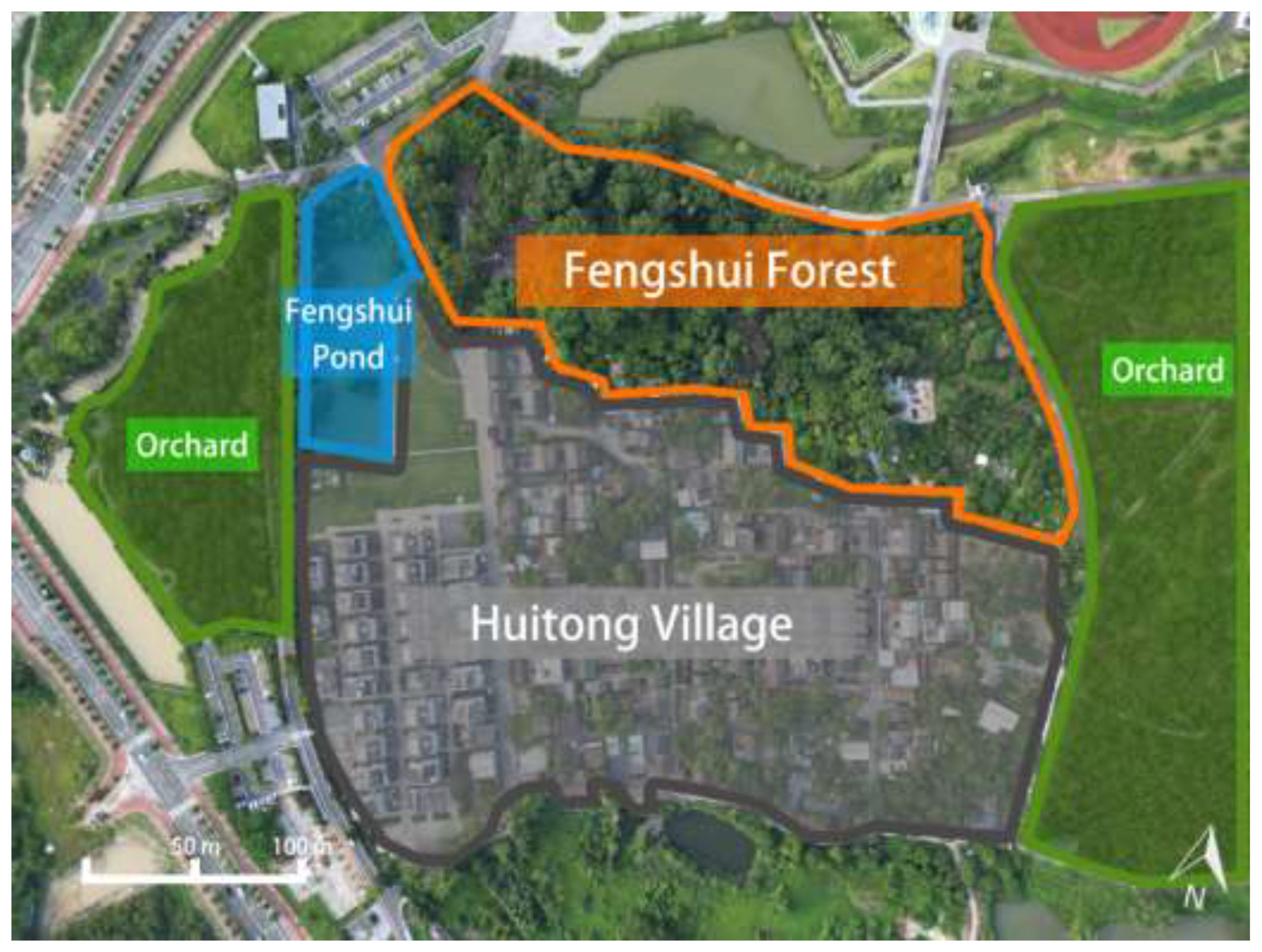
Figure 2.
Flowering seasons and fruiting seasons of recorded plant species in fengshui forests.
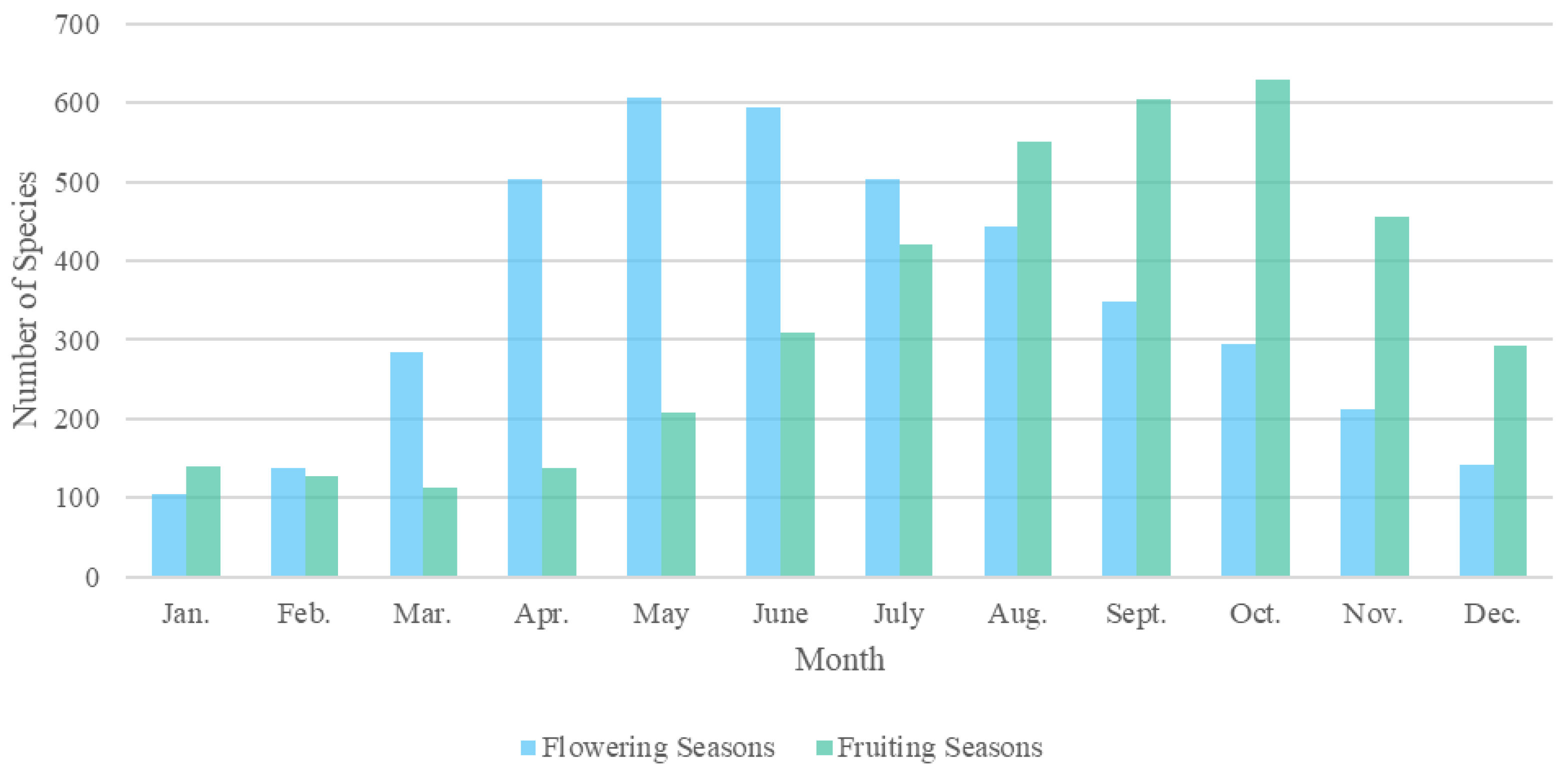

Table 1.
Summary of Biodiversity Studies in Fengshui Forests.
| Indexes | Explanation or Examples | Citations |
|---|---|---|
| Plant diversity |
Comparison of biodiversity indexes (SWI, and SI 1): Fengshui Forest Community in Huizhou: Contains 37 species, which is more diverse than the 31 species found in the nearby golf course and the 2 species in the Masson pine forest. Fengshui Forests in the Pearl River Delta: Analyzed across 32 sites, these forests have a SWI of 4.04 and an SI of 0.90. Their biodiversity is comparable to well-developed evergreen broadleaved forests (SWI: 4.17; SI: 0.90) and greater than that of coniferous-broadleaved mixed forests (SWI: 3.28; SI: 0.86) and coniferous forests (SWI: 3.29; SI: 0.77). Fengshui Forest in Liantang County, Guangzhou: Features 74 species with an SWI of 4.68 and a SI of 0.93, making it significantly more diverse than pure forests, which have only 14 species. |
[35] [28] [36] |
| Birds |
Zhongshan City, China: Fengshui forests host 56.41% of the bird species in Zhongshan, highlighting their significance for forest bird conservation. Zhuhai City, China: In Huitong village, the SWI for the fengshui forest is 1.98, which is greater than that of the lychee orchard, which has an SWI of 1.64. |
[31] Jiang, Zhong and Tsim, personal communication |
| Ants |
Relative Species Richness: All or Native Ant Species: The richness is highest in fengshui forests, followed by secondary forests, and then shrublands. Tramp Ants: The richness is greatest in secondary forests, followed by Shrublands, and lastly fengshui forests. |
[30] |
| Seed bank & Seeding density |
Fengshui Forests as Seed Providers: Frugivorous birds play a crucial role in dispersing seeds from fengshui forests into the surrounding environment. Seedling Density Stability: Fengshui forests maintain a more stable seedling density compared to artificial secondary forests. |
[37] [34] |
| Genetic diversity | Fengshui forests exhibit lower biodiversity compared to natural forests due to smaller populations and human interference, which significantly impacts pollination and seed dispersal behaviors. | [38] |
1 SI: Simpson index; SWI: Shannon-Wiener index.
Table 2.
Summary of Fengshui forest functions in microclimate regulation.
| Functions | Explanation or Examples | Citations |
|---|---|---|
| Temperature regulation |
Provide Shade: Fengshui trees effectively block sunlight, creating a cool, shaded environment. Reduce Solar Radiation: The intensity of sun exposure is lower under fengshui trees compared to areas just beyond their reach, which in turn is less intense than open areas. Specifically, sun exposure intensity is as follows: under fengshui trees < peripheral area of fengshui trees < open areas. |
[8] Xie and Tsim, personal communication |
| Wind regulation |
Typhoon Mitigation: The fengshui forests help mitigate the impact of typhoons and block the cold, dry winds from the north. Reduced Wind Intensity: Wind intensity is reduced by 28.8% to 33.4% due to the forests' direct regulation of wind flow. Sandstorm Protection: The presence of fengshui forests has led to less dust in the villages of Houtian, Nanchang City, effectively blocking sandstorms. |
[8] Rong and Tsim, personal communication [52] |
Table 3.
Summary of Fengshui forest functions in carbon storage.
| Functions | Explanation or Examples | Citations |
|---|---|---|
| Carbon storage |
Comparison of Carbon Storage Capacity: Fengshui Forest in Huizhou: Carbon storage is 137.06 t/hm², which is higher than that of the barren hill at 93.73 t/hm². Fengshui Forests in Guangzhou: Average carbon storage is 259.17 ± 69.67 t/hm², exceeding that of the evergreen broadleaf forest in Dinghushan Nature Reserve (244.998 t/hm²) and the general forest carbon storage in Guangzhou (178.03 t/hm²). This is also higher than the national average for forest carbon storage in China, which is 163.70 t/hm². Economic Value of Carbon Assets: The high carbon storage in fengshui forests represents significant economic value, estimated at up to RMB 186,400/hm². |
[53] [54] [55] |
| Ecological carbon density | Fengshui forests exhibit lower ecosystem carbon density, indicating a greater potential for biomass accumulation over time. | [57] |
Table 4.
Summary of Database of Flora in Fengshui Forests.
| Phylum | Number of species | ||||||||||
|---|---|---|---|---|---|---|---|---|---|---|---|
| Order | Family | Species | Life Form | Protection Degrees | Host Plants | ||||||
| China National Protection Class | IUCN Red List | ||||||||||
| Angiospermae | 45 | 135 | 1110 | Grass Shrub Tree Liana Bamboo |
274 327 417 71 21 |
Class II | 12 | CR EN VU NT |
2 10 25 9 |
- For butterfly - For moths - For beetles and other insects - For other organisms (slugs, mice, etc.) |
157 166 356 15 |
| Pteridophyta | 4 | 17 | 58 | Grass Tree |
57 1 |
Class II | 2 | NT | 1 | - For beetles and other insects - For other organisms (slugs, mice, etc.) |
16 4 |
| Gymnospermae | 7 | 9 | 25 | Shrub Tree Liana |
1 22 2 |
Class I Class II |
5 3 |
CR EN VU NT |
3 3 2 1 |
- For butterfly - For moths - For beetles and other insects - For other organisms (slugs, mice, etc.) |
5 10 20 1 |
| Lycopodiophyta | 2 | 2 | 3 | Grass | 3 | - For beetles and other insects | 1 | ||||
| Sum | 58 | 163 | 1196 | Grass Shrub Tree Liana Bamboo |
334 328 440 73 21 |
Class I Class II |
5 17 |
CR EN VU NT |
5 13 27 11 |
- For butterfly - For moths - For beetles and other insects - For other organisms (slugs, mice, etc.) |
162 176 393 20 |
Table 5.
Summary of plant species with specific values in Database of Flora in Fengshui Forests.
| Values | Number of Plant Species | |
|---|---|---|
Ecological Functions
|
Flowering plants, Fruit plants, Host plants | 1119 |
Conservation Values
|
China National Protected Species; IUCN Red List | 78 |
Economic Values
|
Building material | 127 |
| Product processing | 477 | |
| Edible, food processing | 351 | |
| Other industries | 221 | |
Medicinal materials |
Traditional Chinese medicinal materials | 834 |
| Extraction of medicinal ingredients | 311 | |
| Health food | 43 | |
Landscape & Tourism Values
|
Commercial landscape greening | 528 |
| Eco-tourism | 161 | |
Historical and Cultural Values
|
Historical research | 128 |
| Religious studies | 25 | |
| Folk culture research | 48 | |
Disclaimer/Publisher’s Note: The statements, opinions and data contained in all publications are solely those of the individual author(s) and contributor(s) and not of MDPI and/or the editor(s). MDPI and/or the editor(s) disclaim responsibility for any injury to people or property resulting from any ideas, methods, instructions or products referred to in the content. |
© 2025 by the authors. Licensee MDPI, Basel, Switzerland. This article is an open access article distributed under the terms and conditions of the Creative Commons Attribution (CC BY) license (http://creativecommons.org/licenses/by/4.0/).
Copyright: This open access article is published under a Creative Commons CC BY 4.0 license, which permit the free download, distribution, and reuse, provided that the author and preprint are cited in any reuse.