Preprint
Review

This version is not peer-reviewed.

Multiscale Information Processing in the Immune System

A peer-reviewed article of this preprint also exists.

Submitted:

16 January 2025

Posted:

21 January 2025

You are already at the latest version

Abstract

The immune system is a dynamic network that processes information across multiple biological scales, from molecular recognition of antigens to systemic coordination with the neuroimmune axis and microbiota. At the molecular level, pathways such as NF-κB and JAK-STAT regulate gene expression, integrating signals from pathogens and the organism itself while balancing activation through feedback loops. Cellular and tissue-level dynamics are exemplified by germinal centers, where B-cell hypermutation and clonal selection refine the humoral response, and by immunological synapses that regulate T-cell activation and fate. Systemically, the vagus nerve mediates neuroimmune interactions, while the microbiota co-evolves with the immune system, enhancing its plasticity and robustness. These processes embody antifragility, allowing the immune system to strengthen and expand its capabilities with each challenge. By understanding these multiscale processes, novel strategies emerge for precision medicine, including the modulation of the vagus nerve and microbiota, offering personalized approaches to treat infectious, autoimmune, and chronic diseases.
Keywords: 
;  ;  ;  

1. Introduction

The immune system operates as a complex and dynamic network that integrates information from the molecular level to systemic coordination, continuously adapting to its ecological environment [1,2,3,4]. This ability to integrate signals, adjust them to their context, and generate adaptive responses is at the core of its functionality. However, the immune system does not merely resist disturbances; in many cases, it strengthens and evolves after each challenge, a quality that aligns with the concept of antifragility introduced by Nassim Nicholas Taleb [5]. Antifragility describes the ability of a system to not only survive but also thrive under conditions of uncertainty, stress, or disorder [6,7,8].
From this perspective, the immune system emerges as a model of biological antifragility [7,9]. Processes such as somatic hypermutation in B lymphocytes, clonal selection of T lymphocytes, and the consolidation of immunological memory illustrate how each encounter with a pathogen translates into an opportunity to refine future responses. By operating near a critical state—the point of greatest diversity with an optimal degree of order for information processing—the immune system maximizes its sensitivity to relevant stimuli while minimizing erratic responses to environmental noise. This balance is crucial for detecting minimal threats and amplifying them into effective responses, without compromising the stability of the organism [10,11,12].
Information processing in the immune system is not limited to molecular or cellular signals. It also integrates fundamental properties of information, such as entropy, redundancy, and non-locality [13,14]. Entropy, for example, manifests itself in the clonal diversity of lymphocytes, which maximizes the ability to recognize a wide range of antigens. Redundancy ensures the robustness of responses by allowing multiple pathways or mechanisms to compensate for failures or fluctuations [15]. On the other hand, non-locality allows local signals, such as those emitted at an infection site, to propagate and coordinate global responses through neuroimmune networks and chemokines [16,17].
Furthermore, the immune system is distinguished by its ability to integrate metabolic and epigenetic factors into its functional decisions. Metabolic reprogramming during immune activation not only satisfies immediate energy demands but also modulates the intensity and specialization of responses [18,19,20]. In parallel, epigenetic modifications act as "informational marks" that preserve the memory of previous encounters and recalibrate future responses, optimizing the plasticity and resilience of the system [21,22].
This article provides an integrated review of the principles of multiscale processing of immunological information, the properties that underpin its antifragility, and the key mechanisms that position it as a unique adaptive system. It also explores the clinical implications of these findings in the design of vaccines, immunotherapies, and personalized intervention strategies in infectious, autoimmune, and chronic diseases. Finally, it discusses future directions involving the development of computational models and the incorporation of systems biology tools to unravel the complexity and antifragile potential of the immune system.

2. Multiscale Processing of Immunological Information

The immune response is orchestrated through a complex integration of signals, processes, and feedback loops that operate at different levels of organization, from the molecular detection of antigens to systemic coordination. This section explores how each scale contributes to shaping a network of interactions critical for the antifragility of the immune system.

2.1. Molecular Scale

At the most fundamental level addressed here, immune cells possess pattern recognition receptors (PRRs) and antigen-specific receptors (BCR and TCR), responsible for discriminating signals from pathogens or the organism itself [23,24,25,26]. Their activation promotes structural changes that trigger signaling cascades (NF-κB, MAPK, JAK-STAT, etc.) [27,28,29,30] that regulate various biological processes such as metabolism and gene expression. For example, TCR activation promotes a metabolic shift towards aerobic glycolysis, increasing energy availability to sustain cell proliferation and cytokine production. In parallel, genes encoding key effector molecules are activated, adapting the response to the type and magnitude of the threat. However, immune cells do not respond to a single signal, but rather integrate information from costimulatory, inhibitory, and pattern recognition receptors (Figure 2). This integration ensures that responses are proportional to the context and prevents aberrant activations, as in cases of autoimmunity [31,32,33,34].
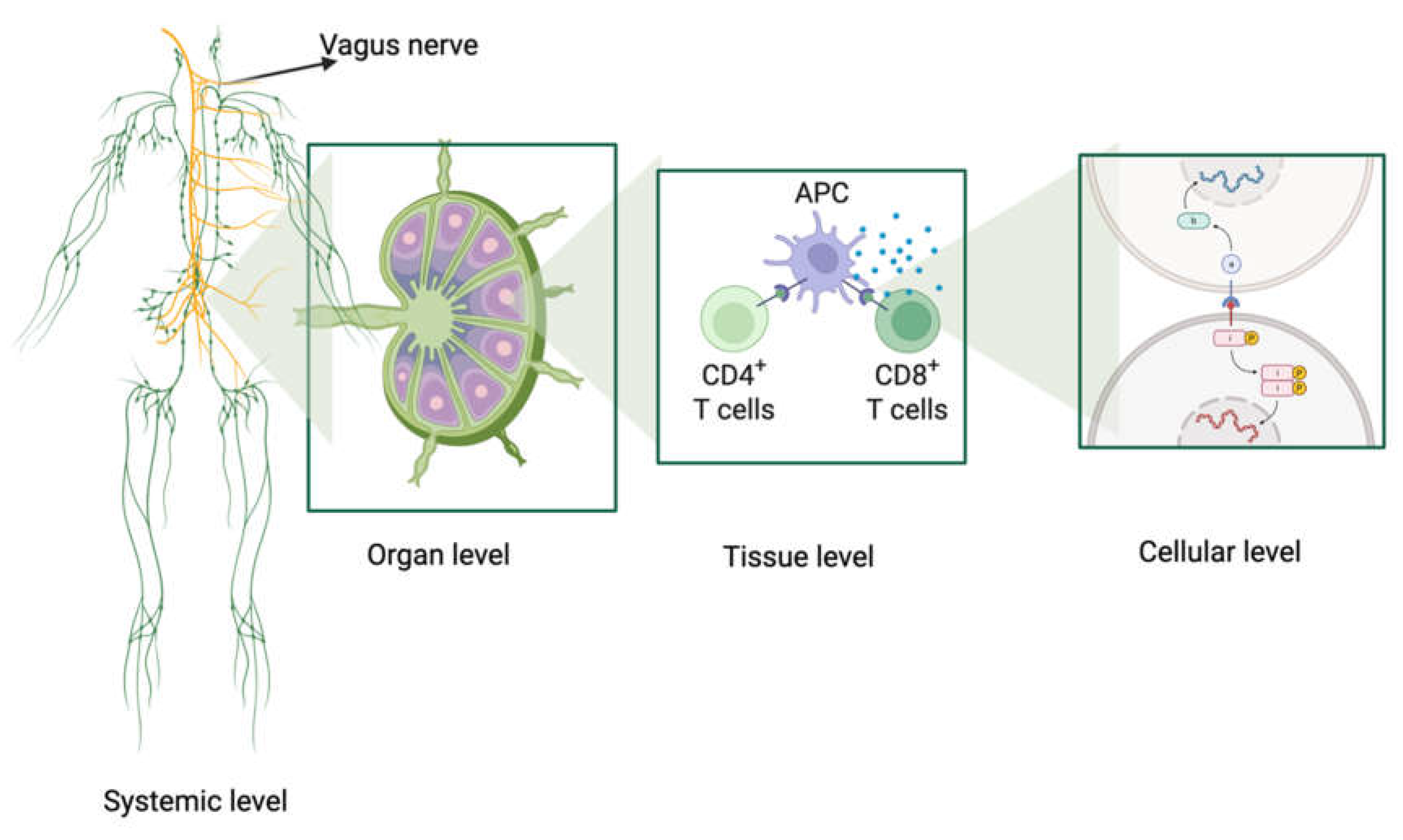
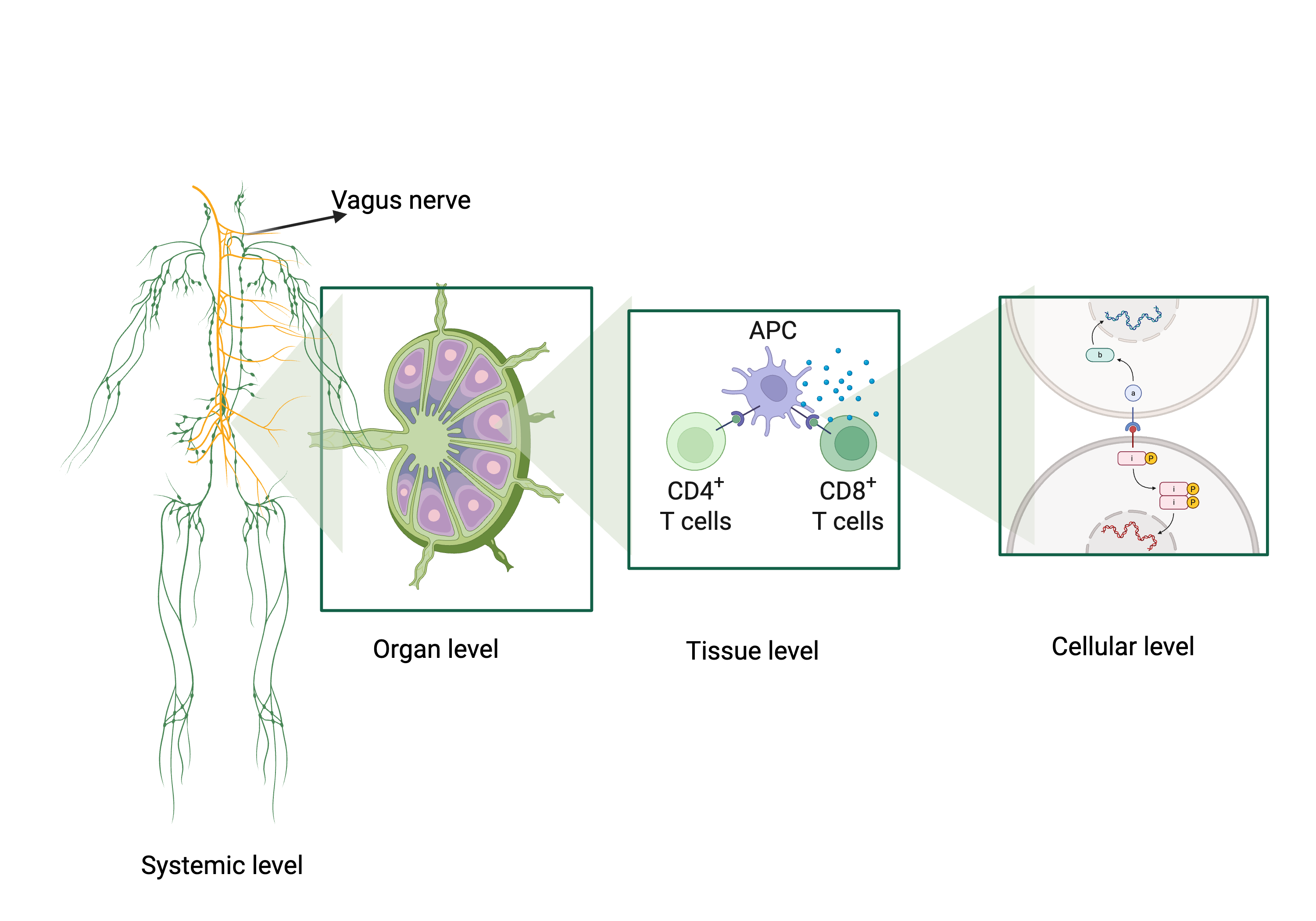
Figure 1. Graphical abstract illustrating the multiscale organization and information processing of the immune system. The figure highlights four interconnected levels: 1) Systemic Level: integration of the vagus nerve, showcasing the neuroimmune axis and its role in modulating immune responses; 2) Organ Level: representation of the lymph node structure as a hub for antigen processing, immune cell interaction, and coordination; 3) Tissue Level: detailed view of antigen-presenting cells (APCs) interacting with CD4+ and CD8+ T cells, emphasizing the role of cytokine signaling in cellular activation; 4) Cellular Level: intracellular processes including antigen recognition, signal transduction pathways (e.g., NF-κB, JAK-STAT), and gene expression. Created using BioRender, this figure encapsulates the dynamic, hierarchical organization of immune processes, linking systemic coordination to molecular specificity. Created in https://BioRender.com.
Preprints 146314 g001
Positive and Negative Feedback
Feedback is a process in which the output of a system is used as input to modify or control the same system. In simple terms, it is the information that a system receives about its own performance or state, which it then uses to adjust and improve [35,36]. Positive feedback is a key mechanism that amplifies initial activation signals, ensuring a rapid and robust response to significant threats. A characteristic example is the overexpression of costimulatory molecules, such as CD80 and CD86, on antigen-presenting cells. These molecules interact with receptors such as CD28 on T lymphocytes, intensifying cellular activation, proliferation, and the production of pro-inflammatory cytokines such as IL-2 and TNF-α [37,38,39].
Activation of pathways such as NF-κB and MAPK generates positive feedback loops by inducing the expression of genes that encode more receptors or inflammatory mediators [40,41,42,43]. This amplifying effect is crucial during the initial phase of an immune response when the body needs to rapidly recruit a sufficient number of effector cells to contain infection or tissue damage [44,45,46].
Intracellular signaling cascades are also subject to control by negative feedback mechanisms that adjust their intensity and duration. In the JAK-STAT pathways, for example, SOCS (Suppressor of Cytokine Signaling) proteins are induced in response to pro-inflammatory cytokine signals. These proteins act by directly blocking cytokine receptors or inhibiting the enzymatic activities of JAK kinases, short-circuiting signal transmission and dampening the response [47,48,49,50]. Another example occurs in the NF-κB pathway, where the IκB protein acts as a key regulator. Following NF-κB activation and target gene transcription, IκB expression is induced. IκB re-enters the cytoplasm, binds to NF-κB, and sequesters it, inhibiting its nuclear activity and restoring a basal state in the cell [51,52,53].
In addition, soluble molecules such as anti-inflammatory cytokines (IL-10 and TGF-β) act as critical mediators by binding to their specific receptors on immune cells, triggering signaling pathways that repress the activation of pro-inflammatory transcription factors, such as NF-κB [54,55,56].
The effectiveness of negative feedback at the molecular level is not uniform but depends on the context and intensity of the stimuli received. For example, in an environment with a high density of antigens or damage signals, negative feedback may be delayed or adjusted to allow for a more prolonged response. However, when stimuli decrease, inhibitory pathways are rapidly activated, promoting the resolution of the immune response. [57,58]
This plasticity in molecular interactions and signaling cascades ensures that immune cells maintain a dynamic balance between activation and inhibition. In this way, the immune system not only responds efficiently to threats but also preserves the integrity of healthy tissue and prevents imbalances such as those observed in autoimmune or inflammatory diseases.
Information Encoding: Molecular Integration and Spatiotemporal Dynamics
Information encoding is the process of converting information from one form to another, usually using a set of rules or a code [59]. This conversion aims to facilitate the storage, transmission, or processing of information [60]. In the immune system, information encoding is based on the ability of cells to translate external signals into specific intracellular responses through an integrated set of molecular processes. These signals must not only be perceived with high fidelity but also integrated into a spatiotemporal framework that optimizes the response based on the biological context [61,62].
Information integration also depends on specific post-translational modifications, such as phosphorylation, ubiquitination, and acetylation of key proteins. These modifications allow signals to be amplified, diversified, or restricted as needed. For example, ubiquitination of components in the NF-κB pathway, such as IKKγ (NEMO), not only activates this pathway but also determines its duration and specificity. Similarly, phosphorylation of STATs in the JAK-STAT pathway modulates the activation of genes related to inflammation and immune regulation [63,64,65,66].
Adding to this complexity, immune proteins like PKR act as critical nodes in adaptive networks capable of processing and discriminating signals even in noisy environments. PKR's ability to distinguish between a viral decoy, such as K3, and a legitimate activator highlights the system's robustness and specificity. This process can be modeled as a decoding problem, where signal fidelity and the integration of multiple stimuli determine the outcome. This approach underscores the importance of coding and decoding patterns in optimizing immune responses at the molecular level [67].
Spatiotemporal Dynamics: Precision in the Response
The precision and timing of immune responses critically depend on a dynamic integration of spatial and temporal dimensions, as signal processing in the immune system is not static but highly adaptable. Both the location (space) and the time at which molecular events occur play a key role in defining the magnitude and specificity of the immune response [68,69]. For example, the subcellular localization of factors such as NF-κB or STAT3 directly influences their functionality. The nuclear translocation of NF-κB, triggered by pathogenic stimuli, occurs in temporal pulses, a mechanism that ensures sustained but carefully regulated activation of target genes, minimizing the risk of excessive responses or collateral damage.
From a spatiotemporal perspective, the structural and organizational properties of the plasma membrane play a crucial role [70,71,72]. The formation of lipid microdomains, such as lipid rafts, creates specialized platforms that facilitate the colocalization of receptors, adaptor molecules, and other signaling components. These microdomains not only improve the efficiency of signal transmission but also act as dynamic hubs that allow for the precise modulation of molecular interactions in real time. This spatiotemporal organization ensures that signals are amplified, integrated, or attenuated according to the specific needs of the biological environment, guaranteeing an effective and adaptive immune response while simultaneously preserving tissue homeostasis [73,74].

2.2. Cellular and Tissue Scale

The cellular and tissue level of the immune system is a fascinating example of how biological systems integrate signals, interaction, and adaptation. This level not only functions as a bridge between molecular and systemic responses but also reveals emergent properties that reinforce the adaptability, robustness, and antifragility of the system in the face of external challenges. The synergy between cells and microenvironments generates dynamic networks that give the immune system the ability to thrive in conditions of uncertainty [75,76,77].
Specialized Microenvironments: Centers of Learning and Humoral Robustness
Germinal centers, strategically located in the lymph nodes and spleen, are dynamic and highly organized environments that represent true centers of immunological learning [78,79]. In these structures, B lymphocytes undergo somatic hypermutation and clonal selection, generating antibodies that are increasingly fine-tuned against the present antigens. However, the role of germinal centers goes far beyond being simple sites of immunological activation: they function as true evolutionary factories where the interaction between cells and contextual signals drives the continuous optimization of the humoral response [80,81,82].
In the process of somatic hypermutation, B lymphocytes introduce point mutations in the genes that encode the variable region of antibodies, generating a wide clonal diversity. This phenomenon, mediated by the enzyme AID (activation-induced cytidine deaminase), is a unique example of accelerated evolution in real-time within the immune system. The generated diversity not only allows the identification of previously unknown antigens but also guarantees an effective response against pathogens that have mutated to evade immunological recognition. The ability of the system to dynamically evolve and adapt embodies an essential principle of antifragility: each challenge strengthens the system instead of weakening it [83,84,85,86].
After hypermutation, B lymphocytes compete within the germinal center microenvironment for survival signals. Follicular dendritic cells, by presenting antigens in the form of stable immune complexes, act as guides that allow the identification of clones with the highest affinity. Only those B lymphocytes that manage to interact effectively with follicular T lymphocytes, through key signals such as the CD40-CD40L interaction and stimulation by cytokines (IL-21 and IL-4), survive and differentiate. This selective process not only ensures the quality of the antibodies produced but also eliminates suboptimal clones, thus strengthening the overall efficacy of the humoral response [87,88,89,90].
Contextual signals within germinal centers are equally fundamental. Cytokines such as IL-4 and IL-21, produced by follicular T lymphocytes, regulate both the proliferation and specialization of B lymphocytes, influencing the class of antibody generated. These signals, combined with CD40-mediated interactions, constantly calibrate the balance between activation, survival, and memory, allowing the system to adjust its response precisely according to the body's needs [91,92].
Furthermore, germinal centers not only perfect the immediate response but also ensure a solid long-term immunological memory. The selected B lymphocytes can differentiate into antibody-producing plasma cells or memory cells, both essential to guarantee rapid and robust responses to future encounters with the same pathogen. This iterative process of mutation, selection, and differentiation turns germinal centers into true centers of adaptive learning, where each interaction contributes to the improvement of the immune system.
Immunological Synapses and Cellular Decisions: Non-linear Networks to Maximize Information
In the context of immunological synapses and cellular decisions, these platforms represent a key point of convergence where molecular biology, physics, and network theory intertwine to enable high-precision cell communication processes. Beyond being simple interfaces of physical contact between dendritic cells and T lymphocytes, immunological synapses are scenarios where chemical, mechanical, and biophysical signals are integrated to guide critical cellular decisions. This process is characterized by extreme sensitivity and an information processing capacity that not only determines cell fate—activation, anergy, or death—but also ensures that these decisions are made with minimal error, which is essential in a system that faces constant pathogenic challenges [93,94,95].
The amplification of signals received by T lymphocytes is mediated by non-linear dynamics, such as synergy in receptor activation, which allow small variations in the initial signals to trigger disproportionately large responses. This type of behavior is typical of complex systems operating in a regime close to criticality. This suggests that evolution has favored a biological design optimized to balance sensitivity and robustness, allowing the immune system to not only detect incipient threats but also process multiple signals efficiently [96,97,98,99,100].
Beyond the direct contact that defines immunological synapses, immune cells interact through an extended communication network that includes indirect mechanisms. Autocrine and paracrine signaling, for example, allows cells to not only regulate their own activity but also influence that of their neighbors by releasing molecules such as cytokines, which establish gradients that guide cell migration and activation. Likewise, extracellular vesicles, such as exosomes, act as specialized vehicles that transport proteins, lipids, and nucleic acids, facilitating the transfer of complex molecular information between distant cells. This mechanism not only ensures functional synchronization between different tissue compartments but also reinforces the ability of the immune system to operate in an integrated and coordinated manner [101,102,103,104].
Another critical component of this extended network is field effects or quorum sensing phenomena. In these processes, the accumulation of signaling molecules in the microenvironment generates collective responses that alter the individual behavior of cells, promoting patterns of synchronized action. This type of collective interaction is essential for processes such as the formation of immune microdomains in tissues and the regulation of inflammatory or tolerogenic responses [105,106,107]. This level of organization, both molecular and systemic, underscores the sophistication of the immune system as a non-linear network that maximizes information transfer to ensure survival [108,109,110,111].
Complementarily, the mitochondrial redistribution toward the immunological synapse can be viewed as a manifestation of evolutionary optimization processes in complex systems, where physical proximity to key points of cellular interaction not only enhances metabolic efficiency but also maximizes the precision of signal transmission. This phenomenon, occurring within a framework of positive feedback between Ca²⁺ uptake and the activation of intracellular signaling pathways, highlights the role of mitochondria not only as energy generators but also as dynamic integrators of biochemical and biophysical signals. Such integration, mediated by the system's emergent properties, ensures that cellular decisions are made robustly and in a coordinated manner, minimizing errors that could result in dysfunctional immune responses, such as inappropriate tolerance or hyperinflammation. Thus, the interplay between molecular biology, physics, and network theory in this context allows for a reinterpretation of mitochondria as critical nodes in a nonlinear cellular network optimized for the organism's survival and adaptability [112].
Emergent Properties at the Tissue Level: Self-Organizing Networks
Emergent properties at the tissue level in the immune system are a manifestation of the complex interaction between immune cells, soluble molecules, and surface signals, resulting in organized patterns that regulate both local and systemic dynamics. These self-organizing networks reflect the ability of the immune system to coordinate multiple cellular and molecular processes without relying exclusively on centralized supervision, taking advantage of physical and biological principles that maximize efficiency and minimize redundancies [113,114,115].
A example of these emergent properties is the formation of granulomas in chronic infections, such as those caused by Mycobacterium tuberculosis. In this context, immune cells such as macrophages, T lymphocytes, and dendritic cells converge in a specific microenvironment, where gradients of chemokines such as CXCL13 and CCL19 play a critical role in structural organization. These gradients act as chemical guides that direct the migration and positioning of cells, facilitating the containment of the pathogen within a central core surrounded by a protective ring of activated immune cells. This process not only reflects self-organization but also the ability of the immune system to create functional microenvironments adapted to the specific needs of the immune response [116,117,118].
Another prominent example is the development of fibrosis in tissues subjected to chronic inflammation or persistent damage. Here, the dynamic interaction between activated fibroblasts, macrophages, and lymphocytes regulates the deposition of extracellular matrix, promoting the structural repair of the tissue. However, this process can overflow, leading to an excessive accumulation of collagen and other matrix components, resulting in a loss of tissue functionality. This delicate balance between regeneration and pathology is an emergent characteristic of self-organizing networks acting at the tissue level [119,120,121,122].
The self-organization of these tissue networks is based on the ability of the immune system to establish dynamic gradients of signaling molecules, such as cytokines and chemokines, which regulate cell activation and migration in a spatiotemporal manner. This process ensures that cellular and molecular resources are concentrated in areas where they are most needed, thus optimizing the efficiency of the immune response. In addition, these networks exhibit fault tolerance properties, allowing the system to maintain its functionality even when some of its individual components are damaged or compromised. This robustness against perturbations guarantees the stability of the immune system in a dynamic and constantly changing environment [123,124,125].
From an evolutionary perspective, self-organizing networks at the tissue level represent a highly adaptive strategy, as they allow for a rapid and localized immune response without relying exclusively on centralized control. This not only minimizes metabolic costs but also ensures that the system can respond effectively to a wide variety of stimuli and challenges [126,127,128].
Temporal Dimension: Memory and Adaptive Plasticity
The temporal dimension of the immune system is a fundamental characteristic that reflects its capacity for adaptation through immunological memory and adaptive plasticity. These properties not only allow the system to remember and respond more efficiently to future challenges but also highlight its antifragility: a phenomenon by which stress, in appropriate doses, not only strengthens the system but prepares it to face even more adverse conditions. This principle can be understood through hormesis, where controlled exposures to stressors, such as vaccines or mild infections, act as an "optimal dose" that induces adaptive benefits. However, excessive stress or extremely virulent pathogens can overcome the system's adaptive capacity, generating damage or disease, which underlines the importance of carefully regulating this dynamic [129,130,131].
In the context of immunological memory, traditionally attributed to the adaptive system, memory T and B lymphocytes have proven to be fundamental for generating rapid and specific responses after a second exposure to the same pathogen. More recently, a "trained memory" has been recognized in the innate immune system, mediated by epigenetic changes such as DNA methylation and histone modifications [132,133,134]. These changes do not alter the genetic sequence, but they do reconfigure gene expression in cells such as macrophages and NK cells, providing a more robust and efficient response to future stimuli. This discovery not only expands our understanding of the immune system but also reveals a dynamic interaction between innate and adaptive memory, where the former can modulate and enhance the quality of the latter's responses [135,136,137,138].
Furthermore, immunological plasticity, defined as the system's ability to adjust in response to changing stimuli, is essential for its antifragility, although not sufficient on its own. It is in this interaction, where plasticity allows for change and antifragility ensures that stress results in functional improvements, that the immune system behaves as a complex adaptive system, exhibiting emergent properties that cannot be predicted solely from the study of its individual components. However, these properties have a dark side: both memory and plasticity can contribute to pathological states, such as "original antigenic sin," chronic inflammation, or autoimmunity, where the immune response is diverted towards inappropriate targets or exacerbated in an uncontrolled manner. This duality highlights the need to understand and carefully manage the temporal dimension of the immune system, not only to prevent dysfunctions but also to design innovative therapeutic interventions. From strategies that leverage trained memory to fight infections and tumors, to approaches that reprogram memory in autoimmune diseases, the possibilities are vast [139,140,141,142].
Connections with Network Theory: A Systemic Approach
Network theory provides a powerful conceptual framework for analyzing the emergent properties of this network, such as robustness, adaptability, and efficient coordination of immune responses. A key aspect of this network is the presence of hubs or concentrators, such as dendritic cells, which act as highly connected nodes essential for signal integration and coordination of immune responses. These hubs have the ability to gather information from various sources, such as antigens, damage signals, and chemokines, to activate T and B lymphocytes, thus ensuring a specific and effective response. Dysfunction or loss of these hubs can destabilize the network, underscoring their importance in maintaining the robustness of the system [143,144,145].
Another relevant principle is modularity, which describes the organization of the immune system into specialized functional subnetworks, such as germinal centers in secondary lymphoid organs or specific regions of inflammation in peripheral tissues. These subnetworks operate semi-independently, allowing for localized and precise responses to external stimuli without compromising the overall stability of the system. At the same time, connections between modules ensure signal integration to coordinate systemic responses when necessary. This modularity not only increases functional efficiency but also reinforces the resilience of the immune system by containing local disturbances and preventing their uncontrolled spread [146,147,148,149].
Finally, the immune system exhibits a small-world topology, characterized by short and efficient paths between nodes, allowing for rapid signal propagation and facilitating coordinated responses at the systemic level. This attribute is particularly critical during systemic infections or acute inflammation, where the rapid and efficient interaction between cytokines and chemokines connects specialized cells in peripheral tissues with lymphocytes in lymphoid organs. The redundancy of these connections also contributes to the robustness of the network, guaranteeing its functionality even in the face of random failures of some nodes [150,151,152].

2.3. Systemic and Neuroimmune Scale: A Dynamic, Adaptive Network with Deep Computational Processing

At this systemic scale, the immune system also emerges as a vastly complex distributed network that integrates and processes information from both organs and tissues, as well as neural circuits. Each interaction—whether between cells, metabolites, or neurotransmitters—acts as a "computational microprocess" capable of reconfiguring the immune response in real-time. This biological intelligence is sustained by a key principle called computational irreducibility, which indicates that it is not enough to reduce the system to simple equations or predictive "shortcuts": to know the total behavior (for example, when an inflammatory response ends or how it resolves) it is necessary to simulate or go through step-by-step the multiple interactions that occur in the network [153,154,155].
Within this framework, neuroimmunology takes on a preponderant role. The brainstem—traditionally considered the center of vital functions such as breathing and heart rate—is now revealed as a "volume controller" of inflammation throughout the body. Recent studies, driven by research on homeostasis and taste circuits, indicate that specific groups of neurons in the brainstem can detect and readjust inflammatory signals through the vagus nerve [156]. Instead of a simple back-and-forth between the brain and the immune system, this axis integrates circadian rhythms, stress, metabolic demands, and other external factors, ensuring homeostatic feedback that balances the elimination of pathogens without compromising the health of healthy tissues [157,158,159].
A second axis of "computation" is provided by the microbiome. Intestinal bacteria and their metabolites (e.g., short-chain fatty acids) regulate the differentiation of T lymphocytes, activating or attenuating their inflammatory profile as needed. But the microbiota is not just a passive sensor: it evolves and co-designs strategies with the immune system, expanding its range of adaptive responses to changing environments. Its plasticity, coupled with dense humoral and neural communication (cytokines, chemokines, vagal pathways, etc.), provides the immune system with outstanding antifragility, that is, the ability to strengthen in the face of disturbances rather than just resist them [160,161,162,163].
Viewing the immune system as a complex and computationally distributed network offers new clinical perspectives. From interventions on the vagus nerve—capable of modulating inflammatory states in autoimmune, metabolic, or neurodegenerative diseases—to the targeted manipulation of the microbiota to fine-tune immunological tolerance, precision medicine ceases to be merely "suppressive" and advances towards the intelligent "reprogramming" of immunity. At the same time, the notion of computational irreducibility—also studied in models of biological evolution—warns that simple natural selection alone does not explain the emergent complexity of the system; the latter displays such great internal computing power that, without fully simulating it, it is impossible to predict exactly how the immune response will evolve in a specific scenario [164,165,166].
Ultimately, the brain, microbiome, and immune network form a high-performance integrating loop in which each cell, molecule, and neuron acts as a modifiable bit of information. This renewed vision positions the immune system not only as a defensive shield but as an evolutionary and computational engine that, in permanent dialogue with the environment, produces transcendental biological innovations. In this broad landscape, the brainstem, vagal pathways, and other central "controllers" constitute neural nodes of enormous influence, placing neuroimmunology at the core of modern medicine and redefining our scope for manipulating and optimizing the very evolution of human health [167,168,169,170].
Multiscale Integration of the Immune System and its Emergent Properties: Lung Cancer as a Case Study
Lung cancer is an archetypal example of how the emergent properties of the immune network can, in turn, be reconfigured by a complex pathology [171,172]. In this context, the tumor microenvironment stands as a co-evolutionary ecosystem that "disrupts" the defensive functions of the immune system and takes advantage of its plasticity. Tumor cells produce pro-inflammatory cytokines (IL-6, IL-10) and growth factors (TGF-β, VEGF) that transform the activity of macrophages (TAMs) and fibroblasts, promote angiogenesis, and stimulate extracellular matrix remodeling, creating a niche favorable for invasion and metastasis. In addition, the induction of hypoxia and the local release of adenosine allow for the inhibition of key functions of cytotoxic T lymphocytes and NK cells, facilitating tumor evasion [173,174,175].
Metabolic reprogramming is essential: tumor cells prioritize pathways such as aerobic glycolysis (Warburg effect) and intensive glutamine consumption, affecting nutrient availability for immune cells. This energy "monopoly," coupled with soluble factors and hypoxia, generates an immunosuppressive environment where dendritic cells have their maturation blocked and often fail to effectively activate T lymphocytes. This creates closed circuits of negative feedback in which chronic inflammation collaborates with tumor progression instead of stopping it [176,177,178,179,180].
The evolutionary dimension of lung cancer reflects the constant selective pressure exerted by both the metabolic environment and the immune response. Tumor subclones with mutations that facilitate evasion of surveillance (overexpression of PD-L1, loss of tumor antigens, secretion of anti-inflammatory cytokines) thrive in such a changing ecosystem, promoting intratumoral heterogeneity and resistance to therapies. The epithelial-mesenchymal transition (EMT) further expands the plasticity of cancer cells, reinforcing their invasive capacity and tolerance to hostile conditions [181,182,183,184].
To address this complexity, both in health and disease, it is imperative to integrate mathematical and computational models that replicate multiscale dynamics. From cellular automata that simulate tumor progression and interaction with immune populations to complex network theory that identifies critical nodes ("hubs") where information transmission is concentrated. These approaches, nurtured by the massive collection of omics data (genomics, transcriptomics, metabolomics), allow for a more accurate approach to precision medicine. Bioinformatic analysis and experimental validation in vitro or in vivo close the feedback loop, facilitating the continuous generation of hypotheses and the refinement of therapeutic interventions.
Therefore, the flow and processing of information within immune circuits and the tumor microenvironment emerges as the true "guiding thread" of this complex multiscale dynamic. Every cell-to-cell interaction, every signal released into the environment, and every metabolic modification not only transmits data but also transforms it, generating new functional states and feedback loops that enhance—or block—immune responses. From the detection of molecular patterns by specific receptors, to the systemic orchestration of adaptive cellular populations and the modification of intracellular signaling pathways, information processing becomes the key axis that unifies the evolutionary aspect of cancer with the emergent properties of immunity. This approach, reinforced by mathematical models and computational simulations that replicate the dynamic nature of cellular communication, paves the way for therapeutic interventions designed to strategically interrupt or redirect these interaction networks; not merely targeting tumor cells, but reconfiguring the informational flows that sustain the disease’s plasticity and resistance.
Conclusions
The immune system stands out as a multifaceted and antifragile network capable of not only resisting disturbances but also learning and strengthening with each experience. Far from being a mere defense mechanism, it acts as a biological engine of innovation whose functional boundaries expand with each challenge. Throughout these pages, the critical role of information processing at multiple scales—molecular, cellular, tissue, and systemic—has been highlighted as the foundation of its extraordinary adaptability and capacity for continuous evolution.
In the molecular dimension, receptors and signaling pathways operate as high-fidelity "biological microprocessors," whose balance between positive and negative feedback allows the system to operate near a critical regime. This "borderline" point maximizes sensitivity to relevant stimuli and enhances the ability to modulate the intensity and duration of the response, minimizing noise that could trigger self-destructive reactions.
Innovation is most clearly manifested at the cellular and tissue scale. Germinal centers emerge as genuine miniature evolutionary laboratories, where somatic hypermutation and clonal selection generate increasingly fine-tuned antibodies. Immunological synapses, on the other hand, illustrate how the convergence between network theory, biophysics, and molecular biology ensures high-precision cellular decisions in environments of high uncertainty. These processes constitute a complex mechanism whose final product is efficiency and systemic robustness.
At the systemic scale, interconnection with the nervous system and the microbiome enhances the plasticity and resilience of the immune system. Neuroimmunological regulation, mediated in part by the vagus nerve, adjusts inflammatory processes in real-time, while the gut microbiota functions as a co-evolutionary ally that co-designs strategies for recognition, tolerance, and immunological memory. This constant interaction underscores the distributed nature of immune processing, analogous to a biological intelligence in permanent reinvention.
The systemic vision rooted in network theory reveals highly connected hubs and modules—for example, dendritic cells or germinal centers—that orchestrate efficient responses even in highly complex scenarios. The "small-world" topology that characterizes these networks reinforces signal transmission and global coordination, inspiring clinical and engineering applications ranging from immunotherapy to the design of robust networks in other scientific and technological fields. The clinical and technological applications that are envisioned have the potential to mark a turning point in the conception and management of human health, with implications ranging from personalized medicine to the design of new architectures in artificial intelligence and complex networks.

Author Contributions

E.N.Q. conceptualized the study, developed the theoretical framework, and supervised the preparation of the manuscript. R.N.Q. contributed to structuring and drafting the manuscript, ensuring a clear presentation of the key concepts. J.V.C. critically reviewed and analyzed the content, enhancing its scientific rigor. E.Z.P. organized and synthesized relevant scientific literature, providing substantial support to the theoretical development. Y.B.L. designed and created illustrative materials, facilitating the visualization of complex ideas. L.G.E. performed bioinformatics analysis, applied statistical models, and significantly refined the manuscript's narrative. C.F.P. conducted an extensive review of the most recent advancements in the field and contributed to the final editorial adjustments. All authors collaborated to ensure the manuscript's quality as a comprehensive and insightful review article.

Acknowledgments

The authors express their gratitude to the Universidad Simón Bolívar in Barranquilla, Colombia, for its support in facilitating this research. Special thanks are extended to the Asociación Colombiana de Inmunología for fostering a collaborative environment and advancing immunological science in Colombia.

Conflicts of Interest

The authors declare that they have no competing interests.

References

  1. Shilts J, Severin Y, Galaway F, et al.: A physical wiring diagram for the human immune system. Nature 608: 397–404, 2022. [CrossRef]
  2. Bausch-Fluck D, Goldmann U, Müller S, van Oostrum M, Müller M, Schubert OT and Wollscheid B: The in silico human surfaceome. Proceedings of the National Academy of Sciences 115: E10988–E10997, 2018.
  3. Subramanian N, Torabi-Parizi P, Gottschalk RA, Germain RN and Dutta B: Network representations of immune system complexity. WIREs Systems Biology and Medicine 7: 13–38, 2015. [CrossRef]
  4. Richter PH: A network theory of the immune system. European Journal of Immunology 5: 350–354, 1975. [CrossRef]
  5. Taleb NN: Antifragile: Things That Gain from Disorder. New York, 2014.
  6. Axenie C, López-Corona O, Makridis MA, Akbarzadeh M, Saveriano M, Stancu A and West J: Antifragility as a complex system’s response to perturbations, volatility, and time. ArXiv: arXiv:2312.13991v1, 2023.
  7. Olivieri F, Prattichizzo F, Lattanzio F, Bonfigli AR and Spazzafumo L: Antifragility and antiinflammaging: Can they play a role for a healthy longevity? Ageing Research Reviews 84: 101836, 2023. [CrossRef]
  8. Jaffe Y, Caramanica A and Price MD: Towards an antifragility framework in past human–environment dynamics. Humanit Soc Sci Commun 10: 1–12, 2023.
  9. Axenie C, López-Corona O, Makridis MA, Akbarzadeh M, Saveriano M, Stancu A and West J: Antifragility in complex dynamical systems. npj Complex 1: 1–8, 2024.
  10. Optimal biochemical information processing at criticality | bioRxiv.
  11. Habibollahi F, Kagan BJ, Burkitt AN and French C: Critical dynamics arise during structured information presentation within embodied in vitro neuronal networks. Nat Commun 14: 5287, 2023. [CrossRef]
  12. Manicka S, Marques-Pita M and Rocha LM: Effective connectivity determines the critical dynamics of biochemical networks. Journal of The Royal Society Interface 19: 20210659, 2022.
  13. O’Donnell TJ, Kanduri C, Isacchini G, et al.: Reading the repertoire: Progress in adaptive immune receptor analysis using machine learning. cels 15: 1168–1189, 2024. [CrossRef]
  14. Klemm K and Bornholdt S: Topology of biological networks and reliability of information processing. Proceedings of the National Academy of Sciences 102: 18414–18419, 2005.
  15. Leydesdorff L: Redundancy in Systems Which Entertain a Model of Themselves: Interaction Information and the Self-Organization of Anticipation. Entropy 12: 63–79, 2010.
  16. Zipp F, Bittner S and Schafer DP: Cytokines as emerging regulators of central nervous system synapses. Immunity 56: 914–925, 2023.
  17. Becher B, Derfuss T and Liblau R: Targeting cytokine networks in neuroinflammatory diseases. Nat Rev Drug Discov 23: 862–879, 2024.
  18. Britt EC, John SV, Locasale JW and Fan J: Metabolic regulation of epigenetic remodeling in immune cells. Curr Opin Biotechnol 63: 111–117, 2020. [CrossRef]
  19. Reid MA, Dai Z and Locasale JW: The impact of cellular metabolism on chromatin dynamics and epigenetics. Nat Cell Biol 19: 1298–1306, 2017. [CrossRef]
  20. Flavahan WA, Gaskell E and Bernstein BE: Epigenetic plasticity and the hallmarks of cancer. Science 357: eaal2380, 2017.
  21. Sheedy FJ and Kaufmann E: Linking metabolic and epigenetic changes in immune tolerance. Proc Natl Acad Sci U S A 121: e2419751121, 2024.
  22. Abhimanyu null, Longlax SC, Nishiguchi T, et al.: TCA metabolism regulates DNA hypermethylation in LPS and Mycobacterium tuberculosis-induced immune tolerance. Proc Natl Acad Sci U S A 121: e2404841121, 2024. [CrossRef]
  23. Bláha J, Skálová T, Kalousková B, et al.: Structure of the human NK cell NKR-P1:LLT1 receptor:ligand complex reveals clustering in the immune synapse. Nat Commun 13: 5022, 2022. [CrossRef]
  24. Fitzgerald KA and Kagan JC: Toll-like Receptors and the Control of Immunity. Cell 180: 1044–1066, 2020.
  25. Shah K, Al-Haidari A, Sun J and Kazi JU: T cell receptor (TCR) signaling in health and disease. Signal Transduct Target Ther 6: 412, 2021.
  26. Wilfahrt D and Delgoffe GM: Metabolic waypoints during T cell differentiation. Nat Immunol 25: 206–217, 2024.
  27. Liu X, Berry CT, Ruthel G, et al.: T Cell Receptor-induced Nuclear Factor κB (NF-κB) Signaling and Transcriptional Activation Are Regulated by STIM1- and Orai1-mediated Calcium Entry. J Biol Chem 291: 8440–8452, 2016. [CrossRef]
  28. Schulze-Luehrmann J and Ghosh S: Antigen-receptor signaling to nuclear factor kappa B. Immunity 25: 701–715, 2006.
  29. Klinger B, Rausch I, Sieber A, et al.: Quantitative modeling of signaling in aggressive B cell lymphoma unveils conserved core network. PLoS Comput Biol 20: e1012488, 2024. [CrossRef]
  30. Satpathy S, Wagner SA, Beli P, et al.: Systems-wide analysis of BCR signalosomes and downstream phosphorylation and ubiquitylation. Molecular Systems Biology 11: 810, 2015. [CrossRef]
  31. Dong R, Aksel T, Chan W, Germain RN, Vale RD and Douglas SM: DNA origami patterning of synthetic T cell receptors reveals spatial control of the sensitivity and kinetics of signal activation. Proc Natl Acad Sci U S A 118: e2109057118, 2021.
  32. Arimont M, Sun S-L, Leurs R, Smit M, de Esch IJP and de Graaf C: Structural Analysis of Chemokine Receptor–Ligand Interactions. J Med Chem 60: 4735–4779, 2017.
  33. Levi-Schaffer F and Mandelboim O: Inhibitory and Coactivating Receptors Recognising the Same Ligand: Immune Homeostasis Exploited by Pathogens and Tumours. Trends Immunol 39: 112–122, 2018.
  34. Kok F, Rosenblatt M, Teusel M, et al.: Disentangling molecular mechanisms regulating sensitization of interferon alpha signal transduction. Mol Syst Biol 16: e8955, 2020. [CrossRef]
  35. Hahn J and Edgar TF: Process Control Systems. In: Encyclopedia of Physical Science and Technology (Third Edition). Meyers RA (ed.) Academic Press, New York, pp111–126, 2003.
  36. Elliott SJ: 6 - Design and Performance of Feedback Controllers. In: Signal Processing for Active Control. Elliott SJ (ed.) Academic Press, London, pp271–327, 2001.
  37. Hubo M, Trinschek B, Kryczanowsky F, Tüttenberg A, Steinbrink K and Jonuleit H: Costimulatory Molecules on Immunogenic Versus Tolerogenic Human Dendritic Cells. Front Immunol 4, 2013.
  38. Mueller DL: Tuning the immune system: competing positive and negative feedback loops. Nat Immunol 4: 210–211, 2003.
  39. Shlomchik MJ, Craft JE and Mamula MJ: From T to B and back again: positive feedback in systemic autoimmune disease. Nat Rev Immunol 1: 147–153, 2001. [CrossRef]
  40. Xiao K, Liu C, Tu Z, et al.: Activation of the NF-κB and MAPK Signaling Pathways Contributes to the Inflammatory Responses, but Not Cell Injury, in IPEC-1 Cells Challenged with Hydrogen Peroxide. Oxid Med Cell Longev 2020: 5803639, 2020. [CrossRef]
  41. Liang K-C, Lee C-W, Lin W-N, Lin C-C, Wu C-B, Luo S-F and Yang C-M: Interleukin-1beta induces MMP-9 expression via p42/p44 MAPK, p38 MAPK, JNK, and nuclear factor-kappaB signaling pathways in human tracheal smooth muscle cells. J Cell Physiol 211: 759–770, 2007.
  42. Coudronniere N, Villalba M, Englund N and Altman A: NF-κB activation induced by T cell receptor/CD28 costimulation is mediated by protein kinase C-θ. Proceedings of the National Academy of Sciences 97: 3394–3399, 2000.
  43. Huang W, Lin W, Chen B, et al.: NFAT and NF-κB dynamically co-regulate TCR and CAR signaling responses in human T cells. Cell Rep 42: 112663, 2023.
  44. Walker GT, Perez-Lopez A, Silva S, et al.: CCL28 modulates neutrophil responses during infection with mucosal pathogens. Elife 13: e78206, 2024. [CrossRef]
  45. Lloyd CM and Snelgrove RJ: Type 2 immunity: Expanding our view. Sci Immunol 3: eaat1604, 2018. [CrossRef]
  46. Sokol CL and Luster AD: The chemokine system in innate immunity. Cold Spring Harb Perspect Biol 7: a016303, 2015.
  47. Seif F, Khoshmirsafa M, Aazami H, Mohsenzadegan M, Sedighi G and Bahar M: The role of JAK-STAT signaling pathway and its regulators in the fate of T helper cells. Cell Communication and Signaling 15: 23, 2017.
  48. Alexander WS and Hilton DJ: The role of suppressors of cytokine signaling (SOCS) proteins in regulation of the immune response. Annu Rev Immunol 22: 503–529, 2004. [CrossRef]
  49. Yan M, Sun Z, Zhang S, et al.: SOCS modulates JAK-STAT pathway as a novel target to mediate the occurrence of neuroinflammation: Molecular details and treatment options. Brain Research Bulletin 213: 110988, 2024. [CrossRef]
  50. Hu X, li J, Fu M, Zhao X and Wang W: The JAK/STAT signaling pathway: from bench to clinic. Signal Transduct Target Ther 6: 402, 2021.
  51. Oeckinghaus A and Ghosh S: The NF-κB Family of Transcription Factors and Its Regulation. Cold Spring Harb Perspect Biol 1: a000034, 2009. [CrossRef]
  52. Guo Q, Jin Y, Chen X, et al.: NF-κB in biology and targeted therapy: new insights and translational implications. Sig Transduct Target Ther 9: 1–37, 2024.
  53. Downton P, Bagnall JS, England H, et al.: Overexpression of IκB⍺ modulates NF-κB activation of inflammatory target gene expression. Front Mol Biosci 10, 2023.
  54. Sanjabi S, Zenewicz LA, Kamanaka M and Flavell RA: Anti- and Pro-inflammatory Roles of TGF-β, IL-10, and IL-22 In Immunity and Autoimmunity. Curr Opin Pharmacol 9: 447–453, 2009. [CrossRef]
  55. Iyer SS and Cheng G: Role of Interleukin 10 Transcriptional Regulation in Inflammation and Autoimmune Disease. Crit Rev Immunol 32: 23–63, 2012.
  56. Al-Qahtani AA, Alhamlan FS and Al-Qahtani AA: Pro-Inflammatory and Anti-Inflammatory Interleukins in Infectious Diseases: A Comprehensive Review. Tropical Medicine and Infectious Disease 9: 13, 2024.
  57. Ruach R, Yellinek S, Itskovits E, Deshe N, Eliezer Y, Bokman E and Zaslaver A: A negative feedback loop in the GPCR pathway underlies efficient coding of external stimuli. Mol Syst Biol 18: e10514, 2022.
  58. Reina A and Marshall JAR: Negative feedback may suppress variation to improve collective foraging performance. PLOS Computational Biology 18: e1010090, 2022.
  59. Kriegeskorte N and Douglas PK: Interpreting encoding and decoding models. Current opinion in neurobiology 55: 167, 2019. [CrossRef]
  60. Blanco Malerba S, Micheli A, Woodford M and Azeredo da Silveira R: Jointly efficient encoding and decoding in neural populations. PLoS Comput Biol 20: e1012240, 2024. [CrossRef]
  61. Makadia HK, Schwaber JS and Vadigepalli R: Intracellular Information Processing through Encoding and Decoding of Dynamic Signaling Features. PLOS Computational Biology 11: e1004563, 2015.
  62. Su J, Song Y, Zhu Z, Huang X, Fan J, Qiao J and Mao F: Cell–cell communication: new insights and clinical implications. Signal Transduct Target Ther 9: 196, 2024.
  63. Mobeen A and Ramachandran S: Modeling the post-translational modifications and its effects in the NF-κB pathway. 2020.02.13.947010, 2020.
  64. Liu J, Qian C and Cao X: Post-Translational Modification Control of Innate Immunity. Immunity 45: 15–30, 2016. [CrossRef]
  65. Sun X, Cao S, Mao C, Sun F, Zhang X and Song Y: Post-translational modifications of p65: state of the art. Front Cell Dev Biol 12, 2024.
  66. Sebban H, Yamaoka S and Courtois G: Posttranslational modifications of NEMO and its partners in NF-κB signaling. Trends in Cell Biology 16: 569–577, 2006.
  67. Chambers MJ, Scobell SB and Sadhu MJ: Systematic genetic characterization of the human PKR kinase domain highlights its functional malleability to escape a poxvirus substrate mimic. eLife 13: RP99575, 2024. [CrossRef]
  68. Vivier E and Malissen B: Innate and adaptive immunity: specificities and signaling hierarchies revisited. Nat Immunol 6: 17–21, 2005.
  69. Devenish LP, Mhlanga MM and Negishi Y: Immune Regulation in Time and Space: The Role of Local- and Long-Range Genomic Interactions in Regulating Immune Responses. Front Immunol 12, 2021.
  70. Martincuks A, Andryka K, Küster A, Schmitz-Van de Leur H, Komorowski M and Müller-Newen G: Nuclear translocation of STAT3 and NF-κB are independent of each other but NF-κB supports expression and activation of STAT3. Cell Signal 32: 36–47, 2017.
  71. Lee H, Herrmann A, Deng J, et al.: Persistently-activated Stat3 maintains constitutive NF-κB activity in tumors. Cancer Cell 15: 283–293, 2009. [CrossRef]
  72. Son M, Wang AG, Keisham B and Tay S: Processing stimulus dynamics by the NF-κB network in single cells. Exp Mol Med 55: 2531–2540, 2023. [CrossRef]
  73. Jin S, Zhou F, Katirai F and Li P-L: Lipid Raft Redox Signaling: Molecular Mechanisms in Health and Disease. Antioxid Redox Signal 15: 1043–1083, 2011.
  74. Ruzzi F, Cappello C, Semprini MS, et al.: Lipid rafts, caveolae, and epidermal growth factor receptor family: friends or foes? Cell Communication and Signaling 22: 489, 2024.
  75. Natoli G and Ostuni R: Adaptation and memory in immune responses. Nat Immunol 20: 783–792, 2019.
  76. Salvador-Martínez I, Murga-Moreno J, Nieto JC, Alsinet C, Enard D and Heyn H: Adaptation in human immune cells residing in tissues at the frontline of infections. Nat Commun 15: 10329, 2024.
  77. Newman MEJ: The Structure and Function of Complex Networks. SIAM Rev 45: 167–256, 2003. [CrossRef]
  78. Allen CD, Okada T and Cyster JG: Germinal Center Organization and Cellular Dynamics. Immunity 27: 190–202, 2007.
  79. Ozulumba T, Montalbine AN, Ortiz-Cárdenas JE and Pompano RR: New tools for immunologists: models of lymph node function from cells to tissues. Front Immunol 14, 2023.
  80. Biram A, Davidzohn N and Shulman Z: T cell interactions with B cells during germinal center formation, a three-step model. Immunol Rev 288: 37–48, 2019.
  81. Stebegg M, Kumar SD, Silva-Cayetano A, Fonseca VR, Linterman MA and Graca L: Regulation of the Germinal Center Response. Front Immunol 9, 2018.
  82. Matz H and Dooley H: 450 million years in the making: mapping the evolutionary foundations of germinal centers. Front Immunol 14, 2023.
  83. HWANG JK, ALT FW and YEAP L-S: Related Mechanisms of Antibody Somatic Hypermutation and Class Switch Recombination. Microbiol Spectr 3: 10.1128/microbiolspec.MDNA3-0037–2014, 2015.
  84. Wang Y, Zhang S, Yang X, et al.: Mesoscale DNA feature in antibody-coding sequence facilitates somatic hypermutation. Cell 186: 2193-2207.e19, 2023. [CrossRef]
  85. Benitez-Cantos MS, Cano C, Cuadros M and Medina PP: Activation-induced cytidine deaminase causes recurrent splicing mutations in diffuse large B-cell lymphoma. Molecular Cancer 23: 42, 2024.
  86. Altan-Bonnet G, Mora T and Walczak AM: Quantitative Immunology for Physicists. 696567, 2019.
  87. Park C-S and Choi YS: How do follicular dendritic cells interact intimately with B cells in the germinal centre? Immunology 114: 2–10, 2005.
  88. El Shikh MEM and Pitzalis C: Follicular dendritic cells in health and disease. Front Immunol 3: 292, 2012.
  89. Papa I and Vinuesa CG: Synaptic Interactions in Germinal Centers. Front Immunol 9, 2018.
  90. Syeda MZ, Hong T, Huang C, Huang W and Mu Q: B cell memory: from generation to reactivation: a multipronged defense wall against pathogens. Cell Death Discov 10: 1–16, 2024.
  91. Choi J, Crotty S and Choi YS: Cytokines in Follicular Helper T Cell Biology in Physiologic and Pathologic Conditions. Immune Netw 24: e8, 2024.
  92. Weinstein JS, Herman EI, Lainez B, Licona-Limón P, Esplugues E, Flavell R and Craft J: Follicular helper T cells progressively differentiate to regulate the germinal center response. Nat Immunol 17: 1197–1205, 2016.
  93. Marijuán PC and Navarro J: The biological information flow: From cell theory to a new evolutionary synthesis. Biosystems 213: 104631, 2022.
  94. Dustin ML and Colman DR: Neural and immunological synaptic relations. Science 298: 785–789, 2002.
  95. Grakoui A, Bromley SK, Sumen C, Davis MM, Shaw AS, Allen PM and Dustin ML: The immunological synapse: a molecular machine controlling T cell activation. Science 285: 221–227, 1999.
  96. Perkins ML: Biological patterning in networks of interacting cells.
  97. Mitrophanov AY and Groisman EA: Positive feedback in cellular control systems. BioEssays 30: 542–555, 2008.
  98. Kim D, Kwon Y-K and Cho K-H: Coupled positive and negative feedback circuits form an essential building block of cellular signaling pathways. BioEssays 29: 85–90, 2007.
  99. Ecosystem Control and Feedback Systems. In: Ecological Engineering Design. John Wiley & Sons, Ltd, pp202–221, 2011.
  100. Shi C, Li H and Zhou T: Architecture-dependent robustness in a class of multiple positive feedback loops. IET Systems Biology 7: 1–10, 2013.
  101. Xie J, Tato CM and Davis MM: How the immune system talks to itself: the varied role of synapses. Immunol Rev 251: 65–79, 2013.
  102. Haykin H and Rolls A: The neuroimmune response during stress: A physiological perspective. Immunity 54: 1933–1947, 2021.
  103. Ngo C, Garrec C, Tomasello E and Dalod M: The role of plasmacytoid dendritic cells (pDCs) in immunity during viral infections and beyond. Cell Mol Immunol 21: 1008–1035, 2024.
  104. Calzada-Fraile D and Sánchez-Madrid F: Reprogramming dendritic cells through the immunological synapse: A two-way street. European Journal of Immunology 53: 2350393, 2023.
  105. Atkinson S and Williams P: Quorum sensing and social networking in the microbial world. Journal of The Royal Society Interface 6: 959–978, 2009.
  106. Scheidweiler D, Bordoloi AD, Jiao W, et al.: Spatial structure, chemotaxis and quorum sensing shape bacterial biomass accumulation in complex porous media. Nat Commun 15: 191, 2024. [CrossRef]
  107. Naoun AA, Raphael I and Forsthuber TG: Immunoregulation via Cell Density and Quorum Sensing-like Mechanisms: An Underexplored Emerging Field with Potential Translational Implications. Cells 11: 2442, 2022.
  108. Stranford S and Ruddle NH: Follicular dendritic cells, conduits, lymphatic vessels, and high endothelial venules in tertiary lymphoid organs: Parallels with lymph node stroma. Front Immunol 3, 2012. [CrossRef]
  109. Acton SE, Onder L, Novkovic M, Martinez VG and Ludewig B: Communication, construction, and fluid control: lymphoid organ fibroblastic reticular cell and conduit networks. Trends in Immunology 42: 782–794, 2021. [CrossRef]
  110. Steinman RM: The dendritic cell system and its role in immunogenicity. Annu Rev Immunol 9: 271–296, 1991.
  111. Vroomans RMA, Marée AFM, Boer RJ de and Beltman JB: Chemotactic Migration of T Cells towards Dendritic Cells Promotes the Detection of Rare Antigens. PLOS Computational Biology 8: e1002763, 2012.
  112. Quintana A, Schwindling C, Wenning AS, Becherer U, Rettig J, Schwarz EC and Hoth M: T cell activation requires mitochondrial translocation to the immunological synapse. Proceedings of the National Academy of Sciences 104: 14418–14423, 2007.
  113. Zak DE, Tam VC and Aderem A: Systems-Level Analysis of Innate Immunity. Annu Rev Immunol 32: 547–577, 2014.
  114. Buonaguro L, Wang E, Tornesello ML, Buonaguro FM and Marincola FM: Systems biology applied to vaccine and immunotherapy development. BMC Syst Biol 5: 146, 2011.
  115. Zak DE and Aderem A: Systems integration of innate and adaptive immunity. Vaccine 33: 5241–5248, 2015.
  116. Lyu J, Narum DE, Baldwin SL, et al.: Understanding the development of tuberculous granulomas: insights into host protection and pathogenesis, a review in humans and animals. Front Immunol 15, 2024.
  117. Sholeye AR, Williams AA, Loots DT, Tutu van Furth AM, van der Kuip M and Mason S: Tuberculous Granuloma: Emerging Insights From Proteomics and Metabolomics. Front Neurol 13: 804838, 2022.
  118. Mayito J, Andia I, Belay M, Jolliffe DA, Kateete DP, Reece ST and Martineau AR: Anatomic and Cellular Niches for Mycobacterium tuberculosis in Latent Tuberculosis Infection. J Infect Dis 219: 685–694, 2019.
  119. Henriques J, Berenbaum F and Mobasheri A: Obesity-induced fibrosis in osteoarthritis: Pathogenesis, consequences and novel therapeutic opportunities. Osteoarthr Cartil Open 6: 100511, 2024.
  120. Niu C, Hu Y, Xu K, Pan X, Wang L and Yu G: The role of the cytoskeleton in fibrotic diseases. Front Cell Dev Biol 12: 1490315, 2024.
  121. Moretti L, Stalfort J, Barker TH and Abebayehu D: The interplay of fibroblasts, the extracellular matrix, and inflammation in scar formation. J Biol Chem 298: 101530, 2021.
  122. Krieg T, Abraham D and Lafyatis R: Fibrosis in connective tissue disease: the role of the myofibroblast and fibroblast-epithelial cell interactions. Arthritis Research & Therapy 9: S4, 2007.
  123. Fowell DJ and Kim M: The spatiotemporal control of effector T cell migration. Nat Rev Immunol 21: 582–596, 2021. [CrossRef]
  124. Schenkel JM and Pauken KE: Localization, tissue biology, and T cell state — implications for cancer immunotherapy. Nat Rev Immunol 23: 807–823, 2023.
  125. Crossley RM, Johnson S, Tsingos E, et al.: Modeling the extracellular matrix in cell migration and morphogenesis: a guide for the curious biologist. Front Cell Dev Biol 12, 2024. [CrossRef]
  126. Germain RN: The art of the probable: system control in the adaptive immune system. Science 293: 240–245, 2001.
  127. Kurakin A: The self-organizing fractal theory as a universal discovery method: the phenomenon of life. Theor Biol Med Model 8: 4, 2011.
  128. Simon AK, Hollander GA and McMichael A: Evolution of the immune system in humans from infancy to old age. Proceedings of the Royal Society B: Biological Sciences 282: 20143085, 2015.
  129. Netea MG, Schlitzer A, Placek K, Joosten LAB and Schultze JL: Innate and Adaptive Immune Memory: an Evolutionary Continuum in the Host’s Response to Pathogens. Cell Host Microbe 25: 13–26, 2019. [CrossRef]
  130. Marchal S, Choukér A, Bereiter-Hahn J, Kraus A, Grimm D and Krüger M: Challenges for the human immune system after leaving Earth. NPJ Microgravity 10: 106, 2024.
  131. He J, Cui H, Jiang G, Fang L and Hao J: Knowledge mapping of trained immunity/innate immune memory: Insights from two decades of studies. Hum Vaccin Immunother 20: 2415823, 2024. [CrossRef]
  132. Epigenetic control of innate and adaptive immune memory | Nature Immunology.
  133. Kim MY, Lee JE, Kim LK and Kim T: Epigenetic memory in gene regulation and immune response. BMB Rep 52: 127–132, 2019. [CrossRef]
  134. Sun S and Barreiro LB: The epigenetic encoded memory of the innate immune system. Curr Opin Immunol 65: 7–13, 2020.
  135. Sun JC, Ugolini S and Vivier E: Immunological memory within the innate immune system. The EMBO Journal 33: 1295–1303, 2014.
  136. Ochando J, Mulder WJM, Madsen JC, Netea MG and Duivenvoorden R: Trained immunity — basic concepts and contributions to immunopathology. Nat Rev Nephrol 19: 23–37, 2023.
  137. Vuscan P, Kischkel B, Joosten LAB and Netea MG: Trained immunity: General and emerging concepts. Immunological Reviews 323: 164–185, 2024.
  138. Netea MG, Domínguez-Andrés J, Barreiro LB, et al.: Defining trained immunity and its role in health and disease. Nat Rev Immunol 20: 375–388, 2020. [CrossRef]
  139. Hajishengallis G and Chavakis T: DEL-1-Regulated Immune Plasticity and Inflammatory Disorders. Trends Mol Med 25: 444–459, 2019.
  140. Hikosaka M, Kawano T, Wada Y, Maeda T, Sakurai T and Ohtsuki G: Immune-Triggered Forms of Plasticity Across Brain Regions. Front Cell Neurosci 16, 2022. [CrossRef]
  141. Martin LB, Hanson HE, Hauber ME and Ghalambor CK: Genes, Environments, and Phenotypic Plasticity in Immunology. Trends in Immunology 42: 198–208, 2021. [CrossRef]
  142. Ratnasiri K, Zheng H, Toh J, et al.: Systems immunology of transcriptional responses to viral infection identifies conserved antiviral pathways across macaques and humans. Cell Reports 43: 113706, 2024. [CrossRef]
  143. Grossman Z: Immunological Paradigms, Mechanisms, and Models: Conceptual Understanding Is a Prerequisite to Effective Modeling. Front Immunol 10, 2019. [CrossRef]
  144. Delplace F, Huard-Chauveau C, Berthomé R and Roby D: Network organization of the plant immune system: from pathogen perception to robust defense induction. The Plant Journal 109: 447–470, 2022.
  145. Artime O, Grassia M, De Domenico M, et al.: Robustness and resilience of complex networks. Nat Rev Phys 6: 114–131, 2024. [CrossRef]
  146. Bery AI, Shepherd HM, Li W, Krupnick AS, Gelman AE and Kreisel D: Role of tertiary lymphoid organs in the regulation of immune responses in the periphery. Cell Mol Life Sci 79: 359, 2022.
  147. Jones GW, Hill DG and Jones SA: Understanding Immune Cells in Tertiary Lymphoid Organ Development: It Is All Starting to Come Together. Front Immunol 7, 2016.
  148. Alcalá-Corona SA, Sandoval-Motta S, Espinal-Enríquez J and Hernández-Lemus E: Modularity in Biological Networks. Front Genet 12, 2021.
  149. Kadelka C, Wheeler M, Veliz-Cuba A, Murrugarra D and Laubenbacher R: Modularity of biological systems: a link between structure and function. Journal of The Royal Society Interface 20: 20230505, 2023. [CrossRef]
  150. Novkovic M, Onder L, Cupovic J, et al.: Topological Small-World Organization of the Fibroblastic Reticular Cell Network Determines Lymph Node Functionality. PLoS Biol 14: e1002515, 2016. [CrossRef]
  151. Wang G and Yao W: An application of small-world network on predicting the behavior of infectious disease on campus. Infectious Disease Modelling 9: 177–184, 2024. [CrossRef]
  152. Ahmed E and Hashish AH: On modelling the immune system as a complex system. Theory Biosci 124: 413–418, 2006.
  153. Marin I and Kipnis J: Learning and memory ... and the immune system. Learn Mem 20: 601–606, 2013.
  154. Pappalardo F, Russo G and Reche PA: Toward computational modelling on immune system function. BMC Bioinformatics 21: 546, 2020. [CrossRef]
  155. Clark A and Rivas F: A learning experience. Trends Neurosci 38: 583–584, 2015.
  156. Jin H, Li M, Jeong E, Castro-Martinez F and Zuker CS: A body–brain circuit that regulates body inflammatory responses. Nature 630: 695–703, 2024.
  157. Cohen N: Bidirectional communication between the central nervous system (CNS) and the immune system. Dev Comp Immunol 15: 209–210, 1991. [CrossRef]
  158. Marques-Deak A, Cizza G and Sternberg E: Brain-immune interactions and disease susceptibility. Mol Psychiatry 10: 239–250, 2005. [CrossRef]
  159. Haddad JJ: On the mechanisms and putative pathways involving neuroimmune interactions. Biochem Biophys Res Commun 370: 531–535, 2008.
  160. Ramos Meyers G, Samouda H and Bohn T: Short Chain Fatty Acid Metabolism in Relation to Gut Microbiota and Genetic Variability. Nutrients 14: 5361, 2022. [CrossRef]
  161. Sasso JM, Ammar RM, Tenchov R, Lemmel S, Kelber O, Grieswelle M and Zhou QA: Gut Microbiome–Brain Alliance: A Landscape View into Mental and Gastrointestinal Health and Disorders. ACS Chem Neurosci 14: 1717–1763, 2023. [CrossRef]
  162. Majumdar A, Siva Venkatesh IP and Basu A: Short-Chain Fatty Acids in the Microbiota–Gut–Brain Axis: Role in Neurodegenerative Disorders and Viral Infections. ACS Chem Neurosci 14: 1045–1062, 2023.
  163. Siva Venkatesh IP, Majumdar A and Basu A: Prophylactic Administration of Gut Microbiome Metabolites Abrogated Microglial Activation and Subsequent Neuroinflammation in an Experimental Model of Japanese Encephalitis. ACS Chem Neurosci 15: 1712–1727, 2024. [CrossRef]
  164. Pavlov VA and Tracey KJ: The vagus nerve and the inflammatory reflex—linking immunity and metabolism. Nat Rev Endocrinol 8: 743–754, 2012.
  165. Krsek A and Baticic L: Neutrophils in the Focus: Impact on Neuroimmune Dynamics and the Gut–Brain Axis. Gastrointestinal Disorders 6: 557–606, 2024.
  166. Liu F-J, Wu J, Gong L-J, Yang H-S and Chen H: Non-invasive vagus nerve stimulation in anti-inflammatory therapy: mechanistic insights and future perspectives. Front Neurosci 18, 2024.
  167. Warren A, Nyavor Y, Zarabian N, Mahoney A and Frame LA: The microbiota-gut-brain-immune interface in the pathogenesis of neuroinflammatory diseases: a narrative review of the emerging literature. Front Immunol 15: 1365673, 2024. [CrossRef]
  168. Szentirmai É, Buckley K, Massie AR and Kapás L: Lipopolysaccharide-mediated effects of the microbiota on sleep and body temperature. Sci Rep 14: 27378, 2024. [CrossRef]
  169. Munteanu C, Galaction AI, Turnea M, Blendea CD, Rotariu M and Poștaru M: Redox Homeostasis, Gut Microbiota, and Epigenetics in Neurodegenerative Diseases: A Systematic Review. Antioxidants (Basel) 13: 1062, 2024. [CrossRef]
  170. Montagnani M, Bottalico L, Potenza MA, Charitos IA, Topi S, Colella M and Santacroce L: The Crosstalk between Gut Microbiota and Nervous System: A Bidirectional Interaction between Microorganisms and Metabolome. International Journal of Molecular Sciences 24: 10322, 2023.
  171. Domagala-Kulawik J, Osinska I and Hoser G: Mechanisms of immune response regulation in lung cancer. Translational Lung Cancer Research 3: 15, 2014.
  172. Carbone DP, Gandara DR, Antonia SJ, Zielinski C and Paz-Ares L: Non–Small Cell Lung Cancer: Role of the Immune System and Potential for Immunotherapy. J Thorac Oncol 10: 974–984, 2015.
  173. Liu Z, Chen J, Ren Y, et al.: Multi-stage mechanisms of tumor metastasis and therapeutic strategies. Signal Transduct Target Ther 9: 270, 2024. [CrossRef]
  174. Hu A, Sun L, Lin H, Liao Y, Yang H and Mao Y: Harnessing innate immune pathways for therapeutic advancement in cancer. Sig Transduct Target Ther 9: 1–59, 2024.
  175. Shi X, Wang X, Yao W, et al.: Mechanism insights and therapeutic intervention of tumor metastasis: latest developments and perspectives. Signal Transduct Target Ther 9: 192, 2024. [CrossRef]
  176. Xia L, Oyang L, Lin J, et al.: The cancer metabolic reprogramming and immune response. Mol Cancer 20: 28, 2021. [CrossRef]
  177. Li X, Liu M, Liu H and Chen J: Tumor metabolic reprogramming in lung cancer progression. Oncol Lett 24: 287, 2022.
  178. Liao M, Yao D, Wu L, Luo C, Wang Z, Zhang J and Liu B: Targeting the Warburg effect: A revisited perspective from molecular mechanisms to traditional and innovative therapeutic strategies in cancer. Acta Pharmaceutica Sinica B 14: 953–1008, 2024.
  179. Tufail M, Jiang C-H and Li N: Altered metabolism in cancer: insights into energy pathways and therapeutic targets. Molecular Cancer 23: 203, 2024.
  180. Nong S, Han X, Xiang Y, et al.: Metabolic reprogramming in cancer: Mechanisms and therapeutics. MedComm 4: e218, 2023. [CrossRef]
  181. Wu Y, Biswas D and Swanton C: Impact of cancer evolution on immune surveillance and checkpoint inhibitor response. Seminars in Cancer Biology 84: 89, 2022.
  182. Cha J-H, Chan L-C, Li C-W, Hsu JL and Hung M-C: Mechanisms controlling PD-L1 expression in cancer. Mol Cell 76: 359–370, 2019.
  183. Thol K, Pawlik P and McGranahan N: Therapy sculpts the complex interplay between cancer and the immune system during tumour evolution. Genome Medicine 14: 137, 2022. [CrossRef]
  184. Lei Q, Wang D, Sun K, Wang L and Zhang Y: Resistance Mechanisms of Anti-PD1/PDL1 Therapy in Solid Tumors. Front Cell Dev Biol 8, 2020. [CrossRef]
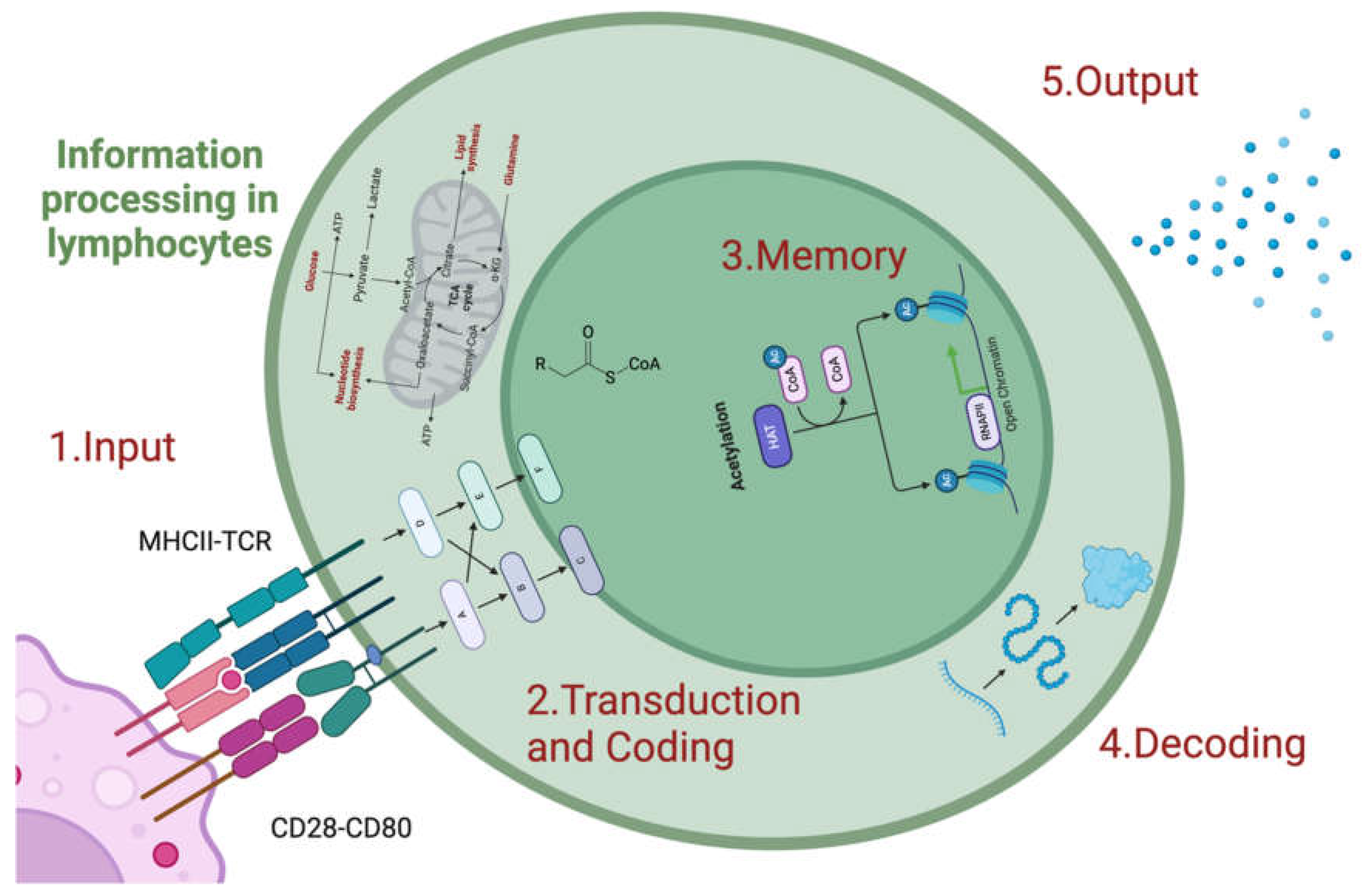
Figure 2. Schematic representation of information processing in a T cell, created using BioRender, illustrating five stages: 1) Input: antigen recognition mediated by the MHCII-TCR complex and costimulatory signals such as CD28-CD80, which initiate cellular activation and prime the immune response; 2) Transduction and Coding: signal integration through intracellular pathways, including NF-κB and JAK-STAT, that regulate metabolic reprogramming (e.g., glycolysis and lipid biosynthesis) and epigenetic modifications; 3) Memory: establishment of durable epigenetic marks and chromatin remodeling to encode functional and adaptive memory, enabling rapid responses to future challenges; 4) Decoding: gene expression and effector molecule synthesis, such as cytokines, that shape the immune response; 5) Output: secretion of cytokines and signaling molecules, amplifying and coordinating immune activity within the microenvironment. This figure integrates molecular, metabolic, and epigenetic processes into a multiscale framework, highlighting the adaptability and robustness of the immune system in response to external perturbations. Created in https://BioRender.com.
Preprints 146314 g002
Disclaimer/Publisher’s Note: The statements, opinions and data contained in all publications are solely those of the individual author(s) and contributor(s) and not of MDPI and/or the editor(s). MDPI and/or the editor(s) disclaim responsibility for any injury to people or property resulting from any ideas, methods, instructions or products referred to in the content.
Copyright: This open access article is published under a Creative Commons CC BY 4.0 license, which permit the free download, distribution, and reuse, provided that the author and preprint are cited in any reuse.
Prerpints.org logo

Preprints.org is a free preprint server supported by MDPI in Basel, Switzerland.

Subscribe

Disclaimer

Terms of Use

Privacy Policy

Privacy Settings

© 2025 MDPI (Basel, Switzerland) unless otherwise stated