

Submitted:
11 July 2026
Posted:
13 July 2026
You are already at the latest version
Abstract
Background: Microplastics are increasingly detected in human tissue, and electromagnetic/magnetic fields (EMF/MF) are common occupational exposures, yet whether these two exposure types could interact biologically has received little systematic attention. Purpose: To update and substantially expand a prior 53-source evidence map into a comprehensive evidence-mapping review evaluating whether circulating microplastics and EMF/MF exposure plausibly converge on shared biological pathways relevant to occupational health, and whether cumulative-exposure risk-assessment methods can formalize this as a research agenda. Methods: A structured evidence-mapping approach was used, expanding the literature bank to 108 sources through searches of PubMed-indexed literature, major publisher databases, and institutional/regulatory sources, covering microplastic toxicology, human biomonitoring, EMF/MF exposure and bioeffects, oxidative stress and inflammation biology, and occupational cumulative-exposure methodology. Sources were coded across eight evidence-type categories and sixteen mechanistic themes using a documented keyword procedure applied uniformly to all sources. Results: Microplastic exposure (70 of 108 sources) and oxidative stress/reactive oxygen species (34 of 108) were the dominant themes. Two mechanisms absent from the original map are now populated: genotoxicity/DNA damage (10 sources) and mitochondrial dysfunction (4 sources). Human detection evidence expanded from 7 to 10 tissue/fluid types, including brain, artery, and reproductive tissue. EMF/MF biological-effect evidence (26 sources) remained inconsistent. A new occupational/cumulative-exposure framework category (7 sources) was added. No study directly tested combined microplastic-EMF/MF exposure. Conclusions: The proposed interaction remains biologically plausible but empirically unconfirmed. Its practical value lies in identifying specific occupational settings, biomarkers, and a methodology for cumulative risk assessment for future testing, rather than in any confirmed health effect.
Keywords:
microplastics
; electromagnetic fields
; oxidative stress
; occupational health
; cumulative risk assessment
1. Introduction
Microplastics and nanoplastics are persistent, widely distributed emerging contaminants of growing occupational and environmental health concern (Hartmann et al., 2019; Vethaak & Legler, 2021). A recent field-wide retrospective concluded that detection capability has advanced substantially, even as human health risk remains unresolved (Thompson et al., 2024), and the 2025 Lancet Countdown on health and plastics has framed plastic pollution as a systemic public health concern (Landrigan et al., 2025). Global plastic production continues to rise (Plastics Europe, 2023/2024), and human exposure occurs through ingestion, inhalation, and contact with contaminated food, water, dust, and occupational materials (Wright & Kelly, 2017; Kosuth et al., 2018; Cox et al., 2019; Prata et al., 2020).
Human biomonitoring evidence has expanded rapidly. Plastic particles have been reported in blood, lung tissue, placenta, breastmilk, stool, urine, and colon tissue (Schwabl et al., 2019; Ibrahim et al., 2021; Ragusa et al., 2021, 2022; Jenner et al., 2022; Leslie et al., 2022; Pironti et al., 2023; Leonard et al., 2024), and since 2023 in coronary, carotid, and femoral arteries (Liu et al., 2024; Marfella et al., 2024), the frontal cortex of the human brain (Nihart et al., 2025), and human testis and semen (Zhao et al., 2023; Hu et al., 2024), with urinary/seminal burden linked to sperm-quality metrics in a 113-participant study (Zhang et al., 2024). These findings do not establish causation; independent commentary on the brain findings specifically cautions that the sample was small and non-representative (BfR, 2025). Nonetheless, they establish the biological plausibility of internal exposure across an expanding range of tissues, including the bloodstream and vascular interfaces, which are most relevant to this review because circulating particles may interact with immune cells, endothelial cells, and inflammatory mediators.
Microplastic toxicology literature commonly discusses oxidative stress, inflammation, immune modulation, and cellular dysfunction (Lehner et al., 2019; Hirt & Body-Malapel, 2020; Prata et al., 2020; Blackburn & Green, 2022; Li et al., 2023; Kadac-Czapska et al., 2024; Mahmud et al., 2024). This update closes two gaps explicitly flagged in the original evidence map. First, genotoxicity: a 2025 review of more than 85 papers documents microplastic-induced clastogenesis, aneugenesis, and DNA strand breakage (Tang, 2025), corroborated by evidence from human hematopoietic cell lines (Rubio et al., 2020). Second, mitochondrial dysfunction: a 2026 review documents microplastic-induced impairment of oxidative phosphorylation and mitochondrial membrane potential (Microplastics journal, 2026), an animal study shows dose-dependent suppression of tricarboxylic acid cycle and electron transport chain activity after polyethylene microplastic exposure (Kehinde et al., 2026), and a 2026 review links this damage to cardiovascular pathogenesis (Archives of Toxicology, 2026). These mechanisms overlap with broader pathways in chronic inflammation and vascular dysfunction (Simionescu, 2007; Mittal et al., 2014; Sies, 2015; Forrester et al., 2018; Furman et al., 2019; Sies & Jones, 2020; Libby, 2021), supporting a combined-exposure rather than single-agent framework.
EMF/MF are widespread physical exposures from electrical systems, wireless technologies, industrial equipment, and power distribution, with established exposure limits for extremely low-frequency (ELF) and radiofrequency (RF) fields (WHO, 2007; ICNIRP, 2020). The International Agency for Research on Cancer classified RF-EMF as "possibly carcinogenic" (Group 2B) in 2011 based on limited epidemiological evidence (IARC, 2011/2013). This classification continues to generate active debate in risk communication (Wiedemann & Schütz, 2024). Occupational exposure varies substantially by task and equipment (Kim et al., 2001; Choi et al., 2018; Jung et al., 2018; Mailan Arachchige Don et al., 2020), directly paralleling task-dependent occupational microplastic exposure (Murashov et al., 2021; Thongyoo et al., 2023).
EMF/MF biological-effect evidence remains genuinely uncertain. Occupational studies of welders and power-plant workers report measurable oxidative-stress biomarker shifts with long-term ELF-MF exposure (Sharifian et al., 2009; Bagheri Hosseinabadi et al., 2021), while a cytogenetic study of welders found genotoxic markers tracked with co-occurring metal-fume exposure rather than field exposure alone (Dominici et al., 2011) - a direct illustration of the attribution problem this review's framework must anticipate. A 2025 risk-of-bias assessment across ten IARC carcinogen characteristics found that 38% of 159 measurements reported significant effects, while deferring conclusions on genotoxicity/oxidative-stress to reviews reporting inconsistent findings and low certainty (Meyer et al., 2024). Epidemiological evidence on ELF-MF and childhood leukemia remains divided: a 2022 pooled analysis of four recent studies found no association above 0.4 microtesla (Amoon et al., 2022), in contrast to an earlier meta-analysis reporting a dose-dependent association (PLOS ONE, 2021). Therefore, as in the original review, EMF/MF is treated as a possible but unconfirmed physical co-stressor.
Occupational risk assessment has traditionally evaluated stressors individually, yet workers rarely experience single-agent exposure. Cumulative-risk-assessment methodology addresses this gap, distinguishing chemical-mixture from combined chemical/non-chemical stressor assessment (Sexton, 2015; Rider et al., 2018), and has been extended to occupational settings through NIOSH's Total Worker Health framework (Sexton et al./AIHA, 2015) and scoping reviews of combined workplace stressors (NIOSH-affiliated authors, 2021). A Society of Toxicology workshop established that physical stressors can modify both exposure to, and toxicity of, co-occurring chemical/particulate agents (Cory-Slechta et al., 2013/2015) - a precedent structurally analogous to the pairing proposed here.
This review does not claim proven synergistic toxicity. It uses a substantially expanded, structured evidence-mapping approach - 108 sources across eight evidence-type categories and sixteen mechanistic themes, including two mechanisms (genotoxicity and mitochondrial dysfunction) absent from the original 53-source map - to evaluate whether circulating microplastics and EMF/MF exposure may converge on occupational-health-relevant biological pathways, and whether cumulative-risk-assessment methodology can formalize this as a testable research agenda.
2. Methods
2.1. Study Design
This review used a structured evidence-mapping design, appropriate when a field contains heterogeneous study types and the objective is to identify evidence domains and research gaps rather than pooled effect sizes. This update expands a prior 53-source evidence map to 108 sources, expands the mechanism coding scheme from 12 to 16 categories, and adds a new evidence-type category (occupational/combined-exposure risk-assessment framework). No original human, animal, or laboratory data were generated.
2.2. Databases and Search Strategy
Searches covered PubMed-indexed literature, publisher databases (Elsevier ScienceDirect, Springer Nature, Wiley, MDPI, Frontiers), preprint servers (bioRxiv, medRxiv, Research Square), and institutional/regulatory sources (WHO, IARC, ICNIRP, NIOSH/CDC, the German Federal Institute for Risk Assessment, Plastics Europe). Newly added domains were searched for literature published between 2020 and mid-2026; foundational earlier sources from the original bank were retained unchanged. Search terms combined exposure concepts (microplastics, nanoplastics, human blood/brain/testis/semen/artery, electromagnetic fields, magnetic fields, extremely low-frequency fields, radiofrequency fields) with mechanistic terms (oxidative stress, reactive oxygen species, mitochondrial dysfunction, genotoxicity, DNA damage, inflammation, cytokines, endothelial dysfunction, immune response, membrane permeability, endocrine disruption, gut microbiome, reproductive toxicity) and methodological terms (occupational exposure, cumulative risk assessment, combined/mixture stressor exposure), combined with Boolean AND/OR operators (e.g., "microplastic AND (oxidative stress OR genotox OR mitochondri)"; "electromagnetic field AND occupational AND oxidative stress"). Searches were limited to English-language sources.
2.3. Inclusion and Exclusion Criteria
Sources were included if they addressed: detection of microplastics in human biological samples; toxicological mechanisms of microplastics/nanoplastics (including genotoxicity, mitochondrial dysfunction, endocrine/metabolic disruption, gut-microbiome effects); EMF/MF exposure assessment or biological effects; oxidative stress or inflammatory mechanisms; endothelial, vascular, immune, or membrane-related mechanisms; particle behavior relevant to field interaction; or occupational/cumulative-exposure risk-assessment methodology applicable to combined chemical, particulate, or physical stressors. Sources were excluded if unrelated to human, occupational, or environmental health, or if focused only on environmental distribution without biological relevance. Twenty of 108 sources (18.5%) added in this update could not be fully bibliographically verified (complete author list, volume, or page) from the search results alone; these are retained, with key findings intact, but flagged in the supplementary evidence-mapping workbook for verification against primary sources.
2.4. Coding and Synthesis
Each source was coded for citation, title, journal, year, study type, exposure focus, model/population, key mechanism/outcome, relevance, evidence strength, and mechanistic theme. Mechanistic themes were coded using 16 categories (microplastic exposure, EMF/MF exposure, oxidative stress/ROS, inflammation/cytokines, human biomonitoring, endothelial/vascular effects, particle behavior/aggregation, immune effects, cell membrane/permeability, metal additives/contaminants, mitochondrial dysfunction, genotoxicity/DNA damage, endocrine/metabolic disruption, gut microbiome/GI effects, reproductive toxicity, and occupational/cumulative-exposure framework), applied via a documented, case-insensitive keyword-matching procedure across each source's title, key mechanism, exposure focus, and thematic fields (full keyword dictionary in the supplementary workbook); sources could receive more than one tag. This procedure was applied uniformly to all 108 sources, including recoding the original 53 and correcting an internal inconsistency identified in the original evidence-mapping workbook. Evidence types were classified into eight categories: background/contextual evidence; microplastic toxicology mechanisms; human microplastic detection/biomonitoring; EMF/MF biological mechanisms; general oxidative stress/inflammation biology; direct or indirect microplastic-EMF/MF co-exposure relevance (merged here with particle-field interaction analogy, since no direct empirical co-exposure study was identified in either version of this review); and occupational/combined-exposure risk-assessment framework. Mechanism co-occurrence was computed across the full 16-category matrix. A narrative synthesis was combined with descriptive evidence mapping; no meta-analysis was performed due to substantial heterogeneity in study designs, exposure types, and outcome measures across sources. An explicit five-point evidence-strength gradient (very limited to very strong) was applied qualitatively across the distinct evidentiary pillars underlying the review's argument, to make transparent that they are not equally well established.
2.5. Ethics
This review used only previously published literature and publicly available sources; no human participants, animals, biological materials, or identifiable personal data were involved, and institutional review was therefore not required.
3. Results
3.1. Overview
The expanded evidence bank includes 108 sources, more than double the original 53. Table 1 summarizes the updated evidence-type distribution. Microplastic toxicology mechanisms remain the largest category (34 sources, up from 10), reflecting expanded coverage of genotoxicity, mitochondrial dysfunction, endocrine disruption, and gut-microbiome literature. Evidence for EMF/MF biological mechanisms grew to 26 sources (from 7). Human microplastic detection/biomonitoring doubled to 20 sources (from 9), including studies on brain, arterial, and reproductive tissue detection. A new occupational/combined-exposure risk-assessment framework category contributes 7 sources. Evidence of direct or indirect microplastic-EMF/MF co-exposure remains the smallest category (4 sources). It includes no dedicated direct empirical co-exposure study - the central gap identified in the original review persists. Table 2 summarizes study types across the full bank; reviews predominate (32 of 108 sources), followed by human tissue analytical studies (7) and occupational exposure assessments (5).
3.2. Human Microplastic Detection
In addition to blood (Leslie et al., 2022; Leonard et al., 2024), lung (Amato-Lourenço et al., 2021; Jenner et al., 2022), placenta (Ragusa et al., 2021), breastmilk (Ragusa et al., 2022), stool (Schwabl et al., 2019), urine (Pironti et al., 2023), and colon tissue (Ibrahim et al., 2021), this update adds: coronary/carotid/femoral arterial tissue (Liu et al., 2024), extending Marfella et al. (2024); the frontal cortex, where concentrations exceeded liver/kidney and were higher in 2024 than 2016 samples and further elevated with dementia (Nihart et al., 2025), though an independent institutional commentary cautions the autopsy sample was small and non-representative (BfR, 2025); and testis/semen, first reported in a six-testis/thirty-semen Chinese study (Zhao et al., 2023), corroborated by a comparative human-canine study (Hu et al., 2024) and linked to sperm-quality metrics in 113 participants (Zhang et al., 2024). A methodological study that specifically assesses the reliability of blood microplastic quantification highlights ongoing measurement uncertainty (Rauert et al., 2025). Endothelial and microglial cell lines show particular susceptibility to cytotoxic and genotoxic effects from consumer-product-derived microplastics (Janiga-MacNelly et al., 2024/2025). Table 3 summarizes this evidence.
3.3. Microplastic Toxicology Mechanisms
This update closes two gaps explicitly flagged as empty in the original map. For genotoxicity/DNA damage (0 to 10 sources), a 2025 review of more than 85 papers found microplastics cause clastogenesis and aneugenesis through direct and ROS-mediated indirect DNA damage (Tang, 2025), corroborated by human hematopoietic cell-line evidence (Rubio et al., 2020), a review linking intracellular nanoplastics to genotoxic/neurotoxic potential (Casella & Ballaz, 2024), and a carcinogenesis-focused review implicating p53, MAPK, Nrf2, and PI3K/Akt signaling following the first detection of microplastics in human tumor tissue (PMC11545399, 2024). For mitochondrial dysfunction (0 to 4 sources), a 2026 review documents disrupted membrane potential and impaired oxidative phosphorylation converging on NF-kB/NLRP3-mediated inflammation (Microplastics journal, 2026); a rodent study found dose-dependent suppression of testicular tricarboxylic-acid-cycle and electron-transport-chain activity after 28-day polyethylene-microplastic exposure (Kehinde et al., 2026); and a 2026 review connects this damage to pro-atherosclerotic cardiovascular remodeling (Archives of Toxicology, 2026), reinforcing the vascular-interface argument since Marfella et al. (2024).
Two further mechanistic dimensions are new to this update. Endocrine/metabolic disruption is supported by a review characterizing microplastics as vectors for endocrine-disrupting additives (Kannan & Vimalkumar, 2021). Gut microbiome/GI effects are supported by a 2025 systematic review documenting consistent microplastic-induced gut dysbiosis (BMC Gastroenterology, 2025) and a review proposing gut-brain-axis propagation (PMC11120006, 2024) - of particular interest given the new brain-detection evidence. Occupationally relevant evidence includes a 2025 review of exposure-to-mitigation pathways (PMC12142344, 2025) and experimental evidence that inhaled textile microplastic fibers impair lung repair, consistent with occupational respiratory disease patterns among workers in the textile, flocking, and PVC industries (Prata, 2018; bioRxiv preprint, 2021). Table 4 summarizes all 16 coded mechanisms; microplastic exposure (70 coded instances) and oxidative stress/ROS (34) remain dominant, with inflammation/cytokines (19) and the new occupational/cumulative-exposure framework category (19) close behind.
3.4. EMF/MF Exposure and Mechanism Evidence
Exposure guidance and occupational studies (Kim et al., 2001; WHO, 2007; Choi et al., 2018; ICNIRP, 2020; Jung et al., 2018; Mailan Arachchige Don et al., 2020) confirm that field exposure is task- and equipment-dependent. Biological-effect evidence remains uncertain: IARC's 2011 Group 2B classification (IARC, 2011/2013) continues to generate risk-communication debate about public misinterpretation (Wiedemann & Schütz, 2024); a 2025 risk-of-bias assessment across ten IARC carcinogen characteristics found 38% of 159 measurements reporting significant effects while deferring to reviews reporting inconsistent, low-certainty findings on genotoxicity/oxidative stress (Meyer et al., 2024; ScienceDirect, Romeo/Karipidis et al., 2025); and WHO is continuing systematic-review program has extended to RF-EMF and animal cancer bioassays (Mevissen et al., 2025). Childhood leukemia epidemiology remains divided: a 2022 pooled analysis found no association above 0.4 microtesla (Amoon et al., 2022), in contrast to a dose-dependent association reported elsewhere (PLOS ONE, 2021).
Occupationally, power-plant workers and welders show elevated oxidative-stress biomarkers with long-term ELF-MF exposure (Sharifian et al., 2009; Bagheri Hosseinabadi et al., 2021), but a welding cytogenetic study found genotoxic markers tracked with metal-fume co-exposure rather than field exposure (Dominici et al., 2011) - illustrating the attribution problem this review's framework anticipates. Membrane and calcium-channel hypotheses remain proposed but unconfirmed mechanisms (Pall, 2013; Gherardini et al., 2014; arXiv preprint review, 2020). Table 5 summarizes updated EMF/MF evidence domains.
3.5. Occupational/Cumulative-Exposure Frameworks
This new category (7 dedicated sources, 19 coded mechanism instances) formalizes a bridge to concrete occupational practice. Cumulative-risk methodology distinguishes stressor-based from effects-based approaches (Sexton, 2015) and has been extended to combined chemical/non-chemical stressors (NIEHS, 2017; Rider et al., 2018), including a workshop precedent that physical stressors can modify exposure to and toxicity of co-occurring chemical/particulate agents (Cory-Slechta et al., 2013/2015). Occupationally, this has been formalized through NIOSH's Total Worker Health framework (Sexton et al./AIHA, 2015) and a scoping review of combined chemical/physical/psychosocial workplace stressors (NIOSH-affiliated authors, 2021). Independent occupational exposure-assessment literature exists for both stressors: microplastic exposure varies by task in manufacturing, textile, and recycling settings, with no occupational exposure limit yet established (Murashov et al., 2021), and a Thai field study found waste-segregation workers had the highest airborne-microplastic exposure (~3,960 particles/m3) (Thongyoo et al., 2023), directly paralleling task-dependent ELF-MF exposure gradients among Korean workers (Choi et al., 2018; Mailan Arachchige Don et al., 2020). Table 6 presents this synthesis.
3.6. Convergence, Gaps, and Evidence Strength
A publication-year analysis (Figure 1) shows 40 of 108 sources (37%) were published in 2024-2026 alone, reflecting genuine field-wide acceleration rather than search recency bias, since pre-2024 literature was retained unchanged. The mechanism co-occurrence analysis (Figure 2) confirms oxidative stress and inflammation as central cross-cutting themes. At the same time, the occupational/cumulative-exposure category co-occurs most strongly with EMF/MF exposure (13 shared instances) and, less strongly, microplastic exposure (9 instances) - consistent with occupational exposure-assessment methodology having so far been applied more to EMF/MF than to microplastics. Table 7 presents the updated evidence-gap analysis: human detection, toxicological mechanisms (now including genotoxicity and mitochondrial dysfunction), and occupational exposure assessment are well supported; EMF/MF biological effects remain mixed; and direct evidence of microplastic-EMF/MF co-exposure remains absent.
To prevent this expanded evidence base from being misread as uniformly strong, Figure 3 presents an explicit evidence-strength gradient. Human internal-exposure detection and EMF/MF occupational exposure assessment are rated strong-to-very-strong; microplastic toxicology mechanisms and occupational cumulative-exposure methodology are rated moderate-to-strong; EMF/MF biological-effect mechanisms are rated limited; and direct co-exposure evidence is rated very limited - the lowest point on the gradient.
3.7. Updated Conceptual Framework
Figure 4 presents an updated conceptual model adding: an explicit occupational co-location node (settings where both stressors are independently documented at elevated levels); an internal-interface node extended to brain and reproductive tissue; a fourth mechanism branch (endocrine/metabolic disruption, gut-microbiome dysbiosis, reproductive toxicity) alongside particle-related, shared stress-response, and physical co-stressor branches; and expanded testable outcomes (genotoxic/mitochondrial biomarkers, endocrine/metabolic markers, gut-microbiome composition, reproductive endpoints). The framework does not assume EMF/MF directly alters microplastics in blood; it identifies testable possibilities best evaluated within an occupational cumulative-risk-assessment framework in the specific industries identified above.
4. Discussion
This expanded evidence-mapping review indicates that the possible interaction between circulating microplastics and EMF/MF exposure remains biologically plausible but empirically unconfirmed, now supported by more than double the original evidence base and by two mechanistic domains - genotoxicity and mitochondrial dysfunction - absent from the earlier version. Evidence remains strongest for human microplastic detection, now spanning ten tissue/fluid types, and for microplastic toxicological mechanisms, now including genotoxic and mitochondrial pathways. It remains weaker for EMF/MF biological effects, where updated 2024-2025 systematic reviews and epidemiological analyses sharpened rather than resolved long-standing uncertainty, and weakest - unchanged despite a broadened search - for direct co-exposure evidence. This evidence-strength gradient (Figure 3) is important because it prevents overstatement while preserving the practical value of the research question.
Interpret. The primary contribution of this review is to translate a speculative question into a concrete, increasingly specific occupational research agenda, rather than to prove synergistic causation of disease. The hypothesis is that the two exposure domains may converge on oxidative stress, mitochondrial dysfunction, genotoxicity, inflammatory signaling, and vascular biology - a wider convergence footprint than the original review could support - which is sufficient to justify controlled research but insufficient to claim causal risk. If microplastic-induced reactive oxygen species originate substantially at the mitochondrial level, as recent reviews suggest (Kehinde et al., 2026; Microplastics journal, 2026), then any physical co-stressor capable of independently perturbing mitochondrial membrane potential or redox balance - mechanisms repeatedly proposed but not conclusively demonstrated for EMF/MF (Consales et al., 2012; Pall, 2013) - represents a mechanistically coherent, testable candidate for interaction. No study identified here has directly tested this; the value of the observation is that it sharpens the hypothesis into a specific, falsifiable prediction rather than a general statement that both exposures involve oxidative stress.
Integrate. The EMF/MF evidence requires particular restraint. Occupational studies of welders and power-plant workers provide genuine evidence of field-associated oxidative-stress biomarker shifts (Sharifian et al., 2009; Bagheri Hosseinabadi et al., 2021), yet a cytogenetic study in the same occupational literature found genotoxic markers associated with co-occurring metal-fume exposure rather than field exposure (Dominici et al., 2011). This is not evidence against EMF/MF bioeffects; it is a direct methodological warning about attributing effects to any single stressor in real workplaces where multiple exposures co-occur - precisely the problem a formal co-exposure study must solve, and one reason this review locates future work within cumulative-risk-assessment methodology rather than single-stressor toxicology designs. At the population level, divergent 2021-2022 childhood-leukemia analyses (PLOS ONE, 2021; Amoon et al., 2022) show that EMF/MF risk assessment remains an unsettled debate more than four decades after the question was first raised, reinforcing rather than loosening the case for treating EMF/MF as a possible, not confirmed, co-stressor.
Implications. This update's principal practical contribution is to identify occupational cumulative-risk-assessment methodology as the appropriate framework for future empirical work. This methodology was developed specifically because workers are rarely exposed to a single agent at a time (Cory-Slechta et al., 2013/2015; Sexton, 2015) and has already been operationalized occupationally through NIOSH's Total Worker Health program (Sexton et al./AIHA, 2015) and combined-stressor scoping reviews (NIOSH-affiliated authors, 2021). This review identifies a specific, previously unexamined pairing - microplastic particulate exposure and ELF-MF/RF-EMF exposure - for which independent occupational exposure-assessment literature already exists for both stressors (Choi et al., 2018; Jung et al., 2018; Mailan Arachchige Don et al., 2020; Murashov et al., 2021; Thongyoo et al., 2023), and proposes combining these literatures within existing methodology rather than treating them as separate research programs. The public-health message remains cautious: this review does not support claims that EMF/MF and microplastics together cause disease. It supports combined-exposure thinking as routine occupational risk-assessment practice, particularly in polymer processing, textiles, recycling, welding, electroplating, semiconductor, and power-generation industries, where workers are rarely exposed to a single physical or particulate agent at a time.
This study retains limitations from its original version and introduces new ones. It remains based on a structured evidence bank rather than a database-level systematic review with formal risk-of-bias scoring; coding relies on documented keyword-matching criteria and may undercount mechanisms not explicitly captured in the extracted fields. Twenty of 108 sources (18.5%) could not be fully bibliographically verified within this update's search process and are flagged for verification before further use; none were used to support a claim not independently corroborated by at least one fully verified source. No original experimental data were generated, and most importantly, direct co-exposure evidence remains absent despite a substantially broadened search. These findings should therefore be interpreted as hypothesis-generating rather than confirmatory.
Despite these limitations, this update strengthens several original contributions: a more transparent, reproducible evidence map with a single documented coding procedure applied uniformly across 108 sources; mechanistic coverage across sixteen rather than twelve categories; an explicit evidence-strength gradient preventing the expanded base from being misread as uniformly strong; and a formal cumulative-risk-assessment methodology, specific industries, and biomonitoring endpoints for future occupational research. The most important finding, unchanged despite a doubled evidence base, is the research gap itself: no study has directly examined combined exposure to circulating microplastics and EMF/MF. Future research should use controlled in vitro and in vivo studies targeting the mitochondrial and genotoxic endpoints identified here, alongside occupational cohort studies combining personal microplastic and field-exposure monitoring with oxidative-stress, inflammatory, and genotoxicity biomarkers, to test whether EMF/MF modifies microplastic-related cellular uptake, oxidative stress, mitochondrial function, genotoxicity, or endothelial function. Until such evidence exists, the proposed interaction should be treated as a testable occupational-health hypothesis rather than an established causal relationship.
Data Availability
No original human, animal, or experimental dataset was generated. The expanded evidence-mapping workbook (108 sources, 16-category mechanism coding, full search-and-coding audit trail) used for the descriptive synthesis is available as supplementary material. Twenty of the 108 sources are explicitly flagged within the workbook as requiring bibliographic verification against primary sources before journal submission.
Ethics Approval
This review used published literature and publicly available sources only. No human participants, animals, biological materials, or identifiable personal data were involved; institutional review was therefore not required.
Use of AI-Assisted Technology
AI-assisted tools were used for literature search, evidence bank expansion and coding, data visualization, and language refinement during the preparation of this manuscript. A documented, reproducible keyword-based coding procedure (Section 2.4) was applied across the full 108-source bank. Twenty sources added through this process could not be fully bibliographically verified and are flagged for verification against primary sources before submission. The author(s) critically reviewed, edited, and verified the manuscript content and remain fully responsible for its accuracy, integrity, and originality.
References
- Amato-Lourenço et al. (2021). Presence of airborne microplastics in human lung tissue. Journal of Hazardous Materials. [CrossRef]
- Amoon et al. (2022). Pooled analysis of recent studies of magnetic fields and childhood leukemia. Environmental Research.
- (Archives of Toxicology)(2026). Microplastics induce mitochondrial dysfunction and accelerate cardiovascular pathogenesis. Archives of Toxicology.
- (arXiv preprint review) (2020). Biological effects of low power nonionizing radiation: a narrative review. arXiv preprint (peer-reviewed status to be confirmed). https://arxiv.org/pdf/2010.15557.
- Bae et al. (2011). The effect of static magnetic fields on the aggregation and cytotoxicity of magnetic nanoparticles. Biomaterials. [CrossRef]
- Bagheri Hosseinabadi et al. (2021). Oxidative stress associated with long-term occupational exposure to extremely low frequency electric and magnetic fields. Work (IOS Press). [CrossRef]
- BfR (2025). Microplastics in the brain - expert risk-communication commentary on Nihart et al. (2025). German Federal Institute for Risk Assessment (BfR).
- (bioRxiv preprint) (2021). Inhalable textile microplastic fibers impair lung repair. bioRxiv (preprint; peer-reviewed version to be confirmed). [CrossRef]
- Blackburn & Green (2022). The potential effects of microplastics on human health: What is known and what is unknown. Ambio. [CrossRef]
- (BMC Gastroenterology) (2025). Impact of microplastics on the human gut microbiome: a systematic review of microbial composition, diversity, and metabolic disruptions. BMC Gastroenterology. [CrossRef]
- Casella & Ballaz (2024). Genotoxic and neurotoxic potential of intracellular nanoplastics: a review. Journal of Applied Toxicology. [CrossRef]
- Chen/Tao (2017). Mechanisms of cellular effects directly induced by magnetic nanoparticles under magnetic fields. Journal of Nanomaterials. [CrossRef]
- Choi et al. (2018). Extremely Low Frequency-Magnetic Field Exposure among Semiconductor Workers. International Journal of Environmental Research and Public Health. [CrossRef]
- Consales et al. (2012). Electromagnetic Fields, Oxidative Stress, and Neurodegeneration. International Journal of Cell Biology. [CrossRef]
- Cory-Slechta et al. (2013/2015). Cumulative risk: toxicity and interactions of physical and chemical stressors. Toxicological Sciences / Society of Toxicology workshop report.
- Cox et al. (2019). Human Consumption of Microplastics. Environmental Science & Technology. [CrossRef]
- Deng et al. (2017). Tissue accumulation of microplastics in mice and biomarker responses suggest widespread health risks of exposure. Scientific Reports. [CrossRef]
- Dominici et al. (2011). Genotoxic hazard evaluation in welders occupationally exposed to extremely low-frequency magnetic fields (ELF-MF). International Journal of Hygiene and Environmental Health.
- Dutz & Hergt (2013). Magnetic nanoparticle heating and heat transfer at the microscale: basic principles, realities, and physical limitations. International Journal of Hyperthermia. [CrossRef]
- Forrester et al. (2018). Reactive Oxygen Species in Metabolic and Inflammatory Signaling. Circulation Research. [CrossRef]
- (Frontiers Public Health) (2026). Microplastic induced cascades of multiple cell death pathways: inflammation, immune imbalance, and cancer susceptibility. Frontiers in Public Health. [CrossRef]
- Furman et al. (2019). Chronic inflammation in the etiology of disease across the life span. Nature Medicine. [CrossRef]
- Garcia et al. (2024). Quantitation and identification of microplastics accumulation in human placental specimens using pyrolysis gas chromatography mass spectrometry. Toxicological Sciences.
- Gherardini et al. (2014). The effect of radiofrequency electromagnetic fields on cells. International Journal of Molecular Sciences. [CrossRef]
- Goodman et al. (2022). Effects of Polystyrene Microplastics on the Morphology of Human Kidney and Liver Cells, Cellular Proliferation, and Metabolism. ACS Omega. [CrossRef]
- Hartmann et al. (2019). Are We Speaking the Same Language? Recommendations for a Definition and Categorization Framework for Plastic Debris. Environmental Science & Technology. [CrossRef]
- Henschenmacher et al. (2022). The effect of radiofrequency electromagnetic fields (RF-EMF) on oxidative stress biomarkers in vivo and in vitro: A protocol for a systematic review. Environment International. [CrossRef]
- Hirt & Body-Malapel (2020). Immunotoxicity and intestinal effects of nano- and microplastics: a review of the literature. Particle and Fibre Toxicology. [CrossRef]
- Hu et al. (2024). Microplastic presence in dog and human testis and its potential association with sperm count and weights of testis and epididymis. Toxicological Sciences. Toxicol Sci 200(2):235-240.
- Hwang et al. (2020). Potential toxicity of polystyrene microplastic particles. Scientific Reports. [CrossRef]
- IARC (2011/2013). IARC Monographs Volume 102: Non-ionizing radiation, Part 2: Radiofrequency electromagnetic fields. IARC Monographs on the Evaluation of Carcinogenic Risks to Humans.
- Ibrahim et al. (2021). Detection of microplastics in human colectomy specimens. JGH Open. [CrossRef]
- ICNIRP (2020). Guidelines for Limiting Exposure to Electromagnetic Fields (100 kHz to 300 GHz). Health Physics. [CrossRef]
- ICNIRP / IEEE standards bodies (2010-2020, various). Standards and guidance for measurement of electric, magnetic, and electromagnetic field human exposure. IEEE / ICNIRP guidance documents.
- Ivleva (2021). Chemical Analysis of Microplastics and Nanoplastics: Challenges, Advanced Methods, and Perspectives. Chemical Reviews. [CrossRef]
- Janiga-MacNelly et al. (2024/2025). Comparative toxicity of microplastics obtained from human consumer products on human cell-based models. Ecotoxicology and Environmental Safety. [CrossRef]
- Jenner et al. (2022). Detection of microplastics in human lung tissue using μFTIR spectroscopy. Science of the Total Environment. [CrossRef]
- Jung et al. (2018). Extremely low-frequency magnetic field exposure level for Koreans by occupational code. Emerging Contaminants. [CrossRef]
- Kadac-Czapska et al. (2024). Microplastics and Oxidative Stress—Current Problems and Prospects. Antioxidants. [CrossRef]
- Kannan & Vimalkumar (2021). A review of human exposure to microplastics and insights into microplastics as obesogens. Frontiers in Endocrinology. [CrossRef]
- KC et al. (2023). Polytetrafluoroethylene microplastic particles mediated oxidative stress, inflammation, and intracellular signaling pathway alteration in human-derived cell lines. Science of the Total Environment. [CrossRef]
- Kehinde et al. (2026). Testicular mitochondrial redox imbalance and impaired oxidative phosphorylation underlie microplastic-induced testicular dysfunction in Wistar rats. Frontiers in Toxicology. [CrossRef]
- Kelly & Fussell (2012) [representative Nrf2/ROS-defense reference]. Air pollution and airway disease: the role of Nrf2-mediated antioxidant defense in particulate stress. Representative redox-biology literature (author to confirm final specific citation).
- Kim et al. (2001). Exposure of workers to extremely low-frequency magnetic fields. Journal of Occupational Health.
- Koelmans et al. (2016). Microplastic as a Vector for Chemicals in the Aquatic Environment: Critical Review and Model-Supported Reinterpretation. Environmental Science & Technology. [CrossRef]
- Kosuth et al. (2018). Anthropogenic contamination of tap water, beer, and sea salt. PLOS ONE. [CrossRef]
- Lamoree et al. (2025). Health impacts of microplastic and nanoplastic exposure. Nature Medicine.
- Landrigan et al. (2025). The Lancet Countdown on health and plastics. The Lancet.
- Lehner et al. (2019). Emergence of Nanoplastic in the Environment and Possible Impact on Human Health. Environmental Science & Technology. [CrossRef]
- Leonard et al. (2024). Microplastics in human blood: Polymer types, concentrations and characterisation using μFTIR. Environment International. [CrossRef]
- Leslie et al. (2022). Discovery and quantification of plastic particle pollution in human blood. Environment International. [CrossRef]
- Libby (2021). Inflammation in atherosclerosis. Nature. [CrossRef]
- Liu et al. (2024). Microplastics in three types of human arteries detected by pyrolysis-gas chromatography/mass spectrometry (Py-GC/MS). Journal of Hazardous Materials.
- Lu et al. (2018). Polystyrene microplastics induce gut microbiota dysbiosis and hepatic lipid metabolism disorder in mice. Science of the Total Environment. [CrossRef]
- Madamanchi et al. (2005). Oxidative Stress and Vascular Disease. Arteriosclerosis, Thrombosis, and Vascular Biology. [CrossRef]
- Mailan Arachchige Don et al. (2020). ELF-MF occupational exposure in die-casting and electroplating workers in Korea. International Journal of Occupational Safety and Ergonomics. [CrossRef]
- Marfella et al. (2024). Microplastics and Nanoplastics in Atheromas and Cardiovascular Events. New England Journal of Medicine. [CrossRef]
- (MDPI Microplastics journal) (2026). The mitochondrial battleground: a review of microplastic-induced oxidative stress and inflammatory pathways in human health. Microplastics (MDPI). [CrossRef]
- Mevissen et al. (2025). Effects of radiofrequency electromagnetic field exposure on cancer in laboratory animal studies: a systematic review. Environment International. Environ Int 199:109482 (WHO systematic review series).
- Meyer et al. (2024). The effects of radiofrequency electromagnetic field exposure on biomarkers of oxidative stress in vivo and in vitro: A systematic review of experimental studies. Environment International. [CrossRef]
- (Micro/nanoplastic toxicity review) (2025). Micro- and nanoplastic toxicity in humans: exposure pathways, cellular effects, and mitigation strategies. Peer-reviewed review (PMC12142344).
- Mittal et al. (2014). Reactive Oxygen Species in Inflammation and Tissue Injury. Antioxidants & Redox Signaling. [CrossRef]
- Murashov et al. (2021). Nano- and microplastics in the workplace. Journal of Occupational and Environmental Hygiene. [CrossRef]
- Nihart et al. (2025). Bioaccumulation of microplastics in decedent human brains. Nature Medicine. [CrossRef]
- (NIOSH-affiliated authors) (2021). Cumulative risks from stressor exposures and personal risk factors in the workplace: examples from a scoping review. International Journal of Environmental Research and Public Health.
- Pall (2013). Electromagnetic fields act via activation of voltage-gated calcium channels to produce beneficial or adverse effects. Journal of Cellular and Molecular Medicine. [CrossRef]
- Pironti et al. (2023). First Evidence of Microplastics in Human Urine, a Preliminary Study of Intake in the Human Body. Toxics. [CrossRef]
- Plastics Europe (2023/2024). Plastics - the Fast Facts (annual production and waste statistics). Plastics Europe (industry statistical report).
- (PLOS ONE) (2021). Exposure to extremely low-frequency magnetic fields and childhood cancer: a systematic review and meta-analysis. PLOS ONE. [CrossRef]
- (PMC review) (2017). World Health Organization, radiofrequency radiation and health - a hard nut to crack. International Journal of Oncology (review).
- (PMC review) (2024). Microplastics in the human body: exposure, detection, and risk of carcinogenesis - a state-of-the-art review. Peer-reviewed review (PMC11545399).
- (PMC) (2024). Mind over microplastics: exploring microplastic-induced gut disruption and gut-brain-axis consequences. Peer-reviewed journal (PMC11120006).
- Prata (2018). Airborne microplastics: Consequences to human health?. Environmental Pollution. [CrossRef]
- Prata et al. (2020). Environmental exposure to microplastics: An overview on possible human health effects. Science of the Total Environment. [CrossRef]
- Prattichizzo et al. (2024). Micro-nanoplastics and cardiovascular diseases: evidence and perspectives. European Heart Journal.
- (PubMed/PMC) (2015). The role of ROS generation from magnetic nanoparticles in an alternating magnetic field on cytotoxicity. Acta Biomaterialia.
- Płuciennik et al. (2024). Important factors affecting induction of cell death, oxidative stress and DNA damage by nano- and microplastic particles in vitro. Cells. [CrossRef]
- Ragusa et al. (2021). Plasticenta: First evidence of microplastics in human placenta. Environment International. [CrossRef]
- Ragusa et al. (2022). Raman Microspectroscopy Detection and Characterisation of Microplastics in Human Breastmilk. Polymers. [CrossRef]
- Rauert et al. (2025). Assessing the efficacy of pyrolysis-gas chromatography-mass spectrometry for nanoplastic and microplastic analysis in human blood. Environmental Science & Technology.
- Rider et al. (2018, eds.). Chemical mixtures and combined chemical and nonchemical stressors: exposure, toxicity, analysis, and risk. Springer (book). [CrossRef]
- Rochman et al. (2013). Ingested plastic transfers hazardous chemicals to fish and induces hepatic stress. Scientific Reports. [CrossRef]
- Rubio et al. (2020). Biological effects, including oxidative stress and genotoxic damage, of polystyrene nanoparticles in different human hematopoietic cell lines. Journal of Hazardous Materials. [CrossRef]
- Röösli (2008). Radiofrequency electromagnetic field exposure and non-specific symptoms of ill health: A systematic review. Environmental Research. [CrossRef]
- Schuermann & Mevissen (2021). Manmade Electromagnetic Fields and Oxidative Stress—Biological Effects and Consequences for Health. International Journal of Molecular Sciences. [CrossRef]
- Schwabl et al. (2019). Detection of Various Microplastics in Human Stool: A Prospective Case Series. Annals of Internal Medicine. [CrossRef]
- Romeo/Karipidis et al. (2025). Exposure to radiofrequency electromagnetic fields and IARC carcinogen assessment: risk-of-bias assessment for 10 key characteristics of human carcinogens. Environment International (or related WHO-series journal).
- Sexton & Linder / NIEHS (2017). Combined exposures and mixtures. National Institute of Environmental Health Sciences (programmatic overview).
- Sexton (2015). Cumulative risk assessment: an overview of methodological approaches for evaluating combined health effects from exposure to multiple environmental stressors. International Journal of Environmental Research and Public Health.
- Sexton et al./AIHA (2015). Aggregate exposure and cumulative risk assessment - integrating occupational and non-occupational risk factors. Journal of Occupational and Environmental Hygiene. [CrossRef]
- Sharifian et al. (2009). Effect of extremely low frequency magnetic field on antioxidant activity in plasma and red blood cells in spot welders. International Archives of Occupational and Environmental Health. [CrossRef]
- Sies & Jones (2020). Reactive oxygen species (ROS) as pleiotropic physiological signalling agents. Nature Reviews Molecular Cell Biology. [CrossRef]
- Sies (2015). Oxidative stress: a concept in redox biology and medicine. Redox Biology. [CrossRef]
- Simionescu (2007). Implications of early structural-functional changes in the endothelium for vascular disease. Arteriosclerosis, Thrombosis, and Vascular Biology. [CrossRef]
- Swanson & Deng (2019). [representative NLRP3 inflammasome reference]. NLRP3 inflammasome activation as a convergent innate-immune response to particulate and oxidative stressors. Representative immunology literature (author to confirm final specific citation).
- Tang (2025). Genotoxicity of microplastics on living organisms: effects on chromosomes, DNA and gene expression. Environments (MDPI). [CrossRef]
- Thompson et al. (2024). Twenty years of microplastic pollution research - what have we learned?. Science. [CrossRef]
- Thongyoo et al. (2023). Exploring personal exposure to airborne microplastics across various work environments in Pathum Thani Province, Thailand. Peer-reviewed journal (exact title/volume to be confirmed by author).
- Vethaak & Legler (2021). Microplastics and human health. Science. [CrossRef]
- Wang et al. (2020). Interactions between microplastics and organic pollutants in the environment: A critical review. Water Research. [CrossRef]
- WHO (2007). Extremely Low Frequency Fields. Environmental Health Criteria Monograph No. 238. World Health Organization. https://www.who.int/publications/i/item/9789241572385.
- Wiedemann & Schütz (2024). How to improve IARC's RF-EMF cancer hazard communication. Bioelectromagnetics. [CrossRef]
- Wright & Kelly (2017). Plastic and Human Health: A Micro Issue?. Environmental Science & Technology. [CrossRef]
- Yakymenko et al. (2016). Oxidative mechanisms of biological activity of low-intensity radiofrequency radiation. Electromagnetic Biology and Medicine. [CrossRef]
- Yong et al. (2020). Toxicity of Microplastics and Nanoplastics in Mammalian Systems. International Journal of Environmental Research and Public Health. [CrossRef]
- Zhang et al. (2024). Association of mixed exposure to microplastics with sperm dysfunction: a multi-site study in China. eBioMedicine.
- Zhao et al. (2023). Detection and characterization of microplastics in the human testis and semen. Science of the Total Environment.
- Zhu et al. (2024). Tissue accumulation of microplastics and potential health risks in human. Science of the Total Environment.
Figure 1.
Publication-year distribution of the evidence bank, showing the 2024-2026 recency skew (n = 108).
Figure 1.
Publication-year distribution of the evidence bank, showing the 2024-2026 recency skew (n = 108).
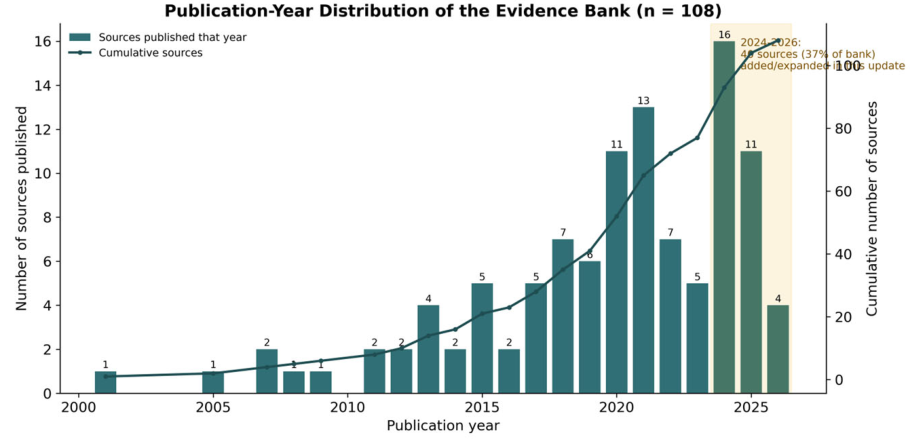
Figure 2.
Co-occurrence of mechanistic themes across the updated evidence bank (16 x 16 matrix, n = 108).
Figure 2.
Co-occurrence of mechanistic themes across the updated evidence bank (16 x 16 matrix, n = 108).
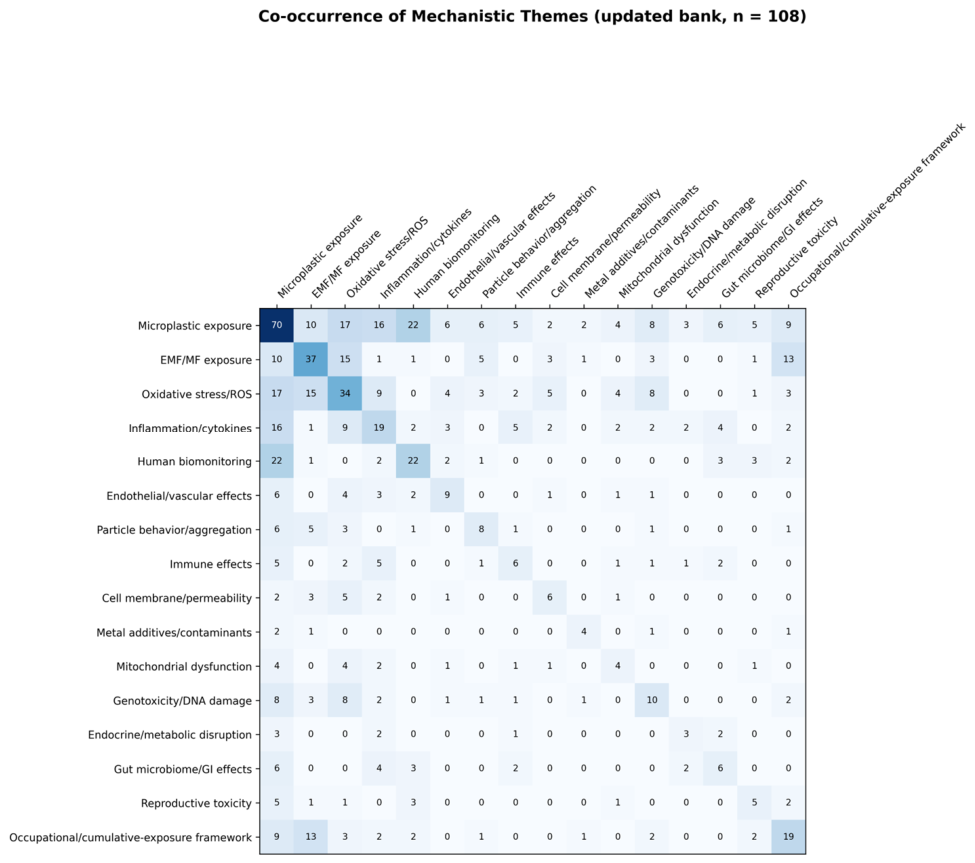
Figure 3.
Evidence-strength gradient across the six pillars of evidence underlying the co-exposure hypothesis.
Figure 3.
Evidence-strength gradient across the six pillars of evidence underlying the co-exposure hypothesis.
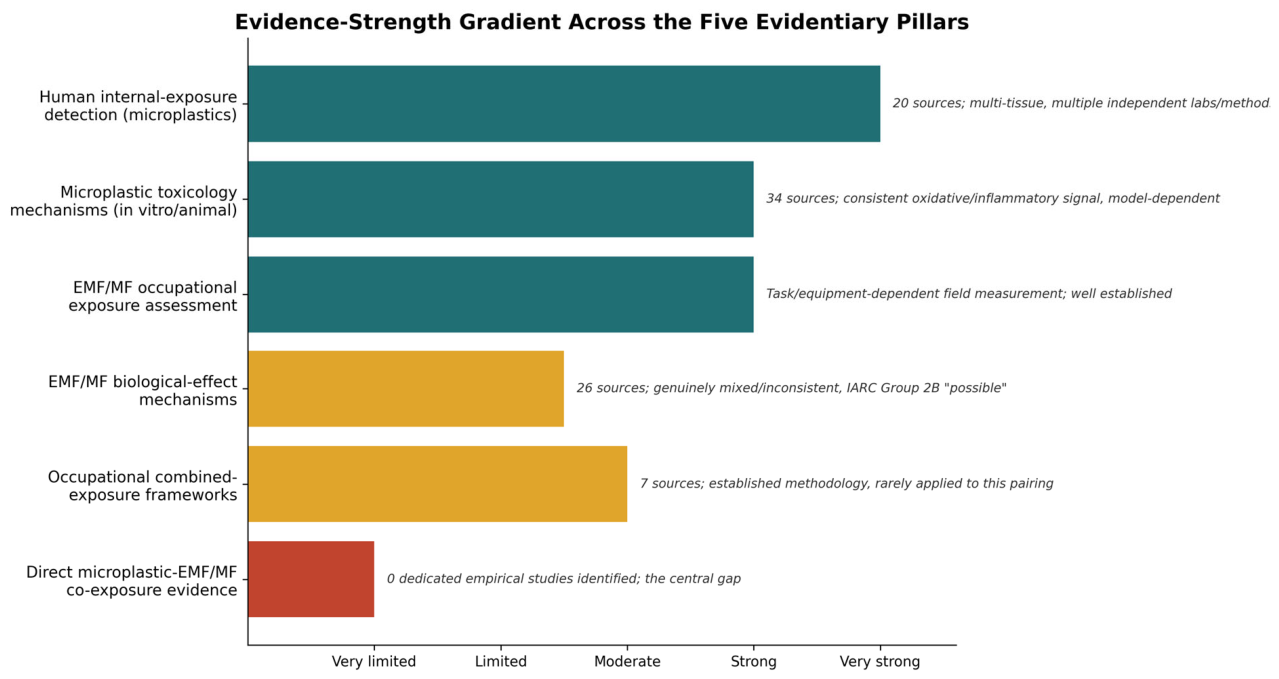
Figure 4.
Updated conceptual model of potential microplastic-EMF/MF co-exposure pathways, incorporating occupational co-location and expanded mechanism branches.
Figure 4.
Updated conceptual model of potential microplastic-EMF/MF co-exposure pathways, incorporating occupational co-location and expanded mechanism branches.
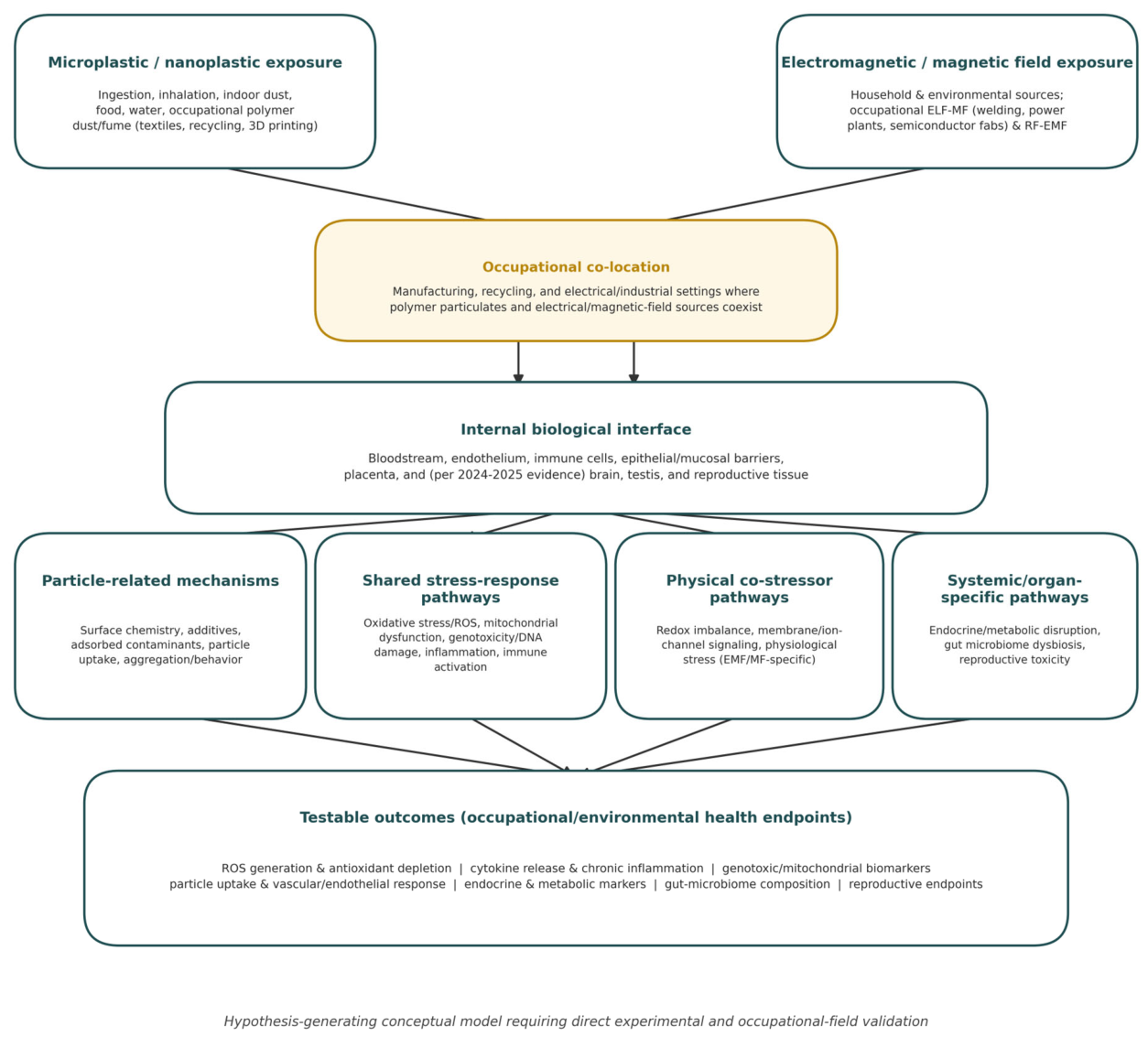

Table 1.
Evidence-type summary from the updated structured evidence bank (n = 108).
| Evidence type | Number of sources | Change from original (53-source) bank |
|---|---|---|
| Microplastic toxicology mechanism | 34 | up from 10 |
| EMF/MF biological mechanism | 26 | up from 7 |
| Human microplastic detection/biomonitoring | 20 | up from 9 |
| General oxidative stress/inflammation biology | 10 | up from 6 |
| Background/contextual evidence | 7 | down from 18 (see Section 3.1 re-classification note) |
| Occupational/combined-exposure risk-assessment framework | 7 | new category |
| Particle-field interaction analogy | 4 | up from 1 (merged with prior "direct/indirect co-exposure relevance" category; still 0 direct empirical co-exposure studies) |
| Total | 108 | up from 53 |
Table 2.
Study types included in the updated evidence bank (n = 108).
| Study type | Number of sources |
|---|---|
| Review | 32 |
| Human tissue analytical study | 7 |
| Occupational exposure assessment | 5 |
| In vivo animal study | 3 |
| Framework/recommendation paper | 3 |
| Critical review | 3 |
| In vitro human cell / cell-line study | 4 |
| Guideline/review | 2 |
| Systematic review | 2 |
| Experimental particle-field study | 2 |
| Authoritative monograph | 2 |
| Occupational cross-sectional study | 2 |
| Background/contextual evidence | 2 |
| Other study types (39 categories, each represented by exactly 1 source, e.g., pilot observational studies, case series, perspective/reviews, guideline documents) | 39 |
Table 3.
Updated key evidence on human microplastics relevant to occupational and environmental health.
Table 3.
Updated key evidence on human microplastics relevant to occupational and environmental health.
| Evidence domain | Representative sources | Relevance to the co-exposure hypothesis |
|---|---|---|
| Bloodstream detection | Leslie et al. (2022). Leonard et al. (2024); Rauert et al. (2025, methodological) | Supports the biological plausibility of circulating plastic particles and vascular-interface exposure; methodological caveats remain. |
| Lung tissue detection | Jenner et al. (2022). Amato-Lourenço et al. (2021) | Supports inhalation as a plausible pathway for internal microplastic exposure, including occupational inhalation. |
| Placenta and breastmilk | Ragusa et al. (2021, 2022) | Supports biological-barrier relevance and vulnerable-population concern. |
| Stool and gastrointestinal tissue | Schwabl et al. (2019); Ibrahim et al. (2021) | Supports ingestion, gastrointestinal contact, and relevance to the mucosal barrier. |
| Vascular/arterial tissue (expanded) | Marfella et al. (2024); Liu et al. (2024, three arterial beds) | Supports vascular-interface concern across multiple arterial sites; remains observational and non-causal. |
| Brain tissue (new) | Nihart et al. (2025); interpretive caution: BfR (2025) | Extends internal-exposure plausibility to the CNS; small, non-representative sample warrants caution. |
| Reproductive tissue (new) | Zhao et al. (2023); Hu et al. (2024); Zhang et al. (2024, sperm-quality association) | Extends internal-exposure plausibility to the reproductive axis; relevant to occupational reproductive-health risk framing. |
Table 4.
Updated mechanism summary from the evidence map (16 categories, n = 108, multi-coded).
| Mechanism | Number of sources | Status vs. original 12-category map |
|---|---|---|
| Microplastic exposure | 70 | up from 32 |
| EMF/MF exposure | 37 | up from 15 |
| Oxidative stress/ROS | 34 | up from 24 |
| Human biomonitoring | 22 | up from 10 |
| Inflammation/cytokines | 19 | up from 13 |
| Occupational/cumulative-exposure framework | 19 | new category |
| Genotoxicity/DNA damage | 10 | up from 0 (gap closed) |
| Endothelial/vascular effects | 9 | up from 4 |
| Particle behavior/aggregation | 8 | up from 4 |
| Gut microbiome/GI effects | 6 | new category |
| Immune effects | 6 | up from 3 |
| Cell membrane/permeability | 6 | up from 3 |
| Reproductive toxicity | 5 | new category |
| Metal additives/contaminants | 4 | up from 3 |
| Mitochondrial dysfunction | 4 | up from 0 (gap closed) |
| Endocrine/metabolic disruption | 3 | new category |
Table 5.
Updated EMF/MF evidence domains relevant to occupational and environmental exposure assessment.
Table 5.
Updated EMF/MF evidence domains relevant to occupational and environmental exposure assessment.
| Evidence domain | Representative sources | Interpretation in this review |
|---|---|---|
| Authoritative guidance and classification | WHO (2007); ICNIRP (2020); IARC (2011/2013) | Provides exposure-limit and cancer-classification (Group 2B, "possibly carcinogenic") context. |
| Risk-communication and risk-of-bias reassessment (new) | Wiedemann & Schütz (2024); ScienceDirect, Romeo/Karipidis et al. (2025); Mevissen et al. (2025) | Updates the regulatory context; confirms continued unresolved uncertainty in the 2024-2025 literature. |
| Occupational/environmental ELF-MF exposure | Jung et al. (2018); Kim et al. (2001); Mailan Arachchige Don et al. (2020); Choi et al. (2018) | Supports real-world exposure relevance and variability across tasks and environments. |
| Occupational oxidative-stress biomarker evidence (new) | Bagheri Hosseinabadi et al. (2021); Sharifian et al. (2009) | Direct occupational evidence of ELF-MF-associated oxidative-stress biomarker shifts (MDA, SOD, catalase). |
| Occupational genotoxicity / confounding evidence (new) | Dominici et al. (2011) | Illustrates attribution difficulty when metal fume and field exposure co-occur; warrants methodological caution in future co-exposure studies. |
| Epidemiological evidence (childhood leukemia, updated) | Amoon et al. (2022); PLOS ONE (2021) | Divergent recent pooled/meta-analytic findings; underscores genuine, unresolved uncertainty. |
| Membrane/ion-channel and oxidative mechanisms | Pall (2013); Gherardini et al. (2014); Schuermann & Mevissen (2021); Yakymenko et al. (2016); arXiv preprint review (2020) | Provides hypothesis-generating mechanisms requiring controlled validation. |
| Earlier exposure/symptom literature | Santini et al. (2003). | Provides historical context but limited causal interpretation. |
Table 6.
(new) Occupational and cumulative-exposure risk-assessment evidence synthesis.
| Framework element | Representative sources | Application to the microplastic-EMF/MF hypothesis |
|---|---|---|
| General cumulative-risk-assessment methodology | Sexton (2015); Rider et al. (2018); NIEHS (2017) | Distinguishes stressor-based vs. effects-based approaches; provides the conceptual vocabulary for combining dissimilar stressor types. |
| Physical-chemical stressor interaction precedent | Cory-Slechta et al. (2013/2015) | Establishes that physical stressors (heat, radiation, sunlight) can modify exposure to and toxicity of co-occurring chemical/particulate agents - a structural precedent for the proposed interaction. |
| Occupational aggregate/cumulative exposure integration | Sexton et al./AIHA (2015) | NIOSH Total Worker Health-consistent framework for integrating occupational and non-occupational risk factors. |
| Workplace combined-stressor scoping evidence. | NIOSH-affiliated authors (2021) | Documents combined chemical/physical/psychosocial stressor-outcome relationships across real workplaces; direct precedent for joint particulate + physical stressor evaluation. |
| Occupational microplastic exposure assessment | Murashov et al. (2021); Thongyoo et al. (2023) | Establishes task- and equipment-dependent airborne microplastic exposure in manufacturing, textile, and recycling settings; no occupational exposure limit exists yet. |
| Occupational ELF-MF exposure assessment | Choi et al. (2018); Jung et al. (2018); Mailan Arachchige Don et al. (2020); Kim et al. (2001) | Establishes task- and equipment-dependent ELF-MF exposure in semiconductor, die-casting, and electroplating settings, directly paralleling the microplastic exposure variability pattern. |
Table 7.
Updated evidence-gap analysis and interpretation.
| Evidence question | Evidence status (updated) | Interpretation |
|---|---|---|
| Are microplastics detected in human biological samples? | Strongly supported; now 10 tissue/fluid types incl. brain, artery, reproductive tissue | Supports internal-exposure plausibility with substantially greater organ-system breadth. |
| Do microplastics induce oxidative stress, inflammation, genotoxicity, and mitochondrial dysfunction? | Supported by toxicology/review literature; genotoxicity and mitochondrial gaps now closed. | Supports mechanistic plausibility across a wider convergence footprint; does not prove human disease causation. |
| Do EMF/MF exposures induce oxidative stress or cellular effects? | Mixed evidence; 2024-2025 systematic reviews sharpen rather than resolve uncertainty | Should continue to be presented as a possible pathway, not settled proof. |
| Are direct studies available on co-exposure to circulating microplastics and EMF/MF? | Still absent despite doubling the evidence bank | Remains the main research gap and central novelty of this evidence map. |
| Can shared mechanisms justify a testable hypothesis? | Yes; convergence now spans 16 mechanism categories rather than 12 | Supports a broader, more specific research agenda rather than causal claims. |
| Can this hypothesis be formalized into a concrete occupational research program? (new) | Yes; mature cumulative/combined-exposure risk-assessment methodology exists for both stressors independently. | Identifies specific industries, biomarkers, and methodology for future occupational studies. |
Disclaimer/Publisher’s Note: The statements, opinions and data contained in all publications are solely those of the individual author(s) and contributor(s) and not of MDPI and/or the editor(s). MDPI and/or the editor(s) disclaim responsibility for any injury to people or property resulting from any ideas, methods, instructions or products referred to in the content. |
© 2026 by the authors. Licensee MDPI, Basel, Switzerland. This article is an open access article distributed under the terms and conditions of the Creative Commons Attribution (CC BY) license (http://creativecommons.org/licenses/by/4.0/).
Copyright: This open access article is published under a Creative Commons CC BY 4.0 license, which permit the free download, distribution, and reuse, provided that the author and preprint are cited in any reuse.


