

Submitted:
15 January 2025
Posted:
15 January 2025
You are already at the latest version
Abstract
The socioeconomic and environmental potential of cashew nut production in Bangladesh's Ranganati Hill District is examined in this study while emphasizing the crop's potential as a cash crop for rural development. With yields of 1.4 to 1.8 tons per hectare and net returns exceeding those of conventional crops, cashew farming—which was first promoted by the Department of Agricultural Extension and the Chittagong Hill Tracts Development Board—has proven very profitable. Despite advantageous agro-climatic conditions, the industry nevertheless confronts obstacles, including weak marketing infrastructure, insufficient financial facilities, and restricted availability of high-quality planting supplies. Sixty farmers participated in the research, which was carried out in eight Ranganati upazilas. It used primary and secondary data to examine the variables that affect cashew production, such as land types, seedling sources, cultivation expenses, and economic profitability. According to the findings, steep hills were the favoured land type, and 63% of farmers switched to cashew growing because it was profitable. Most farmers paid between 11,000 and 15,000 Taka a year for cultivation and obtained seedlings from the Upazila Agriculture Office (UAO). With domestic pricing between 500 and 600 BDT per kilogram and production costs between 300 and 350 BDT, cashew cultivation exhibits strong economic viability, resulting in a 95–100% profit margin. However, the sector's expansion is hampered by a lack of high-quality processing facilities and training. The research comes to the conclusion that cashew farming may greatly boost rural employment, poverty alleviation, and GDP development in Bangladesh with the right governmental support, infrastructural investment, and capacity building.
Keywords:
cashew production
; Bangladesh
; agroclimatic conditions
; rural development
; agricultural profitability
; socioeconomic effect
; Ranganati Hill District
; and governmental assistance
1. Introduction
The cashew, widely grown in Asia, Africa, and Latin America, is one of the most valuable nuts in the world. It produces cashew apples, cashew nut shell liquid (CNSL), and edible nuts, all of which have a variety of industrial and dietary uses (Akhigbe-Ahonkhai E. C. et al., 2024). A major economic and agricultural endeavour, cashew nut farming (Anacardium occidentale) offers a combination of environmental adaptability and socioeconomic advantages. It supports national economies, rural livelihoods, and environmental sustainability in tropical and subtropical regions worldwide (Agbongiarhuoyi A. E. et al., 2020). For instance, Nigeria’s annual production of more than 982,530 metric tons of raw cashew nuts greatly increases its GDP and foreign exchange profits. These international achievements demonstrate the potential of cashew cultivation for Bangladesh’s economic growth (Akhigbe-Ahonkhai E. C. et al., 2024)
Cashew farming has gained attention recently as a potential game-changer for Bangladesh’s agricultural economy, especially in the hilly Rangamati regions where the agroclimatic conditions are ideal for its cultivation (Agbongiarhuoyi A. E. et al., 2020). Even though cashew cultivation has been practised in Bangladesh for many years, the industry is still largely unexploited. Rangamati, Bandarban, and Khagrachari are the main locations for cashew farming, which was introduced by the Department of Agricultural Extension and the Chittagong Hill Tracts Development Board (Islam et al., 2022). Cashew farming in Rangamati has demonstrated significant profitability compared to traditional crops. Farmers report yields of 1.4 to 1.8 tons per hectare, with net profits exceeding those of other cash crops (Eze, Macharia and Ngare, 2023).
Annual demand for cashew nuts in Bangladesh is about 50,000 tons, while domestic production is only around 1,323 tons. This large production gap leads to extensive imports to satisfy consumers (Islam et al., 2022). The region also contains significant areas of fallow land, enabling expansion of cultivation with minimal environmental compromise. This underscores the potential of cashew farming to contribute to rural economic development (Eze, Macharia and Ngare, 2023). The cashew industry is still undeveloped and has little capacity for export, processing, and production despite its potential (Agbongiarhuoyi A. E. et al., 2020). Expanding cashew cultivation in Rangamati could help bridge this gap, reduce reliance on imports, and create substantial employment opportunities in the agricultural value chain (Islam et al., 2022).
Despite its potential and the favourable cultivation conditions in these areas, the sector’s growth has been constrained by a lack of infrastructure, awareness, and policy support. In addition, the Challenges of Cashew farming in Bangladesh include limited quality planting materials and low credit facilities and marketing facilities (Venkattakumar, 2009; Islam et al., 2022). Farmers in Rangamati also have limited access to modern farming inputs and extension services, which minimizes their potential to maximize output and income. Addressing these issues is critical to unlocking the full potential of cashew farming in the region (Venkattakumar, 2009).
The economic viability of cashew farming is further enhanced by its suitability for intercropping and its resilience to adverse conditions like drought and salinity (Agbongiarhuoyi A. E. et al., 2020). Policy interventions can play a transformative role in enhancing the socio-economic impact of cashew farming in Bangladesh (Islam et al., 2022). Additionally, cashew cultivation offers a pathway for diversifying agricultural incomes and increasing rural employment, particularly in processing and value addition (Agbongiarhuoyi A. E. et al., 2020). Key areas for action include the development of high-yielding varieties, investment in processing infrastructure, capacity building for farmers, and establishing organized marketing channels. These measures could position cashew farming as a cornerstone of sustainable agricultural development in Bangladesh (Islam et al., 2022). For example, in countries like India and Nigeria, cashew processing provides substantial employment opportunities, especially for women (Agbongiarhuoyi A. E. et al., 2020).
The socio-economic potential of cashews growing in Rangamati, Bangladesh, is huge. With the right policy support, investment, and capacity-building, the sector could be a major driver of rural development, poverty reduction, and economic diversification. The findings of this study provide sustainable recommendations for the stakeholders related to the economic, social and environmental dimensions of cashew cultivation in Rangamati. Hence, the part of the study was done with the aims of:
- To unveil the present condition of cashew cultivation in the Rangamati Hill District,
- To figure out the socio-economic status of the farmers involved in cashew nut cultivation,
- To explore the influencing factors of cashew cultivation.
2. Research Methodology
2.1. Characteristic of the Study Area
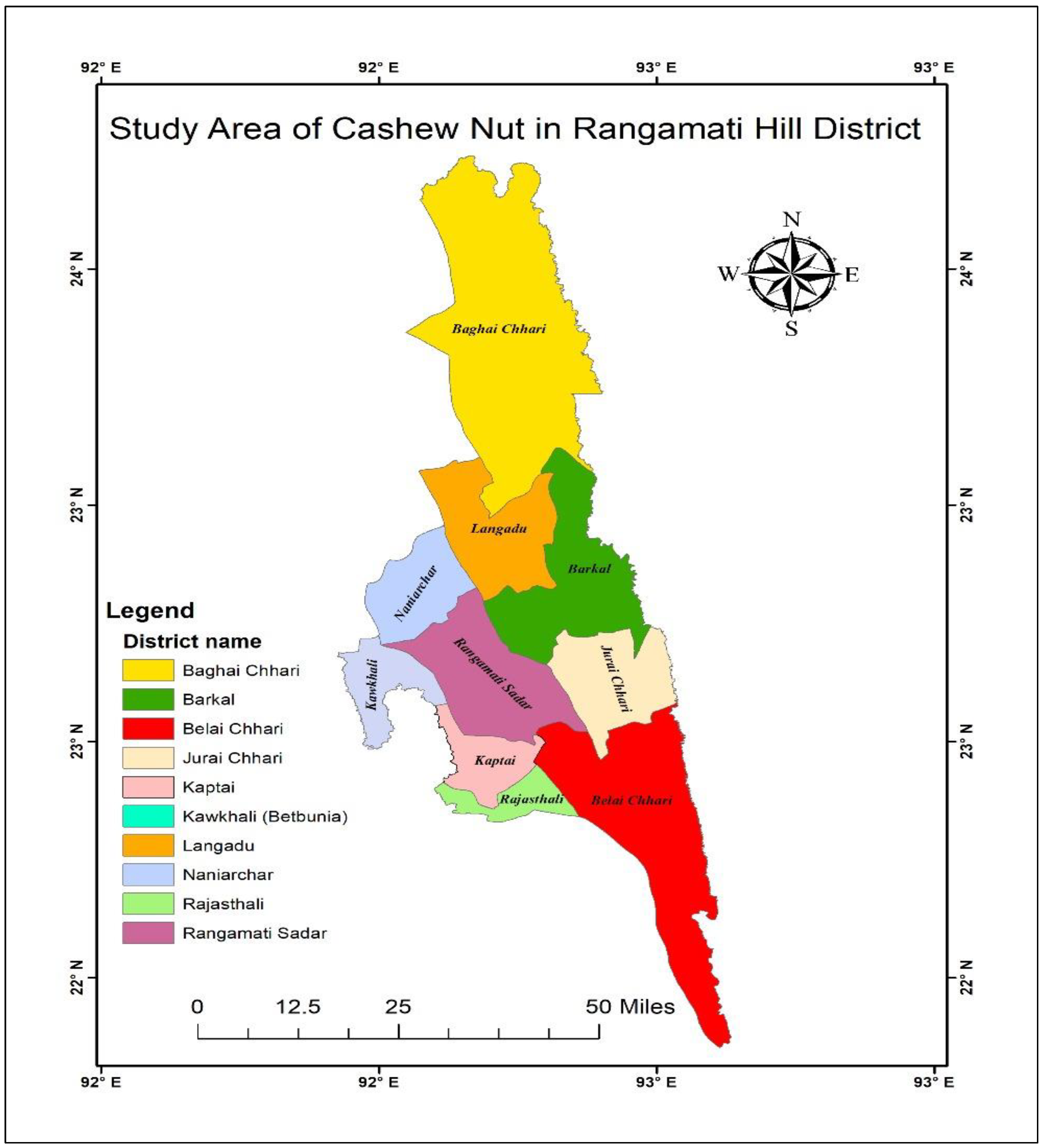
Cashew nuts may be farmed in all types of soil in Bangladesh. Heavy sandy loam soil is the best ideal for cashew nut farming. It grows well in rich red soil on steepy hills, which are often observed in three hill areas of Bangladesh. Therefore, like the other two hill districts, Rangamati hill district too offers significant potential for cashew nut farming. Hence, on the basis of higher concentration of cashew nut farming, out of 10 upazilas of Rangamati, eight upazilas were chosen for the study. Those upazilas were Bagaichhari, Barkal, Belaichhari, Juraichhari, Kawkhali, Langadu, Naniarchar and Rangamati Sadar. The rationale behind not picking the two upazilas was the paucity of data. The map of Rangamati Hill District is presented below:
Map 1.
Map of Rangamati Hill Tract District, Bangladesh.
2.2. Sources of Data
While working on a field study of cashew nut cultivation, it was believed that there was a lot of field surveying, research, and study should be necessary in the field of cashew nut cultivation in Bangladesh. Though there was a lot of work to be done in nations like India, Vietnam, Cambodia, Benin and Nigeria etc. This paper was designed to be one of the important endeavors in this sector of Bangladesh. In this chapter, the researcher explored the sources of data, region of the study, selection of respondents and time of the study, data processing and data analysis.
The sources of data of the study were simultaneously primary and secondary. Primary data are obtained through personal interviews and questionnaires, assuring data propriety and authenticity. They developed a welcoming environment for respondents to voice viewpoints, outlined the study’s aims, and guaranteed it was academically done without damage. They also paid attention to cashew nuts growers’ emotions throughout data collecting. Additionally, The study utilized secondary data from various sources, including articles, books, papers, journals, and newspapers, to gather information on cashew nut cultivation, including information from various ministries, agencies, and organizations like the Ministry of Agriculture and Department of Agricultural Extension.
2.3. Selection of Respondents and Period of the Study
The most crucial aspect of any research or study is the selection of the participants. Respondents were chosen for the current study in a way that would yield an unbiased outcome. It was unfortunate that owing to time and budget constraints, it was not able to research every farmer. But for the field survey, 60 farmers were chosen at random from eight upazilas in the Rangamati Hill District. Two respondents had business as their primary employment, and 58 respondents had agriculture as their primary occupation.
The study’s data collection period was 2 months. For this study, all of the data were available at the time of data collection.
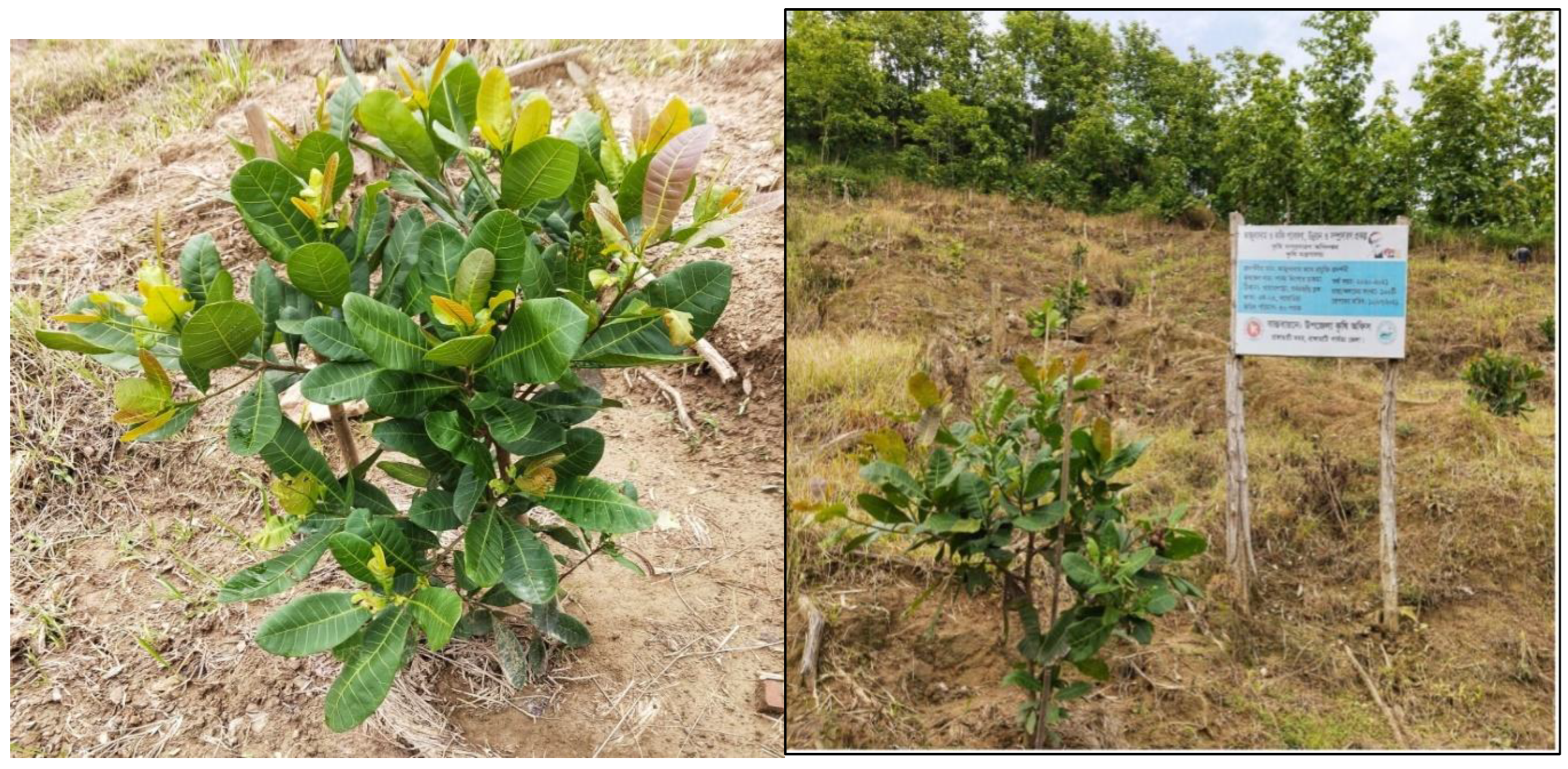
Figure 1 & 2.
Cashew Sapling and Cashew Saplings Cultivated Land.
2.4. Processing and Analysis of Data
Following the completion of data collecting, data analysis was the next stage. For analysis in this study, Microsoft Word and Excel were utilized.
3. Result & Discussion
3.1. Profile of the Respondents
The socioeconomic standing of the farmers greatly influences the level of output. The goals of the research must be assessed in the succinct presentation of the farmers’ situation. According to the respondents’ age, gender, education level, marital status, primary employment, number of years of farming experience, family income, engagement in the agricultural industry, and quantity of arable land they own, their socioeconomic position was assessed.
3.1.1. Farming Experience of the Respondents
The study found that farming experience significantly impacts a farmer’s productivity. 31.67% of farmers had 11-20 years of experience, while 30% had 21-30 years and 26.67% had 0-10 years. The most experienced farmer was 10% with 31-40 years of experience, and only 1.67% had no experience. This highlights the importance of farming experience in enhancing a farmer’s output.

Table 1.
Farming Experience of the Respondents.
| Farming Experience (Year) | No. of Respondents | Percentage |
|---|---|---|
| 1 to 10 | 15 | 26.67% |
| 11 to 20 | 19 | 31.67% |
| 21 to 30 | 19 | 30.00% |
| 31 to 40 | 6 | 10.00% |
| No Experience | 1 | 1.67% |
| Total | 60 | 100% |
3.1.2. Monthly Income of the Respondents
According to the survey, 60% of participants had monthly incomes between 11000 and 15000 Tk, 20% had incomes between 16000 and 20,000 Tk, 7% had incomes between 6000 and 10,000 Tk, 4% had incomes between 21000 and 25,000 Tk, and 1.67% belonged to the lower income category, which included 20% with incomes between 16000 and 20,000 Tk and 7% with incomes between 6000 and 10,000 Tk.
Table 2.
Monthly Family Income.
| Monthly Family Income (Tk.) | No. of Respondents | Percentage |
|---|---|---|
| 0-5000 | 1 | 1.67% |
| 6000-10000 | 7 | 11.67% |
| 11000-15000 | 36 | 60.00% |
| 16000-20000 | 12 | 20.00% |
| 21000-25000 | 4 | 6.67% |
| Total | 60 | 100% |
3.1.3. Involved Agricultural Sectors of the Respondents
The data reveals that the majority of respondents in the agricultural sector, specifically paddy, comprised of 30 respondents, accounting for 50% of the total, while tobacco had the lowest number of respondents, accounting for only 1.67%.
Table 3.
Involved Agricultural Sectors of the Respondents.
| Involved Agricultural Sectors | No. of the Respondents | Percentage |
|---|---|---|
| Paddy | 30 | 50.00% |
| Jum | 11 | 18.33% |
| Fruit | 2 | 3.33% |
| Turmeric | 3 | 5.00% |
| Ginger | 2 | 3.33% |
| Teak Wood | 5 | 8.33% |
| Agar Wood | 3 | 5.00% |
| Rubber Plant | 3 | 5.00% |
| Tobacco | 1 | 1.67% |
| Total | 60 | 100% |
3.2. Influencing Factors on Present Condition and Cost of Cashew Nut Cultivation
The current state and important aspects of cashew nut cultivation are the main subjects of this chapter’s research. These include the origins of the cashew cultivation concept, determining factors, land selection types, cashew sapling sources, cashew sapling prices, total cultivation area, number of planted saplings, minimum and maximum number of saplings, number of care times, and overall production costs. The following summarizes the discussion and findings:
3.2.1. Sources of the Idea of the Cashew Nut Cultivation of the Respondents
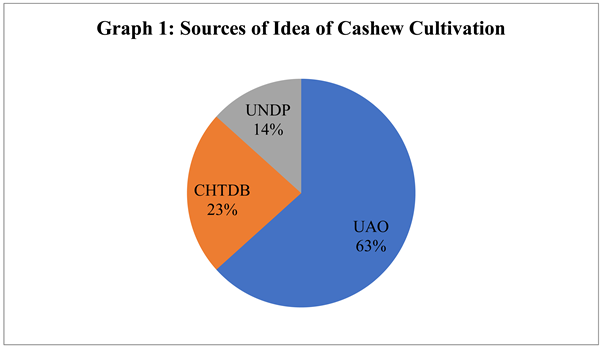
The data reveals that UAO had the highest number of respondents, accounting for 63% of the total, followed by CHTDB with 14 respondents, accounting for 23%, and UNDP with 8 respondents, accounting for 14.0%. The second highest source was CHTDB, with 14 respondents. The lowest source was UNDP, with 8 respondents.
3.2.2. Influential Factors of Cultivating Cashew Nu
According to the statistics, out of 60 responders, “Finds Profitable” had the most influence, making up 52.0% of the total. With 25.0% of the total, “Market Demand” was the second most important element. With 15.0% of the total, “Less Effort” was the third most important factor. With 8.00% of the total, “Low Transportation Hassle” was the least significant contributing factor.
Table 4.
Influential Factors of Cultivating Cashew Nut.
| Influential Factors | No. of the Respondents | Percentage |
|---|---|---|
| Finds Profitable | 31 | 52% |
| Market Demand | 15 | 25% |
| Less Effort | 9 | 15% |
| Low Transportation Hassle | 5 | 8% |
| Total | 60 | 100% |
3.2.3. Types of Land in Selected Area
In Bangladesh, cashew nuts can be grown on any kind of ground, although they thrive on sloping hilly terrain. According to our survey, almost 63.33% of the participants grew cashew nuts on steep hills. Approximately 33.3% of those surveyed grew cashew nuts on hillocks. Cashew nuts were grown on plain terrain by only roughly 3.33% of respondents.
Table 5.
Types of Land in Selected Area.
| Types of Land | No. of Respondents | Percentage |
|---|---|---|
| Steep Hill | 38 | 63.33% |
| Hillock | 20 | 33.33% |
| Plain Land | 2 | 3.33% |
| Total | 60 | 100% |
3.2.4. Sources of Cashew Sapling
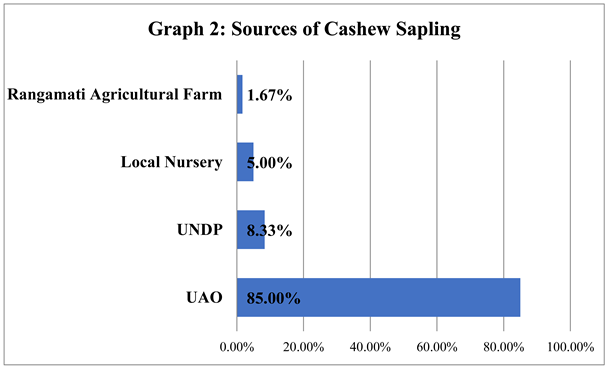
The information about 60 respondents’ sources and the proportion that corresponds to them is summarized here. UAO was the source with the most responders, accounting for 85.00% of the total with 51 responses. UNDP was the source with the second-highest number of responders, accounting for 5.3% of the total. Local Nursery had three respondents, or 5.00% of the total, making it the source with the third-highest number of respondents. Rangamati Agriculture Farm had the fewest respondents (1 respondent, or 1.67% of the total), out of all the sources.
3.2.5. Total Area of Cultivation
The study reveals that 25 respondents used 0.50 acres, representing 41.67% of the total land area, followed by 19 respondents using 0.60 acres, representing 31.67%. The least common total acreage used was 2 acres, used by 10.00% of respondents.
Table 6.
Total Area of Cultivation.
| Total Area | No. of the Respondents | Percentage |
|---|---|---|
| 0.50 Acre | 25 | 41.67% |
| 0.60 Acre | 19 | 31.67% |
| 0.80 Acre | 3 | 5.00% |
| 1 Acre | 7 | 11.67% |
| 2 Acre | 6 | 10.00% |
| Total | 60 | 100% |
3.2.6. Times of Taking Care in a Year
The respondents’ frequency of caring for the planted saplings is shown in this table. 26 (43%), the majority of responders, said they cared for their saplings three times a year, while 23 (39%) said they cared for them twice a year. Just two respondents, or 3% of the total, said that taking care was not necessary.
Table 7.
Times of Taking Care in a Year.
| Times of Taking Care in a Year | No. of the Respondents | Percentage |
|---|---|---|
| 2 Times | 23 | 39% |
| 3 Times | 26 | 43% |
| 4 Times | 9 | 15% |
| Not Required | 2 | 3% |
| Total | 60 | 100% |
3.2.7. Total Cost of Cashew Cultivation
The respondents’ share of the overall cost of caring for the planted saplings is shown in this table. 34 (56.67%) of the respondents, or the majority, said they spent between 11,000 and 15,000 Taka on caring for their saplings. Fifteen (25.00%), the second-highest percentage of respondents, said they had spent between 16,000 and 20,000 Taka. Just three (5.00%) of the respondents, the fewest, said they had spent between 21,000 and 25,000 Taka.
Table 8.
Total Cost of Cashew Cultivation.
| Total Cost (Tk.) | No. of the Respondents | Percentage |
|---|---|---|
| 6,000-10,000 | 8 | 13.33% |
| 11,000-15,000 | 34 | 56.67% |
| 16,000-20,000 | 15 | 25.00% |
| 21,000-25,000 | 3 | 5.00% |
| Total | 60 | 100% |
3.2.8. Economic Profitability Analysis of Cashew Nut Cultivation
Cashew nut farming has evolved as a successful agricultural industry in the Rangamati Hill District of Bangladesh, bringing great economic viability and potential for rural development.
Local farmers, particularly those in Indigenous communities, are becoming more interested in cashew nut farming due to the region’s favourable agroclimatic conditions. Cashew nut farming is economically profitable due to low input costs and high demand for cashew nuts domestically and internationally. Growing consumer awareness of cashew nuts’ nutritional benefits and use in various culinary fields has propelled the domestic market in Bangladesh. The yearly demand for cashew nuts in Bangladesh is 10,000 metric tons. However, only about 30% of this need is satisfied by local production (BBS, 2022). Moreover, cashew nuts are subject to a 25% import tax administered by Bangladesh’s National Board of Revenue (NBR), encouraging domestic production to reduce dependence on imports (GoB, 2023). Farmers in Rangamati and other areas have been encouraged to increase cashew nut farming by this tax scheme. In Bangladesh, the domestic price varied between BDT 500 and BDT 600 per kilogram. The manufacturing cost until market launch is between 300 and 350 BDT, allowing farmers to benefit at a rate of 95-100%.
4. Conclusions
There is no doubt that the cashew can be one of the leading cash crops in our country. Its popularity and value are recognized around the world. The study found several challenges and high potential in the field study. Traditional cashew cultivation and local cashew processing have been practised in Rangamati. However, farmers and traders have not got the right price due to a lack of quality processing facilities and another one is lack of proper training for cashews. Subsequently, quality seeds or seedlings, insect infestations on seedlings and fruits, improper packaging of seedlings, and processing facilities have hampered the potential of cashew cultivation. Commercial cultivation can be possible in Rangamati Hill District by overcoming those challenges, and farmers are so ambitious that it will be a profitable crop for them. However, proper planning, effective policy implications and management should be the first conditions to make it a reality. Moreover, the government and non-governmental agencies should also step forward to ensure these operations and patronize the farmers by providing the financial, physical, and other required facilities. To implement those facilities, responsible authorities should pay attention to protecting ecosystems, sustainably managing the forests, and reverse land degradation. Thus, commercial cashew cultivation can be a promising and profitable crop for farmers and contribute to the GDP growth of a country.
References
- Agbongiarhuoyi, A. E., Uwagboe E. O.1, Agbeniyi S. O.1, Famuyiwa B. S.1, Shittu T. R. (2020). Analysis of Farmers’ Cashew Nuts Marketing Channels and Information Frequency: Implications for Cashew Sustainability in Nigeria. World Rural Observation. https://http//www.sciencepub.net/rural/wro120320/02_36755wro120320_23_30.pdf.
- Akhigbe-Ahonkhai, E. C., Adebanjo O. A., Balogun E. O, Sanusi H. T. (2024). Economic analysis of cashew nut production in Saki East Local Government Area, Oyo State, Nigeria. UNIZIK Journal of Agricultural Economics and Extension (UJAEE), 1(2), 288–295. https://journals.unizik.edu.ng/ujaee.
- Bangladesh Bureau of Statistics (BBS). (2022). Annual Report on Agricultural Production and Trade. Dhaka: Government of Bangladesh.
- Eze, A. V., Macharia, I., & Ngare, L. (2023). Economic viability of value-added cashew products processed in Southeast zone, Nigeria. Heliyon, 9(1), e12791. [CrossRef]
- Islam, M. M., Islam, M. M., Sultana, Z., & Mannan, M. A. (2022). PRESENT STATUS, PROSPECTS AND PROBLEMS OF CASHEW CULTIVATION IN BANGLADESH. Food and Agribusiness Management, 3(2), 53–62. [CrossRef]
- National Board of Revenue (NBR). (2023). Customs and Import Tax Policy. Dhaka: Government of Bangladesh.
- (2009). Socio-Economic impact of cashew cultivation in Cuddalore District of Tamil Nadu-An Overview. https://epubs.icar.org.in/index.php/IJEE/article/view/124499.
Disclaimer/Publisher’s Note: The statements, opinions and data contained in all publications are solely those of the individual author(s) and contributor(s) and not of MDPI and/or the editor(s). MDPI and/or the editor(s) disclaim responsibility for any injury to people or property resulting from any ideas, methods, instructions or products referred to in the content. |
© 2025 by the authors. Licensee MDPI, Basel, Switzerland. This article is an open access article distributed under the terms and conditions of the Creative Commons Attribution (CC BY) license (http://creativecommons.org/licenses/by/4.0/).
Copyright: This open access article is published under a Creative Commons CC BY 4.0 license, which permit the free download, distribution, and reuse, provided that the author and preprint are cited in any reuse.


