

Submitted:
11 January 2025
Posted:
13 January 2025
You are already at the latest version
Abstract
Background Dietary interventions significantly influence lipid profiles, which are key risk factors for cardiovascular disease. Understanding the impact of various dietary patterns can guide effective strategies to improve lipid profiles and reduce cardiovascular risk. Objectives This systematic review aims to evaluate the effectiveness of dietary interventions in improving lipid profiles. Methods ● Search Strategy: Articles published up to July 31, 2023, were identified using PubMed and Google Scholar. ● Inclusion Criteria: Studies examining the relationship between dietary interventions and lipid profiles. ● Review Process: The review followed PRISMA (Preferred Reporting Items for Systematic Reviews and Meta-Analyses) guidelines. Results ● Impact of Dietary Composition: ○ Diets high in saturated fats and cholesterol were linked to elevated low-density lipoprotein (LDL) cholesterol levels.(Sacks et al., 2017). ○ Diets rich in fruits, vegetables, whole grains, and lean proteins were associated with reduced LDL cholesterol and increased high-density lipoprotein (HDL) cholesterol.(Rodríguez-López et al., 2021). ○ Ketogenic diets, characterized by low carbohydrate and high fat, showed a potential increase in LDL cholesterol.(Schwingshackl & Hoffmann, 2014). ● Effectiveness of Specific Diets: ○ The Mediterranean diet and the Dietary Approaches to Stop Hypertension (DASH) diet emerged as effective dietary patterns for improving lipid profiles.(Davis et al., 2017; Rodríguez-López et al., 2021) ○ These diets prioritize plant-based foods, lean proteins, and healthy fats while minimizing saturated and trans fats.(Sacks et al., 2017). ● Individual Variability: ○ The effectiveness of dietary interventions varies based on factors such as age, sex, and medical history.(Berryman et al., 2017; Maki et al., 2018). Conclusion Dietary interventions are non-invasive and cost-effective strategies to improve lipid profiles and reduce cardiovascular disease risk. However, these interventions should be tailored to individual needs and conducted under the guidance of healthcare professionals. Further research is required to assess the long-term effects of dietary modifications on lipid profiles.
Keywords:
Introduction
Background
Methods
- Objective
- Systematic Literature Search and Study Selection
- Inclusion and Exclusion Criteria
- Search Strategy
- Quality Appraisal
- Data Extraction and Synthesis
Results
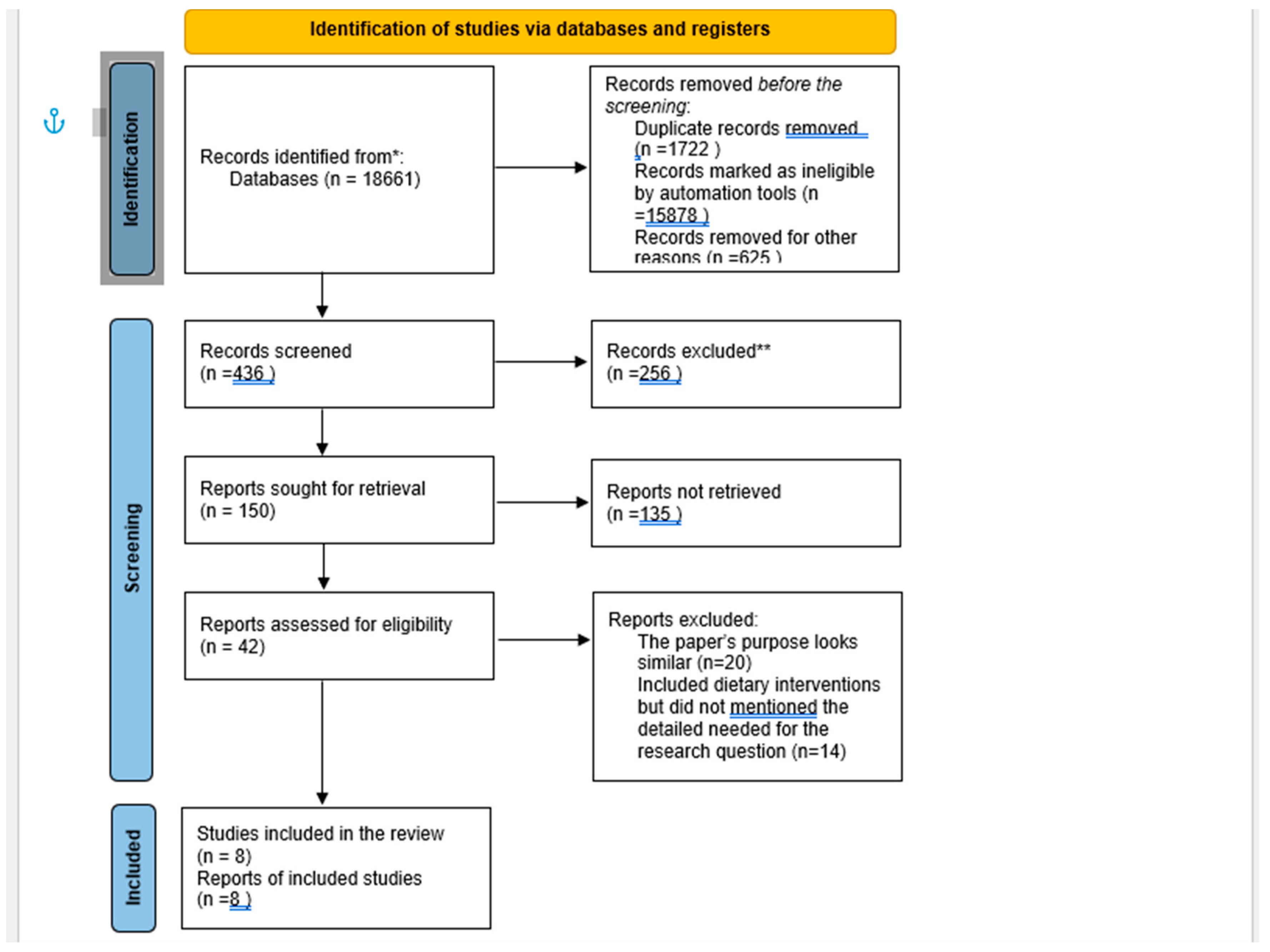
- Study Selection Process
- Summary of Selected Studies
- Key Findings
- 1.
- Dietary Patterns: Several dietary interventions, such as the Mediterranean diet, DASH diet, and low-carbohydrate, high-fat diets, demonstrated improvements in lipid profiles, including reductions in LDL-C, total cholesterol, triglycerides, and non-HDL-C.(Davis et al., 2017; Rodríguez-López et al., 2021).
- 2.
- Specific Foods: Incorporating foods such as walnuts, almonds, high-glucoraphanin broccoli, and corn oil contributed to better lipid profiles. (Bamberger et al., 2017; Maki et al., 2018).
- 3.
- Nutrient Composition: Diets emphasizing healthy fatty acids, reduced saturated fats, and increased intake of micronutrients like folate and vitamin C showed consistent benefits.(Berryman et al., 2017; Aptekmann & Cesar, 2013).
Discussion
Limitations
Conclusion
References
- Aptekmann, N. P. , & Cesar, T. B. (2013). Long-term orange juice consumption is associated with low LDL-cholesterol and apolipoprotein B in normal and moderately hypercholesterolemic subjects. Lipids in Health and Disease, 12. [CrossRef]
- Armah, C. N. , et al. (2015). Diet rich in high-glucoraphanin broccoli reduces plasma LDL cholesterol: Evidence from randomised controlled trials. Molecular Nutrition & Food Research, 59. [CrossRef]
- Bamberger, C. , et al. (2017). A walnut-enriched diet reduces lipids in healthy Caucasian subjects, independent of recommended macronutrient replacement and time point of consumption: A prospective, randomized, controlled trial. Nutrients, 9. [CrossRef]
- Berryman, C. E. , Fleming, J. A., & Kris-Etherton, P. M. (2017). Inclusion of almonds in a cholesterol-lowering diet improves plasma HDL subspecies and cholesterol efflux to serum in normal-weight individuals with elevated LDL cholesterol. Journal of Nutrition, 147. [CrossRef]
- Burén, J. , et al. (2021). A ketogenic low-carbohydrate high-fat diet increases LDL cholesterol in healthy, young, normal-weight women: A randomized controlled feeding trial. Nutrients, 13. [CrossRef]
- Davis, C. R. , et al. (2017). A Mediterranean diet reduces F(2)-isoprostanes and triglycerides among older Australian men and women after 6 months. Journal of Nutrition, 147, 1355. [Google Scholar] [CrossRef]
- Maki, K. C. , et al. (2018). Corn oil lowers plasma cholesterol compared with coconut oil in adults with above-desirable levels of cholesterol in a randomized crossover trial. Journal of Nutrition, 148, 1563. [Google Scholar] [CrossRef]
- Rodríguez-López, C. P. , et al. (2021). DASH diet as a proposal for improvement in cellular immunity and its association with metabolic parameters in persons with overweight and obesity. ( 13(10), 3517. [CrossRef]
- Schwingshackl, L. , & Hoffmann, G. (2014). Low-carbohydrate diets and cardiovascular risk factors: A meta-analysis of randomized controlled trials. British Journal of Nutrition, 110(7), 1178–1187. [CrossRef]
- Sacks, F. M. , Lichtenstein, A. H., Wu, J. H., Appel, L. J., Creager, M. A., Kris-Etherton, P. M., Miller, M.,... & Van Horn, L. V. (2017). Dietary fats and cardiovascular disease: A presidential advisory from the American Heart Association. Circulation, 136(3), e1–e23. [CrossRef]

| Inclusion Criteria | Exclusion Criteria |
|---|---|
| Clinical trials, meta-analyses, randomized controlled trials, reviews, and systematic reviews | Books, documents, or non-peer-reviewed sources |
| Free full-text availability | Studies with only abstracts available |
| Published between 2013–2023 | Studies published before 2013 |
| Human studies | Non-human studies |
| English-language publications | Non-English publications |
| Gender: Male and female | Gender not specified |
| Age ≥ 19 years | Age ≤ 19 years |
| Database | Search Strategy | Search Results |
|---|---|---|
| PubMed | Effects lipid OR LDL OR cholesterol OR diet modification | 1,761 |
| Google Scholar | Diet lipid, LDL, HDL, cholesterol AND diet OR diet modification | 16,900 |
| Quality Appraisal Tool | Study Design |
|---|---|
| Cochrane Bias Tool Assessment | Randomized Controlled Trials |
| Newcastle-Ottawa Tool | Non-Randomized and Observational Studies |
| PRISMA Checklist | Systematic Reviews |
| SANRA (Scale for the Assessment of Narrative Review Articles) | Narrative Reviews |
| CASP (Critical Appraisal Skills Program) Checklist | Qualitative Studies |
| Author/Year | Country | Study Design | Database Used | Conclusion |
|---|---|---|---|---|
| Apetakmann, N.P. (Year) | England | Clinical Trial | Google Scholar | Long-term orange juice users had reduced total cholesterol, LDL cholesterol, apo B, and LDL/HDL ratios, as well as higher intakes of folate and vitamin C. |
| Armah, C.N. (Year) | Germany | Randomized Controlled Trial | PubMed | High-glucoraphanin broccoli consumption significantly lowered plasma LDL-C in two independent investigations. |
| Bamberger, C. (Year) | Switzerland | Randomized Controlled Trial | PubMed | Walnut consumption reduced non-HDL-C, apo B, TC, LDL-C, VLDL-C, TG, and VLDL-TG levels. |
| Berryman, C.E. (Year) | USA | Randomized Controlled Trial | PubMed | A diet low in saturated fat that includes almonds enhanced HDL subspecies, specifically halting declines in -1 HDL caused by a low-fat diet. |
| Buren, J. (Year) | Switzerland | Randomized Controlled Trial | PubMed | A low-carbohydrate, high-fat diet rich in healthy fatty acids reduced blood lipids in young women after four weeks of consumption. |
| Davis, C.R. (Year) | Australia | Randomized Controlled Trial | PubMed | Older Australians following the Mediterranean diet for six months exhibited significant reductions in TG and F2-IsoP levels. |
| Maki, K.C. (Year) | USA | Randomized Crossover Trial | PubMed | Adults with high cholesterol consuming less than 54 grams of corn oil per day had a better plasma lipid profile than those consuming coconut oil. |
| Rodriguez-Lopez, C.P. (Year) | Switzerland | Clinical Trial | PubMed | The DASH diet improved glucose levels, total cholesterol, LDL-C, TG, waist circumference, and systolic blood pressure. |
Disclaimer/Publisher’s Note: The statements, opinions and data contained in all publications are solely those of the individual author(s) and contributor(s) and not of MDPI and/or the editor(s). MDPI and/or the editor(s) disclaim responsibility for any injury to people or property resulting from any ideas, methods, instructions or products referred to in the content. |
© 2025 by the authors. Licensee MDPI, Basel, Switzerland. This article is an open access article distributed under the terms and conditions of the Creative Commons Attribution (CC BY) license (http://creativecommons.org/licenses/by/4.0/).


