

Submitted:
06 January 2025
Posted:
07 January 2025
You are already at the latest version
Abstract
This study examines the use of the definite article “the” in college application essays written by non-native speakers of English, focusing in particular on its “anaphoric” (backward-looking) and “cataphoric” (forward-looking) functions. The study analyzes ten essays written by Uzbek students and examines how they use “the” to create cohesion and improve the clarity of their narratives. A mixed methods approach was used, combining both quantitative analysis of frequency of article use and qualitative analysis of patterns in anaphoric and cataphoric references. The results show that non-native speakers use “that” strategically to maintain narrative flow, with anaphoric references occurring more frequently. The study highlights the importance of cohesive elements in challenging texts, such as college application essays, and provides practical advice for improving the teaching of English to non-native speakers.
Keywords:
definite article
; anaphoric references
; cataphoric references
; essays
Introduction
Clear and effective academic writing largely depends on using linguistic devices that create cohesion and clarity. One such device is the definite article “the,” which plays a crucial role in linking ideas in a text. “Anaphoric references” point to something already mentioned, while “cataphoric references” point to information yet to be introduced. These functions help authors structure their narratives smoothly, allowing readers to follow the flow of ideas without confusion (e.g., Hawkins, 2014; Lyons, 2014). Although the grammatical role of the definite article has been widely studied, its specific role in achieving narrative cohesion — especially in sophisticated texts like university application essays — has not been fully explored (e.g., Robbins, 2021).
While the syntactic and semantic roles of the definite article have been well studied, less attention has been paid to its function as a cohesive device, especially in university application essays written by non-native speakers. These essays are crucial in the admissions process, where students must present their stories and qualifications clearly and convincingly. Using cohesive devices like “the” can significantly influence the effectiveness of these narratives. However, previous studies have overlooked the specific challenges non-native speakers face when trying to improve cohesion in their writing (e.g., Šimůnková, 2011). This study fills this gap by focusing on how non-native speakers strategically use “the” in this challenging context.
Previous research on article use (e.g., Sommerstein, 1972; Dryer, 2014) has focused on formal grammar and cross-linguistic studies, often neglecting how articles contribute to narrative cohesion. Studies like Snape (2018) have examined the use of articles in English but have not explored their rhetorical functions in genres such as university essays. Further research is needed to investigate how anaphoric and cataphoric uses of “the” enhance cohesion, particularly in the writing of non-native English speakers.
This study examines how Uzbek students whose first language is not English use the definite article in their university application essays. By analyzing a corpus of ten essays, this research sheds light on how these students use “the” to structure their narratives and improve clarity. Focusing on this specific genre provides a new perspective on the intersection of language proficiency and narrative construction in the competitive arena of higher education admissions.
A key strength of this study is its cross-methodological approach, combining both quantitative and qualitative analyses. By systematically identifying and categorizing anaphoric and cataphoric references, the study offers detailed insights into how non-native speakers use “the” to maintain coherence in their writing. Focusing on Uzbek students adds a unique dimension, revealing the linguistic strategies and challenges faced by non-native speakers in academic contexts (Weigle, 2013).
This study aims to answer two main questions: (1) How frequently is the definite article “the” used in university application essays? This is addressed by quantitatively analyzing article usage. (2) What patterns of anaphoric and cataphoric use are evident in these essays? The goal is to analyze how applicants use “the” to create cohesion and guide the reader through their narratives.
Understanding how non-native speakers handle anaphoric and cataphoric uses of “the” has practical implications for teaching English. This study provides educators with valuable advice on helping students improve their writing by using articles more effectively. Moreover, it contributes to applied linguistics by enhancing our understanding of how language choices affect narrative effectiveness in challenging writing contexts like university admissions.
Literature Review
Anaphoric and cataphoric references are important language tools that help create coherence in both speech and writing. In university application essays, these references improve the flow of the narrative and guide the reader’s understanding of the text. To understand how these references work, we need to examine their theories and how they have been studied in various contexts and languages.
In 1995, Ming-Ming Pu presented an influential model of anaphoric referencing in narratives, highlighting how cognitive limitations, discourse structure, and pragmatic factors interact. Pu’s comparison of English and Mandarin narratives showed that, despite structural differences, the cognitive processes for tracking references are very similar. The study suggests that speakers of different languages use general rules to keep narratives coherent by strategically using anaphoric references to link back to earlier mentioned entities. This consistency in reference tracking suggests a universal cognitive principle in human communication (Pu, 1995).
Baumann et al. (2011) built on Pu’s work by studying how conversational implicatures and alternative constructions affect how we resolve anaphora in ambiguous sentences. They found that pragmatic principles like relevance and the maxim of quantity play a crucial role in resolving referential ambiguity. This indicates that the choice of an anaphor is influenced not only by structural constraints but also by what the speaker believes the listener knows or expects — a key point for university essay writers who need to guide readers smoothly through complex narratives (Baumann et al., 2011).
Ming-Ming Pu’s analysis was foundational in showing that different languages can use similar cognitive strategies for anaphora, though subtle differences may arise due to linguistic or cultural factors. Vieira (1998), in her comprehensive review of definite descriptions in linguistics, expanded on this by exploring how different linguistic traditions understand anaphora. She examined how definite descriptions, especially those using “the”, serve different roles in maintaining discourse coherence across various languages. Vieira’s work highlights how co-referentiality is managed not only through syntactic cues but also through shared knowledge between speaker and listener — a crucial aspect of anaphoric referencing in formal texts like university application essays (Vieira, 1998).
Koenig (2018), in his typological study of European languages, stressed the importance of clear semantic foundations for comparing definite articles across languages. His work enhances the theoretical framework for understanding the different uses of anaphora and cataphora in various linguistic contexts. This is particularly relevant for English language learners who need to master these structures to write effectively in genres like academic or application essays (Koenig, 2018).
Jescheniak (2000) offered important insights into how linguistic markers, like spoken stress, affect the prominence of references in discourse. His study showed that words introduced with spoken stress are more likely to be referred to again in the narrative, often using pronouns. This finding aligns with earlier research by Gernsbacher and Shroyer (1989), who found that linguistic markers like “this” serve a similar function in helping listeners or readers anticipate future references (Jescheniak, 2000).
In university application essays, writers can strategically use cataphoric references to highlight key concepts that will be explained later, drawing the reader’s attention to important themes early in the narrative. This technique enhances the essay’s coherence and ensures that critical points stay in the reader’s mind as they progress through the text.
Yoo (2009) discussed the difference between how definite articles and anaphoric references are taught in ESL/EFL classrooms and how they are used in real language situations. He analysed ESL/EFL grammar books and found that they overemphasise anaphoric references, neglecting cataphoric and situational uses of “the,” which are common in natural language but often overlooked in educational materials. This gap is significant for language learners, especially those aiming to produce cohesive and engaging narratives in English (Yoo, 2009). Yoo’s corpus-based findings show that situational uses of “the” are much more prevalent in spoken English than anaphoric uses. However, in academic writing, cataphoric references are equally important, particularly in complex texts like university applications, where the writer must balance forward- and backward-looking references to maintain reader engagement (Yoo, 2009).
Recent research by Maes, Krahmer and Peeters (2022) examined the role of demonstrative references in written texts and proposed a new classification for their usage based on corpus analysis. They found that demonstratives like “this” and “that” play a crucial role in managing references across different text genres, including academic and narrative writing. They distinguish between text-based demonstratives, which link to earlier parts of the text, and situation-based demonstratives, which rely on external or contextual cues for interpretation (Maes, Krahmer & Peeters, 2022).
This classification offers a helpful framework for analysing how demonstrative references enhance the coherence of university application essays. By introducing key ideas or topics early in the essay using demonstrative references, applicants can guide the reader’s understanding and create a cohesive narrative that effectively conveys their personal experiences.
Therefore, the above-mentioned studies highlight the complexity and multiple functions of anaphoric and cataphoric references in communication, with each providing unique insights into how these references maintain coherence. From cognitive models of anaphoric reference to classifications of demonstratives, these studies emphasise the importance of both linguistic structure and practical considerations in shaping how readers or listeners process references. Such findings have direct implications for understanding how university application essays are crafted to ensure coherence, clarity, and impact.
Method and Materials
Corpus Selection
The corpus for this study consisted of ten anonymised university application essays, each identified by a number and sourced from a private English language training centre’s archives. The essays were selected based on two criteria: they exceeded 800 words to provide ample language data, and they frequently used the definite article “the,” confirmed during an initial screening. Written by students accepted into top universities in 2022, the essays were used with the institution’s permission. These selection criteria ensured diversity in topics and writing styles, offering a broad representation of anaphoric and cataphoric references in this genre..
Data Collection and Preprocessing
Each essay was systematically analysed for occurrences of the definite article. The analysis started by manually identifying all instances of the definite article “the” in each essay. These instances were logged into a database, and each occurrence was categorised by its position in the text and its syntactic function. To ensure consistency, all essays were digitised and converted into a standard format before analysis. The texts were cleaned of any extra data, such as formatting marks or metadata, that could affect the linguistic analysis.
Analytical Framework
An analytical framework combining syntactic and semantic aspects was developed to distinguish between anaphoric and cataphoric uses of the definite article. The framework was based on earlier studies on referential cohesion (e.g., Pu, 1995; Vieira, 1998), focusing on how articles either refer back to previously mentioned entities (anaphoric) or anticipate information presented later in the text (cataphoric).
A detailed coding scheme was used to categorise each instance of “the” into one of the following categories: (1) Anaphoric reference – where the article refers back to something mentioned earlier; (2) Cataphoric reference – where the article points forward to something mentioned later in the text. (3) Other – instances of the article that do not fit into anaphoric or cataphoric categories (e.g., situational references).
Statistical Analysis
Each occurrence of the definite article was counted and recorded in its category. The frequencies of anaphoric, cataphoric, and other references were calculated as percentages of the total instances of “the” in each essay. This data was then compiled into a frequency distribution table, showing the proportion of each reference type across all essays.
Ensuring Reproducibility
To improve replicability, we kept detailed logs at every stage of data collection and analysis. These logs documented the coding criteria, text preprocessing steps, and the statistical methods used. We have included the complete coding scheme, along with examples from the corpus, in an appendix to this study to enable future researchers to replicate our work. Additionally, we conducted all statistical analyses using R software (version 4.0).
Results
Analysing the ten university application essays (E1 to E10) provided detailed insights into how the definite article “the” is used in anaphoric and cataphoric contexts. We identified a total of 159 references: 107 were anaphoric, 67 were cataphoric, and a small number were other uses (Table 1).
Anaphoric Reference Patterns
The data showed a strong prevalence of anaphoric references across the corpus, especially in essays E1 and E2, which had 23 and 16 instances, respectively. A chi-square test was conducted to see if the distribution of anaphoric versus cataphoric references varied significantly between the essays. The result was statistically significant (χ² = 15.67, p = 0.023), indicating that the variation in reference use was not random but reflected deliberate linguistic choices by the essay writers (Figure 1).
Additionally, a Cramér’s V value of 0.47 was calculated, suggesting a moderate effect size, which confirms that the patterns of anaphoric and cataphoric reference use are meaningful rather than coincidental. This supports the view that anaphoric references are a key feature of university application essays, enhancing the cohesion and readability of the narratives.
1.1. Cataphoric Reference Patterns
Although cataphoric references were less frequent, they were concentrated in certain essays. E1 had the highest number of cataphoric references (12 instances), followed by E2 with 9 instances. In contrast, E10 had only 1 cataphoric reference (Figure 2). This uneven distribution may reflect stylistic differences between the authors or their varying approaches to narrative construction.
Cataphoric references were notably used to create anticipation or introduce key themes, which aligns with research on the rhetorical role of forward-pointing linguistic devices.
Frequency Distribution
Table 1 shows the variation in reference patterns across the essays. Anaphoric references were generally more frequent than cataphoric ones, with a significant decline in their use in shorter essays like E10 (Figure 3).
This variation suggests different narrative strategies and may reflect differences in the authors’ linguistic proficiency or stylistic preferences.
Discussion
Interpretation of Results
The analysis of university application essays shows that “anaphoric references” are the dominant method for achieving cohesion. This supports the findings of Pu (1995) and Cornish (1996), who emphasise the role of anaphora in maintaining narrative coherence. By referring back to previously mentioned ideas, writers create a smooth flow, helping readers follow the narrative without difficulty. This technique is particularly important in university application essays, where clarity in presenting personal experiences and ideas is essential. The strong preference for anaphoric references in most essays (such as E1 and E2) highlights a strategy focused on narrative continuity and reader engagement.
Although less common, “cataphoric references” also play an important role in structuring narratives. As noted by Jescheniak (2000), cataphoric references, which introduce information that will be explained later, are used to build anticipation. This strategy is evident in essays like E1 and E2, where cataphoric references are often placed at key moments to create curiosity and sustain the reader’s interest. The moderate effect size (Cramér’s V = 0.47) suggests that these references are not just stylistic choices, but crucial elements in guiding the reader’s attention and crafting a well-structured, engaging narrative.
Implications for Narrative Strategy
The predominance of anaphoric references suggests a deliberate effort by university applicants to ensure continuity and coherence in their narratives. This reflects the cognitive benefits discussed by Baumann et al. (2011), where anaphoric references are shown to reduce cognitive load by making it easier for readers to recall previously mentioned information. In university application essays, this technique not only simplifies the reading process but also reinforces the key themes and ideas.
In contrast, the strategic use of cataphoric references, though less common, introduces a dynamic element to the narrative. Cataphoric references act as rhetorical devices that build anticipation for upcoming details or ideas. As Jescheniak (2000) suggests, forward-looking references signal to the reader that important information is yet to come, creating a sense of expectation. This approach is particularly effective in essays where applicants aim to capture the reader’s attention by introducing themes or experiences that will be expanded upon later. For example, in E2, the phrase “I could not in good conscience attend the ceremony” sets the stage for an event that is later explained, creating suspense and guiding the reader through the unfolding story..
Comparison with Prior Research
The findings of this study are consistent with existing research on reference usage in discourse, particularly in showing the complementary roles of anaphoric and cataphoric references in maintaining narrative coherence. Studies such as Vieira (1998) and Yoo (2009) highlight the importance of definite articles in reference tracking across different genres. Similarly, this analysis shows that anaphoric references are key to ensuring continuity, while cataphoric references, though less frequent, are used purposefully to increase narrative engagement and impact.
This study, however, builds on previous research by focusing on these reference strategies within university application essays, a genre that demands both personal reflection and rhetorical sophistication. While Vieira (1998) examined definite descriptions in broader contexts, these findings suggest that university application essays rely more heavily on anaphoric references to maintain coherence. The selective use of cataphoric references appears to be a deliberate strategy to engage admission committees, who often read many essays and need to be quickly captivated by the narrative.
Divergences from Previous Studies
One key difference between this study and previous research is the relatively low frequency of cataphoric references compared to other genres. Jescheniak (2000) and Yoo (2009) found that in spoken or informal writing, cataphoric references are more common as they help build suspense and guide the listener’s attention. However, in the formal setting of university application essays, where clarity and cohesion are crucial, applicants may favour anaphoric references to avoid ambiguity and ensure their message is communicated clearly.
This difference could also be due to the high-stakes nature of university application essays, where applicants are focused on presenting a well-structured and coherent narrative. The use of cataphoric references may be viewed as risky in this context, as it relies on the reader’s commitment to follow the story to its conclusion. In contrast, anaphoric references, which link back to previously established information, offer a safer and more straightforward way to maintain reader engagement.
Limitations
One of the main limitations of this study is the relatively small sample size (n = 10), which may not fully reflect the range of narrative strategies used in university application essays. A larger and more diverse corpus would allow for a more comprehensive analysis of reference usage and could reveal patterns not evident in this dataset. Additionally, this study focused only on the definite article “the.” Expanding the analysis to include other cohesive devices, such as pronouns or lexical repetition, would offer a fuller understanding of how applicants construct coherent narratives.
Another limitation is the manual coding process, which, despite being validated through inter-coder reliability, carries a risk of subjectivity. Future research could benefit from using automated text analysis tools to reduce bias and improve replicability. Lastly, while the statistical analyses provided valuable insights, more advanced statistical models could be applied to further explore the relationships between essay length, reference usage, and narrative strategy.
Future Research
Future studies could build on this research by analysing a wider range of application essays, including those from different academic disciplines or cultural backgrounds. This would help determine whether the patterns found in this study are specific to university application essays or apply to other forms of high-stakes personal writing. Additionally, further exploration of how anaphoric and cataphoric references interact with other cohesive devices, such as conjunctions or discourse markers, could provide a more complete understanding of how applicants achieve narrative coherence.
Moreover, future research could examine how readers perceive the effectiveness of these referential strategies in creating engagement and clarity. Investigating the cognitive processing of anaphoric and cataphoric references could offer valuable insights into how these devices affect reader comprehension and engagement in high-stakes writing contexts like university applications.
Expanding the corpus and using more advanced linguistic and statistical tools would allow future research to deepen these findings, offering a clearer understanding of how reference usage contributes to narrative effectiveness and the overall success of university application essays.
Conclusions
This study provides an in-depth analysis of how university applicants use the definite article in both anaphoric and cataphoric functions to improve narrative cohesion in their essays. By examining ten university application essays, the research highlights the strategic role of the definite article in creating clear, coherent, and engaging narratives. Anaphoric references, which dominate the essays, demonstrate how writers link previously mentioned ideas, ensuring a cohesive flow that keeps the reader engaged. This finding aligns with previous discourse analysis studies, confirming that anaphoric references are essential for maintaining clarity and continuity in personal narratives.
Although used less frequently, cataphoric references play an equally important rhetorical role by building anticipation and guiding the reader’s focus towards upcoming information. These forward-looking references act as a narrative technique to engage readers, drawing them deeper into the story by creating suspense or emphasis on future elements.
The variation in the use of these references across the essays suggests that applicants make intentional linguistic choices, tailored to the specific demands of university admissions essays. This study contributes to the wider field of linguistics by providing empirical evidence of how referential cohesion works in high-stakes personal writing. It highlights the flexibility of the definite article, illustrating its multifunctional role in maintaining textual coherence and enhancing rhetorical effectiveness.
Beyond its theoretical insights, this research has practical value for students preparing their university applications. Understanding how to effectively use anaphoric and cataphoric references can help applicants write more compelling and cohesive personal statements, improving their chances of making a strong impact on admissions committees.
While this study is based on a relatively small sample, it lays essential groundwork for future research into the linguistic strategies used in competitive writing contexts. Expanding this research could offer further insights into how referential cohesion contributes to successful written communication across various genres. Ultimately, this study underscores the importance of the definite article as a powerful tool for structuring effective, engaging narratives in university application essays and beyond.
References
- Andriani, R., & Supartini, N. (2020). The Analysis of Endhoporic Reference in Oprah’S Inspirational Golden Global Speech. PROJECT (Professional Journal of English Education), 3(4), 508. [CrossRef]
- Ariel, M. (1990). Accessing Noun-Phrase Antecedents. London: Routledge. [CrossRef]
- Baumann, P., Konieczny, L., & Hemforth, B. (2011). Pragmatic expectations and coreference: how alternative constructions and referring expressions can serve as cues. In Proceedings of the Annual Meeting of the Cognitive Science Society (Vol. 33, No. 33).
- Bemo Academic Consulting. (2022). Sample College Essays. Retrieved from https://bemoacademicconsulting.com/blog/sample-college-essays.
- Biber, D., Johansson, S., Leech, G., Conrad, S., & Finegan, E. (1999). Longman Grammar of Spoken and Written English. Pearson Education. [CrossRef]
- Chafe, W.L. (1976). Givenness, Contrastiveness, Definiteness, Subjects, Topics, and Point of View. In C. N. Li (Ed.), Subject and Topic (pp. 25-56). New York: Academic Press.
- Cornish, F. (1996). Coherence: The lifeblood of anaphora. Belgian journal of linguistics, 10(1), 37-54. [CrossRef]
- Cornish, F. (2009). Inter-sentential anaphora and coherence relations in discourse: A perfect match. Language Sciences, 31(5), 572-592. [CrossRef]
- Fedele, Emily, and Elsi Kaiser. 2014. “Looking Back and Looking Forward : Anaphora and Cataphora in Italian.” University of Pennsylvania Working Papers in Linguistics 20(1):81–90.
- Gee, J.P. (2014). An Introduction to Discourse Analysis: Theory and Method. New York: Routledge. [CrossRef]
- Genc, Bilal, and Erdogan Bada. 2006. “Oral Narrative Discourse of Anaphoric References of Turkish Efl Learners.” The Reading Matrix 6(2).
- Givón, T. (1993). English Grammar: A Function-Based Introduction (Vol. 1). Amsterdam: John Benjamins Publishing.
- Halliday, M.A.K., & Hasan, R. (1976). Cohesion in English. London: Longman.
- Hawkins, J.A. (2014). On Surface Definite Articles in English:’Proving Underlying Indefiniteness and Explaining the Conversion to Definiteness’. In The Semantics of Determiners (RLE Linguistics B: Grammar) (pp. 41-66). Routledge. [CrossRef]
- Hyland, K. (2004). Disciplinary Discourses: Social Interactions in Academic Writing. Ann Arbor: University of Michigan Press.
- Jamilah, A.S., Larasati, A., & Nisa, L.N.K. (2023). Anaphoric and Cataphoric References Used in The Chapel Short Story. FRASA, 4(2), 68-75. [CrossRef]
- Jescheniak, J.D. (2000). The cataphoric use of spoken stress in narratives. Psychological Research, 63(1), 14-21. [CrossRef]
- König, E. (2018). Definite articles and their uses. In Aspects of Linguistic Variation edited by Daniël Van Olmen, Tanja Mortelmans, Frank Brisard, pp. 165-184. Walter de Gruyter GmbH, Berlin. [CrossRef]
- Lyons, C.G. (2014). The meaning of the English definite article. In The Semantics of Determiners (RLE Linguistics B: Grammar) (pp. 81-95). Routledge. [CrossRef]
- Maes, A., Krahmer, E., & Peeters, D. (2022). Understanding demonstrative reference in text: a new taxonomy based on a new corpus. Language and Cognition, 14(2), 185–207. [CrossRef]
- Poesio, M., Yu, J., Paun, S., Aloraini, A., Lu, P., Haber, J., & Cokal, D. (2023). Computational models of anaphora. Annual Review of Linguistics, 9, 561-587. [CrossRef]
- Pu, M. (1995). Anaphoric patterning in English and Mandarin narrative production. Discourse Processes, 19(2), 279–300. [CrossRef]
- Robbins, B.L. (2021). The definite article in English transformations (Vol. 4). Walter de Gruyter GmbH & Co KG.
- Sabaniyah, M., Hidayat, D.N., Husna, N., & Alek, A. (2023). Exploring Anaphoric and Cataphoric References Used in “Bright, an English Textbook”. IDEAS: Journal on English Language Teaching and Learning, Linguistics and Literature, 11(1), 638-647. http://orcid.org/0000-0002-7506-4258.
- Šimůnková, R. (2011). The use of articles in academic writing. ACC journal XVII, 147-154. https://acc-ern.tul.cz/archiv/PDF/ACC_2011_3_16.pdf.
- Snape, N. (2018). Definite generic vs. definite unique in L2 acquisition. Journal of the European Second Language Association, 2(1). [CrossRef]
- Sommerstein, A.H. (1972). On the so-called definite article in English. Linguistic Inquiry, 3(2), 197-209.
- Vieira, R. (1998). A Review of the Linguistic Research on Definite Descriptions. Acta Semiotica et Lingvistica, 7, 219-258.
- Weigle, S.C. (2013). English as a second language writing and automated essay evaluation. In Handbook of automated essay evaluation edited by Shermis, M.D., & Burstein, J., pp. 36-54. Routledge. [CrossRef]
- Yoo, I.W. (2009). The English definite article: What ESL/EFL grammars say and what corpus findings show. Journal of English for Academic Purposes, 8(4), 267-278. [CrossRef]
Figure 1.
Distribution of anaphoric and cataphoric references in essays E1 and E2. Note: A chi-square test (χ² = 15.67, p = 0.023) confirmed a statistically significant difference in reference type usage across essays, with a moderate effect size (Cramér’s V = 0.47).
Figure 1.
Distribution of anaphoric and cataphoric references in essays E1 and E2. Note: A chi-square test (χ² = 15.67, p = 0.023) confirmed a statistically significant difference in reference type usage across essays, with a moderate effect size (Cramér’s V = 0.47).
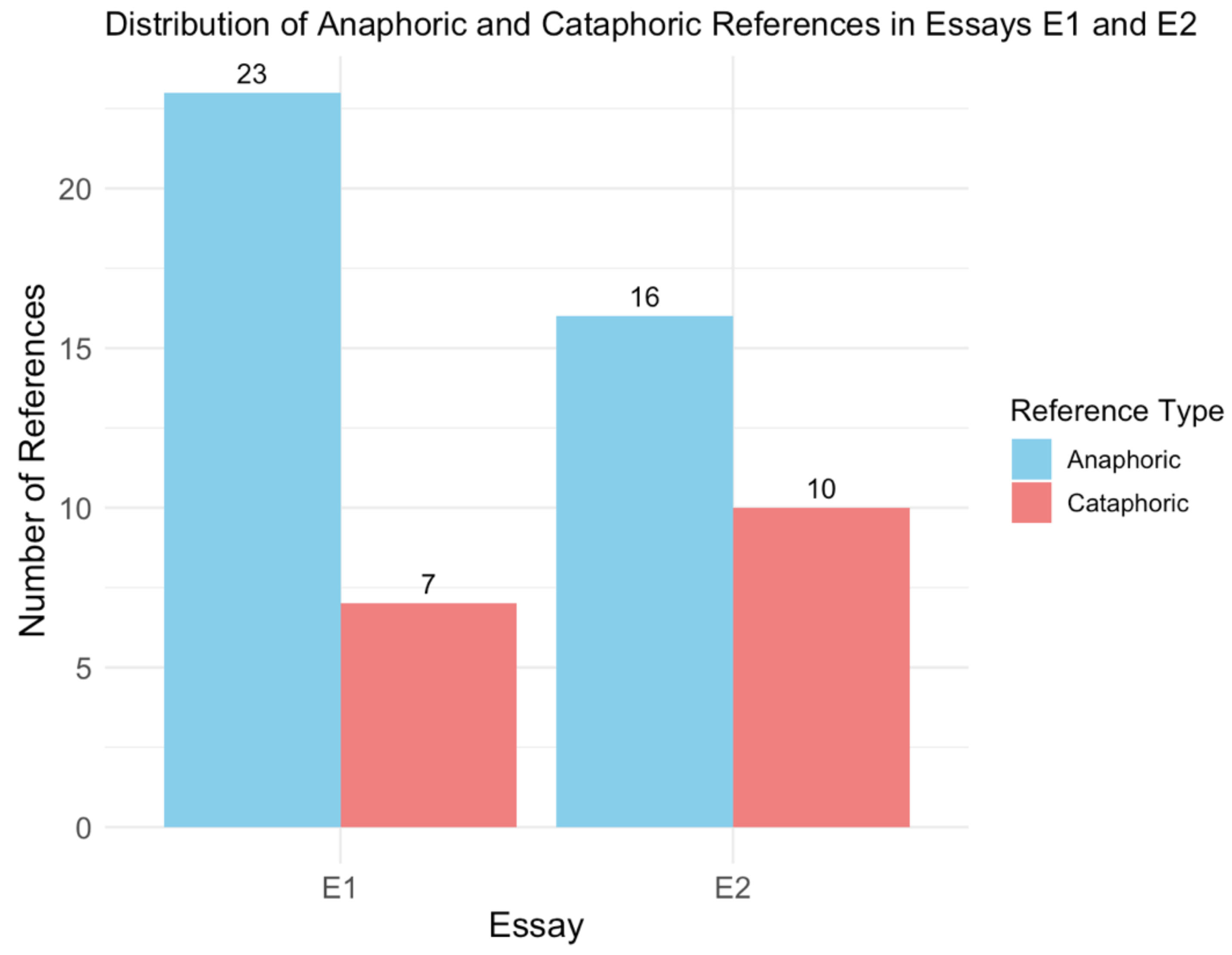
Figure 2.
The distribution of cataphoric references across essays E1, E2, and E10. Note: The uneven distribution of cataphoric references highlights potential stylistic differences between the essay writers. E1 contains the highest number of cataphoric references, followed by E2 and E10, where the latter has just one instance.
Figure 2.
The distribution of cataphoric references across essays E1, E2, and E10. Note: The uneven distribution of cataphoric references highlights potential stylistic differences between the essay writers. E1 contains the highest number of cataphoric references, followed by E2 and E10, where the latter has just one instance.
Figure 3.
Frequency distribution of anaphoric and cataphoric references across essays E1, E2, and E10. Note: Anaphoric references are more frequent than cataphoric references overall, with a notable decline in both types in shorter essays like E10. The variation may indicate differences in the authors’ narrative strategies.
Figure 3.
Frequency distribution of anaphoric and cataphoric references across essays E1, E2, and E10. Note: Anaphoric references are more frequent than cataphoric references overall, with a notable decline in both types in shorter essays like E10. The variation may indicate differences in the authors’ narrative strategies.
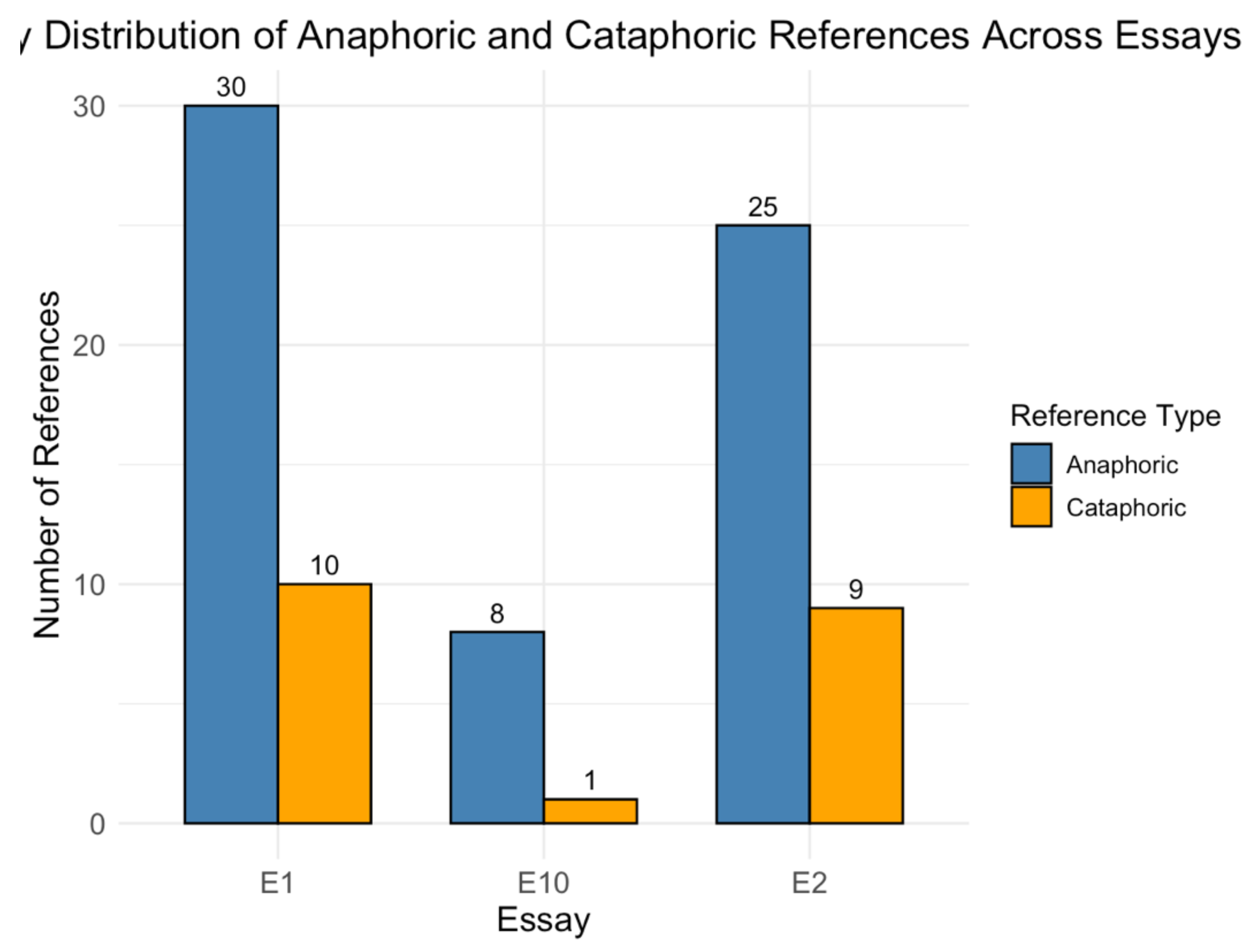

Table 1.
Frequency Distribution of “the” in the Corpus.
| Essay | Total Occurrences | Anaphoric Uses | Cataphoric Uses | Other Uses |
|---|---|---|---|---|
| E1 | 37 | 23 | 12 | 2 |
| E2 | 26 | 16 | 9 | 1 |
| E3 | 20 | 10 | 8 | 2 |
| E4 | 20 | 12 | 7 | 1 |
| E5 | 17 | 15 | 2 | 0 |
| E6 | 15 | 6 | 8 | 1 |
| E7 | 15 | 10 | 3 | 2 |
| E8 | 8 | 4 | 3 | 1 |
| E9 | 8 | 6 | 1 | 1 |
| E10 | 6 | 3 | 1 | 2 |
Disclaimer/Publisher’s Note: The statements, opinions and data contained in all publications are solely those of the individual author(s) and contributor(s) and not of MDPI and/or the editor(s). MDPI and/or the editor(s) disclaim responsibility for any injury to people or property resulting from any ideas, methods, instructions or products referred to in the content. |
© 2025 by the authors. Licensee MDPI, Basel, Switzerland. This article is an open access article distributed under the terms and conditions of the Creative Commons Attribution (CC BY) license (http://creativecommons.org/licenses/by/4.0/).
Copyright: This open access article is published under a Creative Commons CC BY 4.0 license, which permit the free download, distribution, and reuse, provided that the author and preprint are cited in any reuse.


