

Submitted:
06 January 2025
Posted:
07 January 2025
You are already at the latest version
Abstract
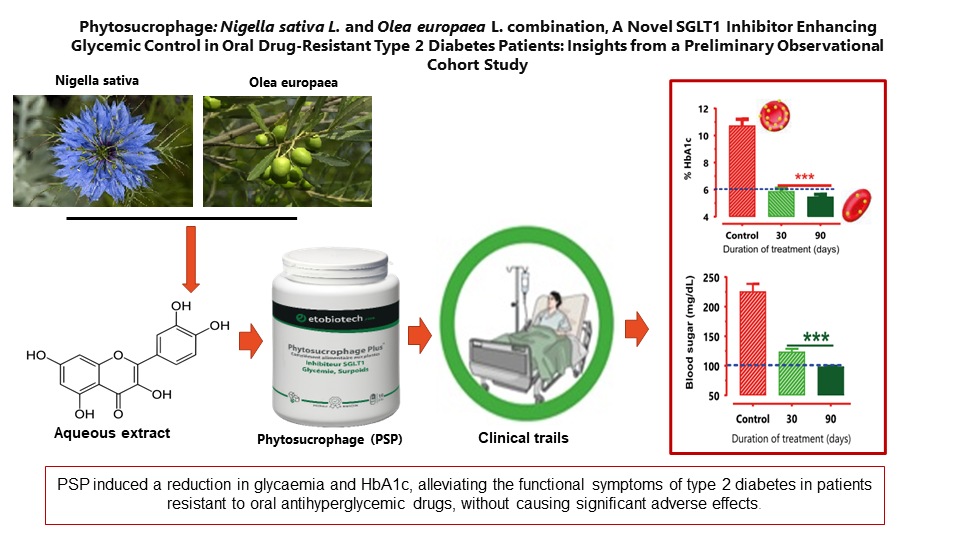
Background: Nigella sativa L. (seeds) and Olea europaea L. (leaves) are widely utilized as food supplements and traditional herbal remedies to reduce hyperglycemia. Purpose: This study evaluated the efficacy of a commercial combination of Nigella sativa and Olea europaea aqueous extracts, marketed as Phytosucrophage (PSP), in managing type 2 diabetes mellitus (T2DM) in patients resistant to oral antihyperglycemic drugs (OADs). Study Design: A multicenter, observational cohort study was conducted involving 38 treatment-naïve T2DM patients and 282 patients resistant to OADs. Participants received a fixed-dose capsule containing 550 mg of PSP, administered twice daily for 12 weeks. Clinical efficacy was assessed by monitoring fasting blood glucose, glycosylated hemoglobin (HbA1c), aspartate aminotransferase (AST), alanine aminotransferase (ALT), creatinine levels, and evaluating functional symptoms. Results: PSP treatment significantly reduced fasting blood glucose and HbA1c levels. Additionally, it alleviated functional symptoms of T2DM without inducing adverse effects. Conclusions: The findings suggest that PSP is an effective and safe adjunctive therapy for reducing blood glucose and HbA1c levels in T2DM patients resistant to OADs. PSP also improved clinical symptoms associated with T2DM without causing notable adverse effects.
Keywords:
1. Introduction
2. Material and Methods
2.1. Study Design
2.2. Statistical Analysis
3. Results
3.1. Clinical Benefit of Oral Administration of Phytosucrophage (PSP).
3.2. Effect of PSP on Serum Aminotransferase Activities and Creatinine
3.3. Effect of PSP on Functional Adverse Effects and Symptoms of T2DM
4. Discussion
Author Contributions
Patents
Institutional Review Board Statement
Informed Consent Statement
Declaration of Competing Interests
Data Availability
Acknowledgements
Abbreviations
| ALT | alanine aminotransferase |
| AST | aspartate aminotransferase |
| BGLT | Baseline glucose-lowering therapies |
| CDF | commercial dosage form |
| CRT | creatinine |
| CT | control |
| Glib | Glibenclamide, |
| Glim | Glimepiride, |
| HbA1c | glycosylated hemoglobin |
| IQR | Inter quartile range, ou écart inter quartiles |
| LDL | low density lipoprotein |
| MET | metformin |
| NS | Nigella sativa L. |
| OE | Olea europaeaL. |
| PSP | Phytosucrophage |
| SGLT1 | sodium-dependent glucose cotransporter-1 |
| SGLT2 | sodium-dependent glucose cotransporter-2 |
| T2DM | type 2 diabetes |
| TBC | Laboratoires TBC. |
| VLDL | very low-density lipoprotein |
References
- S.C. Nair, M.J. Salomi, B. Panikkae, K.R. Panikkar, Modulatory effects of Crocus sativus and Nigella sativa extracts on cisplatin-induced toxicity in mice, J. Ethnopharmacol. 31 (1991) 75–83. [CrossRef]
- O.A. Badary, A.B. Abdel-Naim, M.H. Abdel-Wahab, F.M. Hamada, The influence of thymoquinone on doxorubicin-induced hyperlipidemic nephropathy in rats, Toxicology 143 (2000) 219–226. [CrossRef]
- F.M. Al-Awadi, K.A. Gumaa, Studies on the activity of individual plants of an antidiabetic plant mixture, Acta Diabetol. Lat. 24 (1987) 37–41. [CrossRef]
- G. Besnard, P. Baradat, C. Breton, B. Khadari, A. Bervillé, Olive domestication from structure of oleasters and cultivars using nuclear RAPDs and mitochondrial RFLPs, Genet. Sel. Evol. 33 (2001) S251. [CrossRef]
- L. Melillo, Diuretic plants in the paintings of Pompeii, Am. J. Nephrol. 14 (1994) 423–425. [CrossRef]
- S. FK, On treatment of hypertension with folia oleae substances and a sali-diuretic, Med. Welt 42 (1960) 2226–2228.
- L.I. Somova, F.O. Shode, P. Ramnanan, A. Nadar, Antihypertensive, antiatherosclerotic and antioxidant activity of triterpenoids isolated from Olea europaea, subspecies africana leaves, J. Ethnopharmacol. 84 (2003) 299–305. [CrossRef]
- I.W. Suryasa, M. Rodríguez-Gámez, T. Koldoris, Health and treatment of diabetes mellitus, Int. J. Health Sci. 5 (2021). [CrossRef]
- E.W. Gregg, J. Buckley, M.K. Ali, J. Davies, D. Flood, R. Mehta, B. Griffiths, L.-L. Lim, J. Manne-Goehler, J. Pearson-Stuttard, improving health outcomes of people with diabetes: target setting for the WHO Global Diabetes Compact, The Lancet 401 (2023) 1302–1312.
- B. Meddah, R. Ducroc, M.E.A. Faouzi, B. Eto, L. Mahraoui, A. Benhaddou-Andaloussi, L.C. Martineau, Y. Cherrah, P.S. Haddad, Nigella sativa inhibits intestinal glucose absorption and improves glucose tolerance in rats, J. Ethnopharmacol. 121 (2009) 419–424. [CrossRef]
- H. Kakinuma, T. Oi, Y. Hashimoto-Tsuchiya, M. Arai, Y. Kawakita, Y. Fukasawa, I. Iida, N. Hagima, H. Takeuchi, Y. Chino, (1 S)-1, 5-anhydro-1-[5-(4-ethoxybenzyl)-2-methoxy-4-methylphenyl]-1-thio-d-glucitol (TS-071) is a potent, selective sodium-dependent glucose cotransporter 2 (SGLT2) inhibitor for type 2 diabetes treatment, J. Med. Chem. 53 (2010) 3247–3261. [CrossRef]
- A.A. Tahrani, A.H. Barnett, C.J. Bailey, SGLT inhibitors in management of diabetes, Lancet Diabetes Endocrinol. 1 (2013) 140–151.
- D.M. McDonald: Tighter lymphatic junctions prevent obesity, Science 361 (2018) 551–552. [CrossRef]
Disclaimer/Publisher’s Note: The statements, opinions and data contained in all publications are solely those of the individual author(s) and contributor(s) and not of MDPI and/or the editor(s). MDPI and/or the editor(s) disclaim responsibility for any injury to people or property resulting from any ideas, methods, instructions or products referred to in the content. |
© 2025 by the authors. Licensee MDPI, Basel, Switzerland. This article is an open access article distributed under the terms and conditions of the Creative Commons Attribution (CC BY) license (https://creativecommons.org/licenses/by/4.0/).