1. Introduction
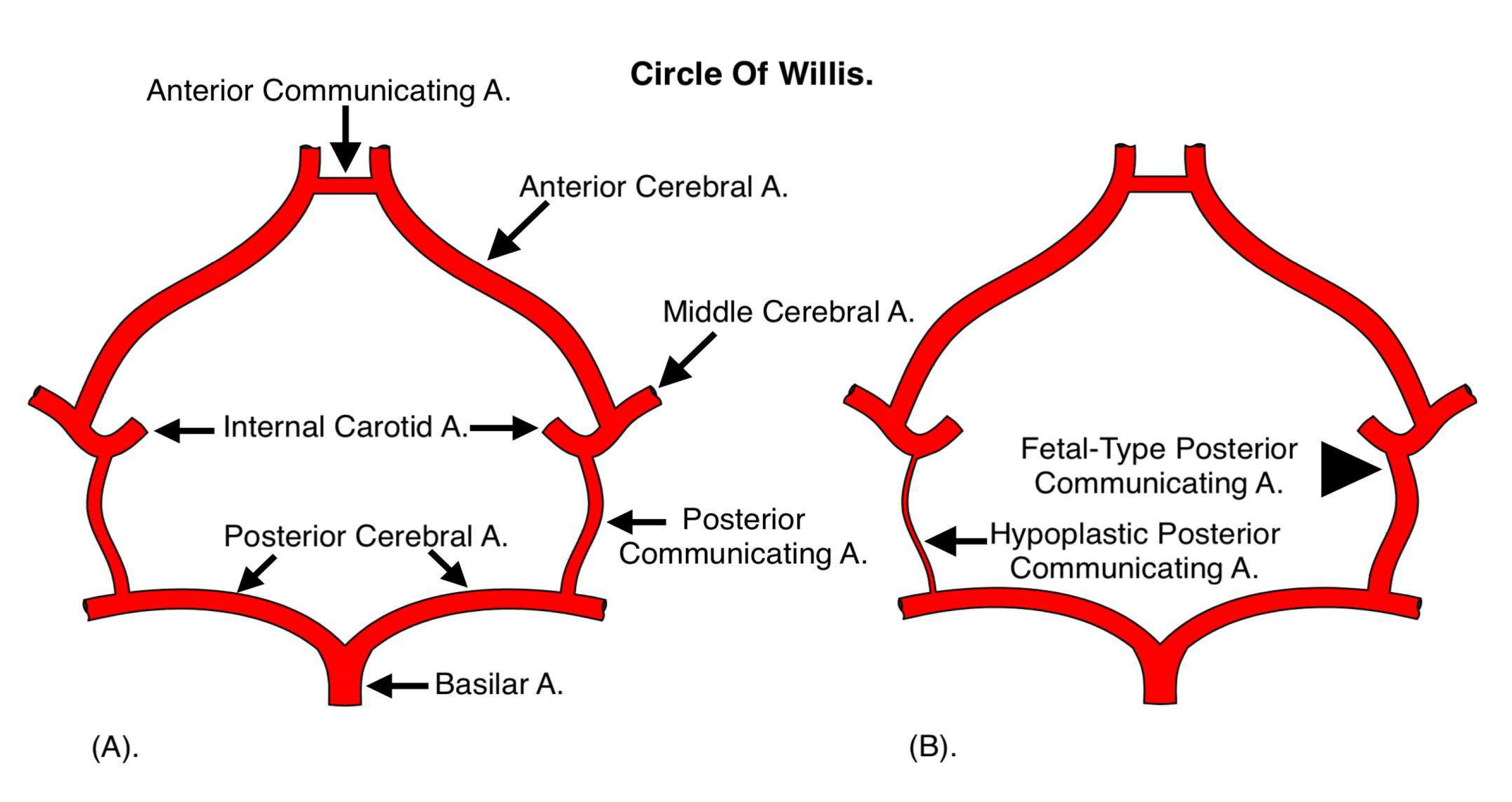
A fetal-type configuration of the Circle of Willis occurs in approximately 17.5% of the adult population and can be classified into partial or true fetal-type posterior communicating artery (PCoA) variants (
Figure 1). This anatomical variation has significant clinical implications, particularly in the management of cerebrovascular disorders, such as aneurysms, and in neurosurgical interventions [
1]. Altered hemodynamics associated with this variant predispose individuals to ischemic events, especially during vascular compromise or surgical interventions. Additionally, aneurysms located in the PCoA region are more challenging to treat due to the abnormal flow dynamics and fragile vascular structure inherent to this anatomy [
2]. Recognizing and understanding the fetal-type PCoA variant is crucial for neurosurgeons and clinicians to anticipate potential complications, optimize treatment strategies, and improve patient outcomes [
1,
2].
The fetal-type PCoA arises from the internal carotid artery (ICA), as opposed to the posterior cerebral artery (PCA). This variation complicates the management of aneurysms in this region, making both surgical clipping and endovascular interventions technically demanding [
3]. High-resolution preoperative imaging, such as CT angiography or MR angiography, is essential for developing a tailored surgical approach, whether by open, endoscopic, or endovascular techniques [
4]. Furthermore, the fetal-type configuration can complicate post-surgical recovery due to its unique influence on neurovascular perfusion [
1,
2,
3,
4].
Surgical clipping of aneurysms associated with fetal-type PCoA requires careful dissection and visualization of the aneurysm neck. A comprehensive understanding of the patient’s vascular anatomy is critical for planning the most effective surgical approach [
1]. In certain cases, endovascular treatment is preferred, especially for aneurysms with wide necks or those difficult to reach surgically [
5]. The fetal-type PCoA variant has been associated with an increased risk of ischemic stroke, particularly in the setting of carotid artery disease or occlusion [
6].
Table 1.
Comparison between the Standard PCoA anatomy and Fetal-Type PCoA anatomy.
Table 1.
Comparison between the Standard PCoA anatomy and Fetal-Type PCoA anatomy.
| Feature |
Standard PCoA Anatomy |
Fetal-Type PCoA Anatomy |
Clinical Implications & Tratament |
| Origin |
Posterior Cerebral Artery (PCA) |
Internal Carotid Artery (ICA) |
-Fetal-Type is a common congenital variation with altered blood flow |
| Hemodynamics |
Normal flow dynamics |
Abnormal flow due to ICA-PCA connection |
-Increased risk of ischemia and aneurysm rupture. |
| Aneurysm Risk |
Standard risk of formation |
Higher risk due to altered hemodynamics |
-Aneurysms more prone to rupture and difficult to treat. |
| Surgical Challenges |
More straightforward dissection |
Complex due to vascular fragility and abnormal anatomy |
- Difficult access and higher risk of complications. |
| Surgical Approach |
Standard clipping techniques |
Requires tailored approach (Extra care not to obstruct the blood flow) |
- Risk of obstructing the blood flow. Attention to the patency is crucial. Personalized surgical strategy for better outcomes. |
| Postoperative Monitoring |
Routine follow-up |
Extended follow-up for potential recurrence and ischemia. |
-Regular imaging (Ct/MRI- Angio) and neurosurgical monitoring are critical. |
At our institution, we have managed 22 cases of fetal-type PCoA aneurysms in the past three years. The surgical techniques were tailored to the individual characteristics of the aneurysms, considering factors such as aneurysm location, size, and the relationship to adjacent neurovascular structures. Given the anatomical variability of fetal-type PCoA, a personalized surgical strategy is essential to achieve optimal outcomes, ensure complete aneurysm obliteration, and minimize the risk of neurovascular injury [
2]. The management of fetal-type PCoA aneurysms is a complex and challenging endeavor, requiring a comprehensive understanding of the unique anatomical and hemodynamic features associated with this variant.
2. Case Presentation
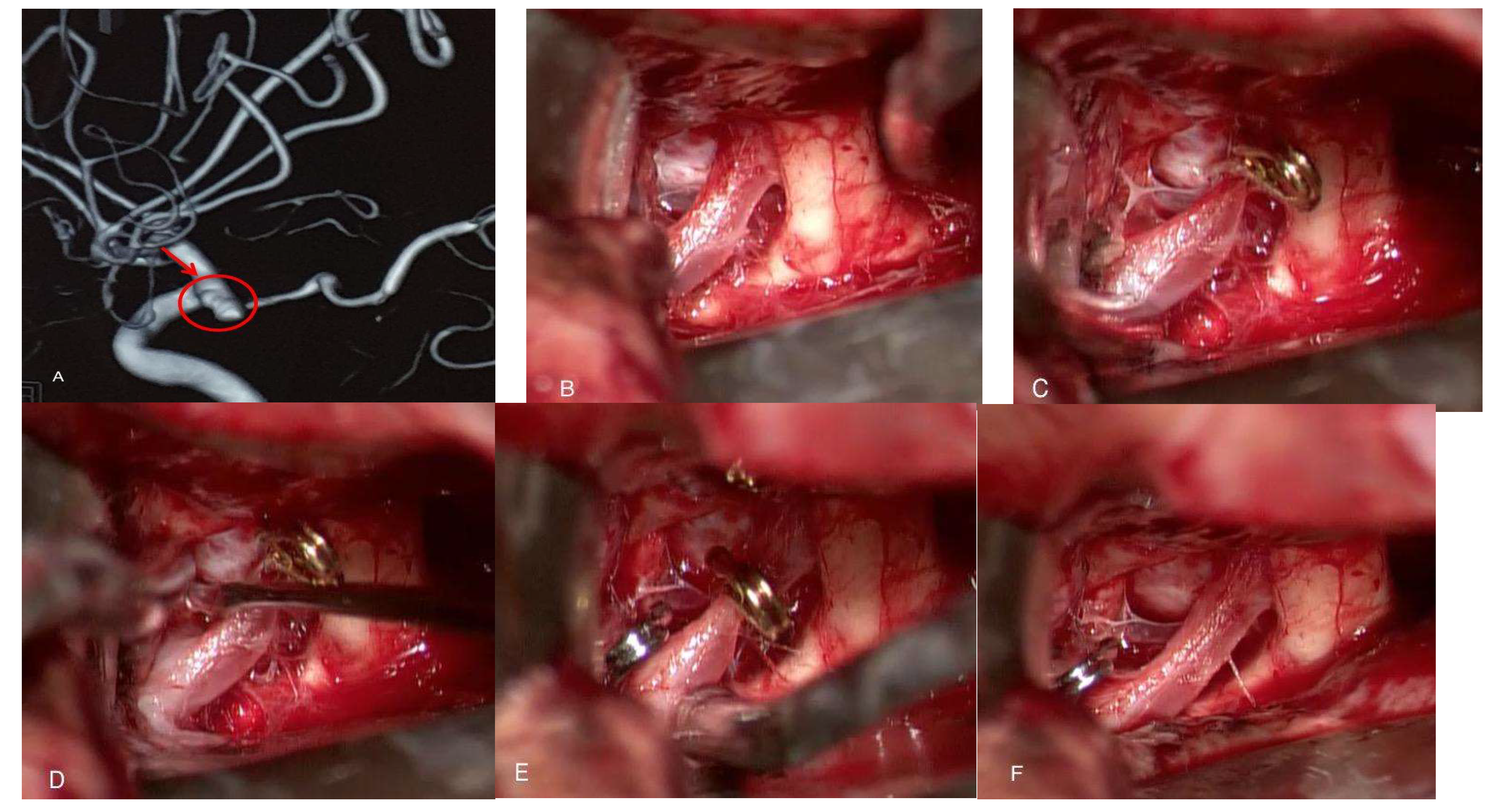
A 53-year-old female presented to our emergency department with the sudden onset of severe headache and diplopia. On physical examination, she was found to have a left-sided complete third nerve palsy (Hunt and Hess grade 3). A CT scan confirmed a subarachnoid hemorrhage, with a Fisher score of grade 2, indicating a moderate to severe degree of hemorrhage. Digital subtraction angiography (DSA) (►
Figure 2A) revealed an unruptured left PCoA aneurysm, measuring 4.8 mm by 4.1 mm, with a postero-lateral projection.
3. Surgical Technique
A pterional craniotomy was performed on the left side. Under microscopic visualization, initial arachnoid dissection was carried out in the optic-carotid cistern to facilitate brain relaxation via cerebrospinal fluid (CSF) drainage. This maneuver allowed optimal exposure of the PCoA originating from the ICA, where the aneurysm was identified at the junction of the PCoA and ICA (►
Figure 2B). To enhance exposure, we performed a proximal opening of the Sylvian fissure, revealing the critical carotid-oculomotor window (COW), allowing visualization of the PCoA’s origin (►
Figure 2B). This approach minimized the risk of injury to surrounding structures, including the oculomotor nerve and optic nerve.
Retraction of the temporal lobe was done cautiously to avoid damage to adjacent neurovascular structures. The brain was relaxed further through CSF drainage, minimizing pressure on the brain and surrounding critical structures. A temporary clip was applied to the ophthalmic segment of the ICA (►
Figure 2C), facilitating softening of the aneurysm sac and allowing safe dissection (►
Figure 2D).
After careful circumferential dissection of the aneurysm neck, a permanent aneurysm clip was applied to the neck (
Figure 2E). If necessary, the clip was repositioned to ensure optimal occlusion while preventing injury to the PCoA, ICA, and anterior choroidal artery (
Figure 2F). Postoperative angiography confirmed the patency of these key vessels, and the aneurysm was successfully obliterated.
The patient experienced an uneventful postoperative recovery, with gradual improvement in her third nerve palsy. Follow-up imaging confirmed complete obliteration of the aneurysm, and the patient was discharged on day 8 post-surgery, with a recommendation for regular follow-up.
4. Discussion
Anatomical Considerations and Challenges:
The fetal-type PCoA presents substantial anatomical challenges during surgery. The PCoA arises from the ICA, rather than the PCA, leading to atypical blood flow patterns and an increased risk of ischemic events [
2]. This variant can result in tortuous vessels, which make it difficult to visualize and securely clip the aneurysm without damaging surrounding structures. The anatomical arrangement also increases the risk of intraoperative rupture due to the fragility of the aneurysm [
1].
In this context, microsurgical techniques such as the proximal Sylvian fissure opening and temporary ICA clipping are essential to gaining adequate exposure and controlling blood flow, thus facilitating aneurysm dissection and clipping. However, the surgical approach must be individualized based on the patient’s specific vascular anatomy, aneurysm location, and relationship to neighboring neurovascular structures.
Surgical Approaches and Alternatives: The pterional craniotomy is a well-established approach for PCoA aneurysms and allows optimal access to the optic-carotid cistern and the carotid-oculomotor window. This approach is advantageous for direct visualization of the aneurysm and the critical surrounding structures. However, in some cases, such as when the aneurysm is located in a particularly difficult-to-reach area, or if the aneurysm has a wide neck, a microsurgical approach may be combined with endovascular treatment [
3]. Endovascular embolization is particularly useful for aneurysms that are not amenable to surgical clipping due to their location or complex anatomy. The decision between surgical clipping and endovascular embolization often depends on the accessibility and morphology of the aneurysm, with the endovascular approach offering less invasiveness and quicker recovery times [
5].
However, endovascular techniques carry a risk of incomplete occlusion or recurrence, especially for wide-necked aneurysms, necessitating careful post-procedure imaging and follow-up.
Long-Term Outcomes: Postoperative recovery and long-term outcomes in patients with fetal-type PCoA aneurysms depend heavily on early detection, appropriate surgical intervention, and ongoing monitoring. In our series, we observed favorable outcomes, with patients demonstrating gradual improvement in neurological deficits (such as third nerve palsy) following successful aneurysm obliteration. Long-term follow-up imaging is critical to assess for rebleeding, aneurysm recurrence, and the development of ischemic events [
4]. The mortality rate for PCoA aneurysms is higher when rupture occurs, underscoring the importance of early diagnosis and prompt intervention. Careful preoperative assessment, tailored surgical planning, and meticulous intraoperative technique are essential to achieve favorable outcomes and minimize the risk of neurovascular complications [
7].
5. Conclusion
The management of fetal-type PCoA aneurysms presents a significant challenge for both diagnosis and treatment. A personalized surgical strategy, guided by advanced preoperative imaging, is essential for achieving successful outcomes. Surgical clipping remains the treatment of choice for many cases, but endovascular techniques offer a valuable alternative, particularly for challenging aneurysms. Long-term follow-up is crucial to monitor for complications such as rebleeding and recurrence, and to assess the patient’s neurological recovery. As more data accumulate on outcomes and comparative techniques, the field may move towards more multimodal strategies for managing these complex lesions.
Author Contribution
Investigation, R.-A.C.B., A.T., A.R.A.; Resources, G.S.R.A., C.T., M.P.R.; Supervision, C.T., M.P.R.; Validation, T.M.P., C.T.; Visualization, G.S.R.A., A.T., A.R.A.; Writing – original draft, G.S.R.A., A.T., A.R.A.; Writing – review and editing, G.S.R.A.,R.-A.C.-B.
Acknowledgement
Publication of this paper was supported by the University of Medicine and Pharmacy “Carol Davila”, through the institutional Open Access Program.
References
- Mazzucchi, E., Casali, M., & Borsato, S. (2022). “Fetal-type posterior communicating artery and its implications in aneurysm surgery.” Journal of Neurosurgery, 15(2), 567–578.
- Chung, D., & Lee, J. (2023). “Challenges in managing fetal-type PCoA aneurysms: A review of surgical approaches.” Neurosurgical Review, 31(3), 233–240.
- Huang, Y., Zhang, L., & Liu, Y. (2021). “Anatomical and surgical considerations of fetal-type posterior communicating artery aneurysms.” Stroke Surgery and Neurointervention, 18(4), 1023–1030.
- Patel, R., & Goyal, M. (2022). “Preoperative imaging strategies in aneurysm surgery: Emphasis on PCoA variants.” Journal of Vascular and Interventional Radiology, 33(5), 1248–1255.
- Kumar, V., Prakash, R., & Malhotra, A. (2023). “Endovascular versus microsurgical treatment of posterior communicating artery aneurysms.” Neurointervention, 13(1), 29–36.
- Purkayastha, S., Singh, A., & Shah, S. (2006). “Fetal-type posterior communicating artery: Implications in ischemic stroke.” Stroke Research and Treatment, 12(1), 45–51.
- Boukili, M., Asser, M., Gupta, K., & Horio, N. (2021). “Advances in microsurgical techniques for PCoA aneurysms.” World Neurosurgery, 15(6), 789–805.
|
Disclaimer/Publisher’s Note: The statements, opinions and data contained in all publications are solely those of the individual author(s) and contributor(s) and not of MDPI and/or the editor(s). MDPI and/or the editor(s) disclaim responsibility for any injury to people or property resulting from any ideas, methods, instructions or products referred to in the content. |
© 2025 by the authors. Licensee MDPI, Basel, Switzerland. This article is an open access article distributed under the terms and conditions of the Creative Commons Attribution (CC BY) license (http://creativecommons.org/licenses/by/4.0/).