

Submitted:
06 January 2025
Posted:
06 January 2025
You are already at the latest version
Abstract
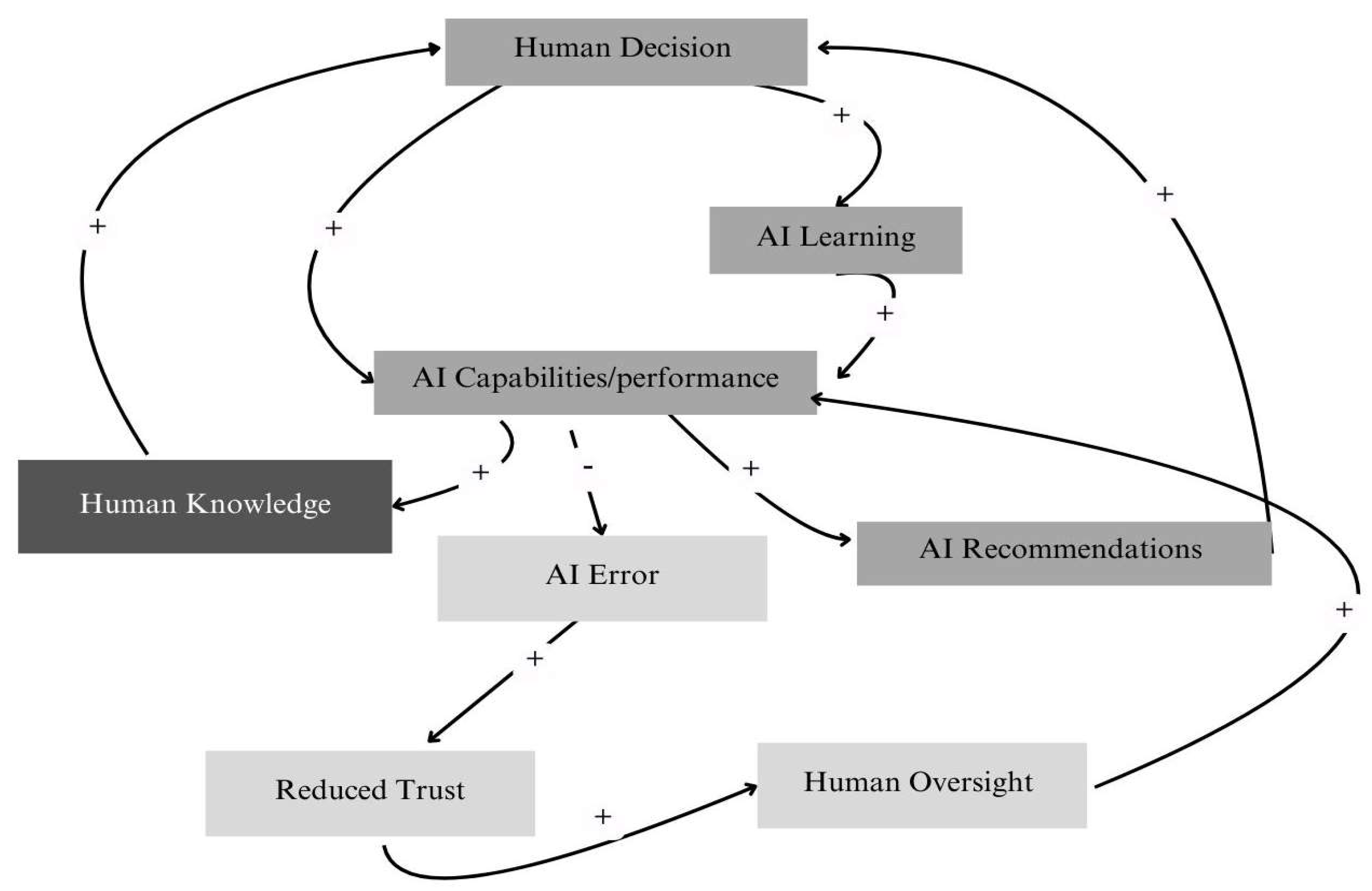
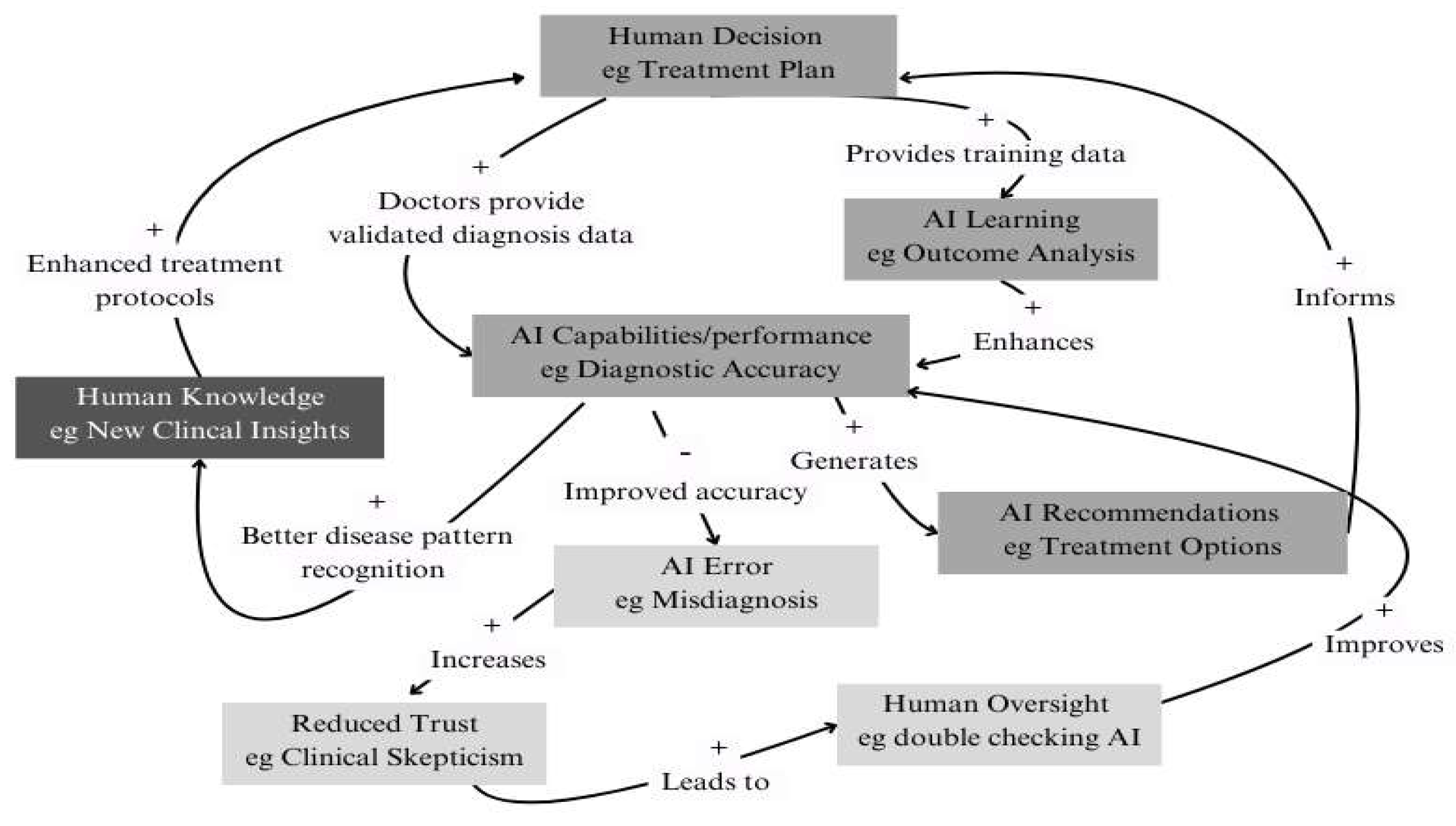
This paper examines the framework of Cybernetics 3.0 as a way of addressing grand challenges related to human-machine interaction in complex systems. The paper explores the evolution of Cybernetics and highlights the limitations of the earlier versions. The current approach to Cybernetics, Cybernetics 3.0, focuses upon human agency and the co-evolution of humans and machines in the decision-making space. The paper argues that this approach when combined with Web 3.0 technologies gives new ways to optimise decision-making by integrating human capabilities and ethical considerations with machine capabilities. The paper uses causal loop diagrams to demonstrate the factors leading to interconnectedness between human and machine decision-making. A practical example from the field of healthcare illustrates the interconnections and demonstrates the utility of this framework for more sustainable and wise decisions. A holistic systems thinking approach in addressing grand challenges such as these could promote human flourishing, and the discipline of Cybernetics is a promising way to better understand the interaction and its potential, through its focus on systems of control, human AI learning and communication, feedback loops, self-regulating systems, and knowledge enhancement in humans and machines.
Keywords:
1. Introduction
2. Cybernetics 3.0 and Human Machine Interactions
3. Systems Thinking in Complex Decision-Making Contexts
4. Human-Machine Interaction and Decision-Making
5. Implications of Cybernetics 3.0 for Human Machine Decision-Making
6. A Cybernetic Model of Human AI Collaboration
7. Conclusion
8. Limitations and Future Research
Author Contributions
Funding
Conflicts of Interest
References
- World Economic Forum. Stakeholder capitalism: metrics and disclosures. 2020. Available online: https://www.weforum.org (accessed on November 2024).
- Pew Research Centre. In Global demographic trends and ethnic diversity; 2021.
- Van Kuiken, S. Tech at the edge: trends reshaping the future of IT and business. 2022. Available online: https://www.mckinsey.com/capabilities/mckinsey-digital/our-insights/tech-at-the-edge-trends-reshaping-the-future-of-it-and-business.
- Department of Economic and Social Affairs (DESA). 2018 Revision of World Urbanisation Prospects; Department of Economic and Social Affairs, 2018. Available online: https://esa.un.org/unpd/wup/.
- Huang, S.-L.; Yeh, C.-T.; Chang, L.-F. The transition to an urbanizing world and the demand for natural resources. Current Opinion in Environmental Sustainability 2010, 2, 136–143. [Google Scholar] [CrossRef]
- World Meteorological Organisation (WMO). State of the global climate. 2021. Available online: https://wmo.int/publication-series/state-of-global-climate.
- OII. Europe Annual Report 2020. EU2020. Available online: https://www.oiieurope.org/oii-europe-annual-report-2020/.
- IPCC. Climate Change 2022: Impacts, Adaptation and Vulnerabliity. 2022. Available online: https://www.ipcc.ch/report/sixth-assessment-report-working-group-ii/.
- Castells, M. The rise of the network society; John Wiley & Sons, 2011. [Google Scholar]
- Urry, J. Global complexities. In Frontiers of globalization research: Theoretical and methodological approaches; Springer, 2007; pp. 151–162. [Google Scholar]
- Van der Byl, C.; Slawinski, N.; Hahn, T. Responsible management of sustainability tensions: A paradoxical approach to grand challenges. In Research Handbook of Responsible Managementt; Edward Elgar Publishing, 2020; pp. 438–452. [Google Scholar]
- de Ruyter, K.; Keeling, D.I.; Plangger, K.; Montecchi, M.; Scott, M.L.; Dahl, D.W. Reimagining marketing strategy: driving the debate on grand challenges. Journal of the Academy of Marketing Science 2022, 50, 13–21. [Google Scholar] [CrossRef] [PubMed]
- Helbing, D. Globally networked risks and how to respond. Nature 2013, 497, 51. [Google Scholar] [CrossRef]
- Acemoglu, D.; Restrepo, P. Robots and jobs: Evidence from US labor markets. Journal of Political Economy 2020, 128, 2188–2244. [Google Scholar] [CrossRef]
- Pennycook, G.; Rand, D.G. The psychology of fake news. Trends in Cognitive Sciences 2021, 25, 388–402. [Google Scholar] [CrossRef]
- Bostrom, N.; Yudkowsky, E. The ethics of artificial intelligence. In Artificial Intelligence Safety and Security; Chapman and Hall/CRC, 2018; pp. 57–69. [Google Scholar]
- Brynjolfsson, E.; Rock, D.; Syverson, C. Artificial intelligence and the modern productivity paradox. In The economics of artificial intelligence: An agenda; 2019; Volume 23, pp. 23–57. [Google Scholar]
- Sheridan, T. Telerobotics, Automation, and Human Supervisory Control; MIT Press, 1992. [Google Scholar]
- Harari, Y.N. Homo deus; Random House: NY, 2016. [Google Scholar]
- Wiener, N. Cybernetics: Or Control and Communication in the Animal and the Machine; MIT Press, 1948. [Google Scholar]
- Hipel, K.W.; Jamshidi, M.M.; Tien, J.M.; White, C.C., III. The future of systems, man, and cybernetics: Application domains and research methods. IEEE Transactions on Systems, Man, and Cybernetics, Part C (Applications and Reviews) 2007, 37, 726–743. [Google Scholar] [CrossRef]
- Rosenblueth, A.; Wiener, N.; Bigelow, J. Behavior, purpose and teleology. Philosophy of Science 1943, 10, 18–24. [Google Scholar] [CrossRef]
- Novikov, D.A. Cybernetics: from past to future; Springer, 2015. [Google Scholar]
- Morador, F.F. Cybernetics 3.0. Available at SSRN 4140029 2022, 2022. [Google Scholar]
- Cibu, B.; Delcea, C.; Domenteanu, A.; Dumitrescu, G. Mapping the evolution of cybernetics: a bibliometric perspective. Computers 2023, 12, 237. [Google Scholar] [CrossRef]
- Goldstein, J. Emergence in complex systems. In The Sage Handbook of Complexity and Management; 2011; pp. 65–78. [Google Scholar]
- Goldin, I.; Vogel, T. Global governance and systemic risk in the 21st century: Lessons from the financial crisis. Global Policy 2010, 1, 4–15. [Google Scholar] [CrossRef]
- Prescott, S.L. Planetary Health Requires Tapestry Thinking—Overcoming Silo Mentality. Challenges 2023, 14, 10. [Google Scholar] [CrossRef]
- Rifkin, S.B.; Fort, M.; Patcharanarumol, W.; Tangcharoensathien, V. Primary healthcare in the time of COVID-19: breaking the silos of healthcare provision. BMJ Global Health 2021, 6, e007721. [Google Scholar] [CrossRef]
- Sturmberg, J.P.; Tsasis, P.; Hoemeke, L. COVID-19–an opportunity to redesign health policy thinking. International Journal of Health Policy and Management 2022, 11, 409. [Google Scholar] [CrossRef]
- WHO. Key Messages: World Health Day. 2024. Available online: https://www.who.int/campaigns/world-health-day/2024/key-messages.
- Merali, Y.; Allen, P. Complexity and systems thinking. The SAGEHandbook of Complexity and Management 2011, 31–52. [Google Scholar]
- Cilliers, F.; Greyvenstein, H. The impact of silo mentality on team identity: An organisational case study. Journal of Industrial Psychology 2012, 38, 1–9. [Google Scholar] [CrossRef]
- Bento, F.; Tagliabue, M.; Lorenzo, F. Organizational silos: A scoping review informed by a behavioral perspective on systems and networks. Societies 2020, 10, 56. [Google Scholar] [CrossRef]
- Jeleel-Ojuade, A. The Role of Information Silos: An analysis of how the categorization of information creates silos within financial institutions, hindering effective communication and collaboration. Available at SSRN 4881342 2024. [CrossRef]
- Senge, P.M. The fifth discipline: The art and practice of the learning organization; Broadway Business, 2006. [Google Scholar]
- Kunsch, P.L.; Theys, M.; Brans, J.-P. The importance of systems thinking in ethical and sustainable decision-making. Central European Journal of Operations Research 2007, 15, 253–269. [Google Scholar] [CrossRef]
- Kahneman, D.; Klein, G. Conditions for intuitive expertise: A failure to disagree. American Psychologist 2009, 64, 515–526. [Google Scholar] [CrossRef] [PubMed]
- Meissner, P.; Narita, Y. AI Will Transform Decision-Making. Here's How. In Emerging Technologies; Forum, W.E., Ed.; 2023. [Google Scholar]
- Rahwan, I.; et al. Machine behaviour. Nature 2019, 568, 477–486. [Google Scholar] [CrossRef]
- Davenport, T.H.; Ronanki, R. Artificial intelligence for the real world. Harvard Business Review 2018, 36, 108–116. [Google Scholar]
- Barber, O. How AI will change decision-making. 2024. Available online: https://indatalabs.com/blog/artificial-intelligence-decision-making.
- Brynjolfsson, E.; McAfee, A. The business of artificial intelligence: What it can – and cannot – do for your organization. Harvard Business Review 2017.
- Agrawal, A.; Gans, J.S.; Goldfarb, A. Prediction machines: The simple economics of artificial intelligence; Harvard Business Review Press, 2018. [Google Scholar]
- Mollick, E.; Mollick, E. Co-Intelligence; Random House UK, 2024. [Google Scholar]
- Sheridan, T.B.; Verplank, W.L.; Brooks, T. Human/computer control of undersea teleoperators. In NASA. American Research Centre: the 14th Annual Conference on Manual Control; 1978. [Google Scholar]
- Rhim, J.; Lee, J.-H.; Chen, M.; Lim, A. A deeper look at autonomous vehicle ethics: an integrative ethical decision-making framework to explain moral pluralism. Frontiers in Robotics and AI 2021, 8, 632394. [Google Scholar] [CrossRef]
- Jyothi, R.K.; Thenepalli, T.; Ahn, J.W.; Parhi, P.K.; Chung, K.W.; Lee, J.-Y. Review of rare earth elements recovery from secondary resources for clean energy technologies: Grand opportunities to create wealth from waste. Journal of Cleaner Production 2020, 267, 122048. [Google Scholar] [CrossRef]
- Bhattacharya, N.; Nelson, C.C.; Ahuja, G.; Sengupta, D. Big data analytics in single-cell transcriptomics: Five grand opportunities. Wiley Interdisciplinary Reviews: Data Mining and Knowledge Discovery 2021, 11, e1414. [Google Scholar] [CrossRef]
- Hallo, L.; Rowe, C.; Duh, G. Metaverse vs Descartes: Free Will and Determinism All Over Again. In Proceedings of the International Conference on Information, Intelligence, Crete, Greece, 2024; IEEE Computer Society., Systems and Applications (IISA).
- Bala, B.K.; Arshad, F.M.; Noh, K.M.; Bala, B.K.; Arshad, F.M.; Noh, K.M. Causal loop diagrams. System Dynamics: Modelling and Simulation 2017, 37–51. [Google Scholar]
Disclaimer/Publisher’s Note: The statements, opinions and data contained in all publications are solely those of the individual author(s) and contributor(s) and not of MDPI and/or the editor(s). MDPI and/or the editor(s) disclaim responsibility for any injury to people or property resulting from any ideas, methods, instructions or products referred to in the content. |
© 2025 by the authors. Licensee MDPI, Basel, Switzerland. This article is an open access article distributed under the terms and conditions of the Creative Commons Attribution (CC BY) license (http://creativecommons.org/licenses/by/4.0/).