

Submitted:
30 December 2024
Posted:
03 January 2025
You are already at the latest version
Abstract
The Anglophone crisis in Cameroon, which escalated into widespread conflict in 2016, is emblematic of the country's enduring structural maladies, underpinned by historical, political, socio-economic, and cultural dynamics. At its core, the crisis is a product of historical injustices ; specifically the colonial legacy of divide-and-rule tactics and the subsequent marginalization of the Anglophone population in post-independence governance structures. The failure of successive governments to address the unique needs and grievances of the Anglophone regions has precipitated a deepening sense of alienation. Politically, the centralization of power and the imposition of a unilingual Francophone identity have exacerbated Anglophone demands for autonomy. Socio-economically, systemic inequities in resource distribution and development have fueled resentment, creating a sharp divide between the Anglophone and Francophone regions. Culturally, the marginalization of Anglophone identity and values has compounded the alienation felt by these communities. This essay critically engages with the literature on the conflict, drawing on a multi-disciplinary framework that integrates historical analysis, political theory, and socio-economic critique. It evaluates proposed solutions, examining their practical viability within Cameroon’s complex political context. Ultimately, the essay seeks to offer nuanced, actionable recommendations for conflict resolution, emphasizing the need for structural reforms, equitable governance, and genuine dialogue between all stakeholders.
Keywords:
Introduction
Historical Context and the Roots of Discontent
Political Centralization and Governance Failures

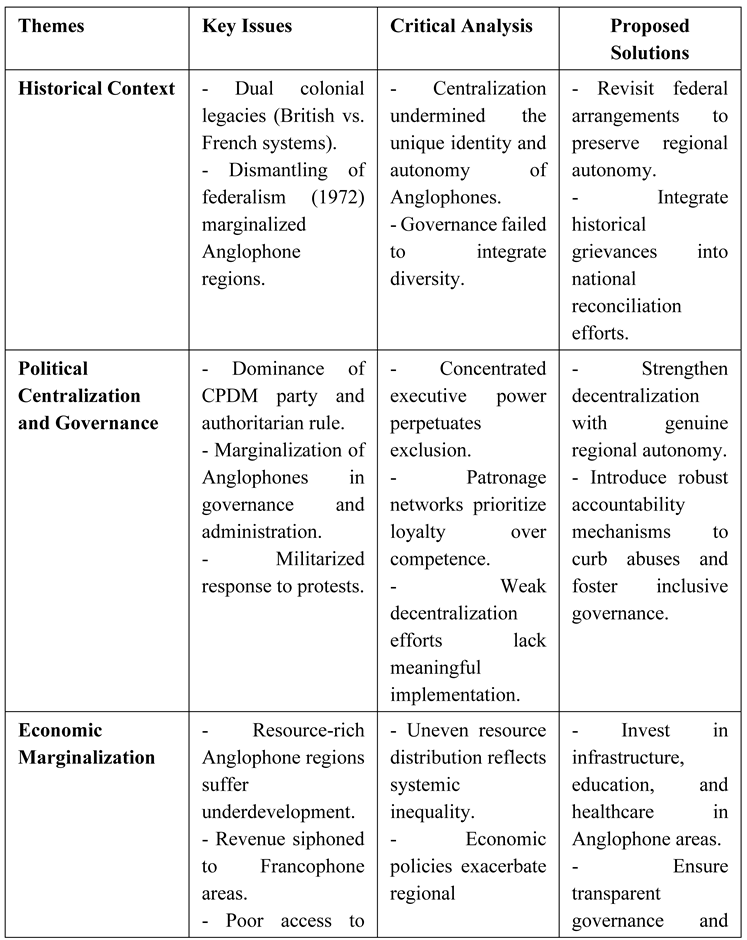
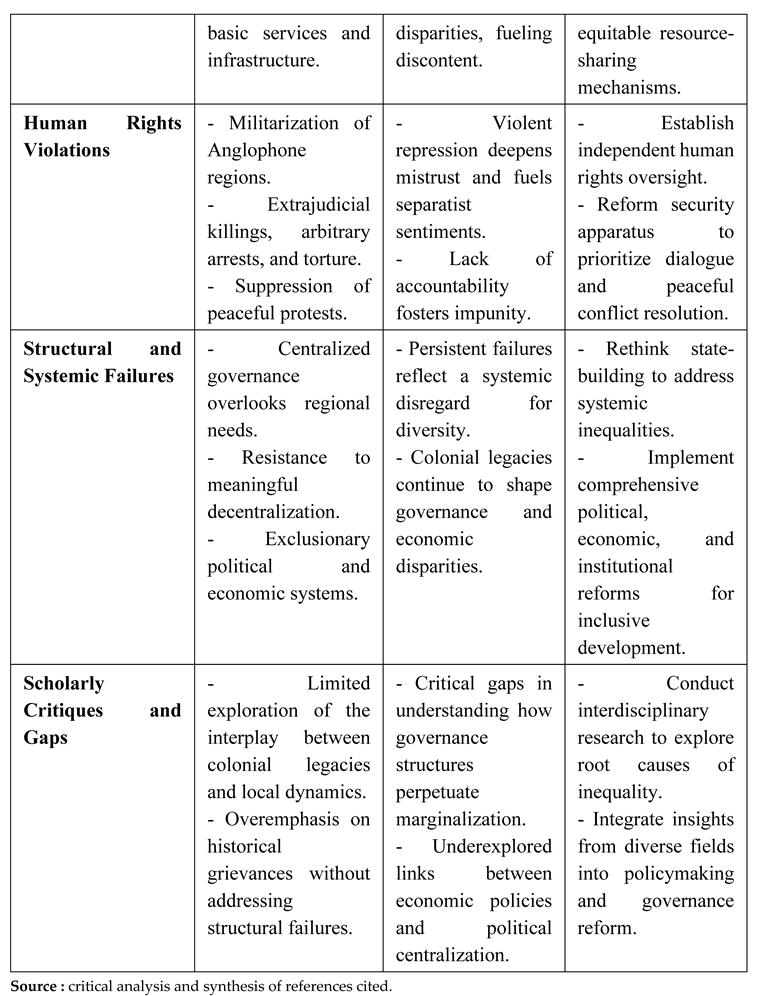
Identity Politics and the Struggle for Recognition
Pathways to Resolution: A Critical Appraisal of the Anglophone Crisis in Cameroon
Decentralization and Political Reform
Dialogue and Reconciliation
Economic Equity
Cultural Preservation
Conclusion
Appendix A
References
- AZONGA, T. M. (n.d.). Political communication: The shifting paradigm of Cameroon Anglophone self-expression (1961-2018).
- Bang, H. N. (2024). Displacement-induced destitution in Cameroon: Seeking durable livelihood solutions for internally displaced persons from the Anglophone crisis. Cogent Social Sciences, 10(1), 2411861.
- Bang, H. N., & Balgah, R. A. (2022). The ramification of Cameroon’s Anglophone crisis: Conceptual analysis of a looming “complex disaster emergency”. Journal of International Humanitarian Action, 7(1), 6.
- Begealawuh, N. C. (2024). Missed or misused opportunity? Social cohesion, national dialogue and peacebuilding in Cameroon. African Security Review, 33(4), 497-513.
- Che, C. A. C. (2019). An analysis of decentralisation under the 1996 constitution of Cameroon. University of Pretoria (South Africa).
- EKO, L. (2024). The Anglophone Question. The Anglophone question and postcolonial hegemony in Cameroon: The past that did not pass (pp. 31).
- Fouopi Djiogap, C., Amougou Manga, J. R., Onana, S. P., & Ewolo Bitoto, F. (2024). Does fiscal decentralization improve people's access to health and education services in Cameroon? African Development Review. [CrossRef]
- Identity, C. (2024). Cameroon and the crisis of constitutional identity. Constitutional identity and constitutionalism in Africa (p. 214).
- Konings, P. (2009). Neoliberal bandwagonism: Civil society and the politics of belonging in Anglophone Cameroon. African Books Collective.
- Kouega, J.-P., & Dempowo, S. (2022). The implementation of Cameroon’s French-English official bilingualism policy: The case of the Special Bilingual Education Programme in secondary level education institutions. Open Access Library Journal, 9(1). [CrossRef]
- Lo-oh, J. (2024). Internalised and externalised problems and perspectives for wellbeing during emergency: Reflections on the psychological impacts of the Anglophone crisis in Cameroon. Social Science and Humanities Journal (SSHJ, 8)(12), 6159-6184.
- Mbatna Taiwe, T. A. (2022). Peacebuilding through education: The case of Cameroon's schools amid the Anglophone crisis. Marquette University ePublications. Retrieved from https://epublications.marquette.edu.
- Talla, D. T. (2024). Culture or power: The eruption of the Anglophone crisis in Cameroon (Master's thesis, Portland State University).
- Yenshu Vubo, E., & Ngwa, G. A. (2001). Changing intercommunity relations and the politics of identity in the Northern Mezam area, Cameroon. Cahiers d’études africaines, 161, 163–190 . [CrossRef]
Disclaimer/Publisher’s Note: The statements, opinions and data contained in all publications are solely those of the individual author(s) and contributor(s) and not of MDPI and/or the editor(s). MDPI and/or the editor(s) disclaim responsibility for any injury to people or property resulting from any ideas, methods, instructions or products referred to in the content. |
© 2025 by the authors. Licensee MDPI, Basel, Switzerland. This article is an open access article distributed under the terms and conditions of the Creative Commons Attribution (CC BY) license (http://creativecommons.org/licenses/by/4.0/).