

Submitted:
31 December 2024
Posted:
03 January 2025
You are already at the latest version
Abstract
Physical specimens have been always the primary resources for teaching and learning paleontology in formal educational environments. However, there is a growing interest in the use of paleontological data in higher education, supported by the increased use of digital tools and large paleontological databases for data-driven learning (DDL). In the context of the ongoing data revolution in modern paleontological research, the notion of the two fossil records has emerged to distinguish the physical record consisting of specimens, from the abstracted record consisting of the data derived from those specimens. Here we argue that the so-called abstracted record extends beyond the digital data (e.g., databases, digital models, and imagery) to include (i) network-based representations of high-dimensional fossil data (e.g., The Earth-Life System), and (ii) point process models describing spatially explicit events (e.g., community-scale spatial distributions; distribution of biotic traces on shelled invertebrates). We discuss these multiples fossil records from a didactical perspective, highlighting their promise for DDL in the paleontology classroom. Network science and spatial point processes modeling are transforming paleontological research by enhancing modeling capacities and helping researchers to reveal the complexity of the global biosphere over deep-time. Our perspective paper aims to bridge the gap between the state-of-the-art paleontological research and current teaching practices in higher education courses of paleontology, by calling on educators to leverage these breakthroughs into their classrooms.
Keywords:
paleontology
; networks
; spatial point process
; data-driven learning
; higher education
Introduction
Fossils are remains of ancient organisms, or their traces, which document diverse aspects of the Earths’ history. Fossilized materials-such as shells, bones, and wood fragments-are commonly used as didactic materials for teaching and learning paleontological concepts in formal settings. Researchers and educators, spanning primary to higher education learning environments, have explored the use of physical specimens for teaching and learning different concepts of both the Natural and Earth sciences (Dilcher, 1967; Grant et al., 2016; Macdonald et al., 2005; Martinez & Serpa, 2022; Pimiento, 2015). While the educational value of fossils is widely recognized, teaching practices are still cantered around the use of physical fossil records (i.e., fossil materials) (Figure 1), ignoring the abstracted fossil records (Allmon et al., 2018) that led to major breakthroughs in modern paleobiology research (e.g., Sepkoski 1981; Alroy et al. 2008). Here we aim to highlight a gap between state-of-the-art paleontological research and teaching practices in the classroom by exploring the multifaceted nature of the fossil record, including in-situ and ex-situ physical materials as well as the data and different abstracted representations as educational tools in formal education environments.
The Multiple Fossil Records in Modern Paleontological Research
A major conceptual change in modern paleobiology research has been the distinction between the physical fossil record, consisting of specimens, and the abstracted fossil record derived from this physical record (Allmon et al., 2018). The concept of the abstracted fossil record was first introduced to highlight the extensive data already stored in large paleontological databases (D. Sepkoski, 2013), concurrent with the ambitious research effort of cataloging the Phanerozoic fossil record (Alroy et al., 2008; J. J. Sepkoski, 1981). This major shift in paleobiology research represents a transition from a specimen-based discipline to its current status as a data-driven field (Dillon et al., 2023). Recently, a new major conceptual change in paleobiology has emerged from network-based studies that characterize network representations of fossil data as abstracted fossil records that can be improved (Rojas et al. 2017b; Kocsis et al. 2018; Muscente et al. 2018; Rojas et al. 2019; Kocsis et al. 2021; Rojas et al. 2021; Viglietti et al. 2021; Pilotto et al. 2022). Intuitively, a good network representation of the physical fossil record should be maximally parsimonious yet sufficiently complex to capture the dependencies in the high-dimensional paleontological data. Researchers designing network representations of paleontological data make various assumptions about the structure and dynamics of the sedimentary record, such as whether or not to describe temporal constraints. These assumptions impact the outcome of the network analysis, such as whether or not network partitions capture or distort larger-scale patterns (see Rojas et al. 2022). As a result, the same benchmark data, for instance global records of the benthic marine invertebrates in the paleobiology database (Peters & McClennen, 2016), can be represented in different ways, for instance unipartite networks (Kocsis et al., 2018), bipartite networks (Rojas, Gracia, et al., 2022), multilayer networks (Rojas et al., 2021), hypergraphs (Eriksson et al., 2021, 2022), and population networks (Kirkley et al., 2023).
In addition to the network representations of fossil data, point process models describing spatially explicit events, for instance the distribution of individual fossil specimens in the geological record (Mitchell et al., 2015; Mitchell & Butterfield, 2018) or the location of biotic traces on the skeletons of shelled marine invertebrates (Karapunar et al., 2023; Rojas et al., 2015, 2020), are abstracted records that holds considerable promise for data-driven learning (DDL) in paleobiology. A large body of research on drilling predation in shelled marine invertebrates has successfully documented diverse aspects of predator–prey interactions (Kelley & Hansen, 2003; Klompmaker et al., 2015; Kowalewski et al., 1998) in the fossil record. However, taking advantage of the spatial information inherent to the drillholes, the spatial point pattern analysis of traces (SPPAT) (Rojas et al. 2020b) introduced a novel set of graphic (i.e., kernel density and hotspot maps) and quantitative tools (i.e., K-function, L-function, MCD), previously used in ecological research, to unlock some spatial information usually ignored in paleontological studies. Karapunar et al. (2023) showed that the SPPAT is transferable to other paleoecologic data such as encrustation (Klompmaker & Boxshall, 2015) and parasite-induced malformations (Fitzgerald et al., 2024; Huntley & De Baets, 2015), allowing for standardized investigation of a wide range of biotic interactions.
A Call for Educators to Leverage the Multiple Fossil Records in the Classroom
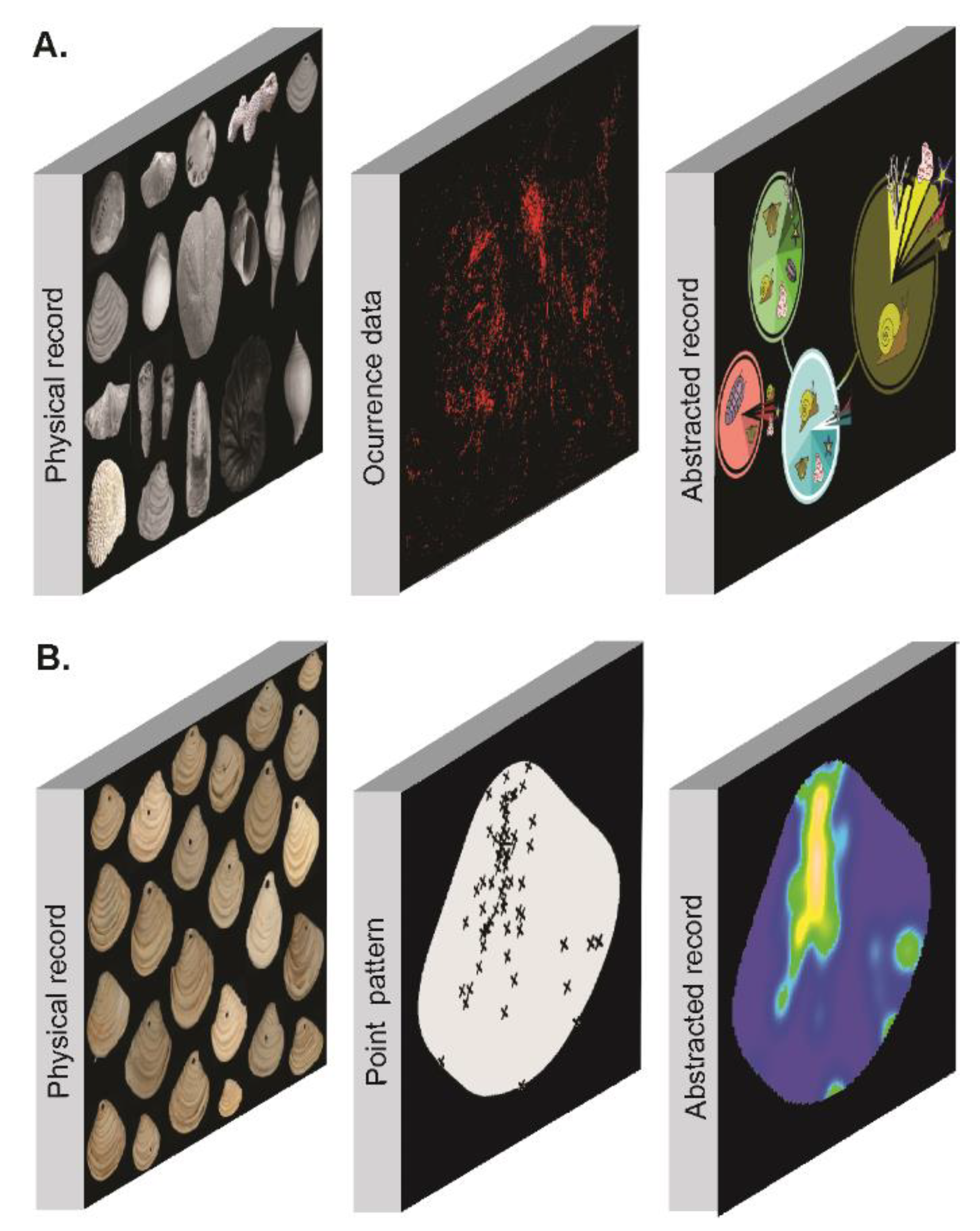
Over recent decades, fossil specimens have become essential tools in education, extending their influence from natural history museums to formal educational settings. Educators and researchers across primary, secondary, and higher education levels have embraced the use of fossils, such as shells, carapaces, bones, and wood fragments, to teach concepts in both the Natural and Earth sciences. These physical materials allow students to engage with evolutionary biology, ecological dynamics, and geological processes in an interactive and hands-on manner (Grant et al., 2016; Macdonald et al., 2005; Martinez & Serpa, 2022; Pimiento, 2015). However, the widespread emphasis on fossil specimens, while valuable, reflects only a portion of the multiple fossil records available for education, aligning with contemporary paleontological research (Figure 2).
Teaching practices in paleontology and related disciplines often overlook abstracted fossil records, i.e., network-based representations of high-dimensional fossil data and (point process models describing spatially explicit events (e.g., community-scale spatial distributions; distribution of biotic traces on shelled invertebrates) that have driven transformative breakthroughs in modern paleobiology (Alroy et al., 2008; J. J. Sepkoski, 1981). These abstracted records offer critical insights into large-scale paleontological patterns and processes that cannot be obtained from physical specimens alone. Moreover, integrating abstracted fossil records into the classroom creates opportunities for interdisciplinary education by linking paleontology to fields like data science, and computer modeling. Such an approach not only enriches students' understanding of the history of Life on Earth but also could provide them with transferable skills and a broader appreciation for the interconnectedness of scientific disciplines. By integrating both physical and abstracted fossil records, educators can foster a more holistic and interdisciplinary understanding of the history of Life on Earth, while also embracing data-driven learning (DDL) in paleobiology. Leveraging abstracted records not only deepens insights into paleontological patterns but can also develop critical skills in data analysis, visualization, and interpretation. This aligns with modern educational strategies that emphasize data literacy as essential for navigating and contributing to contemporary science (Qiao et al., 2024), thereby preparing students to address complex, interdisciplinary challenges.
Acknowledgments
AR, AM, YB and MG thank to the many students of the biology program at the Universidad Pedagógica Nacional de Colombia, whose interest in paleontology inspired this contribution.
References
- Allmon, W. D., Dietl, G. P., Hendricks, J. R., & Ross, R. M. (2018). Bridging the two fossil records: Paleontology’s “big data” future resides in museum collections. In G. D. Rosenberg & R. M. Clary, Museums at the Forefront of the History and Philosophy of Geology: History Made, History in the Making. Geological Society of America. [CrossRef]
- Alroy, J., Aberhan, M., Bottjer, D. J., Foote, M., Fürsich, F. T., Harries, P. J., Hendy, A. J. W., Holland, S. M., Ivany, L. C., Kiessling, W., Kosnik, M. A., Marshall, C. R., McGowan, A. J., Miller, A. I., Olszewski, T. D., Patzkowsky, M. E., Peters, S. E., Villier, L., Wagner, P. J., … Visaggi, C. C. (2008). Phanerozoic Trends in the Global Diversity of Marine Invertebrates. Science, 321(5885), 97–100. [CrossRef]
- Dilcher, D. L. (1967). Fossil Plants and Their Use in Teaching High School Biology*. School Science and Mathematics, 67(4), 316–320. [CrossRef]
- Dillon, E. M., Dunne, E. M., Womack, T. M., Kouvari, M., Larina, E., Claytor, J. R., Ivkić, A., Juhn, M., Milla Carmona, P. S., Robson, S. V., Saha, A., Villafaña, J. A., & Zill, M. E. (2023). Challenges and directions in analytical paleobiology. Paleobiology, 49(3), 377–393. [CrossRef]
- Eriksson, A., Carletti, T., Lambiotte, R., Rojas, A., & Rosvall, M. (2022). Flow-Based Community Detection in Hypergraphs. In F. Battiston & G. Petri (Eds.), Higher-Order Systems (pp. 141–161). Springer International Publishing. [CrossRef]
- Eriksson, A., Edler, D., Rojas, A., de Domenico, M., & Rosvall, M. (2021). How choosing random-walk model and network representation matters for flow-based community detection in hypergraphs. Communications Physics, 4(1), 133. [CrossRef]
- Fitzgerald, E., Ryan, D., Scarponi, D., & Huntley, J. W. (2024). A sea of change: Tracing parasitic dynamics through the past millennia in the northern Adriatic, Italy. Geology, 52(8), 610–614. [CrossRef]
- Grant, C. A., MacFadden, B. J., Antonenko, P., & Perez, V. J. (2016). 3D Fossils for K-12 Education: A Case Example Using the Giant Extinct Shark Carcharocles Megalodon. The Paleontological Society Papers, 22, 197–209. [CrossRef]
- Huntley, J. W., & De Baets, K. (2015). Trace Fossil Evidence of Trematode—Bivalve Parasite—Host Interactions in Deep Time. In Advances in Parasitology (Vol. 90, pp. 201–231). Elsevier. [CrossRef]
- Karapunar, B., Werner, W., Simonsen, S., Bade, M., Lücke, M., Rebbe, T., Schubert, S., & Rojas, A. (2023). Drilling predation on Early Jurassic bivalves and behavioral patterns of the presumed gastropod predator—Evidence from Pliensbachian soft-bottom deposits of northern Germany. Paleobiology, 49(4), 642–664. [CrossRef]
- Kelley, P. H., & Hansen, T. A. (2003). The Fossil Record of Drilling Predation on Bivalves and Gastropods. In P. H. Kelley, M. Kowalewski, & T. A. Hansen (Eds.), Predator—Prey Interactions in the Fossil Record (pp. 113–139). Springer US. [CrossRef]
- Kirkley, A., Rojas, A., Rosvall, M., & Young, J.-G. (2023). Compressing network populations with modal networks reveal structural diversity. Communications Physics, 6(1), 148. [CrossRef]
- Klompmaker, A. A., & Boxshall, G. A. (2015). Fossil Crustaceans as Parasites and Hosts. In Advances in Parasitology (Vol. 90, pp. 233–289). Elsevier. [CrossRef]
- Klompmaker, A. A., Portell, R. W., Lad, S. E., & Kowalewski, M. (2015). The fossil record of drilling predation on barnacles. Palaeogeography, Palaeoclimatology, Palaeoecology, 426, 95–111. [CrossRef]
- Kocsis, Á. T., Reddin, C. J., & Kiessling, W. (2018). The biogeographical imprint of mass extinctions. Proceedings of the Royal Society B: Biological Sciences, 285(1878), 20180232. [CrossRef]
- Kocsis, Á. T., Reddin, C. J., Scotese, C. R., Valdes, P. J., & Kiessling, W. (2021). Increase in marine provinciality over the last 250 million years governed more by climate change than plate tectonics. Proceedings of the Royal Society B: Biological Sciences, 288(1957), 20211342. [CrossRef]
- Kowalewski, M., Dulai, A., & Fürsich, F. T. (1998). A fossil record full of holes: The Phanerozoic history of drilling predation. Geology, 26(12), 1091. [CrossRef]
- Macdonald, R. H., Manduca, C. A., Mogk, D. W., & Tewksbury, B. J. (2005). Teaching Methods in Undergraduate Geoscience Courses: Results of the 2004 On the Cutting Edge Survey of U.S. Faculty. Journal of Geoscience Education, 53(3), 237–252. [CrossRef]
- Martinez, V. V., & Serpa, L. F. (2022). Introduction to teaching science with three-dimensional images of dinosaur footprints from Cristo Rey, New Mexico. Geoscience Communication, 5(1), 1–9. [CrossRef]
- Mitchell, E. G., & Butterfield, N. J. (2018). Spatial analyses of Ediacaran communities at Mistaken Point. Paleobiology, 44(1), 40–57. [CrossRef]
- Mitchell, E. G., Kenchington, C. G., Liu, A. G., Matthews, J. J., & Butterfield, N. J. (2015). Reconstructing the reproductive mode of an Ediacaran macro-organism. Nature, 524(7565), 343–346. [CrossRef]
- Muscente, A. D., Prabhu, A., Zhong, H., Eleish, A., Meyer, M. B., Fox, P., Hazen, R. M., & Knoll, A. H. (2018). Quantifying ecological impacts of mass extinctions with network analysis of fossil communities. Proceedings of the National Academy of Sciences, 115(20), 5217–5222. [CrossRef]
- Peters, S. E., & McClennen, M. (2016). The Paleobiology Database application programming interface. Paleobiology, 42(01), 1–7. [CrossRef]
- Pilotto, F., Rojas, A., & Buckland, P. I. (2022). Late Holocene anthropogenic landscape change in northwestern Europe impacted insect biodiversity as much as climate change did after the last Ice Age. Proceedings of the Royal Society B: Biological Sciences, 289(1977), 20212734. [CrossRef]
- Pimiento, C. (2015). Engaging students in paleontology: The design and implementation of an undergraduate-level blended course in Panama. Evolution: Education and Outreach, 8(1), 19. [CrossRef]
- Qiao, C., Chen, Y., Guo, Q., & Yu, Y. (2024). Understanding science data literacy: A conceptual framework and assessment tool for college students majoring in STEM. International Journal of STEM Education, 11(1), 25. [CrossRef]
- Rojas, A., Calatayud, J., Kowalewski, M., Neuman, M., & Rosvall, M. (2019). Low-Latitude Origins of the Four Phanerozoic Evolutionary Faunas [Preprint]. Paleontology. [CrossRef]
- Rojas, A., Calatayud, J., Kowalewski, M., Neuman, M., & Rosvall, M. (2021). A multiscale view of the Phanerozoic fossil record reveals the three major biotic transitions. Communications Biology, 4(1), 309. [CrossRef]
- Rojas, A., Dietl, G. P., Kowalewski, M., Portell, R. W., Hendy, A., & Blackburn, J. K. (2020). Spatial point pattern analysis of traces (SPPAT): An approach for visualizing and quantifying site-selectivity patterns of drilling predators. Paleobiology, 46(2), 259–271. [CrossRef]
- Rojas, A., Gracia, A., Hernández-Ávila, I., Patarroyo, P., & Kowalewski, M. (2022). Occurrence of the brachiopod Tichosina in deep-sea coral bottoms of the Caribbean Sea and its paleoenvironmental implications. Bulletin of the Florida Museum of Natural History, 59(1), 1–15. [CrossRef]
- Rojas, A., Hendy, A., & Dietl, G. P. (2015). Edge-drilling behavior in the predatory gastropod Notocochlis unifasciata (Lamarck, 1822) (Caenogastropoda, Naticidae) from the Pacific coast of Panama: Taxonomic and biogeographical implications. Vita Malacologica, 13, 63–72. https://repository.si.edu/handle/10088/27807.
- Rojas, A., Holmgren, A., Neuman, M., Edler, D., Blöcker, C., & Rosvall, M. (2022). A natural history of networks: Modeling higher-order interactions in geohistorical data [Preprint]. Paleontology. [CrossRef]
- Rojas, A., Patarroyo, P., Mao, L., Bengtson, P., & Kowalewski, M. (2017). Global biogeography of Albian ammonoids: A network-based approach. Geology, 45(7), 659–662. [CrossRef]
- Scarponi, D., Rojas, A., Nawrot, R., Cheli, A., & Kowalewski, M. (2022). Assessing biotic response to anthropogenic forcing using mollusk assemblages from the Po-Adriatic System (Italy). In Conservation Palaeobiology of Marine Ecosystems: Concepts and Applications. The Geological Society Special Publications.
- Sepkoski, D. (2013). Towards “A Natural History of Data”: Evolving Practices and Epistemologies of Data in Paleontology, 1800–2000. Journal of the History of Biology, 46(3), 401–444. [CrossRef]
- Sepkoski, J. J. (1981). A factor analytic description of the Phanerozoic marine fossil record. Paleobiology, 7(01), 36–53. [CrossRef]
- Van Eck, N. J., & Waltman, L. (2010). Software survey: VOSviewer, a computer program for bibliometric mapping. Scientometrics, 84(2), 523–538. [CrossRef]
- Viglietti, P., Rojas, A., & Rosvall, M. (2021). A network-based biostratigraphic framework for the Beaufort Group (Karoo Supergroup), South Africa. Paleontology.
Figure 1.
An alluvial diagram describing the major topics addressed in the literature on paleontology teaching and education research. It depicts the modular structure of a weighted co-occurrence network of authors keywords in filtered documents from the Web of Science core collection database (WoS). Data: 107 documents retrieved from WoS under the search: (PALEONTOLOGY OR PALEOBIOLOGY) AND (TEACHING OR EDUCATION). The network was built using VOSviewer (Van Eck & Waltman, 2010). After removing names (e.g., personal names, cities, countries, localities) and disconnected words, the input network comprises 191 keywords linked through 586 weighted edges. Because the optimized network partition (A) does not show a hierarchical structure, it was partitioned using varying Markov times models (A = 1 and B = 2) with the Map Equation framework (see Scarponi et al. 2022) to describe its modular organization at different resolutions.
Figure 1.
An alluvial diagram describing the major topics addressed in the literature on paleontology teaching and education research. It depicts the modular structure of a weighted co-occurrence network of authors keywords in filtered documents from the Web of Science core collection database (WoS). Data: 107 documents retrieved from WoS under the search: (PALEONTOLOGY OR PALEOBIOLOGY) AND (TEACHING OR EDUCATION). The network was built using VOSviewer (Van Eck & Waltman, 2010). After removing names (e.g., personal names, cities, countries, localities) and disconnected words, the input network comprises 191 keywords linked through 586 weighted edges. Because the optimized network partition (A) does not show a hierarchical structure, it was partitioned using varying Markov times models (A = 1 and B = 2) with the Map Equation framework (see Scarponi et al. 2022) to describe its modular organization at different resolutions.
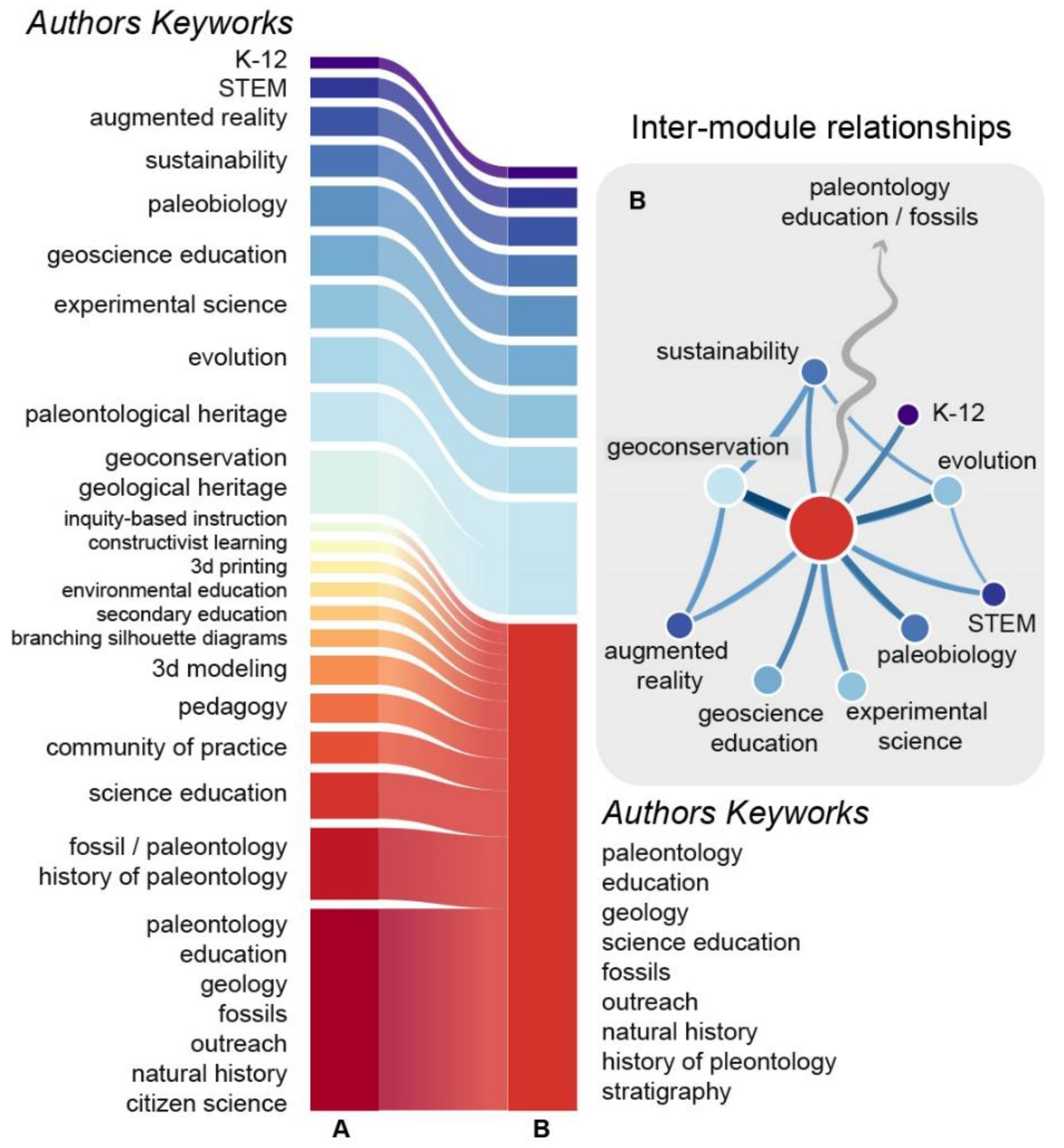
Figure 2.
The notion of the multiple fossil records in modern paleobiology research. A. The multiples records of the Phanerozoic marine faunas: (left) a selection of fossil representing the core of the benthic marine faunas (i.e., corals, brachiopods, mollusk, echinoderms); (middle) a scatterplot of global records of the Phanerozoic benthic marine faunas in the Paleobiology Database (PaleoDB); (right) the Earth-Life System. It is a multilayer network representation of the global occurrence data with a four-tier modular structure (Rojas et al. 2021). B. The multiple fossil records of drilling predation: (Left) Specimens of the bivalve Lirophora glyptocyma (Oak Grove Sand Formation, Early Miocene, Florida) representing the physical record; (Middle) spatially explicit data on drillhole locations; (Right) Kernel Density Map of predatory traces around the prey shell. Data on drillhole locations were collected and analyzed using Spatial Point Pattern Analysis of Traces (SPPAT) (Rojas et al., 2020). Adapted from (Rojas, Holmgren, et al., 2022).
Figure 2.
The notion of the multiple fossil records in modern paleobiology research. A. The multiples records of the Phanerozoic marine faunas: (left) a selection of fossil representing the core of the benthic marine faunas (i.e., corals, brachiopods, mollusk, echinoderms); (middle) a scatterplot of global records of the Phanerozoic benthic marine faunas in the Paleobiology Database (PaleoDB); (right) the Earth-Life System. It is a multilayer network representation of the global occurrence data with a four-tier modular structure (Rojas et al. 2021). B. The multiple fossil records of drilling predation: (Left) Specimens of the bivalve Lirophora glyptocyma (Oak Grove Sand Formation, Early Miocene, Florida) representing the physical record; (Middle) spatially explicit data on drillhole locations; (Right) Kernel Density Map of predatory traces around the prey shell. Data on drillhole locations were collected and analyzed using Spatial Point Pattern Analysis of Traces (SPPAT) (Rojas et al., 2020). Adapted from (Rojas, Holmgren, et al., 2022).
Disclaimer/Publisher’s Note: The statements, opinions and data contained in all publications are solely those of the individual author(s) and contributor(s) and not of MDPI and/or the editor(s). MDPI and/or the editor(s) disclaim responsibility for any injury to people or property resulting from any ideas, methods, instructions or products referred to in the content. |
© 2025 by the authors. Licensee MDPI, Basel, Switzerland. This article is an open access article distributed under the terms and conditions of the Creative Commons Attribution (CC BY) license (http://creativecommons.org/licenses/by/4.0/).
Copyright: This open access article is published under a Creative Commons CC BY 4.0 license, which permit the free download, distribution, and reuse, provided that the author and preprint are cited in any reuse.


