

Submitted:
24 December 2024
Posted:
25 December 2024
You are already at the latest version
Abstract
This paper presents the results of the study of the composite based on magnesium hydride with the addition of nanosized nickel powder, obtained by the method of electric explosion of wires. The obtained MgH₂-EEWNi (20 wt.%) composite with the core-shell configuration demonstrated a developed defect structure, which makes it possible to significantly reduce the hydrogen desorption temperature from 418 °C for pure magnesium hydride to 229°C for hydride with the addition of nickel powder. In situ studies of the evolution of the defect structure using positron annihilation methods and diffraction methods made it possible to draw conclusions about the influence of the Mg₂NiH₀.₃, Mg₂NiH₄ phases on the sorption and desorption properties of the composite. The results obtained in this work can be used in the field of hydrogen energy in mobile or stationary hydrogen storage systems.
Keywords:
hydrogen storage material
; magnesium hydride
; nickel
; nanoscale powders
; hydrogen
; desorption
1. Introduction
Metal-hydrogen systems have their own specific features, which are associated mainly with the high diffusion mobility of hydrogen in the crystal lattice of metals and their alloys, as well as high reactivity. This is due to the fact that hydrogen tends to interact with various types of defects, such as impurity atoms, dislocations, grain boundaries, vacancy-type defects and its own embedding atoms [1,2,3,4,5,6,7]. Hydrogen can induce the formation of many other defects and actively interact with defects in the structure of the material as well. Many studies have been aimed at studying the effect of hydrogen on defects, their structure and mechanical properties, but the mechanisms of such influence have not been fully established and explained. Thus, it is important to develop and improve known methods for defect control in functionally graded materials. This is directly related to the unresolved problems of hydrogen embrittlement of metals, which is why a lot of scientific works is devoted to the creation of completely new materials for operation in a hydrogen environment [8,9,10,11,12,13,14,15,16]. In this context, the most effective method for evaluating hydrogen interaction with the structure of defects is the positron spectroscopy method. Due to its high sensitivity, it allows the most accurate determination of the type of defects and their concentration, as well as the chemical environment. The effectiveness of this method has been demonstrated in many studies [17,18,19,20]. Since hydrogen stored in hydride-forming materials is currently considered as a promising energy carrier, it is important to study the properties of the interaction of this material with hydrogen. Of particular interest in this case is the study of metal hydrides with different properties [21,22,23,24,25,26,27,28]. One of the most common hydride-forming material is LaNi₅. This compound is characterized by high cyclic stability and is capable of absorbing and releasing about 1.2–1.4% hydrogen at room or higher temperatures. This makes it suitable for use in laboratory storage devices. However, this compound has disadvantages, such as high cost and mass, as well as limited production sites. Due to the small capacity for storing hydrogen, the possibilities of using this hydrogen storage material are limited. Another promising hydrogen storage material is magnesium. Magnesium hydride has several advantages: it is light, cheap and has a high hydrogen capacity (7.6% by weight). However, it has a few drawbacks as well. It has a high bond stability with hydrogen and begins to dissociate only at relatively high temperatures about 400 °C. Despite the slow kinetics and high activation energy of desorption, this material is of great interest to researchers as a potential mobile source of hydrogen storage. To improve the properties of magnesium hydride, the authors of various studies suggest using different methods and approaches [29,30,31,32,33,34,35,36,37]. One of the most well-known methods for improving sorption characteristics is milling in a planetary ball mill. This method allows the magnesium powder to be activated by mechanical friction [38,39,40,41,42,43]. Activation in this case means mechanical milling of the powder in order to destroy oxide layer and increase the surface area to create additional hydrogen diffusion paths into the bulk of material. Moreover, the interaction of magnesium and hydrogen is strongly influenced by the presence of various catalysts that can be added during the ball milling process. In recent years, many research papers have been published on the effects of catalytic additives on magnesium hydride by various research groups. Metal oxides are most often used as additives [44,45,46], as well as transition metals: nickel [47,48], cobalt [49], iron [50], titanium [51], vanadium [52], palladium [53], rare earth metals [54,55] etc. However, the problem of reducing operating temperatures is still relevant. Many authors [43,44,48,52,60] note an acceptable level of reduction in operating temperature and maximum hydrogen performance.
Doppiu S., Schultz L. and Gutfleisch O. [62] in their work obtained a composite based on magnesium hydride with the addition of nickel obtained by decomposition of metal carbonyl. All catalysts were divided into micro-, submicro- and nano-nickel. According to the data obtained, the most effective added material turned out to be a powder with a nano-nickel configuration. This effect was explained by the size of the added powder materials – in this case, the dependence on the size factor was demonstrated. Liang G. et al. [63] in a similar work, the effect of adding another metal group – Ti, V, Mn, Fe, Ni - was investigated. The result of the work was that the addition of only 1 at. % nickel reduces the temperature of hydrogen desorption from 450 °C to 350-370 ° C. Shang et al. [64] conducted their own research, according to the results of which they were able to establish that the addition of 8 mol. % nickel allows the magnesium hydride to dissociate at temperatures of about 300 ° C. They associate this phenomenon with the formation of the intermetallic hydride phase Mg₂NiH₄. In their work, rapid desorption kinetics was achieved in ~700-800 s. Despite this, it is still impossible to overcome some limitations, in particular, the impossibility of studying the defect structure evolution during hydrogen sorption, as well as distribution of hydrogen in the volume of the material. On the other hand, positron annihilation methods can help solve this problem. In our work, we consider a composite based on Mg/MgH₂ and nickel powder obtained by the electric wire explosion (EEWNi) method.
2. Materials and Methods
2.1. Materials Preparation
Nanoscale nickel powder obtained by electric explosion of wires (EEWNi) [65,66,67,68] and magnesium of MPF-4 grade (Russia) of high purity 99.2% with particle size (50-300) μm were used to obtain the composite. Magnesium powder was preliminarily subjected to mechanical activation in a planetary ball mill and then to hydrogenation using Gas Reaction Automated Machine (GRAM) complex. A detailed description of mechanical activation and hydrogenation process are presented in [69]. They are acceptable and optimal for the synthesis of this type of powder materials. Mechanical synthesis of composites was carried out in a planetary ball mill AGO-2 at the following parameters: jar rotation speed was 900 rpm, milling time – 120 minutes, mass ratio of balls and powder – 20:1 and the amount of EEWNi powder – 20 wt.%. To eliminate the possibility of contamination and appearance of oxides on the surface of the materials used, the processes of unpacking of packages, loading into the drums of the planetary ball mill and chambers of the automated complex were carried out in a sealed glove box SPEX GB 02M with an argon supply line to the working chamber and airlock. The content of purified argon 99.999%, water vapor and oxygen less than 1 ppm.
2.2. Analysis and Characterization
The morphology of the obtained composites was studied using a TESCAN VEGA 3 SBU scanning electron microscope (Tescan Orsay Holding s.r.o., Czech Republic). The elemental composition of the composite was analyzed by the energy-dispersive X-ray spectroscopy on an XMax 50 X-ray spectrometer (Oxford Instruments plc, UK). Transmission electron microscopy (TEM) was performed on a Philips CM12 microscope (Philips/FEI Company, Netherlands/USA). Differential scanning calorimetry was carried out on a STA 449 F3 Jupiter unit. Hydrogen concentration curves and hydrogen sorption-desorption cycles were obtained using Gas Reaction Automated Machine (GRAM) complex specially developed at the Department of Experimental Physics of Tomsk Polytechnic University. Hydrogen concentration was measured after hydrogen sorption-desorption experiments by melting the sample in an inert gas (Ar) atmosphere using a RHEN602 hydrogen analyzer (LECO Corporation, USA). The crystalline structure of the samples was analyzed by X-ray diffraction (XRD) in the scanning range of (5-80)º using an XRD-7000S (Shimadzu, Japan). The diffractometer was operated in a Bragg-Brentano configuration with a Cu Kα tube (λ = 0.154 nm, 40 kV, 30 mA) with a divergence slit of 1 nm. The study of phase transitions in magnesium hydride and composite during dehydrogenation was carried out in situ at the Precision Diffractometry II station of the Institute of Nuclear Physics, Siberian Branch of the Russian Academy of Sciences, on channel 6 of the synchrotron radiation of the VEPP-3 electron storage ring. Single-coordinate detectors simultaneously record the scattered radiation in a specified angular range (~30°) over 3328 channels at a rate of up to 10 MHz. The sample was placed in a chamber pumped with argon to remove air, and the sample was heated linearly to a temperature of 723 K at a rate of 6 K/min. Analysis of the gas release during temperature-programmed desorption was performed using a UGA100 mass spectrometer (Stanford Research Systems, USA). The measured diffraction patterns were processed and reflections were identified using the PDF-2 database, FullProf, and Crystallographica search-match software. The in situ analysis of experimental samples of magnesium powders and composites based on them was carried out using the Doppler broadening spectroscopy method on a specialized facility [70]. A positron source based on the ⁶⁴Cu isotope was used in this work. This source can be produced by the reaction ⁶³Cu (n, γ) → ⁶⁴Cu by irradiating copper foil with a thermal neutron flux. Pure copper, which has a high melting point, interacts very weakly with hydrogen compared to other materials, allowing it to be used in a heated hydrogen environment at high pressure [35]. DBS were acquired and recorded every five minutes. The minimum number of spectra in each sample was 150,000. The ratio of the number of positron events at the center of the annihilation peak to the total number of events below the peak is known as the S parameter and characterizes the probability of positron annihilation with free electrons. The parameter W is defined as the ratio of the number of events in the wings of the annihilation peak to the total area of the peak and characterizes the probability of positron annihilation with half-wing and half-wing electrons. The S parameter is therefore more sensitive to changes in the free volume, while the W parameter is more sensitive to the chemical environment. Values used to determine S and W: channel width for S is 6; channel width for W is 8; parameter A is 40; background level is 500 [35].
3. Results and Discussion
3.1. Composite Characterization
Figure 1 shows microphotographs of magnesium hydride and MgH₂-20 wt.% EEWNi composite obtained using a scanning electron microscope (SEM), as well as particle size distribution histograms and element distribution maps.
Magnesium hydride particles represent large agglomerates up to 180 μm in size consist of smaller particles of (3-15) μm in size as can be seen in the Figure 1e. Average particle size is about 12 μm (Figure 1e). At the same time, no contaminants are observed on the surface of the particles, and the elemental distribution map for this sample shows only the presence of the Mg (Figure 1b). SEM micrographs of the composite show that the particles of synthesized MgH₂- EEWNi composite reach sizes of (0.25-0.3) μm (Figure 1c). The average particle size is much smaller than that of magnesium hydride and is about 0.14 μm (Figure 1f). The elemental distribution maps showed that during the mechanical synthesis process, nickel powder particles were uniformly distributed over the volume of the composite and deposited on magnesium particles (Figure 1d).
Figure 1 (g-h) demonstrates the results obtained by transmission electron microscopy. From the images presented, the nanoscale nickel particles lying on the surface of the magnesium hydride particle can be clearly identified (Figure 1g). Thus, the composite particles represent a core-shell structure, where Ni nanoparticles acts as the shell and MgH₂ particles act as the core. Selected area electron diffraction (SAED) pattern demonstrated in Figure 1h makes it possible to conclude that there is no interaction between Mg and Ni with the formation of new phases. The diffraction rings and spots can be assigned to the Mg, MgH₂ and Ni phases. A small halo is observed at angles characteristic of magnesium hydride as well, which may indicate the formation of a small amount of amorphous phase during the milling process. The results of calculations of the sizes of coherent scattering regions and microstresses in MgH₂ and MgH₂-EEWNi composite are presented in Table 1.
The combined mechanical milling of magnesium hydride and EEWNi powder leads to a decrease in the size of crystallites and an increase in micro strains in all detected phases, since EEWNi particles are not only deposited on the surface of MgH₂ particles, but also embedded in the surface inducing intense defect formation (it can be seen on TEM image on Figure 1g), which also increases the milling efficiency. Higher stress values in the composite compared to magnesium hydride indicate the formation of a developed defect structure in the composite. In this regard, the use of positron spectroscopy to identify the features of defect formation in the composite and its interaction with hydrogen is relevant.
3.2. Hydrogen Storage Properties Of Composite
Figure 2 shows differential scanning calorimetry (DSC) analysis of MgH₂ and MgH₂- EEWNi composite when heated to 600°C at a heating rate of 6 K/min in an inert gas (argon) stream. Differential scanning calorimetry (DSC) is a well-established technique in which the difference in the amount of heat needed to raise the temperature of a sample and a reference is measured as a function of temperature. Both the sample and the reference are maintained at almost the same temperature throughout the experiment. As a rule, the temperature program for DSC analysis is designed in such a way that the temperature of the sample holder increases linearly as a function of time. The control sample must have a well-defined heat capacity in the temperature range to be scanned.
The process of hydrogenation and dehydrogenation is accompanied by the process of dissociation of hydrogen molecules at the surface of the material due to nickel powder particles covering magnesium hydride and acting as a "hydrogen pump", which make it easy to diffuse into the volume of the material. Figure 3a shows the X-ray diffraction (XRD) pattern of the corresponding composite after the dehydrogenation process.
From Figure 3b it is clearly seen, that an increase in the Mg₂NiH₀.₃ phase can be observed, indicating the dissociation of magnesium hydride due to the introduction of nickel powder. Peaks of nickel and its oxide are observed as well, which is in agreement with the above presented data. The phase upon hydrogenation changes to Mg₂NiH₄ and acts as a "hydrogen pump". Nanoscale particles of nickel and its oxide act as additional hydrogen diffusion pathways. In situ studies using synchrotron radiation techniques can demonstrate the hydride phase change during desorption. Figure 3c clearly shows the dissociation of hydride during its heating, decrease in the hydride phase and an increase in the metal phase, in this case magnesium with increasing temperature. Before the first temperature maximum, dissociation of the material begins to occur, which allows us to complete the assumption about the mechanism of the "hydrogen pump" and the catalytic effect from the addition of nickel powder produced by electrical explosion of the conductor. Experiments were also carried out to determine the cyclic stability of the composite, which are shown in Figure 3d. As a result of this experiment, it was found that during 10 sorption/desorption cycles, the composite demonstrates good cyclic stability and practically does not lose its hydrogen capacity. In the process of hydrogen sorption by magnesium without the addition of a catalyst, hydrogen molecules dissociate into individual atoms on the surface of the magnesium particle when overcoming a potential barrier under the influence of temperature and pressure, binding to atoms of the storage material, forming hydrides. In this case, a hydride layer is formed on the surface of the magnesium particle, which prevents the diffusion of hydrogen into the volume of the metal matrix. The hydrogen desorption process for magnesium hydride consists in the recombination of hydrogen atoms into a molecule on the surface of the particle, followed by the desorption of hydrogen from the volume. In the MgH₂-EEWNi composite, nickel and nickel oxide particles lying on the surface of magnesium particles have a significant catalytic effect, as a result, hydrogen molecules dissociate at temperatures below 473 K. It is known that Ni forms Mg₂Ni intermetallic compound during hydrogenation, which then passes into Mg₂NiH₄ during hydrogen sorption, accelerating the diffusion of hydrogen into the volume of the material. At the same time, during desorption, individual hydrogen atoms recombine into molecular hydrogen, passing through nickel particles, and are desorbed from the surface of MgH₂ particles. It is shown that the hydrogen content in the initial composite MgH₂-EEWNi has an average value of ~ 4.64 wt. %. In the powder MgH₂-EEWNi after vacuum degassing, the hydrogen content is slightly lower (~4.46 wt. %), probably due to the removal of residual gases and water vapor. In the MgH₂-EEWNi composite, after thermal desorption, the residual hydrogen content is ~ 4% of the initial concentration. For further in situ analysis of the MgH₂-EEWNi composite, the absorption and backscattering coefficients of positrons and the path of positrons in this material were calculated (Table 2).
According to the calculations filling a powder layer of more than 5 mm ensures complete absorption of positrons from a source based on the isotope ⁶⁴Cu by the material under study. In addition, as shown in section 1, the distance from the edge of the source to the inner wall of the crucible of the experimental chamber should also exceed 5 mm. Thus, for in situ analysis of MgH₂- EEWNi composite powders, a round-shaped positron source of ∅4 mm is required. In this case, its mass will be ~ 1.5 g, which increases the irradiation time to achieve nominal activity to 120 ± 15 minutes. The in situ Doppler Broadening Spectroscopy (DBS) spectra are analyzed by estimating the S and W parameters for each spectrum as pressure and temperature change over time. Such a graphical representation is optimal because it provides information about the pulse distribution of positron annihilation in the material under study at each moment of time at a known pressure and temperature, which allows us to characterize the kinetics of processes and structural features quite fully. In situ studies by using positron annihilation methods for Mg/MgH₂ were performed in our previous articles [72,73]. The time dependences of pressure, temperature and DBS parameters for the composite MgH₂-EEWNi when held in vacuum at room temperature are shown in Figure 4.
According to the data presented in Figure 4a, in situ DBS spectra, there is a decrease in the number of samples over time associated with a change in the activity of the positron source. The activity of the ⁶⁴Cu isotope decreases markedly throughout the experiment due to its short half-life of ~12.5 hours. The annihilation line narrows over time due to a decrease in half-width at half-height and a decrease in background with a significant decrease in overall statistics. Exposure of the MgH₂-EEWNi composite in vacuum at room temperature is accompanied by an increase in the S parameter and a corresponding decrease in the W parameter due to stabilization of the detector load and a change in the recording efficiency. The dependence of the annihilation parameters for the MgH₂ sample showed similar changes over time [72]. Figure 5 shows the in situ DBS spectra and the corresponding dependences of pressure, temperature and S, W parameters for the composite MgH₂-EEWNi obtained by stepwise heating in vacuum and in a hydrogen medium at pressures of 2 and 30 bar.
Significant changes in the shape of the annihilation lines are observed over a period of 200 to 1200 minutes during the thermally stimulated hydrogen desorption from the MgH₂-EEWNi composite. In situ DBS spectra during thermally stimulated desorption of the composite (Figure 5a) reveal a sharp increase in the parameter S in the range from 200 to 500 minutes, which is associated with intensive decomposition of hydrides and the release of hydrogen atoms from the material. Comparing these data with changes in pressure P and temperature T during this period (Figure 5b), the release of hydrogen from the composite in the time range (190-300) minutes is accompanied by a sharp increase in the S parameter and a decrease in the W parameter, as well as a noticeable increase in pressure P. In the range corresponding to an increase in temperature from 50 to 200 °C, the changes are due to both the release of adsorbed gases from the surface of the MgH₂-EEWNi composite particles and the release of hydrogen as a result of rapid decomposition of MgH₂. In the second range, corresponding to the time interval (400-560) minutes, there is also an intense hydrogen yield, while for magnesium hydride only one broad and intense peak of hydrogen release was observed at (555-750) minutes upon reaching a temperature of (342-400) °C [73]. This second peak for composite is associated with the decomposition of residual hydrides in the composite. The relative change in the parameter S in these two ranges is significantly higher, which confirms the intensive process of hydrogen desorption and decomposition of hydrides in the specified time intervals. Such an intense change in the S parameter may indicate both an increase in the excess free volume in the material due to dissociation of hydrogen-associated defects and an increase in the concentration of vacancy-type defects, and a change in the electronic structure. In particular, the transition from an "insulator" to a "metal" as a result of the decomposition of magnesium hydrides affects the concentration of charge carriers and the electronic structure of the material. Similar correlation was observed previously for MgH₂ and MgH₂-based composites [72,73]. The observed changes in the S and W parameters indicate the complex dynamics of physico-chemical processes during heating of MgH₂-EEWNi in vacuum, including hydrogen desorption and the evolution of the composite structure. The changes in the DBS parameters occur in stages and correspond to the heating profile with further heating. This profile is due to a combination of changes in the activity of the positron source and the formation of thermal vacancies in Mg. It is noted that the release of hydrogen at high temperatures observed in the intervals (600-630) and (780-810) minutes, is associated with residual hydrogen, which is strongly associated with defects, as well as with a small amount of hydrides in the material that were not doped with the catalytic additive EEWNi. In the range of (950-2000) minutes, the composite sample is cooled to room temperature in a vacuum. Thus, the behavior of DBS parameters in the process of thermally stimulated desorption can be characterized in several stages. At the first stage, in the range (0-190) minutes, a slight 16 increase in the S parameter and a decrease in the W parameter are due to a decrease in the activity of the positron source. The second stage includes both ranges associated with the release of adsorbed gases and the decomposition of hydrides (stages with more abrupt changes in S and W parameters, ranges (190-300) and (400-560) minutes), as well as the contribution from changes in the activity of the source and the formation of thermal vacancies in the sample (contribution to the intervals at which the output is observed hydrogen, and the stages of a smoother change in the S and W parameters in the interval of 400-920 minutes). The third stage (950-2000) minutes is characterized by minor changes in the S and W parameters, while the contribution is mainly made by relaxation of thermally induced defects and a change in the activity of the positron source. As a result of exposure of the MgH₂-EEWNi composite in a hydrogen atmosphere at a pressure of 2 bar (Figure 5 c, d), special changes in the shape of the annihilation line are observed, other than thermally stimulated desorption. In this case, changes in the shape of the annihilation line are limited to a small number of counts during the first 1000 minutes. This is due to an increase in the free volume in the material during heating and holding at a constant temperature and pressure of hydrogen, as well as a change in the activity of the source. The graph of the dependencies of the DBS, temperature and pressure parameters also confirms that these changes follow a complex stepwise heating profile. Exposure of the composite to a hydrogen atmosphere at a pressure of 2 bar in the first 500 minutes does not lead to hydrogen absorption or desorption by the material. There are no areas of sharp decrease in S and increase in W parameters during thermally stimulated desorption, which indicates the absence of phase transformations Mg→MgH₂ and other induced physico-chemical processes in this time interval. Thus, at this stage of the process, there is mainly an accumulation of thermally induced defects, without observed phase changes in the material. However, it is worth noting that in the range (300-920) minutes, there is a more significant increase in the S parameter and a decrease in the W. These changes become most significant in the range from 800 to 920 minutes, which indicates the accumulation of thermal and hydrogen-induced defects under the influence of elevated temperature and a hydrogen atmosphere. At the stage of subsequent cooling (920-2000) minutes, there is a decrease in S and an increase in W parameters, which are due not only to the relaxation of defects at the initial stage of the cooling process with a decrease in the activity of the source, but also to the absorption of hydrogen and the phase transformation of Mg→MgH₂. The DBS In situ spectra for the MgH₂-EEWNi composite under exposure conditions at 30 bar of hydrogen (Figure 5e) exhibits a more complex shape compared to other patterns and includes several additional stages. Analyzing them in combination with pressure graphs for the corresponding measurements (Figure 5f), it can be noted that the number of counts increases during hydrogen desorption and decreases during sorption. This indicates that the shape of the 17 annihilation line is closely related to the phase transformations in the magnesium-hydrogen system and the physico-chemical processes occurring during hydrogen sorption and desorption. The injection of 25 bar of hydrogen into the chamber at room temperature has a negligible effect on the DBS parameters, the nature of the dependencies of which is mainly due to a decrease in the activity of the positron source. The same effect was observed when magnesium was heated in hydrogen medium [72]. Heating to a temperature of 200°C leads to an increase in pressure in the chamber to 32 bar, however, intensive absorption of hydrogen by magnesium powder does not occur. However, a gradual slow uptake of hydrogen was observed, in contrast to magnesium [72]. At the same time, there is an increase in the S parameter and a decrease in the W parameter. Heating to 300 °C in a time interval (400-450) minutes leads to the beginning of an active hydrogen sorption process, accompanied by an increase in the parameter W and a decrease in the parameter S, a phase transformation occurs with the formation of hydrides. and active hydrogen absorption up to equilibrium was completed in time two times less than for Mg/MgH₂, which indicates a faster sorption rate [72]. Further exposure and an increase in temperature to 350°C in the interval (480- 780) minutes leads to pressure equalization, but further hydrogen sorption does not occur. There is only a slight increase in pressure due to an increase in temperature from 300°C to 350°C. In this case, the parameter S increases and the parameter W decreases, which, apparently, is due to rapid diffusion in the volume of the material and the accumulation of hydrogen-induced defects. Heating to 400°C is accompanied by a significant increase in pressure in the chamber due to hydrogen desorption and a sharp increase in the S parameter. In this range, not only the active accumulation of thermal and hydrogen-induced defects occurs, but also the decomposition of hydrides, accompanied by an intensive release of hydrogen. There is also a transition of the electronic structure from an insulator (MgH₂) to a metal (Mg). Exposure at this temperature has practically no effect on the S and W parameters, as well as for MgH₂ sample [72]. However, after that, the absorption of hydrogen is accompanied by the same sharp change in the parameter S in the opposite direction. Apparently, the Mg₂NiH₄–Mg₂Ni phase, which occurs during the processes of hydrogen sorption/desorption at a given hydrogenation pressure, as well as other structural-phase transformations, plays an important role here. The pressure of hydrogen in the chamber drops to 11 bar upon cooling, the main stage of the phase transformation from magnesium to hydride occurs. Figure 6 shows the scheme of formation of the Mg₂NiH₄ and Mg₂Ni phases. A scheme for reducing the activation energy of desorption for the MgH₂-EEWNi composite is also presented here. This behavior in the interaction of hydrogen with the material is caused by the effect of adding nanoscale nickel powder and co-milling of materials in a planetary ball mill.
The mechanism is as follows. Co-milling of magnesium hydride with nanonickel leads to the formation of a core-shell structure, where Ni nanoparticles acts as the shell and MgH₂ particles act as the core. Further, in the obtained composite in the processes of hydrogen sorption and desorption additional phases are formed, which contribute to faster absorption and release of hydrogen. During hydrogen sorption, the Mg₂Ni phase appears, which then, during the hydrogenation process, passes into the ternary hydride phase Mg₂NiHₓ, which acts as a "hydrogen pump". The obtained results of in situ positron spectrometry make it possible to identify mechanisms for improving the basic characteristics of hydrogen storage materials and to develop technological approaches to the formation and management of their structure.
4. Conclusions
In this work it was experimentally shown that the addition of nickel nanoparticles obtained by the electric explosion of wires significantly improves the hydrogen sorption and desorption properties of Mg/MgH₂. Using scanning electron microscopy, it was shown that the composite consists of MgH₂ particles and 20 wt. % of EEWNi nanoparticles uniformly distributed on their surface. The behavior of the defect structure of the composites during thermally stimulated hydrogen desorption and exposure to a hydrogen atmosphere at a pressure of 2 and 30 bar was characterized by positron annihilation methods. The results of in situ positron spectroscopy allows to establish the mechanisms for improving the main characteristics of hydrogen storage materials, as well as to develop technological approaches to forming and controlling their structure. A comprehensive analysis of time correlations of the parameters of Doppler broadening of the annihilation line, pressure and temperature in the processes of thermal exposure, as well as the effect of a hydrogen atmosphere on the MgH₂-EEWNi composite allows to obtain the most complete data on the sorption and desorption properties and internal structure. It has been established that the decrease in the activation energy of magnesium hydride dissociation upon addition of nanosized nickel powder is due to the fact that deposition of nickel nanoparticles on magnesium hydride particles reduces the binding energy of hydrogen with magnesium.
Funding
This research was funded by the Governmental Program, Grant №FSWW-2023-0005
Institutional Review Board Statement
Not applicable.
Informed Consent Statement
Not applicable.
Data Availability Statement
The raw/processed data required to reproduce these findings cannot be shared at this time as the data also forms part of an ongoing study.
Conflicts of Interest
The authors declare no conflict of interest. The funders had no role in the design of the study; in the collection, analyses, or interpretation of data; in the writing of the manuscript, or in the decision to publish the results.
References
- Bordulev, I.; Kudiiarov, V.; Svyatkin, L.; Syrtanov, M.; Stepanova, E.; Čížek, J.; Vlček, M.; Li, K.; Laptev, R.; Lider, A. Positron Annihilation Spectroscopy Study of Defects in Hydrogen Loaded Zr-1Nb Alloy. Journal of Alloys and Compounds 2019, 798, 685–694. [CrossRef]
- Laptev, R.S.; Lider, A.M.; Bordulev, Y.S.; Kudiiarov, V.N.; Garanin, G.V.; Wang, W.; Kuznetsov, P.V. Investigation of Defects in Hydrogen-Saturated Titanium by Means of Positron Annihilation Techniques. Defect and Diffusion Forum/Diffusion and Defect Data, Solid State Data. Part a, Defect and Diffusion Forum 2015, 365, 232–236. [CrossRef]
- Laptev, R.; Lider, A.; Bordulev, Yu.; Kudiiarov, V.; Garanin, G. HydrogenationInduced Microstructure Changes in Titanium. Journal of Alloys and Compounds 2015, 645, S193–S195. [CrossRef]
- Laptev, R.S.; Kudiiarov, V.N.; Bordulev, Y.S.; Mikhaylov, A.A.; Lider, A.M. GasPhase Hydrogenation Influence on Defect Behavior in Titanium-Based Hydrogen-Storage Material. Progress in Natural Science/Progress in Natural Science 2017, 27, 105–111. [CrossRef]
- Cherdantsev, Y.P.; Chernov, I.P.; Tyurin, Y.I. Methods for studying metalhydrogen systems. Energoatomizdat 2004, 270.
- Faber, M.S.; Lukowski, M.A.; Ding, Q.; Kaiser, N.S.; Jin, S. Earth-Abundant Metal Pyrites (FeS2, CoS2, NiS2, and Their Alloys) for Highly Efficient Hydrogen Evolution and Polysulfide Reduction Electrocatalysis. Journal of Physical Chemistry. C./Journal of Physical Chemistry. C 2014, 118, 21347–21356. [CrossRef]
- Kolachev, B.A. Hydrogen in Metals and Alloys. Metal Science and Heat Treatment 1999, 41, 93–100. [CrossRef]
- Alefeld, G.; Voelkl, J. Hydrogen in Metals I - Basic Properties. 1978, 28.
- Geld, P.V.; Ryabov, R.A.; Kodes, E.S. Hydrogen and imperfections of metal structure. Metallurgy 1979, 221.
- Popov, E.; Troev, T.; Petrov, L.; Berovski, K.; Peneva, S.; Kolev, B. Model calculations of positron interaction in materials for ITER. Bulg. Chem. Commun. 2015, 47, 192–199.
- Gainotti, A.; Ghezzi, C.; Manfredi, M.; Zecchina, L. Positron Lifetimes in Metal Hydrides. Nuovo Cimento. B 1968, 56, 47–56. [CrossRef]
- Budziak, A.; Dryzek, J.; Krawczyk, J.; Zieliński, P.M. Calorimetric and Positron Lifetime Measurements Of Hydrogenated Carbon Nanocones. Acta Physica Polonica. A 2010, 117, 574–577. [CrossRef]
- Laptev, R.S.; Bordulev, Y.S.; Kudiiarov, V.N.; Lider, A.M.; Garanin, G.V. Positron Annihilation Spectroscopy of Defects in Commercially Pure Titanium Saturated with Hydrogen. Advanced Materials Research 2014, 880, 134–140. [CrossRef]
- Hautojarvi, P.; Huomo, H.; Puska, M.; Vehanen, A. Vacancy Recovery and Vacancy-Hydrogen Interaction in Niobium and Tantalum Studied by Positrons. Physical Review. B, Condensed Matter 1985, 32, 4326–4331. [CrossRef]
- Kulkova, S. Electron and Positron Characteristics of Group IV Metal Dihydrides. International Journal of Hydrogen Energy 1996, 21, 1041–1047. [CrossRef]
- Aref’ev, K.P.; Boev, O.V.; Imas, O.N.; Lider, A.M.; Surkov, A.S.; Chernov, I.P. Annihilation of Positrons in Hydrogen-Saturated Titanium. Physics of the Solid State 2003, 45, 1–5. [CrossRef]
- Sakaki, K.; Kawase, T.; Hirato, M.; Mizuno, M.; Araki, H.; Shirai, Y.; Nagumo, M. The Effect of Hydrogen on Vacancy Generation in Iron by Plastic Deformation. Scripta Materialia 2006, 55, 1031–1034. [CrossRef]
- Chernov, I.P. Accumulation and elimination of hydrogen defects under radiation and heat treatment of titanium. Fiz. Khimiya Obrab. Mater. 2002, 3, 55–59.
- Takai, K.; Shoda, H.; Suzuki, H.; Nagumo, M. Lattice Defects Dominating Hydrogen-Related Failure of Metals. Acta Materialia 2008, 56, 5158–5167. [CrossRef]
- Middleburgh, S.C.; Voskoboinikov, R.E.; Guenette, M.C.; Riley, D.P. Hydrogen Induced Vacancy Formation in Tungsten. Journal of Nuclear Materials 2014, 448, 270–275. [CrossRef]
- Lin H. J. et al. Symbiotic CeH₂.73/CeO2 catalyst: a novel hydrogen pump // Nano Energy. – 2014. – Vol. 9. – P. 80–87. [CrossRef]
- Bououdina M., Grant D., Walker G. Review on hydrogen absorbing materials—structure, microstructure, and thermodynamic properties // International Journal of Hydrogen Energy. – 2006. – Vol. 31. – N. 2. – P. 177–182. [CrossRef]
- Kojima Y. Hydrogen storage materials for hydrogen and energy carriers // International Journal of Hydrogen Energy. – 2019. – Vol. 44. – N. 33. – P. 18179–18192. [CrossRef]
- Khafidz N. Z. A. K. et al. The kinetics of lightweight solid-state hydrogen storage.
- materials: A review // International Journal of Hydrogen Energy. – 2016. – Vol. 41. –N. 30. – P. 13131–13151. [CrossRef]
- Rusman N. A. A., Dahari M. A review on the current progress of metal hydrides material for solid-state hydrogen storage applications // International Journal of Hydrogen Energy. – 2016. – Vol. 41. – N. 28. – P. 12108–12126. [CrossRef]
- Sakintuna B., Lamari-Darkrim F., Hirscher M. Metal hydride materials for solid hydrogen storage: a review // International journal of hydrogen energy. – 2007. – Vol. 32. – N. 9. – P. 1121–1140. [CrossRef]
- Ismail M. et al. Desorption behaviours of lithium alanate with metal oxide nanopowder additives // International Journal of Electrochemical Science. – 2014. – Vol. 9. – P. 4959–4973. [CrossRef]
- Cortez J. J. et al. Kinetic improvement of H₂ absorption and desorption properties in Mg/MgH₂ by using niobium ethoxide as additive // International Journal of Hydrogen Energy. – 2019. – Vol. 44 – N. 23. – P. 11961–11969. [CrossRef]
- Zhang X. et al. Realizing 6.7 wt% reversible storage of hydrogen at ambient temperature with non-confined ultrafine magnesium hydrides //Energy & Environmental Science. – 2021. – Vol. 14. – N. 4. – P. 2302–2313. [CrossRef]
- Xie X. et al. Recent advances in magnesium-based hydrogen storage materials with multiple catalysts // International Journal of Hydrogen Energy. – 2019. – Vol. 44. – N. 21. – P. 10694–10712. [CrossRef]
- Vigeholm B., Kjøller J., Larsen B. Magnesium for hydrogen storage // Journal of the Less Common Metals. – 1980. – Vol. 74. – N. 2. – P. 341–350. [CrossRef]
- Galey B. et al. Improved hydrogen storage properties of Mg/MgH₂ thanks to the addition of nickel hydride complex precursors // International Journal of Hydrogen Energy. – 2019. – Vol. 44. – N. 54. – P. 28848–28862. [CrossRef]
- Lin H. J. et al. Hydrogen storage properties of Mg–Ce–Ni nanocomposite induced from amorphous precursor with the highest Mg content // International Journal of Hydrogen Energy. – 2012. – Vol. 37. – N. 19. – P. 14329–14335. [CrossRef]
- Yang J., Sudik A., Wolverton C. Activation of hydrogen storage materials in the Li–Mg–N–H system: Effect on storage properties // Journal of Alloys and Compounds. – 2007. – Vol. 430. – N. 1–2. – P. 334–338. [CrossRef]
- Zhang J. et al. State of the art multi-strategy improvement of Mg-based hydrides for hydrogen storage // Journal of Alloys and Compounds. – 2019. – Vol. 782. – P. 796–823. [CrossRef]
- Zaluska A., Zaluski L., Ström–Olsen J. O. Nanocrystalline magnesium for hydrogen storage // Journal of Alloys and Compounds. – 1999. – Vol. 288. – N. 1–2. – P. 217–225. [CrossRef]
- Jinzhe L., Lider A. M., Kudiyarov V. N. Using Ball Milling for Modification of the Hydrogenation/Dehydrogenation Process in Magnesium-Based Hydrogen Storage Materials: An Overview // Metals. – 2019. – Vol. 9. – N. 7. – Article number 768. [CrossRef]
- Zaluska A., Zaluski L., Ström-Olsen J. O. Synergy of hydrogen sorption in ballmilled hydrides of Mg and Mg₂Ni // Journal of Alloys and Compounds. – 1999. – Vol. 289. – N. 1–2. – P. 197–206. [CrossRef]
- Malka I. E., Czujko T., Bystrzycki J. Catalytic effect of halide additives ball milled with magnesium hydride // International Journal of Hydrogen Energy. – 2010. – Vol. 35. – N. 4. – P. 1706–1712. [CrossRef]
- Zadorozhnyy V. Y. et al. Effect of mechanical activation on compactibility of metal hydride materials // Journal of Alloys and Compounds. – 2017. – Vol. 707. – P. 214–219. [CrossRef]
- Huot J., Liang G., Schulz R. Mechanically alloyed metal hydride systems // Applied Physics A. – 2001. – Vol. 72. – N. 2. – P. 187–195. [CrossRef]
- Wu C. Z. et al. Effect of carbon/noncarbon addition on hydrogen storage behaviors of magnesium hydride // Journal of Alloys and Compounds. – 2006. – Vol. 414. – N. 1–2. – P.259–264. [CrossRef]
- Oelerich W., Klassen T., Bormann R. Metal oxides as catalysts for improved hydrogen sorption in nanocrystalline Mg-based materials // Journal of Alloys and Compounds. – 2001. – Vol. 315. – N. 1–2. – P. 237–242. [CrossRef]
- Milošević S. et al. Fast hydrogen sorption from MgH₂–VO2 (B) composite materials // Journal of Power Sources. – 2016. – Vol. 307. – P. 481–488. [CrossRef]
- Polanski M., Bystrzycki J. Comparative studies of the influence of different nanosized metal oxides on the hydrogen sorption properties of magnesium hydride // Journal of Alloys and Compounds. – 2009. – Vol. 486. – N. 1–2. – P. 697–701. [CrossRef]
- Shao H. et al. Preparation and hydrogen storage properties of nanostructured Mg–Ni BCC alloys // Journal of Alloys and Compounds. – 2009. – Vol. 477. – N. 1–2. – P. 301–306. [CrossRef]
- Liu H. et al. Recent advances in hydrogen storage of MgH₂ doped by Ni // IOP Conference Series: Earth and Environmental Science. – IOP Publishing, 2019. – Vol. 267. – N. 2. – Article number 022042. 10.1088/1755-1315/267/2/022042.
- Shao H. et al. Synthesis and hydrogen storage behavior of Mg–Co–H system at nanometer scale // Journal of Solid State Chemistry. – 2004. – Vol. 177. – N. 10. – P. 3626–3632. [CrossRef]
- Pukazhselvan D. et al. Dehydrogenation properties of magnesium hydride loaded with Fe, Fe− C, and Fe− Mg additives // ChemPhysChem. – 2017. – Vol. 18. – N. 3. – P. 287–291. [CrossRef]
- Zhou C. et al. Roles of Ti-based catalysts on magnesium hydride and its hydrogen storage properties // Inorganics. – 2021. – Vol. 9. – N. 5. – Article number 36. [CrossRef]
- Ren C. et al. Hydrogen storage properties of magnesium hydride with V-based additives // The Journal of Physical Chemistry C. – 2014. – Vol. 118. – N. 38. – P. 21778–21784. [CrossRef]
- Liu Y. et al. Magnesium nanoparticles with Pd decoration for hydrogen storage // Frontiers in Chemistry. – 2020. – Vol. 7. – Article number 949. [CrossRef]
- Liu Y. et al. Effect of novel La-based alloy modification on hydrogen storage performance of magnesium hydride: First-principles calculation and experimental investigation // Journal of Power Sources. – 2022. – Vol. 551. – Article number 232187. [CrossRef]
- Spassov T. et al. Mg–Ni–RE nanocrystalline alloys for hydrogen storage // Materials Science and Engineering: A. – 2004. – Vol. 375. – P. 794–799. [CrossRef]
- Jangir M. et al. Catalytic effect of TiF4 in improving hydrogen storage properties of MgH₂ // International Journal of Hydrogen Energy. – 2016. – Vol. 41. – N. 32. – P. 14178– 14183. [CrossRef]
- Park H. R. et al. Hydrogen Sorption of Pure Mg and Niobium (V) Fluoride-Added Mg Alloys Prepared by Planetary Ball Milling in Hydrogen // Korean Journal of Metals and Materials. – 2016. – Vol. 54. – N. 12. – P. 916–924. [CrossRef]
- Lin H. J. et al. Enhanced hydrogen desorption property of MgH₂ with the addition of cerium fluorides // Journal of Alloys and Compounds. – 2015. – Vol. 645. – P. S392-S396. [CrossRef]
- Malka I. E. et al. A study of the ZrF4, NbF5, TaF5, and TiCl3 influences on the MgH₂ sorption properties // International Journal of Hydrogen Energy. – 2011. – Vol. 36. – N. 20. – P. 12909–12917. [CrossRef]
- Rahmalina D. et al. Experimental Evaluation for the Catalytic Effect of Nickel in Micron Size on Magnesium Hydride //WSEAS Transactions on Applied and Theoretical Mechanics. – 2021. – Vol. 16. – P. 293-302. [CrossRef]
- Varin R. A. et al. Catalytic effects of various forms of nickel on the synthesis rate and hydrogen desorption properties of nanocrystalline magnesium hydride (MgH₂) synthesized by controlled reactive mechanical milling (CRMM) //Journal of alloys and compounds. – 2007. – Vol. 432. – N. 1-2. – P. 217-231. [CrossRef]
- Doppiu S., Schultz L., Gutfleisch O. In situ pressure and temperature monitoring during the conversion of Mg into MgH₂ by high-pressure reactive ball milling //Journal of alloys and compounds. – 2007. – Vol. 427. – N. 1-2. – P. 204-208. [CrossRef]
- Liang G. et al. Catalytic effect of transition metals on hydrogen sorption in nanocrystalline ball milled MgH₂–Tm (Tm= Ti, V, Mn, Fe and Ni) systems //Journal of Alloys and Compounds. – 1999. – Vol. 292. – N. 1-2. – P. 247-252. [CrossRef]
- Shang C. X. et al. Mechanical alloying and electronic simulations of (MgH₂+ M) systems (M= Al, Ti, Fe, Ni, Cu and Nb) for hydrogen storage // International Journal of Hydrogen Energy. – 2004. – Vol. 29. – N. 1. – P. 73-80. 10.1016/S0360-3199(03)00045-4.
- Iljin A. P. , Mostovshchikov A. V. , Nazarenko O. B. , Zmanovsky S. V. Heat release in chemical reaction between micron aluminum powders and water // International Int. J. Hydrog. Energy. – 2019. – Т. 44. – №. 52. – С. 28096-28103.
- Mostovshchikov, A., Gubarev, F., Chumerin, P., Arkhipov, V., Kuznetsov, V., & Dubkova, Y. Solid energetic material based on aluminum micropowder modified by microwave radiation //Crystals. – 2022. – Т. 12. – №. 4. – С. 446.
- Mostovshchikov, A., Gubarev, F., Nazarenko, O., & Pestryakov, A. Influence of short-pulse microwave radiation on thermochemical properties aluminum micropowder //Materials. – 2023. – Т. 16. – №. 3. – С. 951.
- Mostovshchikov A. V., Goldenberg B. G., Nazarenko O. B. Effect of synchrotron radiation on thermochemical properties of aluminum micro-and nanopowders //Materials Science and Engineering: B. – 2022. – Т. 285. – С. 115961.
- Kudiiarov V. N. et al. Microstructure and hydrogen storage properties of MgH₂/MIL-101 (Cr) composite // Journal of Alloys and Compounds. – 2024. – Vol. 976. – Article number 173093. [CrossRef]
- Bordulev I. et al. Positron annihilation spectroscopy complex for structural defect analysis in metal–hydrogen systems // Materials. – 2022. – Vol. 15. – N. 5. – Article number 1823. [CrossRef]
- Kudiiarov V. et al. The phase transitions behavior and defect structure evolution in magnesium hydride/single-walled carbon nanotubes composite at hydrogen sorption-desorption processes // Journal of Alloys and Compounds. – 2023. – Vol. 953. – Article number 170138. [CrossRef]
- Kudiiarov V. N. et al. The defect structure evolution in magnesium hydride/metalorganic framework structures MIL-101 (Cr) composite at high temperature hydrogen sorptiondesorption processes // Journal of Alloys and Compounds. – 2023. – Vol. 966. – Article number 171534. [CrossRef]
- Kudiiarov V. et al. The phase transitions behavior and defect structure evolution in magnesium hydride/single-walled carbon nanotubes composite at hydrogen sorption-desorption processes // Journal of Alloys and Compounds. – 2023. – Vol. 953. – Article number 170138. [CrossRef]
Figure 1.
– SEM micrographs of MgH₂ (a, b) and MgH₂-EEWNi composite (c, d) with the corresponding elemental mapping analysis (b, d) and particle size distribution for MgH₂ (e) and composite (f), TEM image of MgH₂-EEWNi composite particle (g) and the corresponding SAED pattern (h).
Figure 1.
– SEM micrographs of MgH₂ (a, b) and MgH₂-EEWNi composite (c, d) with the corresponding elemental mapping analysis (b, d) and particle size distribution for MgH₂ (e) and composite (f), TEM image of MgH₂-EEWNi composite particle (g) and the corresponding SAED pattern (h).
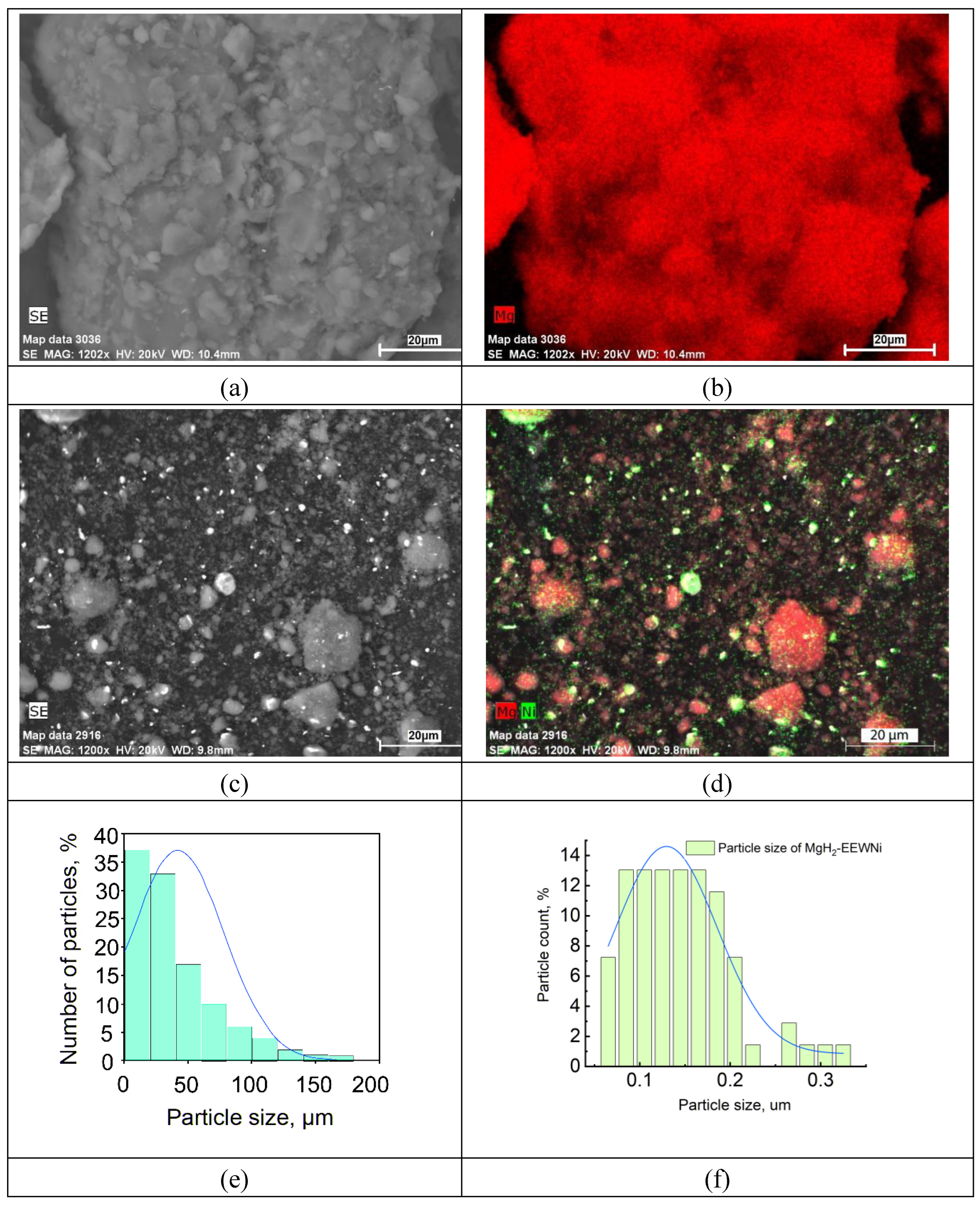
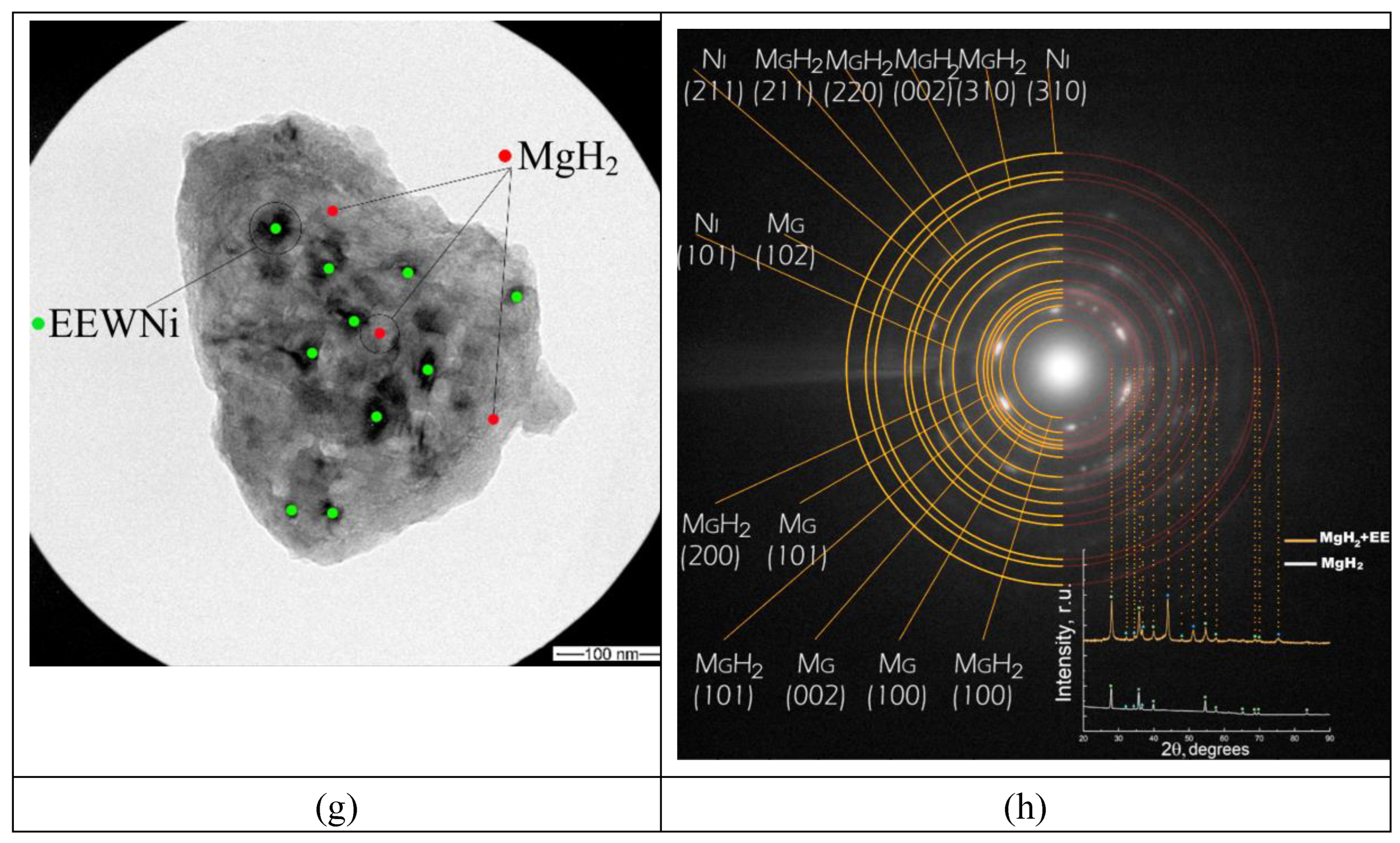
Figure 2.
Differential scanning calorimetry (DSC) analysis of MgH₂ and MgH₂-EEWNi composite.
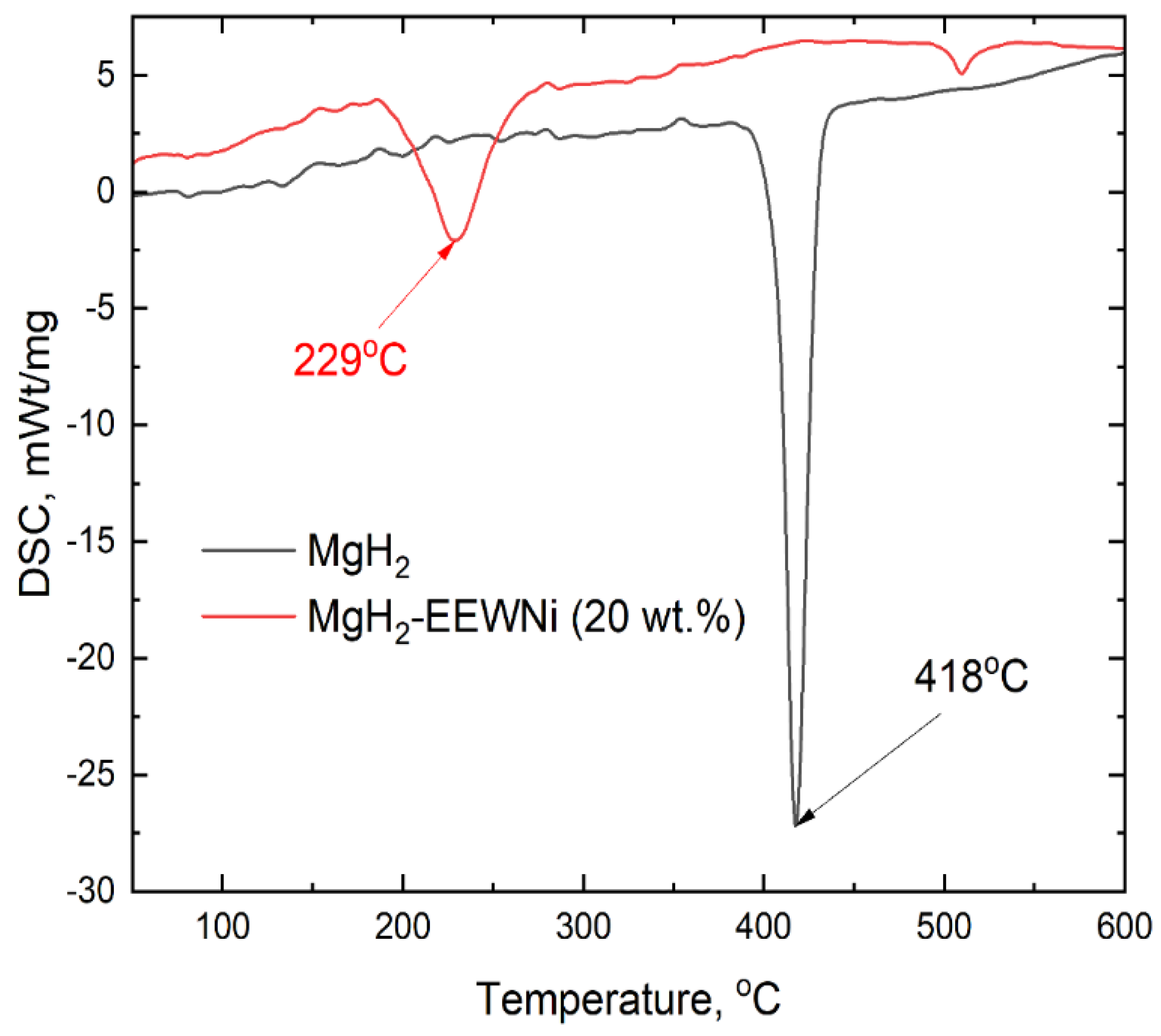
Figure 3.
– XRD pattern of MgH₂-EEWNi sample after dehydrogenation (a), XRD pattern, obtained in situ during heating (b), graph of phase transformations during heating (с) and hydrogen sorption-desorption cycle test for composite MgH₂-EEWNi (d).
Figure 3.
– XRD pattern of MgH₂-EEWNi sample after dehydrogenation (a), XRD pattern, obtained in situ during heating (b), graph of phase transformations during heating (с) and hydrogen sorption-desorption cycle test for composite MgH₂-EEWNi (d).
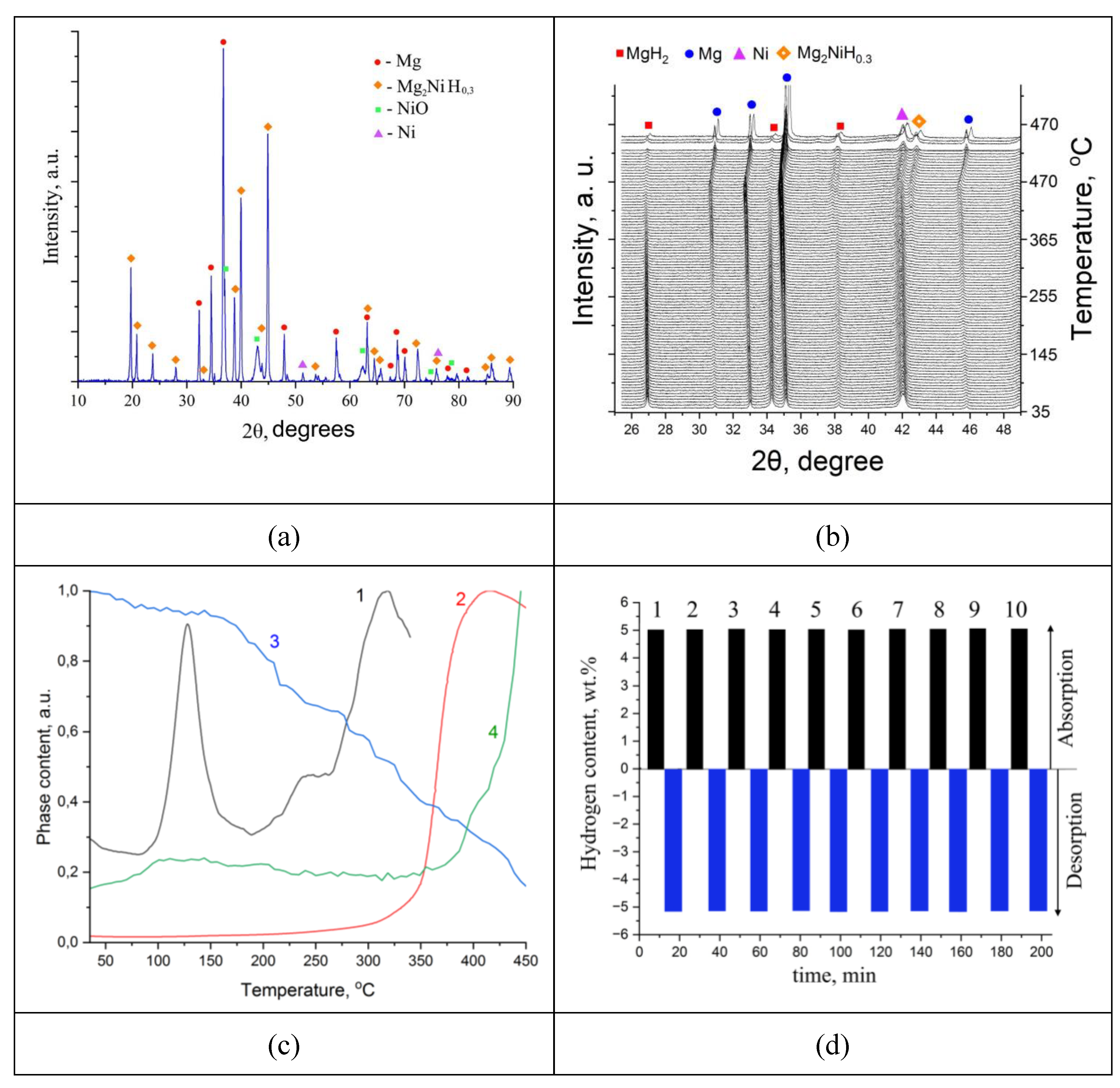
Figure 4.
– DBS in situ spectra (a) and dependencies S(t), W(t), P(t), T(t) (b) for MgH₂-EEWNi composite after exposing in a vacuum at room temperature.
Figure 4.
– DBS in situ spectra (a) and dependencies S(t), W(t), P(t), T(t) (b) for MgH₂-EEWNi composite after exposing in a vacuum at room temperature.
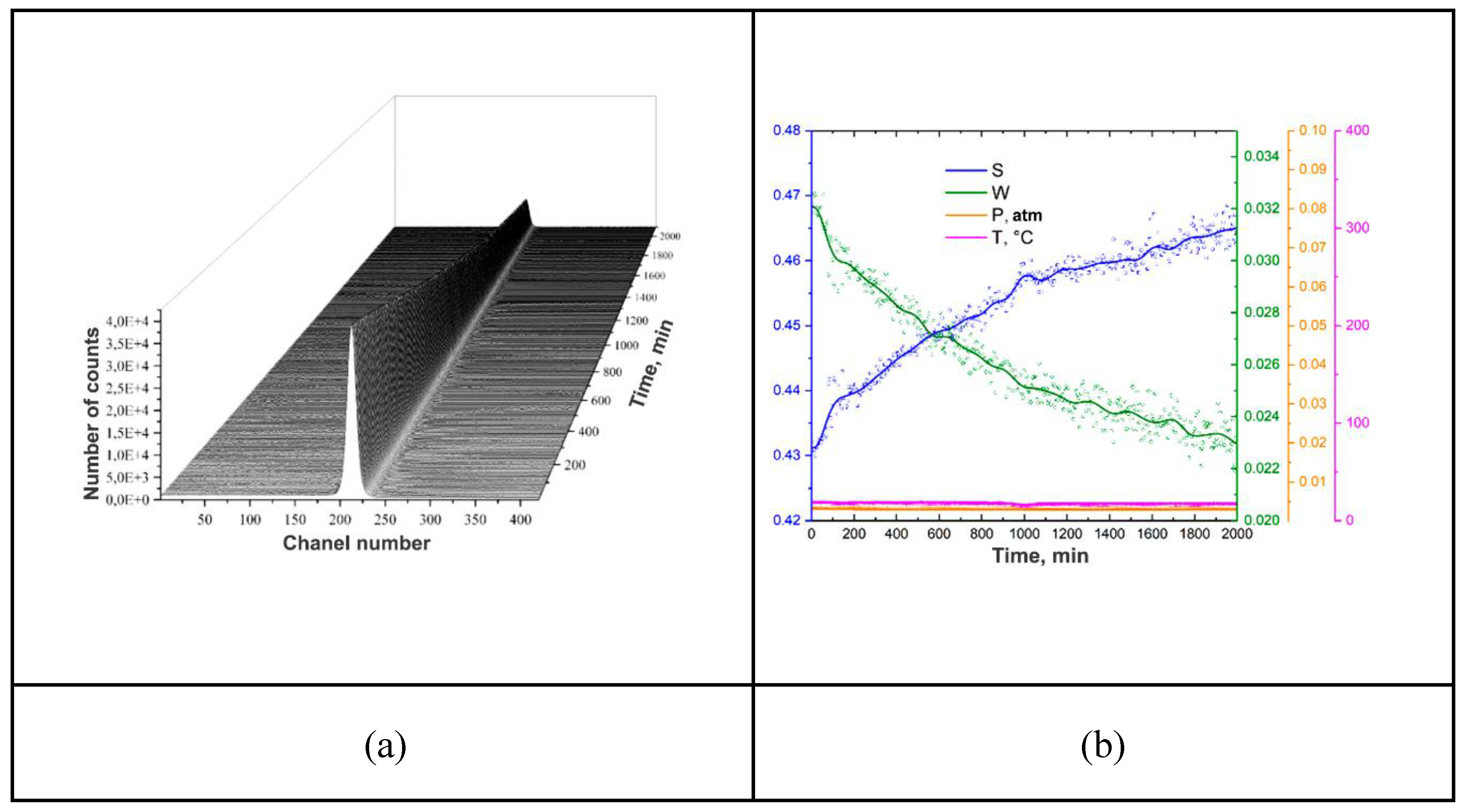
Figure 5.
– DBS in situ spectra and dependencies S(t), W(t), P(t), T(t) for MgH₂-EEWNi composite during vacuum heating (a, b), heating at 2 bar of hydrogen (c, d) and heating at 30 bar of hydrogen (e, f).
Figure 5.
– DBS in situ spectra and dependencies S(t), W(t), P(t), T(t) for MgH₂-EEWNi composite during vacuum heating (a, b), heating at 2 bar of hydrogen (c, d) and heating at 30 bar of hydrogen (e, f).
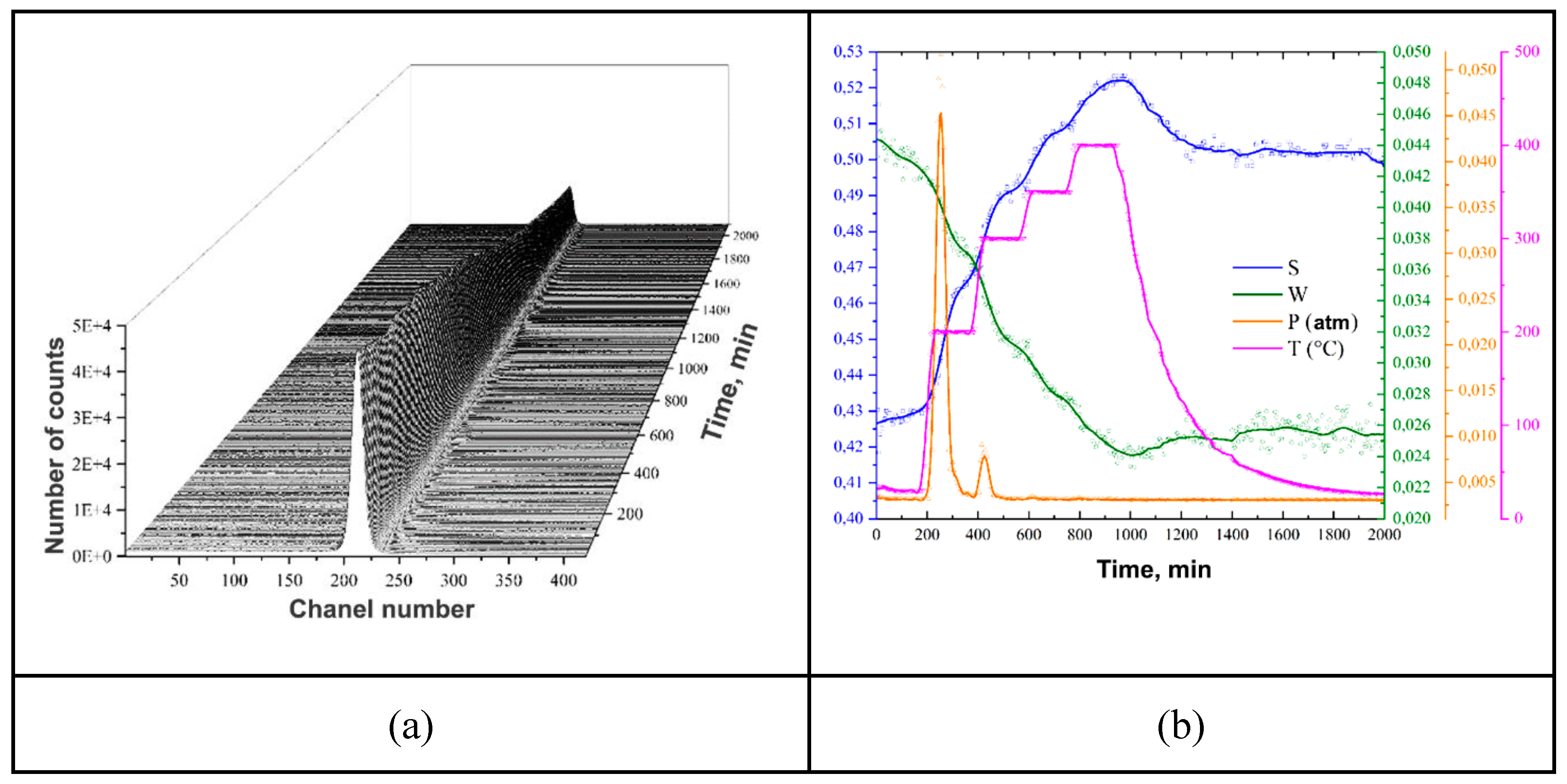
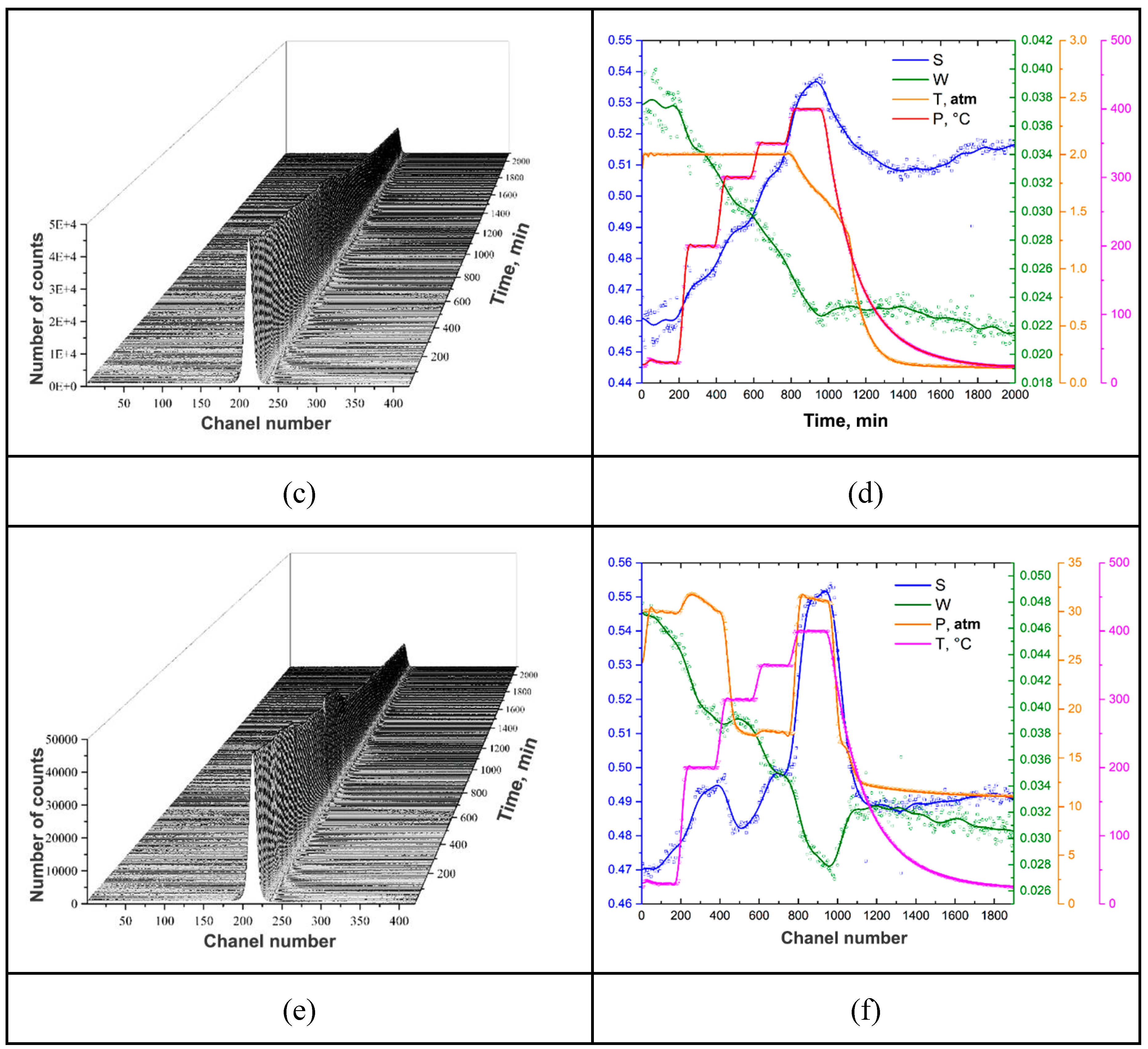
Figure 6.
– Schematic representation of the mechanism of reducing the activation energy of hydrogen desorption from the MgH₂-EEWNi composite.
Figure 6.
– Schematic representation of the mechanism of reducing the activation energy of hydrogen desorption from the MgH₂-EEWNi composite.
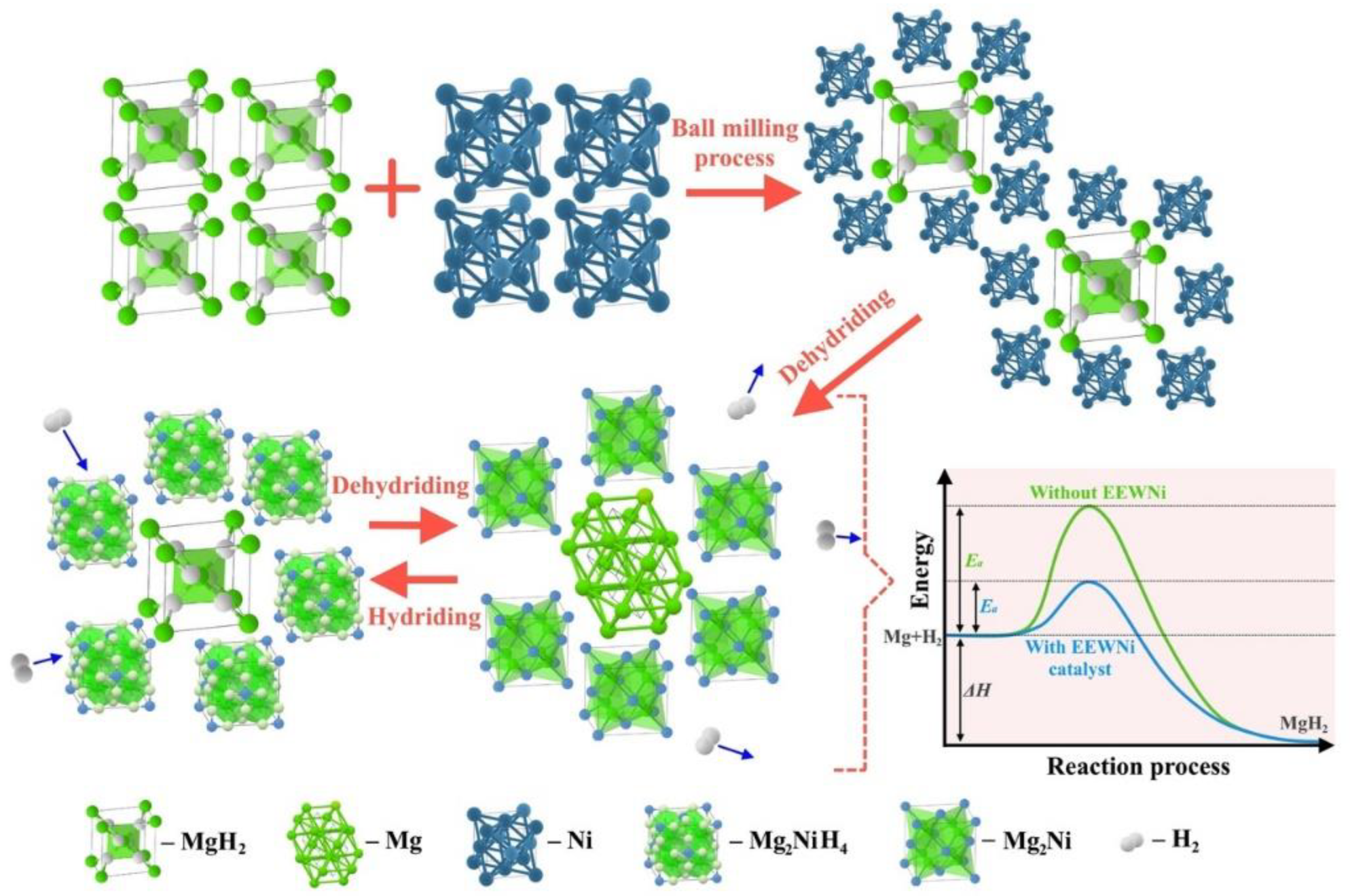

Table 1.
Results of determining the sizes of coherent scattering regions and micro strains in magnesium hydride and MgH₂-EEWNi.
Table 1.
Results of determining the sizes of coherent scattering regions and micro strains in magnesium hydride and MgH₂-EEWNi.
| Sample | Phase | Phase content, vol.% | Crystallite size, nm | Strains, ×10-3 |
| MgH₂ | Mg | 24 | 90 | 0.31 |
| MgH₂ | 76 | 70 | 2.32 | |
| MgH₂-EEWNi | Mg | 18 | 31 | 1.76 |
| MgH₂ | 61 | 24 | 3.53 | |
| Ni | 21 | 31 | 3.84 |
Table 2.
– Calculation of the absorption and backscattering coefficients of positrons and the path of positrons in a MgH₂-EEWNi composite.
Table 2.
– Calculation of the absorption and backscattering coefficients of positrons and the path of positrons in a MgH₂-EEWNi composite.
| Sample | Thickness, μm | The backscattering coefficient of positrons | The absorption coefficient of positrons, cm-1 | Intensity without taking into account the contribution of the source |
| MgH₂–20 wt.%-EEWNi | 5000 | 0.25 | 73 | 50 |
| Copper source (⁶⁴Cu) | 10 | 0.35 | 345 | - |
| MgH₂–20 wt.%-EEWNi | 5000 | 0.25 | 73 | 50 |
Disclaimer/Publisher’s Note: The statements, opinions and data contained in all publications are solely those of the individual author(s) and contributor(s) and not of MDPI and/or the editor(s). MDPI and/or the editor(s) disclaim responsibility for any injury to people or property resulting from any ideas, methods, instructions or products referred to in the content. |
© 2024 by the authors. Licensee MDPI, Basel, Switzerland. This article is an open access article distributed under the terms and conditions of the Creative Commons Attribution (CC BY) license (http://creativecommons.org/licenses/by/4.0/).
Copyright: This open access article is published under a Creative Commons CC BY 4.0 license, which permit the free download, distribution, and reuse, provided that the author and preprint are cited in any reuse.


