

Submitted:
20 December 2024
Posted:
24 December 2024
You are already at the latest version
Abstract
Governments rely on military power to address conflicts, manage crises, and adapt to the evolving nature of modern warfare, which is often characterized by uncertainty and disorder. Wargames, traditionally a military tool for simulating conflicts and decision-making, have gained prominence in civilian applications, including business, cybersecurity, disaster management, and critical infrastructure protection. Despite their utility, designing wargames is a time-intensive process with significant challenges, such as scenario creation and decision modeling, necessitating structured and systematic approaches. This research aims to formalize wargame design by proposing using ontology-driven conceptual modeling to organize and represent the key concepts, characteristics, and elements of the wargame domain. Ontologies provide a structured representation of knowledge, facilitating communication, knowledge management, and collaborative design. As a result, we developed core ontologies for wargame design based on the Unified Foundational Ontology (UFO) and implemented them using OntoUML. These ontologies enhance wargame design by fostering standardization, adaptability, and support for intelligent systems, enabling dynamic and responsive scenarios. These contributions offer a systematic foundation for improving the efficiency and effectiveness of wargame design, with potential applications in both military and civilian domains.
Keywords:
Wargame
; wargame design
; wargaming
; ontology
; Unified Foundational Ontology
; UFO
; OntoUML
; ontology-driven conceptual modeling
1. Introduction
Nations use their military power to resolve conflicts or wars and manage crises through strategic measures without necessarily resorting to combat actions. The armed forces are often trained and prepared to be employed in response to international political and economic instability, as situations may rapidly change, leading to modern conflicts characterized by friction and fog of war factors, such as uncertainty, disorder, and limited intelligence [1]. The military has developed methods and techniques to plan and practice their actions in peacetime [2], building scenarios to anticipate undesirable situations or avoid surprises [3]. Wargames are one such technique based on battle simulations. They represent a conflict or competition in a synthetic environment in which people make decisions and respond to the consequences of those decisions [4]. Wargames are typically conducted on a map laid out on a tabletop, where tokens representing military units are strategically positioned. The umpiring staff oversees movement and combat actions with the support of subject matter experts. Additionally, wargames often incorporate rules to determine the outcomes of combat scenarios, enhancing the realism and analytical value of the exercise.
Wargames have also proven valuable in civilian contexts. They can enhance flexibility and capacity in command, management, decision-making, training, and scenario analysis [5] for businesses [6], government [7], homeland security, police operations, cybersecurity [8,9], and preparedness, response, and recovery from natural disasters [5,10] or critical infrastructure incidents, such as those involving oil and gas [11].
The challenge of designing a wargame is crafting scenarios that enable players to learn, make decisions, and achieve the game’s objectives. Wargames allow us to analyze different types of problems in various ways, but choosing the suitable characteristics for the wargame is a critical factor in its design [12]. Furthermore, wargame design is often a difficult and time-consuming task and may involve many people [13,14]. Wargame design processes suggest phases for specifying, designing, developing, testing, running, and analyzing the game [12,15,16,17,18]. Each phase of the wargame design performs the necessary tasks to enable the wargaming execution, such as defining the game purpose, objectives, scenario, setting, rules, combat units, the decisions that players will be encouraged to make, and the game mechanics that express those decisions into actions.
Ontologies can greatly benefit wargame design by providing a standardized and systematic representation of key concepts and information, facilitating more precise communication among designers, developers, and players, and enhancing the coherence and effectiveness of the design process. This standardized representation promotes a shared understanding of the wargame domain, fostering collaboration, and reducing ambiguity in design discussions. Additionally, using ontologies allows for enhanced knowledge management [19], making it easier to update and expand the wargame design framework over time. This adaptability ensures that the ontologies can evolve alongside advancements in wargaming methodologies and technologies. Finally, ontologies’ formal and structured nature supports the development of intelligent systems and decision-making algorithms [20] that can enhance the overall gaming experience by providing more dynamic and responsive scenarios.
This research aims to organize knowledge about these processes, including concepts, characteristics, and elements, to improve wargame design. We propose using ontologies to structure these concepts and related information. Ontologies provide a formal and systematic approach to representing knowledge within a specific domain [21,22]. Ontologies provide a foundation for building conceptual models that capture the abstract essence of objective facts, describing object types, concepts, entities, attributes, and relationships within a specific domain [23]. We constructed ontologies following the ontology-driven conceptual modeling paradigm [24]. Specifically, we use Unified Foundational Ontology (UFO) [25,26] concepts to propose core ontologies for wargame design using OntoUML [27] notation.
Conceptual modeling can use ontologies to clearly and precisely describe the domain elements for communication, learning, and problem-solving [28]. The design will transform this conceptual modeling into a logical design specification [29]. From the premises that games are information systems [30] and wargames are (serious) games [31], ontologies can be applied to model wargaming domain to aid wargame designs. Our expected contribution is to offer a systematic foundation for improving the efficiency and effectiveness of wargame design through Ontology-driven Conceptual Modeling. This approach formalizes design phases and establishes a framework for standardized, interoperable systems, enabling customization for strategic, tactical, and operational levels, as well as diverse operational contexts like emergency response and crisis management. The integration of UFO enhances real-world simulation accuracy, while the models extend to non-military applications such as disaster response, public health, and corporate decision-making. Therefore, bridging theory and practice while advancing wargaming tools and methods.
The remainder of the text is structured as follows. Section 2 provides the theoretical foundation, encompassing an overview of wargames, the role of ontologies, and an analysis of related works. Section 3 outlines the materials and methods used in the research, describing the approach adopted for analysis. We present our analysis in Section 4, which identifies wargaming’s key characteristics and elements. Section 5 introduces the results, highlighting the ontology’s characteristics and application in the wargaming design process, focusing on the specification and design phases. Section 6 offers a comprehensive discussion of the study’s implications, limitations, and contributions. Section 7 presents the conclusion, summarizing key insights and potential directions for future research. LaTeX-related questions please contact latex@mdpi.com.
2. Theoretical Background
This section outlines key concepts and methodologies that form the basis of the research, providing a structured overview to facilitate the understanding of its objectives and approach. First, we discuss wargames’ principles and applications, highlighting their role in simulating decision-making processes and exploring complex scenarios in controlled environments. Second, the focus shifts to ontology-driven conceptual modeling, emphasizing the use of UFO to create rigorous and semantically consistent representations of domain knowledge. Finally, the review of Related Works contextualizes the study within the broader academic and practical landscape, identifying existing gaps and opportunities addressed in this research.
2.1. Wargames
Humankind has always sought to understand the phenomenon of war since the earliest times. Military personnel created tools known as strategy games to fulfill this desire. These games represented elements of the battlefield with a high degree of abstraction, while allowing the exploration and application of military concepts [32]. Sun Tzu is often credited with inventing the first board game, Wei Hai, around 3000 BC. The players would move colored tokens around on an abstract board, attempting to outflank each other. The game resembled the modern Chinese game of Go [33]. Another ancient game, called Chaturanga, was originated in India. Tokens represented elephants, horses (cavalry), chariots, and soldiers (infantry), and their moves followed pre-established rules. The game resembled chess, but it was a four-player game and dice rolls influenced the outcomes [32].
Wargaming in the modern era began in 1824 when the Baron von Reisswitz and his son, a Prussian military officer, created the Kriegsspiel, which translates to wargame in German. The game established basic principles of wargaming for simulating scenarios and military training, incorporating concepts of combat, movement, and logistical constraints [34]. Movement rules for units considered real-time and distance factors, while map charts illustrated the terrain’s geography. The rulesets also considered other aspects from previous combat experiences, such as unit speed, weather conditions, communications, and logistics [32]. Additionally, Kriegsspiel introduced the role of the umpire, who resolved combat, supervised the movement of units, and determined how to share information between opposing sides. Result tables supported umpires in determining the combat outcomes, though dice rolls also influenced these outcomes [35].
After Prussia’s victories in a series of wars, other countries attributed their success to Kriegsspiel, which contributed to spreading wargaming worldwide [35,36]. The United States Armed Forces created the term wargame as a translation of Kriegspiel. But the military initially revealed uneasiness with using the terms games and wargames, believing they depreciating the gravity of war’s effects [32,37].
In 1966, McHugh [2] described wargame as a simulation of selected aspects of a military operation, following predetermined rules, data, and procedures to provide decision-making experience or information that applies to conflict situations. McHugh’s work significantly influenced Perla’s U.S. Naval War College research in the 1980s. As a result, Perla proposed a new wargame definition in 1990, which became widely accepted among the military and the wargaming community. Notably, he defined wargames as “warfare models or simulations, not involving actual military forces, and in which the flow of events is affected by and, in turn, affects decisions made during those events by players representing the opposing sides” [32].
Currently, each military organization, country, or renowned author has its own definition of wargames or wargaming. However, these definitions often draw from or adapt Perla’s definition. For example, even though NATO has its own definition of wargames, its members, including the United States and the United Kingdom, have their own definitions.
The NATO glossary defined a wargame as “a simulation of a military operation, by whatever means, using specific rules, data, methods, and procedures” [18]. However, this definition is closer to McHugh’s definition than Perla’s. On the other hand, the U.S. Naval War College defines wargames similarly to Perla [32], emphasizing terms such as simulation, military forces, events, decisions, and players [15]. Additionally, the United Kingdom Ministry of Defence defines wargames as “scenario-based warfare models in which the outcome and sequence of events affect, and are affected by, the decisions made by the players” [16].
Although wargames are tools often associated with military contexts, they can also address civilian situations. Wargames can be applied to simulate and analyze disaster responses [5,10], emergency management [11], public health crises [38], urban planning, and other civilian scenarios. Recent definitions of wargames even omit the military aspect and underscore decision-making. For instance, NATO’s latest wargaming handbook disregards the wargame definition in its glossary [18] and defines a wargame as “representations of conflict or competition in a safe-to-fail environment, in which people make decisions and respond to the consequences of those decisions” [39]. France’s Ministère des Armeés adopts this NATO definition for contemporary wargaming [40]. The German Armed Forces adopt a definition of wargaming closely based on NATO’s, emphasizing a safe-to-fail environment and the mutual influence among events, human decisions, and resulting outcomes [41]. The Polish Armed Forces adopt a definition for wargames inspired by U.S. Naval War College [15] and Perla [32], but also emphasize a safe-to-fail environment for researching decision-making [12].
However, we found other definitions that still restrict the use of wargames to a military context. Israeli Defense Forces define a wargame as a “bilateral (or multilateral) simulation of a military activity representing real or hypothetical situations” [42]. Brazilian Navy defines wargames as a “set of situations that are fictitious or not, characterized by a conflict of interests and presented chronologically to players in the form of challenges, whose overcoming implies the simulated use of the military expression of National Power, conditioned by environmental, social, cultural and contextual factors” [17].
By analyzing all the definitions, we conclude that they share a standard view of the game’s essence, reflecting a decision-making process among players in a safe and simulated environment. Thus, wargames exercise the interaction and interplay of human decisions and the simulated outcomes of those decisions [32]. The human-in-the-loop gameplay characterizes the wargames. The absence of the human as a decision-maker would misrepresent wargames as a model or simulation rather than as games [43,44]
Including the human element enriches our understanding of wargaming, which can be seen as a fusion of art and science. The scenario design and the imaginative and unpredictable nature of human choices strengthen the concept of operational art. Conversely, the method, rules, models, and data portray the science around the game [45]. The unpredictability of human behavior makes wargames more complex simulations than pure scientific experiments [8].
The learning process in wargames is often more important than the battle outcomes [46]. The most crucial issue in wargames is not about winning or losing but analyzing players’ decisions [32,36,43]. The central dynamics of any wargame focus on the flow of information and decisions among players [47], which yield insights, ideas, discussions, and learning. Decisions typically influence the game’s progression, enabling players to experience the situation from various perspectives. Therefore, wargaming involves comprehending the decisions in a conflict scenario and the reasoning behind players’ actions and choices.
Wargames encourage the military to practice their art and apply the theoretical lessons they had learned [48]. These games teach through active [34] and experimental learning [49]. As a result, the military adopts wargames as an essential element in their ongoing professional development. Wargames explore problems where players must make decisions in challenging situations, generate possible solutions [50], and appreciate the consequences of these decisions [51]. Wargaming is an appropriate method for the following uses:
- Enhance the capability to evaluate decision-making processes [17];
- Foster socialization and discussion [53];
- Exercise teamwork within staffs [54];
- Evaluate the acquisition of military units, equipment, or infrastructure [55];
- Optimize resources, face emerging challenges, and explore new technologies [8].
Wargames are best used to help the military explore conflict dynamics [13] rather than to assist in calculating the outcomes of those processes [32]. Wargame designs raise issues but do not settle them [37]. The value of wargaming lies in exploring alternatives and enhancing insights into likely courses of action, not in providing quantitative results [46]. Wargaming should not be applied to every analytic effort, as it is ineffective for calculating outcomes, proving theories, predicting “winners”, producing numbers, or generating conclusions [56].
Wargames are valuable tools for exploring innovation, building consensus, understanding divergent perspectives, and identifying new factors, gaps, and unrecognized questions [39]. They offer a safe environment for the military to experience war, with no risk of losing human lives or causing damage or fatigue to combat units. Additionally, wargames provide cost savings, as no expenses are required to sustain a war [37].
Although wargames bring many benefits, they also have limitations. Wargame models abstract reality and only simulate the technical aspects of command. But they cannot reproduce the psycho-physical effects of combat, such as stress, anger, and fear of facing deadly danger [57]. Moreover, the military still lacks the knowledge or tools to model factors like morals, obedience, loyalty, or complex areas like psychological warfare, terrorism, and cyber warfare [58].
Wargame definitions emphasize that these games offer a safe-to-fail environment. However, this statement can lead to two distinct points of view. One may think this would be an advantage, as plans can be tested without fearing failure [16]. On the other hand, losing or improperly playing does not result in severe penalties [37]. Acting without fear and considering the consequences of actions may also present a limitation.
The time and costs associated with wargaming are higher than they may appear. Wargame designs are complex and time-consuming, with executions that can extend over several weeks [13]. Computer-supported wargames also require a team of computer experts to develop and test them. As a result, the design of these wargames should account for the costs associated with the software development team.
Wargames often face criticism for their lack of repeatability [14,16,39]. Players can undertake a broad range of actions in wargames. People are unique; thus, players can make different decisions even when faced with similar situations.
Finally, wargaming stands out as a powerful tool for deepening the understanding of complex and uncertain environments and the evolving dynamics of warfare [59]. However, its effectiveness depends on its careful design and appropriate application. Wargaming quality depends on the participants’ commitment, knowledge, and experience [12]. Improper wargaming may validate flawed assumptions, shape misperceptions, and reinforce hubris [60]. Leaders should never automatically assume that wargames always provide the best answer for any given objective. Wargaming cannot predict outcomes but only suggests insights into possible outcomes [39,55].
2.2. Ontology-Driven Conceptual Modeling Using Unified Foundational Ontology
Conceptual models are formal representations of the socio-physical aspects of a depicted reality, serving as a fundamental discipline in various areas of computer science to support understanding and communication [61]. Conceptual modeling’s main objective is to identify, analyze, and describe the essential concepts and constraints of a domain of discourse using a diagrammatic modeling language [29]. We can use ontologies to describe conceptual models, representing entities acknowledged by a particular theory or system of thought [24]. An ontology is a theory that examines the nature of existence; it provides a domain-independent system of categories that can support the conceptualization of domain-specific scientific theories [28]. A domain ontology represents a consensus model within a community sharing information about that domain by conforming to some standard set of constructs introduced in a top-level ontology [29]. Ontologies support knowledge management, taxonomy alignment, and the construction of domain ontologies, and semantic interoperability [62] in model integration [63] and service interoperability [64]. Additionally, ontologies ensure the ontological soundness of conceptual modeling languages, including their concepts and grammar [24].
Ontology-driven Conceptual Modeling (ODCM) is an approach to improving conceptual modeling theory and practice by leveraging ontologies. ODCM is used to develop engineering artifacts such as modeling languages, methodologies, design patterns, and simulators [27].
A foundational ontology is this domain-independent top-level ontology that provides the basic concepts upon which any domain-specific ontology is built [65]. Foundational ontologies provide real-world semantics for general ontology representation languages [28]. They are philosophically well-founded, domain-independent category systems used to improve the quality of modeling languages and conceptual models [21]. The research uses UFO as the foundational ontology for domain analysis in conceptual modeling. Combining the strengths of the Descriptive Ontology for Linguistic and Cognitive Engineering (DOLCE) [66] and the General Ontology Language (GOL) [67], UFO provides a unified approach to foundational ontologies. It allows the design of concrete models while enabling ontological analysis, conceptual clarification, and semantic understanding of the domain [26]. Micro-theories within UFO address essential conceptual modeling constructs [25], including object types and taxonomic and part-hood relations among objects, roles, properties, data types, and weak entities [68]. To achieve this, UFO is structured into modules, each tailored to handle distinct aspects of reality:
- UFO-A: ontology of Endurants, i.e., individuals (entities) that persist in time with all their parts while keeping their identity [26]. Deals with aspects of structural conceptual modeling such as types and taxonomic structures, part-whole relations, intrinsic properties, attributes, and attribute value spaces, relational properties, relations, and roles [69];
- UFO-C: ontology of Intentional and Social Entities. Deals with beliefs, desires, intentions, goals, actions, commitments and claims, social roles, and social relators [21].
The primary goal of UFO is to serve as the foundational basis for essential conceptual modeling constructs. As a result, UFO has also been systematically applied in the development of OntoUML [27], an ODCM language derived from the Unified Modeling Language (UML) [70] class diagrams to create well-founded ontologies. OntoUML facilitates using formal ontological theories in constructing conceptual models and domain ontologies [25]. The OntoUML metamodel incorporates semantically motivated syntactic constraints that reflect the axiomatization of UFO [71].
2.3. Related Works
Authors from the wargaming community [2,34,42,72,73,74,75,76,77,78] and wargaming handbooks [12,15,16,17,39,40,41] have been developing taxonomies to characterize wargames and describe their main elements. However, these taxonomies represent simple hierarchical structures used to classify wargames and are an insufficient formal representation of the wargame domain.
McHugh [2] presented the first wargame taxonomy in 1966, classifying wargames into six categories: general purpose, scope and level, number of sides, amount of intelligence (information), method of evaluation (adjudication), and simulation technique. These categories provided a good understanding of the wargames’ characteristics and guided future research. For instance, Elg [43] classified the wargame case studies according to McHugh’s taxonomy but using only four categories: sides, information, adjudication, and physical form. He removed purpose and level categories because his research focused on educational wargaming at the tactical level.
Later, in 1987, Perla [72] proposed a framework for wargame design to facilitate communication among sponsors, designers, and analysts, consisting of four parts: the number of players or teams (one, two or multiple sides), the amount of information available to players (open or closed); the style or format of the game (seminar or system), and the decision level of the players, which includes the geopolitical scope of the game and the scale of aggregation. Two years later, Anderson and colleagues [73] developed a wargaming and warfare simulation taxonomy to guide the development of a framework for the Department of Defense to acquire warfare systems. The taxonomy had three dimensions: purpose, qualities, and constructions. They defined training and analysis as wargaming’s primary purposes and specialized them into subcategories. Qualities are (physical) domains, span (scale), environment, force composition, and mission area. Constructions describe human participation, the number of sides, the treatment of randomness, and time processing.
In addition to these works, we found relevant wargame classifications only in wargame handbooks from countries and NATO. The United Kingdom Ministry of Defence [16] and the Brazilian Navy [17] endorse the wargame characteristics from McHugh [2] and Rosenwald [74]. However, the British model incorporated turn length and a narrative driver to define events. The Brazilian approach distinguishes whether a scenario describes a real, fictitious, or hypothetical situation and defines the geographical scope — global, regional, or local — closely tied to the decision level.
On the other hand, NATO [39] and France’s Ministère des Armeés [40] categorize wargames in only three categories. NATO defines the following categories: purpose (learning or analytical), adjudication method (expert judgment, consensus, analytically assisted, or rules-based), and rigidity and format (simulation, rigid, seminar, or matrix). France defines the same categories but includes an experimental purpose and disregards analytically assisted adjudication.
The U.S. Naval War College [15] and Germany Armed Forces [41] classify wargames according to similar categories: purpose (educational or analytical), command level (strategic, operational, or tactical), adjudication method (free, rigid, semi-rigid, or consensual). Both classify wargaming in relation to time, but the Germans use time frames (past or future), while the Americans use time progression (move-step and running time). In addition, the Americans included another category: the number of sides.
Finally, the Doctrine and Training Centre of the Polish Armed Forces [12] also classifies wargames according to purpose, command level, degree of computerization, number of sides, adjudication, method, scenario path, and time. However, the Polish doctrine suggests additional criteria for classifying wargames based on game theory, such as game outcome (zero-sum or non-zero-sum), order of decision-making (sequential or simultaneous), knowledge provided (complete or incomplete information), and possibility of forming coalitions (cooperative and non-cooperative).
In addition to examining wargame characteristics, we analyzed the primary elements that should be considered in wargame design. Wade [77] defined four critical elements to meet the goals of wargame designs: player, scenario, rule set, and adjudication method. The Norwegian Army [78] shares a similar view of the warfare model but replaces the adjudication element with data. Wargame designs in the Israeli Defense Forces suggest the scenario, rules, objective, and analysis as key elements, emphasize that players are gathered into teams, and include a control team [42]. NATO [39] suggests that the essence of wargames lies in players making decisions, which are driven and influenced by friction and the resulting consequences that players must face.
Previously, Perla [32] had defined seven essential elements for wargame designs: objectives, scenario, database, models, rules, players, and analysis. These elements guided further studies [16,34,74,76]. The Polish Armed Forces [12] also share a similar perspective with Perla [32], listing the following elements of a wargame: participants (the design team and players), game mechanics (including rules and procedures), scenario, adjudication, analysis (including the data collection process), and databases.
Other wargaming handbooks and studies suggested considering other elements in designing a wargame, such as battle damage assessment, data collection [15], adjudication, factors (political, economic, social, and technological) [12], infrastructure, cultural, and environmental context [75], setting, opposing force, narrative, injects, vignettes, and resolution tables [39]. Moreover, NATO [39] stresses the lessons learned in wargame analysis. Finally, these references also included other participants (agents) in a wargame design: the game director, sponsors, game managers, game designers, scenario designers, game developers, adjudicators, controllers, umpires, and analysts.
3. Materials and Methods
Our research domain is wargame design. We adopted an inductive approach inspired by Grounded Theory [79] to develop ontologies for wargame design. Grounded Theory is a general research methodology that offers a framework for thinking about and conceptualizing relevant data. This methodology is used to construct theories based on a systematic analysis of data [80]. We applied Grounded Theory to consolidate the knowledge we have been acquiring.
The process of Grounded Theory Building that guided our research method is divided into (not strictly sequential) five steps: research design, data collection, data ordering, data analysis, and literature comparison [79]. "Researchers begin this exploratory and inductive process to understand a problem within a particular issue or domain and to define research questions. Next, the research involves several data collection cycles, ordering, and analysis to identify concepts, categories, and relationships, integrating them into theoretical sampling until reaching the theoretical saturation. Then, researchers compare the emerging theoretical framework with existing literature, examining similarities, differences, and the reasons behind them. Finally, researchers develop an emerging theory. Figure 1 provides an example of how to structure the steps of this process using the Business Process Model and Notation (BPMN) notation [81].
In the research design step, we started formulating three research questions to enhance our understanding of wargame design:
- Q1:
- What are the main characteristics of wargames that should be considered when designing a wargame?
- Q2:
- What are the main elements of wargames, and how are they related?
- Q3:
- How do the desired characteristics of wargame design influence these elements?
The research design step also included a comprehensive literature review to identify case studies of wargame design, some of which applied Grounded Theory. For instance, Haggman [8] developed the research design and method for capturing game results and player experiences in an educational wargame for cybersecurity. He gathered interaction data among players and between players and umpires to identify key decisions, actions, and outcomes necessary for assessing the achievement of objectives. Elg [43] conducted a comparative case study to develop a theory about the factors influencing educational wargaming in the army at the tactical level. Data collected from five countries through interviews, observations, and documents led to the development of an analytical model with a core category, supporting categories, and related concepts. Brightman and Dewey [82] suggested using Grounded Theory and other qualitative techniques in post-game analysis since most data generated from wargames are qualitative.
During the data collection step, we continued the literature review, but this time, we focused on identifying taxonomies, models, and case studies aimed at structuring wargames. Relevant gray literature is dispersed across documents from military sources, prompting a search for articles, technical reports, manuals, and doctrines from military organizations worldwide. This step concluded upon reaching the theoretical saturation of the literature. In the data ordering step, we sorted the publications chronologically and classified them based on their content concerning the characteristics or elements of wargames.
In the data analysis step, we identified core concepts, categories, and propositions regarding wargame design through coding [79]. We also established relationships between these categories to integrate them within this process, aiming to construct the theoretical framework for wargame design using ontologies. We used the UFO [28] to develop the domain ontologies of wargame design, depicting its concepts, categories, and relationships. First, we examined wargames’ characteristics and elements and constructed preliminary conceptual models using UFO-A to structure the aspects of the wargame design domain. Next, we analyzed the wargame design as a process divided into phases and represented this process using UFO-B. Finally, we focused on developing ontologies to represent the first two phases of the wargame design process — specification and design — to address the research questions. Thus, we depicted the wargame elements preliminarily addressed in the specification phase using UFO-A and the events of this phase using UFO-B. Additionally, we developed other ontologies representing the characteristics and elements of wargame designs using UFO-A.
We implemented these ontologies using OntoUML [27], a language that implements UFO. Our preference for using OntoUML was due to its capability to construct well-founded ontologies and our previous knowledge of UML, as OntoUML was developed from this standardized modeling language used in software engineering and computer science. The ontologies were developed using Visual Paradigm [83], which supports UML class diagrams. Support for OntoUML was enabled through an OntoUML plugin [84], allowing for using OntoUML stereotypes and semantic verification of classes and relations.
Finally, in literature comparison step, we improved and sharpened the ontologies, integrating categories found in the literature through data collection and analysis cycles until each ontology reached theoretical saturation. Wargame designers from the Brazilian Naval War College helped evaluate these ontologies through these cycles. We also compared these ontologies with artifacts in the existing literature to examine similarities and differences and highlight their contributions.
4. Analysis
This section outlines our preliminary analyses to uncover the research contributions. We examine the essential characteristics to consider when designing a wargame, identify the primary elements in wargame designs, and establish relationships between these elements.
4.1. Wargame Characteristics
No single wargame classification is universally accepted by the wargame community [85]. However, our literature review revealed that most authors and wargaming handbooks define common characteristics, although their nomenclatures differ. Hence, we gathered these characteristics of wargame designs until reaching theoretical saturation, identifying eight key concepts: purpose, level, number of sides, instrumenting, information limit, format, time progression, and adjudication. We provide more detailed explanations for each characteristic in the following subsections.
4.1.1. Purpose
Wargames provide active learning and decision-making experience. They fulfill two primary purposes: educational, by enhancing skills and knowledge through immersive scenarios; and analytical, by providing a structured environment for examining complex problems and testing strategies [2,12,15,16,39]. Educational wargames focus on analyzing players’ decisions and understanding how and why players made those decisions, reinforcing military doctrines and other training objectives [32]. Analytical wargames aim to improve and validate a military plan or strategy to provide information for decision-making [74]. Reliable results from analytical wargames are obtained through a stochastic process that repeats the game, varying the participants and the decisions taken [17].
4.1.2. Level
The wargame design must specify the appropriate decision level, guiding the scope and focus of players’ decisions in the wargame. Players’ command position or the action level aligned with overarching objectives determine the level [32]. Wargames are classified into political, strategic, operational, and tactical [2,12,15,17,41,55,72].
The political level establishes political objectives, celebrates alliances, formulates guidelines for strategic actions, and defines limits on military employment, use of geographical space, international law, and agreements to be respected [86]. In political wargames, players make political, military, economic, social, and psycho-social decisions and include political actions, such as negotiation, deterrence, or diplomatic support [17].
The strategic level defines the goals to pursue during the conflict and allocates resources to achieve the goals [47]. These resources can range from military forces to economic and political ones. Strategic wargames focus on national wars, often covering the entire territories of the combatants. Forces include all military units from nations in conflict while time spans years to decades [55]. Players control the game’s narrative, test strategies, and gain insight into events and the resulting situation [87].
The operational level connects broad strategic guidance and aims toward tactical actions [88]. Operational wargames are large operations and campaigns that embrace entire regions, periods from days to months, and all forces that are within or can affect the region [55]. The analysis identifies and arranges the end state, objectives, effects, sequencing, and timing actions [88]. Players consider the types, quantities, and relative positions of forces, while ignoring lower-level details such as who fired which weapon at whom and when [32].
The tactical level involves direct combat or other forms of contact with the enemy [47], where military forces determine how to accomplish assigned missions and objectives [88]. Tactical wargames focus on battles and firefights, typically set in small battle spaces with short timeframes. Forces are limited, and environmental changes can influence the outcome of these battles [55]. In tactical wargames, players focus on arranging unit capabilities in time and space, making tactical deployments, managing logistical sustenance, and optimizing weapon and sensor performance.
4.1.3. Number of Sides
A side can represent a player or a team of players who can make decisions that influence the gameplay. Wargames include one-sided, two-sided, and multi-sided games [2,12,15,16,17,72]. One-sided wargames have a player or a team playing against a control group, which assumes the role of the enemy, presents scripted scenario injects, and even umpires the game [72]. These games usually have educational purposes, but some authors consider they are not actual games due to the absence of a real opponent or conflict situation [2] since there is no human taking enemy’s actions and seeking to win [60]. Two-sided wargames involve two opposing players or teams, each aiming to achieve its own objectives [72]. Multi-sided wargames involve two or more teams forming alliances or representing joint forces, which compete against one or more opposing forces [72].
4.1.4. Instrumenting
Most wargames use tools to display force locations, movements, and interactions and to track data [32]. These tools may include maps, boards, tokens, tables, charts, dice, tracking sheets, and supporting equipment such as printers, projectors, computers, software, and radios [76]. Based on the tools used, wargames can be classified as manual, computer-assisted, or computerized [2,12,16,72].
Manual games typically rely on maps, tokens, charts, and printed materials such as rules, procedures, data, and orders of battle [13,32]. Even the simpler versions of these games can effectively simulate specific aspects of conflicts [57]. Despite their complexity, the mechanics of manual games are highly adaptable, as designers or players can modify rules and procedures to enhance playability without requiring technical expertise, relying only on creativity [8]. However, before engaging with these games, players must first learn and master detailed rules, which can be time-consuming and challenging [89].
While computer programs are often called wargames, this label is inaccurate. Wargames inherently involve human players, making it more precise to describe these programs as tools that assist players in conducting wargames [53]. The rise of computer-assisted wargames is a direct result of advancements in computer technology [74]. These programs support gameplay by automating attrition, logistics, and record-keeping calculations, among other aspects [36,43].
Since the 1990s, computing technology has made computerized wargames possible [57]. These wargames use complex mathematical models to manage actions and validate players’ inputs according to programmed rules [55]. Computer aids enhance visualization, recording, adjudication, and information sharing [14]. These aids update force positions, monitor sensor detection, and evaluate battle outcomes using combat result tables or models that factor in environmental elements [32]. Players can play against each other, or the computer can be the opponent. The game director and players can save the game progress and resume it later as needed [90].
Computerized games can use AI algorithms and techniques to generate scenarios and narrative paths, support decision-making, define autonomous agents to oppose human players, and calculate possible combat outcomes. Machine learning algorithms can expand the available data to create models that predict player behavior under specific conditions. An analytical solution or data mining resources can assist umpires and analysts in decision analysis and assessing the achievement of objectives and learning outcomes. However, wargame designs face challenges in applying AI algorithms due to the scarcity of open-source datasets for training. Moreover, decision-making models still struggle with large decision spaces, local optimal solutions, and slow convergence during training [91].
4.1.5. Information Limit
Players need in-depth information to play games. The scenario and a database provide some information in wargames. Other information arises during the gameplay. However, opponent status and action updates may be unavailable to players [72]. The information available to players classifies wargames as open or closed [2,16,17,55,72].
Open wargames give players complete and accurate situational awareness [55]. Players know information about opposing units and their positions, except for their plans. Such games often use a single situation map on which both sides openly deploy their forces [32]. Closed wargames restrict the information available to players, reflecting the real-world limitation of observing the entire battlespace [55]. Game control limits players to knowing only what their sensors or other friendly sources can provide and what the adjudication determines [72]. Closed wargames often require some computer assistance and must physically separate opposing players [32].
4.1.6. Format
Wargames often follow one of the two formats: seminar or system [12,16,17,39,40,72]. A seminar structures discussions on a specific scenario or problem, facilitating the analysis of a particular vignette and the exploration of new ideas and concepts [44]. In seminar wargames, a situation is presented to an audience. Players discuss their course of action and most likely outcomes in an open forum [77]. Controllers evaluate players’ decisions and describe the unfolding situation [92]. A more structured variation of a seminar is the matrix game, which also focuses on players discussing their decisions [40]. Matrix games may include an element of chance to evaluate topics with limited knowledge. Umpires might use dice or assign probabilities to determine a desired outcome [92].
System wargames use rules and procedures to replace discussions about the outcome of players’ decisions [32]. These games rely on a mathematical method typically based on probabilities [77]. Once the players decide, the system determines any interactions and outcomes. Players interact indirectly through judges, controllers, models, computers, or other devices [72]. A computational system typically aids a system game.
4.1.7. Time Progression
Warfare comprises hours of boredom sprinkled with moments of terror [37]. Players often make critical decisions during these moments. Wargames can control the flow of time to focus on events that require a decision. Time progression classifies wargames as running time or turn-based [2,15,16]. Players make decisions simultaneously or sequentially during their moves in both games [93].
In running-time wargames, time progresses continuously without interruption. The pace typically aligns with real-world time but can be adjusted to move slower or faster than reality [55]. Consequently, the pace is defined as the ratio between real-world clock time and in-game clock time [15]. These wargames force players to make rapid decisions [34].
On the other hand, time progression is only sometimes straightforward in turn-based wargames. Each turn may define a specific time duration. Turns flow at the same interval as real-world decision cycles [55] and are subdivided into phases or moves [8]. Time advances only when players complete their moves each turn [34].
4.1.8. Adjudication
Adjudication is at the heart of a wargaming system. Judging which set of decisions and course of action will result in victory is crucial to the wargaming event [92]. The umpires, a set of rules, or even the players can adjudicate wargames, affecting the gameplay. Adjudication usually classifies wargames as free, rigid, semi-rigid, or consensual [2,12,15,16,17,39,40,41,72].
Free wargames rely on umpires’ experience to determine the combat outcomes [72]. Umpires examine past engagements, missions, and campaigns to minimize subjectivity in their judgments [50]. Game objectives, time available, and conflicting interests may influence the evaluations [53]. Free adjudication may require a lot of time and intensive work from judges. Furthermore, the game may become susceptible to umpires’ opinions, biases, and prejudices [92].
Rigid wargames use a set of rules to produce situations governed by the player’s decisions. These rules include, for example, combat-results tables – analog or digital. Adjudication proceeds strictly according to movement, detection, and combat rules [53]. Rigid wargames can be played with or without umpires [92]. Rigid adjudication provides quick results if the rules are embedded in a computer program [55], although configuring automated rules demands additional time and resources [92]. The rigid adjudication process can be either deterministic or stochastic [92]. In deterministic adjudication, the goal is to identify the expected outcome of each action. In contrast, stochastic adjudication estimates the likely outcomes and assigns probabilities to different possibilities within each action [55].
Semi-rigid wargames use a hybrid approach in which the umpires use their experience and some models to make their evaluations [72]. These wargames may generate unbiased data-driven outcomes. The evaluation time may increase because umpires may discuss their judgments and analyze system inputs and outputs [92].
Consensual or open adjudication wargames [15,92,94] are uncommon and involve the group of players assessing their decisions. Players articulate and justify their actions, prompting the team to discuss the strengths and weaknesses of potential outcomes. The ultimate goal is to reach a consensus among the players.
4.2. Wargame Elements
This analysis of wargame elements combines the perspectives on wargames from NATO [39] and its members, such as the United States [15], United Kingdom [16], France [40], Poland [12], Germany [95], Norway [78], and Israel [42]. We also include the wargame perspective from Brazil, a nation outside NATO [17].
Perla’s [47,72,87,96,97,98] research has shaped the understanding of wargame concepts in the United States since the late 1980s. He defined seven primary elements for wargame design: objectives, players, scenario, rules, database, models, and analysis [32].
Every wargame must have clear objectives. Wargame objectives should be explicit and must be gameable. Sponsors, game designers, and analysts must specify how and in what ways the game will provide the information needed to meet those objectives [75].
Human players provide the essential element differentiating wargames from other methods, such as models or simulations [32]. Players are responsible for defining any action, decision, or insight during the wargame to attain their objectives [77]. In many wargames, players are grouped into teams, each assuming an individual and well-defined role within their respective team [75].
A wargame places players in a scenario that provides a background of previous events, explaining the current situation [77]. The scenario sets the context for decision-making [75] and describes initial conditions, developing situation, and objectives for each side [55]. The scenario includes geopolitical information about the area of operation, describing political, military, economic, social, information, and infrastructure (PMESII) factors [85]. Updating the scenario during gameplay changes or influences the evolving situation, requiring players to make decisions [72].
Wargames have rules that limit players’ actions [75]. Rules dictate the overarching structure of the game: the sequence of turns and events, the possible actions that different units can take [77], visibility, move rates, combat damage assessment, and ensure that players receive the proper information during play [32]. Many rules revolve around movement and combat [90]. However, rules can also comprise several other actions, such as cyber warfare, public opinion, and political deterrence. Charts such as the Combat Results Table or Terrain Effects Chart usually supplement rules [57]. At last, rules may include procedures that state how to manage and perform activities, such as setting up, packing away, and operating equipment, participant briefings, and assigning roles [76].
The database provides qualitative information about the scenario, including the physical environment and weather conditions of the game’s geographical area [75]. The database also encompasses quantitative information, such as friendly and enemy forces composition and arrangements, [75], logistical capabilities, combat power, weapons, and sensors [99]. The database may contain information about rules, combat resolution models, and their likely outcomes [100]. Players can analyze all this information to support their decisions.
Wargames use models as logical or physical representations of phenomena, processes, systems, or entities [99]. Models process and generate data before or during the wargame to support decision-making. Models use mathematical expressions to simulate kinematics, detection, combat assessment, intelligence, communications, logistics, etc. [72]. A model should be simple and playable, capturing the subject’s key dynamics [57]. Simple models often use lookup tables and probability values [101] of imposing damage or defeat, combat outcomes, terrain and weather effects, logistics planning, and record-keeping [36].
Wargames even include an analysis, which is usually performed after the game execution. This phase focuses on understanding players’ decisions, how they evaluated their options, and why those decisions led to specific sequences of game events [75]. The analysis should examine the gaps between expectations and results regarding players’ actions [102] and identify any surprises or insights [103]. Finally, feedback from the analysis helps determine whether the wargame achieved its learning objectives and produced valid knowledge, providing insights to sponsors, the game director, and controllers [53].
We constructed a preliminary conceptual model that summarizes the relationships between the main elements of wargames according to Perla [32]. Figure 2 presents this conceptual model that uses the OntoUML notation to stereotype classes and relationships [26,104]. Visual Paradigm depicts Kind classes in red; Mode and Quality (intrinsic moment) classes in blue; Mixin, PhaseMixin, RoleMixin, Phase, and Role classes in light red; Relator classes in green; and Subkind classes in light blue or light red, depending on whether the class extends from a Kind class or an intrinsic moment class.
Wargame, Scenario, Rule, and Player are Kind classes since they provide an identity principle for their instances. Model is a Category class that aggregates kinematics, detection, and combat assessment models, for example, mathematical models that share similar components such as inputs, outputs, variables, constraints, and rules. Database is a Mixin class that gathers data from different individuals, such as scenarios, rules, and other elements with distinct identity principles. Objective is a Mode class, whose existence depends on the Wargame. Finally, Analysis forms a Relator class through a material relationship between players and the wargame.
Player was conceived initially as a Kind class rather than a Role class because we decided to develop this conceptual model using only the seven elements suggested by Perla, along with an additional class to represent the wargame itself. If we had defined Player as a Role class, we would have needed to create another Kind class, such as Person or Agent, and extend from it.
The United Kingdom’s Ministry of Defence describes wargames using similar elements: aim and objectives, setting and scenario, the player (and their decisions), simulation, rules, procedures and adjudication, data and sources, supporting personnel and subject experts, and analysis [16]. The setting serves as the geographic framework upon which the scenario is constructed. Supporting personnel and subject experts are other actors who participate in the wargame design process. Although this perspective classifies simulation and adjudication as wargame elements, our research understands simulation as a computer-assisted instrument and classifies adjudication as a wargame characteristic. The France’s Ministère des Armeés exploits similar elements to design wargames: an intent, objectives, environment, scenario, players, modeling mechanisms, rules to manage the game, and adjudication [40].
In addition, the United Kingdom’s Ministry of Defence points out wargaming as a decision-making process [16]. This process expresses that the core of wargames is the players, their decisions, the narrative they create, the experiences they share during the game, and the lessons they take away. Figure 3 presents a preliminary conceptual model summarizing this view.
Players make decisions during a wargame, creating a unique narrative for each wargame. Decision is modeled as a Relator class established through a material relationship between the Player and Narrative classes. Player remains a Kind class, while Narrative is also a Kind class because its creation provides its own identity. Experience is a Mode class, whose existence depends on the Player class, as the experience is inherent to the player. Lesson is another Relator class, connecting the Player and Wargame classes. Players learn lessons from each wargame, and these lessons update their experience.
5. Results
We analyzed the wargame characteristics and elements, including the two conceptual models (Figure 2 and Figure 3), which aided us in developing the ontologies presented in this section. These ontologies also use the OntoUML notation to stereotype classes and relationships [26,104]. Each of the first three subsections presents an ontology that supports the conceptual modeling of wargame design. The fourth subsection presents the ontology of wargame design itself.
5.1. Wargame Design characteristics
We begin by introducing an ontology that defines the essential characteristics of wargame design. This UFO-A ontology incorporates the eight fundamental characteristics outlined in subSection 4.1: purpose, instrumenting, level, format, number of sides, information limit, time progression, and adjudication. Furthermore, we draw on key concepts from game theory, which provides a formal basis for understanding strategic decision-making in competitive environments involving rational players [105]. Specifically, the ontology integrates classifications of games as symmetric and asymmetric games, zero-sum and non-zero-sum games, and simultaneous or sequential games of imperfect, perfect and complete information. While game theory encompasses a broader range of game types [105,106], we selected the categories most applicable to wargame design. Based on wargame design processes described in wargame handbooks, we also include game duration as an additional characteristic, ensuring a complete representation of wargame design elements in the ontology.
Figure 4 presents the UFO-A of wargame design characteristics. The diagram portrays a centralized Wargame Design class, surrounded by its characteristics. The Wargame Design is a Kind class that provides an identity principle for their instances [26]. Most characteristics are Mode and Quality classes that depend on Wargame Design. We also define a Category class — Instrumenting — to represent the wargame tools. This class specializes in Manual, Computer-Assisted, and Computerized classes
Each Mode, Quality, or Kind class specializes in Subkind classes that effectively characterize the wargame design. But the Instrument class extends Kind classes for the same reason. Most specializations are disjoint, meaning that an instance of the parent class can belong to only one of its specialized classes at a time [22]. The classes of wargame design characteristics are arranged to balance the dimensions of the diagram for optimal page layout. However, we placed classes with a dependency relationship adjacent to each other. We suggest examining the ontology starting from the Purpose class and moving clockwise to the Information Limit class.
Purpose class specializes into Educational ad Analytical classes. Wargame handbooks may derive the purpose from the activity the wargame is supporting: training [16], experiential [40], didactic, research [12], planning, and visualization [39]. But all these terms lie in analyzing players’ decisions, as in educational wargames, and in producing knowledge for decision-making, as in analytical wargames. We detailed these wargames classifications in subSection 4.1.
The term Decision Level replaces Level, commonly used in the literature, to prevent misunderstandings with the level term in the game domain, which can refer to a stage, difficulty, or even player skills. Decision Level class specializes into Political, Strategic, Operational and Tactical classes, which describe the scope or abstraction of the wargame design. These specializations are the only ones that may overlap with their parent class in this ontology, as wargame designs can combine more than one decision level. However, such combinations are uncommon due to the challenges these designs face. Section 6 will explore this topic in greater detail.
Format class specializes into Seminar and System classes. Seminar also specializes in a Matrix class that is a more structured game, but with simple rules [40]. A Side is a Quality class that describes the number of participants in a wargame design. One, two, or more players or teams can play a wargame, defining one-sided, two-sided, and multi-sided wargames. Cooperation class specializes into Cooperative and Non-Cooperative classes. This characteristic inspired in game theory expresses games where players or teams of players cooperate, negotiating and correlating their strategy choices before making a decision or, in contrast, choose a strategy unaware of the decision made by the other players [107]. Thus, the Side and Cooperation classes are related. One-sided and two-sided wargames are non-cooperative, with one-sided wargames involving a single side against a control group or the game system and two-sided wargames involving two opposing sides. In contrast, multi-sided wargames may be cooperative, as the sides can form alliances. But a game design can create a hybrid game [108] combining cooperative and non-cooperative games where a single side opposes an alliance.
Wargame design has some characteristics related to time mechanics, such as game duration, time progression, and player movement. Game Duration class defines the length of the gameplay and specializes into Predefined or Undefined classes. Balancing every game is a challenging task that includes managing the length of the gameplay. Game designers seek balance through an iterative and evolutionary design process based on continuous learning [109]. The main factors determining the game duration — i.e., when a game ends — are the win and lose conditions [108]. There are many ways to attain these conditions, such as achieving goals, reaching victory points, eliminating players, and exhausting resources. A game may also end after a set number of rounds or events or after a set amount of time has elapsed [110].
The sponsor, game designer, or game director coordinates the game duration in wargames. The sponsor may predefine the game duration based on their expectations for obtaining results from the wargame execution. Game designers might also set the duration according to their experience, estimating how long it would take players (or teams of players) to achieve the learning objectives. However, if the game duration depends on achieving objectives, it will remain undefined and tied to meeting those learning objectives. Analysts, umpires, and controllers assist the game director in managing the game duration and time progression and balancing the sides’ achievements.
Time Progression class specializes into Turn-Based or Running Time classes. Time advances in discrete steps in turn-based games, and each turn may have a distinct length. In running time games, time progresses continuously, and the game director can speed up or slow down the gameplay pace. Player Movement class specializes in Sequential and Simultaneous classes. Therefore, the player chooses their actions in temporal order or simultaneously [105].
Adjudication class specializes into Consensual, Free, Semi-Rigid and Rigid classes. Player and umpire experiences influence judgment decisions in consensual and free adjudications. Stochastic or deterministic methods characterize the rules in semi-rigid and rigid adjudications. Each adjudication results in payoffs for the players. So Payoff is a Mode class that depends on Adjudication. Two game theory concepts classify payoffs: strategy payoff and player benefit. Strategy Payoff is a Mode class that specializes into Symmetric and Asymmetric classes. In symmetric games, payoffs depend only on the strategies, not on the players using them. Conversely, in asymmetric games, payoffs depend on both the strategies and the players using them [106]. Player Benefit is a Quality class that specializes into Zero-Sum and Non-Zero-Sum classes. In zero-sum games, the sum of payoffs for the players is always zero for each adjudication. In contrast, in non-zero-sum games, the sum of payoffs for the players is always different from zero [106].
Finally, the game designers and controllers determine the information available to players during the design and gameplay. The Information Limit class specializes in three layers that merge concepts from wargames and game theory. The first layer of specialization brings the Perfect and Imperfect Information classes. In games with perfect information, each player knows the past moves of all other players. Conversely, in games with imperfect information, at least one player does not know the entire history of moves in gameplay [105]. The second layer brings the Complete and Incomplete Information classes. In games with complete information, every aspect of the game is common knowledge, including all possible moves in each position and the payoffs for every outcome [106]. In games with incomplete information, some players have private information about the game that other players are unaware of [105]. So Complete and Incomplete Information classes depend on Payoff class. The third layer reflects the traditional classification of wargames related to information availability. In Open wargames, players know information about opposing units and their positions. In contrast, in Closed wargames, initially, players only have information about their units. Players must discover information about opposing units, including their positions, through intelligence activities or detection resources from their own units.
5.2. Wargame Design Process
A wargame design is more than a game, artifact, or activity. A wargame design is a process that comprises several phases or steps. The analysis of wargame design processes examined wargame handbooks from NATO [39], United States (Army [111] and Navy [15]), United Kingdom [16], France [40], Germany [41], Poland [12], and Brazil [17].
Figure 5 presents a UFO-B model of a wargame design process, as this UFO fragment addresses events, processes, and temporal order. All entities in this model are Event classes. Visual Paradigm depicts Event classes in yellow by default. The Wargame Design Process class represents the primary process, which we structurally decomposed into phases. Each phase is a defined time event.
Wargame design processes may differ slightly in the number of phases, and different names might refer to phases that serve the same purpose. Although there are minor differences in terminology, the methodologies are generally similar [39]. The activities within these phases share common objectives and follow a broadly consistent sequence. Table 1 outlines the phases of wargame design processes as described in wargame handbooks.
All wargame design processes include at least phases dedicated to design, development, execution, and analysis. Other phases, such as specification or testing, might be considered activities within these four phases. This research involved representing a wargame design process from an ontological perspective. Rather than modeling a more straightforward process with the four phases commonly found in wargaming handbooks, we defined a process with eight phases, allowing for optional phases depending on the game’s purpose or deadline constraints.
We defined a parent class, Event, to represent the temporal attributes of the event phases. Thin generalization relations link the parent class to the Event phase classes. The superclass has two attributes — beginDate (stereotyped as begin) and endDate (stereotyped as end) — to capture the temporal boundaries of the events. An UFO-B model for Software Testing Processes inspired us to create this parent class [112].
The participational relationships show that the event phases compose the wargame design process, while the historicalDependence relationships link the wargame design phases. The cardinalities of these relationships show that some phases are optional, and the process can instantiate a phase multiple times. However, each phase progresses to only one subsequent phase.
The process begins with the specification phase when a sponsor contacts the wargame department to explain a research problem and its learning objectives. If the wargame department accepts the sponsor’s request, the process advances to the design phase.
In the design phase, the game director establishes the game’s purpose and objectives, defining its key characteristics, including the decision level, format, number of sides, adjudication process, and information flow. Game designers also define the scenario, setting, rules, and combat units for each side [15]. SubSection 5.3 and Section 5.4 detail the specification and design phases, respectively, to explain the UFO-A models developed for these phases.
In the development phase, the game developers implement a wargame artifact based on the wargame design and ensure its playability and ability to attain game objectives [15]. In the testing phase, game designers and subject matter experts play a simplified version of the wargame to evaluate whether the game mechanics, available information, and time provided allow players to accomplish the game objectives [17]. Umpires can test and practice adjudication procedures. Game designers assess the test results and sharpen the wargame design [15]. The process may return to the design phase from the development and testing phases. Thus, game designers evaluate development feedback and test results to refine the wargame design [15]. The interaction loops among these early design phases are expected in the design process of an artifact to sharpen the design. For example, the methods that implement the Design Science Research (DSR) methodology [113] are cyclic, as they involve iterative processes of problem understanding, solution development, and evaluation. This cyclical process facilitates the continuous improvement and refinement of the artifacts under development. The feedback loop among the design, development and testing phases is limited to make the loop a finite process. Once the wargame design advances to the planning or execution phases, the design process should not backtrack unless an unforeseen event jeopardizes the gameplay [15].
In the planning phase, the players develop a plan according to some doctrine or rule set for an analytical purpose. A wargame design may omit the planning phase. In the execution phase, players test a plan to generate knowledge for analytical purposes, or players make decisions to reach game objectives for educational purposes.
The analysis phase organizes, reviews, and summarizes the data collected in the execution phase. This phase also evaluates whether players’ decisions contributed to achieving objectives and presents the wargame results and lessons learned to the sponsor [15]. Following the analysis, the process may return to the planning or execution phases to conduct additional wargames or advance to refine the wargame design. Finally, the refinement phase allows for improving the wargame design by incorporating lessons learned during the analysis phase [17]. Thus, the process begins a new cycle, starting with the design phase.
This UFO-B model reflects cases where the wargame department accepts the sponsor’s request, which explains the 1 to 1..* relationship between the Specification and Design Phase classes. If this model also represented the case where the wargame department rejects the sponsor’s request, the process would halt in the first phase. In this case, the relationship between the Specification and Design Phases would be 1 to 0..*, and the participational relationships could range from 0..1 to 0..*. Therefore, the model would fail to demonstrate that the testing, planning, and refinement phases are optional.
5.3. Wargame Specification Phase
This subsection details the specification phase, i.e., the first phase of the wargame design process shown in Figure 5. This phase includes formulating the problem, assigning personnel, defining the scope, conducting a literature review, and developing an initial design concept. These activities differ among wargaming handbooks regarding whether the game director assigns the wargame team before or after defining the scope, i.e., whether the wargame team participates in defining the scope or only in the literature review. Our description of this phase includes the wargame team defining the scope. Figure 6 shows the UFO-A model of the specification phase. The ontology structures the conceptual modeling of the entities — agents and elements — and their relationships. The UFO-A excludes addressing the temporal relationships between events and procedures. However, Figure 7 presents a UFO-B model to address this temporal perspective.
The specification phase starts with the sponsor contacting a wargame department, which understands the sponsor’s problem and assesses whether wargaming is an appropriate technique to meet those needs. If the wargame department accepts the sponsor’s request, it will designate a game director for the wargame design. Next, the sponsor details the problem and may predefine the game duration based on their expectations for obtaining results from the wargame analysis [40,41]. In contrast, the game director drafts the wargame design schedule [15] and assigns the wargame team, choosing game designers, umpires, and analysts. The sponsor and the wargame team, including the game director, hold a meeting to address the problem, discuss the wargame scope, including the statement, aim, objectives, and desired outcomes, and identify research questions based on the objectives [111]. If the sponsor is unclear about the problem, several meetings may be required to ensure the wargame design meets those needs. The problem may also describe a complex situation that a single wargame execution may not fully address in answering the research questions [39]. The sponsor also introduces certain limitations and constraints to the scope, such as rules of engagement, setting boundaries, and force readiness levels. At the same time, the wargame team develops assumptions regarding the availability of data, subject experts, models, and facilities [41]. The wargame team must validate these assumptions, i.e., confirm they are facts, with the sponsor as soon as possible [39]. The wargame team also reviews the literature related to the problem, examining relevant publications, doctrines, and documents. This review aims to advise the sponsor and refine the scope by gathering information about the scenario, game mechanics (rules), and force units [15].
The specification phase concludes with the development of an initial concept for the design phase, clarifying the sponsor’s intent and defining concrete aims and objectives [41]. The game director and sponsor agree on the game duration, and the game director finalizes the schedule [15]. The specification phase excludes the design of models and rules for the wargame [40]. However, the wargame team drafts the scenario, setting, and estimates force units [16,39].
The ontology presents the agents that participate in the specification phase. The sponsor can be either a person or an organization. Consequently, the Sponsor is a RoleMixin class that specializes in Sponsor Person and Sponsor Org that are Role classes with different identity principles. Person and Organization are Kind classes that specializes in Sponsor Person and Sponsor Org classes, respectively, to form a RoleMixin pattern with the Sponsor class. Additionally, the Person class also specializes in the Wargame Team Member as a Role class, which, in turn, specializes in Game Director, Game Designer, Analyst, Umpire, and Controller, and Umpire as Role classes. Wargame Team is a Kind class composed by these members.
Problem is a Mode class that describes the sponsor’s issue. Wargame Department is a Kind class that represents an organizational unit. Problem and Wargame Department mediate a Relator class — Problem Assessment — that evaluates whether wargaming techniques can address the sponsor’s problem.
Schedule is a Kind class that specializes into two Phase classes: Preliminary and Established. These phases indicate that the game director drafts a preliminary schedule before the scope meetings and refines it until an established schedule is reached, which will guide the subsequent phases of the wargame design process.
The Sponsor and Wargame Team classes mediate another Relator class — Scope Meeting — as these roles discuss the scope of the wargame design. Scope Planning and Assumption Validation are Mode classes that characterize the meetings regarding the wargame scope and assumptions, respectively. Literature Review is another Relator class that refines the scope. At least two members of the wargame team mediate this Relator.
Assumption is a RoleMixin class, while Scope is a Mixin class. Both deal with abstract concepts and identify other related classes. Two elements generalize the Assumption class: a Category class called Model and a Mixin class called Data. Two Mode classes - Objective and Aim — as well as a Quality class called Game Duration characterizes the Scope class. Additionally, the Research Question is a Mode class that helps define the Objective class.
Other two Mixin classes — Limitation and Product — as well as a RoleMixin class called Constraint — compose Scope class. Constraint specializes in four Role classes. Each one is a specialization of a Kind class: Scenario, Setting, Rules, and Unit. The arrangement of RoleMixin, Role and Kind classes defining constraints follows the same pattern as that used for defining sponsor in this ontology. Model, Scenario, Rule, and Objective are classes related to those wargame elements from Perla [32] in Figure 2.
Next, we developed the UFO-B (Figure 7) for the specification phase based on the respective UFO-A. First, we rename the Role and RoleMixin classes to HistoricalRole and HistoricalRoleMixin, respectively, as these roles are instantiated when participating in these events. Relators are generally founded on Events [114]. Therefore, we transformed the three Relator classes into Event classes to emphasize the occurrence of events rather than the structuring of material relations between individuals. Assumption Validation and Scope Planning are also converted into Event classes to indicate that they are components of the Scope Meeting. In addition, we directly relate the Literature Review class to the Wargame Team.
The relationships between Problem Assessment, Scope Meeting, and Literature Review reflect the temporal dependencies among these events. The relationships between events and individuals indicate whether these individuals participate in or are created during these events. For instance, we defined a Fact as a RoleMixin class to represent assumptions that can be validated as facts. Finally, due to their relevance in this phase, we retained the Problem, Objective, Aim, and Research Question classes in this UFO-B.
5.4. Wargame Design Phase
After defining the scope with the sponsor, the wargame team begins the design activities. The design phase starts with the game purpose and a set of game objectives and finishes with a game design document. Game designers define wargame characteristics such as decision level, number of sides, time progress, adjudication method, and information shared. The wargame design includes developing the scenario and the setting, defining rules, models [15], and units for each side (team), and balancing the teams [17]. This ontology integrates Perla’s seven primary wargaming elements from Figure 2 and the elements that define wargaming as a decision-making process from Figure 3.
The ontology encompasses wargames with educational or analytical purposes. Game designers must define the expected decisions that players will make and the game mechanics that express these decisions into actions [41], determining the desired effects (emotional responses) in players [31]. Umpires and analysts collaborate with game designers to develop a database that provides information to assist players’ decision-making and design the adjudication method [16]. The wargame team designs all these elements and characteristics to provide gameplay that enables players to make decisions that achieve the wargame objectives. The wargame team must provide a structure for recording players’ decisions during the execution phase and examining these decisions in the analysis phase.
Figure 8 presents a UFO-A model of the design phase. Game Designer is a Role class that defines the elements of wargame design: objectives, decision points, rules, units, the scenario, and, consequently, the setting. Kind classes represent these elements, except for Objective, which is a Mode class. Database is a Mixin class that may contain these elements with different identity principles.
The Scenario class describes the geopolitical context of the situation and specializes in Subkind classes, including Political, Military, Economic, Social, Information, Infrastructure, Physical Terrain, and Time factors (PMESII-PT) [85]. The Setting class represents the area of operations and specializes into Subkind classes corresponding to each warfare domain:Land, Air, Maritime, Space, and Cyber [115].
A wargame can be conducted in discrete time, reflecting the intermittent nature of war. Moments of friction alternate with periods of calm for strategy planning and unit recovery. Game designers identify critical events, decisions, or actions required to reach specific decision points, where players are expected to make decisions. Decision Point is a Kind class that represents these discrete moments in time. In an analytical game, the team formulates a plan to achieve the wargame objectives. The Plan is a Kind class that also anticipates players making decisions at predefined points.
Player Team is a Kind class representing military forces that includes their own units. We distinguish the Player Team class from the Wargame Team Member class, which is a Role class detailed in the UFO-A of the wargame specification phase (Figure 6) and specializes into Role classes for Game Director, Game Designer, Umpire, Controller, and Analyst.
Players may be part of a team staff. The Player class is now defined as a Role class, resolving its poorly defined stereotype in the conceptual models shown in Figure 2 and Figure 3. Decision Point and Player mediate the Relator class Decision, which is a central element in the ontology, emphasizing the expected decisions designed to achieve the wargame objectives. The analysts plan to collect all decisions made by players during the execution phase to examine them in the analysis phase. Players are expected to use all available information to make decisions. Information is a Category class that supports decision-making.
Decisions result in a team’s units undertaking one or more actions [116], such as movement and combat. Mathematical models may represent the dynamics and effects of these actions on units. Model is a Category class that accounts for these actions. The database may provide inputs for the models. Action is a Category class that defines a list of actions for units to undertake, such as attack, defend, detect, advance, pursue, withdraw, etc. [31]. Umpires are typically responsible for creating this list of actions.
After the design phase, the wargame design process progresses to the development and testing phases. Both phases collaborate to create and refine the game artifact based on the wargame design, ensuring that the game mechanics enable players to achieve the game objectives. Consequently, the UFO-A of the wargame design phase is a structural model encompassing these phases and the refinement phase. The remaining phases require the development of their own UFO models. However, developing these ontologies falls beyond the scope of this research. The planning phase involves activities to formulate a plan that will be played during the execution phase in an analytical wargame. The execution and analysis phases focus on outlining and analyzing the players’ decision-making processes, respectively.
6. Discussion
During the data analysis, we focused on discerning the connections and patterns among the characteristics of wargames. We concluded that the characteristics could be combined freely — according to design decisions — to meet the objectives of the wargame design. However, we presumed that abstraction could relate to some of these characteristics, aiding in wargame design.
Wargame abstracts the phenomenon of war. This abstraction increases from the tactical to the political level. Tactical and operational wargames are typically less abstract and consider fewer variables. System format usually conducts these games and information is usually closed [32]. Adjudication tends to be rigid, based on rules and models. Variables and outcomes are commonly quantitative. The decision cycle is faster. Therefore, the time factor is more relevant and tends to be continuous (running time) [55].
Strategic and political wargames are typically more abstract. Building a more accurate complex and heterogeneous scenario model requires many variables. Seminar format usually conducts these games and information is usually open [32]. Adjudication tends to be free, relying on umpires’ experience to judge combat outcomes. However, adjudication can also be consensual, so players discuss their own decisions and reach an agreement. Variables and outcomes are commonly qualitative. The time factor has less relevance, so time usually progresses in turns, and the game only analyzes decisive events [55]. Matrix wargames lies between seminar and system games on a spectrum [94].
Figure 9 shows the relationships among these wargame characteristics. This framework may aid in developing wargame design ontologies by suggesting dependency relationships between elements related to these characteristics.
A differential of our wargame characteristics ontology lies in incorporating concepts from game theory. The literature review showed that authors had been limited to classifying wargames using the same characteristics since McHugh [2] in the 1960s and Perla [32] in the 1990s. However, the Polish Armed Forces also classify wargames as zero-sum or non-zero-sum, sequential or simultaneous, complete or incomplete information, and cooperative or non-cooperative. Norwegian Army [78] designed a two-sided brigade-level wargame and classified it as a non-cooperative, asymmetric, sequential game of imperfect information. Research in wargames has cited game theory as a tool for assisting in the formulation of strategies [93,117], estimating payoffs for possible actions resulting from players’ decisions [118,119], and aiming to minimize risks and costs [120].
We classified wargames according to the decision level. However, some may ask whether wargames could combine more than one level, i.e., whether they are multi-level wargames. Perla [32] states that wargames usually focus on one level. There is no consensus about how to perform multi-level wargaming. The project must prioritize a certain decision-making level, although it is possible to design a multi-level war game [87].
Players can get confused if we mix the decision level of the game. A single wargame usually depicts only one level, as the time required for decision cycles and events varies by level [55]. Time management is challenging in multi-level games since different levels have different decision cycles. The lowest level may dictate the game’s speed, leaving higher levels awaiting synchronization — i.e., receiving situation updates.
We found one study whose title refers to a wargame design ontology [121]. However, the study proposes an ontology for Modern Conflict rather than wargaming. The author defined three main entities for the ontology: actor, object, and action, and mentions several warfare elements, such as action, situation, scenario, goal, task, result, adjudication, analysis, and data storage. However, the study lacks capturing the relationships between these elements and the primary entities.
In this research, the development of ontological models aimed to address the three core research questions (RQs) related to the design and conceptualization of wargames. We addressed each research question through conceptual models, ontologies, and analytical approaches.
Q1: What are the main characteristics of wargames that should be considered when designing a wargame? To answer Q1, we developed the UFO-A ontology of wargame design characteristics, as depicted in Figure 4. This ontology provides a formal representation of the essential characteristics that influence the design of wargames. By establishing a structured view of these characteristics, it becomes possible to identify and classify the critical attributes that should be considered during the design process. The primary goal of this ontology is to ensure that wargame designers have a comprehensive understanding of the design requirements and can align them with the objectives of the wargame. This conceptualization provides a foundational reference point for the entire design process.
Q2: What are the main elements of wargames, and how are they related? To address Q2, we created the UFO-A ontology for the wargame design phase, illustrated in Figure 8. This ontology defines and relates the primary elements that constitute a wargame, presenting a comprehensive view of how these elements are interconnected. By establishing these relationships, we provide a formal, conceptual structure that supports the systematic design of wargames. This view facilitates a deeper understanding of how key elements, such as actors, scenarios, rules, and objectives, interact and influence one another throughout the design process. The conceptual models depicted in Figure 2 and Figure 3 supported the development of this ontology, while additional ontological structures in Figure 5, Figure 6, and Figure 7 further contributed to the articulation of the main elements and their interrelations.
Q3: How do the desired characteristics of wargame design influence these elements? Q3 is addressed by examining the interplay between wargame design’s characteristics and elements. Our analysis revealed that the decision level and objectives of the wargame are central to these relationships. They drive the definition of the design characteristics, which in turn shape the elements of the wargame. This influence is particularly notable in the design of the rules, as they often require adjustments to ensure consistency with the desired characteristics. Figure 10 illustrates the UFO-A model, which describes the relationships between characteristics and elements. We also mapped how specific characteristics impact key elements in Table 2. This perspective highlights the cascading impact of design characteristics on a wargame’s structural components, ensuring the effective attainment of its objectives.
7. Conclusions
Wargames provide a safe and cost-effective environment for the military to practice war since there is no risk of human loss, damage, or fatigue to combat units and no expenditure of financial resources to sustain warfare. This research reviews several definitions of wargames and provides a unified view of their characteristics and elements using the Ontology-driven Conceptual Modeling paradigm. These conceptual models may improve understanding of the wargame domain, develop interoperable systems for their application, and improve the doctrines that use wargames.
This research examined the wargame design phase within the wargame design process. We also develop an ontology for the specification phase, which provides the wargame design’s scope, aim, and objectives. Our goal is to model the structural aspects of wargame design, focusing on its elements and characteristics. Accordingly, the ontologies for the specification and design phases of wargames deliberately exclude aspects related to event management, such as venue selection, facility layout and infrastructure, support personnel, logistical setup, risk management, and IT tools and communication methods.
Results provide a ground basis for the evolution of wargame conceptual models, which may include interfaces to their applications. Therefore, tailored models may be developed for certain abstraction levels (political vs. tactical), single-force operations (such as police forces), or mixed civil-military operations (such as search and rescue or emergency response). The ontologies produced may also be used to develop interoperable systems and standardized patterns for wargames development.
This research offers significant contributions to the theory and practice of wargame development, particularly by creating comprehensive conceptual models grounded in the Ontology-driven Conceptual Modeling paradigm. Formalizing the specification and design phases of wargames establishes a structured framework that defines essential elements, characteristics, and design principles, enabling the development of standardized patterns and interoperable systems for diverse wargaming applications. This approach facilitates the customization of wargames for specific abstraction levels (political, strategic, operational, and tactical) and operative contexts, including single-force, mixed-force, and civil-military operations such as emergency responses and crisis management. Furthermore, the integration of UFO provides a conceptual foundation with wargames, supporting more accurate simulations of real-world dynamics. Beyond military applications, these models can be adapted for non-military domains, such as disaster responses, public health simulations, and strategic decision-making in corporate environments, providing a transferable and scalable solution for multi-stakeholder decision-making scenarios. These contributions collectively bridge theoretical and practical perspectives, advancing the development of sophisticated wargaming tools and methodologies.
Despite its contributions, this research has limitations that should be acknowledged. One significant limitation relates to the scope of the ontology developed for the wargame design phase. While this study successfully addresses key aspects of the wargame domain within the development, testing, and refinement phases, it does not extend to the planning, execution, and analysis phases. These phases require the development of distinct UFO models, as they introduce unique conceptual challenges related to scenario preparation, operative decision-making, and post-game analysis. The absence of a comprehensive framework for these phases limits the scope of the current ontology and highlights the need for future research to address this gap.
This research opens several avenues for future research. Future research may include in loco observations of military personnel engaged in diverse abstraction wargames. Such direct observations could offer valuable empirical insights, enabling a more comprehensive understanding of real-world wargaming dynamics and supporting the refinement of the proposed models. This approach could reveal critical nuances of wargame design, decision-making processes, and the contextual variability inherent to wargame execution, which may remain unexplored without this practical perspective. Additionally, case studies conducted in military training schools could validate the effectiveness and practical relevance of the proposed ontologies. Another promising direction involves integrating the proposed ontologies with existing frameworks, extending their utility beyond traditional military scenarios, and exploring their applicability to innovative wargaming contexts. Further research could focus on developing complementary ontologies to cover additional phases of wargame development, providing a more holistic framework for wargame modeling. Expanding the ontology for the wargame design process to encompass the planning, execution, and analysis phases represents another critical avenue. This approach would involve integrating discrete event simulation, decision-making dynamics, and risk analysis to address the uncertainties inherent in complex decision-making processes. Finally, this research opens an opportunity for integrating the Unified Foundational Ontologies (UFO-A and UFO-B) to develop a comprehensive UFO-C. This combined framework would leverage the strengths of both UFO-A and UFO-B, offering a more holistic representation of the ontology to better capture the complexities and dynamic interactions within wargames. In the context of wargames, UFO-C could enable more precise modeling of command structures, strategies, commitments, negotiations, and rules of engagement, reflecting the social and intentional dimensions that drive decision-making and influence outcomes.
Author Contributions
Conceptualization: L.O. and C.E.B. formal analysis: L.O., J.K. and G.X. investigation: L.O. and C.E.B. methodology: L.O., C.E.B. and G.X. supervision: G.X. validation: J.K. writing—original draft: L.O., C.E.B. and G.X. writing—review and editing: L.O., C.E.B. and G.X. All authors have read and agreed to the published version of the manuscript.
Funding
This research was funded by the Conselho Nacional de Desenvolvimento Científico e Tecnológico (CNPq) - Brasil under Grant RN-017/2006; and the Coordenação de Aperfeiçoamento de Pessoal de Nível Superior (CAPES) - Brasil under Grant Finance Code 001.
Institutional Review Board Statement
Not applicable.
Informed Consent Statement
Not applicable.
Data Availability Statement
The original contributions presented in this study are included in the article/supplementary material. Further inquiries can be directed to the corresponding author(s).
Acknowledgments
We thank the Chief of the Wargame Department at the Navy War College of Brazil for reviewing the ontologies of wargame characteristics and the wargame design phase.
Conflicts of Interest
The authors declare no conflicts of interest.
References
- Miranda, J.; Cummings, C. Adapting. Marine Corps Gazette 2023, pp. 82–84.
- McHugh, F.J. Fundamental of War Gaming, 3rd ed.; Naval War College Press, 1966.
- Neves, A.J. A Anatomia de um Jogo de Guerra Didático. Revista da Escola de Guerra Naval 2008, 1, 79–95.
- United States. Joint Planning - Joint Publication 5-0. Joint Chiefs of Staff, 2020.
- Chen, P.; Zhang, J.; Sun, Y.; Liu, X. Wargame Simulation Theory and Evaluation Method for Emergency Evacuation of Residents from Urban Waterlogging Disaster Area. International Journal of Environmental Research and Public Health 2016, 13, 1260. [CrossRef]
- Herman, M.; Frost, M.; Kurz, R. Wargaming for Leaders: Strategic Decision Making from the Battlefield to the Boardroom, 1st ed.; McGraw-Hill, 2009.
- Dorton, S.L.; Maryeski, L.R.; Ogren, L.; Dykens, I.T.; Main, A. A Wargame-Augmented Knowledge Elicitation Method for the Agile Development of Novel Systems. Systems 2020, 8, 27. [CrossRef]
- Haggman, A. Cyber Wargaming: Finding, Designing, and Playing Wargames for Cyber Security Education. PhD thesis, Royal Holloway, University of London, 2019.
- Lantto, H.; Åkesson, B.; Suojanen, M.; Tuukkanen, T.; Huopio, S.; Nikkarila, J.P.; Ristolainen, M. Wargaming the cyber resilience of structurally and technologically different networks. Security and Defence Quarterly 2019, 24, 51–64. [CrossRef]
- Su, W.R.; Lin, Y.J.; Huang, C.H.; Yang, C.H.; Tsai, Y.F. 3D GIS Platform for Flood Wargame: A Case Study of New Taipei City, Taiwan. Water 2021, 13, 2211. [CrossRef]
- Thier, C.M. Wargaming the Impact of External Risks to the Fuel Supply Chain. Master’s thesis, Naval Postgraduate School, Monterrey, CA, 2023.
- Wnorowski, M. Wargaming: Practitioner’s Guide, i ed.; Doctrine and Training Centre of the Polish Armed Forces: Bydgoszcz, Poland, 2022.
- Sabin, P. Wargaming in higher education: Contributions and challenges. Arts and Humanities in Higher Education 2015, 14, 329–348. [Google Scholar] [CrossRef]
- Ellerbe, W.; Selke, K.; Ottenberg, M. Computer Assisted Military Wargaming: The SWIFT Wargame Tool. Cyber Security & Information Systems Information Analysis Center (CSIAC) 2016, 4, 24–27. [Google Scholar]
- Burns, S.; Della Volpe, D.; Babb, R.; Miller, N.; Muir, G. War Gamers Handbook: A Guide for Professional War Gamers. Technical report, United States Naval War College, 2015.
- Ministry of Defence. Wargaming Handbook; LCSLS Headquarters and Operations Centre, 2017. Development, Concepts and Doctrine Centre, United Kingdom.
- Brazil. Jogos de Guerra (EGN-181). Escola de Guerra Naval, Marinha do Brasil, Rio de Janeiro-RJ, 1st ed., 2018. Unclassified.
- NATO. NATO Glossary of Terms and Definitions. NATO Standardization Office, 2019 ed., 2019.
- Park, H.; Shin, S. A Proposal for Basic Formal Ontology for Knowledge Management in Building Information Modeling Domain. Applied Sciences 2023, 13, 4859. [Google Scholar] [CrossRef]
- Masa, P.; Kintzios, S.; Vasileiou, Z.; Meditskos, G.; Vrochidis, S.; Kompatsiaris, I. A Semantic Framework for Decision Making in Forest Fire Emergencies. Applied Sciences 2023, 13, 9065. [Google Scholar] [CrossRef]
- Guizzardi, G.; Falbo, R.; Guizzardi, R. The role of Foundational Ontologies for Domain Ontology Engineering: a case study in the Software Process Domain. IEEE Latin America Transactions 2008, 6, 244–251. [Google Scholar] [CrossRef]
- Guizzardi, R.S.S.; Guizzardi, G., Ontology-Based Transformation Framework from Tropos to AORML. In Social Modeling for Requirements Engineering; The MIT Press, 2010; pp. 547–570. [CrossRef]
- Wang, B.; Huang, T.; Zhou, L.; Guan, L.; Wan, K. Integration of EMU Overall Design Model Based on Ontology–Knowledge Collaboration. Applied Sciences 2024, 14, 7828. [Google Scholar] [CrossRef]
- Verdonck, M.; Gailly, F.; de Cesare, S.; Poels, G. Ontology-driven conceptual modeling: A systematic literature mapping and review. Applied Ontology 2015, 10, 197–227. [Google Scholar] [CrossRef]
- Guizzardi, G.; Wagner, G.; Almeida, J.P.A.; Guizzardi, R.S. Towards ontological foundations for conceptual modeling: The unified foundational ontology (UFO) story. Applied ontology 2015, 10, 259–271. [Google Scholar] [CrossRef]
- Guizzardi, G.; Botti Benevides, A.; Fonseca, C.M.; Porello, D.; Almeida, J.P.A.; Prince Sales, T. UFO: Unified Foundational Ontology. Applied Ontology 2022, 17, 167–210. [Google Scholar] [CrossRef]
- Guizzardi, G.; Fonseca, C.M.; Benevides, A.B.; Almeida, J.P.A.; Porello, D.; Sales, T.P., Endurant Types in Ontology-Driven Conceptual Modeling: Towards OntoUML 2.0. In Conceptual Modeling; Springer International Publishing, 2018; pp. 136–150. [CrossRef]
- Guizzardi, G. On Ontology, ontologies, Conceptualizations, Modeling Languages, and (Meta)Models. In Proceedings of the Seventh International Baltic Conference, Databases and Information Systems, Vilnius, Lithuania, July 2006; pp. 18–39. [Google Scholar]
- Guizzardi, G.; Halpin, T. Ontological foundations for conceptual modelling. Applied Ontology 2008, 3, 1–12. [Google Scholar] [CrossRef]
- Xexéo, G.; Mangeli, E.; Silva, F.; Ouriques, L.; Costa, L.F.C.; Monclar, R.S. Games as Information Systems. In Proceedings of the XVII Brazilian Symposium on Information Systems. ACM, June 2021, SBSI 2021. [CrossRef]
- Ouriques, L.; Xexéo, G.; Barbosa, C.E. A Proposal to Model Wargames in the MDA Framework. In Proceedings of the Proceedings of the XX Brazilian Symposium on Computer Games and Digital Entertainment (SBGames 2021). SBC, 2021.
- Perla, P. The Art of Wargaming: A Guide for Professionals and Hobbyists; Naval Institute Press, 1990.
- Arias, J.J.; Klay, C.O. Insurgent Uprising: An Unconventional Warfare Wargame. Master’s thesis, Naval Postgraduate School Monterey CA United States, 2017.
- Pavek, M.K.; Starken, A.T. Web-based Army Repeatable Lesson in Operational Combat (WARLOC). Master’s thesis, Naval Postgraduate School, Monterey, CA, 2014.
- Britt, K. Operation Swift Withdrawal: A Noncombatant Evacuation Operations (NEO) Wargame. Master’s thesis, Naval Postgraduate School, Monterrey, CA, 2021.
- Kainikara, S. Effective Wargaming: Impact of the Changing Nature of Warfare. Technical report, Royal Australian Air Force - Air Power Development Centre, 2003.
- Lee, D.B. War Gaming: Thinking for the Future. Airpower Journal 1990, Summer, 40–51. [Google Scholar]
- Davies, B.; Brightman, H.; Brostuen, J.; Polatty, D.; Card, B. Urban Outbreak 2019 Pre-Analytic “Quick Look”. Technical report, Civilian-Military Humanitarian Response Program, Naval War College, Newport, Rhode Island, USA, 2019.
- NATO. NATO Wargaming Handook; Allied Command Transformation: Norfolk, Virginia, USA, 2023. [Google Scholar]
- Ministère des Armées. Wargaming Handook Conduct a Wargaming Project, english ed.; Joint-Army Center for Concepts, Doctrine and Experiments (CICDE), 2024. Collaborative document under the supervision of Patrick Ruestchmann (CICDE) and Colonel Jean-Michel Millet (CICDE).
- Bundeswehr. Wargaming Handook, 1st ed.; Bundeswehr Doctrine Centre: Manteuffelstraße 20 22587, Hamburg, Germany, 2024. Editorial team: Jan Landsiedel, Oliver Wyrwa.
- Brahms, Y. Knowledge Development Through War Games Philosophical & Methodological Aspects. Technical report, Israeli Defense Forces, 2014. Dado Center for Interdisciplinary Military Studies.
- Elg, J. Wargaming in Military Education for Army Officers and Officer Cadets. PhD thesis, King’s College London, 2017.
- Wong, Y.; Bae, S.; Bartels, E.; Smith, B. Next-Generation Wargaming for the U.S. Marine Corps: Recommended Courses of Action; RAND Corporation, 2019. [CrossRef]
- Ouriques, L.; Xexéo, G.; Barbosa, C.E. On the Design of Educational Course of Action Wargaming. In Proceedings of the Developments in Business Simulation and Experiential Learning: Proceedings of the Annual ABSEL conference, 2022, Vol. 49.
- Wilkes, B.J. Silver flag: A concept for operational warfare. Air & Space Power Journal 2001, 15, 47–56. [Google Scholar]
- Perla, P.; Markowitz, M. Wargaming strategic linkage. Technical report, Center for Naval Analyses (CNA) Alexandria VA, 2009.
- Armstrong, B. Opinion: The Navy Needs a Wider Look at Wargaming, 2015.
- Lacey, J. Wargaming in the Classroom: An Odyssey. War on the Rocks, 2016. https://warontherocks.com/2016/04/wargaming-in-the-classroom-an-odyssey/.
- Bestard, J. Air Force Research Laboratory Innovation. Cyber Security & Information Systems Information Analysis Center (CSIAC) 2016, 4, 12–17. [Google Scholar]
- Wong, J. Wargaming in Professional Military Education A Student Perspective. The Strategy Bridge, 2016. https://thestrategybridge.org/the-bridge/2016/7/14/wargaming-in-professional-military-education-a-students-perspective.
- Appleget, J.; Cameron, F.; Burks, R.E.; Kline, J. Wargaming at the Naval Postgraduate School, 2016.
- Rubel, R.C. The epistemology of war gaming. Naval War College Review 2006, 59, 108–128. [Google Scholar]
- Ouriques, L.; Eduardo Barbosa, C.; Xexéo, G. Understanding Military Collaboration in Wargames. In Proceedings of the 2023 26th International Conference on Computer Supported Cooperative Work in Design (CSCWD), 2023, pp. 1920–1925. [CrossRef]
- Caffrey Jr, M.B. On Wargaming; Naval War College Press, 2019.
- Pellegrino, P. What is a War Game? U.S. Naval War College, 2012. https://www.youtube.com/watch?v=maHpGR-Vj4Q (accessed on Sep 21, 2019).
- Sabin, P. Simulating war: Studying conflict through simulation games; Continuum, 2012.
- Frank, A. The Potentials of Commercial and Military Wargaming - A Pilot Study. Technical report, Swedish National Defence College Stockholm, 2005.
- Work, R. Wargaming and Innovation. Memorandum FEB 09 2015, Department of Defense, Washington, DC, 2015. Unclassified.
- Wong, J. Interwar-Period Gaming Today for Conflicts Tomorrow: Press Start to Play. Technical report, United States Marine Corps Command and Staff College Quantico, 2016.
- Mylopoulos, J. Conceptual modelling and Telos. Conceptual modelling, databases, and CASE: An integrated view of information system development 1992, pp. 49–68.
- Yılmaz, C.; Cömert, C.; Yıldırım, D. Ontology-Based Spatial Data Quality Assessment Framework. Applied Sciences 2024, 14, 10045. [Google Scholar] [CrossRef]
- May, M.C.; Kiefer, L.; Kuhnle, A.; Lanza, G. Ontology-Based Production Simulation with OntologySim. Applied Sciences 2022, 12, 1608. [Google Scholar] [CrossRef]
- Guizzardi, G.; Baião, F.; Lopes, M.; Falbo, R. The Role of Foundational Ontologies for Domain Ontology Engineering: An Industrial Case Study in the Domain of Oil and Gas Exploration and Production. International Journal of Information System Modeling and Design 2010, 1, 1–22. [Google Scholar] [CrossRef]
- Guizzardi, G.; Wagner, G., Towards Ontological Foundations for Agent Modelling Concepts Using the Unified Fundational Ontology (UFO). In Agent-Oriented Information Systems II; Springer Berlin Heidelberg, 2005; pp. 110–124. [CrossRef]
- Masolo, C.; Borgo, S.; Gangemi, A.; Guarino, N.; Oltramari, A. Ontology Library. WonderWeb Deliverable D18, 2003.
- Heller, B.; Herre, H. Ontological categories in GOL. Axiomathes 2004, 14, 57–76. [Google Scholar] [CrossRef]
- Guizzardi, G.; Wagner, G.; de Almeida Falbo, R.; Guizzardi, R.S.S.; Almeida, J.P.A., Towards Ontological Foundations for the Conceptual Modeling of Events. In Lecture Notes in Computer Science; Springer Berlin Heidelberg, 2013; pp. 327–341. [CrossRef]
- Guizzardi, G. Ontological foundations for structural conceptual models. PhD thesis, University of Twente, 2005.
- (OMG), O. Unified Modeling Language (UML) (version 2.5.1), 2017. https://www.omg.org/spec/ULM/.
- Fonseca, C.M.; Porello, D.; Guizzardi, G.; Almeida, J.P.A.; Guarino, N., Relations in Ontology-Driven Conceptual Modeling. In Conceptual Modeling; Springer International Publishing, 2019; pp. 28–42. [CrossRef]
- Perla, P. Design Development and Play of Navy Wargames. Technical report, Center for Naval Analyses, 1987. Unclassified.
- Anderson, L.; Cushman, J.H.; Gropman, A.L.; Roske, V.P.J. SIMTAX: A Taxonomy for Warfare Simulation. Technical report, Military Operations Research Society, 1989.
- Rosenwald, R.A. Operational Art and the Wargame: Play Now or Pay Later. Master’s thesis, School of Advanced Military Studies, US Army Command and General Staff College, 1990.
- Weuve, C.A.; Perla, P.P.; Markowitz, M.C.; Rubel, R.; Downes-Martin, S.; Martin, M.; Vebber, P.V. Wargame Pathologies. Technical report, Naval War College Newport RI, 2004.
- Mason, T. War Gaming as a Learning Activity. In Proceedings of the Asia Pacific Simulation Technology and Training (SimTecT2012), 2012.
- Wade, B. The Four Critical Elements of Analytic Wargame Design. Phalanx 2018, 51, 18–23. [Google Scholar]
- Evensen, P.I.; Martinussen, S.; Halsør, M.; Bentsen, D. Wargaming Evolved: Methodology and Best Practices for Simulation-Supported Wargaming. In Proceedings of the Interservice/Industry Training, Simulation, and Education Conference (I/ITSEC), December 2019.
- Pandit, N.R. The creation of theory: A recent application of the grounded theory method. The Qualitative Report 1996, 2, 1–15. [Google Scholar] [CrossRef]
- Petrini, M.; Pozzebon, M. Usando Grounded Theory na construção de modelos teóricos. Gestão & Planejamento 2009, 10, 1–18. [Google Scholar]
- (OMG), O. Business Process Model and Notation (BPMN) (version 2.0.2), 2013. https://www.omg.org/spec/BPMN/.
- Brightman, H.J.; Dewey, M.K. Trends in modern war gaming: the art of conversation. Naval War College Review 2014, 67, 16–30. [Google Scholar]
- Visual Paradigm. Visual Paradigm Community Edition, 2024. https://www.visual-paradigm.com/download/community.jsp.
- Fonseca, C.M.; Sales, T.P.; Bassetti, L.; Viola, V. OntoUML plugin for Visual Paradigm. GitHub, Inc., 2021. https://github.com/OntoUML/ontouml-vp-plugin.
- Hodický, J.; Procházka, D.; Baxa, F.; Melichar, J.; Krejčík, M.; Křížek, P.; Stodola, P.; Drozd, J. Computer Assisted Wargame for Military Capability-Based Planning. Entropy 2020, 22, 861. [Google Scholar] [CrossRef] [PubMed]
- Brazil. Doutrina Militar de Defesa (MD51-M-04). Secretaria de Política, Estratégia e Assuntos Internacionais, Departamento de Política e Estratégia, Ministério da Defesa, Brasília-DF, 2nd ed., 2007. Unclassified.
- Perla, P.; Markowitz, M. Conversations with wargamers. Technical report, Center for Naval Analyses (CNA), Arlington VA, 2009.
- Eikmeier, D.C. Waffles or Pancakes? Operational- versus Tactical-Level Wargaming. Joint Force Quarterly (JFQ) 2015, 78, 50–53, published by National Defense University Press. [Google Scholar]
- Sabin, P. The benefits and limits of computerization in conflict simulation. Literary and Linguistic Computing 2011, 26, 323–328. [Google Scholar] [CrossRef]
- Dunnigan, J.F. The Complete Wargames Handbook: How to play, design, and find them; William Morrow & Co., Inc., 2005.
- Yu, S.; Zhu, W.; Wang, Y. Research on Wargame Decision-Making Method Based on Multi-Agent Deep Deterministic Policy Gradient. Applied Sciences 2023, 13, 4569. [Google Scholar] [CrossRef]
- Turnitsa, C. Adjudication in Wargaming for Discovery. Cyber Security & Information Systems Information Analysis Center (CSIAC) 2016, 4, 28–35.
- Hanley Jr, J.T. Planning for the kamikazes: toward a theory and practice of repeated operational games. Naval War College Review 2017, 70, 29–48.
- Appleget, J.; Burks, R.; Cameron, F. The Craft of Wargaming: A Detailed Planning Guide for Defense Planners and Analysts; Naval Institute Press, 2020.
- Birnstiel, M.; Kämmerer, M.; Kern, S.; May, T.; Noeske, A.; Reershemius, I.; Seglitz, C.; Walther, M.A. Wargaming - Guide to Preparation and Execution; Bundeswehr Command and Staff College: Manteuffelstrasse 2022585 Hamburg, Germany, 2006.
- Perla, P.P.; Barrett, R.T. An Introduction to Wargaming and its uses. techreport, Center for Naval Analyses, 1985. Unclassified.
- Perla, P.; Branting, D.L. Wargames, Exercises, and Analysis. Technical report, Center for Naval Analyses, 1986. CRM 86-20.
- Perla, P.; McGrady, E. Why wargaming works. Naval War College Review 2011, 64, 111–130. [Google Scholar]
- Hanson, M.E. Improving Operational Wargaming: Its all fun and games until someone loses a war. Technical report, Army Command and General Staff College, Fort Leavenworth KS, 2016.
- Jaiswal, N.K. Military Operations Research: Quantitative Decision Making; Springer US, 1997.
- Mason, T. Computer Based War Gaming: Recollections After Twenty Years, 2012.
- Downes-Martin, S. Adjudication: The Diabolus in Machina of War Gaming. Naval War College Review 2013, 66, 67–80. [Google Scholar]
- McCreight, R. Scenario development: using geopolitical wargames and strategic simulations. Environment Systems & Decisions 2013, 33, 21–32. [Google Scholar]
- Suchánek, M. OntoUML specification. https://ontouml.readthedocs.io, 2018. Revision 10170d48.
- Narahari, Y. Game Theory and Mechanism Design; World Scientific, Indian Institute of Science, 2013. [CrossRef]
- Prisner, E. Game Theory Through Examples; Mathematical Association of America, Inc, 2014.
- Lucas, W.F.; Siddiqui, S.A. Game Theory. In Encyclopedia of Operations Research and Management Science; Springer Science Business Media, 2013. [CrossRef]
- Schell, J. The Art of Game Design: A book of lenses; Morgan Kaufmann Publishers, Elseiver, 2008.
- Ouriques, L.; Silva, F.; Parreiras, M.; Magalhães, M.; Xexéo, G. Balancing and Analyzing Player Interaction in the ESG+P Game with Machinations. Journal on Interactive Systems 2024, 15, 461–477. [Google Scholar] [CrossRef]
- Engelstein, G.; Shalev, I. Building Blocks of Tabletop Game Design An Encyclopedia of Mechanisms, 2nd ed.; CRC Press, 2022.
- Markley, J.; Brashear, J.; Cleckner, W.; Kauffman, B.; Ritzman, N.; Scanlon, R.; Travis, D. Strategig Wargaming Series Handbook A Guide for Professional War Gamers. Technical report, United States Army War College, 2015.
- Almeida, J.P.A.; Falbo, R.A.; Guizzardi, G., Events as Entities in Ontology-Driven Conceptual Modeling. In Lecture Notes in Computer Science; Springer International Publishing, 2019; pp. 469–483. [CrossRef]
- Dresch, A.; Lacerda, D.P.; Jr, J.A.V.A. Design Science Research; Springer International Publishing, 2015. [CrossRef]
- Guizzardi, G.; Wagner, G. Towards an ontological foundation of discrete event simulation. In Proceedings of the Proceedings of the 2010 Winter Simulation Conference. IEEE, December 2010, Vol. 13, pp. 652–664. [CrossRef]
- United States. DoD Dictionary of Military and Associated Terms. Joint Chiefs of Staff, 2020.
- Gómez, C.; Ayala, C.; Franch, X.; López, L.; Behutiye, W.; Martínez-Fernández, S., Towards an Ontology for Strategic Decision Making: The Case of Quality in Rapid Software Development Projects. In Advances in Conceptual Modeling; Springer International Publishing, 2017; pp. 111–121. [CrossRef]
- Bracken, P.; Shubik, M. War Gaming in the Information Age Theory and Purpose. Naval War College Review 2001, 54, 6. [Google Scholar]
- Polski, M.M. Back to Basics—Research Design for the Operational Level of War. Naval War College Review 2019, 72, 6. [Google Scholar]
- Curry, J. The Utility of Narrative Matrix Games. Naval War College Review 2020, 73, 39–58. [Google Scholar]
- Nguyen, T.; Tran, H.; Guillen, A.; Bui, T.; Matsunaga, S. Acquisition War-Gaming Technique for Acquiring Future Complex Systems: Modeling and Simulation Results for Cost Plus Incentive Fee Contract. Mathematics 2018, 6, 43. [Google Scholar] [CrossRef]
- Hartley, D.S., Using an Ontology to Design a Wargame/Simulation System. In Simulation and Wargaming; Wiley, 2021; chapter 14, pp. 335–366. [CrossRef]
Figure 1.
Grounded Theory process: Iterative analysis for concept emergence and theory refinement.
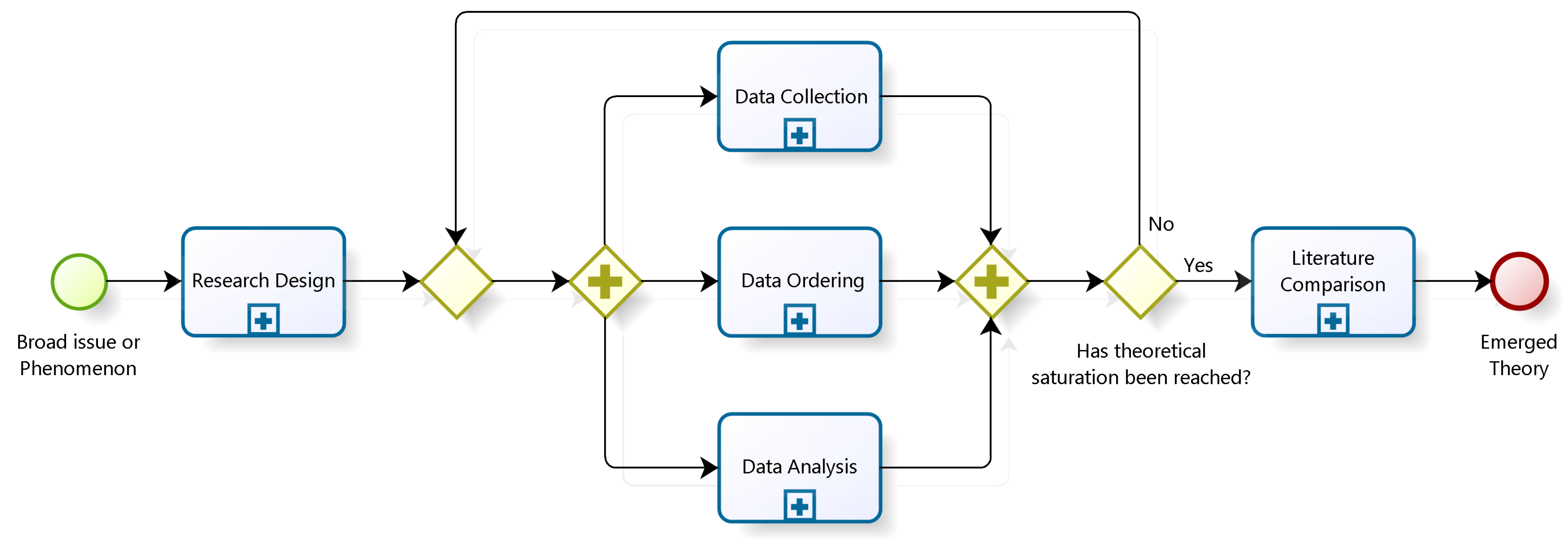
Figure 2.
Elements of wargames according to Perla [32], described in UFO-A.
Figure 2.
Elements of wargames according to Perla [32], described in UFO-A.
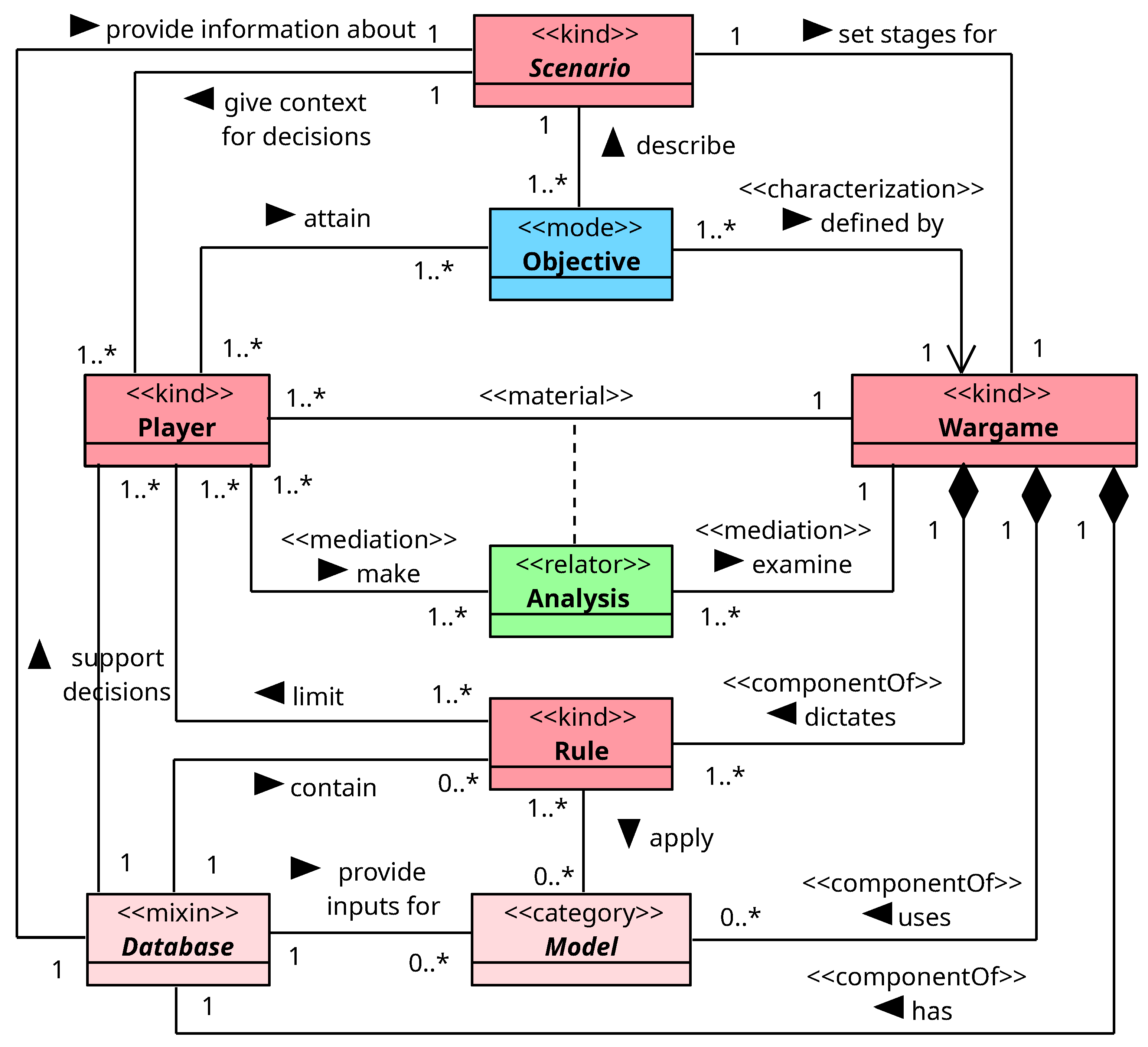
Figure 3.
Wargaming model as a decision-making process.
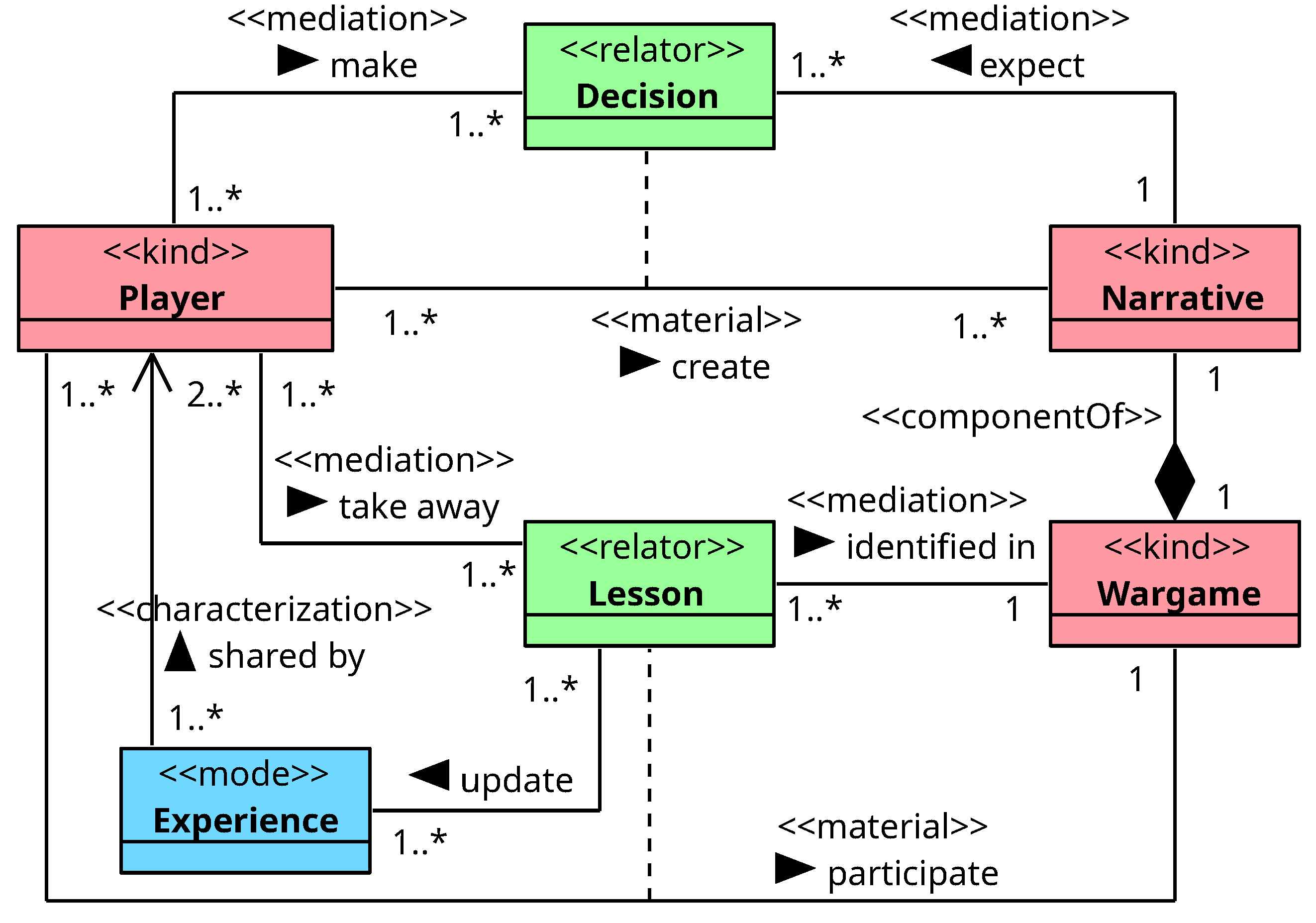
Figure 4.
The UFO-A for wargame design characteristics.
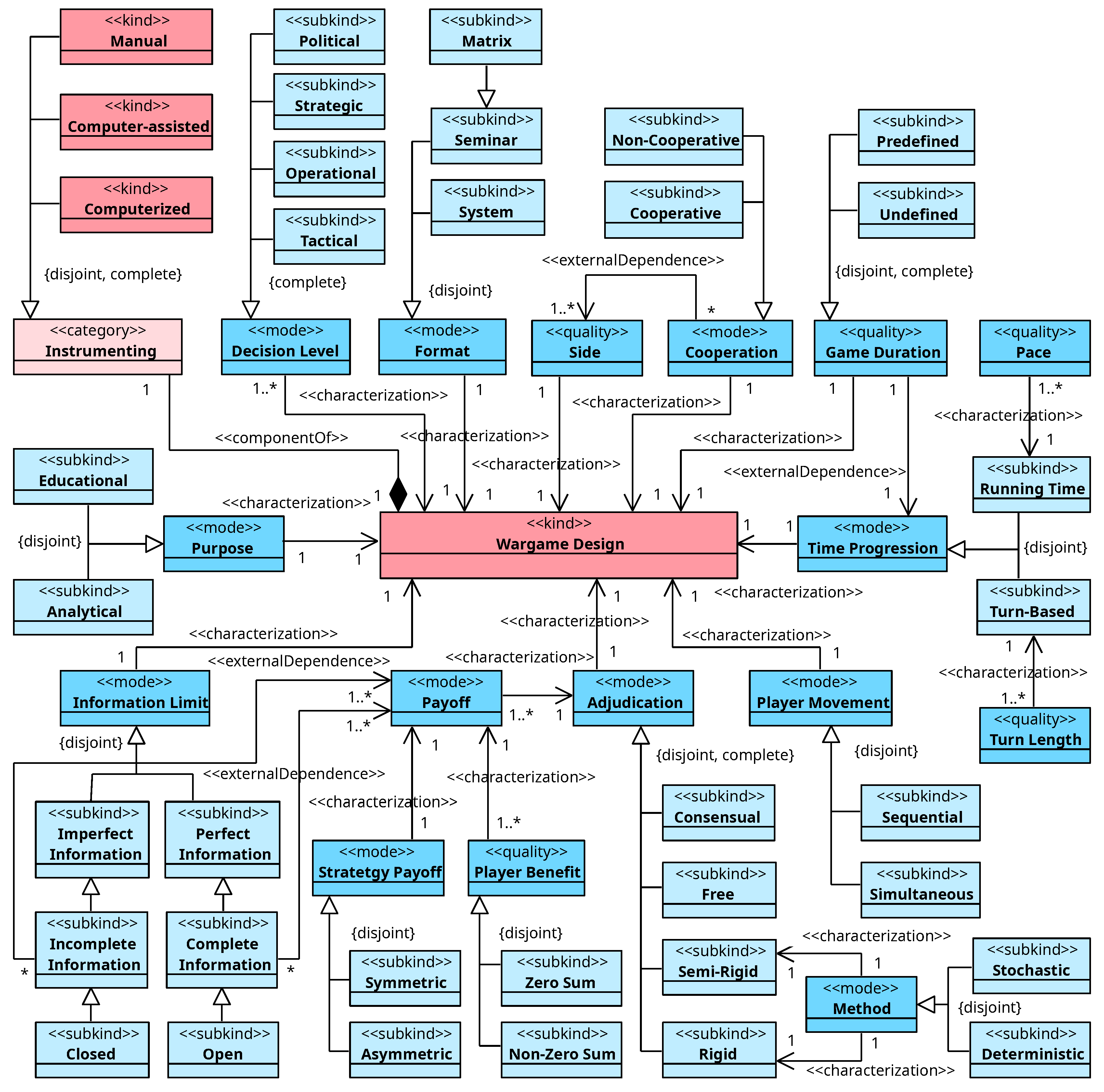
Figure 5.
The UFO-B for the wargame design process.
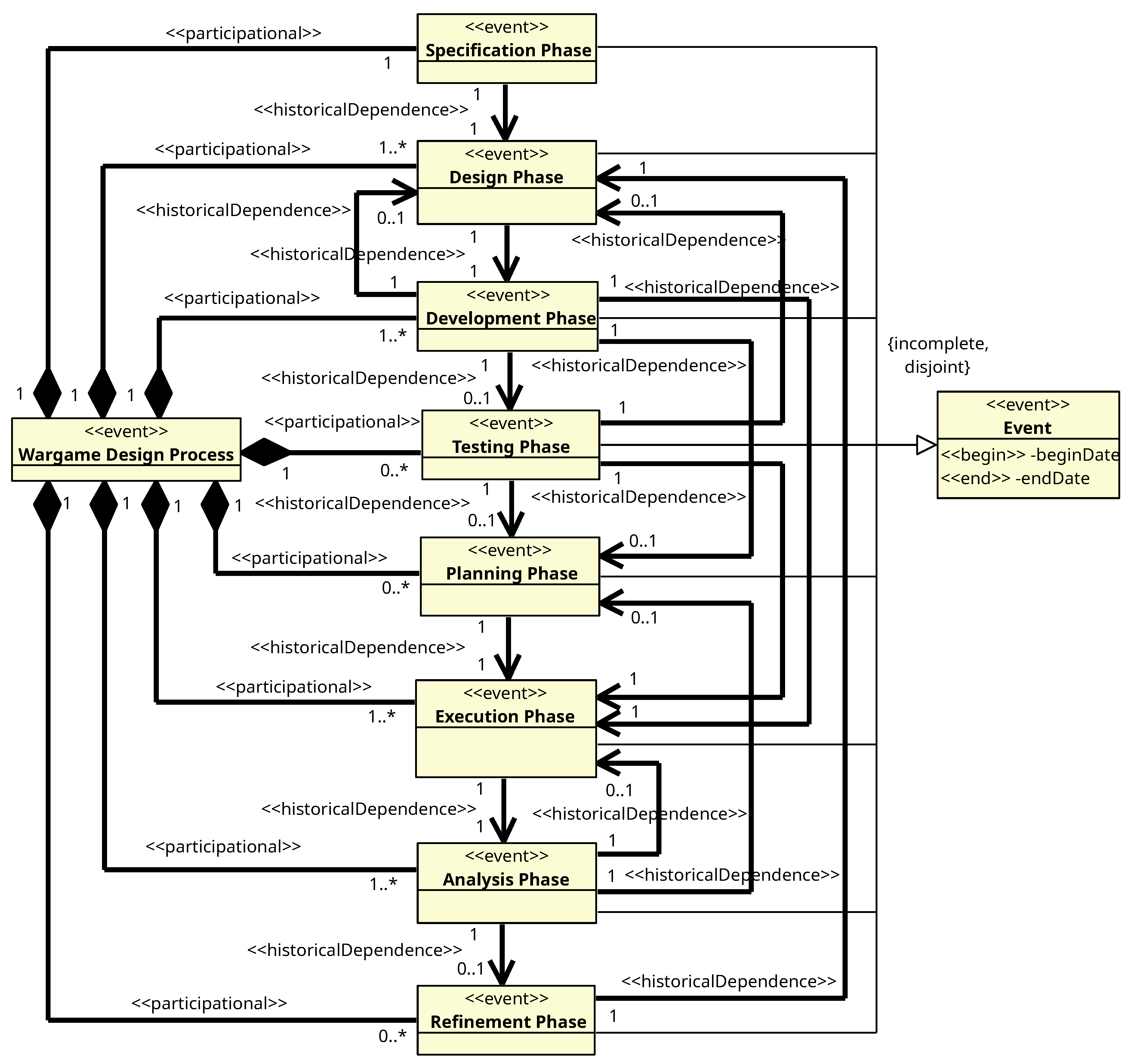
Figure 6.
The UFO-A for wargame specification phase.
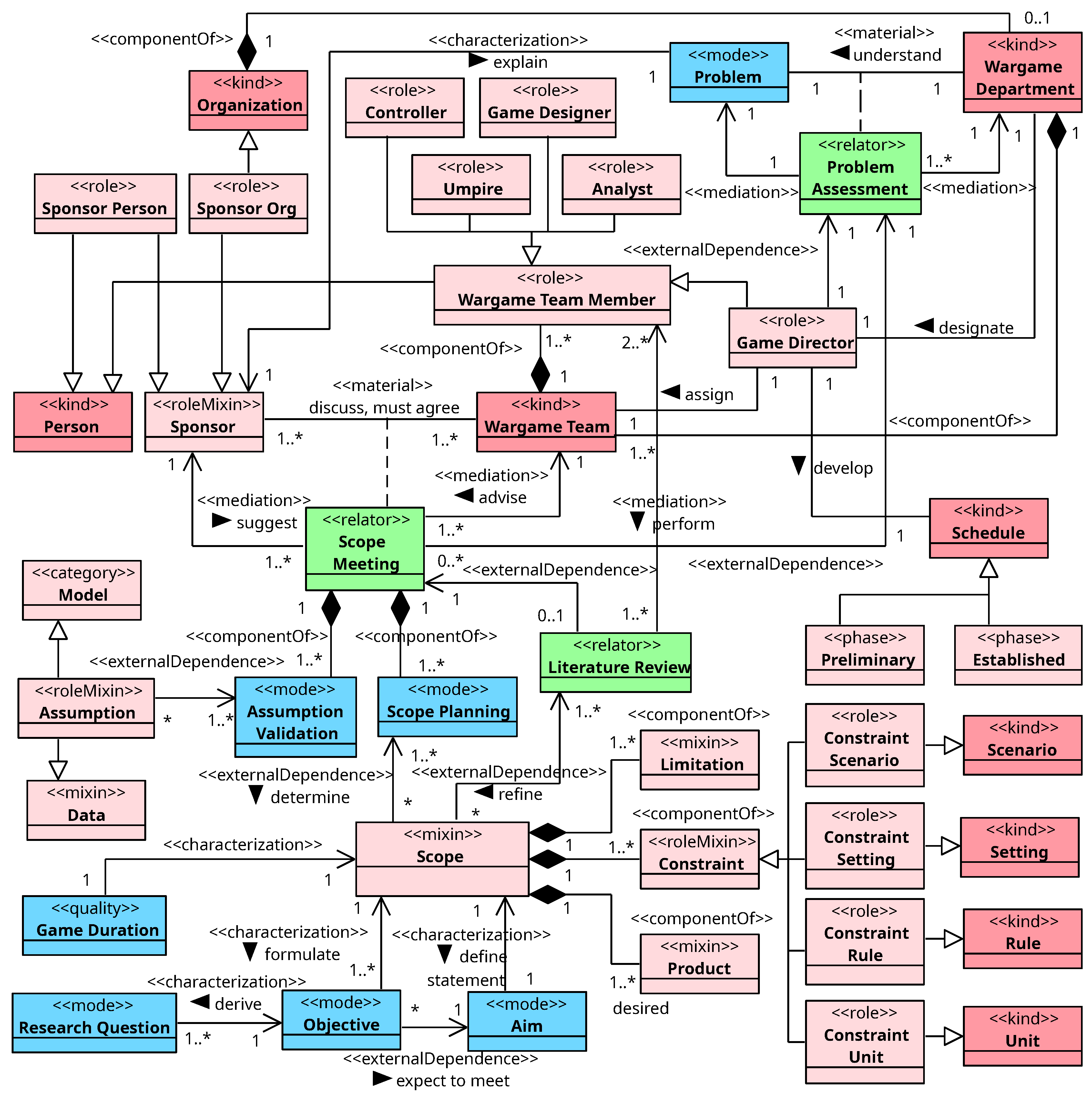
Figure 7.
The UFO-B for wargame specification phase.
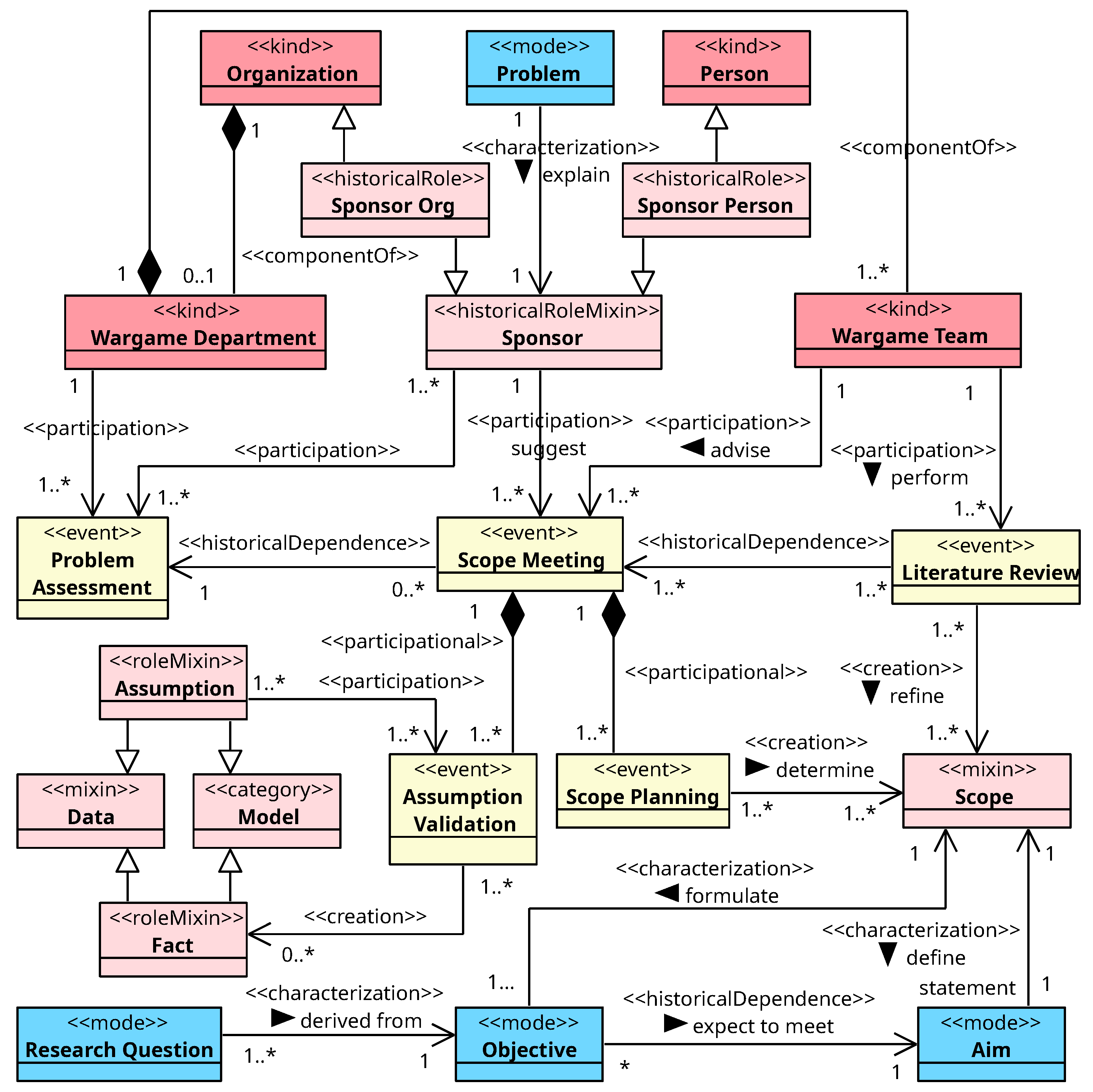
Figure 8.
The UFO-A for the wargame design phase.
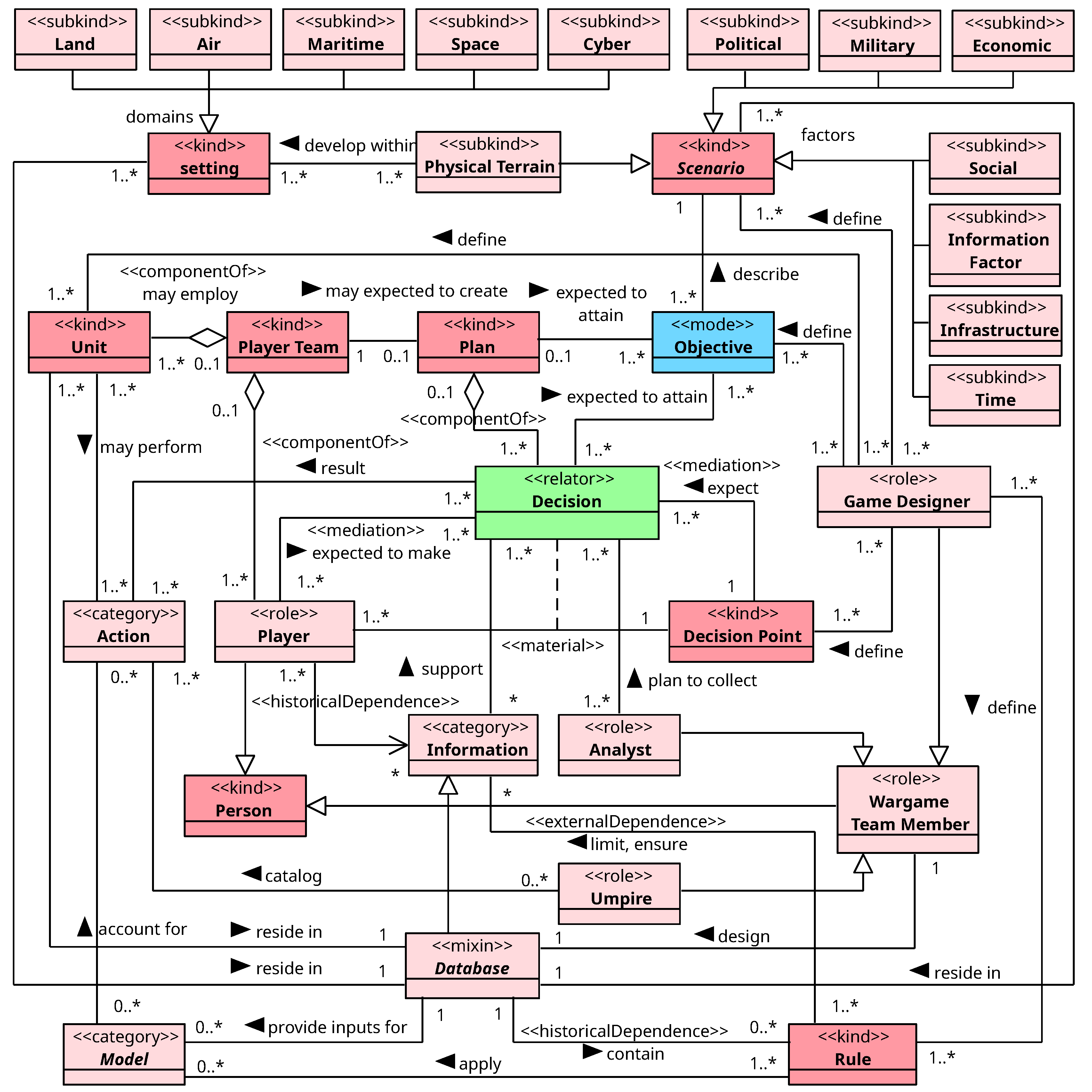
Figure 9.
Abstraction levels for the characteristics of wargame designs.
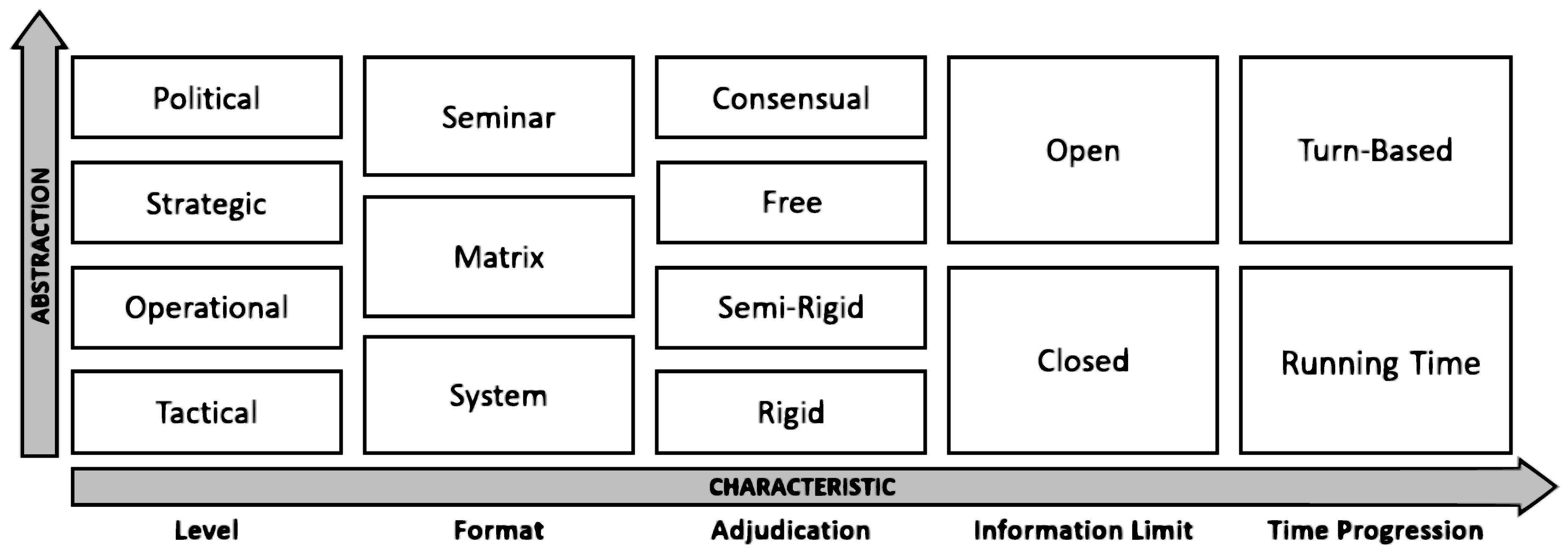
Figure 10.
UFO-A relating elements and characteristics of wargame designs.
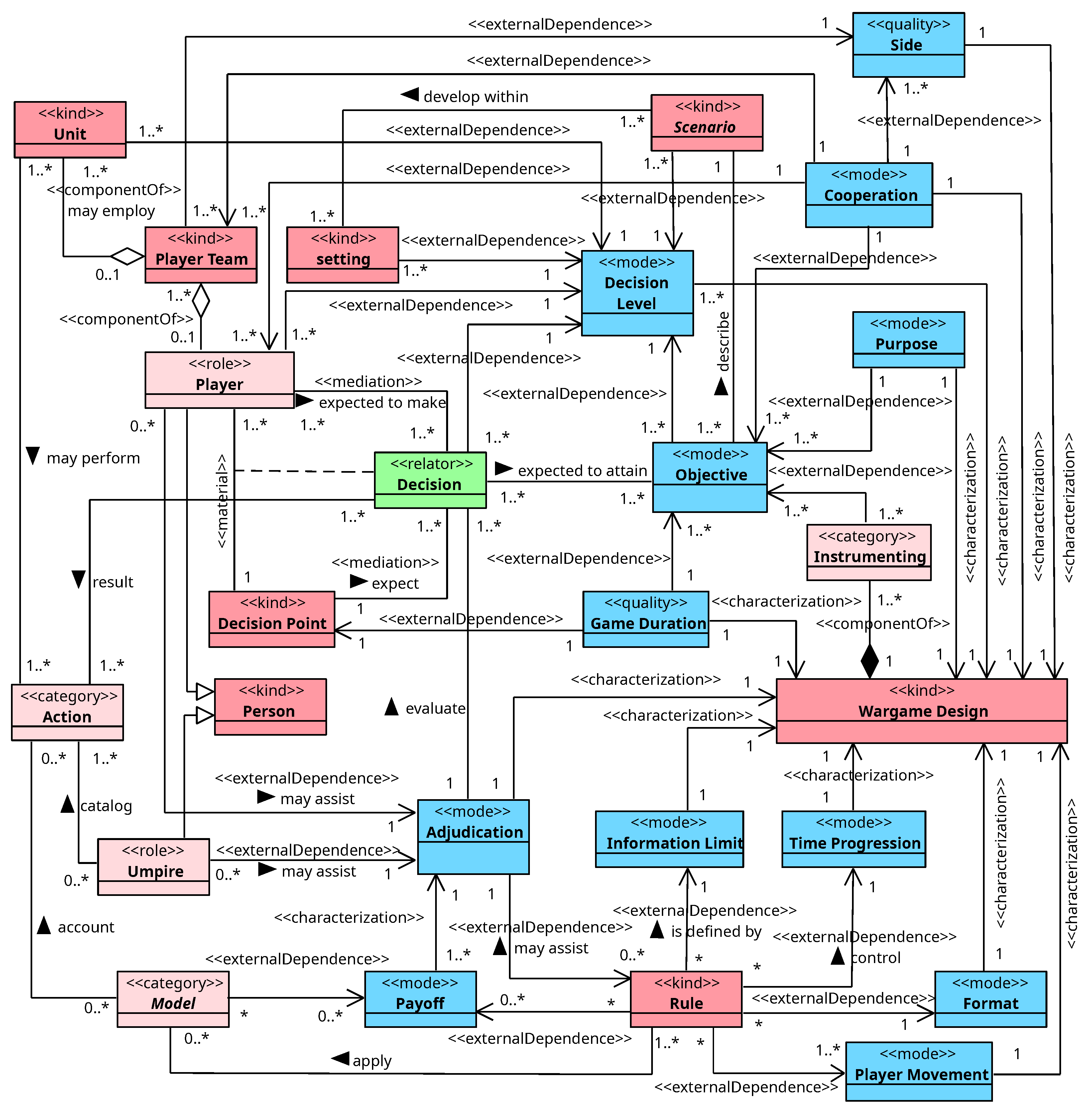

Table 1.
Wargame design phases from wargaming handbooks.
| Source | Sequence of Phases |
|---|---|
| NATO | Design, Development, Execute, Analysis |
| U.S. Army | Define, Plan Support, Design, Develop, Rehearse, Execution, Communicate Results |
| U.S. Navy | Tasking, Design, Development, Testing, Rehearsal, Execution, Analysis and Archive |
| UK | Design, Develop, Execute, Validate, Refine |
| France | Initialisation, Design, Development, Execution, Analysis |
| Germany | Planning, Development, Execution, Analysis |
| Poland | Commissioning, Designing, Preparation, Testing, Trial Game, Game Execution, Analysis and Archiving |
| Brazil | Specification, Design, Test, Planning, Execution, Analysis |
Table 2.
Relationship between Wargame Characteristics and Related Elements.
| Characteristics | Elements |
|---|---|
| Decision Level | Scenario, Setting, Player, Decision, Objective, Unit, Action |
| Purpose | Objective |
| Instrumenting | Objective |
| Game Duration | Objective, Decision Point |
| Cooperation | Objective, Player Team, Player |
| Side | Player Team |
| Adjudication | Rule, Umpire, Player |
| Format | Rule |
| Information Limit | Rule |
| Time Progression | Rule |
| Player Movement | Rule |
Disclaimer/Publisher’s Note: The statements, opinions and data contained in all publications are solely those of the individual author(s) and contributor(s) and not of MDPI and/or the editor(s). MDPI and/or the editor(s) disclaim responsibility for any injury to people or property resulting from any ideas, methods, instructions or products referred to in the content. |
© 2024 by the authors. Licensee MDPI, Basel, Switzerland. This article is an open access article distributed under the terms and conditions of the Creative Commons Attribution (CC BY) license (http://creativecommons.org/licenses/by/4.0/).
Copyright: This open access article is published under a Creative Commons CC BY 4.0 license, which permit the free download, distribution, and reuse, provided that the author and preprint are cited in any reuse.