

Submitted:
18 December 2024
Posted:
20 December 2024
You are already at the latest version
Abstract
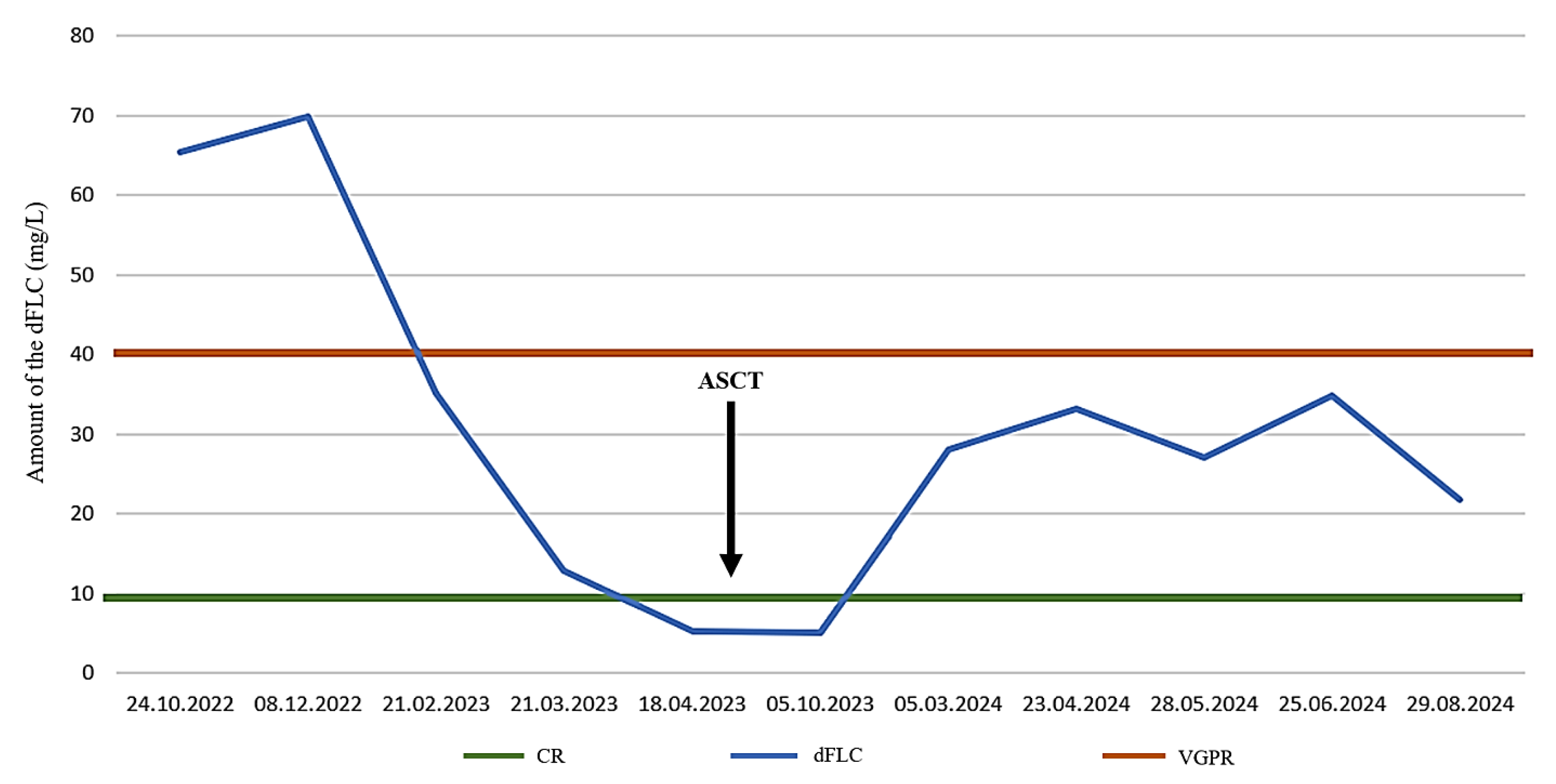
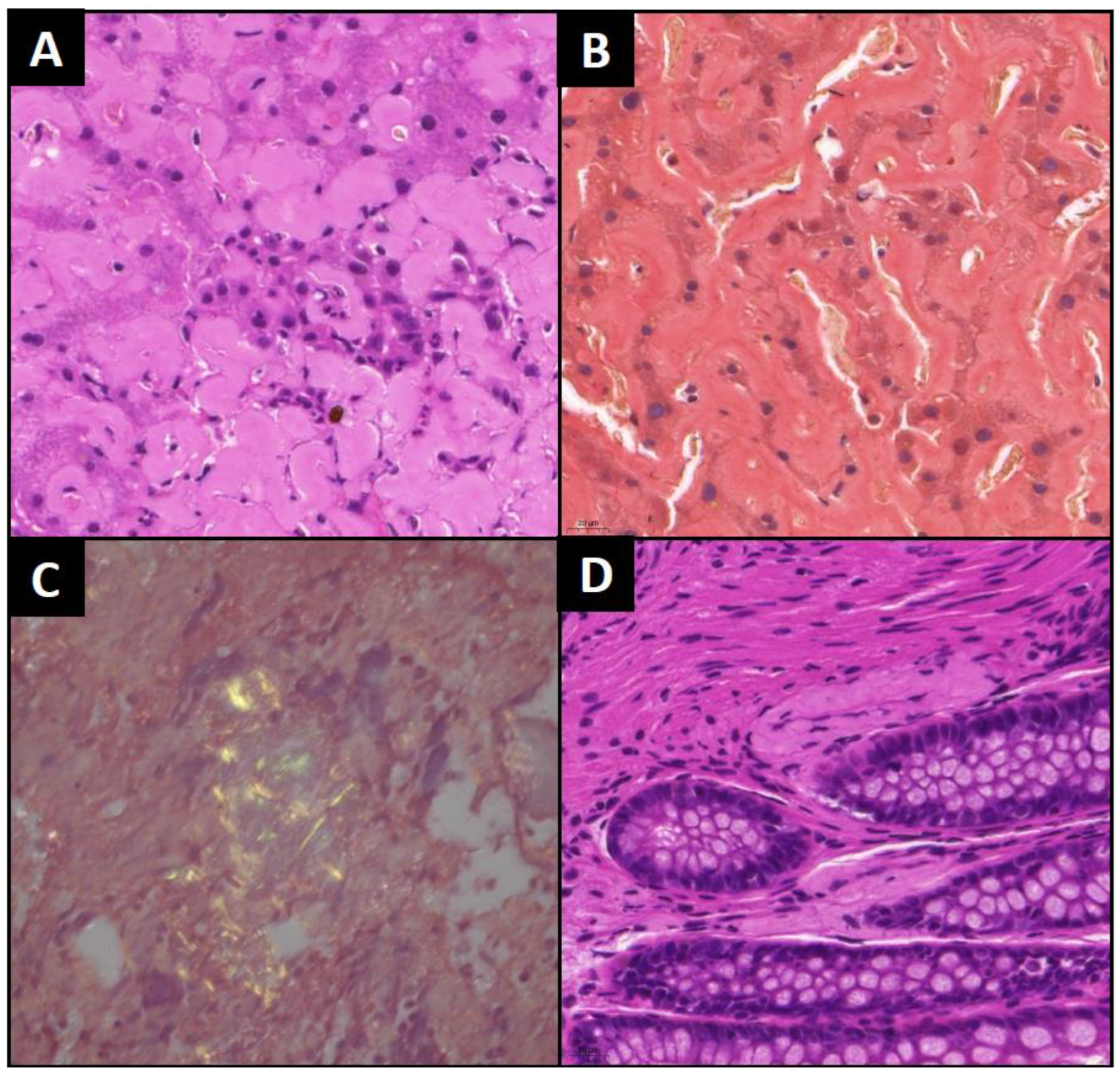
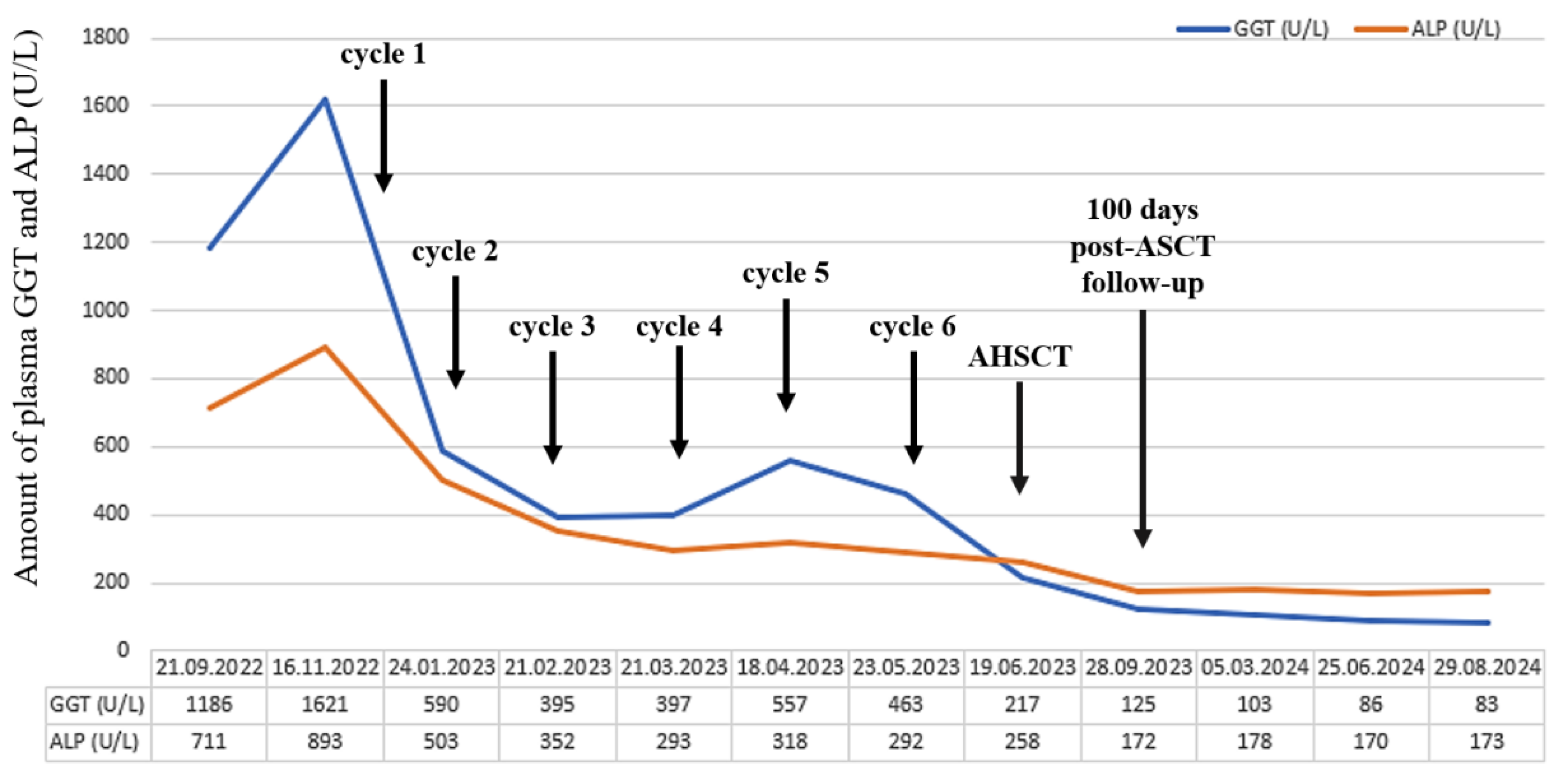
Background: 50% of patients in AL amyloidosis have t(11;14) translocation, allowing to use the selective, oral BCL-2 inhibitor venetoclax in their treatment. Case presentation: Our patient was admitted to the Gastroenterology Ambulance due to weight loss and abdominal pain. An abdominal CT scan revealed some enlarged lymph nodes, he was referred to the Hematology Ambulance. Bone marrow biopsy showed massive amorphous amyloid deposition. The sample was positive with Congo red staining and exhibited double refraction under polarized light microscope. Serum free light chains and the difference between involved and uninvolved free light chains (dFLC) were elevated. Fluorescent in situ hybridization detected t(11;14) translocation. Further examinations confirmed the involvement of the liver, colon and heart. Stage II. AL amyloidosis was confirmed. Combined chemotherapy was initiated with Venetoclax due to the presence of the t(11;14) translocation. After six cycles, the patient achieved complete remission. Autologous stem cell transplantation (ASCT) was performed. At 100 days post-ASCT, the patient had complete hematologic remission. Venetoclax maintenance treatment was initiated. Follow-up examinations are showing that the patient is in very good partial remission. Conclusions: In case of our AL amyloidosis patient with t(11;14) translocation the combined treatment of CyBorD and venetoclax was well tolerated and effective.
Keywords:
1. Introduction
2. Case Report
3. Conclusions
Informed Consent Statement
Conflicts of Interest statement
References
- Alaggio, R.; et al. The 5th edition of the World Health Organization Classification of Haematolymphoid Tumours: Lymphoid Neoplasms. Springer Nature 2022. [CrossRef] [PubMed]
- Campo, E.; et al. The International Consensus Classification of Mature Lymphoid Neoplasms: a report from the Clinical Advisory Committee. Blood 2022, 140, 1229. [Google Scholar] [CrossRef] [PubMed]
- Gadó, K.; Domján, G. AL-amyloidosis. Orv Hetil 2012, 153, 563–573. [Google Scholar] [CrossRef] [PubMed]
- D’Souza, A.; et al. Improved outcomes after autologous hematopoietic cell transplantation for light chain amyloidosis: A center for international blood and marrow transplant research study. Journal of Clinical Oncology 2015, 33, 3741–3749. [Google Scholar] [CrossRef] [PubMed]
- Bal, S.; Estrada-Merly, N.; Costa, L.J.; Qazilbash, M.H.; Kumar, S.; D’Souza, A. Outcomes of t(11;14) light chain (AL) amyloidosis after autologous stem cell transplantation: benchmark for new therapies. Springer Nature 2023. [CrossRef]
- Sidiqi, M.H.; et al. Venetoclax for the treatment of translocation (11;14) AL amyloidosis. Springer Nature 2020. [CrossRef] [PubMed]
- Leung, N.; Thomé, S.D.; Dispenzieri, A. Venetoclax induced a complete response in a patient with immunoglobulin light chain amyloidosis plateaued on cyclophosphamide, bortezomib and dexamethasone. Ferrata Storti Foundation 2018. [CrossRef] [PubMed]
- Chakraborty, R.; Lentzsch, S. Emerging drugs for the treatment of light chain amyloidosis. Taylor and Francis Ltd. 2020. [CrossRef] [PubMed]
- Van Doren, L.; Lentzsch, S. Nonchemotherapy treatment of immunoglobulin light chain amyloidosis. S. Karger AG 2020. [CrossRef]
- Premkumar, V.; Comenzo, R.; Lentzsch, S. Venetoclax in Immunoglobulin Light Chain Amyloidosis: Is This the Beginning or the End? Clin Lymphoma Myeloma Leuk 2019, 19, 686–688. [Google Scholar] [CrossRef] [PubMed]
- Gertz, M.A. Immunoglobulin light chain amyloidosis: 2020 update on diagnosis, prognosis, and treatment. Am J Hematol 2020, 95, 848–860. [Google Scholar] [CrossRef] [PubMed]
- Szita, V.R.; et al. Targeted Venetoclax Therapy in t(11;14) Multiple Myeloma: Real World Data From Seven Hungarian Centers. Pathology and Oncology Research 2022, 28. [Google Scholar] [CrossRef]
- Moreau, P.; et al. Promising efficacy and acceptable safety of venetoclax plus bortezomib and dexamethasone in relapsed/refractory MM. 2017.
- Theodorakakou, F.; et al. Outcomes of patients with light chain (AL) amyloidosis after failure of daratumumab-based therapy. Br J Haematol 2023, 203, 411–415. [Google Scholar] [CrossRef] [PubMed]
- Lebel, E.; et al. Venetoclax in Relapse/Refractory AL Amyloidosis—A Multicenter International Retrospective Real-World Study. Cancers (Basel) 2023, 15, 6. [Google Scholar] [CrossRef] [PubMed]
- Zanwar, S.; et al. Treatment patterns for AL amyloidosis after frontline daratumumab, bortezomib, cyclophosphamide, and dexamethasone treatment failures. Springer Nature 2024. [CrossRef]
- Zerdan, M.B.; et al. Systemic AL amyloidosis: current approach and future direction. 2023. Available online: www.oncotarget.com.
- Wechalekar, A.D.; et al. Guidelines for non-transplant chemotherapy for treatment of systemic AL amyloidosis: EHA-ISA working group. Amyloid 2023, 30, 3–17. [Google Scholar] [CrossRef] [PubMed]
- Al Saleh, A.S.; et al. Impact of consolidation therapy post autologous stem cell transplant in patients with light chain amyloidosis. Am J Hematol 2019, 94, 1066–1071. [Google Scholar] [CrossRef] [PubMed]
- Faust, D.; Akoglu, B.; Ristic, G.; Milovic, V. Strana 482 VOJNOSANITETSKI PREGLED Ursodeoxycholic acid for treatment of cholestasis in patients with hepatic amyloidosis Ursodeoksiholna kiselina za lečenje holestaze kod bolesnika sa amiloidozom jetre.
Disclaimer/Publisher’s Note: The statements, opinions and data contained in all publications are solely those of the individual author(s) and contributor(s) and not of MDPI and/or the editor(s). MDPI and/or the editor(s) disclaim responsibility for any injury to people or property resulting from any ideas, methods, instructions or products referred to in the content. |
© 2024 by the authors. Licensee MDPI, Basel, Switzerland. This article is an open access article distributed under the terms and conditions of the Creative Commons Attribution (CC BY) license (http://creativecommons.org/licenses/by/4.0/).


