

Submitted:
17 December 2024
Posted:
18 December 2024
You are already at the latest version
Abstract
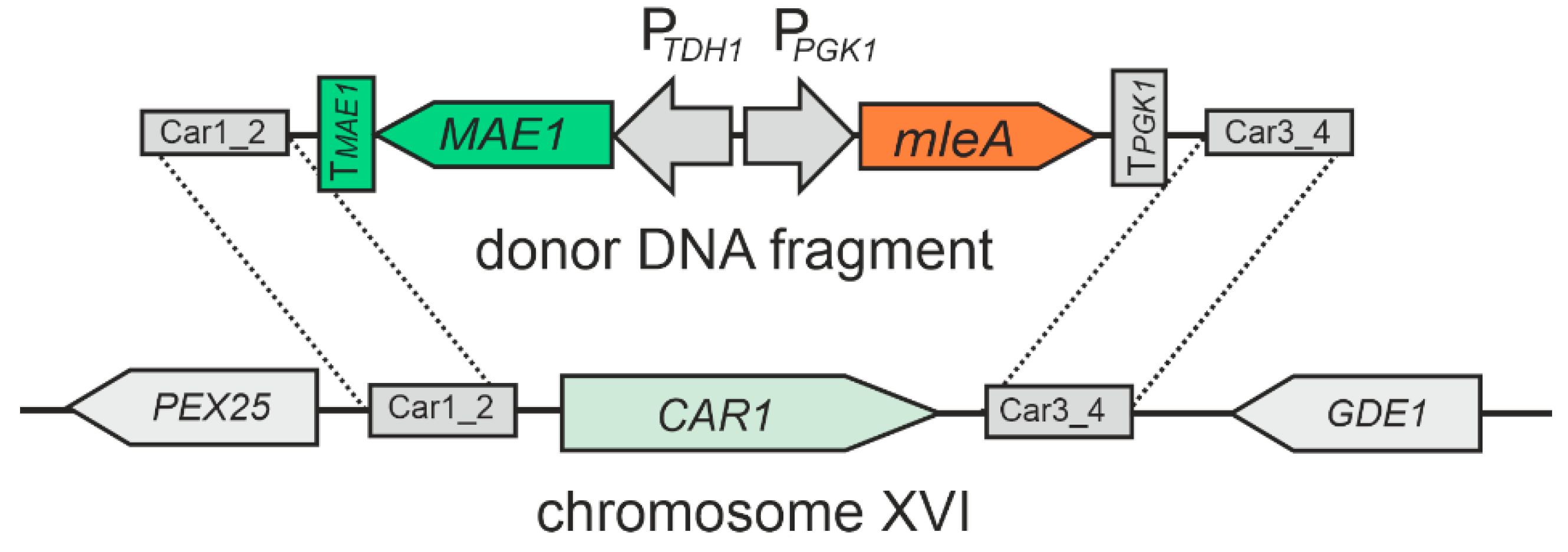
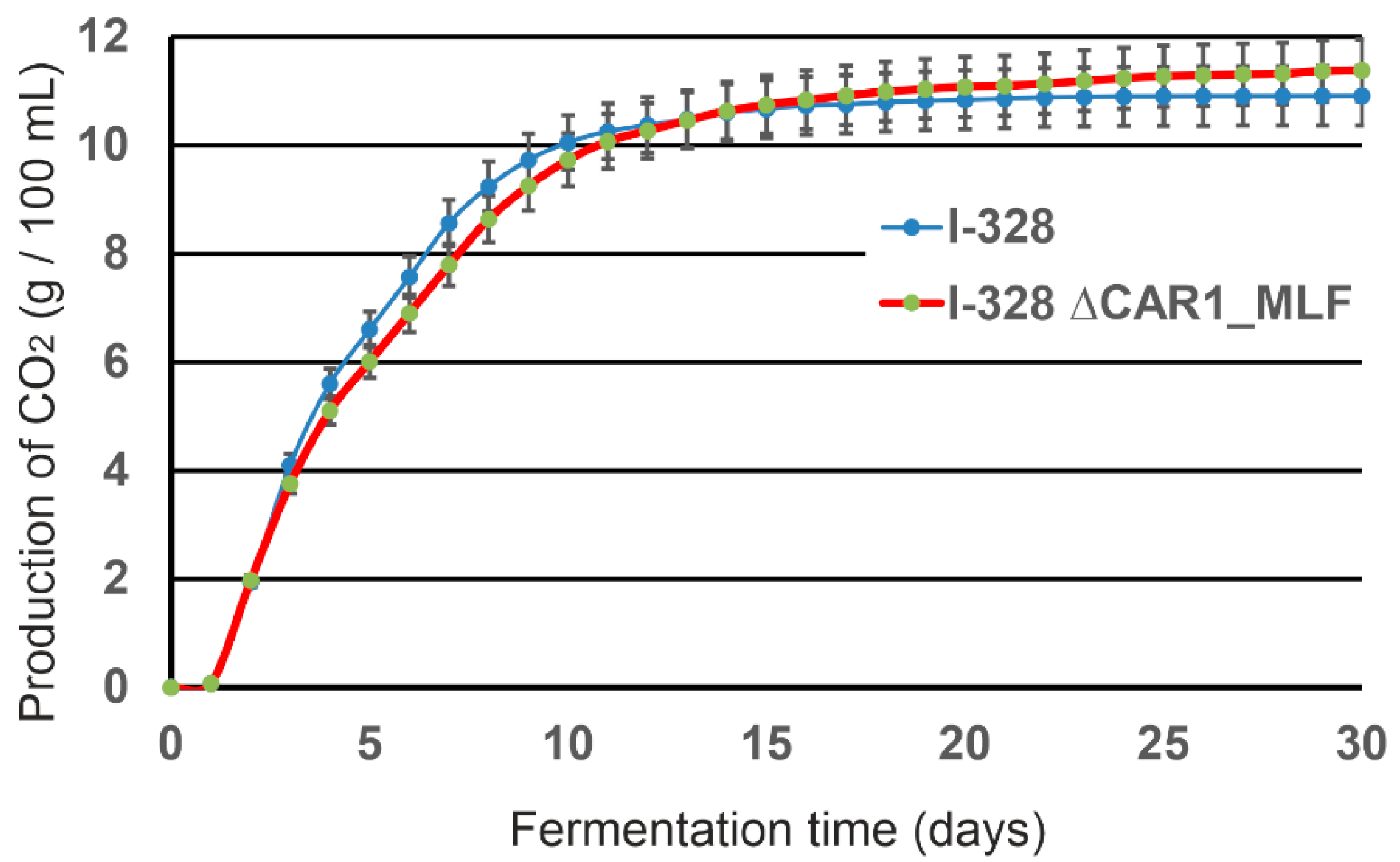
In winemaking, malolactic fermentation (MLF), which converts L-malic acid to L-lactic acid, is often applied after the alcoholic fermentation stage to improve the sensory properties of the wine and its microbiological stability. MLF is usually implemented by lactic acid bacteria, which, however, are sensitive to the conditions of alcoholic fermentation. Therefore, the development of a wine yeast strains capable of both alcoholic fermentation and MLF is an important task. Using genome editing, we engineered a modified variant of the triploid wine yeast strain Saccharomyces cerevisiae I-328, in which the CAR1 arginase gene was replaced with the malate permease gene from Schizosaccharomyces pombe and the malolactic enzyme gene from Oenococcus oeni. Genome-wide transcriptional profiling confirmed the expression of the introduced genes and revealed a limited effect of the modification on global gene expression. Winemaking experiments show that genome editing did not affect the fermentation activity and the production of ethanol, while the use of the modified strain ensured a tenfold reduction in malate content with the simultaneous formation of lactate. The resulting wines had a softer and more harmonious taste compared to the wine obtained using the parental strain. Inactivation of arginase, which forms urea and L-ornithine through the breakdown of arginine, also led to a twofold decrease in the content of urea and the carcinogenic ethyl carbamate in wine. Thus, the new strain with the replacement of the arginase gene with the MLF gene cassette is promising for use in winemaking.
Keywords:
1. Introduction
2. Materials and Methods
2.1. Strains, Media and Cultivation Conditions
2.2. Construction of a MLF Gene Cassette for Integration into the Genome of Yeast Strain I-328
2.3. Genome Editing
2.4. Genome Sequencing and Assembly
2.5. Transcriptome Sequencing and Analysis of Gene Expression
2.5. Nucleotide Sequence Accession Numbers
2.6. Characteristics of Morphological, Cultural, Physiological, and Biochemical Properties of Yeast
2.7. The Ability of Yeast Strains to Ferment Malic Acid
2.8. Evaluation of Fermentation Activity
2.9. Large-Scale Fermentation Procedure
2.10. Oenological Parameters Analysis
3. Results and Discussion
3.1. Construction of a Yeast Strain with CAR1 Gene Deletion and Insertion of the MLF Cassette Using the CRISPR/Cas9 System
3.2. The Effect of Integration of the MLF Cassette in Place of the CAR1 Gene on the Transcriptome
3.3. Morphological, Cultural, Physiological and Biochemical Properties of Strains
3.4. Functional Characteristics of the Modified and Parental Strains
4. Conclusions
Supplementary Materials
Author Contributions
Funding
Data Availability Statement
Conflicts of Interest
References
- Gil-Sánchez, I.; Bartolomé Suáldea, B.; Victoria Moreno-Arribas, M. Malolactic Fermentation. In Red Wine Technology; Academic Press: Cambridge, MA, USA, 2019; pp. 85–98. [Google Scholar] [CrossRef]
- Volschenk, H.; Van Vuuren, H.J.J.; Viljoen-Bloom, M. Malic acid in wine: Origin, function and metabolism during vinification. South African Journal of Enology and Viticulture 2006, 27(2), 123–136. [Google Scholar] [CrossRef]
- Barbieri, F.; Montanari, C.; Gardini, F.; Tabanelli, G. Biogenic Amine Production by Lactic Acid Bacteria: A Review. Foods 2019, 8, 17. [Google Scholar] [CrossRef]
- Sumby, K.M.; Bartle, L.; Grbin, P.R.; Jiranek, V. Measures to Improve Wine Malolactic Fermentation. Appl Microbiol Biotechnol 2019, 103, 2033–2051. [Google Scholar] [CrossRef]
- Liu, S.Q. Malolactic Fermentation in Wine—Beyond Deacidification. J Appl Microbiol 2002, 92, 589–601. [Google Scholar] [CrossRef] [PubMed]
- Cinquanta, L.; De Stefano, G.; Formato, D.; Niro, S.; Panfili, G. Effect of PH on Malolactic Fermentation in Southern Italian Wines. Eur Food Res Technol 2018, 244, 1261–1268. [Google Scholar] [CrossRef]
- Guzzon, R.; Villega, T.R.; Pedron, M.; Malacarne, M.; Nicolini, G.; Larcher, R. Simultaneous Yeast-Bacteria Inoculum. A Feasible Solution for the Management of Oenological Fermentation in Red Must with Low Nitrogen Content. Ann Microbiol 2013, 63, 805–808. [Google Scholar] [CrossRef]
- Husnik, J.I.; Volschenk, H.; Bauer, J.; Colavizza, D.; Luo, Z.; van Vuuren, H.J.J. Metabolic Engineering of Malolactic Wine Yeast. Metab Eng 2006, 8, 315–323. [Google Scholar] [CrossRef] [PubMed]
- Husnik, J.I.; Delaquis, P.J.; Cliff, M.A.; Van Vuuren, H.J.J. Functional Analyses of the Malolactic Wine Yeast ML01. Am J Enol Vitic 2007, 58, 42–52. [Google Scholar] [CrossRef]
- Lachenmeier, D.W.; Lima, M.C.P.; Nóbrega, I.C.C.; Pereira, J.A.P.; Kerr-Corrêa, F.; Kanteres, F.; Rehm, J. Cancer Risk Assessment of Ethyl Carbamate in Alcoholic Beverages from Brazil with Special Consideration to the Spirits Cachaça and Tiquira. BMC Cancer 2010, 10. [Google Scholar] [CrossRef]
- Weber, J.V.; Sharypov, V.I. Ethyl Carbamate in Foods and Beverages: A Review. Environ Chem Lett 2009, 7, 233–247. [Google Scholar] [CrossRef]
- Shalamitskiy, M.Y.; Tanashchuk, T.N.; Cherviak, S.N.; Vasyagin, E.A.; Ravin, N.V.; Mardanov, A.V. Ethyl Carbamate in Fermented Food Products: Sources of Appearance, Hazards and Methods for Reducing Its Content. Foods 2023, 12, 3816. [Google Scholar] [CrossRef] [PubMed]
- Kitamoto, K.; Oda, K.; Gomi, K.; Takahashi, K. Genetic Engineering of a Sake Yeast Producing No Urea by Successive Disruption of Arginase Gene. Appl Environ Microbiol 1991, 57, 301–306. [Google Scholar] [CrossRef] [PubMed]
- Wu, D.; Li, X.; Shen, C.; Lu, J.; Chen, J.; Xie, G. Decreased Ethyl Carbamate Generation during Chinese Rice Wine Fermentation by Disruption of CAR1 in an Industrial Yeast Strain. Int J Food Microbiol 2014, 180, 19–23. [Google Scholar] [CrossRef] [PubMed]
- Park, H.; Shin, M.; Woo, I. Antisense-Mediated Inhibition of Arginase (CAR1) Gene Expression in Saccharomyces cerevisiae. J Biosci Bioeng 2001, 92, 481–484. [Google Scholar] [CrossRef] [PubMed]
- Dahabieh, M.S.; Husnik, J.I.; Van Vuuren, H.J.J. Functional Enhancement of Sake Yeast Strains to Minimize the Production of Ethyl Carbamate in Sake Wine. J Appl Microbiol 2010, 109, 963–973. [Google Scholar] [CrossRef] [PubMed]
- Zhang, P.; Hu, X. Metabolic Engineering of Arginine Permeases to Reduce the Formation of Urea in Saccharomyces cerevisiae. World J Microbiol Biotechnol 2018, 34, 47. [Google Scholar] [CrossRef] [PubMed]
- Vigentini, I.; Gebbia, M.; Belotti, A.; Foschino, R.; Roth, F.P. CRISPR/Cas9 System as a Valuable Genome Editing Tool for Wine Yeasts with Application to Decrease Urea Production. Front Microbiol 2017, 8, 2194. [Google Scholar] [CrossRef]
- Zhang, P.; Li, B.; Wen, P.; Wang, P.; Yang, Y.; Chen, Q.; Chang, Y.; Hu, X. Metabolic Engineering of Four GATA Factors to Reduce Urea and Ethyl Carbamate Formation in a Model Rice Wine System. J Agric Food Chem 2018, 66, 10881–10889. [Google Scholar] [CrossRef]
- Jung, J.Y.; Kang, M.J.; Hwang, H.S.; Baek, K.R.; Seo, S.O. Reduction of Ethyl Carbamate in an Alcoholic Beverage by CRISPR/Cas9-Based Genome Editing of the Wild Yeast. Foods 2023, 12, 102. [Google Scholar] [CrossRef] [PubMed]
- Kishkovskaia, S.A.; Eldarov, M.A.; Dumina, M.V.; Tanashchuk, T.N.; Ravin, N.V.; Mardanov, A.V. Flor Yeast Strains from Culture Collection: Genetic Diversity and Physiological and Biochemical Properties. Appl Biochem Microbiol 2017, 53, 359–367. [Google Scholar] [CrossRef]
- Mardanov, A.V.; Beletsky, A.V.; Eldarov, M.A.; Tanashchuk, T.N.; Kishkovskaya, S.A.; Ravin, N.V. Draft Genome Sequence of the Wine Yeast Strain Saccharomyces Cerevisiae I-328. Genome Announc 2018, 6, e01520-17. [Google Scholar] [CrossRef] [PubMed]
- Gietz, R.D.; Woods, R.A. Transformation of Yeast by Lithium Acetate/Single-Stranded Carrier DNA/Polyethylene Glycol Method. Methods Enzymol 2002, 350, 87–96. [Google Scholar] [CrossRef] [PubMed]
- Mardanov, A.V.; Beletsky, A.V.; Vasyagin, E.A.; Tanashchuk, T.N.; Shalamitskiy, M.Yu.; Ravin, N.V. Complete Genome Sequence of Oenococcus Oeni Strain K19-3 Isolated from Must. Microbiol Resour Announc 2024, 13, e0098823. [Google Scholar] [CrossRef] [PubMed]
- Eldarov, M.A.; Beletsky, A.V.; Tanashchuk, T.N.; Kishkovskaya, S.A.; Ravin, N.V.; Mardanov, A.V. Whole-Genome Analysis of Three Yeast Strains Used for Production of Sherry-like Wines Revealed Genetic Traits Specific to Flor Yeasts. Front Microbiol 2018, 9, 965. [Google Scholar] [CrossRef] [PubMed]
- Shaw, W. Quick and Easy CRISPR Engineering in Saccharomyces cerevisiae. Available online: https://benchling.com/pub/ellis-crispr-tools (accessed on 25 November 2024).
- Urakov, V.N.; Mardanov, A.V.; Alexandrov, A.I.; Ruzhitskiy, A.O.; Ravin, N.V.; Kushnirov, V.V. CAR1 as a New Selective Marker for Genetic Engineering of Wine Yeasts. J Microbiol Methods 2023, 214, 106840. [Google Scholar] [CrossRef] [PubMed]
- Martin, M. Cutadapt Removes Adapter Sequences from High-Throughput Sequencing Reads. EMBnet J 2011, 17, 10. [Google Scholar] [CrossRef]
- Sickle: A Windowed Adaptive Trimming for Fastq Files Using Quality. Available online: https://github.com/najoshi/sickle (accessed on 25 November 2024).
- Langmead, B.; Salzberg, S.L. Fast Gapped-Read Alignment with Bowtie 2. Nat Methods 2012, 9, 357–359. [Google Scholar] [CrossRef] [PubMed]
- Garrison, E.; Marth, G. Haplotype-Based Variant Detection from Short-Read Sequencing. arXiv 2012, arXiv:1207.3907. [Google Scholar]
- Schmitt, M.E.; Brown, T.A.; Trumpower, B.L. A Rapid and Simple Method for Preparation of RNA from Saccharomyces Cerevisiae. Nucleic Acids Res 1990, 18, 3091–3092. [Google Scholar] [CrossRef]
- Li, B.; Dewey, C.N. RSEM: Accurate Transcript Quantification from RNA-Seq Data with or without a Reference Genome. BMC Bioinformatics 2011, 12, 323. [Google Scholar] [CrossRef] [PubMed]
- Love, M.I.; Huber, W.; Anders, S. Moderated Estimation of Fold Change and Dispersion for RNA-Seq Data with DESeq2. Genome Biol 2014, 15, 550. [Google Scholar] [CrossRef] [PubMed]
- Moriya, Y.; Itoh, M.; Okuda, S.; Yoshizawa, A.C.; Kanehisa, M. KAAS: An Automatic Genome Annotation and Pathway Reconstruction Server. Nucleic Acids Res 2007, 35(Web Server issue), W182-5. [Google Scholar] [CrossRef]
- Yu, G.; Wang, L.G.; Han, Y.; He, Q.Y. ClusterProfiler: An R Package for Comparing Biological Themes among Gene Clusters. OMICS 2012, 16, 284–287. [Google Scholar] [CrossRef] [PubMed]
- Jiranek, V.; Langridge, P.; Henschke, P.A. Validation of Bismuth-Containing Indicator Media for Predicting H2S-Producing Potential of Saccharomyces Cerevisiae Wine Yeasts under Enological Conditions. Am J Enol Vitic 1995, 46, 269–273. [Google Scholar] [CrossRef]
- Lemaresquier, H.; Gainvors, A.; Lequart, C.; Charlemagne, B.; Frezier, V.; Belarbi, A. Sélection de levures œnologiques à activité clarifiante: Les différentes techniques utilisées pour caractériser des levures, intérêt de la sélection d’ une levure productrice d’ enzymes pectolytiques. Rev. française d’oenologie 1995, 35, 23–29. [Google Scholar]
- Compendium of International Methods of Wine and Must Analysis. Available online: https://www.oiv.int/standards/compendium-of-international-methods-of-wine-and-must-analysis (accessed on 25 November 2024).
- Zhang, J.; Liu, G.; Zhang, Y.; Gao, Q.; Wang, D.; Liu, H. Simultaneous Determination of Ethyl Carbamate and Urea in Alcoholic Beverages by High-Performance Liquid Chromatography Coupled with Fluorescence Detection. J Agric Food Chem 2014, 62, 2797–2802. [Google Scholar] [CrossRef] [PubMed]
- Wang, R.; Wu, H.; Zhou, X.; Chen, L. Simultaneous Detection of Ethyl Carbamate and Urea in Chinese Yellow Rice Wine by HPLC-FLD. J Liq Chromatogr Relat Technol 2014, 37, 39–47. [Google Scholar] [CrossRef]
- Cicchetti, D.V.; Cicchetti, A.F. Wine Rating Scales: Assessing Their Utility for Producers, Consumers, and Oenologic Researchers. Int. J. Wine Res 2009, 1, 73–83. [Google Scholar] [CrossRef]
- Urakov, V.; Kushnirov, V. Acetamidase Gene as a New Plasmid Marker for CRISPR Modification of Industrial and Laboratory Saccharomyces Yeasts. Biol. Commun 2024, 69, 105–110. [Google Scholar] [CrossRef]
- Park, H.D.; Scott, S.; Rajendra, R.; Dorrington, R.; Cooper, T.G. Synergistic Operation of the CAR2 (Ornithine Transaminase) Promoter Elements in Saccharomyces Cerevisiae. J Bacteriol 1999, 181, 7052–7064. [Google Scholar] [CrossRef] [PubMed]

| Primer | Sequence (5’-3’) |
|---|---|
| Car_1F | AACCGTGTAGGCAAAACTGGAC |
| Car_2R | CTCGAGTCGCGACCCGGGAGACAGTATGCGTAGCTTTACCA |
| Car_3R | CCCGGGTCGCGACTCGAGATCATCATCCCTTTTATCAAAATAAGCA |
| Car_4R | AGCGCTAAGAAGTGGAATTTATT |
| maeF | AAAACAAAATGGGTGAACTCAAGGAAAT |
| maeR | ATCCCGGGAGTACAATAAAGATACAGAA |
| PtdhF | ATTCGCGATTAGTAAAAATGTGCGCACCA |
| PtdhR | TCACCCATTTTGTTTTGTGTGTAAATTT |
| PpgkF | TATCGCGAACGCACAGATATTATAACAT |
| PpgkR | TCTGTCATTGTTTTATATTTGTTGTAAA |
| mleF | ATAAAACAATGACAGATCCAGTAAGTAT |
| mleR | AATTCAATTTAGTATTTCGGCTCCCACT |
| TpgkF | AATACTAAATTGAATTGAATTGAAATCG |
| TpgkR | ATCTCGAGAGGCATTAAAAGAGGAGCGA |
| Strain | Cell Morphology | Average Cell Size, µm | Sediment | Ring * | Velum * |
|---|---|---|---|---|---|
| I-328 | round-ovoid, elongated and oval ones are also found | 8.43 х 5.84 | dusty | No | no |
| I-328 ∆CAR1_MLF | round-ovoid, elongated and oval ones are also found | 8.55 х 6.01 | dusty | No | no |
| Strain | Initial content of L-malic acid (g/L) | ∆ рН | Final content | |||||
|---|---|---|---|---|---|---|---|---|
| Malic acid (g/L) | Lactic acid (g/L) | Acetic acid (g/L) | Glucose (g/L) | Fructose (g/L) | Ethanol (%, v/v) | |||
| I-328 | 2 | +0.06 | 1.56 ± 0.02 | 0.31 ± 0.03 | 0.03 ± 0.01 | 0.74 ± 0.1 | 0.18 ± 0.1 | 9.70 ± 0.05 |
| 3 | +0.11 | 2.39 ± 0.01 | 0.42 ± 0.02 | 0.04 ± 0.01 | 0.64 ± 0.1 | 0.21 ± 0.1 | 9.72 ± 0.05 | |
| 4 | +0.11 | 3.07 ± 0.03 | 0.65 ± 0.02 | 0.05 ± 0.01 | 0.68 ± 0.1 | 0.20 ± 0.1 | 9.76 ± 0.05 | |
| I-328 ∆CAR1_MLF | 2 | +0.15 | 0.24 ± 0.02 | 1.20 ± 0.01 | 0.03 ± 0.01 | 2.18 ± 0.1 | 0.70 ± 0.1 | 9.74 ± 0.05 |
| 3 | +0.19 | 0.48 ± 0.01 | 1.70 ± 0.02 | 0.03 ± 0.01 | 2.06 ± 0.1 | 0.67 ± 0.1 | 9.87 ± 0.05 | |
| 4 | +0.21 | 0.40 ± 0.01 | 2.44 ± 0.02 | 0.03 ± 0.01 | 2.10 ± 0.1 | 0.66 ± 0.1 | 9.50 ± 0.05 | |
| Characteristic | I-328 | I-328 ∆CAR1_MLF |
|---|---|---|
| Glucose, g/L | 1.1 ± 0.1 | 1.3 ± 0.1 |
| Fructose, g/L | 1.0 ± 0.1 | 1.2 ± 0.1 |
| Ethanol, % (v/v) | 11.5 ± 0.05 | 11.6 ± 0.05 |
| Citric acid, g/L | 0.76 ± 0.05 | 0.74 ± 0.05 |
| Succinic acid, g/L | 0.28 ± 0.05 | 0.32 ± 0.05 |
| Acetic acid, g/L | 0.26 ± 0.05 | 0.25 ± 0.05 |
| Glycerol, g/L | 7.0 ± 0.05 | 7.1 ± 0.05 |
| Titratable acidity, g/L | 9.45 ± 0.05 | 8.66 ± 0.05 |
| Malic acid, g/L | 3.98 ± 0.05 | 0.31 ± 0.05 |
| Lactic acid, g/L | 0.66 ± 0.05 | 3.02 ± 0.05 |
| Urea, mg/L | 6.12 ± 0.05 | 3.45 ± 0.05 |
| Ethyl carbamate, µg/L | 15.4 ± 0.05 | 7.2 ± 0.05 |
| рН | 3.03 ± 0.05 | 3.1 ± 0.05 |
Disclaimer/Publisher’s Note: The statements, opinions and data contained in all publications are solely those of the individual author(s) and contributor(s) and not of MDPI and/or the editor(s). MDPI and/or the editor(s) disclaim responsibility for any injury to people or property resulting from any ideas, methods, instructions or products referred to in the content. |
© 2025 by the authors. Licensee MDPI, Basel, Switzerland. This article is an open access article distributed under the terms and conditions of the Creative Commons Attribution (CC BY) license (https://creativecommons.org/licenses/by/4.0/).


