
Submitted:
16 December 2024
Posted:
17 December 2024
You are already at the latest version
Abstract
This research examines the impact of Human Resource Management (HRM) practices on ICT employee’s turnover intentions in Malaysia: recruitment and selection, training and development, compensation, performance appraisal and work life balance. The Malaysian government is indicating support for knowledge-based economy with initiatives towards strategic Information Communication Technology (ICT); however, the high turnover rates, within this sector, undermines the stability of skilled labors potential. Perceived organizational support, perception of distributive justice in HR practices and rewards are further confirmed as predictors of employee turnover with the array of three well established theories namely Social Exchange Theory (SET) and Organizational Support Theory (OST). In order to study the relationships of HRM practices and turnover intentions data were collected from a cross-sectional survey of ICT employees. It concluded that recruitment practices, compensation, training and development programs, performance appraisals along with work-life balance policies were related to lower turnover intentions. Such findings, thus further reinforce the rationale for human resource management and turnover strategies to be implemented in order to give a competitive edge to organisations in Malaysia rapidly transforming ICT industry. The study contributes to HRM literature by offering implications for practitioners who may be interested in reducing turnover by advancing the existence of an association between higher retention and employee commitment with the positive impact of HRM. A longitudinal research approach, which future studies may opt for to extend the generalizability of our findings across industries and to explore HRM effects over time, can overcome this limitation of cross-sectional design.
Keywords:
1. Introduction
1.1. Background of the ICT Industry in Malaysia
1.2. Importance of Human Resource Management (HRM) Practices
1.3. Overview of Turnover Intentions
1.4. Research Objective and Questions
- To scrutinize the result of recruitment and selection procedures on turnover intentions.
- To investigate training and development as a predictor of turnover intentions.
- To evaluate the impact compensation strategies, have on the retention of staff employees.
- This study examines the linkage between performance appraisal systems and turnover intentions.
- To investigate the impact of work-life balance initiatives on employees' intention to leave their organizations.
- What are the roles of recruitment and selection practices in mediating ICT employees' intention to leave Malaysia?
- How does turnover intention and the availability of training and development opportunities work together?
- Compensation Strategies Effects on Employee Retention in Malaysia's ICT Sector?
- The influence of performance appraisal systems on employees' turnover intention?
- How Work-Life Balance Could Influence Turnover Intentions among ICT Professionals in Malaysia?
2. Literature Review
2.1. Human Resource Management Practices
2.1.1. Recruitment and Selection
2.1.2. Training and Development
2.1.3. Compensation
2.1.4. Performance Appraisal
2.1.5. Work-Life Balance
2.2. Turnover Intention
2.3. Theoretical Background
2.3.1. Social Exchange Theory
2.3.2. Organizational Support Theory (OST)
2.4. Theoretical Framework
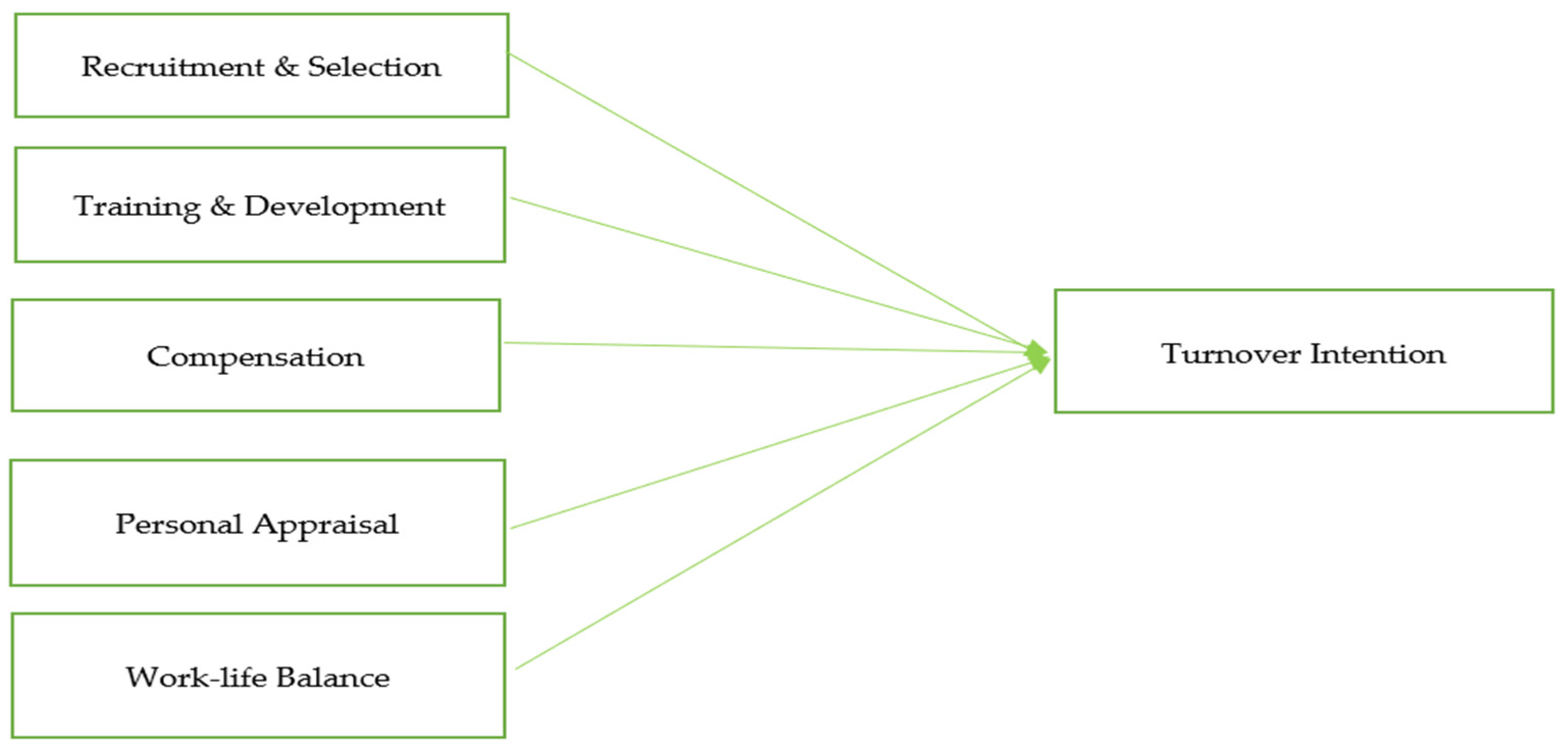
2.4.1. Conceptual Model of HRM Practices
Recruitment and Selection
Training and Development
Compensation
Performance Appraisal
Work-Life Balance
2.4.2. Hypotheses Development
3. Discussion
3.1. Implications of HRM Practices on Turnover
3.1.1. Recruitment and Selection
3.1.2. Training and Development
3.1.3. Compensation
3.1.4. Performance Appraisal
3.1.5. Work-Life Balance
3.2. Theoretical Contributions
3.3. Practical Implications for ICT Companies in Malaysia
4. Conclusion
4.1. Summary of Findings
4.2. Recommendations for Future Research
4.3. Limitations of the Study
Author Contributions
Funding
Data Availability Statement
Acknowledgments
Conflicts of Interest
References
- Ahmad, N., Drus, S., & Kasim, H. (2020). Factors that influence the adoption of enterprise architecture by public sector organizations: an empirical study. Ieee Access, 8, 98847-98873. [CrossRef]
- Isa, F., Muhammad, N., Ahmad, A., & Noor, S. (2021). Effect of ict on women entrepreneur business performance: case of malaysia. Journal of Economics and Business, 4(1). [CrossRef]
- Giménez, G. and Vargas-Montoya, L. (2021). Ict use and successful learning: the role of the stock of human capital. Mathematics, 9(14), 1648. [CrossRef]
- Lekić, N., Carić, M., Soleša, D., Vapa-Tankosić, J., Rajaković-Mijailović, J., Bogetić, S., … & Vučičević, M. (2021). Employees’ perceptions on the relationship of intellectual capital and business performance of ict companies. Sustainability, 14(1), 275. [CrossRef]
- Mongale, I. and Magongoa, M. (2020). Human capital and information and communication technology nexus: the south african perspective. Journal of Reviews on Global Economics, 9, 403-412. [CrossRef]
- Rehan, R. (2023). Inspecting sector-specific capital structure determinants: the case of malaysian shariah firms. International Journal of Applied Economics Finance and Accounting, 17(2), 402-414. [CrossRef]
- Nhon, H., Thong, B., & Trung, N. (2020). The effects of intellectual capital on information communication technology firm performance: a moderated mediation analysis of environmental uncertainty. Cogent Business & Management, 7(1), 1823584. [CrossRef]
- Gil-Delgado, M., Sánchez-Braza, A., & González-Jara, D. (2022). Economic growth and global warming effects on electricity consumption in spain: a sectoral study. Environmental Science and Pollution Research, 30(15), 43096-43112. [CrossRef]
- Alola, U. and Alafeshat, R. (2020). The impact of human resource practices on employee engagement in the airline industry. Journal of Public Affairs, 21(1). [CrossRef]
- Jose, S. (2019). Innovation in recruitment and talent acquisition: a study on technologies and strategies adopted for talent management in it sector. International Journal of Marketing & Human Resource Management, 10(3). [CrossRef]
- Ohene, A., Owusu-Acheampong, E., Jabez, A., & Doumbia, M. (2022). Recruitment and selection, training and development on job satisfaction mediated by motivation: exploratory and confirmatory factor analysis in the ghanaian smes. Journal of Human Resource Management – Hr Advances and Developments, 2022(1), 52-65. [CrossRef]
- Elrehail, H., Harazneh, I., Abuhjeeleh, M., Alzghoul, A., Alnajdawi, S., & Ibrahim, H. (2019). Employee satisfaction, human resource management practices and competitive advantage. European Journal of Management and Business Economics, 29(2), 125-149. [CrossRef]
- Abou-Moghli, A. (2019). The influence of compensation management strategy on talent retention: exploring the mediating role of structural capital. International Business Research, 12(3), 165. [CrossRef]
- Gilal, F., Ashraf, Z., Gilal, N., Gilal, R., & Chaana, N. (2019). Promoting environmental performance through green human resource management practices in higher education institutions: a moderated mediation model. Corporate Social Responsibility and Environmental Management, 26(6), 1579-1590. [CrossRef]
- Malik, S., Mughal, Y., Azam, T., Cao, Y., Wan, Z., Zhu, H., … & Ramayah, T. (2021). Corporate social responsibility, green human resources management, and sustainable performance: is organizational citizenship behavior towards environment the missing link? Sustainability, 13(3), 1044.
- Hayuni, A. (2023). The influence of servant leadership and self-efficacy on employee performance with job satisfaction as intervening variables (empirical study on rural banks in the magelang region)., 1475-1486.
- Wang, H., Jin, Y., Wang, D., Zhao, S., Xin-gang, S., & Yuan, B. (2020). Job satisfaction, burnout, and turnover intention among primary care providers in rural china: results from structural equation modeling. BMC Family Practice, 21(1). [CrossRef]
- Uzuntarla, Y., Bayer, N., Gölbaşı, Z., & Akarsu, K. (2021). Job satisfaction, burnout and turnover intention of nurses working in hospital during the pandemic covid-19 in turkey. Journal of Clinical Medicine of Kazakhstan, 18(6), 69-75. [CrossRef]
- Dewi, R. and Nurhayati, M. (2021). The effect of career development on turnover intention with job satisfaction and organizational commitment as mediators, study at pt control systems arena para nusa. European Journal of Business Management and Research, 6(4), 11-18. [CrossRef]
- Güzeller, C. and Çeliker, N. (2019). Examining the relationship between organizational commitment and turnover intention via a meta-analysis. International Journal of Culture Tourism and Hospitality Research, 14(1), 102-120. [CrossRef]
- Ferrari, I., Mulyawan, I., Witarsana, I., & Yudhistira, P. (2021). The effect of job satisfaction on employee turnover intention: case study in tanadewa resort and spa ubud. Jurnal Bisnis Hospitaliti, 10(2), 126-136. [CrossRef]
- Wicaksono, A., Amin, S., & Solihin, A. (2021). Role of mediating job satisfaction to improve organizational justice and turnover intentions. Journal of Business Studies and Mangement Review, 5(1), 1-9. [CrossRef]
- Chen, X., Li, R., Zhang, Y., Yang, J., Yao, H., Zhu, S., … & Tan, X. (2019). Moderating role of job satisfaction on turnover intention and burnout among workers in primary care institutions: a cross-sectional study. BMC Public Health, 19(1). [CrossRef]
- Dhanpat, N., Manakana, T., Mbacaza, J., Mokone, D., & Mtongana, B. (2019). Exploring retention factors and job security of nurses in gauteng public hospitals in south africa. African Journal of Economic and Management Studies, 10(1), 57-71. [CrossRef]
- Noreña-Chavez, D. and Thalassinos, E. (2023). Fueling innovation performance through entrepreneurial leadership: assessing the neglected mediating role of intellectual capital. Journal of Infrastructure Policy and Development, 7(1), 2020. [CrossRef]
- Zhang, M., Zheng, X., Chen, C., Fang, J., Liu, H., Zhang, X., … & Lang, H. (2022). Role of patient safety attitudes between career identity and turnover intentions of new nurses in china: a cross-sectional study. Frontiers in Public Health, 10. [CrossRef]
- Wajdi, M. (2023). The impact of compensation, organizational commitment, and job satisfaction on turnover intention among young female employees. Jbti Jurnal Bisnis Teori Dan Implementasi, 14(2), 383-400. [CrossRef]
- Rahadi, D. (2023). Analysis of recruitment and selection process in the field of information technology. International Journal of Scientific and Management Research, 06(08), 01-11. [CrossRef]
- Malik, M. and Mujtaba, M. (2018). Impact of e-recruitment on effectiveness of hr department in private sector of pakistan. International Journal of Human Resource Studies, 8(2), 80.
- Hee, O. and Jing, K. (2018). The influence of human resource management practices on employee performance in the manufacturing sector in malaysia. International Journal of Human Resource Studies, 8(2), 129. [CrossRef]
- Nguyen, C., 2020. The impact of training and development, job satisfaction and job performance on young employee retention. Job Satisfaction and Job Performance on Young Employee Retention (May 1, 2020).
- Memon, M.A., Salleh, R., Mirza, M.Z., Cheah, J.H., Ting, H., Ahmad, M.S. and Tariq, A., 2021. Satisfaction matters: the relationships between HRM practices, work engagement and turnover intention. International Journal of Manpower, 42(1), pp.21-50. [CrossRef]
- Sahija, D. (2022). Employee performance appraisal process and its impact on employee satisfaction. Technoarete Transactions on Economics and Business Systems, 1(2). [CrossRef]
- Görün, M., Kayar, İ., & Varol, B. (2018). 360-degree performance appraisal and feedback system: a study with heads of departments in çanakkale onsekiz mart university. Gaziantep University Journal of Social Sciences, 17(4), 1407-1419. [CrossRef]
- Boruett, H., Ronoh, A., Dimba, M., & Kisirkoi, F. (2021). Employees’ perceptions on the contribution of performance appraisal to career growth and development in kenya’s ministry of education in nairobi city county, kenya. The International Journal of Humanities & Social Studies, 9(3). [CrossRef]
- Wanigasinghe, N. (2020). Can i switch off? i can’t breathe. University of Colombo Review, 1(1), 81.
- Ágota-Aliz, B. (2021). Flexible working practices in the ict industry in achieving work-life balance. Studia Universitatis Babes-Bolyai Sociologia, 66(1), 29-50.
- Norizan, N. (2023). Exploring the research landscape of turnover intention: a bibliometric analysis. Information Management and Business Review, 15(3(I)), 361-372. [CrossRef]
- Putra, U. and Masdupi, E. (2019). The effect of compensation and organizational commitments to turnover intention with work satisfaction as intervening variables. case study at pt. bni life west sumatra region.
- Tampubolon, V. and Sagala, E. (2020). Pengaruh kepuasan kerja dan komitmen organisasi terhadap turnover intention pada karyawan pt. bum divisi pmks. Business Management Journal, 16(2), 65. [CrossRef]
- Ratnawita, R. (2023). The role of job satisfaction as intervening variable in the relationship between career development, work-life balance and turnover intention in outsource solution company. Jemsi (Jurnal Ekonomi Manajemen Dan Akuntansi), 9(3), 708-712. [CrossRef]
- Agustine, T. and Nawangsari, L. (2020). The effect of compensation and workloads towards intension of turnover with work satisfaction as a variable mediation in clinic employees of pt nayaka era husada branch of bekasi. International Journal of Innovative Science and Research Technology, 5(7), 1304-1312.
- Quynh, A. and Tran, A. (2021). Job satisfaction and turnover intention of preventive medicine workers in northern vietnam: is there any relationship? Health Services Insights, 14, 117863292199517.
- Silva, L. (2024). Relationship between job satisfaction and turnover intentions among nurses in south america. Journal of Human Resource and Leadership, 9(3), 1-12. [CrossRef]
- Hasan, N., Bagis, A., & Wahyulina, S. (2019). Effect of job satisfaction on turnover intention and organizational commitment as moderator variable at multi jaya lombok. Scientific Research Journal, 07(10), 97-102. [CrossRef]
- Sabarrudin, M. (2023). The impact of organizational commitment and motivation on turnover intention with job satisfaction asus a variable intervening at pt bgr logistics indonesia post-merger. Dinasti International Journal of Digital Business Management, 4(2), 233-241. [CrossRef]
- Kavakli, B. and Yıldırım, N. (2022). The relationship between workplace incivility and turnover intention in nurses: a cross-sectional study. Journal of Nursing Management, 30(5), 1235-1242. [CrossRef]
- Sazili, S., Ju’im, J., Indarti, S., & Efendi, R. (2022). Turnover intention influenced by work environment and job satisfaction. International Journal of Social Science Research and Review, 5(6), 102-108. [CrossRef]
- Bos-Nehles, A. and Meijerink, J. (2018). Hrm implementation by multiple hrm actors: a social exchange perspective. The International Journal of Human Resource Management, 29(22), 3068-3092. https://doi.org/10.1080/09585192.2018.1443958. [CrossRef]
- Liu, W., Zhao, S., Shi, L., Zhong, Z., Li, X., Li, L., … & Ni, X. (2018). Workplace violence, job satisfaction, burnout, perceived organisational support and their effects on turnover intention among chinese nurses in tertiary hospitals: a cross-sectional study. BMJ Open, 8(6), e019525. https://doi.org/10.1136/bmjopen-2017-019525. [CrossRef]
- Hidayah, N. and Ananda, H. (2021). Compensation, career development, and job satisfaction as the antecedent of nurse turnover intention. Jurnal Medicoeticolegal Dan Manajemen Rumah Sakit, 10(2), 139-147. https://doi.org/10.18196/jmmr.v10i2.10631. [CrossRef]
- Aburumman, O., Salleh, A., Omar, K., & Abadi, M. (2020). The impact of human resource management practices and career satisfaction on employee’s turnover intention. Management Science Letters, 641-652. https://doi.org/10.5267/j.msl.2019.9.015. [CrossRef]
- Wang, Q., Kai-peng, G., Wei, H., Sun, A., Wang, Y., & Zhou, X. (2022). Public service motivation and public employees' turnover intention: the role of job satisfaction and career growth opportunity. Personnel Review, 53(1), 99-118. https://doi.org/10.1108/pr-11-2020-0836. [CrossRef]
- Saragih, D. and Hendy, H. (2022). The effect of organizational commitment and job satisfaction on turnover intentions. Almana Jurnal Manajemen Dan Bisnis, 6(1), 95-106. https://doi.org/10.36555/almana.v6i1.1754. [CrossRef]
- Farndale, E., Ruiten, J., Kelliher, C., & Hailey, V. (2011). The influence of perceived employee voice on organizational commitment: an exchange perspective. Human Resource Management, 50(1), 113-129. https://doi.org/10.1002/hrm.20404. [CrossRef]
- Ramlah, S., Sudiro, A., & Juwita, H. (2021). The influence of compensation and job stress on turnover intention through mediation of job satisfaction. International Journal of Research in Business and Social Science (2147-4478), 10(4), 117-127. [CrossRef]
- Kashif, M.F. and Israr, S. (2020). Relationship between work-family conflict and turnover intention of university teachers in lahore. Global Sociological Review, V(III), 117-123. [CrossRef]
- Renaud, S., St-Onge, S., & Morin, D. (2021). Do vacations and parental leave reduce voluntary turnover? a study of organizations in the ict sector in canada. International Journal of Manpower, 42(7), 1224-1237. [CrossRef]
- Pepple, D., Akinsowon, P., & Oyelere, M.A. (2021). Employee commitment and turnover intention: perspectives from the nigerian public sector. Public Organization Review, 23(2), 739-757. [CrossRef]
- Zahari, A., Supriyati, Y., & Santoso, B. (2020). The influence of compensation and career development mediated through employee engagement toward turnover intention of the permanent officers employees at the head office of pt bank syariah mandiri. Journal of International Conference Proceedings, 3(1), 22-40. [CrossRef]
- Zhen, Y., Mansor, Z.D., Choo, W.C., & Abdullah, A.R. (2021). How to reduce employees’ turnover intention from the psychological perspective: a mediated moderation model. Psychology Research and Behavior Management, Volume 14, 185-197. [CrossRef]
- Giao, H.N.K., Vương, B.N., Huan, D.D., Tushar, H., & Quan, T.N. (2020). The effect of emotional intelligence on turnover intention and the moderating role of perceived organizational support: evidence from the banking industry of vietnam. Sustainability, 12(5), 1857. [CrossRef]
- Kumar, S.R. (2021). The impact of talent management practices on employee turnover and retention intentions. Global Business and Organizational Excellence, 41(2), 21-34. [CrossRef]
- Irawanto, D., Novianti, K., & Roz, K. (2021). Work from home: measuring satisfaction between work–life balance and work stress during the covid-19 pandemic in indonesia. Economies, 9(3), 96. [CrossRef]
- Hee, O. and Ann, Y. (2019). Factors influencing employee turnover in the food manufacturing industry in malaysia. International Journal of Academic Research in Business and Social Sciences, 9(1). [CrossRef]
- Hanifa, M. (2024). The mediating role of job satisfaction in the relationship between human resource management practices and turnover intention. Jurnal Manajemen Bisnis, 15(1), 32-56. [CrossRef]
- Triningsih, N. (2023). Compensation, worklife balance, employee engagement, and turnover intention. Quantitative Economics and Management Studies, 5(1), 10-21.
- Amir, E., Winarto, E., Sunarno, R., & Hapsari, S. (2023). The correlation between job satisfaction, compensation, and work environment on nurse's turnover intention in kotamobagu regional general hospital using structural equation modeling path analysis. GHMJ (Global Health Management Journal), 6(1), 01-10.
- Hartono, M. (2019). Relationship of work environment, commitment, compensation and turnover intention of private elementary school teachers.
- Aman-Ullah, A., Ibrahim, H., Aziz, A., & Mehmood, W. (2022). Balancing is a necessity not leisure: a study on work–life balance witnessing healthcare sector of pakistan. Asia-Pacific Journal of Business Administration, 16(1), 127-147. [CrossRef]
- Purwatiningsih, E. and Sawitri, H. (2021). Analysis on the effect of work-life balance and career development on turnover intention for millennial generations. Management and Entrepreneurship Trends of Development, 1(15), 80-88. [CrossRef]
- Paluck, E.L., Porat, R., Clark, C.S., & Green, D.P. (2021). Prejudice reduction: Progress and challenges. Annual review of psychology, 72(1), 533-560. [CrossRef]
- Kar, A.K., & Dwivedi, Y.K. (2020). Theory building with big data-driven research–Moving away from the “What” towards the “Why”. International Journal of Information Management, 54, 102205.
- Ingsih, K., Kadarningsih, A., & Rijati, N. (2022). Job stress, compensation, job dissatisfaction and turnover intention.
- Zahari, A.E., Supriyati, Y., & Santoso, B. (2020). The influence of compensation and career development mediated through employee engagement toward turnover intention of the permanent officers employees at the head office of pt bank syariah mandiri. Journal of International Conference Proceedings, 3(1), 22-40. [CrossRef]
- Alifuddin, M. and Widodo, W. (2021). Mitigating turnover intention among private school teachers. Journal of Education and Learning (Edulearn), 15(3), 443-449. [CrossRef]
- Zhang, W., Meng, H., Yang, S., & Liu, D. (2018). The influence of professional identity, job satisfaction, and work engagement on turnover intention among township health inspectors in china. International Journal of Environmental Research and Public Health, 15(5), 988. [CrossRef]
- Zhang, X., Zhang, W., Li, X., Zhang, X., Tian, Z., Wei, C., … & Gao, S. (2022). The influence of professional identity, job satisfaction, burnout on turnover intention among village public health service providers in china in the context of covid-19: a cross-sectional study. Frontiers in Public Health, 10. [CrossRef]
- Islam, A., Jantan, A., Yusoff, Y., Chong, C., & Hossain, S. (2020). Green human resource management (ghrm) practices and millennial employees’ turnover intentions in tourism industry in malaysia: moderating role of work environment. Global Business Review, 24(4), 642-662. [CrossRef]
- Hee, O., Lien, C., Liang, S., Ali, A., Manap, N., & Lailee, S. (2018). Human resource management practices and employee’s turnover intention in the manufacturing industry in malaysia. International Journal of Human Resource Studies, 8(2), 216. [CrossRef]
- Jevtić, T. (2024). The effects of the compensation system on job satisfaction and turnover intention of employees in the republic of serbia. Strategic Management, (00), 64-64. [CrossRef]
- Rajapakshe, W. (2021). The effect of hrm practices: performance appraisal system and career development on turnover intention. Asian Journal of Economics Business and Accounting, 29-39. [CrossRef]
- Sija, A. (2021). The influence of job satisfaction and its effect on employee turnover intention in financial service industry of malaysia. European Journal of Economic and Financial Research, 5(1). [CrossRef]
- Purba, A. (2023). The effect of leadership, motivation, and compensation on employee turnover intention with job satisfaction as an intervening variable at pt bpr npb 22 binjai., 1370-1378.
- Bede, C. and Iqbal, M. (2022). The role of job satisfaction as an intervening variable and its effect on burnout and compensation for turnover intention. International Journal of Research and Review, 9(7), 724-732. [CrossRef]
- Wiguna, I. (2023). The effect of compensation on employee turnover intention at msmes in denpasar city: job satisfaction as mediation. Management and Applied Social Studies Review, 1(2), 53-63. [CrossRef]
Disclaimer/Publisher’s Note: The statements, opinions and data contained in all publications are solely those of the individual author(s) and contributor(s) and not of MDPI and/or the editor(s). MDPI and/or the editor(s) disclaim responsibility for any injury to people or property resulting from any ideas, methods, instructions or products referred to in the content. |
© 2024 by the authors. Licensee MDPI, Basel, Switzerland. This article is an open access article distributed under the terms and conditions of the Creative Commons Attribution (CC BY) license (http://creativecommons.org/licenses/by/4.0/).