Preprint
Article

This version is not peer-reviewed.

Estimating the Potential for Rooftop Generation of Solar Energy in an Urban Context Using High-Resolution Open Access Geospatial Data: A Case Study of the City of Tromsø, Norway

A peer-reviewed article of this preprint also exists.

Submitted:

16 December 2024

Posted:

17 December 2024

You are already at the latest version

Abstract

An increasing trend towards the installation of photovoltaic solar energy generation capacity is driven by several factors including the desire for greater energy independence and, especially, the desire to decarbonize industrial economies. While large ‘solar farms’ can be installed in relatively open areas, urban environments also offer scope for significant energy generation, although the heterogeneous nature of the surface of the urban fabric complicates the task of forming an area-wide view of this potential. In this study, we investigate the potential offered by publicly available airborne LiDAR data, augmented using data from OpenStreetMap, to estimate rooftop PV generation capacities from individual buildings and regionalized across an entire small city. We focus on the city of Tromsø, Norway, which is located far north of the Arctic Circle in a region not usually assumed to be suitable for solar energy generation and demonstrate that the city is potentially capable of generating a significant fraction of its electricity demand in this way. Regional averages within the city show significant variations in potential energy generation.

Keywords: 
;  ;  ;  

1. Introduction

Solar energy generation has become increasingly important in the global pursuit of sustainable clean energy solutions and climate change mitigation. In 2023, global solar energy capacity grew by 87% compared to the previous year, adding 447 GW of new capacity and bringing the world's total solar capacity to 1.6 TW [1], making solar energy currently the fastest-growing renewable energy source globally [2]. This surge in solar energy adoption is expected to significantly decrease emissions from the production and use of fossil fuels, which are primary sources of CH₄, CO₂, and CO [3,4].
While most solar energy continues to be generated from large, dedicated arrays, rooftop generation is becoming more prevalent. In urban environments, photovoltaic (PV) deployment on buildings has the potential to play an important role in decarbonization and facilitating the clean energy transition [5,6,7]. Exploiting existing building areas, including rooftop spaces, may offer an environmentally and economically sustainable solution to meet the escalating energy demands of city populations [6,7]. Rooftop solar installations reduce dependence on fossil fuels, mitigate greenhouse gas emissions, and enhance air quality [8]. Furthermore, they minimize the need for additional land use, preserve natural habitats and biodiversity, and reduce transmission losses by generating electricity close to the point of consumption [9]. With rapid global urbanization, the total rooftop area is projected to increase significantly. Recent findings estimate that from 2020 to 2050, the world's rooftop area could expand by 20 - 52%, highlighting the potential of this resource to sustainably meet the growing energy needs of urban populations [10]. Obstacles to the adoption of rooftop PV, however, include economic factors, structural and technical challenges, complex administrative and regulatory processes [11], as well as aesthetic concerns and limited awareness of the benefits of solar PV. Moreover, the limited availability of optimal sunlight hours in some parts of the world, further affected by varying weather conditions, can present a challenge to the efficiency and performance of any form of solar energy generation [12,13].
Despite the global potential for solar energy on buildings, its realization in high-latitude regions such as northern Norway faces some particular challenges [14,15,16]. Although the total annual insolation is somewhat lower at high latitudes compared to more southern locations, summer insolation is still high and the main difficulty arises from the extreme seasonality of the potential energy generation [17,18,19]. Harsh climatic conditions impose further difficulties. These factors have led to a widespread perception that solar PV systems are not feasible in these regions [19]. In addition, Norway’s vast hydropower reserves have historically provided citizens with cheap and abundant renewable electricity [2,17,18,19,20]. However, the urgent need for more renewable energy production makes it imperative to explore and exploit the solar potential of roofs, even in Arctic regions [19,20]. Widespread electrification, establishment of green industries, and the need to diversify the energy supply are among the factors driving the need for renewable energy installations in Norway, and the cumulative installed solar capacity has increased from 300 MW in 2023 to 661 MW by May 2024 [21]. The solar energy output is positively affected by factors such as abundant summer sunshine lasting up to 24 hours above the Arctic Circle, low temperatures that increase the efficiency of PV installations, and increased solar radiation from snow reflection [2,21,22]. A recent report calculated that there is a potential to install 8.7 GW on buildings alone in Norway, and the Norwegian Government has established an energy goal of 8 TWh annually from solar power [23,24].
Assessment of the potential for solar PV generation from a building requires the integration of geometrical data describing the building and its surroundings with a model of the available solar radiation. It is well known that the solar potential of individual buildings can be assessed using cadastral building plans, while city-wide assessments require large amounts of geospatial data and are rarely carried out [25,26,27]. However, the increasing availability of high-resolution remote sensing data in the public domain is changing this landscape [28]. Airborne LiDAR (Light Detection and Ranging) data, at a sufficiently high spatial resolution to resolve relevant aspects of roof geometry, are becoming increasingly relevant in this regard [25,26,27,28,29,30,31,32,33]. The spatial resolution of LiDAR surveys is usually expressed in points per square metre (psm), or as the cell size of interpolated and uniformly gridded data. A number of studies [27,28,31,32,33,34,35,36] have explored the potential of LiDAR data at different resolutions, from less than 1 to as high as 25 psm. In general, resolutions below around 1 psm are shown to be insufficient for anything other than rough estimates of solar energy potential [36,37] while higher resolutions can be used to derive 3D models of buildings [31,38]. LiDAR data can however be enhanced by combining with other sources of 3D information such as cadastral data, photogrammetry [39] or vector data from OpenStreetMap (OSM) [19,40].
Local insolation at a roof surface can be used to derive an area-specific energy generation potential, either instantaneously or integrated over some period of time. As well as requiring information about the slope and aspect of the roof surface, this also needs a model of solar radiation [38,39,41,42]. Various well-known models are available for use within a GIS environment, such as the Area Solar Radiation/Raster Solar Radiation tool [43], the Solar irradiance and irradiation model ‘r.sun’ in GRASS GIS [44,45], and the Potential Incoming Solar Radiation tool in SAGA GIS [42,46,47]. All of these require considering the effect of weather and atmospheric propagation, and some also account for shadowing. PVGIS, developed at the Joint Research Centre of the European Union and available at https://re.jrc.ec.europa.eu/pvg_tools/en/ [48,49,50], uses cloudiness data derived from satellite observations. Other models are also available [51,52]. However, all are relatively computationally intensive and processing times for a large DSM can be long. Our model differs from existing GIS methods by applying a simplified statistical approach that uses publicly available ultra-high resolution LiDAR data. By focusing exclusively on the geographic location and orientation of the roof, approximating and deliberately neglecting local shading effects and horizon irregularities, our method provides transparency and modifiability at every stage of processing in the GIS environment. This significantly reduces computational complexity, allowing for efficient processing of the large urban datasets required for city-wide solar potential assessment, a notable advantage over more complex and less adaptive existing tools.
Integration of the area-specific energy generation potential over an entire roof requires knowledge of which parts of a roof are capable of supporting solar panels. This necessitates a detailed knowledge of the roof’s topology so that it is not assumed that solar panels can be placed on top of, for example, chimneys, roof lights etc. [35,53]. While for estimation for a single building, this information can be gathered from an individual survey, for a city-wide analysis it must be derived automatically from topographic data or statistically approximated. The ability to recognize roof features from a DSM alone is clearly dependent on its spatial resolution [53,54,55].
The primary objective of the present study is to develop and implement methods using publicly available high-resolution LiDAR data within an open-source processing environment like QGIS to perform a citywide analysis of rooftop solar PV potential in Tromsø, Norway. This involves assessing the capabilities of accessible data and analysis tools to estimate PV potential both at the level of individual buildings and across different regions of the city, identifying areas that are more suitable for PV generation. By exploring techniques such as connecting nearby buildings, and by following approaches suggested in [40,56], this study can identify how to optimize local PV deployment strategies that incorporate battery storage. This preliminary assessment seeks to contribute to the understanding of solar PV potential in high-latitude urban environments using readily available data and open-source tools, addressing spatial resolution challenges noted in previous research [33,56]. Since the study is performed using freely available data and tools, it also can also contribute to empowering local communities and increasing their ownership of climate change mitigation strategies. A key component of this aspect of the study is the development of a simple solar energy model that can be applied in a GIS environment and can easily be adapted by users to suit local circumstances.

2. Materials and Methods

2.1. Study Area

Tromsø, located at a latitude of 69.6° N and longitude of 18.9° E, is the largest urban area in Northern Norway and the world’s third largest city north of the Arctic Circle, after Murmansk and Norilsk. The city centre is situated on the island of Tromsøya (Figure 1), covering an area of 13.8 km2, and is home to a population of 42,800. The urban area also encompasses parts of the nearby mainland and the island of Kvaløya, giving a total population of 69,800, which is 89% of the population in Tromsø municipality [57]. Despite its high latitude, Tromsø experiences milder temperatures than other regions at similar latitudes due to the warming effects of the Gulf Stream. This climatic anomaly influences its solar irradiance levels and presents unique opportunities for solar energy generation. The total electricity consumption of the municipality in 2023 was 1281.9 GWh [2,21,22], equivalent to around 16 MWh per person, yet the adoption of solar power remains minimal and is often doubted in Arctic regions. Due to its location above the Arctic Circle, solar energy production in Tromsø varies significantly throughout the year due to extreme seasonal changes in daylight hours and weather conditions. This includes midnight sun between 21 May and 21 July, and polar night between 27 November and 15 January [56,57]. Experimental data from solar PV installations in Tromsø [58] show typical area-specific annual energy generation of around 110 to 150 kWh m-2 per year for south-facing roofs These data also imply that the maximum monthly energy generation, in July, is almost three times as high as the average monthly energy generation, with zero generation in December and January.
The primary reason for exploring Tromsø as a case study is to assess the feasibility and potential of rooftop solar PV installations in high-latitude urban environments. Norway possesses extensive high-resolution LiDAR data, arguably more than any other European Arctic country, which provides an excellent foundation for accurately estimating solar energy potential in urban areas like Tromsø [28,58]. This data availability, combined with the city's unique geographic and climatic characteristics, makes Tromsø a suitable location for such an analysis.

2.2. PV Generation Model

We developed a statistical model of solar energy generation potential that is a function of geographical location and roof orientation. The approach involves a number of approximations and ignores any effects from local shadowing or uneven horizons but leads to a model that can be applied simply and transparently in a GIS environment. This is a huge advantage given the need to process very large quantities of data to represent an entire city. Geographical location affects both direct-beam insolation and the impact of cloudiness. The fundamental insolation model is derived as follows. Its inputs are the known geographical location of the study area, and the slope and aspect of the insolated surface, which are obtained from a suitable DSM as described below.
First, we define the annual insolation E0 on a plane surface with slope angle θ and aspect ψ located at latitude ϕ, assuming no atmosphere (and no clouds), and that the surface is not shadowed by neighboring structures or an elevated horizon:
E 0 θ , ψ , ϕ
This function is evaluated by straightforward numerical integration of the relevant astronomical formulae (GNU Octave code is available) and tabulated for different values of its arguments.
To allow for the effect of atmosphere and cloudiness, we apply a factor f that depends only on geographical location (i.e. on latitude ϕ and longitude λ):
E 1   θ , ψ , ϕ   , λ = f ϕ ,   λ E 0 θ , ψ , ϕ
The factor f is estimated from:
f ϕ , λ = E s 0,0 , ϕ , λ E 0 0,0 , ϕ
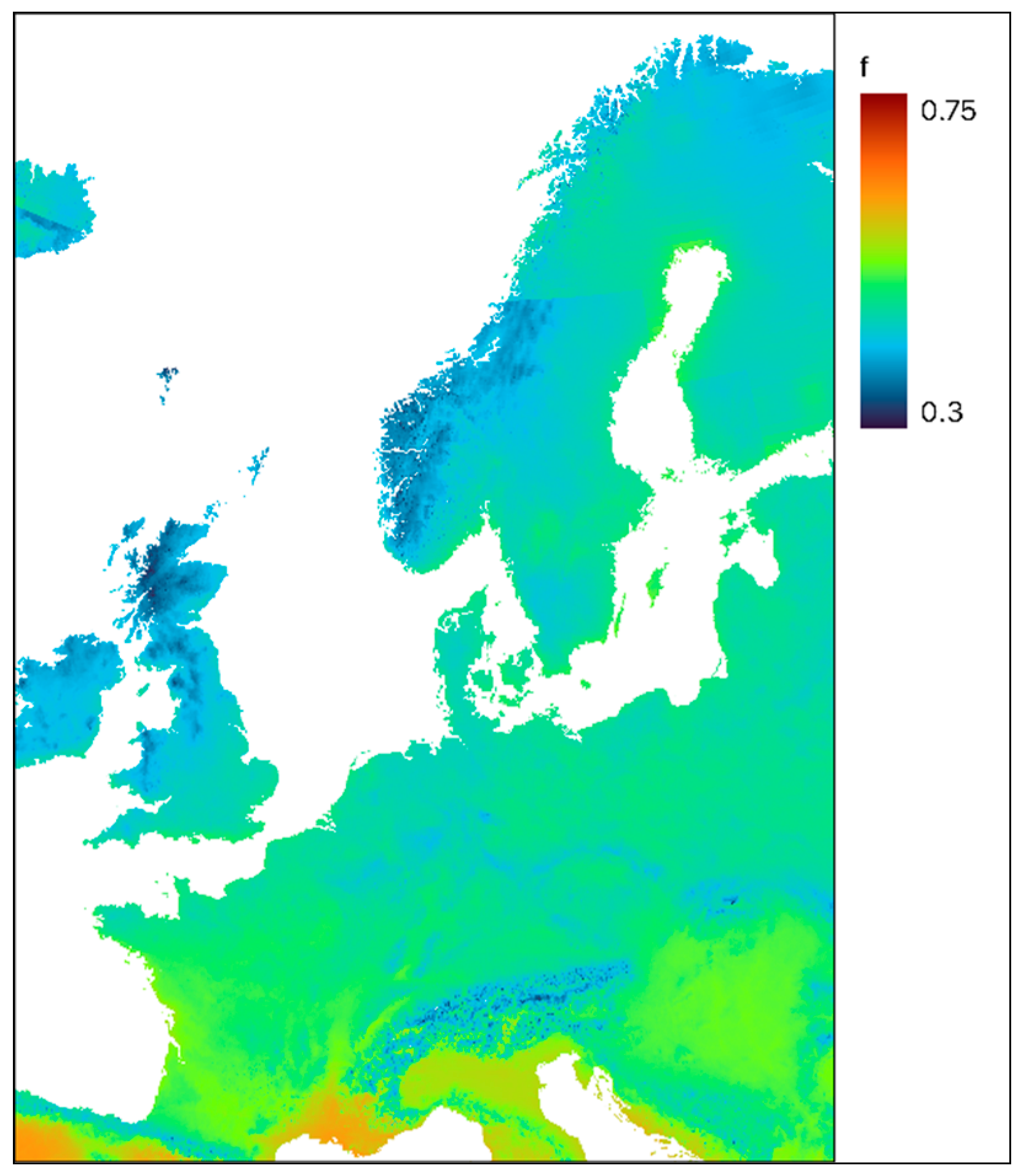
where Es (0,0, ϕ, λ) is annual at-surface insolation on a horizontal surface estimated by the PVGIS-SARAH2 model [48,49,59]. PVGIS-SARAH2 data, which are gridded at a spatial resolution of 0.05˚, were downloaded from the PVGIS Data Download portal [60] https://joint-research-centre.ec.europa.eu/photovoltaic-geographical-information-system-pvgis/pvgis-data-download/sarah-2-solar-radiation-data_en. Values of the function f estimated using equation (2) for the whole of Europe are illustrated in Figure 2.
Finally, to allow for the efficiency of the solar panel, we estimate the annual energy generation potential as:
E 2   θ , ψ , ϕ , λ = η E 1   θ , ψ , ϕ , λ
In our model, we simply assume that η = 0.2. Although modern crystalline silicon PV modules typically have an efficiency a little higher than this, losses in cabling and inverters would probably decrease the efficiency defined in terms of power input to the electricity grid to 0.2 or even a little lower. In any case, this parameter is easily adjusted. All places within the city of Tromsø are assumed to lie at the same location so we assume, using the data of Figure 2, that f (ϕ, λ) = 0.4 and hence that η f (ϕ, λ) = 0.08.
To facilitate calculation within a GIS environment, we approximate the function E0 at this latitude as:
E 0   θ , ψ , 70 0 A θ + B ( θ ) cos ψ + C ( θ ) cos 2 ψ
where the slope-dependent functions have the following polynomial forms (values of θ expressed in radians):
A = 1731 + 49.5 θ + 689.3 θ   2 457.5 θ   3
B = 19.5 1758.2 θ + 833.7 θ   2 + 32.0 θ   3
C = 1.8 + 105.3 θ 161.5 θ 2 642.2 θ 3 + 1040.4 θ 4 397.2 θ 5
Roof slope and aspect were calculated from high-resolution LiDAR data sourced from the Norwegian national elevation data portal Høydedata, which provides openly accessible digital elevation models. Specifically, we utilized LiDAR-derived DSMs and DTMs with a raster resolution of 0.25 m × 0.25 m. These data are part of the National Detailed Elevation Model (NDH - Nasjonal detaljert høydemodell), where selected areas were laser-scanned at a density of 5 psm. The LiDAR data collection for Tromsø was acquired on 31 July 2022 under favourable conditions characterized by clear skies and light turbulence, although some localized areas of snow were present. For our analysis, we downloaded 69 raster tiles covering the entire island of Tromsøya. Each tile measures 800 m × 600 m (3200 × 2400 pixels) and, at a bit depth of 32 bits, has a data size of approximately 30 MB, so the total data volume for this study was approximately 2 GB. Data were accessed at https://hoydedata.no/LaserInnsyn2/. Tiles were merged into a single file and processed in QGIS to generate slope and aspect, then the modeled annual area-specific PV generation E2 was calculated for all pixels using equations (1)-(7).

2.3. Selecting Usable Areas of Roofs

The data were filtered in two further steps. To this point, the method estimates the insolation on all parts of the DSM, regardless of whether they constitute roofs of buildings, other artificial surfaces, and vegetation. It is necessary to remove all areas that are not roofs of buildings through selective masking of the DSM. This could potentially be achieved using the DSM itself [34,61], in conjunction with a DTM, to select for objects sufficiently elevated above the terrain and perhaps using a texture measure to differentiate between artificial structures and tall vegetation [29]. In the present study, however, building footprints were derived from vector data provided by OSM, simplifying and automating the approach, particularly for large-scale research. The data contained in the OSM database is available under the Open Data Common Open Database Licence (ODbL) licence3 which allows for data download along with using, sharing, and modifying it as long as the data are attributed and made available under the same license [62,63]. This includes classification of buildings and other structures. Data were downloaded from https://www.openstreetmap.org/#map=12/69.6656/18.9976 using the ‘Export’ function. Informal checking suggested that the data contained in this dataset were generally accurate and up-to-date, and 16445 building footprints were extracted, encompassing a diverse range of building types, and imported into QGIS. The raster data representing the PV generation variable E2 were set to zero for all non-roof areas.
The final filtering step was to segment rooftop areas into suitable and unsuitable parts for mounting solar panels. This required a simple criterion that could be applied uniformly across the entire dataset. We chose to define suitability based on uniformity of slope and aspect – in effect, the local smoothness of the surface – and derived this as a texture measure of the PV generation variable E2. This was implemented by applying a high-pass filter, followed by thresholding, converting to binary form and then dilating. Symbolically, this is represented by equation (8):
D I S E 2 > t = 1
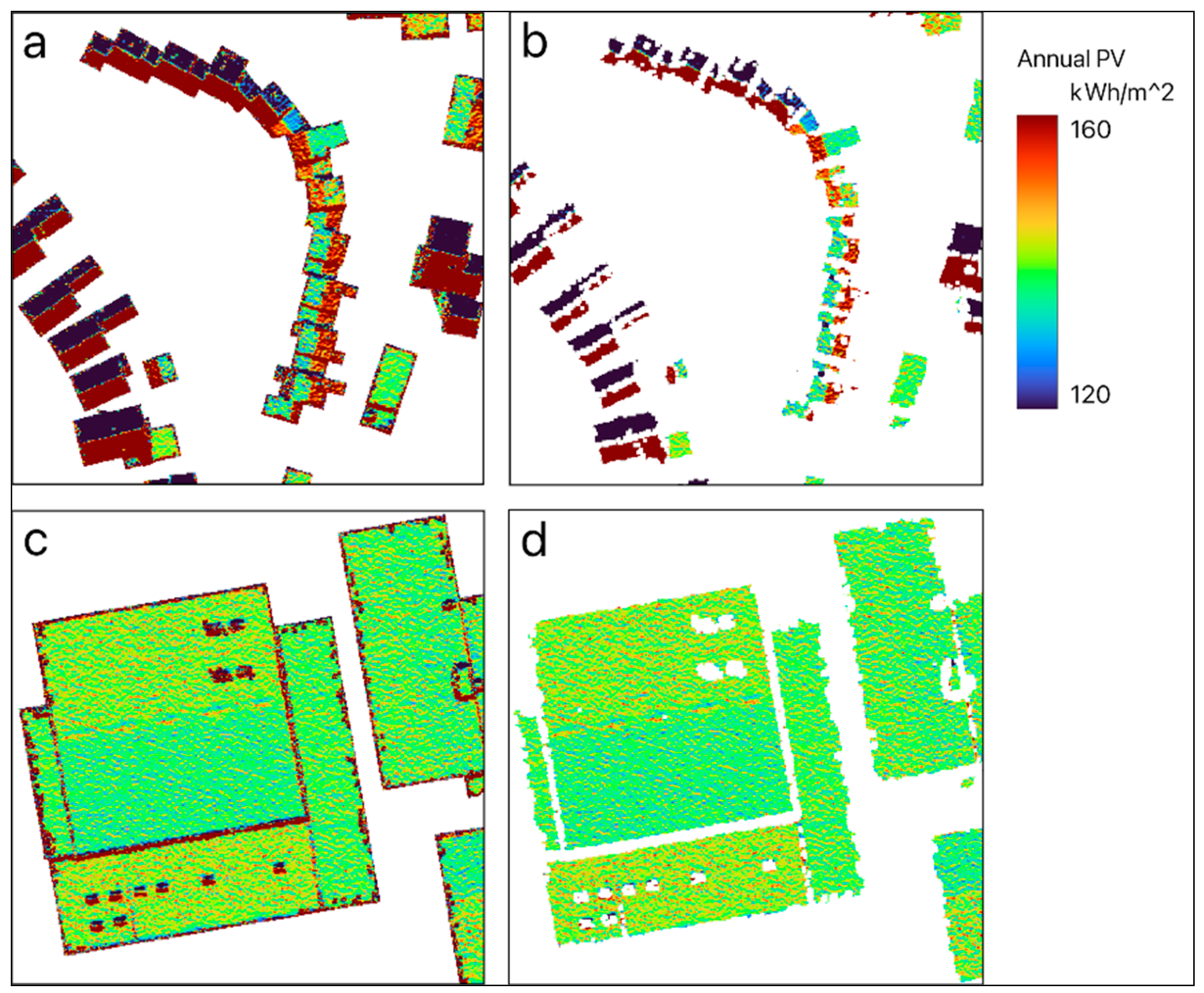
where > and = are interpreted as binary tests with outcomes of 0 if false and 1 if true, D is a dilation operator, I is a square identity kernel, S is a square smoothing kernel of unit total weight, and t is a threshold value, |.| denotes the absolute value. The result of applying this set of operators is a binary image representing unsuitably rough areas of the roof surface. Choices that must be made in implementing equation (8) are the neighbourhood size of the kernels D, I, and S, the specific form of the kernel S, and the value of threshold t. After some experimentation, we selected a 3 × 3 neighbourhood for I and S, and a 3 × 3 neighbourhood for D with a threshold value of 20. Examples of the application of this operation to small and large buildings are shown in Figure 3.

3. Results

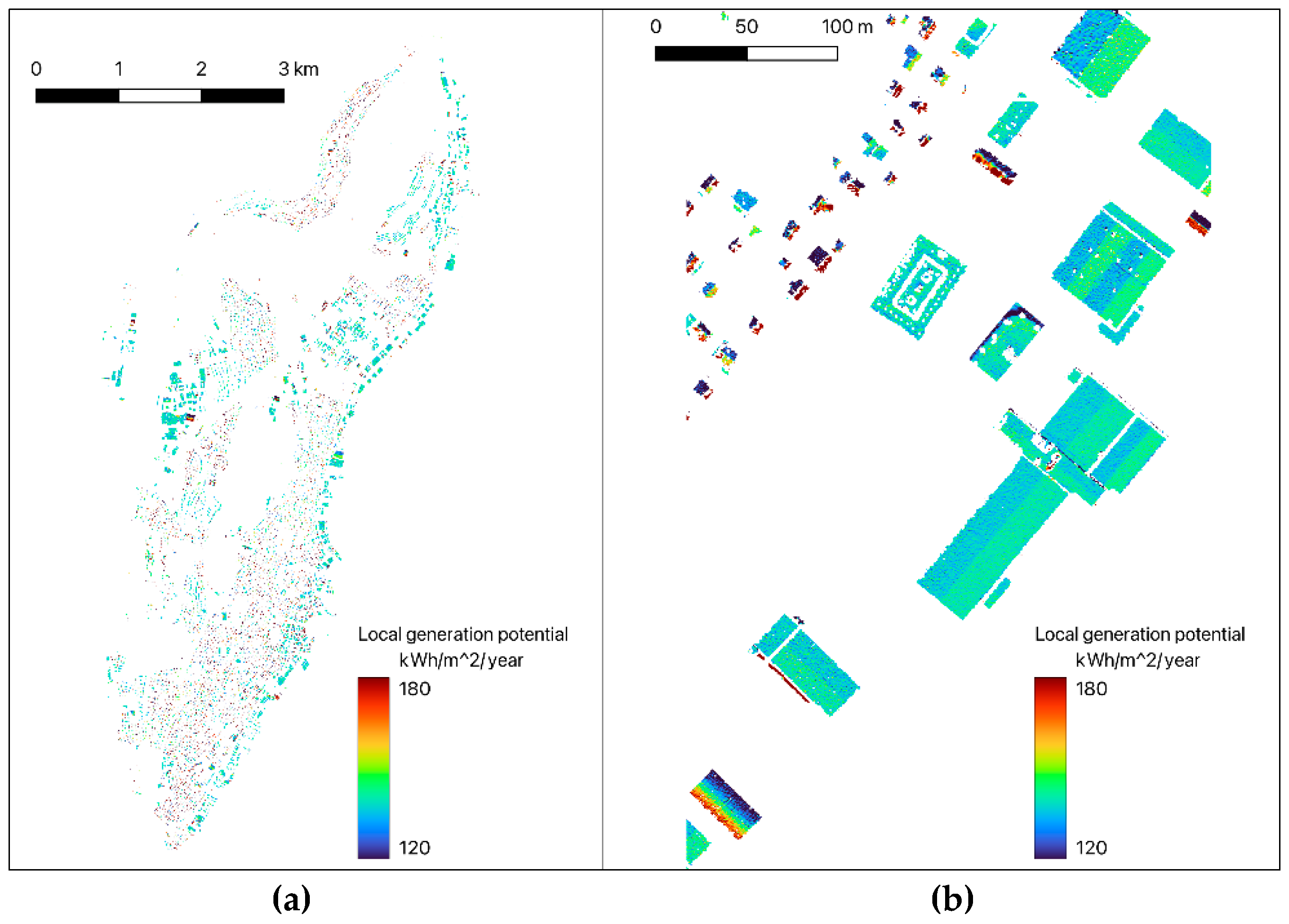
Local PV generation potential calculated using our algorithm, and masked to include only suitable roof surfaces, is presented in Figure 4a,b. Typical values of this variable range from around 120 to 180 kWh m-2 per year, with a mean value of 147 and a standard deviation of 31. As implicit in the algorithm, the roof aspect can be seen to play an important part in controlling the generation potential (Figure 4b).
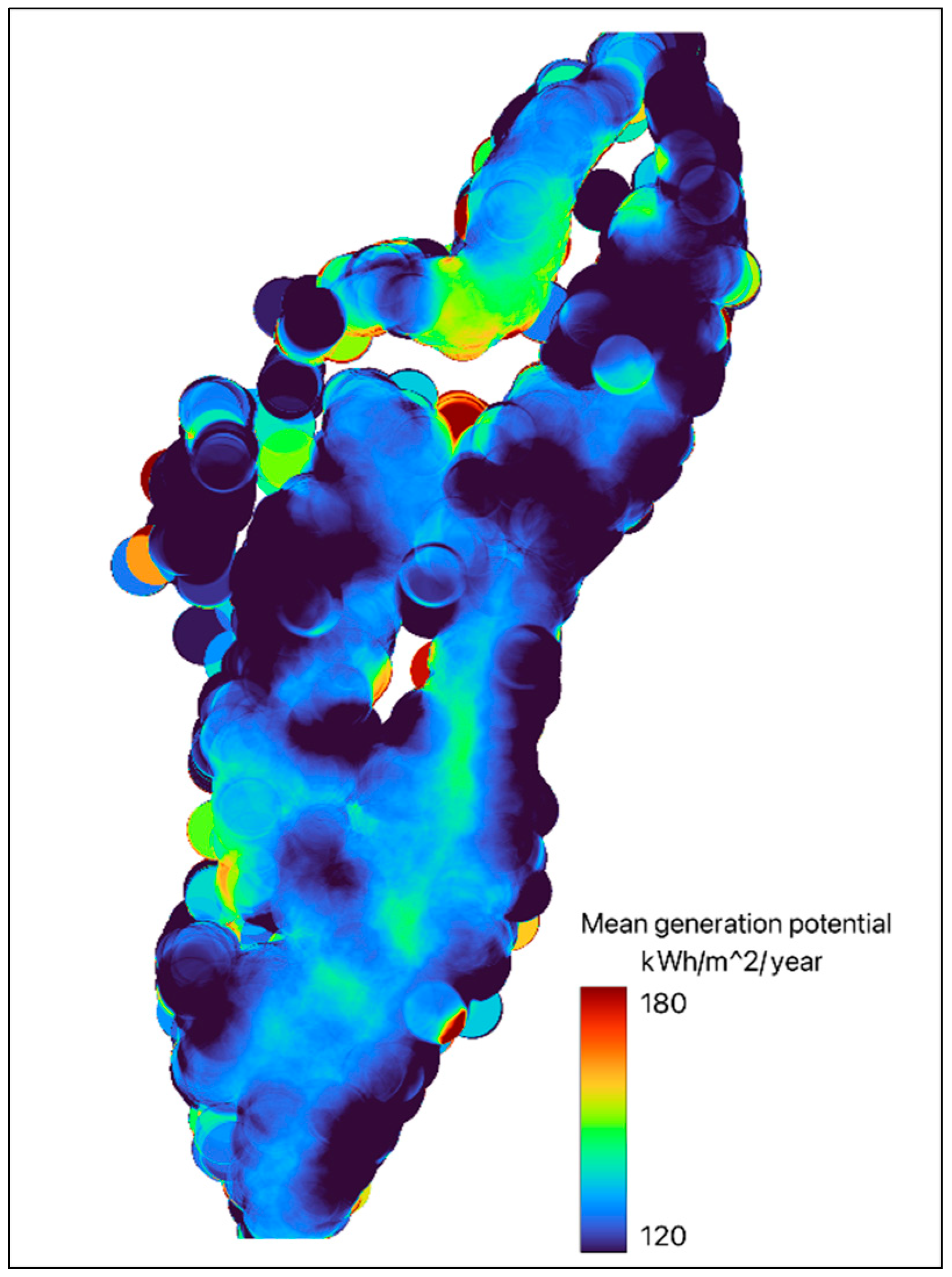
The data presented in Figure 4a,b were spatially smoothed using a uniform circular kernel with a radius of 250 metres, to give a sense of regional variations across the city. The result of this operation is presented in Figure 5.
The spatial filter was normalized (idempotent), implying that a uniform area in Figure 4a,b would be unchanged by smoothing. In this context, we can note that a value of 1 kWh m-2 is equivalent to 10 MWh ha-1, so that typical local values of the generation potential as shown in Figure 6 range from around 1.2 to 1.8 GWh ha-1. We note that there is appreciable spatial variation in this quantity, with particularly high values around the district of Hamna in the north-central part of the island, where the density of buildings is especially high, and low values around Breivik (the north-eastern part of the island), the airport, and the coastal areas. A few parts of the island have no roofs, and hence no regional generation potential according to this definition, within a 250-metre radius.
Data were analyzed according to the class of building. Importing metadata from OSM into the GIS attribute table of QGIS revealed 54 different building types, some of which (such as ‘bridge’ and ‘greenhouse’) were deemed unsuitable for installation of solar panels, some of which were essentially duplicates (e.g. ‘garage’ and ‘garages’), and some of which were ambiguous (e.g. ‘roof’ and ‘yes’). After eliminating unsuitable objects, the dataset was reduced to 16377 buildings. Types were aggregated into broad classes as follows: ‘residential’ = apartments, dormitory, house, residential, semidetached house, terrace; ‘commercial’ = commercial, retail, hotel, office; ‘civic’ = civic, fire station, hangar, hospital, parking, prison, public, toilets, transportation, cathedral, chapel, church, monastery, religious, grandstand, riding hall, sports center, stadium; ‘education’ = college, kindergarten, school, university; ‘outbuildings’ = carport, garage, garages, cabin, hut, shed; ‘warehouses’ = warehouse; ‘industrial’ = barn, boathouse, farm, farm auxiliary, container, industrial. Analysis by building type is summarized in Table 1, which shows both the average roof area for each building class and the average usable roof area after applying the roof smoothness criterion. It also shows the average roof slope. Average aspects were not calculated since the figure would be largely meaningless for most buildings, which have sections of roofs with different aspects. The Table 1 shows, inter alia, that residential buildings account for around 60% of all buildings, 50% of total roof area, and 40% of total estimated energy generation from the city, and that the total estimated annual energy generation potential is around 200 GWh, or around 30% of the city’s current total consumption of electricity.
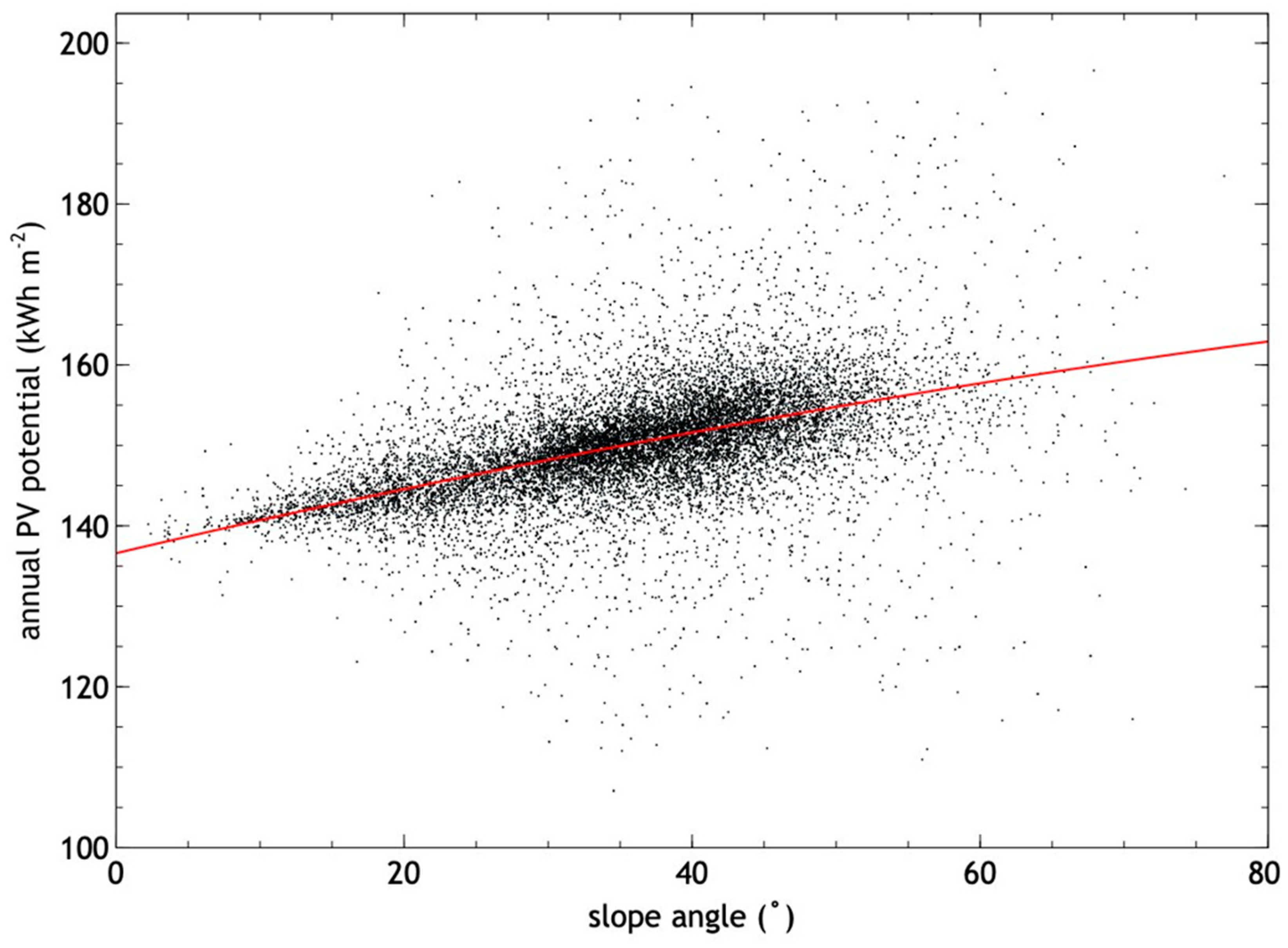
Table 1 shows differences between the roof slopes of different classes of buildings: residential buildings and outbuildings generally have the steepest pitches, while warehouses are generally flatter. The effect of roof slope on the area-specific generation potential was investigated, as summarized in Figure 6.
Fitting a quadratic variation to the data explains 23% of the variance. Since the model depends only on roof slope and orientation, the remaining 77% of the variance must be attributed to orientation.

4. Discussion

We have developed a relatively simple, transparent, and easily adaptable method of estimating city-wide rooftop solar power generation, applied to the city of Tromsø in Norway. Fundamentally, the method requires little more than high-resolution LiDAR data. Lacking any direct validation of the results, we can consider their plausibility in terms of the estimated annual area-specific energy generation potential (mean value 147 kWh m-2 per annum), and the estimated fraction of usable roof area (typically around 30-50%). Larsen (2022) [40] has modeled in some detail the generation potential from a particular warehouse building in Tromsø, assuming that a total area of 5187 m2 of the roof would be suitable for solar PV generation and estimating an area-specific generation potential of between 91 and 141 kWh m-2 per annum, using (respectively) ‘Area Solar Radiation in ArcGIS Pro [43], and ‘PVsys solar modeller’ [64] driven by local meteorological data. The latter figure is very close to our modeled average of 142.3 kWh m-2 per annum for warehouses (Table 1), which encourages confidence in our algorithm. This can also be compared with experimental data from PV installations in and near Tromsø [58] which show area-specific energy generation of between 110 and 150 kWh m-2 per year for south-facing surfaces. For buildings with both north- and south-facing roofs, equations (4) to (7) imply that the average would be around 80% of the south-facing value, i.e. in the range 90-120 kWh m-2 per year.
The main uncertainty is in the filtering of unsuitable areas of the roof. According to our adopted criteria, we retain on average around 35-50% of the roof area. It seems implausible that the figure should be much lower or indeed higher than this, though validation would be possible by considering the shapes of individual buildings in detail.
It may be reasonable to suggest that the range of energy generation density found by Larsen (2022) [40] in modeling one specific building is indicative of the uncertainty in estimating the potential generation from all rooftop areas in the city, so perhaps a realistic estimate would be 130 to 210 GWh. We note that this would represent around 20-30% of the city’s total electricity consumption, although we do not assert that such an installation would be viable on economic, practical, or aesthetic grounds. As already noted, the potential generation of solar PV electricity at high latitudes is highly seasonal, so there is an increased likelihood that generation during the summer months would be surplus to requirements and hence that seasonal energy storage would be needed.
Some aspects of our model could be more realistic. It does not allow for shadowing by surrounding buildings or by an irregular topographic horizon. Both aspects could be incorporated, with further processing of the LiDAR-derived DSM and including a topographic DEM, though the computational burden would be greatly increased. Relevant studies that have included an allowance for shadowing include those of [26,27] for Uppsala, Sweden, and of [35,36] for Canberra, Australia. In a study of Västerås, Sweden [65] also incorporated shading by trees. Compared with these settlements, Tromsø is densely built and surrounded by relatively high mountains, so shadowing effects are likely to be relatively more important. Given the complexity of implementing an exact solution [66], it is suggested that a statistical approach following to shadowing could be adopted in future work. Comparison of our estimated values of solar energy generation with in situ measurements [58] suggest that the combined effect of these unmodelled factors is to overestimate by around 30%.
The model also assumes that solar panels are always laid directly on the roof. In the case of relatively steeply pitched roofs, this is certainly a reasonable assumption, although for flat roofs it is usually not the case, especially at high latitudes where the optimum slope of a solar panel is rather steep. As Table 1 shows, the dominant roof pitch in Tromsø is relatively steep, at least for the residential buildings, which account for both the largest number of buildings and 40% of the potential energy output. It is therefore unlikely that this assumption is an important source of error for residential buildings. The average roof slope is lower for buildings such as warehouses or commercial buildings, and though these are lower in number than residential buildings, their roof areas are generally larger. A number of these buildings also have large flat roofs, which may be ideal for solar installations, but where the installation would not be laid directly on the roof, but either with a low slope angle or vertically using bifacial modules. The assumption of modules laid directly on the roof would underestimate the potential of such installations. It would be possible to modify the functional dependence expressed by equation (4) to allow for this effect. In any case, we note that failing to allow for this effect is ‘conservative’ in the sense that it underestimates the potential for energy generation by not choosing the optimum slope for solar panels.
It can, however, be argued that the focus on only roof areas in this study omits a potentially significant contribution from façade-mounted PV systems. This type of installation is particularly relevant in the north since the optimal angle for an installation (around 50°) is steeper than most roofs. Other benefits of façade installations are fewer problems with snow pileup on the modules, and a better match between the heating season and potential solar energy generation, due to the low sun height in the spring and autumn.
Other sources of uncertainty should be considered. The height error in the LiDAR data is estimated as 1 cm based on transects through a flat area, while horizontal errors can only be assessed to be small compared to the gridding interval of 25 cm (they may be much smaller than this.) Since the planar geometry of roofs is not determined from the LiDAR data itself but from OSM data, errors in slope and aspect of roofs determined from the LiDAR data will depend principally on the height errors and will be negligibly small. For example, an error in the mean roof slope of an outbuilding of an area 45 m2 (Table 1) will be of the order of 0.01˚ assuming that LiDAR errors are spatially uncorrelated. Very occasional errors in the spatial interpolation of the LiDAR data onto the 25 cm grid were noted, estimated informally as less than one error per thousand buildings.
Potential errors in the OSM vector data are harder to quantify [67]. Although the data were not inspected systematically or exhaustively, matching the hill-shaded LiDAR GSM to the OSM vector outlines of buildings gave great confidence in the spatial accuracy in the latter, and again, very conservatively, we state that not more (and in reality, probably very many fewer) than one building in a thousand was incorrectly located in the OSM dataset. Other authors [19,53,68] have demonstrated the utility of OSM data for evaluating rooftop solar energy potential. The attributes describing the buildings, however, were somewhat less reliable. We attempt to minimize the impact of variability in the naming of building types by grouping them into very general classes (Table 1). Errors in this attribution, or too broad a generalization, could obscure the relationship between solar energy generation potential and different building types, but would not affect more general conclusions about the total energy generation from a building.
Deductions from applying the method that relates primarily to the spatial distribution and orientation of roof surfaces will be only weakly affected by the omissions noted above, or by incorrectly selected parameters. The conclusion implied by Table 1, that residential buildings could provide around 30% of the total rooftop solar energy generation capacity of the city, is believed to be robust, and is similar to the conclusion of study [39] for urban areas in Lithuania, as is the result implied by Figure 6 that the variance in area-specific energy generation capacity is partitioned between slope and aspect in the ratio of around 1 to 3. Figure 6 also reliably indicates district-to-district variations in potential energy generation density and hence provides a good indication of where energy storage could preferentially be located. Higher district potentials are associated with denser building patterns and favourable roof orientations, while lower potentials indicate lower ratios of roof area to ground area, in turn likely associated with wealthier neighborhoods.
Although this investigation has been focused on the city of Tromsø in arctic Norway, the method developed here could readily be applied to other locations for which accurate high-resolution (sub-metre) LiDAR data are available. Notably, the public availability of such datasets is steadily expanding, thereby enabling broader spatial applications. In this regard, in study [28] authors provide a comprehensive overview of the current state of LiDAR data availability throughout European countries. Beyond Europe, numerous other regions - including the United States, Canada, China, New Zealand, and Australia [68,69] are also actively engaged in the systematic acquisition of high-resolution LiDAR surveys.

5. Conclusions

We have developed a relatively simple, transparent approach to estimating the potential annual generation of solar PV across an urban area, using publicly available high-resolution LiDAR data. The method can be implemented using open-access tools such as QGIS GIS software. We have demonstrated the method for the city of Tromsø in arctic Norway, and although no direct validation has yet been performed we believe that the conclusion that between 20 and 30% of the city’s annual electricity consumption could be generated from rooftop solar installations is robust. Around 40% of this total would be contributed by residential properties. Our method permits simple visualisation of spatial variation in electricity generation density which is potentially useful for determining the location of seasonal energy storage facilities.

Author Contributions

WGR and LHB conceived this project and carried out the geospatial analysis. CG contributed experimental data from installations in Tromsø. WGR, LHB, and CG all contributed to the writing.

Funding

No direct funding was provided.

Data Availability Statement

Map data copyrighted by OpenStreetMap contributors and available from https://www.openstreetmap.org. LiDAR data for Tromsøya are provided freely by the Norwegian Mapping Agency Statens Kartverket, and are available from https://hoydedata.no/LaserInnsyn2.

Acknowledgments

The work described here is connected to the project Northern Homes, supported by Troms and Finnmark County, Norway, and to the Arctic Centre for Sustainable Energy (ARC), both at UiT The Arctic University of Norway, Tromsø. LHB gratefully acknowledges the financial support of the British Academy and the Council for At-Risk Academics (CARA).

Conflicts of Interest

The authors declare no conflicts of interest.

References

  1. Global Market Outlook For Solar Power 2024 - 2028. Intersolar Europe, Global Solar Council (GSC), 2024. Available online: https://www.solarpowereurope.org/insights/outlooks/global-market-outlook-for-solar-power-2024-2028/detail (accessed on 12 September 2024).
  2. Norway 2022 Energy Policy Review. IEA Publications, 2022. Available online: https://iea.blob.core.windows.net/assets/de28c6a6-8240-41d9-9082-a5dd65d9f3eb/NORWAY2022.pdf (accessed on 27 September 2024).
  3. Calvin, K.; Dasgupta, D.; Krinner, G.; Mukherji, A.; Thorne, P. W.; Trisos, C.; Romero, J.; et al. IPCC, 2023: Climate Change 2023: Synthesis Report. Contribution of Working Groups I, II and III to the Sixth Assessment Report of the Intergovernmental Panel on Climate Change [Core Writing Team, H. Lee and J. Romero (eds.)]. IPCC, Geneva, Switzerland. (First). Intergovernmental Panel on Climate Change (IPCC). [CrossRef]
  4. Muellejans, H.; Pavanello, D.; Sample, T.; Kenny, R.; Shaw, D.; Field, M.; Dunlop, E.; et al. State-of-the-art assessment of solar energy technologies, EUR 31189 EN, Publications Office of the European Union, Luxembourg, 2022, ISBN 978-92-76-55849-1, JRC130086. [CrossRef]
  5. Molnár, G.; Ürge-Vorsatz, D.; Chatterjee, S. Estimating the global technical potential of building-integrated solar energy production using a high-resolution geospatial model. Journal of Cleaner Production 2022, 375, 134133. [Google Scholar] [CrossRef]
  6. Bódis, K.; Kougias, I.; Jäger-Waldau, A.; Taylor, N.; Szabó, S. A high-resolution geospatial assessment of the rooftop solar photovoltaic potential in the European Union. Renewable and Sustainable Energy Reviews 2019, 114, 109309. [Google Scholar] [CrossRef]
  7. Kapsalis, V.; Maduta, C.; Skandalos, N.; Bhuvad, S. S.; D’Agostino, D.; Yang, R. J.; Udayraj; Parker, D.; Karamanis, D. Bottom-up energy transition through rooftop PV upscaling: Remaining issues and emerging upgrades towards NZEBs at different climatic conditions. Renewable and Sustainable Energy Transition 2024, 5, 100083. [Google Scholar] [CrossRef]
  8. Chen, L.; Hu, Y.; Wang, R.; Li, X.; Chen, Z.; Hua, J.; Osman, A. I.; Farghali, M.; Huang, L.; Li, J.; Dong, L.; Rooney, D. W.; Yap, P.-S. Green building practices to integrate renewable energy in the construction sector: A review. Environmental Chemistry Letters 2023, 22, 751–784. [Google Scholar] [CrossRef]
  9. Maka, A. O. M.; Ghalut, T.; Elsaye, E. The pathway towards decarbonisation and net-zero emissions by 2050: The role of solar energy technology. Green Technologies and Sustainability 2024, 2, 100107. [Google Scholar] [CrossRef]
  10. Joshi, S.; Zakeri, B.; Mittal, S.; Mastrucci, A.; Holloway, P.; Krey, V.; Shukla, P. R.; O’Gallachoir, B.; Glynn, J. Global high-resolution growth projections dataset for rooftop area consistent with the shared socioeconomic pathways, 2020–2050. Scientific Data 2024, 11, 563. [Google Scholar] [CrossRef]
  11. Mathew, T. C.; Nagaraja Pandian, S. Unveiling the shadows: A qualitative exploration of barriers to rooftop solar photovoltaic adoption in residential sectors. Clean Energy 2024, 8, 218–228. [Google Scholar] [CrossRef]
  12. Bernardi, M.; Ferralis, N.; Wan, J. H.; Villalon, R.; Grossman, J. C. Solar energy generation in three dimensions. Energy & Environmental Science 2012, 5, 6880. [Google Scholar] [CrossRef]
  13. Khan, M. I.; Al Huneidi, D. I.; Asfand, F.; Al-Ghamdi, S. G. Climate Change Implications for Optimal Sizing of Residential Rooftop Solar Photovoltaic Systems in Qatar. Sustainability 2023, 15, 16815. [Google Scholar] [CrossRef]
  14. Jouttijärvi, S.; Lobaccaro, G.; Kamppinen, A.; Miettunen, K. Benefits of bifacial solar cells combined with low voltage power grids at high latitudes. Renewable and Sustainable Energy Reviews 2022, 161, 112354. [Google Scholar] [CrossRef]
  15. Akbarinejad, T.; Machlein, E.; Bertolin, C.; Lobaccaro, G.; Salaj, A.T. Enhancing the deployment of solar energy in Norwegian high-sensitive built environments: challenges and barriers—a scoping review. Front. Built Environ. 2023, 9, 1285127. [Google Scholar] [CrossRef]
  16. Sicard, M.; Kageyama, M.; Charbit, S.; Braconnot, P.; Madeleine, J.-B. An energy budget approach to understand the Arctic warming during the Last Interglacial. Clim. Past 2022, 18, 607–629. [Google Scholar] [CrossRef]
  17. Formolli, M.; Kleiven, T.; Lobaccaro, G. Assessing solar energy accessibility at high latitudes: A systematic review of urban spatial domains, metrics, and parameters. Renewable and Sustainable Energy Reviews 2023, 177, 113231. [Google Scholar] [CrossRef]
  18. Formolli, M.; Lobaccaro, G.; Kanters, J. Solar Energy in the Nordic Built Environment: Challenges, Opportunities and Barriers. Energies 2021, 14, 8410. [Google Scholar] [CrossRef]
  19. Formolli, M.; Schön, P.; Kleiven, T.; Lobaccaro, G. Solar accessibility in high latitudes urban environments: A methodological approach for street prioritization. Sustainable Cities and Society 2024, 103, 105263. [Google Scholar] [CrossRef]
  20. Gholami, H. Technical potential of solar energy in buildings across Norway: Capacity and demand. Solar Energy 2024, 278, 112758. [Google Scholar] [CrossRef]
  21. The Energy Commission. 2023. Available online: https://www.regjeringen.no/no/dokumenter/nou-2023-3/id2961311/ (accessed on 10 October 2024).
  22. Bjørndalen, J.; Fiskvik, I. H.; Hadizadeh, M.; Horschig, T.; Ingeberg, K. Energy Transition Norway 2050. DNV AS. Available online: https://www.dnv.com/publications/energy-transition-norway-2024/ (accessed on 10 October 2024).
  23. Solar power potential on built-up areas in Norway, 2024. Available online: https://solenergiklyngen.no/wp-content/uploads/2024/10/Solkraftpotensial-pa-nedbygde-arealer-i-Norge_final.pdf (accessed on 10 October 2024).
  24. Socioeconomic analysis of 8 TWh solar power, 2024. Available online: https://solenergiklyngen.no/wp-content/uploads/2024/03/240321-DNV-Menon-Solrapport-6.pdf (accessed on 10 October 2024).
  25. Eikeland, O. F.; Apostoleris, H.; Santos, S.; Ingebrigtsen, K.; Boström, T.; Chiesa, M. Rethinking the role of solar energy under location specific constraints. Energy 2022, 211, 118838. [Google Scholar] [CrossRef]
  26. Lingfors, D. Solar Variability Assessment in the Built Environment: Model Development and Application to Grid Integration. Doctoral thesis, Acta Universitatis Upsaliensis, Uppsala, Sweden, 2017. [Google Scholar]
  27. Lingfors, D.; Bright, J. M.; Engerer, N. A.; Ahlberg, J.; Killinger, S.; Widén, J. Comparing the capability of low- and high-resolution LiDAR data with application to solar resource assessment, roof type classification and shading analysis. Applied Energy 2017, 205, 1216–1230. [Google Scholar] [CrossRef]
  28. Kakoulaki, G.; Martinez, A.; Florio, P. Non-commercial Light Detection and Ranging (LiDAR) data in Europe. Publications Office of the European Union 2021. [Google Scholar] [CrossRef]
  29. Huang, Y.; Chen, Z.; Wu, B.; Chen, L.; Mao, W.; Zhao, F.; Wu, J.; Wu, J.; Yu, B. Estimating Roof Solar Energy Potential in the Downtown Area Using a GPU-Accelerated Solar Radiation Model and Airborne LiDAR Data. Remote Sensing 2015, 7, 17212–17233. [Google Scholar] [CrossRef]
  30. Kodysh, J. B.; Omitaomu, O. A.; Bhaduri, B. L.; Neish, B. S. Methodology for estimating solar potential on multiple building rooftops for photovoltaic systems. Sustainable Cities and Society 2013, 8, 31–41. [Google Scholar] [CrossRef]
  31. Nguyen, H. T.; Pearce, J. M.; Harrap, R.; Barber, G. The Application of LiDAR to Assessment of Rooftop Solar Photovoltaic Deployment Potential in a Municipal District Unit. Sensors 2012, 12, 4534–4558. [Google Scholar] [CrossRef] [PubMed]
  32. Hu, M.; Liu, Z.; Huang, Y.; Wei, M.; Yuan, B. Estimation of Rooftop Solar Photovoltaic Potential Based on High-Resolution Images and Digital Surface Models. Buildings 2023, 13, 2686. [Google Scholar] [CrossRef]
  33. Nelson, J. R.; Grubesic, T. H. The use of LiDAR versus unmanned aerial systems (UAS) to assess rooftop solar energy potential. Sustainable Cities and Society 2020, 61, 102353. [Google Scholar] [CrossRef]
  34. Nys, G.-A.; Poux, F.; Billen, R. CityJSON Building Generation from Airborne LiDAR 3D Point Clouds. ISPRS International Journal of Geo-Information 2020, 9, 521. [Google Scholar] [CrossRef]
  35. Lingfors, D.; Killinger, S.; Engerer, N. A.; Widén, J.; Bright, J. M. Identification of PV system shading using a LiDAR-based solar resource assessment model: An evaluation and cross-validation. Solar Energy 2018, 159, 157–172. [Google Scholar] [CrossRef]
  36. Lingfors, D.; Shepero, M.; Good, C. Modelling City Scale Spatio-temporal Solar Energy Generation and Electric Vehicle Charging Load. 8th International Workshop on the Integration of Solar Power into Power Systems, 2018, Stockholm, Sweden.
  37. Gooding, J.; Crook, R.; Tomlin, A. S. Modelling of roof geometries from low-resolution LiDAR data for city-scale solar energy applications using a neighbouring buildings method. Applied Energy 2015, 148, 93–104. [Google Scholar] [CrossRef]
  38. Manni, M.; Nocente, A.; Kong, G.; Skeie, K.; Fan, H.; Lobaccaro, G. Solar energy digitalization at high latitudes: A model chain combining solar irradiation models, a LiDAR scanner, and high-detail 3D building model. Frontiers in Energy Research 2022, 10, 1082092. [Google Scholar] [CrossRef]
  39. Kozlovas, P.; Gudzius, S.; Ciurlionis, J.; Jonaitis, A.; Konstantinaviciute, I.; Bobinaite, V. Assessment of Technical and Economic Potential of Urban Rooftop Solar Photovoltaic Systems in Lithuania. Energies 2023, 16, 5410. [Google Scholar] [CrossRef]
  40. Larsen, A. Solar Photovoltaic Potential on Commercial Buildings in Arctic Latitudes. Masters thesis, UiT The Arctic University of Norway UiT Norges arktiske universitet, Norway, 2022. Available online: https://hdl.handle.net/10037/26152.
  41. Liang, J.; Gong, J.; Xie, X.; Sun, J. Solar3D: An Open-Source Tool for Estimating Solar Radiation in Urban Environments. ISPRS International Journal of Geo-Information 2020, 9, 524. [Google Scholar] [CrossRef]
  42. Melius, J.; Margolis, R.; Ong, S. Estimating Rooftop Suitability for PV: A Review of Methods, Patents, and Validation Techniques. National Renewable Energy Laboratory, 2013. Available online: https://www.nrel.gov/docs/fy14osti/60593.pdf (accessed on 12 September 2024).
  43. ArcGIS Pro. Version Spatial Analyst toolbox. [Computer software]. Esri. https://pro.arcgis.com/en/pro-app/latest/tool-reference/spatial-analyst/area-solarradiation.htm.
  44. Neteler, M.; Mitasova, H. Open Source GIS; Springer US, 2008. [Google Scholar] [CrossRef]
  45. Hofierka, J.; Suri, M. The solar radiation model for Open source GIS: Implementation and applications. International GRASS users conference, 2002 Italy.
  46. Conrad, O. Potential Incoming Solar Radiation, 2010 [Computer software].
  47. Kaňuk, J.; Zubal, S.; Šupinský, J.; Šašak, J.; Bombara, M.; Sedlák, V.; Gallay, M.; Hofierka, J.; Onačillová, K. Testing Of V3.Sun Module Prototype For Solar Radiation Modelling On 3d Objects With Complex Geometric Structure. The International Archives of the Photogrammetry. Remote Sensing and Spatial Information Sciences 2019, XLII-4/W15, 35–40. [Google Scholar] [CrossRef]
  48. Amillo, G.; Huld, T. Performance comparison of different models for the estimation of global irradiance on inclined surfaces: Validation of the model implemented in PVGIS. Publications Office 2013. [Google Scholar] [CrossRef]
  49. Amillo, G.; Taylor, N.; Martinez, A. M. Adapting PVGIS to Trends in Climate, Technology and User Needs. 38th European Photovoltaic Solar Energy Conference and Exhibition (PVSEC). 2021; 907–911. [Google Scholar] [CrossRef]
  50. Mueller, R.; Behrendt, T.; Hammer, A.; Kemper, A. A New Algorithm for the Satellite-Based Retrieval of Solar Surface Irradiance in Spectral Bands. Remote Sensing 2012, 4, 622–647. [Google Scholar] [CrossRef]
  51. Margolis, R.; Gagnon, P.; Melius, J.; Phillips, C.; Elmore, R. Using GIS-based methods and lidar data to estimate rooftop solar technical potential in US cities. Environmental Research Letters 2017, 12, 074013. [Google Scholar] [CrossRef]
  52. Martínez-Rubio, A.; Sanz-Adan, F.; Santamaría-Peña, J.; Martínez, A. Evaluating solar irradiance over facades in high building cities, based on LiDAR technology. Applied Energy 2016, 183, 133–147. [Google Scholar] [CrossRef]
  53. Ni, H.; Wang, D.; Zhao, W.; Jiang, W.; Mingze, E.; Huang, C.; Yao, J. Enhancing rooftop solar energy potential evaluation in high-density cities: A Deep Learning and GIS based approach. Energy and Buildings 2024, 309, 113743. [Google Scholar] [CrossRef]
  54. Prieto, I.; Izkara, J. L.; Usobiaga, E. The Application of LiDAR Data for the Solar Potential Analysis Based on Urban 3D Model. Remote Sensing 2019, 11, 2348. [Google Scholar] [CrossRef]
  55. Yan, L.; Zhu, R.; Kwan, M.-P.; Luo, W.; Wang, D.; Zhang, S.; Wong, M. S.; You, L.; Yang, B.; Chen, B.; Feng, L. Estimation of urban-scale photovoltaic potential: A deep learning-based approach for constructing three-dimensional building models from optical remote sensing imagery. Sustainable Cities and Society 2023, 93, 104515. [Google Scholar] [CrossRef]
  56. Falklev, E. H. Mapping of solar energy potential on Tromsøya using solar analyst in ArcGIS. Master’s thesis, UiT The Arctic University of Norway UiT Norges arktiske universitet, Norway, 2017. [Google Scholar]
  57. Statistics Norway. Annual Report 2020. Available online: https://www.ssb.no/en (accessed on 5 June 2024).
  58. Boström, T. and C. Good. Long-term PV performance at high latitudes. 2024. Unpublished manuscript.
  59. Huld, T.; Müller, R.; Gambardella, A. A new solar radiation database for estimating PV performance in Europe and Africa. Solar Energy 2012, 86, 1803–1815. [Google Scholar] [CrossRef]
  60. Pfeifroth, U.; Kothe, S.; Müller, R.; Trentmann, J.; Hollmann, R.; Fuchs, P.; Werscheck, M. Surface Radiation Data Set—Heliosat (SARAH)—Edition 2 (Version 2.0, p. 7.1 TiB) [NetCDF-4], 2017. Satellite Application Facility on Climate Monitoring (CM SAF). [CrossRef]
  61. Adji̇Ski̇, V.; Kaplan, G.; Mi̇Jalkovski̇, S. Assessment of the solar energy potential of rooftops using LiDAR datasets and GIS based approach. International Journal of Engineering and Geosciences 2023, 8, 188–199. [Google Scholar] [CrossRef]
  62. Alhamwi, A.; Medjroubi, W.; Vogt, T.; Agert, C. GIS-based urban energy systems models and tools: Introducing a model for the optimisation of flexibilisation technologies in urban areas. Applied Energy 2017, 191, 1–9. [Google Scholar] [CrossRef]
  63. Biljecki, F.; Chow, Y. S.; Lee, K. Quality of crowdsourced geospatial building information: A global assessment of OpenStreetMap attributes. Building and Environment 2023, 237, 110295. [Google Scholar] [CrossRef]
  64. PVsyst SA. PVsyst Photovoltaic Software v7. PVsyst SA. Satigny, Switzerland. Available online: https://www.pvsyst.com/.
  65. Yang, Y.; Campana, P. E.; Stridh, B.; Yan, J. Potential analysis of roof-mounted solar photovoltaics in Sweden. Applied Energy 2020, 279, 115786. [Google Scholar] [CrossRef]
  66. Romero Rodríguez, L.; Duminil, E.; Sánchez Ramos, J.; Eicker, U. Assessment of the photovoltaic potential at urban level based on 3D city models: A case study and new methodological approach. Solar Energy 2017, 146, 264–275. [Google Scholar] [CrossRef]
  67. Vargas-Munoz, J.E.; Srivastava, S.; Tuia, D.; Falcão, A. X. OpenStreetMap: Challenges and Opportunities in Machine Learning and Remote Sensing. IEEE Geoscience and Remote Sensing Magazine 2021, 9, 184–199. [Google Scholar] [CrossRef]
  68. Cheng, L.; Zhang, F.; Li, S.; Mao, J.; Xu, H.; Ju, W.; Liu, X.; Wu, J.; Min, K.; Zhang, X.; Li, M. Solar energy potential of urban buildings in 10 cities of China. Energy 2020, 196, 117038. [Google Scholar] [CrossRef]
  69. Gagnon, P.; Margolis, R.; Melius, J.; Phillips, C.; Elmore, R. Estimating rooftop solar technical potential across the US using a combination of GIS-based methods, lidar data, and statistical modeling. Environmental Research Letters 2018, 13, 024027. [Google Scholar] [CrossRef]
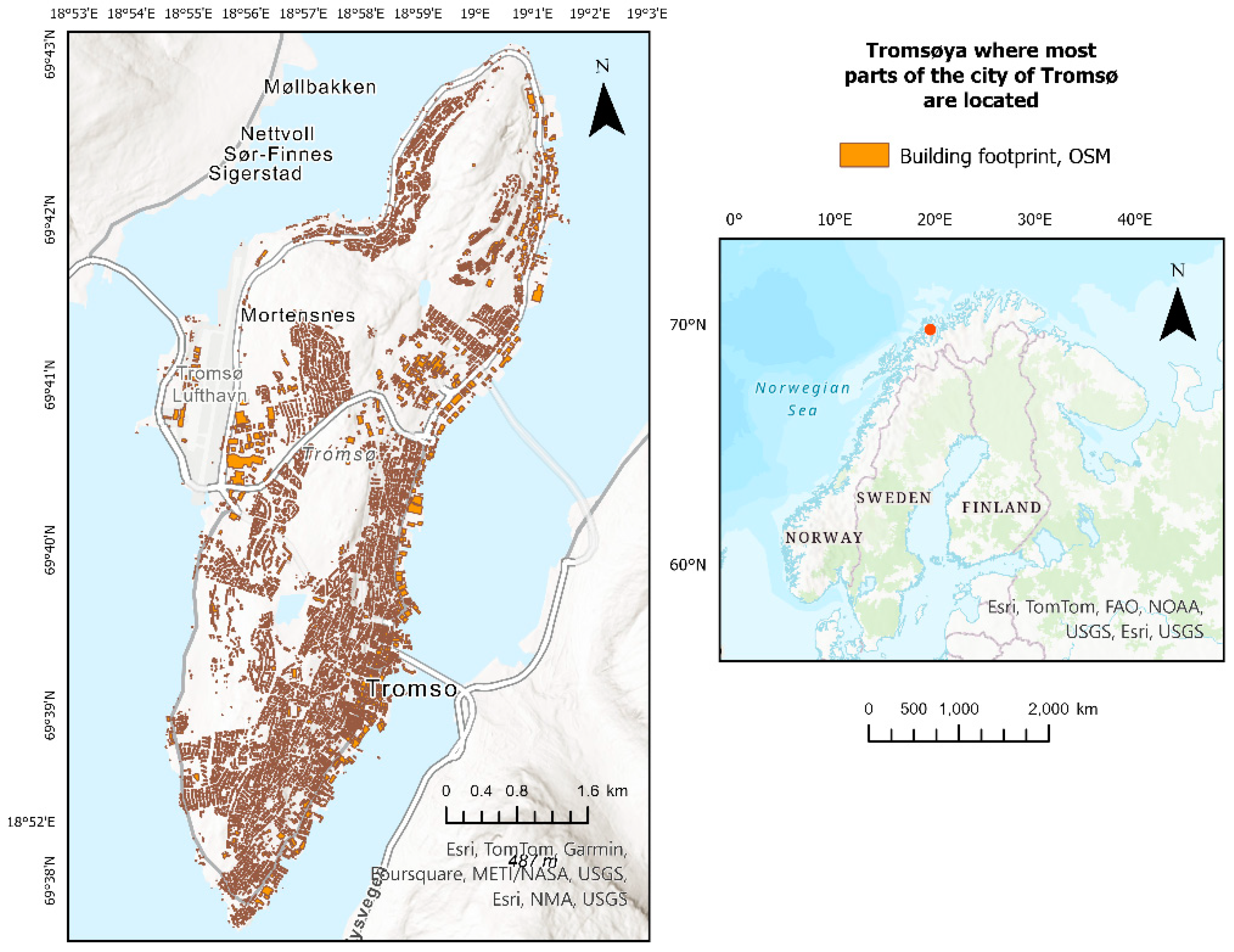
Figure 1. Study area location, showing the island of Tromsøya where most parts of the city of Tromsø are located. Our analysis is confined to the island area.
Preprints 143068 g001
Figure 2. Geographical cloudiness function f defined for Europe, calculated using equation (2) and PVGIS-SARAH2 estimates of average horizontal insolation between 2005 and 2020. The value of f at the location of Tromsø is taken as 0.4. The apparent discontinuity in values at latitude 65˚ is due to the joining of two different tiles of meteorological data.
Preprints 143068 g002
Figure 3. Estimating unusable parts of roofs. (a) and (c) show image extracts with small and large buildings respectively, while (b) and (d) show the corresponding areas after applying the roof roughness filter defined by equation (8). The variable represented in these raster images is the value of the annual estimated area-specific PV generation, E2.
Preprints 143068 g003
Figure 4. a) Local area-specific rooftop PV generation potential for Tromsøya, estimated using the algorithm developed in this work, b) enlarged view of part of Figure 4a.
Preprints 143068 g004
Figure 5. Area-specific solar power generation potential. Smoothing radius = 250 m.
Preprints 143068 g005
Figure 6. Area-specific generation potential as a function of roof slope angle for all buildings on Tromsøya. The regression line is the best-fitting quadratic variation.
Preprints 143068 g006
Table 1. Statistical analysis of annual solar PV generation potential for different building classes on Tromsøya. Definitions of building classes are given in the main text.
class number Average area (m2) Average usable area (m2) Average slope (˚) Annual energy generation (kWh/m2/year) Total (GWh)
residential 10211 168 59 37.1 149.0 86
commercial 555 793 395 27.9 143.8 31
civic 199 1274 691 28.3 144.3 19
education 211 968 530 27.5 145.0 16
outbuildings 4342 45 13 35.0 150.1 8
warehouses 227 748 543 23.6 142.3 17
industrial 238 483 356 31.9 142.4 11
unknown 394 378 272 37.3 142.8 15
TOTAL 16377 203
Disclaimer/Publisher’s Note: The statements, opinions and data contained in all publications are solely those of the individual author(s) and contributor(s) and not of MDPI and/or the editor(s). MDPI and/or the editor(s) disclaim responsibility for any injury to people or property resulting from any ideas, methods, instructions or products referred to in the content.
Copyright: This open access article is published under a Creative Commons CC BY 4.0 license, which permit the free download, distribution, and reuse, provided that the author and preprint are cited in any reuse.
Prerpints.org logo

Preprints.org is a free preprint server supported by MDPI in Basel, Switzerland.

Subscribe

Disclaimer

Terms of Use

Privacy Policy

Privacy Settings

© 2025 MDPI (Basel, Switzerland) unless otherwise stated