

Submitted:
15 December 2024
Posted:
17 December 2024
You are already at the latest version
Abstract
Employing metaheuristics to optimize feature selection in IoT networks targets enhancements in system efficiency, security, and energy management. A survey of research from the Scopus database highlighted intrusion detection as a heavily investigated domain. By merging metaheuristics with machine learning approaches, advancements have been made in threat detection accuracy, energy consumption optimization, and cybersecurity enhancement. Continued exploration into adaptive algorithms and preprocessing techniques is advised to tackle computational challenges and unstructured data management.
Keywords:
metaheuristics
; internet of things
; feature selection
; IoT security
; deep learning
; intrusion detection
; computational optimization
I. Introduction
In the emerging field of the Internet of Things (IoT), feature selection optimization is identified as a critical factor to improve the efficiency and security of systems [1,2,3]. Correct feature selection is crucial to deal with data overload and improve accuracy and security in IoT environments, where cyberattacks are persistent [4,5]. The implementation of metaheuristics proves to be especially effective for these tasks, providing robust and adaptive methods to select the most relevant features. Recent studies have explored various metaheuristic strategies, including swarm optimization, genetic algorithms, and animal behavior-based optimizers, which have shown promising results in ransomware detection, medical diagnosis, and cybersecurity in IoT environments [6,7,8]. This systematic study focuses on how metaheuristics have been applied to optimize feature selection in the IoT, thereby improving intrusion detection, energy efficiency, and system reliability [9,10]. Through a comparative analysis, we will evaluate the effectiveness of different metaheuristic approaches employed in the IoT, highlighting their advantages and limitations in key studies such as those conducted by [11,12,13,14,15].
II. Methodology
A. Type of Study
A systematic review of the application of metaheuristics in the selection of features for IoT networks was carried out, covering research published in the last ten years (2010-2024). Studies published in English were included, regardless of their geographic region. The keywords used in the search were: metaheuristics, feature selection, Internet of Things. Studies outside the specified range of years and those that did not use metaheuristic techniques were excluded.
B. Techniques and Instruments
The documentary analysis technique was used to review original articles. To do so, a registration form was developed that systematizes the relevant information of each study, including metaheuristic techniques used, applications in IoT and results.
Regarding Internet of Things (IoT) technologies, optimization methods applied to data generated by IoT devices were evaluated. Metaheuristic techniques were used to improve feature selection, reduce data dimensionality, and optimize efficiency in IoT network management, where the amount of data is massive and diverse.
C. Bibliographic Search Procedure
The search focused on academic databases from Scopus, due to their relevance in the areas of engineering and technology. The search was conducted over a two-week period in November 2024. The search strategies included combinations of MeSH terms adapted for these databases: Internet of Things, feature selection, and metaheuristics.
Figure 1.
PRISMA flowchart for systematization of original articles 2010-2024.
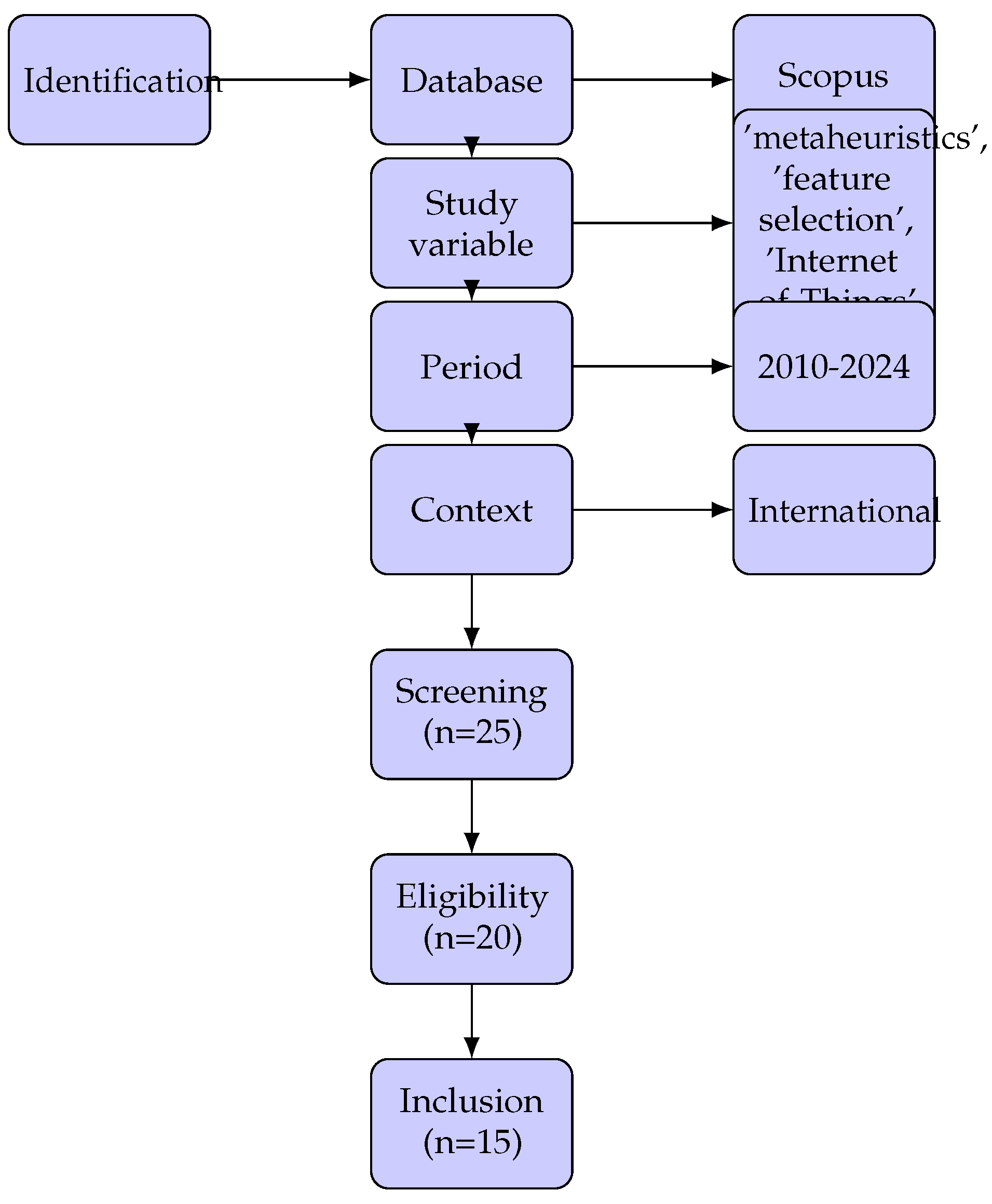
The study selection process was aligned with the recommendations of the PRISMA flowchart, adapted for this review.
Initially, 25 potential studies were identified. In the screening phase, abstracts and methodologies were read, narrowing the number down to 15 eligible studies. Studies selected for inclusion had to strictly fit the keywords and have direct relevance to feature selection optimization in IoT, ultimately including 15 studies in this review. Details of this search can be found at the following link: https://lc.cx/FSxItR.
D. Study Analysis
The information from the 15 selected studies was organized and recorded in a spreadsheet to facilitate analysis. Both qualitative and quantitative methods were applied to synthesize the data and extract meaningful patterns. The results were structured in tables and graphs, organizing the information according to the area of application of metaheuristics in IoT networks, the techniques used, the results obtained and the specific applications in each study. In addition, a quantitative analysis was performed of the distribution of the studies in terms of application areas, the number of studies dedicated to each area and the metaheuristic techniques used.
III. Results
The studies conducted between 2010 and 2024 are summarized in Table 1, which presents an overview of the research reviewed, highlighting the techniques used, the specific areas of application in IoT networks, and the main results obtained.
Regarding the areas of application in IoT networks, Figure 2 shows that intrusion detection is the field with the greatest focus, with five studies dedicated to this topic. This finding highlights the growing importance of security in IoT networks. Combinations of Deep Learning and Machine Learning with metaheuristics have proven to be highly effective in improving the accuracy of intrusion detection. These approaches allow IoT systems to identify threats faster and more accurately, significantly reducing false positives. This advancement is especially crucial in complex environments, where the large amount of data makes it difficult to identify threats and prevent attacks.
Figure 3 shows that 46.7% of the studies employed Deep Learning and Machine Learning based approaches, while 53.3% used traditional methods such as Particle Swarm Optimization, Genetic Algorithms, and Fuzzy Logic. This distribution highlights the effectiveness of hybrid approaches for handling complex IoT network data.
IV. Discussion
The application of metaheuristics in feature selection has shown great potential to improve the performance of IoT networks. These methods allow reducing the amount of data without losing key information, which optimizes both the processing and efficiency of networks. While traditional metaheuristics, such as Genetic Algorithms and Particle Swarm Optimization, have been useful, their combination with advanced Deep Learning and Machine Learning techniques significantly improves accuracy and generalization capabilities, better adapting to changes and variations in data in IoT networks. However, high computational complexity remains a major challenge, especially on resource-constrained devices.
V. Conclusion
Metaheuristics are essential for feature selection in IoT networks, as they allow better management of the large volumes of data generated by these networks. Combining classical techniques with more advanced methods such as Deep Learning and Machine Learning offers a more effective solution to improve accuracy and efficiency in critical tasks such as intrusion detection and energy consumption optimization. As more adaptive and efficient approaches are developed, these combinations are likely to continue to play a crucial role in the evolution of IoT networks.
References
- K. Lin, Y. Huang, J. C. Hung, and Y. Lin, “Feature Selection and Parameter Optimization of Support Vector Machines Based on Modified Cat Swarm Optimization,” International Journal of Distributed Sensor Networks, vol. 2015, pp. 1–12, 2015. [Online]. Available: https://www.scopus.com/inward/record.uri?eid=2-s2.0-84937795869&doi=10.1155%2f2015%2f365869&partnerID=40&md5=abdc025be22b2b260560caa788f162b7. [CrossRef]
- V. K. Kalimuthu and T. Muthu, “Oppositional Coyote Optimization based Feature Selection with Deep Learning Model for Intrusion Detection in Fog-Assisted Wireless Sensor Network,” Acta Montanistica Slovaca, vol. 28, no. 2, pp. 18, 2023. [Online]. Available: https://www.scopus.com/inward/record.uri?eid=2-s2.0-85172330570&doi=10.46544%2fAMS.v28i2.18&partnerID=40&md5=7096ffeff5a8701c96ee79ba0a614a38. [CrossRef]
- M. M. Asiri, H. G. Mohamed, M. K. Nour, M. Al Duhayyim, A. S. A. Aziz, A. Motwakel, A. S. Zamani, and M. I. Eldesouki, “Hybrid Metaheuristics Feature Selection with Stacked Deep Learning-Enabled Cyber-Attack Detection Model,” Computer Systems Science and Engineering, vol. 2023, pp. 1063, 2023. [Online]. Available: https://www.scopus.com/inward/record.uri?eid=2-s2.0-85143821389&doi=10.32604%2fcsse.2023.031063&partnerID=40&md5=fb53ed5466a33e587e44b071e938de4c. [CrossRef]
- F. S. Alrayes, N. Alshuqayran, M. K. Nour, M. Al Duhayyim, A. Mohamed, A. A. Abdelmageed, G. P. Mohammed, and I. Yaseen, “Optimal Fuzzy Logic Enabled Intrusion Detection for Secure IoT-Cloud Environment,” Computers, Materials and Continua, vol. 2023, pp. 32591, 2023. [Online]. Available: https://www.scopus.com/inward/record.uri?eid=2-s2.0-85145355981&doi=10.32604%2fcmc.2023.032591&partnerID=40&md5=5c902b58ca674a756f39a84093031493.
- L. A. Maghrabi, I. R. Alzahrani, D. Alsalman, Z. M. AlKubaisy, D. Hamed, and M. Ragab, “Golden Jackal Optimization with a Deep Learning-Based Cybersecurity Solution in Industrial Internet of Things Systems,” Electronics (Switzerland), vol. 12, no. 19, pp. 4091, 2023. [Online]. Available: https://www.scopus.com/inward/record.uri?eid=2-s2.0-85175031076&doi=10.3390%2felectronics12194091&partnerID=40&md5=5523d8b7df5431ffd977effe27e8e853. [CrossRef]
- I. Katib and M. Ragab, “Blockchain-Assisted Hybrid Harris Hawks Optimization Based Deep DDoS Attack Detection in the IoT Environment,” Mathematics, vol. 11, no. 8, pp. 1887, 2023. [Online]. Available: https://www.scopus.com/inward/record.uri?eid=2-s2.0-85153970460&doi=10.3390%2fmath11081887&partnerID=40&md5=17b0419e37e9c355cd810487b90dafba. [CrossRef]
- M. A. Elaziz, A. Dahou, A. Mabrouk, R. A. Ibrahim, and A. O. Aseeri, “Medical Image Classifications for 6G IoT-Enabled Smart Health Systems,” Diagnostics, vol. 13, no. 5, pp. 834, 2023. [Online]. Available: https://www.scopus.com/inward/record.uri?eid=2-s2.0-85149724139&doi=10.3390%2fdiagnostics13050834&partnerID=40&md5=946b4811b98e437ef033eaa2e6915c28.
- M. Ragab, S. M. Alshammari, A. S. Al-Malaise Al-Ghamdi, A. S. Althaqafi, and A. S. AL-Ghamdi, “Modified Metaheuristics with Weighted Majority Voting Ensemble Deep Learning Model for Intrusion Detection System,” Computer Systems Science and Engineering, vol. 2023, pp. 1446, 2023. [Online]. Available: https://www.scopus.com/inward/record.uri?eid=2-s2.0-85169697448&doi=10.32604%2fcsse.2023.041446&partnerID=40&md5=2dd55e57b65d3a1ee392a328b2b52f6e. [CrossRef]
- F. Alrowais, M. M. Eltahir, S. S. Aljameel, R. Marzouk, G. P. Mohammed, and A. S. Salama, “Modeling of Botnet Detection Using Chaotic Binary Pelican Optimization Algorithm With Deep Learning on Internet of Things Environment,” IEEE Access, vol. 2023, pp. 332690, 2023. [Online]. Available: https://www.scopus.com/inward/record.uri?eid=2-s2.0-85177087408&doi=10.1109%2fACCESS.2023.3332690&partnerID=40&md5=32280eacafcc3323592f40368572d61b. [CrossRef]
- F. Y. Assiri and M. Ragab, “Optimal Deep-Learning-Based Cyberattack Detection in a Blockchain-Assisted IoT Environment,” Mathematics, vol. 11, no. 19, pp. 4080, 2023. [Online]. Available: https://www.scopus.com/inward/record.uri?eid=2-s2.0-85176427308&doi=10.3390%2fmath11194080&partnerID=40&md5=84c30467750400a36d49a05ccf606ad4. [CrossRef]
- A. Fatani, M. Abd Elaziz, A. Dahou, M. A. A. Al-Qaness, S. Ali Lu, S. A. Alfadhli, and S. S. Alresheedi, “IoT Intrusion Detection System Using Deep Learning and Enhanced Transient Search Optimization,” IEEE Access, vol. 9, pp. 3109081, 2021. [Online]. Available: https://www.scopus.com/inward/record.uri?eid=2-s2.0-85115210347&doi=10.1109%2fACCESS.2021.3109081&partnerID=40&md5=730b07e02f079f93617caacc76c9c596. [CrossRef]
- T. Muthu and V. K. Kalimuthu, “Seagull Optimization-based Feature Selection with Optimal Extreme Learning Machine for Intrusion Detection in Fog Assisted WSN,” Tehnicki Vjesnik, vol. 28, pp. 95, 2023. [Online]. Available: https://www.scopus.com/inward/record.uri?eid=2-s2.0-85171470095&doi=10.17559%2fTV-20230130000295&partnerID=40&md5=e3a0e83031794e5e9a77fbb74260fd88. [CrossRef]
- M. A. Alohali, M. Eltahir, F. N. Al-Wesabi, M. Al Duhayyim, A. M. Mustafa Hilal, and A. Motwakel, “Optimal Deep Learning Based Ransomware Detection and Classification in the Internet of Things Environment,” Computer Systems Science and Engineering, vol. 2023, pp. 6802, 2023. [Online]. Available: https://www.scopus.com/inward/record.uri?eid=2-s2.0-85158821150&doi=10.32604%2fcsse.2023.036802&partnerID=40&md5=e6d4492e1375adb99a17c0637bd8cda6. [CrossRef]
- L. Almuqren, H. Alqahtani, S. S. Aljameel, A. S. Salama, I. Yaseen, and A. A. Alneil, “Hybrid Metaheuristics With Machine Learning Based Botnet Detection in Cloud Assisted Internet of Things Environment,” IEEE Access, vol. 11, pp. 32369, 2023. [Online]. Available: https://www.scopus.com/inward/record.uri?eid=2-s2.0-85174800426&doi=10.1109%2fACCESS.2023.3322369&partnerID=40&md5=6b8455b493bd4b722bcc7875f009ce64. [CrossRef]
- S. A. Althubiti, J. Escorcia-Gutierrez, M. Gamarra, R. Soto-Diaz, R. F. Mansour, F. Alenezi, “Improved Metaheuristics with Machine Learning Enabled Medical Decision Support System,” Computers, Materials and Continua, vol. 2022, pp. 28878, 2022. [Online]. Available: https://www.scopus.com/inward/record.uri?eid=2-s2.0-85132345851&doi=10.32604%2fcmc.2022.028878&partnerID=40&md5=f64133bdbb5bebd57e6fffc95df96844. [CrossRef]
Figure 2.
Distribution of Studies Across Application Areas.
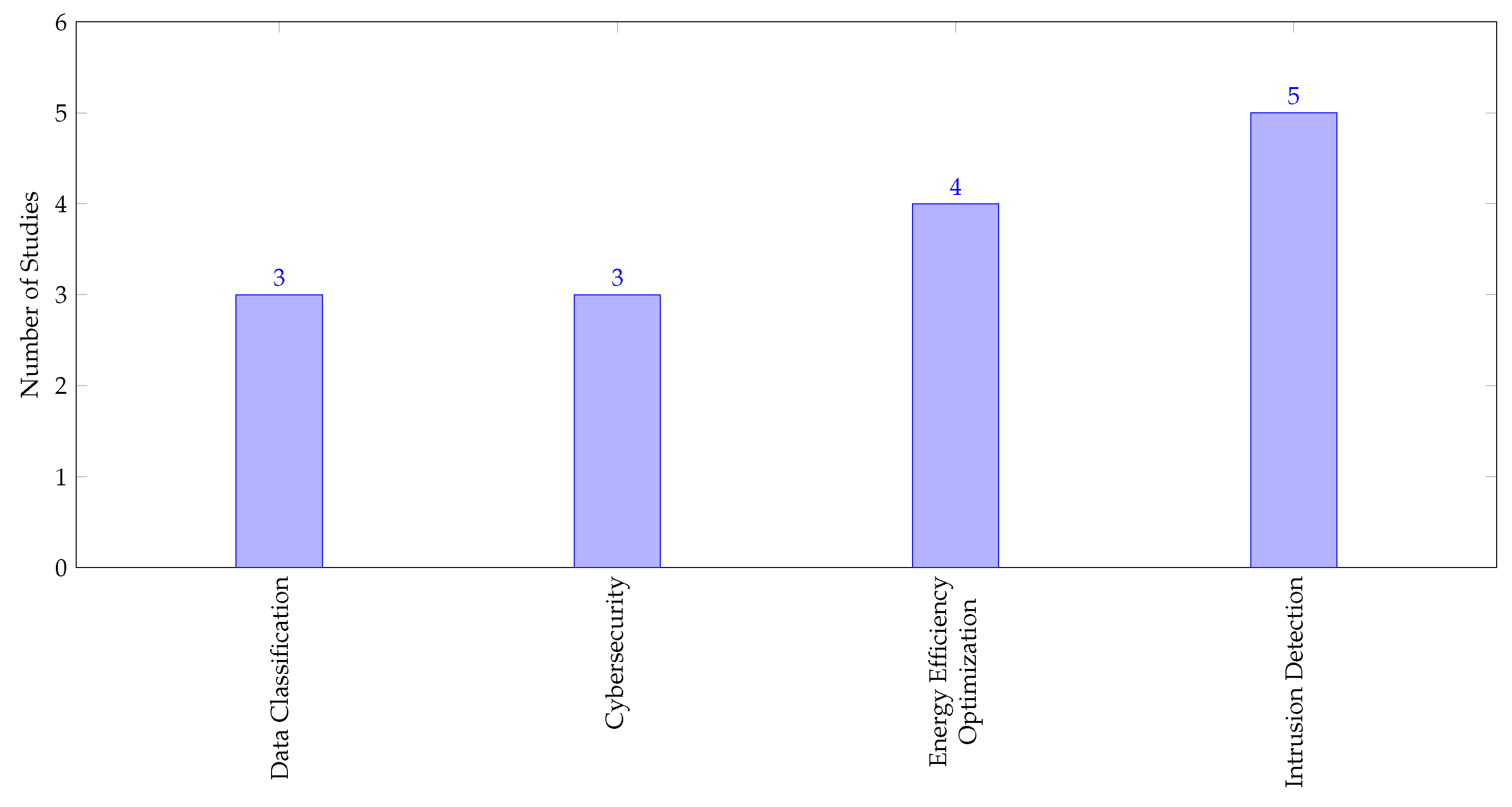
Figure 3.
Combinations of Metaheuristics with Deep Learning/Machine Learning in the Reviewed Articles.
Figure 3.
Combinations of Metaheuristics with Deep Learning/Machine Learning in the Reviewed Articles.
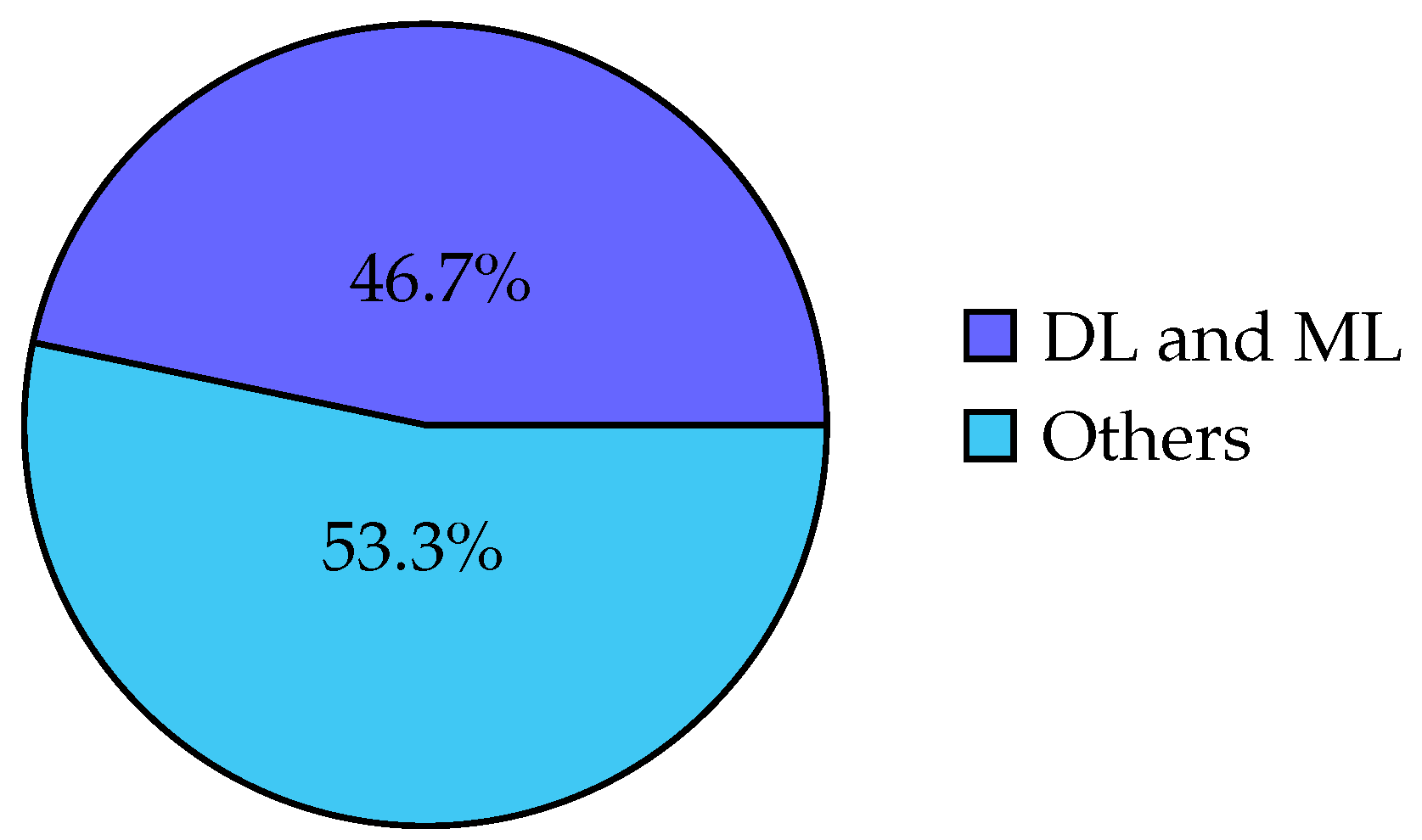

Table 1.
Use of Metaheuristics in IoT Network Optimization and Security.
| Study | Metaheuristics | Application in IoT | Key Results or Contributions |
|---|---|---|---|
| Lin et al. (2015) | Cat Swarm Optimization (CSO) | SVM Optimization in Sensor Networks | Improving SVM Accuracy |
| Kalimuthu et al. (2023) | Coyote Optimization | Intrusion Detection in Sensor Networks | Improving Detection Rate |
| Asiri et al. (2023) | Hybrid + Deep Learning | Cyber Attack Detection | High Detection Accuracy |
| Alrayes et al. (2023) | Fuzzy Logic + Metaheuristics | Intrusion Detection in IoT-Cloud | Improved Performance in IoT Environments |
| Maghrabi et al. (2023) | Golden Jackal Optimization | Security in IoT Industrial Systems | High Effectiveness in Threat Detection |
| Katib et al. (2023) | Harris Hawks Optimization | DDoS Attack Detection | Reducing DDoS Attacks |
| Elaziz et al. (2023) | Deep Learning + Optimization | IoT Medical Image Classification | Improved Diagnostic Accuracy |
| Ragab et al. (2023) | Metaheuristics + Voting | Intrusion Detection | Increased Efficiency and Accuracy |
| Alrowais et al. (2023) | Pelican Optimization + Deep Learning | Botnet Detection in IoT | High Botnet Detection Rate |
| Assiri & Ragab (2023) | Deep Learning + Blockchain | Cyberattack Detection in IoT | Efficiency in IoT Security |
| Fatani et al. (2021) | Transient Search Optimization | IoT Intrusion Detection | Improved Accuracy Performance |
| Muthu et al. (2023) | Seagull Optimization | Intrusion Detection in WSN | Increased Accuracy |
| Alohali et al. (2023) | Deep Learning + Optimization | Ransomware Detection in IoT | Increased Ransomware Effectiveness |
| Almuqren et al. (2023) | Metaheuristics + Machine Learning | Botnet Detection in IoT | Improved Real-Time Detection |
| Althubiti et al. (2022) | Metaheuristics + Machine Learning | IoT Medical Support System | High Accuracy in Diagnosis |
Disclaimer/Publisher’s Note: The statements, opinions and data contained in all publications are solely those of the individual author(s) and contributor(s) and not of MDPI and/or the editor(s). MDPI and/or the editor(s) disclaim responsibility for any injury to people or property resulting from any ideas, methods, instructions or products referred to in the content. |
© 2024 by the authors. Licensee MDPI, Basel, Switzerland. This article is an open access article distributed under the terms and conditions of the Creative Commons Attribution (CC BY) license (http://creativecommons.org/licenses/by/4.0/).
Copyright: This open access article is published under a Creative Commons CC BY 4.0 license, which permit the free download, distribution, and reuse, provided that the author and preprint are cited in any reuse.


