Submitted:
01 November 2026
Posted:
04 November 2026
You are already at the latest version
Abstract
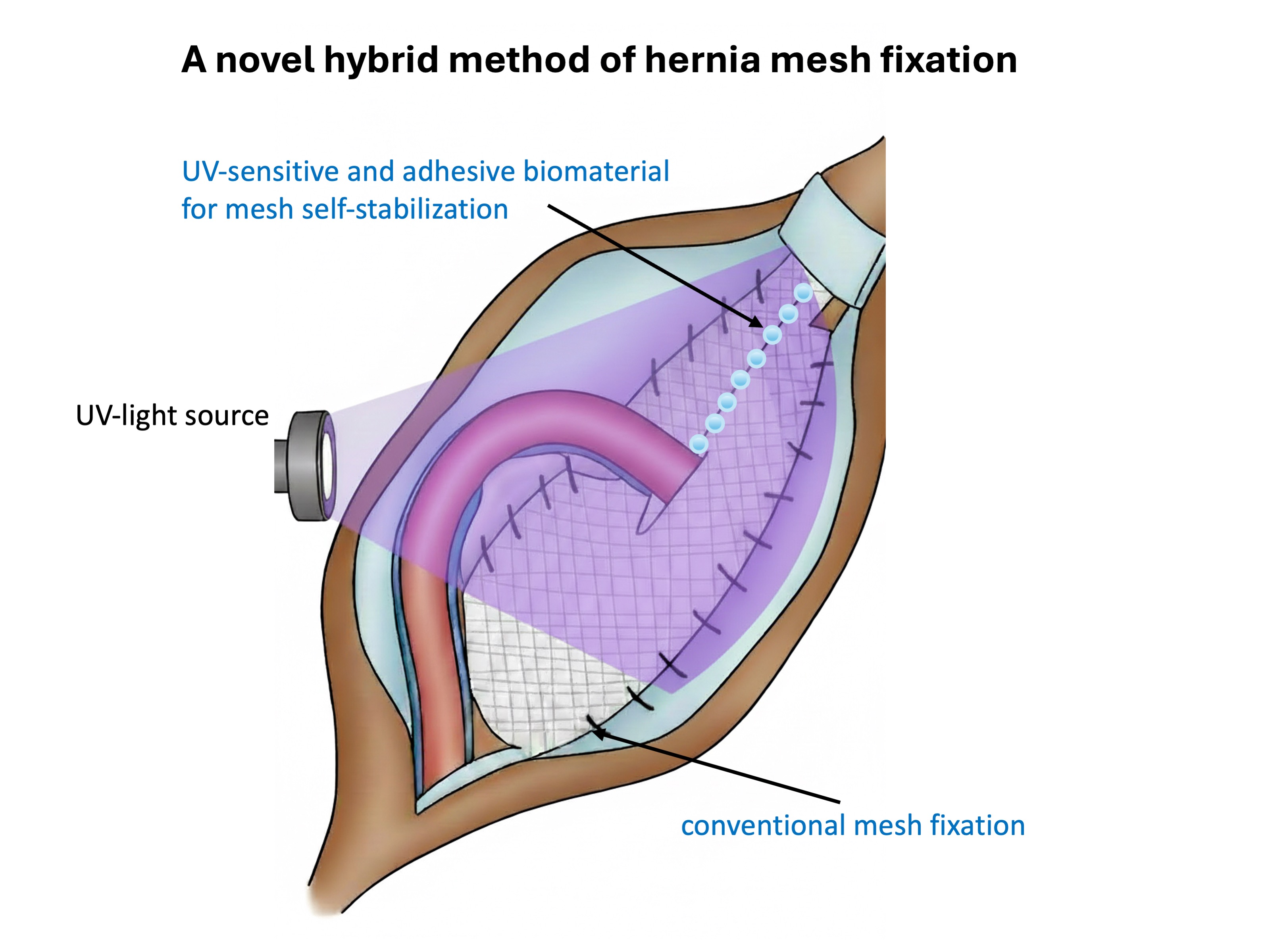
Background: Mesh implantation is the standard approach in inguinal hernia repair. However, the use of penetrating sutures to secure the mesh slit in male patients may cause irritation to the tissues surrounding the spermatic cord. This pilot study evaluated the feasibility of a hybrid fixation technique utilizing a biodegradable, UV-curable adhesive biomaterial. Methods: Ten male patients aged 20-40 years with unilateral inguinal hernia underwent open repair and were assigned to two non-randomized groups (n = 5 each). Eligible patients were assigned alternately according to the order of enrollment. In the hybrid group, the mesh was secured partly conventionally, and the remaining portion was stabilized with the experimental UV-curable adhesive biomaterial. VAS, CCS, and EuraHS-QoL outcomes were assessed in both groups during the 24-month follow-up, whereas SF-36 data were available only for the hybrid group. Results: Adhesive-assisted partial mesh stabilization was associated with a shorter operative time than conventional fixation (52.0 ± 3.1 vs 60.2 ± 3.7 min). Mean VAS scores decreased from 2.6 and 2.8 on day 1 in the hybrid and conventional groups, respectively, to 0.8 in both groups on day 8 and 0 by week 6. Total CCS scores decreased from day 1 to 6 weeks in both groups (hybrid: 54.1% to 30.4%, conventional: 65.3% to 36.6%). No intraoperative complications or hernia recurrences were observed during the 24-month follow-up. The overall SF-36 scores increased from 77.8 preoperatively to 92.4 at 24 months. Conclusions: In this pilot cohort, hybrid fixation was feasible and was associated with shorter operative time. No intraoperative complications or hernia recurrences were observed during follow-up. These preliminary findings support further clinical investigation in larger patient populations to evaluate safety and comparative effectiveness.