

Submitted:
11 December 2024
Posted:
12 December 2024
You are already at the latest version
Abstract
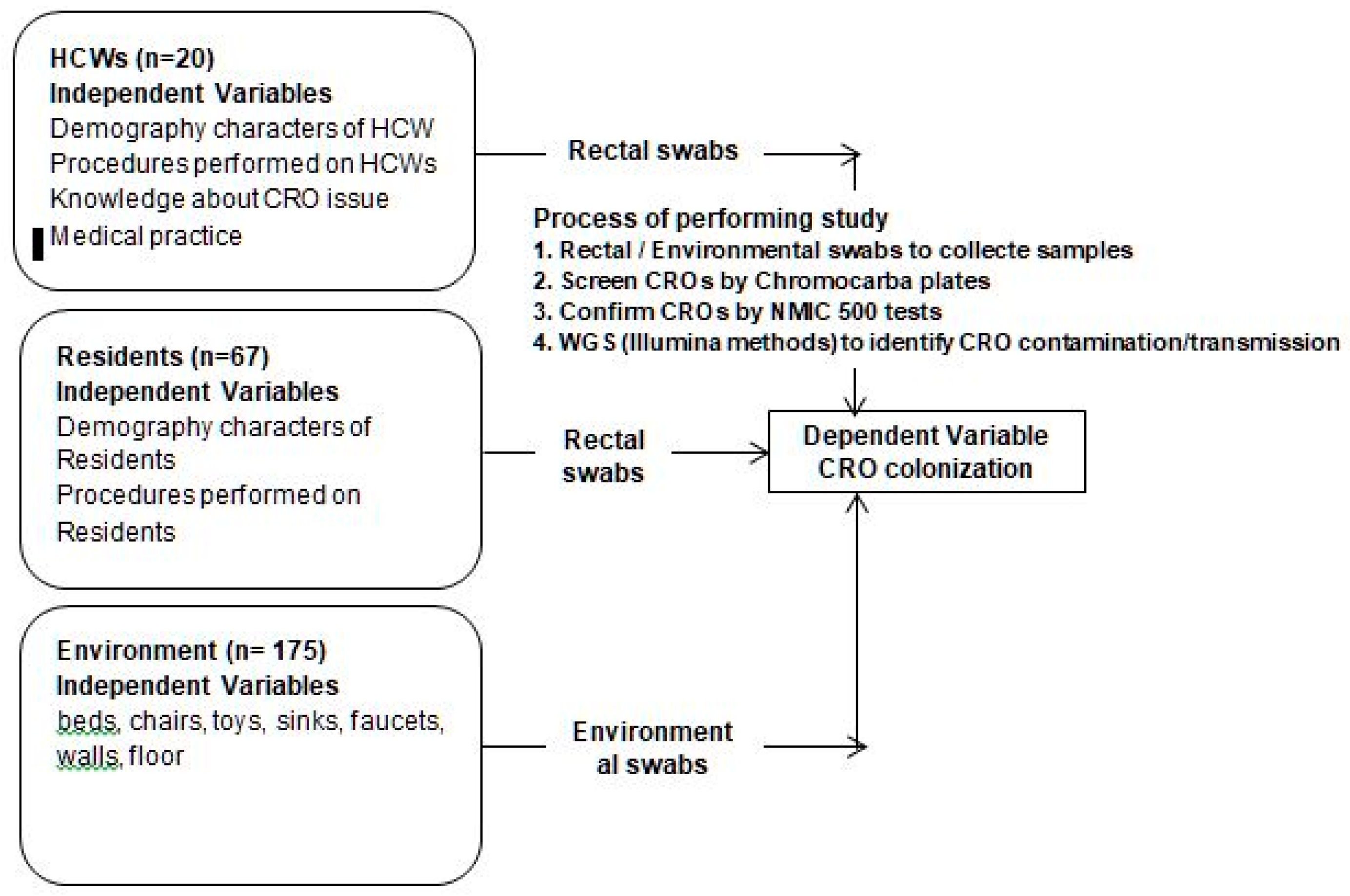
Antimicrobial resistance is a most concerning public health issue in Vietnam due to antibiotic-resistant Gram-negative bacteria, including Carbapenem-resistant organisms (CROs), which might appear in remote areas in Vietnam. So, at this center, we performed a cross-sectional study and collected fecal samples from human subjects (20 healthcare workers (HCWs) and 67 residents) and 175 environmental samples, with rectal and environment swabs, as study data for this study, from September 2022 to December 2022. We conducted the microbiological testing, including the MELAB-Chromogenic-CARBA-agar plates, blood-agar plates, and BD PhoenixTM Automated Microbiology System to screen, isolate, and identify bacterial species and phenotypic tests for antimicrobial susceptibility of carbapenem-resistant bacteria, and the whole genome sequencing for 12 CROs chosen to confirm the CRO transmission between HCWs and residents. The study findings showed the prevalence and risk factors associated with CRO colonization were detected in HCWs, residents, and the environment in the Center of Care and Protection of Orphan Children. CRO transmission happened between HCWs and residents detected with WGS analysis. So, whole genome sequencing (WGS) plays a significant role in CRO control and prevention and reduces CRO transmission/ colonization in this center and other healthcare settings.
Keywords:
1. Introduction
2. Materials and Methods
2.1. Definitions
2.2. Design
2.3. Sample Collection
- Open the swab package and remove a sampling swab tube from this package,
- Then, hold the tube cap and remove a cotton swab stick inside. Only touch the cap,
- Do not touch a cotton swab stick. Insert a sterile rectal cotton sampling swab approximately 1cm into the anal canal.
- Then, rotate slowly for 10 seconds. Take the amount of feces collected on a cotton swab enough to perform the appropriate microbiological tests.
- Next, put the rectal swab specimens into Amies Transport Medium.
- Finally, these fecal specimens must be stored in a container with dry ice and transported to the Lab Department of Hung Vuong Hospital as soon as possible within 6 hours after collecting rectal swab specimens.
- Use the sterile rectal cotton sampling swab to collect the environmental sample.
- An approximate area (10x10 (cm) was sampled on environmental surfaces and furnishings. After collecting samples, the swabs were placed in Amies Transport Medium and processed in the same way as for the rectal swabs.
2.4. Microbiology Methods
2.5. Whole Genome Sequencing (WGS)
2.6. Statistical Analysis

| Part (a): Information of 12 CROs sent to Charles River Laboratories | |||||
| No | Client ID | Location of work/ residence | Name CROs with BD identified in VN | WGS code In Charles River Laboratories | |
| 1 | 24 (C4 003) | Floor 1 | K.pneumonia | 6276063 | |
| 2 | 193 (H 019) | Floor 1 & General floor | E.coli class B | 6276064 | |
| 3 | 250 (H 006) | Floor 1 | E.coli class D | 6276065 | |
| 4 | 251 (C4 003) | Floor 1 | E.coli class D | 6276066 | |
| 5 | 256 (C3 002) | General floor | A. baumannii | 6276067 | |
| 6 | 301 (H 008) | Floor 1 | Ent. cloacea | 6276068 | |
| 7 | 391 (C2 012) | Floor 1 | A. baumannii | 6276069 | |
| 8 | 403 (C3 022) | Floor 1 | A. baumannii | 6276070 | |
| 9 | 413 (C3 011) | Floor1 | A. baumannii | 6276071 | |
| 10 | 414 (C2 020) | Floor 1 | A. baumannii | 6276072 | |
| 11 | 419 (H 009) | Floor 1 | A. baumannii | 6276073 | |
| 12 | H007 (H007) | Floor 1 | E.coli | 6276074 | |
| H = Healthcare worker, C= Children. | |||||
| Part (b): Genome assembly based species identification with WGS at Charles River Laboratories in Australia | |||||
| Before WGS performance | After WGS performance | ||||
| No | CROs confirmed ith BDAMS in VN | WGS code | Provisional Species did not changed before and after WGS | ||
| 1 | K.pneumonia | 6276063 | K. pneumoniae | ||
| 2 | E.coli class B | 6276064 | E.coli | ||
| 3 | E.coli class D | 6276065 | E.coli | ||
| 4 | E.coli class D | 6276066 | E.coli | ||
| 10 | A. baumannii | 6276072 | A. baumannii | ||
| 12 | E.coli | 6276074 | E.coli | ||
| 7 | A. baumannii | 6276069 | A. baumannii | ||
| No | CROs confirmed ith BDAMS in VN | WGS code | Provisional Species changed after WGS | ||
| 5 | A. baumannii | 6276067 | A. seifertii | ||
| 6 | Ent. cloacea | 6276068 | E. cloacae/hormaechei | ||
| 8 | A. baumannii | 6276070 | Acinetobacter nosocomialis | ||
| 9 | A. baumannii | 6276071 | Acinetobacter nosocomialis | ||
| 11 | A. baumannii | 6276073 | A. baumannii/nosocomialis:k-mer graph shows possible mixture | ||
| BD Phoenix TM Automated Microbiology System = BDAMS | |||||
| Part (c): Genomic comparision and MALDI performancebased typing of five samples (6276067, 68, 70, 71,73) | |||||
| No | WGS code | Name CROs with BDAMS | Name CRO after WGS | ||
| 5 | 6276067 | A. baumannii | Acinetobacter seifertiI (sensu lato) | ||
| 6 | 6276068 | Ent. cloacea | Enterobacter cloacae/hormaechei (sensu lato) | ||
| 8 | 6276070 | A. baumannii (sensu lato) | Acinetobacter nosocomialis (sensu stricto) | ||
| 9 | 6276071 | A. baumanni (sensu lato) | Acinetobacter nosocomialis (sensu stricto) | ||
| 11 | 6276073 | A. baumanni (sensu lato) | Acinetobacter baumannii/nosocomialis(assembly shattered, possibly mixture) | ||
2.6. At Charles River Laboratories in Australia: Process of Performing WGS
3. Results
3.1. Results of Whole Genome Sequencing of 12 CROs Analyzed at Charles River Laboratories in Australia
- ▪ between E. coli of C4003 (6276066) and H006 (6276065),
- ▪ between A. baumannii of C3022 (6276070) and H009 (6276073),
- ▪ between A. baumannii of C3011 (6276071) and H009 (6276073) and
- ▪ between A. baumannii of C3022 (6276070) and C3011 (6276071)
3.2. Transmission/Contamination Tracking by SNP (Single Nucleotide Polymorphism) Count
3.2.1. Transmission/Contamination Between the Isolates, Including 6276070, 6276071 and 6276073_isolate
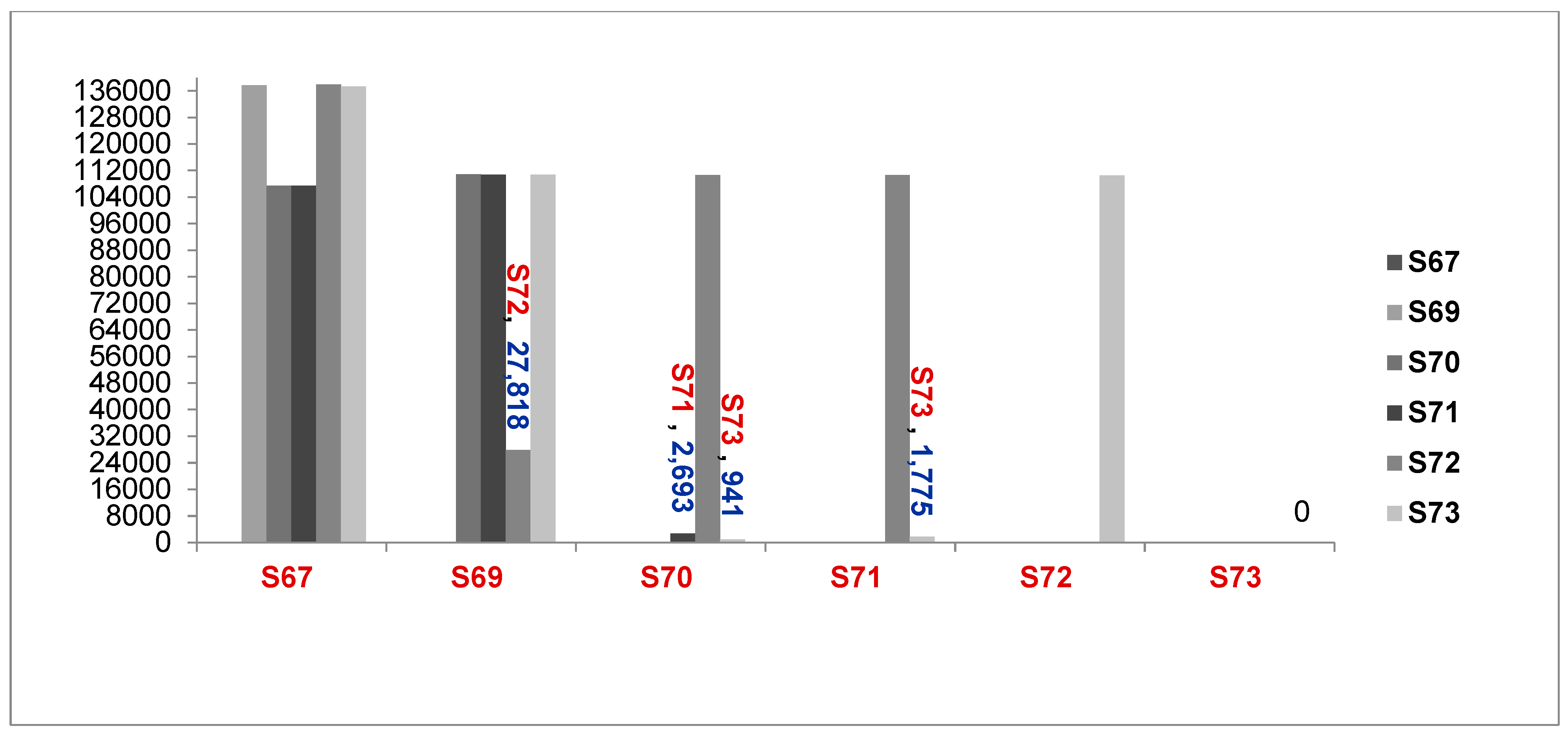
| Part ( a): The results of determining the contamination/transmission from 6276067 to 6276073_isolate) by | |||||
| N of genomes of A. nosocomialis (1) | N of genome different between (2) | Ratio of genome different (%): (2) /( 1) | Ratio of genome difference of two isolates of the same species (%) | Results | |
| A. seifertii and S67 | 3,940,614 | 42246 | 1.07% | < 5.00% | S67 is A. seifertii |
| A. baumannii and S69 | 3,940,614 | 28,554 | 0.72% | < 5.00% | S69 is A. baumannii |
| S69 and S72 | 3,940,614 | 27,818 | 0.71% | < 5.00% | S72 is A. baumannii |
| S71 and S70 | 3,940,614 | 2,693 | 0.07% | < 5.00% | S73, S71, and S70 belong to an identical clone |
| S73 and S70 | 3940614 | 941 | 0.02% | < 5.00% | |
| S73 and S71 | 3940614 | 1,775 | 0.05% | < 5.00% | |
| S67 = 6276067_isolate, S69 = 6276069_isolate, S70 = 6276070_isolate, S71 = 6276071_isolate, S72 = 6276072_Isolate, S73 = 6276073_isolate | |||||
| Part (b) : ANI matrix of isolates and 2 public reference genomes (A. nosocomialis, A. seifertii) | |||||
| OrthoANI values calculated from the OAT software [30] | S70_ | S71_ | S73_ | A. nosocomialis | A. seifertii |
| asm(C3022) | asm(C3011) | asm(H009) | |||
| S70_asm | |||||
| S71_asm | 97.6561 | ||||
| S73_asm | 98.8262 | 99.347 | |||
| A. nosocomialis | 97.6676 | 97.4891 | 97.8075 | ||
| A. seifertii | 91.9344 | 91.8987 | 91.9274 | 92.2549 | |
| A. baumanii | 91.5521 | 91.5963 | 91.4095 | 91.363 | 89.7719 |
3.2.2. Transmission/Contamination Between the Isolates, Including 6276065, 6276066 Isolate
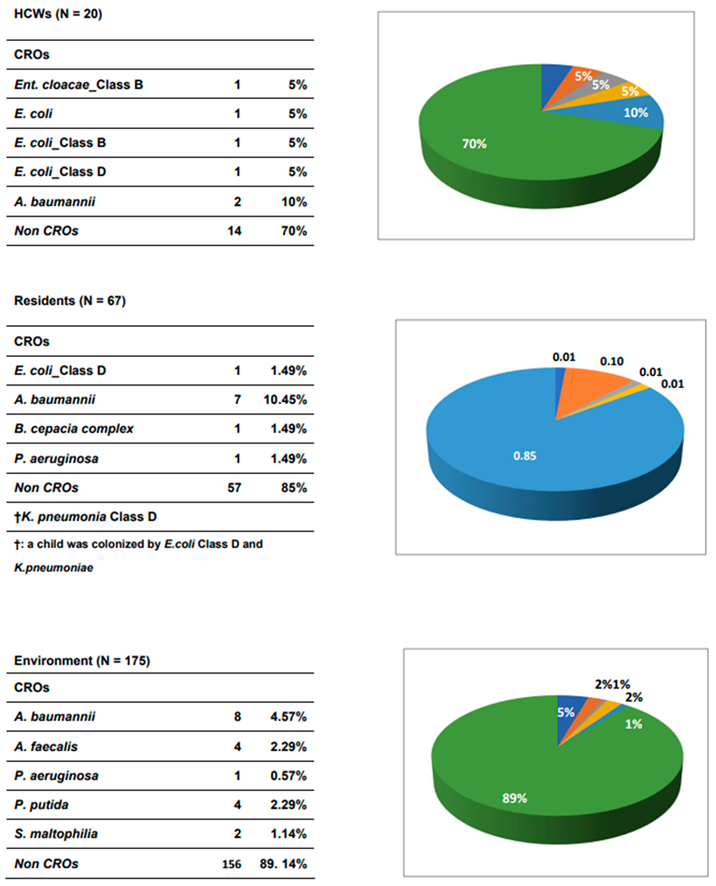
3.3. Prevalence of CROs in HCWs, Residents and Environment
3.4. Characteristics (Demographics) of Independent Variables Associated with HCWs and Residents
3.4.1. Demography Characters of HCWs and Residents
| Part (a) Demography characteristics of HCWs and residents | ||||||||||||||
| 1. Sex | 2. Age (years) | 3. Occu | 4. Seven days for work p WK | |||||||||||
| H | Rsd | H | Rsd | H | Rsd | H | Rsd | |||||||
| N,20 | N, 67 | N,20 | N, 67 | N,20 | N, 67 | N,20 | N, 67 | |||||||
| n, % | n, % | n, % | n, % | n, % | n, % | n, % | n, % | |||||||
| Female | 20 (100) | 18 (26.9) | ≥ 27 yrs old is cut-point | Cc | 12 (60) | 0 | 20 (100) | 4 (6) | ||||||
| Male | 0 (0) | 49 (73.1) | Min / Max of age | 20.00 / 66.00 | 4.00/ 26.00 | Cln | 1 (5) | 0 | 6. N of hrs for PW or W per Day | |||||
| FP | 2 (10) | 0 | 0 | 63 (94.0) | ||||||||||
| 5. Drt of PW/ Rsd (years) | ≤20 | 1 (5.) | 62 (92.5) | Gd | 1 (5) | 0 | 0.5 | 3 (4.5) | ||||||
| < 5 yrs | 10 (50) | 22 (32.84) | > 20 | 4 (20) | 5 (7.5) | Mgr of Ct | 1 (5) | 0 | 4 | 1 (1.5) | ||||
| > 5 | 3 (15) | 37 (55.22) | > 30. | 5 (25) | Pharm | 1 (5) | 0 | 7 | 2 (10) | |||||
| > 10 | 7 (35) | 8 (11.94) | > 40 | 10 (50) | RN | 2 (10) | 0 | 8 | 10 (50) | |||||
| No_OCCU | 67(100) | 10 | 8 (40) | |||||||||||
3.4.2. Demography Characters of HCWs and Residents Related to Antibiotic Use
| Part (b): Demography characteristics of HCWs and orphan patients to antibiotic use | ||||||||||
| 7. ABU | 9. N of Ds of ABU for LT BEF St part | 10. LABU, HL, ago (ds): | ||||||||
| H | Rsd | H | Rsd | H | Rsd | |||||
| N,20 | N, 67 | N,20 | N, 67 | N,20 | N, 67 | |||||
| n, % | n, % | n, % | n, % | n, % | n, % | |||||
| Yes | 13 ( 65) | 5 (7.46) | 0 | 7 (35) | 62 (92.5) | 0 (day) | 7 (35) | 62 (92.50) | ||
| No | 7(35) | 62 (92.5) | 1 | 2 (10) | 14 | 3 (15) | 1(1.50) | |||
| 8. N of Ts for ABU in LY (times) | 2 to 4 | 4 (20) | 30 | 3 (15) | 1(1.50) | |||||
| 0 | 7 (35) | 62 (92.5) | 5 | 4(20) | 4 (6.0) | 60 | 2 3.00) | |||
| 1 to 2 | 5 (25) | 5 (7.5) | 6 to 7 | 2 (10) | 90 | 3 (15) | 1 (1.50) | |||
| 3 to 4 | 5 (25) | 10 | 1 (1.5) | 120 | 3 (15) | |||||
| 8 to 10 | 3 (15) | 30 | 1 (5) | 180 | 1 (5) | |||||
| 11. N of ds for 1st ABU days) | 12. N of days for 2nd ABU | 13. List of AB used for 1st time to treat IDs | ||||||||
| 2 to 4 | 4 (20) | No_Use | 19 (95) | 63 (94.03) | AMC (2:1) | 2 (10) | 1 (1.49) | |||
| 5 | 4 (20) | 5 (7.46) | Not RMR | 1 (5) | 1 (1.49) | AMC (2:1) | 3 (15) | AMC, 1 (1.49) | ||
| 6 to 7 | 2 (10) | Use | 0 | 5 days , 3 (4.48) | AMOX | 1 (5) | AZI, 250 mg: 2 (2.99) | |||
| 30 | 1 (5) | No use | 7 (35) | 62 (92.54) | ||||||
| 0 day | 7 (35) | 62 92.53) | 14. List of AB used for 2nd time to treat IDs | Not RMB | 7(35) | AZI, 500 mg: 1 (1.49) | ||||
| not RMR | 2 (10) | No (Use & RMB) | 20 (100) | 64(95.52) | ||||||
| T of ds for ABU | 75 | 25 | ABU | CPN, 250:, 3 (4.48) | ||||||
3.4.3. Demography Characters of HCWs and Residents Related to Length of Hospital Stay, Number of Hospital Admission Times
| Part (c): Characteristics related to treat HCWs and residents in and out of the Center of Care and Protection of Orphan Children Care | ||||||||||||||||
| 15. N of HA Os of C of C & P of OC | 16. Rs for HA Os of C of C & P of OC | 17. LHA Os of C of C & P of OC, HL ago (Ds) | ||||||||||||||
| H | Rsd | H | Rsd | H | Rsd | |||||||||||
| N,20) | N, 67 | N,20) | N, 67 | N,20) | N, 67 | |||||||||||
| n, % | (n, %) | n, % | (n, %) | n, % | (n, %) | |||||||||||
| No_Ad | 17 (85) | 56 (83.6) | KLT | 1 (5) | 10 | 1 (1.49) | ||||||||||
| 1 | 3 (15) | 3 (4.5) | LF | 1 (5) | 60 | 1 (5) | ||||||||||
| 2 to 3 | 5 (7.5) | PNA | 1 (5) | 120 | 1 (5) | |||||||||||
| Many times | 3 (4.5) | SDU | 1 (1.49) | 365 | 1 (5) | |||||||||||
| No_Ad | 17 (85) | 66 (98.51) | No_Ad | 17 (85) | 66 (98.50) | |||||||||||
| 18. N of Ds for L HA Os of C of C & P of OC | 20..LHA at C of C & P of OC, HL ago (Ds) | 21. Reas for ADM at C of C & P of OC | ||||||||||||||
| 0 days | 17 (85) | 66 (98.5) | 10:00 | 3 (4.5) | Epilepsy | 3 (4.5) | ||||||||||
| 4 | 1(5) | 14 | 1 (1.5) | Flu: | 1 (1.5) | |||||||||||
| 5 | 2 (10) | 30 | 3 (4.5) | PNA | 3 (4.5) | |||||||||||
| 10 | 1 (1.5) | 60 | 2 (3.0) | SDU | 1 (1.5) | |||||||||||
| 19. chronic diseases | 90 | 1 (1.5) | SF | 1 (1.5) | ||||||||||||
| Yes | 11 (55) | 57 (85.1) | 120 | 1 (1.5) | Sinusitis | 1 (1.5) | ||||||||||
| NL | 9 (45) | 10 (14.9) | No HA | 20 (100) | 56 (83.6) | No_Reas | 20 (100) | 57 (85) | ||||||||
| N of HA Os of C of C & P of OC = Number of Hospital admission out side of center of C & P of OC, N of AT Os of C & P of OC Ly Bef study = Number of admission times outside of C of C & P of OC last year, before performed study, Rs for HA Os of C of C & P of OC = Reason for hospital admission outside of C of C & P of OC, LHA Os of C of C & P of OC, HL ago (Ds) = Last hospital admission outside of C of C & P of OC, How long ago (days), N of Ds for L HA Os of C of C & P of OC = Number of days for last admission at hospitals outside of C of C & P of OC, LHA at C of C & P of OC, HL ago (Ds) = Last hospital admission at C of C & P of OC, How long ago, Reas for ADM at C of C & P of OC = Reasons for admission at Center of Care and Protection of Orphan Children. | ||||||||||||||||
| Part (d) Characteristics related to chronic diseases in HCWs and residents | ||||||||||||||||
| H | Rsd | Rsd | ||||||||||||||
| N, 20 | N,67 | N, 67 | ||||||||||||||
| n (%) | n (%) | n (%) | ||||||||||||||
| NL | 10 (50) | NL | 10(14.9) | HPA + SI: | 1 (1.5) | |||||||||||
| CTS | 2 (10) | AT | 1(1.5) | HR + SI: | 2 (3.00) | |||||||||||
| DM | 1 (5) | CP | 27(40.3) | Ment. Retard | 2 (3.0) | |||||||||||
| HND | 1 (5) | CP+ VI | 1(1.5) | OI | 2 (3.0) | |||||||||||
| ELE | 1 (5) | CP+ ELS | 2 (3.0) | ELS | 5(7.50) | |||||||||||
| HTN | 1 (5) | DS | 6 (9.00) | ELS+ SZR | 1(1.50) | |||||||||||
| LF | 1 (5) | DS + SI | 2 (3.0) | ELS+ ID | 1 (1.5) | |||||||||||
| LRG | 1 (5) | ID | 1(1.5) | |||||||||||||
| SD | 1 (5) | HC | 1 (1.5) | |||||||||||||
| SDH | 1 (5) | HPA | 2(3.0) | |||||||||||||
3.4.4. Demography Characters of HCWs and Children Related to Procedures Performed on HCWs and Residents
| Part (e): Characteristics related to procedures performed on HCWs and Children | ||||||||||
| 22. Past operation before participating in study | 24. Last operation before participating study, How long ago | 26. Number of days for periperal intra_catheter use before participating study | ||||||||
| H | Rsd | H | Rsd | H | Rsd | |||||
| N, 20 | N, 67 | N, 20 | N, 67 | N, 20 | N, 67 | |||||
| n, % | n, % | n, % | n, % | n, % | n, % | |||||
| 0 (yrs) | 18 (90) | 66 (98.5) | 0 day | 18 (90) | 66 (98.50) | |||||
| Yes | 1 (5) | 1 (1.50) | 1 | 2 (10) | 1 | 1 (5) | 1 (1.50) | |||
| No | 19 (95) | 66 (98.5) | 6 | 1(1.50) | 5 | 1 (5) | ||||
| 23. Number of times for past operations last year before participating study | 25. Use of periperal intra_catheter before participating study | 27. Urinary catheter use before participating study | ||||||||
| 0 time | 19 (95) | 66 (98.5) | Yes | 2 (10) | 1 (1.50) | No use | 20 (100) | 67 (100) | ||
| 1 | 1 (5) | 1 (1.50) | No | 18 (90) | 66 (98.5) | |||||
3.5. Risk Factors Associated with CROs in HCWs and Residents
3.5.1. Risk Factors Associated with CROs in a Group, Including HCWs and Residents
| HCWs + RESIDENTS = 87 | CRO | n_CROs | Pearson χ2 | P value | Fisher's Exact Test (2-sided) | OR | 95% CI | |
| 1. HCWs (20) | 6 (3.7) | 14 (16.3) | 2.332a | 0.127 | 0.185 | 2.443 | 0.759 | 7.862 |
| /RESIDENTS (67) | 10 (12.3) | 57 (54.7) | ||||||
| 2. AGE ≥ 27 yrs | 6 (3.5) | 13 (15.5) | 2.817a | 0.093 | 0.106 | 2.677 | 0.825 | 8.689 |
| /Others | 10 (12.5) | 58 (55.5) | ||||||
| 3. AGE ≥ 27 yrs & ABU | 2 (2.2) | 10 (9.8) | 0.028 | 0.868 | 1 | 0.871 | 0.172 | 4.428 |
| /Others | 14 (13.8) | 61 (61.2) | ||||||
| 4. AGE ≥ 27 yrs & Work 1st floor | 5 (1.8) | 5 (8.2) | 7.522a | 0.006 | 0.016 | 6 | 1.488 | 24.192 |
| Others | 11 (14.2) | 66 (62.8) | ||||||
| 5. AGE ≥ 27 yrs & Work ≥ 4 years | 5 (2.2) | 7 (9.8) | 5.025a | 0.025 | 0.04 | 4.156 | 1.117 | 15.462 |
| Others | 11 (13.8) | 64 (61.2) | ||||||
| 6. Chidcarers | 5 (2.2) | 7 (9.8) | 5.025a | 0.025 | 0.04 | 4.156 | 1.117 | 15.462 |
| / Others | 11 (13.8) | 64 (61.2) | ||||||
| 7. Age ≥27,work ≥ 1 year, in floor 1 | 5 (1.8) / | 5 (8.2) / | 7.522a | 0.006 | 0.016 | 6 | 1.488 | 24.192 |
| / Others | 11 (14.2) | 66 (62.8) | ||||||
| 8. Age ≥27 years, work ≥ 4 years, work time ≥ 8 hours per day | 5 (2.2) / | 7 (9.8) / | 5.025a | 0.025 | 0.04 | 4.156 | 1.117 | 15.462 |
| / Others | 11 (13.8) | 64 (61.2) | ||||||
| 9. Past surgery before participating in study about one year | 1 (0.4) | 1 (1.6) | 1.363a | 0.243 | 0.336 | 4.667 | 0.276 | 78.869 |
| / no_past surgery | 15 (15.6) | 70 (69.4) | ||||||
| 10. Periperal intra_catheter use before participating study | 1 (0.4) | 1 (1.6) | 4.825a | 0.028 | 0.086 | 10 | 0.847 | 117.999 |
| / No_Periperal intra_catheter use | 15 (15.6) | 70 (69.4) | ||||||
| 11. Childcarers worked ≥2 years at Center, used AB ≥2 times and ≥4 days for each time in last time before particpating study | 2 (0.4) | 0 (1.6) | 9.084a | 0.003 | 0.032 | 6.071 | 3.762 | 9.800 (*) |
| / Others | 14 (15.6) | 71 (69.4) | ||||||
| HCWs/ chilcarers = 12, Residents =67 | ||||||||
| 12. Childcarers worked ≥ 4years at Center, used AB ≥2 times and ≥4 days for each time in last time before particpating study | 2 (0.4) | 0 (1.6) | 8.755a | 0.003 | 0.034 | 5.923 | 3.608 | 9.723 (**) |
| / Others, | 13 (14.6) | 64 (62.4) | ||||||
| AB = Antibiotic,(*)(**) for cohort CRO = CRO | ||||||||
3.5.2. Risk Factors Associated with CROs in Two Different Groups, Including HCWs and Residents
| Residents, N= 67 | CRO | n_CRO | Pearson χ2 | P value | Fisher's Exact Test (2-sided) | OR | 95% C.I | |
| 13. Age < 9 years & resided in center <=7.5 years | 3 (9) | 3 (5.1) | 6.385a | 0.012 | 0.039 | 7.714 | 1.296 | 45.905 |
| / the remaining group | 7 (9.1) | 54 (51.9) | ||||||
| 14. Age < 9 years & resided in center <=7.5 years, Times of ABU ≥ 2, ABU in the first time >=5 days | 1 (0.1) | 0 (0.9) | 5.786a | 0.016 | 0.15 | 7.333 | 3.996 | 13.458 |
| / the remaining group | 9 (9.9) | 57 (56.1) | ||||||
| For cohort CRO = CRO | 6.778 | 1.395 | 32.922 | |||||
| Residents, N= 67 | ABU | n_ABU | Pearson χ2 | P value | Fisher's Exact Test (2-sided) | OR | 95% C.I | |
| 15. Age < 9 years & resided in center <=7.5 years | 2 (0.4) | 4 (5.6) | 6.387a | 0.011 | 0.06 | 9.667 | 1.237 | 75.554 |
| / the remaining group | 3 (4.6) | 58 (56.4) | ||||||
| For cohort = Antibiotic use (ABU) | 6.778 | 1.395 | 32.922 | |||||
| Residents, N= 67 | ABU≥ 5 days in 1st time for ID treatment | ABU <5 in 1st time for ID treatment | Pearson χ2 | P value | Fisher's Exact Test (2-sided) | OR | 95% C.I | |
| 16. Age < 9 years & resided in center <=7.5 years | 2 (0.4) | 3 (4.6) | 6.387a | 0.011 | 0.06 | 9.667 | 1.237 | 75.554 |
| / the remaining group | 4 (5.6) | 58 (56.4) | ||||||
| For cohort = ABU>=5 days for 1st time for ID treatment | 6.2 | 1.395 | 32.922 | |||||
| ID = Infectious disease | ||||||||
4. Discussion
5. Conclusion
6. Limitation of Study
7. Patents
| 1. Abbreviations of antibiotics | |||
| AK: Amikacin; | CRO: Ceftriaxone; | NOR: Norfloxacin; | |
| AM: Ampicillin; | CXM: Cefuroxime; | TZP: Piperacillin/tazobactam; | |
| AMC: Amoxicillin-clavulanic acid; | CIP: Ciprofloxacin, | TGC: Tigecylin; | |
| AZM: Aztreonam; | CST: Colistin; | SXT: Trimethoprim-sulphamethoxazole; | |
| CZ: Cefazolin; | FO: fosfomycin; | I: Intermediate, | |
| FEP: Cefepime; | GEN: Gentamicin; | R: Resistance, | |
| FOX: Cefoxitin; | LVX: Levofloxacin; | X: MICs of antibiotics are in the range of sensitive or intermediate, | |
| CAZ: Ceftazidime; | MIN: Minocycline; | N: is an antibiotic not recommended for the treatment of infections | |
| CZA: Ceftazidime/ avibactam; | NFN: Nitrofurantoin; | ||
| 2. Abbreviations related to study | |||
| ANI: Average nucleotide identity | B. cepacia: Burkholderia cepacia complex; | ||
| CPE: Carbapenemase-producing Enterobacteriaceae; | A. baumannii: Acinetobacter baumannii: | ||
| CPO: Carbapenemase-producing organisms; | A. faecalis: Alcaligenes faecalis; | ||
| CRE: Carbapenem-resistant Enterobacteriaceae; | E. cloacae: Enterobacter cloacae; | ||
| CRO: Carbapenem-resistant organisms; | E. coli: Escherichia coli; | ||
| ESBL: Extended-spectrum β-lactamase; | K. pneumoniae: Klebsiella pneumoniae | ||
| HCW: Health Care Workers; | P. aeruginosa: Pseudomonas aeruginosa; | ||
| HCP: Healthcare personnel; | P. putida: Pseudomonas putida | ||
| NICU: Neonatal Intensive Care Unit; | S. maltophilia: Stenotrophomonas maltophilia; | ||
| PICU: Paediatric Intensive Care Unit | |||
| SICU: Surgical Intensive Care Unit | |||
| SNP: Single nucleotide polymorphism; | |||
| WGS: Whole Genome Sequencing | |||
References
- WHO. Antimicrobial resistance global report on surveillance: 2014 summary. https://www.who.int/publications/i/item/WHO-HSE-PED-AIP-2014.2 2014, (accessed on 23/11/2024).
- CDC. ANTIBIOTIC RESISTANCE THREATS in the United States, 2013. https://www.cdc.gov/antimicrobial-resistance/media/pdfs/ar-threats-2013-508.pdf 2013, (accessed on 23/11/2024).
- Canada, P.H.A.o. Antimicrobial resistance and use in Canada: A federal framework for action. Canada communicable disease report = Releve des maladies transmissibles au Canada 2014, 40, 2–5. [Google Scholar] [CrossRef]
- Control, E.C.f.D.P.a. "Antimicrobial resistance surveillance in Europe 2015. Annual Report of the European Antimicrobial Resistance Surveillance Network (EARS-Net). Stockholm: ECDC; 2017.," https://www.ecdc.europa.eu/en/publications-data/antimicrobial-resistance-surveillance-europe-2015 18 Nov 2020, (accessed on 23/11/2024).
- Nordmann, P.; Poirel, L. Epidemiology and Diagnostics of Carbapenem Resistance in Gram-negative Bacteria. Clinical Infectious Diseases 2019, 69, S521–S528. [Google Scholar] [CrossRef] [PubMed]
- Tacconelli, E.; Carrara, E.; Savoldi, A.; Harbarth, S.; Mendelson, M.; Monnet, D.L.; Pulcini, C.; Kahlmeter, G.; Kluytmans, J.; Carmeli, Y.; et al. Discovery, research, and development of new antibiotics: the WHO priority list of antibiotic-resistant bacteria and tuberculosis. The Lancet. Infectious diseases 2018, 18, 318–327. [Google Scholar] [CrossRef] [PubMed]
- Peleg, A.Y.; Hooper, D.C. Hospital-acquired infections due to gram-negative bacteria. The New England journal of medicine 2010, 362, 1804–1813. [Google Scholar] [CrossRef]
- Giakkoupi, P.; Papagiannitsis, C.C.; Miriagou, V.; Pappa, O.; Polemis, M.; Tryfinopoulou, K.; Tzouvelekis, L.S.; Vatopoulos, A.C. An update of the evolving epidemic of blaKPC-2-carrying Klebsiella pneumoniae in Greece (2009-10). The Journal of antimicrobial chemotherapy 2011, 66, 1510–1513. [Google Scholar] [CrossRef]
- Porres-Osante, N.; Azcona-Gutiérrez, J.M.; Rojo-Bezares, B.; Undabeitia, E.; Torres, C.; Sáenz, Y. Emergence of a multiresistant KPC-3 and VIM-1 carbapenemase-producing Escherichia coli strain in Spain. The Journal of antimicrobial chemotherapy 2014, 69, 1792–1795. [Google Scholar] [CrossRef]
- Reyes, J.A.; Melano, R.; Cárdenas, P.A.; Trueba, G. Mobile genetic elements associated with carbapenemase genes in South American Enterobacterales. The Brazilian journal of infectious diseases : an official publication of the Brazilian Society of Infectious Diseases 2020, 24, 231–238. [Google Scholar] [CrossRef]
- Harris, A.D.; Kotetishvili, M.; Shurland, S.; Johnson, J.A.; Morris, J.G.; Nemoy, L.L.; Johnson, J.K. How important is patient-to-patient transmission in extended-spectrum beta-lactamase Escherichia coli acquisition. American journal of infection control 2007, 35, 97–101. [Google Scholar] [CrossRef]
- Harris, A.D.; Perencevich, E.N.; Johnson, J.K.; Paterson, D.L.; Morris, J.G.; Strauss, S.M.; Johnson, J.A. Patient-to-patient transmission is important in extended-spectrum beta-lactamase-producing Klebsiella pneumoniae acquisition. Clinical infectious diseases : an official publication of the Infectious Diseases Society of America 2007, 45, 1347–1350. [Google Scholar] [CrossRef]
- Adler, A.; Navon-Venezia, S.; Moran-Gilad, J.; Marcos, E.; Schwartz, D.; Carmeli, Y. Laboratory and clinical evaluation of screening agar plates for detection of carbapenem-resistant Enterobacteriaceae from surveillance rectal swabs. Journal of clinical microbiology 2011, 49, 2239–2242. [Google Scholar] [CrossRef]
- Kochar, S.; Sheard, T.; Sharma, R.; Hui, A.; Tolentino, E.; Allen, G.; Landman, D.; Bratu, S.; Augenbraun, M.; Quale, J. Success of an infection control program to reduce the spread of carbapenem-resistant Klebsiella pneumoniae. Infection control and hospital epidemiology 2009, 30, 447–452. [Google Scholar] [CrossRef] [PubMed]
- Enfield, K.B.; Huq, N.N.; Gosseling, M.F.; Low, D.J.; Hazen, K.C.; Toney, D.M.; Slitt, G.; Zapata, H.J.; Cox, H.L.; Lewis, J.D.; et al. Control of simultaneous outbreaks of carbapenemase-producing enterobacteriaceae and extensively drug-resistant Acinetobacter baumannii infection in an intensive care unit using interventions promoted in the Centers for Disease Control and Prevention 2012 carbapenemase-resistant Enterobacteriaceae Toolkit. Infection control and hospital epidemiology 2014, 35, 810–817. [Google Scholar] [CrossRef] [PubMed]
- Chen, X.; Zhou, M.; Yan, Q.; Jian, Z.; Liu, W.; Li, H. Risk factors for carbapenem-resistant Enterobacterales infection among hospitalized patients with previous colonization. Journal of clinical laboratory analysis 2022, 36, e24715. [Google Scholar] [CrossRef] [PubMed]
- Kaye, K.S.; Cosgrove, S.; Harris, A.; Eliopoulos, G.M.; Carmeli, Y. Risk factors for emergence of resistance to broad-spectrum cephalosporins among Enterobacter spp. Antimicrobial agents and chemotherapy 2001, 45, 2628–2630. [Google Scholar] [CrossRef]
- Zhu, W.M.; Yuan, Z.; Zhou, H.Y. Risk factors for carbapenem-resistant Klebsiella pneumoniae infection relative to two types of control patients: a systematic review and meta-analysis. Antimicrobial resistance and infection control 2020, 9, 23. [Google Scholar] [CrossRef]
- Harris, A.D.; Smith, D.; Johnson, J.A.; Bradham, D.D.; Roghmann, M.C. Risk factors for imipenem-resistant Pseudomonas aeruginosa among hospitalized patients. Clinical infectious diseases : an official publication of the Infectious Diseases Society of America 2002, 34, 340–345. [Google Scholar] [CrossRef]
- Dizbay, M.; Tunccan, O.G.; Sezer, B.E.; Hizel, K. Nosocomial imipenem-resistant Acinetobacter baumannii infections: epidemiology and risk factors. Scandinavian journal of infectious diseases 2010, 42, 741–746. [Google Scholar] [CrossRef]
- Yigit, H.; Queenan, A.M.; Anderson, G.J.; Domenech-Sanchez, A.; Biddle, J.W.; Steward, C.D.; Alberti, S.; Bush, K.; Tenover, F.C. Novel carbapenem-hydrolyzing beta-lactamase, KPC-1, from a carbapenem-resistant strain of Klebsiella pneumoniae. Antimicrobial agents and chemotherapy 2001, 45, 1151–1161. [Google Scholar] [CrossRef]
- Palacios-Baena, Z.R.; Giannella, M.; Manissero, D.; Rodríguez-Baño, J.; Viale, P.; Lopes, S.; Wilson, K.; McCool, R.; Longshaw, C. Risk factors for carbapenem-resistant Gram-negative bacterial infections: a systematic review. Clinical microbiology and infection : the official publication of the European Society of Clinical Microbiology and Infectious Diseases 2021, 27, 228–235. [Google Scholar] [CrossRef]
- Hsu, L.Y.; Apisarnthanarak, A.; Khan, E.; Suwantarat, N.; Ghafur, A.; Tambyah, P.A. Carbapenem-Resistant Acinetobacter baumannii and Enterobacteriaceae in South and Southeast Asia. Clinical microbiology reviews 2017, 30, 1–22. [Google Scholar] [CrossRef]
- Tran, H.D.; Bach Nguyen, Y.T.; Thanh Tran, T.; Thu Le, T.T.; Thu Nguyen, H.T.; Minh Nguyen, C.; Bach Le, H.T.; Ngoc Phan, T.T.; Thanh Vo, T.T.; Ngoc Bui, H.T.; et al. Community-acquired pneumonia-causing bacteria and antibiotic resistance rate among Vietnamese patients: A cross-sectional study. Medicine 2022, 101, e30458. [Google Scholar] [CrossRef] [PubMed]
- Le, N.K.; Hf, W.; Vu, P.D.; Khu, D.T.K.; Le, H.T.; Hoang, B.T.N.; Vo, V.T.; Lam, Y.M.; Vu, D.T.V.; Nguyen, T.H.; et al. High prevalence of hospital-acquired infections caused by gram-negative carbapenem resistant strains in Vietnamese pediatric ICUs: A multi-centre point prevalence survey. Medicine 2016, 95, e4099. [Google Scholar] [CrossRef] [PubMed]
- Price, J.R.; Didelot, X.; Crook, D.W.; Llewelyn, M.J.; Paul, J. Whole genome sequencing in the prevention and control of Staphylococcus aureus infection. The Journal of hospital infection 2013, 83, 14–21. [Google Scholar] [CrossRef]
- Eyre, D.W. Infection prevention and control insights from a decade of pathogen whole-genome sequencing. The Journal of hospital infection 2022, 122, 180–186. [Google Scholar] [CrossRef]
- Gniadek, T.J.; Carroll, K.C.; Simner, P.J. Carbapenem-Resistant Non-Glucose-Fermenting Gram-Negative Bacilli: the Missing Piece to the Puzzle. Journal of clinical microbiology 2016, 54, 1700–1710. [Google Scholar] [CrossRef]
- Israel, G.D. Determining Sample Size. https://www.gjimt.ac.in/web/wp-content/uploads/2017/10/2_Glenn-D.-Israel_Determining-Sample-Size.pdf November 1992, Reviewed June 2003.
- Lee, I.; Ouk Kim, Y.; Park, S.C.; Chun, J. OrthoANI: An improved algorithm and software for calculating average nucleotide identity. International journal of systematic and evolutionary microbiology 2016, 66, 1100–1103. [Google Scholar] [CrossRef]
- Read, A.F.; Woods, R.J. Antibiotic resistance management. Evolution, medicine, and public health 2014, 2014, 147. [Google Scholar] [CrossRef]
- CDC. ANTIBIOTIC RESISTANCE THREATS in the United States, 2013. https://www.cdc.gov/antimicrobial-resistance/media/pdfs/ar-threats-2013-508.pdf 2013.
- Sedláková, M.H.; Urbánek, K.; Vojtová, V.; Suchánková, H.; Imwensi, P.; Kolář, M. Antibiotic consumption and its influence on the resistance in Enterobacteriaceae. BMC research notes 2014, 7, 454. [Google Scholar] [CrossRef]
- Lee, H.S.; Loh, Y.X.; Lee, J.J.; Liu, C.S.; Chu, C. Antimicrobial consumption and resistance in five Gram-negative bacterial species in a hospital from 2003 to 2011. Journal of microbiology, immunology, and infection = Wei mian yu gan ran za zhi 2015, 48, 647–654. [Google Scholar] [CrossRef]
- Moghnieh, R.; Abdallah, D.; Jadayel, M.; Zorkot, W.; El Masri, H.; Dib, M.J.; Omar, T.; Sinno, L.; Lakkis, R.; Jisr, T. Epidemiology, risk factors, and prediction score of carbapenem resistance among inpatients colonized or infected with 3rd generation cephalosporin resistant Enterobacterales. Scientific reports 2021, 11, 14757. [Google Scholar] [CrossRef]
- Wilson, G.M.; Suda, K.J.; Fitzpatrick, M.A.; Bartle, B.; Pfeiffer, C.D.; Jones, M.; Rubin, M.A.; Perencevich, E.; Evans, M.; Evans, C.T. Risk Factors Associated With Carbapenemase-Producing Carbapenem-Resistant Enterobacteriaceae Positive Cultures in a Cohort of US Veterans. Clinical infectious diseases : an official publication of the Infectious Diseases Society of America 2021, 73, 1370–1378. [Google Scholar] [CrossRef] [PubMed]
- Allen, J.; Brenner, M.; Hauer, J.; Molloy, E.; McDonald, D. Severe Neurological Impairment: A delphi consensus-based definition. European journal of paediatric neurology : EJPN : official journal of the European Paediatric Neurology Society 2020, 29, 81–86. [Google Scholar] [CrossRef] [PubMed]
- Lin, J.L.; Van Haren, K.; Rigdon, J.; Saynina, O.; Song, H.; Buu, M.C.; Thakur, Y.; Srinivas, N.; Asch, S.M.; Sanders, L.M. Pneumonia Prevention Strategies for Children With Neurologic Impairment. Pediatrics 2019, 144. [Google Scholar] [CrossRef] [PubMed]
- Çokyaman T, K.T., Çelik T. Accompanying Infections in Hospitalized Children with Neurological Disease. J Curr Pediatr. 2022 Apr 2022, 20(1):.
- Schechner, V.; Kotlovsky, T.; Kazma, M.; Mishali, H.; Schwartz, D.; Navon-Venezia, S.; Schwaber, M.J.; Carmeli, Y. Asymptomatic rectal carriage of blaKPC producing carbapenem-resistant Enterobacteriaceae: who is prone to become clinically infected? Clinical microbiology and infection : the official publication of the European Society of Clinical Microbiology and Infectious Diseases 2013, 19, 451–456. [Google Scholar] [CrossRef]
- Correa, L.; Martino, M.D.; Siqueira, I.; Pasternak, J.; Gales, A.C.; Silva, C.V.; Camargo, T.Z.; Scherer, P.F.; Marra, A.R. A hospital-based matched case-control study to identify clinical outcome and risk factors associated with carbapenem-resistant Klebsiella pneumoniae infection. BMC infectious diseases 2013, 13, 80. [Google Scholar] [CrossRef]
- Feldman, N.; Adler, A.; Molshatzki, N.; Navon-Venezia, S.; Khabra, E.; Cohen, D.; Carmeli, Y. Gastrointestinal colonization by KPC-producing Klebsiella pneumoniae following hospital discharge: duration of carriage and risk factors for persistent carriage. Clinical microbiology and infection : the official publication of the European Society of Clinical Microbiology and Infectious Diseases 2013, 19, E190–196. [Google Scholar] [CrossRef]
- Duong, B.T.; Duong, M.C.; Campbell, J.; Nguyen, V.M.H.; Nguyen, H.H.; Bui, T.B.H.; Nguyen, V.V.C.; McLaws, M.L. Antibiotic-Resistant Gram-negative Bacteria Carriage in Healthcare Workers Working in an Intensive Care Unit. Infection & chemotherapy 2021, 53, 546–552. [Google Scholar] [CrossRef]
- Majumdar, S.; Kirby, A.; Berry, N.; Williams, C.; Hassan, I.; Eddleston, J.; Burnie, J.P. An outbreak of imipenem-resistant Pseudomonas aeruginosa in an intensive care unit. The Journal of hospital infection 2004, 58, 160–161. [Google Scholar] [CrossRef]
- Ambrogi, V.; Cavalié, L.; Mantion, B.; Ghiglia, M.J.; Cointault, O.; Dubois, D.; Prère, M.F.; Levitzki, N.; Kamar, N.; Malavaud, S. Transmission of metallo-β-lactamase-producing Pseudomonas aeruginosa in a nephrology-transplant intensive care unit with potential link to the environment. The Journal of hospital infection 2016, 92, 27–29. [Google Scholar] [CrossRef]
- Landelle, C.; Legrand, P.; Lesprit, P.; Cizeau, F.; Ducellier, D.; Gouot, C.; Bréhaut, P.; Soing-Altrach, S.; Girou, E.; Brun-Buisson, C. Protracted outbreak of multidrug-resistant Acinetobacter baumannii after intercontinental transfer of colonized patients. Infection control and hospital epidemiology 2013, 34, 119–124. [Google Scholar] [CrossRef]
- Abdel Rahman, A.T.; Hafez, S.F.; Abdelhakam, S.M.; Ali-Eldin, Z.A.; Esmat, I.M.; Elsayed, M.S.; Aboul-Fotouh, A. Antimicrobial resistant bacteria among health care workers in intensive care units at Ain Shams University Hospitals. Journal of the Egyptian Society of Parasitology 2010, 40, 71–83. [Google Scholar] [PubMed]
- March, A.; Aschbacher, R.; Pagani, E.; Sleghel, F.; Soelva, G.; Hopkins, K.L.; Doumith, M.; Innocenti, P.; Burth, J.; Piazzani, F.; et al. Changes in colonization of residents and staff of a long-term care facility and an adjacent acute-care hospital geriatric unit by multidrug-resistant bacteria over a four-year period. Scandinavian journal of infectious diseases 2014, 46, 114–122. [Google Scholar] [CrossRef] [PubMed]
- Adler, A.; Baraniak, A.; Izdebski, R.; Fiett, J.; Salvia, A.; Samso, J.V.; Lawrence, C.; Solomon, J.; Paul, M.; Lerman, Y.; et al. A multinational study of colonization with extended spectrum β-lactamase-producing Enterobacteriaceae in healthcare personnel and family members of carrier patients hospitalized in rehabilitation centres. Clinical microbiology and infection : the official publication of the European Society of Clinical Microbiology and Infectious Diseases 2014, 20, O516–523. [Google Scholar] [CrossRef] [PubMed]
- Decker, B.K.; Lau, A.F.; Dekker, J.P.; Spalding, C.D.; Sinaii, N.; Conlan, S.; Henderson, D.K.; Segre, J.A.; Frank, K.M.; Palmore, T.N. Healthcare personnel intestinal colonization with multidrug-resistant organisms. Clinical microbiology and infection : the official publication of the European Society of Clinical Microbiology and Infectious Diseases 2018, 24, 82.e81–82.e84. [Google Scholar] [CrossRef]
Disclaimer/Publisher’s Note: The statements, opinions and data contained in all publications are solely those of the individual author(s) and contributor(s) and not of MDPI and/or the editor(s). MDPI and/or the editor(s) disclaim responsibility for any injury to people or property resulting from any ideas, methods, instructions or products referred to in the content. |
© 2024 by the authors. Licensee MDPI, Basel, Switzerland. This article is an open access article distributed under the terms and conditions of the Creative Commons Attribution (CC BY) license (http://creativecommons.org/licenses/by/4.0/).