

Submitted:
10 December 2024
Posted:
10 December 2024
You are already at the latest version
Abstract
Introduction: Transimpedance Matrix Measurement (TIM) is an electrophysiological measurement proto-col of the impedance patterns of electrode contacts within the cochlea. Several studies have reported that TIM is an effective tool for the identification of abnormal electrode array placement. However, the norma-tive values for properly inserted electrodes as well as correlation of the TIM patterns with the electrode po-sition are not completely determined. Objectives: The first aim of this study is to establish normative values of TIM measurements obtained in chil-dren with proper electrode array insertion and tip fold over, with proper inner ear anatomy and in congen-ital anomalies. The second aim of this study is to compare TIM measurements in Slim Modiolar (SM) and in Contour Adavance (CA) electrodes, as they position is different according to the modiolus proximity. Methods: A total of 55 pediatric patients were included in the study and underwent cochlear implantation. 62 intraoperative measurements were conducted in this group – 50 in children with normal inner ear anatomy and 12 in children with inner ear malformations. After each implantation, plain x-ray was ob-tained. Results: There were clear statistically significant differences in TIM patterns in patients where electrode fold-over was confirmed and between SM and CA electrodes. Conclusions: TIM is a promising technique for intraoperative detection of abnormal electrode malinsertion as well as TIM patterns differ and correlate consistently with the different models of array implanted. This study is the first to report TIM patterns observed in children with normal inner ear anatomy and in inner ear malformations.
Keywords:
1. Introduction
2. Materials and Methods
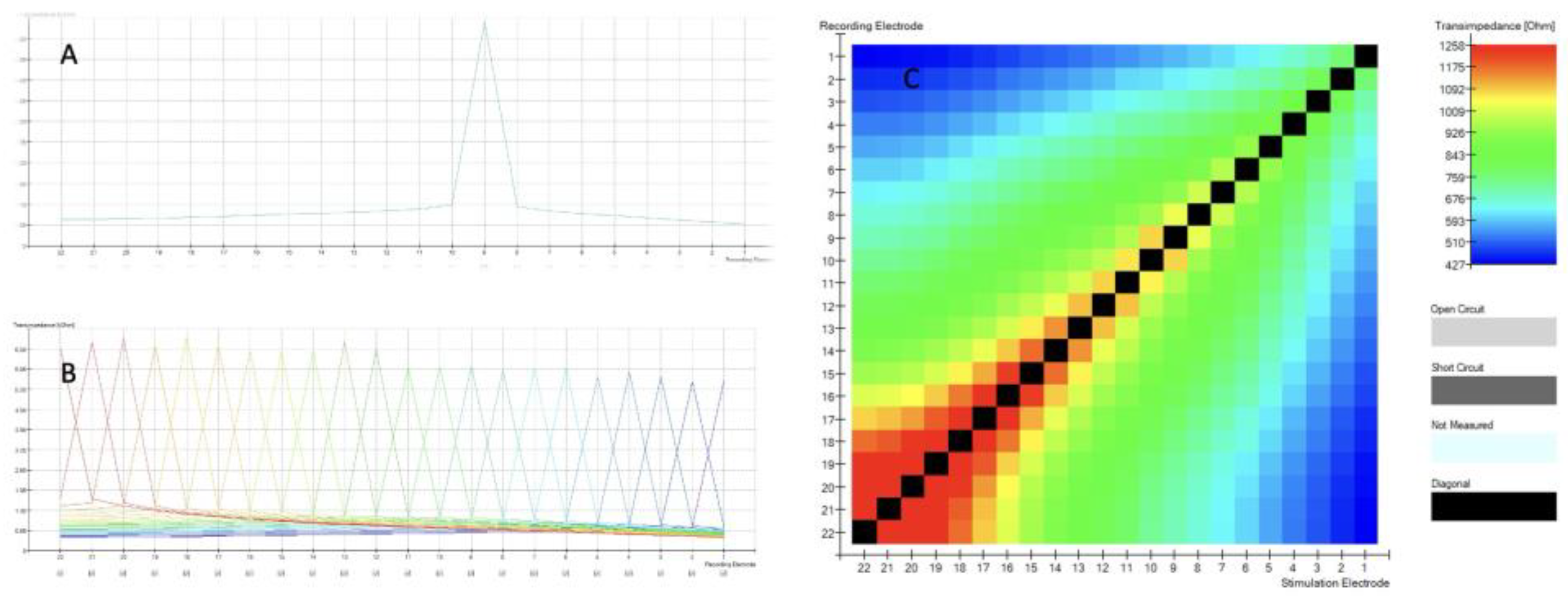
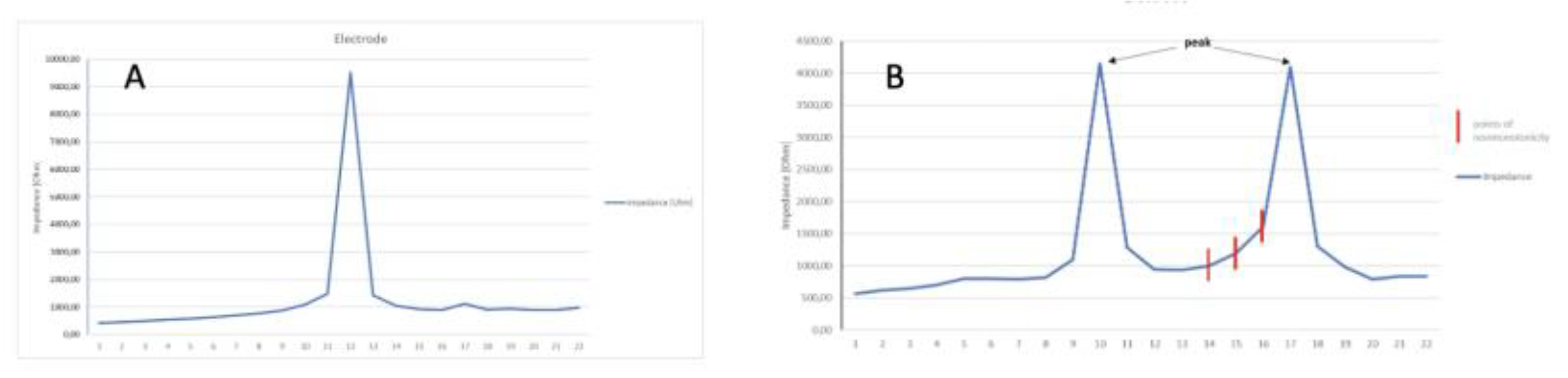
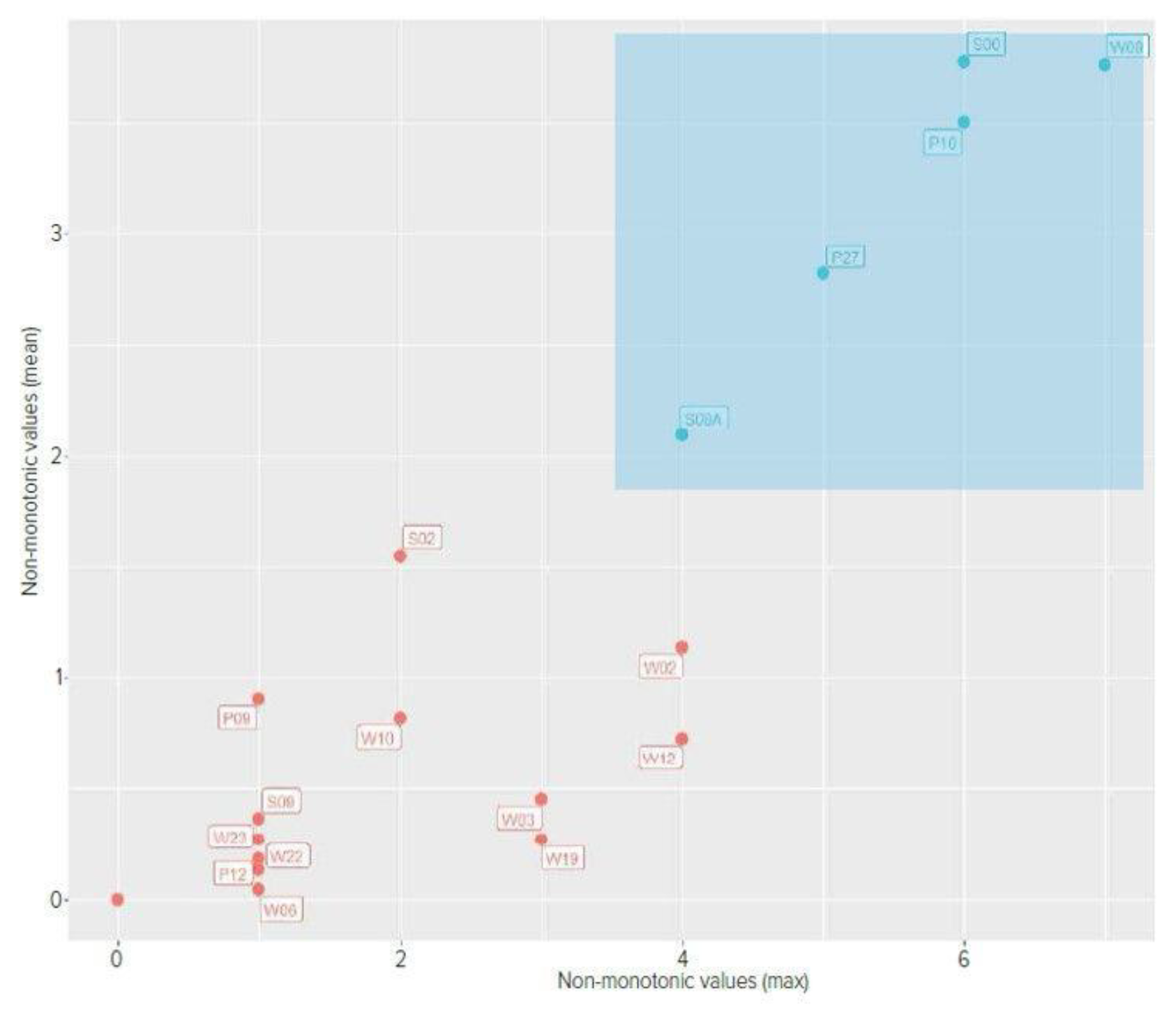
- Mean number of points of non-monotonicity
- Mean number of peaks in the matrix
- Maximum number of points of non-monotonicity
- Maximum number of peaks in the matrix
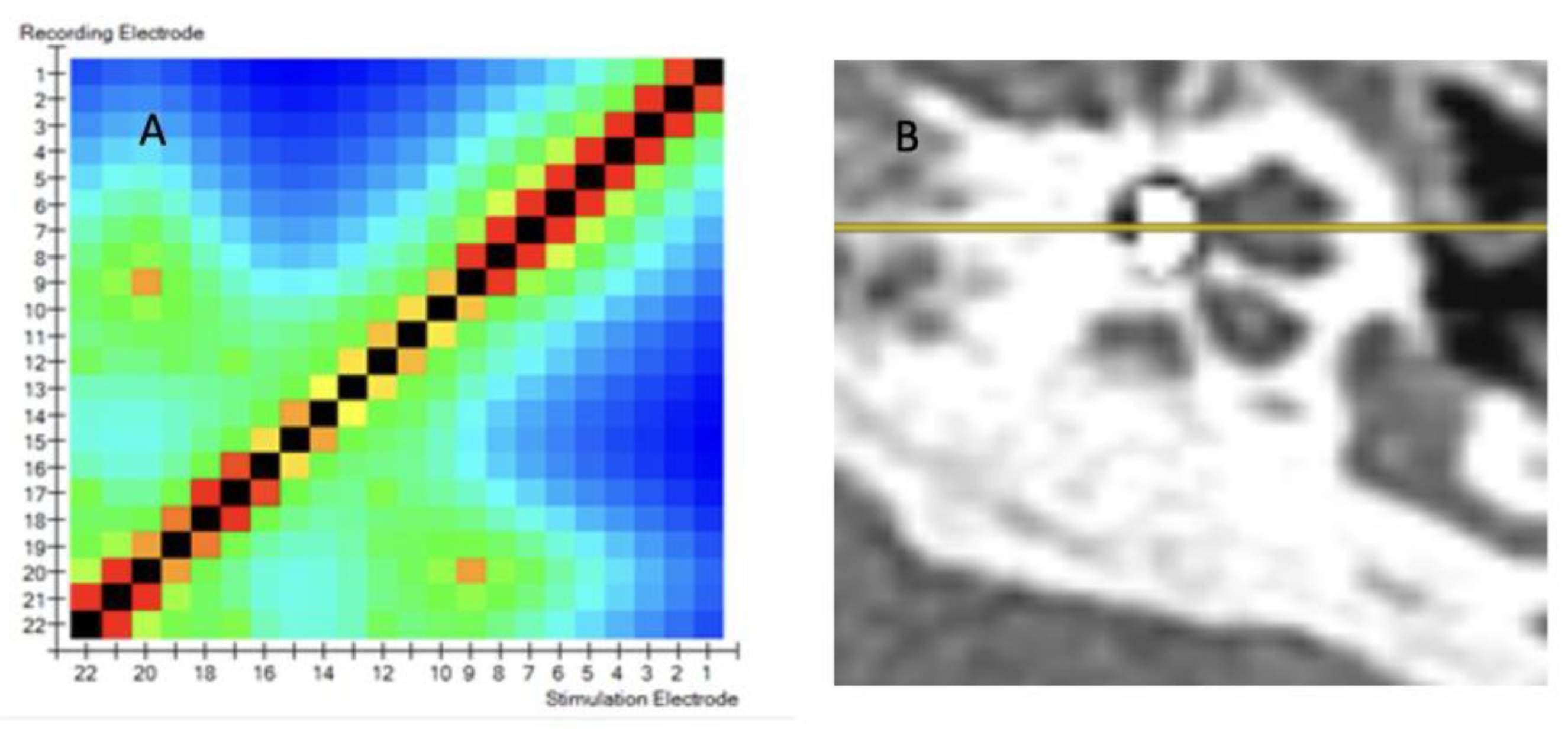
- mean number of points of non-monotonicity
- mean number of peaks in the matrix
- maximum number of points of non-monotonicity
- maximum number of peaks in the matrix
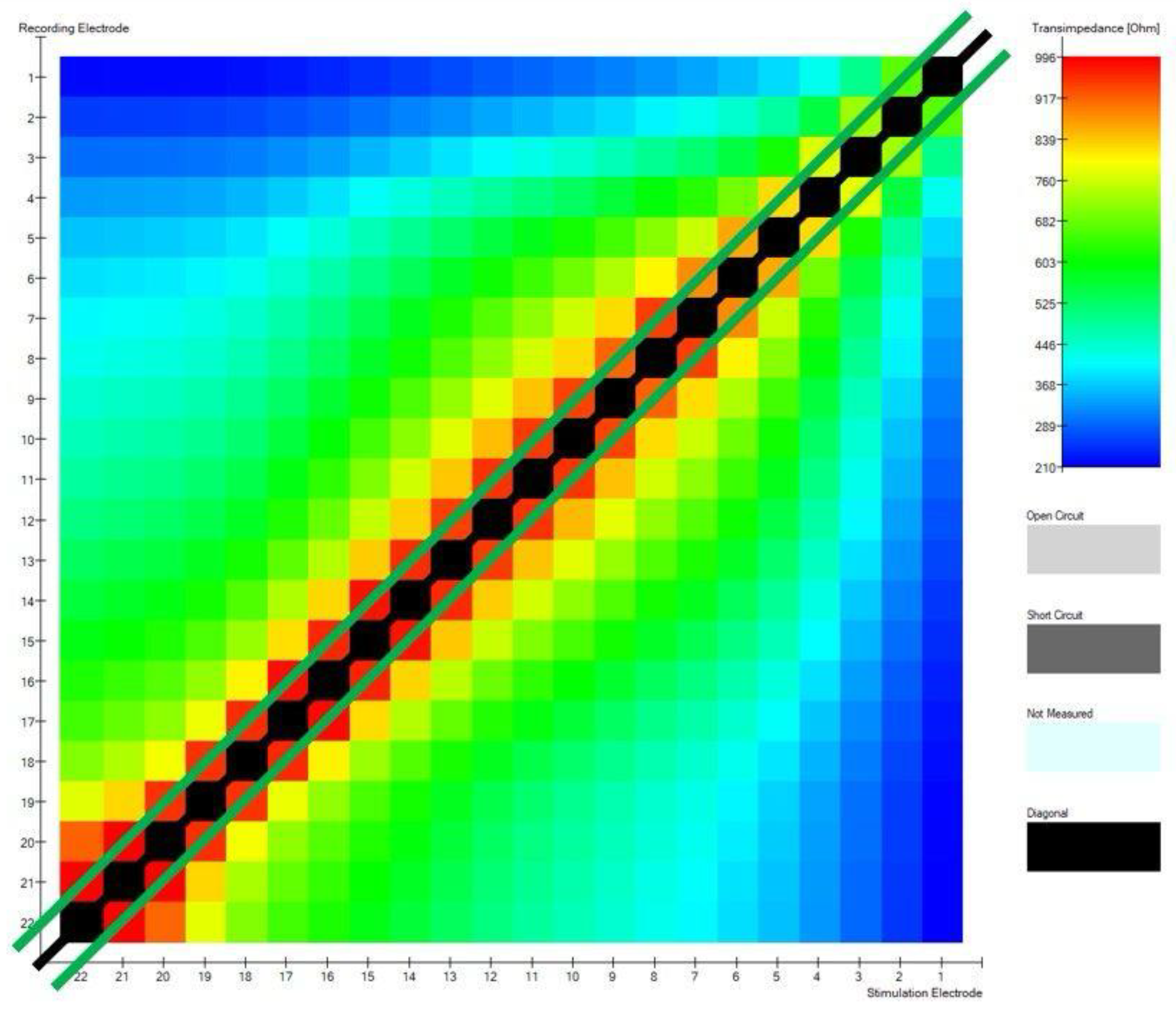
- correct construction of the diagonal
- minimalities on the sub-diagonals
3. Results

| Measure | Mean value - in foldover cases | Mean value - proper insertion cases | T test | df | p |
|
3.045 | 0.064 | -7.882 | 3.066 | 0.004 |
|
1.727 | 1.041 | -4.877 | 3.272 | 0.013 |
|
5.250 | 0.109 | -10.667 | 3.082 | 0.002 |
|
2.750 | 1.043 | -3.558 | 3.024 | 0.037 |
|
0,750 | 0,935 | 0,731 | 3,131 | 0,516 |
|
32,250 | 31,783 | -0,107 | 3,124 | 0,921 |
| Measure | Mean value in CA electrode | Mean value in SM electrode | T test | df | p-value |
|
0 | 0.098 | -1.655 | 29 | 0.109 |
|
1 | 1.063 | -1.437 | 29 | 0.161 |
|
0 | 0.167 | -1.980 | 29 | 0.057 |
|
1 | 1.067 | -1.439 | 29 | 0.161 |
|
1 | 0.900 | 1.795 | 29 | 0.083 |
|
29.750 | 32.867 | -2.258 | 29 | 0.034 |
4. Discussion
5. Conclusions
Author Contributions
Funding
Institutional Review Board Statement
Data Availability Statement
Conflicts of Interest
References
- Perenyi, A.; Toth, F.; Dimak, B.; Nagy, R.; Schoerg, P.; Jori, J.; Kiss, J.G.; Sprinzl, G.; Csanady, M.; Rovo, L. Electrophysiological measurements with electrode types of different perimodiolar properties and the same cochlear implant electronics - a retrospective comparison study. J Otolaryngol Head Neck Surg. 2019, 48, 46. [Google Scholar] [CrossRef] [PubMed] [PubMed Central]
- Aschendorff, A.; Briggs, R.; Brademann, G.; Helbig, S.; Hornung, J.; Lenarz, T.; Marx, M.; Ramos, A.; Stöver, T.; Escudé, B.; James, C.J. Clinical investigation of the Nucleus Slim Modiolar Electrode. Audiol Neurootol. 2017, 22, 169–179. [Google Scholar] [CrossRef] [PubMed]
- Haber, K.; Neagu, A.; Konopka, W.; Amernik, K.; Gheorghe, D.C.; Drela, M.; Wrukowska-Niemczewska, I.; Mierzwiński, J. The influence of Slim Modiolar electrode on residual hearing in pediatric patients. Eur Arch Otorhinolaryngol. 2021, 278, 2723–2732. [Google Scholar] [CrossRef] [PubMed]
- Gabrielpillai, J.; Burck, I.; Baumann, U.; Stöver, T.; Helbig, S. Incidence for Tip Foldover During Cochlear Implantation. Otol Neurotol. 2018, 39, 1115–1121. [Google Scholar] [CrossRef]
- Zuniga, M.G.; Rivas, A.; Hedley-Williams, A.; Gifford, R.H.; Dwyer, R.; Dawant, B.M.; Sunderhaus, L.W.; Hovis, K.L.; Wanna, G.B.; Noble, J.H.; Labadie, R.F. Tip Fold-over in Cochlear Implantation: Case Series. Otol Neurotol. 2017, 38, 199–206. [Google Scholar] [CrossRef]
- Fishman, A.J.; Roland JTJr Alexiades, G.; Mierzwinski, J.; Cohen, N.L. Fluoroscopically assisted cochlear implantation. Otol Neurotol. 2003, 24, 882–6. [Google Scholar] [CrossRef]
- Perényi, Á.; Nagy, R.; Dimák, B.; Csanády, M.; Jóri, J.; Kiss, J.G.; Rovó, L. Cochlearis implantátumok különböző, előre görbített elektródasorainak elhelyezkedése a cochlea tengelyéhez viszonyítva. Radiológiai vizsgálat a perimodiolaritás mértékének megállapítására [The distance from the modiolus of perimodiolar electrode arrays of cochlear implants. A radiological study to evaluate the difference in perimodiolar properties]. Orv Hetil. 2019, 160, 1216–1222 Hungarian. [Google Scholar] [CrossRef] [PubMed]
- Grolman, W.; Maat, A.; Verdam, F.; Simis, Y.; Carelsen, B.; Freling, N.; Tange, R.A. Spread of excitation measurements for the detection of electrode array foldovers: a prospective study comparing 3-dimensional rotational x-ray and intraoperative spread of excitation measurements. Otol Neurotol. 2009, 30, 27–33. [Google Scholar] [CrossRef]
- Vanpoucke, F.J.; Boermans, P.P.; Frijns, J.H. Assessing the placement of a cochlear electrode array by multidimensional scaling. IEEE Trans Biomed Eng. 2012, 59, 307–10. [Google Scholar] [CrossRef]
- Hoppe, U.; Brademann, G.; Stöver, T.; Ramos de Miguel, A.; Cowan, R.; Manrique, M.; Falcón-González, J.C.; Hey, M.; Baumann, U.; Huarte, A.; Liebscher, T.; Bennett, C.; English, R.; Neben, N.; Ramos Macías, A. Evaluation of a Transimpedance Matrix Algorithm to Detect Anomalous Cochlear Implant Electrode Position. Audiol Neurootol. 2022, 27, 347–355. [Google Scholar] [CrossRef]
- Leblans, M.; Zarowski, A.; Molisz, A.; van Dinther, J.; Dedeyne, J.; Lerut, B.; Kuhweide, R.; Offeciers, E. Cochlear implant electrode array tip-foldover detection by electrode voltage telemetry. Cochlear Implants Int. 2023, 24, 95–106. [Google Scholar] [CrossRef] [PubMed]
- Holden, L.K.; Finley, C.C.; Firszt, J.B.; Holden, T.A.; Brenner, C.; Potts, L.G.; Gotter, B.D.; Vanderhoof, S.S.; Mispagel, K.; Heydebrand, G.; Skinner, M.W. Factors affecting open-set word recognition in adults with cochlear implants. Ear Hear. 2013, 34, 342–60. [Google Scholar] [CrossRef] [PubMed]
- Varghese, J.J.; Walia, A.; Lefler, S.M.; Ortmann, A.J.; Shew, M.A.; Durakovic, N.; Wick, C.C.; Herzog, J.A.; Buchman, C.A. Identifying Slim Modiolar Electrode Tip Fold-Over With Intracochlear Electrocochleography. Otolaryngol Head Neck Surg. 2024, 170, 1124–1132. [Google Scholar] [CrossRef] [PubMed]
- Harris, M.S.; Riggs, W.J.; Giardina, C.K.; O'Connell, B.P.; Holder, J.T.; Dwyer, R.T.; Koka, K.; Labadie, R.F.; Fitzpatrick, D.C.; Adunka, O.F. Patterns Seen During Electrode Insertion Using Intracochlear Electrocochleography Obtained Directly Through a Cochlear Implant. Otol Neurotol. 2017, 38, 1415–1420. [Google Scholar] [CrossRef] [PubMed]
- Gawęcki, W.; Balcerowiak, A.; Podlawska, P.; Borowska, P.; Gibasiewicz, R.; Szyfter, W.; Wierzbicka, M. Robot-Assisted Electrode Insertion in Cochlear Implantation Controlled by Intraoperative Electrocochleography-A Pilot Study. J Clin Med. 2022, 11, 7045. [Google Scholar] [CrossRef] [PubMed] [PubMed Central]
- Jwair, S.; Prins, A.; Wegner, I.; Stokroos, R.J.; Versnel, H.; Thomeer, H.G.X.M. Scalar Translocation Comparison Between Lateral Wall and Perimodiolar Cochlear Implant Arrays - A Meta-Analysis. Laryngoscope. 2021, 131, 1358–1368. [Google Scholar] [CrossRef]
- Klabbers, T.M.; Huinck, W.J.; Heutink, F.; Verbist, B.M.; Mylanus, E.A.M. Transimpedance Matrix (TIM) Measurement for the Detection of Intraoperative Electrode Tip Foldover Using the Slim Modiolar Electrode: A Proof of Concept Study. Otol Neurotol. 2021, 42, e124–e129. [Google Scholar] [CrossRef]
- Ramos-Macias, A.; RDe Miguel, A.; Falcon-González, J.C. Mechanisms of electrode fold-over in cochlear implant surgery when using a flexible and slim perimodiolar electrode array. Acta Otolaryngol. 2017, 137, 1129–1135. [Google Scholar] [CrossRef]
- Salkim, E.; Zamani, M.; Jiang, D.; Saeed, S.R.; Demosthenous, A. Insertion Guidance Based on Impedance Measurements of a Cochlear Electrode Array. Front Comput Neurosci. 2022, 16, 862126. [Google Scholar] [CrossRef]
- Gottfried, T.M.; Galeazzi, P.; Föger, A.; Dejaco, D.; Tröger, A.; Fischer, N.; Innerhofer, V.; Di Trapani, F.; Weiss, N.; Seebacher, J.; Dierker, A.; Schmutzhard, J. Evaluation of an impedance-based method to monitor the insertion of the electrode array during cochlear implantation. Eur Arch Otorhinolaryngol. 2024, 281, 4121–4131. [Google Scholar] [CrossRef]
- Lee, S.Y.; Kim, Y.S.; Jo, H.D.; et al. Effects of in vivo repositioning of slim modiolar electrodes on electrical thresholds and speech perception. Sci Rep 2021, 11, 15135. [Google Scholar] [CrossRef]
- Riojas, K.E.; Bruns, T.L.; Granna, J.; Webster, R.J., 3rd; Labadie, R.F. Robotic pullback technique of a precurved cochlear-implant electrode array using real-time impedance sensing feedback. Int J Comput Assist Radiol Surg. 2023, 18, 413–421. [Google Scholar] [CrossRef]
- Riojas, K.E.; Bruns, T.L.; Granna, J.; Smetak, M.R.; Labadie, R.F.; Webster, R.J., 3rd. Towards inferring positioning of straight cochlear-implant electrode arrays during insertion using real-time impedance sensing. Int J Med Robot. 2024, 20, e2609. [Google Scholar] [CrossRef]
- Pile, J.; Sweeney, A.D.; Kumar, S.; Simaan, N.; Wanna, G.B. Detection of modiolar proximity through bipolar impedance measurements. Laryngoscope. 2017, 127, 1413–1419. [Google Scholar] [CrossRef] [PubMed]
Disclaimer/Publisher’s Note: The statements, opinions and data contained in all publications are solely those of the individual author(s) and contributor(s) and not of MDPI and/or the editor(s). MDPI and/or the editor(s) disclaim responsibility for any injury to people or property resulting from any ideas, methods, instructions or products referred to in the content. |
© 2024 by the authors. Licensee MDPI, Basel, Switzerland. This article is an open access article distributed under the terms and conditions of the Creative Commons Attribution (CC BY) license (http://creativecommons.org/licenses/by/4.0/).