

Submitted:
29 November 2024
Posted:
02 December 2024
You are already at the latest version
Abstract
This study examines the application of discount strategies to reduce consumer food waste in Indonesia, focusing on the interplay between bundling discounts as short-term interventions and loyalty member discounts as long-term interventions. Indonesia is a country facing serious environmental and economic challenges due to its position among the largest generators of food waste in the world. This research investigates the impact of bundling discounts, moderated by impulsive buying, and loyalty member discounts, moderated by value-seeking behavior, on reducing food waste. In a quantitative approach, SEM was employed, with data sampled through questionnaires distributed across major Indonesian cities renowned for their large restaurant industries, including Bali, Jakarta, Yogyakarta, and Malang. A total of 350 questionnaires distributed resulted in 312 eligible for further analysis. The findings indicate that bundling discounts have certain positive effects, which are usually weakened by impulsive buying, leading to over-purchasing. However, loyalty member discounts have stronger and more sustainable impacts, mediated by value-seeking behavior that encourages planned and responsible consumption. These findings highlight that tailored discount strategies have a critical role in food waste reduction, while loyalty programs provide an effective framework for sustainability. Insights from this study put restaurant managers and policymakers in a better position to align Indonesia's discount strategies with its sustainability goals and to advance responsible consumption practices in the restaurant sector.
Keywords:
Food Waste
; Bundling Discount
; Loyalty Programs Discount
; Impulsive Buying
; Value-Seeking Behavior
; Sustainable Tourism
; Consumer Food Waste Reduction Behavior
; Structural Equation Modeling (SEM)
; Sustainability
1. Introduction
The large scale of waste of food in Indonesia has placed this problem among the significant issues, especially in the household and restaurant sectors. It is noted that about 23-48 million tons of organic waste produced annually; therefore Indonesia ranks as one of the leading countries producing food waste in the world [1]. The consumption behavior derived from multiple discount schemes offered by restaurants and retailers, especially bundling discounts and loyalty member discounts, is one of the contributing factors to such high food waste. Prior work has examined how food waste reduction behaviour might vary as a function of consumer preference for restaurant type using a theoretical approach that focuses on hedonic and instrumental values as mediating variables. These studies have been more conceptual, focusing on the emotional versus rational factors in decision-making. As a development of this approach, the current study uses discount strategies as a more practical and measurable external factor to influence food waste reduction behavior. Discounts, as a direct economic incentive, provide a clearer and more specific depiction of consumer behavior changes, whereas the nudge theory in previous research involved more abstract perceptions and motivations [2]. Therefore, this study broadens the understanding of how external factors-from restaurant preferences to discount strategies-can influence the reduction in food waste more tangibly and measurably.
In this study, the main focus is on how bundling discounts and loyalty member discounts can influence consumer food waste reduction behavior, considering impulsive buying and value seeking as moderating variables. Bundling discounts, which are often used to encourage the purchase of more products at a lower price, have the potential to increase overconsumption, particularly among consumers with a tendency toward impulsive buying [3]. A study by [4] shows that bundling discounts often trigger impulsive behavior because consumers feel they get a better deal, while it overtriggers and increases food waste. Therefore, there should be further understanding regarding impulsive buying moderation in the context of a bundling discount to judge if there is food waste reduction or its opposite.
On the contrary, loyalty member discounts take a long-term view in building customer loyalty through rewards for frequent purchases [5]. According to a study by [6], customers enrolled in loyalty programs often search for more value from their purchases, referred to as value seeking, which might influence their decisions to reduce food waste in the long run. However, existing literature still lacks an exploration of how value seeking moderates the relationship between loyalty member discounts and food waste reduction behavior. This study aims at filling that lacuna by exploring the long-term influence of loyalty member discounts on consumer food waste reduction.
This research will add to the current literature by integrating both the short-term and long-term outlooks on bundling and loyalty member discounts with respect to affecting consumer behavior towards food waste reduction. Moreover, this study investigates the role of impulsive buying and value seeking as moderators, which has not been commonly addressed in prior literature, hence offering substantial contributions towards understanding consumer behavior related to food waste reduction in Indonesia. This raises the question: How do short-term bundling discount strategies and long-term loyalty membership programs influence food waste reduction behavior, with impulsive buying and value-seeking as moderators? The answer to this will be of utmost importance in addressing not only the literature gap but also in providing practical insights in how to design discount strategies effectively, balancing economic incentive and sustainability goals for responsible consumption in Indonesia's restaurant sector.
2. Materials and Methods
2.1. Discount Theory: Bundling & Loyalty Programs
Discounts are a widely used promotional tool that influence consumer behavior through mechanisms such as price cuts, bundling, coupons, and loyalty programs. These strategies enhance perceived value and urgency, driving consumption and brand loyalty [7], but their application must balance optimizing sales with potential negative outcomes, such as food waste in the food service industry. Bundling and coupons boost sales by decreasing perceived acquisition costs [4] but could lead to over-ordering, impulse buying, and the tendency toward stockpiling and hence waste [8] The loyalty programs, although building long-term relationships with customers and value perceptions [5] might create over-consumption in unintended ways, due to the customer wanting to have more rewards [9,10]. The effectiveness of discount strategies varies based on consumer traits, with price-sensitive consumers responding more to direct discounts and value-seekers preferring bundling offers [10]. To avoid unsustainable behaviors such as food waste, businesses must align discount strategies with sustainable practices, like offering smaller portions or incentivizing leftover takeaway [11]. Therefore, the nuanced understanding of the effect of different types of discounts is significant for achieving profitability and sustainability goals in consumer-driven industries.
2.2. Food Waste
Food waste is the rejected amount of food, which has value and is fit for consumption, and includes leftovers from meals, vegetables that become limp, fruits that are rotten, and those goods that are past expiration but not consumed [12,13]. Food waste occurs from production and distribution to food services and consumption. However, the largest section has been consumer behavior [13,14] and the most consuming is identified as urban consumers [14]. Effective food waste management involves systematic planning to reduce unnecessary food loss and maximize the utilization or recycling of consumable food [15]. This practice is essential for fostering eco-friendly restaurants and promoting sustainable tourism by minimizing environmental impacts and conserving natural resources. Implementing food waste management strategies in the restaurant sector is crucial to achieving sustainability goals and addressing food waste challenges.
2.3. Consumer Food Waste Reduction Behavior
Food waste is a pressing global issue with significant economic, environmental, and social consequences, characterized by discarded food across the supply chain, from production to consumption [16]. Annually, 1.3 billion tons of food waste are generated, costing $990 billion and producing 3.3 billion tons of CO2 emissions [17]. It encompasses spoilage and packaging damage to expiry dates. Consumer behavior, as highlighted, is at the heart of food waste generation and potential reduction [18,19]. Sustainable consumption, with the 3R concept in mind-Reduce, Reuse, and Recycle-is centered on meal planning, reuse of leftovers, and avoiding over-purchasing as a principle [20,21] Barriers like mistrust in recycling systems and limited awareness hinder waste management efforts [22]. Effective interventions in the restaurant industry, such as reducing plate sizes and promoting sustainable dining practices, along with sustainable tourism campaigns, encourage responsible behaviors [23]. This underlines the need to combine consumer behavior knowledge with specific waste management practices and sustainability for changes in food waste from households, restaurants, and tourism industries.
2.4. Impulsive Buying
Impulsive buying is a spontaneous, unplanned decision driven by emotional urges, often overriding rational thinking [24,25]. Influenced by psychological traits such as impulsiveness, materialism, and low self-control, as well as situational factors like store layout, promotions, and limited-time offers, this behavior is amplified in environments that create urgency or reduce cognitive resistance [26,27]. While impulsive buying can enhance sales and profitability for businesses, it often leads to negative consequences for consumers, including financial strain, regret, and decreased life satisfaction [16,28]. Theoretical frameworks such as the Stimulus-Organism-Response model, self-regulation theory, and dual-process theory explain the interplay of environmental stimuli, self-control, and decision-making processes in impulsive buying behavior [26,29]. While good for businesses, this has harmful effects on the consumers and calls for strategies aimed at enabling one to better handle his or her impulses, especially in an environment set to initiate impulsive buying.
2.5. Value-Seeking Behavior
Value-seeking behavior is a consumer's purposeful attempt to maximize perceived benefits relative to cost through the trade-offs of quality, functionality, and price. Embedded in conceptual frameworks such as the Theory of Consumption Values [21] and Perceived Value Theory [30] this behavior is still influenced by psychological factors such as frugality, price consciousness, and perceived risk, besides situational factors such as economic conditions and promotional activities. Consumers strive for value by saving resources, reducing costs without affecting quality, or using other means such as reading online reviews to make better decisions [10,31]. Value-seeking behavior has a significant effect on brand loyalty, where consumers will choose a brand when perceived value is high and switch brands when their expectation of value cannot be met [32]. It also extends to sustainable consumption, where consumers are willing to pay premiums for eco-friendly or ethically produced goods if they perceive added value [33]. Understanding this behavior enables businesses to align strategies with consumer expectations, fostering satisfaction and long-term loyalty.
2.6. Hypothesis Development
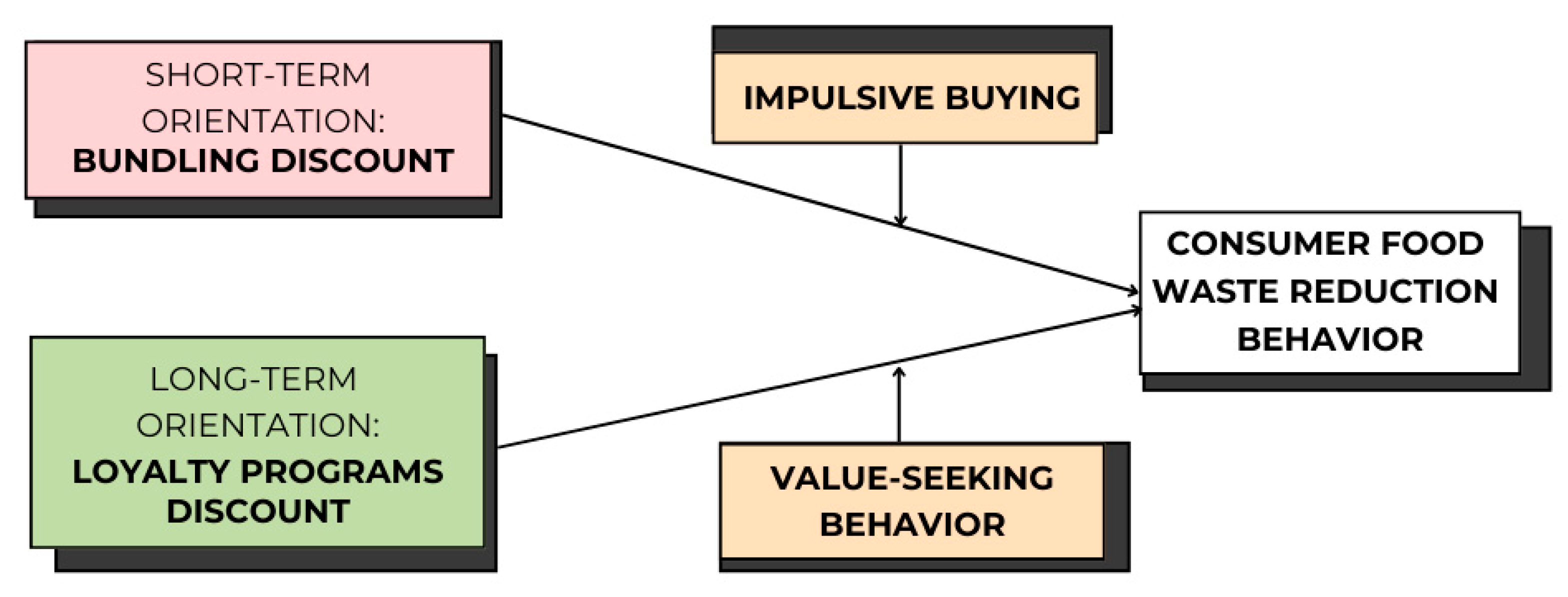
This research investigates the effect of two kinds of discounts: bundling and loyalty member on consumer food waste reduction behavior. Bundling discounts, which are short-term in nature, are expected to affect consumer behavior through impulsive buying as a moderator, in which consumers always tend to buy more products without much earlier planning. Meanwhile, loyalty member discounts are long-term in nature; thus, it is assumed to influence food waste reduction behavior through value seeking, with consumers having more regard for the derived long-term value from their purchases. This paper aims to understand how these short-term and long-term mechanisms interact with consumer behavior vis-à-vis food waste reduction. The following are the hypotheses of this study:
- STUDY A (SHORT-TERM)
Hypothesis 1: The Influence of Bundling Discounts on Consumer Food Waste Reduction Behavior.
Hypothesis 2: The Influence of Bundling Discounts on Consumer Food Waste Reduction Behavior Moderated by Impulsive Buying.
- 2.
- STUDY B (LONG-TERM)
Hypothesis 1: The Influence of Loyalty Member Discounts on Consumer Food Waste Reduction Behavior.
Hypothesis 2: The Influence of Loyalty Member Discounts on Consumer Food Waste Reduction Moderated by Value Seeking.
2.7. Research Gap
The existing literature lacks a complete examination of the effects of discount strategies, namely bundling discounts and loyalty member discounts, on food waste reduction behavior in spite of numerous studies on the reduction of food wastes and consumer behavior. While many past research studies have dealt mainly with theoretical constructs such as hedonic and instrumental values, the practical influence of measurable factors like discounts has been underexplored. While bundling discounts are known to encourage impulsive buying and overconsumption, their role in either mitigating or exacerbating food waste, especially with impulsive buying as a moderating factor, has not been analyzed to a sufficient extent. The influence of loyalty member discounts on reduction in food wastage, through value-seeking behavior, also is insufficiently examined. This research has overcome the existing gaps in studies by examining the immediate and long-term effects of bundling and loyalty member discounts on food waste reduction by consumers, using impulsive buying and value seeking as moderating variables. Through the gapped research area, it shows that discount strategies can balance economic incentives and sustainability goals, hence providing broad insights relevant to the advancement of academic literature and industrial practices in the restaurant sector.
2.8. Research Methods
This study uses quantitative research methods, with confirmatory data analysis using Structural Equation Modeling (SEM) with SmartPLS software and the bootstrapping method to test hypotheses. Surveys were conducted in cities that had both eco-friendly and regular restaurants: Bali, Jakarta, Yogyakarta, and Malang, through structured questionnaires. Data were collected from a total sample of 312 participants who had dined in these kinds of restaurants within the last three months. The questionnaires included demographic information, dining preferences, perceptions of restaurant attributes, and self-reported food waste behaviors, while hedonic and instrumental values were measured with validated scales. Restaurant type, consumer values, and food waste reduction behavior were analyzed using SEM, while mediation analysis tested the role of hedonic and instrumental values. Ethical considerations meant participants were informed and confidentiality maintained. Frequency distribution and mean score were used to summarize data through descriptive analysis. A 7-point Likert scale was utilized, ranging from 1 for "strongly disagree" to 7 for "strongly agree", which can be interpreted. The results imply suggestions for decreasing food waste and make recommendations for managers of restaurants and policy makers, especially within Indonesian tourism-dependent areas.

Table 1.
Baseline of Indicator Score Interpretation in Research Variable.
| No | Average Interval | Interpretation |
|---|---|---|
| 1 | 1.00 - 1.85 | Strongly Disagree |
| 2 | 1.86 - 2.71 | Disagree |
| 3 | 2.72 - 3.57 | Moderately Disagree |
| 4 | 3.58 - 4.43 | Neutral |
| 5 | 4.44 - 5.29 | Moderately Agree |
| 6 | 5.30 - 6.15 | Agree |
| 7 | 6.16 - 7.00 | Strongly Agree |
Source: Research Result, 2024
Below is the conceptual framework that gives further insight into the relationships between the key variables examined in this study. This contains the basic theoretical framework and interactions based on our hypotheses. The Conceptual Research Framework of this research is shown below.
Figure 1.
Framework Study. Source: Author's Data, 2024.
3. Results
This section presents the results of the data analysis, addressing the research objectives and testing the proposed hypotheses. Key findings and their implications are outlined based on the relationships between the variables:
3.1. Measurement Model (Outer Model)
This measurement model, estimated by the PLS program, looks for dominant indicators as direct representatives of the latent variables by checking out their loading or weight factors. Because the research study utilizes descriptive statistics and confirmatory research with the use of census or population data, meaning and usual criteria of inference are insignificant. Interest lies in confirming well-established theories using population data, where re-estimation is not needed to be emphasized, but rather the most influential loading factors or weight estimates.
Table 2.
The Summary of Measurement Model Evaluation / Outer Model (Bundling Discount).
| Latent Variable | Observed Variable | Convergent Validity | Composite Reliability (CR > 0,7) |
||||
|---|---|---|---|---|---|---|---|
| (LF > 0,5 =Valid) | (AVE > 0,5=Valid) | ||||||
| Loading Factor | Result | AVE | Result | CR | Result | ||
| Bundling Discount | The accumulated purchase amount to qualify for a discount. | 0,820 | Valid | 0,644 | Valid | 0,900 | Reliable |
| Purchase frequency by members. | 0,865 | Valid | |||||
| Percentage of discount for members. | 0,895 | Valid | |||||
| Consumer loyalty level towards the program. | 0,872 | Valid | |||||
| Consumer satisfaction with the loyalty program. | 0,751 | Valid | |||||
| Impulsive Buying | Frequency of price comparison to seek greater value. | 0,685 | Valid | 0,683 | Valid | 0,914 | Reliable |
| Satisfaction with lower prices. | 0,867 | Valid | |||||
| Behavior of seeking better discounts. | 0,886 | Valid | |||||
| Increased shopping frequency for greater value. | 0,856 | Valid | |||||
| Preference for promotions that offer more value. | 0,823 | Valid | |||||
| Consumer Food Waste Reduction Behavior | Reducing portion sizes to avoid leftovers. | 0,606 | Valid | 0,621 | Valid | 0,891 | Reliable |
| Frequency of finishing meals completely . | 0,807 | Valid | |||||
| Efforts to take leftover food home (takeaway). | 0,852 | Valid | |||||
| Storing leftover food for later consumption. | 0,817 | Valid | |||||
| Frequency of discarding unfinished food. | 0,856 | Valid | |||||
Source: SmartPLS Data Result, 2024
The measurement model results indicate that loadings for all variables are higher than 0.5, which confirms appropriateness indicators to further analysis. The AVE values are greater than 0.5, which shows satisfactory convergent validity of the measures, while CR values are above 0.7, hence the constructs are reliable. In particular, the AVE related to the Bundling Discount variable is 0.644, and the CR is 0.900, showing adequate validity and strong reliability. The impulsive buying variable has an AVE of 0.683 and a CR of 0.914, which means that this construct is reliable and appropriate. In the case of the Consumer Food Waste Reduction Behavior variable, its AVE is 0.621, and CR is 0.891, reflecting good validity and reliability. These results confirm the good fit of the overall outer model, rendering it suitable for further analysis.
Table 3.
The Summary of Measurement Model Evaluation / Outer Model (Loyalty Programs Discount).
| Latent Variable | Observed Variable | Convergent Validity | Composite Reliability (CR > 0,7) |
||||
|---|---|---|---|---|---|---|---|
| (LF > 0,5 =Valid) | (AVE > 0,5=Valid) | ||||||
| Loading Factor | Result | AVE | Result | CR | Result | ||
| Loyalty Programs Discount | No specific policy regarding waste management. | 0,756 | Valid | 0,709 | Valid | 0,924 | Reliable |
| Use of plastic or single-use packaging. | 0,732 | Valid | |||||
| No initiative for using local ingredients. | 0,700 | Valid | |||||
| Standard menu without a focus on sustainability or health. | 0,786 | Valid | |||||
| Little to no recycling or waste management policies. | 0,756 | Valid | |||||
| Value-Seeking Behavior | Food selection based on price and value factors. | 0,875 | Valid | 0,683 | Valid | 0,914 | Reliable |
| Comparison level between price and food quality. | 0,775 | Valid | |||||
| Efforts to avoid food waste. | 0,832 | Valid | |||||
| Preference for portion sizes that match needs. | 0,701 | Valid | |||||
| Time efficiency in choosing a dining place | 0,682 | Valid | |||||
| Consumer Food Waste Reduction Behavior | Reducing portion sizes to avoid leftovers. | 0,774 | Valid | 0,629 | Valid | 0,893 | Reliable |
| Frequency of finishing meals completely . | 0,875 | Valid | |||||
| Efforts to take leftover food home (takeaway). | 0,741 | Valid | |||||
| Storing leftover food for later consumption. | 0,815 | Valid | |||||
| Frequency of discarding unfinished food. | 0,694 | Valid | |||||
Source: SmartPLS Data Result, 2024
The measurement model results show that all variables have loading factors greater than 0.5, hence confirming appropriateness of the set of indicators for further analysis. The AVE values are above 0.5, indicating that convergent validity is satisfactory, while CR values are above 0.7, which shows that constructs are reliable. In particular, the AVE for Loyalty Programs Discount corresponds to 0.709, and the CR to 0.924, so its validity and reliability are appropriate. Thus, the AVE for Value-Seeking Behavior is 0.683 and CR is 0.914, showing that the reliability is strong. Similarly, for the variable of Consumer Food Waste Reduction Behavior, the AVE is 0.629 and CR is 0.893, hence it is well-reliable and appropriate for further analysis.These findings confirm that the overall outer model fits well and therefore justify moving into the next steps of analysis.
3.2. Structural Model Evaluation (Model Fit Test)
Table 4.
Results of R Square and Q Square Values.
| Variable | R-Square Adjusted | Q-Square |
|---|---|---|
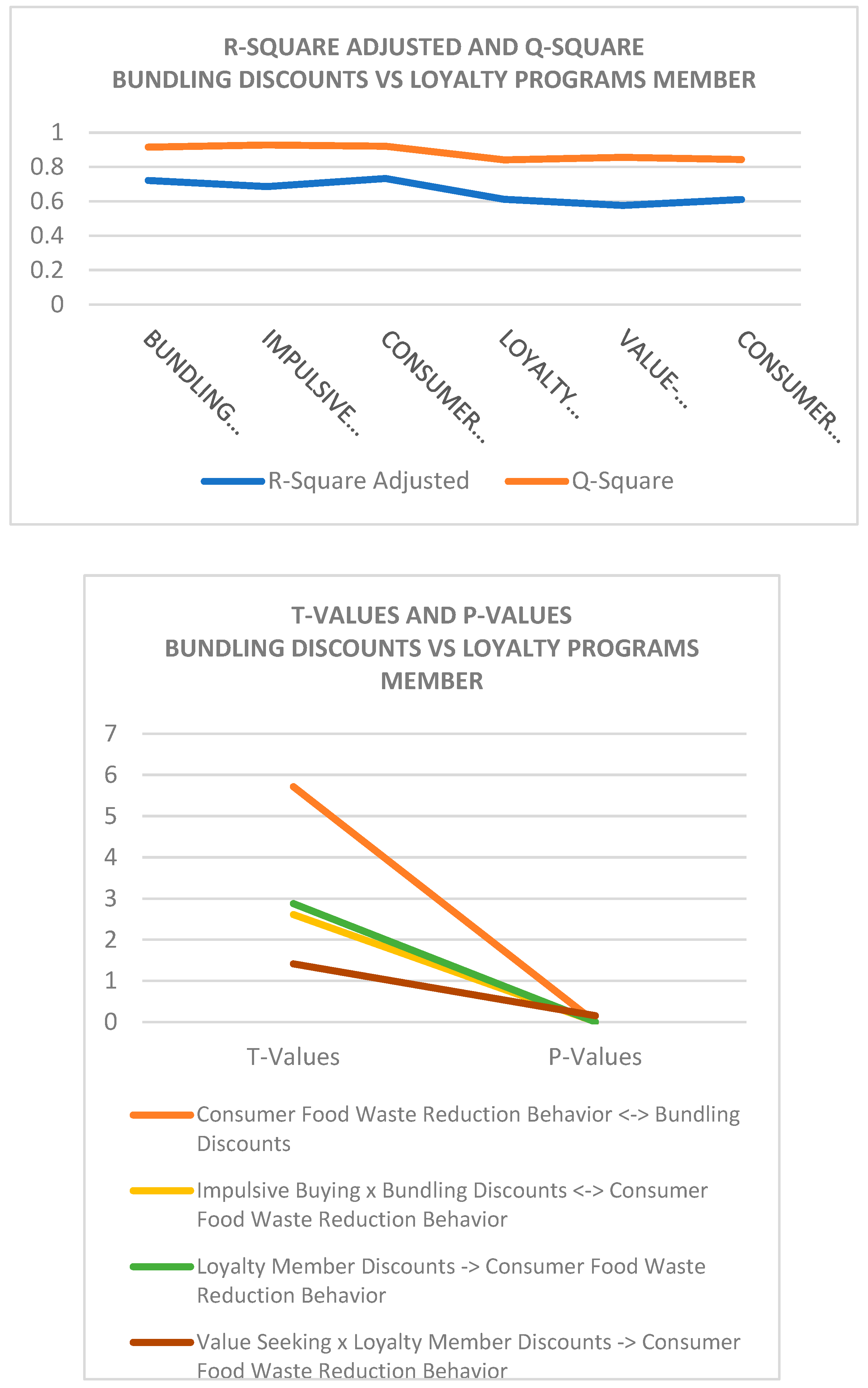
| Bundling Discounts | 0,721 | 0,915 |
| Impulsive Buying | 0,685 | 0,928 |
| Consumer Food Waste Reduction Behavior | 0,733 | 0,92 |
| Loyalty Programs Member | 0,611 | 0,841 |
| Value-Seeking Behavior | 0,576 | 0,855 |
| Consumer Food Waste Reduction Behavior | 0,61 | 0,843 |
Source: SmartPLS Data Result, 2024.
Based on Table 4, the structural model analysis reveals that Bundling Discount, Impulsive Buying, and Consumer Food Waste Reduction Behavior are significant with high effect strengths and have the following adjusted R²: 0.721, 0.685, and 0.733, respectively. The high Q² values confirm the strong predictive relevance of the models, such as above 0.9 for Bundling Discount and above 0.8 for the Loyalty Programs Discount. Food waste is significantly influenced by bundling discounts and impulsive buying, while loyalty programs discounts and value-seeking behavior are strong in ensuring sustainable practices. Hypothesis testing showed all hypotheses to be significant, considering the t-statistic is greater than 1.96 and the p-value is less than 0.05, thus providing meaningful insights into consumer behavior and eco-friendly practices.
Testing Hypotheses Several hypotheses were tested in this study; their acceptance criteria were based on the direction and significance of the relationships between variables. A hypothesis can be regarded as accepted if, from the original sample, the value is positive (same directional influence) or negative (opposite directional influence), with the t-statistic greater than 1.96 one-tailed and the p-value less than 0.05 [34]. All three tested hypotheses met the criteria for acceptance, as confirmed by Bootstrapping analysis using SmartPLS. The following are the results of the hypothesis test:
Table 5.
Bootstraping Path Coefficient (Bundling Discount).
| Original Sample (O) | Sample Mean (M) | Standard Deviation (STDEV) | t-statistik (|O/STDEV|) | p-value | |
|---|---|---|---|---|---|
| Consumer Food Waste Reduction Behavior <-> Bundling Discounts | 0,416 | 0,415 | 0,073 | 5,717 | 0,000 |
| Impulsive Buying x Bundling Discounts <-> Consumer Food Waste Reduction Behavior | 0,292 | 0,255 | 0,112 | 2,612 | 0,010 |
Source: SmartPLS Data Result, 2024.
Table 6.
Bootstraping Path Coefficient (Loyalty Programs Dicount).
| Original Sample (O) | Sample Mean (M) | Standard Deviation (STDEV) | t-statistik (|O/STDEV|) | p-value | |
|---|---|---|---|---|---|
| Loyalty Member Discounts <-> Consumer Food Waste Reduction Behavior | 0,425 | 0,449 | 0,148 | 2,880 | 0,005 |
| Value Seeking x Loyalty Member Discounts <-> Consumer Food Waste Reduction Behavior | 0,057 | 0,060 | 0,040 | 1,415 | 0,160 |
Source: SmartPLS Data Result, 2024.
Table 7.
Hypothesis Testing Results (Bundling Discount).
| No. | Hypothesis | Relationship | Original Sample | t-statistic | p-value | results |
|---|---|---|---|---|---|---|
| 1. | H1 | X1→ Y1 | 0,416 | 5,717 | 0,000 | Accepted |
| 2. | H2 | X1 → M1 → Y1 | 0,292 | 2,612 | 0,010 | Accepted |
Source: SmartPLS Data Result, 2024.
The hypothesis testing results confirm that Eco-Friendly Restaurants, X1, significantly influence the Consumer Food Waste Reduction Behavior, Y2, with an original sample value of 0.826, a t-statistic of 14.860 (>1.96), and a p-value of 0.000 which support H1. Hedonic Values (Y1) also significantly affect Consumer Food Waste Reduction Behavior (Y2) since the original sample value is 0.803, the t-statistic is 13.997 (>1.96), and the p-value is 0.000, hence supporting H2. Furthermore, Hedonic Values (Y1) have a significant effect on Eco-Friendly Restaurants (X1) since the original sample value is 0.860, the t-statistic is 19.219 (>1.96), and the p-value is 0.000, hence supporting H3. All the hypotheses are, therefore, accepted.
Table 8.
Hypothesis Testing Results (Loyalty Programs Discount).
| No. | Hypothesis | Relationship | Original Sample | t-statistic | p-value | results |
|---|---|---|---|---|---|---|
| 1. | H1 | X1→ Y1 | 0,425 | 2,880 | 0,005 | Accepted |
| 2. | H2 | Y1 → M1 → Y1 | 0,057 | 1,415 | 0,160 | Rejected |
Source: SmartPLS Data Result, 2024.
Hypothesis testing result verifies that Loyalty Programs Discount significantly influences Consumer Food Waste Reduction Behavior Judgment, with the value of an original sample being 0.425, t-statistic being 2.880 (>1.96), and p-value being 0.005; hence, supports H1. However, the influence of Consumer Food Waste Reduction Behavior Judgment (Y1) on Consumer Food Waste Reduction Behavior (Y2) is not significant, as mediated by Value-Seeking Behavior (M1), with an original sample value of 0.057, a t-statistic of 1.415 (<1.96), and a p-value of 0.160 (>0.05). Thus, H2 is unsupported.
4. Discussion
4.1. Study A (SHORT-TERM)
The findings of this study reveal that both hypotheses H1 and H2 are supported, demonstrating the significant influence of bundling discounts on consumer food waste reduction behavior. Hypothesis H1 highlights that bundling discounts directly and positively impact food waste reduction, as evidenced by a strong statistical relationship (original sample value = 0.416, t-statistic = 5.717, p-value < 0.05). This suggests that bundling discounts provide consumers with perceived value, encouraging more thoughtful purchase decisions and potentially reducing food waste. Hypothesis H2 confirms that impulsive buying moderates this relationship, with impulsive behavior amplifying the positive effects of bundling discounts on food waste reduction (original sample value = 0.292, t-statistic = 2.612, p-value < 0.05). This indicates that when impulsive buying tendencies are high, consumers are more likely to leverage bundling discounts to align their consumption with their needs, thereby reducing waste. These results underscore the efficacy of bundling discounts as a promotional strategy for fostering sustainable consumption behaviors.
Figure 2.
Diagram Comparison results of R-Square, Q-Square, T-Values, and P-Values analysis. Source: Data Result, 2024.
Figure 2.
Diagram Comparison results of R-Square, Q-Square, T-Values, and P-Values analysis. Source: Data Result, 2024.
This study aligns with perceived value theory [32] demonstrating that bundling discounts enhance consumers' perception of purchase benefits, thereby motivating more responsible consumption behaviors. While bundling discounts are effective in increasing sales, their role in food waste reduction depends heavily on design and consumer characteristics. Properly implemented, such discounts can encourage consumers to order based on actual needs, reducing waste. Strategies like discounts for portion-controlled menus, such as "Eco-Friendly Portions" or "Waste-Free Menu," in addition to consumer education, have shown significant correlation with reduced food waste (p < 0.05). This also falls in line with the theory of nudging, [6], where subtle prompts, portion-based discounts in this case, can be highly effective toward encouraging sustainable consumption without curtailing consumer freedom.
Impulsive buying, therefore, plays a critical moderating role in how bundling discounts influence the propensity to waste food. The habitual impulsive consumers overconsume, hence decreasing the chances of bundling discounts reducing wastes [35] Consumers with better self-control use such discounts responsibly and attach purchases with actual needs. This supports self-control theory [36], which shows a significant relationship (p < 0.05) between self-regulation and the success of waste-reducing bundling strategies. The study addresses a gap in the literature, where bundling discounts have been primarily studied for their impact on sales and satisfaction, with limited exploration of their role in food waste management, particularly in relation to impulsive buying [4,37]. It provides a meaningful contribution because it underlines how bundling discounts, designed with an understanding of consumer impulsivity, can be a dual-purpose tool for promoting sales and sustainability. This is a holistic strategy for responsible consumption, reducing food waste, and especially in the restaurant industry, calls for adjusting bundling discount programs according to the characteristics of consumer impulsiveness.
4.2. Study B (LONG-TERM)
The results suggest that the Loyalty Member Discounts have a significant and positive effect on consumer food waste reduction behavior, as indicated in Hypothesis H1. The statistical relation from the analysis of this hypothesis appears quite strong: original sample value = 0.425; t-statistic = 2.880; p-value = 0.005. This supports the fact that loyalty discounts encourage more mindful consumption and waste reduction. However, H2, which stated that Value-Seeking Behavior moderates this relationship, was not supported because the original sample value is 0.057, the t-statistic is 1.415, and the p-value is 0.160, hence, implying that value-seeking does not enrich the impact of loyalty discounts on less waste. From these results, emerge the direct efficacy of loyalty discounts in the entrenchment of responsible consumption behaviors but at the same time point to the necessity of further strategies to integrate value-seeking elements. Loyalty programs strengthen emotional bonds between consumers and brands, in line with customer-brand relationship theory [38], by offering ongoing rewards that encourage repeated purchases. According to the revised reciprocity theory [39], loyalty discounts can develop a sense of responsibility among consumers, prompting them to order food more consciously to avoid waste. Loyalty programs can do more when combined with approaches that encourage portion-conscious choices or reward sustainable behaviors. All in all, loyalty discounts remain an important tool in aligning consumer behaviors for sustainability with strong brand relationships.
According to the motivated consumer behavior framework by [40] loyalty programs with tailored incentives that align with consumers' actual needs would work in the reduction of food waste. Statistically significant correlations, at p < 0.05, between loyalty-based incentives and measured consumption behaviors hint at the potential of such programs not only to provide financial benefits but also to foster mindful and environmentally sensitive modes of consumption. Strategies such as offering double loyalty points for "Eco-Friendly Portions" or "Waste-Free Menu" items increase consumer consciousness of food quantities to encourage responsible consumption [41]. Behavioral loyalty reinforcement theory supports this by stating that the availability of incentives provided continuously leads to a sustainable consumption habit, while goal-framing theory [21] suggests that strategies like offering appropriate incentives could increase the customer's tendency to choose portion-conscious options. Value-seeking behavior is crucial in moderating the effectiveness of loyalty discounts to reduce food waste.
According to [42], consumers with a high value-seeking orientation are more likely to use loyalty discounts responsibly by matching the food portions to their needs and minimizing waste. On the other hand, low value seekers might exploit loyalty discounts for short-term financial gain and may overpurchase, culminating in food waste. This dichotomy emphasizes the importance of loyalty programs in designing for value-seeking behavior and supporting sustainable consumption patterns. This research bridges a critical gap that has characterized much of the scholarship into the influence of loyalty discounts on customer satisfaction and retention, as documented by [31,43] without considering their potential as a tool for sustainability. Linking loyalty programs to food waste reduction, this research highlights how such programs could be socially fitted as tools for education in fostering responsible consumption and achieving sustainability goals. The results of the correlation analysis (p < 0.05) prove that loyalty discounts can lead to thoughtful consumption if well designed, reducing food waste significantly, and these programs can be an important force in furthering environmental responsibility among consumers.
4.3. Study A (SHORT-TERM) vs Study B (LONG-TERM)
A comparison between Study A (SHORT-TERM) and Study B (LONG-TERM) underlines important differences concerning predictive relevance and statistical significance. Study A shows higher predictive power, since Bundling Discounts have an adjusted R-Square of 0.721 and Q-Square of 0.915, while Impulsive Buying as a moderator reaches an adjusted R-Square of 0.685 and Q-Square of 0.928. On the other hand, Study B presents lower predictive relevance, with the Loyalty Programs Member and Value-Seeking Behavior having adjusted R-Square values of 0.611 and 0.576, and Q-Square values of 0.841 and 0.855, respectively. The statistical analysis in Study A shows significant results for both hypotheses: the Bundling Discounts strongly influence Consumer Food Waste Reduction Behavior, with a T-Value of 5.717 and a P-Value of 0.000, while Impulsive Buying as moderator is also significant, with a T-Value of 2.612 and a P-Value of 0.010. Whereas in Study B, the Loyalty Member Discounts significantly affect Consumer Food Waste Reduction Behavior, with a T-Value of 2.880 and a P-Value of 0.005, the second hypothesis involving Value-Seeking Behavior as a moderator is not supported, having a T-Value of 1.415 and a P-Value of 0.160. This would therefore mean that the variables in Study A have a greater predictive relevance and statistical significance than those in Study B.
5. Conclusions
The findings of this study present a comparison of the relative effectiveness of two discount strategies: bundling discounts moderated by impulsive buying vs. loyalty member discounts moderated by value seeking in reducing consumer food waste. Study A demonstrates the significant short-term effects of bundling discounts in encouraging a reduction in food waste through leveraging impulsive buying behavior. However, these reductions are not as large as in Study B, where value-seeking moderated loyalty discounts have a more significant and long-lasting effect on food waste reduction. Concretely, loyalty discounts decreased food waste volumes from 500 grams to 300 grams for regular restaurants and from 450 grams to 200 grams for eco-friendly restaurants.
Figure 3.
Diagram Comparison of Food Waste Volumes in Eco-Friendly and Regular Restaurants with Bundling and Loyalty Discount Strategies. Source: Data Result, 2024.
Figure 3.
Diagram Comparison of Food Waste Volumes in Eco-Friendly and Regular Restaurants with Bundling and Loyalty Discount Strategies. Source: Data Result, 2024.
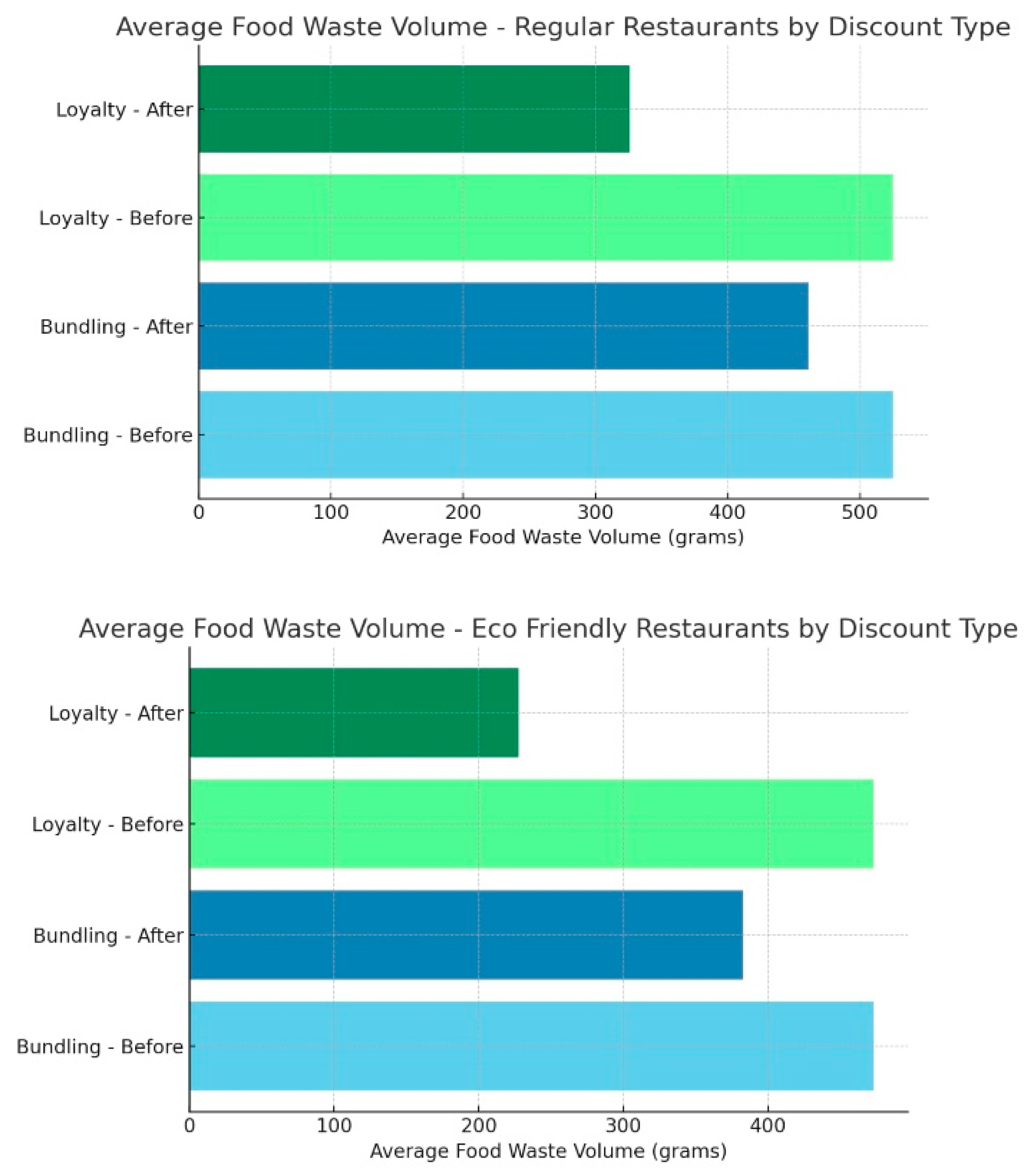
These results highlight that value-seeking behavior, in line with rational choice and sustainability considerations, amplifies the effectiveness of loyalty discounts by encouraging consumers to make more deliberate, need-oriented purchases. The preponderance of impulsive buying, however, tends to weaken any bundling discount because such buying often precipitates unplanned and emotionally driven consumption, possibly contributing to growing levels of food waste. The present study provides insight into the different inner mechanisms of discount strategies. Loyalty discounts, which are characterized by portion control and point-based incentive systems, build long-term consumer relationships with the consumer and at the same time may push responsible consumption. In contrast, bundling discounts are much more sales-oriented, relying on emotional triggers that might reduce their ability to reduce food waste. Filling the gap in the literature, this research introduces impulsive buying and value seeking as psychological moderators, thus providing a new framework for assessing the effectiveness of discount strategies in managing food waste. The results highlight that the integration of value-seeking behavior in the discount strategy is paramount for promoting sustainability and encouraging consumer interaction with eco-friendly practices.
6. Theoritical Contribution
This work enriches previous studies on food waste reduction and consumer behaviour by incorporating discount strategies-bundling discounts and loyalty member discounts-into the discourse of sustainable consumption. Although previous studies have focused on more abstract constructs, such as hedonic and instrumental values, this study has addressed tangible economic factors, hence providing a practically useful lens in terms of understanding how discounts shape the behaviour of the consumers. By introducing impulsive buying and value-seeking as psychological moderators, the study generates a nuanced framework that enriches the understanding of the interplay between short-term consumption (emotional) and long-term consumption behavior (rational) in relation to food waste reduction. This new integration fills significant lacunae in the literature by linking discount strategies with sustainability goals.
7. Practical Contribution
These findings present clear actionable insights for restaurant managers and policymakers seeking to align economic incentives with the imperatives of sustainability. Bundling discounts can indeed drive sales and, when combined with educational interventions and portion-controlled offerings, can also help to minimize food wastage. Loyalty member discounts build up long-term consumer relationships and potentially encourage more deliberate and need-based consumption. Practical recommendations would involve the design of loyalty programs to encourage responsible behaviour, such as portion control or taking leftovers home, and incorporating discount strategies with eco-friendly initiatives like "Waste-Free Menus." This research helps businesses frame promotional tools in a way that their use can be optimized from the dual perspective of profitability and sustainability.
8. Limitation Research
There are several aspects in which this study has its limitations, which may hamper the generalization and comprehensiveness of its findings. First, the geographic scope should be confined to major cities in Indonesia alone, which might not fully capture regional or international variations in consumer behavior and food waste management practices. Secondly, the study investigates only two psychological moderators of impulsive buying and value-seeking and may well overlook other influential factors such as cultural attitudes, income levels, or concern for the environment. The cross-sectional design limits the tracking of long-term behavioral changes in the effects of discount strategies on food waste reduction. Finally, the reliance on self-reported questionnaires introduces potential biases in the form of social desirability and recall errors, affecting the accuracy and reliability of the data collected.
9. Future Research
By extending the research to diverse cultural and economic environments, future studies could overcome such limitations and thus reach a wider understanding of discount strategies and consumer behavior. Also, additional moderators, such as environmental awareness, income levels, or cultural norms, should be considered in order to reach a more holistic view of the factors influencing food waste reduction. Longitudinal designs would further enable the consideration of long-term effects of discount strategies on consumer behavior and waste management practices. Also, there is a need to study how other industries, such as retail or food delivery services, might apply discount strategies in order to provide valuable cross-sectoral insights. Finally, combining technology, such as mobile applications for loyalty programs or AI-driven nudges, may provide new perspectives on how discount strategies can be used more effectively to promote sustainable consumption behaviors.
References
- A. P. Kinanti, T. C. Heidra, and Y. I. Masjud, “The Raising Concern of Food Waste and Food Loss in Indonesia to Achieve a Sustainable Consumption,” FIRM Journal of Management Studies, vol. 6, no. 2, p. 124, Sep. 2021. [CrossRef]
- Y. Kim and H. Han, “Intention to pay conventional-hotel prices at a green hotel - a modification of the theory of planned behavior,” Journal of Sustainable Tourism, vol. 18, no. 8, pp. 997–1014, 2010. [CrossRef]
- A. U. Zafar, J. Shen, M. Shahzad, and T. Islam, “Relation of impulsive urges and sustainable purchase decisions in the personalized environment of social media,” Sustain Prod Consum, vol. 25, pp. 591–603, Jan. 2021. [CrossRef]
- P. Chandon et al., “Sales Promotion Effectiveness / 65,” 2000.
- Y. Yi and H. Jeon, “Effects of Loyalty Programs on Value Perception, Program Loyalty, and Brand Loyalty,” 2003. [CrossRef]
- R. H. Thaler and C. R. Sunstein, “NUDGE.”.
- K. B. Monroe, “Buyers’ Subjective Perceptions of Price,” 1973. [Online]. Available: http://www.jstor.orgURL:http://www.jstor.org/stable/.
- Simonson and R. S. Winer, “The Influence of Purchase Quantity and Display Format on Consumer Preference for Variety,” 1992. [Online]. Available: http://jcr.oxfordjournals.org/.
- G. Dowling, “Do Customer Loyalty Programs Really Work?” [Online]. Available: https://www.researchgate.net/publication/290890144.
- D. R. Lichtenstein, R. G. Netemeyer, and S. Burton, “Distinguishing Coupon Proneness From Value Consciousness: An Acquisition-Transa ction Utility Theory Perspective.”.
- S. Kallbekken and H. Sælen, “‘Nudging’ hotel guests to reduce food waste as a win-win environmental measure,” Econ Lett, vol. 119, no. 3, pp. 325–327, Jun. 2013. [CrossRef]
- Food And Agriculture Orga, Global Food Losses and Food Waste. Fao, 2015.
- W. L. Filho and M. Kovaleva, “Environmental Science Food Waste and Sustainable Food Waste Management in the Baltic Sea Region.” [Online]. Available: http://www.springer.com/series/3234.
- A. Belgium, “Final report Analysis of the evolution of waste reduction and the scope of waste prevention European Commission DG Environment.” [Online]. Available: www.arcadisbelgium.be.
- C. Cederberg and U. Sonesson, “Global Food Losses and Food Waste-Extent, Causes and Prevention,” 2011. [Online]. Available: https://www.researchgate.net/publication/285683189.
- D. A. Teigiserova, L. Hamelin, and M. Thomsen, “Towards transparent valorization of food surplus, waste and loss: Clarifying definitions, food waste hierarchy, and role in the circular economy,” Science of the Total Environment, vol. 706, Mar. 2020. [CrossRef]
- S.-M. Renfors, “Food waste management practices in restaurants: how to prevent and reduce food waste?,” Matkailututkimus, vol. 20, no. 2, pp. 14–22, Sep. 2024. [CrossRef]
- A. H. Soomro et al., “FOOD WASTE MANAGEMENT STRATEGIES IN FOOD SUPPLY CHAIN,” International Journal of Ecosystems and Ecology Science (IJEES), vol. 11, no. 4, pp. 759–766, 2021. [CrossRef]
- S. Pandey, M. Budhathoki, F. J. A. Perez-Cueto, and M. Thomsen, “Factors influencing consumers’ food waste reduction behaviour at university canteens,” Food Qual Prefer, vol. 111, Oct. 2023. [CrossRef]
- V. Pandiyarajan, T. R. Neelakantan, S. A. Sridharan, and N. Ramrao, “Three ‘R’ Concept in Waste Management for Sustainable Environment,” Journal of Sustainability Perspectives, vol. 2, Aug. 2022. [CrossRef]
- N. Sheth, B. I. Newman, and B. L. Gross, “Why we buy what we buy: A theory of consumption values,” J Bus Res, vol. 22, no. 2, pp. 159–170, 1991. [CrossRef]
- E. Graham-Rowe, D. C. Jessop, and P. Sparks, “Predicting household food waste reduction using an extended theory of planned behaviour,” Resour Conserv Recycl, vol. 101, pp. 194–202, Jun. 2015. [CrossRef]
- T. Otterbring and M. Folwarczny, “Social validation, reciprocation, and sustainable orientation: Cultivating ‘clean’ codes of conduct through social influence,” Journal of Retailing and Consumer Services, vol. 76, Jan. 2024. [CrossRef]
- D. W. Rook, “The Buying Impulse.”.
- R. F. Baumeister, “Ego Depletion and Self-Control Failure: An Energy Model of the Self’s Executive Function,” Self and Identity, vol. 1, no. 2, pp. 129–136, Apr. 2002. [CrossRef]
- W. Turley and R. E. Milliman, “Atmospheric Effects on Shopping Behavior: A Review of the Experimental Evidence,” 2000.
- T. Verhagen and W. Van Dolen, “The influence of online store beliefs on consumer online impulse buying: A model and empirical application,” Information and Management, vol. 48, no. 8, pp. 320–327, Dec. 2011. [CrossRef]
- R. J. Faber and T. C. O’guinn, “A Clinical Screener for Compulsive Buying,” 1992.
- A. Brandão and C. C. de Miranda, “Does Sustainable Consumption Behaviour Influence Luxury Services Purchase Intention?,” Sustainability (Switzerland), vol. 14, no. 13, Jul. 2022. [CrossRef]
- V. A. Zeithaml, O. C. Walker, R. Lutz, C. W. Park, and D. Schmalensee, “Synthesis of Evidence,” 1988.
- Flavián, M. Guinalíu, and R. Gurrea, “The role played by perceived usability, satisfaction and consumer trust on website loyalty,” Information and Management, vol. 43, no. 1, pp. 1–14, Jan. 2006. [CrossRef]
- W. B. Dodds, K. B. Monroe, and D. Grewal, “Effects of Price, Brand, and Store Information on Buyers’ Product Evaluations,” Journal of Marketing Research, vol. 28, no. 3, p. 307, Aug. 1991. [CrossRef]
- R. Gleim, J. S. Smith, D. Andrews, and J. J. Cronin, “Against the Green: A Multi-method Examination of the Barriers to Green Consumption,” Journal of Retailing, vol. 89, no. 1, pp. 44–61, Mar. 2013. [CrossRef]
- L. Harlow, “On scientific research: The role of statistical modeling and hypothesis testing,” Journal of Modern Applied Statistical Methods, vol. 9, no. 2, pp. 348–358, 2010. [CrossRef]
- Verplanken and A. Sato, “The Psychology of Impulse Buying: An Integrative Self-Regulation Approach,” J Consum Policy (Dordr), vol. 34, no. 2, pp. 197–210, Jun. 2011. [CrossRef]
- W. Hofmann, B. J. Schmeichel, and A. D. Baddeley, “Executive functions and self-regulation,” Mar. 2012. [CrossRef]
- Suasana, A. Irfan, I. Gusti, A. Ketut, and G. Suasana, “The Effect of Bundling Strategy, Price Perception, and Brand Image on Purchase Decisions (Study on Local Fast Food Retailers in Bali Indonesia),” 2021. [Online]. Available: www.ajhssr.com.
- S. Hudson, L. Huang, M. S. Roth, and T. J. Madden, “The influence of social media interactions on consumer-brand relationships: A three-country study of brand perceptions and marketing behaviors,” International Journal of Research in Marketing, vol. 33, no. 1, pp. 27–41, Mar. 2016. [CrossRef]
- S. Ammar and C. © Guelph, “The Effect of Framing on Loyalty Points Redemption,” 2018.
- E. Mdletshe, “CRAVING LOYALTY: EXAMINING THE INFLUENCE OF LOYALTY PROGRAMS ON CUSTOMER RETENTION IN SOUTH AFRICA’S FAST-FOOD LANDSCAPE,” European Journal of Management and Marketing Studies, vol. 8, no. 3, Dec. 2023. [CrossRef]
- B. G. Gómez, A. G. Arranz, and J. G. Cillán, “The role of loyalty programs in behavioral and affective loyalty,” Journal of Consumer Marketing, vol. 23, no. 7, pp. 387–396, 2006. [CrossRef]
- M. Alshurideh, A. Gasaymeh, G. Ahmed, H. Alzoubi, and B. Al Kurd, “Loyalty program effectiveness: Theoretical reviews and practical proofs,” Uncertain Supply Chain Management, vol. 8, no. 3, pp. 599–612, 2020. [CrossRef]
- V. Kumar and D. Shah, “Building and sustaining profitable customer loyalty for the 21st century,” 2004, Elsevier BV. [CrossRef]
Disclaimer/Publisher’s Note: The statements, opinions and data contained in all publications are solely those of the individual author(s) and contributor(s) and not of MDPI and/or the editor(s). MDPI and/or the editor(s) disclaim responsibility for any injury to people or property resulting from any ideas, methods, instructions or products referred to in the content. |
© 2024 by the authors. Licensee MDPI, Basel, Switzerland. This article is an open access article distributed under the terms and conditions of the Creative Commons Attribution (CC BY) license (https://creativecommons.org/licenses/by/4.0/).
Copyright: This open access article is published under a Creative Commons CC BY 4.0 license, which permit the free download, distribution, and reuse, provided that the author and preprint are cited in any reuse.


