

Submitted:
26 November 2024
Posted:
26 November 2024
You are already at the latest version
Abstract
Transportation 5.0, a more sophisticated transportation system focused on human-centered design and inclusivity, is defined by cutting-edge technologies combined with societal demands. Its vari-ous components, intelligent infrastructure, connected and autonomous vehicles, shared mobility services, green energy solutions, and data-driven systems, come together to form an efficient and sustainable transportation network to tackle modern urban challenges. However, this evolution of transportation is intended to improve accessibility by creating environmentally benign substitutes for traditional fuel-based mobility solutions, even in addressing traffic management and control issues. Consequently, to promote a synergy for sustainability, the diversified nature of its compo-nents ought to be efficiently and effectively managed. Thus, this study aims to reveal the in-volvement of predicting core components of transportation 5.0 in the sustainable transportation system through a systematic literature review. This study also contemplates the causal model un-der system dynamics modeling to address sustainable solutions and movement towards sustaina-bility in the context of transportation 5.0. From the review, besides the developed causal model, it is identified that in the sustainable transportation 5.0 system, every core component management secures reduced environmental impact while increasing passenger convenience and the overall efficiency and accessibility of the transport network, even more advancing for developing nations. As the variety of transportation options, even focusing on electric vehicles, are successfully inte-grated, this evolution will eventually enable shared mobility, green infrastructure, and multimodal transit options.
Keywords:
Transportation
; Technology
; Renewable Energy
; Green
; Sustainability
; Systematic Review
1. Introduction
Transportation 5.0, in contrast to its predecessors, promises safer, greener, and more inclusive transportation in the future [1]. It is a comprehensive user-centered system that offers a fully customized, sustainable, and environmentally conscious mobility experience [2]. The next revolution in transportation models will optimize routes, vehicle performance, and energy consumption using real-time data and AI-driven decision-making [1,3]. Advanced technologies like artificial intelligence, blockchain, and autonomous systems are being incorporated into every aspect of this transportation ecosystem through electric and hydrogen-powered vehicles, shared mobility platforms, and vehicles-and-pedestrians-interacting-smart-infrastructure [1,2,3]. This paradigm shift symbolizes a future-oriented transport ecosystem in which intelligent infrastructure, connected and autonomous vehicles, shared mobility services, green energy solutions, and data-driven systems form an efficient and sustainable transportation network [2,3].
More specifically, transportation 5.0, embedded with sensors and IoT devices, can monitor conditions and track the usage of roads, bridges, and other infrastructures [3,4,5,6] to provide feeds in real-time for effective and proactive traffic flow [7]. This means that intelligent infrastructure can help reduce traffic congestion and lower emissions from the transport sector. For instance, smart traffic lights can change their timings automatically according to the current flow of traffic to identify the best timing and reduce unnecessary congestion or stoppage of vehicles [8]. It saves fuel and reduces the pollution rate as well because there will be minimum stop-and-go traffic situations [9]. Also, the sensors embedded in the roadways might also alert authorities when repairs or maintenance are required to prevent more extensive breakdowns and prolong the lives of infrastructures [10,11]. This reduces waste and saves materials, thus helping to meet the long-term environmental goals [12]. According to a recent report, transportation sustainability comes under the United Nations Sustainable Development Goals [11]; this involves emissions reduction, energy efficiency, and facilitation of public transport with shared mobility [8].
Similarly, AI would significantly contribute to these causes by optimizing resources, reducing operating expenses, and lowering environmental impact [13]. Again, enabling through AI and IoT, Connected and Autonomous Vehicles (CAVs) represent the cornerstone of transportation 5.0, that build vehicles that communicate amongst themselves, also known as Vehicle-to-Vehicle or V2V [14] and Vehicle-to-Infrastructure or V2I [8]. This connectivity further enables CAVs to perform with minimum human intervention by enhancing safety and efficiency [3]. Conversely, AVs add to sustainability by minimizing energy consumption and reducing emissions [11]. CAVs will also allow shared use-car sharing or carpooling-reduced number of on-road vehicles. Similarly, real-time data will enable self-driving cars to select routes that reduce energy consumption, optimize speeds, and avoid sudden stops or sharp acceleration, lowering fuel consumption [14,15,16]. Thus, in advancement to CAVs, a few vehicles can serve several users, reducing demand due to higher numbers requiring parking space and less sprawl in cities, preserving natural areas.
Another ingredient of Transportation 5.0 is green energy input, which introduces eco-friendly technologies into transportation, such as electric cars and hydrogen-powered cars. Electric vehicles (EV) and hydrogen fuel cells reduce reliance on oil-based fuel and reduce greenhouse gas emissions, thus allowing greener transportation [17,18,19,20]. Therefore, this can be accounted for as sustainability by the introduction of renewable sources of energy within the transportation infrastructure [18]. For example, solar-powered charging hubs for EVs lessen the carbon footprint of activities associated with charging, making the intake of clean energy more environmentally friendly [19]. In public transport, transportation 5.0 also supports traffic, such as buses and trains that run on electricity or biofuels [9,16]. Furthermore, cities can use renewable energies to fuel smart infrastructure such as traffic lights and public lighting [17,25,26]. Therefore, achieving an ecologically friendly transportation system will reduce carbon footprint [27]. Thus, by deploying green energies among other transportation 5.0 techniques, the system further reduces carbon footprint to achieve climate targets and makes the urban areas resilient to energy challenges.
Autonomous vehicles are among the most critical pillars of Transportation 5.0; AI drives this AV development [16]. A self-driving car would use machine learning, computer vision, and neural networks while negotiating on the road, recognizing traffic lights, and talking with other vehicles and pedestrians [8]. AI in AVs will provide accurate navigation and safety features in energy-efficient driving behaviors [16]. Eco-efficiency implies, for instance, that AVs can reduce fuel consumption by driving to minimize their fuel use [11]. This is because smooth acceleration, maintaining steady speeds, and avoiding stops contribute to higher energy efficiency by an autonomous vehicle than by human drivers [28]. Second, AVs promote shared mobility since autonomous vehicles could also be used in ride-sharing or ride-pooling services [29] and would thus reduce the number of automobiles on the road, leading to lower GHG emissions [30]. Besides this, AI-powered shared autonomous fleets may substitute for individual car ownership, at least in city centers, and help reduce congestion, emissions, and parking demand [30]. Such fleets can act even further to optimize routing based on real-time traffic flow to move people around the city with the least environmental consequence possible [31,32].
In transportation 5.0, one of the major applications of AI is intelligent traffic management [13]. By processing data from in-road sensors, traffic cameras, and GPS devices, AI systems can monitor traffic flow and, by analyzing past trends, predict congestion well before its occurrence [33]. Based on these capabilities, AI can control traffic signals dynamically to optimize traffic flow and reduce traffic congestion [16]. With the aid of an AI-based system, traffic management systems will adapt traffic control, whereby traffic lights are adjusted based on real-time traffic flows [34]. For example, if one direction is congested, AI can give a green light preference to the other routes; thus, vehicles would take alternative ways and avoid blockage [35]. It minimizes stops at crossroads, while traffic flow would be smooth [36]. That means fuel consumption and harmful emissions will be minimized. Also, AI-powered models can review long-term data to understand recurring congestion patterns [37]. This makes it possible for city planners to create infrastructures, such as bus lanes or bike lanes, or adjust signal timing to mitigate traffic density in high-density areas [38]. Therefore, AI reduces the ecological impact of congestion by decreasing the time spent idling, fuel consumption, and thus emissions.
In this way, AI minimizes the environmental impact of congestion by reducing the time it spends idling, fuel consumption, and emissions. To put it all together, AI is a transformative power in transportation 5.0 that shapes a future with sustainable, efficient, user-centered mobility [39]. Coupled with autonomous cars, traffic management, predictive maintenance, energy efficiency, public transport, and safety, transportation 5.0 stitches together the integral parts of a whole sustainable ecosystem in ways that advance SDGs and meet modern urban lifestyles [13]. These developments indeed build a cleaner, greener planet while developing resilient cities that are concerned with people’s well-being and the health of the environment [39]. The success of Transportation 5.0 is purely dependent on the seamless continued integration of modern technologies to further expand the horizons of what is possible with sustainable human-centered transportation.
Owing to the progression of this study, the aim is to investigate transportation 5.0 as the development of intelligent and sustainable mobility systems for sustainability; thus, the transportation 5.0 component will be advanced through a methodical assessment of the literature. Identifying the fundamental elements of transportation 5.0, a comprehensive assessment of the body of current literature was made on defining the smart infrastructure, linked autonomous cars, green energy integration, and user-centric mobility solutions. The analysis also discusses the deficiencies in implementing transportation 5.0 concepts within underdeveloped countries where the absence of infrastructure and resources becomes a major challenge. A system dynamics-based causal model is presented that maps the interactions and feedback loops between the several elements affecting the adoption of transportation 5.0 and its sustainability impact. The model also visualized the cascading impacts of the transportation 5.0 movement towards sustainability. Ultimately, this research underlines the transformative power of transportation 5.0 toward realizing sustainable development goals and provides useful lessons that policymakers and other relevant stakeholders can apply in developing regions.
2.0. Literature Review
2.1. From the Historical Progression: Transportation 1.0 to 5.0
Transportation has undergone radical changes over the centuries due to the influence of technological, social, and environmental factors [13]. From the early days of mechanized travel to the present focus on sustainable, intelligent systems, each phase is a paradigm shift in how societies move people and goods [40]. The transition from Transportation 1.0 to Transportation 5.0 epitomizes the continuing quest for efficiency, speed, access, and compatibility with the environment [41]. Transportation 1.0 begins modern mobility through mechanized systems like steam engines, trains, horse-drawn carriages, and early automobiles [13]. In this era, steam engines, railways, and early road vehicles powered mainly by coal and gasoline were introduced [43]. During this phase, the focus was on expanding the geographic reach by moving large numbers of people and goods over huge distances. These developments have substituted manual labor or animal-based transport using mechanized innovations, accelerating and optimizing transportation over long distances.
Internal combustion engines, personal vehicles, and mass transit represented the second phase of transportation evolution [44]. Innovations in automobile manufacturing began making cars more accessible and reasonably priced for the average person; Henry Ford developed the assembly line [43]. In the same period, cities invested in public transit systems like trams, buses, and subways to move growing urban populations [43]. On the other hand, digital technologies transformed how mobility was organized and managed in this third phase of transportation [11]. It allowed for digital technologies, enabling devices to track in real-time, navigate, and even connect vehicles [39]. It allowed public transit to create digital displays, GPS, and automated fare systems [43]. Logistics and shipping could be tracked and planned with data, facilitating efficiency in supply chains, continuous tracking, and decision-making processes [45,46,47].
Table 1 demonstrates that transportation 2.0 began in the Industrial Revolution, which featured the development of steam engines and railways. The use of coal and steam-powered engine systems assisted regional communication and improved business productivity. This era notably expanded business and urban growth in urban areas and contributed to increased coal contamination. Transportation 3.0, appearing in the mid-20th century, promoted combustion-engine automobiles and airplanes, significantly altering travel internationally. Petroleum and coal assisted these mechanisms, which enabled large-scale manufacturing and simplicity for the middle-income class. High emissions and restricted automation deliver noteworthy ecological and technological challenges.
Transportation 4.0 focused on integrating automation, data analytics, and smart infrastructure [42]. Further, AVs, artificial intelligence, and IoT devices started to reshape urban environments and the transport sector [42]. Smart city frameworks supported the implementation of adaptive traffic systems, real-time monitoring of public transport, and V2I communication within the cities [33]. However, transportation 5.0 focuses on sustainability and inclusive design for the new evolution, with a core basis of human factors [42]. It aims to fix the environmental impact transportation has caused and make transportation more accessible while developing eco-friendly alternatives to conventional, fuel-based solutions [41]. This generation focuses on electric vehicles, shared mobility, green infrastructure, and multimodal transit options, seamlessly integrating diverse travel modes [48]. This transformation journey is described in more detail below, supported by references to academics and industries, as shown in Table 1.

Table 1.
Historical Progression of Transportation Technology.
| SN | Focus | Transportation 1.0 [43] | Transportation 2.0 [49] | Transportation 3.0 [50] | Transportation 4.0 [51] | Transportation 5.0 [52] |
|---|---|---|---|---|---|---|
| 1 | Time Period | Pre-Industrial Revolution | Industrial Revolution | Mid-20th Century (Mass Production Era) | Early 21st Century (Digital Era) | Future (Human-Centric and Sustainable Era) |
| 2 | Main Mode | Walking, animals, wooden carts | Steam engines, railways | Combustion-engine vehicles, airplanes | Autonomous and electric vehicles | Sustainable, AI-driven, renewable-powered systems |
| 3 | Energy Source | Human/animal power | Coal and steam | Fossil fuels (petrol, diesel) | Electricity, hybrid systems | Renewable energy (solar, wind, hydrogen) |
| 4 | Technology Level | Basic and manual | Mechanized (steam technology) | Mechanical with limited automation | Digitalized and highly automated | AI and human collaboration, eco-technologies |
| 5 | Infrastructure | Dirt paths, primary roads | Railways, paved roads | Highways, airports | Smart roads, connected networks | Green infrastructure with smart-city integration |
| 6 | Speed | Very slow (walking, animal speed) | Moderate (steam trains) | High (cars, airplanes) | Faster with real-time optimizations | Hyperloop, zero-emission supersonic travel |
| 7 | Key Innovations | Wheels, simple carts | Steam engines, locomotives | Cars, airplanes | IoT, AI, autonomous vehicles | AI, IoT, renewable energy-driven hypermobility |
| 8 | Environmental Impact | Minimal | Significant (coal pollution) | High (fossil fuel emissions) | Moderate (electric vehicles) | Minimal focus on sustainability |
| 9 | User Focus | Survival and basic mobility | Industrial efficiency and trade | Convenience and mass production | User-centric, seamless travel | Human-centric, inclusive, equitable systems |
| 10 | Global Integration | Very limited | Regional connectivity via railroads | International travel (airplanes, shipping) | Fully connected global networks | Collaborative, AI-driven, global sustainability |
| 11 | Autonomy Level | No autonomy (fully manual) | Mechanized systems | Semi-autonomous machines (basic automation) | Autonomous systems (self-driving cars) | Collaborative AI with human-in-the-loop |
| 12 | Energy Efficiency | Low | Moderate | Poor due to fossil fuel dependency | High with electrification | Optimal with renewable and efficient systems |
| 13 | Safety Features | None | Basic safety standards | Standardized safety measures (e.g., seat belts) | Advanced sensors, crash avoidance | AI-driven proactive safety |
| 14 | Cost Accessibility | Very low | Moderate (accessible to industrial sectors) | Increased accessibility for the middle class | Affordable options through shared systems | Inclusive, with equitable access |
2.2. Embracing the Future: The Evolution from Transportation 1.0 to 5.0
Owing to the phase-by-phase transportation upgrade, the spirit of mechanized mobility was maintained in steam engines. Steam engines introduced a change in the transportation pattern, making it quicker on both land and water [43]. Railways became integral to industrialization, and several raw materials and manufactured goods began to act on urbanization and industry [53]. This period witnessed rapid urban growth, and railroads were connecting cities to spur the rise of the industrial economy [49]. Their introduction metamorphosed sea transportation and portrayed global trade and colonization efforts. The ease of access to personal vehicles facilitated the growth of suburbs to the extent that they could live further away from city centers for 2nd phase of improvement. The infrastructural adjustments to car travel fundamentally shifted cities’ social and economic functions [48]. Thirdly, due to rapid urbanization, public transit systems such as New York and London subways were brought into the picture [54,55]. These systems provided the foundation for modern metropolitan transit solutions.
While GPS technology was first realized for military use, it later moved to digitalization and connected mobility [50]. It enabled the tracking of location in real-time and even further routed personal and commercial vehicles efficiently [33]. However, the new business model of digital platforms, such as ride-hailing and car-sharing, will revolutionize urban mobility by offering people flexible, accessible travel methods [16]. In the case of Autonomous Vehicles, during this phase, self-driving technology started to mature, and companies such as Google, Tesla, and Uber were heavily investing in AV research [56]. Self-driving cars promise fewer accidents and more productivity but with more complicated regulatory and ethical issues [9]. Moreover, worldwide smart city infrastructures began deployment worldwide with sensor networks, IoT devices, and AI-driven analytics to manage traffic flow and monitor air quality to minimize energy consumption [37]. The above knowledge ultimately grounds the concept of a “smart city” in urban planning.
Transportation 5.0 generally encourages using electric vehicles to reduce emissions and shared mobility to reduce car ownership. The main components involved in this model are ride-sharing, car-sharing, and bike-sharing [16]. In this phase of environmental sustainability, much emphasis is placed on decarbonization [48]. Government policies are being issued to keep the level of emissions low and generate greener infrastructure, such as EV charging stations [57]. It aligns with global climate goals in reducing the carbon footprint within transportation. Ultimately, the march from Transportation 1.0 to Transportation 5.0 reflects a growing awareness of social, technological, and environmental factors shaping mobility. Each step builds upon the last steps, using engineering, digital technology, automation, and sustainability improvements to help move modern society forward [40]. Going into the future, Transportation 5.0 promises an excellent pathway to a more sustainable, efficient, and human-centered future regarding mobility.
2.3. Core Elements of Transportation 5.0 and Sustainable Movement
The concept of Transportation 5.0 comprises a holistic transition toward greener, more efficient, and user-oriented mobility with reduced environmental impact and assures better access and easy integration of technology. Core elements contribute to an integrated conceptual framework that furthers sustainability in transport systems. We introduce these core elements of Transportation 5.0 and their relations in the following:
2.3.1. Electrification of Transport
Electrification is one of the key bases for sustainability through reducing greenhouse gas emissions by substituting fossil-fuel-powered vehicles with electric ones [41]. This includes transitioning to personal electric vehicles and electrifying public transportation modes, like electric buses and trains [44]. In addition, electrification needs an enabling infrastructure, including a broad-based EV charging station network with renewable energy supplies [58]. A wide-reaching charging network is bound to keep the electric vehicles serving the demand of users with minimal environmental degradation [59]. Owing to the transition toward transportation 5.0, data analytics determine the best locations for EV charging stations as a function of traffic and use patterns to support the effective and strategic deployment of the electrified infrastructure [42].
2.3.2. Shared Mobility and MaaS
Shared mobility services are the sharing of rides, bikes, and cars wherein shared services provide reduced vehicle ownership and traffic congestion [16]. MaaS integrates multiple modes of transport into a single digital platform for users to plan, book, and pay for multimodal trips [48]. These offerings have become an environmentally friendly alternative to personal car ownership or fossil fuel-based ride-hailing [16]. The adoption of EVs by shared mobility fleets will go a long way in reducing carbon emissions across urban areas [17]. On the other hand, MaaS platforms rely on real-time data to optimize routes, enhance the customer experience, and balance supply with demand [39]. The data generated by the use of MaaS platforms feeds urban planners with knowledge of travel patterns to make further enhancements in the transport networks.
2.3.3. Data-Driven Decision Making and Integration of AI
Data collection and real-time analysis are critical to Transportation 5.0. AI algorithms, linked to data analytics, will enhance the capabilities of cities and transport providers in demand anticipation, resource allocation optimization, and user safety improvement [39]. Infrastructure-embedded smart sensors and IoT collect data with regard to flow, usage, and environmental conditions [60]. This will allow AI-driven decisions that adjust traffic lights to minimize congestion, such as rerouting public transit based on demand [37]. In this case, autonomous vehicles (AV) rely on sensors and data to safely commute on roads [13]. However, connected vehicles share vital real-time information about their specific route so that route efficiency can be enhanced by reducing traffic accidents.
2.3.4. Smart and Sustainable Infrastructure
Transportation 5.0 is all about sustainable infrastructure, including eco-friendly materials, integrating renewable energy sources, and intelligent management systems. This infrastructure facilitates easy, efficient transportation seamlessly across multiple modes while minimizing environmental impact [17]. An electrified transportation system will need infrastructure supporting EV charging stations, solar-powered lighting, and renewable energy sources [19]. Principally, smart infrastructure comprises vehicle-to-infrastructure communication, V2I, that allows AVs to communicate with lights, road sensors, and other digital components of the traffic infrastructure [61]. Thus, this will make these driverless cars even safer and more efficient [8]. However, future research can explore more concerns based on policy and customer preference changes to modify and adjust to future demands.
2.3.5. Autonomous and Connected Vehicles
Autonomous and connected vehicles define Transportation 5.0, aiming to minimize human driving errors, optimize traffic flow, and reduce emissions through improved routing [7]. In making safe and efficient driving decisions, AVs heavily rely on real-time data from connected infrastructure and other vehicles [38]. Machine learning algorithms allow AVs to learn from data and adapt to changing conditions toward better safety and efficiency [32]. Combining AVs with shared mobility services creates autonomous ride-sharing, car-sharing, and shuttles that become an environmentally friendly alternative to traditional car ownership by reducing urban traffic and contributing to lower emissions.
2.3.6. Human-Centric Design and Accessibility
Transportation 5.0 ensures the process is inclusive in its design and user-centered application to guarantee access for people with disabilities, elderly people, and economically deprived populations [39]. Human-centered design in MaaS platforms offers personalized options, accessible vehicle choices, and price models for people of different affordabilities [39]. Through analyzing user data, transportation providers are able to find deficiencies in service delivery to areas or sections of the population and adjust these accordingly so that the system is inclusive, responsive, and beneficial to all types of users [51]. Table 2 below represents a detailed development of the literature on all the key aspects of Transportation 5.0. These entries describe some of the latest findings in the core areas of Transportation 5.0, with various approaches to handle different challenges pertaining to real-time communication, autonomy, data integration, and societal feedback within intelligent transport systems.
Transportation 5.0 rests on highly interdependent core elements. Indeed, electrification requires sustainable infrastructure. In turn, sustainable infrastructure requires data-driven insights to operate efficiently. The connected and autonomous vehicles rely on smart infrastructure; data-driven decisions will optimize operations for all system components. Human-centered design and accessible options will allow shared mobility and MaaS to reach wide adoption and inclusiveness, while autonomous vehicles contribute to the shared mobility solutions of urban areas. Thus, this integrated system develops a sustainable focus through prioritization of energy efficiency, optimization of resources, and inclusivity. Following this interdependence, Transportation 5.0 shows how to create an integrated, efficient, and sustainable mobility ecosystem.
3.0. Methodology
The methodology of the present work is constructing an effective management framework for the principal components that make up the sustainable transportation 5.0 system, using a causal model through system dynamics modeling. First, a systematic literature review (SLR) was conducted to identify the most influential factors affecting sustainable transportation, such as reducing environmental impact, increasing passenger convenience, and enhancing network efficiency. The findings were then used to develop a causal model that investigated interdependencies and cause-effect relationships among the core components to extract insight into effective management optimization in these results. The system dynamics approach enabled scenarios that showed, in the light of the sustainability impacts of transportation, how optimized component management would further the goals of sustainable transportation 5.0. The methodological approach pledges holistic comprehension of the impacts of sustainable transportation and allows the creation of actionable strategies for improved environmental and operational performances.
3.1. Systematic Literature Review
In the case of a systematic literature review, an organized and comprehensive evaluation method proceeded to examine the current status, challenges, and developments in transportation 5.0 from a sustainability perspective. Maintaining transparency, replicability, and rigor will be essential while reviewing the literature on this emerging area. Major stages of SLR methodology on the topic at hand encompassed through several phases such as follows:
3.1.1. Research question:
Initially, the objective is idealized to explore how technologies associated with transportation 5.0, such as IoT, AI, autonomous vehicles, electric mobility, and smart infrastructure, make a difference toward sustainable mobility when considering trends, challenges, outcomes, and future directions. So, the research question is: How can we adapt to sustainability as transportation 5.0 moves forward?
3.1.2. Systematic Search:
The most comprehensive, reliable, accredited academic databases were identified and selected for review protocol. Commonly used databases include Google Scholar, OpenAlex, and Scopus. Boolean operators are used to make the search terms precise. For instance, here is a sample of commonly used keywords: “Transportation 5.0,” “Sustainable Transportation,” “Smart Mobility,” “Autonomous Vehicles,” “Electric Vehicles,” “Electric Vehicle AND Sustainability,” Autonomous Vehicle AND Sustainability.” After selecting the appropriate keywords, various search strings were developed using a combination of keywords to build a precise search query.
3.1.3. Eligibility/ Exclusion Criteria:
3.1.3.1. Eligibility Criteria:
- ✓
- Studies published in journals or conferences with peers’ reviews.
- ✓
- Studies directly relevant to Transportation 5.0 and/or sustainability in transportation
- ✓
- Studies in the English language only, unless translation resources are available
- ✓
- The publication date should not exceed a decade to benchmark the recent works.
3.1.3.2. Exclusion Criteria:
- ✓
- Studies that fail to address Transportation 5.0 and sustainability.
- ✓
- Articles without data, case studies, or theoretical support are opinion editorials.
- ✓
- Duplicates across databases.
Table 3 presents the number of scholarly articles retrieved using specific keywords related to sustainable and intelligent transport methods that were obtained from three databases: Google Scholar, OpenAlex, and Scopus. Using the keyword “Transportation 5.0,” results showed 37 papers on Google Scholar and 29 through OpenAlex. This merged with the term “Sustainability”; fewer papers appeared: 1 on Google Scholar, 3 on OpenAlex, and none on Scopus. Keywords such as “Sustainable Transportation” and “Electric vehicle” yielded higher counts on OpenAlex, with 99 papers, followed by Google Scholar, with 50 papers, while it was low in Scopus, at 16 papers. The combination of “Electric vehicle” and “Sustainability” produced the biggest number: 174 in Google Scholar and 137 in OpenAlex, where the search in the Scopus database returned 62. Searches including “Autonomous vehicle” and “Sustainability” also produced diverse outcomes: 20 papers on Google Scholar, 137 in OpenAlex, and only 8 on Scopus. Overall, whenever a term related to sustainability was used, OpenAlex yielded more hits than Google Scholar and Scopus.
Table 4 shows the academic output and impact of the period between 1998 and 2024. In this period, 454 papers were published, accumulating a total of 7,369 citations. The average number of annual citations is 283.42, which is as high as 16.23 per paper. On average, authorship is measured at 3.26 authors per paper. The h-index is 39 regarding impact, meaning that 39 papers have received at least 39 citations. The g-index is 79, indicating the highly cited papers continue to gain more citations in their total, while the hA-index is 26, reflecting the core of high-quality output across this set of publications that reveals sustained citation impact. This dataset is thus a productive and influential output in this timeframe.
Besides, Co-citation Network Analysis (Figure 1) was carried out to visualize the intellectual structure of this area by recognizing highly cited works and their relationships, exposing the foundational literature, and tracing the flow of ideas shaping discourse in smart transportation and carbon emission reduction. It, therefore, reveals the interlinked nature of seminal works and influential authors, showing their intellectual lineage that drives transportation 5.0 and how these ideas have grown in informing current research and practice. The network nodes represent authors and/or works, while edges show co-citation relationships where large-sized nodes correspond to more frequently cited authors, and thicker edges correspond to more robust connections. The color-coded clusters represent thematic groups or emerging trends, in which the gradient represents the timeline of publications. Such clusters reflect the evolution of the field from foundational research to newer developments like AI, renewable energy, and autonomous vehicles. However, the network underscores the multidisciplinary nature of transportation 5.0, integrating AI, IoT, sustainable mobility, and policy frameworks to address sustainability goals. In addition, these well-framed policy interventions open a vista for a sustainable future with efficient transportation systems and reduced carbon footprints. The technologies above converge to support such solutions as electrification and sustainable mobility while also tackling challenges like system integration, interoperability, and the critical influence of regulatory frameworks. Each cluster outlines the technical and strategic aspects necessary for advancing transportation 5.0.
After conducting a systematic search using defined keywords and search strings in each selected database, this review progressed to weed out duplicates and manage access to articles in an organized manner. For initial screening, titles, and abstracts were reviewed independently to exclude studies not meeting the inclusion criteria. In particular, the eligibility criteria stringently applied ensure that the papers chosen are relevant. Then, articles passing through the initial screening are subjected to a full-text review for relevance. Studies excluded at this process stage are documented for reasons such as transparency of the final report. Thus, this methodology ensures a systematic, unbiased, and in-depth review of the literature on transportation 5.0 and sustainability, generating insights contributing to academic understanding and practical applications in sustainable mobility.
3.2. System Dynamics Modeling: Mobility toward Sustainability
The transition into transportation 5.0 simplistically denotes a technological evolution toward integrating automation, artificial intelligence, the Internet of Things, and renewable energy in the quest for sustainable technology. In reality, this transformation is made up of innumerable interrelated relationships between technological, economic, social, and environmental parameters; the use of system dynamics modeling can examine how electric and autonomous vehicles interact with the integration of renewable energy and urban infrastructure with reduced emissions or the adoption of specific policies (Figure 2). This study attempts to draw a causal loop diagram using Vensim (6.01b) by connecting important variables in light of transportation transformations. The model considers the main variables as Autonomous Vehicles, AI-Driven Systems, IoT-Enabled Infrastructure, Renewable Energy, EV Charging Stations, Shared Mobility Services, Ride-Sharing, Urban Mobility, Consumer Affordability, Emissions Reduction, Traffic Flow, Regulations, Incentives, Multimodal Trips, Public Health, Air Pollution, V2I Communication, and Renewable-Powered Infrastructure. These variables are discussed in many literature, considering various dimensions of their impacts and importance in transforming transportation for the future.
This approach covers intended as well as unintended impacts, allowing informed decision-making. These include nonlinear dynamics to provide critical tipping points, like widescale adoption of electric vehicles or public acceptance of smart mobility to maximize sustainability benefits. However, its modularity allows for continuous refinement of strategies in response to evolving technologies, policies, and social preferences. Thus, this study is non-negotiable regarding system dynamics modeling, with functionalities to justify and drive the shift to transportation 5.0. It gives the needed analytical depth toward making sense of complexities, evaluating scenarios, and designing adaptive strategies that will ensure the sustainability goals of this transformative approach are reached without any undesirable setbacks.
During the transition to Transportation 5.0, ride-sharing and bike-sharing services need to be acknowledged to minimize city traffic and promote accessibility for the public. Smart traffic flow control utilizing V2I networks for communication and real-time information improves roads, traffic security, and well-managed navigation. Utilizing intelligent sensors and predictive artificial intelligence (AI) algorithms, IoT-enabled facilities can precisely track transport networks while responding to unpredictable circumstances. Developing renewable-powered technology promotes EV and AV penetration. Renewable energy sources and electric vehicle (EV) charging stations reduce fossil fuel consumption and emissions and contribute significantly to this transformation. In addition, EV technologies and associated services evolve to become more affordable, and customer acceptance rates increase. City transportation regulations like EV, AV incentives, and subsidies remain vital for this transformation. The causal model additionally demonstrates how energy from renewable sources, shared transportation, and AI-driven systems decrease air pollution and enhance the quality of life. Expanded multifunctional travel and artificial intelligence-driven traffic management systems provide urban transport with environmentally friendly potential. These interconnected dynamics highlight the importance of persistent creativity and policy convergence for optimal Transportation 5.0.
3.2.1. Electrification and Integration of Renewable Energy [41,42,44,58,59]
Electrification of transportation and integration of renewable energy are the key features in the direction of sustainable mobility involving electric vehicle inventory, availability of charging stations, and renewable energy consumption. This system is driven by the EV adoption rate, charging infrastructure expansion, and renewable energy availability. A reinforcing feedback loop arises from how greater EV adoption fuels demand for the installation of charging stations and, subsequently, further infrastructure deployment along with renewable energy. On the other hand, a balancing loop is derived from a restricted renewable energy supply acting as a constraint to electrification in cases of generation that does not conform to demands, a reminder that the parallel growth of EV infrastructure and energy production is indispensable.
3.2.2. Shared Mobility and Mobility-as-a-Service (MaaS) [16,17,39,48]
Shared mobility systems are sweeping over urban transportation, from ride-sharing to bike-sharing. Stocks include shared mobility services, user adoption rates, and operational efficiency inflow, creating user demand and multimodal trip frequency. Positive feedback would ensue as increased use reduces private car ownership, lowering congestion and emissions and attracting more users. On the other hand, a balancing loop occurs when high demand depletes resources, leading to operational inefficiencies and reduced user satisfaction, again underscoring the importance of scaling operations to match demand.
3.2.3. Data-Driven Decision Making and AI Integration [13,37,39]
Data and AI integration in transportation enhances efficiency and policymaking. Here, stocks comprise current data gathered, policies altered, and the precision of the AI forecast, while flows consist of the velocity at which data is gathered, AI-driven policy implementation, and predictive insights. A reinforcing feedback loop occurs because better data and more refined AI-driven decisions attract investment to drive operational excellence. However, there is a balancing loop in the form of privacy concerns and data management costs that would dampen data gathering and AI deployment. It enables the reaping of full benefits from AI in transport systems.
3.2.4. Smart and Sustainable Infrastructure [8,17,19,61]
Transportation 5.0 rests on smart and sustainable infrastructure, manifested in various forms like smart sensors, green projects, and vehicle-to-infrastructure communication. Stocks encompass a set of sensors and green infrastructures, while flows include investment rates and maintenance efforts. A reinforcing feedback loop is created as better infrastructure creates more users of the sustainable options and spurs further investment. However, a balancing loop exists since high costs of installation and maintenance slow deployment, which in turn could delay improvements to be achieved in the transportation management system as well as environmental improvements. It is a strategic investment that can ensure sustained improvement on this count.
3.2.5. Self-Driving Vehicles and Connected Vehicles [7,32,38]
Transportation 5.0 focuses on connected and self-driving vehicles. Other potential advantages of the vehicles are safety and efficiency. The key stocks will be autonomous and connected vehicles. Example flows include the rate of adoption of AVs and deployment of V2X communication. A reinforcing feedback loop is established as more significant penetration of AVs enhances the system’s efficiency and, importantly, safety, hence favoring more substantial adoption. High costs of AV technology and regulatory complexities create a balancing loop that can restrain the diffusion. Removing these barriers will go a long way in bringing into play the full potential of self-driving and connected vehicles.
3.2.6. Human-Centric and Accessible Design [39,51]
Human-centric design ensures that transportation systems are inclusive and accessible. The stocks interact with the flows; for instance, the total number of accessible vehicles, user satisfaction levels, and accessibility features interact with the improvement rate in accessibility and usage flow of human-centered transport options. A reinforcing feedback loop is thus created whereby higher accessibility brings greater user satisfaction, which encourages further investment into more inclusive designs. In contrast, however, a balancing loop would take hold since either budgetary restrictions or lower demand for some quarters would dampen the improvements in accessibility. It means overcoming such barriers to create an inclusive transportation ecosystem that will work for all users. So, all these interact in a highly linked system with many feedback loops. The key interrelationships driving transportation 5.0 dynamics are as follows:
- Transportation electrification depends on sustainable infrastructure, such as renewable-powered charging stations. As the number of EVs grows, infrastructure investments grow- a snowballing effect that reinforces both the electrification and sustainability of the system.
- Shared mobility- MaaS heavily depends on real-time data for operational efficiency and demand management. Better data capture improves predictive accuracy, which, in turn, optimizes shared mobility services to attract more users, creating a self-reinforcing loop that drives the adoption of shared mobility.
- AVs depend on smart infrastructure for real-time navigation and safety. As the fleet of autonomous vehicles grows, the need for vehicle-to-infrastructure communication consequently increases, speeding up investments in smart infrastructure. This, in turn, will again facilitate AV functionality and user confidence in AV technology.
- User-centered design improves accessibility, hence stimulating shared mobility across different demographics, particularly among people who rely on accessible transport. Increased demand for accessible shared mobility would again stimulate even more user-centered designs by providers.
- AVs rely on data analytics to navigate, ensure safety, and achieve predictive maintenance. More autonomous vehicle usage means more data to analyze. These enhance algorithms further, establishing a reinforcing feedback loop that will lead to even greater efficiency and safety for AVs.
- Green infrastructure must support human-centered mobility options, such as pedestrian-friendly paths and biking lanes. This, in turn, fosters sustainable modes of travel. Improvement in the infrastructure for non-motorized users opens up more inclusiveness, increasing the user base and encouraging further investment in green infrastructure.
4.0. Overview of Transportation 5.0 Mobility toward Sustainability
Indeed, this systematic literature review and system dynamics modeling covers the research of newly developed technologies and their functions. Contrasting previous stages that focused essentially on connectivity and automation, the hallmark of transportation 5.0 lies in the holistic integration of artificial intelligence, the Internet of Things, and other upcoming technologies in pursuit of critical sustainability concerns [41]. Key to this is the reduction of emissions, better use of energy, and generally increased resource efficiency within both urban and rural transportation networks [44]. However, this systematic literature review analyzed a wide range of peer-reviewed articles and other innovations foundational to sustainable mobility. In fact, the studies identify a common focus of AI and IoT in predictive maintenance, real-time traffic management, and energy-efficient route planning for reducing emissions and operational costs [16,42]. The review envisioned that most recent research works emphasize practical applications and outcomes in urban settings and underline the importance of smart city frameworks as a perfect setting for Transportation 5.0 initiatives.
On the other hand, AI plays a vital role in Intelligent Transportation 5.0 in terms of congestion reduction, fuel consumption optimization, and vehicle performance [33,34,35,36,39]. Predictive maintenance with machine learning/deep learning models reduces waste on unscheduled downtime since forecasted breakdowns are mitigated before they can happen [37]. Additionally, AI-enabled traffic prediction models provide easier passage for traffic flow and better public transport scheduling, contributing to lower emissions and better air quality in urban areas. In contrast, in the era of smart transportation, given the fact that condition monitoring of the vehicle and of the traffic flow itself is important, as well as environmental metrics like air quality [33,61]. By communicating through a wireless network, infrastructure- and vehicle-based sensors provide a continuous data flow into the AI models for analysis and responsive decision-making [28]. For example, real-time data from IoT devices enables adaptive traffic signaling by reducing idling time and lowering emissions at busy intersections. Similarly, the implementation of IoT in-vehicle health monitoring improves fuel efficiency through timely maintenance alerts; this goes a step further in encouraging sustainable behavior.
Specifically, system dynamic modeling is a powerful way of understanding and simulating the complex interdependencies of the different components in transportation 5.0 to visualize the feedback loops and delays typical for large-scale transport systems, thus easing the identification of long-term consequences of AI, IoT, and electrification regarding sustainability [13]. For instance, SDM showed how, in real-time, information from IoT devices drives traffic patterns over time and how policymakers can harness such dynamics in creating efficient traffic management systems that are able to adapt dynamically to changes. More specifically, these will involve, for instance, positive feedback loops-in the case of transportation 5.0, increasing user demand for EVs as the charging infrastructure expands-and negative feedback loops, including rebound effects from increased vehicle use due to transportation becoming more efficient. Modeling these feedback loops in SDM is extremely useful in helping researchers and policymakers see some of the possible unexpected results and make requisite adjustments toward long-term sustainability.
Additionally, this transformation movement promulgates and encourages the use of EVs as an alternative ecological mode of transportation. IoT and AI enhance EV charging stations on a manifold basis, thus enabling predictive energy demand management. AI algorithms can predict peak usage times and recommend the best charging schedule for that particular vehicle. At the same time, IoT sensors enable communication between the grid and EVs to balance energy loads. This dynamic approach avoids the wastage of energy and makes the EV charging network sustainable, thereby contributing towards reduced carbon footprints. Even though it is promising, several challenges come in the way of full implementation. Key among these are data privacy concerns, high initial costs to deploy IoT and AI infrastructure, and skilled personnel to manage such technologies. Besides, electric and autonomous transportation will need massive changes in their current infrastructures, from building a charging station network to redesigning roads supporting autonomous driving features. Of course, this cannot be done without active collaboration between the public and private sectors.
Transportation 5.0 has already been tried and implemented in several parts of the world. For instance, cities like Singapore and Stockholm have applied AI-operated traffic management systems, reacting in real-time and reducing congestion and, consequently, emissions [64, 65]. In Amsterdam, IoT-enabled smart parking systems reduce traffic searching for parking, further decreasing overall emissions and improving flow. These case studies give meaning to the practical benefits of Transportation 5.0 and set a blueprint for sustainable mobility. So, transportation 5.0 is a promising step toward sustainable mobility, integrating advanced technologies in an effort to solve many environmental and operational problems that the industry has faced for a long time. Finding success will take continuous collaboration efforts by government entities, the private sector, and the research community to meet and overcome the obstacles. By applying the system dynamics modeling approach to whatever new technologies are under development, the researchers can better recommend policy decisions, optimize resources, and ascertain that Transportation 5.0 achieves its objective of building a cleaner, more effective transportation ecosystem.
5.0. Transportation 5.0 for Sustainability in Developing Countries
5.1. Implementation Process of Transportation 5.0 for Developing Countries
The implementation of Transportation 5.0 in developing countries involves a systematic, multi-phase process to address transportation challenges, leverage emerging technologies, and create efficient, sustainable systems. Here’s a detailed breakdown of each stage of the process:
-
Assessment and Planning
- Conduct a needs analysis of current transportation challenges.
- Develop a master plan integrating Transportation 5.0 solutions with local policies.
-
Digital Infrastructure Development
- Deploy IoT devices, smart sensors, and high-speed internet.
- Establish centralized control systems for monitoring and decision-making.
-
Technology Integration
- Introduce AI-powered tools for traffic management, route optimization, and predictive analytics.
- Deploy autonomous vehicles in controlled environments for testing and gradual rollout.
-
Public-Private Partnerships
- Collaborate with technology providers, private firms, and government agencies to fund and execute projects.
-
Education and Training
- Train transportation staff and the public to use advanced systems effectively.
- Develop educational campaigns to raise awareness about the benefits of Transportation 5.0.
-
Pilot Projects and Scaling
- Implement pilot programs in specific cities or regions to assess feasibility and outcomes.
- Gradually scale successful initiatives across the country.
Successfully implementing Transportation 5.0 in developing countries requires a phased and integrated approach, combining technological advancements with local needs. By following this step-by-step process, starting from assessment and planning through technology integration, public-private partnerships, and education, and scaling up through pilot projects and ongoing optimization, developing countries can transform their transportation systems into more efficient, sustainable, and inclusive systems. This will improve mobility and contribute to economic growth and environmental sustainability.
5.2. Impact of Transportation 5.0 in Developing Countries
The impact of transportation 5.0 in developing countries brings transformative improvement across key areas, particularly in shaping transportation systems into smarter, more efficient, and sustainable systems. Figure 3 shows just how that affects each aspect with relevant variables. Figure 3 demonstrates that transportation 5.0 connects with sustainability, intelligent traffic management, autonomous vehicles, modernized technologies, and inclusive interaction. Tools like AI, IoT sensors, and green energy sources are critical for success in higher traffic throughput, reduced contaminants, and safety. Autonomous and shared automobiles enhance public transportation efficiency and lower pollution. Innovative technology like predictive maintenance and autonomous parking improves efficiency. Accessible connectivity makes rural transportation affordable. Feedback networks like renewable energy support the adoption of electric cars and establish an environmentally friendly, data-driven, and user-friendly transportation infrastructure for the future.
In developing countries, where existing transportation systems often face challenges like congestion, inefficiency, pollution, and lack of proper infrastructure, Transportation 5.0 can drive significant evolution. Here’s how it would create benefits (Table 5) and implementation process for developing countries (Figure 3). Table 5 highlights Transportation 5.0 benefits, investment patterns, and associated challenges to understand the context of transportation 5.0. AI, IoT, EVs, and collaborative transport improve performance, decrease emissions, and enhance accessibility. However, some challenges are created by high expenses, incompetent workers, limited infrastructure, regulatory impediments, unpredictable customer demand shifts, and investment volatility. However, cooperative partnerships and technological advancement are needed to develop environmentally friendly transport solutions.
Adopting such advanced transport systems has several obstacles to overcome, even though it would benefit developing countries. Integrating AI and IoT in traffic improves management at the cost of high investment in building technology and skills; lack of proper charging facilities are drawbacks, as resistance to change and poor internet connectivity in rural areas make the transition to modern transportation systems complex yet vital.
6.0. Theoretical and Managerial Implications
Based on this view, the idea of Transportation 5.0 can improve theoretical knowledge about sustainable mobility because it synthesizes insights from an interdisciplinary background resulting from, but not limited to, AI, IoT, system dynamics, and sustainability science. It proposes a framework in which transportation systems would be digitally connected but also adaptive, predictive, and ecologically centered. Theoretically, Transportation 5.0 questions traditional views on the efficiency and optimization of transport by introducing circular, feedback-driven interactions across urban and rural transport ecosystems, demanding new models to consider human and non-human actors in real time. As applied in Transportation 5.0, system dynamics modeling allows a sophisticated understanding of how feedback loops between such actors and resources, green renewable energy, and infrastructure affect long-term sustainability outcomes. Thus, Transportation 5.0 nurtures the theoretical frameworks in sustainable development and technology management by bringing a holistic perspective that integrates emerging technologies and their systemic interplay with urban ecosystems.
Transportation 5.0 provides managers of urban planning, public transportation, and logistics industries with practical means to enhance both operational efficiency and environmental sustainability through green technologies like renewable energy. It is now possible for transportation management to obtain real-time data via AI and IoT to perform predictive maintenance, adaptive traffic control, and eco-friendly route planning. This, in turn, helps it make decisions that could reduce operation costs by minimizing carbon emissions and aligning day-to-day operations with broader sustainability objectives. Moreover, installing IoT sensors offers the possibility of monitoring the transport networks to enhance resource allocation and responsiveness to changing traffic conditions and the environment. Meanwhile, significant hurdles for managers are to be overcome in ensuring data privacy, investing significantly in the infrastructure of IoT and AI, and educating employees to work with the technologies involved. Public-private partnerships and close collaboration with technology providers will help further develop solutions for Transportation 5.0 so that scaling up is better and the transition toward sustainable mobility is economically viable and operationally feasible.
7.0. Conclusion
Transportation 5.0 represents a paradigm shift toward sustainable mobility; it would create a path for the urban planner, policymaker, and industry leader to deal with the growing environmental impacts of transportation. As cities embark on transportation 5.0, future research will be needed on the long-term impacts of such systems on emissions reduction, green energy consumption, and quality of life in cities. The elaboration of advanced system dynamics models able to simulate complex interactions among AI-driven decisions, IoT-enabled monitoring, and human behavior in dynamic transport systems will require further research. It is also important that the wide adoption of IoT and AI in transportation investigate ethical and privacy implications to ensure that the pursuit of sustainability respects individual rights and societal norms. Finally, understanding how Transportation 5.0 solutions are scaling up across different geographies is worth looking into to see how varied urban, rural, and economic conditions influence the effectiveness of any sustainable transportation initiative. Despite the research limitations of empirical study, it presents insightful details on environmentally friendly modern transportation solutions. The investigation mainly focuses on theoretical models and causal simulations; therefore, it could not sufficiently reflect the challenge of practical application in real life. Likewise, there is quite an inadequate discussion of geographic issues like policy variations and infrastructural availability. Further studies might investigate the socioeconomic implications of autonomous and networked automobiles and quantitative validations of the models suggested in different parts of the world. Additional studies are needed to integrate revolutionary technologies like blockchain, AI, and machine learning within transportation systems to improve sustainability and robustness in rapidly changing technology and the economy.
Author Contributions
Conceptualization, M.A.K., T.N, and M.S.; methodology, M.A.K. and M.S.; software, M.A.K. and M.S.; validation, M.S. and M.A.K.; writing—original draft preparation, M.A.K., T.N, and M.S.; writing—review and editing, M.S., T.N, and M.A.K. All authors have read and agreed to the published version of this manuscript.
Funding
This research received no external funding.
Conflicts of Interest
The authors declare no conflicts of interest.
References
- Qahtan, Sarah, Alsattar, HA, Zaidan, AA, Pamucar, Dragan, & Deveci, Muhammet (2022). Integrated sustainable transportation modelling approaches for electronic passenger vehicle in the context of industry 5.0. Journal of Innovation & Knowledge, 7(4), 100277, ISSN 2444-569X, Elsevier. [CrossRef]
- Chen, Yuanyuan, Zhang, Hui, & Wang, Fei-Yue (2023). Society-centered and DAO-powered sustainability in transportation 5.0: An intelligent vehicles perspective. IEEE Transactions on Intelligent Vehicles, 8(4), 2635-2638, ISSN 2379-8904, IEEE. [CrossRef]
- Han, Xu, Meng, Zonglin, Xia, Xin, Liao, Xishun, He, Yueshuai, Zheng, Zhaoliang, Wang, Yutong, Xiang, Hao, Zhou, Zewei, & Gao, Letian (2024). Foundation intelligence for smart infrastructure services in transportation 5.0. IEEE Transactions on Intelligent Vehicles, ISSN 2379-8904, IEEE. [CrossRef]
- Singh, Vedant, Singh, Harbansh, Dhiman, Bhaskar, Kumar, Nitin, & Singh, Tej (2023). Analyzing bibliometric and thematic patterns in the transition to sustainable transportation: uncovering the influences on electric vehicle adoption. Research in Transportation Business & Management, 50, 101033, ISSN 2210-5395, Elsevier. [CrossRef]
- Wang, Fei-Yue, & Zhang, Jun Jason (2017). Transportation 5.0 in CPSS: Towards ACP-based society-centered intelligent transportation. 2017 IEEE 20th International Conference on Intelligent Transportation Systems (ITSC), 762-767, ISSN 1538615266, IEEE. [CrossRef]
- Bratu, Sofia (2022). Autonomous vehicle perception sensor data, motion planning and object recognition algorithms, and virtual simulation modeling tools in smart sustainable intelligent transportation systems. Contemporary Readings in Law and Social Justice, 14(1), 153-168, ISSN 1948-9137, Addleton Academic Publishers. [CrossRef]
- Rowland, Zuzana, & Porter, Kathleen (2021). Autonomous vehicle driving algorithms, deep learning-based sensing technologies, and big geospatial data analytics in smart sustainable intelligent transportation systems. Contemporary Readings in Law and Social Justice, 13(2), 23-36, ISSN 1948-9137, Addleton Academic Publishers. [CrossRef]
- Lin, Yilun, Na, Xiaoxiang, Wang, Ding, Dai, Xingyuan, & Wang, Fei-Yue (2023). Mobility 5.0: Smart logistics and transportation services in cyber-physical-social systems. IEEE Transactions on Intelligent Vehicles, 8(6), 3527-3532, ISSN 2379-8904, IEEE. [CrossRef]
- Reddy, Y Madhu Sudhana, Prasad, P Venkata, Mustare, Narendra, Ananda, MH, Devi, S Chitra, & Prabagaran, S (2024). Integrating IoT and Artificial intelligent for Enhanced Electric Vehicle Charging and Autonomous Driving for sustainable transportation. Journal of Electrical Systems, 20(2), 893-900, ISSN 1112-5209, Engineering and Scientific Research Groups. [CrossRef]
- Francis, Jeffin, Biju, N Aby, Johnson, Anupama, Mathew, Jeswant, Sreepriya, R, & Sankar, Vishnu (2019). Comparison of six-phase and three-phase induction motors for electric vehicle propulsion as an improvement toward sustainable transportation. Green Buildings and Sustainable Engineering: Proceedings of GBSE 2018, 239-247, ISSN 981131201X, Springer. [CrossRef]
- Wong, Wai Peng, Anwar, Muhammad Fahad, & Soh, Keng Lin (2024). Transportation 4.0 in supply chain management: State-of-the-art and future directions towards 5.0 in the transportation sector. Operations Management Research, 1-28, ISSN 1936-9735, Springer. [CrossRef]
- Wang, Fei-Yue, Lin, Yilun, Ioannou, Petros A, Vlacic, Ljubo, Liu, Xiaoming, Eskandarian, Azim, Lv, Yisheng, Na, Xiaoxiang, Cebon, David, & Ma, Jiaqi (2023). Transportation 5.0: The DAO to safe, secure, and sustainable intelligent transportation systems. IEEE Transactions on Intelligent Transportation Systems, ISSN 1524-9050, IEEE. [CrossRef]
- Ma, Zhitao, Ma, Shizi, & Wang, Sheng (2023). Perspective Chapter: Transportation 5.0–From Cyber-Physical Transportation Systems to Cyber-Physical-Social Transportation Systems., ISSN 0854660941, IntechOpen. [CrossRef]
- Yang, Y., Gao, K., Cui, S., Xue, Y., Najafi, A., & Andric, J. (2024). Data-driven rolling eco-speed optimization for autonomous vehicles. Frontiers of Engineering Management, 1-13. [CrossRef]
- Sumitkumar, R., & Al-Sumaiti, A. S. (2024). Shared autonomous electric vehicle: Towards social economy of energy and mobility from power-transportation nexus perspective. Renewable and Sustainable Energy Reviews, 197, 114381. [CrossRef]
- Alam, T., Gupta, R., Nasurudeen Ahamed, N., Ullah, A., & Almaghthwi, A. (2024). Smart mobility adoption in sustainable smart cities to establish a growing ecosystem: Challenges and opportunities. MRS Energy & Sustainability, 1-13. [CrossRef]
- Palit, Tanmoy, Bari, ABM Mainul, & Karmaker, Chitra Lekha (2022). An integrated Principal Component Analysis and Interpretive Structural Modeling approach for electric vehicle adoption decisions in sustainable transportation systems. Decision Analytics Journal, 4, 100119, ISSN 2772-6622, Elsevier. [CrossRef]
- Kumar, B Anil, Jyothi, B, Singh, Arvind R, Bajaj, Mohit, Rathore, Rajkumar Singh, & Berhanu, Milkias (2024). A novel strategy towards efficient and reliable electric vehicle charging for the realisation of a true sustainable transportation landscape. Scientific Reports, 14(1), 3261, ISSN 2045-2322, Nature Publishing Group UK London. [CrossRef]
- Kumar, Vinay, Sharma, Yogita, & Chadha, Priyanka (2023). Sustainable Solutions: Holistic Strategies For Electric Vehicle Adoption And Transportation Sustainability. Journal of Namibian Studies: History Politics Culture, 39, 506-525, ISSN 2197-5523. [CrossRef]
- Joseph, Peter K, Devaraj, Elangovan, & Gopal, Arunkumar (2019). Overview of wireless charging and vehicleâ€toâ€grid integration of electric vehicles using renewable energy for sustainable transportation. IET Power Electronics, 12(4), 627-638, ISSN 1755-4535, Wiley Online Library. [CrossRef]
- Prasad, Tashildar, Nikhil, Chougule, Sukrut, Chougule, Suraj, Jadhav, & Piyush, Mathurkar (2024). Solar-Powered Electric Vehicle Battery Charging: Integrating LT8490 for Sustainable and Efficient Energy Transfer in the Pursuit of a Green Transportation Future. 2024 IEEE International Students’ Conference on Electrical, Electronics and Computer Science (SCEECS), 1-6, ISSN 9798350348460, IEEE. [CrossRef]
- Reddy, V. J., Hariram, N. P., Maity, R., Ghazali, M. F., & Kumarasamy, S. (2024). Sustainable Vehicles for Decarbonizing the Transport Sector: A Comparison of Biofuel, Electric, Fuel Cell and Solar-Powered Vehicles. World Electric Vehicle Journal, 15(3), 93. [CrossRef]
- Singh, V., Singh, H., Dhiman, B., Kumar, N., & Singh, T. (2023). Analyzing bibliometric and thematic patterns in the transition to sustainable transportation: uncovering the influences on electric vehicle adoption. Research in Transportation Business & Management, 50, 101033. [CrossRef]
- Javadnejad, Farshid, Jahanbakh, Mohammad, Pinto, Cesar Ariel, & Saeidi, Azita (2023). Exploring the Complex Landscape of Electric Vehicle Adoption: Understanding Incentives and Overcoming Barriers for Sustainable Transportation in the US. [CrossRef]
- Khan, Mobashwir (2012). Topics in sustainable transportation: opportunities for long-term plug-in electric vehicle use and non-motorized travel.
- Samuels, Alexander, & Motatsa, Keletsamaile Advancing Smart Mobility in South Africa: A Systematic Literature Review of Transportation Performance from Industry 4.0 to Industry 5.0. Work-in-progress booklet, 61.
- Martins, Leandro do C, Tordecilla, Rafael D, Castaneda, Juliana, Juan, Angel A, & Faulin, Javier (2021). Electric vehicle routing, arc routing, and team orienteering problems in sustainable transportation. Energies, 14(16), 5131, ISSN 1996-1073, MDPI. [CrossRef]
- Dolins, S., Strömberg, H., Wong, Y. Z., & Karlsson, M. (2021). Sharing anxiety is in the driver’s seat: analyzing user acceptance of dynamic ridepooling and its implications for shared autonomous mobility. Sustainability, 13(14), 7828. [CrossRef]
- Karolemeas, C., Tsigdinos, S., Moschou, E., & Kepaptsoglou, K. (2024). Shared autonomous vehicles and agent based models: a review of methods and impacts. European Transport Research Review, 16(1), 25. [CrossRef]
- Wang, Y., Szeto, W. Y., Han, K., & Friesz, T. L. (2018). Dynamic traffic assignment: A review of the methodological advances for environmentally sustainable road transportation applications. Transportation Research Part B: Methodological, 111, 370-394. [CrossRef]
- Kuo, Y. H., Leung, J. M., & Yan, Y. (2023). Public transport for smart cities: Recent innovations and future challenges. European Journal of Operational Research, 306(3), 1001-1026. [CrossRef]
- Olugbade, S., Ojo, S., Imoize, A. L., Isabona, J., & Alaba, M. O. (2022). A review of artificial intelligence and machine learning for incident detectors in road transport systems. Mathematical and Computational Applications, 27(5), 77. [CrossRef]
- Aouedi, O., Piamrat, K., & Parrein, B. (2022). Intelligent traffic management in next-generation networks. Future internet, 14(2), 44. [CrossRef]
- Tong, W., Hussain, A., Bo, W. X., & Maharjan, S. (2019). Artificial intelligence for vehicle-to-everything: A survey. IEEE Access, 7, 10823-10843. [CrossRef]
- Sukhadia, A., Upadhyay, K., Gundeti, M., Shah, S., & Shah, M. (2020). Optimization of smart traffic governance system using artificial intelligence. Augmented Human Research, 5(1), 13. [CrossRef]
- Khan, M. W., Saad, S., Ammad, S., Rasheed, K., & Jamal, Q. (2024). Smart Infrastructure and AI. In AI in Material Science (pp. 193-215). CRC Press.
- Rivadeneira, A. M., Benavente, J., & Monzon, A. (2024). Efficient Operation of Metropolitan Corridors: Pivotal Role of Lane Management Strategies. Future Transportation, 4(3), 1100-1120. [CrossRef]
- Wolniak, R., & Stecuła, K. (2024). Artificial Intelligence in Smart Cities—Applications, Barriers, and Future Directions: A Review. Smart Cities, 7(3), 1346-1389. [CrossRef]
- George, A. S., & George, A. H. (2024). Towards a Super Smart Society 5.0: Opportunities and Challenges of Integrating Emerging Technologies for Social Innovation. [CrossRef]
- Atiku, S. O., Jeremiah, A., Semente, E., & Boateng, F. (Eds.). (2024). Eco-Innovation and Sustainable Development in Industry 5.0. IGI Global. [CrossRef]
- Adel, A. (2023). Unlocking the future: fostering human–machine collaboration and driving intelligent automation through industry 5.0 in smart cities. Smart Cities, 6(5), 2742-2782. [CrossRef]
- Dell, R. M., Moseley, P. T., & Rand, D. A. (2014). Towards sustainable road transport. Academic Press. [CrossRef]
- Frey, H. C. (2018). Trends in onroad transportation energy and emissions. Journal of the Air & Waste Management Association, 68(6), 514-563. [CrossRef]
- Kashem, M. A., Shamsuddoha, M., & Nasir, T. (2024). Digital-Era Resilience: Navigating Logistics and Supply Chain Operations after COVID-19. Businesses, 4(1), 1-17. [CrossRef]
- Kashem, M. A., Shamsuddoha, M., Nasir, T., & Chowdhury, A. A. (2023). Supply chain disruption versus optimization: a review on artificial intelligence and blockchain. Knowledge, 3(1), 80-96. [CrossRef]
- Shamsuddoha, M., Kashem, M. A., & Nasir, T. (2023). Smart Transportation Logistics: Achieving Supply Chain Efficiency with Green Initiatives. In Data Analytics for Supply Chain Networks (pp. 243-258). Cham: Springer International Publishing. [CrossRef]
- Nikitas, A., Kougias, I., Alyavina, E., & Njoya Tchouamou, E. (2017). How can autonomous and connected vehicles, electromobility, BRT, hyperloop, shared use mobility and mobility-as-a-service shape transport futures for the context of smart cities?. Urban Science, 1(4), 36. [CrossRef]
- Young, J. (2015). Infrastructure: Mass transit in 19th-and 20th-century urban America. In Oxford Research Encyclopedia of American History. [CrossRef]
- Bayarçelik, E. B., & Bumin Doyduk, H. B. (2020). Digitalization of business logistics activities and future directions. Digital Business Strategies in Blockchain Ecosystems: Transformational Design and Future of Global Business, 201-238. [CrossRef]
- Reimann, M., Ruckriegel, C., Mortimer, S., Bageritz, S., Henshaw, M., Siemieniuch, C., ... & Alonso, J. (2017). Road2CPS priorities and recommendations for research and innovation in cyber-physical systems. Loughborough University.
- Schmidt, W. P. (2024). Sustainable Production. In Solutions For Sustainability Challenges: Technical Sustainability Management and Life Cycle Thinking (pp. 163-189). Cham: Springer Nature Switzerland. [CrossRef]
- Enflo, K., Alvarez-Palau, E., & Marti-Henneberg, J. (2018). Transportation and regional inequality: The impact of railways in the Nordic countries, 1860–1960. Journal of Historical Geography, 62, 51-70. [CrossRef]
- Guo, Z., & Wilson, N. H. (2011). Assessing the cost of transfer inconvenience in public transport systems: A case study of the London Underground. Transportation Research Part A: Policy and Practice, 45(2), 91-104. [CrossRef]
- Hohne, S. (2021). Riding the New York subway: the invention of the modern passenger. MIT Press. [CrossRef]
- León, L. F. A., & Aoyama, Y. (2022). Industry emergence and market capture: The rise of autonomous vehicles. Technological Forecasting and Social Change, 180, 121661. [CrossRef]
- Hemalatha, J, & Panboli, S (2024). Electric vehicle adoption toward sustainable transportation solution: key drivers and implications. International Journal of Energy Sector Management, ISSN 1750-6220, Emerald Publishing Limited. [CrossRef]
- Emodi, N. V., Akuru, U. B., Dioha, M. O., Adoba, P., Kuhudzai, R. J., & Bamisile, O. (2023). The role of Internet of Things on electric vehicle charging infrastructure and consumer experience. Energies, 16(10), 4248. [CrossRef]
- Asghar, R., Rehman, F., Ullah, Z., Qamar, A., Ullah, K., Iqbal, K., Aman, A. and Nawaz, A.A., 2021. Electric vehicles and key adaptation challenges and prospects in Pakistan: A comprehensive review. Journal of Cleaner Production, 278, p.123375. [CrossRef]
- Ustundag, A., Cevikcan, E., Salkin, C., Oner, M., Ustundag, A., & Cevikcan, E. (2018). A conceptual framework for Industry 4.0. Industry 4.0: managing the digital transformation, 3-23. [CrossRef]
- Sadaf, M., Iqbal, Z., Javed, A. R., Saba, I., Krichen, M., Majeed, S., & Raza, A. (2023). Connected and automated vehicles: Infrastructure, applications, security, critical challenges, and future aspects. Technologies, 11(5), 117. [CrossRef]
- Gao, Letian, Xia, Xin, Zheng, Zhaoliang, Xiang, Hao, Meng, Zonglin, Han, Xu, Zhou, Zewei, He, Yi, Wang, Yutong, & Li, Zhaojian (2024). Cooperative Localization in Transportation 5.0. IEEE Transactions on Intelligent Vehicles, ISSN 2379-8904, IEEE. [CrossRef]
- Vajpayee, Prashant, & Hossain, Gahangir (2024). Cognitive Cybersecurity in Transportation 5.0 and Supply Chain: A Multi-Objective Optimization Framework. 2024 IEEE International Conference on Electro Information Technology (eIT), 698-704, ISSN 9798350330649, IEEE. [CrossRef]
- Viljanen, M. (2020). Shore-based Voyage Planning.
- Hoeft, M., Kronsell, S., Manzoor, S., Johansson, F., Gustafson, A., von Haslingen, T., & Eriksson, K. (2022). Construction automation and robotics in infrastructure.
- Hassebo, A., & Tealab, M. (2023). Global models of smart cities and potential IoT applications: A review. IoT, 4(3), 366-411. [CrossRef]
Figure 1.
Co-citation Network Analysis.
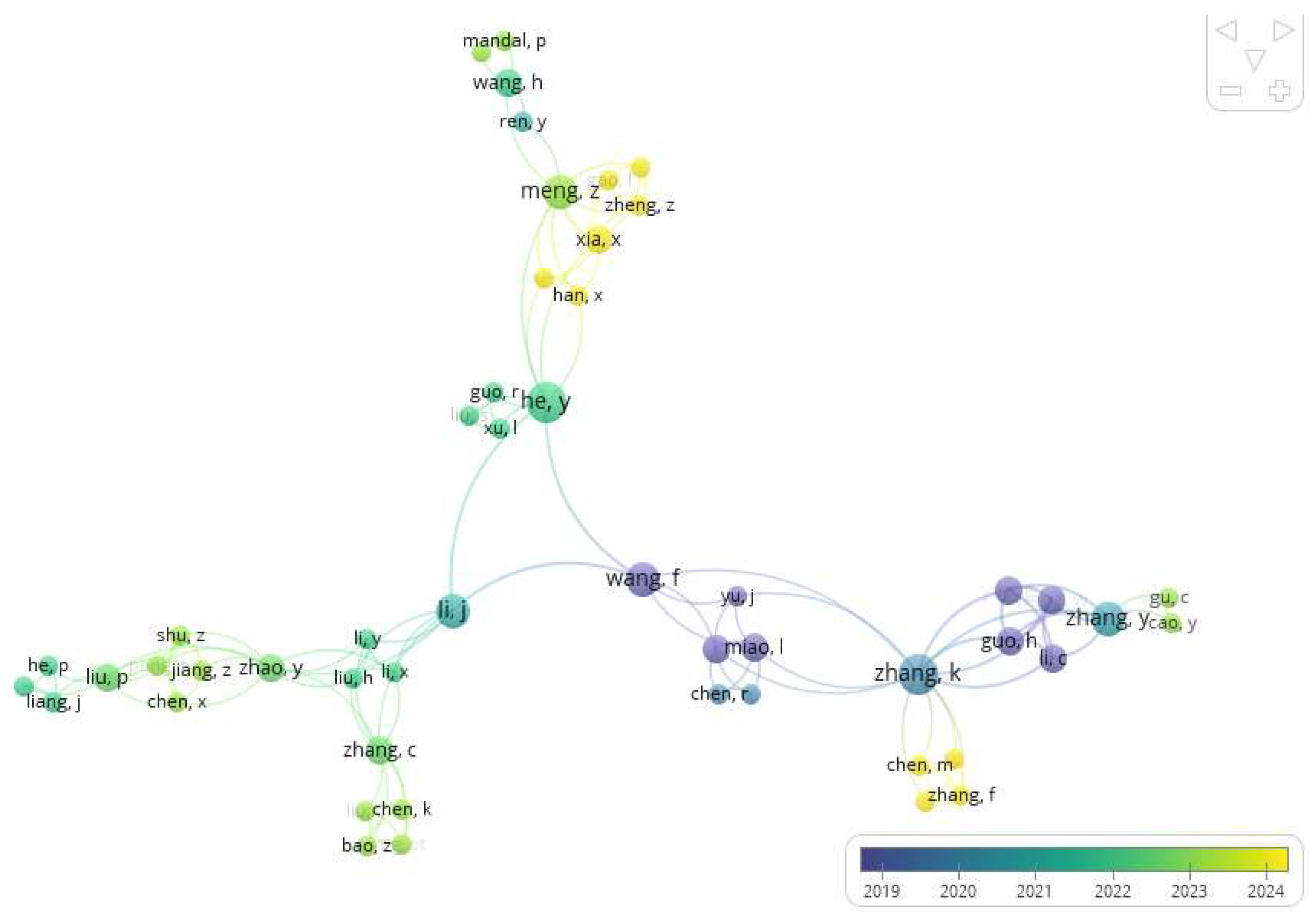
Figure 2.
Core Components of Transportation 5.0 for System Dynamics Modeling.
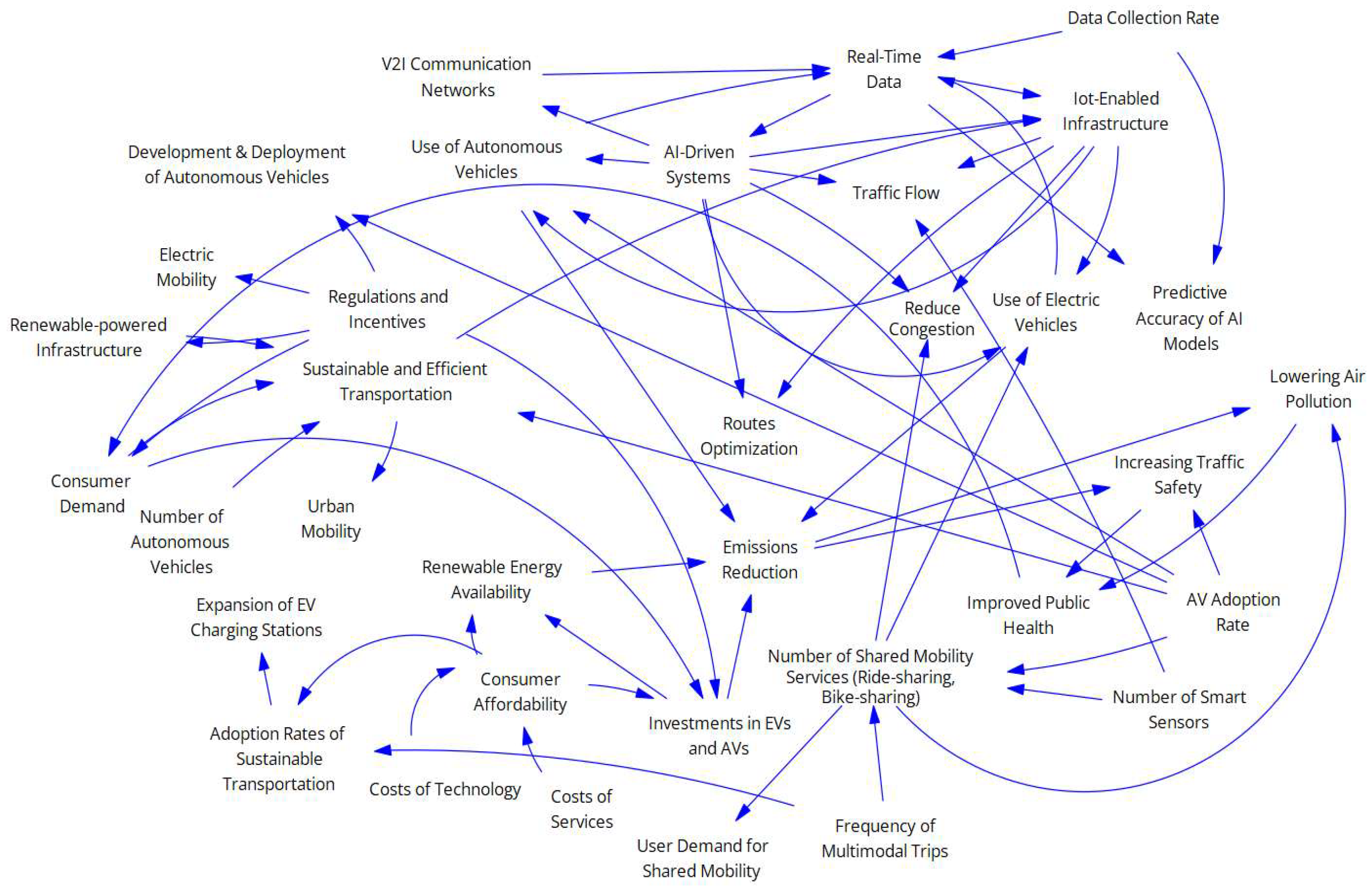
Figure 3.
Possible Impact of Transportation 5.0 in Developing Countries.
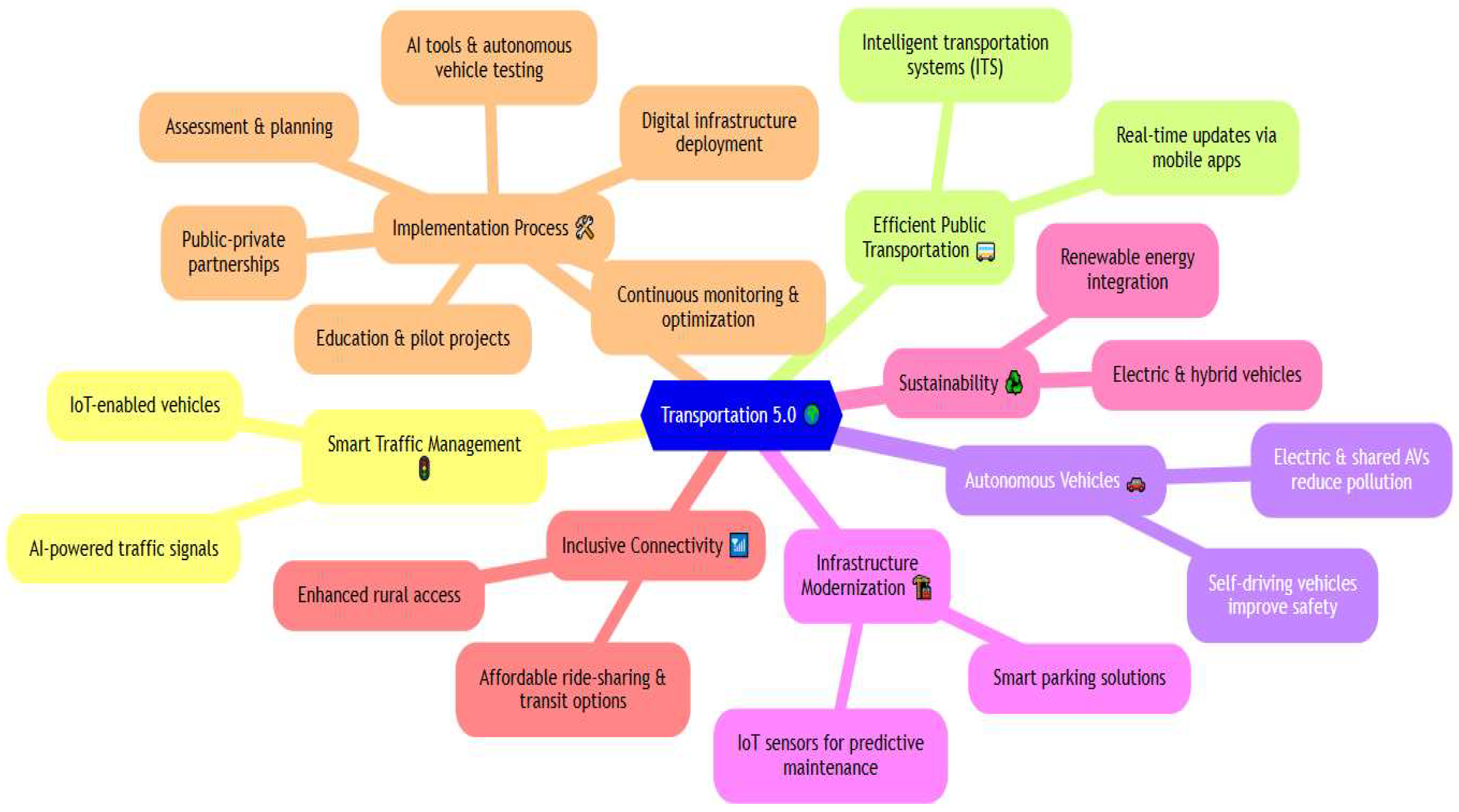
Table 2.
Recent Trends in Transportation Research.
| Author(s) | Focus Area | Findings |
|---|---|---|
| [62] | Cooperative Localization | Enhanced localization accuracy through cooperative approaches is beneficial for autonomous vehicle networks. |
| [14] | Cyber-Physical-Social Systems (CPSS) | Introduced CPSS for real-time traffic and safety optimization using social and physical signals. |
| [7] | Intelligent Vehicles (IV) Technology | Explored IV technology’s role in adaptive frameworks supporting sustainable, intelligent transport systems. |
| [61] | Software-Defined Transportation Systems | Emphasized flexibility and system adaptability via software-defined models for real-time adjustments. |
| [37] | Big Data in Transportation | Utilized big data analytics for predictive management and improved traffic routing. |
| [33] | Traffic Sentiment Monitoring | Analyzed social media data for situational awareness and traffic condition forecasting. |
| [35] | Vehicle-to-Everything (V2X) Communication | Showed V2X tech enhances real-time vehicle interaction, promoting safety and efficiency. |
| [5] | Parallel Transportation Systems | Proposed using parallel systems for continuous model updating and predictive accuracy. |
| [2] | Connected Autonomous Vehicles (CAVs) | Demonstrated CAVs potential to reduce congestion and improve flow via cooperative management strategies. |
| [17] | Urban Mobility and Real-Time Data Utilization | Real-time data helps to develop dynamic urban mobility models adaptable to changing traffic patterns. |
| [63] | Cybersecurity in ITS | Analyzed security protocols to protect data integrity within ITS and Transportation 5.0 frameworks. |
| [40] | Crowdsourcing for Transportation Solutions | Explored the impact of crowdsourcing for dynamic traffic solutions, supporting decision-making processes. |
| [42] | Smart Infrastructure and IoT Integration | Showcased IoT-enabled infrastructure enhancing real-time data collection for intelligent traffic control. |
| [35] | Edge Computing in Transportation | Edge computing reduces latency in data processing, which is beneficial for real-time vehicle response systems. |
| [11] | Cyber-Physical Systems (CPS) in Traffic Analysis | CPS models aid in real-time traffic monitoring and adaptive response for urban systems. |
| [8] | Sustainable Energy Solutions for EVs | Explored sustainable energy integration for electric vehicle networks within Transportation 5.0. |
| [36] | Real-Time Analytics for Traffic Flow Optimization | Real-time analytics helps to adapt traffic signals and flow to reduce congestion dynamically. |
| [48] | Autonomous Navigation Systems | Presented advancements in autonomous vehicle navigation for obstacle avoidance and route planning. |
| [36] | Social Media Data in Traffic Prediction | Used social media data to improve traffic congestion forecasting and management. |
| [25] | Distributed AI for Traffic Management | Showcased AI-distributed models for adaptive and predictive traffic control in complex networks. |
Table 3.
Keyword Search.
| Keyword | Google Scholar | OpenAlex | Scopus |
|---|---|---|---|
| Transportation 5.0 | 37 | 29 | - |
| Transportation 5.0 AND Sustainability | 1 | 3 | - |
| Sustainable Transportation | 50 | 99 | 16 |
| Electric Vehicle | 50 | 99 | 16 |
| Electric Vehicle AND Sustainability | 174 | 137 | 62 |
| Autonomous Vehicle AND Sustainability | 20 | 137 | 8 |
Table 4.
Citation Metrics.
| Papers | Citations | Years | Cites_Year | Cites_Paper | Authors_Paper | h_index | g_index | hA |
| 454 | 7369 | 26 (1998-2024) |
283.42 | 16.23 | 3.26 | 39 | 79 | 26 |
Table 5.
Tentative Benefits and Challenges of Transportation 5.0 for Developing Countries.
| No | Content | Benefits | Investment Type | Challenges |
|---|---|---|---|---|
| 1 | Integration of AI and IoT | Improved traffic management, reduced congestion, and enhanced safety | Technology infrastructure | High initial cost and lack of skilled workforce [50] |
| 2 | Electric Vehicles (EVs) | Reduced dependency on fossil fuels and lower carbon emissions | Renewable energy and EV adoption | Inadequate charging infrastructure and high cost of EVs [58] |
| 3 | Renewable Energy-Powered Transport | Energy sustainability and cost savings over time | Solar, wind, and hydrogen energy | Need for renewable energy generation and storage [9] |
| 4 | Smart Public Transportation Systems | Affordable, efficient, and inclusive mobility for all | Public transport modernization | Requires digitization and data-sharing platforms [60] |
| 5 | Shared Mobility Services | Reduced vehicle ownership and emissions, better affordability | App-based platforms and fleets | Resistance to change and limited internet connectivity in rural areas [48] |
| 6 | Green Infrastructure Development | Eco-friendly urban transport solutions and reduced environmental impact | Roads, parks, and urban planning | Land acquisition challenges and policy delays [39] |
| 7 | Digital Payment Systems | Increased access to transport through cashless transactions | FinTech integration | Financial inclusion and digital literacy barriers [40] |
| 8 | Hyperloop and High-Speed Rail | Faster travel between cities, fostering economic growth | Large-scale transport projects | High capital investment and long implementation periods [48] |
| 9 | Decentralized Freight Management | Efficient logistics and reduced costs for agricultural and industrial goods | Supply chain digitization | Requires collaboration across industries and reliable internet [13] |
| 10 | Inclusive Urban Planning | Improved access to mobility for underserved populations, including rural and marginalized areas | Public-private partnerships | Balancing urban development with equity [38] |
Disclaimer/Publisher’s Note: The statements, opinions and data contained in all publications are solely those of the individual author(s) and contributor(s) and not of MDPI and/or the editor(s). MDPI and/or the editor(s) disclaim responsibility for any injury to people or property resulting from any ideas, methods, instructions or products referred to in the content. |
© 2024 by the authors. Licensee MDPI, Basel, Switzerland. This article is an open access article distributed under the terms and conditions of the Creative Commons Attribution (CC BY) license (http://creativecommons.org/licenses/by/4.0/).
Copyright: This open access article is published under a Creative Commons CC BY 4.0 license, which permit the free download, distribution, and reuse, provided that the author and preprint are cited in any reuse.


