

Submitted:
25 November 2024
Posted:
26 November 2024
You are already at the latest version
Abstract
This paper deals with minimisation of fuel consumption under real driving conditions using a vehicle speed advisor. The aim is to explore the potential of speed profile optimisation in real driving conditions while assessing the suitability of an application which recommends the driver the optimal vehicle speed sequence that minimises the fuel consumption on a particular route. The speed advisor is based on solving the Optimal Control problem of covering a particular route with minimum fuel consumption with a defined time constraint. The approach presented was applied to and implemented on a real passenger vehicle to obtain a trade-off between fuel consumption and travel time for several trips on the route. Experimental results are presented with and without advisory, demonstrating that with speed advisor the results approach the pareto front with lesser dispersion on the other hand without advisory the dispersion is higher and largely above the pareto front.
Keywords:
Eco-driving
; Velocity profile optimisation
; Optimal Control
1. Introduction
Despite a substantial effort has been done during the last decades in order to reduce the fuel consumption and emissions in light duty vehicles by means of improved powertrain design and controls [1], noticeable discrepancies are still observed between declared and real driving consumption and pollutant figures [2,3]. One of the main reasons for such a deviation is that the driving cycles considered by regulations only represent to some extent the set of conditions that a vehicle may face during their entire life. To make up for such a limitation current regulations have introduced Real Driving Emission testing procedures as a method to reduce the gap between the declared performance and that perceived by users. In any case, those facts point out the important impact that the driving conditions, including traffic but also driving style, have on fuel consumption and emissions.
Studies such as [4] show how the vehicle speed profile can be responsible of up to 30% of the fuel consumption. Other studies [5] point out that cruise control can reduce fuel consumption by about 5% compared to standard driving . For this reason is a hot topic in the automotive control sector that has been approached during the last decades with different methods, e.g. in [6] with Model Predictive Control, in [7] by using look-ahead information or [8] with fuzzy-logic controllers.
Another related research line is focused on how the driver should behave to minimise fuel consumption and emissions. Several publications address how to monitor the driver behaviour and promote eco-driving. An example of such a tool is presented by [9] where they propose to encourage economical driving behaviour by giving feedback to the driver with a light code showing his driving aggressiveness (product of velocity and acceleration), since an aggressive driving style will naturally lead to higher fuel consumption. A similar approach is presented and evaluated in [10].
Finally, a third line of study is aimed to obtain a vehicle speed profile to minimise fuel consumption in a given route. This is a problem that matches the field of Optimal Control (OC). In fact, OC has been applied to the speed profile optimization since 1977 in the work of [11], who calculated the optimal speed profile on a hill. From them, and specially during the last decade, several OC techniques have been applied to the vehicle speed trajectory optimization at different scenarios. Some of these approaches are Pontryagin Minimum Principle (PMP) like [12,13,14], Dynamic Programming (DP) in [15,16,17] and Direct Methods (DM) in [18,19]. Due to the complexity of reproducing real driving conditions, most of them focus on particular driving conditions (highway, traffic lights,...) and address this topic from a modelling perspective. A comprehensive review of them can be found in [20,21,22].
In addition, few of the previous studies include the report of the optimal vehicle speed profile to the driver and the assessment of their impact on the fuel consumption. An example of such studies is [17] where authors propose a cloud-based optimization of the vehicle speed profile by DP that is downloaded in the vehicle for a given route. In the same line that the last work, the target of the present study is to explore the potential of speed profile optimisation in real driving conditions, assessing the suitability of an application which recommends the driver the optimal vehicle speed sequence that minimises the fuel consumption for a particular route. To this aim, there are three main aspects to consider:
- The route: The optimal vehicle speed profile is route-dependent. In a final application, information about the route should be a priori available to allow the optimal trajectory computation.
- Model and optimisation tool: In order to provide any advice to the driver about the vehicle speed profile that minimises fuel consumption, a model able to estimate in advance the impact of driver decisions and particularly of the vehicle speed on fuel consumption is required. This model in combination with an optimisation tool allows to compute the optimal speed profile to be followed.
- Driver advisor: The computed optimal speed trajectory should be transmitted to the driver that will follow it in the best way possible. In the same way, the optimal speed trajectory should be continuously updated to make up for the deviations of the actual driving speed from the optimal profile.
In the presented paper, a particular route between two cities has been selected for the optimization. The route consists mainly on highway driving with presence of speed limits and altitude variations but limited traffic and no vehicle stops. The route has been covered several times in order to identify an energy model of the vehicle and characterize the route. Then, the optimal control problem of covering the route with minimum fuel consumption in a given time has been solved by DP for different time constraints in order to assess the compromise between fuel consumption and trip time. The optimal vehicle speed is passed with a display to the driver as a reference to minimize fuel consumption. There are two main contributions of this article:
- Despite of the high computation cost and curse of dimensionality of DP, it allows to store not only the optimal control between initial and final states, but the optimal control sequence between any state contained in the feasible set and the final one. This property is used in the present work to correct any deviation from the optimal speed profile, due to non considered disturbances or lack of accuracy of the driver.
- The experimental validation shows that the application is real time capable with significant improvement in fuel consumption. The developed method is scalable for vehicle which frequently commute between two stations.
Following the previous idea, the paper is structured as follows: First, in Section 2, the energetic model used for the fuel consumption optimization is described. Then, in Section 3, the problem to be addressed and the route considered is described in detail. Then optimization technique employed is introduced in Section 4. Latter, Section 5 is aimed to the description of the driver advisory implementation. Next, the experimental set up is explained in Section 6 and the obtained results are discussed in Section 7. Finally the conclusions of the paper are highlighted in Section 8.
2. Vehicle Model
A vehicle model is required in order to compute the vehicle speed sequence that minimises the fuel consumption in the route. The vehicle should combine accuracy, to have prediction capabilities, and low computation burden, to allow the optimisation of a realistic route with long distance. For the scope of this work, the engine quasi-static modelling approach, usually followed in vehicle speed optimisation strategies, has been used. Models of increasing complexity lead to harder optimisation problems so increased computation time. In this sense, the model considers longitudinal forces acting on the chassis by the following ordinary differential equation (ODE) representing the Newton’s Second Law of motion:
where v is the vehicle speed and accordingly, its time derivative () is acceleration, represents an equivalent vehicle mass including the inertia of powertrain elements, and the terms represent different forces acting on the vehicle, namely, aerodynamic drag:
where is the air density, A the front area of the vehicle and the drag coefficient; rolling resistance:
where is the road friction coefficient (in the case at hand [23]), m the vehicle mass, g the gravity acceleration and the road inclination angle; effect of gravity:
the brake force:
with is braking actuation ranging from full (-1) to no braking (0) and is the maximum braking force.
and finally engine torque contribution to the wheels:
where is the wheel radius and is the engine torque at the wheels. The transmission from the engine to the wheels is modelled as an ideal set of gears. In this sense, the relations between engine torque(T) and wheel torque as well as vehicle speed and engine speed are given by the following expressions [24]:
where is the transmission efficiency and is the transmission ratio, both including gearbox and differential and therefore depending on the selected gear . The multiplication factor converts the engine speed from radians per second to revolutions per minute. The gear is chosen following a vehicle speed based policy that keeps engine speed in the range of 1000 to 2750 rpm. The engine torque is modelled as a non-linear function of engine speed (N) and pedal position () [25]. In particular, torque is calculated from the pedal position and the maximum and minimum torque curves depending on engine speed ( and respectively):
Meanwhile, fuel consumption is calculated as a function of engine speed N and pedal position obtained from experiments. Figure 1 shows the engine maps for torque and fuelling and in the vehicle model. Both variables are calculated by simple interpolation of experimental data as a function of engine speed (N) and throttle ().
Note that, in line with other works in the literature [24], the engine dynamics are completely neglected, the main reasons for such a simplification are:
- A detailed engine model including dynamics substantially increases the complexity of the optimisation problem with its corresponding increase in computational time.
- Vehicle dynamics are much slower than the main engine dynamics.
- Optimal speed profiles are smooth in order to minimise the inertial term in equation 1 and to avoid inefficient operation of the engine during transients.
In order to reduce the number of actuators of the model, the braking and throttle actions ( and ) have been lumped in a single actuator (u) such that:
Note that the previous decision entails that the throttle and brake cannot be applied at the same time, nevertheless this does not seem a critical limitation when efficiency is pursued.
In this sense, analysing Equations (1) to (11) one can observe that the model has a single state (v) and a single actuator () since the gear shift follows a predefined policy depending on the engine speed, and accordingly on the vehicle speed.
Regarding the model ability to capture the plant behaviour, Figure 2 shows the correlation between the fuel consumed in the tested driving cycles, circles represent driving cycles with arbitrary driving to identify the model and black bullets show the model validation using the vehicle speed advisor. Despite the simplicity of the model, the results show a correlation of and differences in the fuel consumption at the end of the cycle are below 0.16 for 80% of the driving cycles considered. In particular, for the validation set (black dots), the maximum error is below 0.15.
3. Problem Description
The aim of this work is to explore the potential of speed profile optimisation in real driving conditions by means of a driving advisor application. In order to provide advice to the driver, a sensible possibility is to compute what is the velocity profile to minimize a given cost function and then provide this information to the driver. Regarding the speed profile computation, the fuel consumption is an intuitive cost function while the time spent during the trip seems a sensible constraint. Other restrictions that should be taken into account are the speed limits during the route or the limits of the vehicle and the powertrain. In any case, a generic control problem consisting in finding the control policy to drive a dynamic system from a given initial state to a defined final state with minimum cost and fulfilling a set of constraints fits in the field of Optimal Control. The formulation of an Optimal Control Problem (OCP) considers a cost index and constraints expressed in terms of system states (x), system actuators (u), problem disturbances (w) and domain. Taking into account that, in the case at hand, the route is a priori known, the slope and speed limits (which are the problem disturbances) are space (s) dependent, it seems more convenient to consider s as the problem domain. In this case, the cost index can be defined as:
where L is the route length and for the sake of readability, the dependence of the fuel consumption on the actuator () has been omitted. The system, i.e the vehicle model described in Section 2 can be condensed in the generic dynamic system:
where the dependence of the state (velocity) evolution on the state itself, the control actions (in the case at hand u), disturbance (road slope) and time is described. Therefore the state evolution with the problem domain (space) becomes:
where the dependence of f on the system state, actions and disturbances has been omitted for the sake of clarity.
The vehicle should cover the defined distance (L) within a given time (), which leads to the following integral constraint:
Road speed limits have to be respected which leads to the following path constraint:
Limits on the engine (speed range and maximum power output) and brakes (maximum braking force) are also considered. Finally, the initial speed is also imposed. Despite the vehicle starts from rest a minimum vehicle speed is imposed to avoid divisions by 0 in the model (boundary constraint):
Regarding final speed, no restrictions are imposed beyond the maximum speed of the road.
In the present case, to analyse the performance of the speed advisor, a 60 km daily commute route between two cities in Spain (A7 route between Canals and Valencia) has been chosen. In this sense, Figure 3 shows the evolution of road slope and maximum vehicle speed along the route. Both variables have been considered in the optimisation problem as disturbance and path constraint respectively. The route was covered daily (during consecutive working days) with an instrumented vehicle to obtain a set of 45 tests. The experiments where carried out between 6:00 am and 7:00 am to avoid the rush hour and therefore traffic jams that complicate the optimization. The occupancy in the road did not exceed 5% according to the measurements of the traffic agency (DGT, [26]). Despite traffic conditions can be included in the optimisation as vehicle speed constraints [26] if external information about their state is available, this is not considered in the present work.
4. Fuel Consumption Optimisation
There are different families of OC methods that can be applied to solve a problem like the one described in the previous section, Dynamic Programming (DP) is among the most used, specially if the number of states (in the case at hand 1) and actuators (also 1) remains low. The DP algorithm is the numerical implementation of the Hamilton-Jacobi-Bellman equation which is a sufficient condition for a global optimum in an OCP. The method is based on the discretization of the domain (S) in N steps, and also the state space (X) and control space (U) to build a set of possible trajectories between the defined boundary conditions. Then, a cost to go function J such that:
where and is the cost in a given step (term inside the integral in Equation (12)), is calculated backwards in order to represent the minimal cost to reach a suitable terminal state from any feasible state at timestep k. The interested reader will find a detailed description of the method, amongst other OC methods, in [27] and a comprehensive but easy to use DP code and tutorials in [28,29].
The model used in the present work has only one state (v) and one actuator (u), nevertheless, the time constraint represented by Equation (15) has to be handled. Since the problem does not explicitly depend on time, the time restriction can be addressed adding it to the cost function and using a weighting factor () that balances between fuel consumption and time:
where is the time needed to cover a step in the space discretization. Then, the DP can be applied with only one state, but a shooting method should be applied to find the proper value of that allows to fulfil the integral constraint (15). The alternative used in this work is to consider time as a second state, in order to compute its evolution and assure that constraint (15) is hold. In this last case, the number of states of the problem increases to 2. Note that despite issues such as the curse of dimensionality, the recursive nature of DP allows it to compute not only the optimal trajectory but a set of optimal trajectories from any state in the feasible state space X at any instant k. This feature is specially interesting to implement a close loop advise on the driver that allows him to make up for any deviation from the optimal trajectory due to disturbances not considered in the optimization or due to the lack of accuracy in his driving when trying to follow the advised trajectory. Of course, this is only possible if constraint (15) is addressed by considering time as a state of the problem.
Table 1 shows the settings used in the DP algorithm, and as an indicative number of the computation burden, the simulation of one route takes 1 hour in a standard laptop (Intel(R) Core(TM) i7-8550U CPU @ 1.8GHz and 8GB RAM).
5. Vehicle Speed Advisor Implementation
The first result of the optimization described in the previous section is the optimal sequence in the states of the problem (particularly on the velocity) depending on the position of the vehicle (). This information would be enough to minimise the fuel consumption if the driver is able to perfectly follow it during the route. In this case, a direct interpolation in the curve of the actual position of the vehicle () would be enough to display the actual and reference vehicle speeds. However, it is not possible for a standard driver to perfectly follow a prescribed speed profile due to both disturbances that may appear during the route (e.g. traffic) and the limited driver skills. Another important reason to not perfectly follow the advised vehicle speed may be drivability. As this criteria has not been taken into account in the optimization process the driver may feel uncomfortable following the advised speed profile in any part of the route. Note that any deviation from the optimal speed profile harms the optimality of the rest of the trip, if the driver continues following the advised speed trajectory after a deviation, in the best case the time constraint will not be fulfilled.
In this sense, some kind of feedback is necessary to keep optimality. To this aim, instead of using the optimal trajectory from the DP, the optimal control signal map () has been used, which specifies the optimal control at each step k and at each state . In the case at hand:
The optimal control signal map is combined with the vehicle model to obtain an optimal speed map, which provides the optimal velocity in the next step and depending on the current state to be used as a set point for the driver:
Figure 4 shows a set of optimal speed maps at different points of the route. Depending on the position of the vehicle (s) there is a map showing what is the optimal velocity in the next step depending on the actual speed and time. A feasible region can be identified in any map, this region is bounded by:
- Maximum speed depending on the speed constraint, which depends on the vehicle position
- Maximum time: if the vehicle passes through this point in the route latter than this maximum time, it will not be able to fulfil the time constraint, even driving from this moment at the maximum allowed speed.
- Minimum time: if the vehicle passes through this point in the route earlier than this minimum time, it will not be able to fulfil the time constraint, even driving from this moment at the minimum speed used in the optimization (30km/h). This limit does not have a practical purpose.
In the feasible area of maps, it can be observed how for a given position and velocity in the route, the advised velocity in the next timestep increases with the time consumed.
As the current velocity, position and time consumed during the trip are available in the vehicle, the developed application use them to interpolate what is the optimal velocity during a moving window of 120 seconds and displays it to the driver. In order to do that, the system should estimate the future positions of the vehicle by integrating the optimal velocity obtained in a given time step. Algorithm 1 shows a simple version of the process used. In the current work the algorithm is run every 5 seconds to update the optimal speed profile. N and are arbitrary numbers, in the case at hand 120 and 1 respectively to define a control horizon of 120 seconds.
| Algorithm 1:Optimal speed calculation during control horizon depending on current speed, position and time. |
|
initialization ; ; ; ; ; whiledo; ; ; ; ; end |
6. Experimental Setup
A 2015 diesel vehicle meeting EURO 5 emissions specifications was used in this work. The main vehicle characteristics are shown in Table 2.
The vehicle was instrumented with:
- a GPS antenna,
- a NOx and sensor,
- a pressure transducer and an inductive sensor to measure in-cylinder pressure and phase it with the crank angle.
Also OBD-II SAE J1979 mode 01 information is read by means of a CAN interface.
This information is captured and processed with a National Instruments PXI system equipped with analog inputs (board model), high speed CAN interfaces (board model) and a USB serial interface. A scheme of the instrumentation system is shown in Figure 5. This system allows to capture in-cylinder pressure with an angular resolution of one sample per degree at 5100 rpm, NOx values ten times per second and OBD-II relevant values five times per second. Geographical position of the vehicle is acquired with a temporal resolution of one sample per second, which is the GPRMC message period.
Optimal speed references are also managed by the PXI system. This information is presented to the user in a screen and updated every two seconds.
7. Results
Figure 6 shows a test carried out with the vehicle speed advisor. In the figure, one can observe how the optimal speed profile is strongly affected by the road slope. The stretch between 3 and 15 kilometres shows the steepest ups and downs, and the optimal speed profile consists on reducing speed uphill and increase it downhill in order to take advantage of road gradient and also to avoid exceeding the vehicle speed constraint. One can also observe how the speed limits play a key role in the optimization since optimal vehicle speed is limited by the maximum velocity in several parts of the cycle, namely during the first 3 kilometres, then between 26 and 32 and finally between 46 and 48. During most part of the route, where ramps are not steep the recommended vehicle speed is almost constant.
Regarding the improvement in fuel consumption with the driving advisor, Figure 7 shows the trade-off between fuel consumption and travel time with (bullets) and without (circles) its use. The black line shows the theoretical pareto front computed by dynamic programming and the grey dashed lines the pareto front ±0.1 L/100 km. White circles show results obtained without speed advisor. Black dots represent results obtained with the speed advisor. Labels A and B point out two different tests with the same time but without and with the speed advisor respectively. The theoretical pareto front obtained from simulation with different time constraints is also shown (black line). It can be observed how results with the speed advisor approach the pareto front, on the contrary, results without any advisory have higher dispersion and are placed, in general clearly above the pareto front. In addition, Figure 7 points out that the higher the time to cover the route, the larger the potential of the speed advisor. The reason for that higher advisory potential, is that as the time increases, the impact of the maximum velocity constraint decreases so the space of feasible velocities is enlarged and accordingly the importance of optimisation increases. It is intuitive that if the time constraint is set to the minimum affordable value (in this particular route, 2000 seconds), the optimal speed profile matches the maximum speed constraint, so there is no room for optimisation.
Figure 8 shows two routes taking the same time with (black) and without (grey) speed advisor (labelled as B and A in Figure 7). Amongst the set of driving cycles without speed advisor and same time than trip B, A has been chosen because it is the one with minimum fuel consumption, so vehicle speed is kept almost constant during the trip and the positive effect of the ramps at the begining of the cycle has been considered by the driver. Nevertheless, even in this case, there is a non-negligible improvement with the speed optimisation (a fuel saving of 4% at the end of the cycle). The main differences in the fuel consumption appear during the stretch with higher height differences, pointing out the importance of taking into account the road slope for the vehicle profile optimisation, and revealing that even small deviations from the optimal vehicle speed profile can involve a substantial penalty in fuel consumption.
8. Conclusions
The discrepancy observed in the declared and the real world emissions has resulted in a strong trend of applications improving real driving emissions. One such application is presented in this article which is the speed advisor in real driving conditions. The application optimises the speed profile in real time and recommends the driver the optimal speed sequence that minimises the fuel consumption on a particular route. The real- time implementation of the application shows the possibility to stay very close to the pareto front. This is majorly possible because the developed application allows to store not only the optimal control between the initial and the final states, but also the optimal control sequence between any state contained in the feasible set and the final one. This property is used as a feedback to correct any deviation from the optimal speed profile, due to non considered disturbances or lack of accuracy of the driver. The study also points out a strong dependence of optimal speed profile on road slope and vehicle speed constraint.
In particular, with the proposed application fuel consumption can be improved upto 4% without any penalty in travel time. Given the increasing use of information systems, which can lead to some degree of a priori knowledge of the vehicle speed trajectory, the results presented in this paper represent a step forward in understanding of the potential of online optimization methods in advising the driver to save fuel in real driving conditions.
Funding
This research was funded by the Generalitat Valenciana though the project entitled "Análisis y optimización de la composición del tráfico para reducir el impacto ambiental" with grant number CIGE/2023/137.
Conflicts of Interest
The authors declare no conflicts of interest.
References
- Payri, F.; Luján, J.M.; Guardiola, C.; Pla, B. A challenging future for the IC engine: new technologies and the control role. Oil & Gas Science and Technology–Revue d’IFP Energies nouvelles 2015, 70, 15–30. [Google Scholar]
- Pelkmans, L.; Debal, P. Comparison of on-road emissions with emissions measured on chassis dynamometer test cycles. Transportation Research Part D: Transport and Environment 2006, 11, 233–241. [Google Scholar] [CrossRef]
- Weiss, M.; Bonnel, P.; Hummel, R.; Manfredi, U.; Colombo, R.; Lanappe, G.; Le Lijour, P.; Sculati, M.; others. Analyzing on-road emissions of light-duty vehicles with Portable Emission Measurement Systems (PEMS). JRC Scientific and Technical Reports, EUR 2011, 24697. [Google Scholar]
- Hooker, J.N. Optimal driving for single-vehicle fuel economy. Transportation Research Part A: General 1988, 22, 183–201. [Google Scholar] [CrossRef]
- Passenberg, B.; Kock, P.; Stursberg, O. Combined time and fuel optimal driving of trucks based on a hybrid model. European Control Conference, 2009, pp. 4955–4960.
- Li, S.; Li, K.; Rajamani, R.; Wang, J. Model Predictive Multi-Objective Vehicular Adaptive Cruise Control. IEEE Transactions on Control Systems Technology 2011, 19, 556–566. [Google Scholar] [CrossRef]
- Stanger, T.; del Re, L. A model predictive Cooperative Adaptive Cruise Control approach. American Control Conference, 2013, pp. 1374–1379.
- Naranjo, J.E.; González, C.; Reviejo, J.; García, R.; de Pedro, T. Adaptive fuzzy control for inter-vehicle gap keeping. IEEE Transactions on Intelligent Transportation Systems 2003, 4, 132–142. [Google Scholar] [CrossRef]
- Vagg, C.; Brace, C.; Hari, D.; Akehurst, S.; Ash, L. A driver advisory tool to reduce fuel consumption. Technical report, SAE Technical Paper, 2013.
- Larsson, H.; Ericsson, E. The effects of an acceleration advisory tool in vehicles for reduced fuel consumption and emissions. Transportation Research Part D: Transport and Environment 2009, 14, 141–146. [Google Scholar] [CrossRef]
- Schwarzkopf, A.B.; Leipnik, R.B. Control of highway vehicles for minimum fuel consumption over varying terrain. Transportation Research 1977, 11, 279–286. [Google Scholar] [CrossRef]
- Fröberg, A.; Hellström, E.; Nielsen, L. Explicit Fuel Optimal Speed Profiles for Heavy Trucks on a Set of Topographic Road Profiles. SAE Technical Paper, 2006.
- Petit, N.; Sciarretta, A. ; others. Optimal drive of electric vehicles using an inversion-based trajectory generation approach. Proceedings of the 18th IFAC World Congress, 2011, pp. 14519–14526.
- Sciarretta, A.; De Nunzio, G.; Ojeda, L.L. Optimal Ecodriving Control: Energy-Efficient Driving of Road Vehicles as an Optimal Control Problem. IEEE Control Systems 2015, 35, 71–90. [Google Scholar]
- Hellström, E.; Ivarsson, M.; Åslund, J.; Nielsen, L. Look-ahead control for heavy trucks to minimize trip time and fuel consumption. Control Engineering Practice 2009, 17, 245–254. [Google Scholar] [CrossRef]
- Hellström, E.; Åslund, J.; Nielsen, L. Design of an efficient algorithm for fuel-optimal look-ahead control. Control Engineering Practice 2010, 18, 1318–1327. [Google Scholar] [CrossRef]
- Ozatay, E.; Onori, S.; Wollaeger, J.; Ozguner, U.; Rizzoni, G.; Filev, D.; Michelini, J.; Di Cairano, S. Cloud-Based Velocity Profile Optimization for Everyday Driving: A Dynamic-Programming-Based Solution. IEEE Transactions on Intelligent Transportation Systems 2014, 15, 2491–2505. [Google Scholar] [CrossRef]
- Saboohi, Y.; Farzaneh, H. Model for developing an eco-driving strategy of a passenger vehicle based on the least fuel consumption. Applied Energy 2009, 86, 1925–1932. [Google Scholar] [CrossRef]
- Reig, A. Optimal Control for Automotive Powertrain Applications. PhD thesis, 2017.
- Sciarretta, A.; Vahidi, A. Energy-Efficient Driving of Road Vehicles; Springer, 2020.
- Guanetti, J.; Kim, Y.; Borrelli, F. Control of Connected and Automated Vehicles: State of the Art and Future Challenges. [1804.03757v1].
- Bae, S.; Kim, Y.; Guanetti, J.; Borrelli, F.; Moura, S. Design and Implementation of Ecological Adaptive Cruise Control for Autonomous Driving with Communication to Traffic Lights. 2019 American Control Conference (ACC). IEEE, 2019. [CrossRef]
- Rajamani, R. Vehicle dynamics and control; Springer Science & Business Media, 2011.
- Guzzella, L.; Sciarretta, A. Vehicle Propulsion Systems. Introduction to Modeling and Optimization; Springer-Verlag, 2005.
- Guzzella, L.; Onder, C.H. Introduction to modeling and control of internal combustion engine systems; Springer, 2004.
- Guardiola, C.; Pla, B.; Pandey, V.; Burke, R. On the potential of traffic light information availability for reducing fuel consumption and NOx emissions of a diesel light-duty vehicle. Proceedings of the Institution of Mechanical Engineers, Part D: Journal of Automobile Engineering 2019, p. 0954407019867167.
- Bryson, A.E. Applied optimal control: optimization, estimation and control; Routledge, 2018.
- Sundstrom, O.; Guzzella, L. A generic dynamic programming Matlab function. 2009 IEEE control applications,(CCA) & intelligent control,(ISIC). IEEE, 2009, pp. 1625–1630.
- Sundström, O.; Ambühl, D.; Guzzella, L. On implementation of dynamic programming for optimal control problems with final state constraints. Oil & Gas Science and Technology–Revue de l’Institut Français du Pétrole 2010, 65, 91–102. [Google Scholar]
Figure 1.
Quasi-steady engine model obtained from experiments: Engine map for torque (left) and fuel consumption (right) depending on engine speed and pedal position.
Figure 1.
Quasi-steady engine model obtained from experiments: Engine map for torque (left) and fuel consumption (right) depending on engine speed and pedal position.
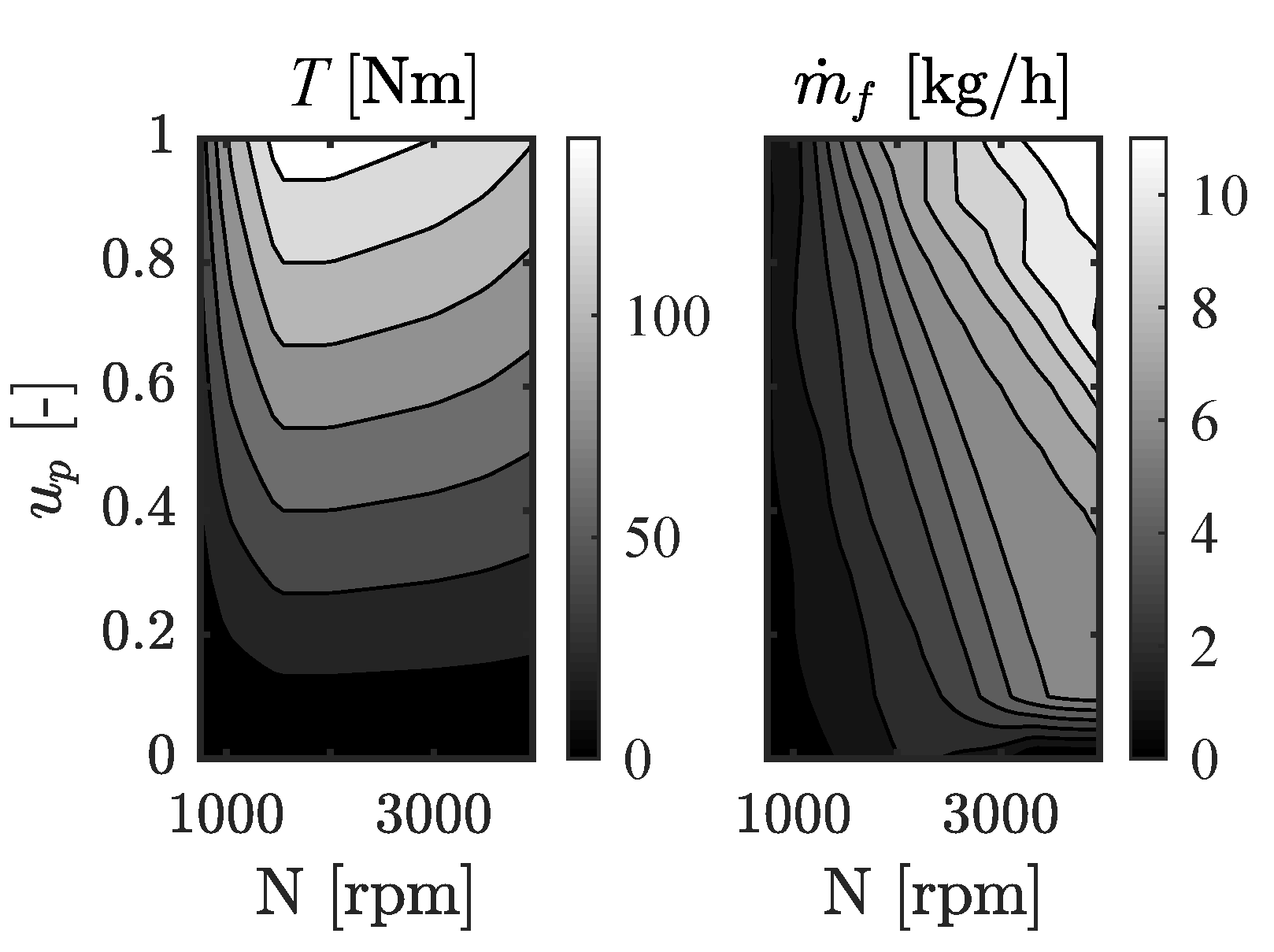
Figure 2.
Vehicle model performance. Left: comparison between measured and modelled fuel consumption during the set of driving cycles tested. Right: Percentage of cycles with modelling error () below certain limit .
Figure 2.
Vehicle model performance. Left: comparison between measured and modelled fuel consumption during the set of driving cycles tested. Right: Percentage of cycles with modelling error () below certain limit .
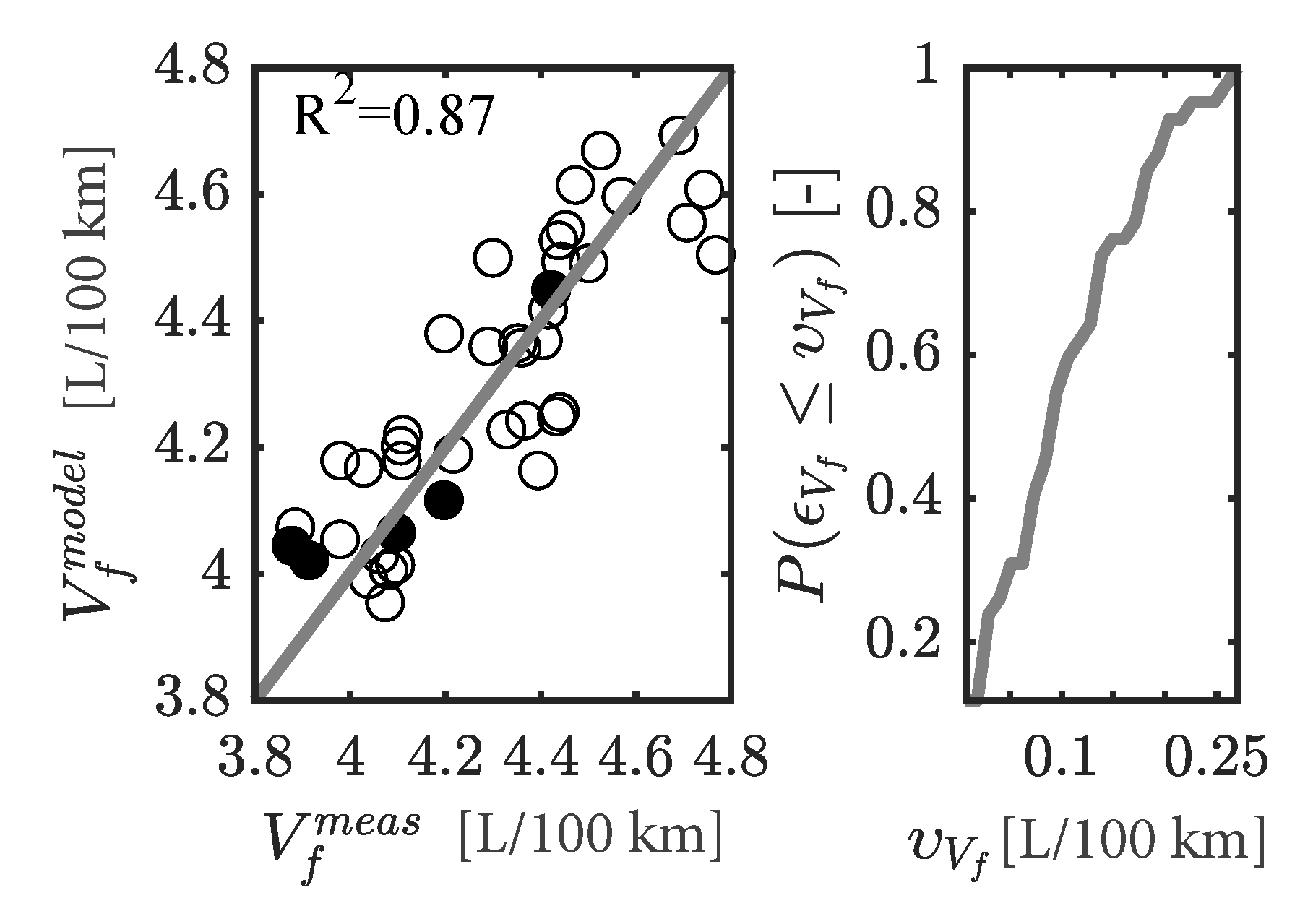
Figure 3.
Maximum vehicle speed and slope along the considered route.
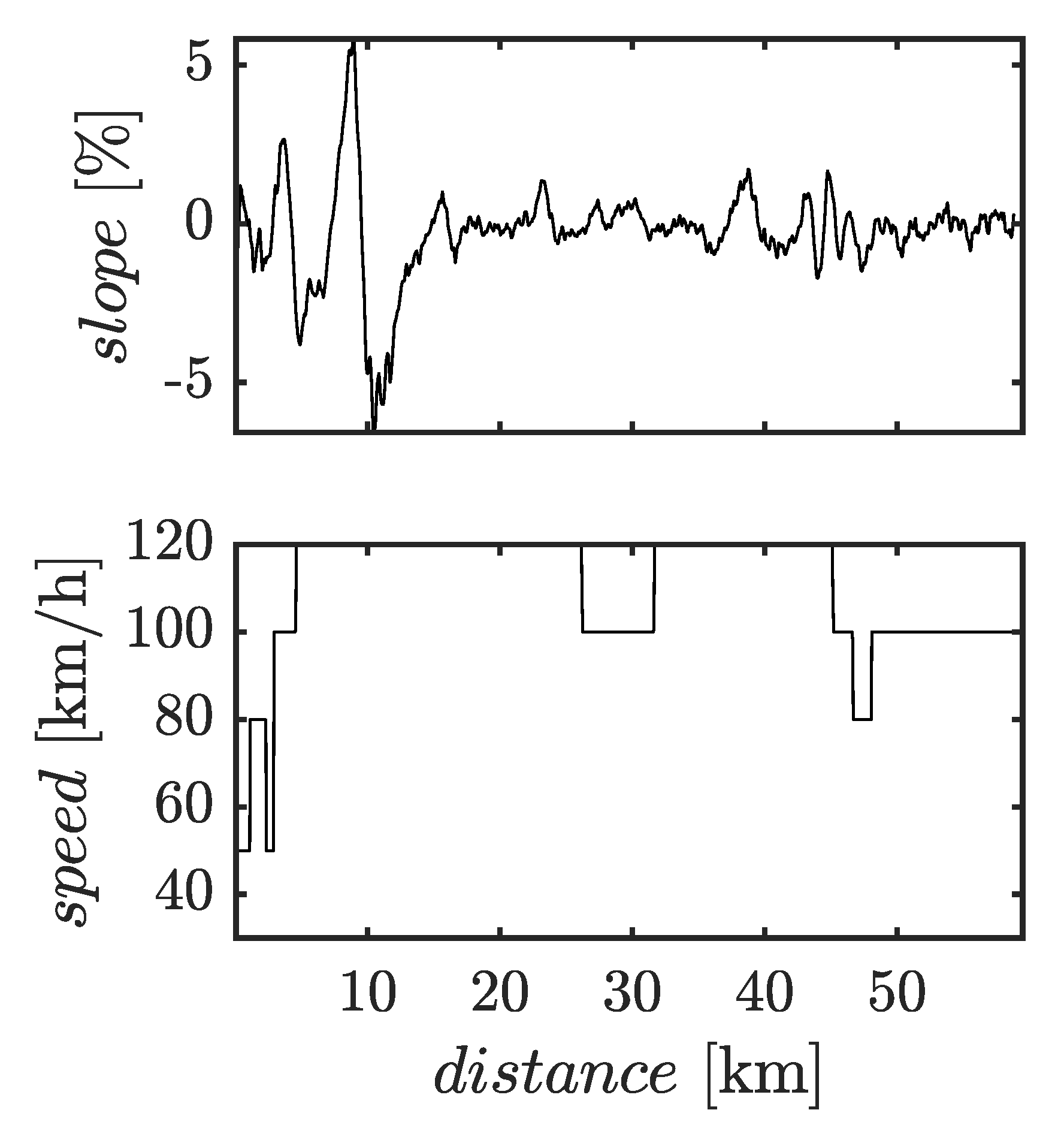
Figure 4.
Optimal vehicle speed set point for a given vehicle position, time and current vehicle velocity.
Figure 4.
Optimal vehicle speed set point for a given vehicle position, time and current vehicle velocity.
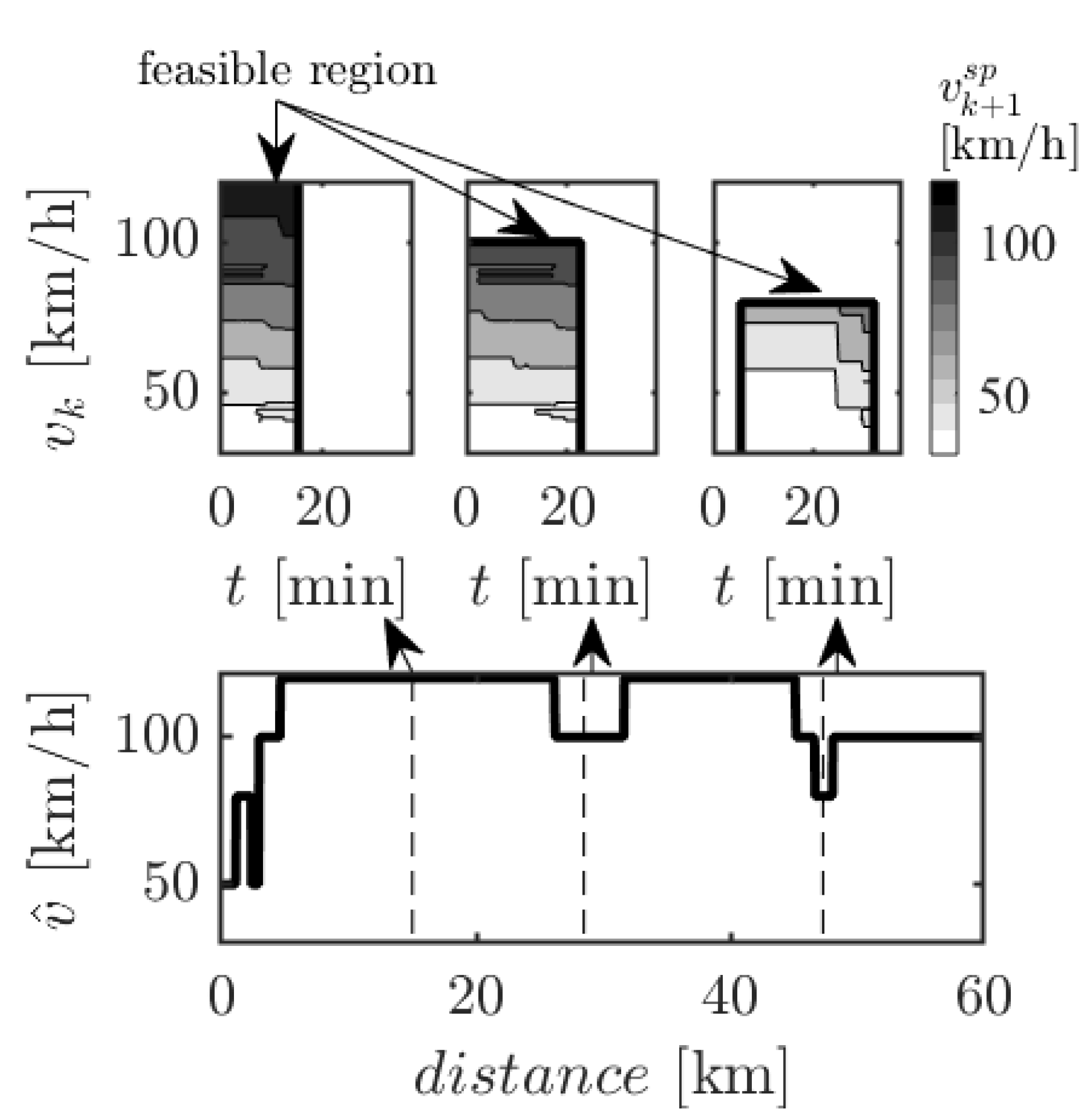
Figure 5.
Scheme of the acquisition system.
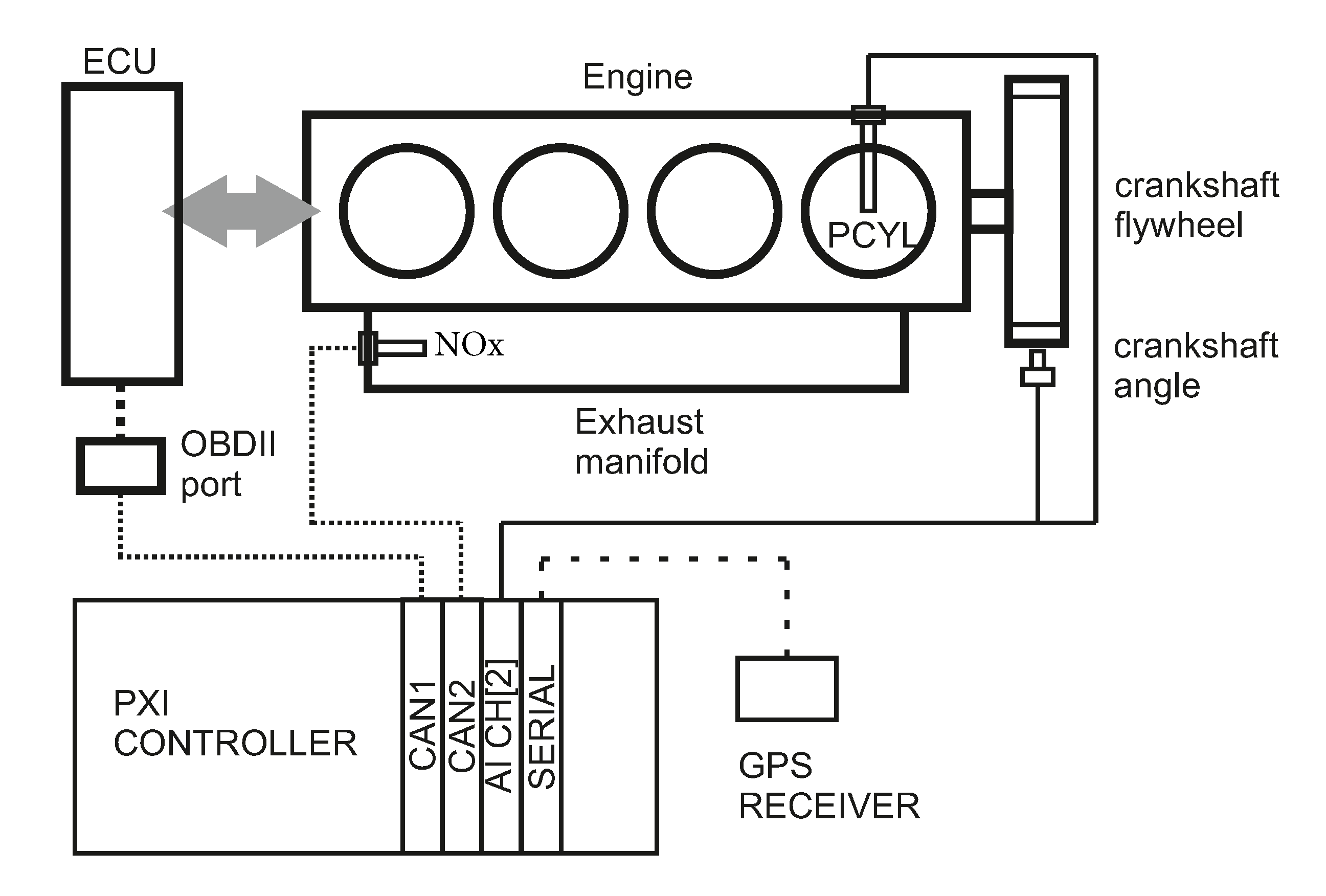
Figure 6.
Upper plot: Road altitude during the route. Lower plot: Optimal vehicle speed profile for an average vehicle speed of 95 km/h from DP optimisation (grey) and driver ability to follow it (black line).
Figure 6.
Upper plot: Road altitude during the route. Lower plot: Optimal vehicle speed profile for an average vehicle speed of 95 km/h from DP optimisation (grey) and driver ability to follow it (black line).
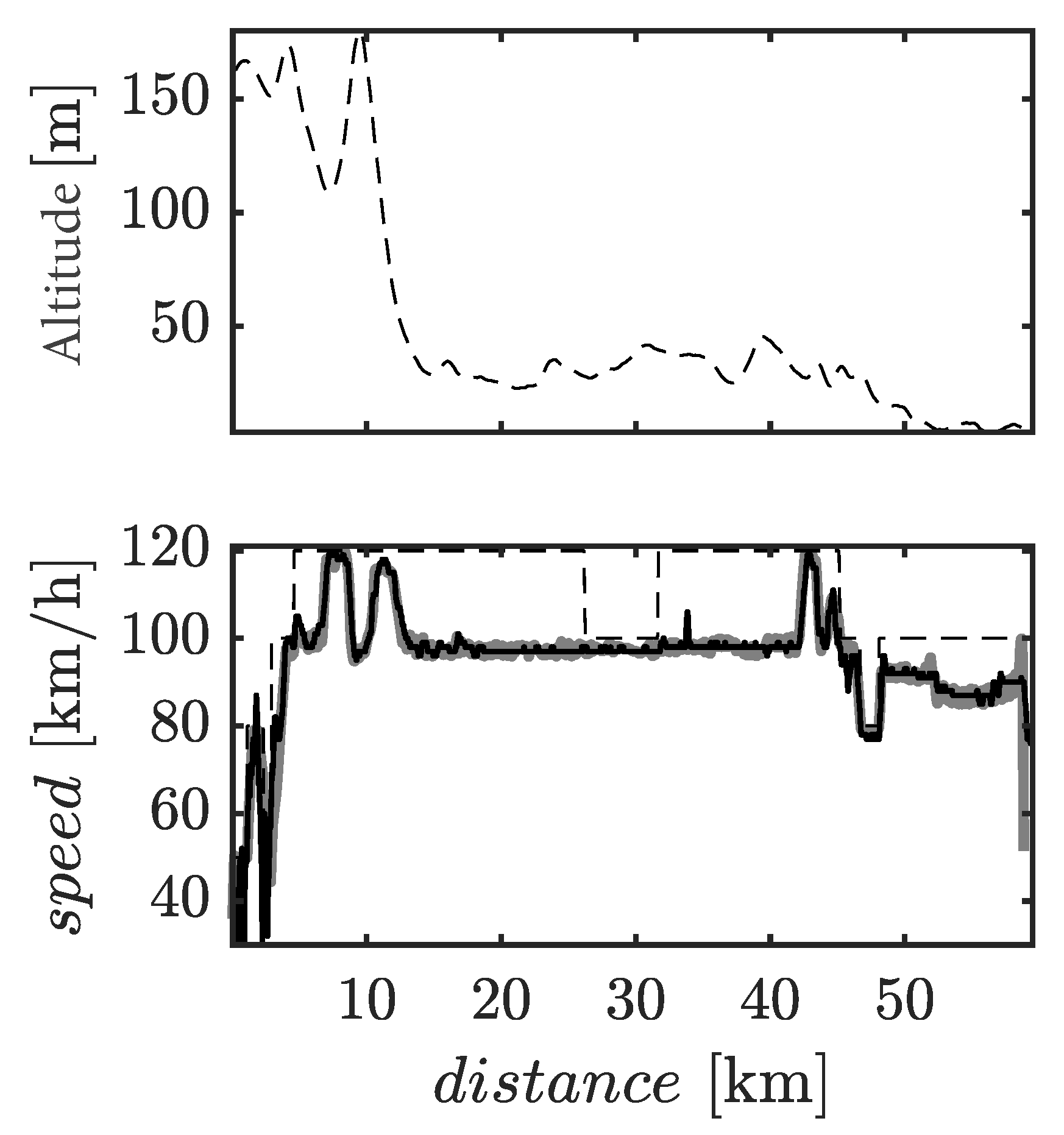
Figure 7.
Trade-off between fuel consumption and time spent to cover the route.
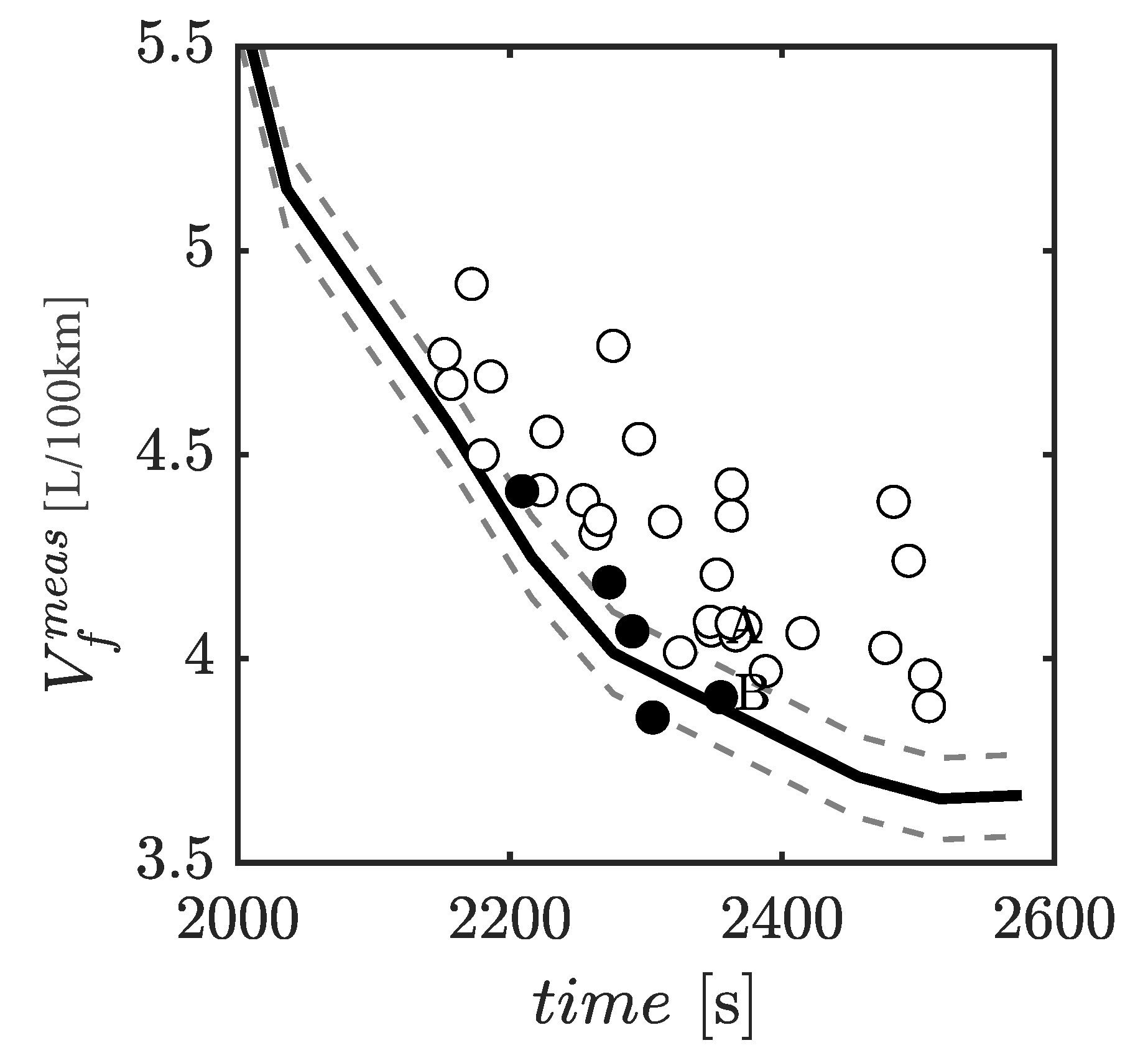
Figure 8.
Comparison between two routes with the same time (average speed of 95km/h) with (black, B point in Figure 7) and without (grey, A point in Figure 7 speed advisor. Upper plot: vehicle speed. Lower plot: fuel consumption difference between the case without speed advisor and the case with speed advisor (*)
Figure 8.
Comparison between two routes with the same time (average speed of 95km/h) with (black, B point in Figure 7) and without (grey, A point in Figure 7 speed advisor. Upper plot: vehicle speed. Lower plot: fuel consumption difference between the case without speed advisor and the case with speed advisor (*)
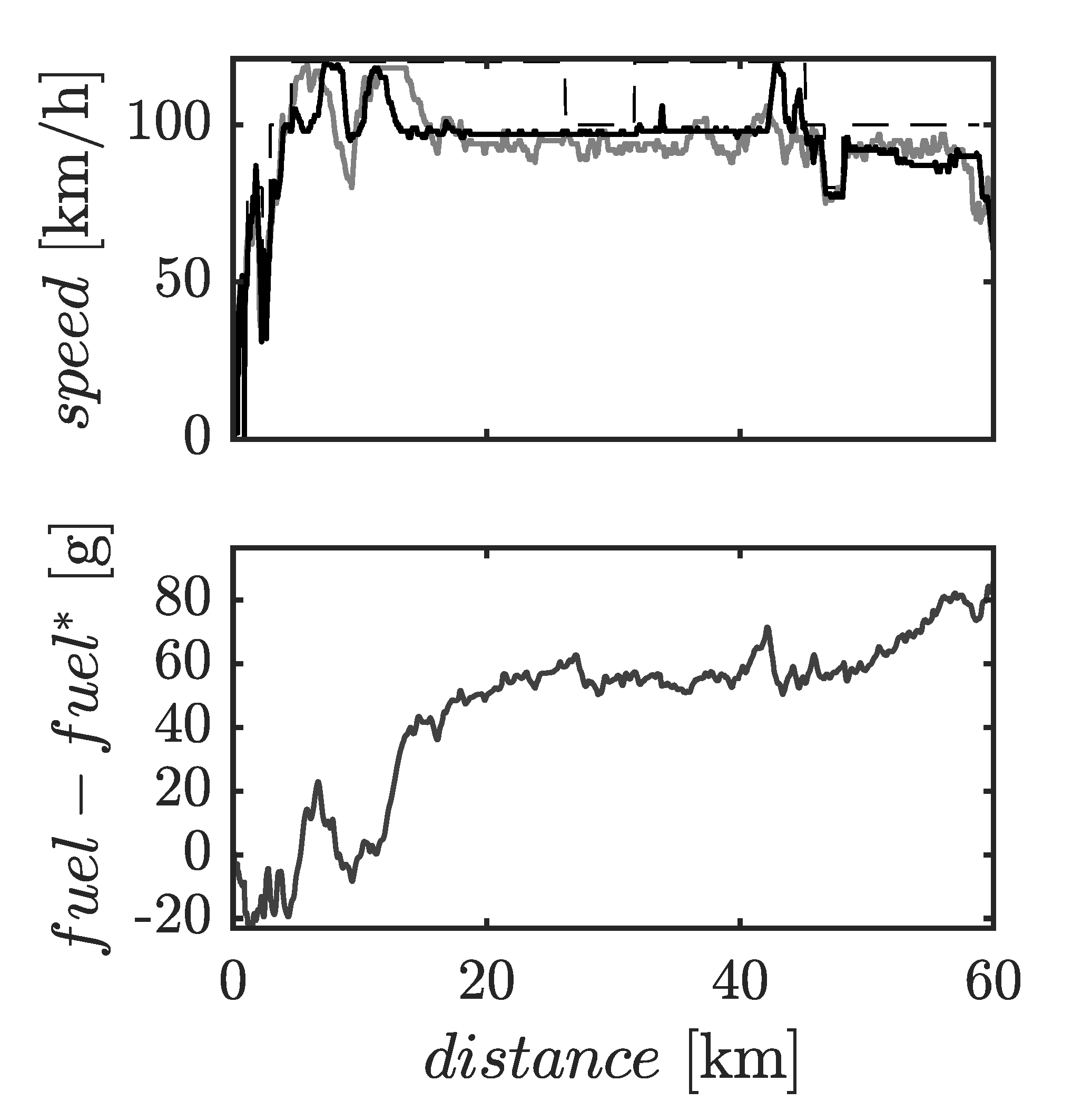

Table 1.
Discretisation employed in the optimisation algorithm DP.
| Variable | Range | Element Size |
|---|---|---|
| Distance (s) | [0, 60] km | 50 m |
| Speed () | [30,120] km/h | 1 km/h |
| Time () | [0, ] | 2 s |
| Brake/Throttle (u) | [−100,100]% | 2% |
Table 2.
Test vehicle specifications.
| Vehicle | |
|---|---|
| Engine displacement | 1.4 L |
| Max. power | 50 kW |
| Max. Torque | 160 Nm |
| Emissions level | EURO 5 |
| After-treatment | DOC + DPF |
| Unladen mass | 1125 kg |
| Manual Gearbox | 6 Spd |
Disclaimer/Publisher’s Note: The statements, opinions and data contained in all publications are solely those of the individual author(s) and contributor(s) and not of MDPI and/or the editor(s). MDPI and/or the editor(s) disclaim responsibility for any injury to people or property resulting from any ideas, methods, instructions or products referred to in the content. |
© 2024 by the authors. Licensee MDPI, Basel, Switzerland. This article is an open access article distributed under the terms and conditions of the Creative Commons Attribution (CC BY) license (http://creativecommons.org/licenses/by/4.0/).
Copyright: This open access article is published under a Creative Commons CC BY 4.0 license, which permit the free download, distribution, and reuse, provided that the author and preprint are cited in any reuse.


