

Submitted:
20 November 2024
Posted:
21 November 2024
You are already at the latest version
Abstract
Ubiquitylation is a post-translational modification that modulates protein function and stability. It is orchestrated by the concerted action of three types of enzymes, with substrate specificity governed by ubiquitin ligases (E3s), which may exist as single proteins or as part of multi-protein complexes. Although Cullin (CUL) proteins lack intrinsic enzymatic activity, they participate in the formation of active ubiquitin ligase complexes, known as Cullin-Ring ubiquitin Ligases (CRLs), through their association with ROC1 or ROC2, along with substrate adaptor and receptor proteins. Mammalian genomes encode several CUL proteins (CUL1-9), each contributing to distinct CRLs. Among these CUL proteins, CUL1, CUL3, and CUL4 are believed to be the most ancient and evolutionarily conserved from yeast to mammals, with CUL4 uniquely duplicated in vertebrates. Genetic evidence strongly implicates CUL4-based ubiquitin ligases (CRL4s) in chromatin regulation across various species and suggests that in vertebrates, CRL4s have also acquired a cytosolic role, facilitated by a cytosol-localizing paralog of CUL4. Substrates identified through biochemical studies have elucidated the molecular mechanisms by which CRL4s regulate chromatin and cytosolic processes. The substantial body of knowledge on CUL4 biology amassed over the past two decades provides a unique opportunity to explore the functional evolution of CRL4. In this review, we synthesize the available structural, genetic, and biochemical data on CRL4 from various model organisms and discuss the conserved and novel functions of CRL4s.
Keywords:
CUL4
; CRL4
; Ubiquitin
; Ubiquitin ligase
; Chromatin
; Evolution
1. Introduction
Active maintenance of protein homeostasis through coordinated protein synthesis and degradation is vital for organismal health [1,2,3]. In eukaryotic cells, protein degradation occurs via the lysosome or proteasome. As the lysosome resides in the cytosol, nuclear protein degradation is predominantly facilitated by the proteasome. The proteasome typically identifies polyubiquitylated proteins as substrates, making precise protein polyubiquitylation crucial for proper protein degradation, particularly in the nucleus.
Ubiquitylation functions not only as a degradation signal but also as a regulator of protein functionality. The versatility of protein ubiquitylation arises, in part, from the diversity of chain types formed by ubiquitin (mono-, multi-, and poly-ubiquitylation) and the various linkage types (M1, K6, K11, K27, K29, K33, K48, and K63) [4,5,6,7]. Moreover, proteomic analyses have identified approximately 90,000 ubiquitylation sites, surpassing the ~15,000 acetylation sites and ~20,000 phosphorylation sites found in mammalian cells [8,9], underscoring the significance of this modification.
Ubiquitylation is orchestrated by the sequential activity of three classes of enzymes: ubiquitin-activating (E1), conjugating (E2), and ligating (E3) enzymes. Ubiquitin ligases (E3s) confer substrate specificity in ubiquitylation by either mediating the transfer of ubiquitin from the E2 ubiquitin-conjugating enzyme to the substrate or directly accepting ubiquitin on their own cysteine residue from the E2 enzyme before transferring it to the substrate. Some ubiquitin ligases function as single proteins, while others form multi-protein complexes comprising E2 binding proteins and substrate-recognizing proteins. Notable examples of multi-protein ubiquitin ligases include Cullin-Ring ubiquitin Ligases (CRLs), where Cullin (CUL) proteins bind to ROC1 or ROC2, E2 enzyme linker proteins, and substrate adaptor and receptor proteins, thereby constituting active ubiquitin ligases [10] (Figure 1a). Through a diverse array of substrate receptors, CRLs are estimated to catalyze as much as 50% of cellular protein ubiquitylation in Trypanosoma brucei [11] and approximately 20% of ubiquitylation in cultured mammalian cells [12].
Evolutionarily, it is proposed that the eukaryotic ancestor harbored three cullin genes (CULα, CULβ and Culγ, each analogous to CUL1, CUL3, and CUL4 in mammals, respectively), forming the foundation of all extant cullins, though lineage-specific expansions have been observed in some species (Figure 1b). For example, yeast genomes encode three Cullin genes (CUL1, CUL3 and CUL4), whereas mammalian cells express eight CUL proteins (CUL1, 2, 3, 4A, 4B, 5, 7, and PARC), with CUL2, CUL5, CUL7, and PARC emerging from the CUL1 prototype [13,14,15], and CUL4 undergoing duplication to generate CUL4A and CUL4B [16,17,18].
Compared with CUL4A, CUL4B contains N-terminal extension where nuclear localization signal is located. Therefore, CUL4B resides in the nucleus whereas CUL4A is primarily observed in the cytosol [19,20]. The nuclear localization of CUL4A is promoted under DNA-damaged condition [21,22], thereby facilitating CUL4A’s engagement in nuclear functions. Given that the amino-terminal 100 amino acids, which serve as the binding site for DDB1, are critical for the nuclear localization of CUL4A [22], it is hypothesized that DDB1 and DCAF proteins play a contributory role. Nonetheless, the precise molecular mechanism underlying this process remains unidentified. Notably, single CUL4 protein in Trypanosoma, plant, yeasts, worm and fly all show nuclear localization [15,23,24,25,26,27,28]. Consistently, genetic and molecular evidence strongly implicates an ancient role for CUL4 in chromatin regulation, while also suggesting that CUL4 acquired a cytosolic function in vertebrates with the emergence of a cytosol-localizing paralog, CUL4A. The identification of nearly 100 substrates has clarified the detailed molecular mechanisms underlying CRL4 function. In this review, we summarize our current understanding of CUL4, derived from structural, genetic, and molecular studies, with an emphasis on its role in chromatin function.
2. CRL4 Structure
CRL4 is composed of three invariant proteins—the CUL4 scaffold protein, the ROC1 E2 enzyme linker protein, and the DDB1 substrate adaptor protein—along with variable substrate receptors, collectively termed DCAF (DDB1 and CUL4-associated factors) or DWD (DDB1-binding WD40 domain) proteins, due to the presence of a WD40 domain in most cases [29] (Figure 1a). The ubiquitin ligase activity of CRL4 is regulated by covalent attachment of NEDD8 (Neddylation) on single lysine residue of CUL4 [30]. Thus, NEDD8-harboring CRL4 is able to associate with ROC1 and DCAFs, but its removal is required for ROC1 and DCAF releases, which are required for DCAF recycling. COP9 signalosome is responsible for NEDD8 removal (deneddylation), and its inactivation leads to dysfunction of CRL4 [31].
The crystal structures of the CRL4A with a viral protein SV5V [32], CRL4A/BDDB2 [33], CRL4ADCAF1 [34] and CRL4ACSB [35,36] have been resolved. These studies collectively reveal that CUL4 forms an elongated and rigid structure, with the ROC1 binding site located at the C-terminal region and the DDB1 binding site at the N-terminal region. DDB1 is divided into three β-propeller domains (BPA, BPB, and BPC), with BPB interacting with an α-helix of CUL4. The BPA-BPC double propeller creates a cavity that binds to substrate receptors by sandwiching an α-helix of these proteins. Although the majority of substrate receptors contain a WD40 domain, it has been shown that the WD40 domain primarily supports binding to DDB1, while it plays a more significant role in substrate recognition. The BPA-BPC double propeller of DDB1 and its associated substrate receptor proteins are oriented towards ROC1, positioning the substrate near the ROC1-bound E2 enzyme, thereby facilitating ubiquitylation.
Vertebrate genomes contain two CUL4 genes—CUL4A and CUL4B—arising from gene duplication [16,17,18]. CUL4B contains a nuclear localization signal (NLS) in its N-terminus, which is absent in CUL4A, resulting in CUL4A localizing mainly in the cytosol, while CUL4B is primarily nuclear [19,20]. Since the NLS of CUL4B is located outside the binding region for DDB1 and ROC1, it does not interfere with CRL4 complex formation. The ancestral function of CUL4 is primarily related to chromatin regulation, as discussed below. This suggests that gene duplication allowed CUL4A to migrate from the nucleus to target cytosolic proteins, while CUL4B retains the ancient chromatin regulatory functions within the nucleus.
3. Organismal Phenotypes of CUL4 Mutation
The organismal function of CUL4 has been investigated through gene disruption or suppression, as well as overexpression, in various model organisms, which are briefly summarized in this section (Table 1).
Disruption of Cul4 in the yeast species Schizosaccharomyces pombe (S. pombe) and Neurospora crassa (N. crassa), along with the functional homolog Cul8 (also known as Rtt101) in Saccharomyces cerevisiae (S. cerevisiae), results in hypersensitivity to DNA damage, mitotic defects, and growth retardation [37,38,39,40,41,42]. Biochemical data discussed later support the notion that these defects are, at least in part, caused by dysregulation of heterochromatin-mediated gene silencing, chromosome segregation, DNA replication, and DNA repair, all of which point to chromatin abnormalities.
In the unicellular green alga Chlamydomonas reinhardtii, which possesses non-photochemical quenching (NPQ) mechanisms to dissipate excess absorbed light energy [63], a loss-of-function mutation in the Cul4 gene was identified as an inducer of photoprotection-related gene expression [43]. This finding suggests that Cul4 plays a role in monitoring and repressing the premature expression of photoprotection-related genes.
The flowering land plant Arabidopsis thaliana (A. thaliana) expresses CUL4 ubiquitously throughout its tissues [23,44]. Whole-body knockdown of Cul4 results in dwarfism, multiple developmental defects, and constitutive photomorphogenesis [23,44,45,46,47,48]. Although A. thaliana also possesses a NPQ system, the role of CUL4 in this process remains unclear to date.
Inactivation of Cul-4 in a free-living transparent nematode Caenorhabditis elegans (C. elegans) causes developmental arrest at the second-instar larval stage, accompanied by the enlargement of blast cell lineages with extensive DNA re-replication and accumulation [49]. The germline cells of such worms also show defects in the process of meiosis [28].
Cul-4 disruption in a fruit fly Drosophila melanogaster (D. melanogaster) also leads to developmental arrest at the larval stage [50,51]. Wing-disc cells in Cul-4 mutant flies exibited reduced DNA replication, highlighting the essential role of Cul-4 in DNA replication. In contrast, during the focal DNA replication stage in ovarian follicle cells, Cul-4 depletion resulted in ectopic DNA replication. These findings suggest dual functions of Cul-4 in DNA replication—facilitating the G1/S transition and suppressing abnormal DNA replication during the S phase. Loss of Cul-4 function in the retina disrupts retinal development by downregulating the expression of retinal determination genes, while ectopically inducing the expression of negative regulators of eye development [52]. These findings suggest that Cul-4 plays a crucial role in cell differentiation through gene regulatory mechanisms.
Disruption of CUL4A in Danio rerio (zebrafish) embryos led to developmental defects in the heart and pectoral fins with abnormal upregulation of Tbx5a gene [53]. Interestingly, human CUL4A and CUL4B both rescued the phenotype caused by CUL4A reduction, while zebrafish CUL4B could not, suggesting that human CUL4B and zebrafish CUL4B have divergent functions, likely involving different substrates. Zhao et al. also noted that CUL4B morpholino caused no apparent phenotype, indicating that CUL4A and CUL4B play distinct roles in development.
The first Cul4a knockout mice generated were mistakenly double knockouts of both the Cul4a gene and the adjacent Pcid2 gene, which resides on the complementary strand of CUL4A [64]. Subsequently, two Cul4a knockout mouse models were developed, each targeting either the ROC1 [54] or DDB1 binding domains [56], and both exhibited no gross developmental abnormalities throughout their lifespans. However, further analyses revealed cardiac hypertrophy [55] and spermatogenic defects in male mice [57,65]. Additionally, drug-induced K14+ skin cell-specific Cul4a knockout mice were found to be resistant to UV irradiation-induced skin tumor formation originating from K14+ cells [54]. Enhanced global genome repair via the nucleotide excision repair (GG-NER) pathway plays a significant role in this protection.
Deletion of CUL4B in mice results in embryonic lethality, characterized by massive apoptosis in extra-embryonic tissues [58,59]. Studies using extra-embryonic tissue-derived XEN cells indicated that impaired proliferation is a likely mechanism behind the embryonic lethality. Disruption of CUL4B in the epiblast, but not in extra-embryonic tissues, allows CUL4B-deficient embryos to survive, and the resulting viable mice display defects in spatial learning and memory, consistent with the fact that CUL4B loss-of-function mutations are frequently associated with X-linked intellectual disability in humans [60,61,62]. However, several phenotypes observed in patients, such as short stature, obesity, small testes, and macrocephaly, were not present in CUL4B null mice. Subsequent studies revealed altered differentiation of neural stem cells into glial cells, driven by the abnormal upregulation of relevant transcription factors [53].
In humans, CUL4A has been reported to be amplified in several cancers, including breast cancer [66,67,68], hepatocellular carcinoma [69], squamous cell carcinoma of the esophagus [70], adrenocortical carcinoma [71], non-small cell lung cancer [72], osteosarcoma [73], pleural mesothelioma [74], childhood medulloblastoma [75], epithelial ovarian tumors [76], and prostate cancer [77]. The causal role of CUL4A overexpression in tumorigenesis was demonstrated in breast cancer cells, where CUL4A silencing led to reduced cell proliferation, colony formation, cell motility, and tumor development [78,79,80]. Consistent with the tumorigenic role of CUL4A, conditional overexpression of CUL4A in mouse lungs induced pulmonary tumors [81].
CUL4B amplification has also been observed in colon cancer [82], as well as in cervix, lung, esophagus, and breast cancers [83]. In mouse models, CUL4B overexpression promoted both spontaneous and DEN-induced hepatocarcinogenesis, supporting the crucial role of CUL4B in tumorigenesis [84]. Given that several CRL4 substrates identified to date either directly or indirectly regulate cell proliferation, the molecular mechanisms by which CUL4 dysregulation drives tumorigenesis appear to be complex and context-dependent.
Overall, these findings suggest that CRL4 functions are closely associated with DNA-templated processes. In the following sections, the reported molecular functions of CRL4 in various model organisms are summarized, providing further evidence in support of these CRL4 functions.
4. CRL4 Functions in Trypanosoma
Trypanosoma, positioned at an early branch of eukaryotic evolution, serves as a valuable model to explore the primitive functions of CRLs [15] (Figure 1b). Proteome-wide identification of T. brucei CUL4 (TbCul-D) bound proteins revealed associations with DDB1, ROC1, two DCAF proteins, and several nuclear proteins. One of the identified DCAF proteins is specific to Trypanosoma, while the other has an ortholog in Leishmania. The elucidation of the molecular functions of these DCAFs is anticipated to shed light on the earliest functions of CRL4. The same study identified two additional DCAF proteins, which are putative orthologs of human nuclear DCAFs; DCAF7 and DCAF13. Whether these proteins act as substrate receptors for CRL4, and if so, whether their substrates are orthologs of human proteins known to be regulated by CRL4—such as DNA ligase 1 for CRL4DCAF7 and DNA-crosslinked TOP1 for CRL4DCAF13—remains to be investigated (see the section “9. CRL4 functions in mammals”).
5. CRL4 Functions in Plants
Numerous substrates of CRL4 have been reported in plants, with those highlighted in this section summarized in Table 2.
Genetic evidence has indicated the involvement of CRL4 in NPQ in Chlamydomonas, as described earlier. More specifically, NPQ can be categorized into at least three types: quenching due to proton concentration gradients (qE), quenching due to state transitions (qT), and photoinhibition (qI). Among these, qE accounts for a significant portion of NPQ, and its regulatory mechanism has garnered considerable attention [96]. The genes related to qE are induced by the CONSTANS transcription factor, which is stabilized when the organism is exposed to high-energy light. Under low-energy light conditions, CRL4SPA/COP1, where the SPA/COP1 dimer appears to function as a DCAF, and CRL4DET1 ubiquitinate the CONSTANS for degradation, preventing untimely dissipation of light energy [43,85,86]. The photoreceptor UVR8, which detects high-energy light, binds to SPA/COP1, likely inhibiting CRL4SPA/COP1 ubiquitin ligase activity, resulting in CONSTANS accumulation [86], as inferred from studies in A. thaliana described below.
In A. thaliana, light not only serves as a critical source of energy for photosynthesis but also provides essential environmental cues that influence optimal growth. Similar to Chlamydomonas, A. thaliana utilizes photoreceptors to detect light conditions and regulate two contrasting developmental programs: skotomorphogenesis and photomorphogenesis [97]. Skotomorphogenesis is characterized by elongated hypocotyls, closed cotyledons, and the formation of an apical hook, enabling seedlings to rapidly grow in darkness using the seed’s stored energy—an example being edible bean sprouts. In contrast, photomorphogenesis is the process by which light signals inhibit hypocotyl elongation, stimulate cotyledon expansion, and promote greening to optimize light-harvesting capacity and initiate autotrophic growth.
A. thaliana encodes several photoreceptors, including blue/UV light-sensing cryptochromes (CRY1/2) [98] and red/far-red light-sensing phytochromes (PHYA/B/C/D/E) [99], both of which are crucial for regulating photomorphogenesis. Upon exposure to light, CRY2 undergoes phosphorylation and conformational changes that facilitate its ubiquitylation and subsequent degradation via CRL4SPA/COP1 [89]. Conversely, phosphorylated CRY2 binds to SPA, inhibiting CRL4SPA/COP1 ubiquitin ligase activity [100]. This inhibition results in the accumulation of the CONSTANS transcription factor, which is otherwise degraded by CRL4SPA/COP1, thereby inducing flowering [87,88]. Thus, CRL4-mediated degradation of CRY2 appears to serve as a regulatory mechanism to ensure that light responses are tightly controlled. Interestingly, the same ubiquitin ligase, CRL4SPA/COP1, is also involved in photomorphogenesis through the ubiquitylation and degradation of PIF1, a transcription factor that represses photomorphogenesis, following light-induced nuclear translocation of PHYA and the subsequent phosphorylation of PIF1 [90]. Notably, genetic evidence clearly indicates that CUL4 acts as a repressor of photomorphogenesis, as discussed in the section “3. Organismal Phenotypes of CUL4 Mutation.” (Table 1). Therefore, the inhibitory effect on PIF1, which promotes photomorphogenesis, is likely counterbalanced by other regulatory mechanisms. One such mechanism, in addition to CONSTANS degradation, is the CRL4SPA/COP1-mediated degradation of the photomorphogenesis-promoting transcription factor HY5 in darkness [23,91].
Light encompasses a spectrum of different wavelengths, among which UV light can cause DNA damage by inducing the formation of cyclobutane pyrimidine dimers (CPD) and pyrimidine (6-4) pyrimidone photoproducts (6,4-PP) [101]. These DNA lesions are recognized by DDB2, which initiates DNA repair via the global genome-nucleotide excision repair (GG-NER) mechanism. Since the prolonged presence of DDB2 can hinder subsequent DNA repair processes, CRL4DET1 is recruited to ubiquitylate DDB2, facilitating its degradation and allowing the NER process to proceed [92].
In mammals, CPD and 6,4-PP obstruct and stall RNA Pol II progression in actively transcribed genes. In response, CSB recognizes the stalled Pol II and recruits CSA, a DCAF protein, ultimately leading to the degradation of CSB to complete transcription-coupled NER (TC-NER, as described in the section ”9. CRL4 functions in mammals”). Although less thoroughly studied than in mammalian systems, A. thaliana encodes homologs of CSA, CSAat1a and CSAat1b, which form CRL4 complexes. Mutations in either CSAat1a or CSAat1b sensitize cells to UV irradiation and reduce TC-NER, indicating that these CSA homologs perform functions analogous to mammalian CSA [102]. Whether plant CRL4CSA ubiquitylates the orthologs of mammalian CRL4CSA proteins remains to be explored.
There are numerous other abiotic stressors, and ABA plays a pivotal role in mitigating these stresses [103]. Under stress conditions, ABA is synthesized and secreted across various plant organs, leading to seed dormancy maintenance, inhibition of development and growth, and stomatal closure to minimize unnecessary energy expenditure and water loss. PYR1/PYL/RCAR proteins function as ABA receptors, inhibiting specific protein phosphatases and resulting in the phosphorylation and activation of AREB/ABF/ABI5 transcription factors, thereby altering the expression of stress-responsive genes. CRL4DWA1/2 and CRL4ABD1 catalyze the ubiquitylation and degradation of ABI5, maintaining low ABI5 levels [93,94]. Additionally, CRL4DDA1 facilitates the ubiquitylation and degradation of the ABA receptor PYL8. Thus, CRL4 complexes regulate and prevent excessive ABA responses [95,104].
In Cul4-mutant plants, seed production is impaired due to severely underdeveloped endosperms and embryos [46]. Additionally, these plants exhibit an early flowering phenotype [47]. These defects have been linked to impaired PRC2 activity, specifically the inability to catalyze histone H3 lysine 27th residue (H3K27) methylation. CRL4MSI1/4 binds to and activates the PRC2 complex, resulting in increased H3K27 methylation on target genes such as MEA (a regulator of endosperm development) and FLC (a regulator of flowering time), repressing their expression. While the association between CUL4/DDB1 and the H3K27 methyltransferase complex PRC2 through DCAF proteins MSI1/MSI4 has been demonstrated, it remains unclear whether PRC2 components themselves are ubiquitylated or if other substrates are responsible for PRC2 activation. In the case of FLC regulation, the binding of CUL4 to the FLC locus has been detected, suggesting that local CRL4 activity is critical for H3K27 methylation, potentially through the recruitment of PRC2 to specific target genes.
6. CRL4 Functions in Fungi
Fungal genomes generally contain at least three prototypical Cullin genes, which correspond to homologs of the mammalian CUL1, CUL3, and CUL4 [13]. Notably, S. cerevisiae does not contain CUL4 based on sequence conservation but expresses a unique cullin, Cul8 (also known as Rtt101), which forms a CRL4-like complex with Mms1 as a counterpart to DDB1 [105]. Cul8 is now considered a functional homolog of CUL4. Similar to other organisms, CRL4/8 complexes play essential roles in chromatin regulation within these yeast species (Table 3).
In the filamentous fungus N. crassa, Cul4 is a component of the histone methyltransferase complex DCDC (DIM-5/-7/-9, Cul4, DDB complex), where DIM-5 catalyzes the trimethylation of lysine 9 on histone H3 (H3K9) [41,42,114]. In this organism, H3K9me3 is essential for DNA methylation, serving as a scaffold for the HP-1/DIM-2 complex, which contains cytosine methyltransferase activity in the DIM-2 subunit. The critical role of Cul4/DDB1 in the DCDC complex was demonstrated by the loss of H3K9me3 and DNA methylation following CUL4 or DDB1 deletion. DIM-9/DCAF26 is considered a DCAF substrate receptor protein, as it directly binds to DDB1/DIM-8 and contains a WD40 domain [42,114]. Additionally, DIM-9 was found to be stabilized by DDB1, a feature shared by some, but not all, DCAF proteins.
Interestingly, Cul4 mutants lacking the C-terminus (which prevents binding to ROC1) or mutants with a point mutation at K863 (the neddylation site) were still able to support H3K9 and DNA methylation to the same extent as wild-type Cul4, indicating that ubiquitin ligase activity is dispensable for DCDC function [115]. Instead, Cul4’s ubiquitin ligase activity is required for DCDC-independent functions, such as DNA repair. However, the molecular mechanisms by which Cul4 contributes to DNA repair in this organism have not yet been explored.
Among the phenotypes induced by CUL4 deletion (Table 1), mitotic defects and growth retardation are at least partially attributable to DCDC dysfunction, as DCDC-deficient strains exhibit abnormal chromosome segregation and growth defects due to disruption of centromeric heterochromatin marked by H3K9me3. Interestingly, only Cul4 and Dim-8 (the DDB1 gene) mutants were hypersensitive to DNA damage, supporting a role for Cul4/DDB1 in DNA repair that is independent of DCDC.
Heterochromatin formation in S. pombe relies on a H3K9 methyltransferase complex called CLRC (Clr4 methyltransferase complex), which contains a CRL4-like module comprising Cul4 (also known as Pcu4), Rik1 (a distant DDB1 homolog), Pip1 (a ROC1 homolog), and the putative DCAF protein Dos1/Clr8/Raf1. In contrast to N. crassa, the ubiquitin ligase activity of CLRC in S. pombe is essential for heterochromatin formation [116,117]. A later study identified H3K14 as a critical substrate of ubiquitylation, which is required for subsequent H3K9 methylation [106]. CLRC also targets the H3K4 methyltransferase Set1, which counteracts heterochromatinization, as well as the H3K9 demethylases Lsd1/2 for degradation [107].
In addition to its role in CLRC, S. pombe Cul4 forms a typical CRL4 complex, as found in multicellular eukaryotes, utilizing Ddb1. Cdt2 was shown to act as the DCAF substrate receptor, targeting Epe1, Spd1, and Cdt1 for ubiquitylation and degradation. Epe1 prevents the spread of H3K9 methylation into euchromatin, thereby maintaining the euchromatin/heterochromatin boundary. Although Epe1 associates with the entire heterochromatin region, CRL4Cdt2-mediated ubiquitylation and degradation within heterochromatin restricts Epe1 to the heterochromatin boundary [108]. Spd1, an inhibitor of ribonucleotide reductase, which generates dNTPs, is also targeted for degradation by CRL4Cdt2 during the S phase and in response to DNA damage, meeting the increased demand for the dNTP pool [39,109,110,118].
Cdt1 degradation by CRL4Cdt2 is a conserved mechanism across fungi and mammals, ensuring that DNA is replicated only once per cell cycle and preventing DNA re-replication [111]. Together, these studies reveal that CRL4 in S. pombe plays dual roles: supporting DNA replication by degrading Spd1 and Cdt1, and maintaining heterochromatin integrity by localizing Epe1 at the euchromatin/heterochromatin boundary.
Cul8 was initially identified through a genetic screen aimed at uncovering genes involved in Ty1 transposition [119] and was later found to repress the transcription of telomeric genes [40]. However, compared to other fungi, the molecular mechanisms of Cul8 related to transcription remain largely unexplored. In contrast, significant progress has been made in understanding Cul8’s role in DNA replication and repair. In this context, Cul8 operates downstream of Rtt109, which catalyzes H3K56 acetylation, a histone mark incorporated into chromatin to ensure genome stability during DNA replication and repair [120,121].
It is well established that newly synthesized histone H3-H4 pairs are first captured by the histone chaperone Asf1, on which Rtt109 acetylates H3K56 before the pair is transferred to other chaperones, such as Rtt106 and Caf-1, which mediate histone incorporation into replicated DNA. The Cul8Mms22 complex was shown to ubiquitylate K56-acetylated H3 at three C-terminal lysine residues, facilitating the transfer of histones from Asf1 to Rtt106 [112]. In parallel, CUL8Mms22 links Asf1 to Caf-1, aiding in histone passage independently of the H3 ubiquitylation mechanism described above [122].
Importantly, these mechanisms appear to be conserved in human cells, as the binding of histones to chaperones downstream of ASF1, as well as the deposition of newly synthesized H3 into chromatin, are compromised in CUL4A- or DDB1-depleted human cultured cells [112]. This biochemical evidence supports the notion that Cul8-based ubiquitin ligase is a functional homolog of CRL4 in chromatin regulation. Beyond histone H3, Cul8 also ubiquitylates Spt16, a component of the histone chaperone FACT, to promote its localization to the replication origin through an as-yet-undefined mechanism [113]. Since FACT is part of the large replication progression complex (replisome), which includes essential replicative helicase MCM proteins, deletion of Rtt101 significantly reduces MCM at the replication origin, indicating that Cul8 facilitates replisome formation via FACT.
Moreover, CUL8Mms22 was found to associate with the replisome, where it ubiquitylates as-yet-unidentified proteins crosslinked to DNA, thus removing obstacles to DNA replication [123], and promoting the restart of stalled replication forks [124].
Similar to A. thaliana, yeasts also encode CSA orthologs (Csa in N. crassa, Rad28 in S. cerevisiae, and Ckn1 in S. pombe); however, their role as DCAFs for CRL4 has not been documented. Although mutants of Rad28 or Ckn1 do not display defects in TC-NER activity [125,126], in the context of a disrupted secondary repair pathway known as UVER, which is unique to yeasts, the Ckn1 mutant exhibits compromised TC-NER function and increased sensitivity to UV radiation [126]. This suggests that yeast CSA orthologs are also involved in the TC-NER pathway.
Collectively, these findings indicate that CRL4 and its functional homologs play pivotal roles in heterochromatin formation, DNA replication, and repair. Disruption of these processes leads to hypersensitivity to DNA damage, mitotic failure, and ultimately, growth retardation.
7. CRL4 Functions in Worms
In this and the next sections, we will overview the chromatin-related substrates and the roles of CRL4 in two model organisms, C. elegans and D. melanogaster, respectively, as outlined in Table 4.
As previously mentioned, inactivation of Cul-4 in C. elegans leads to developmental arrest at the second-instar larval stage, characterized by the enlargement of blast cell lineages [49]. In wild-type worms, these cells rapidly degrade the DNA replication factor CDT-1 by CRL4CDT-2 once DNA replication commences during the S phase. However, this CDT-1 degradation is absent in Cul-4-depleted cells, resulting in massive DNA re-replication and accumulation. The loss of one allele of CDT-1 suppresses this DNA re-replication phenotype, reinforcing the critical role of CDT-1 dysregulation in the DNA replication defects caused by Cul-4 inactivation.
In addition to CDT-1, C. elegans CRL4 has been reported to target Pol η and SKN-1 for degradation, using CDT-2 and WDR-23 as substrate receptors, respectively. Pol η, a well-characterized member of the Y-family DNA polymerases, plays a key role in replicating damaged DNA but at the cost of lower fidelity [134]. In response to DNA damage, Pol η is degraded by CRL4CDT2, with this degradation being counteracted by the SUMOylation of Pol η by the GEI-17 SUMO ligase [127]. This degradation is speculated to be a mechanism for removing Pol η from chromatin after damaged DNA is replicated.
Beyond its roles in DNA replication and repair, CRL4 is also involved in gene expression regulation in C. elegans, as demonstrated by its regulation of SKN-1. SKN-1 is a transcription factor that acts as a master regulator of oxidative stress responses through gene expression [135]. A genome-wide RNAi screen aimed at identifying genes involved in oxidative stress-inducible gene expression revealed the critical roles of proteasome subunits, DDB1, and WDR-23 in the oxidative stress response [128]. Further analyses showed that WDR-23 directly binds to DDB1 and SKN-1, with CRL4WDR-23 mediating the degradation of SKN-1 in intestinal nuclei. Oxidative stress activates p38 MAPK, which inhibits SKN-1 degradation by CRL4WDR-23, contributing to the inducible expression of SKN-1-regulated genes.
Interestingly, while this mechanism is conserved, it functions as a backup in mammals. The mammalian ortholog of SKN-1, NRF2, is predominantly degraded by the CRL3-KEAP1 complex [136]. However, in the absence of KEAP1—similar to C. elegans, which lacks a KEAP1 ortholog—WDR23 (also referred to as DCAF11)-associated CRL4 ubiquitylates NRF2, thereby maintaining NRF2 at low levels [137].
Meiosis is a specialized process in germ cells where genetic information is partially exchanged between homologous regions of sister chromatids through recombination, prior to the formation of haploid cells [138]. The DCAF protein GAD-1 enables CRL4 to participate in this process, as evidenced by the fact that mutants of cul-4, ddb-1, gad-1, or a component of the COP9 signalosome all exhibit defects in synaptonemal complex (SC) formation, which is essential for meiotic recombination [28]. Interestingly, Rbx-1/2 mutants do not display this phenotype, suggesting that either ubiquitin ligase activity is not required at this stage or an atypical E2 enzyme is involved in germ cells. While it is suspected that increased expression and transposition of the Tc3 transposable element, which causes DNA damage, may be partially responsible for SC misformation in CRL4GAD-1-inactivated germ cells, the precise mechanisms and substrates involved in this process remain unknown.
8. CRL4 Functions in Flies
Studies in D. melanogaster have also demonstrated the critical roles of CRL4 in both DNA replication and gene expression. Similar to what was observed in C. elegans, CRL4L(2)dtl (the Drosophila homologous complex of CRL4CDT2) is responsible for the degradation of Double-parked (Dup), the Drosophila homolog of CDT1 [51]. Additionally, the E2f1 transcription factor, a key activator in the E2F family that drives cell cycle progression, is degraded by CRL4L(2)dtl during the S phase [129]. This degradation is essential for normal cell cycle progression in the wing imaginal discs and for the endocycle in larval salivary glands [139].
CRL4 has also been reported to mediate the degradation of cell cycle regulators Dacapo (Dap), the Drosophila homolog of Cip/Kip family CDK inhibitor, and cyclin E, though the substrate adaptor proteins responsible for these actions and the physiological significance of these regulatory processes remain unclear [130].
CRL4 was found to regulate the light-induced degradation of Cry protein, with Ramshackle, the Drosophila homolog of BRWD3, serving as the DCAF substrate receptor [131]. Although Cry is not directly involved in gene expression, its regulation of the circadian clock protein Tim impacts gene expression changes through the Clock-Cycle heterodimer [140], suggesting that CRL4 might indirectly influence circadian gene expression.
Recently, it was demonstrated that CRL4BRWD3 regulates histone H3 lysine 4 (H3K4) methylation levels, a modification crucial for transcriptional regulation [141]. H3K4 can exist in mono-, di-, and tri-methylated states (designated as H3K4me1/2/3, respectively), with these levels being dynamically regulated by the opposing activities of methyltransferases and demethylases. Specifically, BRWD3-associated CRL4 ubiquitylates KDM5 (also known as Lid), an H3K4me3/2 demethylase, targeting it for degradation, which subsequently increases H3K4me3 levels. Although H3K4me3 is extensively associated with transcriptional activity, the authors did not observe a direct correlation with gene expression in the differentially expressed genes—upregulated genes did not necessarily exhibit increased H3K4me3, and this was similarly observed for downregulated genes. This may be attributed to the transient RNAi-based knockdown of CUL4 and BRWD3, which may require more time to manifest in H3K4 methylation’s impact on gene expression. Whether this regulatory mechanism is conserved across other organisms remains to be investigated.
D. melanogaster is frequently used to investigate the mechanisms of cell competition, a process where unfit cells are removed by their neighboring cells. The involvement of Mahjong (the Drosophila homolog of DCAF1) in this process has been suggested [142], and a recent report identified the Xrp1 transcription factor as a critical substrate of CRL4DCAF1. The degradation of Xrp1 by CRL4DCAF1 leads to the transcriptional repression of genes associated with cell elimination, thereby conferring resistance to competition [132].
Cell competition is not the only outcome of cell-cell interactions; most non-transformed cells exhibit contact-dependent inhibition of proliferation through the activation of the Hippo pathway [143,144]. D. melanogaster is also commonly used in studies of the Hippo pathway, which regulates organ size [145]. Activation of the Hippo pathway by cell contact triggers a kinase cascade, leading to the nuclear exclusion and inactivation of Yki, a transcription factor that promotes cell proliferation. DCAF12 has been reported to recognize Yki and recruit CRL4, resulting in Yki’s ubiquitination and subsequent degradation via the proteasome in the nucleus, preventing Yki hyperactivation [133]. This mechanism has also been shown to be conserved in mammalian cells [133].
Taken together, these findings highlight the significant role of CRL4 in regulating DNA replication, repair, and gene expression in both C. elegans and D. melanogaster.
9. CRL4 Functions in Mammals
Although CUL4 was first identified in worms [146], most of the knowledge about CRL4 function has been accumulated through studies in mammalian cells, leading to the availability of many excellent review articles on this topic.
In this section, we first summarize the literature on DNA and histone modification-related proteins that are modulated by CRL4, using these examples to illustrate CRL4-mediated chromatin regulation. We then provide a brief overview of CRL4 functions in relation to nucleus-localizing DCAF proteins [147,148]. Chromatin-related substrates of CRL4 highlighted in this section are summarized in Table 5. Readers are encouraged to refer to the relevant review articles for further details, where available.
9.1. DNA Modification-Related Proteins
DNA methylation at the C-5 position of cytosine (5mC) is a crucial chromatin modification that regulates gene expression. There are three DNA methyltransferases in humans: DNA methyltransferase 3A and 3B (DNMT3A/B), which catalyze de novo DNA methylation, and DNMT1, which acts as a maintenance methyltransferase during cell division, targeting hemimethylated regions in the S phase [192]. DNMT3A, in particular, plays a crucial tumor suppressor role in the hematopoietic system and is frequently mutated in clonal hematopoiesis (CH). Approximately two-thirds of missense mutations and several 3-bp in-frame deletions in the DNMT3A gene cause instability of the DNMT3A protein, with CRL4BDCAF8 identified as the ubiquitin ligase that ubiquitylates and degrades mutant DNMT3A [149]. These findings suggest that DCAF8 monitors abnormal DNMT3A for degradation, contributing to disease pathogenesis, and provide a rationale for developing DCAF8 inhibitors as potential treatments for DNMT3A mutation-induced CH. Notably, wild-type DNMT3A also binds to DCAF8, indicating that CRL4BDCAF8 also regulates wild-type DNMT3A.
Interestingly, DNMT3B has been shown to interact with NEDDylated CUL4A, and NEDD8 enhances DNMT3B-dependent DNA methylation [193]. This suggests that DNMT3B is also regulated by CRL4, though the precise mechanisms remain unclear.
DNMT1 stability is regulated by methylation-dependent ubiquitylation. Outside the S phase, when hemimethylated DNA is absent, SET7 methylates a specific lysine residue on DNMT1, which is recognized by the L3MBTL3 methyl-reader protein, recruiting CRL4DCAF5 for ubiquitylation and degradation of DNMT1. During the S phase, LSD1 removes this methyl group, stabilizing DNMT1 [150].
In the G2/M phase, methylated DNA in centromeric and pericentromeric regions is maintained by the ATP-dependent chromatin remodeler LSH (also known as HELLS or PASG) [194]. CRL4DCAF8, in addition to targeting DNMT3B, also degrades LSH. In response to oxidative stress, CRL4DCAF8 ubiquitylates and degrades LSH, leading to DNA demethylation and the upregulation of genes, particularly those related to ferroptosis [151]. Although the precise mechanisms by which oxidative stress triggers CRL4DCAF8-mediated LSH ubiquitylation and the specificity of target genes in this pathway remain unclear, forced DNA demethylation through TET2 catalytic domain overexpression attenuates the interaction between DCAF8 and LSH. This suggests that methylated DNA, maintained by LSH, promotes LSH degradation, contributing to the dynamic regulation of DNA methylation.
The effects of 5mC are mediated by methyl DNA binding domain proteins (MDBs), which recruit histone-modifying enzymes and chromatin remodelers to exert their repressive functions [195]. Among these, MeCP2 has recently been shown to be ubiquitinated and degraded by CRL4DCAF13 in the ovary [152]. In secondary ovarian follicles, DCAF13 is upregulated, which is correlated with the reduction of MeCP2 levels, promoting gene expression and follicle growth. Given that CRL4DCAF13 regulation of MeCP2 has been demonstrated in HeLa cells, it is plausible that this mechanism functions in other tissues as well.
A breakthrough in the DNA methylation field was the discovery of TET dioxygenases, which catalyze the iterative oxidation of 5mC, ultimately leading to DNA demethylation, demonstrating that DNA methylation is reversible [196]. TET proteins are monoubiquitylated at highly conserved lysine residues by CRL4A/BDCAF1 [153]. This monoubiquitylation enhances the binding of TET proteins to DNA, which is essential for their catalytic function in cells. However, the detailed mechanism by which monoubiquitylation promotes TET binding to DNA remains unclear.
The final step of DNA demethylation is catalyzed by the base excision repair enzyme TDG (thymine DNA glycosylase), which is also targeted by CRL4, with CDT2 as the substrate receptor. Similar to other CRL4A/BCDT2 substrates, TDG degradation occurs during the S phase and in response to UV damage [154,155]. Although the physiological function of this regulated degradation is still unclear, it suggests that DNA demethylation is suppressed during S phase or following UV irradiation.
The terminal regions of eukaryotic genomic DNA are structured into specialized complexes known as telomeres, which progressively shorten with aging [197]. Telomere length is reestablished by a Zscan4-dependent mechanism during early embryogenesis. Zscan4 expression is tightly regulated, with KAP-1 acting as a repressor. CRL4-DCAF11 has been identified to ubiquitinate KAP-1, targeting it for degradation and thereby maintaining optimal levels of Zscan4 expression [156]. CRL4DCAF11-mediated Zscan4 expression is evident in embryos and embryonic stem cells, but not in differentiated fibroblasts, indicating cell-type-specific effects of CRL4DCAF11.
9.2. Histone Modification-Related Enzymes
It is well established that two copies each of the histones H2A, H2B, H3, and H4 form the nucleosome core particle, around which 146 base pairs of DNA are wrapped [198]. In vertebrate cells, it is estimated that 5–15% of H2A and 1–2% of H2B are conjugated with ubiquitin, making them among the most abundant ubiquitylated proteins in the nucleus [199]. Specifically, monoubiquitylation on K119 of H2A and K120 of H2B are well characterized for their respective roles in gene repression and gene activation [7,200].
CRL4B contributes to H2A K119 ubiquitylation via DCAF proteins RBBP4/7 in vivo and in vitro [83]. Hu et al. demonstrated that CUL4B binds to tumor-related gene promoters and negatively regulates their expression by catalyzing H2A K119 ubiquitylation, in collaboration with PRC2 (Polycomb Repressive Complex 2), which catalyzes the repressive histone mark H3K27 methylation. Further analyses revealed that CUL4B also associates with the H3K9 methyltransferase SUV39H1 and DNMT3A, both involved in gene repression through histone and DNA modifications [201]. This suggests that CUL4B may resemble the ancestral CUL4 more closely than CUL4A, given CUL4’s involvement in H3K9 methylation and DNA methylation in single-cell eukaryotes.
Other CRL4-based ubiquitin ligases, such as CRL4A/BDDB2, have been reported to ubiquitylate H2A in vitro [21,22,157], though it remains unclear whether this occurs in cells. In contrast, CRL4A/BDDB2-mediated ubiquitylation of H3 and H4 has been demonstrated both in vitro and in vivo in response to UV damage [157]. The transient nature of H3/H4 ubiquitylation following UV exposure, along with the observation that a fraction of ubiquitylated H3 is released from chromatin, suggests that this process may loosen chromatin structure to facilitate DNA repair. This study implied that degradation may not be the sole fate of CRL4-ubiquitylated proteins. However, ubiquitylation-coupled degradation of H4 has been observed, requiring prior methylation on the 24th residue (H4D24me), which is recognized by the DCAF protein DCAF1, leading to degradation of damaged H4 [158].
Histone variant proteins, such as CENP-A, can replace canonical histones. CENP-A specifically localizes to centromeres and alters chromatin structure to facilitate kinetochore formation [202]. Monoubiquitylation of CENP-A by CRL4ACOPS8 is required for its association with the chromatin assembly factor HJURP and subsequent loading onto the centromere [159]. Another CUL4 complex, CRL4ARBBP4/7, is also essential for CENP-A loading, suggesting multiple points where CRL4 is involved in CENP-A incorporation into chromatin [160].
Replicated DNA is assembled into chromatin, necessitating the supply of new histone proteins. To meet this demand, SLBP binds to histone mRNAs, promoting their translation during S phase. In late S phase, SLBP is degraded through CRL4DCAF11-mediated ubiquitylation to prevent the overproduction of histones [161]. In the context of histone incorporation during S phase, CRL4A/BDCAF14 was recently discovered to ubiquitylate the histone chaperone protein SPT16, facilitating histone release, which is critical for histone incorporation into newly synthesized DNA [147]. These findings underscore CRL4’s extensive role in histone regulation and chromatin remodeling.
Histone modifications extend beyond ubiquitylation, with other modifications such as acetylation, methylation, and phosphorylation being commonly observed. CRL4 regulates DNA replication and gene expression by targeting several histone-modifying enzymes. One key example is the histone acetyltransferase HBO1 (also known as KAT7 and MYST2), which acetylates histones H3 and H4 at DNA replication origins. HBO1 functions as a DNA replication factor, but upon DNA damage, it is rapidly phosphorylated by ATM and ATR kinases and subsequently degraded by CRL4A/BDDB2 [162]. This degradation is proposed to prevent the initiation of DNA replication on damaged DNA, thus maintaining genome integrity.
Another important CRL4 substrate is the H4K20 methyltransferase SET8 (also known as PR-SET7 and KMT5a), which plays critical roles in genome integrity, DNA replication, chromosome condensation, and gene transcription [203]. Multiple studies have reported that SET8 is degraded by CRL4A/BCDT2 during the S phase and in response to UV irradiation, similarly to CDT1 [163,164,165,166,167]. Disruption of CRL4A/BCDT2-mediated SET8 degradation results in defects such as DNA re-replication, abnormal chromatin compaction, and transcriptional repression, underscoring the critical role of CRL4 in these processes through the regulation of SET8 and the subsequent reduction of H4K20 methylation.
SUV39H1/2 catalyzes H3K9 methylation to generate H3K9me3, a repressive histone modification that inhibits transcription. In the investigation of oocytes, the Heng-Yu Fan group discovered that DCAF13, the same protein targeting MeCP2 in ovary as described above, is responsible for the ubiquitylation and degradation of SUV39H1 in zygote, facilitating the removal of H3K9me3 to support zygotic gene activation [168].
H3K27me3 is an established repressive histone mark, written by the EZH2 subunit of the PRC2 complex as previously described, while two proteins serve as erasers: KDM6A and KDM6B (also known as UTX and JMJD3, respectively). A recent study revealed that the CRL4BCOP1 complex ubiquitylates KDM6A, targeting it for degradation [169]. Intriguingly, USP7 was shown to stabilize KDM6B via deubiquitylation [204], and the same study identified DCAF7 (also known as WDR68 or Han11) as a binding partner of KDM6B, suggesting the untested hypothesis that CRL4DCAF7 may ubiquitylate KDM6B for degradation.
Menin is an essential component of the KMT2A and KMT2B H3K4 methyltransferase complexes [205]. In leukemia, particularly in acute myeloid leukemia (AML) and acute lymphoblastic leukemia (ALL), the KMT2A (also known as MLL) gene undergoes translocations with a variety of partner genes, leading to the formation of oncogenic KMT2A fusion proteins [206]. In such a complex, menin interacts with the H3K79 histone methyltransferase DOT1L [207,208] and recruits DOT1L to KMT2A target genes, leading to increased H3K79 methylation and transcriptional upregulation, which is crucial for the leukemic transformation of myeloid progenitors caused by KMT2A mutations [209]. Recently, DCAF7 was identified as a binding partner of menin, facilitating its ubiquitylation and degradation by CRL4B [170], presenting a potential therapeutic target for malignancies driven by menin.
WDR5, an essential component of all H3K4 methyltransferases (KMT2A, B, C, D, F and G), plays a key role in promoting gene expression. It was previously reported that CRL4B targets WDR5 for degradation in the nucleus, without the involvement of DCAF substrate receptors [20,171]. Knockdown of CUL4B leads to the accumulation of WDR5 and increased H3K4 trimethylation at several gene promoters, resulting in enhanced gene expression. This illustrates CRL4B’s regulatory role in gene expression by modulating histone methylation levels.
In conclusion, these findings support the notion that CRL4 is a critical regulator of chromatin structure and function in mammalian cells, targeting both histones and DNA through mechanisms that influence key processes such as DNA methylation and gene expression.
9.3. Other Substrates Targeted by Nuclear DCAFs
In addition to the previously mentioned substrates, CRL4DCAF1 also ubiquitylates transcription factors (FoxM1, MyoD, p53, RORa, TR4), a DNA replication factor (MCM10), DNA repair proteins (UNG2 and SMUG1) and a DNA recombinase (RAG-1) to regulate cell cycle progression and differentiation, as summarized in review articles [210,211]. Notably, DCAF1 recognizes methylated RORa, exemplifying methyl degron-dependent degradation, similar to the function of DCAF5 [175]. However, it remains unclear whether other substrates also require acetylation. A key feature of DCAF1 is its exploitation by several viral proteins to promote cellular protein degradation, aiding viral survival, proliferation and dissemination. Current insights into this intriguing research area are further outlined in recent review articles [212,213].
In addition to DNMT1, CRL4DCAF5 also recognizes methyl degrons on E2F1, SMARCC1/2, and SOX2 via L3MBTL3, facilitating their ubiquitylation and subsequent proteasome-mediated degradation [150,181]. This subject is comprehensively reviewed in a recent article [214].
CRL4DCAF7, in addition to targeting Menin for degradation as previously mentioned, also ubiquitylates and degrades DNA ligase I (LIG1), which is responsible for connecting Okazaki fragments during lagging strand DNA synthesis. This occurs under conditions of proliferation inhibition when its substrate (DNA fragment) is absent [182].
DCAF13 plays a role in DNA repair by targeting TOP1 DNA-protein crosslinks (TOP1-DPCs) for degradation [183]. Consequently, combination therapy involving TOP1 and NEDDylation inhibitors has shown effectiveness in treating colorectal and potentially other types of cancers.
The most deleterious form of DNA damage is the double-strand break (DSB), which is recognized by Ku heterodimers, subsequently leading to the recruitment of DNA-PKcs to initiate the DNA repair process [215]. CRL4ACDT2 ubiquitylates DNA-PKcs for degradation, rendering cells vulnerable to DSBs [184].
In addition to KDM6a, CRL4COP1 targets several transcription factors, including C/EBPβ, c-JUN, ETV5, and ETS1, 2, as well as p53, for degradation, thereby modulating gene expression [185,186,187,188,189,190].
Finally, as discussed in the preceding section (“5. CRL4 Functions in Plants”), CRL4CSA in mammalian cells is recruited by CSB to DNA damage sites, where it ubiquitylates CSB, marking it for degradation to conclude TC-NER and facilitate the subsequent recovery of transcription following TC-NER [191].
10. Concluding Remarks
The current body of knowledge highlights the conserved and specialized functions of CRL4. To facilitate further comparative analysis of CRL4’s role in eukaryotic cells from an evolutionary perspective, the presence of orthologs of representative mammalian DCAFs discussed in this review in various eukaryotic organisms is summarized in Table 6.
One of the most conserved DCAFs is CSA, which plays a critical role in DNA repair at mRNA-producing loci (Figure 2a). This underscores the necessity for eukaryotic cells to possess specialized mechanisms to safeguard Pol II-transcribed regions from DNA damage, likely because such damage could lead to mRNA information alterations and subsequent disruption of protein homeostasis. The functional ortholog of CSA in trypanosomes has yet to be identified, and its discovery would provide valuable insights into the evolutionary trajectory of CRL4 function.
Another NER pathway, GG-NER, is initiated by damage recognition through DDB2. Previously, it was proposed that DDB2 is only found in mammals [223], but it has since been discovered in plants as well. However, further research is needed to elucidate how the function of DDB2 is executed in species that lack this protein and whether CRL4 plays a role in these processes.
COP1 is evolutionarily conserved from yeast to mammals, though its partners and substrates have diverged [224]. In plants, COP1 forms a complex with SPA, a plant-specific protein, acting as a DCAF for CRL4 [225]. In contrast, in mammals, COP1 binds indirectly to DDB1 through DET1 [186]. The mechanisms driving these differences remain unclear, but studies in yeast and insects could provide insights into the processes underlying these divergences, potentially explaining the substrate diversification.
One of the earliest and most well-characterized functions of CRL4 is the prevention of DNA re-replication through the degradation of CDT1, with CDT2 (also known as DCAF2) serving as the DCAF (Figure 2b). This function has been clearly demonstrated in yeast, insects, and mammals, but plants appear to lack CDT2. However, since CDT1 activity is regulated by multiple pathways [226,227], these alternative mechanisms likely compensate for the absence of CDT2 in plants.
Other DCAFs present in yeast, insects, and mammals, but absent in plants, include DCAF11 and DCAF13. DCAF13 is one of four DCAFs identified in trypanosomes, suggesting its early emergence in eukaryotic evolution. Since CRL4DCAF13 has been predominantly studied in mammalian systems, it remains to be determined whether its functions can be traced back to ancient eukaryotic species. In comparison, the data on DCAF11 remains comparatively sparse, with the primary focus on its regulation of SKN-1/NRF2 (Figure 2c), underscoring the need for additional research to elucidate the functions of this evolutionarily conserved DCAF.
The intriguing case of DCAF1, which appears to be present in plants, insects, and mammals, but absent in trypanosomes and yeasts, suggests that it is specific to multicellular eukaryotes. This is consistent with its demonstrated role in cell-cell communication, though many additional functions, particularly those related to transcription, have been uncovered. Thus, it is important to explore the potential links between its transcriptional regulatory roles and its functions in cell-cell or inter-organ communication. Furthermore, the fact that DCAF1 can be hijacked by several viruses highlights the potential for further research on this DCAF to broaden our understanding of CRL4.
With the rapidly expanding field of targeted protein degradation [228,229], spurred by the discovery of thalidomide-induced neo-substrates of CRL4 [230], a deeper understanding of CRL4 is now more critical than ever. Although this review focuses on chromatin, the remarkable functions of CRL4 extend beyond chromatin-related processes. To achieve a comprehensive evolutionary perspective on CRL4, the elucidation of its non-chromatin and cytosolic functions is indispensable. Coordinated research efforts, involving scientists from diverse fields, are essential to uncover the full scope of CRL4’s roles and to harness its potential for therapeutic applications, not only in humans but across various organisms, contributing to a healthier and more sustainable world.
Author Contributions
Conceptualization, M.N. and T.N.; investigation, M.N. and T.N.; writing—original draft preparation, M.N. and T.N.; writing—review and editing, M.N. and T.N.; supervision, T.N.; project administration, T.N.; funding acquisition, T.N. All authors have read and agreed to the published version of the manuscript.
Funding
This research was funded by KAKENHI, grant number 23K06367.
Acknowledgments
The authors acknowledge Keiichi I. Nakayama, Keiko Nakayama and Yue Xiong for guiding to and supporting for our research on CRL4. We would like to also thank Jun Minakawa for discussion
Conflicts of Interest
The authors declare no conflicts of interest.
References
- Labbadia, J.; Morimoto, R.I. The biology of proteostasis in aging and disease. Annu Rev Biochem 2015, 84, 435–464. [Google Scholar] [CrossRef] [PubMed]
- Hipp, M.S.; P. Kasturi,; Hartl, F.U. The proteostasis network and its decline in ageing. Nat Rev Mol Cell Bio 2019, 20, 421–435. [Google Scholar] [CrossRef] [PubMed]
- Verma, K.; et al. Recent advances in understanding the role of proteostasis. Fac Rev 2021, 10, 72. [Google Scholar] [CrossRef]
- Liu, F.; Walters, K.J. Multitasking with ubiquitin through multivalent interactions. Trends Biochem Sci 2010, 35, 352–60. [Google Scholar] [CrossRef]
- Fulda, S.; Rajalingam, K.; Dikic, I. Ubiquitylation in immune disorders and cancer: from molecular mechanisms to therapeutic implications. EMBO Mol Med 2012, 4, 545–56. [Google Scholar] [CrossRef]
- Iwai, K.; Fujita, H.; Sasaki, Y. Linear ubiquitin chains: NF-κB signalling, cell death and beyond. Nat Rev Mol Cell Bio 2014, 15, 503–508. [Google Scholar] [CrossRef]
- Nakagawa, T.; Nakayama, K. Protein monoubiquitylation: targets and diverse functions. Genes Cells 2015, 20, 543–562. [Google Scholar] [CrossRef]
- Choudhary, C.; Mann, M. Decoding signalling networks by mass spectrometry-based proteomics. Nat Rev Mol Cell Biol 2010, 11, 427–439. [Google Scholar] [CrossRef]
- Steger, M.; Karayel, Ö.; Demichev, V. Ubiquitinomics: History, methods, and applications in basic research and drug discovery. Proteomics 2022, 22, e2200074. [Google Scholar] [CrossRef]
- Petroski, M.D.; Deshaies, R.J. Function and regulation of cullin-RING ubiquitin ligases. Nat Rev Mol Cell Biol 2005, 6, 9–20. [Google Scholar] [CrossRef]
- Liao, S.; et al. The Protein Neddylation Pathway in Trypanosoma brucei: FUNCTIONAL CHARACTERIZATION AND SUBSTRATE IDENTIFICATION. J Biol Chem 2017, 292, 1081–1091. [Google Scholar] [CrossRef] [PubMed]
- Soucy, T.A.; et al. An inhibitor of NEDD8-activating enzyme as a new approach to treat cancer. Nature 2009, 458, 732–736. [Google Scholar] [CrossRef] [PubMed]
- Marín, I. , Diversification of the cullin family. BMC Evol Biol 2009, 9, 267. [Google Scholar] [CrossRef]
- Sarikas, A.; Hartmann, T.; Pan, Z.Q. The cullin protein family. Genome Biol, 2011. 12(4): p. 220.
- Del Pino R.C. et al. Evolution of cullin E3 ubiquitin ligases and function in trypanosomes. bioRxiv [Preprint] 2023, 2023.07.24.550360.
- Jackson, S.; Xiong, Y. CRL4s: the CUL4-RING E3 ubiquitin ligases. Trends Biochem Sci 2009, 34, 562–570. [Google Scholar] [CrossRef] [PubMed]
- Sharma, P.; Nag, A. CUL4A ubiquitin ligase: a promising drug target for cancer and other human diseases. Open Biol 2014, 4, 130217. [Google Scholar] [CrossRef]
- Hannah, J.; Zhou, P. Distinct and overlapping functions of the cullin E3 ligase scaffolding proteins CUL4A and CUL4B. Gene 2015, 573, 33–45. [Google Scholar] [CrossRef]
- Zou, Y.; et al. Characterization of nuclear localization signal in the N terminus of CUL4B and its essential role in cyclin E degradation and cell cycle progression. J Biol Chem 2009, 284, 33320–32. [Google Scholar] [CrossRef]
- Nakagawa, T.; Xiong, Y. X-linked mental retardation gene CUL4B targets ubiquitylation of H3K4 methyltransferase component WDR5 and regulates neuronal gene expression. Mol Cell 2011, 43, 381–91. [Google Scholar] [CrossRef]
- Kapetanaki, M.G.; et al. The DDB1-CUL4ADDB2 ubiquitin ligase is deficient in xeroderma pigmentosum group E and targets histone H2A at UV-damaged DNA sites. Proc Natl Acad Sci U S A 2006, 103, 2588–2593. [Google Scholar] [CrossRef]
- Guerrero-Santoro, J.; et al. The cullin 4B-based UV-damaged DNA-binding protein ligase binds to UV-damaged chromatin and ubiquitinates histone H2A. Cancer Res 2008, 68, 5014–5022. [Google Scholar] [CrossRef]
- Chen, H.; et al. Arabidopsis CULLIN4 Forms an E3 Ubiquitin Ligase with RBX1 and the CDD Complex in Mediating Light Control of Development. Plant Cell 2006, 18, 1991–2004. [Google Scholar] [CrossRef] [PubMed]
- Huh, W.K.; et al. Global analysis of protein localization in budding yeast. Nature 2003, 425, 686–691. [Google Scholar] [CrossRef] [PubMed]
- Ding, D.Q.; et al. Large-scale screening of intracellular protein localization in living fission yeast cells by the use of a GFP-fusion genomic DNA library. Genes Cells 2000, 5, 169–190. [Google Scholar] [CrossRef]
- Matsuyama, A.; et al. ORFeome cloning and global analysis of protein localization in the fission yeast Schizosaccharomyces pombe. Nat Biotechnol 2006, 24, 841–847. [Google Scholar] [CrossRef]
- Swenson, J.M.; et al. The composition and organization of Drosophila heterochromatin are heterogeneous and dynamic. Elife, 2016, 5, e16096. [Google Scholar] [CrossRef]
- Alleva, B.; et al. CRL4 regulates recombination and synaptonemal complex aggregation in the Caenorhabditis elegans germline. PLoS Genet 2019, 15, e1008486. [Google Scholar] [CrossRef]
- Lee, J.; Zhou, P. DCAFs, the missing link of the CUL4-DDB1 ubiquitin ligase. Mol Cell 2007, 26, 775–780. [Google Scholar] [CrossRef]
- Pan, Z.Q.; et al. Nedd8 on cullin: building an expressway to protein destruction. Oncogene 2004, 23, 1985–1997. [Google Scholar] [CrossRef]
- Schulze-Niemand, E.; Naumann, M. The COP9 signalosome: A versatile regulatory hub of Cullin-RING ligases. Trends Biochem Sci 2023, 48, 82–95. [Google Scholar] [CrossRef]
- Angers, S.; et al. Molecular architecture and assembly of the DDB1-CUL4A ubiquitin ligase machinery. Nature 2006, 443, 590–593. [Google Scholar] [CrossRef]
- Fischer, E.S.; et al. The molecular basis of CRL4DDB2/CSA ubiquitin ligase architecture, targeting, and activation. Cell 2011, 147, 1024–1039. [Google Scholar] [CrossRef] [PubMed]
- Mohamed, W.I.; et al. , The CRL4(DCAF1) cullin-RING ubiquitin ligase is activated following a switch in oligomerization state. EMBO J 2021, 40, e108008. [Google Scholar] [CrossRef] [PubMed]
- Kokic, G.; et al. , Structural basis of human transcription-DNA repair coupling. Nature 2021, 598, 368–372. [Google Scholar] [CrossRef]
- Kokic, G.; et al. , Structural basis for RNA polymerase II ubiquitylation and inactivation in transcription-coupled repair. Nat Struct Mol Biol 2024, 31, 536–547. [Google Scholar] [CrossRef]
- Osaka, F.; et al. , Covalent modifier NEDD8 is essential for SCF ubiquitin-ligase in fission yeast. EMBO J 2000, 19, 3475–3484. [Google Scholar] [CrossRef]
- Michel, J.J.; McCarville, J.F.; Xiong, Y. A role for Saccharomyces cerevisiae Cul8 ubiquitin ligase in proper anaphase progression. J Biol Chem 2003, 278, 22828–22837. [Google Scholar] [CrossRef]
- Holmberg, C.; et al. , Ddb1 controls genome stability and meiosis in fission yeast. Genes Dev 2005, 19, 853–862. [Google Scholar] [CrossRef]
- Mimura, S.; et al. , Cul8/Rtt101 forms a variety of protein complexes that regulate DNA damage response and transcriptional silencing. J Biol Chem 2010, 285, 9858–9867. [Google Scholar] [CrossRef]
- Zhao, Y.; et al. , Ubiquitin ligase components Cullin4 and DDB1 are essential for DNA methylation in Neurospora crassa. J Biol Chem 2010, 285, 4355–4365. [Google Scholar] [CrossRef]
- Lewis, Z.A.; et al. , DNA methylation and normal chromosome behavior in Neurospora depend on five components of a histone methyltransferase complex, DCDC. PLoS Genet 2010, 6, e1001196. [Google Scholar] [CrossRef]
- Gabilly, S.T.; et al. , Regulation of photoprotection gene expression in Chlamydomonas by a putative E3 ubiquitin ligase complex and a homolog of CONSTANS. Proc Natl Acad Sci U S A 2019, 116, 17556–17562. [Google Scholar] [CrossRef] [PubMed]
- Bernhardt, A.; et al. , CUL4 associates with DDB1 and DET1 and its downregulation affects diverse aspects of development in Arabidopsis thaliana. Plant J 2006, 47, 591–603. [Google Scholar] [CrossRef] [PubMed]
- Zhang, Y. , et al. Arabidopsis DDB1-CUL4 ASSOCIATED FACTOR1 forms a nuclear E3 ubiquitin ligase with DDB1 and CUL4 that is involved in multiple plant developmental processes. Plant Cell 2008, 20, 1437–1455. [Google Scholar] [CrossRef] [PubMed]
- Dumbliauskas, E.; et al. , The Arabidopsis CUL4-DDB1 complex interacts with MSI1 and is required to maintain MEDEA parental imprinting. EMBO J 2011, 30, 731–743. [Google Scholar] [CrossRef]
- Pazhouhandeh, M.; et al. , MSI4/FVE interacts with CUL4-DDB1 and a PRC2-like complex to control epigenetic regulation of flowering time in Arabidopsis. Proc Natl Acad Sci U S A 2011, 108, 3430–3435. [Google Scholar] [CrossRef]
- Jahns, M.T.; et al. Crossover localisation is regulated by the neddylation posttranslational regulatory pathway. PLoS Biol 2014, 12, e1001930. [Google Scholar] [CrossRef]
- Zhong, W.; et al. CUL-4 ubiquitin ligase maintains genome stability by restraining DNA-replication licensing. Nature 2003, 423, 885–889. [Google Scholar] [CrossRef]
- Hu, J.; et al. WD40 protein FBW5 promotes ubiquitination of tumor suppressor TSC2 by DDB1-CUL4-ROC1 ligase. Genes Dev 2008, 22, 866–871. [Google Scholar] [CrossRef]
- Lin, H.C.; et al. Cul4 and DDB1 regulate Orc2 localization, BrdU incorporation and Dup stability during gene amplification in Drosophila follicle cells. J Cell Sci 2009, 122, 2393–2401. [Google Scholar] [CrossRef]
- Tare, M.; et al. An E3 ubiquitin ligase, cullin-4 regulates retinal differentiation in Drosophila eye. Genesis 2020, 58, e23395. [Google Scholar] [CrossRef]
- Zhao, X.; et al. Zebrafish cul4a, but not cul4b, modulates cardiac and forelimb development by upregulating tbx5a expression. Hum Mol Genet 2015, 24, 853–864. [Google Scholar] [CrossRef] [PubMed]
- Liu, L.; et al. CUL4A abrogation augments DNA damage response and protection against skin carcinogenesis. Mol Cell 2009, 34, 451–460. [Google Scholar] [CrossRef] [PubMed]
- Zha, Z.; et al. A Non-Canonical Function of Gβ as a Subunit of E3 Ligase in Targeting GRK2 Ubiquitylation. Mol Cell 2015, 58, 794–803. [Google Scholar] [CrossRef] [PubMed]
- Kopanja, D.; et al. Proliferation defects and genome instability in cells lacking Cul4A. Oncogene 2009, 28, 2456–2465. [Google Scholar] [CrossRef]
- Yin, Y.; et al. The E3 ubiquitin ligase Cullin 4A regulates meiotic progression in mouse spermatogenesis. Dev Biol 2011, 356, 51–62. [Google Scholar] [CrossRef]
- Jiang, B.; et al. Lack of Cul4b, an E3 ubiquitin ligase component, leads to embryonic lethality and abnormal placental development. PLoS One 2012, 7, e37070. [Google Scholar] [CrossRef]
- Liu, L.; et al. Essential role of the CUL4B ubiquitin ligase in extra-embryonic tissue development during mouse embryogenesis. Cell Res 2012, 22, 1258–1269. [Google Scholar] [CrossRef]
- Tarpey, P.S.; et al. Mutations in CUL4B, which encodes a ubiquitin E3 ligase subunit, cause an X-linked mental retardation syndrome associated with aggressive outbursts, seizures, relative macrocephaly, central obesity, hypogonadism, pes cavus, and tremor. Am J Hum Genet 2007, 80, 345–352. [Google Scholar] [CrossRef]
- Zou, Y.; et al. Mutation in CUL4B, which encodes a member of cullin-RING ubiquitin ligase complex, causes X-linked mental retardation. Am J Hum Genet 2007, 80, 561–566. [Google Scholar] [CrossRef]
- Tarpey, P.S.; et al. A systematic, large-scale resequencing screen of X-chromosome coding exons in mental retardation. Nat Genet 2009, 41, 535–543. [Google Scholar] [CrossRef]
- Ruban, A.V.; Wilson, S. The Mechanism of Non-Photochemical Quenching in Plants: Localization and Driving Forces. Plant Cell Physiol 2021, 62, 1063–1072. [Google Scholar] [CrossRef]
- Li, B.; Ruiz, J.C.; Chun, K.T. CUL-4A is critical for early embryonic development. Mol Cell Biol 2002, 22, 4997–5005. [Google Scholar] [CrossRef]
- Kopanja, D.; et al. Cul4A is essential for spermatogenesis and male fertility. Dev Biol 2011, 352, 278–287. [Google Scholar] [CrossRef]
- Chen, L.C.; et al. The human homologue for the Caenorhabditis elegans cul-4 gene is amplified and overexpressed in primary breast cancers. Cancer Res 1998, 58, 3677–3683. [Google Scholar]
- Melchor, L.; et al. Comprehensive characterization of the DNA amplification at 13q34 in human breast cancer reveals TFDP1 and CUL4A as likely candidate target genes. Breast Cancer Res 2009, 11, R86. [Google Scholar] [CrossRef]
- Schindl, M.; et al. Overexpression of the human homologue for Caenorhabditis elegans cul-4 gene is associated with poor outcome in node-negative breast cancer. Anticancer Res 2007, 27, 949–952. [Google Scholar]
- Yasui, K.; et al. TFDP1, CUL4A, and CDC16 identified as targets for amplification at 13q34 in hepatocellular carcinomas. Hepatology 2002, 35, 1476–1484. [Google Scholar] [CrossRef]
- Shinomiya, T.; et al. Comparative genomic hybridization of squamous cell carcinoma of the esophagus: the possible involvement of the DPI gene in the 13q34 amplicon. Genes Chromosomes Cancer, 1999, 24, 337–344. [Google Scholar] [CrossRef]
- Dohna, M.; et al. Adrenocortical carcinoma is characterized by a high frequency of chromosomal gains and high-level amplifications. Genes Chromosomes Cancer 2000, 28, 145–152. [Google Scholar] [CrossRef]
- Wang, Y.; et al. CUL4A overexpression enhances lung tumor growth and sensitizes lung cancer cells to erlotinib via transcriptional regulation of EGFR. Mol Cancer 2014, 13, 252. [Google Scholar] [CrossRef]
- Li, X.; et al. CUL4A expression in pediatric osteosarcoma tissues and its effect on cell growth in osteosarcoma cells. Tumour Biol 2016, 37, 8139–8144. [Google Scholar] [CrossRef]
- Hung, M.S.; et al. Cul4A is an oncogene in malignant pleural mesothelioma. J Cell Mol Med 2011, 15, 350–358. [Google Scholar] [CrossRef]
- Michiels, E.M.; et al. Genetic alterations in childhood medulloblastoma analyzed by comparative genomic hybridization. J Pediatr Hematol Oncol 2002, 24, 205–210. [Google Scholar] [CrossRef]
- Birner, P.; et al. Human homologue for Caenorhabditis elegans CUL-4 protein overexpression is associated with malignant potential of epithelial ovarian tumours and poor outcome in carcinoma. J Clin Pathol 2012, 65, 507–511. [Google Scholar] [CrossRef]
- Ren, S.; et al. Oncogenic CUL4A determines the response to thalidomide treatment in prostate cancer. J Mol Med (Berl) 2012, 90, 1121–1132. [Google Scholar] [CrossRef]
- Saucedo-Cuevas, L.P.; et al. CUL4A contributes to the biology of basal-like breast tumors through modulation of cell growth and antitumor immune response. Oncotarget 2014, 5, 2330–2343. [Google Scholar] [CrossRef]
- Wang, Y.; et al. CUL4A induces epithelial-mesenchymal transition and promotes cancer metastasis by regulating ZEB1 expression. Cancer Res 2014, 74, 520–531. [Google Scholar] [CrossRef]
- Pan, Y.; et al. CUL4A facilitates hepatocarcinogenesis by promoting cell cycle progression and epithelial-mesenchymal transition. Sci Rep 2015, 5, 17006. [Google Scholar] [CrossRef]
- Wang, Y.; et al. Analysis of lung tumor initiation and progression in transgenic mice for Cre-inducible overexpression of Cul4A gene. Thorac Cancer 2015, 6, 480–487. [Google Scholar] [CrossRef]
- Jiang, T.; et al. Cullin 4B is a novel prognostic marker that correlates with colon cancer progression and pathogenesis. Med Oncol 2013, 30, 534. [Google Scholar] [CrossRef]
- Hu, H.; et al. CRL4B catalyzes H2AK119 monoubiquitination and coordinates with PRC2 to promote tumorigenesis. Cancer Cell 2012, 22, 781–95. [Google Scholar] [CrossRef]
- Yuan, J.; et al. Accelerated hepatocellular carcinoma development in CUL4B transgenic mice. Oncotarget 2015, 6, 15209–15221. [Google Scholar] [CrossRef]
- Aihara, Y.; et al. Algal photoprotection is regulated by the E3 ligase CUL4-DDB1(DET1). Nat Plants 2019, 5, 34–40. [Google Scholar] [CrossRef]
- Tokutsu, R.; et al. The CONSTANS flowering complex controls the protective response of photosynthesis in the green alga Chlamydomonas. Nat Commun 2019, 10, 4099. [Google Scholar] [CrossRef]
- Jang, S.; et al. Arabidopsis COP1 shapes the temporal pattern of CO accumulation conferring a photoperiodic flowering response. EMBO J 2008, 27, 1277–1288. [Google Scholar] [CrossRef]
- Liu, L.J.; et al. COP1-mediated ubiquitination of CONSTANS is implicated in cryptochrome regulation of flowering in Arabidopsis. Plant Cell 2008, 20, 292–306. [Google Scholar] [CrossRef]
- Liu, Q.; et al. The Blue Light-Dependent Polyubiquitination and Degradation of Arabidopsis Cryptochrome2 Requires Multiple E3 Ubiquitin Ligases. Plant Cell Physiol 2016, 57, 2175–2186. [Google Scholar] [CrossRef]
- Zhu, L.; et al. CUL4 forms an E3 ligase with COP1 and SPA to promote light-induced degradation of PIF1. Nat Commun 2015, 6, 7245. [Google Scholar] [CrossRef]
- Yanagawa, Y.; et al. Arabidopsis COP10 forms a complex with DDB1 and DET1 in vivo and enhances the activity of ubiquitin conjugating enzymes. Genes Dev 2004, 18, 2172–2181. [Google Scholar] [CrossRef]
- Castells, E.; et al. The conserved factor DE-ETIOLATED 1 cooperates with CUL4-DDB1DDB2 to maintain genome integrity upon UV stress. EMBO J 2011, 30, 1162–1172. [Google Scholar] [CrossRef]
- Lee, J.H.; et al. DWA1 and DWA2, two Arabidopsis DWD protein components of CUL4-based E3 ligases, act together as negative regulators in ABA signal transduction. Plant Cell 2010, 22, 1716–1732. [Google Scholar] [CrossRef]
- Seo, K.I.; et al. ABD1 is an Arabidopsis DCAF substrate receptor for CUL4-DDB1-based E3 ligases that acts as a negative regulator of abscisic acid signaling. Plant Cell 2014, 26, 695–711. [Google Scholar] [CrossRef]
- Irigoyen, M.L.; et al. Targeted degradation of abscisic acid receptors is mediated by the ubiquitin ligase substrate adaptor DDA1 in Arabidopsis. Plant Cell 2014, 26, 712–728. [Google Scholar] [CrossRef]
- Murchie, E.H.; Ruban, A.V. Dynamic non-photochemical quenching in plants: from molecular mechanism to productivity. Plant J 2020, 101, 885–896. [Google Scholar] [CrossRef]
- Xu, X.; et al. Illuminating Progress in Phytochrome-Mediated Light Signaling Pathways. Trends Plant Sci 2015, 20, 641–650. [Google Scholar] [CrossRef]
- Wang, Q.; Lin, C. Mechanisms of Cryptochrome-Mediated Photoresponses in Plants. Annu Rev Plant Biol 2020, 71, 103–129. [Google Scholar] [CrossRef]
- Cheng, M.C.; et al. Phytochrome Signaling Networks. Annu Rev Plant Biol 2021, 72, 217–244. [Google Scholar] [CrossRef]
- Zuo, Z.; et al. Blue light-dependent interaction of CRY2 with SPA1 regulates COP1 activity and floral initiation in Arabidopsis. Curr Biol 2011, 21, 841–847. [Google Scholar] [CrossRef]
- Kciuk, M.; et al. Focus on UV-Induced DNA Damage and Repair-Disease Relevance and Protective Strategies. Int J Mol Sci 2020, 21, 7264. [Google Scholar] [CrossRef]
- Zhang, C.; et al. Arabidopsis cockayne syndrome A-like proteins 1A and 1B form a complex with CULLIN4 and damage DNA binding protein 1A and regulate the response to UV irradiation. Plant Cell 2010, 22, 2353–2369. [Google Scholar] [CrossRef]
- Lim, J.; Lim, C.W.; Lee, S.C. Core Components of Abscisic Acid Signaling and Their Post-translational Modification. Front Plant Sci 2022, 13, 895698. [Google Scholar] [CrossRef]
- Yu, F.; Wu, Y.; Xie, Q. Ubiquitin-Proteasome System in ABA Signaling: From Perception to Action. Mol Plant 2016, 9, 21–33. [Google Scholar] [CrossRef]
- Zaidi, I.W.; et al. Rtt101 and Mms1 in budding yeast form a CUL4(DDB1)-like ubiquitin ligase that promotes replication through damaged DNA. EMBO Rep 2008, 9, 1034–1040. [Google Scholar] [CrossRef]
- Oya, E.; et al. H3K14 ubiquitylation promotes H3K9 methylation for heterochromatin assembly. EMBO Rep 2019, 20, e48111. [Google Scholar] [CrossRef]
- Liu, H.; et al. The Cross-Regulation Between Set1, Clr4, and Lsd1/2 in Schizosaccharomyces pombe. PLoS Genet 2024, 20, e1011107. [Google Scholar] [CrossRef]
- Braun, S.; et al. The Cul4-Ddb1(Cdt)² ubiquitin ligase inhibits invasion of a boundary-associated antisilencing factor into heterochromatin. Cell 2011, 144, 41–54. [Google Scholar] [CrossRef]
- Bondar, T.; Ponomarev, A.; Raychaudhuri, P. Ddb1 is required for the proteolysis of the Schizosaccharomyces pombe replication inhibitor Spd1 during S phase and after DNA damage. J Biol Chem 2004, 279, 9937–9943. [Google Scholar] [CrossRef]
- Liu, C.; et al. Transactivation of Schizosaccharomyces pombe cdt2+ stimulates a Pcu4-Ddb1-CSN ubiquitin ligase. EMBO J 2005, 24, 3940–3951. [Google Scholar] [CrossRef]
- Kim, Y.; Kipreos, E.T. Cdt1 degradation to prevent DNA re-replication: conserved and non-conserved pathways. Cell Div 2007, 2, 18. [Google Scholar] [CrossRef]
- Han, J.; et al. A Cul4 E3 ubiquitin ligase regulates histone hand-off during nucleosome assembly. Cell 2013, 155, 817–829. [Google Scholar] [CrossRef]
- Han, J.; et al. Ubiquitylation of FACT by the cullin-E3 ligase Rtt101 connects FACT to DNA replication. Genes Dev 2010, 24, 1485–1490. [Google Scholar] [CrossRef]
- Xu, H.; et al. DCAF26, an adaptor protein of Cul4-based E3, is essential for DNA methylation in Neurospora crassa. PLoS Genet 2010, 6, e1001132. [Google Scholar] [CrossRef]
- Adhvaryu, K.K.; et al. The cullin-4 complex DCDC does not require E3 ubiquitin ligase elements to control heterochromatin in Neurospora crassa. Eukaryot Cell 2015, 14, 25–28. [Google Scholar] [CrossRef]
- Jia, S.; Kobayashi, R.; Grewal, S.I. Ubiquitin ligase component Cul4 associates with Clr4 histone methyltransferase to assemble heterochromatin. Nat Cell Biol 2005, 7, 1007–1013. [Google Scholar] [CrossRef]
- Horn, P.J.; Bastie, J.N.; Peterson, C.L. A Rik1-associated, cullin-dependent E3 ubiquitin ligase is essential for heterochromatin formation. Genes Dev 2005, 19, 1705–1714. [Google Scholar] [CrossRef]
- Ralph, E.; Boye, E.; Kearsey, S.E. DNA damage induces Cdt1 proteolysis in fission yeast through a pathway dependent on Cdt2 and Ddb1. EMBO Rep 2006, 7, 1134–1139. [Google Scholar] [CrossRef]
- Scholes, D.T.; et al. Multiple regulators of Ty1 transposition in Saccharomyces cerevisiae have conserved roles in genome maintenance. Genetics 2001, 159, 1449–1465. [Google Scholar] [CrossRef]
- Collins, S.R.; et al. Functional dissection of protein complexes involved in yeast chromosome biology using a genetic interaction map. Nature 2007, 446, 806–810. [Google Scholar] [CrossRef]
- Roberts, T.M.; et al. Regulation of rtt107 recruitment to stalled DNA replication forks by the cullin rtt101 and the rtt109 acetyltransferase. Mol Biol Cell 2008, 19, 171–180. [Google Scholar] [CrossRef]
- Young, T.J.; et al. CAF-1 and Rtt101p function within the replication-coupled chromatin assembly network to promote H4 K16ac, preventing ectopic silencing. PLoS Genet 2020, 16, e1009226. [Google Scholar] [CrossRef]
- Noireterre, A.; et al. The cullin Rtt101 promotes ubiquitin-dependent DNA-protein crosslink repair across the cell cycle. Nucleic Acids Res 2024, 52, 9654–9670. [Google Scholar] [CrossRef] [PubMed]
- Buser, R. , et al. The Replisome-Coupled E3 Ubiquitin Ligase Rtt101Mms22 Counteracts Mrc1 Function to Tolerate Genotoxic Stress. PLoS Genet 2016, 12, e1005843. [Google Scholar] [CrossRef] [PubMed]
- Bhatia, P.K.; et al. , Molecular cloning and characterization of Saccharomyces cerevisiae RAD28, the yeast homolog of the human Cockayne syndrome A (CSA) gene. J Bacteriol 1996, 178, 5977–5988. [Google Scholar] [CrossRef] [PubMed]
- Fukumoto, Y.; Dohmae, N.; Hanaoka, F. Schizosaccharomyces pombe Ddb1 recruits substrate-specific adaptor proteins through a novel protein motif, the DDB-box. Mol Cell Biol 2008, 28, 6746–6756. [Google Scholar] [CrossRef]
- Kim, S.H.; Michael, W.M. Regulated proteolysis of DNA polymerase eta during the DNA-damage response in C. elegans. Mol Cell 2008, 32, 757–766. [Google Scholar] [CrossRef]
- Choe, K.P.; Przybysz, A.J.; Strange, K. The WD40 repeat protein WDR-23 functions with the CUL4/DDB1 ubiquitin ligase to regulate nuclear abundance and activity of SKN-1 in Caenorhabditis elegans. Mol Cell Biol 2009, 29, 2704–2715. [Google Scholar] [CrossRef]
- Shibutani, S.T.; et al. Intrinsic negative cell cycle regulation provided by PIP box- and Cul4Cdt2-mediated destruction of E2f1 during S phase. Dev Cell 2008, 15, 890–900. [Google Scholar] [CrossRef]
- Higa, L.A.; et al. Involvement of CUL4 ubiquitin E3 ligases in regulating CDK inhibitors Dacapo/p27Kip1 and cyclin E degradation. Cell Cycle 2006, 5, 71–77. [Google Scholar] [CrossRef]
- Ozturk, N.; et al. Ramshackle (Brwd3) promotes light-induced ubiquitylation of Drosophila Cryptochrome by DDB1-CUL4-ROC1 E3 ligase complex. Proc Natl Acad Sci U S A 2013, 110, 4980–4985. [Google Scholar] [CrossRef]
- Kumar, A.; Baker, N.E. The CRL4 E3 ligase Mahjong/DCAF1 controls cell competition through the transcription factor Xrp1, independently of polarity genes. Development 2022, 149, dev200795. [Google Scholar] [CrossRef]
- Cho, Y.S.; et al. CDK7 regulates organ size and tumor growth by safeguarding the Hippo pathway effector Yki/Yap/Taz in the nucleus. Genes Dev 2020, 34, 53–71. [Google Scholar] [CrossRef] [PubMed]
- Lange, S.S.; Takata, K.; Wood, R.D. DNA polymerases and cancer. Nat Rev Cancer 2011, 11, 96–110. [Google Scholar] [CrossRef] [PubMed]
- Blackwell, T.K.; et al. SKN-1/Nrf, stress responses, and aging in Caenorhabditis elegans. Free Radic Biol Med 2015, 88, 290–301. [Google Scholar] [CrossRef] [PubMed]
- Baird, L.; Yamamoto, M. The Molecular Mechanisms Regulating the KEAP1-NRF2 Pathway. Mol Cell Biol 2020, 40, e00099–20. [Google Scholar] [CrossRef]
- Lo, J.Y.; Spatola, B.N.; Curran, S.P. WDR23 regulates NRF2 independently of KEAP1. PLoS Genet 2017, 13, e1006762. [Google Scholar] [CrossRef]
- Lui, D.Y.; Colaiácovo, M.P. Meiotic development in Caenorhabditis elegans. Adv Exp Med Biol 2013, 757, 133–170. [Google Scholar]
- Zielke, N.; et al. Control of Drosophila endocycles by E2F and CRL4(CDT2). Nature 2011, 480, 123–127. [Google Scholar] [CrossRef]
- Cermakian, N.; Sassone-Corsi, P. Multilevel regulation of the circadian clock. Nat Rev Mol Cell Biol 2000, 1, 59–67. [Google Scholar] [CrossRef]
- Han, D.; et al. BRWD3 promotes KDM5 degradation to maintain H3K4 methylation levels. Proc Natl Acad Sci U S A 2023, 120, e2305092120. [Google Scholar] [CrossRef]
- Tamori, Y.; et al. Involvement of Lgl and Mahjong/VprBP in cell competition. PLoS Biol 2010, 8, e1000422. [Google Scholar] [CrossRef]
- Meng, Z.; Moroishi, T.; Guan, K.L. Mechanisms of Hippo pathway regulation. Genes Dev 2016, 30, 1–17. [Google Scholar] [CrossRef] [PubMed]
- Nita, A.; Moroishi, T. Hippo pathway in cell-cell communication: emerging roles in development and regeneration. Inflamm Regen 2024, 44, 18. [Google Scholar] [CrossRef] [PubMed]
- Zheng, Y.; Pan, D. The Hippo Signaling Pathway in Development and Disease. Dev Cell 2019, 50, 264–282. [Google Scholar] [CrossRef] [PubMed]
- Kipreos, E.T.; et al. cul-1 is required for cell cycle exit in C. elegans and identifies a novel gene family. Cell 1996, 85, 829–839. [Google Scholar] [CrossRef]
- Nakagawa, T.; et al. SPT16 ubiquitylation by DCAF14-CRL4 regulates FACT binding to histones. Cell Rep 2022, 38, 110541. [Google Scholar] [CrossRef]
- Raisch, J.; et al. Pulse-SILAC and Interactomics Reveal Distinct DDB1-CUL4-Associated Factors, Cellular Functions, and Protein Substrates. Mol Cell Proteomics 2023, 22, 100644. [Google Scholar] [CrossRef]
- Huang, Y.H.; et al. Systematic Profiling of DNMT3A Variants Reveals Protein Instability Mediated by the DCAF8 E3 Ubiquitin Ligase Adaptor. Cancer Discov 2022, 12, 220–235. [Google Scholar] [CrossRef]
- Leng, F.; et al. Methylated DNMT1 and E2F1 are targeted for proteolysis by L3MBTL3 and CRL4(DCAF5) ubiquitin ligase. Nat Commun 2018, 9, 1641. [Google Scholar] [CrossRef]
- Huang, D.; et al. CRL4(DCAF8) dependent opposing stability control over the chromatin remodeler LSH orchestrates epigenetic dynamics in ferroptosis. Cell Death Differ 2021, 28, 1593–1609. [Google Scholar] [CrossRef]
- Ren, P.; et al. CRL4(DCAF13) E3 ubiquitin ligase targets MeCP2 for degradation to prevent DNA hypermethylation and ensure normal transcription in growing oocytes. Cell Mol Life Sci 2024, 81, 165. [Google Scholar] [CrossRef]
- Nakagawa, T.; et al. CRL4(VprBP) E3 ligase promotes monoubiquitylation and chromatin binding of TET dioxygenases. Mol Cell 2015, 57, 247–260. [Google Scholar] [CrossRef] [PubMed]
- Shibata, E.; Dar, A.; Dutta, A. CRL4Cdt2 E3 ubiquitin ligase and proliferating cell nuclear antigen (PCNA) cooperate to degrade thymine DNA glycosylase in S phase. J Biol Chem 2014, 289, 23056–23064. [Google Scholar] [CrossRef] [PubMed]
- Slenn, T.J.; et al. Thymine DNA glycosylase is a CRL4Cdt2 substrate. J Biol Chem 2014, 289, 23043–23055. [Google Scholar] [CrossRef] [PubMed]
- Le, R.; et al. Dcaf11 activates Zscan4-mediated alternative telomere lengthening in early embryos and embryonic stem cells. Cell Stem Cell 2021, 28, 732–747.e9. [Google Scholar] [CrossRef]
- Wang, H.; et al. Histone H3 and H4 ubiquitylation by the CUL4-DDB-ROC1 ubiquitin ligase facilitates cellular response to DNA damage. Mol Cell 2006, 22, 383–394. [Google Scholar] [CrossRef]
- Biterge, B.; et al. Methylation of histone H4 at aspartate 24 by protein L-isoaspartate O-methyltransferase (PCMT1) links histone modifications with protein homeostasis. Sci Rep 2014, 4, 6674. [Google Scholar] [CrossRef]
- Niikura, Y.; et al. CENP-A K124 Ubiquitylation Is Required for CENP-A Deposition at the Centromere. Dev Cell 2015, 32, 589–603. [Google Scholar] [CrossRef]
- Mouysset, J.; et al. CRL4(RBBP7) is required for efficient CENP-A deposition at centromeres. J Cell Sci 2015, 128, 1732–1745. [Google Scholar]
- Djakbarova, U.; Marzluff, W.F.; Köseoğlu, M.M. DDB1 and CUL4 associated factor 11 (DCAF11) mediates degradation of Stem-loop binding protein at the end of S phase. Cell Cycle 2016, 15, 1986–1996. [Google Scholar] [CrossRef]
- Matsunuma, R.; et al. UV Damage-Induced Phosphorylation of HBO1 Triggers CRL4DDB2-Mediated Degradation To Regulate Cell Proliferation. Mol Cell Biol 2016, 36, 394–406. [Google Scholar] [CrossRef]
- Abbas, T.; et al. CRL4(Cdt2) regulates cell proliferation and histone gene expression by targeting PR-Set7/Set8 for degradation. Mol Cell 2010, 40, 9–21. [Google Scholar] [CrossRef] [PubMed]
- Centore, R.C.; et al. CRL4(Cdt2)-mediated destruction of the histone methyltransferase Set8 prevents premature chromatin compaction in S phase. Mol Cell 2010, 40, 22–33. [Google Scholar] [CrossRef] [PubMed]
- Oda, H.; et al. Regulation of the histone H4 monomethylase PR-Set7 by CRL4(Cdt2)-mediated PCNA-dependent degradation during DNA damage. Mol Cell 2010, 40, 364–376. [Google Scholar] [CrossRef] [PubMed]
- Tardat, M.; et al. The histone H4 Lys 20 methyltransferase PR-Set7 regulates replication origins in mammalian cells. Nat Cell Biol 2010, 12, 1086–1093. [Google Scholar] [CrossRef] [PubMed]
- Jørgensen, S.; et al. SET8 is degraded via PCNA-coupled CRL4(CDT2) ubiquitylation in S phase and after UV irradiation. J Cell Biol 2011, 192, 43–54. [Google Scholar] [CrossRef]
- Zhang, Y.L.; et al. DCAF13 promotes pluripotency by negatively regulating SUV39H1 stability during early embryonic development. EMBO J 2018, 37, e98981. [Google Scholar] [CrossRef]
- Luo, D.; et al. CUL4B-DDB1-COP1-mediated UTX downregulation promotes colorectal cancer progression. Exp Hematol Oncol 2023, 12, 77. [Google Scholar] [CrossRef]
- Xu, J.; et al. MEN1 Degradation Induced by Neddylation and the CUL4B-DCAF7 Axis Promotes Pancreatic Neuroendocrine Tumor Progression. Cancer Res 2023, 83, 2226–2247. [Google Scholar] [CrossRef]
- Vulto-van Silfhout, A.T.; et al. Variants in CUL4B are associated with cerebral malformations. Hum Mutat 2015, 36, 106–117. [Google Scholar] [CrossRef]
- Wang, X.; et al. VprBP/DCAF1 Regulates the Degradation and Nonproteolytic Activation of the Cell Cycle Transcription Factor FoxM1. Mol Cell Biol 2017, 37, e00609–16. [Google Scholar] [CrossRef]
- Jung, E.S.; et al. Jmjd2C increases MyoD transcriptional activity through inhibiting G9a-dependent MyoD degradation. Biochim Biophys Acta 2015, 1849, 1081–1094. [Google Scholar] [CrossRef] [PubMed]
- Guo, Z.; et al. DCAF1 controls T-cell function via p53-dependent and -independent mechanisms. Nat Commun 2016, 7, 10307. [Google Scholar] [CrossRef] [PubMed]
- Lee, J.M.; et al. EZH2 generates a methyl degron that is recognized by the DCAF1/DDB1/CUL4 E3 ubiquitin ligase complex. Mol Cell 2012, 48, 572–586. [Google Scholar] [CrossRef] [PubMed]
- Karim, M.F.; et al. Sirtuin 7-dependent deacetylation of DDB1 regulates the expression of nuclear receptor TR4. Biochem Biophys Res Commun 2017, 490, 423–428. [Google Scholar] [CrossRef]
- Kaur, M.; et al. CRL4-DDB1-VPRBP ubiquitin ligase mediates the stress triggered proteolysis of Mcm10. Nucleic Acids Res 2012, 40, 7332–7346. [Google Scholar] [CrossRef]
- Wen, X.; et al. The HIV1 protein Vpr acts to enhance constitutive DCAF1-dependent UNG2 turnover. PLoS One 2012, 7, e30939. [Google Scholar] [CrossRef]
- Kassmeier, M.D.; et al. VprBP binds full-length RAG1 and is required for B-cell development and V(D)J recombination fidelity. EMBO J 2012, 31, 945–958. [Google Scholar] [CrossRef]
- Guo, P.; et al. The assembly of mammalian SWI/SNF chromatin remodeling complexes is regulated by lysine-methylation dependent proteolysis. Nat Commun 2022, 13, 6696. [Google Scholar] [CrossRef]
- Zhang, C.; et al. Proteolysis of methylated SOX2 protein is regulated by L3MBTL3 and CRL4(DCAF5) ubiquitin ligase. J Biol Chem 2019, 294, 476–489. [Google Scholar] [CrossRef]
- Peng, Z.; et al. Human DNA Ligase I Interacts with and Is Targeted for Degradation by the DCAF7 Specificity Factor of the Cul4-DDB1 Ubiquitin Ligase Complex. J Biol Chem 2016, 291, 21893–21902. [Google Scholar] [CrossRef]
- Sun, Y.; et al. Targeting neddylation sensitizes colorectal cancer to topoisomerase I inhibitors by inactivating the DCAF13-CRL4 ubiquitin ligase complex. Nat Commun 2023, 14, 3762. [Google Scholar] [CrossRef] [PubMed]
- Feng, M.; et al. CRL4A(DTL) degrades DNA-PKcs to modulate NHEJ repair and induce genomic instability and subsequent malignant transformation. Oncogene 2021, 40, 2096–2111. [Google Scholar] [CrossRef] [PubMed]
- Ndoja, A.; et al. Ubiquitin Ligase COP1 Suppresses Neuroinflammation by Degrading c/EBPβ in Microglia. Cell 2020, 182, 1156–1169.e12. [Google Scholar] [CrossRef] [PubMed]
- Wertz, I.E.; et al. Human De-etiolated-1 regulates c-Jun by assembling a CUL4A ubiquitin ligase. Science 2004, 303, 1371–1374. [Google Scholar] [CrossRef]
- Lin, H.; et al. IP(6)-assisted CSN-COP1 competition regulates a CRL4-ETV5 proteolytic checkpoint to safeguard glucose-induced insulin secretion. Nat Commun 2021, 12, 2461. [Google Scholar] [CrossRef]
- Lu, G.; et al. Phosphorylation of ETS1 by Src family kinases prevents its recognition by the COP1 tumor suppressor. Cancer Cell 2014, 26, 222–234. [Google Scholar] [CrossRef]
- Dornan, D.; et al. The ubiquitin ligase COP1 is a critical negative regulator of p53. Nature 2004, 429, 86–92. [Google Scholar] [CrossRef]
- Su, Y.; et al. Glucose-induced CRL4(COP1)-p53 axis amplifies glycometabolism to drive tumorigenesis. Mol Cell 2023, 83, 2316–2331.e7. [Google Scholar] [CrossRef]
- Groisman, R.; et al. CSA-dependent degradation of CSB by the ubiquitin-proteasome pathway establishes a link between complementation factors of the Cockayne syndrome. Genes Dev, 2006, 20, 1429–34. [Google Scholar] [CrossRef]
- Lyko, F. The DNA methyltransferase family: a versatile toolkit for epigenetic regulation. Nat Rev Genet 2018, 19, 81–92. [Google Scholar] [CrossRef]
- Shamay, M.; et al. De novo DNA methyltransferase DNMT3b interacts with NEDD8-modified proteins. J Biol Chem 2010, 285, 36377–36386. [Google Scholar] [CrossRef] [PubMed]
- Peixoto, E.; et al. The Chromatin Remodeler HELLS: A New Regulator in DNA Repair, Genome Maintenance, and Cancer. Int J Mol Sci 2022, 23, 9313. [Google Scholar] [CrossRef] [PubMed]
- Du, Q.; et al. Methyl-CpG-binding domain proteins: readers of the epigenome. Epigenomics 2015, 7, 1051–1073. [Google Scholar] [CrossRef] [PubMed]
- Wu, H.; Zhang, Y. Reversing DNA methylation: mechanisms, genomics, and biological functions. Cell 2014, 156, 45–68. [Google Scholar] [CrossRef]
- Chakravarti, D.; LaBella, K.A.; DePinho, R.A. Telomeres: history, health, and hallmarks of aging. Cell 2021, 184, 306–322. [Google Scholar] [CrossRef]
- Luger, K.; et al. Crystal structure of the nucleosome core particle at 2.8 A resolution. Nature 1997, 389, 251–260. [Google Scholar] [CrossRef]
- Cao, J.; Yan, Q. Histone ubiquitination and deubiquitination in transcription, DNA damage response, and cancer. Front Oncol 2012, 2, 26. [Google Scholar] [CrossRef]
- Chen, J.J.; Stermer, D.; Tanny, J.C. Decoding histone ubiquitylation. Front Cell Dev Biol 2022, 10, 968398. [Google Scholar] [CrossRef]
- Yang, Y.; et al. CRL4B promotes tumorigenesis by coordinating with SUV39H1/HP1/DNMT3A in DNA methylation-based epigenetic silencing. Oncogene 2015, 34, 104–118. [Google Scholar] [CrossRef]
- Ekwall, K. Epigenetic control of centromere behavior. Annu Rev Genet 2007, 41, 63–81. [Google Scholar] [CrossRef]
- Beck, D.B.; et al. The role of PR-Set7 in replication licensing depends on Suv4-20h. Genes Dev 2012, 26, 2580–2589. [Google Scholar] [CrossRef]
- Jin, Q.; et al. USP7 Cooperates with NOTCH1 to Drive the Oncogenic Transcriptional Program in T-Cell Leukemia. Clin Cancer Res 2019, 25, 222–239. [Google Scholar] [CrossRef]
- Rao, R.C.; Dou, Y. Hijacked in cancer: the KMT2 (MLL) family of methyltransferases. Nat Rev Cancer 2015, 15, 334–346. [Google Scholar] [CrossRef]
- Krivtsov, A.V.; Hoshii, T.; Armstrong, S.A. Mixed-Lineage Leukemia Fusions and Chromatin in Leukemia. Cold Spring Harb Perspect Med 2017, 7, a026658. [Google Scholar] [CrossRef]
- Okada, Y.; et al. hDOT1L links histone methylation to leukemogenesis. Cell 2005, 121, 167–178. [Google Scholar] [CrossRef]
- Gilan, O.; et al. CRISPR-ChIP reveals selective regulation of H3K79me2 by Menin in MLL leukemia. Nat Struct Mol Biol 2023, 30, 1592–1606. [Google Scholar] [CrossRef]
- Krivtsov, A.V.; et al. H3K79 methylation profiles define murine and human MLL-AF4 leukemias. Cancer Cell 2008, 14, 355–368. [Google Scholar] [CrossRef]
- Nakagawa, T.; Mondal, K.; Swanson, P.C. VprBP (DCAF1): a promiscuous substrate recognition subunit that incorporates into both RING-family CRL4 and HECT-family EDD/UBR5 E3 ubiquitin ligases. BMC Mol Biol 2013, 14, 22. [Google Scholar] [CrossRef]
- Schabla, N.M.; Mondal, K.; Swanson, P.C. DCAF1 (VprBP): emerging physiological roles for a unique dual-service E3 ubiquitin ligase substrate receptor. J Mol Cell Biol 2019, 11, 725–735. [Google Scholar] [CrossRef]
- Vanegas-Torres, C.A.; Schindler, M. HIV-1 Vpr Functions in Primary CD4(+) T Cells. Viruses 2024, 16, 420. [Google Scholar] [CrossRef]
- Dobransky, A.; et al. CRL4-DCAF1 Ubiquitin Ligase Dependent Functions of HIV Viral Protein R and Viral Protein X. Viruses 2024, 16, 1313. [Google Scholar] [CrossRef]
- Sun, H.; Zhang, H. Lysine Methylation-Dependent Proteolysis by the Malignant Brain Tumor (MBT) Domain Proteins. Int J Mol Sci 2024, 25, 2248. [Google Scholar] [CrossRef]
- Chang, H.H.Y.; et al. Non-homologous DNA end joining and alternative pathways to double-strand break repair. Nat Rev Mol Cell Biol 2017, 18, 495–506. [Google Scholar] [CrossRef]
- Perez, G. et al. The UCSC Genome Browser database: 2025 update. Nucleic Acids Res 2024, Online ahead of print.
- Potter, S.C.; et al. HMMER web server: 2018 update. Nucleic Acids Res 2018, 46, W200–W204. [Google Scholar] [CrossRef]
- Cherry, J.M.; et al. Saccharomyces Genome Database: the genomics resource of budding yeast. Nucleic Acids Res 2012, 40, D700–D705. [Google Scholar] [CrossRef]
- Rutherford, K.M.; Lera-Ramírez, M.; Wood, V. PomBase: a Global Core Biodata Resource-growth, collaboration, and sustainability. Genetics 2024, 227, iyae007. [Google Scholar] [CrossRef]
- Berardini, T.Z.; et al. The Arabidopsis information resource: Making and mining the “gold standard” annotated reference plant genome. Genesis 2015, 53, 474–485. [Google Scholar] [CrossRef]
- Harris, T.W.; et al. WormBase: a modern Model Organism Information Resource. Nucleic Acids Res 2020, 48, D762–D767. [Google Scholar] [CrossRef]
- Öztürk-Çolak, A.; et al. FlyBase: updates to the Drosophila genes and genomes database. Genetics 2024, 227, iyad211. [Google Scholar] [CrossRef]
- Tang, J.; Chu, G. Xeroderma pigmentosum complementation group E and UV-damaged DNA-binding protein. DNA Repair (Amst) 2002, 1, 601–616. [Google Scholar] [CrossRef]
- Han, X.; Huang, X.; Deng, X.W. The Photomorphogenic Central Repressor COP1: Conservation and Functional Diversification during Evolution. Plant Commun 2020, 1, 100044. [Google Scholar] [CrossRef]
- Ponnu, J.; Hoecker, U. Illuminating the COP1/SPA Ubiquitin Ligase: Fresh Insights Into Its Structure and Functions During Plant Photomorphogenesis. Front Plant Sci 2021, 12, 662793. [Google Scholar] [CrossRef] [PubMed]
- Truong, L.N.; Wu, X. Prevention of DNA re-replication in eukaryotic cells. J Mol Cell Biol 2011, 3, 13–22. [Google Scholar] [CrossRef] [PubMed]
- Pozo, P.N.; Cook, J.G. Regulation and Function of Cdt1; A Key Factor in Cell Proliferation and Genome Stability. Genes (Basel) 2016, 8, 2. [Google Scholar] [CrossRef] [PubMed]
- Dale, B.; et al. Advancing targeted protein degradation for cancer therapy. Nat Rev Cancer 2021, 21, 638–654. [Google Scholar] [CrossRef]
- Tsai, J.M.; et al. Targeted protein degradation: from mechanisms to clinic. Nat Rev Mol Cell Biol 2024, 25, 740–757. [Google Scholar] [CrossRef]
- Ito, T.; et al. Identification of a primary target of thalidomide teratogenicity. Science 2010, 327, 1345–1350. [Google Scholar] [CrossRef]
Figure 1.
(a) Composition of CRL1, CRL3 and CRL4 ubiquitin ligases. Each Cullin protein depicted here associates with a ubiquitin-charged E2 enzyme through ROC1, functioning as a ubiquitylation module. For CRL1, SKP1 operates as a substrate adaptor, linking with F-box proteins to recruit substrate proteins. In contrast, CRL3 functions without a substrate adaptor; instead, CUL3 directly interacts with substrate receptor BTB proteins. CUL4 employs DDB1 as a substrate adaptor, enabling the engagement of substrate receptor DCAF proteins. (b) Evolution of Cullin proteins in eukaryotic cells. The common ancestor of eukaryotic cells is estimated to have contained three Cullin genes: Culα, Culβ, and Culγ. Through evolutionary divergence, Culα gave rise to several Cullins, depicted in green. Culβ served as the precursor for CUL3, represented in blue. CUL4 originated from the gene expansion of Culγ, illustrated in purple. Notably, mammalian cells possess two paralogs of CUL4, designated as CUL4A and CUL4B.
Figure 1.
(a) Composition of CRL1, CRL3 and CRL4 ubiquitin ligases. Each Cullin protein depicted here associates with a ubiquitin-charged E2 enzyme through ROC1, functioning as a ubiquitylation module. For CRL1, SKP1 operates as a substrate adaptor, linking with F-box proteins to recruit substrate proteins. In contrast, CRL3 functions without a substrate adaptor; instead, CUL3 directly interacts with substrate receptor BTB proteins. CUL4 employs DDB1 as a substrate adaptor, enabling the engagement of substrate receptor DCAF proteins. (b) Evolution of Cullin proteins in eukaryotic cells. The common ancestor of eukaryotic cells is estimated to have contained three Cullin genes: Culα, Culβ, and Culγ. Through evolutionary divergence, Culα gave rise to several Cullins, depicted in green. Culβ served as the precursor for CUL3, represented in blue. CUL4 originated from the gene expansion of Culγ, illustrated in purple. Notably, mammalian cells possess two paralogs of CUL4, designated as CUL4A and CUL4B.
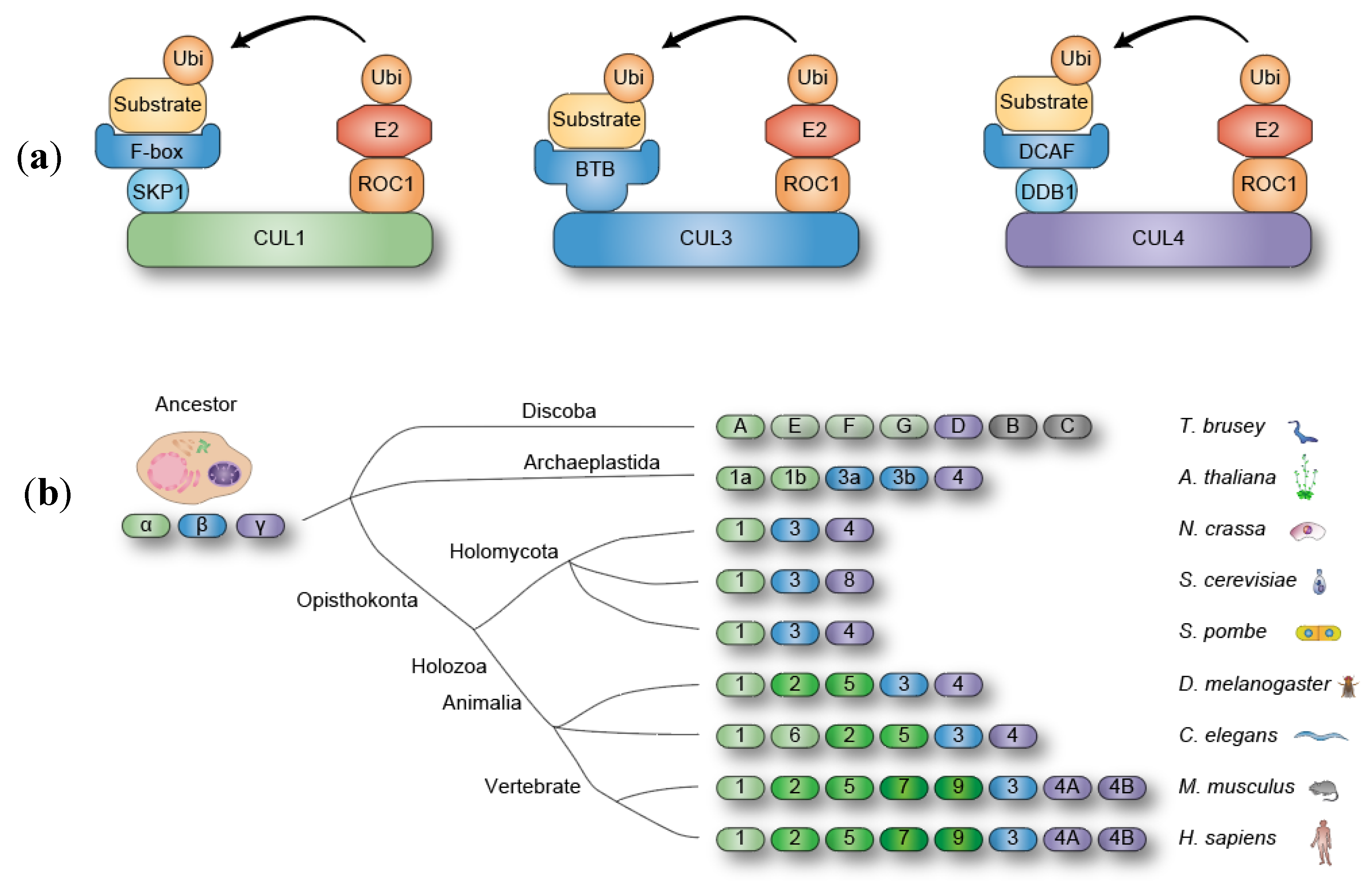
Figure 2.
Evolutionary conserved DCAFs and their established functions in mammalian cells. (a) CRL4 facilitates the ubiquitylation and subsequent proteasomal degradation of CSB via the DCAF protein CSA, playing a crucial role in the DNA repair process, particularly transcription-coupled nucleotide excision repair (TC-NER). While it remains uncertain whether CSA similarly recruits CSB to CRL4 in yeast and plants, organisms harboring CSA gene mutations exhibit impaired TC-NER and heightened sensitivity to UV-induced damage, implying a conserved role for CSA across species. (b) CDT2 mediates the recruitment of CDT1 to CRL4, facilitating its ubiquitylation and subsequent proteasomal degradation in yeast, insects, and mammals. The apparent absence of CDT2 in plants suggests the existence of alternative dominant mechanisms for CDT1 regulation, rendering CRL4CDT2 non-essential in plant systems. (c) In worms and mammals, DCAF11-associated CRL4 mediates the ubiquitylation of NRF2, a transcription factor critical under stress conditions, thereby maintaining NRF2 at low levels under normal circumstances. However, in mammalian cells, CRL3KEAP1 primarily facilitates NRF2 degradation, positioning CRL4DCAF11 as a secondary or backup regulatory mechanism.
Figure 2.
Evolutionary conserved DCAFs and their established functions in mammalian cells. (a) CRL4 facilitates the ubiquitylation and subsequent proteasomal degradation of CSB via the DCAF protein CSA, playing a crucial role in the DNA repair process, particularly transcription-coupled nucleotide excision repair (TC-NER). While it remains uncertain whether CSA similarly recruits CSB to CRL4 in yeast and plants, organisms harboring CSA gene mutations exhibit impaired TC-NER and heightened sensitivity to UV-induced damage, implying a conserved role for CSA across species. (b) CDT2 mediates the recruitment of CDT1 to CRL4, facilitating its ubiquitylation and subsequent proteasomal degradation in yeast, insects, and mammals. The apparent absence of CDT2 in plants suggests the existence of alternative dominant mechanisms for CDT1 regulation, rendering CRL4CDT2 non-essential in plant systems. (c) In worms and mammals, DCAF11-associated CRL4 mediates the ubiquitylation of NRF2, a transcription factor critical under stress conditions, thereby maintaining NRF2 at low levels under normal circumstances. However, in mammalian cells, CRL3KEAP1 primarily facilitates NRF2 degradation, positioning CRL4DCAF11 as a secondary or backup regulatory mechanism.
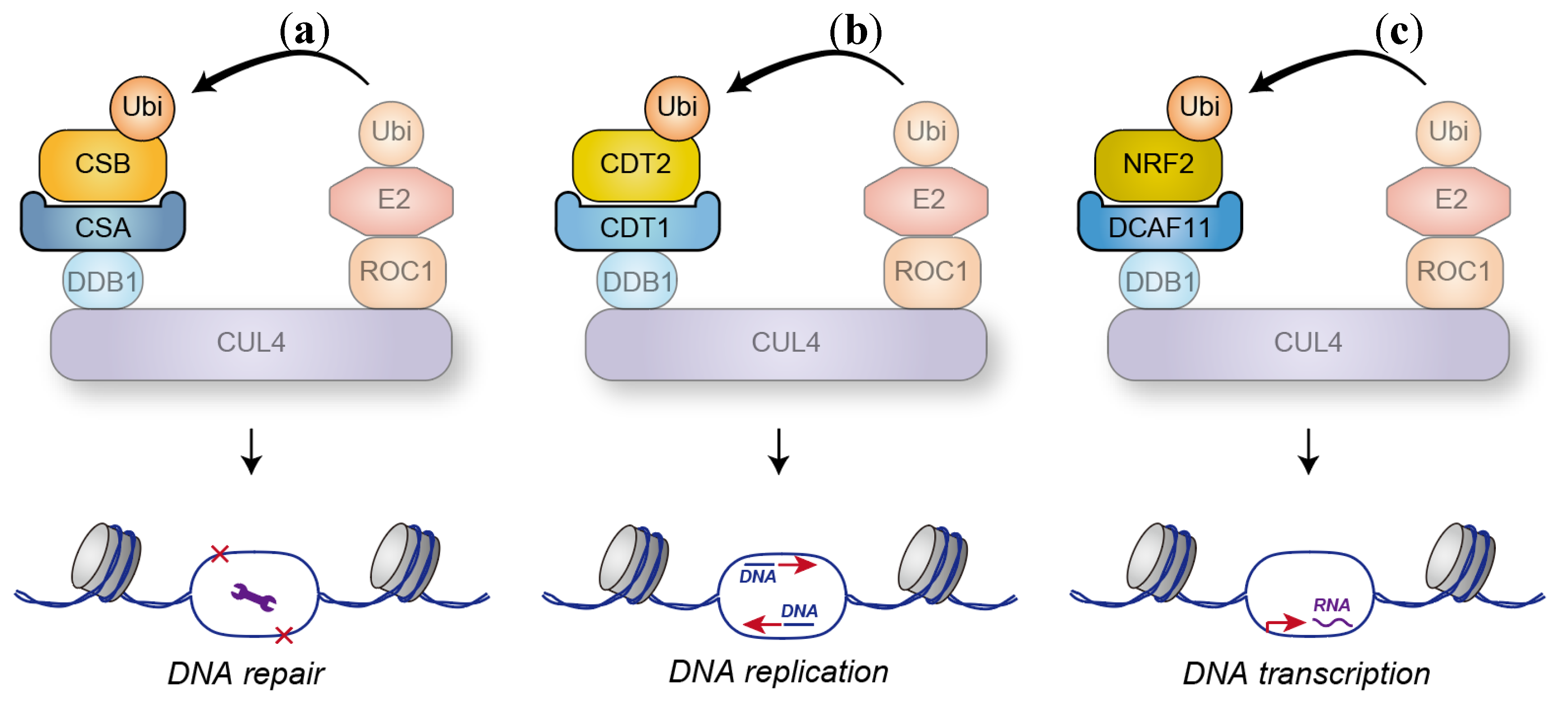

Table 1.
Phenotypes of loss-of-function CUL4 mutation.
| Species | Cul4 gene | Phenotype | Reference |
|---|---|---|---|
| S. cerevisiae$$$S. Pombe$$$N. crassa | Cul8/Cul4 | Hypersensitivity to DNA damage | [37,38,39,40,41,42] |
| Growth retardation | |||
| Mitotic defect | |||
| C. reinhardtii | Cul4 | Induction of photoprotection-related gene expression | [43] |
| A. thaliana | Cul4 | Developmental defects | [23,44,45,46,47,48] |
| Constitutive photomorphogenesis | |||
| C. elegans | Cul-4 | Developmental defects | [28,49] |
| DNA re-replication | |||
| D. melanogaster | Cul-4 | Developmental defects | [50,51,52] |
| D. rerio | Cul4a | Developmental defects | [53] |
| M. musculus | Cul4a | Resistance to skin cancer | [54] |
| Cardiac hypertrophy | [55] | ||
| Male infertility | [56,57] | ||
| Cul4b | Lethality at embryonic stage | [58,59] | |
| H. sapiens | CUL4B | X-linked intellectual disability | [60,61,62] |
Table 2.
Chromatin-related CRL4 substrates in plants.
| Species | Substrate | Receptor | Function of CRL4 | Reference |
|---|---|---|---|---|
| C. reinhardtii | CONSTANS | SPA/COP1$$$DET1 | Inhibition of light energy dissipation-related gene expression | [43,85,86] |
| A. thaliana | CONSTANS | SPA/COP1 | Inhibition of flowering-related gene expression | [87,88] |
| CRY2 | SPA/COP1 | Inhibition of light response-related gene expression | [89] | |
| PIF1 | SPA/COP1 | Promotion of photomorphogenesis-related gene expression | [90] | |
| HY5 | SPA/COP1$$$DET1 | Inhibition of photomorphogenesis-related gene expression | [23,91] | |
| DDB2 | DET1 | Promotion of DNA repair | [92] | |
| ABI5 | DWA1/2 | Inhibition of ABA signaling-related gene expression | [93] | |
| ABI5 | ABD1 | Inhibition of ABA signaling-related gene expression | [94] | |
| PYL8 | DDA1 | Inhibition of ABA signaling-related gene expression | [95] |
Table 3.
Chromatin-related CRL4 substrates in yeasts.
| Species | Substrate | Receptor | Function of CRL4 | Reference |
|---|---|---|---|---|
| S. pombe | Histone H3 | Dos1 | Promotion of H3K9 methylation | [106] |
| Lsd1/2 | Dos1 | Inhibition of H3K9 demethylation | [107] | |
| Set1 | Dos1 | Inhibition of H3K4 methylation | [107] | |
| Epe1 | Cdt1 | Establishment of heterochromatin boundary | [108] | |
| Spd1 | Cdt1 | Promotion of dNTP synthesis | [39,109,110] | |
| Cdt2 | Cdt1 | Inhibition of DNA re-replication | [111] | |
| S. cerevisiae | Histone H3 | Mms22 | Promotion of histone transfer to replicated DNA | [112] |
| Spt16 | Mms22 | Promotion of DNA replication | [113] |
Table 4.
Chromatin-related CRL4 substrates in insects.
| Species | Substrate | Receptor | Function of CRL4 | Reference |
|---|---|---|---|---|
| C. elegans | CDT-1 | CDT-2 | Inhibition of DNA re-replication | [49] |
| Pol η | CDT-2 | Completion of DNA repair | [127] | |
| SKN-1 | WDR-23 | Inhibition of stress-related gene expression | [128] | |
| D. melanogaste | Dup (Cdt1) | L(2)dtl | Inhibition of DNA re-replication | [51] |
| E2f1 | L(2)dtl | Promote of cell proliferation | [129] | |
| Dap | Unknown | Promote of cell proliferation | [130] | |
| Cyclin E | Unknown | Inhibition of cell proliferation | [130] | |
| Cry | Ramshackle (Brwd3) | Inhibition of circadian gene expression | [131] | |
| Xrp1 | Mahjong$$$(Dcaf1) | Inhibition of cell elimination-related gene expression | [132] | |
| Yki | Dcaf12 | Inhibition of cell proliferation-related gene expression | [133] |
Table 5.
Chromatin-related CRL4 substrates in mammals.
| Category | Substrate | Receptor | Function of CRL4 | Reference |
|---|---|---|---|---|
| DNA modification-related | DNMT3A | DCAF8 | Inhibition of DNA methylation | [149] |
| DNMT1 | DCAF5/L3MBTL3 | Inhibition of DNA methylation | [150] | |
| LSH | DCAF8 | Promotion of DNA demethylation | [151] | |
| MeCP2 | DCAF13 | Promotion of gene expression | [152] | |
| TET1/2/3 | DCAF1 | Promotion of DNA demethylation | [153] | |
| TDG | CDT2 | Inhibition of DNA demethylation | [154,155]4 | |
| KAP1 | DCAF11 | Promotion of gene expression | [156] | |
| Histone modification-related | Histone H2A | RBBP4/7 | Inhibition of gene expression | [83] |
| Histone H2A | DDB2 | Promotion of DNA repair | [21,22,157] | |
| Histone H3 | DDB2 | Promotion of DNA repair | [157] | |
| Histone H4 | DDB2 | Promotion of DNA repair | [157] | |
| Histone H4 | DCAF1 | Promotion of DNA repair | [158] | |
| CENP-A | COPS8 | Promotion of centromere formation | [159] | |
| CENP-A | RBBP4/7 | Promotion of centromere formation | [160] | |
| SLBP | DCAF11 | Inhibition of histone translation | [161] | |
| SPT16 | DCAF14 | Promotion of DNA replication | [147] | |
| HBO1 | DDB2 | Inhibition of DNA replication | [162] | |
| SET8 | CDT2 | Inhibition of DNA re-replication and transcription | [163,164,165,166,167] | |
| SUV39H1 | DCAF13 | Promotion of gene expression | [168] | |
| KDM6A | COP1 | Promotion of gene expression | [169] | |
| Menin | DCAF7 | Inhibition of gene expression | [170] | |
| WDR5 | Not required | Inhibition of gene expression | [20,171] | |
| Others | NRF2 | DCAF11 | Inhibition of gene expression | [137] |
| FoxM1 | DCAF1 | Inhibition of gene expression | [172] | |
| MyoD | DCAF1 | Inhibition of gene expression | [173] | |
| p53 | DCAF1 | Inhibition of gene expression | [174] | |
| RORa | DCAF1 | Inhibition of gene expression | [175] | |
| TR4 | DCAF1 | Inhibition of gene expression | [176] | |
| MCM10 | DCAF1 | Inhibition of DNA replication | [177] | |
| UNG2 | DCAF1 | Inhibition of DNA repair | [178] | |
| SMUG1 | DCAF1 | Inhibition of DNA repair | [178] | |
| RAG1 | DCAF1 | Inhibition of DNA recombination | [179] | |
| E2F1 | DCAF5/L3MBTL3 | Inhibition of gene expression | [150] | |
| DNMT1 | DCAF5/L3MBTL3 | Inhibition of DNA methylation | [150] | |
| SMARCC1 | DCAF5/L3MBTL3 | Inhibition of gene expression | [180] | |
| SMARCC2 | DCAF5/L3MBTL3 | Inhibition of gene expression | [180] | |
| SOX2 | DCAF5/L3MBTL3 | Inhibition of gene expression | [181] | |
| LIG1 | DCAF7 | Inhibition of DNA replication | [182] | |
| TOP1-DPCs | DCAF13 | Promotion of DNA repair | [183] | |
| DNA-PKcs | CDT2 | Inhibition of DNA repair | [184] | |
| C/EBPβ | COP1 | Inhibition of gene expression | [185] | |
| c-JUN | COP1 | Inhibition of gene expression | [186] | |
| ETV5 | COP1 | Inhibition of gene expression | [187] | |
| ETS1 | COP1 | Inhibition of gene expression | [188] | |
| ETS2 | COP1 | Inhibition of gene expression | [188] | |
| p53 | COP1 | Inhibition of gene expression | [189,190] | |
| CSB | CSA | Completion of DNA repair | [191] |
Table 6.
Conservation of representative nuclear DCAFs. USCS genome browser [216], HMMER web server [217], Saccharomyces Genome Database [218], PomBase [219], The Arabidopsis Information Resource [220], WormBase [221] and FlyBase [222] were searched for finding DCAF orthologs.
| Mammalian DCAF | Trypanosoma | Yeasts | Plants | Insects |
|---|---|---|---|---|
| DCAF1 | (-) | (-) | ✔︎ | ✔︎ |
| CDT2 (DCAF2) | (-) | ✔︎ | (-) | ✔︎ |
| DCAF5 | (-) | (-) | (-) | (-) |
| DCAF7 | (-) | ✔︎ | (-) | (-) |
| DCAF8 | (-) | (-) | (-) | (-) |
| DCAF11 | (-) | ✔︎ | (-) | ✔︎ |
| DCAF12 | (-) | (-) | (-) | ✔︎ |
| DCAF13 | ✔︎ | ✔︎ | (-) | ✔︎ |
| DCAF14 | (-) | (-) | (-) | ✔︎ |
| COP1 | (-) | ✔︎ | ✔︎ | ✔︎ |
| CSA | (-) | ✔︎ | ✔︎ | ✔︎ |
| DDB2 | (-) | (-) | ✔︎ | (-) |
Disclaimer/Publisher’s Note: The statements, opinions and data contained in all publications are solely those of the individual author(s) and contributor(s) and not of MDPI and/or the editor(s). MDPI and/or the editor(s) disclaim responsibility for any injury to people or property resulting from any ideas, methods, instructions or products referred to in the content. |
© 2024 by the authors. Licensee MDPI, Basel, Switzerland. This article is an open access article distributed under the terms and conditions of the Creative Commons Attribution (CC BY) license (http://creativecommons.org/licenses/by/4.0/).
Copyright: This open access article is published under a Creative Commons CC BY 4.0 license, which permit the free download, distribution, and reuse, provided that the author and preprint are cited in any reuse.


