

Submitted:
19 November 2024
Posted:
21 November 2024
You are already at the latest version
Abstract
This study uses time series and machine learning techniques to forecast Saudi Arabia’s refined petroleum output; a significant player in the global energy market. Using data from 1962 to 2022 acquired from the Ministry of Energy, Kingdom of Saudi Arabia, the study evaluates the forecasting performance of different models such as Facebook Prophet, Long Short-Term Memory (LSTM), Gaussian Process (GP), and Auto-Regressive Integrated Moving Average Model(ARIMA) based on metrics including Root mean squared error (RMSE), mean absolute percentage error (MAPE), relative absolute error (RAE), Akaike Information Criterion (AIC), and training time. The study results demonstrate that traditional time series models like ARIMA consistently exhibit superior prediction accuracy, whereas machine learning models like LSTM and GP offer more flexibility but need more data. Conversely, Prophet Model performs poorly as it often overlooks complex patterns within the data. The finding of this research work highlights the need for appropriate methodology use and careful model selection in predictive modeling initiatives to provide decision-makers with relevant information in the energy business. Future research may look into ways to use ensemble modeling techniques and other exogenous factors to increase the accuracy of forecasts for petroleum production.
Keywords:
1. Introduction
2. Materials and Methods
2.1. Data
2.2. Models
2.2.1. Predictive Models
Prophet
Long-Term Short-Term Memory
2.3. Gaussian Process (GP)
2.4. Auto-Regressive Integrated Moving Average Model (ARIMA)
Evaluation Metrics
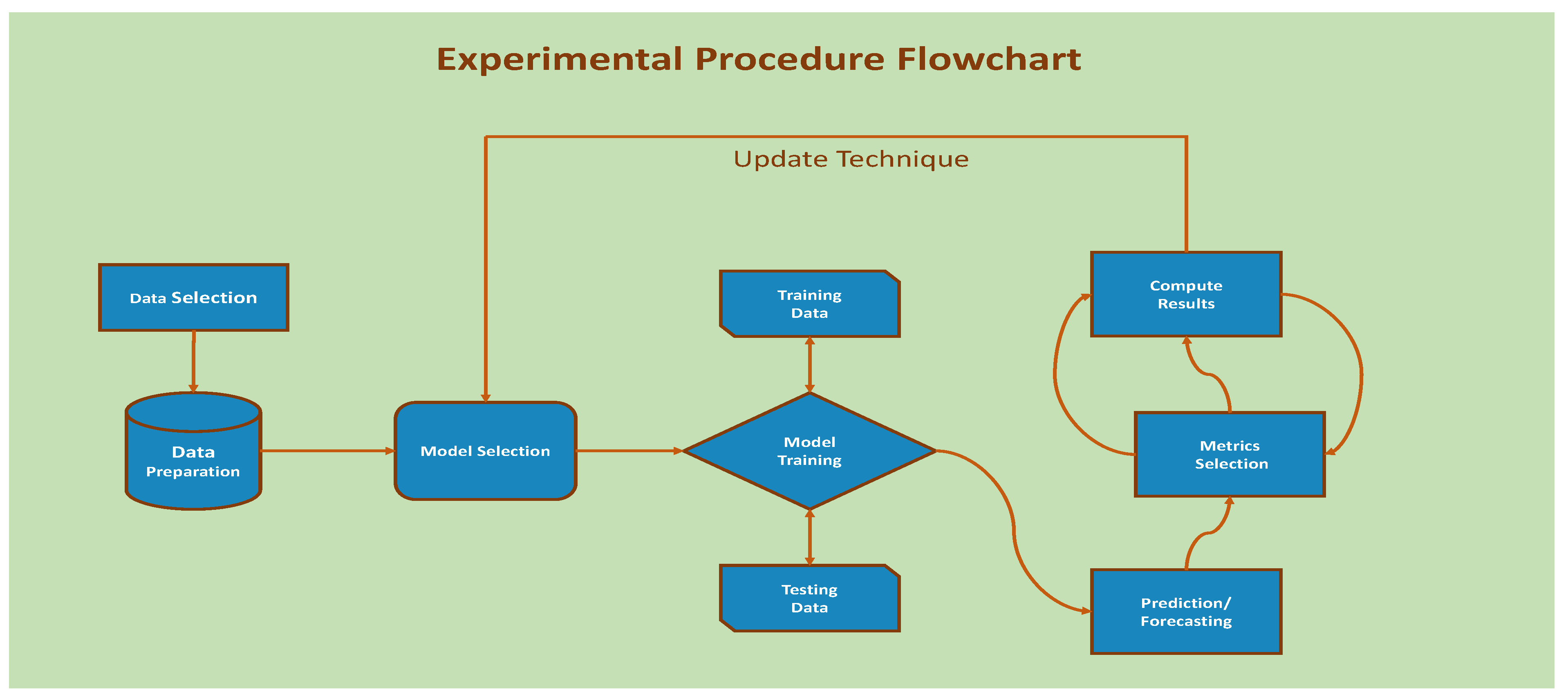
2.5. Experimental Procedure
3. Results
4. Discussion
5. Conclusions
Author Contributions
Funding
Data Availability Statement
Conflicts of Interest
References
- Ceylan, H.; Ozturk, H.K. Estimating energy demand of Turkey based on economic indicators using genetic algorithm approach. Energy Conversion and Management 2004, 45, 2525–2537. [Google Scholar] [CrossRef]
- Kontopoulou, V.I.; et al. A review of ARIMA vs. machine learning approaches for time series forecasting in data driven networks. Future Internet 2023, 15, 255. [Google Scholar] [CrossRef]
- Santangelo, O.E.; et al. Machine learning and prediction of infectious diseases: a systematic review. Machine Learning and Knowledge Extraction 2023, 5, 175–198. [Google Scholar] [CrossRef]
- Ilu, S.Y.; Prasad, R. Improved autoregressive integrated moving average model for COVID-19 prediction by using statistical significance and clustering techniques. Heliyon 2023, 9. [Google Scholar] [CrossRef] [PubMed]
- Álvarez-Chaves, H.; Muñoz, P.; R-Moreno, M.D. Machine learning methods for predicting the admissions and hospitalisations in the emergency department of a civil and military hospital. Journal of Intelligent Information Systems 2023, 61, 881–900. [Google Scholar] [CrossRef]
- Ansari, M.; Alam, M. An intelligent IoT-cloud-based air pollution forecasting model using univariate time-series analysis. Arabian Journal for Science and Engineering 2023, 1–28. [Google Scholar] [CrossRef]
- Parlak, F. The forecast performances of the classical time series model and machine learning algorithms on BIST-50 price index using exogenous variables. MS thesis, Middle East Technical University, 2023. [Google Scholar]
- Murugesan, R.; Mishra, E.; Krishnan, A.H. Deep learning based models: Basic LSTM, Bi LSTM, Stacked LSTM, CNN LSTM and Conv LSTM to forecast agricultural commodities prices. Preprint 2021. [Google Scholar]
- Feng, T.; Zheng, Z.; Yu, X. The comparative analysis of SARIMA, Facebook Prophet, and LSTM for road traffic injury prediction in Northeast China. Frontiers in Public Health 2022, 10, 946563. [Google Scholar] [CrossRef]
- Suganthi, L.; Samuel, A.A. Energy models for demand forecasting—A review. Renewable and Sustainable Energy Reviews 2012, 16, 1223–1240. [Google Scholar] [CrossRef]
- Ekonomou, L. Greek long-term energy consumption prediction using artificial neural networks. Energy 2010, 35, 512–517. [Google Scholar] [CrossRef]
- Guarnaccia, C.; et al. Development of seasonal ARIMA models for traffic noise forecasting. MATEC Web of Conferences, EDP Sciences 2017, 125. [Google Scholar] [CrossRef]
- Theerthagiri, P.; Ruby, A.U. Seasonal learning based ARIMA algorithm for prediction of Brent oil Price trends. Multimedia Tools and Applications 2023, 82, 24485–24504. [Google Scholar] [CrossRef]
- Grigoraș, A.; Leon, F. Transformer-Based Model for Predicting Customers’ Next Purchase Day in e-Commerce. Computation 2023, 11, 210. [Google Scholar] [CrossRef]
- Contreras, J.; et al. ARIMA models to predict next-day electricity prices. IEEE Transactions on Power Systems 2003, 18, 1014–1020. [Google Scholar] [CrossRef]
- Agrawal, R.K.; Muchahary, F.; Tripathi, M.M. Long term load forecasting with hourly predictions based on long-short-term-memory networks. In Proceedings of the 2018 IEEE Texas Power and Energy Conference (TPEC); IEEE, 2018. [Google Scholar]
- Telo, J. Web traffic prediction using Autoregressive, LSTM, and XGBoost time series models. Applied Research in Artificial Intelligence and Cloud Computing 2020, 3, 1–15. [Google Scholar]
- Gupta, R.; et al. Time series forecasting of solar power generation using Facebook prophet and XG boost. In Proceedings of the 2022 IEEE Delhi Section Conference (DELCON); IEEE, 2022. [Google Scholar]
- Ganapathy, G.P.; et al. Rainfall forecasting using machine learning algorithms for localized events. Comput. Mater. Contin. 2022, 71, 6333–6350. [Google Scholar]
- Othman, K.M.; et al. Evaluating and Comparing the Performance of Statistical and Artificial Intelligence Algorithms to Achieve Improved Load Forecasting in Saudi Arabia. Available at SSRN: https://ssrn.com/abstract=4484535.
- Natarajan, Y.; et al. Enhancing Building Energy Efficiency with IoT-Driven Hybrid Deep Learning Models for Accurate Energy Consumption Prediction. Sustainability 2024, 16, 1925. [Google Scholar] [CrossRef]
- Soto-Ferrari, M.; Carrasco-Pena, A.; Prieto, D. Deep Learning Architectures Framework for Emerging Outbreak Forecasting of Mpox: A Bagged Ensemble Scheme to Model Accurate Prediction Intervals. 2023. [Google Scholar]
- Niyogi, D.; Srinivasan, J. Accurate Prediction of Global Mean Temperature through Data Transformation Techniques. arXiv preprint 2023, arXiv:2303.06468. [Google Scholar]
- Jahin, M.A.; et al. Big Data-Supply Chain Management Framework for Forecasting: Data Preprocessing and Machine Learning Techniques. arXiv preprint 2023, arXiv:2307.12971. [Google Scholar]
- Zhang, J.; Yang, Y.; Feng, Y. Hybrid Time-Series Prediction Method Based on Entropy Fusion Feature. International Journal of Intelligent Systems 2023, 2023. [Google Scholar] [CrossRef]
- Kożuch, A.; Cywicka, D.; Adamowicz, K. A comparison of artificial neural network and time series models for timber price forecasting. Forests 2023, 14, 177. [Google Scholar] [CrossRef]
- Mandalis, P.; et al. Towards a Unified Vessel Traffic Flow Forecasting Framework. In Proceedings of the EDBT/ICDT Workshops; 2023. [Google Scholar]
- Zhao, J.; et al. A Novel Short-Time Passenger Flow Prediction Method for Urban Rail Transit: CEEMDAN-CSSA-LSTM Model Based on Station Classification. Engineering Letters 2023, 31. [Google Scholar]
- Shin, S.-Y.; Woo, H.-G. Energy consumption forecasting in Korea using machine learning algorithms. Energies 2022, 15, 4880. [Google Scholar] [CrossRef]
- Wang, H.; Chen, S. Insights into the Application of Machine Learning in Reservoir Engineering: Current Developments and Future Trends. Energies 2023, 16, 1392. [Google Scholar] [CrossRef]
- Dudek, G.; Piotrowski, P.; Baczyński, D. Intelligent Forecasting and Optimization in Electrical Power Systems: Advances in Models and Applications. Energies 2023, 16, 3024. [Google Scholar] [CrossRef]
- Saglam, M.; Spataru, C.; Karaman, O.A. Forecasting electricity demand in Turkey using optimization and machine learning algorithms. Energies 2023, 16, 4499. [Google Scholar] [CrossRef]
- Çodur, M.K. Ensemble Machine Learning Approaches for Prediction of Türkiye’s Energy Demand. 2023. [Google Scholar]
- Paassen, B.; Göpfert, C.; Hammer, B. Gaussian process prediction for time series of structured data. In Proceedings of the ESANN; 2016. [Google Scholar]
- Al-Rakhami, M.; et al. An ensemble learning approach for accurate energy load prediction in residential buildings. IEEE Access 2019, 7, 48328–48338. [Google Scholar] [CrossRef]
- Alali, Y.; Harrou, F.; Sun, Y. A proficient approach to forecast COVID-19 spread via optimized dynamic machine learning models. Sci. Rep. 2022, 12, 2467. [Google Scholar] [CrossRef]
- Kumar, S.V.; Vanajakshi, L. Short-term traffic flow prediction using seasonal ARIMA model with limited input data. European Transport Research Review 2015, 7, 1–9. [Google Scholar] [CrossRef]
- Nespoli, A.; et al. Day-ahead photovoltaic forecasting: A comparison of the most effective techniques. Energies 2019, 12, 1621. [Google Scholar] [CrossRef]
- Chadalavada, R.J.; Raghavendra, S.; Rekha, V. Electricity requirement prediction using time series and Facebook’s PROPHET. Indian J. Sci. Technol. 2020, 13, 4631–4645. [Google Scholar] [CrossRef]
- Taylor, S. J.; Letham, B. Forecasting at scale. The American Statistician 2018, 72, 37–45. [Google Scholar] [CrossRef]
- Ahmad, F.; Finos, L.; Guidolin, M. Forecasting hydropower with innovation diffusion models: A cross-country analysis. Forecasting 2024, 6, 1045–1064. [Google Scholar] [CrossRef]
- Jarrah, M.; Derbali, M. Predicting Saudi Stock Market Index by Using Multivariate Time Series Based on Deep Learning. Applied Sciences 2023, 13, 8356. [Google Scholar] [CrossRef]
- Herrera, G.P.; et al. Long-term forecast of energy commodities price using machine learning. Energy 2019, 179, 214–221. [Google Scholar] [CrossRef]
- Liu, T.; et al. Industrial time series forecasting based on improved Gaussian process regression. Soft Computing 2020, 24, 15853–15869. [Google Scholar] [CrossRef]
- Han, J.; Lin, H.; Qin, Z. Prediction and Comparison of In-Vehicle CO2 Concentration Based on ARIMA and LSTM Models. Applied Sciences 2023, 13, 10858. [Google Scholar] [CrossRef]
- Zhu, Q.; Guo, Y.; Feng, G. Household energy consumption in China: Forecasting with BVAR model up to 2015. In Proceedings of the 2012 Fifth International Joint Conference on Computational Sciences and Optimization; IEEE, 2012. [Google Scholar]
- Waseem, K.H.; et al. Forecasting of air quality using an optimized recurrent neural network. Processes 2022, 10, 2117. [Google Scholar] [CrossRef]
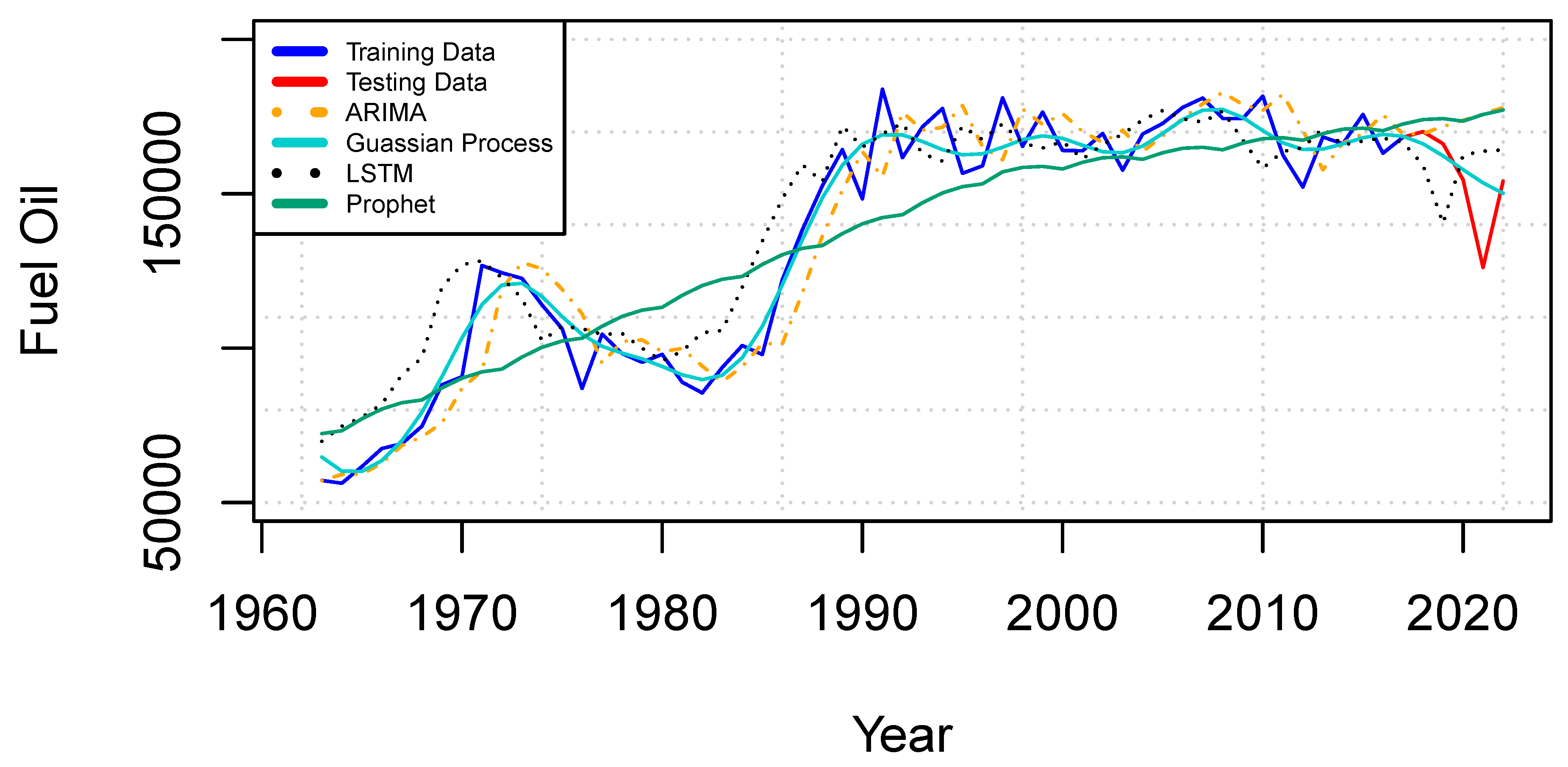
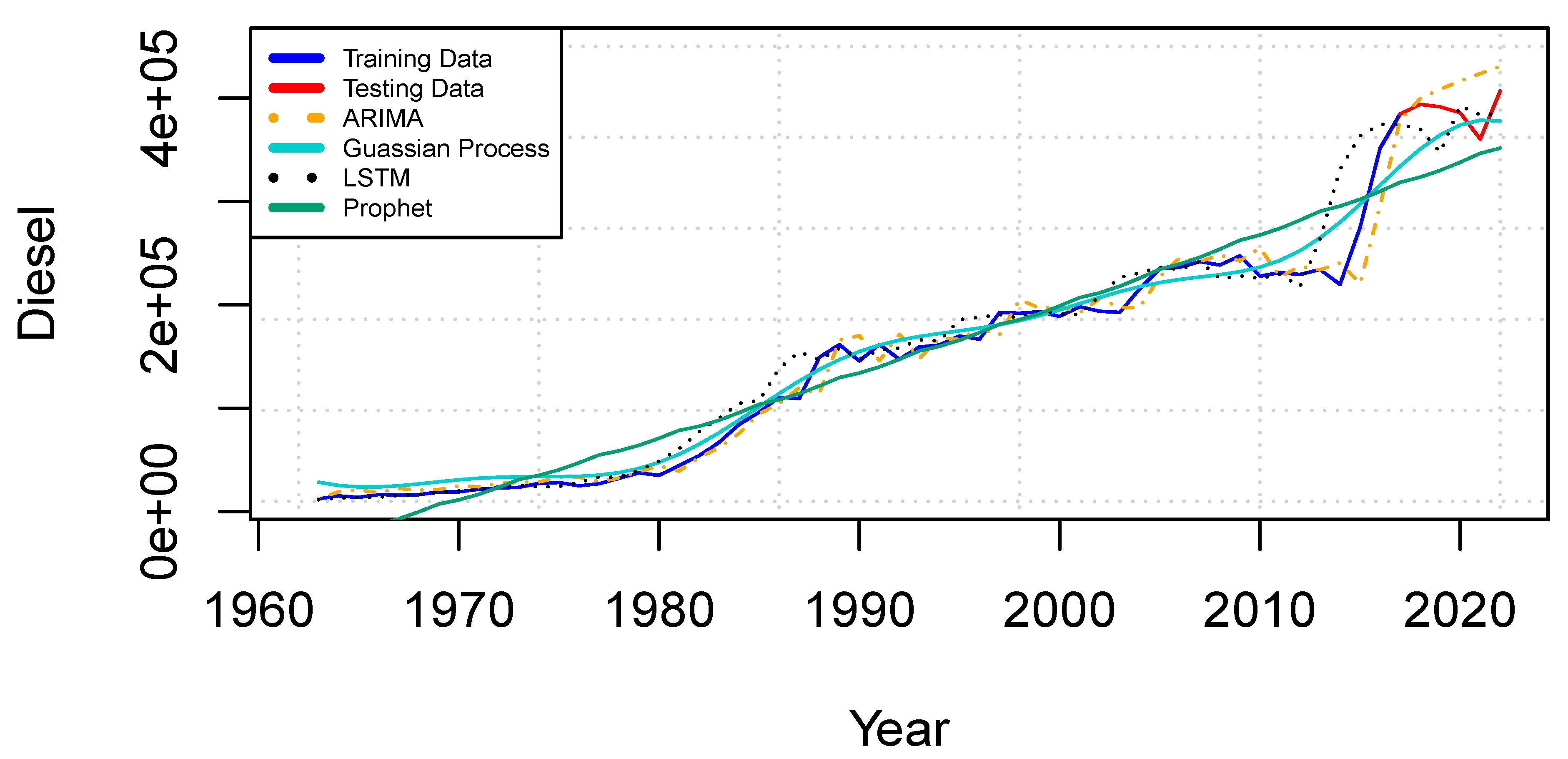
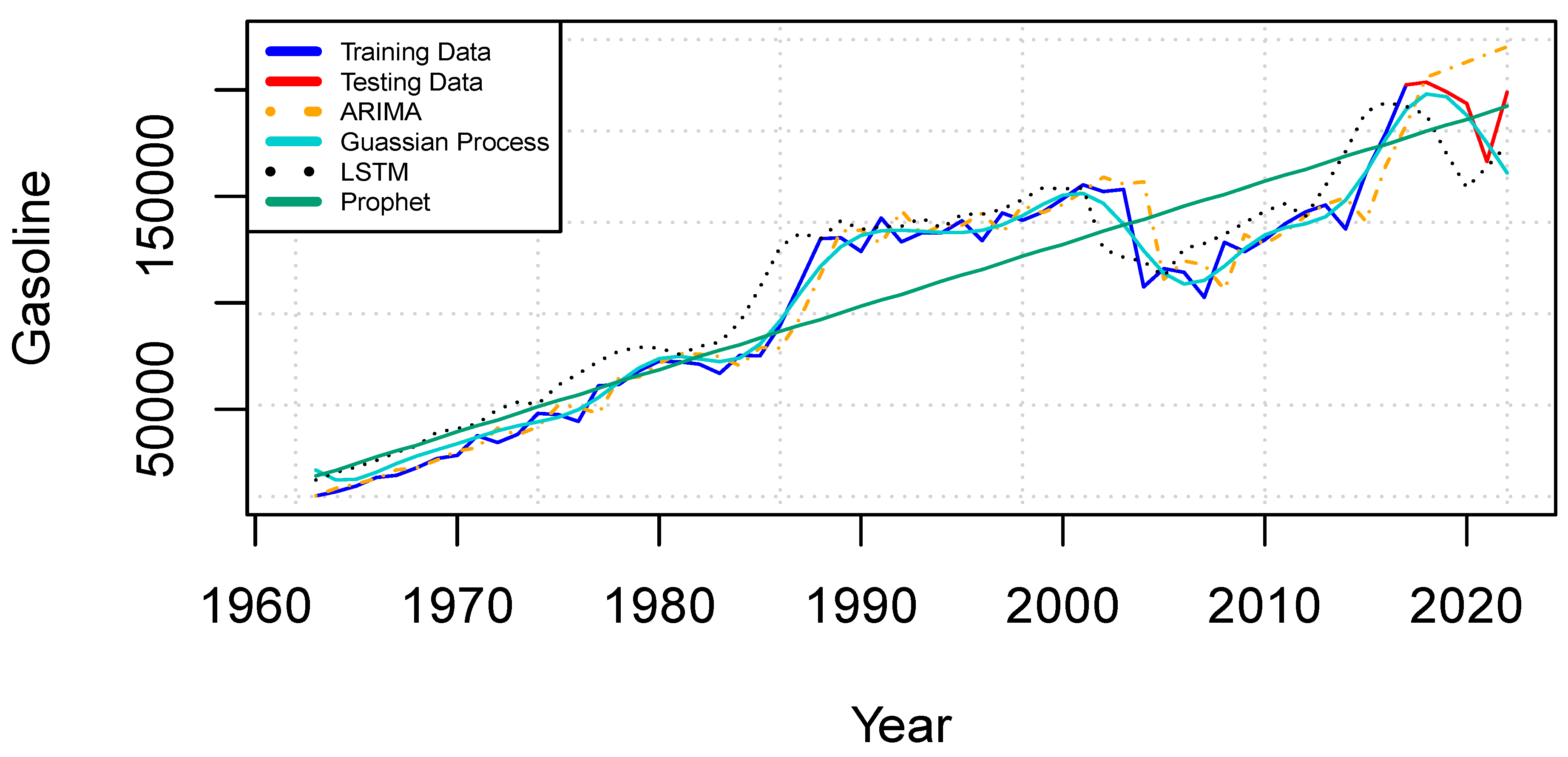
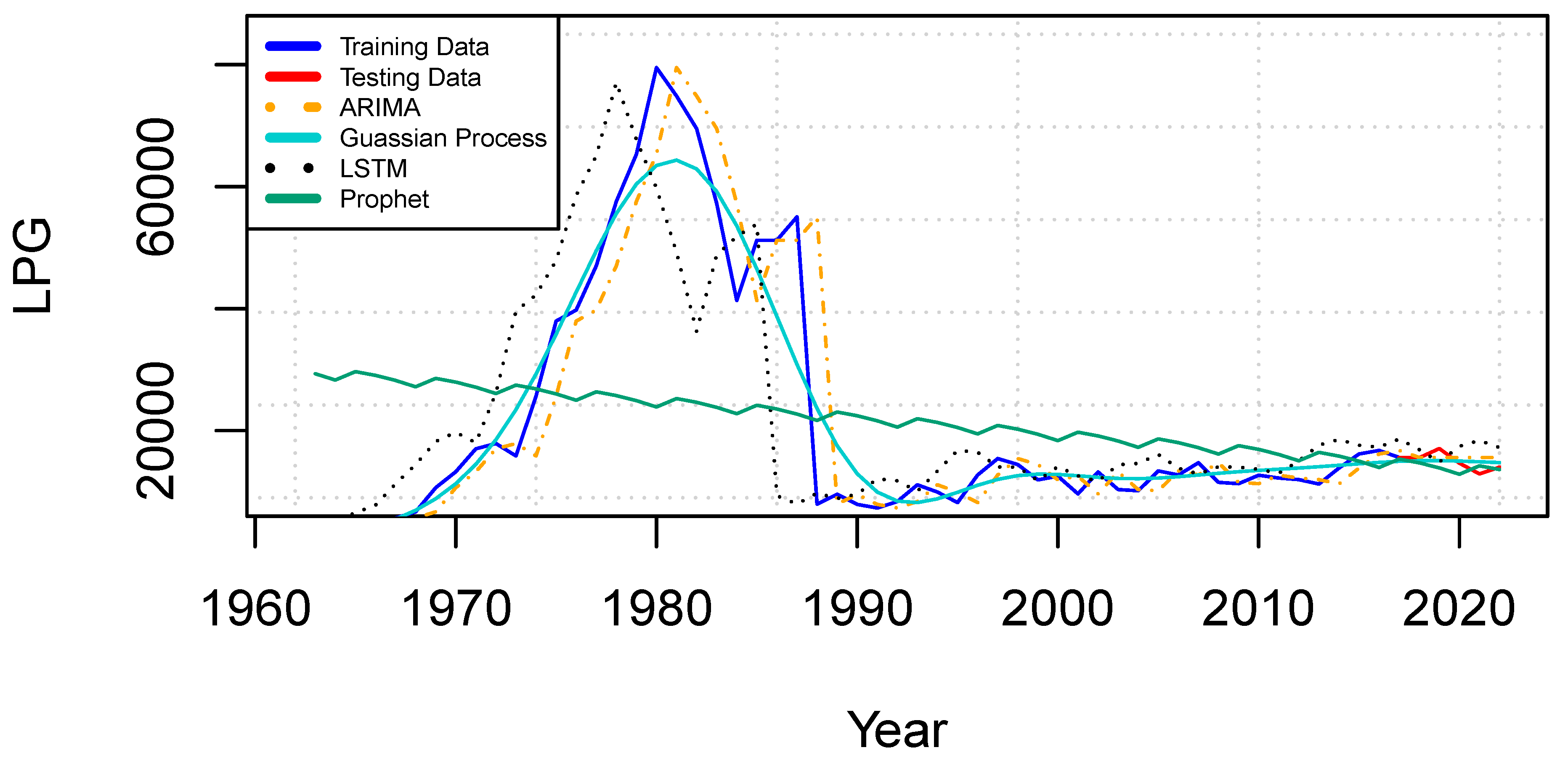

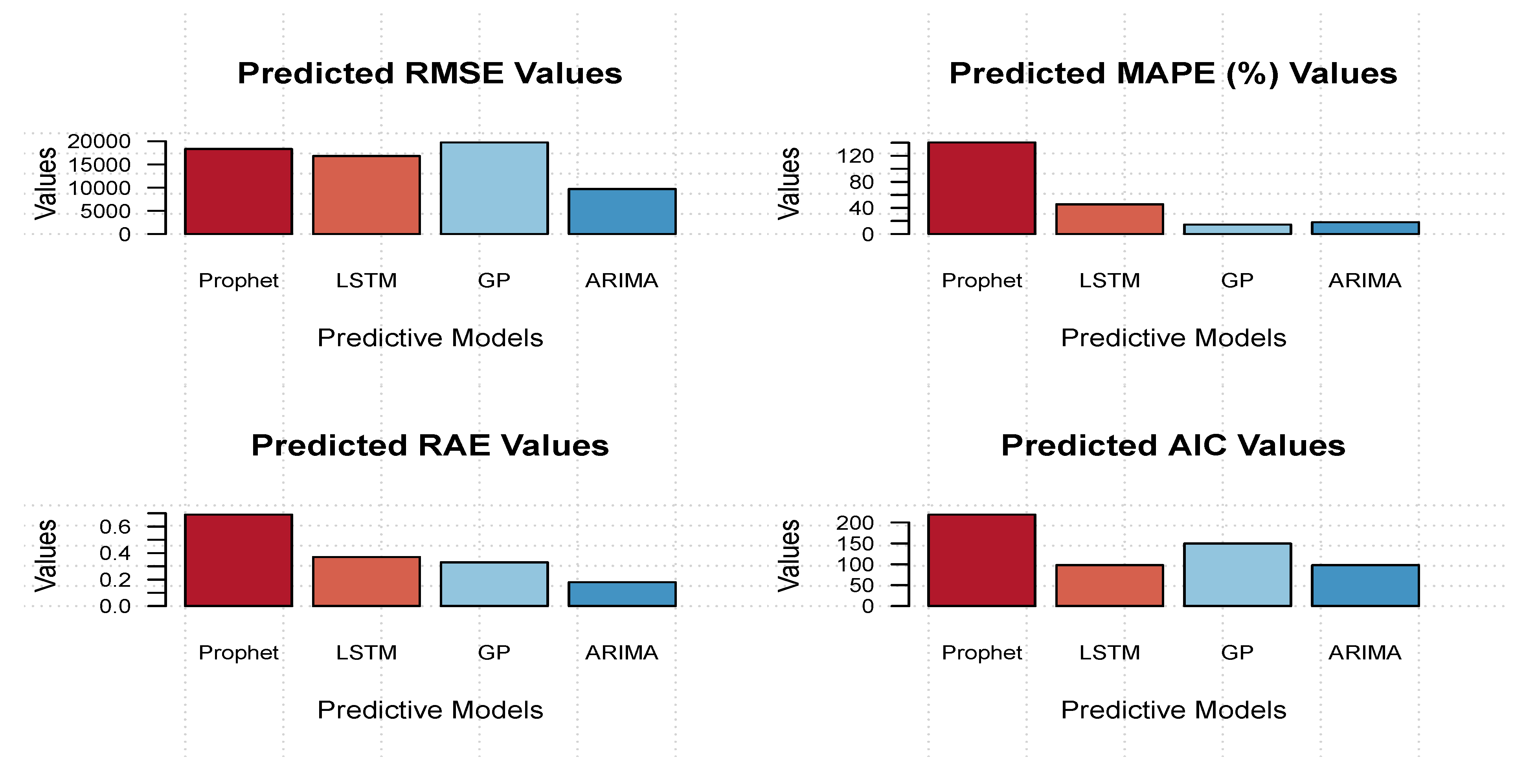

| Datasets | Min | Max | Mean | Median |
|---|---|---|---|---|
| Fuel Oil | 56274 | 183863 | 136383 | 154301 |
| Diesel | 12310 | 407034 | 154236 | 161372 |
| Gasoline | 9339 | 203564 | 105489 | 124057 |
| LPG | 1058 | 79523 | 21348 | 13242 |
| Kerosine | 7796 | 95804 | 43484 | 49597 |
| Models | RMSE | MAPE% | RAE | AIC | Training Time (in Seconds) |
|---|---|---|---|---|---|
| Prophet | 18184.8 | 12.4% | 0.42 | 1158.9 | 3 |
| LSTM | 14564.1 | 10.3% | 0.32 | 1121.9 | 128 |
| GP | 25052.6 | 4.8% | 0.44 | 1073.9 | 1.2 |
| ARIMA | 13793.7 | 7.7% | 0.29 | 1146.8 | 0.7 |
| Models | RMSE | MAPE% | RAE | AIC | Training Time (in Seconds) |
|---|---|---|---|---|---|
| Prophet | 29897.4 | 41.1% | 0.23 | 1236.1 | 2 |
| LSTM | 28952.5 | 16.1% | 0.18 | 1216.6 | 135 |
| GP | 18133.1 | 17.5% | 0.13 | 1168.9 | 0.8 |
| ARIMA | 17492.4 | 10.7% | 0.11 | 1175.1 | 1 |
| Models | RMSE | MAPE% | RAE | AIC | Training Time (in Seconds) |
|---|---|---|---|---|---|
| Prophet | 19919.8 | 21.5% | 0.35 | 1183.3 | 2 |
| LSTM | 20635.8 | 28.1% | 0.38 | 1153.4 | 121 |
| GP | 7893.6 | 9.3% | 0.11 | 1065.4 | 0.7 |
| ARIMA | 13024.4 | 8.2% | 0.17 | 1139.5 | 1 |
| Models | RMSE | MAPE% | RAE | AIC | Training Time (in Seconds) |
|---|---|---|---|---|---|
| Prophet | 18950.5 | 152.8% | 0.92 | 1017.2 | 1 |
| LSTM | 12467.8 | 55.8% | 0.55 | 1118.8 | 112 |
| GP | 5318.8 | 19.2% | 0.19 | 1019.3 | 1 |
| ARIMA | 7799.5 | 25.8% | 0.26 | 1077.3 | 1 |
| Models | RMSE | MAPE% | RAE | AIC | Training Time (in Seconds) |
|---|---|---|---|---|---|
| Prophet | 18950.5 | 152.8% | 0.92 | 1017.2 | 1 |
| LSTM | 12467.8 | 55.8% | 0.55 | 1118.8 | 112 |
| GP | 5318.8 | 19.2% | 0.19 | 1019.3 | 1 |
| ARIMA | 7799.5 | 25.8% | 0.26 | 1077.3 | 1 |
Disclaimer/Publisher’s Note: The statements, opinions and data contained in all publications are solely those of the individual author(s) and contributor(s) and not of MDPI and/or the editor(s). MDPI and/or the editor(s) disclaim responsibility for any injury to people or property resulting from any ideas, methods, instructions or products referred to in the content. |
© 2024 by the authors. Licensee MDPI, Basel, Switzerland. This article is an open access article distributed under the terms and conditions of the Creative Commons Attribution (CC BY) license (http://creativecommons.org/licenses/by/4.0/).