I. Introduction
An intelligent library ought to integrate devices endowed with artificial intelligence to execute library functions like proficient librarians. An intelligent library is a combination of technology and software intended to operate like librarians. Intelligent services, enabled by artificial intelligence, perform functions traditionally executed by librarians. These services enhance, rather than replace, conventional library personnel. Intelligent libraries provide both physical and digital services, creating a digital ecosystem that fosters study and research (Orji, S. et al. (2021)) [
1].
Correspondence to Irin Sultana, isultana@g.emporia.edu
Manuscript is accepted at 8th (IEEE) ICICT 2025, Hilo, Hawaii, USA
Omame & Alex-Nmecha (2020) [
2] defined artificial intelligence (AI) as a branch of computer science that investigates how computers gain knowledge (Machine Learning), analyze data, and perform tasks such as character recognition, image analysis, 3D visions, and ocular function modeling. AI systems offer benefits in libraries by minimizing error susceptibility and functioning continuously without tiredness, so enabling librarians to focus on other tasks. Computers can process library items more swiftly, efficiently, and effectively than humans, leading to improved service delivery at all levels. Artificial intelligence allows computers to replicate human cognitive and decision-making functions. They can gain knowledge through experience and reconfigure themselves to correct past mistakes, as illustrated in films.
Kim, B. (2019) [
3] indicated that recent progress in machine learning, a branch of artificial intelligence (AI), implies that we will soon live in a world filled with robots. Robots have historically been employed in libraries. Many esteemed libraries utilize robotic technologies for the storage and retrieval of library items. AuRoSS, an autonomous robotic shelf scanning system developed in Singapore, functions in libraries at night, scans RFID tags, and reports on missing or misaligned books. Some libraries began acquiring and providing access to robots. The Westport Public Library offers training programs for its two Nao robots. The Chicago Public Library offers Finch robots for users to develop programming abilities. The San Diego Public Library hosted a Robot Day event to educate the public about the societal implications of robotics. A weekly Robotics Club was established for participants to learn and engage in robot construction.
Mupaikwa, E. (2024) argued that artificial intelligence is driving the development of intelligent libraries in developing nations to stay in accordance with global information and communication technology trends. Libraries can now manage significant quantities of diverse and swiftly changing content, an essential element of the Fourth Industrial Revolution (4IR). The data-driven projects of the Fourth Industrial Revolution require information from all sectors, exacerbating the problem. Traditional libraries were created to accommodate vast collections and reading spaces, resulting in the preservation of varied documents. As users increasingly rely on the internet and digital resources, libraries must adopt innovative technology to deliver information services and improve their collections and offers. Reading venues have become obsolete. The deployment of advanced technology aims to improve productivity, alleviate workloads, and create intelligent libraries. Artificial intelligence technologies have been utilized in numerous fields, including search engines, recommendations, personalization, text and data mining, information services, topic librarianship, education, virtual services, IT support, and digitization.
Wang, Y. (2022) asserted that libraries are employing artificial intelligence and machine learning techniques to improve their services. Libraries acquire significant knowledge from transcripts from chat conversations. The study examines eight years of chat transcripts from an academic library utilizing machine learning and natural language processing techniques. The raw data for this machine learning and natural language processing research was sourced from Springshare's repository of conversation transcripts. Between 2014 and 2021, there were 8,000 chat reference trades. Many academic libraries have implemented chat reference services to support students in their studies and academic research on campus. Stanford University Library excels in the integration of machine learning and artificial intelligence (AI) in library systems. The chat reference service establishes a link between the library's resources and services and the university community.
II. Literature Review
Artificial intelligence and machine learning technologies have been employed to assist library internal operations, including cataloging, classification, indexing, document analysis, and text recognition. Advanced AI and machine learning techniques, including pattern recognition and multi-agent systems, are employed to enhance library security, user identification, book title recognition, RFID management, and many administrative functions. Deep learning, neural network algorithms, and convolutional neural networks have demonstrated efficacy as tools for research, collection finding, search, and analysis. Various machine learning methodologies, including logistic regression, KNN, and AdaBoost, have been extensively utilized in libraries for metadata generation, resource discovery, and book acquisition (Das, et al.) [
6].
Additionally, there are two primary types of natural language interaction: chatbots and embodied conversational agents. Engagement with chatbots is limited to textual input and output. Embodied Conversational Agents are computer interfaces that interact with users through facial and bodily expressions in a manner akin to human communication (Gujral, G., et al. (2019)) [
7]. Library automation software enhances productivity, accuracy, and accessibility while reducing costs through operational automation. AI-driven personalized learning tailors’ content to individual student needs by assessing performance and providing customized recommendations. Duolingo customizes tasks according to individual learning styles, competencies, and deficiencies, hence enhancing engagement (Senthilkumar, K.R. (2024)). [
8].
Padilla, T. (2019) [
9] asserted that libraries aiming to utilize machine learning for enhancing discovery systems would gain from educating librarians and subject liaisons on the methodology and its consequences. The University of Nebraska-Lincoln employs computer vision to enhance the discovery of historical newspapers; Indiana University utilizes natural language processing and machine learning to facilitate access to audiovisual collections; and the University of North Carolina at Chapel Hill applies machine learning for semi-automated systematic reviews in its medical libraries.
X. Yang et al. [
10] examined deep learning to enhance book management, addressing difficulties such as inconsistent lighting and image distortion. Analyze photos of bookshelves to identify and extract text from book spines for the creation of a digital book inventory. The authors proposed a system capable of diminishing the extensive manual labor needed for book inventory, particularly for large collections, by employing text recognition with enhanced supervision to expedite training through pre-time step classification utilizing a weighted Connectionist Temporal Classification (CTC) loss function. Authors employ a deep sequential labeling model utilizing recurrent neural networks (RNN) and convolutional neural networks (CNN) for text recognition.
C. Jayawardena et al. [
11] presented an intelligent smart library system to address the deficiencies of conventional library management systems by enhancing user services through the implementation of IoT technologies, including RFID and Raspberry Pi. A dimensionality reduction neural network method, together with the LSTM algorithm for predictions, was employed to determine the ideal seating arrangement for enhancing service efficiency for library patrons. The primary library administration tasks encompass book issuance, re-issuance, returns, disposal, organization, and other additional responsibilities. The management and storage of libraries remain resource-intensive, requiring personnel for organization, assembly, and maintenance of shelves.
Table I.
Summary of technology integrated with objective and insights of the study from Literature review [
6,
7,
8,
9,
10,
11].
Table I.
Summary of technology integrated with objective and insights of the study from Literature review [
6,
7,
8,
9,
10,
11].
| Ref |
Technology |
Objective of Study |
Insight(s) of Study |
| [6] |
AI, ML |
Provide a synthesis of empirical studies exploring application of AI and ML in libraries |
Rigorous selection of 32 articles, reviewed and analyzed to summarize on application of AL and ML domain used in libraries |
| [7] |
Chatbots, Embodied Agents |
Investigate ideas and possibilities of artificial intelligence technologies for educational institutions. |
While integrated conversational agents use human-like facial and body interactions, chatbots limited to text provide distinct kinds of natural language engagement. |
| [8] |
AI Learning |
Investigate the use of AI in the reconstruction of libraries. |
Personalizes learning by responding to student needs, resulting in more engagement. |
| [9] |
ML, NLP |
Review artificial intelligence in the functioning of libraries. |
Training librarians improves discovery systems at several universities. |
| [10] |
Deep Learning, Computer Vision |
Using deep learning to identify books on shelves. |
Reduces the amount of manual inventory work by using pictures to identify book spine text. |
| [11] |
IoT, RFID, Neural Networks |
Create an innovative, smart library system to enhance traditional library management. |
IoT and machine learning are used to optimize library functions and seating for increased efficiency.0 |
III. AI and ML Applications in Libraries
A. Core Technology Applications
The digital revolution of libraries has profoundly changed conventional operations, as artificial intelligence and machine learning technologies provide advanced automation and data-driven services (Omame & Alex-Nmecha, 2020). Contemporary libraries are transforming into intelligent establishments that merge physical and virtual services, forming a cohesive digital environment that amplifies research and educational opportunities (Cox et al., 2019).
1) Information Retrieval Systems: Contemporary libraries employ advanced retrieval systems that leverage natural language processing and machine learning techniques to manage vast quantities of diverse and rapidly changing data. This skill is essential in the context of the Fourth Industrial Revolution, when data-driven operations require effective information processing across multiple industries (Yang et al., 2021).
2) Automated Cataloging and Classification: The incorporation of AI in cataloging signifies a substantial improvement over conventional manual methods (Jayawardena et al., 2021), as illustrated in the subsequent comparison:
Table II.
Traditional vs AI-Enhanced Library Functions [
13,
14,
15].
Table II.
Traditional vs AI-Enhanced Library Functions [
13,
14,
15].
| Function |
Traditional Approach |
AI-Enhanced Solution |
Measured Impact |
| Cataloging |
Manual classification |
Automated metadata generation |
Enhanced accuracy |
| Search Systems |
Keyword matching |
Semantic processing |
Improved relevance |
| Resource Management |
Fixed scheduling |
Predictive analytics |
Optimized efficiency |
| User Support |
Staff-dependent |
AI-assisted service |
24/7 availability |
3) Smart Resource Management: Libraries currently utilize advanced automation technologies for resource management, such as the AuRoSS autonomous robotic shelf scanning system, which performs overnight RFID scanning to detect misplaced or absent materials (Cox et al., 2019). These intelligent services enhance, rather than supplant, conventional library professionals, facilitating more effective resource allocation and management.
B. Advanced Library Services
The advancement of library services has been considerably improved by the incorporation of advanced AI and ML technologies, converting conventional library operations into intelligent, automated services that more effectively address modern user requirements (Cox et al., 2019).
1) AI-Powered Reference Services: Modern libraries have transformed their reference services using advanced systems that use complex text classification models. Although resource-intensive models are widespread, libraries can adopt efficient alternatives like fusion chain architectures that integrate CNN, LSTM, and BiLSTM layers, which are particularly useful for those with constrained technical infrastructure or operating in multilingual contexts (Maheen et al., 2022). These systems exhibit enhanced accuracy in classifying and directing user queries, with research indicating precision rates over 90% in differentiating between reference and non-reference enquiries (Wang, 2022).
2) Machine Learning in Collection Development: Automated indexing and classification methods have revolutionized advanced collection management. Technologies such as Annif exhibit the ability to analyze enormous volumes of varied material kinds and languages, applying multiple algorithms including:
Table II.
Service Area Comparison in Modern Libraries [
13,
14,
15].
Table II.
Service Area Comparison in Modern Libraries [
13,
14,
15].
| Service Area |
Traditional Method |
Advanced AI Implementation |
Performance Metrics |
| Reference Services |
Manual Query Handling |
ML-Based Classification |
>90% Accuracy |
| Collection Management |
Manual Indexing |
Automated Subject Analysis |
Multilingual Support |
| Resource Discovery |
Keyword Search |
NLP-Enhanced Discovery |
Improved Relevance |
| User Assistance |
In-Person Support |
24/7 AI-Powered Support |
Continuous Service |
3) Intelligent Search and Discovery: Today library systems utilize advanced natural language processing technologies to promote semantic interpretation and contextual searching, greatly enhancing resource discovery and accessibility for users (Cox et al., 2019).
4) Digital Asset Management: Libraries currently leverage AI-driven solutions for the management of digital collections, enabling automatic metadata development and improved accessibility. These systems adjust to user behavior patterns and organizational demands, promoting a more dynamic and responsive resource environment (Wang, 2022).
C. Automation and Infrastructure
The integration of automation and information technology in library applications has transformed traditional library operations, promoting improved effectiveness and user-friendliness. Current libraries are adopting advanced robotic and IoT technologies to improve service provision and operational efficacy.
1) RFID and IoT Integration: Libraries have adopted RFID technology and IoT solutions to enhance operational efficiency and service quality. These solutions allow automatic tracking of library resources and improve security protocols via real-time monitoring (Jayawardena et al., 2021). The integration of IoT technology with library management systems has resulted in:
Automated checkout processes
Smart inventory management
Real-time resource tracking
Enhanced security monitoring
2) Robotic Systems for Physical Operations: Modern libraries are adopting advanced robotic technologies for repeated tasks. Automated mobile robots employing A-Star algorithms facilitate book returns and shelf organization, notably decreasing manual labor and enhancing accuracy. These systems employ RFID technology to:
Recognize book titles.
Navigate to correct shelf locations.
Arrange books automatically.
Maintain proper categorization.
Table II.
Service Area Comparison in Modern Libraries [
13,
14,
15].
Table II.
Service Area Comparison in Modern Libraries [
13,
14,
15].
| Automation Feature |
Traditional Approach |
Robotic Solution |
Impact |
| Book Shelving |
Manual sorting |
Automated placement |
Reduced errors |
| Inventory |
Physical counting |
RFID scanning |
Real-time tracking |
| Navigation |
Human guidance |
A-Star algorithms |
Optimal pathfinding |
| Resource Location |
Manual search |
Automated detection |
Faster retrieval |
3) Smart Space Management: The implementation of intelligent space management systems has transformed how libraries utilize their physical infrastructure. These systems employ:
|
Algorithm 1: Smart Space Optimization |
class SmartSpaceSystem procedure OPTIMIZE_SPACE () /* Get occupancy data from sensors */ occupancy_data ← sensors.GET_REAL_TIME_DATA ( ) /* Analyze usage patterns using ML */ usage_patterns ← ML.ANALYZE_PATTERNS (occupancy_data) /* Return space optimization recommendations */ return space_recommendations end class |
4) Resource Tracking and Analytics: Modern library infrastructure incorporates advanced analytics systems that provide: Real-time resource utilization data, Predictive maintenance alerts, Usage pattern analysis, Automated inventory management
D. User Interaction Technologies
The adoption of intelligent interaction technology has transformed user engagement with library resources and services, advancing beyond conventional interfaces to foster more intuitive and responsive user experiences (Wang, 2022).
1) Chatbots and Virtual Assistants: Modern libraries are actively adopting conversational AI chatbots to improve user services. These technologies are progressively replacing traditional human-executed jobs while continuously enhancing their functionalities via machine learning. Research indicates that chatbots have been especially beneficial in situations requiring remote access, such as the COVID-19 pandemic, by offering uninterrupted support to library patrons (Aboelmaged et al., 2024). The advancement of chatbot technology in libraries has concentrated on:
24/7 query resolution
Multilingual support
Personalized assistance
Resource recommendations
2) Natural Language Processing Applications: Libraries currently utilize advanced NLP technologies to enhance user engagement and resource identification. These systems exhibit:
Table IV.
Feature Comparison of Library User Interaction Systems [
12,
13,
14,
15].
Table IV.
Feature Comparison of Library User Interaction Systems [
12,
13,
14,
15].
| Automation Feature |
Traditional Approach |
Robotic Solution |
Impact |
| Feature |
Traditional Approach |
NLP-Enhanced Method |
User Benefit |
| Query Understanding |
Keyword Matching |
Semantic Analysis |
Better Search Results |
| Resource Discovery |
Manual Navigation |
Contextual Understanding |
Improved Relevance |
| User Assistance |
Fixed Responses |
Adaptive Interactions |
Personalized Help |
3) Personalized Recommendation Systems: Contemporary libraries utilize AI-powered recommendation systems that assess user behavior and interests to deliver customized choices. These systems employ:
| Algorithm 2: Recommendation Engine |
class RecommendationEngine procedure GENERATE_SUGGESTIONS(user_profile) /* Analyze user's historical preferences and behavior */ historical_data ← ANALYZE_USER_HISTORY() /* Process current usage patterns and trends */ current_trends ← PROCESS_USAGE_PATTERNS() /* Generate personalized recommendations */ return personalized_recommendations end class |
4) Interactive Learning Tools: Libraries have included advanced interactive tools to promote user education and information literacy. These systems offer contextually relevant advice and adjust to individual learning styles. The implementation focusses the cultivation of collaborative learning settings while preserving the fundamental human aspect of library services.
E. Data Analytics and Decision Support
Modern libraries utilize data analytics to refine decision-making and enhance service delivery by systematically analyzing usage patterns and user behavior.
1) Usage Pattern Analysis: Libraries increasingly leverage advanced analytical methods to understand user behavior and resource usage. These systems evaluate library attendance, borrowing trends, and collection usage to produce descriptive statistics that guide service enhancements (Jayawardena et al., 2021). The adoption of data analytics has enabled:
2) Performance Metrics and Reporting: Libraries have implemented comprehensive reporting systems that provide:
| Automation Feature |
Traditional Approach |
Robotic Solution |
Impact |
| Feature |
Traditional Approach |
NLP-Enhanced Method |
User Benefit |
| Query Understanding |
Keyword Matching |
Semantic Analysis |
Better Search Results |
| Resource Discovery |
Manual Navigation |
Contextual Understanding |
Improved Relevance |
| User Assistance |
Fixed Responses |
Adaptive Interactions |
Personalized Help |
3) Collection Development Intelligence: Modern libraries employ data-driven decision support systems for collection development, utilizing:
Usage statistics analysis
User preference tracking
Resource relevance assessment
Budget optimization algorithms
The implementation of AI and ML technologies in libraries has fundamentally revolutionized traditional operations into intelligent, data-driven services. Advancements in fundamental technology applications and sophisticated analytics have enhanced operational efficiency and user experience. The amalgamation of automation, intelligent infrastructure, and analytical skills has created a new paradigm in library services, establishing a foundation for future developments in smart library systems.
IV. Are Our Libraries Smart and Secure?
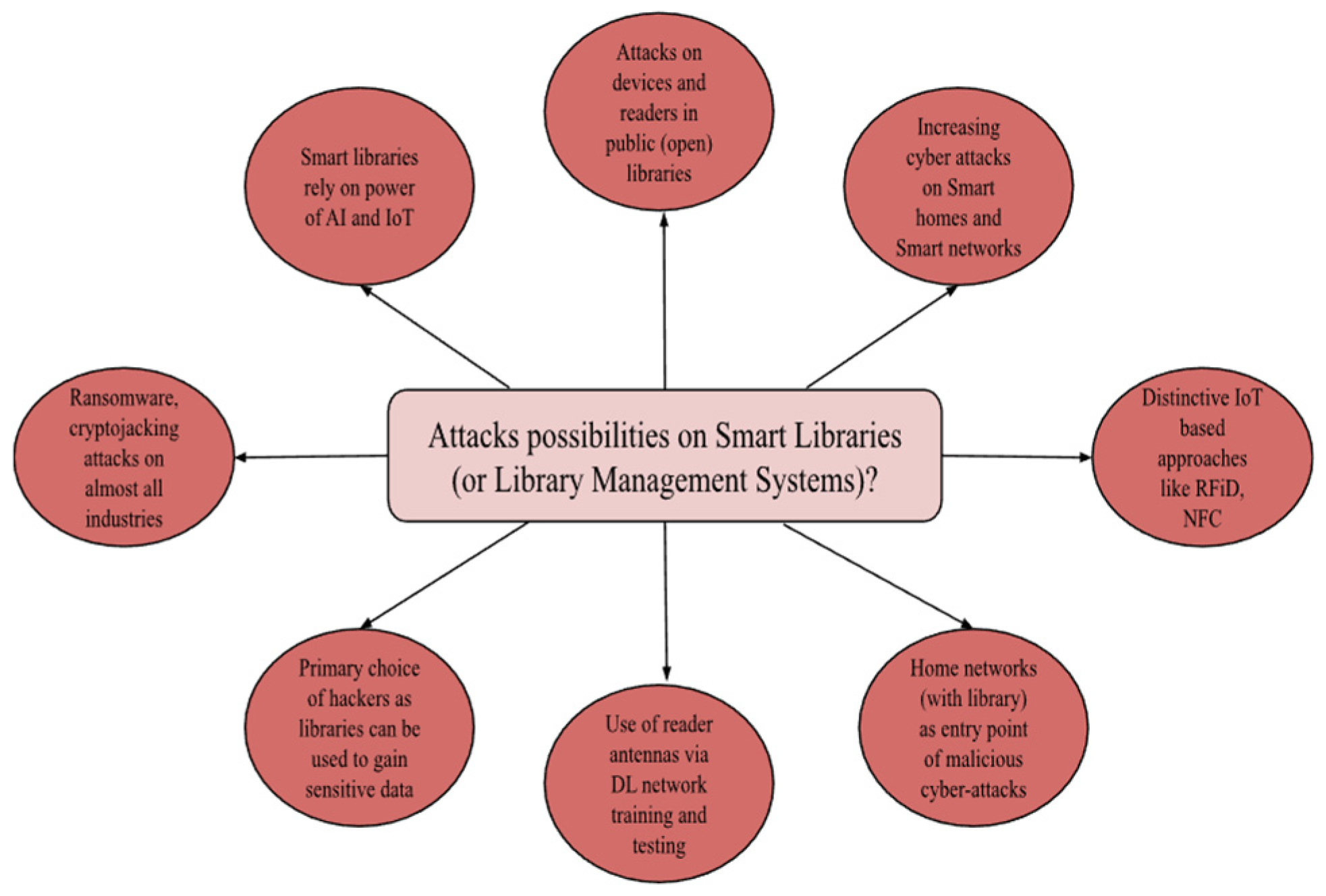
The recent advancement of the Internet of Things (IoT) combined with Artificial Intelligence (AI) has facilitated the emergence of creative concepts ranging from Smart Homes to Smart Planet, including frameworks for intelligent library systems [
14,
15]. The framework as stated is divided into four layers from Resource layer, Integrated cluster layer, Data storage and analysis layer, Reader service layer. The use of images and their classification with benefits of image processing as dimensional matrix is handled via convolutional neural network (CNN). Although it can be a smart approach, identifying books via one reader antenna and deploying multiple antennas are suspicious to cyberattacks.
New technology has brought about significant changes in smart libraries. They employ IoT to automate checkouts, control smart lighting, and track resources in real time. Libraries now include services such as mobile borrowing apps, AI chatbots for assistance, and cloud computing to manage resources. However, they continue to confront issues such as safeguarding privacy, integrating new technology with existing services, obtaining funding, and educating staff and customers to use these systems effectively [
16]. Nonetheless, cybersecurity is a growing concern for public libraries, as attackers target sensitive patron data. Recent ransomware attacks on major libraries, like the Toronto, British, and Seattle Public Libraries, show their vulnerability. To protect against these threats, libraries should conduct regular security audits, train staff in cybersecurity, keep networks separate, and use strong antivirus software [
17].
The study examines the methods employed by attackers to maintain their malware's inactivity and regularly alter its forms to evade detection. These assailants remain dormant for extended periods before executing their assaults on the appropriate gadgets at optimal moments, inflicting maximum damage [
18,
19]. Home networks, vehicular networks encompassing V2V, V2P, and V2I, as well as library networks, provide as potential entry sites for harmful cyber-attacks in several linked vehicles and smart networks [
19]. The utilization of network sensors and readers in libraries serves to identify books that may be compromised by hackers, indicating that current smart libraries lack the necessary security measures.
Figure 1.
Possible attacks on smart libraries, library systems as use of technology and advancement schemes are growing.
Figure 1.
Possible attacks on smart libraries, library systems as use of technology and advancement schemes are growing.
When considering the ethical aspects of smart (and secure) libraries, it does get connected and involved with cyber ethics, computer ethics, and various uses of recent technologies [
20,
21]. Handling sensitive user information with reliable legal procedures to protect library data is needed as data breach is increasing every year. Legal automation and legal documentation for every library module can be helpful in terms of ethical considerations and design. Knowledge and awareness of computer ethics and cyber ethics within library users can play a decisive role in countering possible cyber-attacks on the library management systems. Victims are almost unknown about the cyber incidents and cyber-attacks that make cyber attackers work in secrecy for future attacks.
V. Case Studies and Intersections
Many aspects of libraries can gain from the implementation of Machine Learning (ML) and Artificial Intelligence (AI) technologies, including AI-driven classification and indexing, book recommendations based on ML algorithms, processing and interpreting patron inquiries through Natural Language Processing (NLP), and utilizing AI analytics for the efficient management of library resources. Numerous technologies have already been implemented in several libraries globally. We will examine several practical applications of AI and ML in libraries.
The chat reference service assists consumers in their study by locating relevant materials and addressing additional inquiries. This discussion is typically addressed by library personnel, resulting in time consumption and necessitating the allocation of more librarians according to service demand. Nonetheless, conducting a first assessment of the conversation to categorize them into reference and non-reference services, followed by directing the chats to the proper departments, would considerably save the time spent managing non-reference inquiries.
A study conducted by Yongming Wang occurred in the academic library at the College of New Jersey. The library launched a chat service in 2014 and accumulated almost 8000 chat transcripts by 2021. The research aimed to create a classification model utilizing chat transcripts to determine if the discussion pertains to a reference service or a non-reference service. A machine learning model was created by partitioning the data into two subsets: one for training and the other for testing the model. This research employed random forest and gradient boosting machine learning models from Scikit-learn. Analysis revealed that both models exhibited commendable performance, achieving precision values exceeding 90%. Nonetheless, the random forest model exhibited superior performance relative to the gradient boosting model. This work demonstrated the potential to streamline chat queries through appropriate classification in the beginning of the chat with the help of Machine Learning modeling [
5] (Wang, Y., 2022).
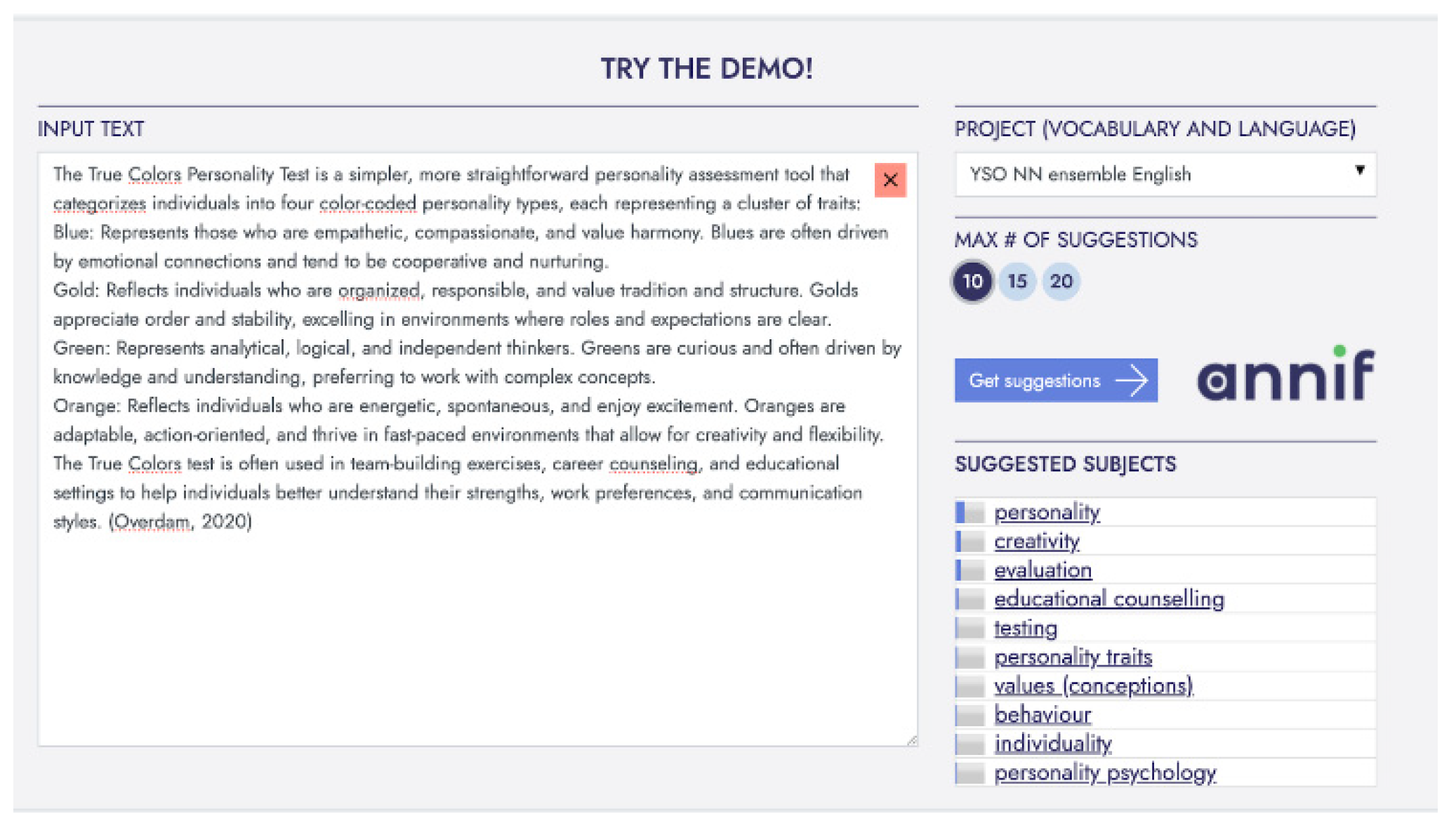
A library generally houses extensive collections of material, including books, papers, journals, and question-and-answer logs, with the objective of facilitating discovery for scholars. When appropriately categorized in the index, these sites serve as invaluable information sources for several researchers. Nonetheless, the manual processing of large volumes of data is labor-intensive, which can be reduced with automatic indexing. Annif is a tool that facilitates semi-automatic or completely automated subject indexing. This program employed a combination of many algorithms, including TF-IDF, fastText, Vowpal Wabbit, and Maui. The comprehensive automated indexing on Annif was evaluated utilizing two extensive document collections: 1. the digital archives of the Satakunnan Kansa regional newspaper, and 2. Finnish Wikipedia. The findings provided a thematic overview of both. The outcome of the tests contained some misleading subject heading which needs careful interpretation, however, it also demonstrated the ability to handle diverse content types and languages, where manual verification was not feasible (Suominen, O., 2019) [
23].
Figure 2.
A subject heading evaluation on the Annif demonstration is as follows (Suominen, O., Inkinen, J., Virolainen, T., Fürneisen, M., Kinoshita, B. P., Veldhoen, S., Sjöberg, M., Zumstein, P., Neatherway, R., & Lehtinen, M., 2023) [
24].
Figure 2.
A subject heading evaluation on the Annif demonstration is as follows (Suominen, O., Inkinen, J., Virolainen, T., Fürneisen, M., Kinoshita, B. P., Veldhoen, S., Sjöberg, M., Zumstein, P., Neatherway, R., & Lehtinen, M., 2023) [
24].
The content on the text is about personality tests and the subject heading suggestions provided by the Annif are listed as personality, creativity, evaluation, educational counseling and so on. The test suggests the tool is capable of automated indexing, especially when a large volume of data is not feasible for manual verification.
VI. Trends and Challenges
Libraries have embraced the recent technological developments, and this collaboration has greatly enhanced the accessibility of library resources, preservation, library resource management, and patrons' experiences (Okwu, E., Okwu, N. E., & Oladokun, B. D., 2024, May) [
27]. ChatGPT has a potential to enhance user experience, assisting reference service, providing personalized recommendations, encouraging user participation, along with assisting in navigating the library's website (Verma, M., 2023) [
28]. Uses of Augmented Reality (AR) such as ShelvAR are being used to read the tags and locate all the books on the shelf at once (Nepali, S., & Tamang, R., 2022) [
29]. Blockchain contains hashed value which allows accessibility to find out detailed information and ensure the authenticity and integrity of data using tamper proof technology (Badhon, M. B., Carr, N., Hossain, S., Khan, M. R. H., Sunna, A. A., Uddin, M. M., Chavarria, J. A., & Sultana, T., 2023) [
30]. This technology can be used for digital rights and permissions management of library resources (Gaikwad, M. N., & Bilawar, P. B., 2023) [
31]. Robotics is implemented in library services, particularly to execute repetitive operations. Robots are recognized for managing user inquiries, retrieving bibliographic records, and processing user surveys (Echedom, A. U., & Okuonghae, O., 2021) [
32].
Alongside the myriad contemporary applications and potentialities of AI and machine learning in libraries, several socio-economic and technological challenges persist, including high costs and financial constraints, inadequate infrastructure, resistance to change, and security concerns regarding the implementation of these technologies. Furthermore, AI adaptation could lead to unemployment for many working in this field (Echedom, A. U., & Okuonghae, O., 2021) [
32]. Moreover, the digital divide exists in different demographic groups such as gender, urban or rural areas, literary levels and socio-economic status (Bhuiyan, M. R. I., Ullah, M. W., Ahmed, S., Bhuyan, M. K., & Sultana, T., 2024) [
34]. The use of AI should aim to minimize and not widen this gap in accessing library resources.
In examining ethical difficulties, one encounters the intersection of money, technology, and law, which presents significant financial obstacles (Hutson, J., Banerjee, G., Kshetri, N., Odenwald, K., & Ratican, J., 2023) [
25]. The ethical application of computer technology and considerations for our smart libraries are prevalent domains of computers and the Internet. The worldwide increase of online devices, digital library management systems, and internet users has produced numerous ethical dilemmas and necessitated an ethical defensive strategy (Kshetri, N., 2022) [
26]. The digital transactions in the library management systems will be adapted to accommodate the changing digital landscape. Cyber risks are ubiquitous, even within our advanced and secure libraries, where exploration of the latest intersections of Machine Learning (and deep learning) with AI might provide protection.
VII. Conclusions and Future Scope
This study navigates the uses of AI and ML in fostering a digital ecosystem for smart and secure libraries which facilitates research and study and enhances patrons' experiences. The opportunities to implement technologies in libraries are endless, as this study mentioned a few. The application of AI, ML, NLP, IoT, Robotics can greatly improve traditional library management and user experiences. Even though AI-driven technologies have great prospects for improved efficiency, it contains considerable challenges. Potential issues such as data privacy, digital security, algorithm biases and disruption of traditional library roles should be carefully addressed (Hanson, E. D., OKORIE, U. U., & Nsit, A., 2024, April) [
33]. The transaction of traditional to smart libraries should also consider ethical defense strategies to protect intellectual ownerships.
The future of smart libraries offers various intriguing paths for research and growth. Integrating advanced security frameworks, such as blockchain technology, into library systems can greatly improve data security and access control, allowing for more secure interlibrary lending systems while protecting patron privacy. As quantum computing evolves, libraries must focus on establishing quantum-resistant security mechanisms to protect their digital assets from new dangers. Moreover, the integration of sophisticated AI represents a significant area for exploration, especially for the enhancement of capabilities like natural language processing and computer vision. Future advancements may enhance the precision of natural language queries, facilitate real-time translation services, offer predictive resource suggestions, and automate cataloging processes. The efficacy of systems like AuRoSS for autonomous shelf scanning illustrates the capability of these technologies to enhance library operations. In addition, intelligent resource management is also critical to the development of library systems. Using advanced machine learning algorithms can help with predictive collection development, dynamic resource allocation, automated maintenance scheduling, and smart energy management. These enhancements would enhance existing implementations, resulting in more efficient and responsive library systems.
Moreover, as libraries use these advancements, the creation of an ethical AI framework becomes critical. This framework should protect privacy, promote fair access, keep algorithms transparent, and develop strong data governance rules. Balancing these factors with technology innovation will allow libraries to adapt responsibly, preserving their basic mission while addressing emerging challenges and possibilities for providing services to the university community.
References
- Orji, S. and Echezonamanyira, I. (2021) ‘What is “smart” about smart libraries?’, International Journal of Research in Library Science, 7(4), p. 265. [CrossRef]
- Omame, I.M. and Alex-Nmecha, J.C. (2020) ‘Artificial Intelligence in libraries’, Advances in Library and Information Science, pp. 120–144. [CrossRef]
- Kim, B. (2019) AI-powered robots for libraries exploratory questions. Wildau: Technical University of Applied Sciences.
- Mupaikwa, E. (2024) ‘The application of Artificial Intelligence and machine learning in academic libraries’, Advances in Information Quality and Management, pp. 1–18. [CrossRef]
- Wang, Y. (2022) ‘Using machine learning and natural language processing to analyze library chat reference transcripts’, Information Technology and Libraries, 41(3). [CrossRef]
- Das, R.K. and Ul Islam, M.S. (no date) Application of Artificial Intelligence and Machine Learning in Libraries: A Systematic Review [Preprint].
- Gujral, G., Shivarama, J. and Choukimath, P.A. (2019) ‘12th International CALIBER-2019 ’, in ResearchGate. Bhubaneswar. Available at: https://www.researchgate.net/publication/338375624_Perceptions_and_Prospects_of_Artificial_Intelligence_Technologies_for_Academic_Libraries_An_Overview_of_Global_Trends (Accessed: 2024).
- Senthilkumar, K.R. (2024) Ai-Assisted Library Reconstruction. Hershey, Pennsylvania (701 E. Chocolate Avenue, Hershey, Pennsylvania, 17033, USA): IGI Global.
- Padilla, T. (2019) Responsible operations: Data science, machine learning, and AI in libraries. Dublin, OH: OCLC.
- Yang, X., He, D., Huang, W., Ororbia, A., Zhou, Z., Kifer, D., & Giles, C. L. (2017, June). Smart library: Identifying books on library shelves using supervised deep learning for scene text reading. In 2017 ACM/IEEE Joint Conference on Digital Libraries (JCDL) (pp. 1-4). IEEE.
- Jayawardena, C., Reyal, S., Kekirideniya, K. R., Wijayawardhana, G. H. T., Rupasinghe, D. G. I. U., & Lakranda, S. Y. R. M. (2021, December). Artificial intelligence based Smart library management system. In 2021 6th IEEE Int. Conference on Recent Advances and Innovations in Engineering (ICRAIE) (Vol. 6, pp. 1-6). IEEE.
- Aboelmaged, M., Shaker Bani-Melhem, Mohd Ahmad Al-Hawari, & Ahmad, I. (2024). Conversational AI Chatbots in library research: An integrative review and future research agenda. Journal of Librarianship and Information Science. [CrossRef]
- Cox, A. M., Pinfield, S., & Rutter, S. (2019). The intelligent library: Thought leaders’ views on the likely impact of artificial intelligence on academic libraries. Library Hi Tech, 37(3), 418–435. [CrossRef]
- Maheen, S. M., Faisal, M. R., & Rahman, R. (2022). Alternative non-BERT model choices for the textual classification in low-resource languages and environments. 192–202. [CrossRef]
- Bi, S., Wang, C., Zhang, J., Huang, W., Wu, B., Gong, Y., & Ni, W. (2022). A survey on artificial intelligence aided internet-of-things technologies in emerging smart libraries. Sensors, 22(8), 2991. [CrossRef]
- Bai, R., Zhao, J., Li, D., Lv, X., Wang, Q., & Zhu, B. (2020). RNN-based demand awareness in smart library using CRFID. China Communications, 17(5), 284-294. [CrossRef]
- Kumar, Dr.G.K. and Chikkamanju, Dr. (2024) ‘ Smart Libraries in Digital Era: An Overview ’, JOURNAL OF EMERGING TECHNOLOGIES AND INNOVATIVE RESEARCH (JETIR), 11(1).
-
Public libraries and cybersecurity: Keeping Patrons’ Data Safe. Available at: https://blog.pressreader.com/libraries-institutions/public-libraries-and-cybersecurity-keeping-patrons-data-safe (Accessed: 10 October 2024).
- Kshetri, N., Rahman, M.M., et al. (2024) ‘cryptoRAN: A review on Cryptojacking and Ransomware attacks w.r.t. Banking Industry - Threats, Challenges, & Problems’, 2024 2nd International Conference on Advancement in Computation & Computer Technologies (InCACCT), 5, pp. 523–528. IEEE. [CrossRef]
- Kshetri, N., Sultana, I., et al. (2024) DefTesPY: Cyber defense model with enhanced data modeling and analysis for Tesla Company via Python Language, arXiv.org. Available at: https://arxiv.org/abs/2407.14671 (Accessed: 10 October 2024). .
- Pokharel, B. P., & Kshetri, N. (2024). blockLAW: Blockchain Technology for Legal Automation and Workflow--Cyber Ethics and Cybersecurity Platforms. arXiv preprint arXiv:2410.06143. [CrossRef]
- Kshetri, N., & Hoxha, D. (2023, November). knowCC: Knowledge, awareness of computer & cyber ethics between CS/non-CS university students. In 2023 International Conference on Computing, Communication, and Intelligent Systems (ICCCIS) (pp. 298-304). IEEE. [CrossRef]
- Suominen, O. (2019). Annif: DIY automated subject indexing using multiple algorithms. LIBER Quarterly: The Journal of the Association of European Research Libraries, 29(1), 1-25. [CrossRef]
- Suominen, O., Inkinen, J., Virolainen, T., Fürneisen, M., Kinoshita, B. P., Veldhoen, S., Sjöberg, M., Zumstein, P., Neatherway, R., & Lehtinen, M. (2023). Annif (v1.0.0). Zenodo. [CrossRef]
- Hutson, J., Banerjee, G., Kshetri, N., Odenwald, K., & Ratican, J. (2023). Architecting the Metaverse: Blockchain and the Financial and Legal Regulatory Challenges of Virtual Real Estate. Journal of Intelligent Learning Systems and Applications, 15(1), 1-23. [CrossRef]
- Kshetri, N. (2022). The global rise of online devices, cybercrime and cyber defense: Enhancing ethical actions, counter measures, cyber strategy, and approaches. University of Missouri-Saint Louis. https://irl.umsl.edu/dissertation/1155 .
- Okwu, E., Okwu, N. E., & Oladokun, B. D. (2024, May). New Technological Trends and Application in Libraries: An Overview. In Seminars in Medical Writing and Education (Vol. 3, pp. 64-64). [CrossRef]
- Verma, M. (2023). Novel study on AI-based chatbot (ChatGPT) impacts on the traditional library management. International Journal of Trend in Scientific Research and Development (IJTSRD), 7(1), 961-964.
- Nepali, S., & Tamang, R. (2022). A Review on Emerging Trends and Technologies in the Library. American Journal of Information Science and Technology, 6(1), 8. [CrossRef]
- Badhon, M. B., Carr, N., Hossain, S., Khan, M. R. H., Sunna, A. A., Uddin, M. M., Chavarria, J. A., & Sultana, T. (2023). Digital Forensics Use-Case of Blockchain Technology: A Review.
- Gaikwad, M. N., & Bilawar, P. B. (2023). Transforming Academic Libraries: Exploring Emerging Trends and Technologies. LIS Links Newsletter, 9(1), 1-9.
- Echedom, A. U., & Okuonghae, O. (2021). Transforming academic library operations in Africa with artificial intelligence: Opportunities and challenges: A review paper. New Review of Academic Librarianship, 27(2), 243-255. [CrossRef]
- Hanson, E. D., OKORIE, U. U., & Nsit, A. (2024, April), Chapter 2, THE ROLES OF ARTIFICIAL INTELLIGENCE IN LIBRARY AUTOMATION: THE PROSPECTS AND CHALLENGES., ERUDITE COMPENDIUMS IN EDUCATION. .
- Bhuiyan, M. R. I., Ullah, M. W., Ahmed, S., Bhuyan, M. K., & Sultana, T. (2024). Information Security for An Information Society for Accessing Secured Information: A PRISMA Based Systematic Review. International Journal of Religion, 5(11), 932-946. [CrossRef]
|
Disclaimer/Publisher’s Note: The statements, opinions and data contained in all publications are solely those of the individual author(s) and contributor(s) and not of MDPI and/or the editor(s). MDPI and/or the editor(s) disclaim responsibility for any injury to people or property resulting from any ideas, methods, instructions or products referred to in the content. |
© 2024 by the authors. Licensee MDPI, Basel, Switzerland. This article is an open access article distributed under the terms and conditions of the Creative Commons Attribution (CC BY) license (http://creativecommons.org/licenses/by/4.0/).