
Submitted:
11 November 2024
Posted:
13 November 2024
You are already at the latest version
Abstract
As artificial intelligence (AI) begins to gain traction in today's technological world. The media, academia, and literature have all taken an interest in AI because of the buzz around its possible effects on the job market. Many have predicted a dramatic change in the character of employment in light of the concerns surrounding AI and its potential effects on the future of work. The need to understand the ethical consequences of these technical advancements has been highlighted by the progress in automation and artificial intelligence. Both the automation of cognitive functions and the possibility of modifications to organisational structures and management systems are related to the ongoing evolution of AI. Our study covers the implications that many businesses may face as a result of using AI and automation. We chose to take on the challenge of figuring out how AI will impact our workforce, productivity, and economic development since we know it will be a crucial topic to address in the future years of technological advancement. We hope that by analysing the many ways AI may affect jobs, we can shed light on the topic and help shape future debates, regulations, and strategies for AI's fair and equitable integration into the workplace. We found that AI may boost productivity, simplify operations, and provide new job possibilities, all of which have a favourable effect on the workforce. When AI and automation are used more often, productivity rises, which in turn may boost GDP.
Keywords:
1. Introduction
1.1. Businesses, the Economy, and Society Are Benefiting from the Possibilities Presented by the Rapid Advancements in AI and Automation
- Rapid technological progress: Emerging in settings as diverse as grocery store automated checkout lanes and autonomous cars on public roadways are new generations of highly competent autonomous systems, going beyond conventional industrial automation and sophisticated robotics. Mechanics, sensors, and software have all seen significant advancements because to system and component upgrades. Due to the exponential expansion in both processing power and the amount of data accessible to train machine-learning algorithms, AI has achieved remarkable progress in the last few years. Many of the recent sensational discoveries have to do with superhuman powers in areas like computer vision, natural language processing, and very difficult games like Go.
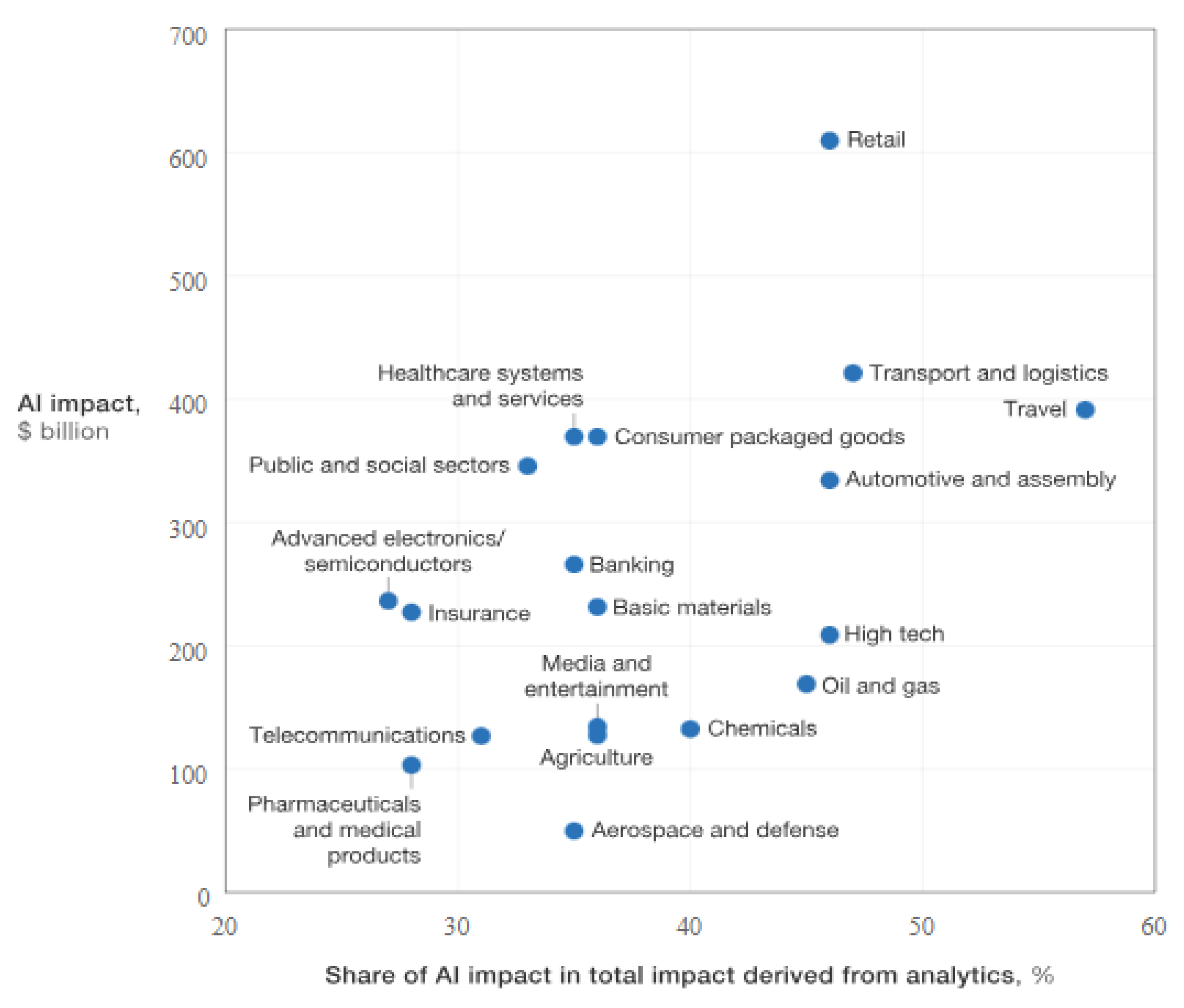
- Possibility of influencing company practices and adding to GDP growth: Businesses across sectors use these technologies in a variety of processes to personalize product recommendations, find anomalies in production, identify fraudulent transactions, and more. They are already adding value to various products and services, and they have the potential to transform businesses and contribute to economic growth. The most recent developments in artificial intelligence hold even more promise, with methods that tackle categorization, estimation, and clustering issues offering even more use. Based on our study of hundreds of AI use cases, the most sophisticated deep learning methods using artificial neural networks have the potential to generate an annual value between $3.5 trillion and $5.8 trillion, or 40% of the total value provided by analytics approaches (Figure 1).
2. Literature Review
3. AI, Robots, and Automation
4. How Does AI in Automation Increase Productivity?
- Communication and collaboration: Use platforms driven by AI to streamline team communication, automate processes, and boost output.
- Minutes, audio recordings, and synopses of meetings: Artificial intelligence meeting transcription services can take audio recordings of meetings and turn them into searchable, shareable summaries.
- Creating a presentation: Using AI to advantage, create presentations with captivating slides, layouts, and topic suggestions.
- Cleaning up and organising email inbox: Use artificial intelligence to sort email messages into folders, set priorities, and delete unnecessary ones.
- Making plans and schedules: Use artificial intelligence (AI) technologies to automate appointment scheduling, analyse calendars, and propose meeting times.
5. Artificial Intelligence (AI) and Automation Reform the Growth of the Global Economy
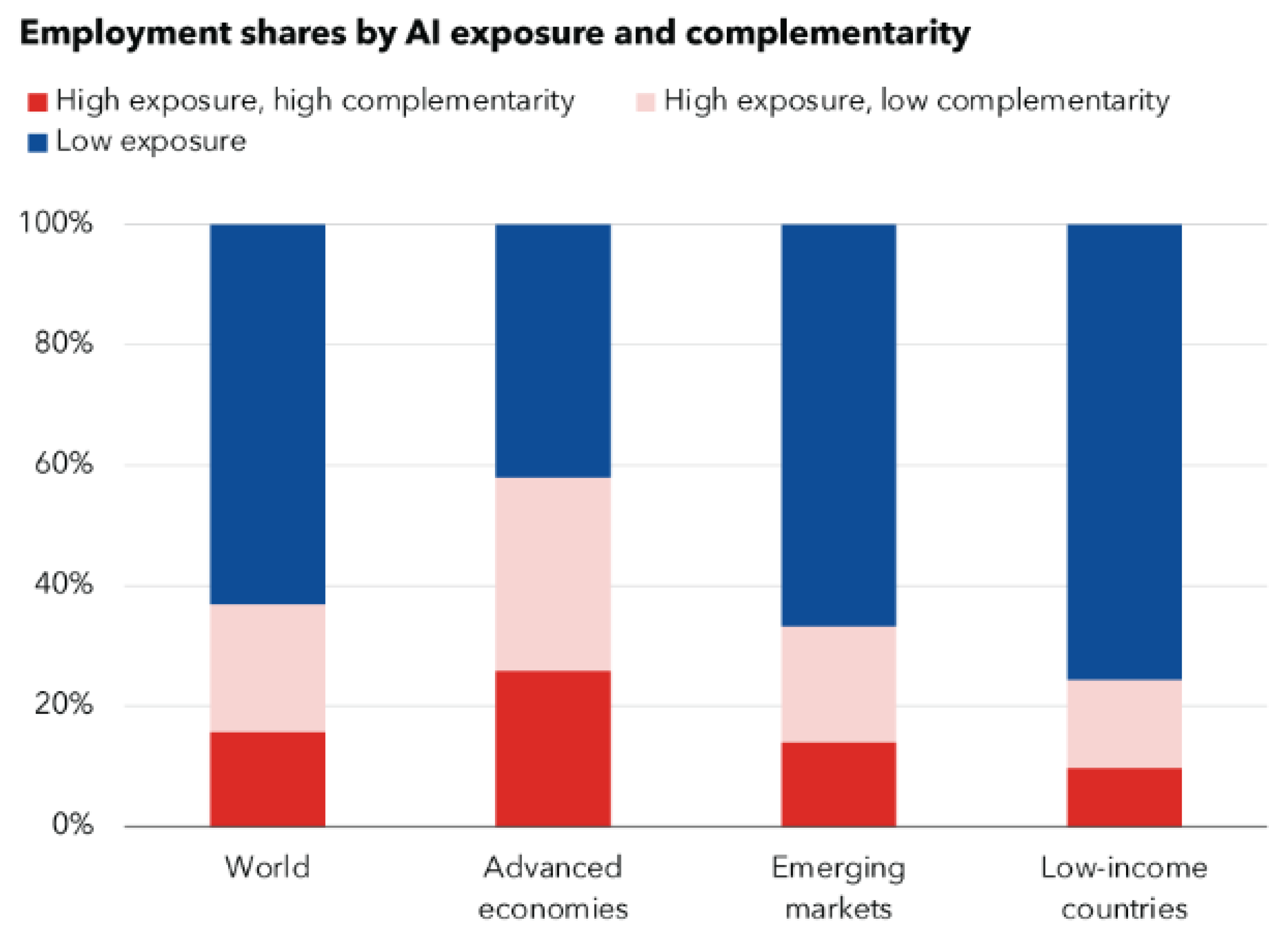
6. The Effects of AI and Automation on Workforce and Productivity
- i.
- Job Displacement and Transformation:
- Some occupations, especially those involving mundane or repetitive activities, may become obsolete as a result of automation and AI. Examples of potentially susceptible occupations include those in manufacturing, data entry, and customer service.
- The flip side is that new occupations will pop up, and those people will need to be proficient in things like data analysis, programming, artificial intelligence, and more. These positions might be in areas like human-AI interface, robotics maintenance, or artificial intelligence ethics.
- ii.
- Skill Shift and Training:
- To keep up with the ever-evolving employment market, the workforce will have to change and learn new things. To maintain a competitive edge, people will need to commit to lifelong learning and continuously improve their skills.
- In order for people to thrive in the era of AI and automation, training and educational programmes that are jointly provided by governments, educational institutions, and businesses will be essential.
- iii.
- Industry Disruption:
- Automation and AI will most certainly cause major shifts in the way certain sectors do business. Examples of industries that could see changes in work practices and human responsibilities include transportation, manufacturing, retail, and agriculture.
- As AI and automation revolutionise production and delivery of goods and services, conventional business models may need a re-evaluation.
- iv.
- Economic Impact:
- Productivity and GDP development might be enhanced by using automation and AI. On the other hand, if particular groups of workers are hit worse than others by job loss, they might make income disparity worse.
- Organisations and governments must devise plans to mitigate the economic effects of automation. This may include exploring ideas like alternate employment arrangements or a universal basic income.
7. Conclusions
References
- Masriadi, & Dasmadi, & Ekaningrum, Nurul & Hidayat, Muhammad & Yuliati, Farida. (2023). Exploring the Future of Work: Impact of Automation and Artificial Intelligence on Employment. ENDLESS: INTERNATIONAL JOURNAL OF FUTURE STUDIES. 6. 125-136.
- Panigrahi, Ashok & Ahirrao, Shrinivas & Patel, Arav. (2024). Impact of Artificial Intelligence on Indian Economy. Journal of Management Research and Analysis. 11. 33-40.
- Solos, Wein & Leonard, Joel. (2022). On the Impact of Artificial Intelligence on Economy. Science Insights. 41. 501-560.
- Govindharaj, Yoganandham & Elanchezhian, G. & Khan, Mr. (2023). Impact of Artificial Intelligence (Ai) on India's Economic Growth and Population -An Assessment. 11. 2455-6211.
- Gries, Thomas & Naudé, Wim. (2018). Artificial Intelligence, Jobs, Inequality and Productivity: Does Aggregate Demand Matter?. SSRN Electronic Journal.
- De Backer K, Destefano T, Menon C, Ran Suh J (2018) Industrial robotics and the global organization of production. OECD Science, Technology and Industry Working Papers No. 2018/03. 1787.
- Vivarelli M (2014) Innovation, employment, and skills in advanced and developing countries: A survey of the economic literature. J Econ Issues 48(1): 123–154. [CrossRef]
- Van Roy V, Vertesy D, Vivarelli M (2018) Technology and employment: Mass unemployment or job creation? Empirical evidence from European patenting firms. Res Pol 47(9): 1762-1776. [CrossRef]
- T. Gries and W. Naudé, ‘Artificial Intelligence, Income Distribution and Economic Growth’, SSRN Electronic Journal, 2020. [CrossRef]
- S. Jha, ‘Automation and Radiology—Part 1’, Acad Radiol, vol. 27, no. 1, pp. 147–149, Jan. 2020. [CrossRef]
- J. Lobera, C. J. Fernández Rodríguez, and C. Torres-Albero, ‘Privacy, Values and Machines: Predicting Opposition to Artificial Intelligence’, Commun Stud, vol. 71, no. 3, pp. 448–465, May 2020,. [CrossRef]
- L. Abrardi, C. Cambini, and L. Rondi, ‘The Economics of Artificial Intelligence: A Survey’, SSRN Electronic Journal, 2019. [CrossRef]
Disclaimer/Publisher’s Note: The statements, opinions and data contained in all publications are solely those of the individual author(s) and contributor(s) and not of MDPI and/or the editor(s). MDPI and/or the editor(s) disclaim responsibility for any injury to people or property resulting from any ideas, methods, instructions or products referred to in the content. |
© 2024 by the authors. Licensee MDPI, Basel, Switzerland. This article is an open access article distributed under the terms and conditions of the Creative Commons Attribution (CC BY) license (https://creativecommons.org/licenses/by/4.0/).


