1. Introduction
Migrant workers are defined as individuals who secure paid employment in various forms, such as full-time, part-time, or other arrangements, in a country or region other than their own (Le et al., 2022). Macao government classifies migrant employees into three categories: professional workers, domestic workers, and non-professional workers. According to Macao’s No. 21/2009 Non-local Resident Employment Law, migrant workers may be employed as professional employees if they possess a higher education degree or highly specialized work experience and are engaged in highly specialized work. Those who do not meet these criteria and are not engaged in domestic work are classified as non-professional employees (Macao Special Administration Region China, 2009). Employees from Mainland China are categorized as migrant workers because they need work permit to work in Macao, due to two distinctive governance systems between Mainland China and Macao Special Administration Region.
Migrant workers are deeply embedded in the social contexts where they live and work, and their social connections do matter (Barbier et al., 2013) because they are influenced by local coworkers and communities (Bianchi et al., 2016; Sim & Wee, 2009). As such, both migrant workers and their employers need to navigate varying degrees of internal and external pressures. For example, employers who hire large numbers of migrant workers may face pressure from local communities and government agencies regarding structural unemployment and social conflicts (Shi, 2017). Wide exposure to uncivilized behaviors among migrant worker groups (Sim & Wee, 2009) may lead to biased perceptions toward migrant workers within local communities. Migrant workers, on the other hand, must adapt to work settings with local colleagues and manage stress from host city cities or countries (Bernardo et al., 2018). Additionally, migrant workers may experience cultural deprivation (Bernardo et al., 2022), which significantly affect their well-being and health (Hall et al., 2019; Ju & Sandel, 2019), as they may struggle to find sufficient support.
Stigmatization studies have identified that perceived stigma can lead to various behaviors. Healthcare providers who experience self-stigma may feel shame when seeking help from outsiders due to disadvantaged social status (Endriulaitienė et al., 2019). Similarly, abortion workers who perceive resistance and vulnerability in their profession may attribute this to social stigmatization (O’Donnell et al., 2011). Perceived stigma is also prevalent among parents caring for children with epilepsy, leading to heightened stress levels (Rani & Thomas, 2019). In Macao, the majority of Macao mainland migrant workers, particularly non-professional employees, are employed in low-skilled jobs, receiving minimal financial compensation, and are often involved in 3D jobs (dirty, dangerous, and demanding, sometimes degrading or demeaning) (Moyce & Schenker, 2018). Compared to local workers, migrant worker identity has been a significant factor impacting their salary levels, with 33.8% of wage discrepancies explained by identity discrimination (Li, 2023). In addition, migrant workers in Macao perceive stigma for various reasons, including conflicts of interest with local workers (Bernardo et al., 2018), hidden political agenda, rampant exposure of their so-called “uncivilized” behaviors, and instances of discrimination (Ju & Sandel, 2019; Shi, 2017). Some politicians exploit the narrative that migrant workers are “stealing” local workers’ job opportunities to advance their hidden political purposes. These factors contribute to migrant workers’ low social status and subsequently leading to migrant workers’ stigmatization (Chang et al., 2018).
Stigmatization can result in various psychological problems (Bianchi et al., 2016), including depression (Li et al., 2019), anxiety (Hall et al., 2019), and even lead to mental disorders (LeBel, 2008). Research has found that migrant workers often face work and financial pressure, deteriorating work conditions, psychological issues as well as sexual and genital problems. These external and internal factors lead to unhealthy lifestyles and burnout (Hall et al., 2019). Past studies have verified the psychological and physiological problems among stigmatized migrant work groups (Bernardo et al., 2018; Ju & Sandel, 2019; Shi, 2017), and these negative psychological effects are likely influencing migrant workers’ attitudes toward their jobs (Bianchi et al., 2016; Hall et al., 2019).
The relationship between perceived stigma and job burnout has not been thoroughly explored, despite the evident overlap between these two concepts (Bianchi et al., 2016). One study confirmed that when mental health providers perceived stigma while seeking help from others, they are likely experience job burnout (Endriulaitienė et al., 2019). Similarly, some clinical studies have found a positive correlation between the perceived stigma of abortion workers and occupational burnout, as well as psychological distress (Janiak et al., 2018; Martin et al., 2014; Martin et al., 2018; Mosley et al., 2020). Based on these findings, we assume that when Macao migrant workers perceive stigma, it leads to job burnout. We focused on migrant workers in Macao because they represent a typical group that seeks to make a living overseas to support themselves and families, yet this workforce group has been ignored in global organization behavior studies. Although several reviewing articles underscored the health and wellbeing of migrant workers (Cho et al., 2023; Hargreaves et al., 2019), there remains a research gap in exploring the psychological responses of migrant workers in the host country’s business context. Therefore, our primary research questions are: in Macao, does perceived stigma among migrant workers lead to job burnout? Additionally, does role stress mediate the relationship between perceived stigma and job burnout?
Individuals’ responses to stigma are believed to play a crucial role in affecting employees’ well-being and overall quality of life (Chang et al., 2018). For example, migrant workers may engage in acculturation practices, such as learning Cantonese or appreciating other ethnic cultures, to reduce their sense of alienation or discrimination (Choe et al., 2020). This approach can be seen as an effort to acquire essential resources that help overcome psychological deprivation, including the effects of stigmatization. In this context, self-efficacy is a critical factor that enables workers to build the mental resilience needed to address psychological challenges (Robbins & Judge, 2012) arising from stigmatization. Previous clinical studies have shown that perceived stigma accounts for a significant portion of the variance in low self-efficacy (Kleim et al., 2008), suggesting that employees with high self-efficacy may be better equipped to buffer stigmatization.
Additionally, organizational support is considered a vital resource in helping migrant workers mitigate their perceptions of stigma. For instance, perceptions of organizational climate are believed to affect employees’ experiences of stigmatization, which in turn influence their identity and career advancement (Trau, 2015). If organizations provide adequate support and resources, such as fostering an equitable and diverse work environment, migrant workers may experience reduced stigmatization in the workplace, thereby leading to low levels of job burnout. Therefore, other research questions in the current study include: Do self-efficacy and organizational support buffer the effects of perceived stigma on job burnout?
This study extends previous research on stigmatization from sociology into organizational management, advocating for the exploration of related outcomes within the workplace context (LeBel, 2008). Additionally, this empirical study makes a significant theoretical contribution, particularly in its examination of Macao migrant workers, as job burnout manifests differently between local employees and migrant workers. For example, an analysis of burnout and life satisfaction among local and migrant workers in the hotel industry in mainland China revealed that migrant workers are more susceptible to burnout than their local counterparts due to a lack of resource support (Shen & Huang, 2012). Furthermore, due to poor living conditions, migrant workers are likely experience discrimination compared to local workers, particularly housing discrimination, which can lead to higher level of depression and distress (Chang & Fong, 2023; Xiao et al., 2018). Therefore, migrant workers are a particularly vulnerable group at risk of compromised health and well-being, which urgently requires further study.
2. Literature Review and Conceptual Model
2.1. Definitions of Key Variables
2.1.1. Perceived Stigma
Negative attitudes and beliefs that lead individuals to reject, shun, or fear those they perceive as different are collectively known as stigma (Tesfaw et al., 2020). Previous literature categorizes stigma into various forms, such as public stigma, which involves stereotypes, discrimination, and prejudgment from the public; structural stigma, which manifests through laws, governmental policies, and official documents; courtesy stigma, which arises from association with a stigmatized group or person; provider-based stigma, which is discrimination enacted by professional associations intended to support marginalized communities; and self-stigma, where individuals internalize public stigma directed towards their group (Chang et al., 2018). These distinctions highlight various perspectives on stigma. The experiential aspect refers to how stigma is received, anticipated, perceived, endorsed, or enacted. In contrast, action-oriented stigma emphasizes behaviors aimed at addressing or mitigating stigma, such as providing support to stigmatized groups (Pescosolido & Martin, 2015).
This study focuses on perceived stigma (PS), which falls under the experiential nature of stigma. Perceived stigma can be understood through the following processes: first, what an individual believes most people think about the stigmatized population in general; and second, how an individual perceives the community treats or categorizes them as a member of the stigmatized population (LeBel, 2008). Perceived stigma is a form of experiential stigma. Many migrant workers in Macao experience this due to factors such as disadvantageous government policies including immigration and work permit regulations, comparatively lower salaries compared to local labor, unsatisfactory working environments, and the widespread perception of their jobs as menial, such as domestic work or waitstaff positions. These conditions contribute to their belief that they are a stigmatized group and that their identities are subject to discrimination. (Ju & Sandel, 2019).
2.1.2. Job Burnout
Burnout is a long-lasting, unpleasant condition that combines physical tiredness, mental fatigue, and emotional depletion. It is associated with numerous detrimental health effects and is considered the result of ongoing, unresolved workplace stress (Bianchi et al., 2016). Job burnout is often viewed as an inadequate response to chronic occupational stress, encompassing emotional exhaustion, depersonalization, and a diminished sense of personal achievement (Luken & Sammons, 2016). Studies have identified three key dimensions of burnout: exhaustion, cynicism, and inefficacy (Maslach et al., 2001). Exhaustion involves the depletion of emotional resources, hindering workers from achieving psychological well-being. Cynicism refers to the development of a distant, indifferent, or cynical attitude toward one’s job and colleagues. Inefficacy is characterized by a decline in competence and accomplishment in one’s work. Job burnout can lead to severe consequences including absenteeism, the intention to leave the job, resignation, reduced productivity, and less effective work (Bianchi et al., 2016). It is a widely used perception in understanding employees’ psychological responses (Mosley et al., 2020).
2.1.3. Role Stress
Sociology scholars often use the term “role stress” to explore various issues, such as family role stress, exemplified by parents of children with specific needs (Rani & Thomas, 2019), and social role stress, as seen in abortion worker’s research. In the work context, role stress specifically refers to stress related to job roles. Studies have identified three main areas where roles within an organization can negatively impact individuals: role conflict, role ambiguity, and role overload (Kahn et al., 1964). According to Peterson et al. (1995), role conflict occurs when there is an incompatibility between the expectations of different parties or between elements of a single role. Role ambiguity arises when an employee receives unclear or inconsistent instructions regarding the role they are required to fulfill. Role overload is the outward manifestation of stress resulting from excessive responsibilities or demands associated with a job role. Role stress can lead to severe workplace consequences, including increased anxiety, depression, and burnout, higher risks of health problems such as cardiovascular diseases, decreased productivity and job satisfaction, and strained relationships with colleagues (Salvagioni et al., 2017).
2.1.4. Organization Support
Perceived organizational support refers to employees’ belief that their employers value their contributions and care about their well-being (Riggle et al., 2009). There is often confusion between organizational support and perceived organizational support, and a clear distinction between the two terms has yet to be firmly established. According to social exchange theory, when employees perceive that rewards, favorable working conditions, and other resources provided by the employer are given voluntarily, they experience higher levels of perceived organizational support (Rhoades & Eisenberger, 2002). In this study, organizational support is used as a variable to interact with perceived stigma, role stress, and job burnout. Organizational support is known to enhance employees’ well-being, emotional outcomes, and to foster creative and innovative behaviors, which are highly valued in organizational management theories (Eisenberger et al., 2020).
2.1.5. Self-efficacy
Self-efficacy refers to an individual’s belief in their capacity to execute the behaviors necessary to achieve specific performance outcomes (Bandura, 1986; Bandura, 1994). From the perspective of Job Demands-Resources (JD-R) theory, self-efficacy represents migrant workers’ internal resources for performing organizational tasks (Grover et al., 2018). Additionally, from the social cognitive theory perspective, self-efficacy is considered a critical factor in determining various stress-related outcomes, including job burnout (Shoji et al., 2016), as it can buffer physiological arousal and enhance individual performance (Bandura, 1986; Bandura, 1994).
2.2. Theoretical Lens
2.2.1. Conservation of Resources Theory
Conservation of Resources (COR) theory predicts organizational behaviors (Ghafoor & Haar, 2022) and has been widely used in studies on role stress and job burnout (Hobfoll et al., 2018). The central tenet of COR theory is that individuals strive to obtain and preserve valuable resources. According to COR, stress occurs when key resources are threatened with loss, are lost, or when efforts to obtain these resources fail (Hobfoll, 1989). This study posits that self-efficacy and organizational support are vital resources for employees to overcome workplace difficulties. For example, if employees perceive a high level of self-efficacy and organizational support, they are better equipped to preserve their core resources such as self-esteem and organization identity in the workplace, and they can use these resources to resist the negative effects of stigmatization.
2.2.2. The Job Demands-Resources (JD-R) Theory
The Job Demands-Resources (JD-R) model, proposed by Demerouti et al. (2001), has been extensively utilized to explain stress, strain, and job burnout over the past two decades (Bakker & Demerouti, 2017; Bakker et al., 2014). The JD-R theory categorizes all job characteristics into two broad categories: job demands and job resources. Job demands refer to the physical, psychological, social, and organizational aspects of a job that require sustained physical and/or psychological effort, often leading to specific physiological and/or psychological costs. In contrast, job resources refer to the physical, psychological, social, and organizational components of a job that help achieve objectives, reduce the physiological and psychological costs of job demands, or promote personal development (Bakker & Demerouti, 2017). Migrant workers often face external pressures, such as stigmatization, workplace bullying, and discrimination (Ju & Sandel, 2019), which serve as sources of job demands. On the other hand, their self-efficacy, along with support from colleagues, leaders, and employers, can be considered job resources that help buffer the negative effects of these job demands. In this context, the JD-R theory provides a suitable theoretical framework for constructing the hypotheses of the present research.
2.3. Hypotheses Development
2.3.1. Perceived Stigma and Job Burnout
Previous studies have shown that stigmatized groups may experience job burnout when subjected to differential treatment (Bianchi et al., 2016; Endriulaitienė et al., 2019). For instance, abortion workers often struggle to manage occupational stress, which can lead to poor physical health outcomes and heightened emotional burnout (Janiak et al., 2018; Martin et al., 2014; Martin et al., 2018; Mosley et al., 2020). Stigmatized roles, such as those of abortion workers, require managing intense emotional responses and constantly adapting coping strategies (O’Donnell et al., 2011). In a study by Endriulaitienė et al. (2019), recruiting 234 professionals from Lithuania and 93 from the U.S., the researchers used the Self-Stigma of Seeking Help Scale and the Maslach Burnout Inventory-General Survey. The results showed that the three dimensions of burnout, emotional exhaustion, depersonalization, and professional efficacy, significantly led to self-stigma, with a significant correlation between general stigma and burnout (r=0.28, p<0.01). Macao migrant workers face discrimination due to their perceived identities, with locals often accusing them of taking jobs and blaming them for behaviors such as smoking, spitting, and speaking loudly (Ju & Sandel, 2019). This discrimination has heightened their anxiety, as they fear losing their jobs if they voice concerns about unfair treatment in the workplace. Over time, they perceive stigma as a migrant worker, which is consistent with the nature of experiential stigma defined by Pescosolido and Martin (2015). Therefore, this study hypothesizes that Macao migrant workers who perceive a high level of stigma are likely to experience high level of job burnout. For example, young migrant workers may feel bored and dissatisfied with repetitive jobs such as cleaners or security guards, yet struggle to find appropriate places in Macao to relax and unwind (Ju & Sandel, 2019). Therefore, we assume that,
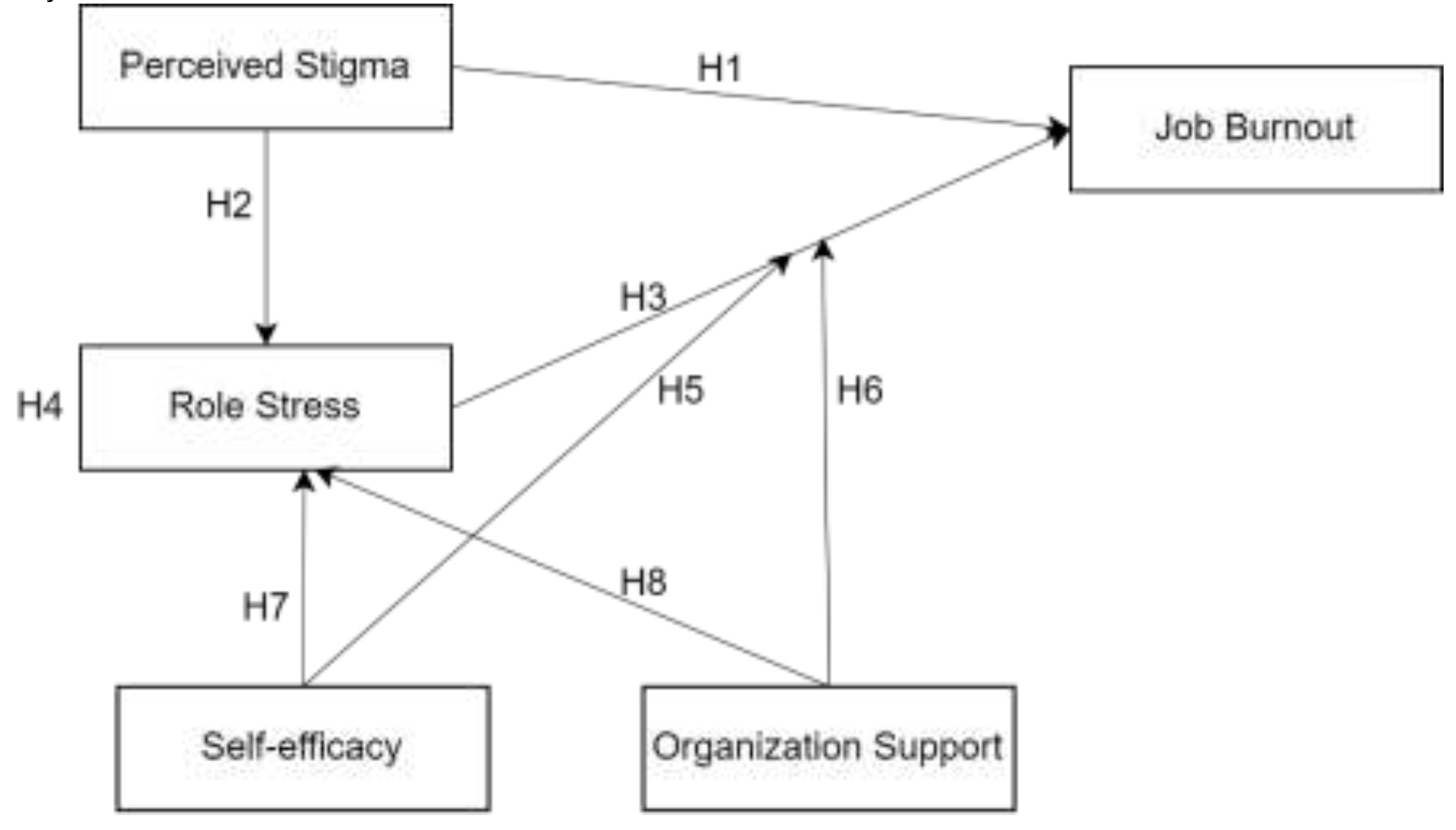
Hypothesis 1: A high-level perceived stigma will lead to a high-level job burnout.
2.3.2. Identity Discrimination and Role Stress
Stigmatized workers may encounter high level of role stress. For instance, abortion workers facing greater abortion stigma are more likely to experience increased role stress (Janiak et al., 2018; Martin et al., 2014). Anecdotal evidence also suggests a strong correlation between stigma and role stress, such as the need to conceal their occupation as abortion practitioners (Harris et al., 2011). Similarly, a study by Rani and Thomas (2019) found that parents raising children with epilepsy are more likely to experience emotional reactions such as anger, guilt, fear, anxiety, and depression. By analyzing 60 parents of children with epilepsy and comorbid conditions, the study revealed a higher frequency of parent stress (±130.50), and perceived stigma (±21.90) compared to parents of children with epilepsy without comorbid conditions. The results indicate that stigmatized parents experience more stress due to their specific group membership. In a similar context, migrant workers who perceive stigma may face heightened role stress. For example, if migrant restaurant managers perceive a high level of identity stigma, they may feel stressed when assuming leadership over their Macao subordinates and colleagues. Therefore, we propose,
H2: A high-level perceived stigma will lead to a high-level role stress.
2.3.3. Role Stress and Job Burnout
In terms of role stress study, role overload has not been studied as extensively as role ambiguity and role conflict, because it is often considered an individual’s internal role conflict (Wu et al., 2019). The correlations between stress and depression have been evaluated. For instance, Schmidt et al. (2014) conducted a meta-analysis on role ambiguity, role conflict, and depression, suggesting strong correlations between these stressors and depression (r=0.262 for role ambiguity, r=0.293 for role conflict after corrections both statistically significant). Additionally, positive correlations between role stress and job burnout have been empirically tested in various studies (Kahn et al., 1964; Wu et al., 2019).
Migrant workers in Macao often undertake low-skill jobs with lower pay compared to local workers (Li, 2023). Li et al. (2019) surveyed 900 mainland Chinese migrant workers in Macao and found that perceived job stress is positively related to depressive symptoms (r=0.21, p<0.01), while the relationship between job stress and migrant workers’ self-esteem is negatively and significantly associated (β=-0.202, p<0.001). Wu et al. (2019) surveyed 191 practitioners from China’s construction industry and found that role conflict and role ambiguity positively and significantly contribute to job burnout (βrc=0.502, p<0.001; βra=0.359, p<0.001).These antecedents indicate that higher job stress leads to job burnout among migrant workers. Based on these findings, the following hypothesis is developed:
Hypothesis 3: A high level of role stress will lead to a higher level of job burnout.
2.3.4. The Mediation Role of Role Stress
Employees form social bonds and strive to preserve personal strength and social connections as their central resources. At the core, employees value their connections with families, their well-being, self-esteem, and their sense of life and work. Migrant workers often suffer from cultural isolation and lack social support (Bernardo et al., 2022), making them more susceptible to issues like alcoholism, sexual abuse, and other social problems (Hall et al., 2019). Being stigmatized further drives them into isolation and depletes valuable resources such as self-esteem (LeBel, 2008). Based on Conservation of Resources (COR) theory, cultural and family detachment, along with stigmatization, deprives migrant workers from their central resources, leading to stress (Bernardo et al., 2018; Bernardo et al., 2022).
Chronic work stress is often followed by job burnout (Bianchi et al., 2016). Resource deprivation thus leads to job burnout over time, a scenario migrant workers may frequently encounter in their daily work and life (Ju & Sandel, 2019). Role stress serves as a mediator in the effect of perceived stigma on job burnout because migrant workers might be treated differently from local employees in terms of career path, performance management, and job status. In other words, we assume that when migrant workers face long-lasting stigmatization, role stress occurs sequentially; as when role stress accumulates, job burnout follows.
Hypothesis 4: Role stress acts as a mediating variable between perceived stigma and job burnout.
2.3.5. The Moderating Role of Self-Efficacy and Organization Support
Self-efficacy is the self-driven power of stigmatized employees, enabling them to manage their emotions. Migrant workers who suffer from stigma and demanding work stress require additional resources to manage their jobs effectively. Based on COR theoretical inference, both self-efficacy and organizational support are crucial resources to help migrant workers to cope with stress in the workplace. For instance, stigmatized migrant workers may seek self-motivation and emotional adjustment to resist external pressures such as implicit bias and discrimination in the workplace. Alternatively, they might seek assistance from the HR department or their leaders for mental health support. We assume that if organizations can help migrant workers such as house allowance and social integration policies, employees may perceive less job burnout. In this regard, we propose Hypotheses 5 and 6:
H5: Self-efficacy negatively moderates the relationship between role stress and job burnout. In other words, the positive relationship is stronger when migrant workers’ self-efficacy is lower.
H6: Organizational support negatively moderates the relationship between role stress and job burnout. In other words, the positive relationship is stronger when migrant workers’ organization support is lower.
2.3.6. Moderated Mediation
This study considers role stress as the mediating variable and hypothesizes that self-efficacy and organizational support are two moderating variables. Self-efficacy reflects how individuals assess their confidence and ability to fulfill job needs, which in turn affects their work attitude and organizational behaviors (Wulandari et al., 2021). Based on the JD-R theory, self-efficacy is an important resource that helps employees cope with role stress, which stems from job demands. For instance, a high level of self-efficacy can help individuals manage job demands and expectations from supervisors by increasing internal resources such as confidence and determination, thereby alleviating stress. Therefore, when migrant workers’ self-efficacy is high, they will feel less stressed in the workplace. Thus, the mediating effect of role stress on the relationship between perceived stigma and job burnout will be reduced accordingly.
H7: Self-efficacy negatively moderates the mediating effect of role stress on the relationship between perceived stigma and job burnout. In this sense, when migrant workers’ self-efficacy is at a high level, the mediating effect of role stress between perceived stigma and job burnout will be reduced.
Based on the JD-R theory, organizational support is an important resource that helps employees cope with role stress. A high level of organizational support can enhance employees’ sense of responsibility and security, allowing them to overcome stressors and negativity in the workplace. For instance, if organizations in Macao can provide sufficient support to migrant workers, such as family care programs, work shift flexibility, appropriate job allocation, migrant workers may feel less role stress in the workplace. In this sense, organization support encourages employees to take initiative-taking actions that benefit the organization and adjust their working conditions to an optimal level. Thus, when employees perceive a high level of organizational support, migrant workers’ role stress is reduced accordingly and the mediating relationship between perceived stigma, role stress, and job burnout will be reduced.
H8: Organizational support negatively moderates the mediating effect of role stress on the relationship between perceived stigma and job burnout. In this sense, when organization support for migrant workers is at a high level, the mediating effect of role stress between perceived stigma and job burnout will be reduced.
Figure 1.
Conceptual work of various hypotheses in this research project.
Figure 1.
Conceptual work of various hypotheses in this research project.
3. Methods
3.1. Sampling Method
This study distributed questionnaires to collect data from the target population, focusing on Chinese migrant workers in Macao. Mainland Chinese workers account for the largest percentage of Macao’s labor market, comprising 68% of the migrant workforce as of December 2023. Over 95% of these workers are engaged in non-professional jobs, so the targeted samples are low-skilled employees, consistent with the “3D” definition of migrant workers (Moyce & Schenker, 2018). In addition, the targeted sample population has direct working experiences in Macao, which means that investigating the attitudes of this group (perceived stigma and stress) can strongly predict their behaviors (burnout), aligns with the argument from Robbins and Judge (2012).
The research team contacted several large Macao food and beverage corporations through the United Association of Food and Beverage Merchants of Macao and then randomly distributed electronic questionnaires via WeChat groups, which consist of a significant percentage of Mainland migrant workers in Macao. Self-exclusion criteria were included in the questionnaire to prevent non-migrant workers from participating. The questionnaire was designed with two sections. The first section outlined the purpose of research and included an informed consent letter. The second section comprised questions about demographic information such as gender, age, education level, marital status, industry, and work experience, as well as questions from established scales. To facilitate data collection and ensure reliability, this study used a validated Chinese version of the scale. Participation in the study was voluntary, and the authors ensured that participants’ privacy was protected during the study.
3.2. Scale Selection
3.2.1. Perceived Stigma Scale
In the workplace study, the occupation stigma scale was developed (Zhou & Huang, 2020), combining elements from previous studies on stigmatized identities based on gender (Pinel, 1999) and staff workers (Pinel & Paulin, 2005). The later scale by Pinel and Paulin (2005) was a slight revision of the earlier stigma consciousness scale for women (Pinel, 1999), adapting it specifically for staff workers. Both scales have consolidated the identity of employees as being stigmatized. Both scales reinforced the concept of employees as stigmatized individuals. Following these developments, Shantz and Booth (2014) created an occupation stigma consciousness scale, which demonstrated high internal consistency (Cronbach alpha = 0.77), and focused on call center employees. This scale includes six items, with statements such as “being a call center employee is unfairly treated by other non-call center employees” (Shantz & Booth, 2014).
Building on these scales, this study adapted measures from (Shantz & Booth, 2014; Shen et al., 2009) to design a perceived stigma scale that highlights the social identity of migrant workers in Macao. For example, items such as “Being a migrant employee in Macao, I feel that the management and coworkers unfairly treat me” were used to assess employees’ experiences about stigmatization. This adaptation aligns with previous research on workplace stigma (Zhou & Huang, 2018; Zhou & Huang, 2020; Zhou et al., 2020). The perceived stigma scale employed a 5-point Likert scoring system, ranging from 1 (strongly disagree) to 5 (strongly agree). In this study, the scale demonstrated a high-level reliability with a Cronbach’s alpha of 0.92.
3.2.2. Role Stress Scale
Peterson et al. (1995) developed the role stress scale, which consists of three dimensions: role conflict, role ambiguity, and role overload. developed the role stress scale, which comprises three dimensions: role conflict, role ambiguity, and role overload. This scale utilizes a 5-point Likert scoring system, ranging from 1 (strongly disagree) to 5 (strongly agree). A sample item is “I have often had to deal with conflicting demands from management.” The Chinese version of this scale, translated and edited by Li and Zhang (2009), demonstrated internal consistency with a Cronbach’s alpha value of 0.79.. In a study by Chen et al. (2020) involving employees from various industries, the Cronbach’s alpha reached 0.87. For the present study, we adapted this scale as our instrument, and the internal consistency of the scale exceeded 0.9.
3.2.3. Self-Efficacy Scale
The widely utilized Self-Efficacy Scale, developed by Schwarzer et al. (1997), has achieved a Cronbach alpha value of 0.91 for the Chinese version and 0.84 and 0.81 for the German and Spanish versions, respectively (Schwarzer et al., 1997). This scale employs a 4-point Likert scoring system, where higher scores on an item indicate a higher level of self-efficacy. A sample item is “I can always manage to solve difficult problems if I try hard enough.” We adapted this scale as the instrument for the present study, and the internal consistency of the scale exceeded 0.9.
3.2.4. Organization Support Scale
This study utilized the organization support scale developed by Shen and Benson (2016), which comprises eight items. A sample item is “my employer or supervisor cares about my opinions.” This scale uses a Likert 5-point scoring system, ranging from 1 (very much disagree) to 5 (very much agree). Higher scores indicate greater perceived support from the organization. We adapted this scale as an instrument in the present study, and the internal consistency of the scale exceeded 0.9.
3.2.5. Job Burnout Scale
The dependent variable, the Job Burnout Scale, was chosen from Maslach and Jackson (1981). The Chinese version of the Job Burnout Scale, adapted from the original by Li and Shi (2003), has an internal consistency exceeding 0.8, meeting the required threshold (Li & Shi, 2003; Ma et al., 2023). This scale has been used in previous stigma study (Mosley et al., 2020), which enhances the confidence from researchers. This scale contains three dimensions: emotional exhaustion, cynicism, and reduced personal accomplishment. The Chinese adapted version includes 15 items using a Likert 5-point scoring system, ranging from 1 (very much disagree) to 5 (very much agree). A sample item is “I feel emotionally drained from my work.” The reduced personal accomplishment dimension is scored reversely. This study adapted this scale as an instrument, and the internal consistency of the scale exceeded 0.9.
3.3. Data Analysis Method
The research data analysis involves several steps. First, SPSS software package is used to conduct a reliability analysis of the data. Second, Amos software package is employed to construct a measurement model, perform confirmatory factor analysis, and assess the validity of the data structure, including both convergent and discriminant validity. The main effect is assessed using a hierarchical regression model, while the mediating effect, moderating effect, and moderated mediating effect are tested using the SPSS macro program PROCESS. The mediation effect test follows the Bootstrap mediation test method proposed by Preacher and Hayes (2004). The moderation model test procedures are based on the guidelines proposed by Wen et al. (2006), and the moderated mediation test procedures are based on the guidelines proposed by Wen and Ye (2014).
4. Findings, Analyses, and Discussion
4.1. Descriptive Statistic Analysis
After the pilot study, we distributed questionnaires in August 2023. We sent a total of 380 questionnaires electronically. Due to various errors, including incomplete responses and repetitive choices, 68 samples were removed. Finally, we collected and utilized 312 valid data samples. Among the participants, 57.4% were male, and the largest age group, accounting for 32.4% of respondents, was aged 31-40. The education levels of the participants were as follows: junior school and below (26.3%), senior high school and middle school (21.8%), college and bachelor’s degree (28.2%), and postgraduate and above (23.7%). Regarding marital status, 66.0% of participants were married, 19.6% were unmarried, 8.7% were divorced, and 5.7% fell into other categories. Respondents came from various industries, including food and beverage and hospitality. The respondents’ years of work experience were similarly distributed into different categories.
Regarding these demographic characteristics, there were no significant differences in perceived stigma (F=1.65, p>0.05), role stress (F=1.02, p>0.05), self-efficacy (F=0.47, p>0.05), and organizational support (F=0.85, p>0.05). However, there was a statistically significant difference (F=3.30, p<0.05) based on marital status. The unmarried population scored higher on job burnout, suggesting that marital status may affect job burnout.
4.2. Common Method Bias Check
As the nature of cross-sectional data collection, the common method bias was a concern. We used Harman’s Single Factor to test the common method bias (Podsakoff et al., 2003) and results showed that the first component of the variance explained accounted for 26.61%, which is less than 40%. Therefore, according to Babin et al. (2016), it appears that “little concern of any amount of bias due to common methods”.
Table 1.
Common Method Bias Check.
Table 1.
Common Method Bias Check.
| Component |
Initial Eigenvalues |
| Total |
% of Variance |
Cumulative % |
| 1 |
13.84 |
26.61 |
26.61 |
| 2 |
9.26 |
17.80 |
44.47 |
| 3 |
6.38 |
12.28 |
56.69 |
| 4 |
4.02 |
7.74 |
64.63 |
| 5 |
3.32 |
6.38 |
70.81 |
4.3. Model Fitness Check
This study checked the fitness of all variables in the confirmatory factor analysis (CFA), and the results indicated that the variables reached the required thresholds, demonstrating good model fitness. As this study adapted established scales, the model fit for each scale was confirmed to be good compared to the criteria index (see
Table 2).
4.4. Discriminant Validity
This study tested the discriminant validity using Amos. This process tests the model’s fitness when combined with different variables. Based on criteria from Bentler 1990, we tested
χ2/df, RMSEA, SRMR, CFI, and
TLI, and the results are believed to show discriminant validity. As shown in
Table 3, based on benchmarks, the results of CFA manifested that the Five-Factor Model shows the best number of model fitness compared with other models, which means the scales have a better discriminant validity.
4.5. Variable Correlations
The correlations among variables are shown in
Table 4. There are positive correlations between PS and RS (r=0.32, p<0.01), as well as PS and JB (r=0.24, p<0.01). PS is also positively related to three latent variables, including role conflict (RC) (r=0.38, p<0.01), role ambiguity (RA) (r=0.25, p<0.01), and role overload (RO) (r=0.29, p<0.01). Furthermore, RS has a positive correlation with JB (r=0.25, p<0.01). These results are acceptable for further analysis. It is noted that relationships among RS, RC, RA, and RO exceed 0.7 because these three latent variables are manifestos of RS (see
Table 4). The results meet our expectations of inter-correlations.
4.6. Hypotheses Test
4.6.1. Main Effects and Mediation Effects
According to
Table 5 Model b, when introducing perceived stigma as an independent variable, the regression coefficient between PS and JB reaches 0.33 at a 0.001 significance level. Simultaneously, the model fitness of R
2 reaches 0.21 at the
F value 5.6 level and ΔR
2 obtains 0.11. This means the main effect between PS in regression model is reached. In other words, migrant workers’ perceived stigma positively affects their job burnout. In the Model e of
Table 5, it has shown that perceived stigma positively and significantly affects job burnout (b=0.19,
p<0.001). Role stress positively and significantly affects job burnout (b=0.19,
p<0.001). This means role stress has played a mediation role in the function. At this point, the R
2 reaches 0.30 and F value reaches 4.13 at a significance 0.001 level, and ΔR
2 obtains 0.19. Combined with the results, hypotheses H1, H2, H3, and H4 are supported in present research.
To further validate the mediation effects,
Table 6 shows the Bootstrap Path Analysis of the mediation test statistical significance. The direct effect between perceived stigma (PS) and job burnout (JB) is positive, as indicated by the direct path analysis with a 95% confidence interval of [0.06, 0.31]. Similarly, the indirect effect between PS and JB is positive as well, with a 95% confidence interval of [0.02, 0.12]. Since neither result of confidence interval contains 0, the mediating role of role stress (RS) is supported. Therefore, the Bootstrap test confirmed previous hypotheses.
4.6.2. Moderation Test of Self-efficacy and Organization Support
Table 7 shows two moderated variables in the hierarchical regression function. On the left side of
Table 7, Self-Efficacy (SE) is used as a moderate variable. In Step 1 of Model b, it is noted that role stress (RS) positively leads to job burnout (JB) (β=0.21,
p<0.001), whereas SE negatively relates to JB (β=-0.16,
p<0.001). Additionally, the interaction between RS and SE is negatively associated with JB (β=-0.13,
p<0.01) in the Model c of Step 2. This indicates that SE negatively moderates the correlation between RS and JB. In other words, employees’ self-efficacy can reduce the effects of role stress on job burnout. For instance, when employees have a higher-level self-efficacy, they may less perceive their role stress, thereby reducing the likelihood of job burnout. Therefore, H5 is supported.
The right side of
Table 7 shows Organizational Support (OS) as a moderating variable in the Function. In Step 2 of Model e, results indicate that RS positively relates to JB (β=0.32,
p<0.001), while OS negatively relates to JB (β=-0.28,
p<0.001). The interaction between RS and OS is negatively lead to JB (β=-0.17,
p<0.01). This means that OS negatively moderates the correlation between RS and JB. In other words, employers’ organization support can mitigate the direct effects of role stress on job burnout. For instance, if organizations provide sufficient support to employees to decrease their role stress levels, these preventive measures will help reduce employees’ job burnout likelihood. Therefore, H6 is supported.
4.6.3. Moderated Mediation Test of Self-efficacy and Organization Support
In the previous two sections, the mediation role of RS and the moderating roles of SE and OS were tested and supported, aligning with theoretical inferences. Controlling variables such as gender, age, education, marital status, industry, and work years, this study tested whether the mediation role of RS between PS and JB was affected by the two moderating variables SE and OS. According to
Table 8, Regression Function 1 shows positive relationships between JB and the predictor variables PS (β=0.16,
p<0.01) and RS (β=0.16,
p<0.01), and a negative relationship with SE (β=-0.13,
p<0.05). This indicates that SE plays a moderating role in the second half of the RS mediation model. Similarly, Regression Function 2 shows positive relationships between JB and the predictor variables PS (β=0.20,
p<0.001) and RS (β=0.26,
p<0.001) and a negative relationship with OS (β=-0.18,
p<0.001). The results demonstrate that OS also plays a moderating role in the second half of the RS mediation model. The results show that both SE and OS can play a moderating role in the second half path of mediating tests.
To further study this association, the analyses categorized SE and OS into three groups: Low-Level Group (M-1SD), Middle-Level Group (M), and High-Level Group (M+1SD). As
Table 9 illustrates, when SE and OS reach a high level, the mediation effect does not reach a significant level because the 95% confidence intervals include zero of SE (M+1SD) [-0.05, 0.07] and zero of OS (M+1SD) [-0.02, 0.09]. By contrast, when SE and OS reach the middle and the lower level, the mediation role of RS between PS and JB is significant and stronger because the 95% confidence intervals do not include zero, as of SE (M) [0.01, 0.11] and SE (M-1SD) [0.05, 0.17]; as of OS (M) [0.05, 0.15] and OS (M-1SD) [0.09, 0.23]. In other words, when migrant workers perceive low and middle-level self-efficacy and organization support, the mediation effect of role stress between perceived stigma and job burnout is significant. Therefore, H7 and H8 are supported.
5. Conclusions and Implications
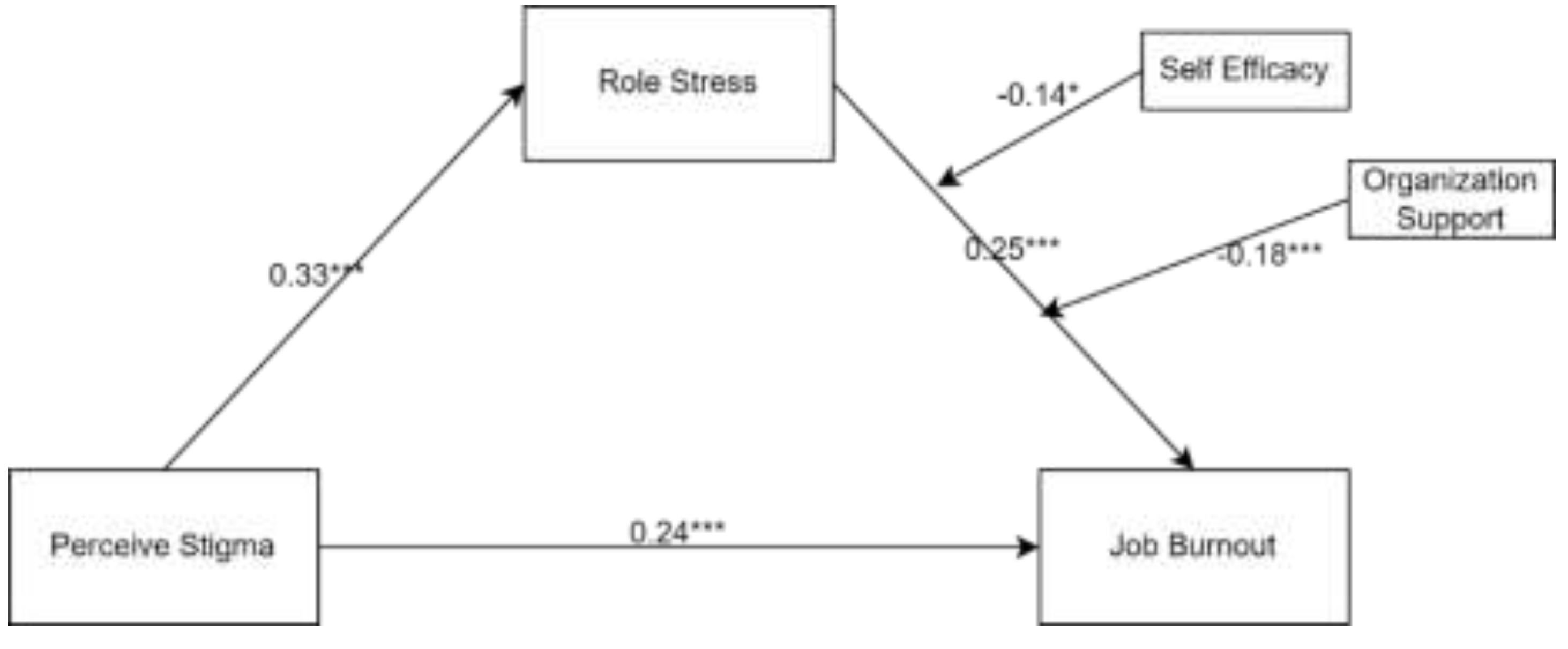
The findings confirm that perceived stigma and role stress lead to job burnout, supporting Hypothesis 1 and Hypothesis 2. Specifically, perceived stigma is a direct cause of job burnout among migrant workers (b=0.24, p<0.001) and role stress (b=0.33, p<0.001). According to Schmidt et al. (2014), emotional exhaustion overlaps with job burnout, indicating that individuals experiencing emotional exhaustion may suffer from job burnout to a certain extent. In this study, perceived stigma is identified as the cause of emotional exhaustion because migrant workers might endure various conditions damage their feelings and self-esteem (Chang & Fong, 2023; Xiao et al., 2018). Therefore, being stigmatized can lead to job burnout. Additionally, based on the Conservation of Resources (COR) theory, the loss of resources leads to stress (Hobfoll et al., 2018), including the loss of psychological resources such as those affected by stigmatization. This study argues that perceived stigma represents an emotional loss, which leads to stress and job burnout. For instance, if migrant workers perceive stigmatization, they may experience depression or other negative emotions, depleting their emotional energy and leading to role stress. Consequently, this emotional loss leads to job burnout chronically. Thus, the findings confirm relationships between perceived stigma, role stress, and job burnout, consistent with previous studies (Endriulaitienė et al., 2019; Janiak et al., 2018).
Second, this study found that role stress mediates the relationship between perceived stigma and job burnout. The hypotheses posit that chronic stress leads to job burnout and that perceived stigma induces stress. Results from
Figure 2 validate these correlations, confirming the mediating role of role stress (b=0.19,
p<0.001). The mediation role of role stress can be understood as the transmission of effects between perceived stigma and job burnout, though it is emphasized that role stress serves as a partial mediator in this study. One explanation is that migrant workers may suffer from constant stigmatization due to their life and work environments and their job burnout does not directly associate with their work stress. However, their intensive role stress (work demand) may exacerbate the negative feelings caused by stigmatization, which leads to job burnout. Therefore, this indirect effect is consistent with the Job Demands-Resources (JD-R) theory.
Furthermore, based on the JD-R and COR theories, this study introduced two variables, self-efficacy, and organizational support, into the analysis, revealing two important findings. Both variables serve as moderating factors that buffer the effects between role stress and job burnout. The moderating effect of self-efficacy is statistically significant (b=-0.14, p<0.05), as is the moderating effect of organizational support (b=-0.18, p<0.001). According to the JD-R theory, when job demands are high, more resources are needed among workers to cope with the demands; otherwise, stress will occur. The findings suggest that both self-efficacy and organizational support are crucial resources that help migrant workers reduce role stress, thereby decreasing the likelihood of job burnout. When self-efficacy and organizational support are at high levels, the mediating effect of role stress between perceived stigma and job burnout is not statistically significant. This indicates that self-efficacy and organizational support can mitigate the impact of role stress on job burnout. Therefore, moderated mediation effect existed.
Overall, being stigmatized among migrant workers is a significant issue for migrant workers in Macao, yet their perceptions of stigma remain underexplored. Based on COR theory and JD-R theory, this study found that perceived stigma leads to role stress and job burnout among migrant workers. Role stress mediates the effect of perceived stigma on job burnout. Additionally, self-efficacy and organizational support are crucial resources that help migrant workers cope with perceived stigma, serving as moderating variables in our hypothetical model.
The use of self-reported questionnaires in this study may introduce bias and inaccuracies due to social desirability and inconsistent memory recall. Despite these limitations, the subjective nature of perceived stigma justifies the use of subjective instruments for research such as previous stigma studies (Martin et al., 2014; Martin et al., 2018; Mosley et al., 2020). However, there is a need for further improvement of these instruments in assessing individual subjective responses. For instance, longitudinal research design may help researchers reduce the impact of data sources. From a broader perspective, migrant workers across different industries face varying levels of stigmatization. Whether these migrant workers need to cooperate with local workers or interact with Macanese consumers is particularly important when determining their level of stigmatization. Therefore, there is a need to explore migrant workers’ perceived stigma based on their industry characteristics and their length of stay in Macao. In terms of statistical analysis, while SPSS and Amos packages are widely used in scientific studies for regression and hypothesis testing, inherent problems exist in these software programs when processing mediating and moderating variables. Future studies should consider these factors during data collection and computation.
From a practice perspective, employers using migrant workers in Macao should not ignore the stigmatization these workers face, as perceived stigma may lead to stress, job burnout, and decreased productivity over time. Organizations should provide valuable support, such as counseling or mental health therapies, to boost migrant employees’ confidence and self-esteem, thereby buffering the effects of stigmatization on job performance (Trau, 2015). For migrant workers, enhancing self-efficacy can improve their confidence, self-esteem, and attitude toward job demands, which helps them to reduce job burnout. For Macao community, creating a well-established and civilized community requires addressing and eliminating stigmatization or discriminations based on jobs, migrant status, and other individual characteristics. Reducing the stigmatization of migrant workers can significantly contribute to the advancement of a prosperous Macao.
Data Availability Disclaim
The data that support the findings of this study are available at the request of the author, H.W. The data is not publicly available due to their containing information that could compromise the privacy of research participants.
References
- Babin, B. J., Griffin, M., & Hair, J. F. (2016). Heresies and sacred cows in scholarly marketing publications. Journal of Business Research, 69(8), 3133-3138. [CrossRef]
- Bakker, A. B., & Demerouti, E. (2017). Job demands–resources theory: Taking stock and looking forward. Journal of Occupational Health Psychology, 22(3), 273-285. [CrossRef]
- Bakker, A. B., Demerouti, E., & Sanz-Vergel, A. I. (2014). Burnout and Work Engagement: The JD–R Approach. Annual review of organizational psychology and organizational behavior, 1(1), 389-411. [CrossRef]
- Bandura, A. (1986). Social Foundations of Thought and Action: A Social Cognitive Theory. Englewood Cliffs.
- Bandura, A. (1994). Self-efficacy: The Exercise of Control (Vol. 4). W. H. Freeman & Co.
- Barbier, M., Dardenne, B., & Hansez, I. (2013). A longitudinal test of the Job Demands–Resources model using perceived stigma and social identity. European Journal of Work and Organizational Psychology 22(5), 532-546. [CrossRef]
- Bernardo, A. B., Daganzo, M. A. A., & Ocampo, A. C. G. (2018). Abusive supervision and well-being of Filipino migrant workers in Macau: Consequences for self-esteem and heritage culture detachment. Social Indicators Research, 139, 277-292. [CrossRef]
- Bernardo, A. B. I., Daganzo, M. A., & Burgos, J. F. C. (2022). Heritage Culture Detachment Predicts Hope and Well-Being of Filipino Migrant Workers: A Study of Low- and Semi-skilled Filipino Workers in Macau. Psychological Studies, 67(3), 372-384. [CrossRef]
- Bianchi, R., Verkuilen, J., Brisson, R., Schonfeld, I. S., & Laurent, E. (2016). Burnout and depression: Label-related stigma, help-seeking, and syndrome overlap. Psychiatry Research 245, 91-98. [CrossRef]
- Chang, C.-C., Lin, C.-Y., Gronholm, P. C., & Wu, T.-H. (2018). Cross-Validation of Two Commonly Used Self-Stigma Measures, Taiwan Versions of the Internalized Stigma Mental Illness Scale and Self-Stigma Scale–Short, for People With Mental Illness. Assessment, 25(6), 777-792. [CrossRef]
- Chang, Y.-T., & Fong, E. (2023). The challenge of retaining highly educated migrants in tourism destinations: Case comparison of Macau and Hong Kong. Cities, 137, 104286. [CrossRef]
- Chen, X. D., Chen, H., & Luo, W. C. (2020). An Inverted U-shaped Relationship between Helping Behavior and Career Growth: The Mediating Role of Role Stressor and the Moderating of Job Autonomy. China Human Resource Development, 37(04), 51-63.
- Cho, H.-J., Kang, K., & Park, K.-Y. (2023). Health-related quality of life of migrant workers: a systematic literature review. BMC public health, 23(1), 1004. [CrossRef]
- Choe, J., O’Regan, M., & Kimbu, A. N. (2020). Filipino migrant workers’ leisure and subjective quality of life in Macao. World Leisure Journal, 62(3), 242-260. [CrossRef]
- Demerouti, E., Bakker, A. B., Nachreiner, F., & Schaufeli, W. B. (2001). The job demands-resources model of burnout. Journal of Applied Psychology, 86(3), 499-512. [CrossRef]
- Eisenberger, R., Rhoades Shanock, L., & Wen, X. (2020). Perceived Organizational Support: Why Caring About Employees Counts. Annual Review of Organizational Psychology and Organizational Behavior 7, 101-124. [CrossRef]
- Endriulaitienė, A., Žardeckaitė-Matulaitienė, K., Pranckevičienė, A., Markšaitytė, R., Tillman, D. R., & Hof, D. D. (2019). Self-Stigma of seeking help and job burnout in mental health care providers: the comparative study of Lithuanian and the USA samples. Journal of Workplace Behavioral Health, 34(2), 129-148. [CrossRef]
- Ghafoor, A., & Haar, J. (2022). Does job stress enhance employee creativity? Exploring the role of psychological capital. Personnel Review, 51(2), 644-661. [CrossRef]
- Grover, S. L., Teo, S. T., Pick, D., Roche, M., & Newton, C. (2018). Psychological capital as a personal resource in the JD-R model. Personnel Review, 47(4), 968-984. [CrossRef]
- Hall, B. J., Garabiles, M. R., & Latkin, C. A. (2019). Work life, relationship, and policy determinants of health and well-being among Filipino domestic Workers in China: A qualitative study. BMC Public Health 19, 229-238. [CrossRef]
- Hargreaves, S., Rustage, K., Nellums, L. B., McAlpine, A., Pocock, N., Devakumar, D., Aldridge, R. W., Abubakar, I., Kristensen, K. L., Himmels, J. W., Friedland, J. S., & Zimmerman, C. (2019). Occupational health outcomes among international migrant workers: a systematic review and meta-analysis. The Lancet Global Health, 7(7), e872-e882. [CrossRef]
- Harris, L. H., Debbink, M., Martin, L., & Hassinger, J. (2011). Dynamics of stigma in abortion work: Findings from a pilot study of the Providers Share Workshop. Social Science & Medicine, 73(7), 1062-1070. [CrossRef]
- Hobfoll, S. E. (1989). Conservation of resources: A new attempt at conceptualizing stress. American Psychologist, 44(3), 513-524. [CrossRef]
- Hobfoll, S. E., Halbesleben, J., Neveu, J.-P., & Westman, M. (2018). Conservation of Resources in the Organizational Context: The Reality of Resources and Their Consequences. Annual Review of Organizational Psychology and Organizational Behavior 5(1), 103-128. [CrossRef]
- Janiak, E., Freeman, S., Maurer, R., Berkman, L. F., Goldberg, A. B., & Bartz, D. (2018). Relationship of job role and clinic type to perceived stigma and occupational stress among abortion workers. Contraception, 98(6), 517-521. [CrossRef]
- Ju, B., & Sandel, T. L. (2019). Adaptation of Mainland Chinese labour migrants in Macao. Journal of Intercultural Communication Research, 48(3), 257-273. [CrossRef]
- Kahn, R. L., Wolfe, D. M., Quinn, R. P., Snoek, J. D., & Rosenthal, R. A. (1964). Organizational stress: Studies in role conflict and ambiguity. John Wiley.
- Kleim, B., Vauth, R., Adam, G., Stieglitz, R.-D., Hayward, P., & Corrigan, P. (2008). Perceived stigma predicts low self-efficacy and poor coping in schizophrenia. Journal of Mental Health, 17(5), 482-491. [CrossRef]
- Le, H., Nielsen, K., & Noblet, A. (2022). The well-being and voice of migrant workers in participatory organizational interventions. International Migration Review, 60(3), 52-71. [CrossRef]
- LeBel, T. P. (2008). Perceptions of and Responses to Stigma. Sociology Compass, 2(2), 409-432. [CrossRef]
- Li, C. P., & Shi, K. (2003). The Influence of Distributive Justice and Procedural Justice on Job Burnout. Acta Psychologica Sinica(5), 677-684.
- Li, C. P., & Zhang, Y. (2009). The Effects of Role Stressors on Physical Health and Mental Health among Chinese Teachers. Psychological Development and Education, 25(1), 114-119.
- Li, J. J. (2023). Does Wage Discrimination Exist between Macao Local and Non-local Labor? Hou Keng(31), 87-109.
- Li, Q., Chi, P., Hall, B. J., Wu, Q., & Du, H. (2019). Job stress and depressive symptoms among migrant workers in Macau: A moderated mediation model of self-esteem and perceived social support. Psychology Journal, 8(3), 307-317. [CrossRef]
- Luken, M., & Sammons, A. (2016). Systematic Review of Mindfulness Practice for Reducing Job Burnout. The American Journal of Occupational Therapy, 70(2), 1-10. [CrossRef]
- Ma, Z. L., Yu, J. T., & Wang, L. (2023). The double-edged sword effect of telecommuting on the telecommuter's innovation performance Science Research Management, 44(8), 173-182.
- No. 21/2009 Macao Non-local Resident Employment Law, (2009).
- Martin, L. A., Debbink, M., Hassinger, J., Youatt, E., & Harris, L. H. (2014). Abortion providers, stigma and professional quality of life. Contraception, 90(6), 581-587. [CrossRef]
- Martin, L. A., Hassinger, J. A., Seewald, M., & Harris, L. H. (2018). Evaluation of Abortion Stigma in the Workforce: Development of the Revised Abortion Providers Stigma Scale. Womens Health Issues, 28(1), 59-67. [CrossRef]
- Maslach, C., & Jackson, S. E. (1981). The measurement of experienced burnout. Journal of Organizational Behavior 2(2), 99-113.
- Maslach, C., Schaufeli, W. B., & Leiter, M. P. (2001). Job Burnout. Annual Review of Psychology, 52(1), 397-422. [CrossRef]
- Mosley, E. A., Martin, L., Seewald, M., Hassinger, J., Blanchard, K., Baum, S. E., Santana, D., Echeverri, L., Garrett, J., Njunguru, J., & Harris, L. H. (2020). Addressing Abortion Provider Stigma: A Pilot Implementation of the Providers Share Workshop in Sub-Saharan Africa and Latin America. International Perspectives on Sexual and Reproductive Health, 46, 35-50. [CrossRef]
- Moyce, S. C., & Schenker, M. (2018). Migrant Workers and Their Occupational Health and Safety. Annual Review of Public Health, 39(1), 351-365. [CrossRef]
- O’Donnell, J., Weitz, T. A., & Freedman, L. R. (2011). Resistance and vulnerability to stigmatization in abortion work. Social Science & Medicine, 73(9), 1357-1364. [CrossRef]
- Pescosolido, B. A., & Martin, J. K. (2015). The Stigma Complex. Annual Review of Sociology, 41, 87-116. [CrossRef]
- Peterson, M. F., Smith, P. B., Akande, A., Ayestaran, S., Bochner, S., Callan, V., Cho, N. G., Jesuino, J. C., D'amorim, M., & Francois, P.-H. (1995). Role conflict, ambiguity, and overload: A 21-nation study. Academy of Management Journal, 38(2), 429-452.
- Pinel, E. C. (1999). Stigma consciousness: The psychological legacy of social stereotypes. Journal of Personality and Social Psychology, 76(1), 114-128. [CrossRef]
- Pinel, E. C., & Paulin, N. (2005). Stigma consciousness at work. Basic and Applied Social Psychology, 27(4), 345-352. [CrossRef]
- Podsakoff, P. M., MacKenzie, S. B., Lee, J. Y., & Podsakoff, N. P. (2003). Common method biases in behavioral research: a critical review of the literature and recommended remedies. Journal of Applied Psychology, 88(5), 879-903. [CrossRef]
- Preacher, K. J., & Hayes, A. F. (2004). SPSS and SAS procedures for estimating indirect effects in simple mediation models. Behavior Research Methods, Instruments & Computers, 36(4), 717-731. [CrossRef]
- Rani, A., & Thomas, P. T. (2019). Stress and perceived stigma among parents of children with epilepsy. Neurological Sciences, 40(7), 1363-1370. [CrossRef]
- Rhoades, L., & Eisenberger, R. (2002). Perceived organizational support: a review of the literature. Journal of Applied Psychology, 87(4), 698.
- Riggle, R. J., Edmondson, D. R., & Hansen, J. D. (2009). A meta-analysis of the relationship between perceived organizational support and job outcomes: 20 years of research. Journal of Business Research, 62(10), 1027-1030. [CrossRef]
- Robbins, S. P., & Judge, T. A. (2012). Organizational Behavior 15th Edition. Prentice Hall.
- Salvagioni, D. A. J., Melanda, F. N., Mesas, A. E., González, A. D., Gabani, F. L., & Andrade, S. M. d. (2017). Physical, psychological and occupational consequences of job burnout: A systematic review of prospective studies. PloS One 12(10), e0185781.
- Schmidt, S., Roesler, U., Kusserow, T., & Rau, R. (2014). Uncertainty in the workplace: Examining role ambiguity and role conflict, and their link to depression—a meta-analysis. European Journal of Work and Organizational Psychology 23(1), 91-106. [CrossRef]
- Schwarzer, R., Bäßler, J., Kwiatek, P., Schröder, K., & Zhang, J. X. (1997). The assessment of optimistic self-beliefs: comparison of the German, Spanish, and Chinese versions of the general self-efficacy scale. Applied Psychology 46(1), 69-88.
- Shantz, A., & Booth, J. E. (2014). Service employees and self-verification: The roles of occupational stigma consciousness and core self-evaluations. Human Relations, 67(12), 1439-1465. [CrossRef]
- Shen, H., & Huang, C. (2012). Domestic migrant workers in China’s hotel industry: an exploratory study of their life satisfaction and job burnout. International Journal of Hospitality Management, 31(4), 1283-1291. [CrossRef]
- Shen, J., & Benson, J. (2016). When CSR Is a Social Norm:How Socially Responsible Human Resource Management Affects Employee Work Behavior. Journal of Management, 42(6), 1723-1746. [CrossRef]
- Shen, J. L., Hu, X. Y., & Liu, X. (2009). Left-over Children's Perceived Discrimination: Its Characteristics and Relationship with Personal Well Being. Journal of Henan University (Social Science), 49(06), 116-121.
- Shi, W. (2017). Cultural politics of emotions in households: migrant domestic workers in Macau. Inter-Asia Cultural Studies, 18(4), 464-481. [CrossRef]
- Shoji, K., Cieslak, R., Smoktunowicz, E., Rogala, A., Benight, C. C., & Luszczynska, A. (2016). Associations between job burnout and self-efficacy: A meta-analysis. Anxiety, Stress, Coping, 29(4), 367-386.
- Sim, A., & Wee, V. (2009). Undocumented Indoesian Workers in Macau. Critical Asian Studies, 41(1), 165-188. [CrossRef]
- Tesfaw, G., Kibru, B., & Ayano, G. (2020). Prevalence and factors associated with higher levels of perceived stigma among people with schizophrenia Addis Ababa, Ethiopia. International Journal of Mental Health Systems, 14(1), 19-27. [CrossRef]
- Trau, R. N. C. (2015). The Impact of Discriminatory Climate Perceptions on the Composition of Intraorganizational Developmental Networks, Psychosocial Support, and Job and Career Attitudes of Employees with an Invisible Stigma. Human Resource Management, 54(2), 345-366. [CrossRef]
- Wen, Z., & Ye, B. (2014). Different methods for testing moderated mediation models: Competitors or backups? Acta Psychologica Sinica, 46(5), 714-726.
- Wen, Z. L., Zhang, L., & Hou, J. T. (2006). Mediated Moderator and Moderated Mediator. Acta Psychologica Sinica, 38(03), 448-452. https://journal.psych.ac.cn/acps/CN/abstract/article_1187.shtml.
- Wu, G., Hu, Z., & Zheng, J. (2019). Role Stress, Job Burnout, and Job Performance in Construction Project Managers: The Moderating Role of Career Calling. International Journal of Environmental Research and Publich Health, 16(13), 2493. [CrossRef]
- Wulandari, R., Djawoto, D., & Prijati, P. (2021). The influence of delegative leadership style, motivation, work environment on employee performance in self-efficiency mediation in SNVT housing provision of East Java Province. Budapest International Research Critics Institute-Journal, 4(3), 3294-3311.
- Xiao, Y., Miao, S., Sarkar, C., Geng, H., & Lu, Y. (2018). Exploring the Impacts of Housing Condition on Migrants' Mental Health in Nanxiang, Shanghai: A Structural Equation Modelling Approach. International Journal Environment Research Public Health, 15(2), 225-239. [CrossRef]
- Zhou, Y., & Huang, X. (2018). High-prestige-occupation Worker Occupational Stigma Perception and Employee Well-being: Based on Cognitive Dissonance Perspective. Business and Management Journal, 40(04), 84-101. [CrossRef]
- Zhou, Y., & Huang, X. (2020). The Study of Physical Dirty Worker Occupational Stigma Coping Strategies: Scale Development and Predictive Effects. Human Resources Development of China, 37(09), 38-56.
- Zhou, Y., Huang, X., & Ouyang, K. (2020). Activity or Avoidance: Occupational Stigma, Self-evaluation and Task Performance. Foreign Economics & Management, 42(08), 50-67.
|
Disclaimer/Publisher’s Note: The statements, opinions and data contained in all publications are solely those of the individual author(s) and contributor(s) and not of MDPI and/or the editor(s). MDPI and/or the editor(s) disclaim responsibility for any injury to people or property resulting from any ideas, methods, instructions or products referred to in the content. |
© 2024 by the authors. Licensee MDPI, Basel, Switzerland. This article is an open access article distributed under the terms and conditions of the Creative Commons Attribution (CC BY) license (http://creativecommons.org/licenses/by/4.0/).