

Submitted:
07 November 2024
Posted:
08 November 2024
You are already at the latest version
Abstract
Emerging evidence suggests that the severe-acute-respiratory-syndrome-related coronavirus (SARS- CoV-2) infection and anti-SARS-CoV-2 vaccines may trigger autoimmune responses in genetically predisposed individuals. Idiopathic inflammatory myopathies (IIMs) are a group of diseases with a broad spectrum of clinical manifestations featured by the presence of myositis autoantibodies (MAs). The diagnosis of IIM is challenging due to the limitations of current classification criteria and diagnostic assays. We conducted a multicenter observational study, whose main goal was to describe the incidence of IIM following exposure to SARS-CoV-2 infection and/or its specific vaccination, and to compare the rates of both. A total of 788 patients belonging to 11 different Spanish referral centers were analyzed, with a cumulative count of 1,209 MAs measured by line blot immunoassays (LIA). The study identified distinct patterns in the frequency of aminoacyl-tRNA synthetase (ARS) antibodies compared to pre-pandemic periods. Notably, the most prevalent ARS antibody identified associated to IIM was anti-PL-7 (14.85%), whereas anti-Jo1, traditionally the most frequent antibody documented, had a frequency of 7.23% in our cohort. Anti- MDA5, the most commonly described antibody in the literature associated with the SARS-CoV-2 infection, was identified in 11.68% of our patients. Our cohort displayed positive antinuclear antibodies (ANA) result in 61% of patients, which suggests an underlying autoimmune background. The most prevalent final diagnoses were anti- synthetase syndrome (ASSD) or IIM-non-ASSD (21.31% of total cases) and other systemic autoimmune diseases (SAID) with 13.57% of cases. 91.13% of patients received at least one dose of a messenger RNA (mRNA) coronavirus disease 2019 (COVID-19) vaccine, with a median of three doses per patient. It is noteworthy that patients with prior SARS-CoV-2 infection or heterologous vaccination demonstrated a higher frequency of multiple autoantibody positivity (p<0.05), which could reflect different humoral and cellular immune signatures. This collaborative work enhances our understanding of IIM and may facilitate the optimization of care through the implementation of standardized approaches. Further investigation is required to fully characterize the autoimmune risks and phenotypes following a diagnosis of SARS-CoV-2 infection or vaccination.Emerging evidence suggests that the severe-acute-respiratory-syndrome-related coronavirus (SARS- CoV-2) infection and anti-SARS-CoV-2 vaccines may trigger autoimmune responses in genetically predisposed individuals. Idiopathic inflammatory myopathies (IIMs) are a group of diseases with a broad spectrum of clinical manifestations featured by the presence of myositis autoantibodies (MAs). The diagnosis of IIM is challenging due to the limitations of current classification criteria and diagnostic assays. We conducted a multicenter observational study, whose main goal was to describe the incidence of IIM following exposure to SARS-CoV-2 infection and/or its specific vaccination, and to compare the rates of both. A total of 788 patients belonging to 11 different Spanish referral centers were analyzed, with a cumulative count of 1,209 MAs measured by line blot immunoassays (LIA). The study identified distinct patterns in the frequency of aminoacyl-tRNA synthetase (ARS) antibodies compared to pre-pandemic periods. Notably, the most prevalent ARS antibody identified associated to IIM was anti-PL-7 (14.85%), whereas anti-Jo1, traditionally the most frequent antibody documented, had a frequency of 7.23% in our cohort. Anti- MDA5, the most commonly described antibody in the literature associated with the SARS-CoV-2 infection, was identified in 11.68% of our patients. Our cohort displayed positive antinuclear antibodies (ANA) result in 61% of patients, which suggests an underlying autoimmune background. The most prevalent final diagnoses were anti- synthetase syndrome (ASSD) or IIM-non-ASSD (21.31% of total cases) and other systemic autoimmune diseases (SAID) with 13.57% of cases. 91.13% of patients received at least one dose of a messenger RNA (mRNA) coronavirus disease 2019 (COVID-19) vaccine, with a median of three doses per patient. It is noteworthy that patients with prior SARS-CoV-2 infection or heterologous vaccination demonstrated a higher frequency of multiple autoantibody positivity (p<0.05), which could reflect different humoral and cellular immune signatures. This collaborative work enhances our understanding of IIM and may facilitate the optimization of care through the implementation of standardized approaches. Further investigation is required to fully characterize the autoimmune risks and phenotypes following a diagnosis of SARS-CoV-2 infection or vaccination.
Keywords:
1. INTRODUCTION
2. METHODS
2.1. Patients and Study Design
2.2. Laboratory Assessment
2.2.1. Line Blot Immunoassay Analysis
2.2.2. Indirect Immunofluorescence Assay
2.2.3. Extractable Nuclear Antigen Antibodies
2.2.4. Muscle and Liver Enzymes
2.2.5. Analysis of HLA Typing
2.3. Statistical Analysis
3. RESULTS
3.1. Overall Overview and Incidence of Myositis Autoantibodies
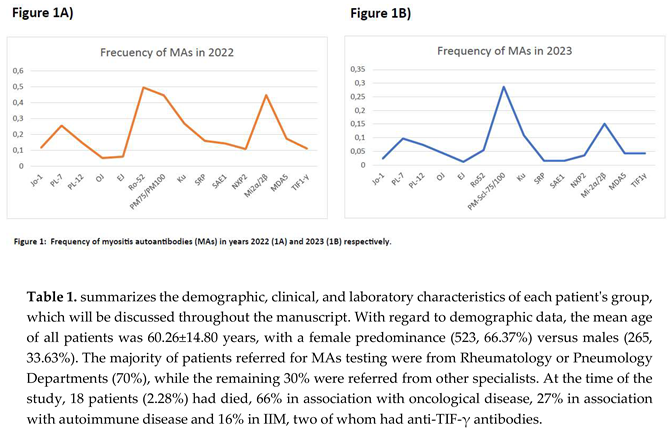
3.2. Autoantibody Profile: Frequency and Levels
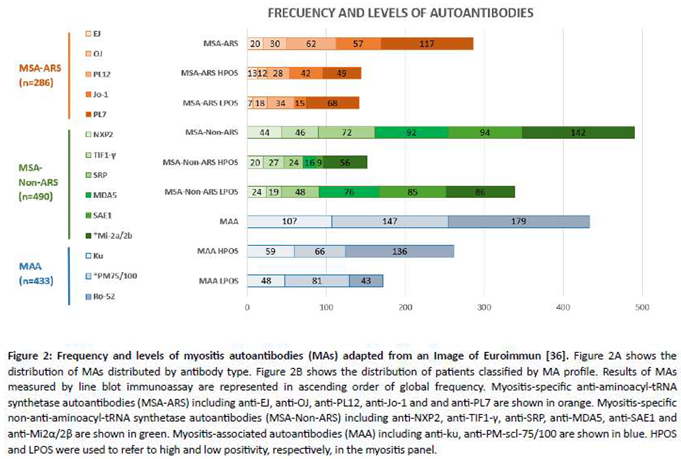
3.3. MAs Associated with ANA Antibodies
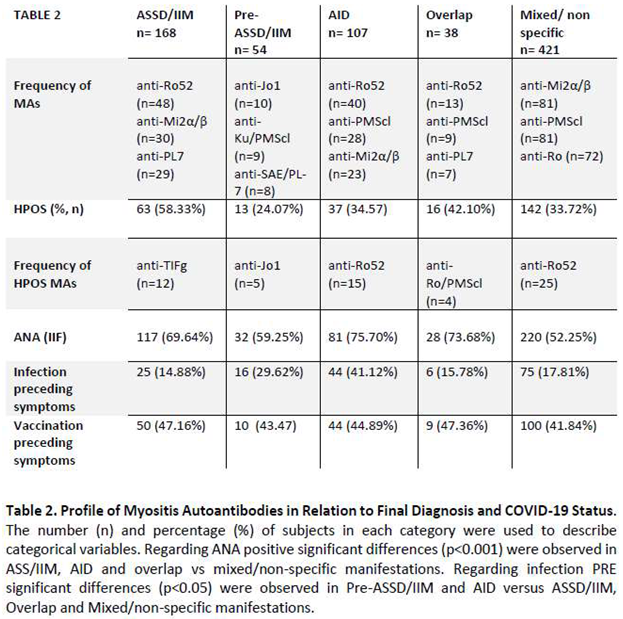
3.3. Antibody Association to COVID-19 Infection Or Vaccination
3.3. Description of clinical manifestations. Diagnosis, treatment and outcomes
3.6. HLA Typing in a Subgroup of Patients
4. DISCUSSION AND FUTURE RESEARCH
- How does the clinical pattern of IIM correlate with the specific type of antibody involved, especially in the presence of multiple antibodies?
- Could the potential epitopes recognized by each antibody provide insight into the mechanisms underlying the association with COVID-19?
- Is it necessary to perform a clinical follow-up in those patients with antibody positivity and nonspecific clinical manifestations, for how long?
- Does the persistence of these antibodies over time without associated clinical symptoms indicate a milder clinical phenotype or a true false positive?
Abbreviations:
| ANA | antinuclear antibodies |
| ARS | aminoacyl-tRNA synthetase |
| ASSD | antisynthetase syndrome |
| COVID-19 | coronavirus disease 2019 |
| CK | creatine kinase |
| DM | dermatomyositis |
| ENA | extractable nuclear antigen |
| HLA | Human leucocyte antigen |
| HPOS | high positive |
| IIF | indirect immunofluorescence |
| ILD | interstitial lung disease |
| IIM | idiopathic inflammatory myopathies |
| LIA | line blot immunoassays |
| LPOS | low positive |
| MA | myositis autoantibodies |
| MAA | myositis-associated autoantibodies |
| MCP | mycophenolate mofetil |
| mRNA | messenger RNA |
| MSA | myositis-specific autoantibodies |
| RA | rheumatoid arthritis |
| RT-PCR | reverse transcription polymerase chain reaction |
| SAID | systemic autoimmune diseases |
| SARS-CoV-2 | severe-acute-respiratory-syndrome-related coronavirus |
| SLE | systemic lupus erythematosus |
| SjS | Sjögren syndrome |
| SSc | systemic sclerosis |
References
- Malik A, Hayat G, Kalia JS, Guzman MA. Idiopathic Inflammatory Myopathies: Clinical Approach and Management. Front Neurol. 2016 May 20;7:64. [CrossRef]
- Lundberg IE, Fujimoto M, Vencovsky J, Aggarwal R, Holmqvist M, Christopher-Stine L, Mammen AL, Miller FW. Idiopathic inflammatory myopathies. Nat Rev Dis Primers. 2021 Dec 2;7(1):86. [CrossRef]
- Miller FW, Lamb JA, Schmidt J, Nagaraju K. Risk factors and disease mechanisms in myositis. Nat Rev Rheumatol. 2018 Apr 20;14(5):255-268. [CrossRef]
- Ghirardello A, Borella E, Beggio M, Franceschini F, Fredi M, Doria A. Myositis autoantibodies and clinical phenotypes. Auto Immun Highlights. 2014 Aug 23;5(3):69-75. [CrossRef]
- Gallay L, Gayed C, Hervier B. Antisynthetase syndrome pathogenesis: knowledge and uncertainties. In: Doria A, Ghirardello A, editors. Myositis and Myopathies. Current Opinion in Rheumatology 2018;30(6):664-73. [CrossRef]
- Lundberg IE, Miller FW, Tjärnlund A, Bottai M. Diagnosis and classification of idiopathic inflammatory myopathies. J Intern Med. 2016 Jul;280(1):39-51. [CrossRef]
- Jee AS, Parker MJS, Bleasel JF, Troy LK, Lau EM, Jo HE, Teoh AKY, Webster S, Adelstein S, Corte TJ. Diagnosis of myositis-associated interstitial lung disease: Utility of the myositis autoantibody line immunoassay. Respir Med. 2021 Oct;187:106581. [CrossRef]
- Gonzalez D, Gupta L, Murthy V, Gonzalez EB, Williamson KA, Makol A, Tan CL, Sulaiman FN, Shahril NS, Isa LM, Martín-Nares E, Aggarwal R. Anti-MDA5 dermatomyositis after COVID-19 vaccination: a case-based review. Rheumatol Int. 2022 Sep;42(9):1629-1641. [CrossRef]
- Sher EK, Ćosović A, Džidić-Krivić A, Farhat EK, Pinjić E, Sher F. Covid-19 a triggering factor of autoimmune and multi-inflammatory diseases. Life Sci. 2023 Apr 15;319:121531. [CrossRef]
- Shah V, Patel H, Oza J, Patel P, Radhakrishnan H, Arunachalam J, Bag S, Patra T, Shekar SP. Atypical Immunologic Manifestations of COVID-19: a Case Report and Narrative Review. SN Compr Clin Med. 2023;5(1):108. [CrossRef]
- Palmucci S, Galioto F, Fazio G, Ferlito A, Cancemi G, Di Mari A, Sambataro G, Sambataro D, Zanframundo G, Mauro LA, Foti PV, Vancheri C, Basile A. Clinical and radiological features of lung disorders related to connective-tissue diseases: a pictorial essay. Insights Imaging. 2022 Jun 29;13(1):108. [CrossRef]
- Vahabi M, Ghazanfari T, Sepehrnia S. Molecular mimicry, hyperactive immune system, and SARS-COV-2 are three prerequisites of the autoimmune disease triangle following COVID-19 infection. Int Immunopharmacol. 2022 Nov;112:109183. [CrossRef]
- Duda-Seiman D, Kundnani NR, Dugaci D, Man DE, Velimirovici D, Dragan SR. COVID-19 Related Myocarditis and Myositis in a Patient with Undiagnosed Antisynthetase Syndrome. Biomedicines. 2022 Dec 30;11(1):95. [CrossRef]
- Holzer MT, Krusche M, Ruffer N, Haberstock H, Stephan M, Huber TB, Kötter I. New-onset dermatomyositis following SARS-CoV-2 infection and vaccination: a case-based review. Rheumatol Int. 2022 Dec;42(12):2267-2276. [CrossRef]
- Syrmou V, Liaskos C, Ntavari N, Mitsimponas K, Simopoulou T, Alexiou I, Vlychou M, Katsiari CG, Bogdanos DP. COVID-19 vaccine-associated myositis: a comprehensive review of the literature driven by a case report. Immunol Res. 2023 Aug;71(4):537-546. [CrossRef]
- García-Bravo L, Calle-Rubio M, Fernández-Arquero M, Mohamed Mohamed K, Guerra-Galán T, Guzmán-Fulgencio M, Rodríguez de la Peña A, Cañizares C, López B, Vadillo C, Matías-Guiu J, Nieto Barbero A, Álvarez-Sala Walther JL, Sánchez-Ramón S, Ochoa-Grullón J. Association of anti-SARS-COV-2 vaccine with increased incidence of myositis-related anti-RNA-synthetases auto-antibodies. J Transl Autoimmun. 2022 Jun 30;5:100160. [CrossRef]
- Al-Beltagi M, Saeed NK, Bediwy AS. COVID-19 disease and autoimmune disorders: A mutual pathway. World J Methodol. 2022 Jul 20;12(4):200-223. [CrossRef]
- Iqbal K, Sinha S, David P, De Marco G, Taheri S, McLaren E, Maisuria S, Arumugakani G, Ash Z, Buckley C, Coles L, Hettiarachchi C, Smithson G, Slade M, Shah R, Marzo-Ortega H, Keen M, Lawson C, Mclorinan J, Nizam S, Reddy H, Sharif O, Sultan S, Tran G, Wood M, Wood S, Ghosh P, McGonagle D. MDA5-autoimmunity and Interstitial Pneumonitis Contemporaneous with the COVID-19 Pandemic (MIP-C). medRxiv [Preprint]. 2023 Nov 5:2023.11.03.23297727. [CrossRef]
- Mehta P, Machado PM, Gupta L. Understanding and managing anti-MDA 5 dermatomyositis, including potential COVID-19 mimicry. Rheumatol Int 2021;41:1021–36. [CrossRef]
- Nuño-Nuño, L. , Joven, B.E., Carreira, P.E. et al. Mortality and prognostic factors in idiopathic inflammatory myositis: a retrospective analysis of a large multicenter cohort of Spain. Rheumatol Int 37, 1853–1861 (2017). [CrossRef]
- Lundberg IE, Tjärnlund A, Bottai M, et al. 2017 European League against Rheumatism/ American College of rheumatology classification criteria for adult and juvenile idiopathic inflammatory myopathies and their major subgroups. Ann Rheum Dis 2017;76:1955–64. [CrossRef]
- Mohammad I, Devarasetti PK, Rajasekhar L. Correspondence on ‘EULAR/ACR classification criteria for adult and juvenile idiopathic inflammatory myopathies and their major subgroups. Ann Rheum Dis 2023;82:e40. [CrossRef]
- Zampieri S, Ghirardello A, Iaccarino L, Tarricone E, Gambari PF, Doria A. Anti-Jo-1 antibodies. Autoimmunity. 2005 Feb;38(1):73-8. [CrossRef]
- Yamasaki Y., Satoh M., Mizushima M., Okazaki T., Nagafuchi H., Ooka S., et al. Clinical subsets associated with different anti-aminoacyl transfer RNA synthetase antibodies and their association with coexisting anti-Ro52. Mod. Rheumatol. 2016 May 3;26(3) https://www.tandfonline.com/doi/full/10.3109/14397595.2015.1091155.
- Loarce-Martos J, Calvo Sanz L, Garrote-Corral S, Ballester González R, Pariente Rodríguez R, Rita CG, García-Soidan A, Bachiller-Corral J, Roy Ariño G. Myositis autoantibodies detected by line blot immunoassay: clinical associations and correlation with antibody signal intensity. Rheumatol Int. 2023 Jun;43(6):1101-1109. [CrossRef]
- Hannah JR, Lawrence A, Martinovic J, Naqvi M, Chua F, Kouranos V, Ali SS, Stock C, Owens C, Devaraj A, Pollard L, Agarwal S, Atienza-Mateo B, González-Gay MA, Patel A, West A, Tinsley K, Robbie H, Lams B, Wells AU, Norton S, Galloway J, Renzoni EA, Gordon PA. Antibody predictors of mortality and lung function trends in myositis spectrum interstitial lung disease. Rheumatology (Oxford). 2023 Dec 1:kead638. [CrossRef]
- Wolstencroft PW, Fiorentino DF. Dermatomyositis clinical and pathological phenotypes associated with myositis-specific autoantibodies. Curr Rheumatol Rep. 2018;20:28. [CrossRef]
- Marzęcka, M., Niemczyk, A. & Rudnicka, L. Autoantibody Markers of Increased Risk of Malignancy in Patients with Dermatomyositis. Clinic Rev Allerg Immunol 63, 289–296 (2022). [CrossRef]
- Damoiseaux J, Vulsteke JB, Tseng CW, Platteel ACM, Piette Y, Shovman O, Bonroy C, Hamann D, De Langhe E, Musset L, Chen YH, Shoenfeld Y, Allenbach Y, Bossuyt X. Autoantibodies in idiopathic inflammatory myopathies: Clinical associations and laboratory evaluation by mono- and multispecific immunoassays. Autoimmun Rev. 2019 Mar;18(3):293-305. [CrossRef]
- Sharma, C. , Bayry, J. High risk of autoimmune diseases after COVID-19. Nat Rev Rheumatol 19, 399–400 (2023). [CrossRef]
- Eaton WW, Rose NR, Kalaydjian A, Pedersen MG, Mortensen PB. Epidemiology of autoimmune diseases in Denmark. J Autoimmun. 2007 Aug;29(1):1-9. [CrossRef] [PubMed]
- Syrmou V, Liaskos C, Ntavari N, Mitsimponas K, Simopoulou T, Alexiou I, Vlychou M, Katsiari CG, Bogdanos DP. COVID-19 vaccine-associated myositis: a comprehensive review of the literature driven by a case report. Immunol Res. 2023 Aug;71(4):537-546. [CrossRef]
- Huang HL, Lin WC, Tsai WL, Weng CT, Weng MY, Wu CH, Sun YT. Coexistence of Multiple Myositis-Specific Antibodies in Patients with Idiopathic Inflammatory Myopathies. J Clin Med. 2022 Nov 25;11(23):6972. [CrossRef]
- Sundaresan, B.; Shirafkan, F.; Ripperger, K.; Rattay, K. The Role of Viral Infections in the Onset of Autoimmune Diseases. Viruses 2023, 15, 782. [Google Scholar] [CrossRef] [PubMed]
- Nuñez, N.G., Schmid, J., Power, L. et al. High-dimensional analysis of 16 SARS-CoV-2 vaccine combinations reveals lymphocyte signatures correlating with immunogenicity. Nat Immunol 24, 941–954 (2023). [CrossRef]
- Platteel ACM, Wevers BA, Lim J, Bakker JA, Bontkes HJ, Curvers J, Damoiseaux J, Heron M, de Kort G, Limper M, van Lochem EG, Mulder AHL, Saris CGJ, van der Valk H, van der Kooi AJ, van Leeuwen EMM, Veltkamp M, Schreurs MWJ, Meek B, Hamann D. Frequencies and clinical associations of myositis-related antibodies in The Netherlands: A one-year survey of all Dutch patients. J Transl Autoimmun. 2019 Aug 23;2:100013. [CrossRef]
Disclaimer/Publisher’s Note: The statements, opinions and data contained in all publications are solely those of the individual author(s) and contributor(s) and not of MDPI and/or the editor(s). MDPI and/or the editor(s) disclaim responsibility for any injury to people or property resulting from any ideas, methods, instructions or products referred to in the content. |
© 2024 by the authors. Licensee MDPI, Basel, Switzerland. This article is an open access article distributed under the terms and conditions of the Creative Commons Attribution (CC BY) license (http://creativecommons.org/licenses/by/4.0/).


