

Submitted:
20 December 2024
Posted:
23 December 2024
You are already at the latest version
Abstract
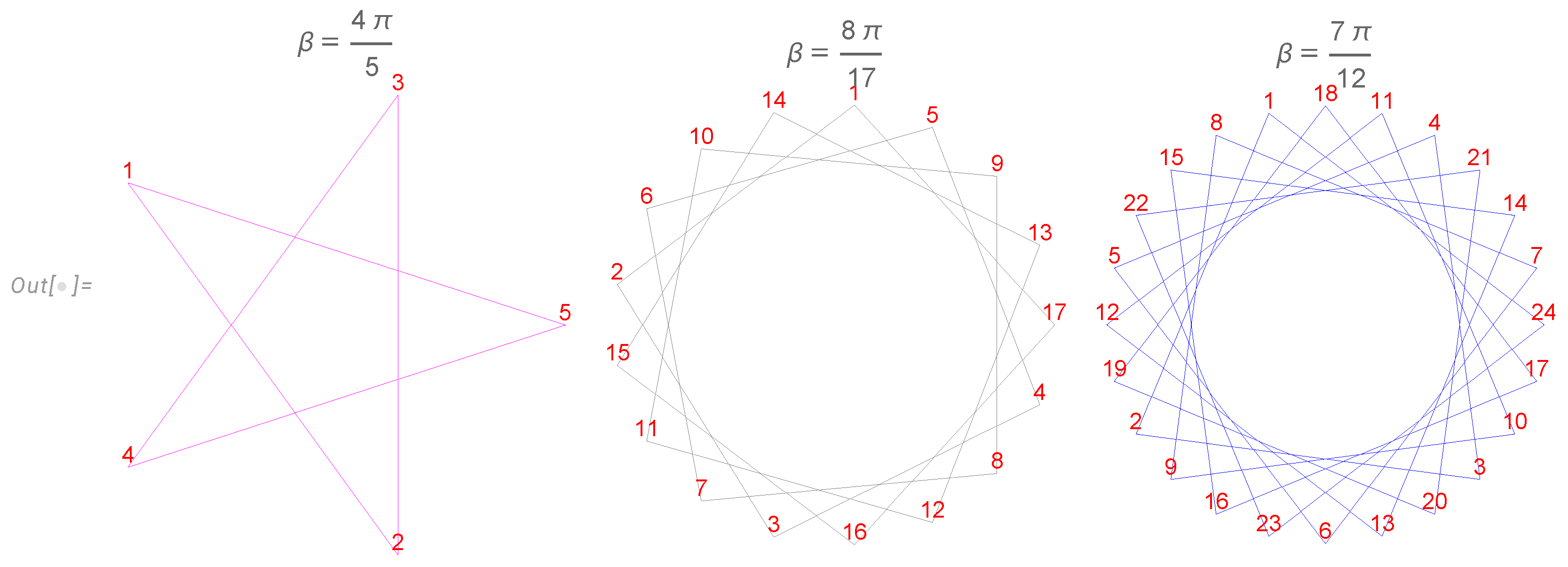
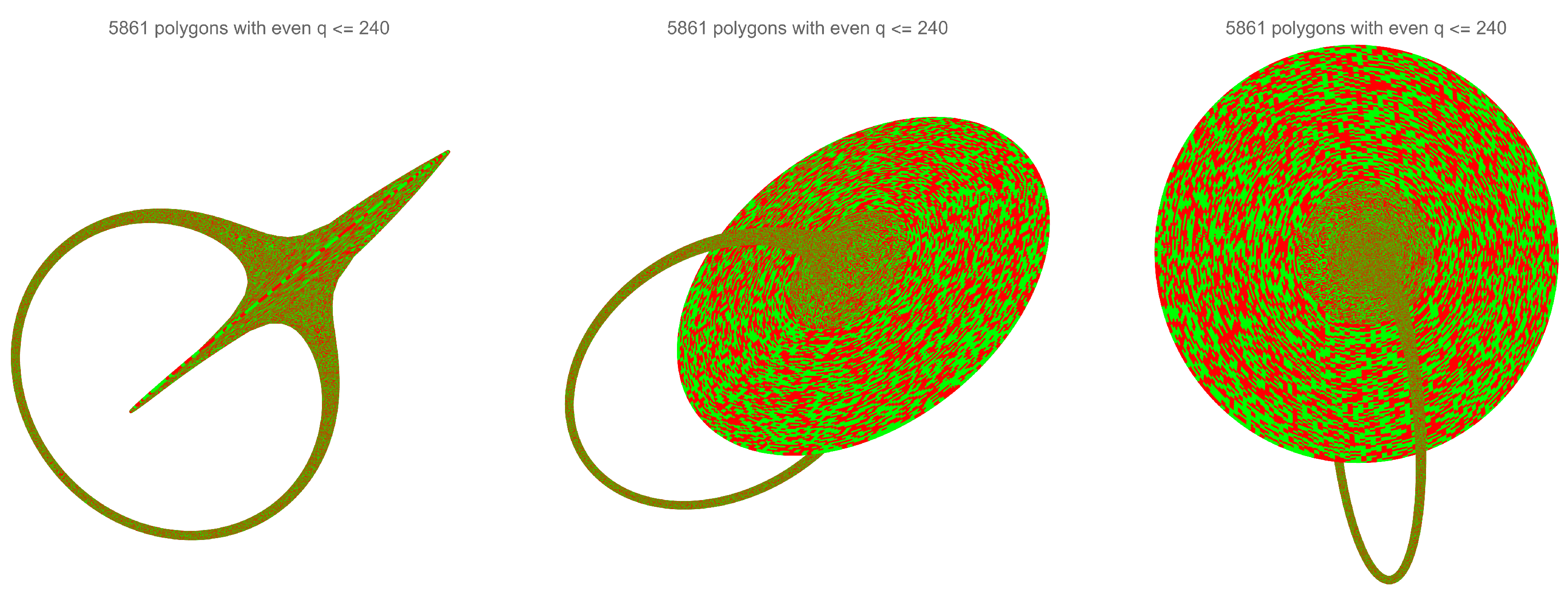
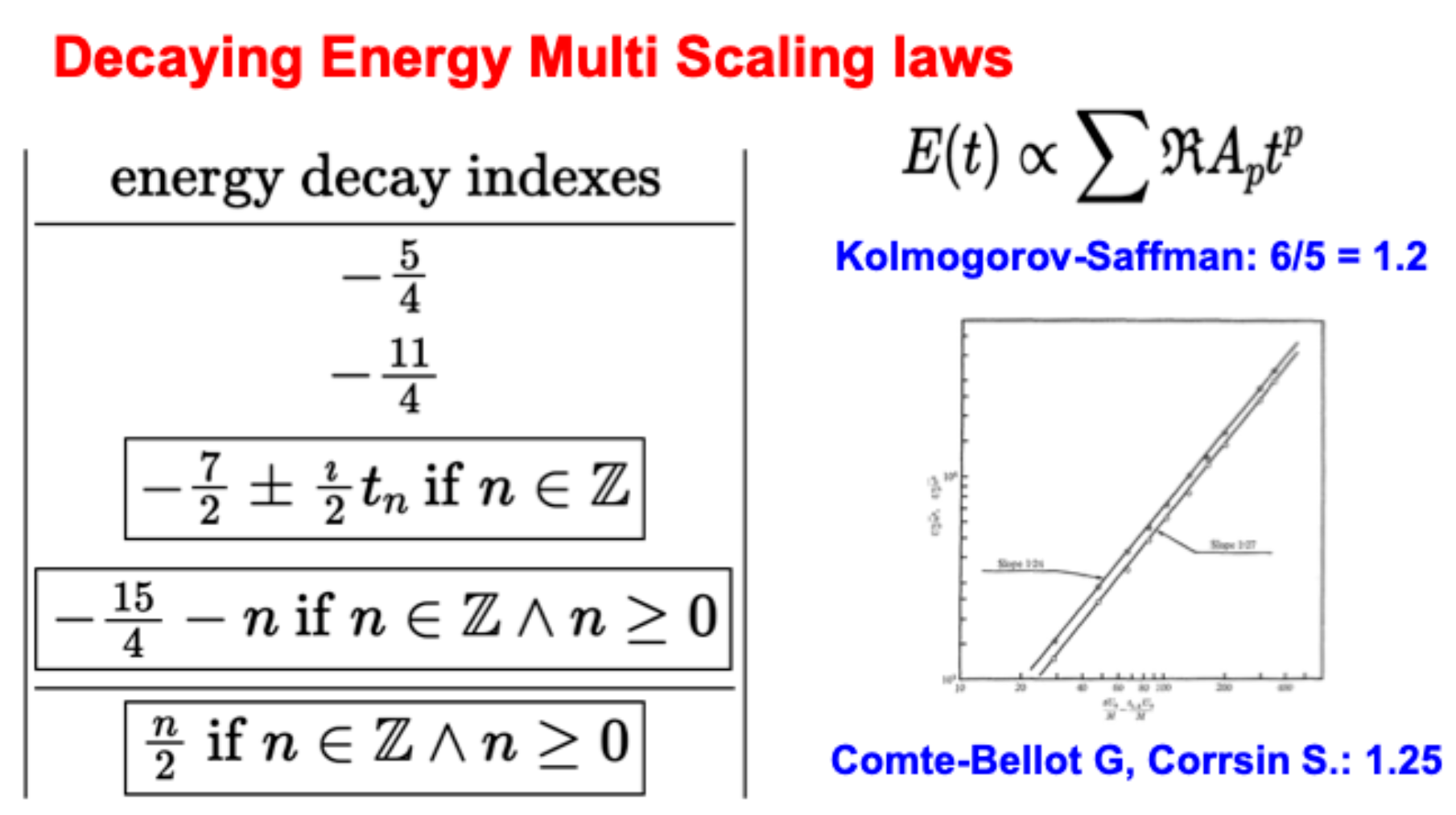
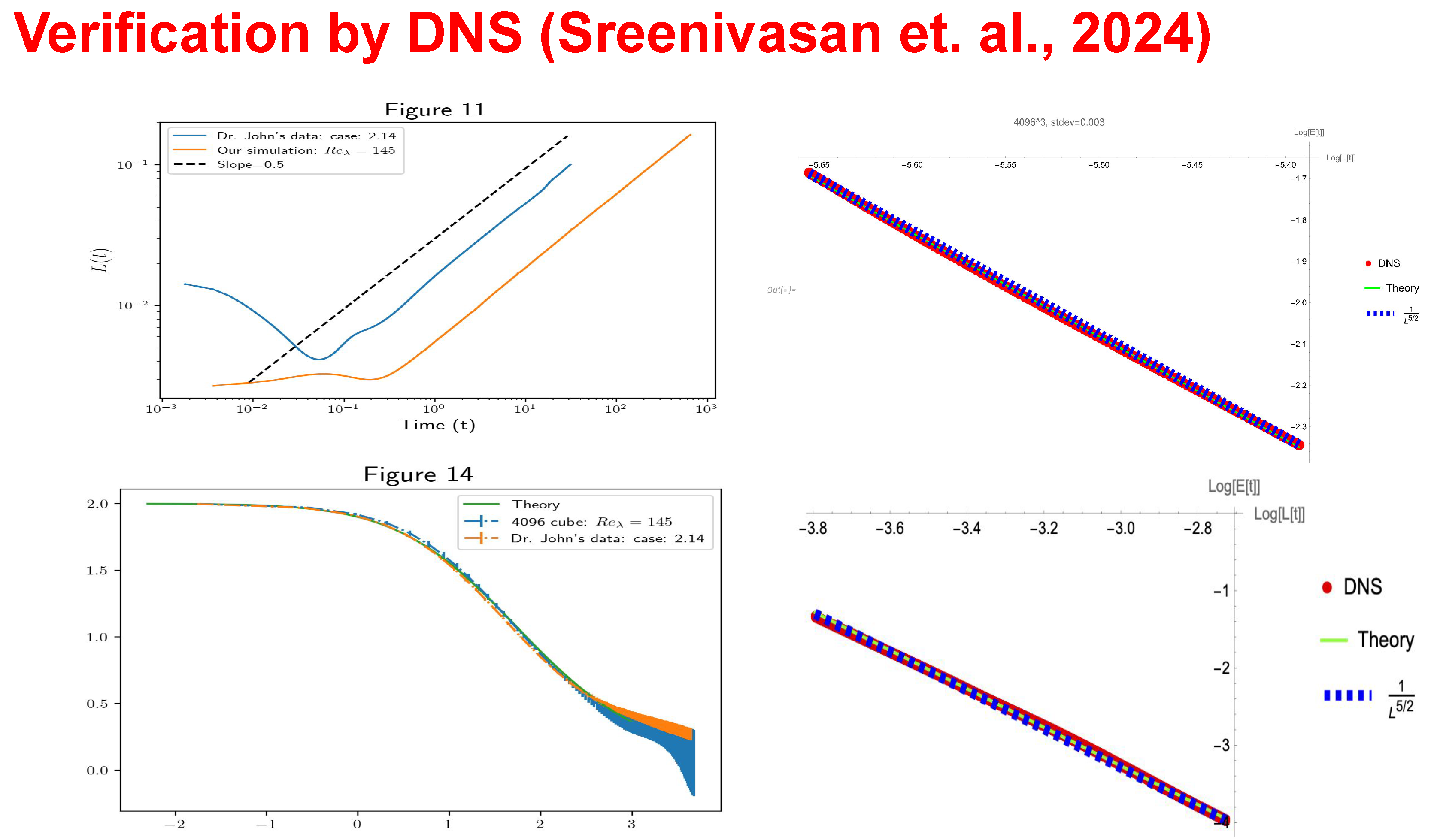
We present a duality in the dynamics of incompressible Navier-Stokes fluids in three dimensions, leading to a reformulation of the problem as a one-dimensional momentum loop equation. Importantly, the momentum loop equation does not admit finite-time blow-up solutions. The phenomenon of decaying turbulence emerges as a solution to this equation and can be interpreted as a string theory with a discrete target space composed of regular star polygons and Ising degrees of freedom along their edges. This string theory is solvable in the turbulent limit, which corresponds to a quasiclassical approximation in a nontrivial, calculable background. As a result, the spectrum of decay exponents is derived analytically and exhibits excellent agreement with both experimental data and numerical simulations. Notably, the spectrum includes complex conjugate pairs of exponents associated with the nontrivial zeros of the Riemann zeta function. The classical Kolmogorov scaling laws are replaced by specific functions derived from number theory, exhibiting nonlinear behavior in log-log scale. In particular, we compare the theoretically predicted effective exponent for the second moment of the velocity difference with new DNS results. This comparison reveals a remarkable agreement, with deviations well within the small DNS error margin over a broad range of the scaling variable r / sqrt(t).
Keywords:
1. Introduction
- It uncovers a duality between classical fluid dynamics and quantum mechanics.
- It reduces the problem from to dimensions, introducing fractal curves as solutions.
- It allows for exact solutions characterized by fixed trajectories.
- The explosive solutions are ruled out.
2. Loop Functional and Its General Properties
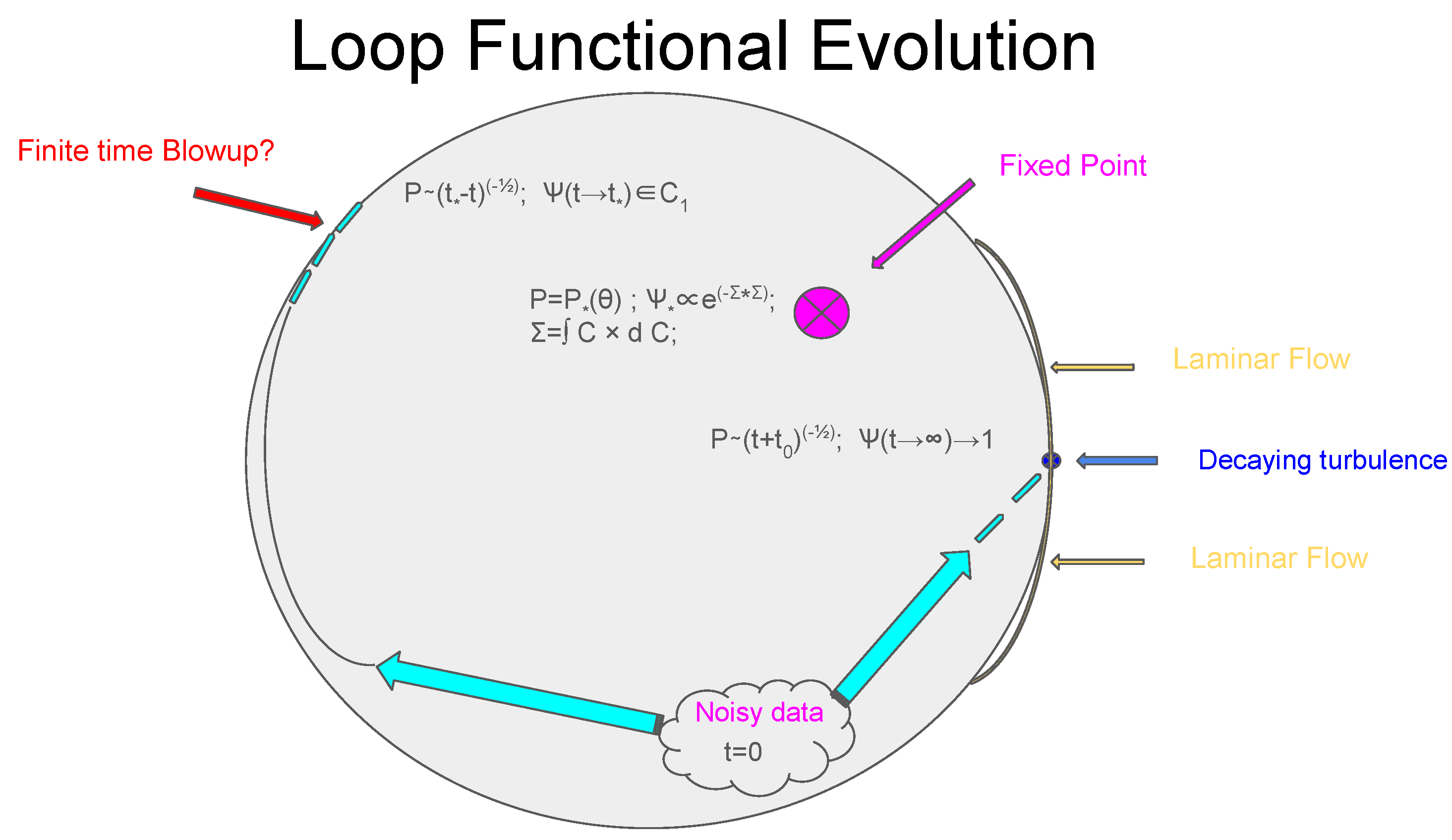
- Finite-time explosion? The vorticity could blow up at some finite or infinite point in time, leading to infinite circulation. In this case, the loop functional would cover the unit circle at this moment of singularity.
3. Loop Equation
4. The Definitions of the Loop Operators and the Proof of the Loop Equation
5. Schrödinger Equation in Loop Space
6. Momentum Loop Equation
7. Uniform Constant Rotation and Momentum Loop
7.1. Infinite Fourier Series
7.2. Polygonal Approximation
8. Cauchy Problem and Its Solution
9. Universality and Scaling of MLE
10. Laminar Flow at Small Time and Seeds of Turbulence
11. Decaying Turbulence
11.1. Fixed Point Solution
11.2. The Proof of the Euler Ensemble as a Fixed Point of MLE
11.3. Euler Ensemble as a Random Walk on a Regular Star Polygon
11.4. Euler Ensemble as String Theory with Discrete Target Space
11.5. The Limit of Large Reynolds Number Is Not Equivalent to Vanishing Viscosity
11.6. Continuum Limit Exists for the Loop Functional but Not for the Momentum Loop
11.7. An Open Problem of the Stability of Euler Ensemble as MLE Fixed Point
12. Inconsistency of Explosive Solution
13. Discussion
13.1. Physical Generalizations
- Turbulence driven by random rotations. In this solvable case, the loop equations, when modified to include random centrifugal forces, exhibit a fixed point describing the steady state of forced turbulence with energy flow. (A.M., in preparation).
- Compressible fluids and aerodynamics. The loop functional remains unchanged, but the incompressibility condition linking velocity to vorticity must be replaced with variable density dynamics, governed by the conservation of the volume element.
- Incompressible magnetohydrodynamics (MHD). For MHD, two independent circulation variables emerge: one corresponding to the velocity field and another to the vector potential of the electromagnetic field.
- Passive scalars. The statistics of a passive scalar advected by a turbulent velocity field can be expressed via path integrals involving the loop functional. These integrals resemble the propagator of a charged particle in an electromagnetic field.
- General Relativity. Could turbulence replace naked singularities in Einstein’s equations? Loop equations might provide insight. Unlike the longstanding focus of loop quantum gravity [12,13] on quantizing gravity via loop variables (e.g., Ashtekar variables [14]), we propose exploring the classical Einstein loop equations [15] for spontaneous stochasticity. This mechanism, analogous to the NS case, could offer a physical alternative to naked singularities. In this framework, the stochasticity in loop equations could imply a form of spontaneous quantization for classical gravity.
13.2. Mathematical Directions
- Classification of dual PDEs. What is the class of partial differential equations (PDEs) that exhibit duality to quantum mechanical systems in loop space?
- Dimensional reduction. Among these dual PDEs, which can be reduced to one-dimensional nonlinear momentum loop equations?
- Random walks on discrete manifolds. Are there higher-dimensional analogs of the observed random walk on star polygons, or other discrete manifolds, that lead to similarly nontrivial statistical limits?
14. Conclusions
- The classical Navier-Stokes equation, when supplemented by thermal fluctuations, is reformulated as a dimensional equation (78) for momentum loop trajectory . The loop functional (83) is related to the momentum loop by equation (81).
- The viscosity drops from this momentum loop equation (78), making momentum loop trajectories completely universal. The Reynolds number becomes the property of initial data , a stochastic loop in .
- There is a degenerate fixed point for covered by decaying turbulence solution: periodic random walk on a regular star polygon with steps. This fixed point (Euler ensemble) was found analytically in previous works [5,6], where the decaying energy spectrum was computed in quadrature and verified by the experimental data.
- This Euler ensemble is equivalent to a string theory with the target space made of regular star polygons. This solvable string theory is an explicit example of a decaying stochastic solution of the unforced Navier-Stokes equation.
- We have not proven that this solution is reachable from smooth initial data, corresponding to vanishing noise or , so we cannot claim a stochastic solution of the conventional Cauchy problem. However, thermal noise is always present in a physical fluid, making the conventional Cauchy problem a purely academic one.
Acknowledgments
References
- Arnold, V. Sur la géométrie différentielle des groupes de Lie de dimension infinie et ses applications à l’hydrodynamique des fluides parfaits. Annales de l’Institut Fourier 1966, 16, 319–361. [Google Scholar] [CrossRef]
- Migdal, A. Loop Equation and Area Law in Turbulence. In Quantum Field Theory and String Theory; Baulieu, L.; Dotsenko, V.; Kazakov, V.; Windey, P., Eds.; Springer US, 1995; pp. 193–231. [CrossRef]
- Iyer, K.P.; Sreenivasan, K.R.; Yeung, P.K. Circulation in High Reynolds Number Isotropic Turbulence is a Bifractal. Phys. Rev. X 2019, 9, 041006. [Google Scholar] [CrossRef]
- Iyer, K.P.; Bharadwaj, S.S.; Sreenivasan, K.R. The area rule for circulation in three-dimensional turbulence. Proceedings of the National Academy of Sciences of the United States of America 2021, 118, e2114679118. [Google Scholar] [CrossRef] [PubMed]
- Migdal, A. To the Theory of Decaying Turbulence. Fractal and Fractional 2023, arXiv:physics.flu-dyn/2304.13719]7, 754. [Google Scholar] [CrossRef]
- Migdal, A. Quantum solution of classical turbulence: Decaying energy spectrum. Physics of Fluids 2024, 36, 095161. [Google Scholar] [CrossRef]
- Migdal, A. Hierarchical Structure of Quantum Solution. https://sashamigdal.github.io/QuantumSolution/, 2024.
- Migdal, A. Statistical Equilibrium of Circulating Fluids. Physics Reports 2023, arXiv:physics.flu-dyn/2209.12312]1011C, 1–117. [Google Scholar] [CrossRef]
- Polyakov, A. Gauge Fields and Strings; Number v. 3 in Contemporary concepts in physics, Taylor & Francis, 1987.
- Bandak, D.; Mailybaev, A.A.; Eyink, G.L.; Goldenfeld, N. Spontaneous Stochasticity Amplifies Even Thermal Noise to the Largest Scales of Turbulence in a Few Eddy Turnover Times. Physical Review Letters 2024, 132. [Google Scholar] [CrossRef] [PubMed]
- Constantin, P.; Fefferman, C. Direction of Vorticity and the Problem of Global Regularity for the Navier-Stokes Equations. Indiana University Mathematics Journal 1993, 42, 775–789. [Google Scholar] [CrossRef]
- Rovelli, C.; Smolin, L. Knot Theory and Quantum Gravity. Phys. Rev. Lett. 1988, 61, 1155–1158. [Google Scholar] [CrossRef] [PubMed]
- Wikipedia contributors. Loop representation in gauge theories and quantum gravity — Wikipedia, The Free Encyclopedia, 2023. [Online; accessed 21-April-2023].
- Wikipedia contributors. Ashtekar variables — Wikipedia, The Free Encyclopedia, 2022. [Online; accessed 17-April-2023].
- N. A. Voronov, Y.M.M. Loop equations in the theory of gravity. Sov. J. Nucl. Phys. 1982, 36, 444, Translated from Yad. Fiz. 36 (1982) 758-766. [Google Scholar]
| 1 | We do not count deterministic fixed points corresponding to potential flows. They correspond to isolated points on the unit circle. |

Disclaimer/Publisher’s Note: The statements, opinions and data contained in all publications are solely those of the individual author(s) and contributor(s) and not of MDPI and/or the editor(s). MDPI and/or the editor(s) disclaim responsibility for any injury to people or property resulting from any ideas, methods, instructions or products referred to in the content. |
© 2024 by the authors. Licensee MDPI, Basel, Switzerland. This article is an open access article distributed under the terms and conditions of the Creative Commons Attribution (CC BY) license (http://creativecommons.org/licenses/by/4.0/).