

Submitted:
28 October 2024
Posted:
29 October 2024
You are already at the latest version
Abstract
Rivers are crucial hydrological cycle components, supporting ecosystems and human activities. Managing and protecting river water quality is essential. Diatoms, microscopic algae, are widespread and sensitive to changes in water quality, making them effective bioindicators. This study focused on the Kuils River in the Western Cape, South Africa, where diatom sampling was conducted at four sites. Their communities are affected by different physicochemical parameters, such as changes in pH, salinisation, eutrophication, and organic enrichment. A total of 98 diatom species were identified. The Omnidia software was used to calculate the Generic Diatom Index, Specific Pollution Index, and Trophic Diatom Index. Historical physicochemical data from the Department of Water and Sanitation provided a reference for comparing diatom communities. The results showed clear signs of pollution, as shifts in diatom species composition were observed. Pollu-tion-tolerant species like the Nitzchia palea, Navicula viridula, Eunotia bilunaris, and Fragilaria ulna dominated, while less pollution-tolerant species like Gomphonema parvulum and Cyclotella meneghiniana were less abundant. Both diatom indices and physicochemical data indicated poor water quality in the Kuils River. The study concludes that diatoms are a valuable tool for biomonitoring river water quality and recommends their use alongside traditional physicochemical methods for future assessments of river sys-tems.
Keywords:
1. Introduction
2. Materials and Methods
2.1. Study Area
2.2. Sample Collection
2.3. Physicochemical Analysis
2.4. Diatom Sample Preparation
2.5. Diatom Counting and Data Processing
3. Results
3.1. Physicochemical Parameters
3.2. Diatom Species Composition
3.2.1. Index Scores
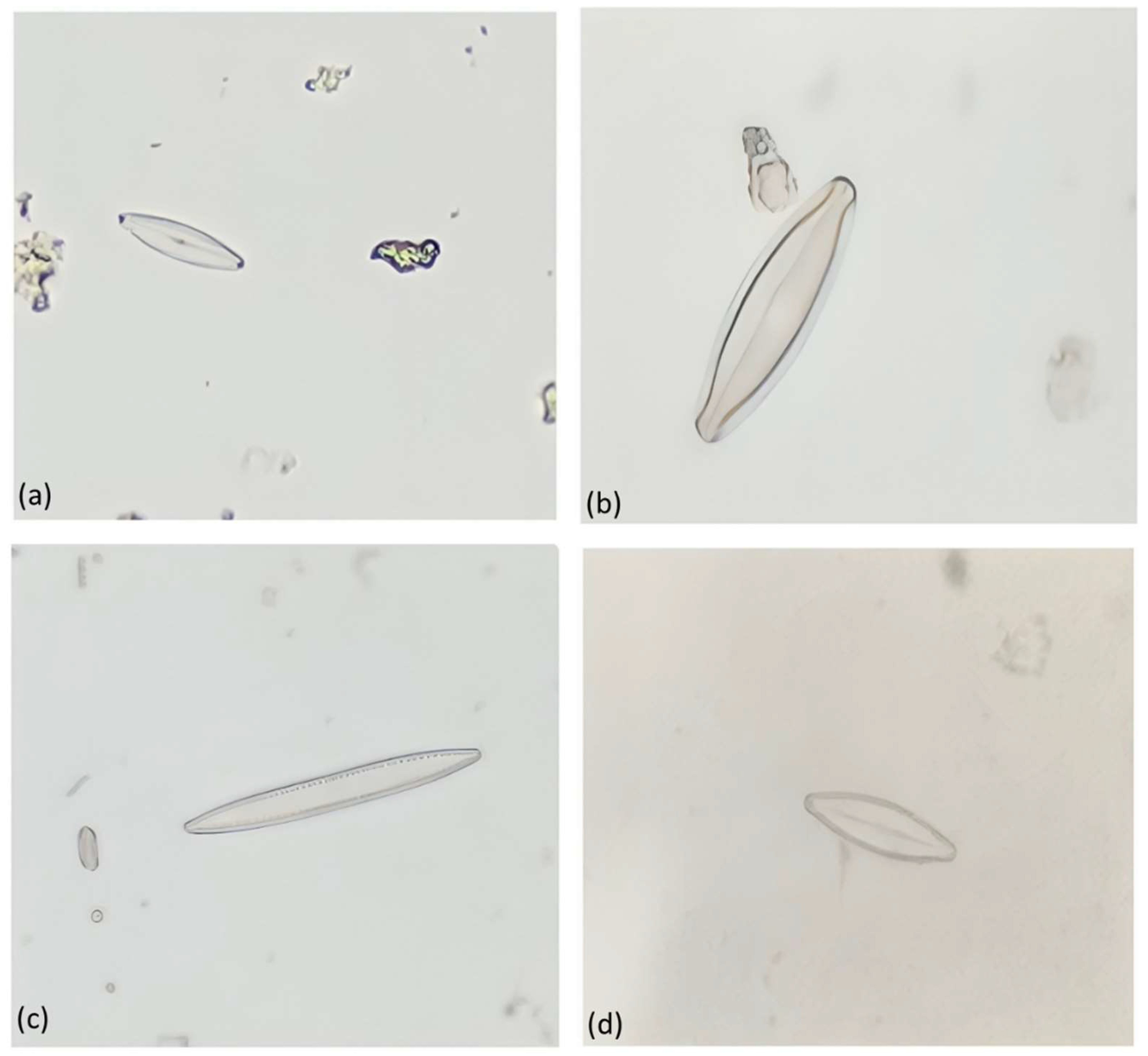
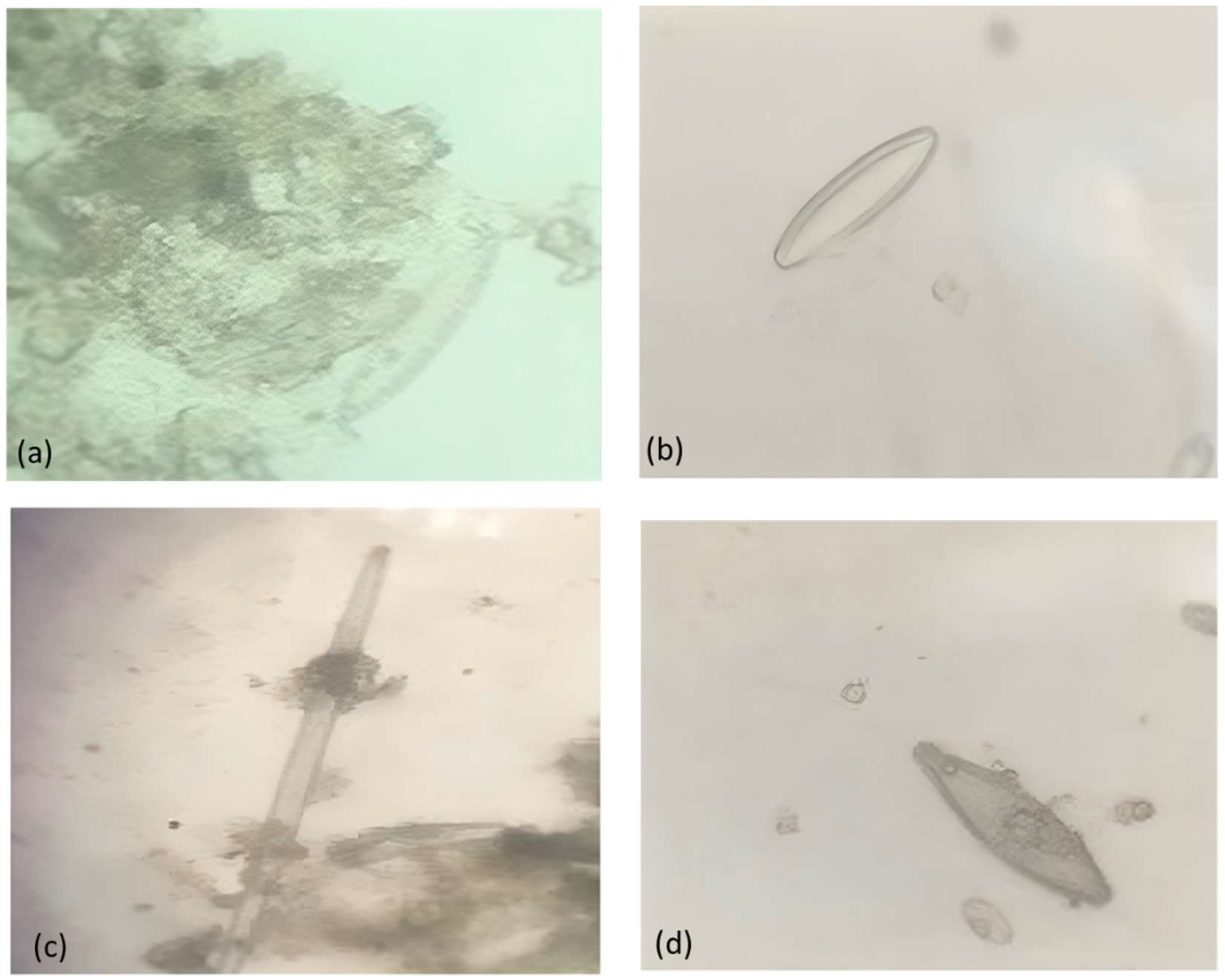
3.3. Observed Diatom Species
4. Discussion
5. Conclusions
Author Contributions
Funding
Institutional Review Board Statement
Informed Consent Statement
Data Availability Statement
Acknowledgments
Conflicts of Interest
References
- Gqomfa, B.; Maphanga, T.; Shale, K. The impact of informal settlement on water quality of Diep River in Dunoon. Sustain. Water Resour. Manag. 2022, 8, 27 [. [Google Scholar] [CrossRef]
- Daily Maverick. Cape Town’s rivers are open streams of sewage, yet the city is not spending its budget. Available online: https://www.dailymaverick.co.za/article/2019-09-26-cape-towns-rivers-are-open-streams-of-sewage-yet-the-city-is-not-spending-its-budget (accessed on 11 August 2022).
- Dallas H., F.; Day J., A. The effect of water quality variables on aquatic ecosystems: A review. Pretoria: Water Research Commission, South Africa, 2004; pp. 224. Available online: https://www.wrc.org.za/wp-content/uploads/mdocs/TT-244-04.pdf.
- Matlala, M. D. The use of diatoms to indicate water quality in wetlands: A South African perspective. Masters Thesis, North-West University, Potchefstroom, 2010. Available online: http://hdl.handle.net/10394/4410.
- Sonneman, J. A.; Walsh, C. J. ; Breen; P. F.; Sharpe, A. K. Effects of urbanization on streams of the Melbourne region, Victoria, Australia. II. Benthic diatom communities. Freshwater Biology, 2001, 46(4): 553-565. [CrossRef]
- Belore, M.L.; Winter, J.G.; Duthie, H.C. Use of diatoms and macroinvertebrates as bioindicators of water quality in southern Ontario rivers. Can. Water Resour. J. 2002, 27 (4): 457-484. [CrossRef]
- Geng, S.W.; Qu, X.D.; Zhang, Y.; Lin, K.D. Comparison and application of biological indices of macroinvertebrates in river health assessment. Huan Jing ke Xue=Huanjing Kexue 2012, 33, 2281–2287. Available online: https://pubmed.ncbi.nlm.nih. [PubMed]
- Lobo, E.A.; Heinrich, C.G.; Schuch, M.; Wetzel, C.E.; Ector, L. Diatoms as bioindicators rivers. River algae, 2016, 245-271. [CrossRef]
- Slingers, O. An analysis of diatoms as biological indicators of water quality in rivers of the Western Cape. Master's thesis, University of Cape Town, South Africa, 2015. Available online: http://hdl.handle.net/11427/19990.
- Musa, R. S. Relating epiphytic diatom community assemblage to water quality along the Nyl River floodplain, Limpopo, South Africa. Ph.D. Thesis, University of Johannesburg, South Africa, 2015. [Google Scholar]
- Ashbolt, N.J.; Grabow, W.O.K.; Snozzi, M. Indicators of Microbial Water Quality. In Water Quality: Guidelines, Standards and Health Risk Assessment and Management for Water-Related Infectious Disease; Chapter 13; Fewtrell, L., Bartram, J., Eds.; IWA Publishing: London, 2001; pp. 289–315, [924154533X.pdf (4.483Mb)]. [Google Scholar]
- De Almeida, S. F.P.; Gil, M.C.P. Ecology of freshwater diatoms from the central region of Portugal, Cryp-togamie algol, 2001, 22: 109-126. [CrossRef]
- Kelly, M.G.; Whitton, B.A. The Trophic Diatom Index: a new index for monitoring eutrophication in rivers. J Appl Phycol, 1995. [Google Scholar] [CrossRef]
- Hagen, B. Restoring the Kuils River: understanding the past to inform the future. Ph.D,Thesis, Stellenbosch University, Cape Town, South Africa, 2022. Available online: http://hdl.handle.net/10019.1/124601.
- Mwangi, F. N. Land use practices and their impact on the water quality of the upper Kuils River. Masters Thesis, University of Western Cape, Cape Town, South Africa, 2014. Available online: https://core.ac.uk/download/pdf/58914502.pdf.
- Taylor, J.C.; Harding, W. R.; Archibald, C.G. M. A methods manual for the collection, preparation and analysis of diatom samples, Version 1: 60, 2007; pp. 60. Available online: https://docs.niwa.co.nz/library/public/1770054839.pdf.
- Phungula, P. P. The use of diatoms in assessing water quality in the Nyl and Mogalakwena River system, in the Limpopo, South Africa. Masters Thesis, University of Johannesburg, South Africa, 2018. [Google Scholar]
- Kaushal, S.S.; Likens, G.E.; Utz, R.M.; Pace, M.L.; Grese, M.; Yepsen, M. Increased River alkalinization in the Eastern US. ES&T, [es401046s_si_001.pdf (1.27 MB)]. 2013, 47, 10302–10311. [Google Scholar]
- Chapman, D. V. Water quality assessments: a guide to the use of biota, sediments and water in environmental monitoring, 2nd Ed,; E&FN Spon; Great Britain, 1996; pp. 1- 609. Available online: https://iris.who.int/bitstream/10665/41850/1/0419216006_eng.pdf.
- Kelly, M.G. Use of the trophic diatom index to monitor eutrophication in rivers. Wat. Res, 1998, 32(1): 236-242. [CrossRef]
- De la Rey, P.A.; Taylor, J.C.; Laas, A.; Van Rensburg, L.; Vosloo, A. Determining the possible application value of diatoms as indicators of general water quality: A comparison with SASS 5. Water Sa 2004, 30, 325–332, [10.4314/wsa.v30i3.5080]. [Google Scholar] [CrossRef]
- Szczepocka, E.; Szulc, B. The use of benthic diatoms in estimating water quality of variously polluted rivers. Oceanol. Hydrobiol. Stud, 2009, 38 (1): 17-26. [CrossRef]

| Variables | Unit | Sampling year | Site 1 | Site 2 | Site 3 | Site 4 |
|---|---|---|---|---|---|---|
| pH | - | 2019 | 7.5 | 7.7 | 7.7 | 7.7 |
| - | 2020 | 8.3 | 8 | 8 | 8 | |
| - | 2021 | 7.9 | 7.7 | 7.7 | 7.9 |
|
| Chemical oxygen demand (COD) | mg/L | 2019 | 24 | 25 | 25 | 26 |
| mg/L | 2020 |
54 | 32 | 32 | 0 | |
| mg/L | 2021 | 64 | 34 | 34 | 48 | |
| Phosphorus (PO43-) | mg/L | 2019 | 0.13 | 0.08 | 0.08 | 0.55 |
| mg/L | 2020 | 0.17 | 0.33 | 0.33 | 0 | |
| mg/L | 2021 | 0.1 | 0.22 | 0.22 | 1.14 |
| Variables | Unit | Sampling Year |
Site 1 | Site 2 | Site 3 | Site 4 |
|---|---|---|---|---|---|---|
| pH | - | 2019 | 7.4 | 8.2 | 8.2 | 8.5 |
| - | 2020 | 7.8 | 8.1 | 8.1 | 8.5 | |
| - | 2021 | 8.1 | 7.8 | 7.8 | 8.2 | |
| Chemical oxygen demand (COD) | mg/L | 2019 | 55 | 39 | 39 | 45 |
| mg/L | 2020 | 41 | 35 | 35 | 57 | |
| mg/L | 2021 | 84 | 35 | 35 | 40 | |
| Phosphorus (PO43-) | mg/L | 2019 | 0.2 | 0.2 | 0.2 | 0.49 |
| mg/L | 2020 | 0.13 | 0.1 | 0.1 | 0.82 | |
| mg/L | 2021 | 1.7 | 0.12 | 0.12 | 1.2 |
| Taxon | Distribution at sample site | Relative abundance (%) |
|---|---|---|
| Navicula viridula (Kützing) Ehrenberg var. viridula | Site 1 & 4 | 30.8 |
| Nitzschia frustulum (Kützing) Grunow var. bulnheimiana (Rabenhorst) Grunow | Site 4 | 25.5 |
| Planothidium rostratum (Østrup) Round et Bukhtiyarova | All Sites | 18.5 |
| Nitzschia perspicua Cholnoky | Site 4 | 19.4 |
| Planothidium engelbrechtii (Cholnoky) Round et Bukhtiyarova | All Sites | 15.3 |
| Nitzschia frustulum (Kützing) Grunow var. frustulum | All Sites | 24.5 |
| Gomphonema pseudoaugur Lange-Bertalot | All Sites | 9.9 |
| Nitzschia archibaldii Lange-Bertalot | All Sites | 19.9 |
| Cyclotella meneghiniana Kützing | Site 2 and 3 | 18.5 |
| Planothidium frequentissimum Round & Bukhtiyarova in Zidarova & al. | All Sites | 20.4 |
| Gomphonema parvulum var. parvulum f. saprophilum Lange-Bertalot et Reichardt | Site 2 & 3 | 12.5 |
| Achnanthes oblongella Østrup | All Sites | 7.5 |
| Craticula acidoclinata Lange-Bertalot & Metzeltin | All Sites | 9.0 |
| Achnanthidium exiguum (Grunow) Czarnecki var. exiguum | All Sites | 20.5 |
| Geissleria decussis (Østrup) Lange-Bertalot et Metzeltin | All Sites | 5.4 |
| Cocconeis placentula Ehrenberg | All Sites | 8.0 |
| Eunotia rhomboidea Hustedt | All Sites | 15.0 |
| Eunotia formica Ehrenberg sensu lato | All Sites | 6.6 |
| Nitzschia communis Rabenhorst | All Sites | 8.0 |
| Nitzschia palea (Kützing) W.Smith var. palea | Site 4 | 35.6 |
| Gyrosigma acuminatum (Kützing) Rabenhorst | Site 4 | 5.5 |
| Cocconeis engelbrechtii Cholnoky | All Sites | 27.8 |
| Craticula ambigua (Ehrenberg) Mann | All Sites | 10.5 |
| Nitzschia filiformis (W.M. Smith) Van Heurck var. filiformis | All Sites | 19.4 |
| Craticula cuspidata (Kützing) Mann var. cuspidate | All Sites | 20.4 |
| Nitzschia heufleriana Grunow var. heufleriana | All Sites | 22.4 |
| Cymbopleura amphicephala Krammer | All Sites | 10.5 |
| Eunotia bilunaris (Ehrenberg) Mills var. bilunaris | All Sites | 11.6 |
| Eunotia flexuosa (Brébisson) Kützing var. flexuosa | All Sites | 9.9 |
| Fragilaria biceps (Kützing) Lange-Bertalot | All Sites | 8.5 |
| Fragilaria tenera (W. Smith) Lange-Bertalot var. tenera | All Sites | 8.0 |
| Fragilaria ulna (Nitzsch.) Lange-Bertalot var. ulna | All Sites | 24.5 |
| Fragilaria ulna var. acus (Kützing) Lange-Bertalot | All Sites | 7.2 |
| Nitzschia umbonate (Ehrenberg) Lange-Bertalot | All Sites | 6.3 |
| Planothidium Frequentissimum (Lange-Bertalot) Lange-Bertalot var. frequentissimum | All Sites | 23.4 |
| Tabularia fasciculata (Agardh) Williams et Round | All Sites | 12.5 |
| Tryblionella coarctata (Grunow in Cl. & Grun.) D.G. Mann | All Sites | 5.4 |
| Tryblionella littoralis (Grunow in Cl. et Grun.) D.G. Mann var. littoralis | All Sites | 6.4 |
| Class | The interpretation of the index scores (Index score) |
|---|---|
| Bad | <9 |
| Poor | 9-12 |
| Satisfactory | 12-15 |
| Good | 15-17 |
| Very good | >17 |
| Trophic category of water | The interpretation of the index scores (Index value ranges) |
|---|---|
| Oligotrophic | 0-20 |
| Oligo-mesotrophic | 21-40 |
| Mesotrophic | 41-60 |
| Meso-eutrophic | 61-80 |
| Eutrophic | >80 |
Disclaimer/Publisher’s Note: The statements, opinions and data contained in all publications are solely those of the individual author(s) and contributor(s) and not of MDPI and/or the editor(s). MDPI and/or the editor(s) disclaim responsibility for any injury to people or property resulting from any ideas, methods, instructions or products referred to in the content. |
© 2024 by the authors. Licensee MDPI, Basel, Switzerland. This article is an open access article distributed under the terms and conditions of the Creative Commons Attribution (CC BY) license (http://creativecommons.org/licenses/by/4.0/).