

Submitted:
25 October 2024
Posted:
28 October 2024
You are already at the latest version
Abstract
Bone age assessment is essential for evaluating skeletal maturity, especially in cases where chronological age is uncertain, such as in unaccompanied foreign minors. Traditional methods, such as the Greulich-Pyle atlas and the Tanner-Whitehouse system, while effective, often result in variability due to manual interpretation and are not fully adapted to ethnically diverse populations. Although automated systems are available, they are typically proprietary, expensive, and require programming expertise, which limits their accessibility. This paper introduces an open-source domain-specific language specifically designed for bone age estimation, offering a balance between flexibility and ease of use. The system provides a straightforward, user-friendly syntax, allowing healthcare professionals without programming knowledge to perform accurate bone age assessments. It integrates well-established bone age methodologies, such as the Greulich-Pyle and Tanner-Whitehouse systems, ensuring flexibility in its application. The system is developed using a test-driven development approach, which guarantees both accuracy and reproducibility in bone age assessments. By offering a customizable, open-source solution, this system reduces costs and eliminates the reliance on proprietary software. Its ability to simplify the bone age estimation process makes it a valuable tool in clinical and forensic settings, particularly for professionals involved in the assessment of unaccompanied foreign minors and other populations where accurate bone age determination is crucial.
Keywords:
1. Introduction
2. Materials and Methods
2.1. Basics
2.2. Sintaxis
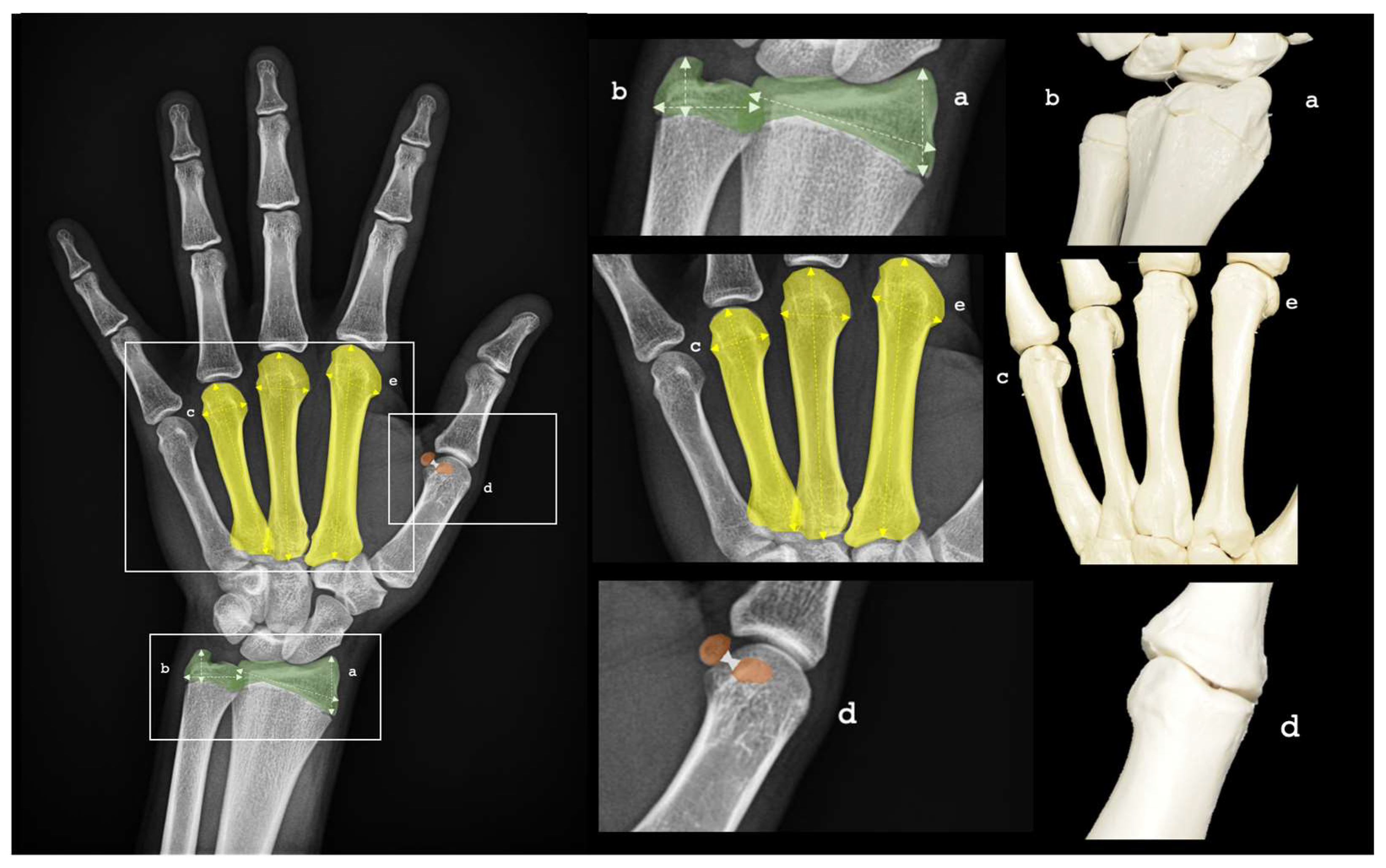

| Declarative Syntax |
|---|
|
COMPARE THE RADIOGRAPHY USING THE basicatlas ATLAS STARTING WITH GENDER male DEFINED BY A radius BONE OF MEASUREMENTS length = 2.813 |
| Declarative Syntax |
|---|
|
COMPARE THE RADIOGRAPHY (...) COMPARE THE RADIOGRAPHY (...) |
2.3. Semantic
| Declarative Syntax |
|---|
|
DEFINE A greulichPyle ATLAS NAMED basicatlas WITH THE FOLLOWING RADIOGRAPHIES ONE FOR GENDER male AGE 8 WITH A radius BONE OF MEASUREMENTS length = 2.813 ONE FOR GENDER male AGE 9 WITH A radius BONE OF MEASUREMENTS length = 2.9 |
| Declarative Syntax |
|---|
|
DEFINE A basicScoringSystem SCORING SYSTEM NAMED basicAssignment WITH ONE ROI DESCRIBED AS roiA WITH SCORE 5 COMPOSED OF radius ONE ROI DESCRIBED AS roiB WITH SCORE 3 COMPOSED OF ulna |
2.3. DSL interpreter execution
2.4. Software Architecture Diagram
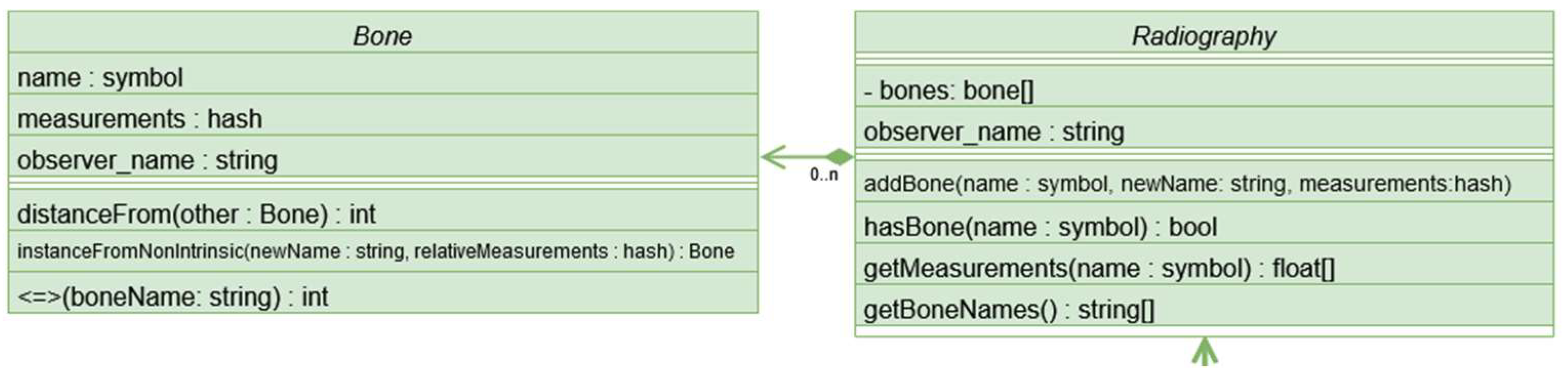
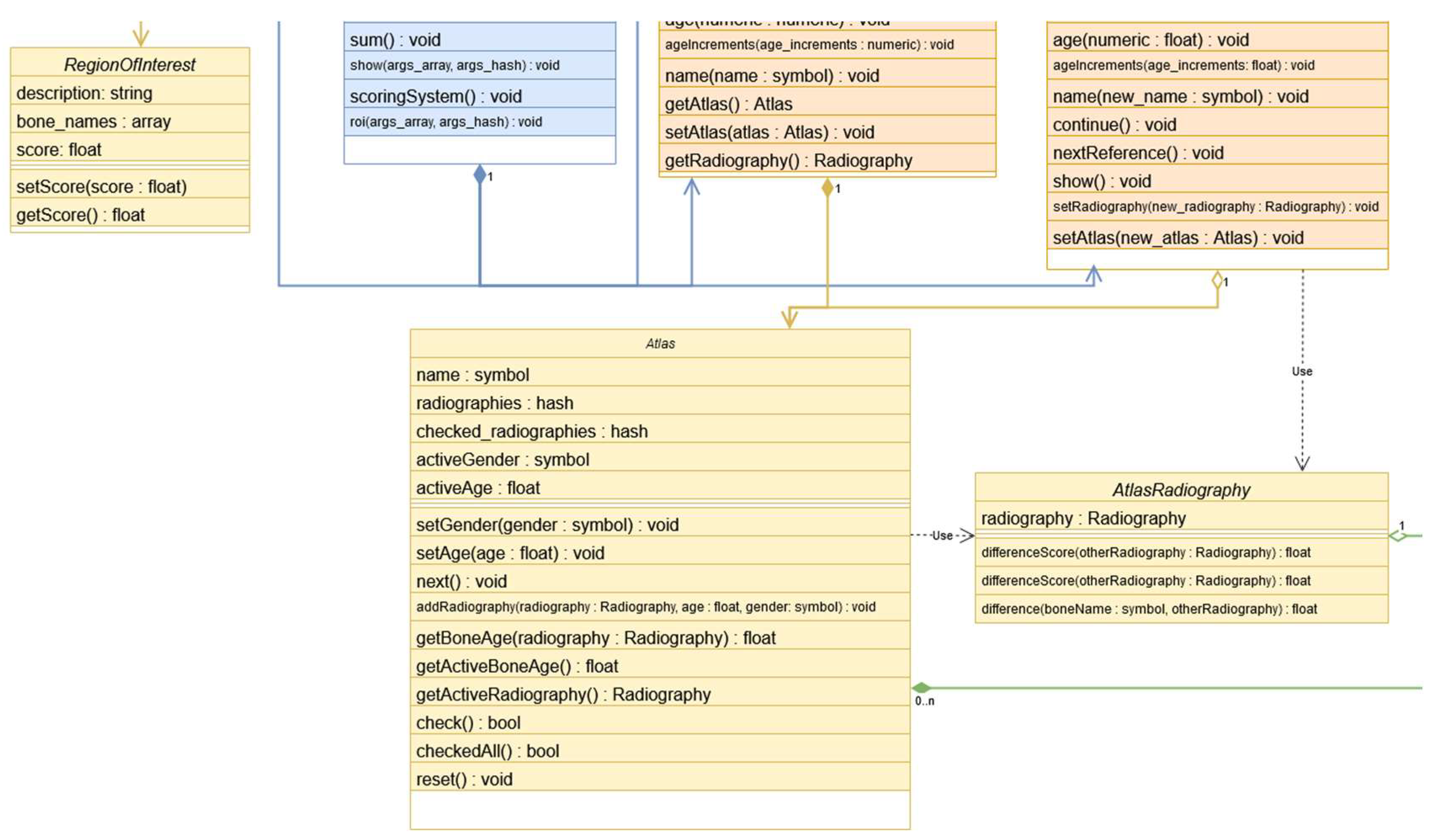
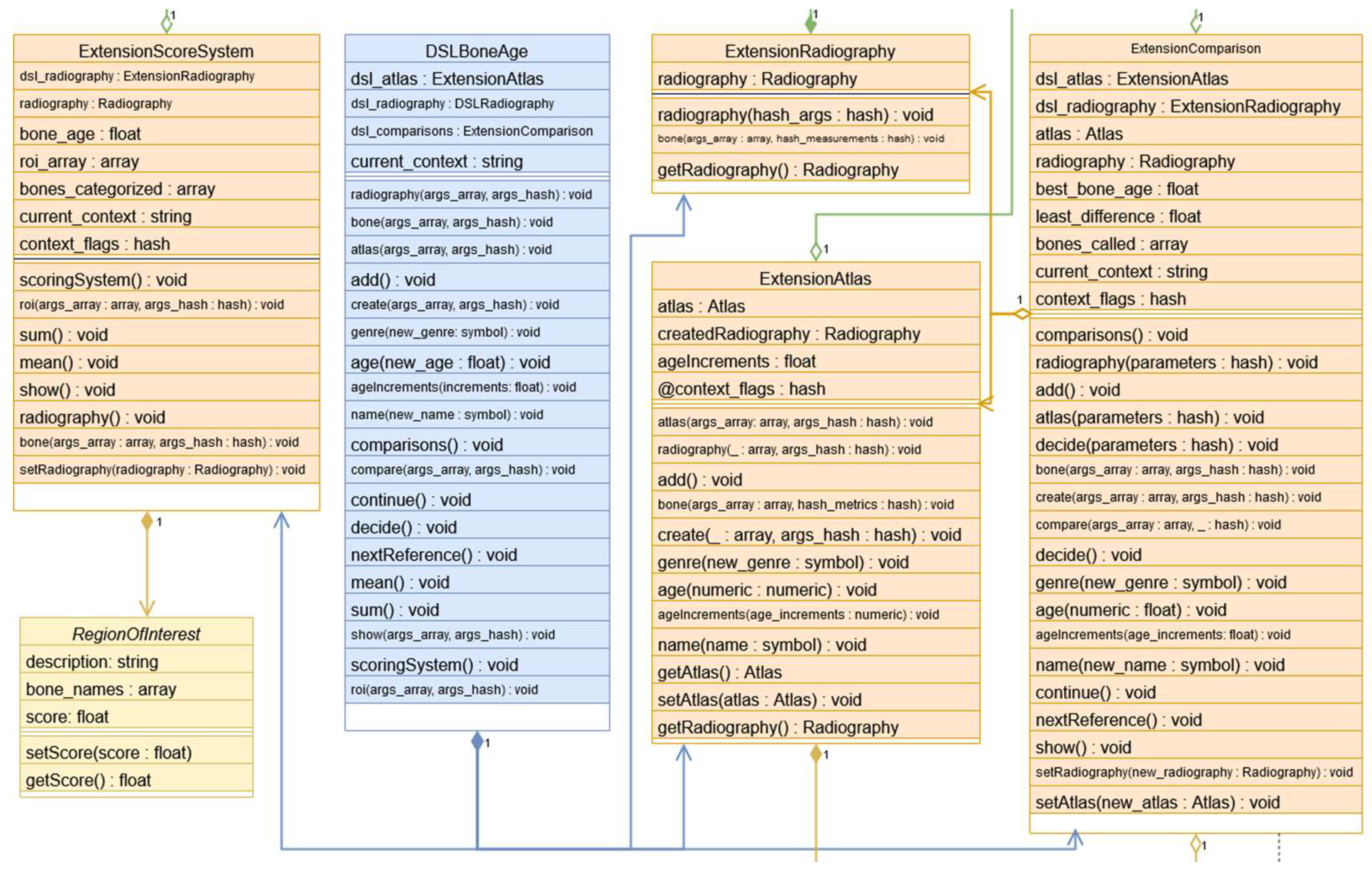
3. Results
4. Discussion
5. Conclusions
Supplementary Materials
Author Contributions
Funding
Institutional Review Board Statement
Informed Consent Statement
Data Availability Statement
Acknowledgments
Conflicts of Interest
References
- Satoh, M.; Hasegawa, Y. Factors Affecting Prepubertal and Pubertal Bone Age Progression. Front. Endocrinol. 2022, 13, 967711. [Google Scholar] [CrossRef] [PubMed]
- Moca, A.E.; Vaida, L.L.; Moca, R.T.; Țuțuianu, A.V.; Bochiș, C.F.; Bochiș, S.A.; Iovanovici, D.C.; Negruțiu, B.M. Chronological Age in Different Bone Development Stages: A Retrospective Comparative Study. Children 2021, 8, 142. [Google Scholar] [CrossRef] [PubMed]
- Ording Müller, L.S.; Offiah, A.; Adamsbaum, C.; et al. Bone Age for Chronological Age Determination—Statement of the European Society of Paediatric Radiology Musculoskeletal Task Force Group. Pediatr. Radiol. 2019, 49, 979–982. [Google Scholar] [CrossRef]
- Elhakeem, A.; Frysz, M.; Tilling, K.; Tobias, J.H.; Lawlor, D.A. Association Between Age at Puberty and Bone Accrual From 10 to 25 Years of Age. JAMA Netw. Open 2019, 2, e198918. [Google Scholar] [CrossRef]
- Spadoni, G.L.; Cianfarani, S. Bone Age Assessment in the Workup of Children With Endocrine Disorders. Horm. Res. Paediatr. 2010, 73, 2–5. [Google Scholar] [CrossRef]
- Umer, M.; Eshmawi, A.A.; Alnowaiser, K.; Mohamed, A.; Alrashidi, H.; Ashraf, I. Skeletal Age Evaluation Using Hand X-rays to Determine Growth Problems. PeerJ Comput. Sci. 2023, 9, e1512. [Google Scholar] [CrossRef]
- Schagen, S.E.E.; Wouters, F.M.; Cohen-Kettenis, P.T.; Gooren, L.J.; Hannema, S.E. Bone Development in Transgender Adolescents Treated With GnRH Analogues and Subsequent Gender-Affirming Hormones. J. Clin. Endocrinol. Metab. 2020, 105, e4252–e4263. [Google Scholar] [CrossRef]
- Lee, J.Y. Bone Health in the Transgender and Gender Diverse Youth Population. Curr. Osteoporos. Rep. 2023, 21, 459–471. [Google Scholar] [CrossRef]
- Mishori, R. The Use of Age Assessment in the Context of Child Migration: Imprecise, Inaccurate, Inconclusive and Endangers Children's Rights. Children 2019, 6, 85. [Google Scholar] [CrossRef]
- Hjern, A.; Brendler-Lindqvist, M.; Norredam, M. Age Assessment of Young Asylum Seekers. Acta Paediatr. 2012, 101, 4–7. [Google Scholar] [CrossRef]
- Todd, TW. The Effects of Body Mass on the Estimation of Skeletal Age. Am J Phys Anthropol, 2004, 124, 1, 1–10. [Google Scholar] [CrossRef]
- Greulich, W.W.; Pyle, S.I. Radiographic Atlas of Skeletal Development of the Hand and Wrist; Stanford University Press: Stanford, CA, 1959. [Google Scholar]
- Gilsanz, V.; Ratib, O. Hand Bone Age. A Digital Atlas of Skeletal Maturity; Springer: Berlin, Heidelberg, New York, 2005. [Google Scholar]
- Martín Pérez IM, Martín Pérez SE, Vega González JM, Molina Suárez R, García Hernández AM, Rodríguez Hernández F, Herrera Pérez M. The Validation of the Greulich and Pyle Atlas for Radiological Bone Age Assessments in a Pediatric Population from the Canary Islands. Healthcare. 2024, 18, 1847. [Google Scholar] [CrossRef]
- Benso, L.; Vannelli, S.; Pastorin, L.; Angius, P.; Milani, S. Main Problems Associated With Bone Age and Maturity Evaluation. Horm. Res. 1996, 45 (Suppl. 2), 42–48. [Google Scholar] [CrossRef] [PubMed]
- Acheson, R.M. A Method of Assessing Skeletal Maturity from Radiographs; A Report from the Oxford Child Health Survey. J. Anat. 1954, 88, 498–508. [Google Scholar] [PubMed]
- Tanner, J.M.; Whitehouse, R.H.; Healy, M.J.R. A New System for Estimating Skeletal Maturity from the Hand and Wrist, with Standards Derived from a Study of 2,600 Healthy British Children; Centre International de l'Enfant: Paris, France, 1962. [Google Scholar]
- Martín Pérez, I.M.; Martín Pérez, S.E.; Vega González, J.M.; Molina Suárez, R.; García Hernández, A.M.; Rodríguez Hernández, F.; Herrera Pérez, M. Validation of Greulich and Pyle Atlas for Radiological Bone Age Assessment in Pediatric Population From the Canary Islands. Preprints 2024, 2024090071. [Google Scholar] [CrossRef]
- Shah, N.; Khadilkar, V.; Lohiya, N.; et al. Comparison of Bone Age Assessments by Greulich-Pyle, Gilsanz-Ratib, and Tanner Whitehouse Methods in Healthy Indian Children. Indian J. Endocrinol. Metab. 2021, 25, 240–246. [Google Scholar] [CrossRef]
- Tanner, J.M.; Whitehouse, R.H.; Cameron, N.; Marshall, W.A.; Healy, M.J.R.; Goldstein, H. Assessment of Skeletal Maturity and Prediction of Adult Height (TW2 Method); Academic Press: New York, 1975. [Google Scholar]
- Tanner, J.M.; Healy, M.J.R.; Goldstein, H.; Cameron, N. (Eds.) Assessment of Skeletal Maturity and Prediction of Adult Height (TW3 Method); Saunders: London, 2001. [Google Scholar]
- Zhang, A.; Sayre, J.W.; Vachon, L.; Liu, B.J.; Huang, H.K. Racial Differences in Growth Patterns of Children Assessed on the Basis of Bone Age. Radiology 2009, 250, 228–235. [Google Scholar] [CrossRef]
- Ebrí Torné, B. Maduración ósea: metodología numérica sobre tarso y carpo. Zaragoza: [s.n.]; 1988.p.67.
- Prokop-Piotrkowska, M.; Marszałek-Dziuba, K.; Moszczyńska, E.; Szalecki, M.; Jurkiewicz, E. Traditional and New Methods of Bone Age Assessment—An Overview. J. Clin. Res. Pediatr. Endocrinol. 2021, 13, 251–262. [Google Scholar] [CrossRef]
- De Sanctis, V.; Soliman, A.T.; Di Maio, S.; Bedair, S. Are the New Automated Methods for Bone Age Estimation Advantageous Over the Manual Approaches? Pediatr. Endocrinol. Rev. 2014, 12, 200–205. [Google Scholar]
- Michael, D.J.; Nelson, A.C. HANDX: A Model-Based System for Automatic Segmentation of Bones From Digital Hand Radiographs. IEEE Trans. Med. Imaging 1989, 8, 64–69. [Google Scholar] [CrossRef]
- Tanner, J.M.; Oshman, D.; Lindgren, G.; Grunbaum, J.A.; Elsouki, R.; Labarthe, D. Reliability and Validity of Computer-Assisted Estimates of Tanner-Whitehouse Skeletal Maturity (CASAS): Comparison With the Manual Method. Horm. Res. 1994, 42, 288–294. [Google Scholar] [CrossRef] [PubMed]
- Pietka, E.; McNitt-Gray, M.F.; Kuo, M.L.; Huang, H.K. Computer-Assisted Phalangeal Analysis in Skeletal Age Assessment. IEEE Trans. Med. Imaging 1991, 10, 616–620. [Google Scholar] [CrossRef] [PubMed]
- Thodberg, H.H.; Kreiborg, S.; Juul, A.; Pedersen, K.D. The BoneXpert Method for Automated Determination of Skeletal Maturity. IEEE Trans. Med. Imaging 2009, 28, 52–66. [Google Scholar] [CrossRef]
- Thodberg, H.H.; Sävendahl, L. Validation and Reference Values of Automated Bone Age Determination for Four Ethnicities. Acad. Radiol. 2010, 17, 1425–1432. [Google Scholar] [CrossRef]
- Maratova, K.; Zemkova, D.; Sedlak, P.; Pavlikova, M.; Amaratunga, S.A.; Krasnicanova, H.; Soucek, O.; Sumnik, Z. A Comprehensive Validation Study of the Latest Version of BoneXpert on a Large Cohort of Caucasian Children and Adolescents. Front. Endocrinol. 2023, 14, 1130580. [Google Scholar] [CrossRef]
- van Rijn, R.R.; Thodberg, H.H. Bone Age Assessment: Automated Techniques Coming of Age? Acta Radiol. 2013, 54, 1024–1029. [Google Scholar] [CrossRef]
- Lee, B.D.; Lee, M.S. Automated Bone Age Assessment Using Artificial Intelligence: The Future of Bone Age Assessment. Korean J. Radiol. 2021, 22, 792–800. [Google Scholar] [CrossRef]
- Pietka, E.; Gertych, A.; Pospiech-Kurkowska, S.; Cao, F.; Huang, H.K.; Gilzanz, V. Computer-Assisted Bone Age Assessment: Graphical User Interface for Image Processing and Comparison. J. Digit. Imaging 2004, 17, 175–188. [Google Scholar] [CrossRef]
- Tanner, J.M.; Gibbons, R.D. Automatic Bone Age Measurement Using Computerized Image Analysis. J. Pediatr. Endocrinol. 1994, 7, 141–145. [Google Scholar] [CrossRef]
- Dallora, A.L.; Anderberg, P.; Kvist, O.; Mendes, E.; Diaz Ruiz, S.; Sanmartin Berglund, J. Bone Age Assessment with Various Machine Learning Techniques: A Systematic Literature Review and Meta-Analysis. PLoS ONE 2019, 14, e0220242. [Google Scholar] [CrossRef]
- Chen, T.L.; Emerling, M.; Chaudhari, G.R.; Chillakuru, Y.R.; Seo, Y.; Vu, T.H.; Sohn, J.H. Domain Specific Word Embeddings for Natural Language Processing in Radiology. J. Biomed. Inform. 2021, 113, 103665. [Google Scholar] [CrossRef] [PubMed]
- Steinkamp, J.; Cook, T.S. Basic Artificial Intelligence Techniques: Natural Language Processing of Radiology Reports. Radiol. Clin. N. Am. 2021, 59, 919–931. [Google Scholar] [CrossRef] [PubMed]
- Kim, J.K.; Park, D.; Chang, M.C. Assessment of Bone Age Based on Hand Radiographs Using Regression-Based Multi-Modal Deep Learning. Life 2024, 14, 774. [Google Scholar] [CrossRef]
- Tugwell, P.; Tovey, D. PRISMA 2020. J. Clin. Epidemiol. 2021, 134, A5–A6. [Google Scholar] [CrossRef]
- Universidad de La Laguna. Lenguaje de dominio específico para la estimación de la edad ósea. Available online: https://riull.ull.es/xmlui/handle/915/33068 (accessed on 5 September 2024).
- Schroeder, A.B.; Dobson, E.T.A.; Rueden, C.T.; Tomancak, P.; Jug, F.; Eliceiri, K.W. The ImageJ Ecosystem: Open-Source Software for Image Visualization, Processing, and Analysis. Protein Sci. 2021, 30, 234–249. [Google Scholar] [CrossRef]
- Fowler, M. Domain-Specific Languages; Pearson Education: Boston, MA, USA, 2010. [Google Scholar]
- Flanagan, D.; Matsumoto, Y. The Ruby Programming Language; O'Reilly Media, Inc.: Sebastopol, CA, USA, 2008. [Google Scholar]
- Badreddin, O.; Forward, A.; Lethbridge, T.C. A Test-Driven Approach for Developing Software Languages. In Proceedings of the 2014 2nd International Conference on Model-Driven Engineering and Software Development (MODELSWARD); IEEE; 2014; pp. 225–234. [Google Scholar]
- Crispin, L. Driving Software Quality: How Test-Driven Development Impacts Software Quality. IEEE Software 2006, 23, 70–71. [Google Scholar] [CrossRef]
- Furs, L.A. Subjective Interpretation in Syntax: How the Mind Structures Reality. In Pavlova, A., Ed.; Philological Readings; European Proceedings of Social and Behavioural Sciences; pp. 20208339–47. [CrossRef]
- Onisawa, T. Subjective analysis of system reliability and its analyzer. Fuzzy Sets and Systems 1996, 83, 249–269. [Google Scholar] [CrossRef]
- Chen, T.L.; Emerling, M.; Chaudhari, G.R.; Chillakuru, Y.R.; Seo, Y.; Vu, T.H.; Sohn, J.H. Domain Specific Word Embeddings for Natural Language Processing in Radiology. J. Biomed. Inform. 2021, 113, 103665. [Google Scholar] [CrossRef]
- Lee, H.; Brown, KJ; Sujeeth, AK. , Chafi, H.; Olukotun, K., Rompf, T; Odersky M. Implementing Domain-Specific Languages for Heterogeneous Parallel Computing. IEEE Micro 2011, 31, 42–53. [Google Scholar] [CrossRef]
- van Rozen, R.; van der Storm, T. Toward Live Domain-Specific Languages: From Text Differencing to Adapting Models at Run Time. Softw. Syst. Model. 2017, 18, 10270–10277. [Google Scholar] [CrossRef]
- Fog, A. Optimizing Software in C++. 2006. Available online: http://www.agner.org/optimize/optimizing_cpp.pdf (accessed on [4/10/2024]).
- Bugden, W.; Alahmar, A. Rust: The Programming Language for Safety and Performance. arXiv 2022. [Google Scholar] [CrossRef]
- Kusmenko, E.; Rumpe, B.; Schneiders, S.; von Wenckstern, M. Highly-Optimizing and Multi-Target Compiler for Embedded System Models: C++ Compiler Toolchain for the Component and Connector Language EmbeddedMontiArc. In Proceedings of the 21st ACM/IEEE International Conference on Model Driven Engineering Languages and Systems; October 2018; pp. 447–457. [Google Scholar]
- Zehra, F.; Javed, M.; Khan, D.; Pasha, M. Comparative Analysis of C++ and Python in Terms of Memory and Time. Preprints 2020, 2020120516. [Google Scholar] [CrossRef]
- Lee, H.; Tajmir, S.; Lee, J.; Zissen, M.; Yeshiwas, B.A.; Alkasab, T.K.; Choy, G.; Do, S. Fully Automated Deep Learning System for Bone Age Assessment. J. Digit. Imaging 2017, 30, 427–441. [Google Scholar] [CrossRef]
- Czech, G.; Moser, M.; Pichler, J. A Systematic Mapping Study on Best Practices for Domain-Specific Modeling. Softw. Qual. J. 2020, 28, 663–692. [Google Scholar] [CrossRef]
- Kosar, T.; Bohra, S.; Mernik, M. Domain-Specific Languages: A Systematic Mapping Study. Inf. Softw. Technol. 2016, 71, 77–91. [Google Scholar] [CrossRef]
- Iung, A.; Carbonell, J.; Marchezan, L.; et al. Systematic Mapping Study on Domain-Specific Language Development Tools. Empir. Softw. Eng. 2020, 25, 4205–4249. [Google Scholar] [CrossRef]
- Czech, G.; Moser, M.; Pichler, J. Best Practices for Domain-Specific Modeling: A Systematic Mapping Study. In Proceedings of the 2018 44th Euromicro Conference on Software Engineering and Advanced Applications (SEAA), Prague, Czech Republic; 2018; pp. 137–145. [Google Scholar] [CrossRef]
- Pape, J.; Hirsch, F.W.; Deffaa, O.J.; DiFranco, M.D.; Rosolowski, M.; Gräfe, D. Applicability and Robustness of an Artificial Intelligence-Based Assessment for Greulich and Pyle Bone Age in a German Cohort. Rofo 2024, 196, 600–606. [Google Scholar] [CrossRef]
- Booz, C.; Wichmann, J.L.; Boettger, S.; Al Kamali, A.; Martin, S.S.; Lenga, L.; Leithner, D.; Albrecht, M.H.; Ackermann, H.; Vogl, T.J.; Bodelle, B.; Kaltenbach, B. Evaluation of a Computer-Aided Diagnosis System for Automated Bone Age Assessment in Comparison to the Greulich-Pyle Atlas Method: A Multireader Study. J. Comput. Assist. Tomogr. 2019, 43, 39–45. [Google Scholar] [CrossRef]
- Kim, J.K.; Park, D.; Chang, M.C. Assessment of Bone Age Based on Hand Radiographs Using Regression-Based Multi-Modal Deep Learning. Life 2024, 14, 774. [Google Scholar] [CrossRef]
- Peng, C.-T.; Chan, Y.-K.; Yuh, Y.-S.; Yu, S.-S. Applying Convolutional Neural Network in Automatic Assessment of Bone Age Using Multi-Stage and Cross-Category Strategy. Appl. Sci. 2022, 12, 12798. [Google Scholar] [CrossRef]
- Lee, B.D.; Lee, M.S. Automated Bone Age Assessment Using Artificial Intelligence: The Future of Bone Age Assessment. Korean J. Radiol. 2021, 22, 792–800. [Google Scholar] [CrossRef] [PubMed]
- Bajjad, A.A.; Gupta, S.; Agarwal, S.; Pawar, R.A.; Kothawade, M.U.; Singh, G. Use of Artificial Intelligence in Determination of Bone Age of the Healthy Individuals: A Scoping Review. J. World Fed. Orthod. 2024, 13, 95–102. [Google Scholar] [CrossRef] [PubMed]
- Lee, H.; Tajmir, S.; Lee, J.; Zissen, M.; Yeshiwas, B.A.; Alkasab, T.K.; Choy, G.; Do, S. Fully Automated Deep Learning System for Bone Age Assessment. J. Digit. Imaging 2017, 30, 427–441. [Google Scholar] [CrossRef] [PubMed]
Disclaimer/Publisher’s Note: The statements, opinions and data contained in all publications are solely those of the individual author(s) and contributor(s) and not of MDPI and/or the editor(s). MDPI and/or the editor(s) disclaim responsibility for any injury to people or property resulting from any ideas, methods, instructions or products referred to in the content. |
© 2024 by the authors. Licensee MDPI, Basel, Switzerland. This article is an open access article distributed under the terms and conditions of the Creative Commons Attribution (CC BY) license (http://creativecommons.org/licenses/by/4.0/).