
Submitted:
19 October 2024
Posted:
21 October 2024
You are already at the latest version
Abstract
This paper presents an educational application called AR Firework designed for an interactive science museum exhibition in the wild. We adopted STEAM and a game-based education approach for the major visitors and children to teach them the mechanisms of fireworks. Augmented reality is used to simulate dangerous laboratory environments and visualize abstract concepts. DIY souvenirs featuring fireworks are created in the process of interacting with the exhibits. This hybrid souvenir combines a physical firework launcher and AR models. The visitors can present it as a gift to others or display it in the digital gallery. This souvenir establishes a long-lasting connection between visitors and their personal visiting experiences through digital media. This paper promotes an improved understanding of personalization, socialization, AR, and STEAM education. It can be an inspiration for souvenir designers and education products.
Keywords:
1. Introduction
2. Background
2.1. Personalization in the Museum Experience
2.2. Socialization in the Museum Experience
2.3. Augmented Reality in Museum Education
3. Design
3.1. AR Firework System
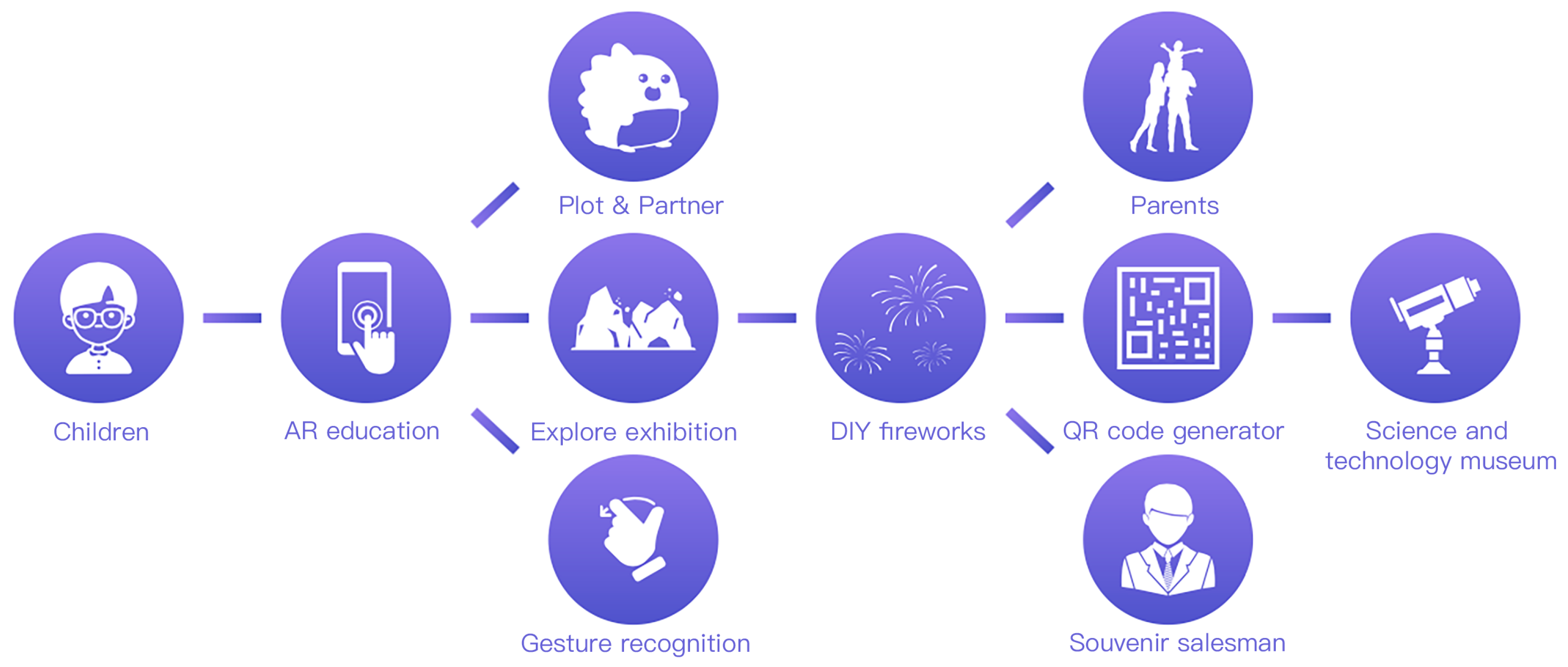

Children and their parents came to the museum and entered the Information Age exhibition hall. They found that the exhibits were old and lacked interaction.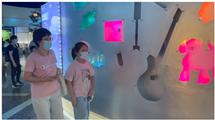 1. Enter the Science and Technology museum |
They suddenly find a poster with a QR code, their parent scan it with their phone and then download the app called My Firework.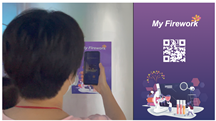 1. Scan the QR code 2. Download application |
They opened the app, read the instructions, clicked the DIY button, and their learning partner appeared and played a plot animation. 1. Read instructions 2. Start DIY fireworks 3. Watch plot animation 4. Learning partner: little dragon |
Users need to log in or register, and the system generates recommendations for routes to explore the exhibition based on their age.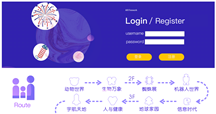 1. Login/Register 2. Generate recommendations for routes based on age |
Children follow the hints to find the materials for making fireworks. Then they find the Magnesiteore.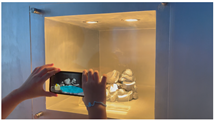 1. Explore the exhibits 2. Find material for fireworks |
By scanning the pictures of the material around the ore, corresponding models and introductions will appear. The material is added to the backpack.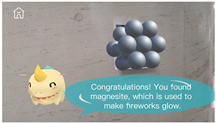 1. Scan the picture 2. Molecular models emerge 3. Add material to the backpack |
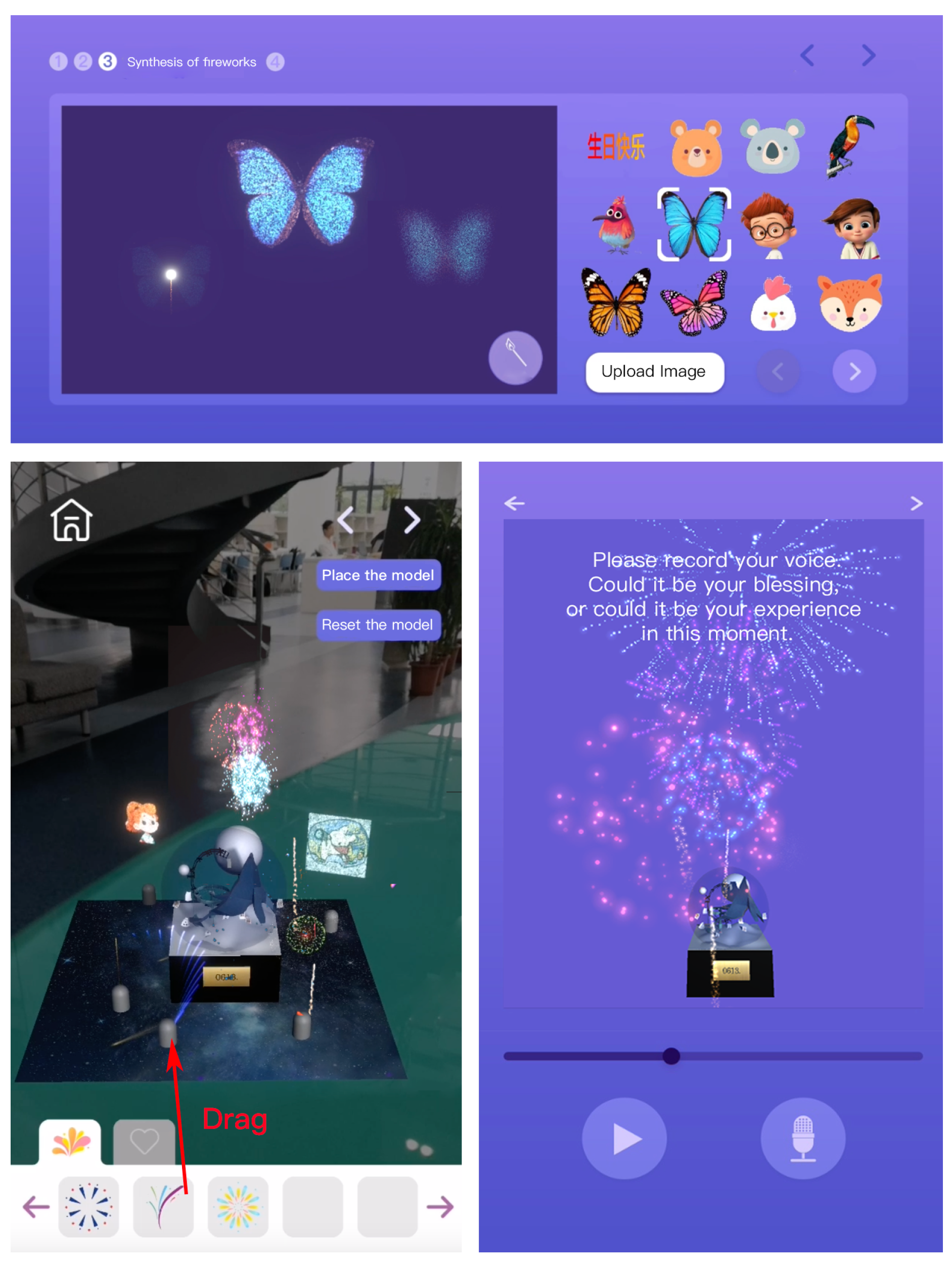
Children and parents learn about fireworks and customize AR fireworks souvenirs together.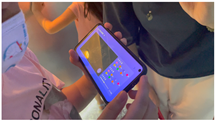 1. DIY fireworks 2. Learn knowledge 3. Parents buy the fireworks launcher box for the children. |
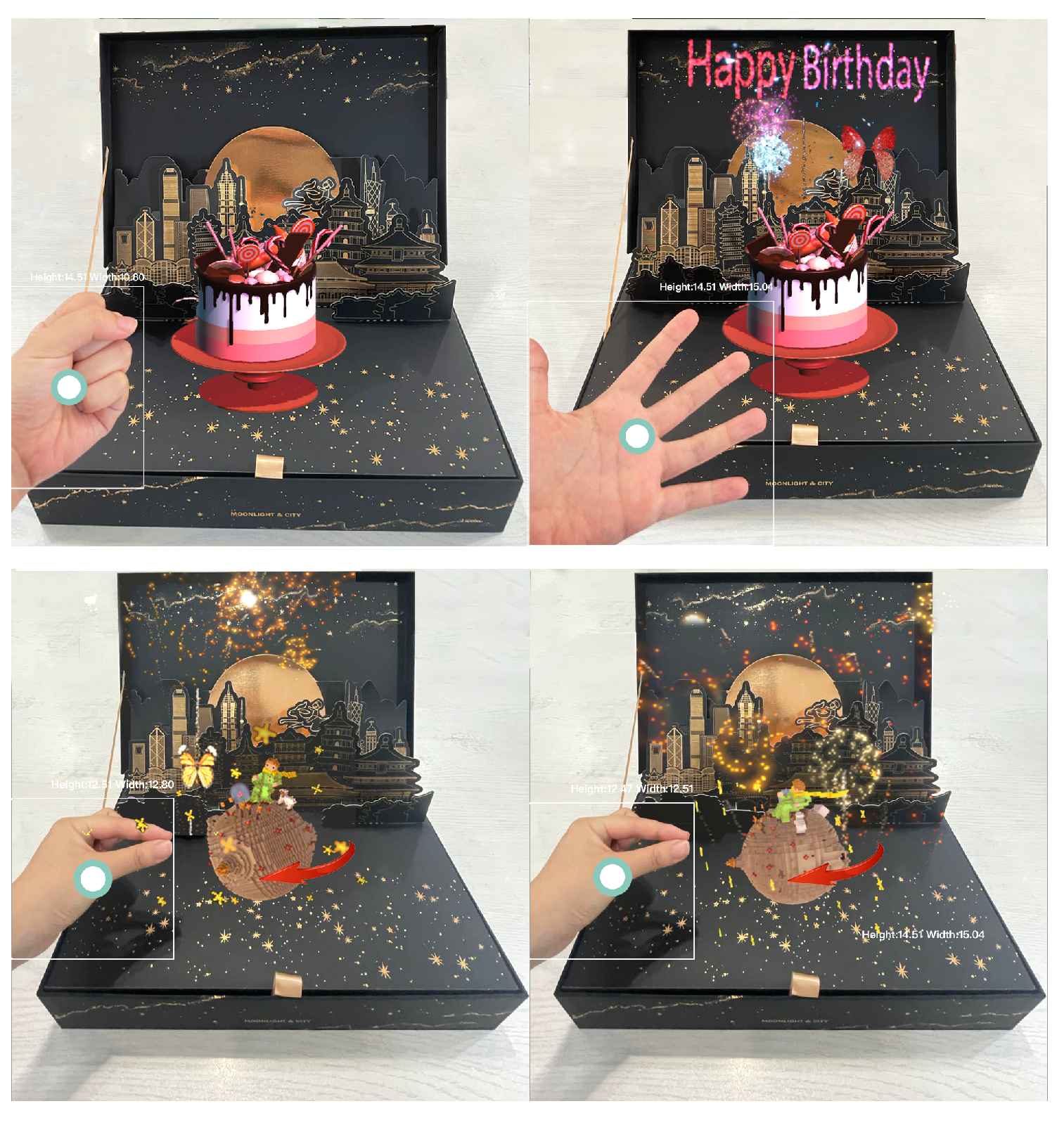
They’ll print a QR code and attach it to the box. Then they can DIY even add audio and finally upload it.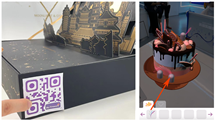 1. Buy firework launch box 2. Attach QR code 3. DIY souvenir 4. Add audio Upload |
They can keep this souvenir for themselves or give it to others. When the box is opened next time, the models with memories appear.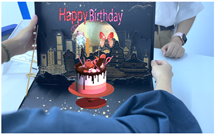 1. Give it to others/ Keep it 2. Open again 3. Show the AR model |
3.2. STEAM Education Approach
3.3. Augmented Reality and Natural Hand Gesture
3.4. The Hybrid Souvenir with DIY Firework
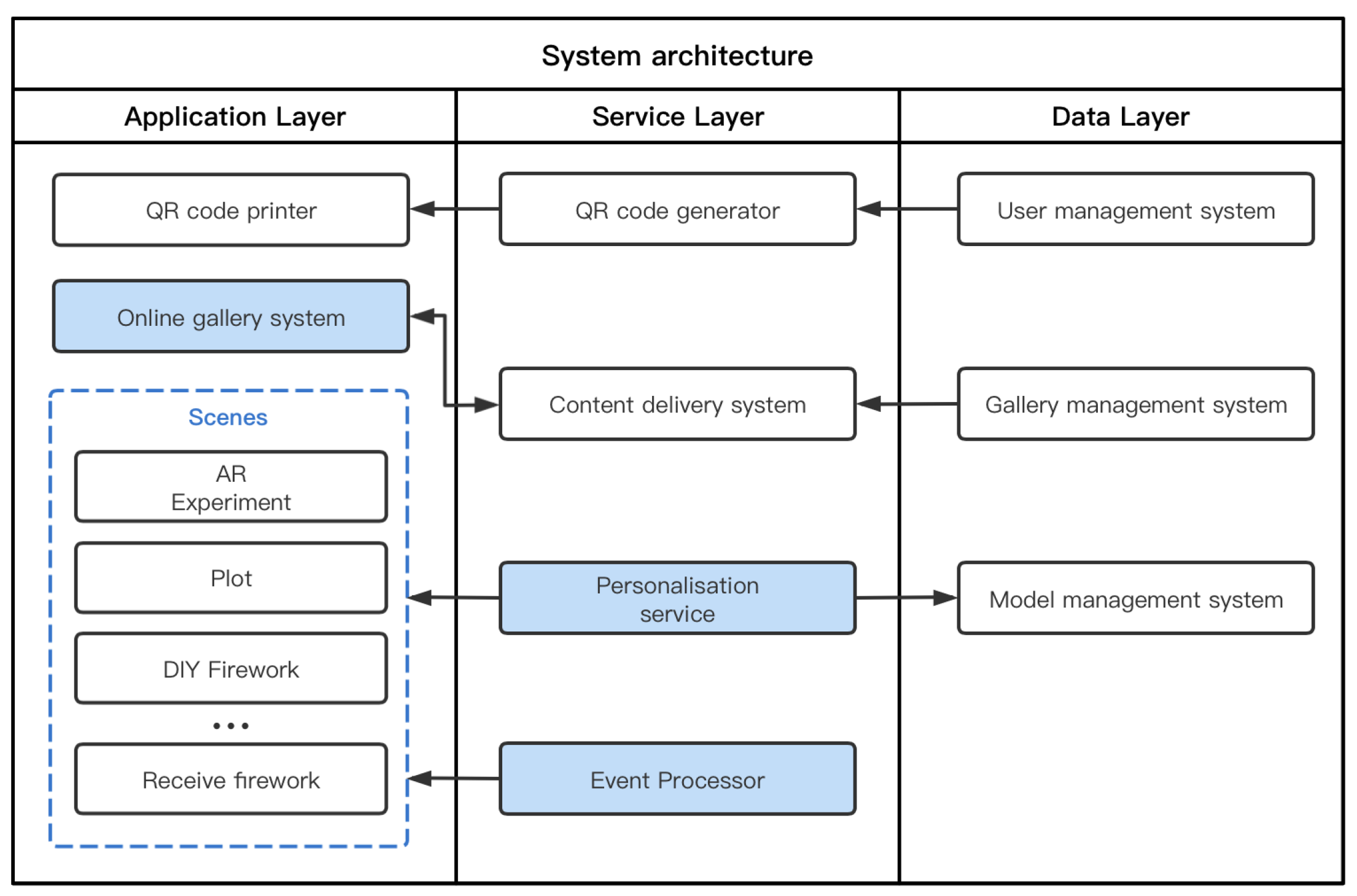
3.5. System Architecture
4. Findings
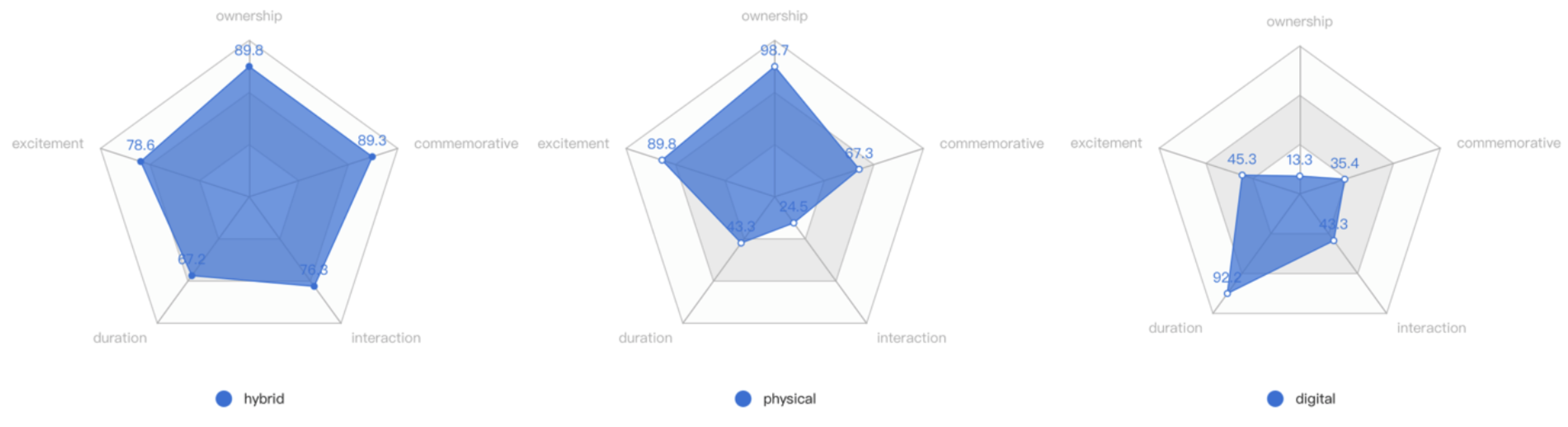
4.1. Enhancement of Physical and Virtual Souvenirs
4.2. Stimulate Learning Motivation
4.3. Distinctive Self-Making Experience Leads to Long-Term Memory
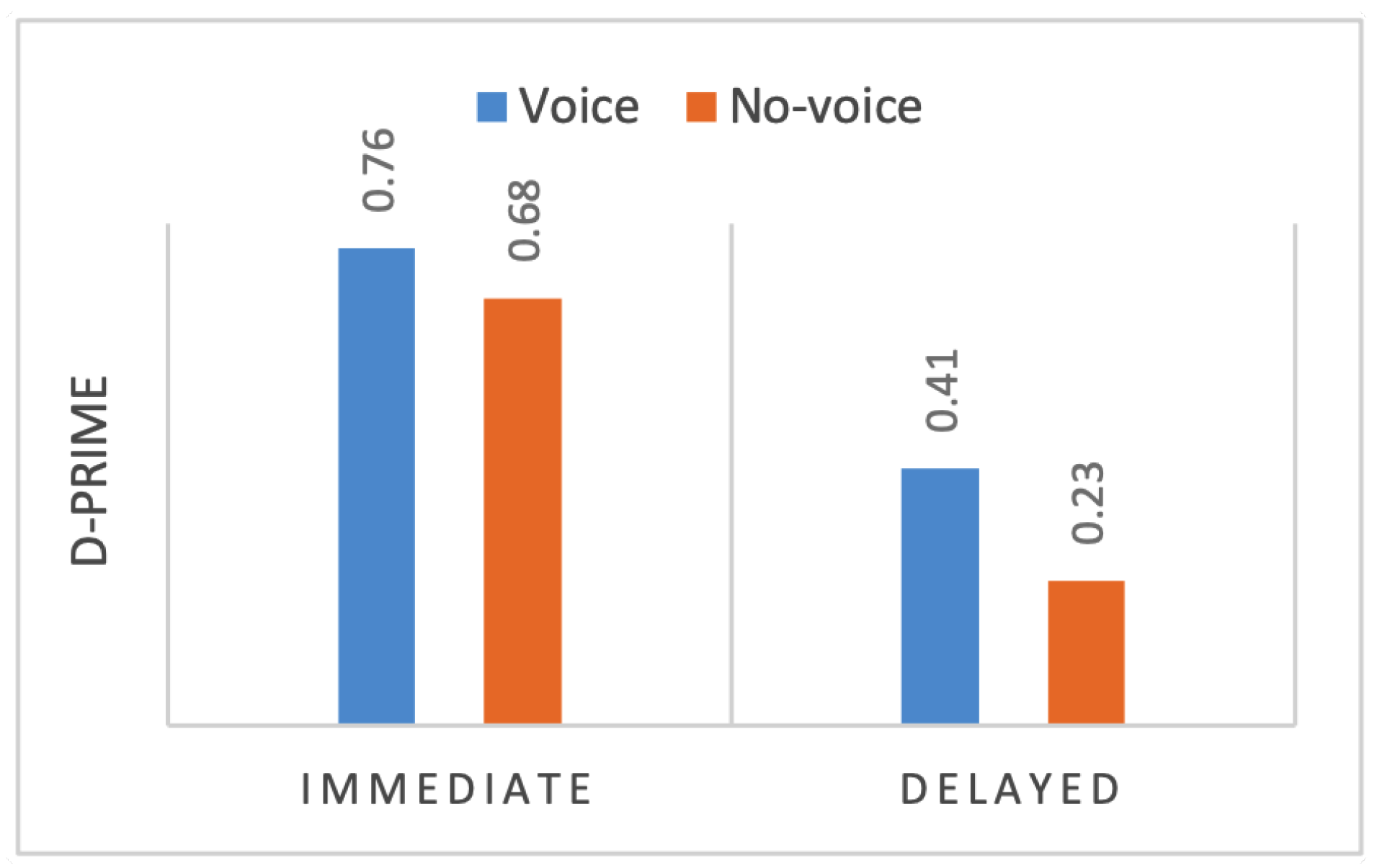
4.4. Framing the Museum Visit
| Purpose of the experiment | Compare the impact of AR on the viewer |
| Subjects’ characteristics | Middle school students in the 13-16 age group* |
| Experimental method | Control experiment (Group A: control group; Group B: experimental group) |
| Sample size | Total 20 persons (Group A: 10 persons; Group B: 10 persons) |
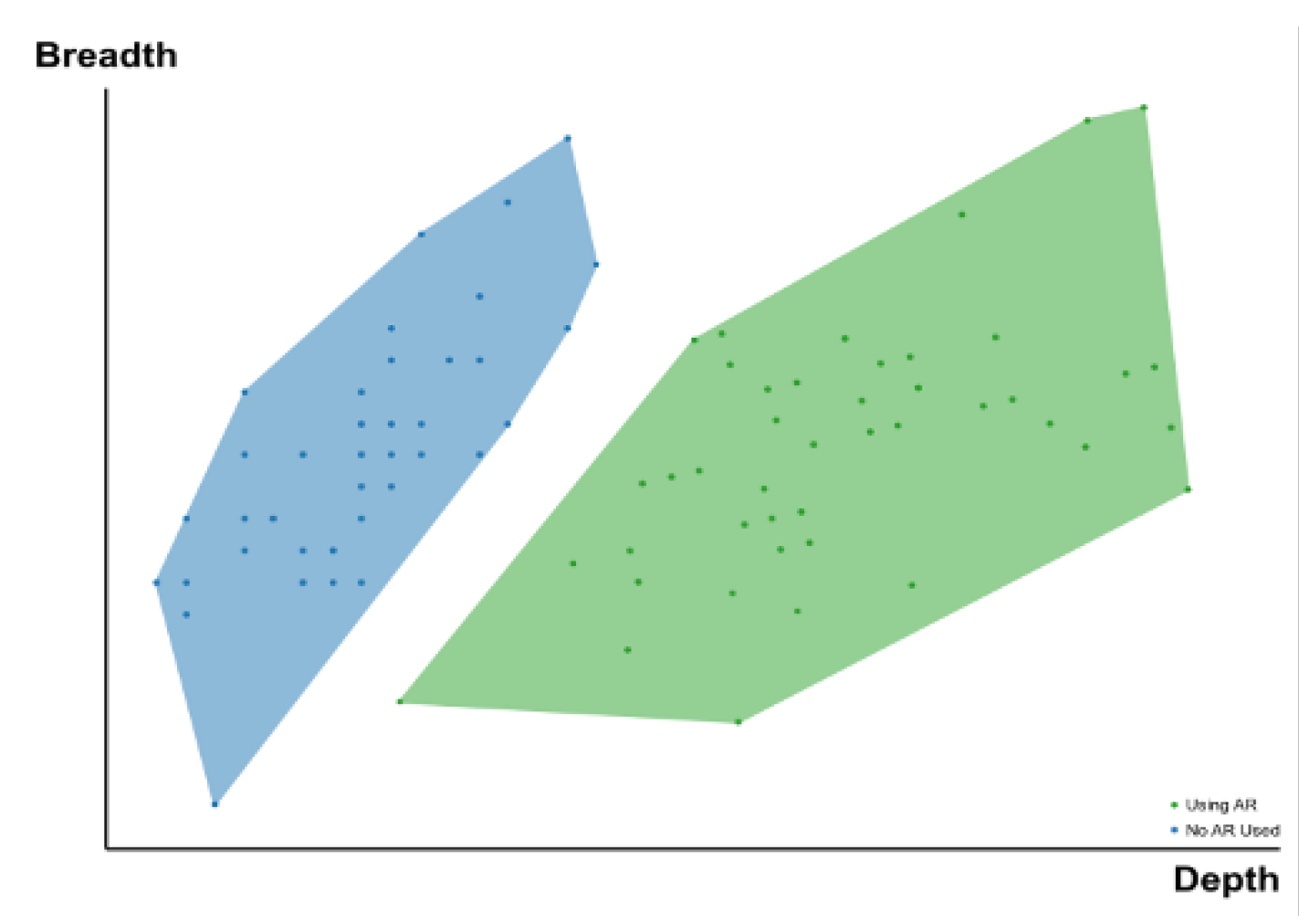
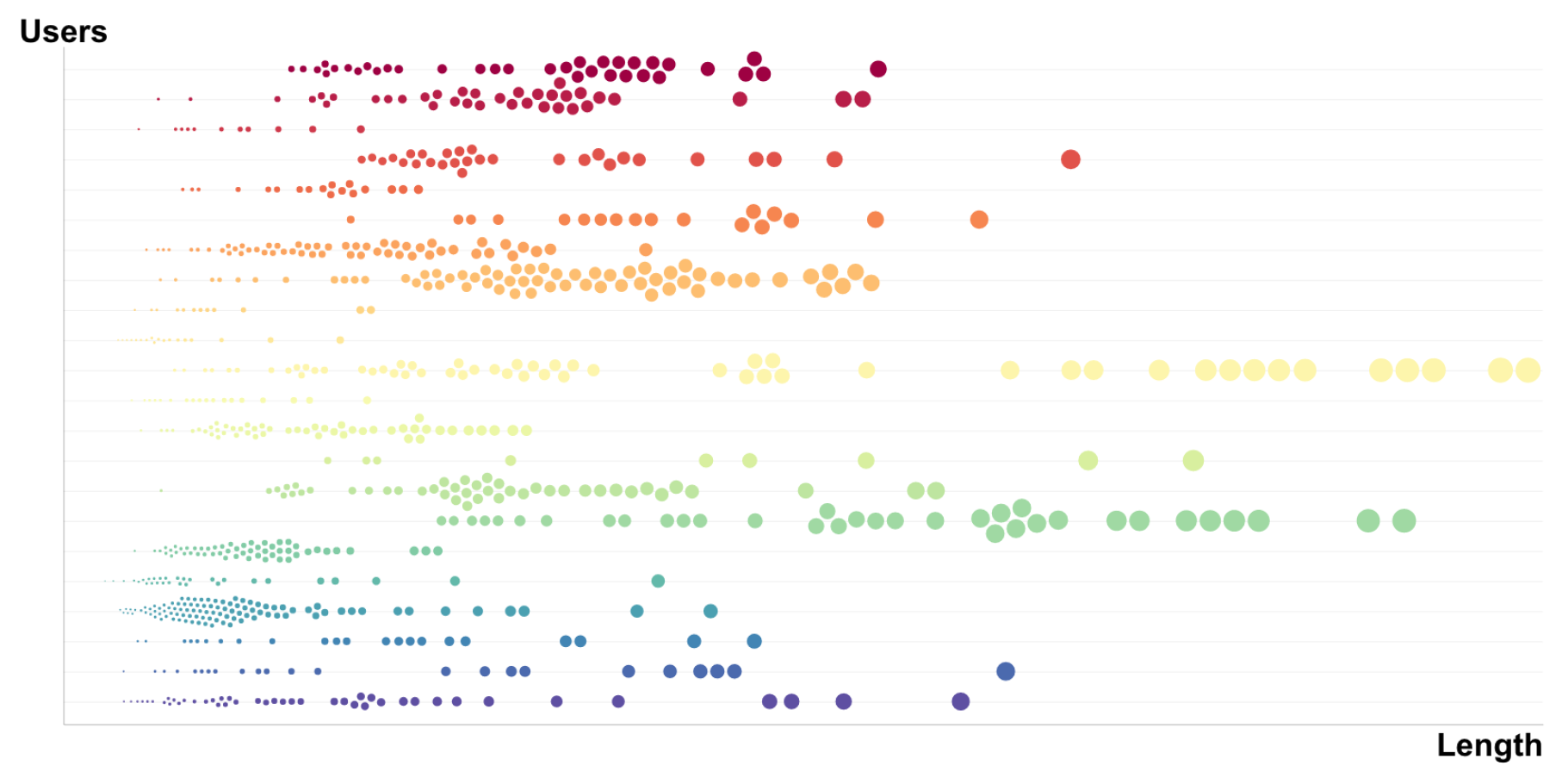
| Experiment description | The permanent exhibition area of “Earth Home” was chosen as the experimental exhibition gallery. Two groups of junior high school students were arranged to visit the display area, one group visited the original one and the other group visited the one under AR fireworks design service, and the duration of the visit was limited to 30 minutes to compare the breadth and depth of memory of the exhibits in the display area between the two groups. |
5. Discussion
5.1. AR Personalization
5.2. Focus on Accessibility and Usability
6. Conclusion
References
- Sakkopoulos, E.; Paschou, M.; Panagis, Y.; Kanellopoulos, D.; Eftaxias, G.; Tsakalidis, A. e-souvenir appification: QoS web based media delivery for museum apps. Electronic Commerce Research 2015, 15, 5–24. [CrossRef]
- Goldman, K.H. Understanding adoption of mobile within museums. Mobile apps for museums, the AAM guide for planning and strategy 2011.
- Paschou, M.; Sakkopoulos, E.; Tsakalidis, A.; Tzimas, G.; Viennas, E. An XML-Based Customizable Model for Multimedia Applications for Museums and Exhibitions. In Intelligent Multimedia Technologies for Networking Applications: Techniques and Tools; IGI Global, 2013; pp. 348–363. [CrossRef]
- Fosh, L.; Benford, S.; Reeves, S.; Koleva, B. Gifting personal interpretations in galleries. Proceedings of the SIGCHI conference on human factors in computing systems, pp. 625–634.
- Spence, J.; Bedwell, B.; Coleman, M.; Benford, S.; Koleva, B.N.; Adams, M.; Row Farr, J.; Tandavanitj, N.; Løvlie, A.S. Seeing with new eyes: Designing for in-the-wild museum gifting. Proceedings of the 2019 CHI Conference on Human Factors in Computing Systems, pp. 1–13.
- Durrant, A.; Rowland, D.; Kirk, D.S.; Benford, S.; Fischer, J.E.; McAuley, D. Automics: souvenir generating photoware for theme parks. Proceedings of the SIGCHI conference on Human factors in computing systems, pp. 1767–1776.
- Kang, Y.; Zhang, Z.; Zhao, M.; Yang, X.; Yang, X. Tie Memories to E-souvenirs: Hybrid Tangible AR Souvenirs in the Museum. Adjunct Proceedings of the 35th Annual ACM Symposium on User Interface Software and Technology, 2022, pp. 1–3.
- Maria Shehade, T.S.L. Virtual Reality in Museums: Exploring the Experiences of Museum Professionals 2020. [CrossRef]
- Cai, S.; Chiang, F.K.; Wang, X. Using the augmented reality 3D technique for a convex imaging experiment in a physics course. International Journal of Engineering Education 2013, 29, 856–865.
- Kang, Y.; Xu, Y.; Chen, C.P.; Li, G.; Cheng, Z. 6: Simultaneous Tracking, Tagging and Mapping for Augmented Reality. SID Symposium Digest of Technical Papers. Wiley Online Library, 2021, Vol. 52, pp. 31–33. [CrossRef]
- Billinghurst, M.; Clark, A.; Lee, G. A survey of augmented reality 2015.
- Sanders, M. Integrative STEM education: primer. The Technology Teacher 2009, 68, 20–26.
- Yang, X.; Kang, Y.; Yang, X. Retargeting destinations of passive props for enhancing haptic feedback in virtual reality. 2022 IEEE Conference on Virtual Reality and 3D User Interfaces Abstracts and Workshops (VRW). IEEE, 2022, pp. 618–619.
- Yousefi, S.; Kidane, M.; Delgado, Y.; Chana, J.; Reski, N. 3D gesture-based interaction for immersive experience in mobile VR. 2016 23rd International Conference on Pattern Recognition (ICPR). IEEE, pp. 2121–2126.
Disclaimer/Publisher’s Note: The statements, opinions and data contained in all publications are solely those of the individual author(s) and contributor(s) and not of MDPI and/or the editor(s). MDPI and/or the editor(s) disclaim responsibility for any injury to people or property resulting from any ideas, methods, instructions or products referred to in the content. |
© 1996 by the authors. Licensee MDPI, Basel, Switzerland. This article is an open access article distributed under the terms and conditions of the Creative Commons Attribution (CC BY) license (https://creativecommons.org/licenses/by/4.0/).