
Submitted:
17 October 2024
Posted:
21 October 2024
You are already at the latest version
Abstract
Non-Destructive Testing (NDT) is an appealing technique for confirming the welding quality and ensuring structural integrity without causing damage. It assists in regulatory compliance, risk mitigation, and process optimization for improved industrial reliability. This study reviews potential NDT approaches. Through a rigorous analysis of existing surveys, we aim to decipher the current landscape and highlight the significant advancements in the field. Because of the potential of artificial intelligence (AI) assistive X-ray imaging-based NDT, we particularly examine the integration of AI algorithms and X-ray imaging in the NDT of welds. This convergence represents a paradigm shift, redefining traditional methods and ushering in a new era of precision, automation, and efficiency. As we navigate through potential X-ray imaging datasets, delve into crucial image processing techniques, examine feature extraction methods, and explore AI algorithms, our survey reveals the intricate interplay of technologies that drive automated weld defect categorization. The review broadens its focus by including various practical applications, highlighting the adaptable utility of AI-assistive X-ray imaging for weld defect detection in potential industrial applications. Moreover, the promising opportunities and nuanced challenges associated with integrating X-ray imaging and AI in weld integrity assessment are highlighted. It provides a comprehensive perspective on this rapidly evolving field.
Keywords:
Non-destructive testing
; Weld defects
; Classification
; Applications fields
; X-ray imaging
; Deep Learning
; Machine Learning
; Ensemble Learning
; Algorithms
1. Introduction
Welding is crucial in sectors like automobile, aerospace, and oil. Rigorous weld monitoring ensures high-quality welds and identifies defects, while robotic systems make real-time adjustments. The complexity of welding processes drives advancements in non-destructive testing (NDT), contributing to improved efficiency, safety, and quality standards across industries [1,2].
Advancements in non-destructive testing (NDT), fueled by technologies like AI and machine learning, are transforming materials inspection for heightened precision in defect identification. Techniques such as ultrasonic testing and digital radiography have evolved, ensuring structural integrity across industries. Ongoing scholarly efforts aim to refine NDT methodologies, promising increased sophistication in the non-destructive evaluation and ensuring precision and reliability in various industrial sectors [3,4,5].
Various welding imperfections can compromise the strength of welded joints. The welding method influences Porosity from small voids or gas pockets and can be caused by issues such as impurities in the base metal. Prevention involves thorough cleaning and proper shielding. Additional defects like slag inclusion, incomplete penetration, lack of fusion, undercutting, and cracks may arise due to excessive heat input. Overlapping defects occur when there is an insufficient fusion between adjacent weld beads [6,7,8]. Ensuring well-built weld joints necessitates optimizing welding parameters and using Non-Destructive Testing (NDT) methods for early flaw detection without causing damage [9,10,11].
Various NDT techniques are used for comprehensive inspections. Radiographic testing(RT) uses X-rays or gamma rays to reveal internal structures and defects. In addition, visual inspection (VT) relies on direct observation and is essential for surface-level assessments. Furthermore, ultrasonic testing(UT) uses high-frequency sound waves to detect internal flaws and measure material thickness. Moreover, magnetic particle testing(MT) uses magnetic fields to identify surface and near-surface defects in ferromagnetic materials. Also, Acoustic emission testing (AE) detects structural changes by monitoring the release of stress-induced acoustic waves. Besides, eddy current testing(EC) induces electric currents to evaluate conductivity and detect defects in conductive materials. similarly, infrared thermography (IRT) measures surface temperatures to identify irregularities or anomalies. Each technique uniquely contributes to the quality control process, providing a comprehensive and accurate evaluation of materials and structures in various industries [12,13].
X-ray image processing advancements have transformed non-destructive testing (NDT) for welding joints, providing more precise inspections. Technologies like digital radiography and computed tomography offer improved resolution and faster imaging, enabling thorough analyses and enhanced defect detection. The integration of advanced algorithms ensures dependable inspections, contributing to continual improvements in welding quality and safety standards across industries
The integration of artificial intelligence (AI) into non-destructive testing (NDT) for weld flaws is a significant advancement that improves the accuracy and efficiency of flaw detection. AI, with its pattern recognition and data analysis capabilities, automates the detection process and enables real-time analysis of complex weld structures. This not only speeds up inspections but also reduces the likelihood of human error. The continuous adaptation and improvement of AI-driven NDT systems further refine their ability to detect and categorize weld defects over time, signifying a transformative shift in welding technology toward proactive and adaptive quality control measures [14,15].
The main contributions of this study are:
- Performing a rigorous comparative analysis of the critical previous studies and surveys in Non-Destructive Testing (NDT) of welds while presenting the current landscape and highlighting the advancements in the NDT.
- Presenting an in-depth examination of a novel paradigm about incorporating artificial intelligence (AI) assistive X-ray imaging in the NDT of welds. Establishing a solid research foundation through exploring X-ray imaging of weld defects datasets and investigating image processing, feature extraction, and AI techniques provides a comprehensive understanding of available data and processing methods.
- Summarizing the practical exploration of AI-Assistive X-ray imaging in various industrial sectors, going beyond theoretical discussions.
The rest of this paper is organised as follows. Section 2 presents the various weld defects and the NDT approaches. Section 3 reviews recent survey papers on X-ray image-based inspection of welds, highlighting our contributions through a comparative analysis. Section 4 provides a comprehensive review of publicly available X-ray imaging weld defects datasets, laying the foundation for subsequent analyses. Section 5 reviews various image processing techniques, used in X-ray-based welds quality inspection. Section 6 focuses on feature extraction and selection techniques, contributing to the understanding of key features. In Section 7, we explore AI-based, including machine-learning, ensemble-learning and deep-learning, classifiers for the automated classification of weld defects using X-ray images. Section 8 discusses practical applications of AI-assistive X-ray imaging-based weld defect identification. Section 9 presents the opportunities and challenges and provides a comprehensive summary of key findings and contributions, outlining implications and suggesting future directions. Section 10 concludes the paper.
2. Welds Defects and Non-Destructive Testing
2.1. Welds Defects Categories
Weld strength depends on regions such as the fusion zone, which is affected by the choice of filler material and its compatibility with the base metal. Weld monitoring prioritizes examination of the fusion zone and heat-affected zone (HAZ) to ensure weld integrity, performance, and safety. A comprehensive understanding of defects in these regions is critical to maintaining overall weld quality and reliability and provides insight into the effectiveness of different detection methods. Figure 1 illustrates the typical weld defects commonly encountered, including cracks, porosity, slag inclusion, overlap, incomplete fusion, incomplete penetration, undercut, and ideal weld.
Porosity defects: it is caused by small voids or gas bubbles in the welded metal, which is often influenced by contaminated parent metal and inadequate shielding gas during welding. To mitigate porosity-related problems and ensure quality welds, important measures include proper surface preparation, adequate shielding, thorough parent metal cleaning, moisture content control, regular equipment inspection and cleaning, and comprehensive welder training [16].
Slag inclusion: is a welding defect in which non-metallic substances, such as oxides or fluorides, become trapped within the weld bead. This occurs when residual slag particles are not completely removed between successive layers of the weld, compromising the final weld structure and reducing the overall quality of the joint [17].
Incomplete fusion: The melted filler metal does not completely fuse with the base metal or previously deposited metal. This defect weakens the joint and compromises the overall structural integrity. Factors such as insufficient heat input, improper parameters, or inadequate techniques are often associated with incomplete fusion, posing a significant risk to the quality and strength of the welded joint [18].
Incomplete penetration: characterized by insufficient weld metal penetration through the joint or workpiece thickness, compromises structural integrity. Factors such as insufficient heat input or improper angles contribute to this defect, making the weld susceptible to failure. Eliminating incomplete penetration requires precise adjustments to welding parameters and techniques to ensure proper penetration and fusion throughout the joint [19].
Cracks: are fractures within the welded material that occur in various orientations and affect the overall integrity. Stress, rapid cooling, or contaminants contribute to their formation. Managing weld cracking requires precise adjustment of welding parameters, careful material preparation, and post-weld heat treatment to ensure joint quality and minimize risk [20,21].
undercut: is characterized by ridges or notches along the edges of the weld bead caused by excessive melting of the base metal during welding. These grooves act as stress concentration points and pose a risk of premature weld failure. Undercutting is often associated with improper welding parameters, such as excessive current or travel speed, and can compromise the structural integrity of the weld [22].
Overlap: results from insufficient fusion or penetration between weld beads, weakening the weld. Contributing factors include improper welding parameters, techniques, joint preparation, and consumable selection. Prevention includes optimizing parameters, adjusting techniques, ensuring thorough joint preparation, considering increased heat input when necessary, selecting appropriate consumables, and maintaining a clean weld surface [23].
Ideal weld: Meets quality standards with consistent fusion and adequate penetration. It conforms to specified parameters, ensures structural reliability, and reflects the common goal of welding to meet performance criteria [24].
2.2. Non-Destructive Testing Methods
Non-destructive testing (NDT) techniques are essential for assessing the quality of welded joints without causing damage. These methods allow early detection and correction of defects, ensuring the reliability and longevity of welded structures while meeting stringent quality control standards [25].
-
Visual inspection method: Visual inspection (VT) identifies visible defects such as undercuts, slag inclusions, blowholes, surface cracks, and porosity. Conducted systematically by experienced inspectors, the process is enhanced with visible or fluorescent liquid penetrants for rapid, non-destructive defect identification [26]. Implemented through a methodical three-step process, it contributes significantly to comprehensive quality assurance across multiple industries, the results of which are compared to standards to ensure compliance with quality and safety benchmarks:
- -
- Penetrant Application: Penetrant is applied evenly to the entire surface to be inspected, ensuring complete coverage.
- -
- Cleaning: Excess penetrant is meticulously cleaned from the surface to prevent misleading indications during the inspection.
- -
- Developer Application: involves a developer’s application that pulls the penetrant out of potential defects and creates visible indications. During inspection, the surface is thoroughly examined for these indications, allowing the size, shape, and location to be assessed. The methodology is illustrated in Figure 2.
- Ultrasonic testing: Ultrasonic testing (UT), an NDT, employs high-frequency sound waves to inspect material internal structures for defects. This method, using specialized equipment like ultrasonic transducers, provides detailed information about defect size, shape, and location, making it a valuable tool for quality assessment across industries [27]. Figure 3 delineates the methodology.
- Infrared thermography method: Infrared thermography(IRT), a non-intrusive NDT technique, detects weld flaws by applying a heat source to the weld, which creates distinctive thermal patterns based on different heat absorption properties. Captured by an infrared camera, these patterns enable real-time identification and localization of various weld defects. Widely used in critical industries such as aerospace and manufacturing, IR thermography is essential for rapid on-site inspection and provides valuable insight into weld integrity [28]. Figure 4 elucidates the Infrared Thermography (IRT) methodology.
- Eddy current technique: Eddy current testing (ECT), a non-destructive technique, uses electromagnetic induction to detect surface and subsurface irregularities in conductive materials. Using an alternating current (AC) coil, eddy currents induced in the material reveal defects by changing the impedance of the coil. This enables fast and effective flaw detection in components such as tubes and pipes, eliminating the need for direct material contact [29]. Figure 5 illustrates the methodology.
- Acoustic emission method: Acoustic emission (AE) testing is essential for monitoring weld integrity by detecting defects such as cracks and delaminations through transient stress waves. In real-time analysis, AE signals identify potential problems immediately, making it widely used in design and manufacturing for continuous monitoring and timely insight into the reliability and integrity of welded components [30]. Figure 6 depicts the process.
- The radiographic technique: radiographic testing ((RT) uses high-energy X-rays to identify and evaluate weld defects, ensuring structural integrity without causing damage. Particularly adept at detecting internal flaws, radiography captures transmitted radiation to form detailed images on a radiographic film. Widely used in manufacturing, construction, and aerospace applications, this method provides a comprehensive insight into weld quality by accurately characterizing the size, location, and nature of defects [31]. Figure 8 illustrates the approach.
- Magnetic particle inspection( MT): is a non-destructive method to detect surface and near-surface weld defects. By inducing a magnetic field in the material and applying ferrous particles, defects disrupt the magnetic field, causing particles to accumulate around them [32]. Figure 7 describes the magnetic testing method.
3. Comparative Analysis of the Non-Destructive Testing(NDT) Techniques
This section navigates the present NDT landscape by providing a comprehensive, meticulously crafted comparison of key studies. Numerous studies provide extensive insight into various facets of weld quality, additive manufacturing, structural safety, and materials testing. Collectively, these articles address non-destructive testing (NDT) and defect detection in a variety of manufacturing domains. Madhvacharyula et al.(2022) [13] focuses on improving weld quality through real-time defect detection during welding. They provide a concise overview of various weld defects, common nondestructive testing techniques, and in-situ detection methods, categorized by input signals and algorithms. M.shaloo et al.(2022) [33] address defects in wire and arc additive manufacturing (WAAM) and fusion welding, highlighting their negative impact on mechanical properties and advocating for effective NDT techniques. J.rao et al.(2023) [34] review the transformative impact of additive manufacturing (AM), highlighting its benefits while acknowledging its challenges and emphasizing the role of NDT in inspecting for damage. X.Shen et al.(2023) [35] emphasize the importance of early detection of metal components in safety-critical structures through NDT, providing a comprehensive analysis of NDT technologies for metal crack detection. I.ramirez et al.(2023) [36] discuss the central role of additive manufacturing in the Fourth Industrial Revolution, emphasizing the need for efficient inspection methods and reviewing NDT practices. Other investigations cover diverse areas such as real-time monitoring of laser welding discussed by W. Cai et al.(2020) [37], the integration of deep learning for bridge deck assessment explored by DN. Lavadiya et al.(2022) [38], and the application of automated defect detection in industrial processes explored by M. Amarnath et al. (2023) [39]. Another focus is on surface defect detection using deep learning methods, as highlighted by Saberironaghi et al. (2023) [40], while Liu et al.(2023) [41] provide insights into radiographic image analysis of welding. Zhao et al.(2021) [42] highlight the vulnerability of ceramic products to defects and discuss non-destructive testing (NDT) methods tailored for ceramics. In addition, Gupta et al.(2022) [3] delve into the pivotal role of NDT in manufacturing processes, providing a comprehensive overview of various methods and highlighting the expanding applications of NDT. Taken together, these articles enrich our understanding of defect detection and NDT techniques, each contributing valuable insights and perspectives within its specific field.
Various research has been conducted to gain deeper knowledge about the different uses of NDT conventional techniques, such as the acoustic emission(AE) technique. Ramalho et al. [43] conducted a detailed investigation of the influence of various defects on the sound waves captured by a microphone during the Wire Arc Additive Manufacturing (WAAM) process. Using power spectral density and short-time Fourier transform (STFT) analysis techniques, they successfully identified defects. Luo et al. [44] investigated the application of AE count statistics, RMS waveform calculation, and power spectrum distribution methods for the analysis of AE signals during pulsed YAG laser welding. Their study asserted that the plasma plume induces recoil force and thermal vibration, which affect the acoustic parameters, especially influenced by the type of shielding gas and wire extension length exceeding 12 mm. In addition, Zhang et al. [45] used acoustic emission and air-coupled ultrasonic testing for real-time monitoring of burn-through events in gas tungsten arc welding (GTAW).
The infrared thermography (IRT) technique, is valuable for the detection of weld defects. Elkihel et al. [46] investigated the heat propagation of a weld using an active thermography method. Using inductive heating, they raised the temperature of the weld to 80 °C and observed the heat propagation using a FLIR T440 infrared camera with a resolution of 320 × 240 pixels and a bandwidth of 7.5 to 13 µm. Their results indicate that the heat loss in the weld zone is significantly greater than in the flawed region. In addition, researchers such as Massaro et al. [47] have integrated image processing and thermography techniques to ensure weld quality. They presented a novel method for identifying weld defects on a welded steel tank (AISI 304/316) using infrared thermography and image processing. By cutting out a sample and applying heat with a heat gun, the heat distribution was captured using a FLIR T 1020 with a resolution of 1024 × 768 pixels. The combination of infrared thermography and various image processing techniques, including line calculation, 2D K-means algorithm, 2D morphology functions, and a Long Short Term Memory (LSTM) artificial neural network, proved to be a powerful tool for real-time identification and classification of weld defects. Ziegler et al. [48] investigated the use of high-power laser excitation sources in lock-in thermography and claimed that the use of high-power lasers instead of LEDs and halogen lamps has minimal effect on the thermal emission generated by the excited sample since their emission is based on electroluminescence. Consequently, this method can be effectively used in one-sided transient thermography.
Ultrasonic testing is critical for detecting weld defects and providing an accurate assessment of the structural integrity of welded joints. Sun et al. [49] introduced an innovative hybrid ultrasonic sensing system, called diffuse ultrasonic wave (DUW), designed for the detection of damage in railway tracks using a lead zirconate titanate (PZT) actuator and a fiber Bragg grating (FBG) hybrid sensing system. The experimental results showed that the DUW signals captured by the hybrid sensing system show significant promise for detecting damage in railroad tracks. The use of conventional ultrasonic testing (UT) is limited when it comes to inspecting structures with hard-to-reach areas, such as superstructures or substructures. To overcome this limitation, embedded ultrasonic techniques have been used for damage detection. In the study by Chakraborty et al. [50], they presented a crack detection methodology based on an advanced signal processing algorithm, which was tested on various reinforced concrete structures and successfully identified cracks between embedded sensors. In an extension of their research, Chakraborty et al. [51] proposed an active approach to damage detection in multiple structures using embedded ultrasonic sensors. This involved processing raw ultrasonic signals with continuous wavelet transform (CWT) and non-decimated wavelet transform (NDWT) methods to extract features for damage detection. Both studies concluded that embedded ultrasonic sensors better monitor real structures more effectively than conventional techniques.
The eddy current utilizes light reflection to detect weld defects. F.xie et al. [52] investigate the use of pulsed eddy current (PEC) nondestructive testing to detect weld defects in large pressure vessel cylinders. Using a PEC sensor on a mobile platform, two simulated weld specimens are tested, revealing distinct signal patterns for specimens with and without defects. X-ray testing confirms the method’s feasibility for efficiently detecting subsurface defects in welds. Additionally, T.alvarenga et al. [53] proposes an embedded system using eddy current for real-time detection and localization, introducing a novel method that uses wavelet transforms and a convolutional neural network to interpret signals. This approach is instrumental in efficiently categorizing and locating anomalies, thus contributing to the optimization of rail maintenance strategies. Field tests successfully classify rail anomalies into three main classes: squids, welds, and joints. Further, R.M. Gansel et al. [54] highlight the need for a reliable inspection concept to detect fatigue cracks and damage. By evaluating five eddy current sensors, the research focuses on optimizing the signal-to-noise ratio during cyclic fatigue testing and selecting two sensors for semi-automated weld inspection. The effectiveness of the technique in detecting fatigue cracks is highlighted, with air coils arranged parallel to the test surface identified as optimal. The study demonstrates the ability of eddy currents to discriminate groove depths and detect actual fatigue cracks, providing important insights for assessing the structural integrity of wind turbines.
The use of magnetic inspection for weld flaw detection has been the focus of numerous research efforts to improve the reliability and efficiency of weld inspection processes. G.Y. Liu et al. [32] focuses on improving the visual effectiveness of weld flaw detection through magneto-optical imaging nondestructive testing technology. Finite element analysis and magneto-optical image simulation are used to analyze the detection characteristics under rotating excitation. The study proposes an image fusion method based on pixel standard deviation to improve welding defect detection in magneto-optical imaging. By applying fast guided filtering and pixel standard deviation to fuse multi-frame magneto-optical images, the proposed method improves image quality and ensures efficient nondestructive testing of welding defects with improved visual effects. In addition, F.brauchle et al. [55] addresses the detection of production defects in lithium-ion cell manufacturing to reduce scrap rates and improve energy efficiency through early detection. The proposed method uses an improved magnetic field imaging (MFI) setup and current reconstruction, building on previous work with anisotropic magnetic resistance (AMR) sensors. The approach involves scanning the magnetic field above the cell in a two-dimensional plane to detect and locate manufacturing defects, such as missing welds, cuts, cracks in the active material and current collector, and blocking elements between cell layers. Moreover, J. Ai et al. [56] aims to improve the applicability of eddy current magneto-optical imaging nondestructive testing technology for defect detection in carbon fiber reinforced polymers (CFRP). By improving the magnetic field response of the system, especially in the context of CFRP with low conductivity, the research introduces a scanning eddy current magneto-optical imaging device. A novel inspection method known as eddy current magneto-optical phase imaging is proposed for detecting crack defects in CFRP.
The exploration of weld quality and defect detection with the use of X-ray techniques unfolds systematically, with each study building upon the foundation laid by Madhvacharyula et al.(2022) [13], they concentrate on real-time defect detection during welding, offering a comprehensive overview of weld defects, prevalent nondestructive testing techniques, and in-situ detection methods categorized by input signals and algorithms. This establishes a cohesive starting point for subsequent research. Moreover, Li, Yaping, et al. (2019) [57] contribute by proposing a deep learning network for X-ray image-based weld flaw detection, introducing a novel approach that simulates visual perception principles. This study directly identifies linear defects, circular defects, or noise without explicit feature extraction, demonstrating feasibility and effectiveness in enhancing efficiency. However, potential challenges, such as significant computational resource requirements and the need for robust model training for diverse defect types, are acknowledged. In addition, S.Sudhagar et al. (2020) [58] take a numerical approach to evaluate friction stir welding (FSW) quality using X-ray images. Employing image processing, they quantify and correlate defect areas with weld mechanical properties, providing valuable quantitative insights. The Taguchi method is utilized to identify optimal process parameters. However, potential limitations arise from assumptions about the relationship between defect area and mechanical properties, as well as the need for precise control of process parameters. Furthermore, Chen, Ji et al. (2023) [26] contribute to the sequence by aiming to enhance accuracy and efficiency in pipeline weld defect detection through non-destructive testing (NDT). Their model integrates the Feature Pyramid Network (FPN) and introduces a new visual attention mechanism (SPAM) to address challenges in X-ray image analysis. Improved detection accuracy is evident, although potential drawbacks include challenges in parameter tuning and dataset biases. Besides, J. Kastner et al. (2015) [59] offers a unique perspective by exploring the application of flat-panel matrix X-ray computed tomography (XCT) as a non-destructive method for characterizing sample structures. Challenges in analyzing generated XCT data are highlighted, but the benefits include the ability to scan and quantify heterogeneities of different sizes and topologies, offering valuable insights that require specialized image processing expertise. Further, A. Bansal et al. (2023) [60] conclude the sequence by focusing on weld defect detection through radiographic image analysis. They recognize the complexities introduced by diverse defect characteristics and propose computer-based image processing approaches. The study emphasizes the potential for automated detection using a unique image-based approach, with a comparison favoring deep learning networks for higher accuracy. This sequence of studies collectively presents a nuanced exploration of improving weld inspection and defect detection methodologies, with each study contributing progressively to the overarching theme. Table 1 summarizes the significant contributions and limitations extracted from the relevant literature, providing essential insights into different methodological approaches within nondestructive testing research. It provides a valuable guide for navigating the intricacies of the field and enhances our understanding of both advances and challenges in the discipline.
Based on findings, presented in Table 1 and Table 2 outlines the advantages and disadvantages associated with each of the considered NDT technique. Each method has its plus and minus, and the choice depends on the particular inspection requirements, material characteristics, and the nature of the potential defects.
Among the considered NDT methods, the X-ray imaging approach is becoming famous because of its remarkable ability to penetrate materials, provide detailed information on internal structures, and effectively identify subsurface defects within welds. Moreover, it is easily compatible with existing mature image processing, feature extraction, and AI algorithms to attain a precise and automated solution. Additionally, its proven success in various industries makes it a reliable option for inspecting weld quality and categorizing major welding defects. This is why, in the remaining parts of this paper, we focused on the X-ray method for NDT of welds.
4. X-ray Images Datasets for Welding Joints
In the field of NDT, especially in welding, the datasets play an essential role in AI-based automated defect detection. They are crucial tools for analyzing and mining intricate weld details and defect characteristics. Leveraging advanced technologies, researchers use these datasets to investigate weld integrity and defect identification comprehensively. Adopting data-driven AI approaches increases the accuracy and reliability of weld quality assessment, contributing significantly to the advancement of weld inspection practices.
RIAWELC Dataset, [73], is a novel dataset for automatic weld defect classification. It consists of 24,407 radiographic weld images classified into four classes: lack of penetration, cracks, porosity, and no defect. With an emphasis on authenticity, the dataset accounts for real-world conditions and variations in image quality. The original X-ray weld images, taken in an industrial setting and digitized as JPEGs (2000×8640 pixels, 8-bit), underwent initial processing including bead segmentation and background removal. A custom software routine extracted regions of interest, specifically slices with potential weld defects, using a windowing technique. An optimal compromise for clear visualization of various defects was found with a window size of 80×80, balancing the detection of both small and large defects. Totino. B et al. [73] introduce the RIAWELC dataset, highlighting its characteristics and its usefulness in classifying weld defects using deep learning models. Then draw a comparison between the RIAWELC dataset and the GDX-ray and WDXI datasets. In addition, S.perri et al. [74] present a new dataset of 24,407 annotated grayscale images of welding defects, along with a novel CNN model called WelDeNet. This model demonstrates a high accuracy of 99.5% in classifying four defect classes: lack of penetration, cracks, porosity, and no defect.
GDXray, [75], is a weld x-ray database created by adapting the GRIMA x-ray database. The acquisition of the x-ray images followed the guidelines outlined in the ISO 17636-1 standard, specifically designed for the radiographic examination of metal fusion welds. A Lumisys LS85 SDR scanner was used to digitize the radiographic films. The rescaling process involved converting the original 12-bit data to 8-bit using a linear look-up table (LUT) proportional to the optical density of the film. The resulting radiographs are formatted in TIFF with a pixel size of 630 DPI. Several applications use the GDxray dataset to enhance our efforts in the area of weld joints. Say.D et al. [76] study proposes an automated approach using GDXray, which combines data augmentation and convolutional neural networks (CNN) to identify multi-class weld defects in X-ray images. Additionally, Sh.naddaf et al. [8] focus on the use of artificial intelligence, specifically deep learning, for automated defect detection and classification in nondestructive testing of newly created welds. The study involves generating 100,000 X-ray images of various welds, annotating them with NDT experts, and training a convolutional neural network (CNN) with an overall defect detection accuracy of 96%, prioritizing field-quality welds over laboratory welds. Furthermore, A.movafeghi et al. [77] highlight the importance of identifying defects in industrial pipe welding through radiographic inspection. It introduces the Sparse Coding and Gaussian Scale Mixture (SSC-GSM) method, which uses Gaussian mixture models to enhance image contrast in radiographic images. By effectively eliminating background noise, the method results in a twofold increase in pixel density along analyzed profile lines. SSC-GSM demonstrates improved contrast and defect detection compared to conventional approaches. Also, S.kumaresan et al. [78] presents a novel approach using a deep learning model trained on a small radiographic dataset. Data augmentation and fine-tuned transfer learning using VGG16 and ResNet50 architectures are employed. The VGG16-based model achieves a high average accuracy of 90%.
The WDXI dataset, [79], contains 16,950 weld images obtained from equipment manufacturers and quality inspection laboratories. Converted from X-ray films and paper reports, the dataset covers various defect types and includes 13,766 annotated images. Stored in 16-bit TIF format, these images vary in resolution and aspect ratio, providing a diverse representation of real-world welding scenarios. S. Mohana et al. [80] propose a method for crack detection in weld images using image processing techniques, involving stages of preprocessing, feature extraction, classification, and crack region segmentation. Further, J.zhang et al. [81] focus on the problem of accurate segmentation of weld defects (WDS) in X-ray images, particularly in distinguishing critical defects such as cracks from the noisy background, is addressed. To address this challenge, the authors present a solution called Boundary Label Smoothing (BLS), which uses Gaussian blur to soften labels near object boundaries, while acknowledging the inherent inaccuracies in ground truth labels. Moreover, Ch.ajmi et al. [82] discusses the impact of computer-aided weld flaw detection in nondestructive testing, highlighting its ability to overcome the limitations of manual inspection. It emphasizes the importance of overcoming the challenges of visually inspecting X-ray weld databases, especially when dealing with poor-quality data containing small, sticky porosities. The study presents a novel approach using the Faster RCNN architecture and thoroughly validates its effectiveness through parameterization, training, testing, and comparison with other models such as YOLO and DCNN.
The SBD dataset, [83], is used for weld defect classification, which comprises 100,000 patches extracted from full-sized 13,560 × 1024-pixel images of a welded pipeline. An expert has categorized these patches into two groups: no-defective and defective. Sh. naddaf et al. [83] describe the importance of continuous monitoring and advanced inspection in modern manufacturing and infrastructure maintenance. It highlights the potential economic risks associated with the growing demand for these processes and the shortage of skilled personnel. The use of artificial intelligence (AI) in advanced inspection is advocated to automate tasks and increase confidence in operations. The focus is on the non-destructive testing (NDT) of newly created welds using radiographic imaging. Existing Assisted Defect Recognition (ADR) tools are criticized for their limitations, leading to the introduction of deep learning for defect detection in newly created welds.
Table 3 concisely overviews various X-ray imaging-based welding datasets. It offers insight into the diversity of data sources, and access links to these datasets are included to facilitate further exploration and use for research purposes.
5. X-ray Image Processing for Welding Defects Enhancement
Digital radiographic images often present challenges, including reduced contrast, the presence of noise, and uneven gray scale distribution. These issues have a significant impact on weld defect detection, especially when dealing with small defects that are easily obscured by noise. Various processing methods have been used to address or mitigate these challenges. It is critical to perform the processing with precision to prevent the loss of critical information. For example, applying image enhancement methods such as normalization and histogram equalization can risk losing the original shape and brightness distribution of defects, which is essential for distinguishing between defect types.
A nuanced image processing pipeline is employed in the area of X-ray-based weld flaw detection, showcasing the fusion of advanced techniques. Notable methods such as histogram equalization [84,85] are used in image processing to improve image contrast by redistributing pixel intensities across the dynamic range. The process begins by constructing a histogram that represents the distribution of pixel intensities within the image. A transformation is applied to this histogram to achieve a more uniform distribution. This transformation adjusts and stretches the intensity values to encompass the available range. The result is an image with improved visibility of details and features. This improvement is particularly noticeable in regions that were previously confined to a narrow intensity range and are now more visible due to the increased contrast. In addition, image filtering [86] is a powerful technique that involves applying convolution or mathematical operations to an image. This process uses filters or convolution matrices designed to enhance or reduce certain features within the image. Filters can be spatial or frequency-based and can include actions such as blurring, sharpening, or edge detection. Convolution, an integral part of this process, involves sliding a filter matrix over the pixel values of the image, performing a weighted sum at each step. This action changes pixel intensities, emphasizing or diminishing certain features. Image filtering is widely used in various image processing contexts for noise reduction, edge enhancement, and feature extraction tasks. Furthermore, the Contrast stretching technique [85], Contrast stretching is an image enhancement technique that linearly scales pixel intensities across the entire dynamic range, effectively expanding the contrast within the image. By redistributing pixel values, it aims to improve the visibility of features. This method identifies the minimum and maximum pixel values in the original image and applies a linear transformation to enhance the differences between the intensities. Contrast stretching is valuable for improving visibility in images with limited contrast by making darker areas darker and brighter areas brighter. Moreover, the Wavelet Transform [87,88] is a mathematical tool that is critical in image processing for performing multi-resolution analysis. Its primary function is to decompose an image into distinct components present at different frequency bands, effectively capturing both intricate and broad details. This complex transformation is accomplished by convolving the image with a series of wavelet functions that vary in scale and location. The resulting coefficients provide a representation of the image’s frequency content, facilitating a thorough examination of its features. Wavelet transforms are particularly useful in a variety of applications such as image compression, noise reduction, and feature extraction because of their ability to provide a nuanced, multi-scale representation of visual data. Also, the thresholding and morphological operations [89,90] is a segmentation method used to divide an image into distinguishable regions based on pixel intensity values. The process requires the specification of a threshold, and pixels with intensities above or below the threshold are assigned to different segments. This binary classification streamlines image analysis and facilitates the feature extraction process. Thresholding is widely used in image segmentation, object detection, and image binarization tasks. In particular, adaptive thresholding techniques account for local fluctuations in pixel intensities, making the method more resilient when dealing with images under varying lighting conditions. The illustration in Figure 9 depicts the assessment of an image processing technique applied to X-ray images.
6. Feature Extraction and Selection Techniques
Feature extraction and dimension reduction techniques are essential processes in data analysis and machine learning to improve model efficiency and reduce computational complexity.
The Non-transformed signal features [91,92] in image processing involve extracting features directly from pixel values, including intensity-based features (mean, standard deviation), spatial-based features (coherence, smoothness), statistical measures (entropy), color-based features (histograms), and edge-based features. This approach provides insight into image properties without mathematical transformations, making it suitable for tasks where computational efficiency is a priority or simple pixel analysis is required.
Transformed signal processing [93] involves applying mathematical transformations such as Fourier or wavelet transforms to analyze pixel values. This process, which transforms images into frequency or spatial domains, reveals hidden patterns and structures. Key features include frequency components, making them valuable for tasks such as compression and texture analysis. Transformed signal characteristics offer efficiency in analyzing complex image content, especially for identifying specific patterns that are not readily apparent in the original pixel space. This technique involves the Principal Component Analysis (PCA) [94] is a dimensionality reduction technique that transforms the original features into a new set of uncorrelated features called principal components. This process helps retain the essential information in the data while eliminating less important details. In addition, it requires discrete sine transform (DST) and discrete cosine transform (DCT) [95,96] are mathematical methods for transforming data from the spatial to the frequency domain. DST is effective for signals with odd symmetry, commonly used in applications such as speech processing. DCT, widely used in image and video compression (e.g., JPEG, MPEG), excels at concentrating signal energy into fewer coefficients, making it a key component in compression algorithms. Both transforms play an essential role in applications where efficient data representation and compression are critical.
Graph descriptors [97] are quantitative measures derived from graphs that represent networks of nodes and edges. These measures, including degree distributions, clustering coefficients, and centrality metrics, provide insight into networks’ structural and topological properties. Graph descriptors are critical to analyzing complex systems such as social and biological networks, facilitating a systematic understanding of their organization and connectivity.
Structural descriptors in image processing [98] are quantitative measures that capture spatial relationships, shapes, and patterns within an image. These descriptors, including moments, shape metrics, and spatial relations, provide valuable information for tasks such as object recognition and image segmentation. They play a crucial role in quantifying the structural attributes of digital images, supporting various image processing applications.
In the advanced domain of non-transformed and transformed signal characteristics in image processing [1], methods such as Krawtchouk moments, Minkowski moments, and Zernike moments provide clear insight into spatial relationships and shape characteristics. These non-transformed techniques serve as powerful descriptors for tasks such as object recognition. At the same time, advanced transformed techniques, including Zernike velocity and the concept of writhe number, contribute to a comprehensive toolkit for image processing. The integration of these diverse methods enhances capabilities in tasks ranging from biomedical imaging to computer vision applications, exemplifying the dynamic environment of research underway in image processing.
In image processing, texture descriptors [99] are crucial for quantifying visual patterns within an image and play an important role in tasks such as recognition and segmentation. These descriptors include statistical measures such as mean and variance, histogram-based features such as entropy, matrices such as the co-occurrence matrix (GLCM) that capture common pixel occurrences, and transforms such as wavelet transforms that reveal different frequency components. Local binary patterns (LBPs) are used to characterize local patterns. These descriptors play a crucial role in understanding the spatial arrangement of pixel values, contributing significantly to effective image analysis in applications such as medical imaging and computer vision.
Dimension reduction, or feature selection, is a critical step in image processing that uses statistical measures to efficiently select informative features from high-dimensional datasets and streamline computational complexity.
Filtering methods [100] in dimension reduction for image processing use statistical measures such as variance thresholding, correlation-based selection, mutual information, chi-square tests, and ANOVA. These techniques efficiently identify informative features by evaluating variance, correlation, and statistical differences, making them computationally efficient for handling high-dimensional image data. Furthermore, Wrapper feature selection [101] methods evaluate the performance of a machine learning model with different subsets of features, optimizing the selection based on the model’s predictive accuracy. In addition, Embedded methods for feature selection [102] incorporate the process directly into model training, automatically selecting relevant features during learning, offering a streamlined and efficient approach. Manifold learning [103] is a set of techniques in machine learning and data analysis that aim to uncover the intrinsic, lower-dimensional structure or geometry of high-dimensional data. These methods are instrumental when the data lies on or near a lower-dimensional manifold within a higher-dimensional space. Manifold learning algorithms such as t-distributed Stochastic Neighbor Embedding (t-SNE), Isomap, and Locally Linear Embedding (LLE) attempt to preserve the essential relationships and similarities between data points in the reduced-dimensional space. By revealing the underlying structure, manifold learning enables improved visualization, clustering, and classification of complex data sets. Figure 10 below illustrates diverse techniques for feature extraction and dimension reduction, including methods for feature selection.
7. AI Based Classifiers
7.1. Machine Learning Algorithms
Machine learning (ML) is a subdivision of the expansive field of AI, aiming to emulate the learning and recognition abilities of the human brain while also possessing self-optimization capabilities. The use of machine learning (ML) in NDT is driven by the need for accurate defect prediction in materials, structures, and welds within pipelines. To keep pace with expanding industrial production and ensure accuracy, defect analysis, and detection systems must minimize errors, taking into account both human and algorithmic factors.
The Support Vector Machine (SVM) algorithm [104] is a powerful supervised learning method that establishes an optimal hyperplane for classifying data points by maximizing the margin between classes. By using kernel functions to transform data into higher-dimensional feature spaces, SVM excels at discovering nonlinear decision boundaries. Its robustness and theoretical underpinnings make it valuable in scientific applications such as image recognition and text classification. In non-destructive testing, SVM is useful for analyzing and classifying data from tests that assess material or structural integrity without causing damage. With labeled data representing different material conditions, SVM accurately detects defects or anomalies, contributing to efficient and reliable structural integrity assessment [105].
Among the works for defect detection in welded joints using SVM classifiers, we find C.Y. Liang et al. [106] present an approach that includes extracting features from ultrasonic defect signals bychen2023automatic wavelet packet energy entropy (WPEE) and kernel principal component analysis (KPCA). Defect classification uses an artificial bee colony optimization support vector machine (ABC-SVM) classifier. M.A. Amine et al. [107] use machine learning algorithms, specifically the one-class support vector machine (SVM) with distance substitution kernels, to automate weld defect detection by identifying abnormal subsequences in the weld voltage signal.
Moreover, the k-nearest Neighbor (k-NN) algorithm [108], a supervised learning technique, assigns class labels to data points based on the consensus of their closest k-neighbors. It computes distances within the training dataset to identify nearest neighbors. In non-destructive testing, k-NN scrutinizes data from tests assessing material or structural integrity. By training with annotated data covering diverse conditions, the k-NN model excels at accurately categorizing novel test data, enhancing the assessment of material and structural soundness in scientific contexts involving non-destructive testing [109].
During studies on the detection of defects in welded joints through the use of KNN classifiers, we encounter, S. Pekcsin et al. [110] use machine learning techniques, specifically KNN and CART, to evaluate the conformance of spot welds performed by robotic arms with predefined standards. Among the methods used, the CART model proved to be the most suitable, with the highest F1 score of 93% in the experiments conducted. In another study, J.M. Grochowalski et al. [111] uses Pulsed Multifrequency Excitation and Spectrogram Eddy Current Testing (PMFES-ECT) along with a supervised learning approach to estimate defect parameters in conductive materials. The k-NN algorithm is then used to infer defect parameters from measured data, and the research includes an evaluation of the classification accuracy for different combinations of predictors derived from these measurements.
Like the previous algorithms, Random Forest [112] is an ensemble learning technique that is widely used in supervised learning for classification and regression. It consolidates predictions from multiple decision trees, increasing accuracy and robustness. Each tree is constructed using a random subset of training data and input features to prevent overfitting and increase diversity. During prediction, the algorithm combines predictions from individual trees using methods such as majority voting or averaging. Known for its ability to handle high-dimensional data, its resistance to noise, and its ability to identify significant features, Random Forest also provides interpretability by revealing the importance of features. Its scalability and effectiveness in managing complex datasets have made it valuable in several scientific domains where accurate predictions are critical.
Although the random forest has a significant role in the detection of defects in welded joints, we find that, HF. Wang et al. [113] focus on the automated identification and categorization of linear and volumetric defects in welds using phased-array and total-focus ultrasonic techniques. The random forest algorithm is used for feature extraction, resulting in a commendable 96% accuracy rate for defect detection and classification from images. On the other hand, SC. Wang et al. [114] presents a pioneering thin-film thermocouple (TFTC) sensor tailored for real-time temperature monitoring in metal inert gas (MIG) welding of aluminum alloys. Emphasizing its fast response, easy installation, and non-destructive properties, the study employs a random forest model and achieves an impressive 97.14% accuracy in identifying four common welding defects. The key ML algorithms, previously employed for the X-ray image-based NDT of welds, are graphically summarized in Figure 11.
7.2. Deep Learning Algorithms
Deep learning, a subset of machine learning [115,116], focuses on training artificial neural networks, commonly known as deep neural networks, with multiple layers. This enables these networks to learn autonomously and make intelligent decisions based on data, to replicate the hierarchical information processing observed in the human brain. Deep learning algorithms excel at tasks such as image and speech recognition, natural language processing, and strategic gaming. This ability is achieved by iteratively refining data representations across interconnected layers of neurons.
Deep Learning encompasses a multitude of algorithms at its forefront, each contributing to its dynamic progress. Among these, Convolutional Neural Networks (CNNs) [117] is a specialized deep learning model designed for visual data, particularly images. It consists of convolutional layers that automatically learn hierarchical features from input images, capturing patterns and structures. Pooling layers reduce spatial dimensions, and fully connected layers combine features for tasks like classification. CNNs excel in image recognition, object detection, and visual perception due to their ability to learn complex features without manual engineering.
B. Guo et al. [118] addresses the hurdles in welding defect classification using deep learning, specifically addressing challenges such as insufficient training data and complex model structures that hinder real-time performance. They propose a solution by introducing a lightweight convolutional neural network (CNN) and solving problems related to insufficient and unbalanced weld defect images by applying generative adversarial network (GAN) data augmentation. furthermore, AM. AlShareef et al. [14] focus the industry’s attention on improving production and reducing human failure by integrating non-destructive testing (NDT) with artificial intelligence technologies. They propose a triple classification convolutional neural network (CNN) for weld defects.
Recurrent Neural Networks (RNNs) [119] is a neural network specifically designed to process sequential data. Unlike traditional feedforward networks, RNNs have cyclic connections, allowing them to retain a memory of previous inputs. This design is well suited for tasks that require the capture of context or temporal dependencies. RNN classifiers are widely used in various domains, including natural language processing, speech recognition, and time series analysis, where the ordering of data is critical for accurate classification or prediction.
C. Hu et al. [120] propose a non-destructive testing (NDT) technique using infrared thermography, complemented by a long short-term memory recurrent neural network (LSTM-RNN) model, designed to automatically categorize common defects in honeycomb materials, including debonding, adhesive pooling, and liquid intrusion. B. Wang et al. [121] improve ultrasonic welding (USW) process monitoring by accurately predicting quality outcomes through modern process automation. their proposed solution involves the use of a long short-term memory (LSTM) recurrent neural network to classify quality outcomes from continuous signals and determine the time segment when the processed signal aligns with the final quality class prediction.
Long Short-Term Memory (LSTM) [122] classifier is a specialized recurrent neural network designed for sequential data processing. Its special feature is the inclusion of memory cells and gating mechanisms that control the flow of information. Through input, output, and forget gates, the LSTM selectively retains relevant information, effectively handling long-term dependencies in sequential patterns. Widely used in applications such as natural language processing and time series prediction.
C. Hu et al. [120] address weld seam inspection in the manufacturing industry by proposing a digital twin system for welding robots. They incorporate a wavelet filtering technique to eliminate machine noise interference from the acoustic signals. Then, a SeCNN-LSTM model is implemented to detect and categorize weld acoustic signals based on strong acoustic signal time sequences, achieving a high inspection accuracy of 91%. On a related note, B. Wang et al. [121] present an LSTM recurrent neural network designed to monitor ultrasonic welding (USW) and other time-series signals. The focus is on identifying the point at which a process signal deviates from an acceptable final quality outcome to classify quality outcomes from continuous signals, using finite segments of process monitoring signals and their sampling time as inputs.
In parallel, Generative Adversarial Networks (GANs) [123] introduce a dynamic interplay between generator and discriminator, facilitating the creation of realistic data, spanning images to text. Simultaneously, Transformer-based architectures, exemplified by the BERT model [124], have reshaped natural language processing by capturing contextual intricacies, driving advancements in sentiment analysis and language translation. These and other algorithms propel the evolution of Deep Learning, reshaping the landscape of artificial intelligence in the process. The key DL algorithm employed in the X-ray image-based NDT of welding defects is graphically summarized in Figure 11.
7.3. Ensemble Learning Techniques
Ensemble learning [125] is a machine learning approach that combines multiple models to improve prediction accuracy and robustness. By aggregating different models, such as through bagging, boosting, or stacking, ensemble methods aim to achieve better generalization and performance compared to individual models. This technique is widely used to improve predictive capabilities in various domains. Ensemble learning consists of two approaches: boosting and bagging techniques, Boosting sequentially corrects errors in models, often used with decision trees such as AdaBoost [126], is an ensemble learning algorithm designed to improve the performance of weak learners and produces a robust classifier. The algorithm sequentially trains a set of weak classifiers, assigning higher weights to misclassified instances at each iteration. It adapts over iterations, focusing on difficult instances and emphasizing misclassifications to improve overall accuracy. The final model is a weighted combination of weak classifiers, with more accurate classifiers contributing more to the final decision. AdaBoost is versatile, with applications in computer vision, object detection, and medical image analysis, thanks to its adaptability and effectiveness in handling complex datasets.
The Gradient Boosting [127] is an ensemble learning technique that constructs a predictive model as a combination of weak learners, typically decision trees. The algorithm trains new models sequentially, focusing on correcting the errors of the previous ensemble. During each iteration, a weak learner is trained on the residuals or errors of the current ensemble, and its predictions are integrated with those of the existing ensemble. This iterative process continues, with each new model focusing on minimizing the errors of the collective ensemble. The learning rate parameter controls the impact of each new model. Known for its effectiveness in regression and classification tasks, gradient boosting is characterized by its resilience, adaptability, and ability to handle complex, non-linear relationships within the data.
Bagging [128], is an ensemble learning method that involves training multiple instances of a base learner, typically decision trees, on different subsets of the training data created through bootstrapping. This process, which entails random sampling with replacement, generates diverse training sets. The predictions of each independently trained base learner are then aggregated to form the final ensemble model. Bagging is effective in reducing overfitting and enhancing model stability and generalization performance, particularly when applied to unstable models or datasets with variability. Random Forest, a popular ensemble algorithm, utilizes Bagging by training multiple decision trees and combining their predictions. Overall, Bagging contributes to improved model robustness in various machine-learning applications. Various ensemble learning techniques, used in the X-ray image-based NDT of welding defects are graphically summarized in Figure 11.
Several research studies have been conducted on the detection of welding defects using ensemble learning. Such as H. Li et al. [129] applied machine learning techniques, specifically utilizing an ensemble model comprising RandomForest and CatBoost, to prioritize weld inspections. Through an examination of the West-East Gas Pipeline Girth Weld Dataset and addressing data imbalances with the SMOTE technique, the model parameters were refined, resulting in a model that outperformed standalone models with an F1-score of 0.815 and an average accuracy of 0.836. G. Lv et al. [130] focused on non-contact laser ultrasonic techniques, employing a machine learning (ML) algorithm for the analysis of subsurface defects. Through laser ultrasonic experiments with 22 specimens, the study produced 220 labeled signals for ML model training and validation. Three widely used ML models—adaptive boosting (AdaBoost), extreme gradient boosting (XGBoost), and support vector machine (SVM)—combined with PCA were proposed and compared. The PCA-XGBoost model demonstrated the highest recognition rate at 98.48%, establishing itself as the most effective method for analyzing laser-ultrasonic signals. Y. Liu et al. [131] aimed to enhance the understanding of thermal conductivity physics and improve the design of Thermal Barrier Coatings (TBCs) with low thermal conductivity using microstructure-property relationships. Various ML models and algorithms, such as support vector regression (SVR), Gaussian process regression (GPR), and convolutional neural networks, were implemented in Python. The study compiled an extensive dataset of thermal conductivity for TBCs, with the neural network (NN) and gradient boosting regression (GBR) models exhibiting superior predictive capabilities.
8. Applications of the X-ray Image-Based NDT of Welds
Weld defect detection and categorization are critical in the automotive, marine, aerospace, oil and gas, and rail industries. Automated systems using advanced techniques such as vision and machine learning identify defects such as porosity and cracks. Undetected defects can compromise structural integrity, leading to failures and safety risks. Robust inspection systems contribute to preventive maintenance, reduce the risk of failure, and meet industry standards for high-quality, code-compliant welded products across all industries.
8.1. Automotive
For the automotive industry applications, W. Xu et al. [132] proposes a deep learning-based defect detection method for automobile parts, using EfficientNetB0 to optimize memory usage, shorten inference time, and improve accuracy. Confronted with a small defect image dataset, then introduces online data enhancement methods, achieving a 22.3% increase in detection accuracy without additional data. In addition, to emphasize the need to automate weld inspection in the automotive industry to improve quality standards, Ch. El Hachem et al. [133] explores the use of a standard deep learning algorithm and various data augmentation approaches to achieve 97% accuracy in identifying defective welds, a goal that has been successfully achieved in some cases, but has proven challenging for certain welds.
8.2. Maritime Sector
Diverse applications employed within the maritime sector, X.Liu et al. [134] examine the influence of weld defects, specifically porosity and slag inclusion, on the weld quality of large cruise ships using tungsten inert gas welding tests on Q355 steel. The study underscores the importance of non-destructive testing by demonstrating a relationship between surface defects and internal weld problems and emphasizes the need to detect internal weld problems. Furthermore, S.Oh et al. [135] propose to automate welding defect detection in shipbuilding using Faster R-CNN, which streamlines the interpretation of radiographic inspection images. The study includes data analysis, algorithm learning, and performance evaluation, exploring data augmentation methods to overcome limited data.
8.3. Aerospace Sector
The aerospace industry is a critical area where weld control is essential, R.Tyystj et al. [136] explore modern approaches that face challenges due to limited data. Introducing data augmentation, especially with virtual defects, significantly improves performance. A trained semantic segmentation network detects defects in aerospace welds with high reliability and sizing accuracy, demonstrating industrial readiness in the deployed prototype. X.Dong et al. [137] emphasizes the importance of automatic industrial inspection using vision-based systems. To address the challenge of acquiring large annotated datasets, the study introduces an unsupervised local deep feature learning method based on image segmentation. Applied to aerospace weld inspection tasks, this approach performs comparably to a supervised CNN with the same architecture.
8.4. Oil and Gas
The oil and gas sector is among the industries that significantly influence the industrial landscape, particularly regarding the control of welded joints.S.Dong et al. [138] focus on improving the accuracy of defect identification in digital images of pipeline welds for reliability management. It employs various image processing methods, constructs a defect feature database, and establishes a multi-classifier model (SVM) for classification and evaluation. The developed automatic defect identification software demonstrates its applicability to various pipeline weld defects and achieves an identification accuracy of more than 90%. Overall, the research aims to ensure the safe operation of pipelines through reliable defect identification and evaluation.J.shang et al. [139] focus on automating the identification and classification of weld defects in complex X-ray images. Four deep convolutional neural networks are evaluated and compared on a dataset of 1631 images, classifying six types of defects in pipeline welding. A CNN model named "RayNet" is trained from scratch, achieving a classification accuracy of 96.5%, outperforming existing models and traditional image processing methods. The results indicate the proposed method’s effectiveness in assisting evaluators in accurately classifying pipeline welding defects.
8.5. Railway Sector
Railway transportation relies on critical and maintenance-intensive rails, often joined by the thermite welding process, which can lead to defects requiring inspection. Radiography is a common method, but manual detection is time-consuming and costly. M.molefe et al. [140] introduce an automated defect detection method using the Bag of Visual Words approach, achieving a high average classification accuracy of 94.60%. J.sresakoolchai et al. [141] focus on enhancing railway maintenance efficiency by utilizing track geometry data obtained from a track geometry car (TGC) to detect various track component defects. Supervised machine learning models, including deep neural networks, achieve high accuracies in defect detection. Unsupervised machine learning techniques, such as k-means clustering and association rules, provide valuable insights into relationships between different track component defects. The findings offer a cost-effective method for defect detection and contribute to improving decision-making in railway maintenance.
8.6. Construction and Infrastructure
The combination of non-destructive testing (NDT) and artificial intelligence (AI) has made significant advances in construction and infrastructure. NDT techniques, such as ultrasonic testing and infrared thermography, ensure material integrity without damage. AI improves data analysis, provides predictive insights, and helps identify structural weaknesses. In construction, AI enables real-time monitoring and predictive maintenance. For infrastructure, the combination facilitates the early detection of problems in bridges and pipelines, promoting efficient and proactive strategies for structural longevity and safety. Firstly, the application in bridge engineering, that, Y. Zheng et al. [142], Analyzes nondestructive testing of prestressed reinforced concrete structures in construction, compares various detection methods, and suggests optimization through AI integration for improved efficiency. It serves as a valuable reference for the advancement of quality inspection in the field. In addition, F.Akgul [143] presents an integrated bridge evaluation method that combines visual inspection and multiple non-destructive testing techniques for reinforced concrete bridges. This approach includes a novel NDT-based reinforcement corrosion assessment and the development of multiple linear regression models to improve the efficiency of bridge prioritization within bridge management systems. Secondly, the infrastructure application, Q.Qiu [144] reviews advanced imaging techniques, such as synthetic aperture radar and infrared thermography, for defect detection in fiber-reinforced polymer (FRP)-bonded civil engineering structures. It also proposes the integration of these imaging techniques with artificial intelligence, specifically deep learning algorithms, for automated and efficient defect detection in FRP-bonded infrastructure. Furthermore, J.sresakoolchai et al. [145] integrate Building Information Modeling (BIM) with Artificial Intelligence (AI), using deep neural networks and convolutional neural networks to achieve accurate detection of rail infrastructure defects, such as dipped joints and settlement. The developed models show potential with accuracies up to 99%, providing benefits for effective risk management, improved passenger comfort, and cost-effective asset management in the railway system.
8.7. Battery Packs Inspection
Inspecting welds and performing nondestructive testing (NDT) on battery packs is critical to ensure structural integrity and safety. Using techniques such as ultrasonic testing and AI-enhanced methods increases the accuracy of defect detection, promoting the reliability and safety of these critical components.
Various researchers contribute to advancing battery technology, inspecting weld quality in battery packs, and addressing safety concerns in the new energy vehicle industry.H. Villarraga et al. [146] focus on non-destructive visualization of battery cell microstructures using computed tomography and 3D X-ray microscopy to understand internal changes during charging/discharging cycles. NG. Panwar et al. [147] identifies gaps, proposes an efficient BMS framework, and emphasizes the deployment of intelligent technologies, including digital-twin and nondestructive testing, for comprehensive battery monitoring and recycling automation. S.Racewicz et al. [148] investigate the weld quality of battery packs, employing an automatic resistance spot welding machine and a fracture test method to evaluate the impact of welding time parameters. Y.Huang [149] addresses safety issues in China’s growing new energy vehicle fleet, proposing technical improvements to reduce thermal runaway and enhance safety. M.Wu et al. [150] review technology routes for recycling end-of-life traction batteries, analyzing global case studies and government plans to provide insights into recycling trends and guide development planning in this field.
8.8. Power Generation
The integration of artificial intelligence (AI) into nondestructive testing (NDT) plays a key role in addressing the challenges of the modern power industry. J. Zhang et al. [151] review the progress of phased array detection technology in the power sector and demonstrate its potential to advance NDT with the influence of AI. V.I. Surin et al. [152] apply electrophysical nondestructive testing (EPhT) to welded joints of PGV 1000M steam generators, focusing on the early detection of corrosion-induced cracks. The study explores theoretical and practical aspects of EPhT implementation and demonstrates its effectiveness in structural process control in various industries. S.Sarp et al. [153] utilize Explainable AI (XAI) in solar photovoltaic (PV) power generation forecasting, using XGBoost and the ELI5 XAI tool for interpretability and evaluation based on Root Mean Squared Error (RMSE). Z. Geng et al. [154] propose a deep learning method combining DCGAN and a seam carving algorithm for improved small sample defect detection in thermal power plant water walls, achieving high accuracy and superior generalization ability. E. Kovshov et al. [155] analyze the virtualization requirements for NDT education, emphasizing effective personnel training and exploring methods such as digital twins for realistic training experiences to improve the overall effectiveness of NDT training. Figure 12 illustrates the various applications of the NDT techniques in various domains of industries.
9. Opportunities and Challenges
The integration of AI with X-ray imaging for NDT of welds presents a myriad of opportunities and challenges.
9.1. Opportunities
The key opportunities include:
- Enhanced Defect Detection: AI enhances the analysis of X-ray imaging data, significantly improving the accuracy of defect detection and allowing the identification of subtle anomalies that may be missed by traditional methods. AI algorithms can process large amounts of data, identify complex patterns, and provide more reliable and consistent defect detection compared to manual inspection.
- Predictive Maintenance: The development of predictive maintenance models enables the prediction of potential problems based on historical data and facilitates proactive intervention to extend the life of critical structures. By analyzing trends and anomalies in X-ray imaging data, AI can forecast when maintenance or repairs will be needed, optimizing resource allocation and minimizing unexpected downtime.
- Real-time Decision-making: Real-time decision-making during inspections becomes possible, reducing the need for post-inspection analysis and enabling immediate action. AI systems can provide instantaneous feedback on the condition of welds, allowing for rapid decision-making and timely interventions to address any issues.
- Customizable Inspection Solutions: The adaptability of AI allows the creation of customized inspection solutions tailored to specific industry requirements, optimizing the inspection process for different applications and materials. AI models can be trained on diverse datasets and adjusted to handle varying X-ray imaging techniques, work-piece geometries, and inspection environments.
- Streamlined Workflows: AI-assistive X-ray image analysis streamlines workflows, increasing efficiency and accelerating overall inspection times, leading to significant cost savings, especially in industries where downtime results in financial losses. Automated inspection systems can perform repetitive tasks consistently and quickly, reducing the need for manual labor and minimizing the potential for human error.
9.2. Challenges
The key challenges include:
- Data Quality and Diversity: Ensuring the quality and diversity of training data for AI models, which impacts the robustness and generalization of AI applications. Obtaining comprehensive and representative datasets for weld defects and other inspection-relevant features is crucial for developing accurate and reliable AI models.
- Explainability and Transparency: Developing explicable AI methodologies to build trust in automated systems, involving unraveling the complex decision-making processes of AI models, ensuring algorithmic transparency, and elucidating the correlation between AI results and the underlying scientific principles of X-ray imaging based NDT. Providing clear explanations of how AI systems arrive at their conclusions is essential for gaining the confidence of industry stakeholders.
- Integration and Interoperability: Achieving seamless integration of AI technologies into existing X-ray imaging based NDT workflows and infrastructure, requiring the development of interoperable standards, data fusion techniques, and adaptive algorithms tuned to dynamic environmental conditions. Integrating AI-powered tools with existing X-ray imaging based NDT equipment and software can be technically challenging, necessitating the development of robust integration strategies.
- Ethical Considerations: Addressing ethical considerations in AI algorithms, requiring scientific rigor in identifying and mitigating biases, involving interdisciplinary collaboration among computer scientists, ethicists, and domain experts. Ensuring that AI-driven inspection systems do not perpetuate or amplify biases, and that they adhere to ethical principles, is a critical concern.
- Cost and Cybersecurity: Addressing the preliminary costs associated with implementing AI technologies and cybersecurity concerns, driving the development of robust encryption methods, secure communication protocols, and resilient AI architectures. The initial investment required for AI integration and the need for robust data security measures can be significant barriers to adoption.
- Workforce Development: Developing a skilled workforce capable of navigating this complex scientific landscape, requires continuous education and training initiatives that address the evolving nature of the X-ray imaging based automated welds inspection, including machine learning, robotics, and materials science. Upgrading the existing workforce and attracting new talent with interdisciplinary expertise is essential for the successful implementation of AI-powered X-ray imaging based welding quality verification solutions.
The consolidation of novel radiographic techniques such as the computerd tomography can enhance the precision of AI-assistive radiography based welds inspection [156]. Moreover, the incorporation of Internet of Things (IoT) and cloud computing can lead towards efficient and cost effective solutions [157]. However, the cloud based solutions are vunerable and needs the assurance of security measures for privancy prevention [158]. Additionaly, the feasibility of integrating the event-driven adaptive-rate methods for the attainement of real-time compression and computational effectiveness can be explored in future [159,160,161].
An effective advancement of AI-assistive X-ray imaging based NDT of welds requires a comprehensive interdisciplinary strategy that brings together AI specialists, X-ray imaging based welds inspection experts, data scientists, and ethicists. Consistent oversight, feedback loops, and continuous refinement are essential components of a scientific approach to the successful integration of AI into weld inspection, marking a scientific frontier where innovation and ethical responsibility converge.
10. Conclusions
A comprehensive review of potential Non-Destructive Testing (NDT) techniques for weld inspection is presented in this paper. Among the intended approaches, artificial intelligence (AI) assistive X-ray imaging-based weld inspection is appealing and effective. In this context, we mainly examined this tactic and presented the related datasets, image processing, feature selection, and AI-based algorithms. The growing importance of weld inspection across diverse industries is highlighted. The existing state-of-the-art radiographic NDT testing of welds has been thoroughly examined. It opens numerous opportunities for improvement. Optimizing AI algorithms for radiographic weld image analysis could enable more accurate and rapid defect detection, enhancing the efficiency of the inspection process, while exploring new imaging techniques like computed tomography (CT) or infrared thermography holds promise for better characterization of weld defects. Integrating robotics and smart sensors into the inspection process can reduce costs and time associated with manual inspection while enabling real-time monitoring of welding conditions, which could prevent weld defect formation and improve overall weld quality. An understanding of defect formation mechanisms can be achieved by analyzing the correlation between welding conditions and detected weld defects. It can lead to strategies for avoiding such defects in the future. It can lead to the realization of practical preventive approaches, crucial for ensuring the reliability and durability of welded structures in critical environments. References
References
- Abdelkader, R.; Ramou, N.; Khorchef, M. Welding Defects Detection in Radiographic Images Using an Improved Denoising Technique Combined with an Enhanced Chan-Vese Model. International Journal of Engineering Research in Africa 2022, 60, 155–172. [Google Scholar] [CrossRef]
- Vishal, V.; Ramya, R.; Srinivas, P.V.; Samsingh, R.V. A review of implementation of Artificial Intelligence systems for weld defect classification. Materials Today: Proceedings 2019, 16, 579–583. [Google Scholar] [CrossRef]
- Gupta, M.; Khan, M.A.; Butola, R.; Singari, R.M. Advances in applications of Non-Destructive Testing (NDT): A review. Advances in Materials and Processing Technologies 2022, 8, 2286–2307. [Google Scholar] [CrossRef]
- Nsengiyumva, W.; Zhong, S.; Luo, M.; Zhang, Q.; Lin, J. Critical insights into the state-of-the-art NDE data fusion techniques for the inspection of structural systems. Structural Control and Health Monitoring 2022, 29, e2857. [Google Scholar] [CrossRef]
- Artagan, S.S.; Bianchini Ciampoli, L.; D’Amico, F.; Calvi, A.; Tosti, F. Non-destructive assessment and health monitoring of railway infrastructures. Surveys in Geophysics 2020, 41, 447–483. [Google Scholar] [CrossRef]
- ARUNMUTHU, K.; SARAVANAN, T.; MAHADEVAN, S.; MUKHOPADHYAY, C. Application of X-ray Computed Tomography for Characterization of Weld Defects in Tubes.
- Zhao, Y.; Zhao, P.; Li, X.; Zhai, J. Fast Welding Defect Inspection on Digital Radiography Images Using Saliency Detection. 2021 4th International Conference on Artificial Intelligence and Big Data (ICAIBD). IEEE, 2021, pp. 480–484.
- Naddaf-Sh, M.M.; Naddaf-Sh, S.; Zargarzadeh, H.; Zahiri, S.M.; Dalton, M.; Elpers, G.; Kashani, A.R. Defect detection and classification in welding using deep learning and digital radiography. In Fault diagnosis and prognosis techniques for complex engineering systems; Elsevier, 2021; pp. 327–352.
- Yang, L.; Wang, H.; Huo, B.; Li, F.; Liu, Y. An automatic welding defect location algorithm based on deep learning. Ndt & E International 2021, 120, 102435. [Google Scholar]
- Hu, A.; Wu, L.; Huang, J.; Fan, D.; Xu, Z. Recognition of weld defects from X-ray images based on improved convolutional neural network. Multimedia Tools and Applications 2022, 81, 15085–15102. [Google Scholar] [CrossRef]
- Liu, Y.; Yuan, K.; Li, T.; Li, S. NDT Method for Weld Defects Based on FMPVit Transformer Model. IEEE Access 2023. [Google Scholar] [CrossRef]
- Deepak, J.; Raja, V.B.; Srikanth, D.; Surendran, H.; Nickolas, M. Non-destructive testing (NDT) techniques for low carbon steel welded joints: A review and experimental study. Materials Today: Proceedings 2021, 44, 3732–3737. [Google Scholar] [CrossRef]
- Madhvacharyula, A.S.; Pavan, A.V.S.; Gorthi, S.; Chitral, S.; Venkaiah, N.; Kiran, D.V. In situ detection of welding defects: A review. Welding in the World 2022, 66, 611–628. [Google Scholar] [CrossRef]
- AlShareef, A.M.; Alnowaimi, M.; Siddig, M. CNN-Based Detection Of Welding Crack Defects In Radiographic Non-Destructive Testing. Proceedings of SCOPE 2023, 13, 15. [Google Scholar]
- Gholizadeh, S. Deep Learning and Machine learning Techniques in Advanced Non-Destructive Testing. Journal of Harbin Engineering University 2023, 44. [Google Scholar]
- Yan, Z.; Chen, S.; Jiang, F.; Zhang, W.; Huang, N.; Chen, R. Control of gravity effects on weld porosity distribution during variable polarity plasma arc welding of aluminum alloys. Journal of Materials Processing Technology 2020, 282, 116693. [Google Scholar] [CrossRef]
- Kim, C.J.; Seo, B.W.; Son, H.J.; Kim, S.; Kim, D.; Cho, Y.T. Slag inclusion-free flux cored wire arc directed energy deposition process. Materials & Design, 2024; 112669. [Google Scholar]
- Kim, K.; Kim, K.S.; Park, H.J. Multi-branch deep fusion network-based automatic detection of weld defects using non-destructive ultrasonic test. IEEE Access 2023. [Google Scholar] [CrossRef]
- Sun, J.; Li, C.; Wu, X.J.; Palade, V.; Fang, W. An effective method of weld defect detection and classification based on machine vision. IEEE Transactions on Industrial Informatics 2019, 15, 6322–6333. [Google Scholar] [CrossRef]
- Yang, L.; Jiang, H. Weld defect classification in radiographic images using unified deep neural network with multi-level features. Journal of Intelligent Manufacturing 2021, 32, 459–469. [Google Scholar] [CrossRef]
- Ji, Y.; Dong, C.; Chen, L.; Xiao, K.; Li, X. High-throughput computing for screening the potential alloying elements of a 7xxx aluminum alloy for increasing the alloy resistance to stress corrosion cracking. Corrosion Science 2021, 183, 109304. [Google Scholar] [CrossRef]
- Nguyen, A.; Wu, D.; Tashiro, S.; Tanaka, M. Undercut formation mechanism in keyhole plasma arc welding. Welding journal 2019, 98, 204–212. [Google Scholar]
- Yang, L.; Wang, H.; Huo, B.; Li, F.; Liu, Y. An automatic welding defect location algorithm based on deep learning. Ndt & E International 2021, 120, 102435. [Google Scholar]
- Cardellicchio, A.; Nitti, M.; Patruno, C.; Mosca, N.; di Summa, M.; Stella, E.; Renò, V. Automatic quality control of aluminium parts welds based on 3D data and artificial intelligence. Journal of Intelligent Manufacturing, 2023; 1–20. [Google Scholar]
- MacLeod, C.; Javadi, Y. Advanced nondestructive evaluation for welded joints. In Welding of Metallic Materials; Elsevier, 2023; pp. 431–461.
- Ji, C.; Wang, H.; Li, H. Defects detection in weld joints based on visual attention and deep learning. NDT & E International 2023, 133, 102764. [Google Scholar]
- Towsyfyan, H.; Biguri, A.; Boardman, R.; Blumensath, T. Successes and challenges in non-destructive testing of aircraft composite structures. Chinese Journal of Aeronautics 2020, 33, 771–791. [Google Scholar] [CrossRef]
- Wang, B.; Zhong, S.; Lee, T.L.; Fancey, K.S.; Mi, J. Non-destructive testing and evaluation of composite materials/structures: A state-of-the-art review. Advances in mechanical engineering 2020, 12, 1687814020913761. [Google Scholar] [CrossRef]
- Kong, Y.; Bennett, C.; Hyde, C. A review of non-destructive testing techniques for the in-situ investigation of fretting fatigue cracks. Materials & Design 2020, 196, 109093. [Google Scholar]
- Chauveau, D. Review of NDT and process monitoring techniques usable to produce high-quality parts by welding or additive manufacturing. Welding in the World 2018, 62, 1097–1118. [Google Scholar] [CrossRef]
- Rafiei, M.; Raitoharju, J.; Iosifidis, A. Computer vision on x-ray data in industrial production and security applications: A comprehensive survey. Ieee Access 2023, 11, 2445–2477. [Google Scholar] [CrossRef]
- Liu, Q.; Ye, G.; Gao, X.; Zhang, Y.; Gao, P.P. Magneto-optical imaging nondestructive testing of welding defects based on image fusion. NDT & E International, 2023; 102887. [Google Scholar]
- Shaloo, M.; Schnall, M.; Klein, T.; Huber, N.; Reitinger, B. A Review of Non-Destructive Testing (NDT) Techniques for Defect Detection: Application to Fusion Welding and Future Wire Arc Additive Manufacturing Processes. Materials 2022, 15, 3697. [Google Scholar] [CrossRef]
- Rao, J.; Leong Sing, S.; Liu, P.; Wang, J.; Sohn, H. Non-destructive testing of metal-based additively manufactured parts and processes: a review. Virtual and Physical Prototyping 2023, 18, e2266658. [Google Scholar] [CrossRef]
- Shen, X.; Lu, X.; Guo, J.; Liu, Y.; Qi, J.; Lv, Z. Nondestructive Testing of Metal Cracks: Contemporary Methods and Emerging Challenges. Crystals 2023, 14, 54. [Google Scholar] [CrossRef]
- Ramírez, I.S.; Márquez, F.P.G.; Papaelias, M. Review on additive manufacturing and non-destructive testing. Journal of Manufacturing Systems 2023, 66, 260–286. [Google Scholar] [CrossRef]
- Cai, W.; Wang, J.; Jiang, P.; Cao, L.; Mi, G.; Zhou, Q. Application of sensing techniques and artificial intelligence-based methods to laser welding real-time monitoring: A critical review of recent literature. Journal of Manufacturing systems 2020, 57, 1–18. [Google Scholar] [CrossRef]
- Lavadiya, D.N.; Dorafshan, S. Deep learning models for analysis of non-destructive evaluation data to evaluate reinforced concrete bridge decks: A survey. Engineering Reports, 2022; e12608. [Google Scholar]
- Amarnath, M.; Sudharshan, N.; Srinivas, P. Automatic detection of defects in welding using deep learning-a systematic review. Materials Today: Proceedings, 2023. [Google Scholar]
- Saberironaghi, A.; Ren, J.; El-Gindy, M. Defect detection methods for industrial products using deep learning techniques: A review. Algorithms 2023, 16, 95. [Google Scholar] [CrossRef]
- Liu, T.; Zheng, P.; Bao, J.; Chen, H. A state-of-the-art survey of welding radiographic image analysis: challenges, technologies and applications. Measurement, 2023; 112821. [Google Scholar]
- Zhao, Z. Review of non-destructive testing methods for defect detection of ceramics. Ceramics International 2021, 47, 4389–4397. [Google Scholar] [CrossRef]
- Ramalho, A.; Santos, T.G.; Bevans, B.; Smoqi, Z.; Rao, P.; Oliveira, J. Effect of contaminations on the acoustic emissions during wire and arc additive manufacturing of 316L stainless steel. Additive Manufacturing 2022, 51, 102585. [Google Scholar] [CrossRef]
- Luo, Y.; Zhu, L.; Han, J.; Xie, X.; Wan, R.; Zhu, Y. Study on the acoustic emission effect of plasma plume in pulsed laser welding. Mechanical Systems and Signal Processing 2019, 124, 715–723. [Google Scholar] [CrossRef]
- Zhang, L.; Basantes-Defaz, A.C.; Ozevin, D.; Indacochea, E. Real-time monitoring of welding process using air-coupled ultrasonics and acoustic emission. The International Journal of Advanced Manufacturing Technology 2019, 101, 1623–1634. [Google Scholar] [CrossRef]
- Elkihel, A.; Bakdid, A.; Jeffali, F.; Gziri, H. Evaluation of thermal losses for welded structures. Materials Today: Proceedings 2020, 31, S78–S82. [Google Scholar] [CrossRef]
- Massaro, A.; Panarese, A.; Dipierro, G.; Cannella, E.; Galiano, A. Infrared Thermography and Image Processing applied on Weldings Quality Monitoring. 2020 IEEE International Workshop on Metrology for Industry 4.0 & IoT. IEEE, 2020, pp. 559–564.
- Ziegler, M.; Thiel, E.; Ahmadi, S. Lock-in thermography using high-power laser sources. Proceedings of the 12th European Conference on Non-destructive Testing 2018, 2018, pp. ECNDT–0139.
- Sun, X.; Guo, C.; Yuan, L.; Kong, Q.; Ni, Y. Diffuse ultrasonic wave-based damage detection of railway tracks using PZT/FBG hybrid sensing system. Sensors 2022, 22, 2504. [Google Scholar] [CrossRef]
- Chakraborty, J.; Wang, X.; Stolinski, M. Analysis of Sensitivity of Distance between Embedded Ultrasonic Sensors and Signal Processing on Damage Detectability in Concrete Structures. acoustics. MDPI, 2022, Vol. 4, pp. 89–110.
- Chakraborty, J.; Wang, X.; Stolinski, M. Damage detection in multiple RC structures based on embedded ultrasonic sensors and wavelet transform. Buildings 2021, 11, 56. [Google Scholar] [CrossRef]
- Xie, F.; Wu, X.; Zhang, H.; Zhang, X. Research on pulsed eddy current automatic detection technology for weld defects of pressure vessel cylinder. Measurement 2021, 176, 109081. [Google Scholar] [CrossRef]
- Alvarenga, T.A.; Carvalho, A.L.; Honorio, L.M.; Cerqueira, A.S.; Filho, L.M.; Nobrega, R.A. Detection and classification system for rail surface defects based on Eddy current. Sensors 2021, 21, 7937. [Google Scholar] [CrossRef] [PubMed]
- Gansel, R.; Maier, H.J.; Barton, S. Detection and characterization of fatigue cracks in butt welds of offshore structures using the eddy current method. Journal of Nondestructive Evaluation, Diagnostics and Prognostics of Engineering Systems 2023, 6, 021001. [Google Scholar] [CrossRef]
- Brauchle, F.; Grimsmann, F.; von Kessel, O.; Birke, K.P. Defect detection in lithium ion cells by magnetic field imaging and current reconstruction. Journal of Power Sources 2023, 558, 232587. [Google Scholar] [CrossRef]
- Ai, J.; Zhou, Q.; Zhang, X.; Li, S.; Long, B.; Bai, L. Improving Magnetic Field Response of Eddy Current Magneto-Optical Imaging for Defect Detection in Carbon Fiber Reinforced Polymers. Applied Sciences 2023, 13, 4541. [Google Scholar] [CrossRef]
- Yaping, L.; Weixin, G. Research on X-ray welding image defect detection based on convolution neural network. Journal of Physics: Conference Series. IOP Publishing, 2019, Vol. 1237, p. 032005.
- Sudhagar, S.; Sakthivel, M.; Daniel, S.A.A. Application of image processing to radiographic image for quantitative assessment of friction stir welding quality of aluminium 2024 alloy. Measurement 2020, 152, 107294. [Google Scholar] [CrossRef]
- Kastner, J.; Heinzl, C. X-ray computed tomography for non-destructive testing and materials characterization. Integrated Imaging and Vision Techniques for Industrial Inspection: Advances and Applications, 2015; 227, 250. [Google Scholar]
- Bansal, A.; Vettivel, S.; Kumar, M.; Agarwal, M. Weld defect identification and characterization in radiographic images using deep learning. Engineering Research Express 2023. [Google Scholar] [CrossRef]
- Dwivedi, S.K.; Vishwakarma, M.; Soni, A. Advances and researches on non destructive testing: A review. Materials Today: Proceedings 2018, 5, 3690–3698. [Google Scholar] [CrossRef]
- Campbell, L.E.; Connor, R.J.; Whitehead, J.M.; Washer, G.A. Benchmark for evaluating performance in visual inspection of fatigue cracking in steel bridges. Journal of Bridge Engineering 2020, 25, 04019128. [Google Scholar] [CrossRef]
- Farhangdoust, S.; Mehrabi, A. Health monitoring of closure joints in accelerated bridge construction: A review of non-destructive testing application. Journal of Advanced Concrete Technology 2019, 17, 381–404. [Google Scholar] [CrossRef]
- Mehrabi, A.; Farhangdoust, S.; others. NDT methods applicable to health monitoring of ABC closure joints. Technical report, Accelerated Bridge Construction University Transportation Center (ABC-UTC), 2019.
- Qu, Z.; Jiang, P.; Zhang, W. Development and application of infrared thermography non-destructive testing techniques. Sensors 2020, 20, 3851. [Google Scholar] [CrossRef]
- Wimsatt, A.J.; Scullion, T.; Fernando, E.; Hurlebaus, S.; Lytton, R.; Zollinger, D.; Walker, R. A Plan for Developing High-Speed, Nondestructive Testing Procedures for Both Design Evaluation and Construction Inspection. Strategic Highway Research Program 2009, 2. [Google Scholar]
- Sophian, A.; Tian, G.; Fan, M. Pulsed eddy current non-destructive testing and evaluation: A review. Chinese Journal of Mechanical Engineering 2017, 30, 500–514. [Google Scholar] [CrossRef]
- García-Martín, J.; Gómez-Gil, J.; Vázquez-Sánchez, E. Non-destructive techniques based on eddy current testing. Sensors 2011, 11, 2525–2565. [Google Scholar] [CrossRef] [PubMed]
- Khedmatgozar Dolati, S.S.; Caluk, N.; Mehrabi, A.; Khedmatgozar Dolati, S.S. Non-destructive testing applications for steel bridges. Applied Sciences 2021, 11, 9757. [Google Scholar] [CrossRef]
- Menaria, T.; Kumar, M. Review on radiographic imaging modalities for non-destructive testing and evaluation (NDT & E). Proceedings of International Conference on Sustainable Computing in Science, Technology and Management (SUSCOM), Amity University Rajasthan, Jaipur-India, 2019.
- Vraj, P.; Ayush, J.; Yash, P.; Hardik, P.; VOHRA, M. Detection of Weld Metal Defects using DT and NDT-A Review 2020.
- Hopwood, I.; Goff, C.; Fairchild, J.; Palle, S. ; others. Nondestructive Evaluation of Steel Bridges: Methods and Applications. Technical report, University of Kentucky Transportation Center, 2016.
- Totino, B.; Spagnolo, F.; Perri, S. RIAWELC: A Novel Dataset of Radiographic Images for Automatic Weld Defects Classification. International Journal of Electrical and Computer Engineering Research 2023, 3, 13–17. [Google Scholar] [CrossRef]
- Perri, S.; Spagnolo, F.; Frustaci, F.; Corsonello, P. Welding defects classification through a Convolutional Neural Network. Manufacturing Letters 2023, 35, 29–32. [Google Scholar] [CrossRef]
- Mery, D.; Riffo, V.; Zscherpel, U.; Mondragón, G.; Lillo, I.; Zuccar, I.; Lobel, H.; Carrasco, M. GDXray: The database of X-ray images for nondestructive testing. Journal of Nondestructive Evaluation 2015, 34, 42. [Google Scholar] [CrossRef]
- Say, D.; Zidi, S.; Qaisar, S.M.; Krichen, M. Automated Categorization of Multiclass Welding Defects Using the X-ray Image Augmentation and Convolutional Neural Network. Sensors 2023, 23, 6422. [Google Scholar] [CrossRef]
- Movafeghi, A.; Mirzapour, M.; Yahaghi, E. Defect detection enhancement using Gaussian Sparse Models. Applied Radiation and Isotopes 2024, 204, 111142. [Google Scholar] [CrossRef]
- Kumaresan, S.; Aultrin, K.J.; Kumar, S.; Anand, M.D. Deep learning-based weld defect classification using VGG16 transfer learning adaptive fine-tuning. International Journal on Interactive Design and Manufacturing (IJIDeM), 2023; 1–12. [Google Scholar]
- Guo, W.; Qu, H.; Liang, L. WDXI: The dataset of X-ray image for weld defects. 2018 14th International Conference on Natural Computation, Fuzzy Systems and Knowledge Discovery (ICNC-FSKD). IEEE, 2018, pp. 1051–1055.
- Mohana Sundari, L.; Sivakumar, P. Detection and segmentation of cracks in weld images using ANFIS classification method. Russian Journal of Nondestructive Testing 2021, 57, 72–82. [Google Scholar] [CrossRef]
- Zhang, J.; Guo, M.; Chu, P.; Liu, Y.; Chen, J.; Liu, H. Weld Defect Segmentation in X-ray Image with Boundary Label Smoothing. Applied Sciences 2022, 12, 12818. [Google Scholar] [CrossRef]
- Ajmi, C.; Zapata, J.; Elferchichi, S.; Laabidi, K. Advanced Faster-RCNN Model for Automated Recognition and Detection of Weld Defects on Limited X-Ray Image Dataset. Journal of Nondestructive Evaluation 2024, 43, 14. [Google Scholar] [CrossRef]
- Naddaf-Sh, M.M.; Naddaf-Sh, S.; Zargaradeh, H.; Zahiri, S.M.; Dalton, M.; Elpers, G.; Kashani, A.R. Next-generation of weld quality assessment using deep learning and digital radiography. Proceedings of the 2020 AAAI Spring Symposium, Palo Alto, CA, USA, 2020, pp. 11–12.
- Al-Hameed, W. Segmentation of radiographic images of weld defect. Journal of Global Research in Computer Science 2013, 4, 1–4. [Google Scholar]
- Mishra, A. Contrast limited adaptive histogram equalization (CLAHE) approach for enhancement of the microstructures of friction stir welded joints. arXiv preprint arXiv:2109.00886 2021.
- Lin, Z.; Yingjie, Z.; Bochao, D.; Bo, C.; Yangfan, L. Welding defect detection based on local image enhancement. IET Image Processing 2019, 13, 2647–2658. [Google Scholar] [CrossRef]
- Halidou, A.; Mohamadou, Y.; Ari, A.A.A.; Zacko, E.J.G. Review of wavelet denoising algorithms. Multimedia Tools and Applications, 2023; 1–31. [Google Scholar]
- You, N.; Han, L.; Zhu, D.; Song, W. Research on image denoising in edge detection based on wavelet transform. Applied Sciences 2023, 13, 1837. [Google Scholar] [CrossRef]
- Zhao, F.; Chao, Y.; Li, L. A Crack Segmentation Model Combining Morphological Network and Multiple Loss Mechanism. Sensors 2023, 23, 1127. [Google Scholar] [CrossRef]
- Abualigah, L.; Almotairi, K.H.; Elaziz, M.A. Multilevel thresholding image segmentation using meta-heuristic optimization algorithms: Comparative analysis, open challenges and new trends. Applied Intelligence 2023, 53, 11654–11704. [Google Scholar] [CrossRef]
- Gupta, V.; Mittal, M.; Mittal, V.; Saxena, N.K. A critical review of feature extraction techniques for ECG signal analysis. Journal of The Institution of Engineers (India): Series B 2021, 102, 1049–1060. [Google Scholar] [CrossRef]
- Tzouanas, C.N.; Sherman, M.S.; Shay, J.E.; Rubin, A.J.; Mead, B.E.; Dao, T.T.; Butzlaff, T.; Mana, M.D.; Kolb, K.E.; Walesky, C.; others. Chronic metabolic stress drives developmental programs and loss of tissue functions in non-transformed liver that mirror tumor states and stratify survival. Biorxiv 2023, pp. 2023–11.
- Chaudhary, P.K.; Gupta, V.; Pachori, R.B. Fourier-Bessel representation for signal processing: A review. Digital Signal Processing, 2023; 103938. [Google Scholar]
- Salem, B.; others. Principal Component Analysis (PCA). La Tunisie Medicale 2021, 99, 383–389.
- Wang, Y.; Mukherjee, D. The Discrete Cosine Transform and Its Impact on Visual Compression: Fifty Years From Its Invention [Perspectives]. IEEE Signal Processing Magazine 2023, 40, 14–17. [Google Scholar] [CrossRef]
- Bardi, A.B.; Daković, M.; Yazdanpanah, T.; Zarei, F.; Stanković, L. The Schur decomposition of discrete Sine and Cosine transformations of type IV. Digital Signal Processing 2024, 144, 104260. [Google Scholar] [CrossRef]
- Guan, K.; Sun, Y.; Yang, G.; Yang, X. Knowledge Acquisition and Reasoning Model for Welding Information Integration Based on CNN and Knowledge Graph. Electronics 2023, 12, 1275. [Google Scholar] [CrossRef]
- Gorokhovatskyi, V.; Tvoroshenko, I.; Kobylin, O.; Vlasenko, N. Search for visual objects by request in the form of a cluster representation for the structural image description. Advances in Electrical and Electronic Engineering 2023, 21, 19–27. [Google Scholar] [CrossRef]
- Arya, R.; Vimina, E. Local triangular coded pattern: a texture descriptor for image classification. IETE Journal of Research 2023, 69, 3267–3278. [Google Scholar] [CrossRef]
- Cao, J.; Jiang, Z.; Gao, L.; Liu, Y.; Bao, C. Continuous crack detection using the combination of dynamic mode decomposition and connected component-based filtering method. Structures. Elsevier, 2023, Vol. 49, pp. 640–654.
- Yasar, A. Wrapper and hybrid feature selection methods using metaheuristic algorithm for chest x-ray images classification: COVID-19 as a case study. Tehnički glasnik 2023, 17, 313–323. [Google Scholar] [CrossRef]
- Zhao, T.; Zheng, Y.; Wu, Z. Feature selection-based machine learning modeling for distributed model predictive control of nonlinear processes. Computers & Chemical Engineering 2023, 169, 108074. [Google Scholar]
- Ghojogh, B.; Crowley, M.; Karray, F.; Ghodsi, A. Elements of dimensionality reduction and manifold learning; Springer Nature, 2023.
- Taheri, H.; Gonzalez Bocanegra, M.; Taheri, M. Artificial Intelligence, Machine Learning and Smart Technologies for Nondestructive Evaluation. Sensors 2022, 22, 4055. [Google Scholar] [CrossRef]
- Pal, A.; Kundu, T.; Datta, A.K. Assessing the Influence of Welded Joint on Health Monitoring of Rail Sections: An Experimental Study Employing SVM and ANN Models. Journal of Nondestructive Evaluation 2023, 42, 102. [Google Scholar] [CrossRef]
- Chen, Y.; Liang, S.; Wang, Z.; Ma, H.; Dong, M.; Liu, D.; Wan, X. Automatic classification of weld defects from ultrasonic signals using WPEE-KPCA feature extraction and an ABC-SVM approach. Insight-Non-Destructive Testing and Condition Monitoring 2023, 65, 262–269. [Google Scholar] [CrossRef]
- Melakhsou, A.A.; Batton-Hubert, M.; Casoetto, N. Welding fault detection and diagnosis using one-class SVM with distance substitution kernels and random convolutional kernel transform. The International Journal of Advanced Manufacturing Technology 2023, 128, 459–477. [Google Scholar] [CrossRef]
- de Beurs, Z.L.; Islam, N.; Gopalan, G.; Vrtilek, S. A Comparative Study of Machine-learning Methods for X-Ray Binary Classification. The Astrophysical Journal 2022, 933, 116. [Google Scholar] [CrossRef]
- Patil, R.V.; Reddy, Y.P. Multiform weld joint flaws detection and classification by sagacious artificial neural network technique. The International Journal of Advanced Manufacturing Technology 2023, 125, 913–943. [Google Scholar] [CrossRef]
- PEKŞİN, S.; SERTTAŞ, S. Evaluation Of The Resistance Spot Welding Process With KNN and CART Machine Learning Techniques. Afyon Kocatepe Üniversitesi Uluslararası Mühendislik Teknolojileri ve Uygulamalı Bilimler Dergisi, 6, 132–145.
- Grochowalski, J.M.; Chady, T. Rapid identification of material defects based on pulsed multifrequency eddy current testing and the k-nearest neighbor method. Materials 2023, 16, 6650. [Google Scholar] [CrossRef] [PubMed]
- Alzubaidi, L.; Zhang, J.; Humaidi, A.J.; Al-Dujaili, A.; Duan, Y.; Al-Shamma, O.; Santamaría, J.; Fadhel, M.A.; Al-Amidie, M.; Farhan, L. Review of deep learning: Concepts, CNN architectures, challenges, applications, future directions. Journal of big Data 2021, 8, 1–74. [Google Scholar] [CrossRef]
- Wang, H.; Fan, Z.; Chen, X.; Cheng, J.; Chen, W.; Wang, Z.; Bu, Y. Defect Recognition and Classification From Ultrasonic Phased Array Total Focusing Method Imaging Based on Random Forest. Pressure Vessels and Piping Conference. American Society of Mechanical Engineers, 2023, Vol. 87455, p. V002T02A017.
- Wang, S.; Cui, Y.; Song, Y.; Ding, C.; Ding, W.; Yin, J. A novel surface temperature sensor and random forest-based welding quality prediction model. Journal of Intelligent Manufacturing, 2023; 1–24. [Google Scholar]
- Ganaie, M.A.; Hu, M.; Malik, A.; Tanveer, M.; Suganthan, P. Ensemble deep learning: A review. Engineering Applications of Artificial Intelligence 2022, 115, 105151. [Google Scholar] [CrossRef]
- Shrestha, A.; Mahmood, A. Review of deep learning algorithms and architectures. IEEE access 2019, 7, 53040–53065. [Google Scholar] [CrossRef]
- Gupta, J.; Pathak, S.; Kumar, G. Deep learning (CNN) and transfer learning: a review. Journal of Physics: Conference Series. IOP Publishing, 2022, Vol. 2273, p. 012029.
- Guo, B.; Wang, Y.; Li, X.; Zhou, Y.; Li, J.; Rao, L. Welding Defect Classification Based on Lightweight CNN. International Journal of Pattern Recognition and Artificial Intelligence 2023, 37, 2350026. [Google Scholar] [CrossRef]
- Mathew, A.; Amudha, P.; Sivakumari, S. Deep learning techniques: an overview. Advanced Machine Learning Technologies and Applications: Proceedings of AMLTA 2020 2021, pp. 599–608.
- Hu, C.; Duan, Y.; Liu, S.; Yan, Y.; Tao, N.; Osman, A.; Ibarra-Castanedo, C.; Sfarra, S.; Chen, D.; Zhang, C. LSTM-RNN-based defect classification in honeycomb structures using infrared thermography. Infrared Physics & Technology 2019, 102, 103032. [Google Scholar]
- Wang, B.; Li, Y.; Luo, Y.; Li, X.; Freiheit, T. Early event detection in a deep-learning driven quality prediction model for ultrasonic welding. Journal of Manufacturing Systems 2021, 60, 325–336. [Google Scholar] [CrossRef]
- Kumar, A.; Kumar, N.; Kuriakose, J.; Kumar, Y. A review of deep learning-based approaches for detection and diagnosis of diverse classes of drugs. Archives of Computational Methods in Engineering 2023, pp. 1–23.
- Liu, T.; Zheng, P.; Bao, J. Deep learning-based welding image recognition: A comprehensive review. Journal of Manufacturing Systems 2023, 68, 601–625. [Google Scholar] [CrossRef]
- Mutinda, J.; Mwangi, W.; Okeyo, G. Sentiment analysis of text reviews using lexicon-enhanced bert embedding (LeBERT) model with convolutional neural network. Applied Sciences 2023, 13, 1445. [Google Scholar] [CrossRef]
- Choudhary, C.; Singh, I.; Kumar, M. SARWAS: Deep ensemble learning techniques for sentiment based recommendation system. Expert Systems with Applications 2023, 216, 119420. [Google Scholar] [CrossRef]
- Jin, C.; Kong, X.; Chang, J.; Cheng, H.; Liu, X. Internal crack detection of castings: a study based on relief algorithm and Adaboost-SVM. The International Journal of Advanced Manufacturing Technology 2020, 108, 3313–3322. [Google Scholar] [CrossRef]
- Nhat-Duc, H.; Van-Duc, T. Comparison of histogram-based gradient boosting classification machine, random Forest, and deep convolutional neural network for pavement raveling severity classification. Automation in Construction 2023, 148, 104767. [Google Scholar] [CrossRef]
- Nakach, F.Z.; Idri, A.; Zerouaoui, H. Deep Hybrid Bagging Ensembles for Classifying Histopathological Breast Cancer Images. ICAART (2), 2023, pp. 289–300.
- Li, H.; Li, L.; Chen, X.; Zhou, Y.; Li, Z.; Zhao, Z. Addressing the inspection selection challenges of in-service pipeline girth weld using ensemble tree models. Engineering Failure Analysis 2024, 156, 107852. [Google Scholar] [CrossRef]
- Lv, G.; Guo, S.; Chen, D.; Feng, H.; Zhang, K.; Liu, Y.; Feng, W. Laser ultrasonics and machine learning for automatic defect detection in metallic components. NDT & E International 2023, 133, 102752. [Google Scholar]
- Liu, Y.; Chen, K.; Kumar, A.; Patnaik, P. Principles of Machine Learning and Its Application to Thermal Barrier Coatings. Coatings 2023, 13, 1140. [Google Scholar] [CrossRef]
- Xu, W.; Liu, G.; Wang, M. A Deep Neural Network-Based Intelligent Detection Model for Manufacturing Defects of Automobile Parts. Journal of Circuits, Systems and Computers 2023, p. 2350236.
- El Hachem, C.; Perrot, G.; Painvin, L.; Ernst-Desmulier, J.B.; Couturier, R. Welding seam classification in the automotive industry using deep learning algorithms. 2021 IEEE International Conference on Industry 4.0, Artificial Intelligence, and Communications Technology (IAICT). IEEE, 2021, pp. 235–240.
- Liu, X.; Guo, Z.; Bai, D.; Yuan, C. Study on the mechanical properties and defect detection of low alloy steel weldments for large cruise ships. Ocean Engineering 2022, 258, 111815. [Google Scholar] [CrossRef]
- Oh, S.j.; Jung, M.j.; Lim, C.; Shin, S.c. Automatic detection of welding defects using faster R-CNN. Applied Sciences 2020, 10, 8629. [Google Scholar] [CrossRef]
- Tyystjärvi, T.; Virkkunen, I.; Fridolf, P.; Rosell, A.; Barsoum, Z. Automated defect detection in digital radiography of aerospace welds using deep learning. Welding in the World 2022, 66, 643–671. [Google Scholar] [CrossRef]
- Dong, X.; Taylor, C.J.; Cootes, T.F. Automatic aerospace weld inspection using unsupervised local deep feature learning. Knowledge-Based Systems 2021, 221, 106892. [Google Scholar] [CrossRef]
- Dong, S.; Sun, X.; Xie, S.; Wang, M. Automatic defect identification technology of digital image of pipeline weld. Natural Gas Industry B 2019, 6, 399–403. [Google Scholar] [CrossRef]
- Shang, J.; An, W.; Liu, Y.; Han, B.; Guo, Y. Oil Pipeline Weld Defect Identification System Based on Convolutional Neural Network. KSII Transactions on Internet & Information Systems 2020, 14. [Google Scholar]
- Molefe, M.; Tapamo, J.R. Classification of Rail Welding Defects Based on the Bag of Visual Words Approach. Mexican Conference on Pattern Recognition. Springer, 2021, pp. 207–218.
- Sresakoolchai, J.; Kaewunruen, S. Railway defect detection based on track geometry using supervised and unsupervised machine learning. Structural health monitoring 2022, 21, 1757–1767. [Google Scholar] [CrossRef]
- Zheng, Y.; Wang, S.; Zhang, P.; Xu, T.; Zhuo, J. Application of nondestructive testing technology in quality evaluation of plain concrete and RC structures in bridge engineering: A review. Buildings 2022, 12, 843. [Google Scholar] [CrossRef]
- Akgul, F. Inspection and evaluation of a network of concrete bridges based on multiple NDT techniques. Structure and Infrastructure Engineering 2021, 17, 1076–1095. [Google Scholar] [CrossRef]
- Qiu, Q. Imaging techniques for defect detection of fiber reinforced polymer-bonded civil infrastructures. Structural Control and Health Monitoring 2020, 27, e2555. [Google Scholar] [CrossRef]
- Sresakoolchai, J.; Kaewunruen, S. Integration of building information modeling (BIM) and artificial intelligence (AI) to detect combined defects of infrastructure in the railway system. In Resilient Infrastructure: Select Proceedings of VCDRR 2021; Springer, 2021; pp. 377–386.
- Villarraga-Gómez, H.; Begun, D.L.; Bhattad, P.; Mo, K.; Norouzi Rad, M.; White, R.T.; Kelly, S.T. Assessing rechargeable batteries with 3D X-ray microscopy, computed tomography, and nanotomography. Nondestructive Testing and Evaluation 2022, 37, 519–535. [Google Scholar] [CrossRef]
- Panwar, N.G.; Singh, S.; Garg, A.; Gupta, A.K.; Gao, L. Recent advancements in battery management system for Li-ion batteries of electric vehicles: future role of digital twin, cyber-physical systems, battery swapping technology, and nondestructive testing. Energy Technology 2021, 9, 2000984. [Google Scholar] [CrossRef]
- Racewicz, S.; Fijałkowski, R. Quality Analysis of Welds Made with an Automatic Battery Pack Spot Welding Machine. Elektronika ir Elektrotechnika 2023, 29, 19–25. [Google Scholar] [CrossRef]
- Huang, Y. Analysis of the Causes of Fire of Lithium Batteries and Improvement Measures. Highlights in Science, Engineering and Technology 2023, 33, 1–6. [Google Scholar] [CrossRef]
- Wu, M.; Hu, S. Progress in Recovery and Utilization Technology of traction batteries for New Energy Vehicles and Analysis on Tendency. International Journal of Energy 2023, 3, 31–35. [Google Scholar] [CrossRef]
- Zhang, J.; Li, W.; Wang, Y.; Yang, J. Phased Array Detection Technology in Artificial Intelligence and Its Application in Power Industry. Journal of Physics: Conference Series. IOP Publishing, 2021, Vol. 1915, p. 042028.
- Surin, V.; Alwaheba, A.; Beketov, V.; Gazal, A. Alternative method of non-destructive testing for nuclear power plant. EPJ Web of Conferences. EDP Sciences, 2021, Vol. 247, p. 11002.
- Sarp, S.; Kuzlu, M.; Cali, U.; Elma, O.; Guler, O. An interpretable solar photovoltaic power generation forecasting approach using an explainable artificial intelligence tool. 2021 IEEE Power & Energy Society Innovative Smart Grid Technologies Conference (ISGT). IEEE, 2021, pp. 1–5.
- Geng, Z.; Shi, C.; Han, Y. Intelligent small sample defect detection of water walls in power plants using novel deep learning integrating deep convolutional gan. IEEE Transactions on Industrial Informatics 2022. [Google Scholar] [CrossRef]
- Kovshov, E.; Kuvshinnikov, V.; Dolgov, N. Process virtualization for X-ray images obtaining in industrial radiography during nuclear power plant NDT specialists training. E3S Web of Conferences. EDP Sciences, 2023, Vol. 371.
- Hamade, R.; Baydoun, A. Nondestructive detection of defects in friction stir welded lap joints using computed tomography. Materials & Design 2019, 162, 10–23. [Google Scholar]
- Li, H.; Wang, X.; Liu, Y.; Liu, G.; Zhai, Z.; Yan, X.; Wang, H.; Zhang, Y. A novel robotic-vision-based defect inspection system for bracket weldments in a cloud–edge coordination environment. Sustainability 2023, 15, 10783. [Google Scholar] [CrossRef]
- Khan, M.N.; Rahman, H.U.; Hussain, T.; Yang, B.; Qaisar, S.M. Enabling Trust in Automotive IoT: Lightweight Mutual Authentication Scheme for Electronic Connected Devices in Internet of Things. IEEE Transactions on Consumer Electronics 2024. [Google Scholar] [CrossRef]
- Qaisar, S.M. Efficient mobile systems based on adaptive rate signal processing. Computers & Electrical Engineering 2019, 79, 106462. [Google Scholar]
- Mian Qaisar, S. Signal-piloted processing and machine learning based efficient power quality disturbances recognition. PloS one 2021, 16, e0252104. [Google Scholar] [CrossRef]
- Mian Qaisar, S. Event-driven coulomb counting for effective online approximation of Li-ion battery state of charge. Energies 2020, 13, 5600. [Google Scholar] [CrossRef]
Figure 1.
Various welding defects.
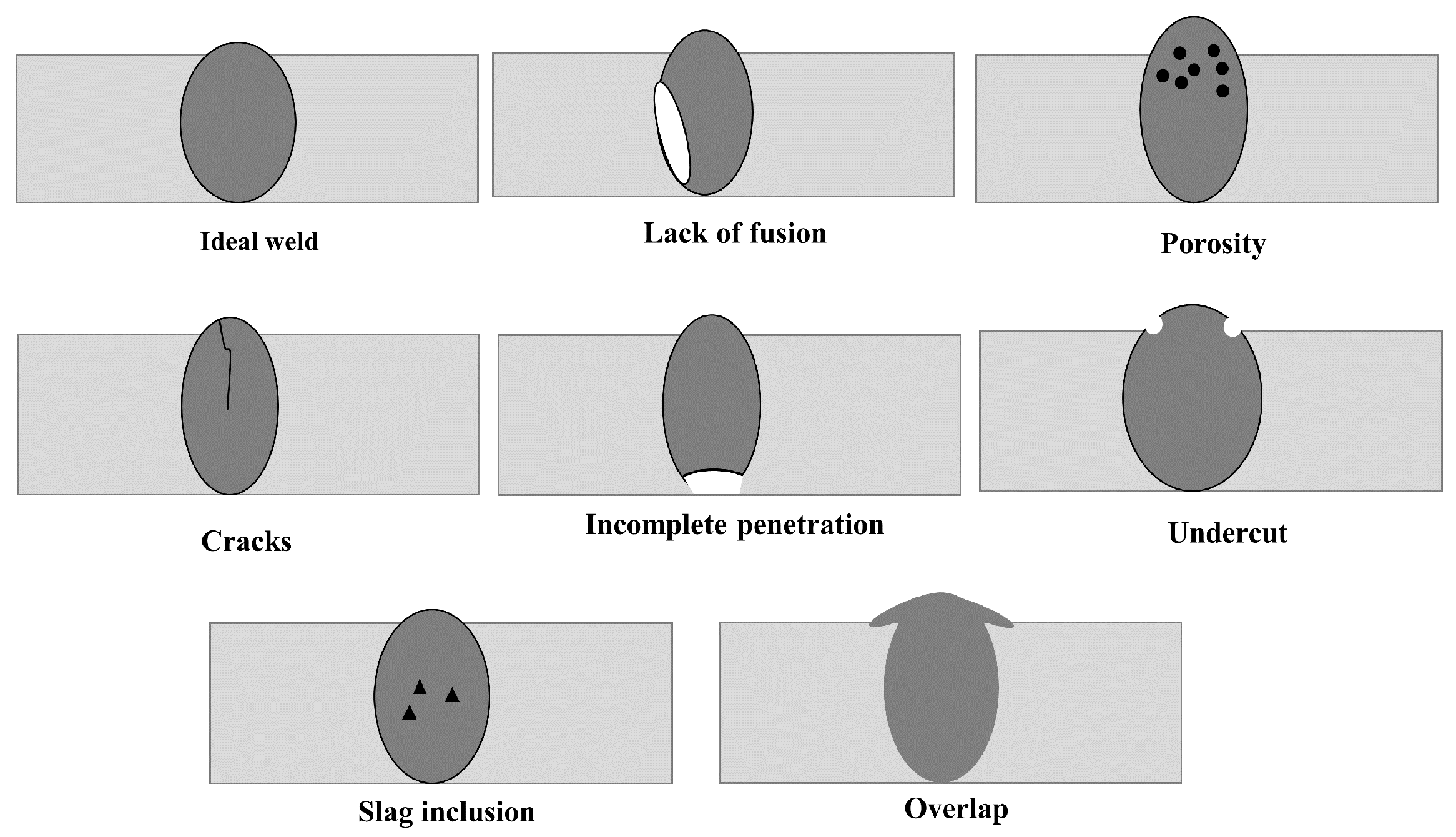
Figure 2.
Visual method of weld defect identification.
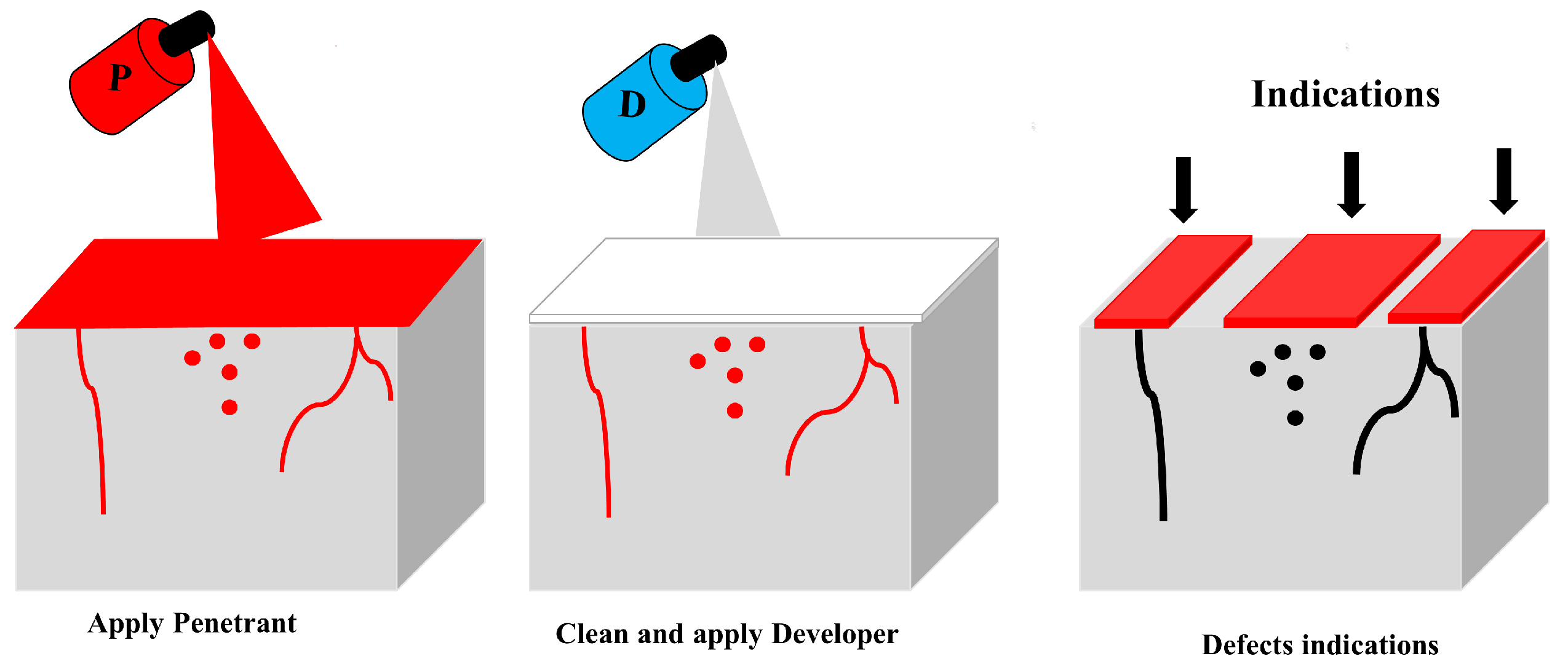
Figure 3.
The process of ultrasonic testing for additively manufactured components.
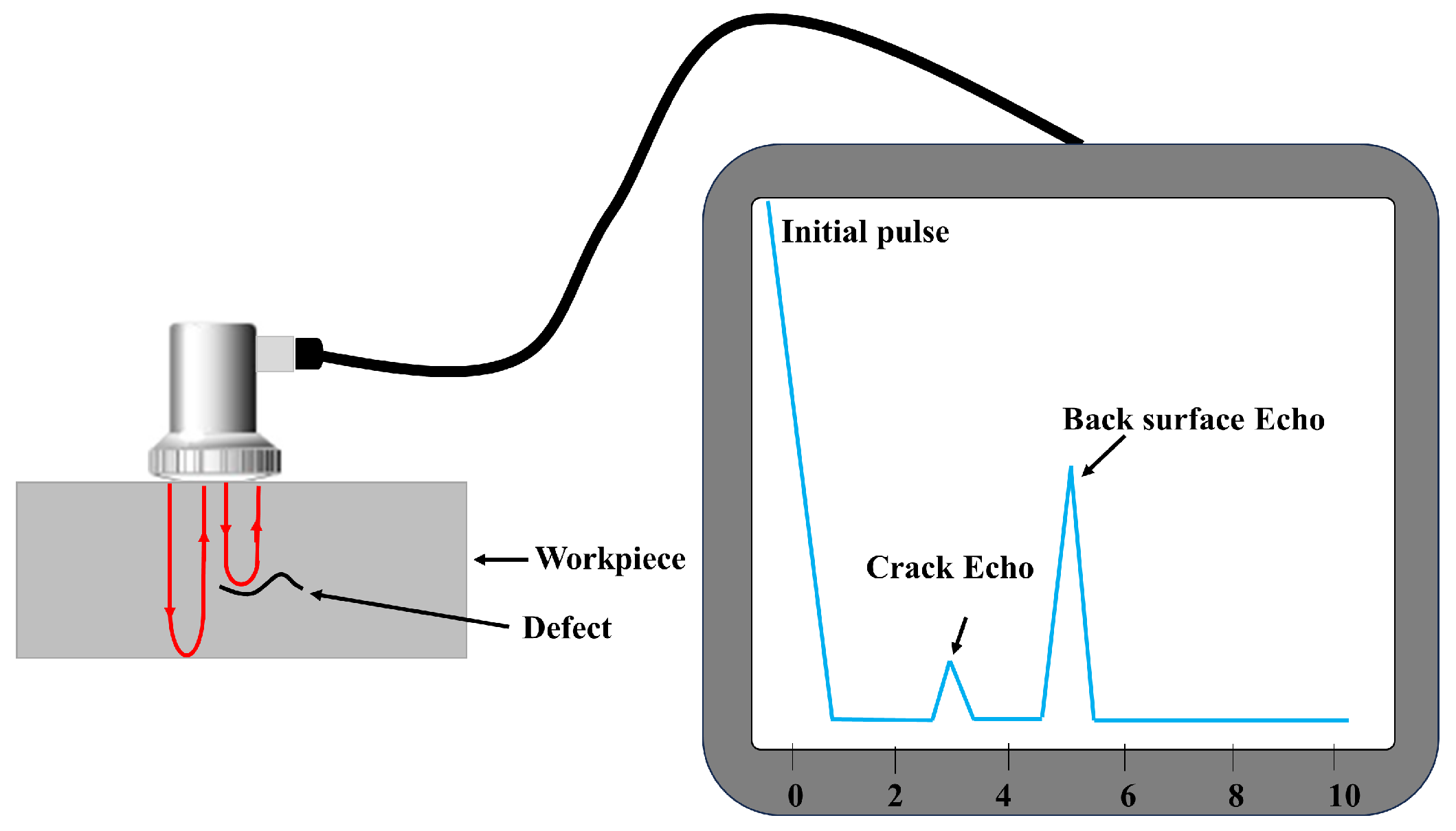
Figure 4.
IR thermography for weld defect detection.
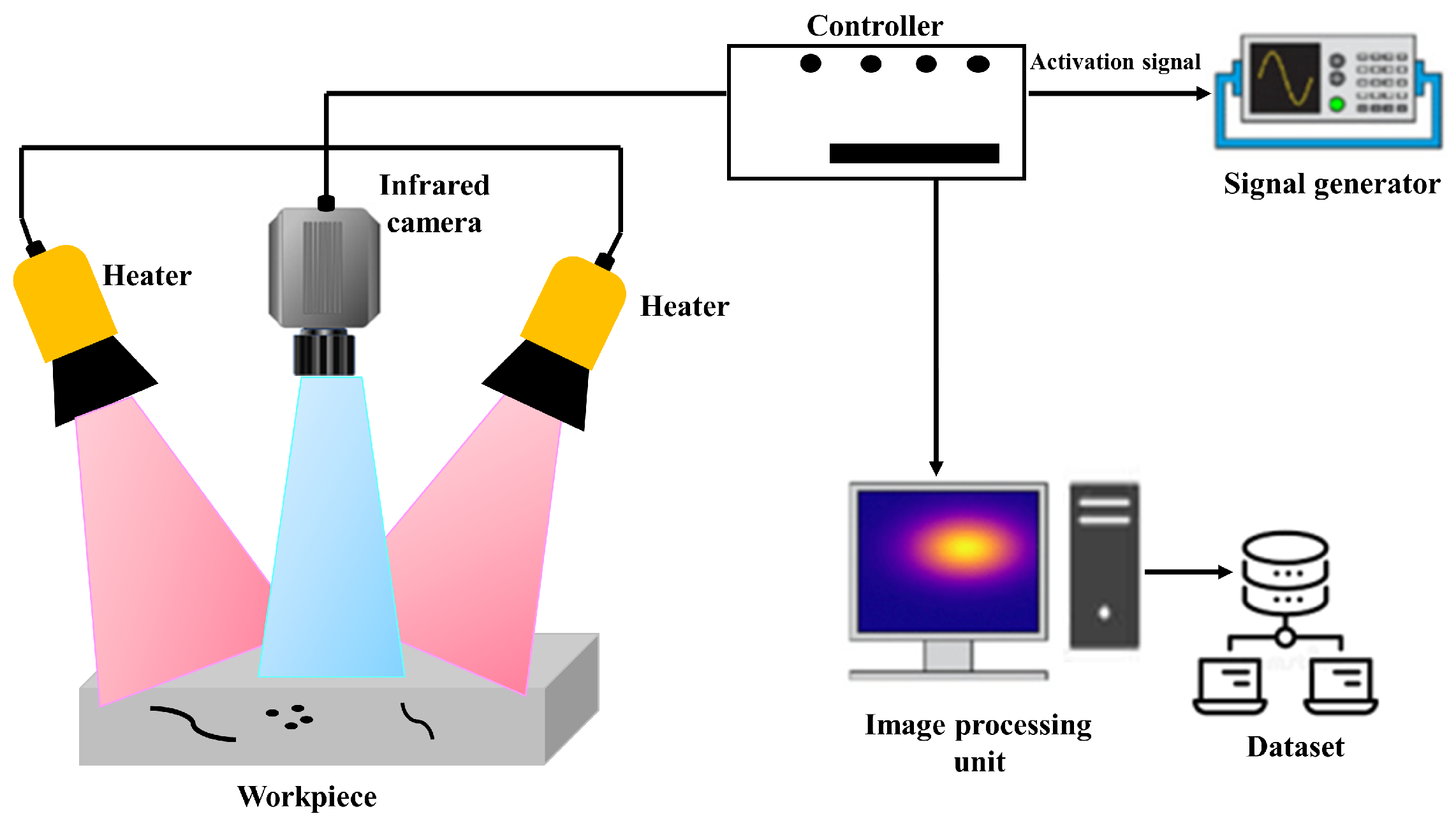
Figure 5.
Eddy Current testing weld defect detection method.
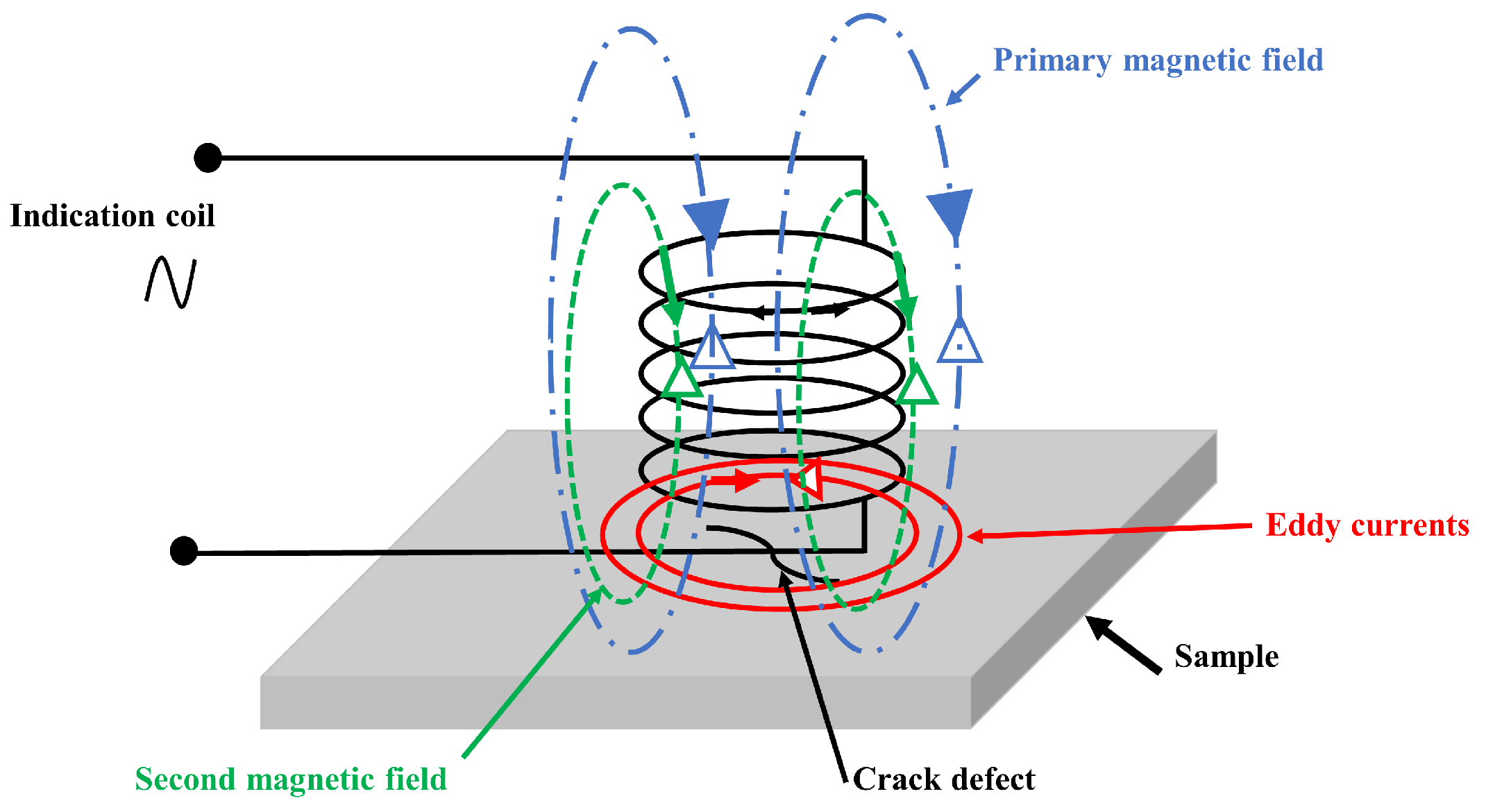
Figure 6.
Acoustic emission weld defects method.
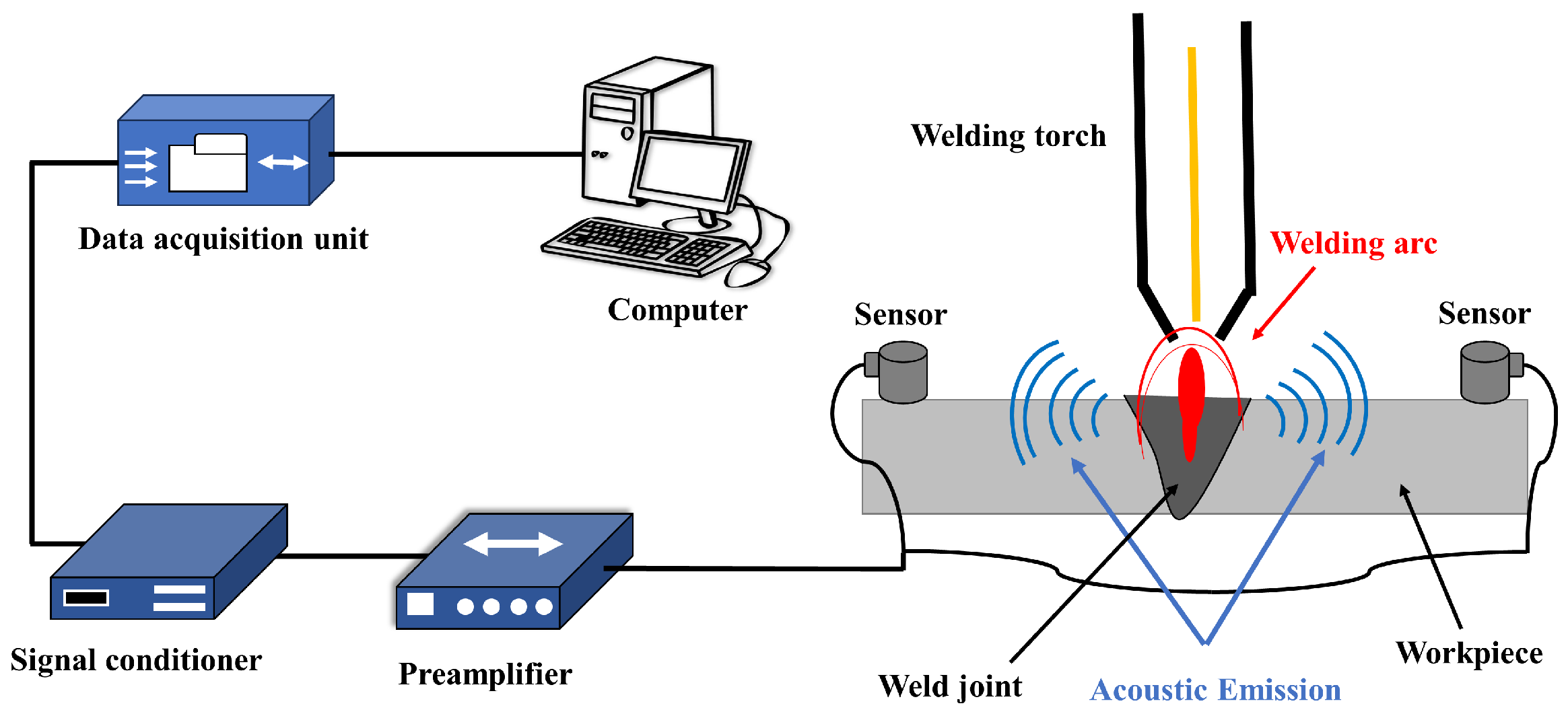
Figure 7.
Magnetic testing method.
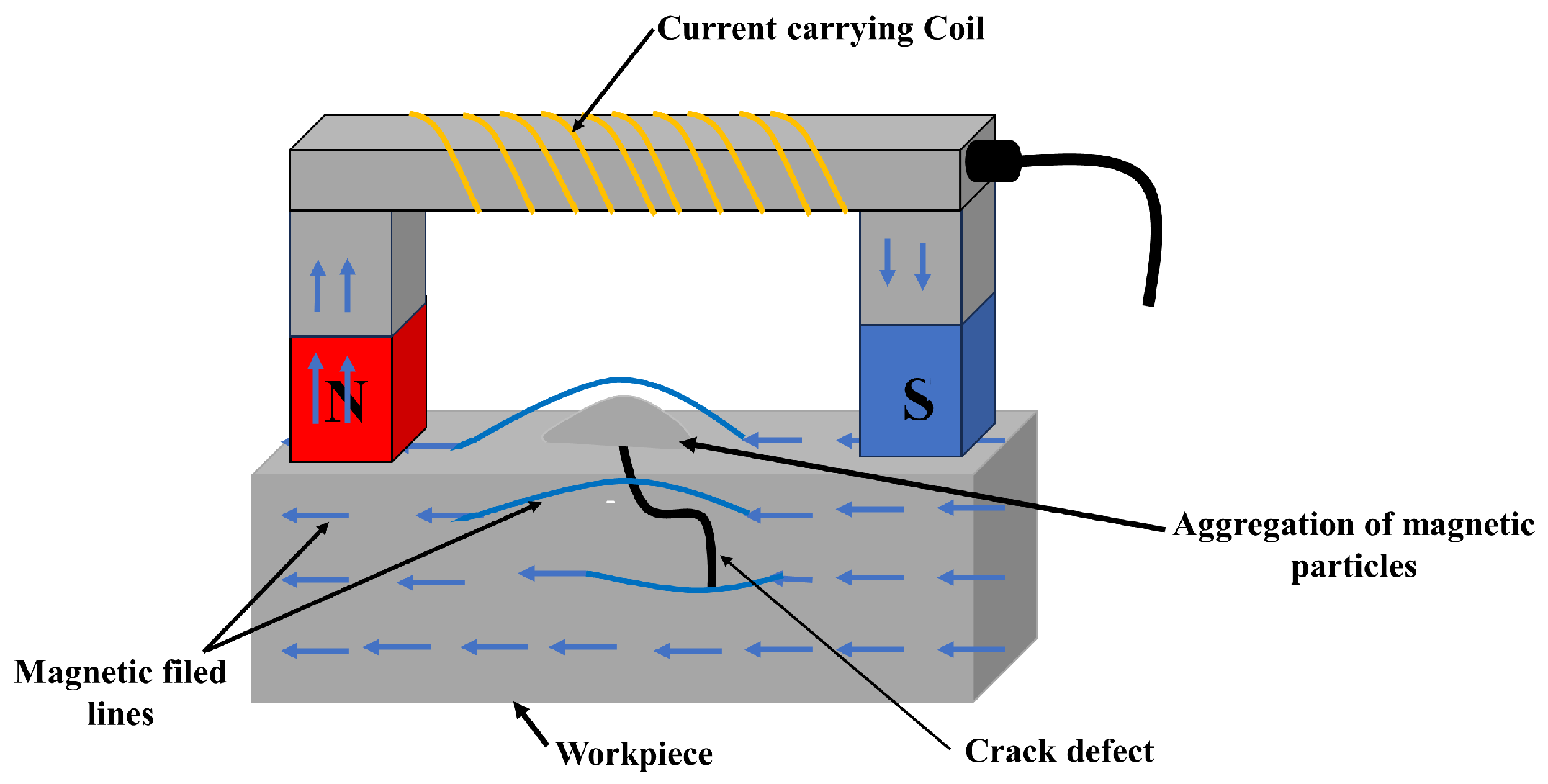
Figure 8.
X-ray method for weld defects detection.
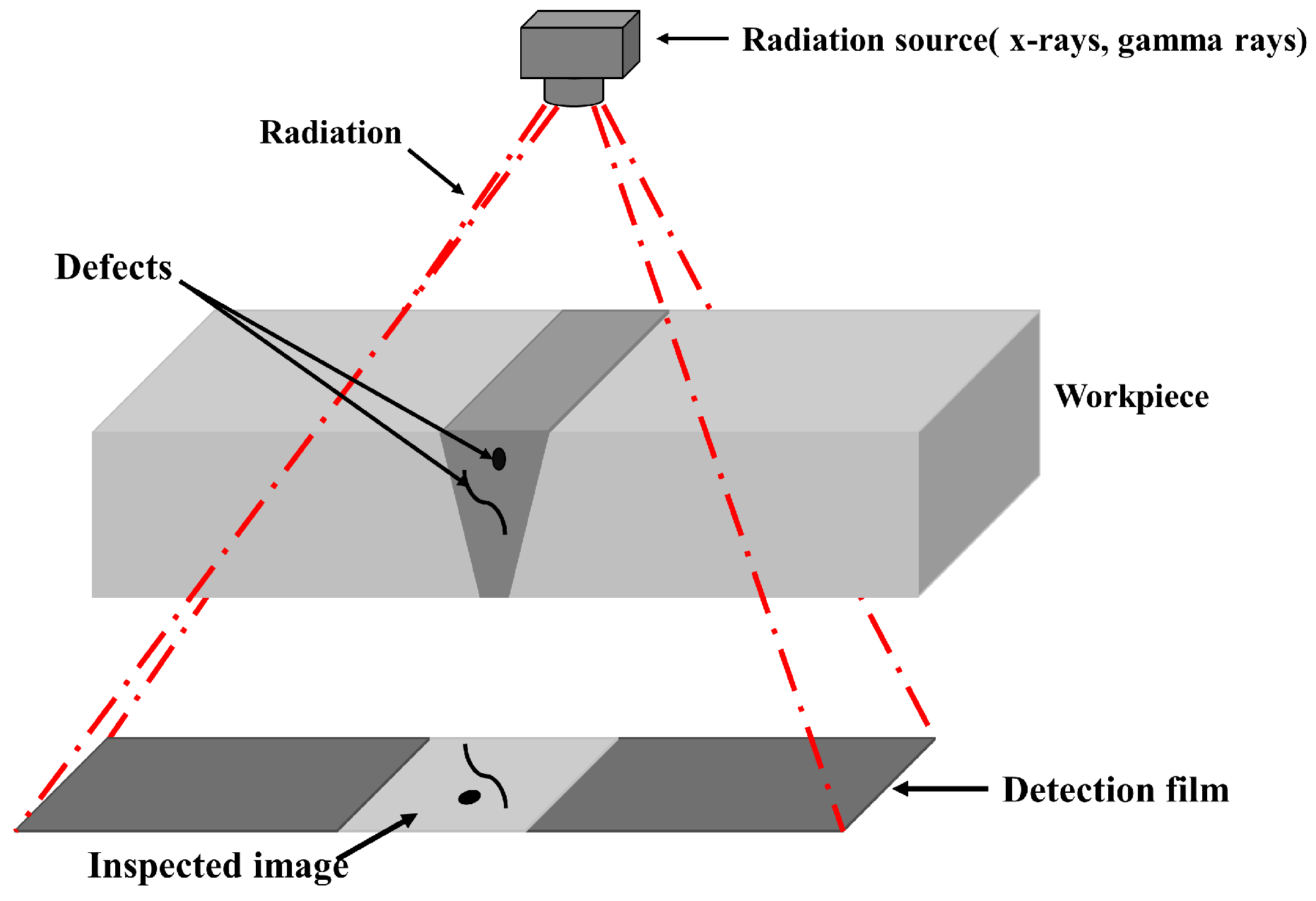
Figure 9.
Image processing techniques.
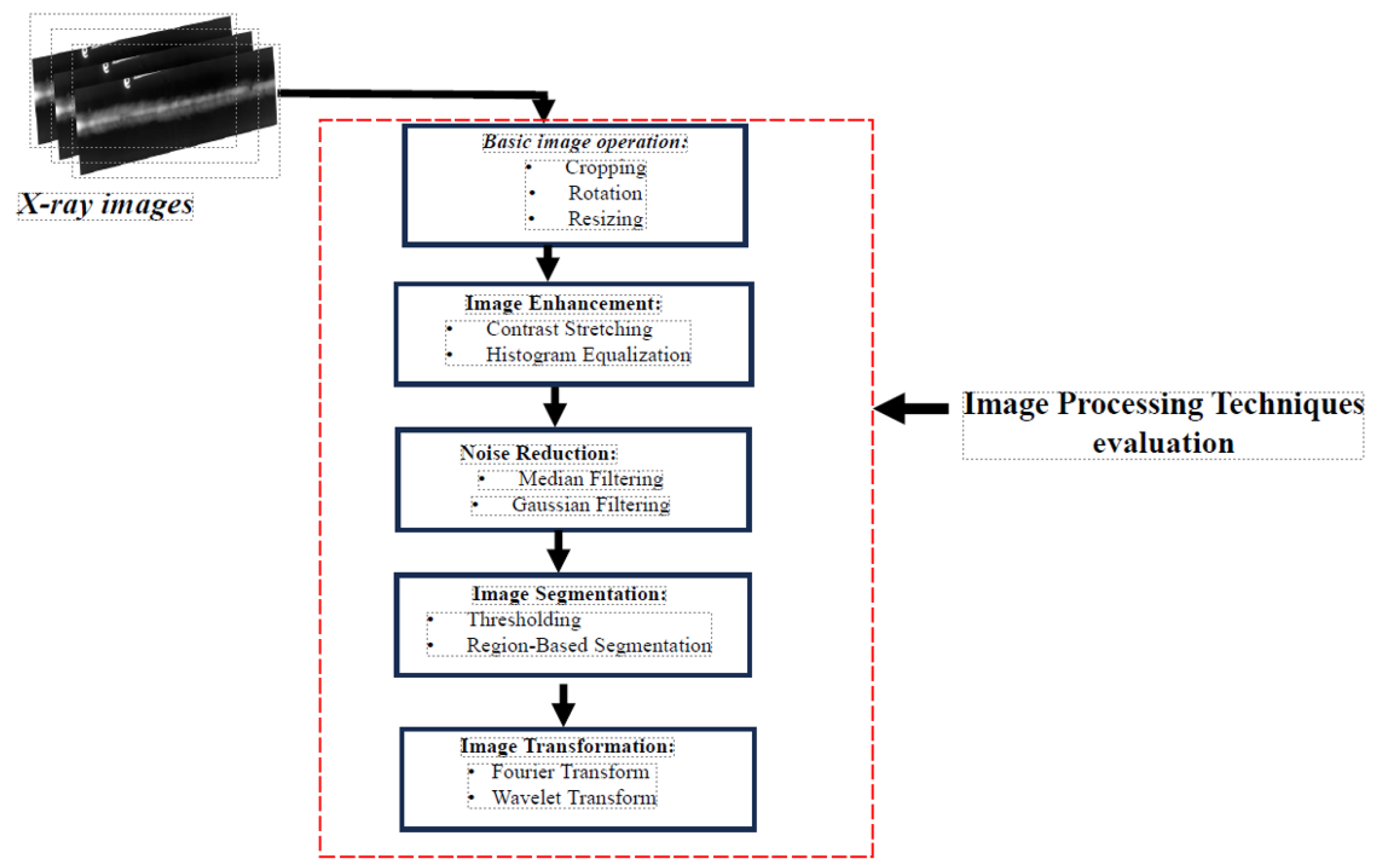
Figure 10.
Summary of feature extraction and selection techniques.
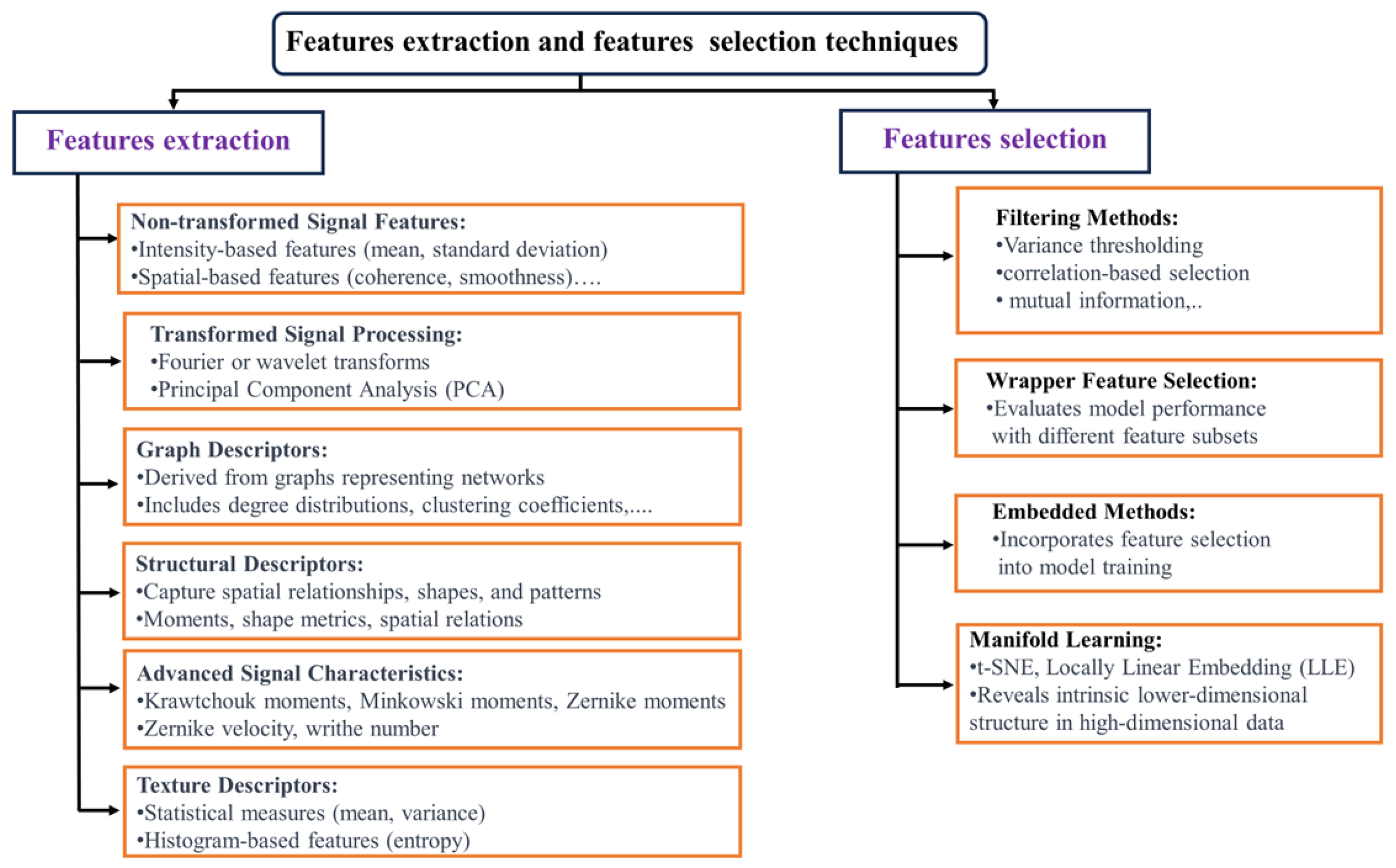
Figure 11.
Summary of the AI algorithms used for NDT of Welding Defects.
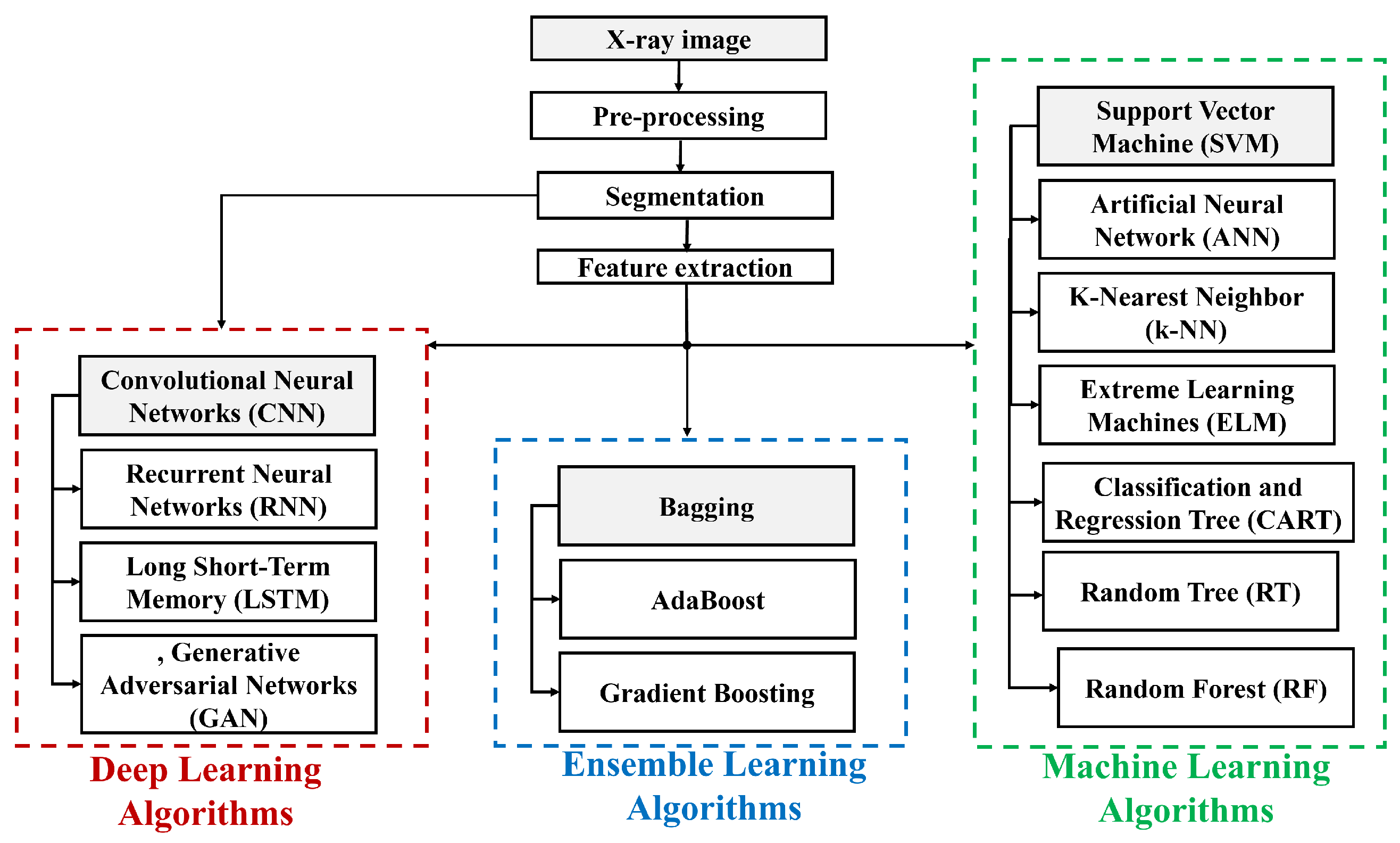
Figure 12.
Various applications fields of the AI-assistive X-Ray imaging based welds inspection.
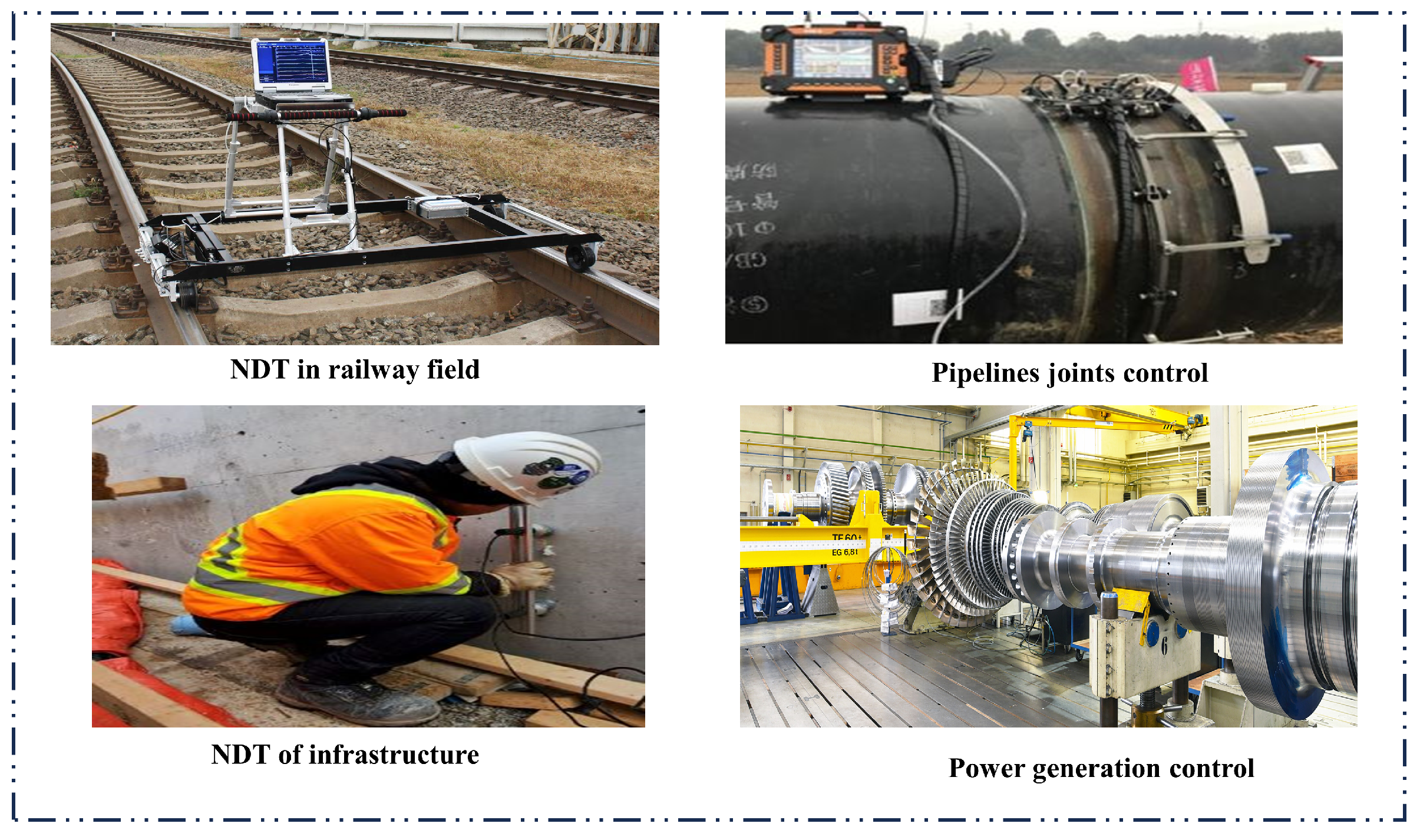

Table 1.
Summary of the NDT methods for welds quality inspection.
| references | contributions | limitations |
|---|---|---|
| A.madhvacharyula et al.(2022)[13] | highlight the real-time, in-situ approaches and provide valuable insight into weld defect detection methods. |
Oversimplify the complex algorithms and lack exhaustive coverage. |
| M.shaloo et al. (2022) [33] | The importance of non-destructive testing (NDT) for defect detection in wire and arc additive manufacturing and fusion welding, providing insights into various techniques and their practical implications. | Detecting defects by relying on existing research and industry testing. |
| J.rao et al. (2023)[34] | The transformative impact of additive manufacturing (AM), particularly in the nuclear, energy, and aerospace industries, emphasizing the role of non-destructive testing (NDT) techniques, | The integration of advanced artificial intelligence and machine learning techniques in non-destructive testing |
| X.Shen et al. (2023)[35] | The identification of metal elements in safety-critical structures using non-destructive testing (NDT), with a focus on early crack detection and the integration of advanced methods such as machine learning and artificial intelligence. | The use of artificial intelligence and X-ray image processing methods for non-destructive testing of welds. |
| I.ramirez et al. (2023)[36] | the importance of additive manufacturing in the Fourth Industrial Revolution, underscores the need for efficient non-destructive testing (NDT) inspection methods, and takes an in-depth exploration of approaches and standards for quality control and defect detection. | The use of X-ray technology and the integration of artificial intelligence to detect welding defects. The focus is on improving the accuracy and efficiency of defect detection through specialized methodologies. |
| W.cai et al. (2020)[37] | Real-time, multi-sensor, artificial intelligence-based laser welding monitoring is important for optimizing efficiency and ensuring quality in many industries.. | highlight the essential role of real-time monitoring supported by advanced technologies such as X-ray and AI. |
| DN.lavadiya et al.(2022)[38] | Applying deep learning to assess the condition of bridge decks, with a focus on identifying surface and subsurface defects. | Exploration of deep learning methods for bridge deck condition assessment, specifically to improve the identification and categorization of surface and subsurface defects. |
| M.amarnath et al. (2023)[39] | Defect detection in industrial automation, especially in TIG welding, using deep learning, with a focus on demonstrating the potential of convolutional neural networks (CNN) and vision transformers. | The focus on advancing defect detection through the innovative integration of X-ray technology |
| A. Saberironaghi et al. (2023) [40] | Applying deep learning techniques to detect surface defects in industrial products and X-ray images | The move to deep learning for surface defect detection, expanding the field through in-depth investigations and proposing practical solutions to address the challenges identified. |
| Li, Yaping, et al. (2019)[57] | The implementation of a deep learning network to detect defects in welds from X-ray images, with a focus on efficient detection of these defects. | Detection of weld defects in pipelines with a tailored approach to the challenges of pipeline weld inspection. |
| S.Sudhagar et al. (2020)[58] | Proposes a quantitative evaluation of the friction stir welding process using X-ray images. The aim is to reveal the optimal process parameters for this welding technique. | The advancement of artificial intelligence algorithms in X-ray-based weld inspection to overcome limitations associated with assumptions about the relationship between defect area and mechanical properties. |
| Liu et al. (2023)[41] | Examine the analysis of radiographic images in welding, providing key insights and identifying pertinent challenges in the field. | Represents an evolution by introducing a more technologically sophisticated approach to addressing challenges in the field. |
| Chen, Ji et al. (2023)[26] | Integration of the Feature Pyramid Network (FPN) and a novel visual attention mechanism (SPAM) for weld defect detection. | Precise parameter tuning and the potential for bias in the dataset |
| J. Kastner al. (2015)[59] | The study of flat-panel matrix X-ray computed tomography for non-destructive scanning, which provides valuable insight into heterogeneities. | Analysis and visualization of the generated XCT data requires advanced 3D image processing techniques.. |
| A. Bansal et al. (2023)[60] | The effectiveness of computer-based processing to potentially automate defect detection using a unique image-based approach. | Recognizes the difficulties associated with weld defect detection, including dependence on external factors and variations in defect characteristics |
| Zhao et al. (2021)[42] | The use of ceramic materials and their susceptibility to imperceptible defects underscores the critical importance of non-destructive testing methods. | The timely detection and prevention of these defects, with the study examining the related issues in non-destructive testing for ceramics.. |
| Gupta et al. (2022)[3] | highlight the technological advances that have expanded the use of NDT beyond traditional industries. | Integrate artificial intelligence or automation to improve accuracy and reduce the need for manual inspection. |
| Ramalho et al. [43] | The effect of defects on sound waves in Wire Arc Additive Manufacturing, successfully identified using Power Spectral Density and STFT analysis. | A broader and potentially more comprehensive approach that considers visual and structural aspects in addition to acoustic signals. |
| Luo et al. [44] | Analyze the acoustic emission signals during pulsed YAG laser welding, revealing the effect of the plasma plume on acoustic parameter. | Involves investigating a wider range of welding conditions and incorporating additional factors to improve the applicability of acoustic emission analysis in detecting welding defects. |
| Zhang et al. [45] | Acoustic emission and air-coupled ultrasonic testing for real-time monitoring of burn-through events in gas tungsten arc welding (GTAW). | Expand the scope to include various weld defects beyond burn-through events. |
| Elkihel et al. [46] | Investigate heat propagation in a weld using active thermography and find significantly greater heat loss in the weld zone compared to the flawed area. | Explore different temperatures, heating methods, and defect types to understand the broader implications of heat propagation in welds. |
| Massaro et al. [47] | Developed a method combining infrared thermography and image processing for real-time identification and classification of weld defects on a steel tank, demonstrating the effectiveness of techniques such as the Long Short Term Memory (LSTM) artificial neural network. | Optimize and fine-tune the combination of vision and thermography techniques to detect and classify a wider range of weld defects. |
| Ziegler et al. [48] | The use of high-power lasers in lock-in thermography, suggesting their minimal impact on thermal emission, allows effective application in one-sided transient thermography. | Experimental validations and comparisons of the effectiveness of high-power lasers in lock-in thermography across different materials, welding scenarios, and defect types. |
| Sun et al. [49] | Present a hybrid ultrasonic sensing system, diffuse ultrasonic wave (DUW), using PZT actuators and FBG sensors for damage detection in railroad tracks. | Focus on validating the DUW system on different track materials and configurations, assessing its sensitivity to different types of damage. |
| Chakraborty et al. [50] | Introduction of a crack detection method using an advanced signal processing algorithm. | Explore the incorporation of advanced machine learning for automated crack detection and classification based on signal processing results. |
| Chakraborty et al. [51] | Propose an active approach to damage detection in multiple structures using embedded ultrasonic sensors. | The adaptability of the proposed damage detection approach to different types of structures and materials. |
| F.xie et al. [52] | Use pulsed eddy current (PEC) testing to detect weld flaws in large pressure vessel cylinders. | Validation by radiographic testing confirming its ability to detect subsurface defects in welds. |
| T.alvarenga et al. [53] | Present an embedded system for real-time rail anomaly detection using eddy current, wavelet transforms, and a convolutional neural network. | Integrate other advanced signal processing techniques or machine learning algorithms |
| R.M. Gansel et al. [54] | The effectiveness of eddy currents in discriminating groove depths and detecting actual fatigue cracks, providing critical information for assessing the structural integrity of wind turbines. | Explore advanced signal processing, machine learning integration, real-world application studies, comparative analysis, parameter optimization, and cost-benefit analysis to further advance this inspection approach. |
| G.Y. Liu et al. [32] | Improve weld flaw detection using magneto-optical imaging, applying finite element analysis and proposing an image fusion method based on pixel standard deviation for improved visual effects in nondestructive welding flaw inspection. | Use fast guided filtering and pixel standard deviation to merge multi-frame magneto-optic images |
| F.brauchle et al. [55] | Detect production defects in lithium-ion cell manufacturing using an enhanced Magnetic Field Imaging (MFI) setup and current reconstruction. | Exploration of advanced signal processing techniques or integration of complementary technologies to address specific challenges in detecting subtle defects could be areas of focus. |
| J. Ai et al. [56] | The effectiveness of eddy current magneto-optical imaging for defect detection in carbon fiber reinforced polymers (CFRP) | Optimization of the scanning eddy current magneto-optical imaging device, and exploration of variations in the inspection method parameters. |
Table 2.
Advantages and disadvantages of the considered NDT methods.
| Method | Advantages | Disadvantages |
|---|---|---|
| VT | An affordable and uncomplicated solution, perfect for surface flaws, ensures immediate improvement [61]. | The effectiveness of this method heavily relies on the inspector’s expertise, making it imperative for experienced professionals to ensure accuracy. While proficient in identifying surface defects, its scope is restricted, rendering it unsuitable for internal or subsurface inspections [62]. |
| UT | This method boasts remarkable precision in identifying internal flaws across various materials, showcasing its versatility. Its capability to provide real-time results adds to its appeal, making it a valuable asset in numerous applications [63]. | This process demands skilled operators for effective execution, as its outcomes can be influenced by the properties of the materials involved. Moreover, its application is restricted to surfaces that are readily accessible [64]. |
| IRT | Utilizing a non-contact and non-intrusive approach, this method swiftly inspects expansive areas while adeptly identifying subsurface defects [65]. | This method’s effectiveness hinges on environmental conditions and is primarily tailored for surface defects, albeit constrained by equipment costs [66]. |
| ECT | This technique exhibits a high sensitivity to surface flaws, delivering immediate results [67]. | This method’s penetration is limited, and its results can be influenced by the conductivity of the material being tested. A qualified operator is necessary for accurate implementation [68]. |
| AE | This technique excels in detecting active defects, offering real-time monitoring capabilities while effectively identifying faults even under load conditions [69]. | This method may face interference from background noise and is most suitable for high-stress applications. Expert analysis is necessary for accurate interpretation of results [69]. |
| RT | Utilizing high-resolution capabilities and a non-contact methodology, this approach accurately exposes internal defects, supplying ample data for thorough analysis [70]. | This approach presents challenges due to intricate procedures, rigorous security measures, and the use of costly equipment that exposes individuals to radiation [70]. |
| MT | This method provides real-time results for immediate assessment and is particularly effective for ferrous materials, it offers a cost-effective and time-efficient solution [71]. | This method is vulnerable to environmental influences and demands meticulous surface preparation. Additionally, its ability to detect deeper defects is constrained by limited penetration [72]. |
Table 3.
Varoius X-ray images-based datasets used in the weld defects field.
|
Dataset Name |
Description | Access Link |
|---|---|---|
| GDX-ray[75] | - Benchmark dataset for evaluating deep learning models in weld inspection. -Focuses on weld defect evaluation using meticulously curated X-ray images. |
https://Demery.ing.puc.cl/index.php/ material/gdxray |
| RIAWELC[73] | -Curated collection of X-ray images for weld defect classification tasks. -Essential for developing and refining deep learning models in NDT. |
https://github.com/stefyste/RIAWELC |
| WDXI[79] | -Dedicated resource for research in weld defect detection using X-ray imaging. -Provides a variety of X-ray images to improve the accuracy of weld defect identification algorithms. |
https://www.researchgate.net/publication/332376907 _WDXI_The_Dataset_of_X-Ray_Image_for_Weld_Defects |
Disclaimer/Publisher’s Note: The statements, opinions and data contained in all publications are solely those of the individual author(s) and contributor(s) and not of MDPI and/or the editor(s). MDPI and/or the editor(s) disclaim responsibility for any injury to people or property resulting from any ideas, methods, instructions or products referred to in the content. |
© 2024 by the authors. Licensee MDPI, Basel, Switzerland. This article is an open access article distributed under the terms and conditions of the Creative Commons Attribution (CC BY) license (http://creativecommons.org/licenses/by/4.0/).
Copyright: This open access article is published under a Creative Commons CC BY 4.0 license, which permit the free download, distribution, and reuse, provided that the author and preprint are cited in any reuse.