

Submitted:
17 October 2024
Posted:
18 October 2024
You are already at the latest version
Abstract
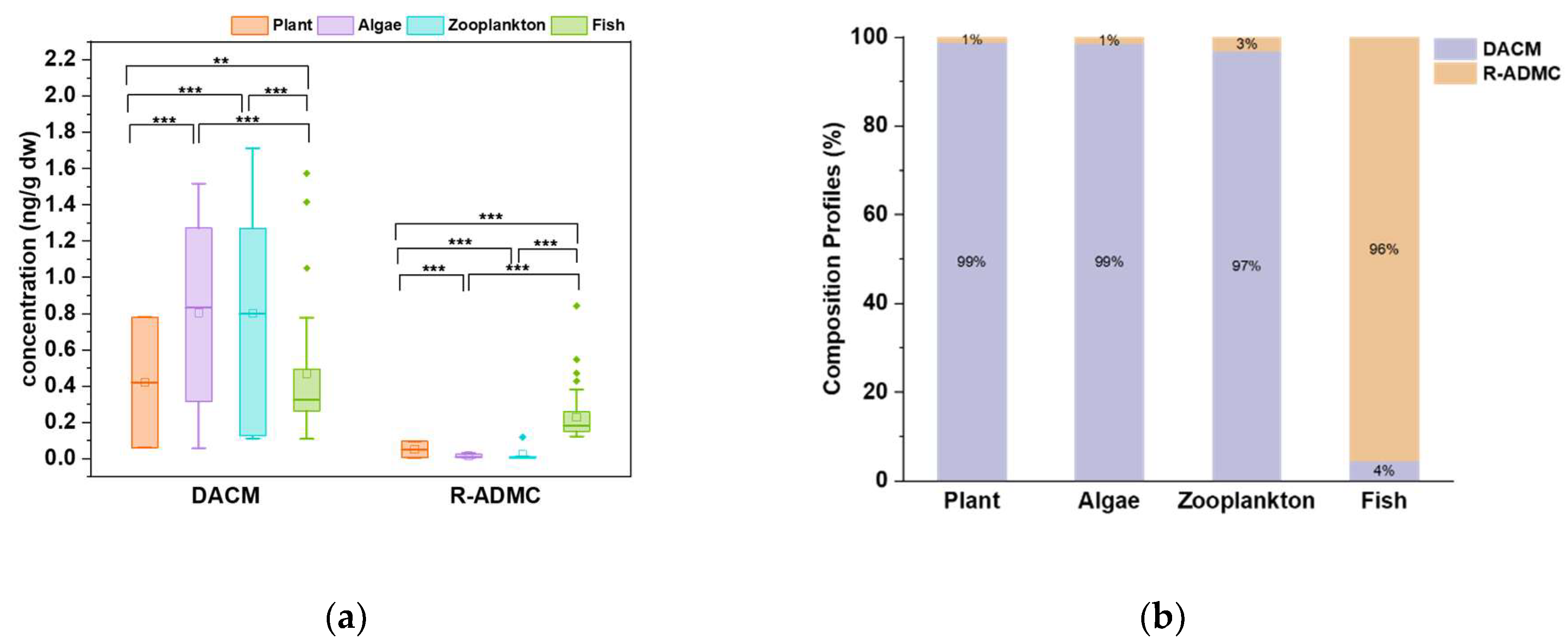
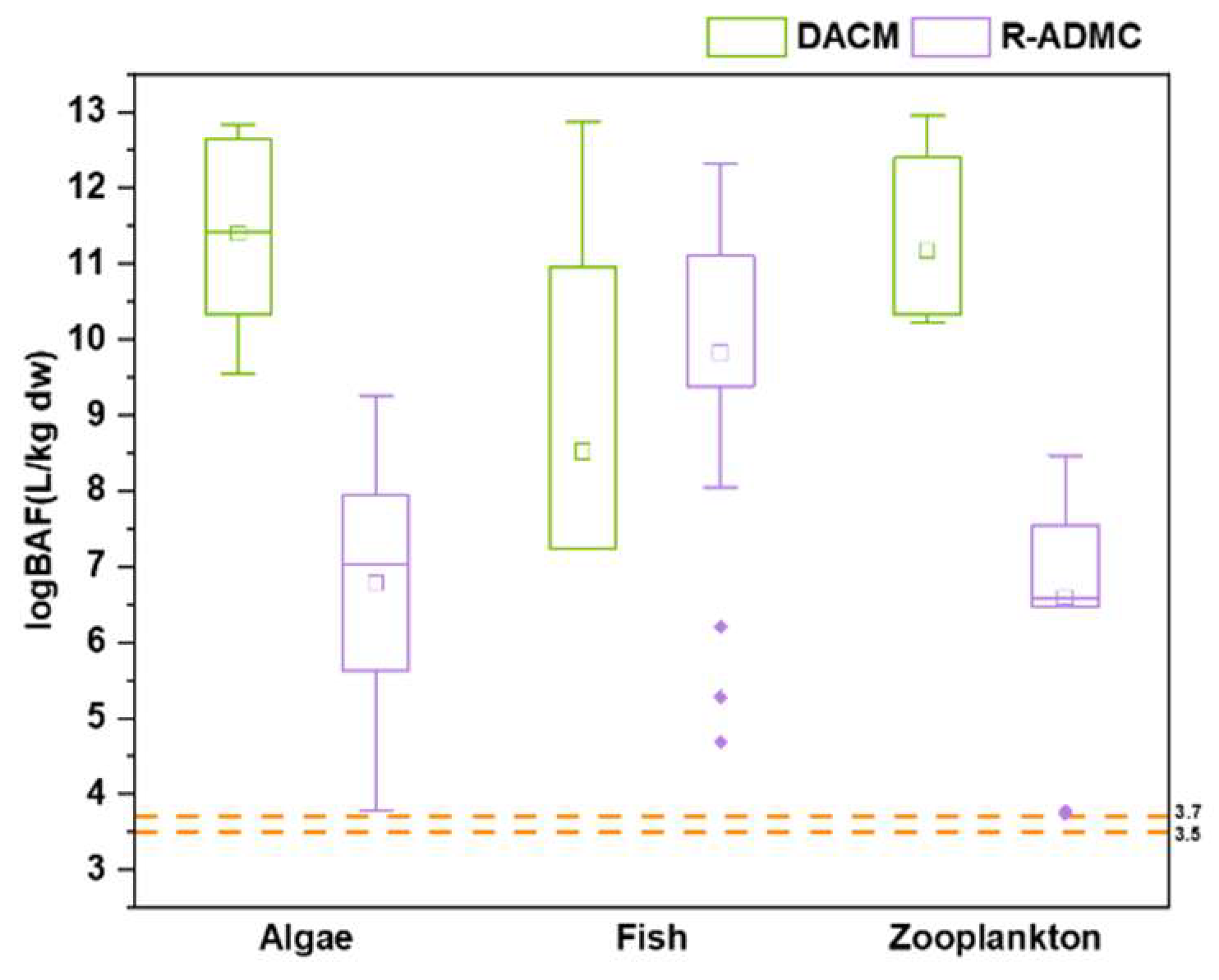
Despite the widespread application of antiandrogenic fluorescent dye synthetic coumarins in both industrial and consumer products, little is known about their occurrence in the aquatic ecosystem. In this study, concentrations of two synthetic coumarins, namely 7-(dimethylamino)-4-methylcoumarin (DACM) and 7-diethylamino-4-methylcoumarin (R-ADMC), were determined in abiotic (water, sediment) and biotic (plant, plankton and fish) samples (n=208) collected from a subtropical freshwater ecosystem, Dongjiang River basin, in southern China. DACM was the predominant compound found in the sediment, plant, algae, zooplankton, and fish muscle samples, with median concentrations at 0.189, 0.421, 0.832, 0.798, and 0.335 ng/g dry wt., respectively, although it was not detected in any surface water sample. For R-ADMC, the median concentrations observed in the surface water, sediment, plant, algae, zooplankton, and fish muscle samples were 0.105 ng/L, 0.012, 0.051, 0.009, 0.008, and 0.181 ng/g, dry wt., respectively. The bioaccumulation factor (BAF) values of DACM and R-ADMC in the algae, zooplankton and fish muscle exceeded 5000 L/kg, suggesting that the two coumarins may have significant bioaccumulation potentials in aquatic biota. Additionally, the mean daily intake (EDI) of coumarins through fish consumption was estimated as 0.27 ng/kg bw/day for toddlers in urban. This is the first field study to document widespread occurrence of the synthetic coumarins in aquatic ecosystems and to elucidate bioaccumulation potential of coumarins in aquatic organisms.
Keywords:
1. Introduction
2. Materials and Methods
2.1. Standards and Reagents
2.2. Sample Collection
2.3. Sample Preparation
2.4. Instrumental Analysis
2.5. Quality Control and Quality Assurance
2.6. Bioaccumulation Capacity Estimation
2.7. Human Exposure Risk Estimation
2.8. Statistical Analysis
3. Results and Discussions
3.1. Coumarin and the Metabolite in Abiotic Samples
3.2. Coumarin and the Metabolite in Aquatic Biota
3.3. Bioaccumulation of Coumarins in Aquatic Biota
3.4. Estimated Daily Intake of Coumarins through Fish Ingestion
4. Conclusion
Supplementary Materials
Author Contributions
Funding
Data Availability Statement
Conflicts of Interest
References
- Sharifi-Rad, J.; Cruz-Martins, N.; López-Jornet, P.; Lopez, E.P.-F.; Harun, N.; Yeskaliyeva, B.; Beyatli, A.; Sytar, O.; Shaheen, S.; Sharopov, F.; et al. Natural Coumarins: Exploring the Pharmacological Complexity and Underlying Molecular Mechanisms. Oxid. Med. Cell. Longev. 2021, 2021, 6492346. [Google Scholar] [CrossRef] [PubMed]
- Muschket, M.; Brack, W.; Inostroza, P.A.; Beckers, L.; Schulze, T.; Krauss, M. Sources and Fate of the Antiandrogenic Fluorescent Dye 4-Methyl-7-Diethylaminocoumarin in Small River Systems. Environ. Toxicol. Chem. 2021, 40, 3078–3091. [Google Scholar] [CrossRef] [PubMed]
- Kitamura, N.; Fukagawa, T.; Kohtani, S.; Kitoh, S.; Kunimoto, K.-K.; Nakagaki, R. Synthesis, Absorption, and Fluorescence Properties and Crystal Structures of 7-Aminocoumarin Derivatives. J. Photochem. Photobiol. Chem. 2007, 188, 378–386. [Google Scholar] [CrossRef]
- Di Paolo, C.; Kirchner, K.; Balk, F.G.P.; Muschket, M.; Brack, W.; Hollert, H.; Seiler, T.-B. Downscaling Procedures Reduce Chemical Use in Androgen Receptor Reporter Gene Assay. Sci. Total Environ. 2016, 571, 826–833. [Google Scholar] [CrossRef] [PubMed]
- Sébillot, A.; Damdimopoulou, P.; Ogino, Y.; Spirhanzlova, P.; Miyagawa, S.; Du Pasquier, D.; Mouatassim, N.; Iguchi, T.; Lemkine, G.F.; Demeneix, B.A.; et al. Rapid Fluorescent Detection of (Anti)Androgens with Spiggin-Gfp Medaka. Environ. Sci. Technol. 2014, 48, 10919–10928. [Google Scholar] [CrossRef] [PubMed]
- Muschket, M.; Di Paolo, C.; Tindall, A.J.; Touak, G.; Phan, A.; Krauss, M.; Kirchner, K.; Seiler, T.-B.; Hollert, H.; Brack, W. Identification of Unknown Antiandrogenic Compounds in Surface Waters by Effect-Directed Analysis (EDA) Using a Parallel Fractionation Approach. Environ. Sci. Technol. 2018, 52, 288–297. [Google Scholar] [CrossRef] [PubMed]
- Yang, D.; Zhao, D.; Chen, H.; Cai, Y.; Liu, Y.; Guo, F.; Li, F.; Zhang, Y.; Xu, Z.; Xue, J.; et al. Distribution, Bioaccumulation and Human Exposure Risk of Bisphenol Analogues, Bisphenol A Diglycidyl Ether and Its Derivatives in the Dongjiang River Basin, South China. Sci. Total Environ. 2024, 952, 175969. [Google Scholar] [CrossRef] [PubMed]
- Zhao, Y.; Zhang, H.; Liu, Y.; Lan, Y.; Zhu, J.; Cai, Y.; Guo, F.; Li, F.; Zhang, Y.; Zhang, T.; et al. Evidence of Strobilurin Fungicides and Their Metabolites in Dongjiang River Ecosystem, Southern China: Bioaccumulation and Ecological Risks. Sci. Total Environ. 2024, 908, 168427. [Google Scholar] [CrossRef] [PubMed]
- Smalling, K.L.; Orlando, J.L.; Calhoun, D.; Battaglin, W.A.; Kuivila, K. Occurrence of Pesticides in Water and Sediment Collected from Amphibian Habitats Located throughout the United States, 2009-10; U.S. Geological Survey, 2012.
- Montagner, C.C.; Vidal, C.; Acayaba, R.D.; Jardim, W.F.; Jardim, I.C.S.F.; Umbuzeiro, G.A. Trace Analysis of Pesticides and an Assessment of Their Occurrence in Surface and Drinking Waters from the State of São Paulo (Brazil). Anal Methods 2014, 6, 6668–6677. [Google Scholar] [CrossRef]
- Liu, J.; Xia, W.; Wan, Y.; Xu, S. Azole and Strobilurin Fungicides in Source, Treated, and Tap Water from Wuhan, Central China: Assessment of Human Exposure Potential. Sci. Total Environ. 2021, 801, 149733. [Google Scholar] [CrossRef] [PubMed]
- Liao, C.; Lee, S.; Moon, H.-B.; Yamashita, N.; Kannan, K. Parabens in Sediment and Sewage Sludge from the United States, Japan, and Korea: Spatial Distribution and Temporal Trends. Environ. Sci. Technol. 2013, 47, 10895–10902. [Google Scholar] [CrossRef] [PubMed]
- Liu, J.; Wan, Y.; Jiang, Y.; Xia, W.; He, Z.; Xu, S. Occurrence of Azole and Strobilurin Fungicides in Indoor Dust from Three Cities of China. Environ. Pollut. 2022, 304, 119168. [Google Scholar] [CrossRef] [PubMed]
- Xue, X.; Xue, J.; Liu, W.; Adams, D.H.; Kannan, K. Trophic Magnification of Parabens and Their Metabolites in a Subtropical Marine Food Web. Environ. Sci. Technol. 2017, 51, 780–789. [Google Scholar] [CrossRef] [PubMed]
- Li, H.; Yang, S.; Li, T.; Li, X.; Huang, X.; Gao, Y.; Li, B.; Lin, J.; Mu, W. Determination of Pyraclostrobin Dynamic Residual Distribution in Tilapia Tissues by UPLC-MS/MS under Acute Toxicity Conditions. Ecotoxicol. Environ. Saf. 2020, 206, 111182. [Google Scholar] [CrossRef] [PubMed]
- Liu,, D.; Wu, S.; Xu, H.; Zhang, Q.; Zhang, S.; Shi, L.; Yao, C.; Liu, Y.; Cheng, J. Distribution and Bioaccumulation of Endocrine Disrupting Chemicals in Water, Sediment and Fishes in a Shallow Chinese Freshwater Lake: Implications for Ecological and Human Health Risks. Ecotoxicol. Environ. Saf. 2017, 140, 222–229. [Google Scholar] [CrossRef]
- Miller, M.E.; Motti, C.A.; Hamann, M.; Kroon, F.J. Assessment of Microplastic Bioconcentration, Bioaccumulation and Biomagnification in a Simple Coral Reef Food Web. Sci. Total Environ. 2023, 858, 159615. [Google Scholar] [CrossRef] [PubMed]
- CDC Nutrition Data Yearbook. Available online: https://www.chinanutri.cn/sjnj/ (accessed on 8 October 2024).
- Zhao, X.; Duan, X.; Wang, B.; Cao, S. Environmental Exposure Related Activity Patterns Survey of Chinese Population (Children). China Environmental Science Press, Beijing. Available online: https://scholar.google.com/scholar_lookup?title=Environmental%20Exposure%20Related%20Activity%20Patterns%20Survey%20of%20Chinese%20Population%20(Children)&author=X.%20Zhao&publication_year=2016 (accessed on 8 October 2024).
- Bayen, S.; Gong, Y.; Chin, H.S.; Lee, H.K.; Leong, Y.E.; Obbard, J.P. Androgenic and Estrogenic Response of Green Mussel Extracts from Singapore’s Coastal Environment Using a Human Cell-Based Bioassay. Environ. Health Perspect. 2004, 112, 1467–1471. [Google Scholar] [CrossRef] [PubMed]
- Liao, C.; Kannan, K. Temporal Trends of Parabens and Their Metabolites in Mollusks from the Chinese Bohai Sea during 2006–2015: Species-Specific Accumulation and Implications for Human Exposure. Environ. Sci. Technol. 2018, 52, 9045–9055. [Google Scholar] [CrossRef] [PubMed]
- EFSA Opinion of the Scientific Panel on Food Additives, Flavourings, Processing Aids and Materials in Contact with Food (AFC) Related to Coumarin. | EFSA. Available online: https://www.efsa.europa.eu/en/efsajournal/pub/104 (accessed on 8 October 2024).
- EFSA Coumarin in Flavourings and Other Food Ingredients with Flavouring Properties - Scientific Opinion of the Panel on Food Additives, Flavourings, Processing Aids and Materials in Contact with Food (AFC) | EFSA. Available online: https://www.efsa.europa.eu/en/efsajournal/pub/793 (accessed on 8 October 2024).
- Loos, R.; Hanke, G.; Eisenreich, S.J. Multi-Component Analysis of Polar Water Pollutants Using Sequential Solid-Phase Extraction Followed by LC-ESI-MS. J. Environ. Monit. 2003, 5, 384. [Google Scholar] [CrossRef] [PubMed]

| DRa | median | mean | STDb | max | |
|---|---|---|---|---|---|
| surface water | |||||
| DACM | -c | - | - | - | - |
| R-ADMC | 31.40% | 0.105 | 0.12 | 0.097 | 0.309 |
| sediment | |||||
| DACM | 37.5% | 0.189 | 0.247 | 0.202 | 0.668 |
| R-ADMC | 59.4% | 0.012 | 0.038 | 0.053 | 0.173 |
| plant | |||||
| DACM | 14.29% | 0.421 | 0.421 | 0.509 | 0.781 |
| R-ADMC | 14.29% | 0.051 | 0.051 | 0.064 | 0.096 |
| algae | |||||
| DACM | 75.00% | 0.832 | 0.804 | 0.609 | 1.517 |
| R-ADMC | 62.50% | 0.009 | 0.015 | 0.012 | 0.031 |
| zooplankton | |||||
| DACM | 58.33% | 0.798 | 0.802 | 0.620 | 1.712 |
| R-ADMC | 58.33% | 0.008 | 0.023 | 0.042 | 0.118 |
| fish muscle | |||||
| DACM | 30.30% | 0.335 | 0.467 | 0.369 | 1.574 |
| R-ADMC | 50.60% | 0.181 | 0.230 | 0.135 | 0.842 |
| DACM | R-ADMC | ||
|---|---|---|---|
| Mean Toddlers (2–5 years) |
|||
| urban | 0.14 | 0.13 | |
| rural | 0.05 | 0.04 | |
| Children & Teenagers (6–17 years) | urban | 0.08 | 0.07 |
| rural | 0.03 | 0.03 | |
| Adults (≥18 years) | urban | 0.07 | 0.06 |
| rural | 0.04 | 0.03 | |
| 95th percentile | |||
| Toddlers (2–5 years) | urban | 0.78 | 0.41 |
| rural | 0.26 | 0.13 | |
| Children & Teenagers (6–17 years) | urban | 0.44 | 0.23 |
| rural | 0.16 | 0.08 | |
| Adults (≥18 years) | urban | 0.36 | 0.19 |
| rural | 0.19 | 0.10 |
Disclaimer/Publisher’s Note: The statements, opinions and data contained in all publications are solely those of the individual author(s) and contributor(s) and not of MDPI and/or the editor(s). MDPI and/or the editor(s) disclaim responsibility for any injury to people or property resulting from any ideas, methods, instructions or products referred to in the content. |
© 2024 by the authors. Licensee MDPI, Basel, Switzerland. This article is an open access article distributed under the terms and conditions of the Creative Commons Attribution (CC BY) license (http://creativecommons.org/licenses/by/4.0/).